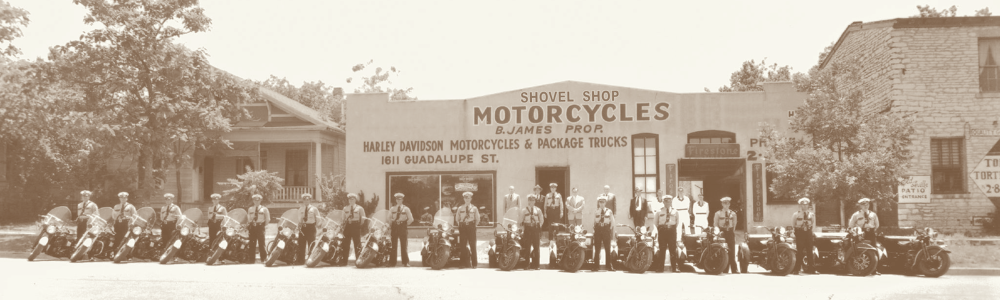
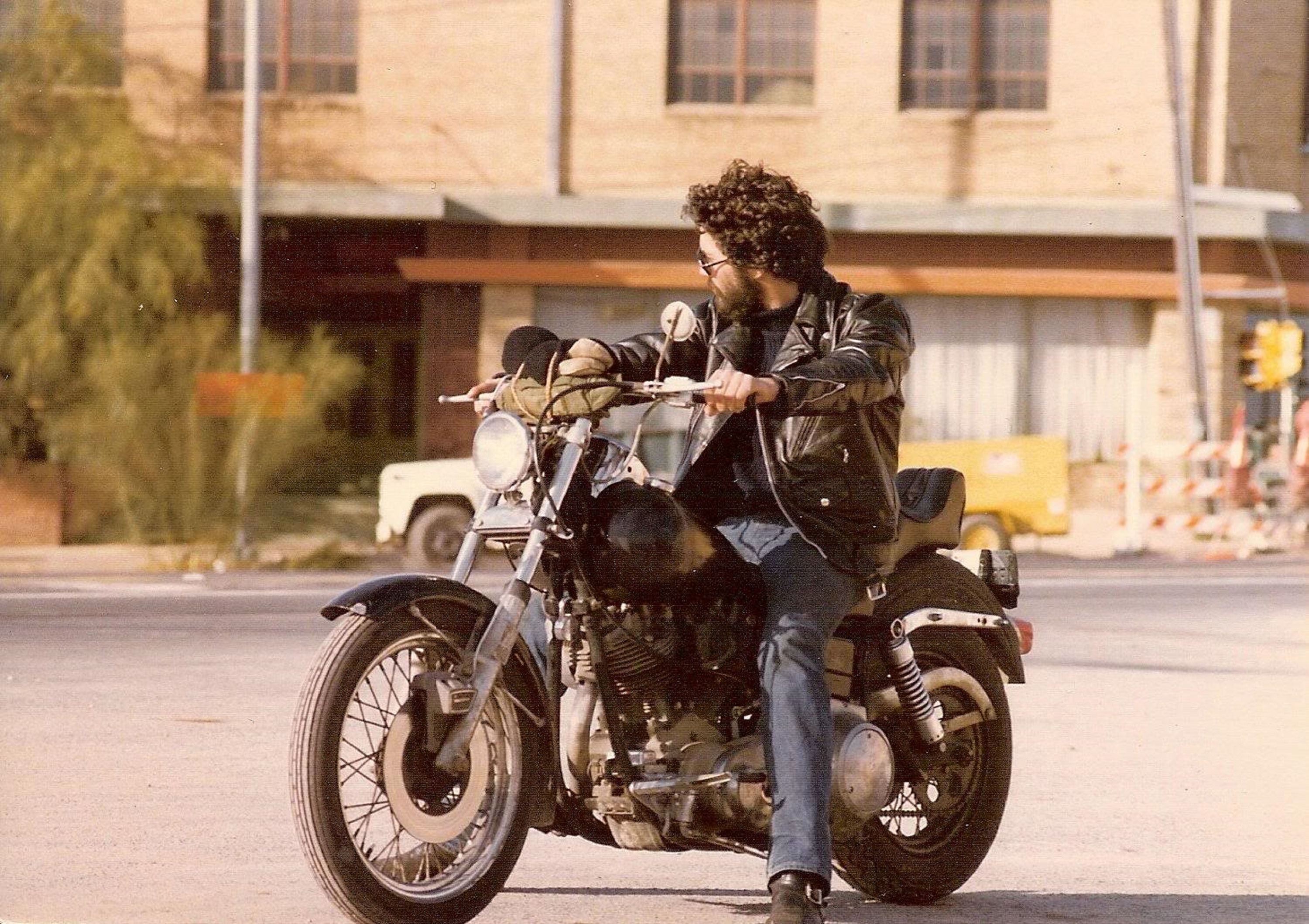
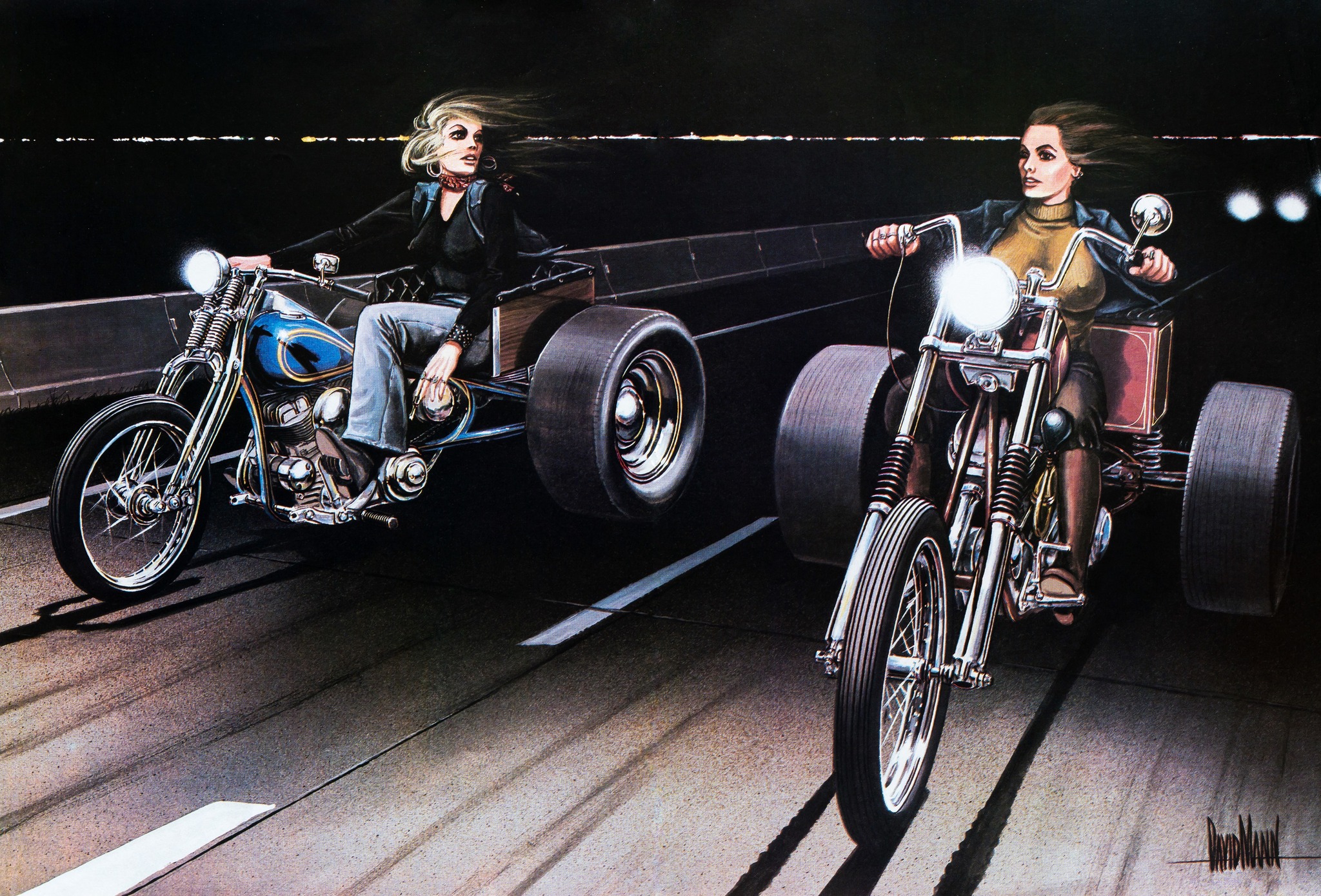
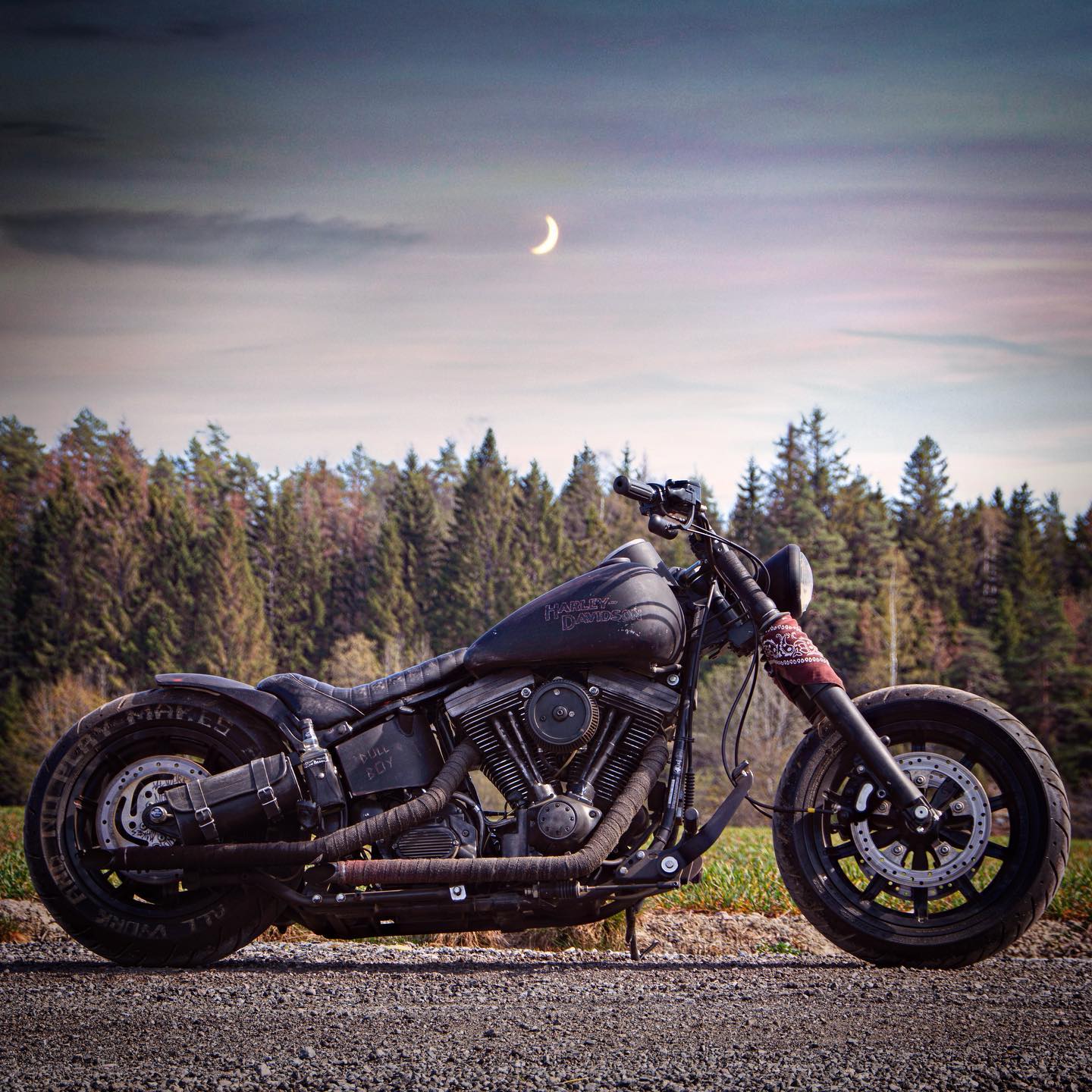
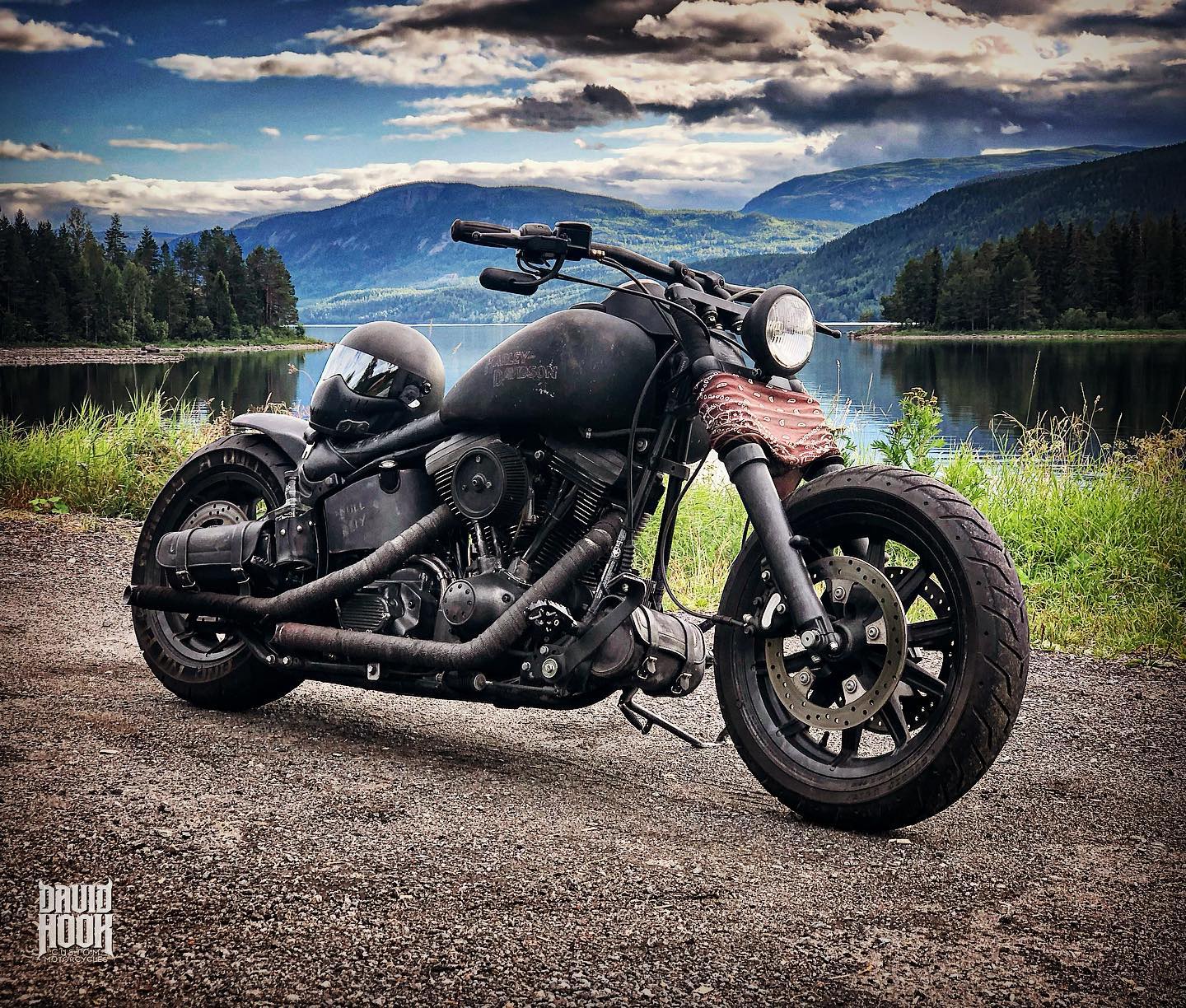
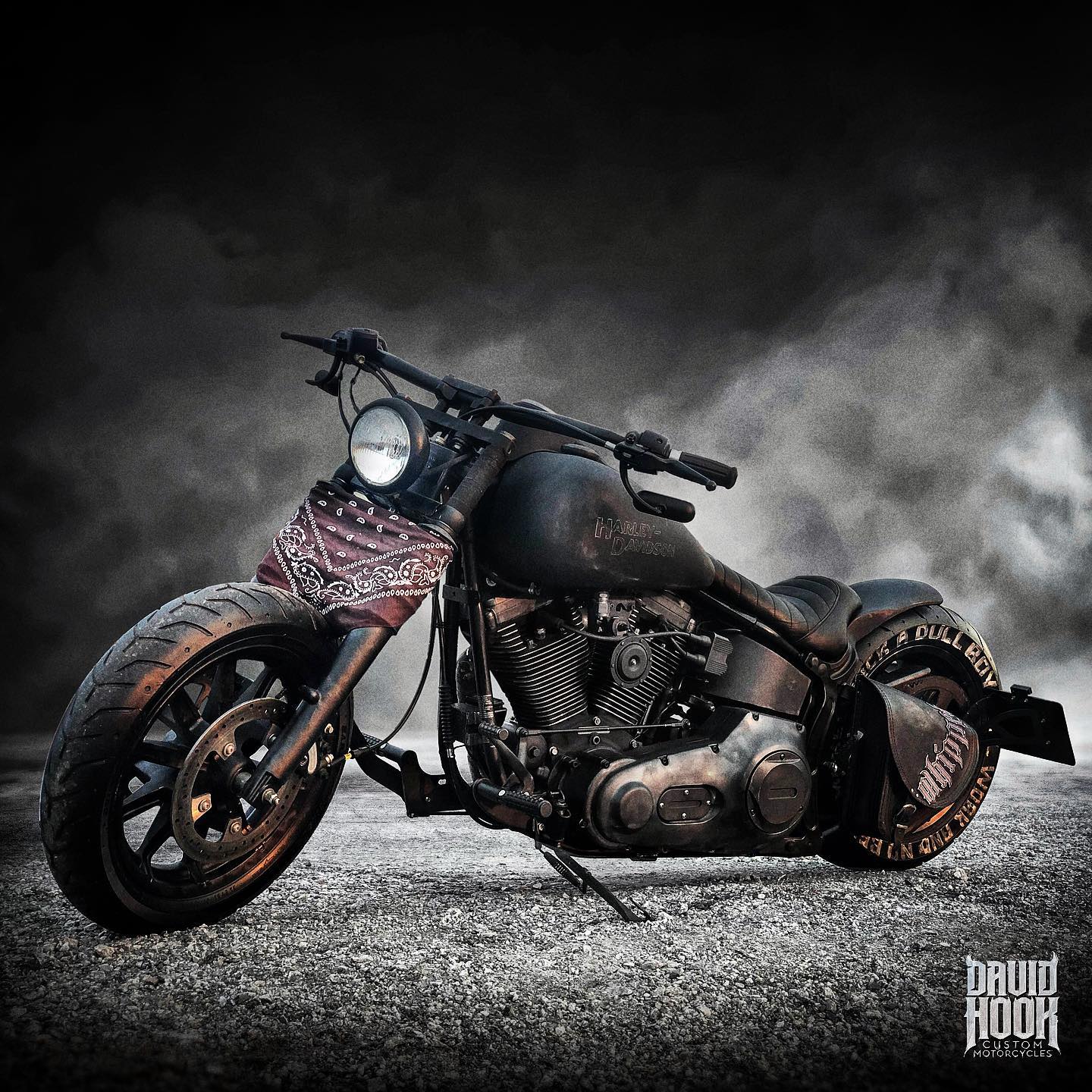
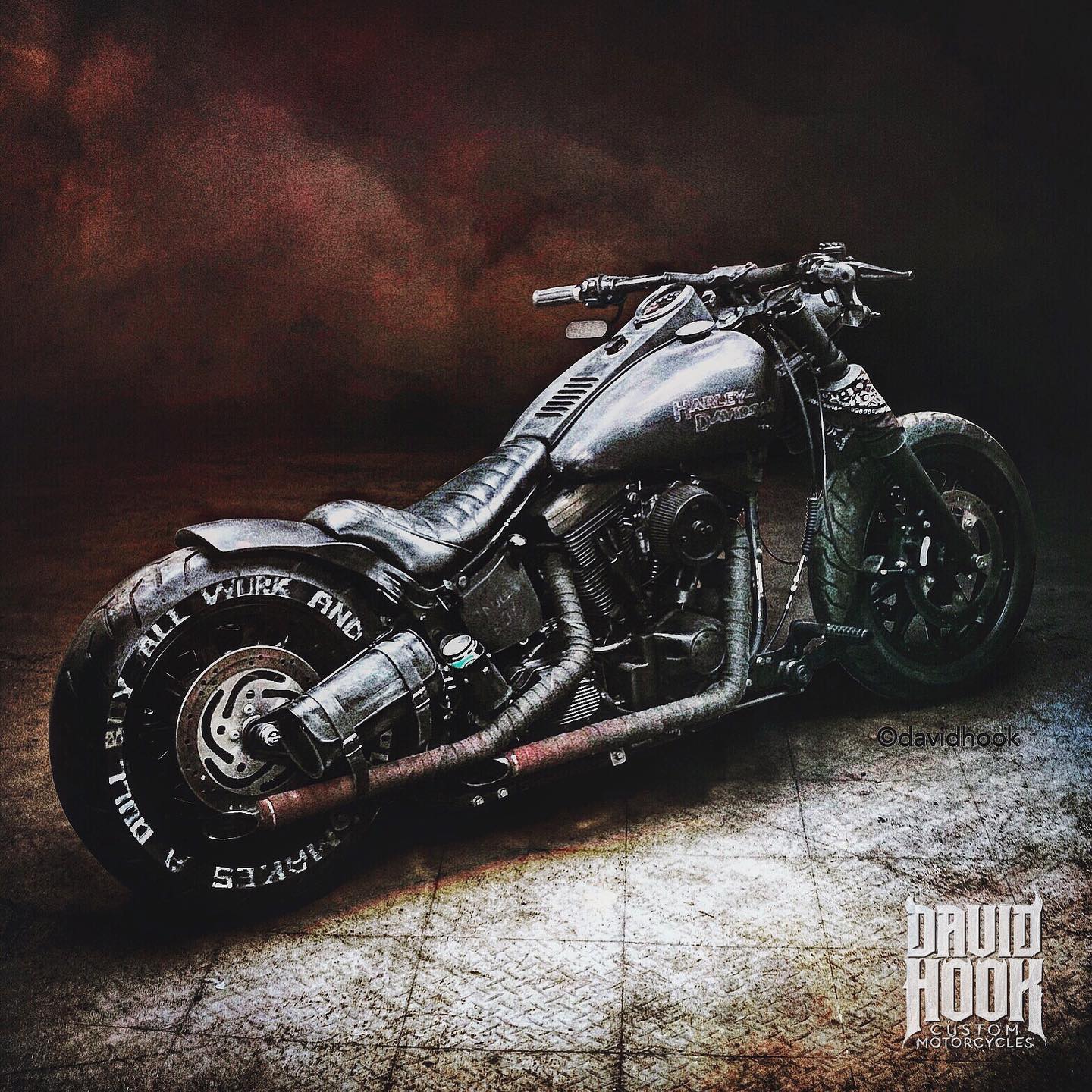
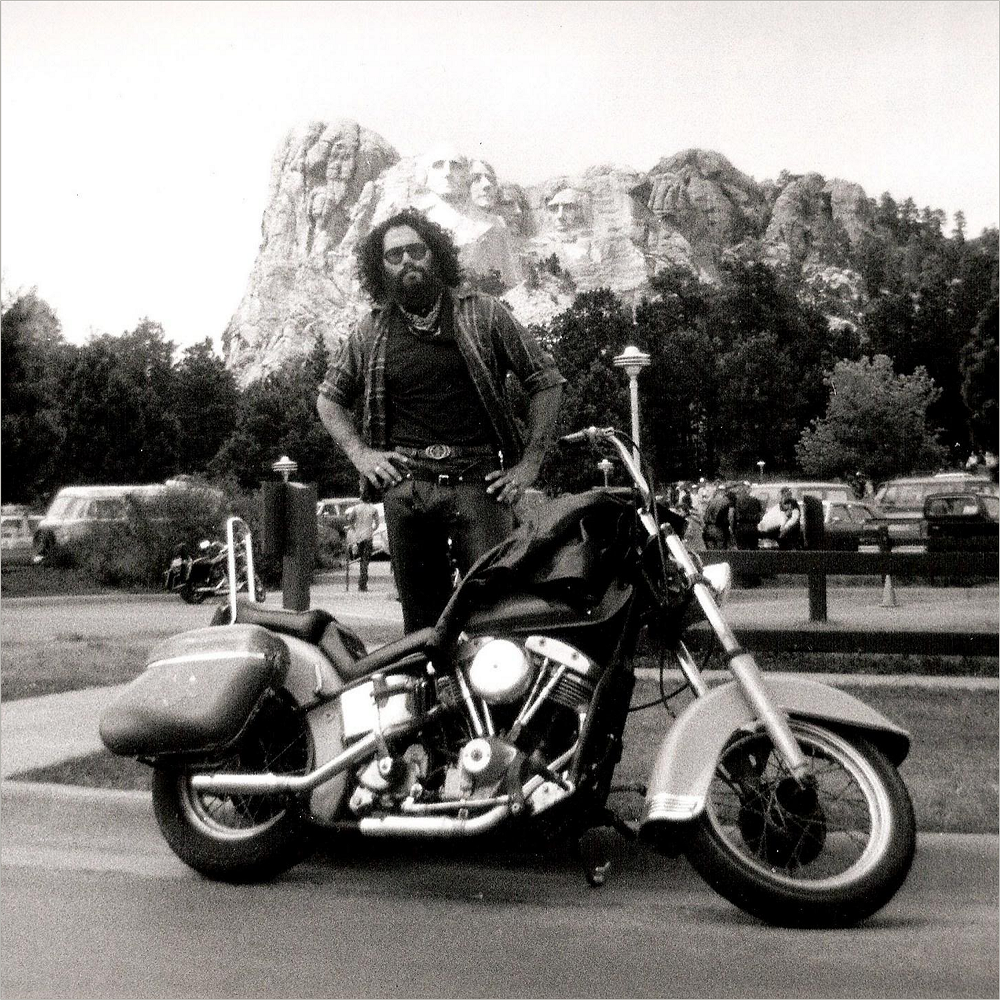
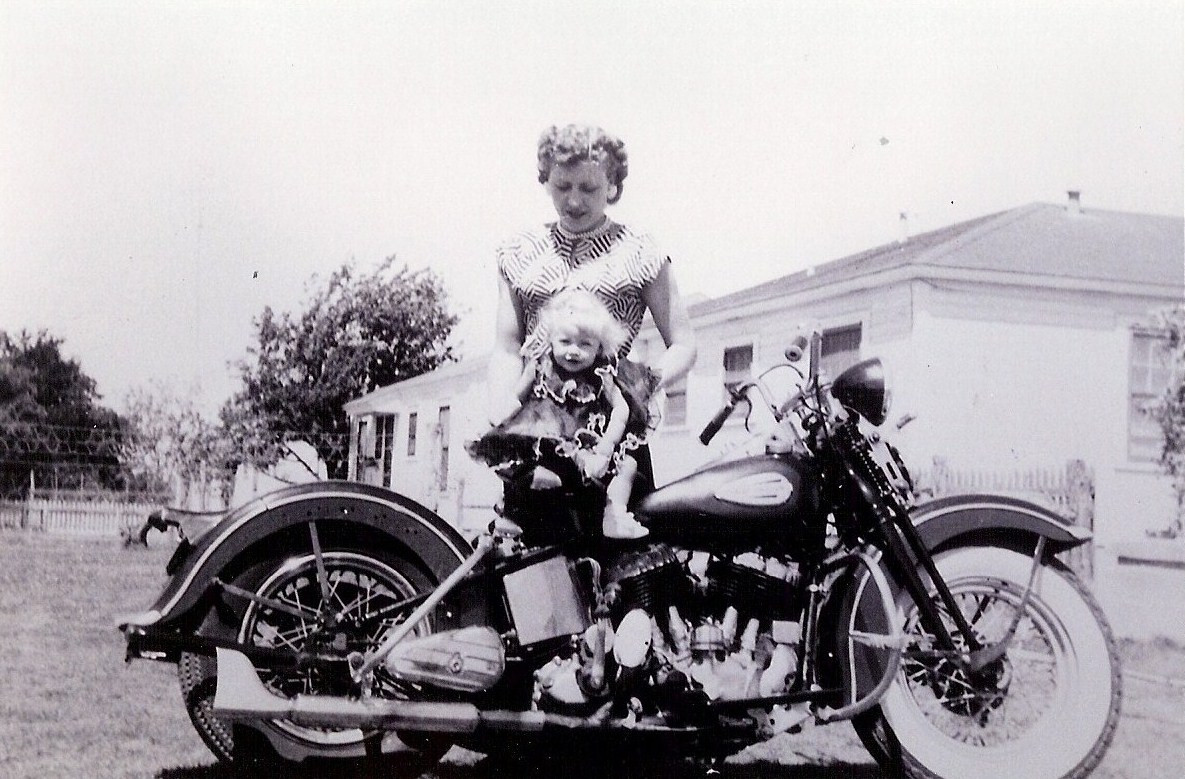
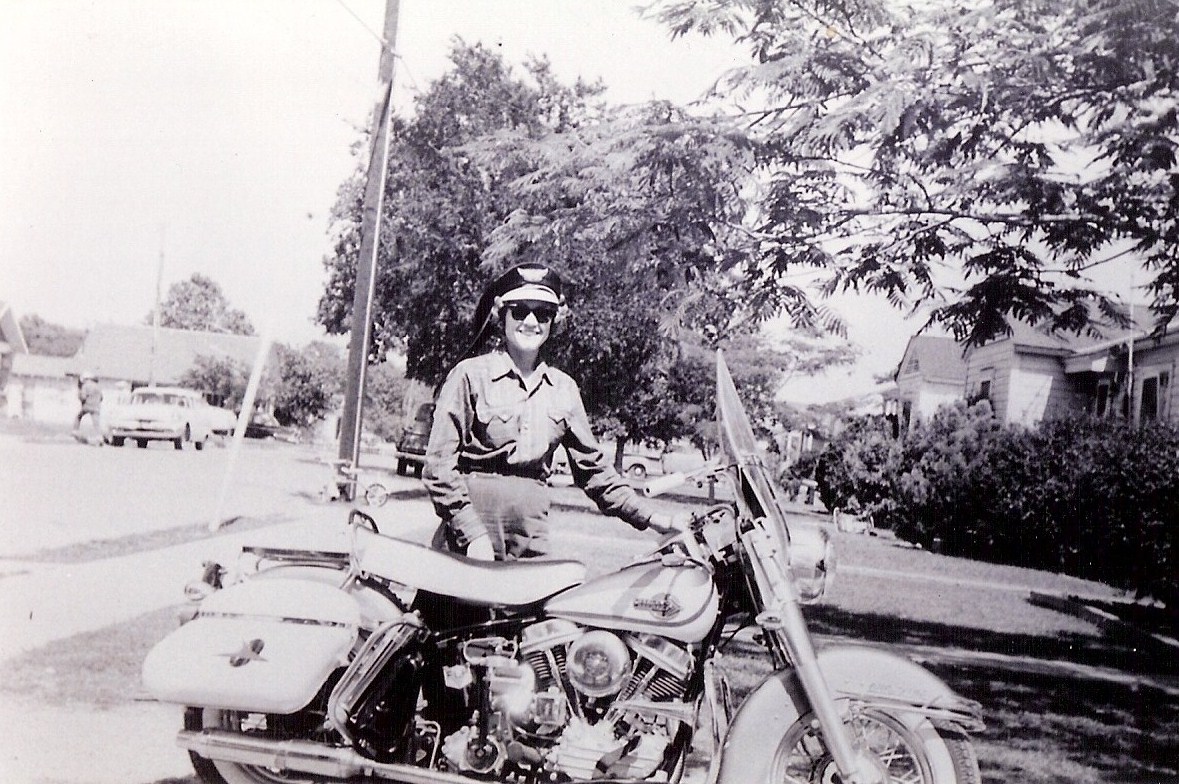
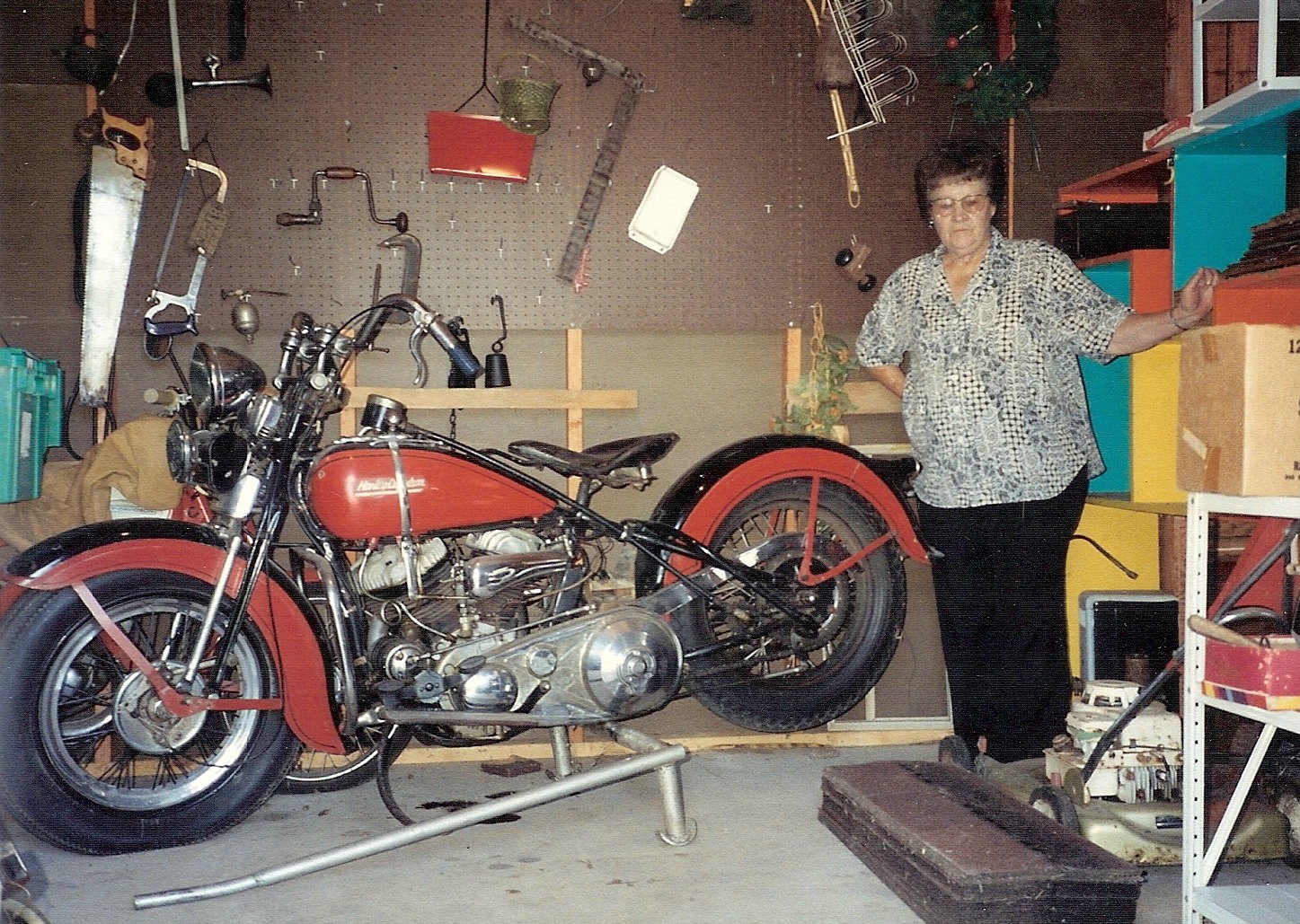
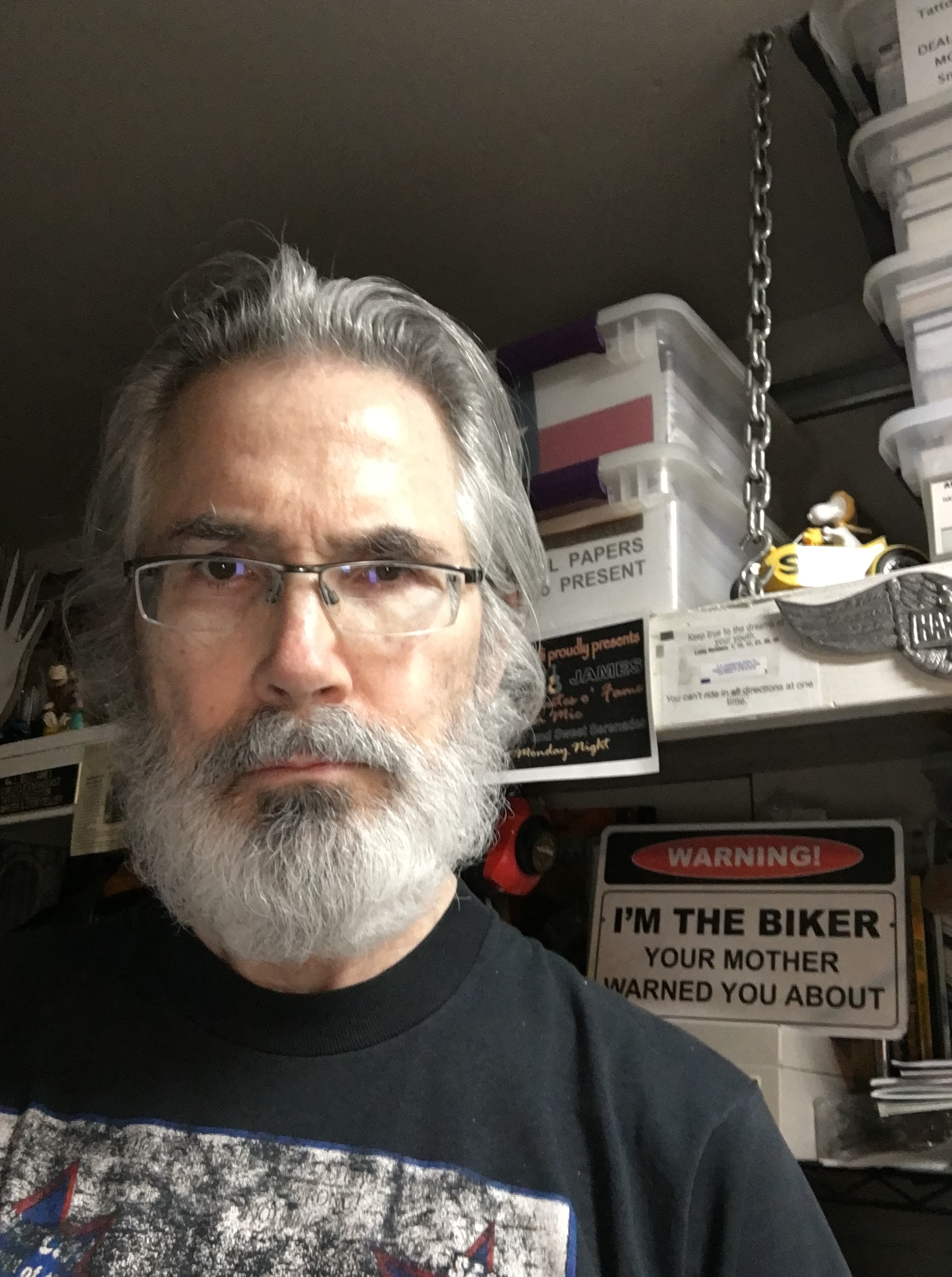
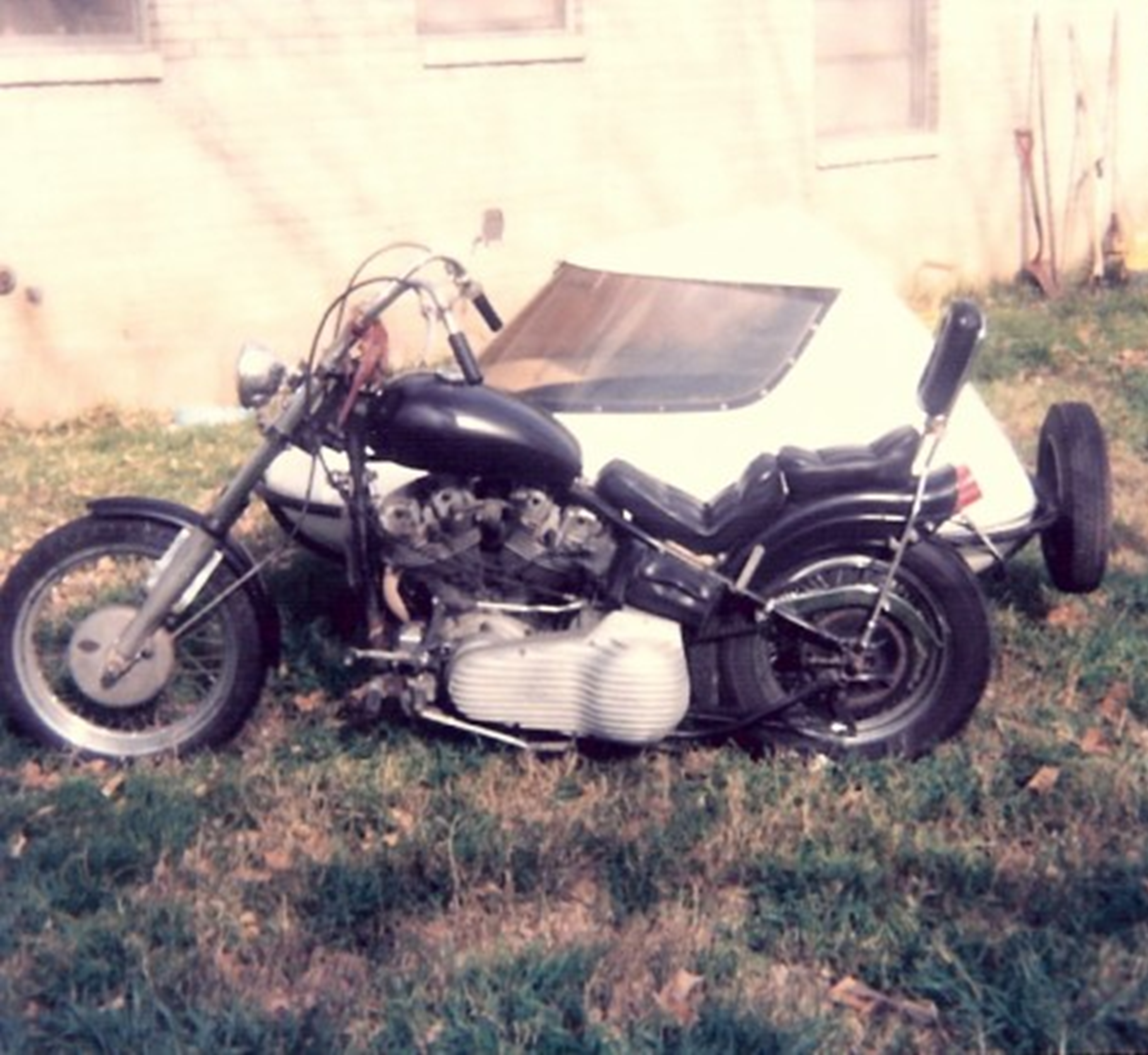
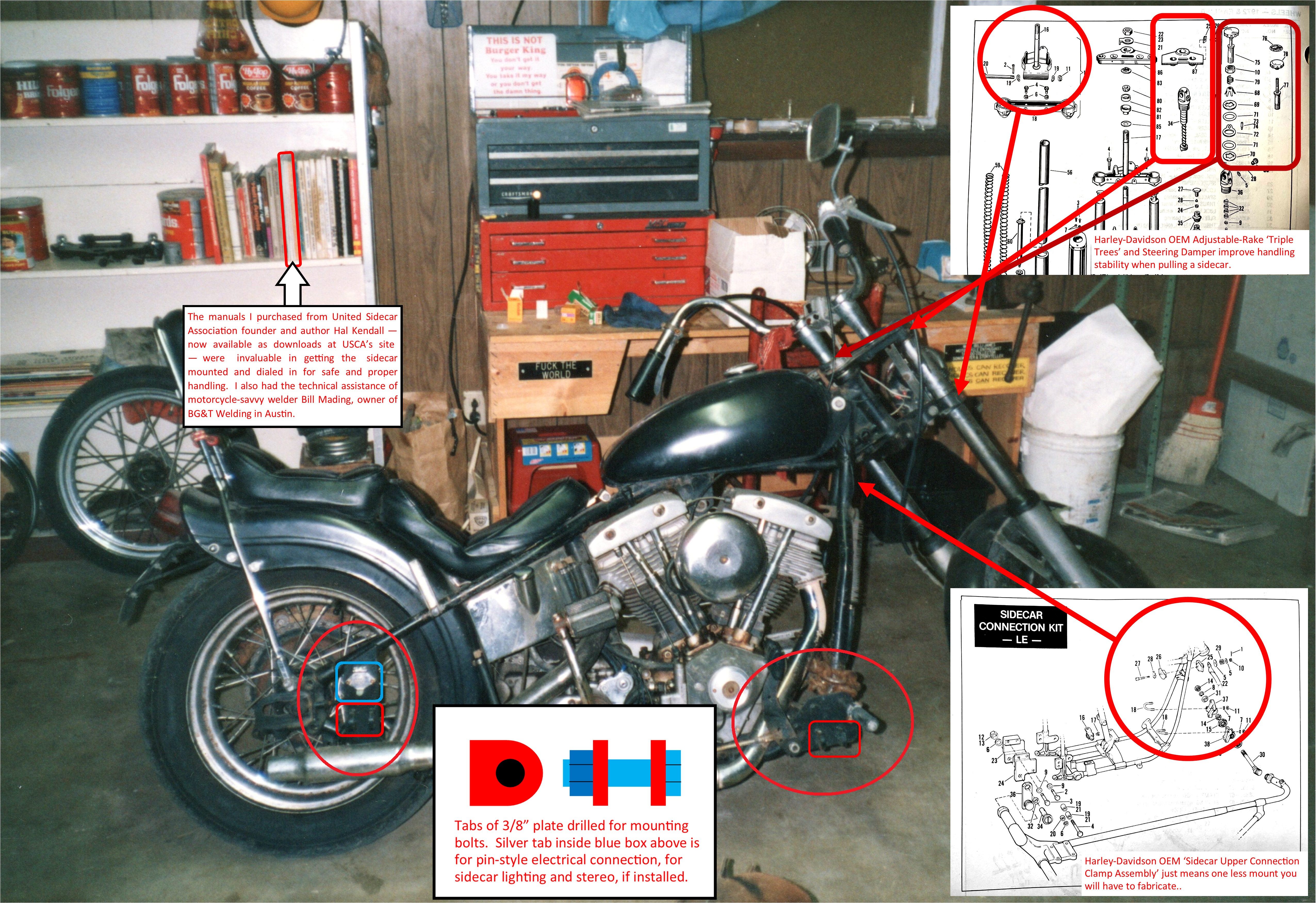
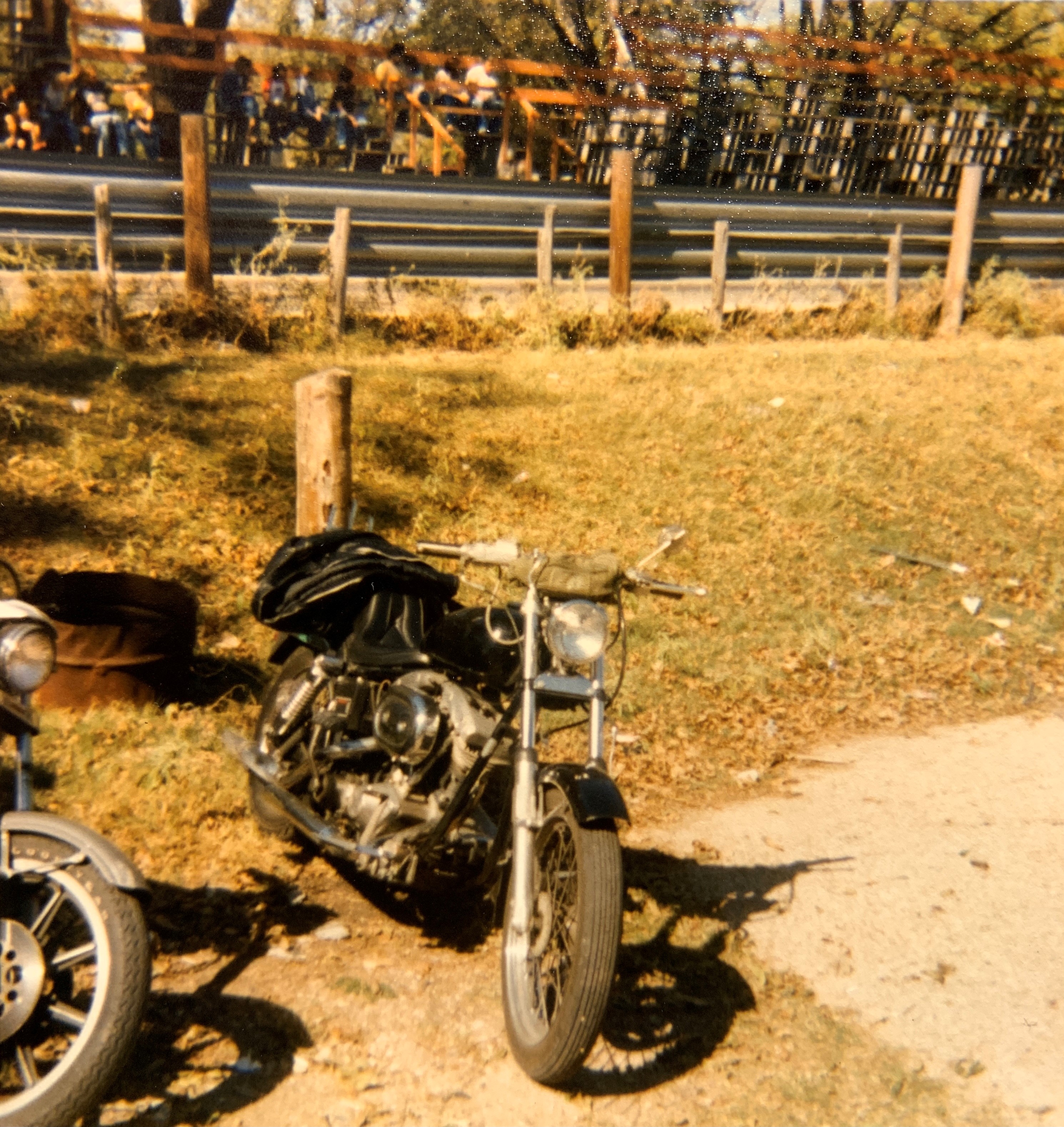
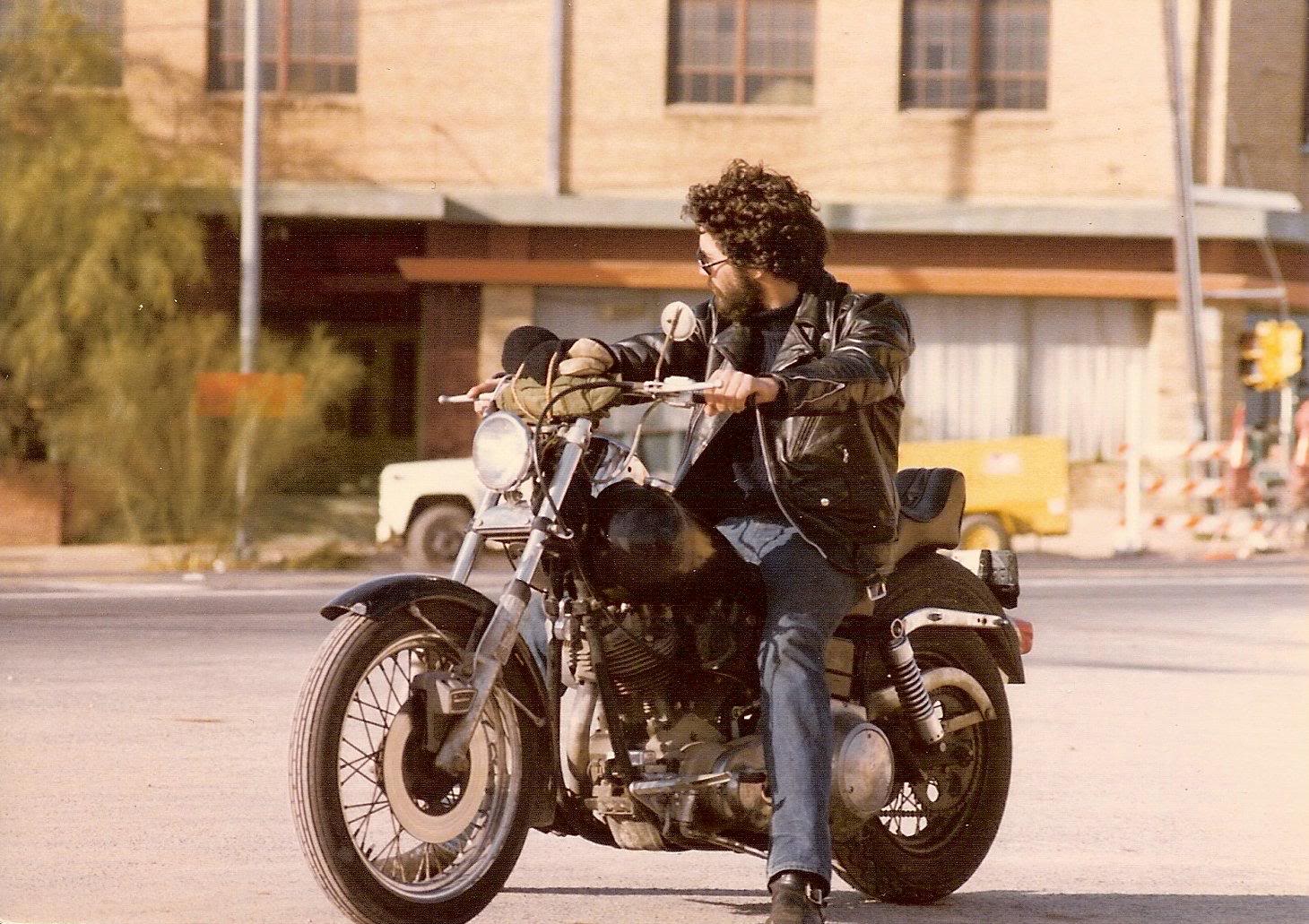
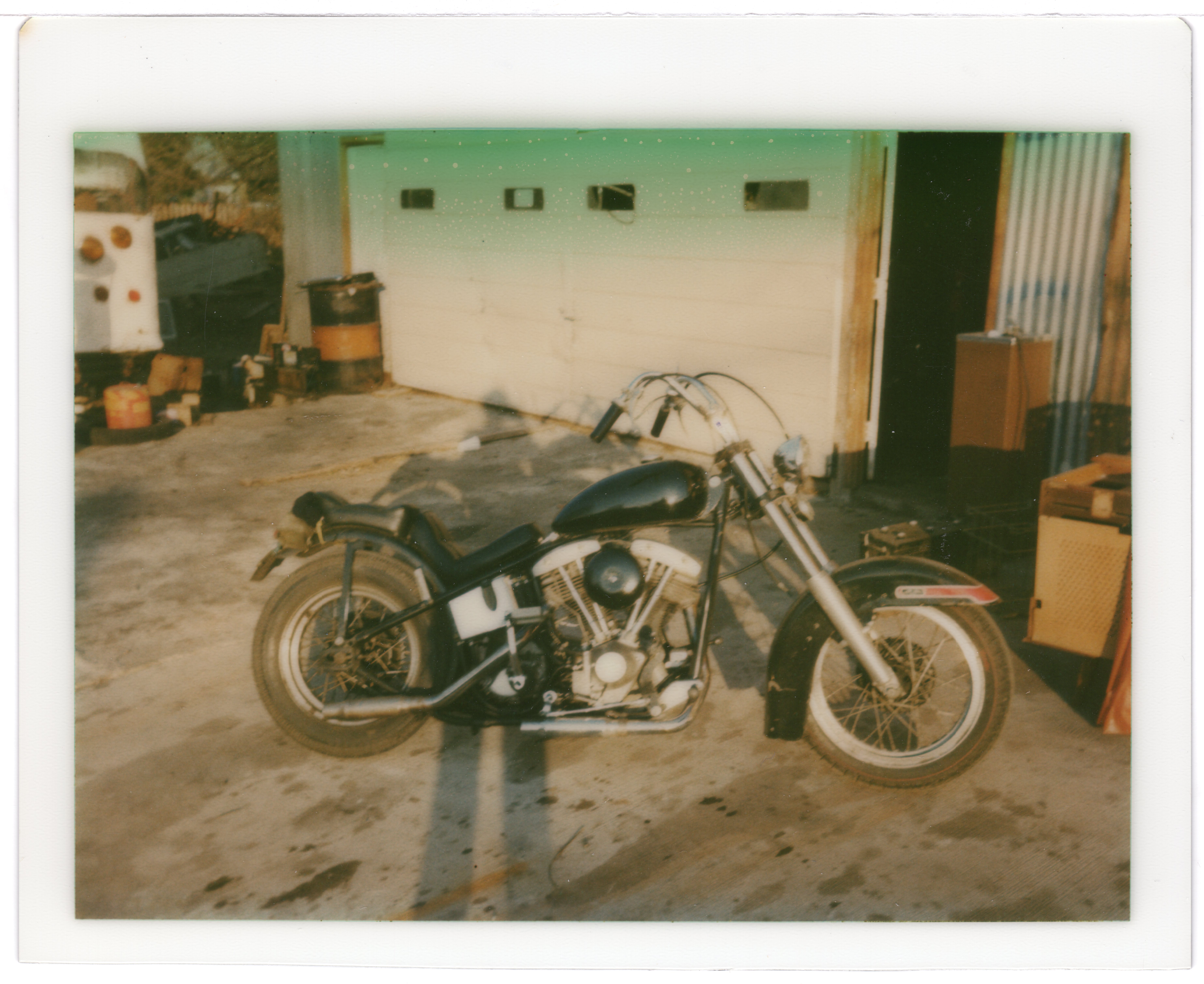
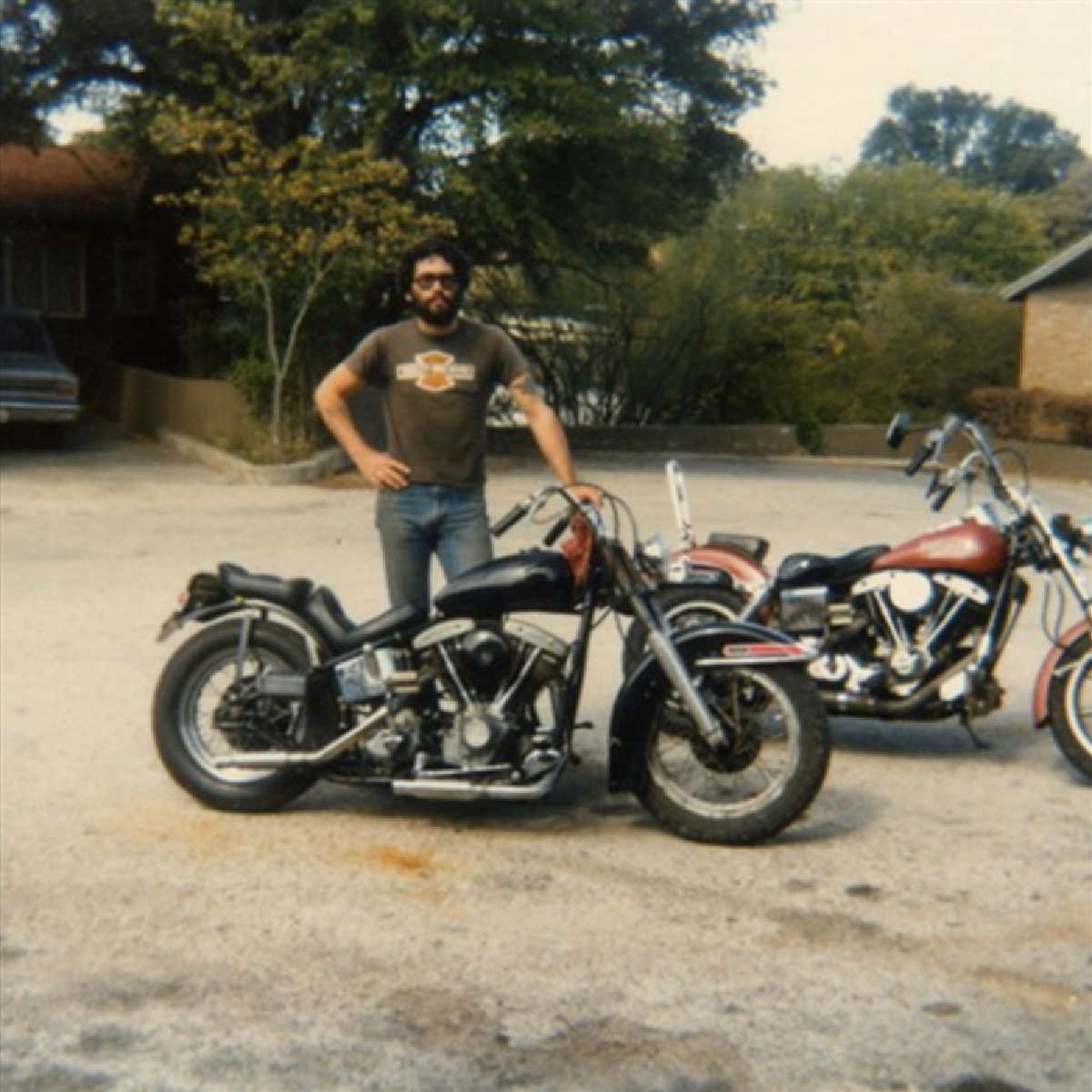
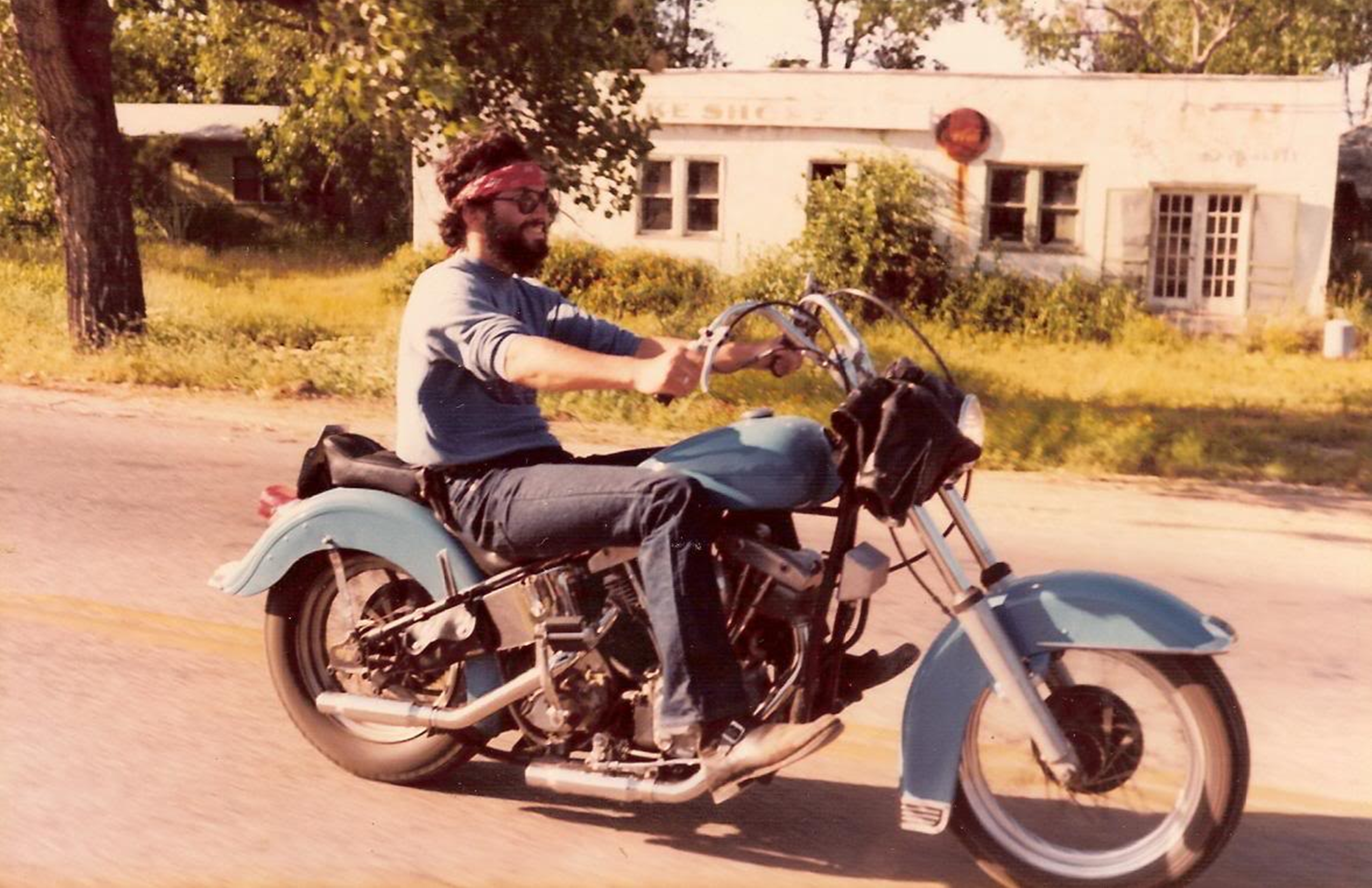
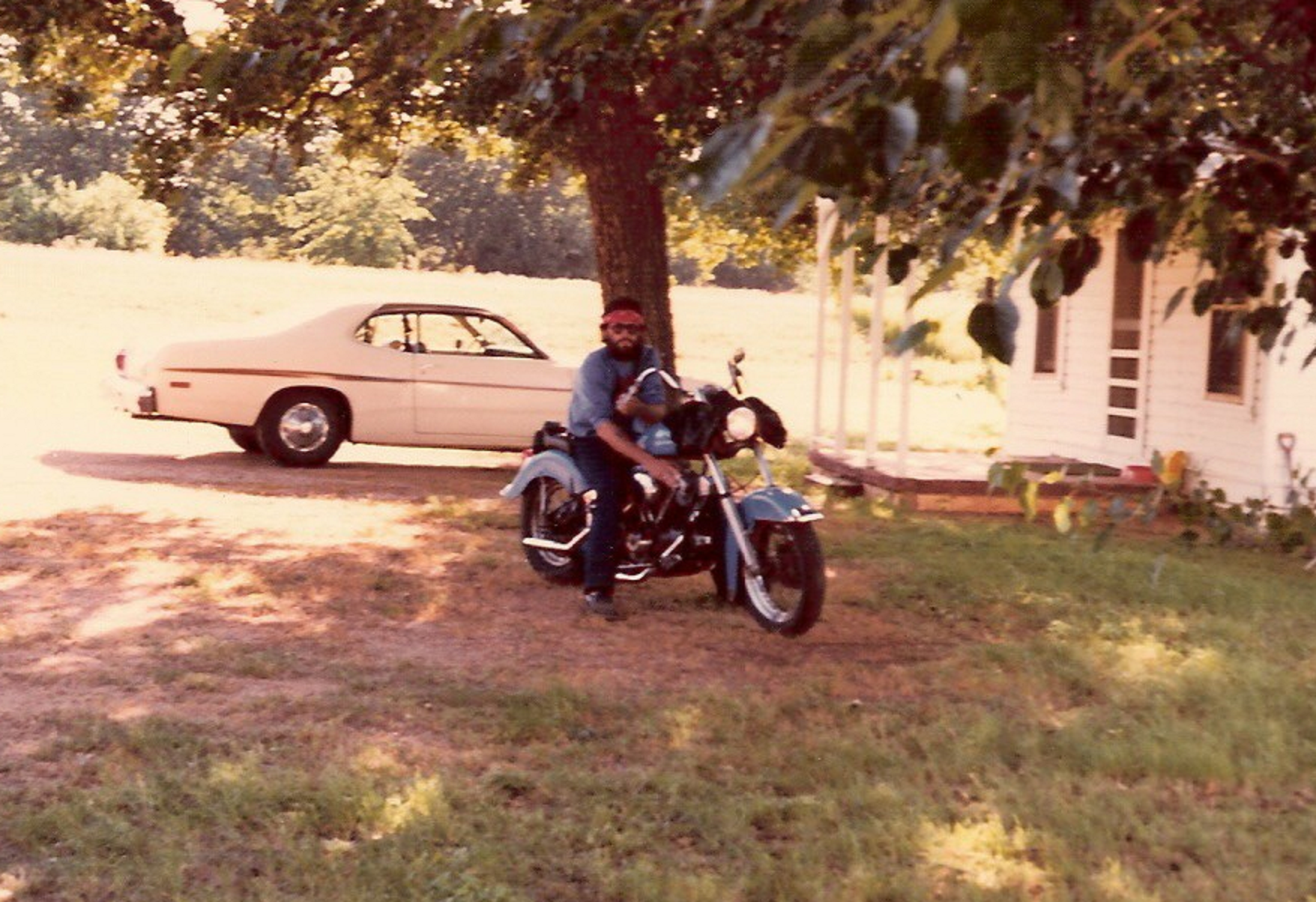
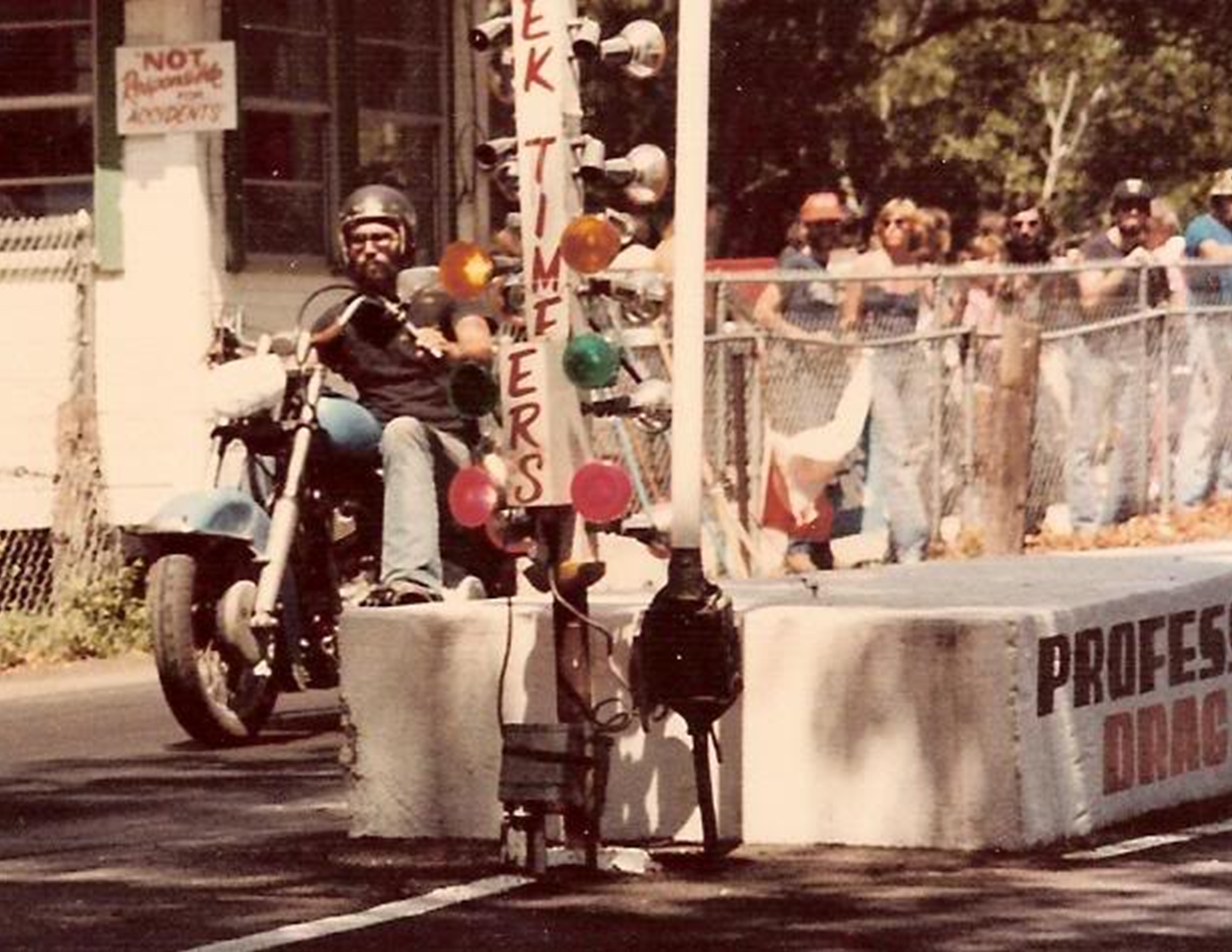
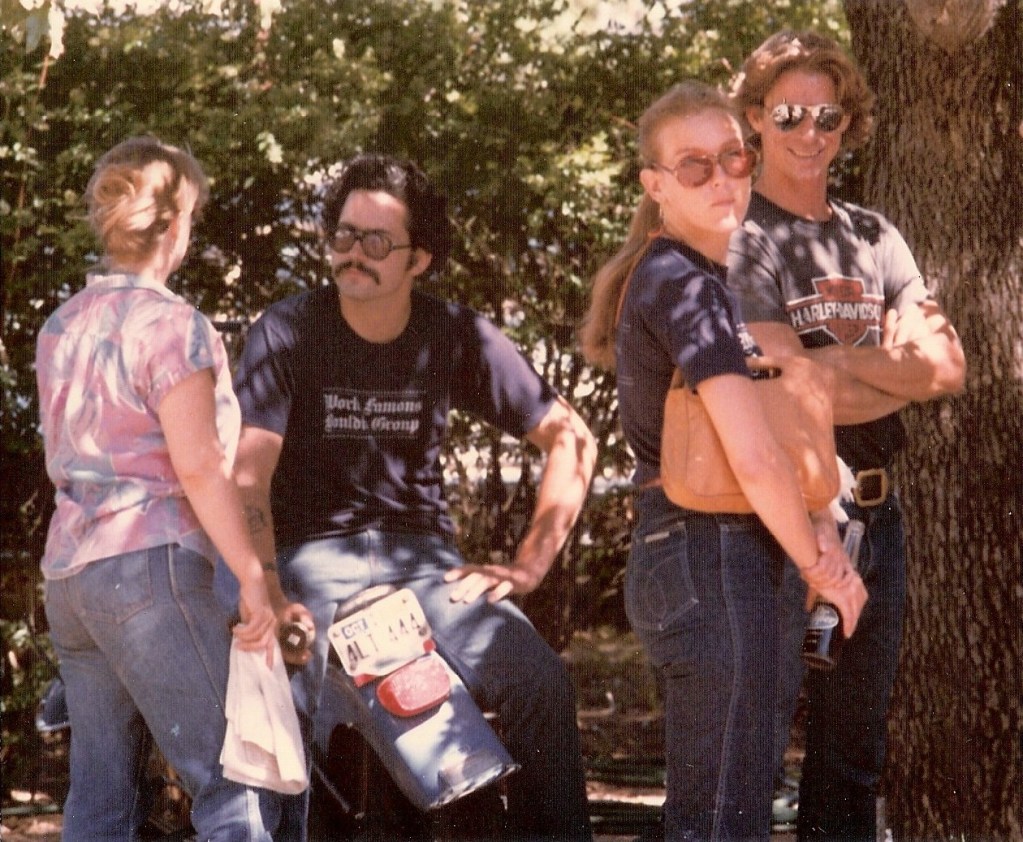
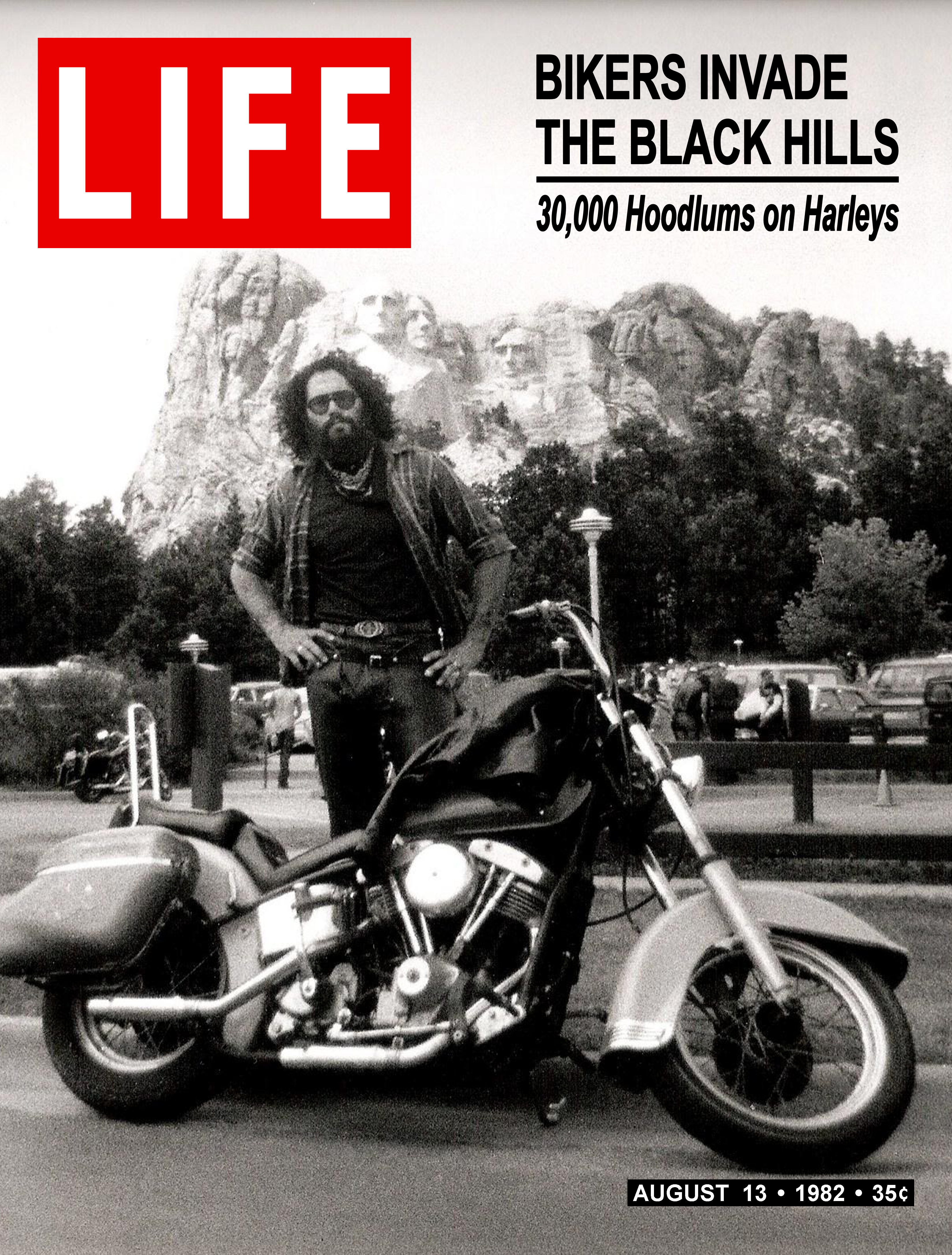
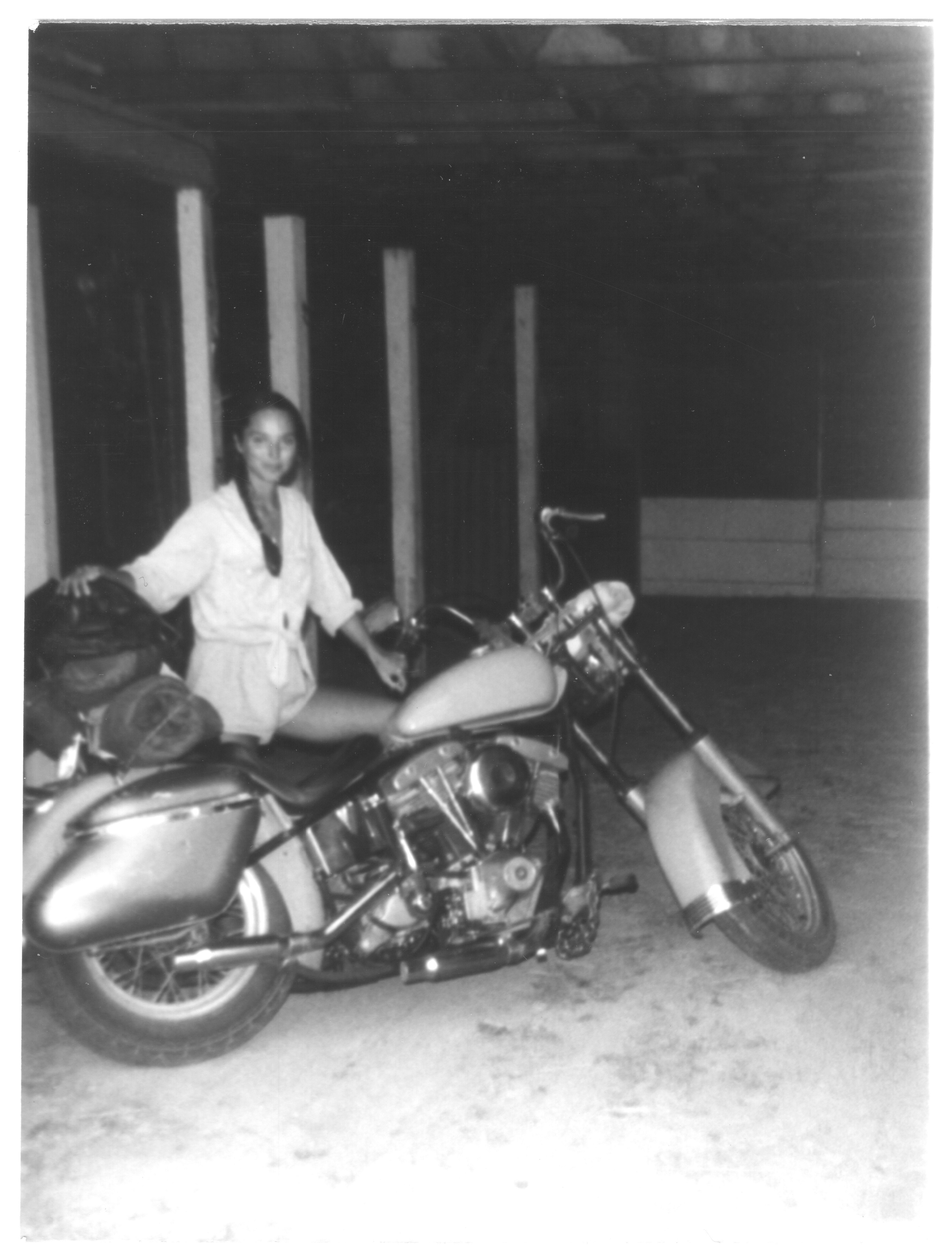
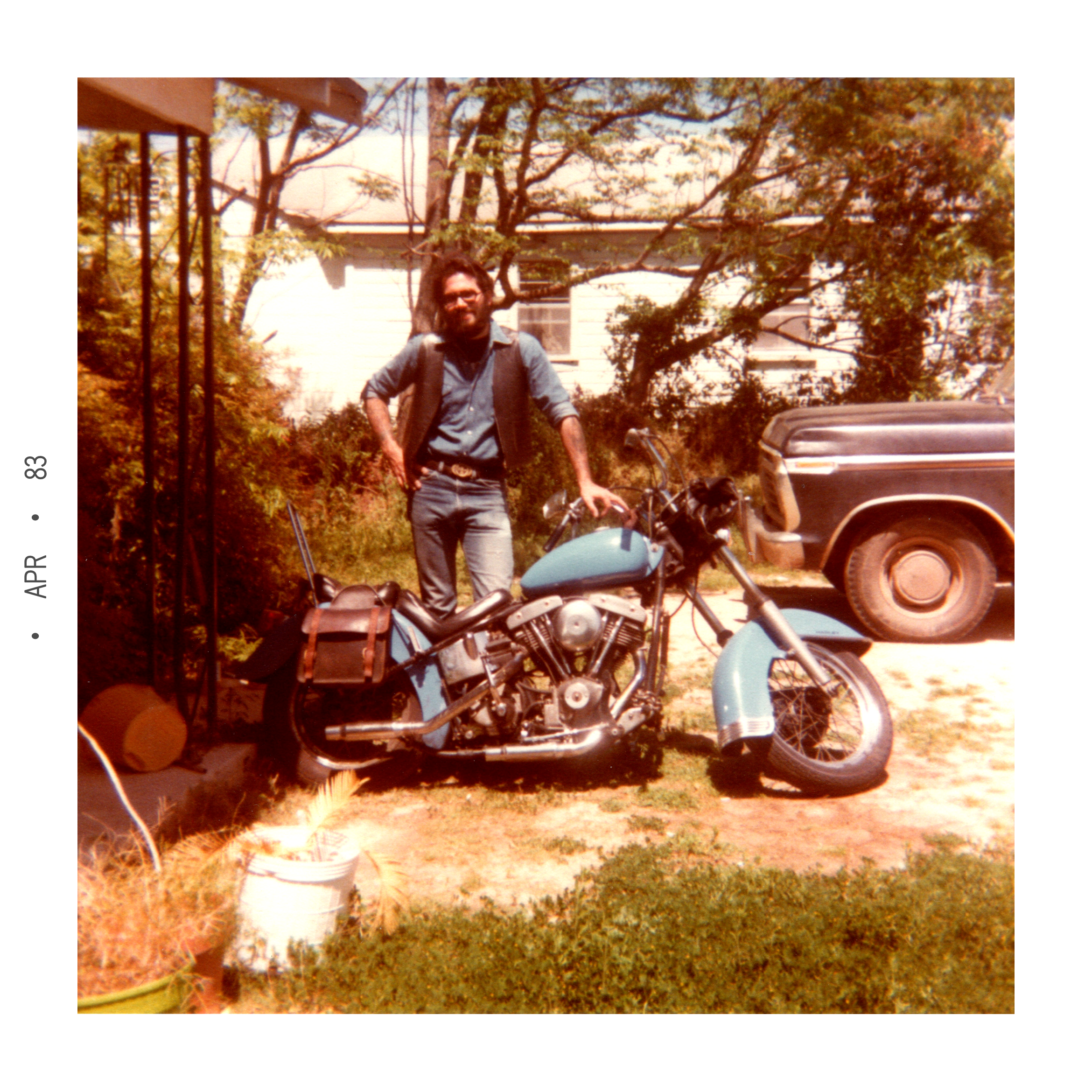
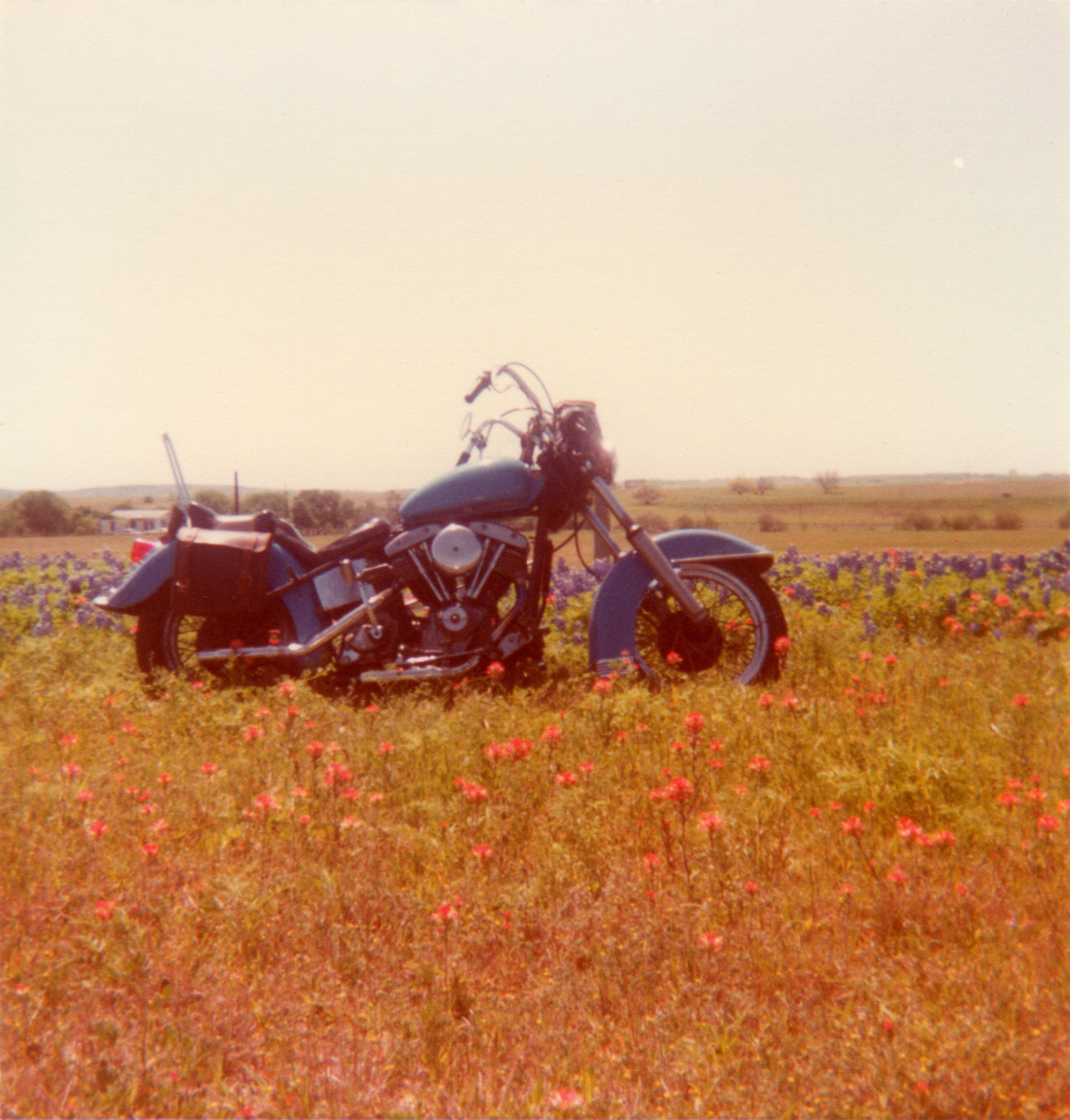
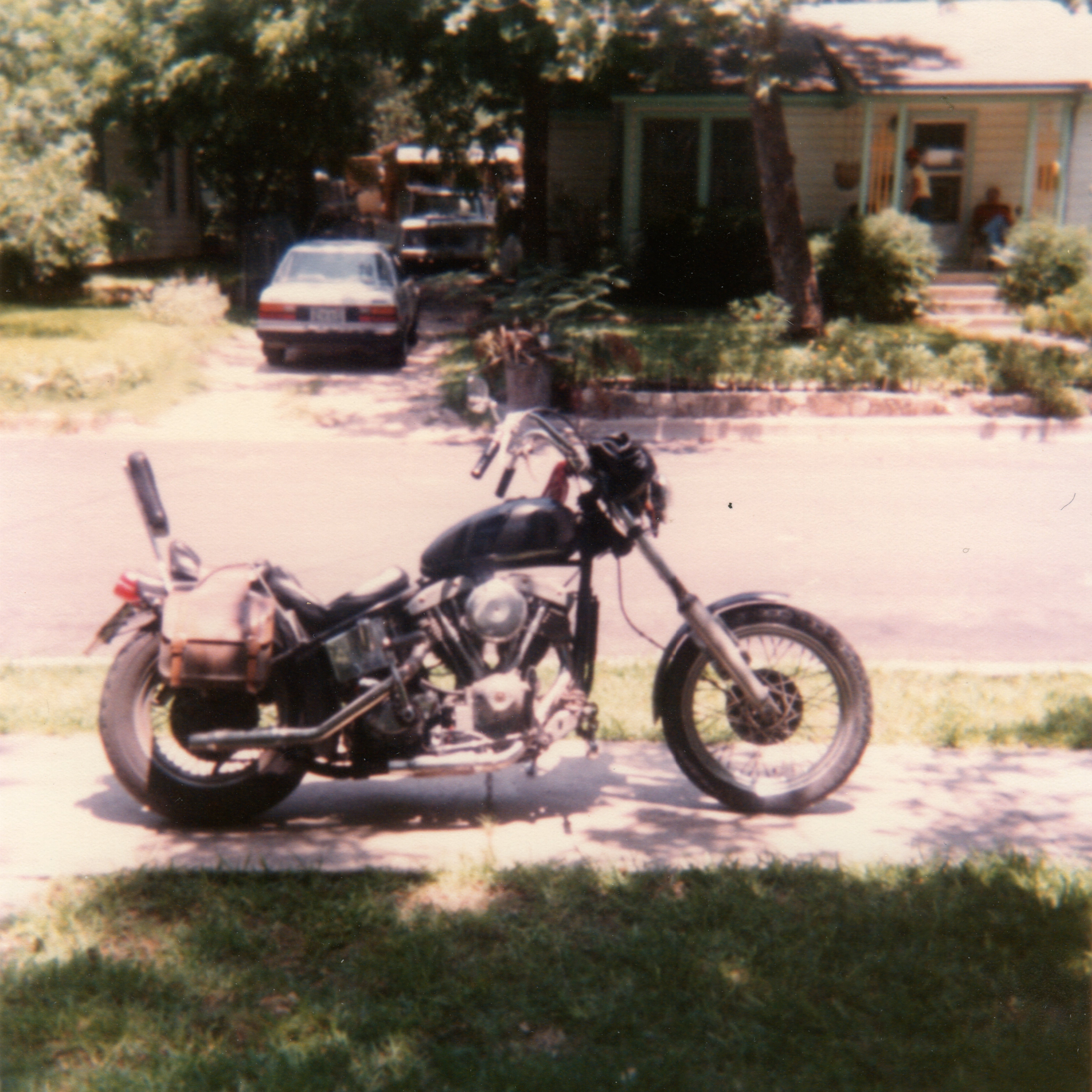
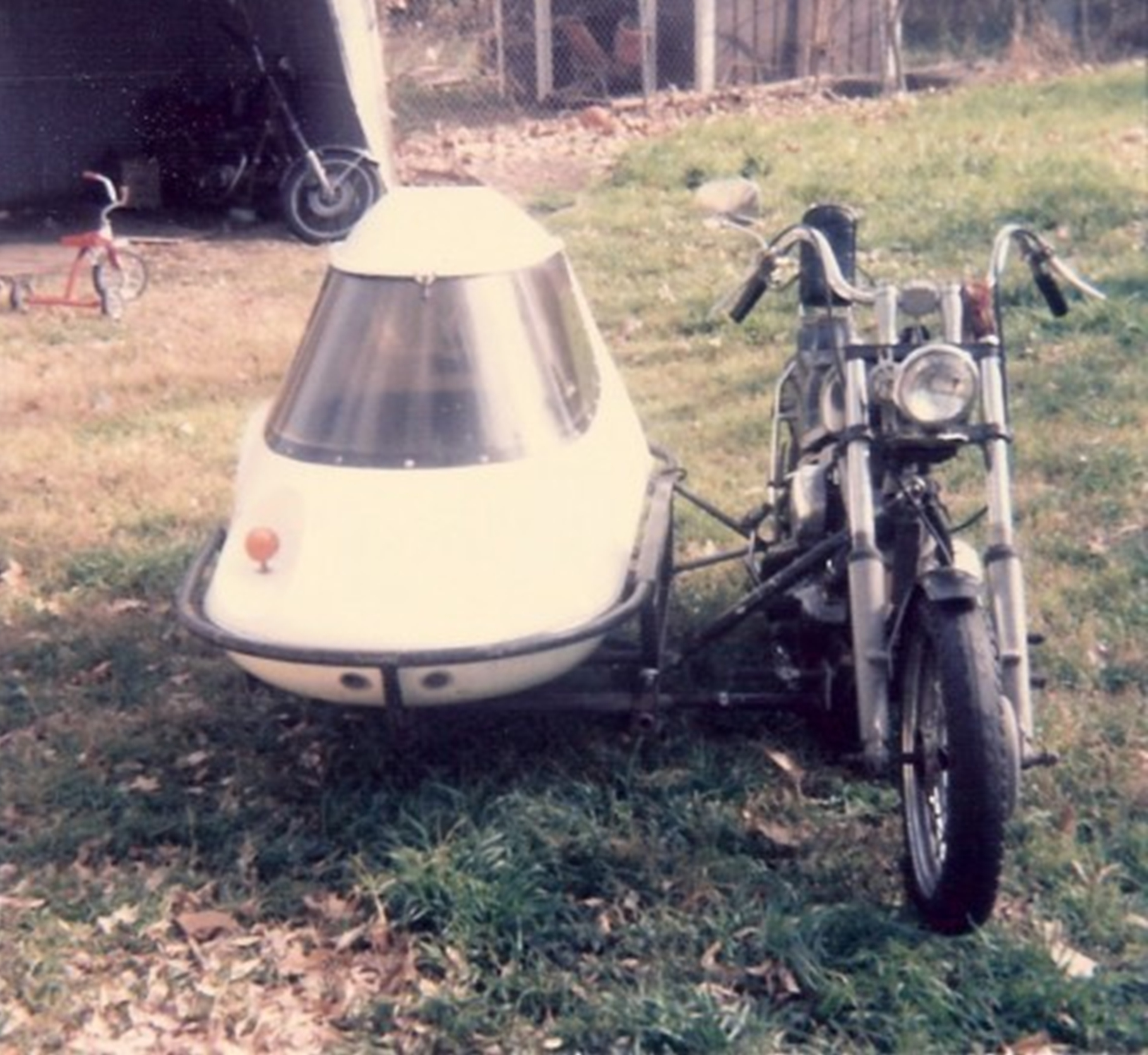
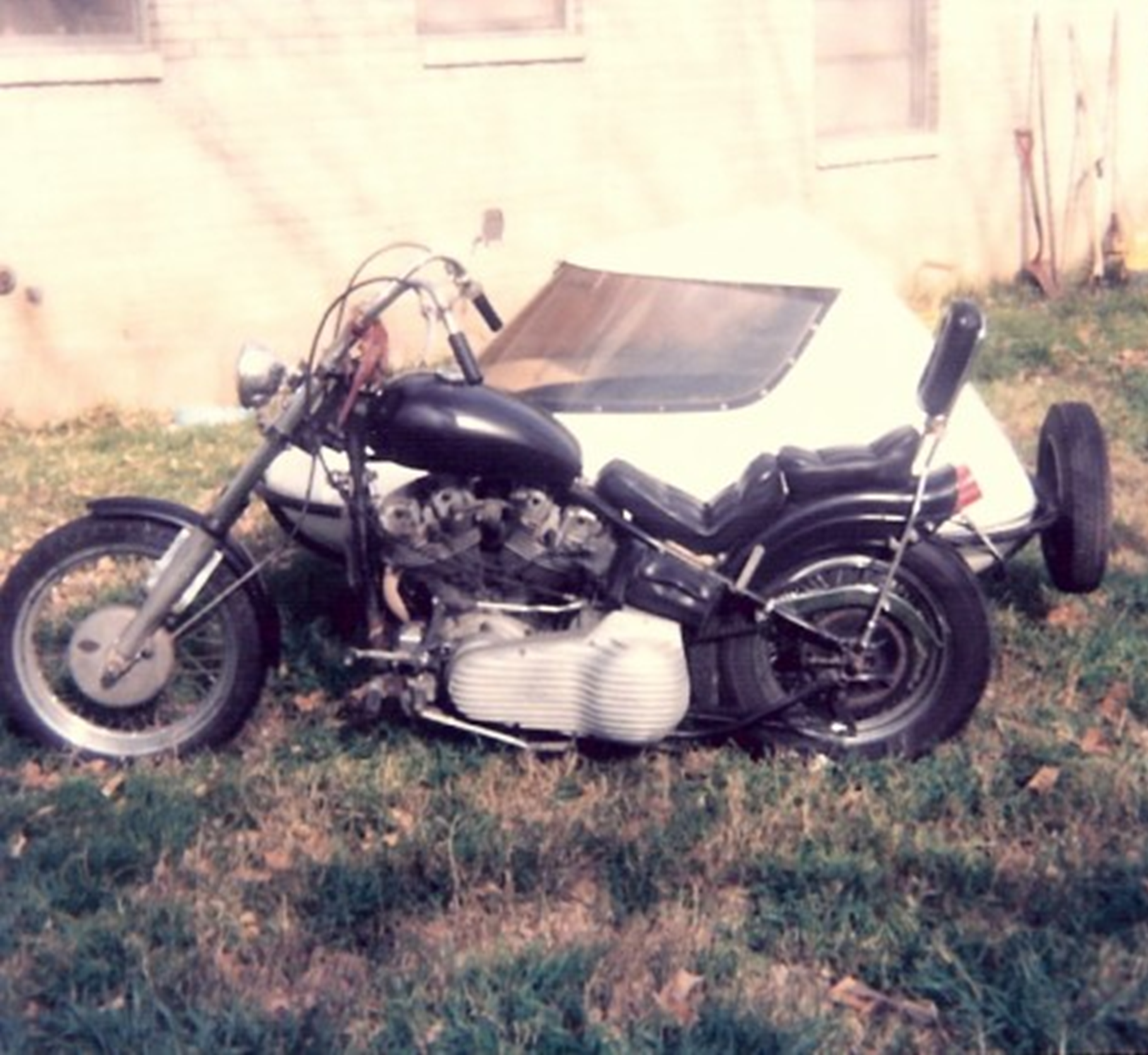
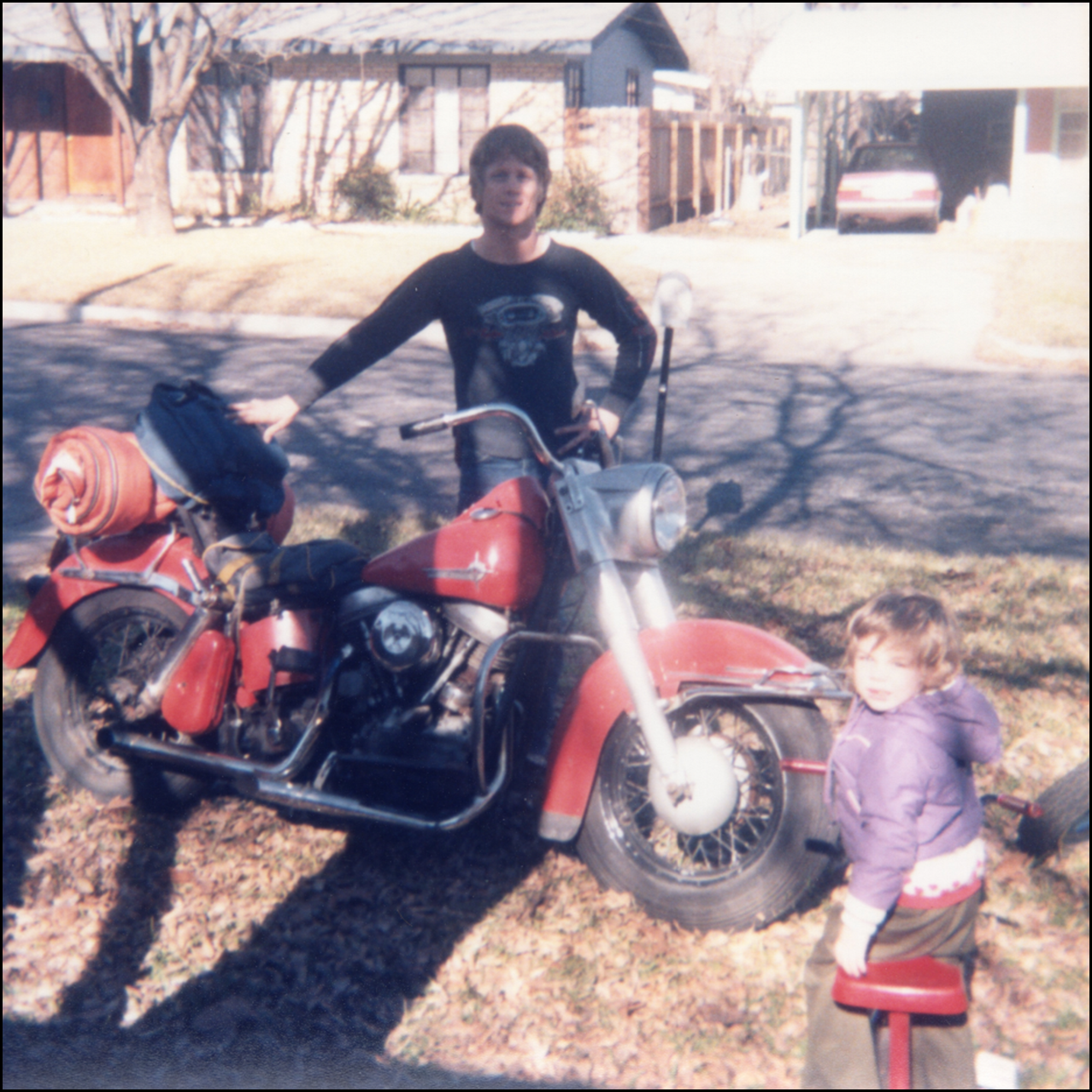
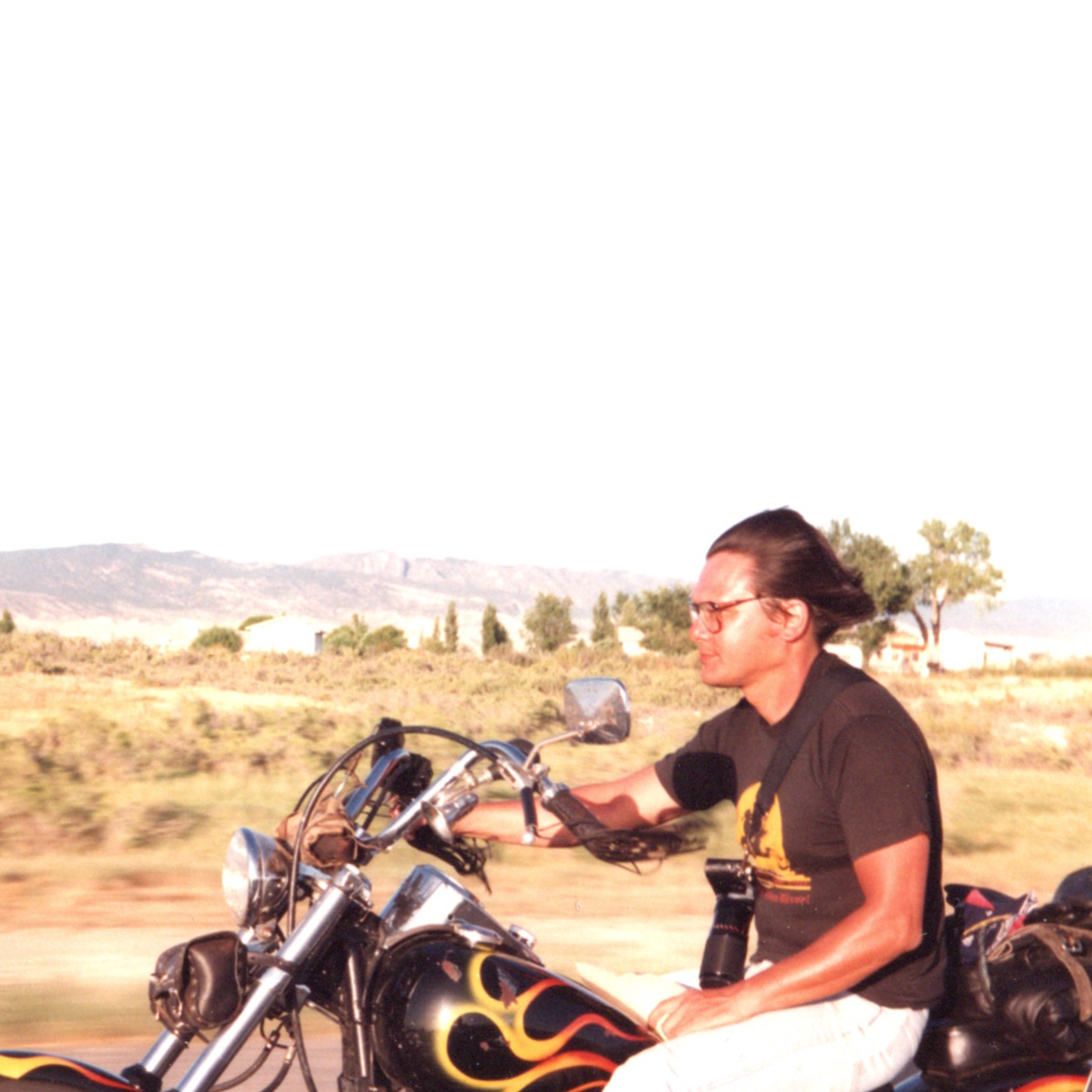
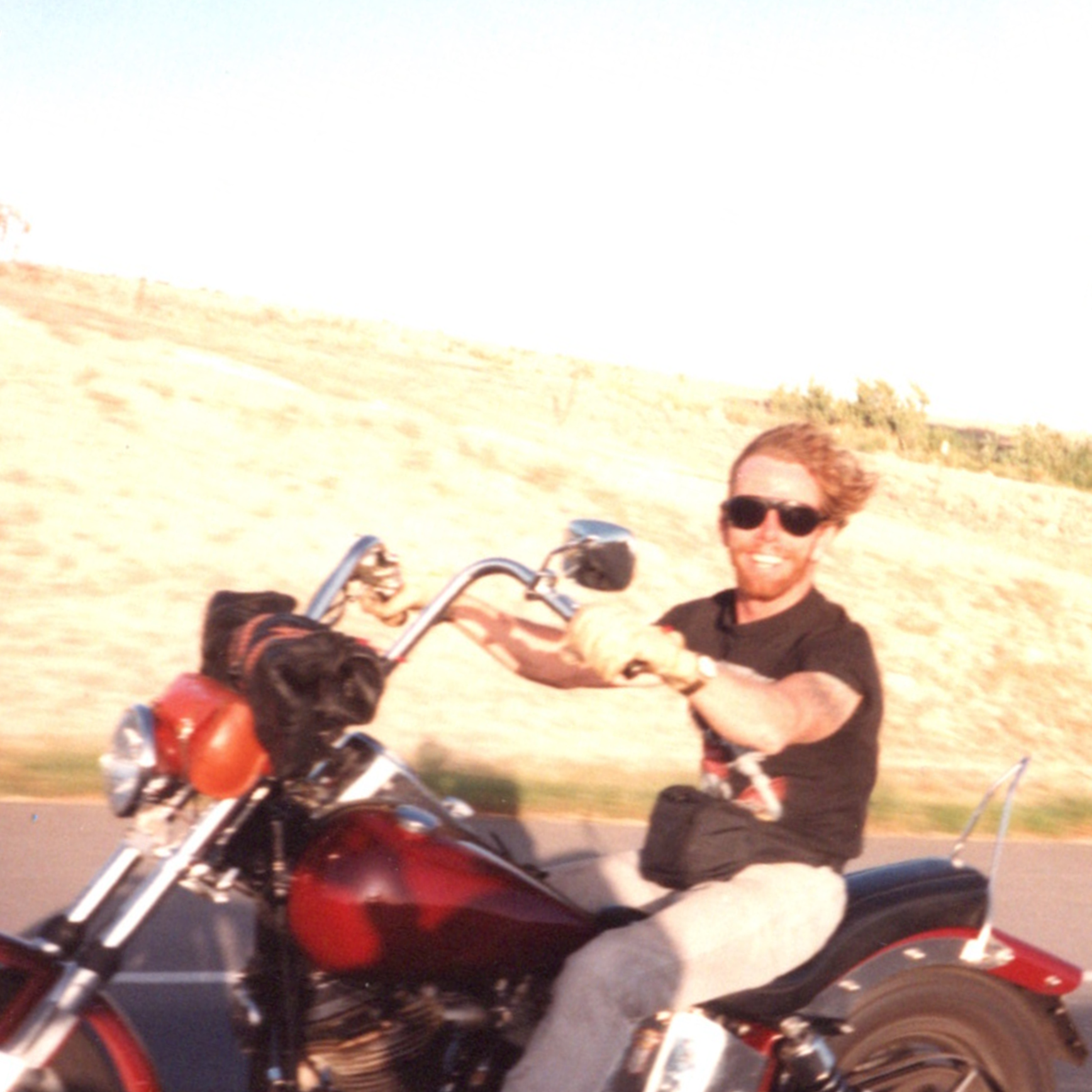
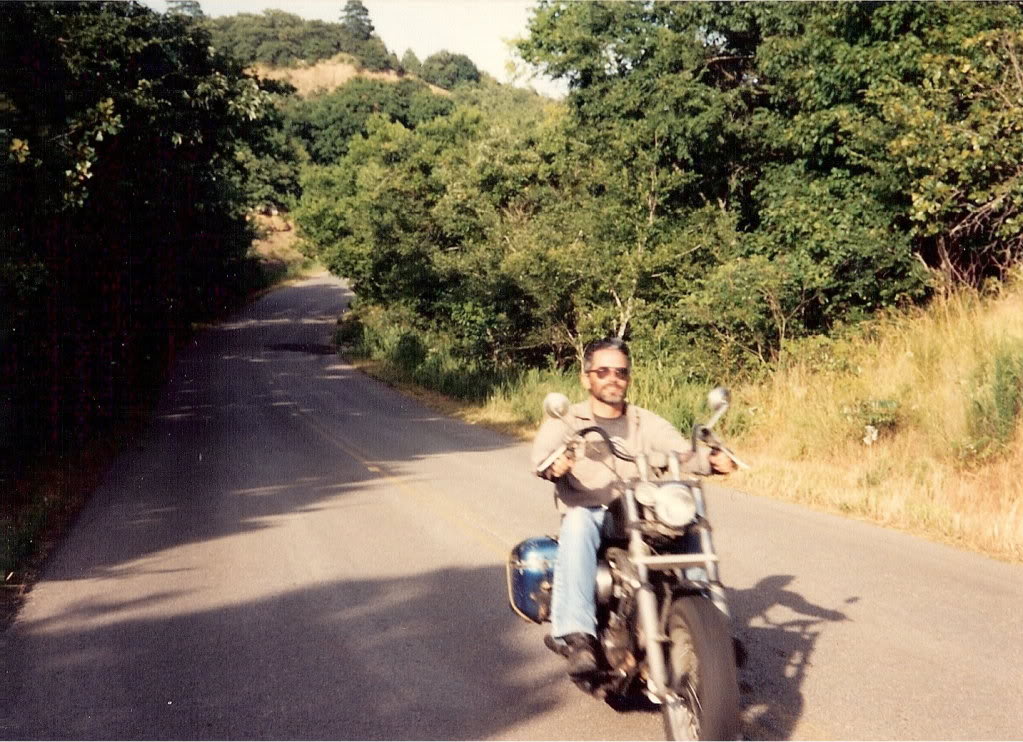
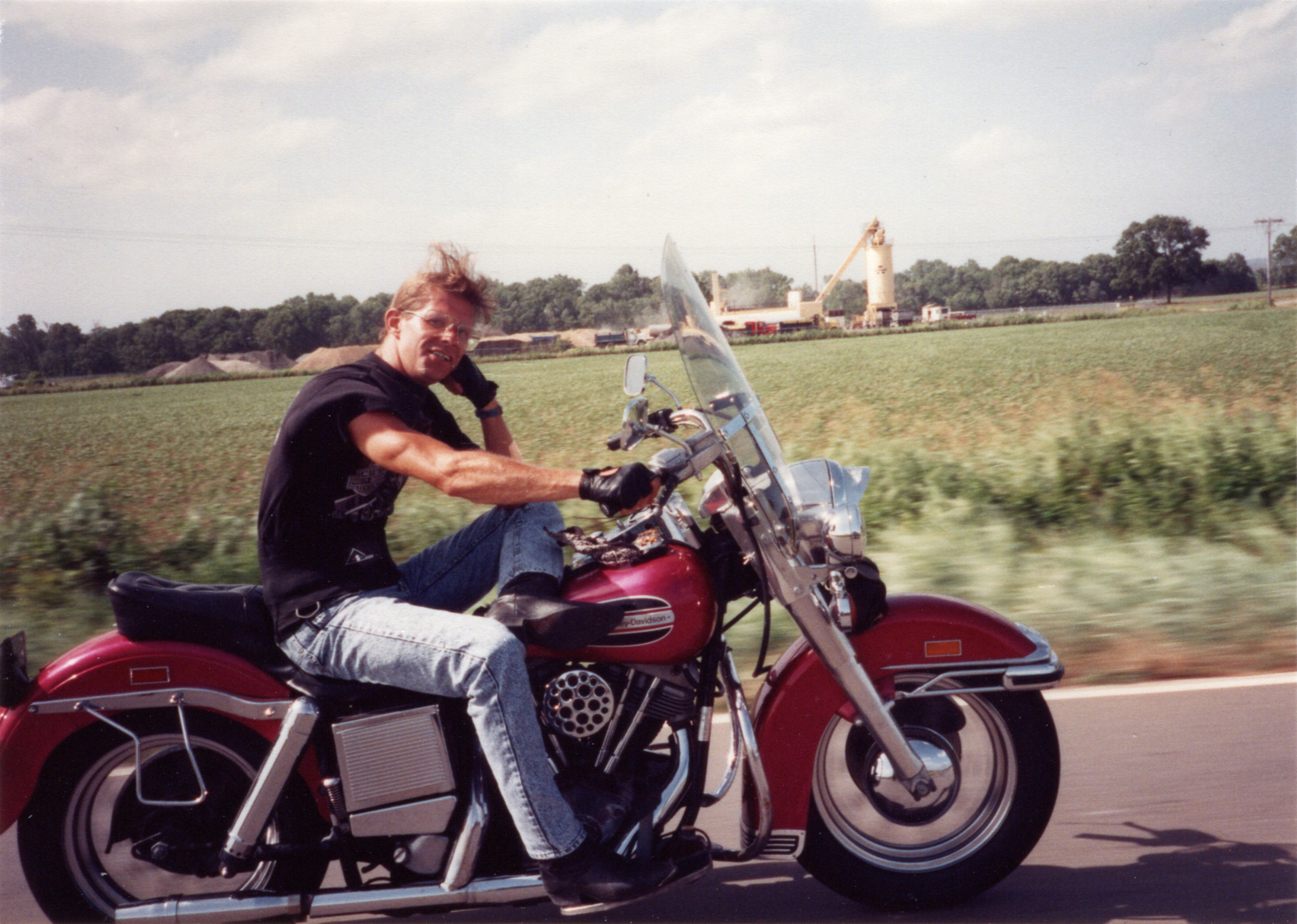
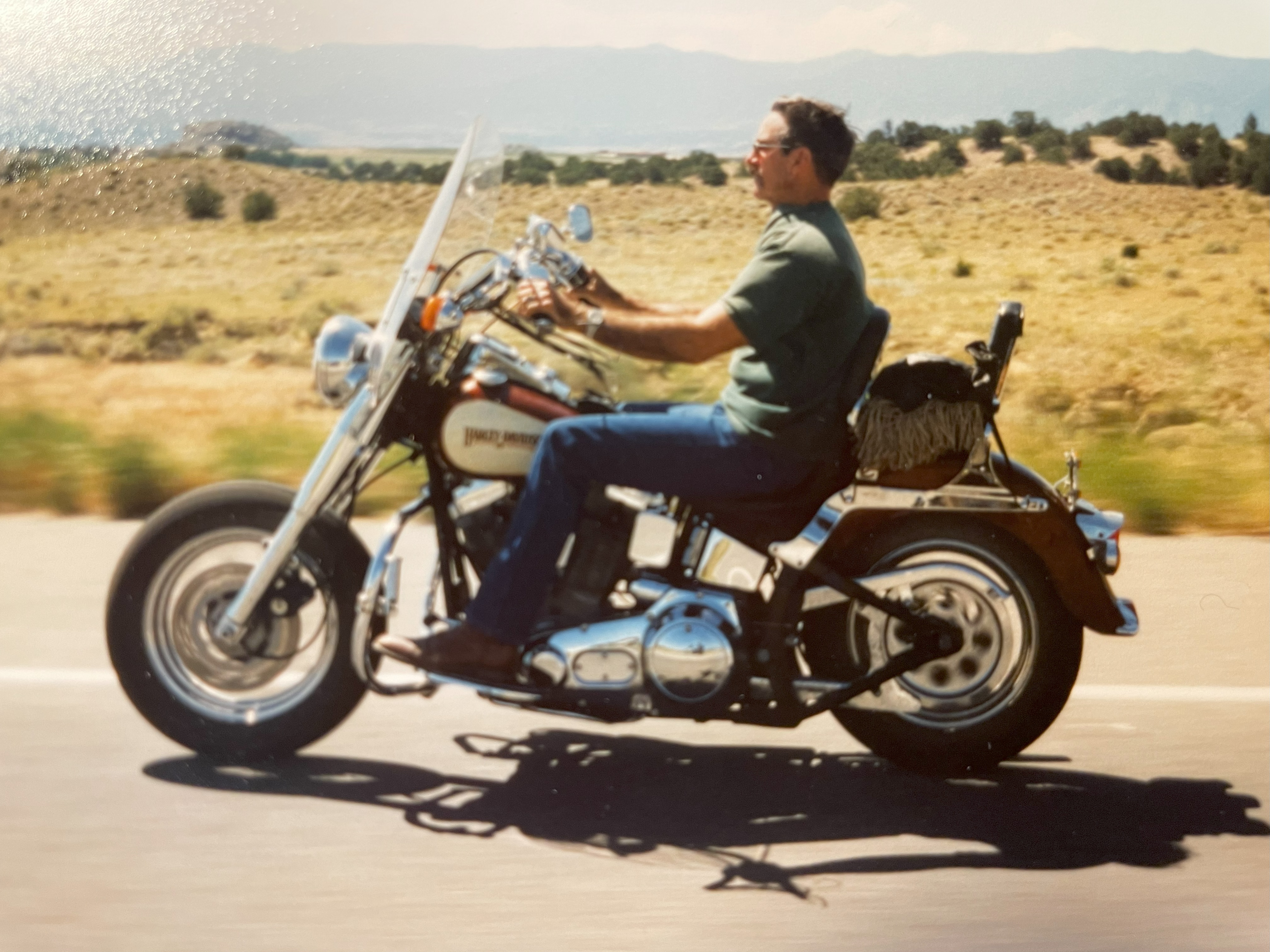
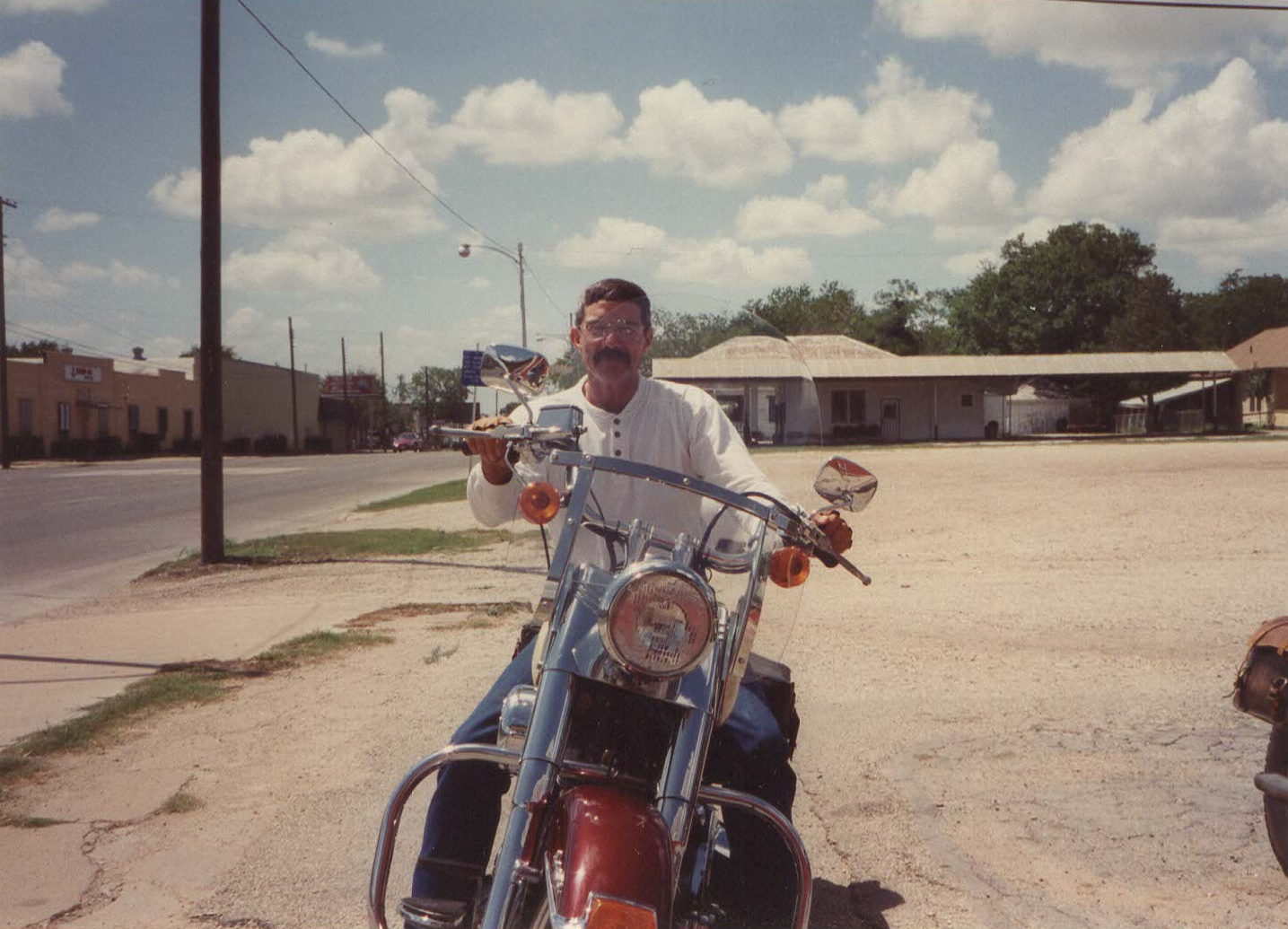
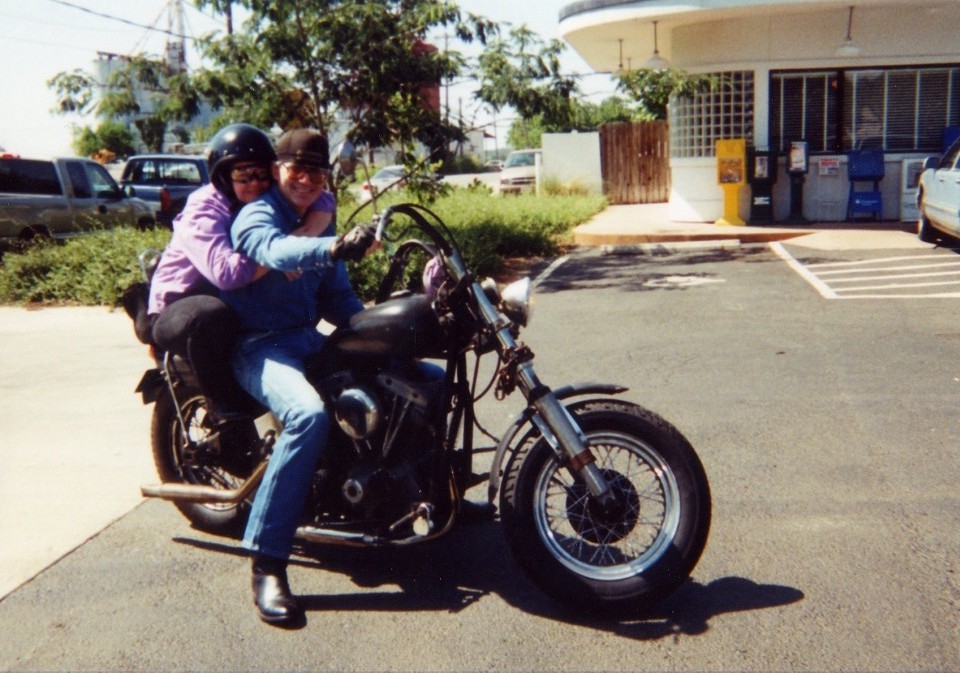
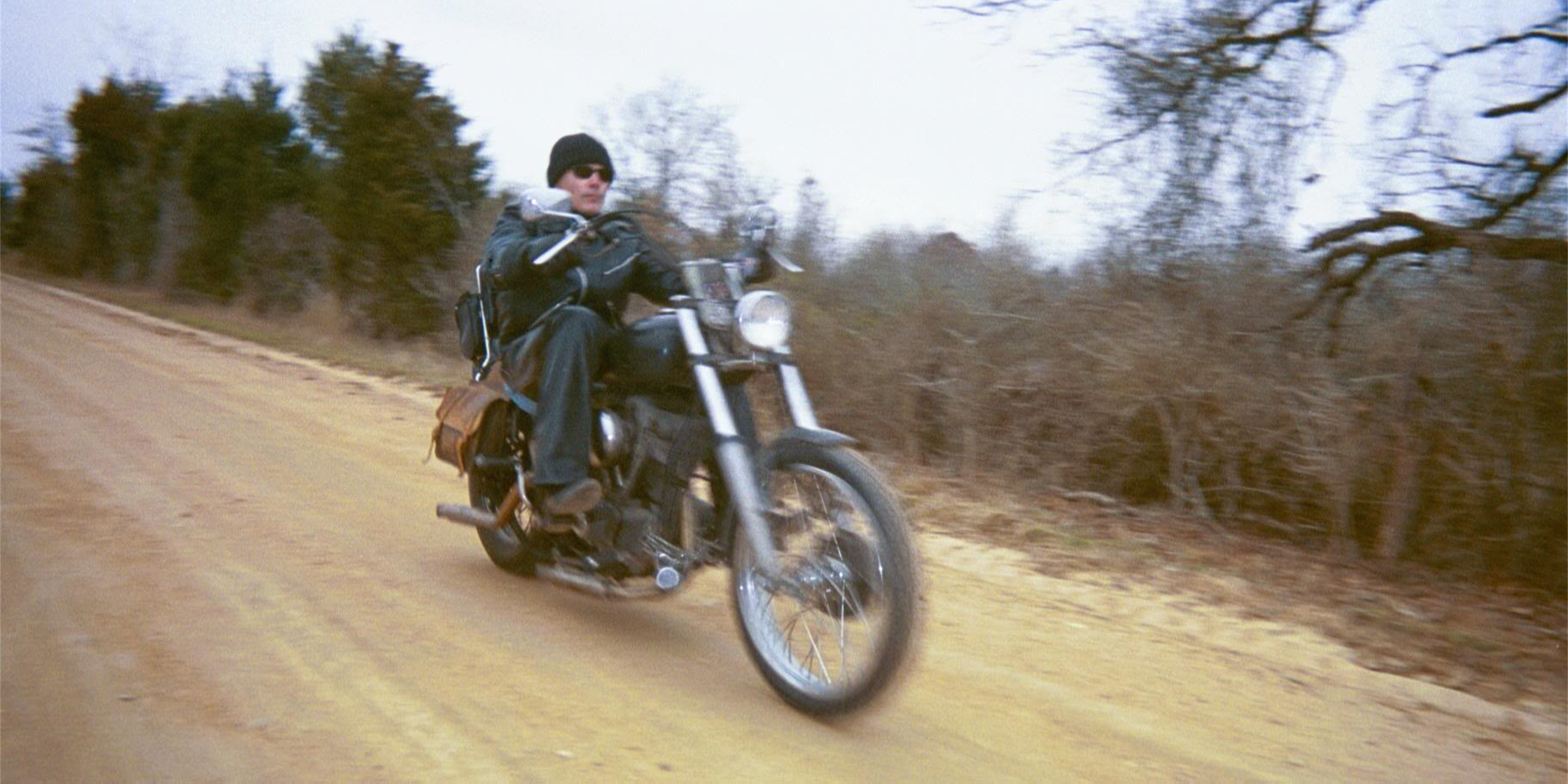
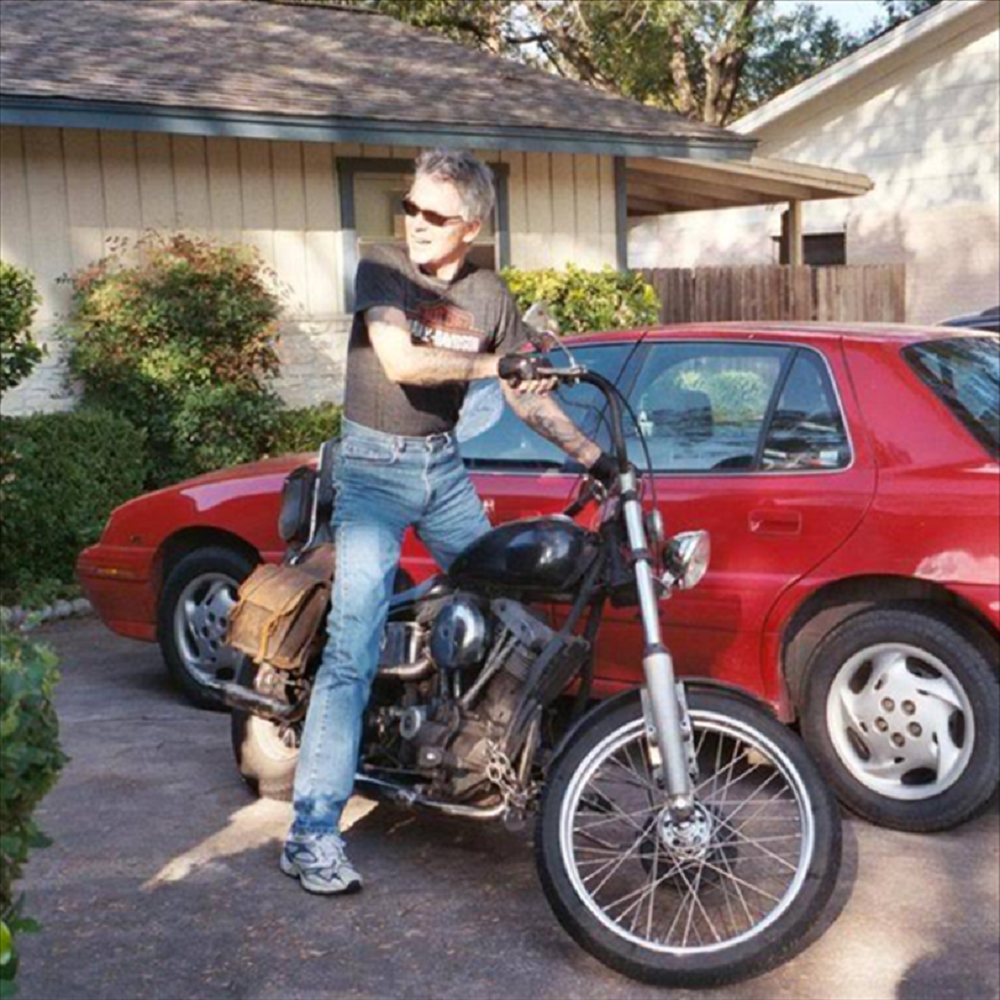
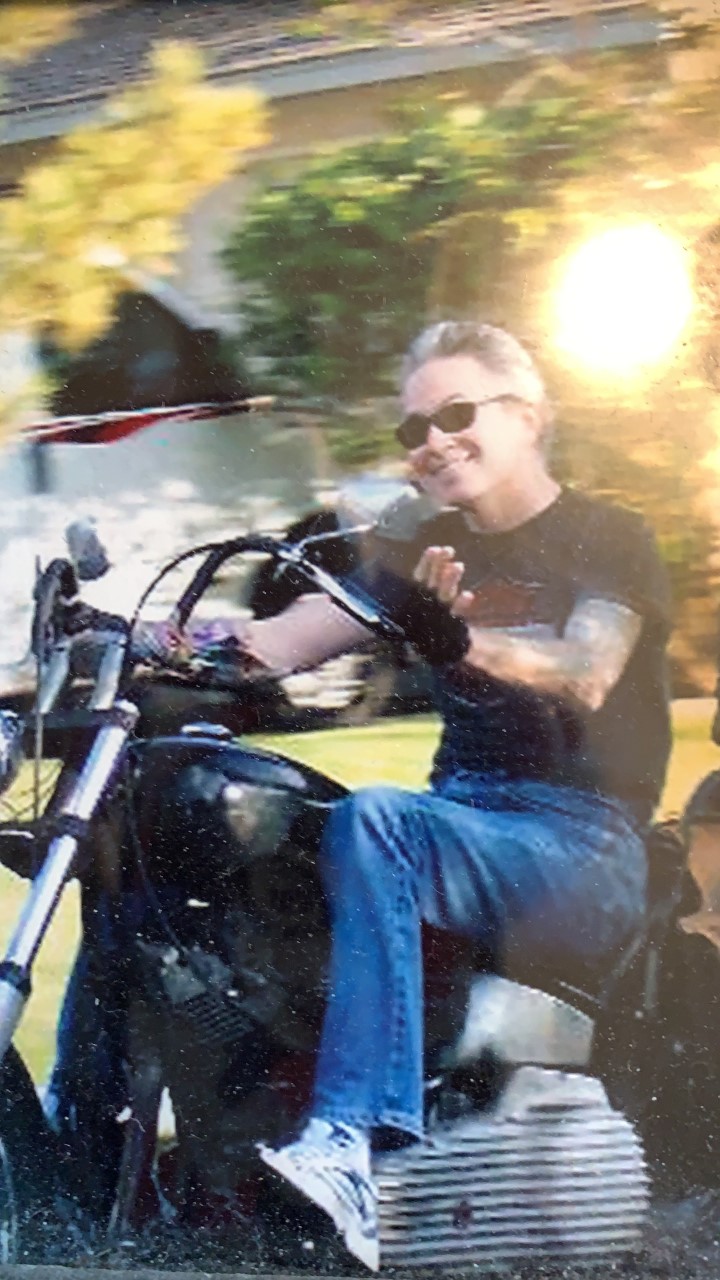
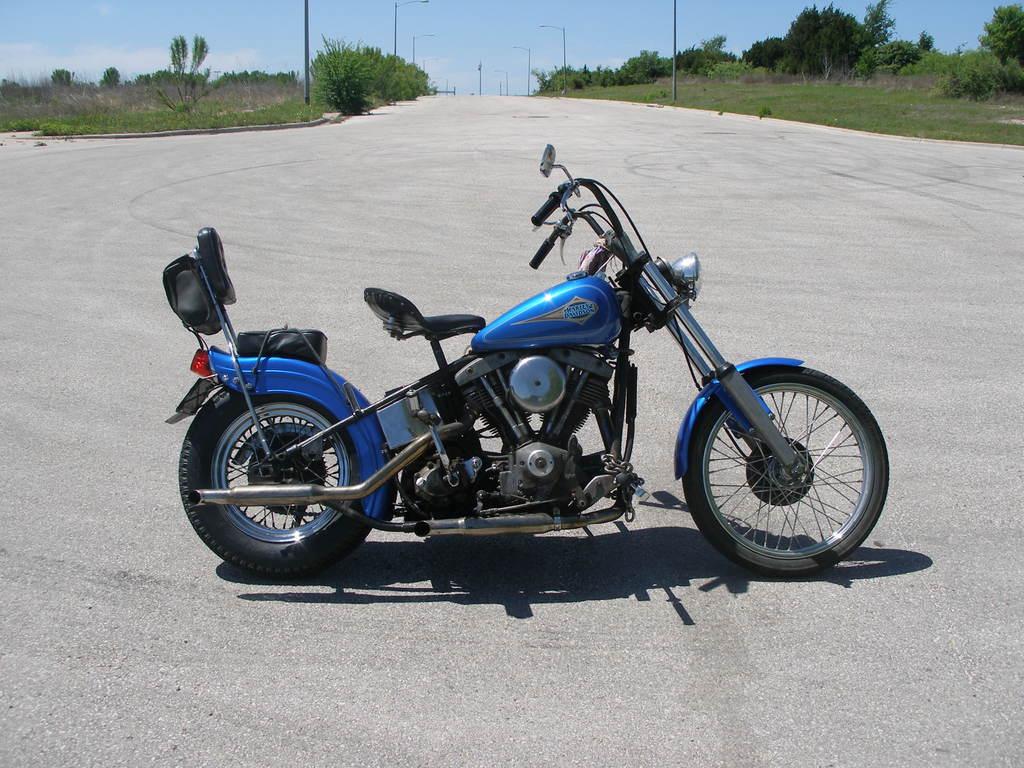
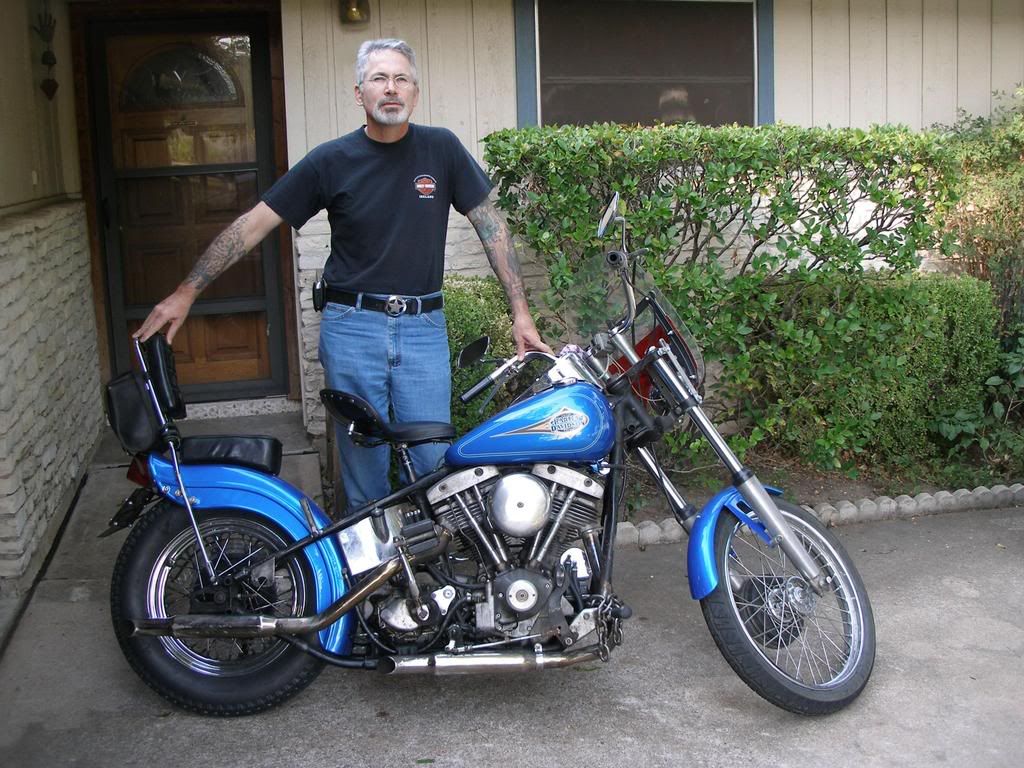
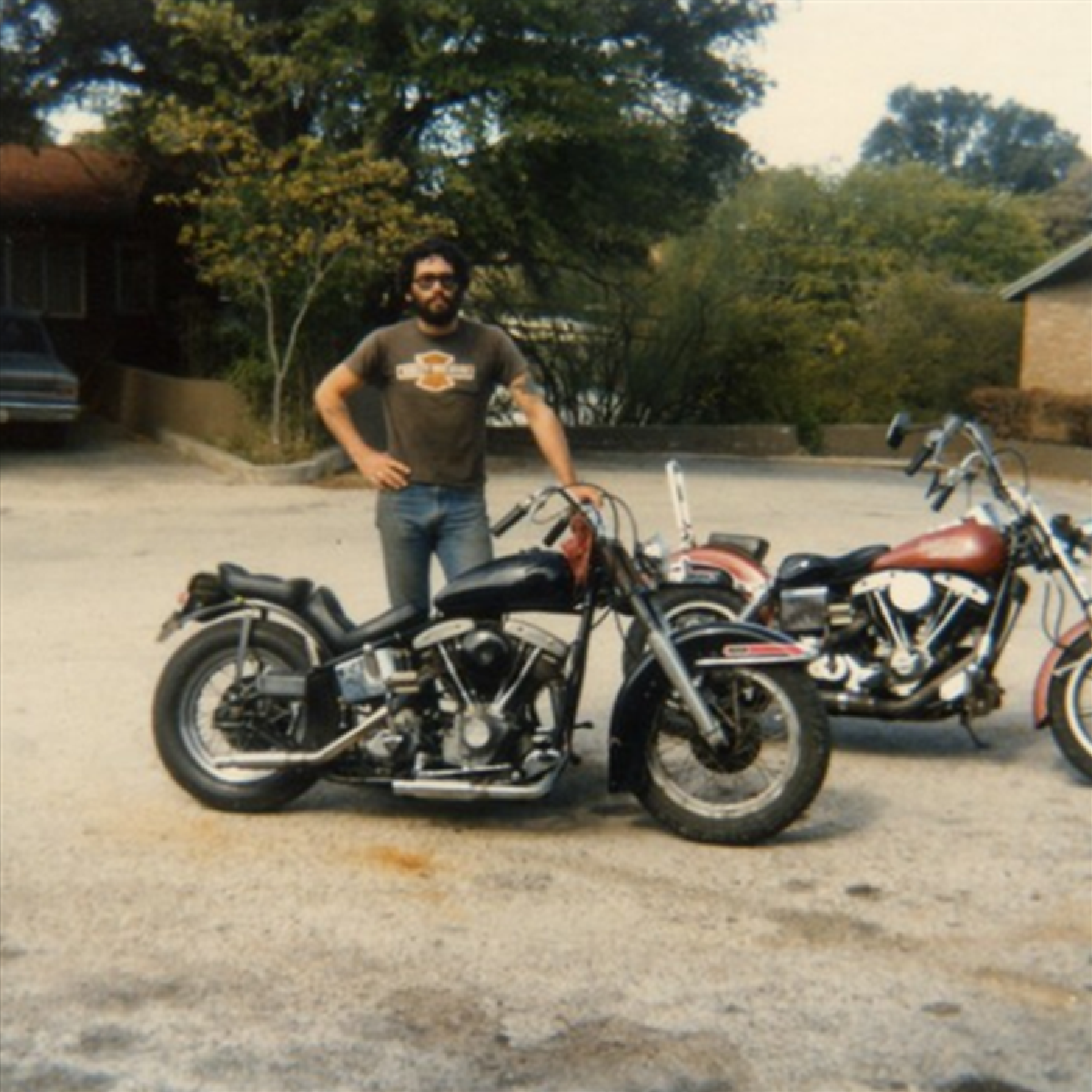
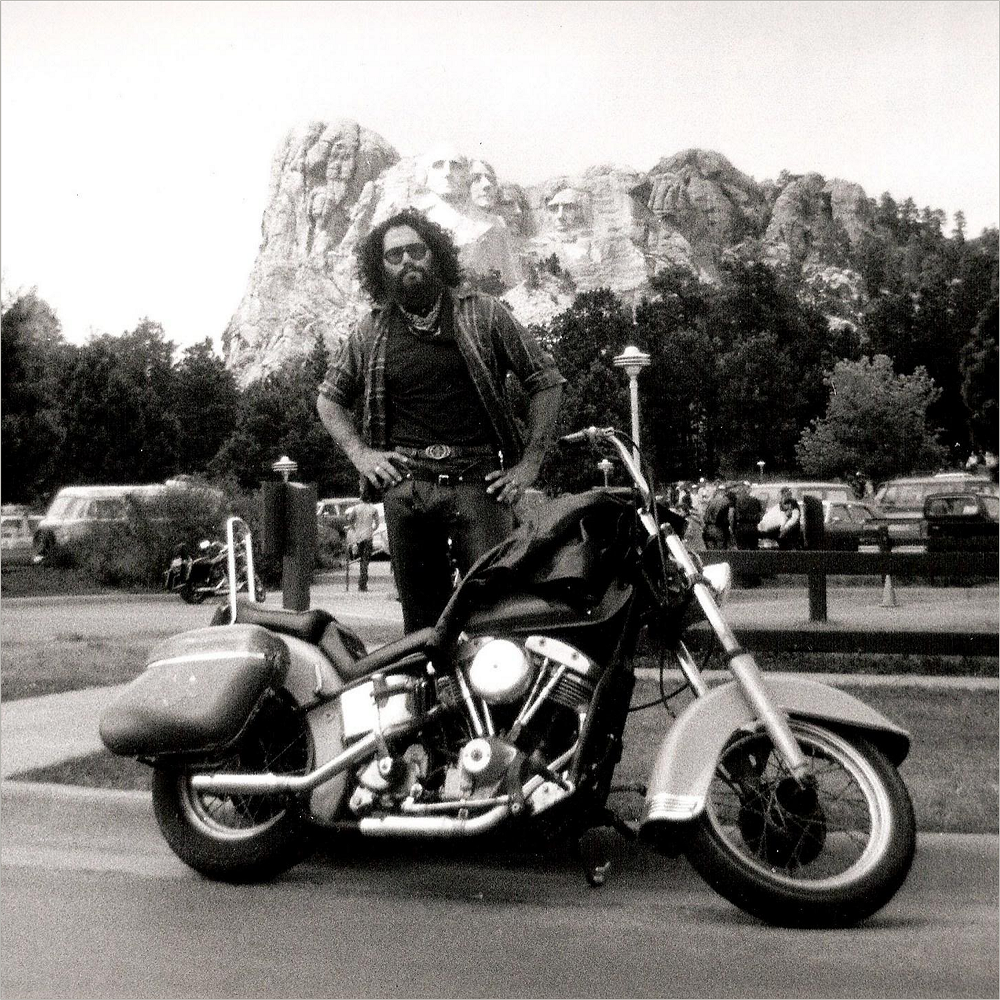
As some of you know, I have long been a proponent of women riding their own bikes, so I pay attention to articles like the one posted below. Karan Andrea would have been an interesting person in her own right, for her determination and accomplishments, but she also had the good sense to fall in love with another 1974 Shovelhead, which makes her my sister…. or sister-in-law, at least. 😏
Karan wrote:
Riding, Wrenching, & Empowerment
Antique Motorcycle Club of America Riveters Chapter founder Karan Andrea brought a vintage Harley back to life, despite all odds
Note: per the Riveter Chapter’s website, they will host a run to Berea, Kentucky May 30 – June 2, 2023. Visit them at https://www.riveterchapter.com/ for more info.
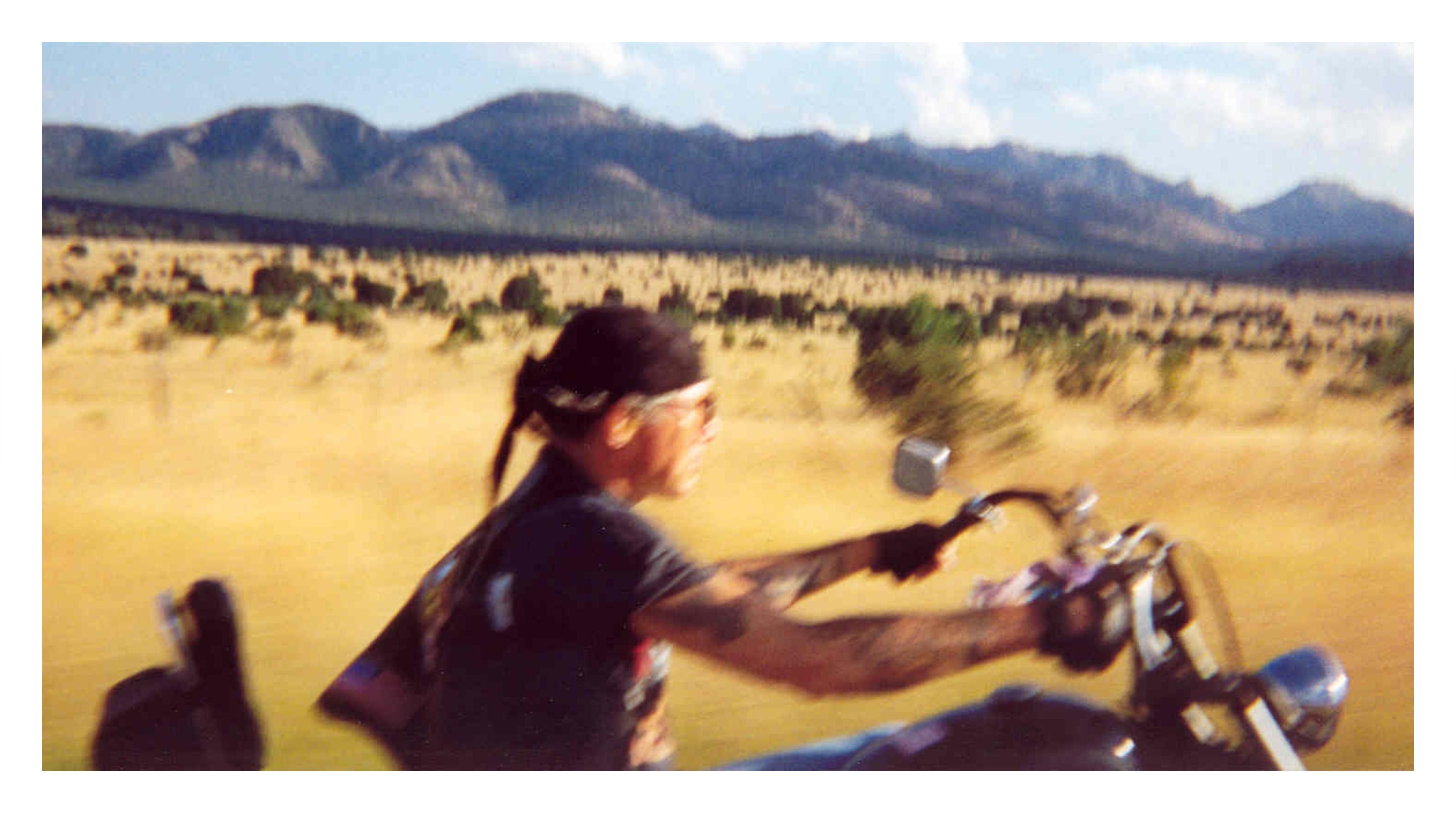
Despite three years of struggling to learn to ride well, I never gave up. Today, I am the master of my 1974 Harley-Davidson Shovelhead, which I can not only ride, but wrench on. This photo was taken at the Shovelhead Reunion in Milwaukee last June by Mark Garcia, Big Machine Photography.
AMCA Riveter Founder’s Herstory
I started riding motorcycles in 2011 when I was 45 years old. Prior to that, I hadn’t been around bikes all that much. I never rode dirt bikes and didn’t have a parent or relative who rode. When I was 19 years old, I dated a guy for a minute who had a Yamaha Virago. I rode with him a few times and loved it! But after we broke up, I didn’t have the opportunity to ride a motorcycle again for 25 years.
At that point, I had a friend who had a motorcycle who was going through a rough patch in life. The only solace he had was riding, but he had a hard time getting himself to leave the house to go for a ride. I started asking him to take me for rides. I’d cover the gas, and we’d ride for hours.
After a while, he said, ‘You know, if you like riding that much, why don’t you get your license and get your own bike. That way, you don’t have to date some asshole in order to ride.’ My answer was, ‘I can do that?’ It never occurred to me that I could learn to ride a motorcycle. I had no idea how one learned to ride, but in some part of my mind I think I assumed that if you were a dude, you just automatically knew how, so of course I did not know how. I didn’t know any women who rode, although that wasn’t a huge factor because I’ve always done things that were non-traditional for a woman.
Learning to Ride a Motorcycle
My friend told me about a motorcycle class for beginners, and I went for it. I was a nervous wreck. I have no idea how I passed the riding evaluation, but I did it. There I was, an endorsed rider with no friggin’ clue how to ride a motorcycle. This is not a shortcoming of the class at all. The beginner’s class teaches you how to operate a motorcycle and teaches you the basics of safety, but we never went beyond the parking lot.
The only way to learn to ride a motorcycle, is to ride a motorcycle. Karan, meet anxiety, anxiety, Karan. The next three years were a struggle. I bought the wrong bike, was getting (no) help from the wrong person, and I just never felt comfortable riding. But I wanted to ride so badly, that I refused to give up.
When I left a damaging relationship in 2018, I was left with a 1974 Harley-Davidson FLH Shovelhead in my garage that was the most terrifying beast I had ever faced. That motorcycle needed a lot of work. It was barely ridable as it sat, and even after I conquered my fear and rode it, it was a physically exhausting—but strangely exhilarating—adventure. Along with needing major motor, clutch, transmission, and fork work, the bike needed to be completely rewired. Wrenching still intimidates me even though I will do it, but wiring… I was pretty sure I could do that.
Quite a few people told me I was crazy and that I would get frustrated and end up hauling it to a shop for them to finish. They said I didn’t know what I was doing, and I would screw it up and would never finish the job. My answer was, “So what? I’m gonna try.”
In winter of 2018, I screwed up the nerve to rewire this beast
Overcoming Obstacles
I did get some help (although it was the wrong help) and I built up some confidence. I taught myself how to read an electrical diagram and learned to trust my instincts with the bike, people, and myself. I finally finished the rewire job and took the Shovel on its first journey. I did a 1,000-mile trip, fixed a few things along the way, and never felt more in control of myself and my bike.
Again, people told me I was crazy to travel on this old motorcycle. What was I going to do if it broke down? My answer was always the same, “I will figure it out.” My second trip on the Shovelhead was 2,000 miles. During both trips the bike had minor problems, but I got some fabulous stories out of it, and I was forming a bond with that old Harley that I had never had with any other vehicle I have ever owned.
Nothing about riding or wrenching has come easily. I am grateful to the short list of people who have been so generous with information, advice, parts, and encouragement. I am also grateful to the longer list of people who tried to derail me, who said I’d never succeed, who tried to sabotage my efforts. Because in the end, I have shown myself who I am.
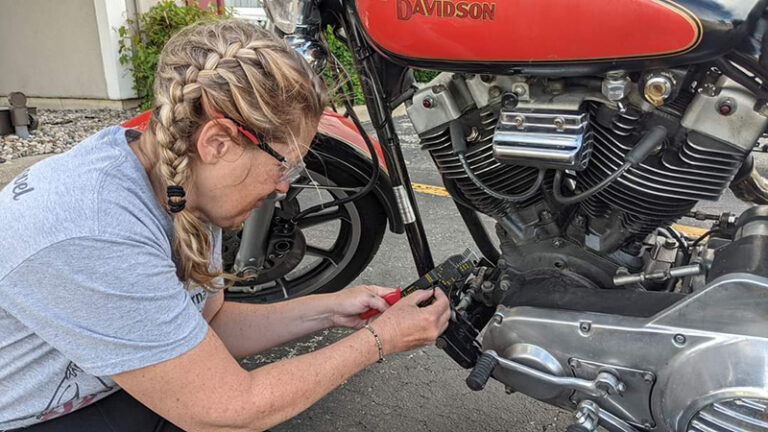
The first word I ever read as a child was SHELL. When I saw this aging service station during a motorcycle trip in 2019, I whipped around and went back for a photo. This is either in northern Kentucky or southern OhioIn 2021 Ernie Barkman crafted this seat rail for me and the Shovelhead’s official name became Atomic Shovel.I have graduated to hacking up other people’s motorcycles. This was another parking lot repair in 2021 on fellow vintage motorcycle rider Marjorie Kleiman’s Harley-Davidson FXR. Photo by Marjorie Kleiman.
As I read Karan’s article, I found two lines that really spoke to me, because they so perfectly mirror my own feelings. First, Karan wrote that, after teaching herself to rebuild and rewire the bike, she:
‘…took the Shovel on its first journey. I did a 1,000-mile trip, fixed a few things along the way, and never felt more in control of myself and my bike.’
That sense of competence and control Karan cites – the sensation I get from knowing my Shovelhead inside and out – is so precious to me. I’m pleased to know it is to her, as well.
She follows that by saying:
‘Again, people told me I was crazy to travel on this old motorcycle. What was I going to do if it broke down? My answer was always the same, “I will figure it out.” My second trip on the Shovelhead was 2,000 miles. During both trips the bike had minor problems, but I got some fabulous stories out of it, and I was forming a bond with that old Harley that I had never had with any other vehicle I have ever owned.’
The bond Karan mentions is why I still get loquacious AF about my Shovelhead after all these years. See previous post, f’rinstance. What can I say? 🤷♀️ The Bitch is in my blood, and my blood, sweat and tears are in hers. 😁
Thank you, Karan Andrea and Women Riders Now for sharing that essay with us. Sláinte!
When I was maybe seven or eight the boy next door came home from college on a toaster-tank BMW, and was giving the neighbor kids rides around the block. I begged and pleaded with my Mom – ‘PleaseI’llbecarefulI’llhangontightPleasecanIgoCanIgoPleaseI’llbecarefulPlease….’ – until she finally gave in. Yay! 😁👍
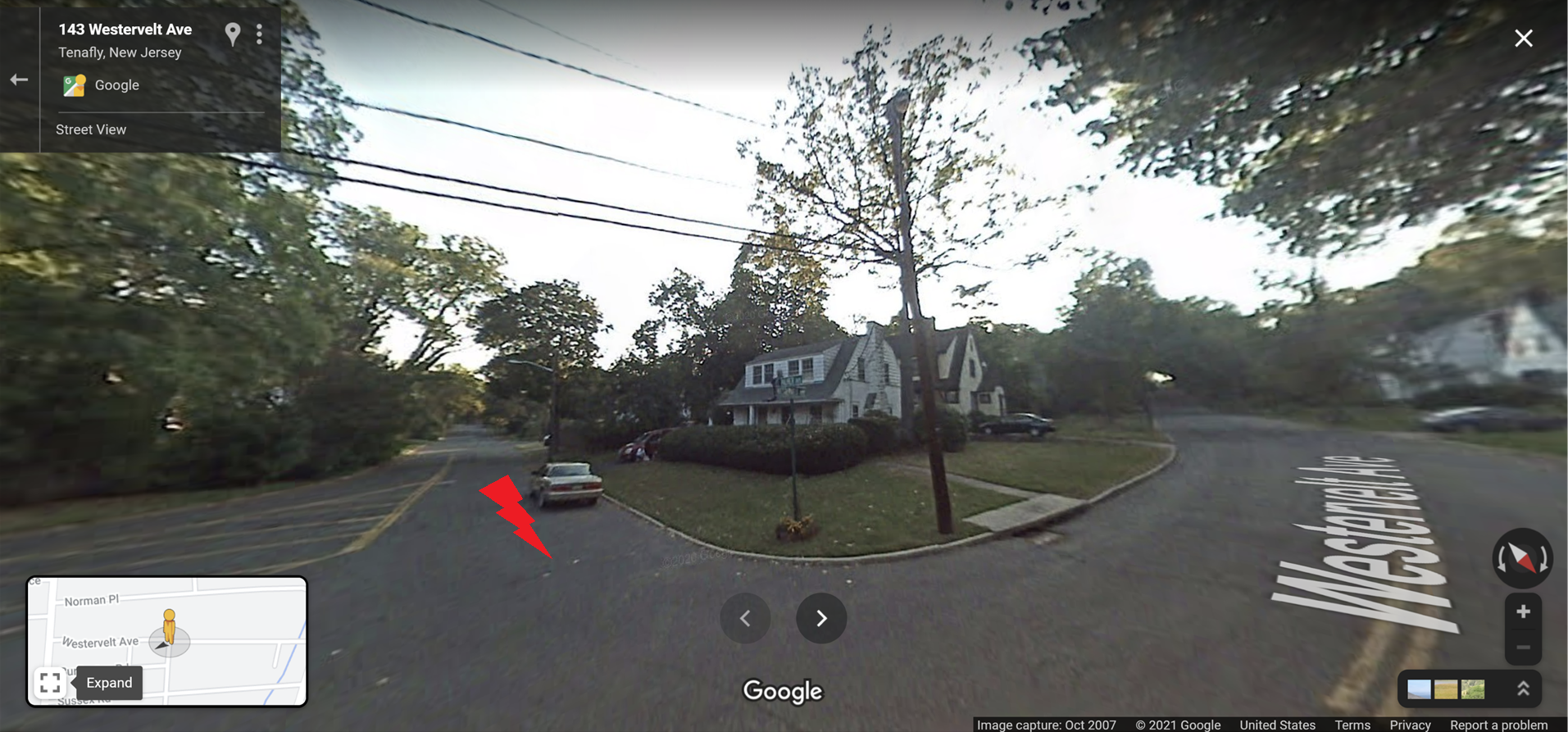
Gene and I were halfway around the block when I got this thought, like a crystal-clear voice in my head, that said ‘I’m going to HAVE one of these someday!’ The moment was so profound that, forty years later, I was able to take my wife to that exact spot and say ‘There! That’s where it all began!’ 🤷♀️
Right about there is where that lightning bolt inspiration struck me!
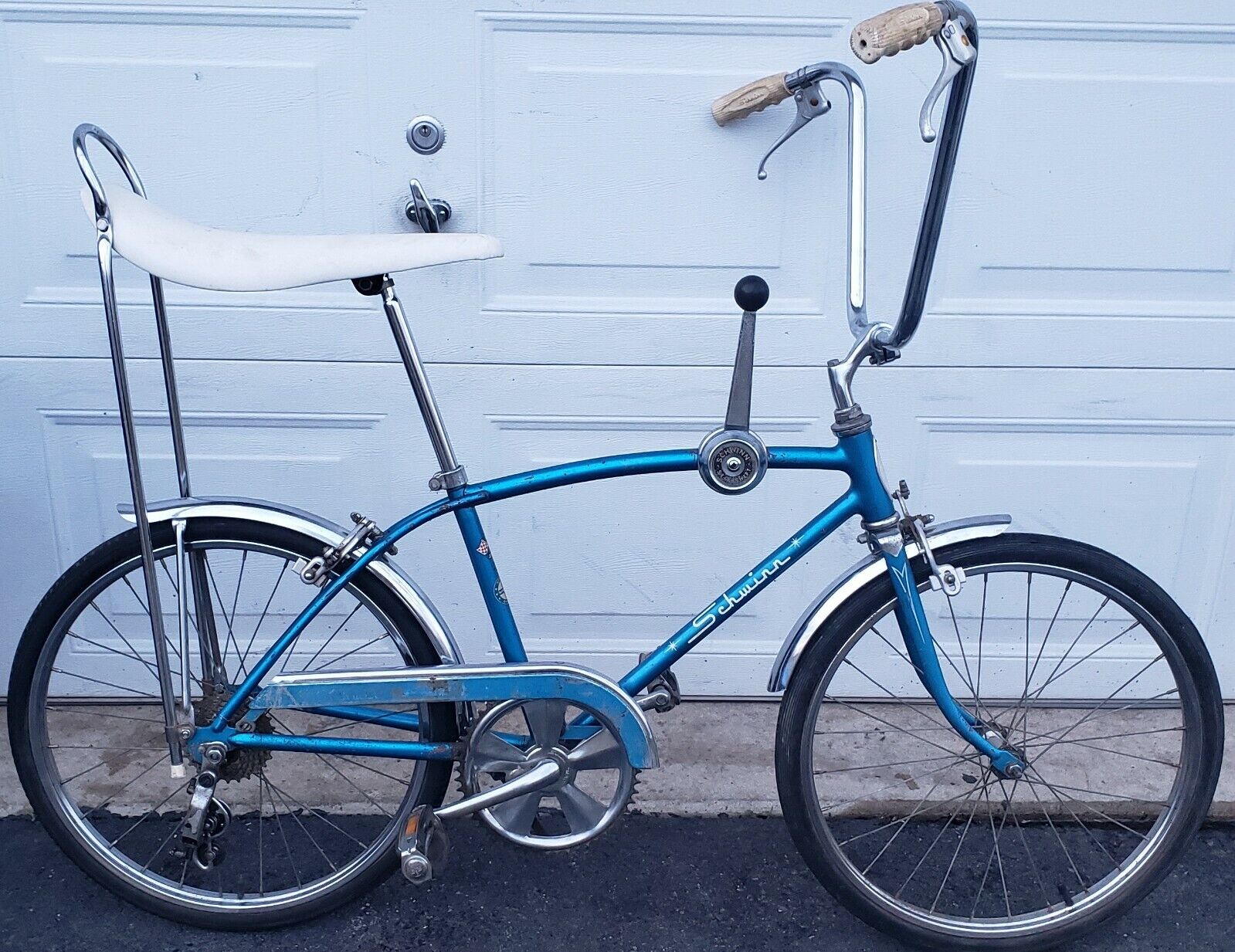
We were not allowed to have motorcycles when we were kids; not even minibikes, which were all the rage at the time. The closest I got to the chopper of my dreams was some plastic modelling kits and a Sting-Ray bicycle.
Not my Sting-Ray – this one is listed on eBay for $1200 😳 – but this is the color and year I had.
Of course, on the sly I rode anything with a motor – minibike, moped, dirtbike, whatever – whenever anyone was dumb enough to let me, but that wasn’t often. We lived in a ‘nice’ suburban town, and actual bikers were hard to find. The boy next door and Steve down the street, who had a BSA, were the only people I knew with real motorcycles, and they were never dumb enough to let me near the controls! 😆
As noted in previous posts, I spent my teen years drinking and drugging – a lot and very badly – and it wasn’t until I put all that aside, at the age of 21, that I could get serious about putting together the money for my first motorcycle. It took a year of sobriety to clean up my rather messy financial history, and working two jobs while going to school full-time on the GI Bill, but I finally got together the down-payment. With that in hand I got the nod from the credit union to begin shopping. Yay again! 😁👍
I toddled off to the Harley-Davidson dealership – I already knew I wanted a Harley – but the guy there was such a jackass that I turned around and walked out. Smart move, because half a block up the street I saw a Harley for sale in a used car lot. It was black, low, lean and mean, one of the prettiest things I’d ever seen, and looked like it might be everything I ever wanted.
I could not have been more right.
I called this biker I’d met in sobriety – a lawyer, of all things, who built choppers! – and asked him to come look at the bike with me. He came down and we went over the bike together. It was a 1974 Harley-Davidson Superglide FX with a 74 cubic inch shovelhead motor, a kickstarter (no electric start then or now) and disc brakes fore and aft. After he took it for a test ride (I did not yet have my motorcycle license) Wayne gave it the thumbs-up, and the deal was done. I completed the paperwork at the credit union, conveniently located just around the corner from the used-car lot, and spent a near-sleepless night as keyed up as a kid at Christmas.
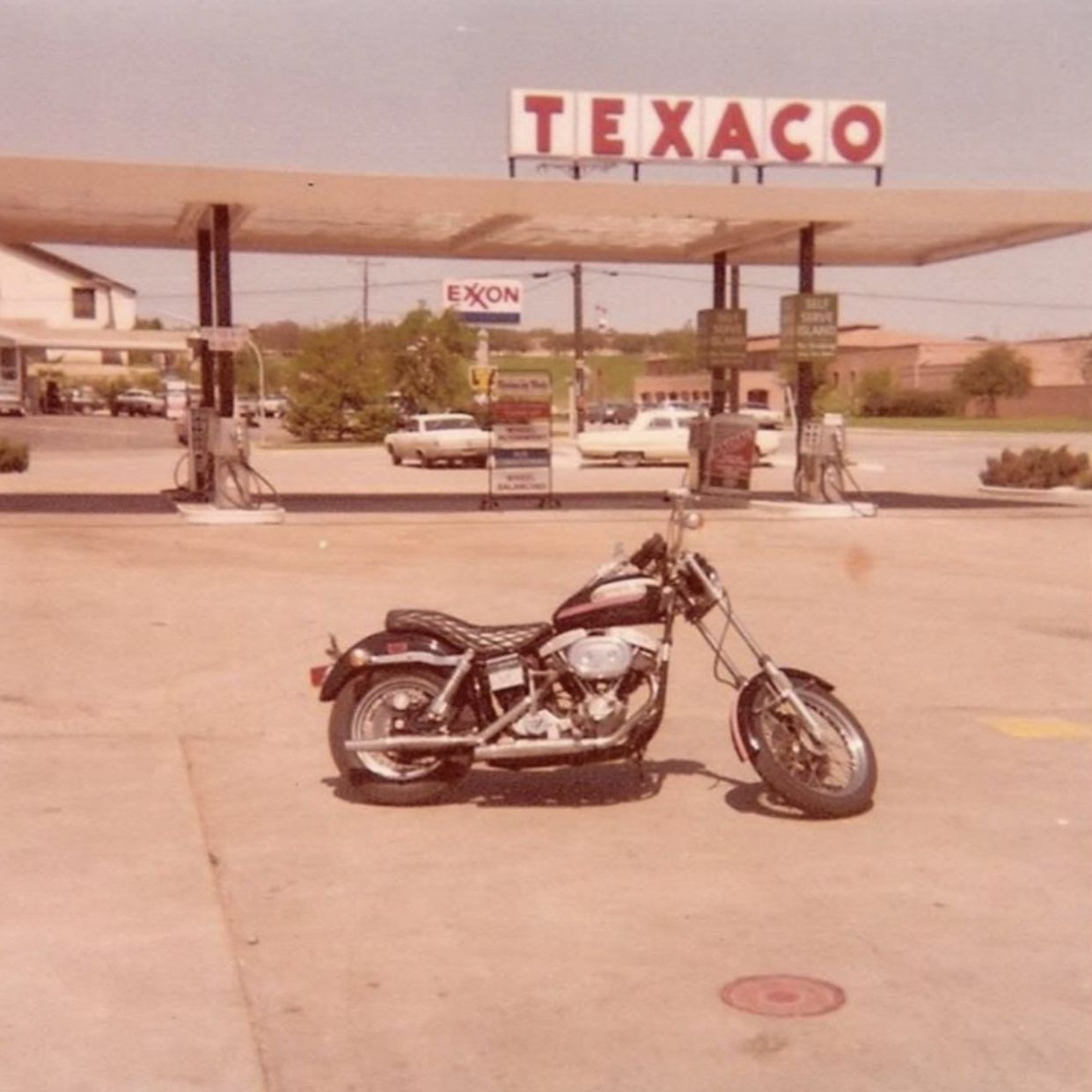
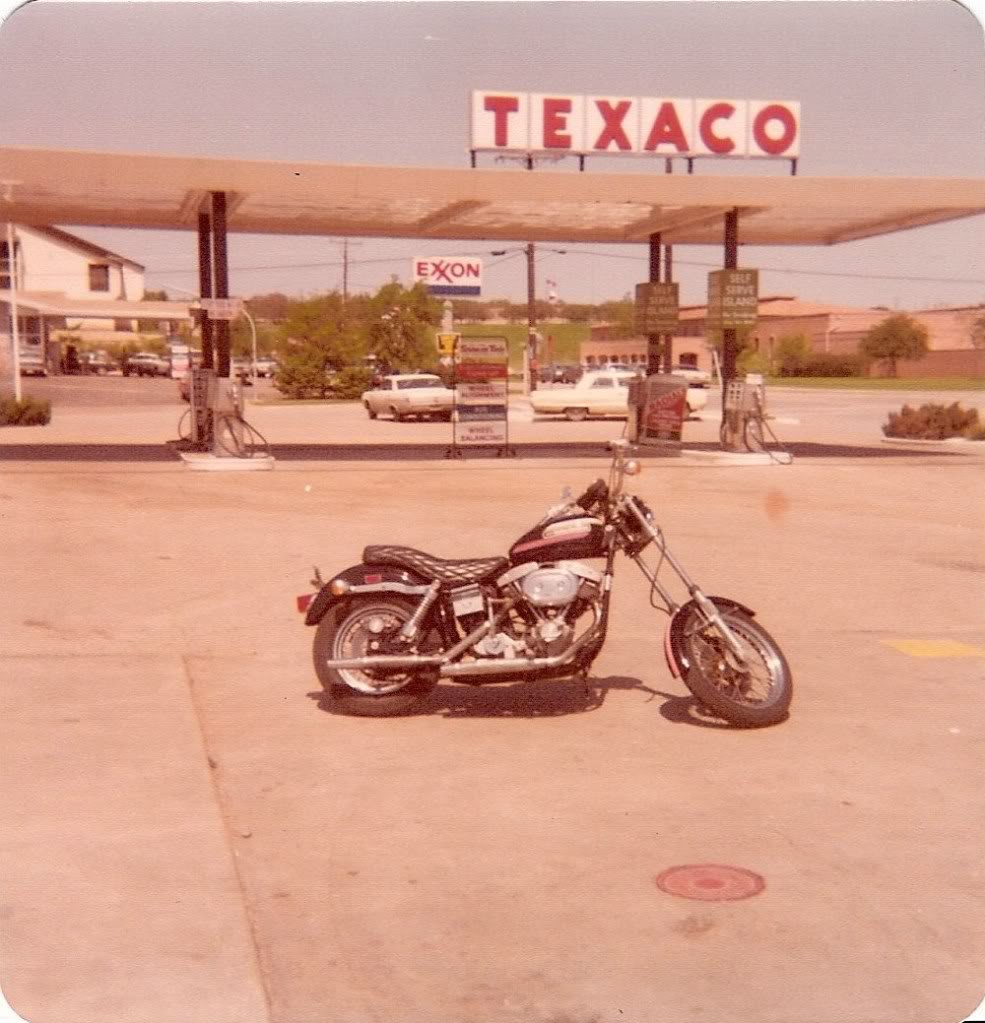
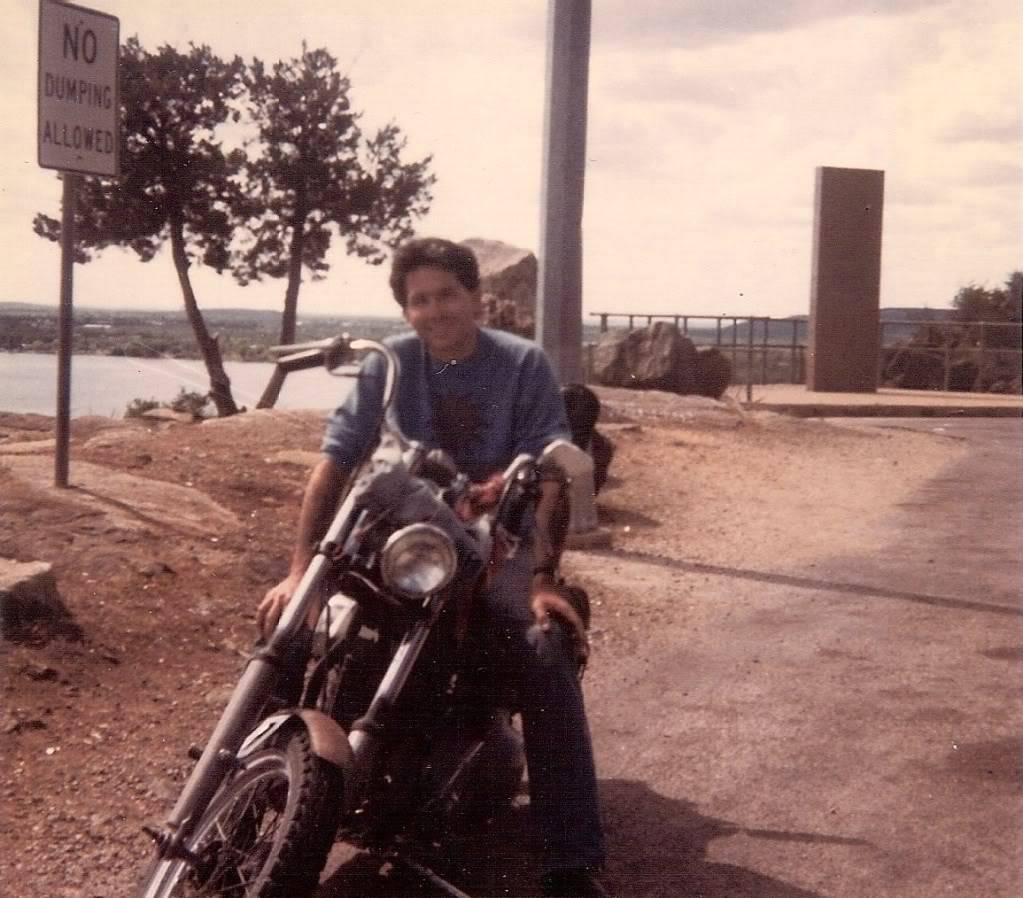
The next day – April 11th, 1979 – I threw my leg over my very first Harley for the very first time. That’s right: Forty-four years ago today I answered the call I heard that long-ago afternoon, on the back of Gene Graf’s BMW. After years of wishing and wanting and dreaming about it, I finally had me one of those things! 😎
April 11, 1979, at Northwest Hills Texaco, where I worked at the time.
And forty-four years later, I still have that same motorcycle. I’ve had a few others along the way, but that one is my ride-or-die keeper. She (for she is a girl, make no mistake) is no longer black, and not as low or quite as lean as she was (neither am I, for that matter 😏 ) but she is still the prettiest thing I have ever seen. She’s still gorgeous, and righteous, and I still love her dearly.
Sad to say, a series of unfortunate events (primarily a disabling on-the-job accident) have kept me off my one true love (machine division) for several years, but I still harbor a hope that we may still find a way to be together again.
However, in the meanwhile, and with the support of my one true love (human division) I have secured a different bike, better suited to my disabilities. She’s big and fat and shiny and loud, and so new-fangled and complicated I dare not touch most of her more intimate components, but I’ve already had my hands on her, a little bit, doing little fix-its and adjustments, and once that happens love is sure to follow. She’ll never displace my shovelhead – seriously, what could? – but I have a good feeling about her. 🥰
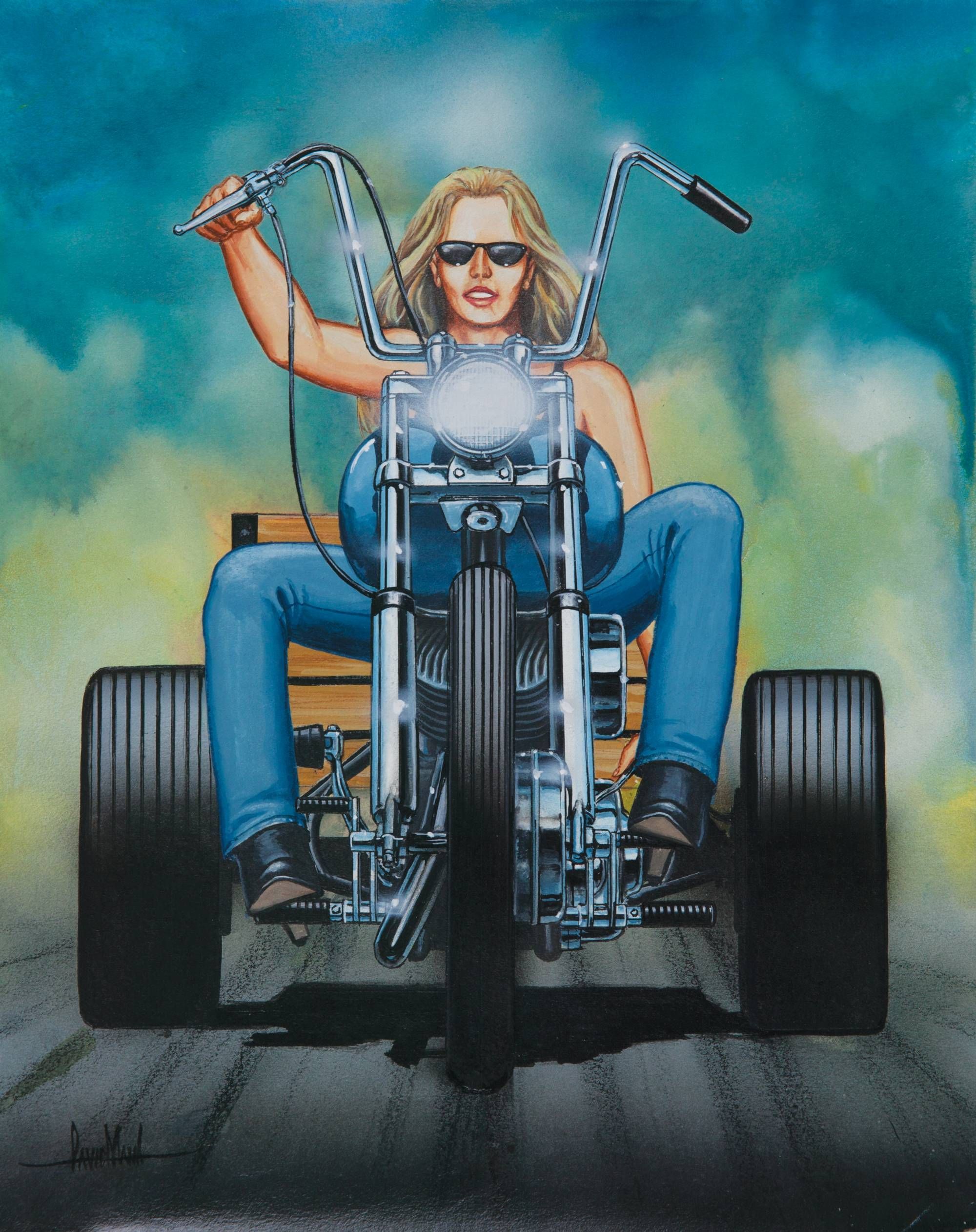
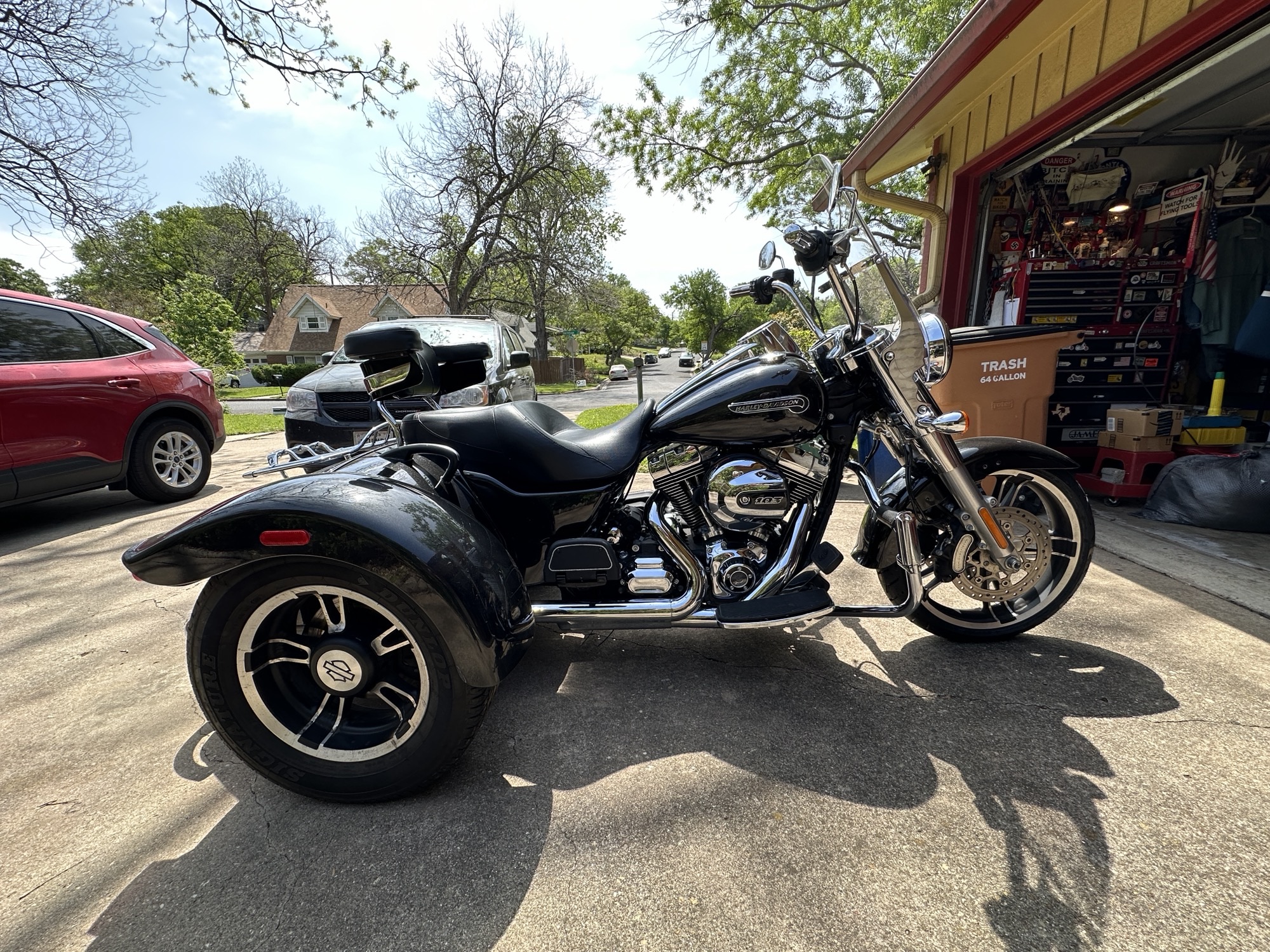
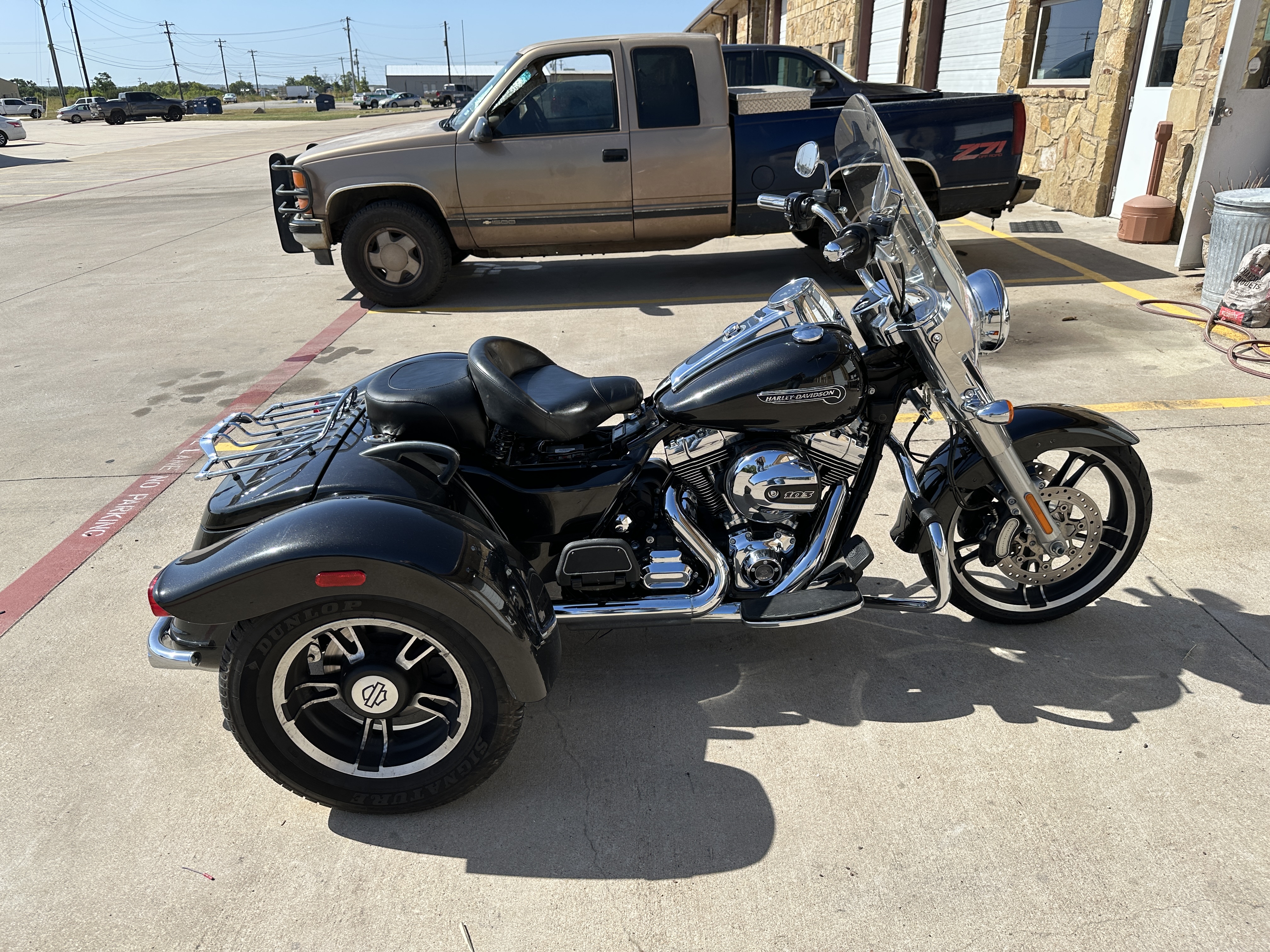
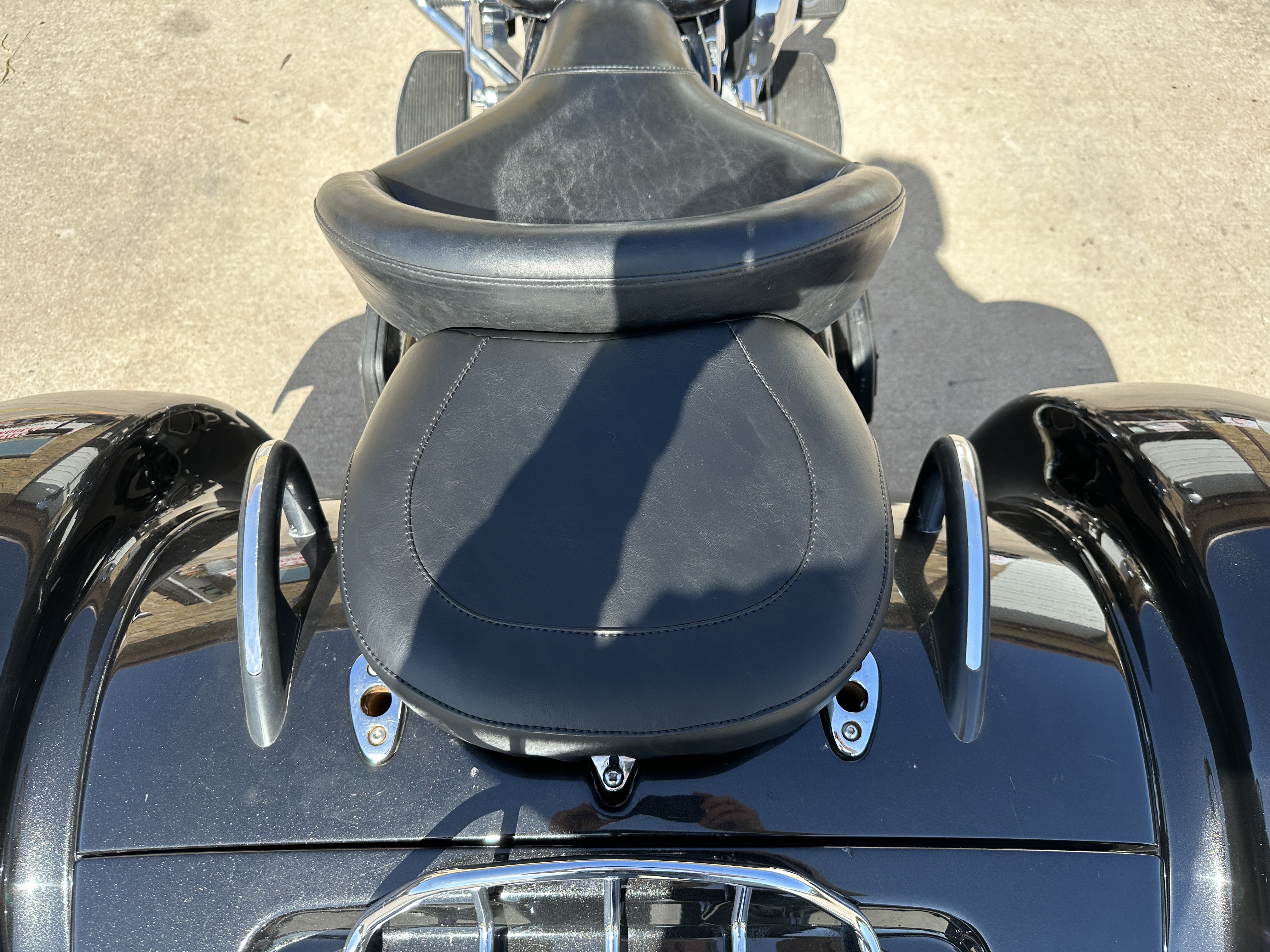
My new-to-me 2016 Harley-Davidson Freewheeler. Now all I have to do is unlearn forty-four years of training, practice and instinct I’ve accumulated riding a two-wheeler, and learn the proper handling of a three-wheeler. For those who don’t know: it’s a very different style of riding!
So, Happy Anniversary to my 1974 Harley-Davidson FX – my beloved shovelhead – and thank you, thank you, thank you for all the years of joy and adventure you brought me. Let’s go for forty-four more, eh? 😁
Yes, sir, that’s my baby. No, sir, I don’t mean ‘maybe.’ Yes, sir, that’s my baby now!
And don’t you go getting jealous of the new kid. She’s just here to help. 😏
‘Art is eternal, for it reveals the inner landscape, which is the soul of man’ – – Martha Graham, Dancer and Choreographer – –
The very first article I ever published appeared in Easyriders, the groundbreaking magazine which was at once the LIFE, Saturday Evening Post and Reader’s Digest of the outlaw biker set. I wrote about tattoo removal – a topic I thought some readers might find interesting – after an encounter with a dermatologist at a Veteran’s Administration hospital in Hastings, Nebraska, who told me about a then-new technique for obliterating unwanted tattoos via laser. I won’t bore you with the details – the information is all woefully outdated anyway – but I ended my piece with the words
‘These days, even art is not eternal.’
However, barring catastrophic circumstances like the 9/11 attacks on the World Trade Center, where – in addition to thousands of lives, including my cousin Eddie – an estimated $110 million worth of art was destroyed, or the Taliban’s deliberate destruction of The Buddhas of Bamiyan, art really is eternal….
….and even those pieces lost or destroyed live on in memory.
….and all this to say ‘Hey! I got some cool stuff to show ya!’
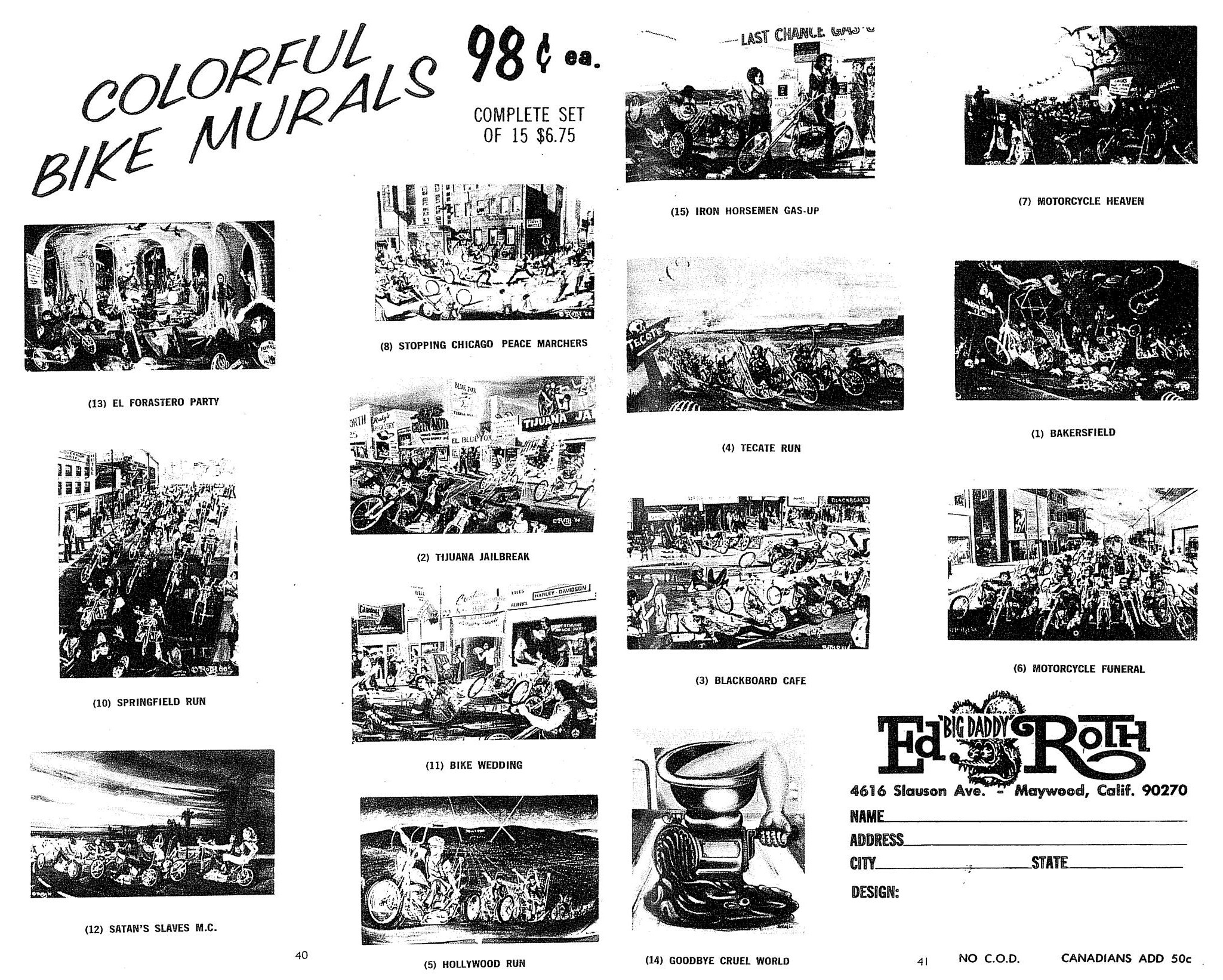
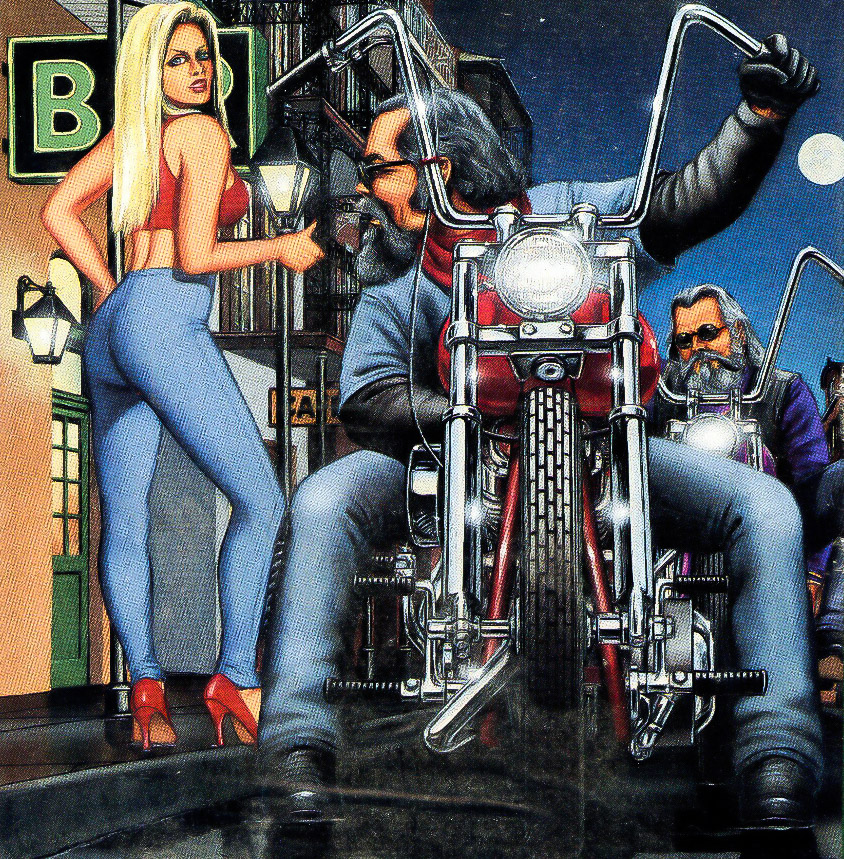
An advert for prints of Dave Mann’s earliest posters. Chopperspublisher Ed ‘Big Daddy’ Roth was a wily self-promoter with a sharp eye for moneymaking opportunities. He had no problem exploiting the talents of young artists like Mann, and continued to make bank off Mann’s work long after Mann left his stable.
IN THE BEGINNING….
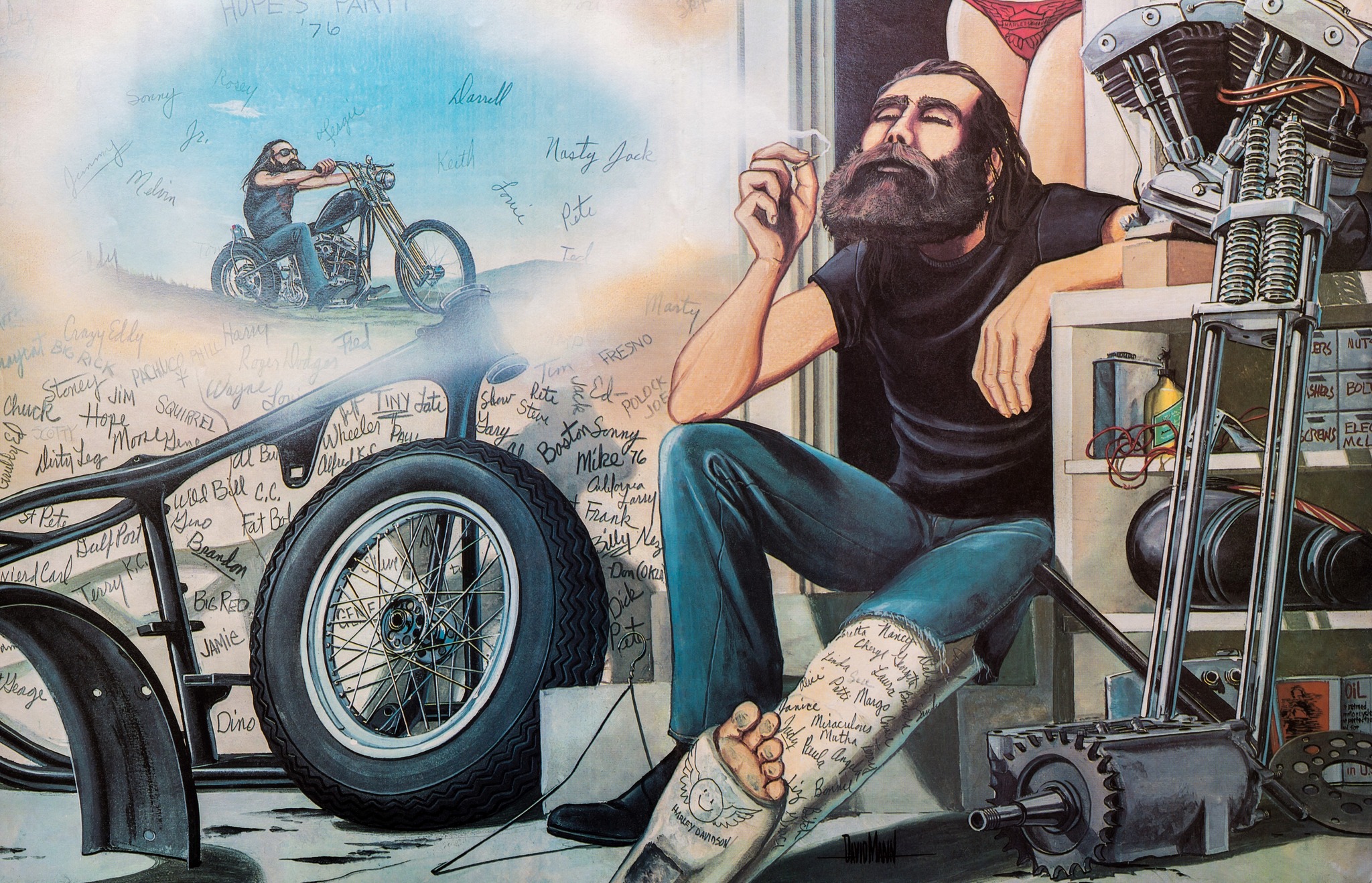
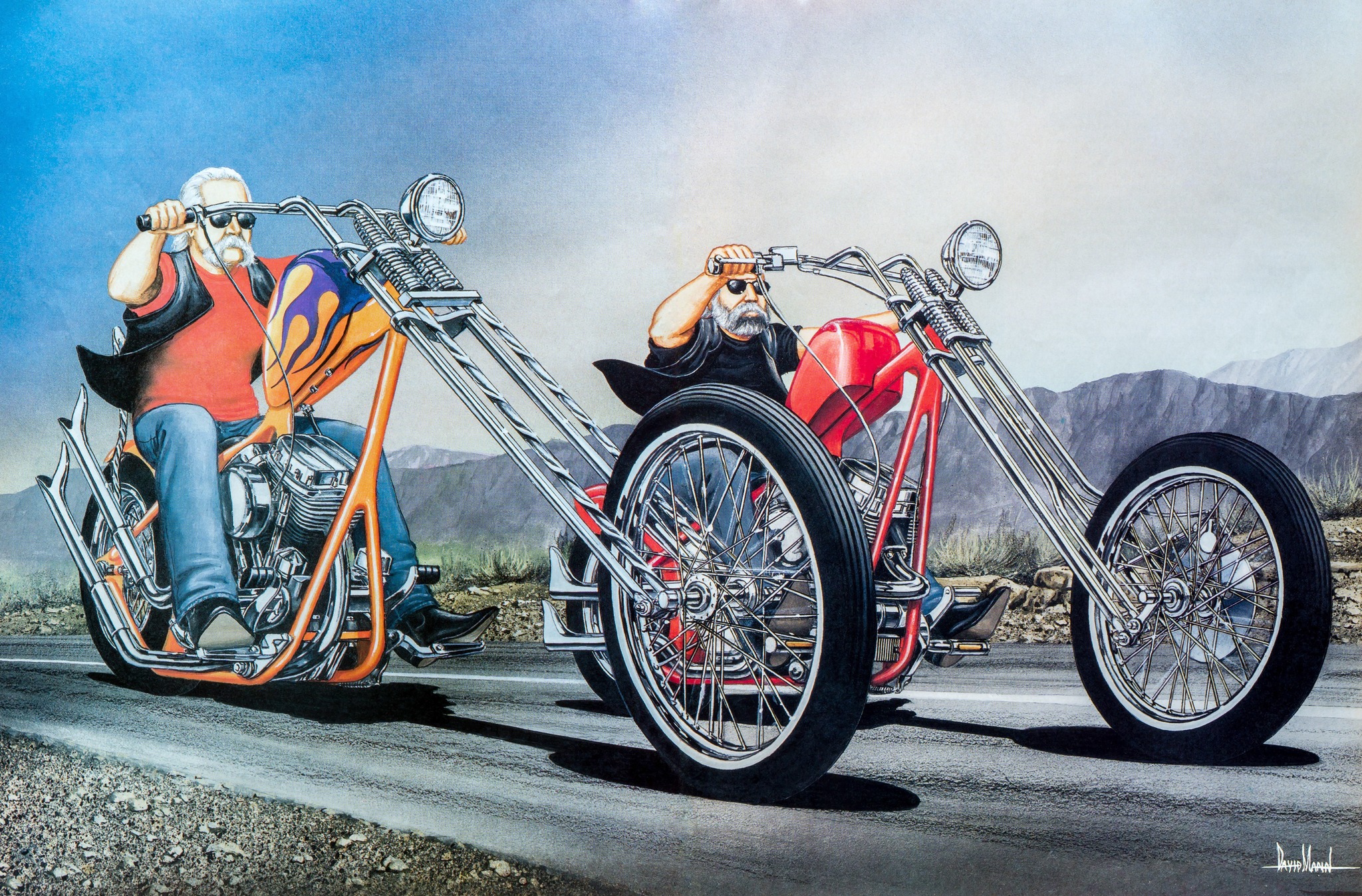
I don’t know who first attempted to paint or draw images of the biker life, but Dave Mann was certainly a pioneer. After selling some early paintings of biker life to Choppers magazine founder Ed ‘Big Daddy’ Roth (creator of the iconic ‘Rat Fink’ and a number of radically customized cars and motorcycles), Mann joined the El Forastero Motorcycle Club (forastero is ‘stranger’ or ‘foreigner’ in Spanish) as a charter member of the club’s Kansas City MO chapter.
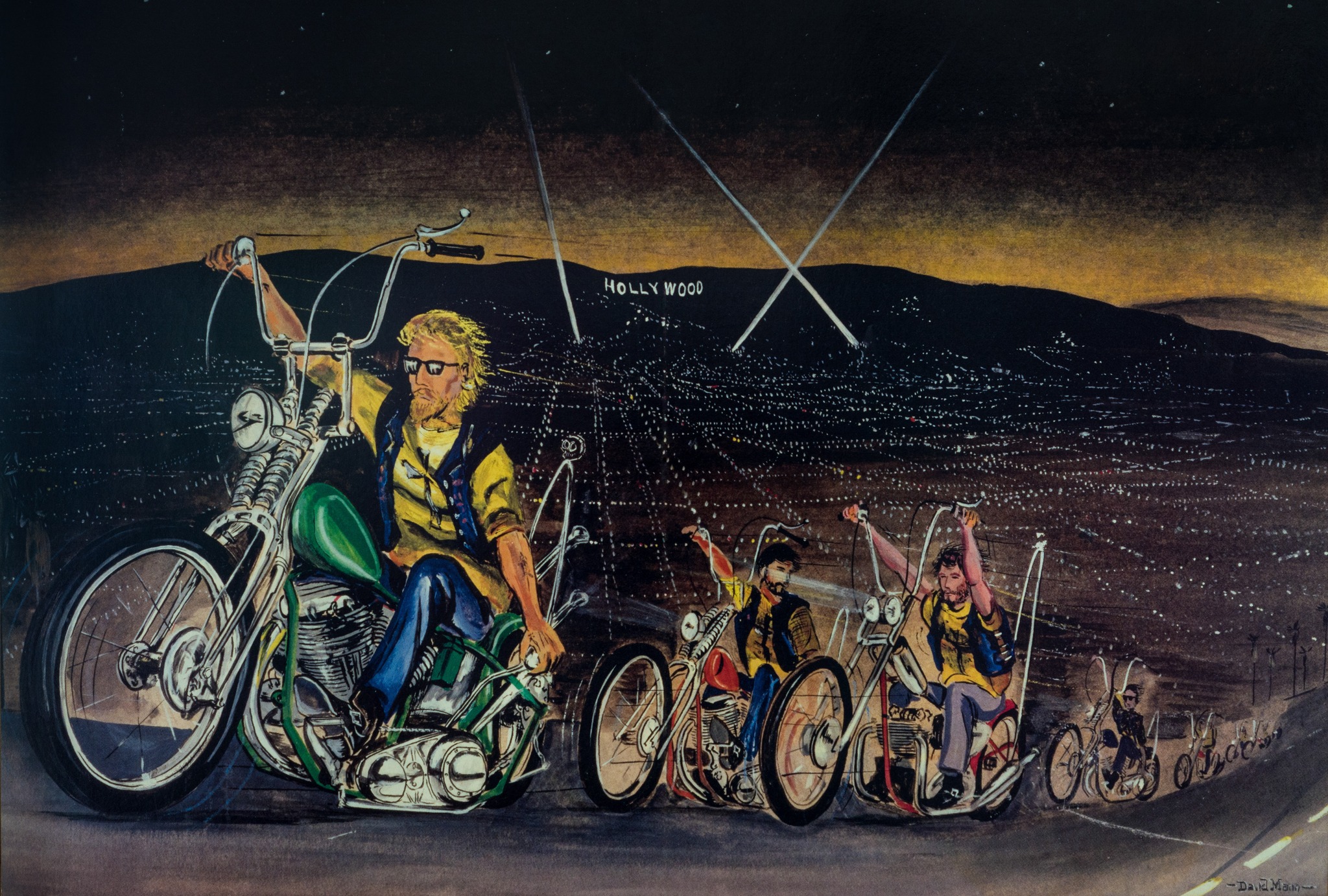
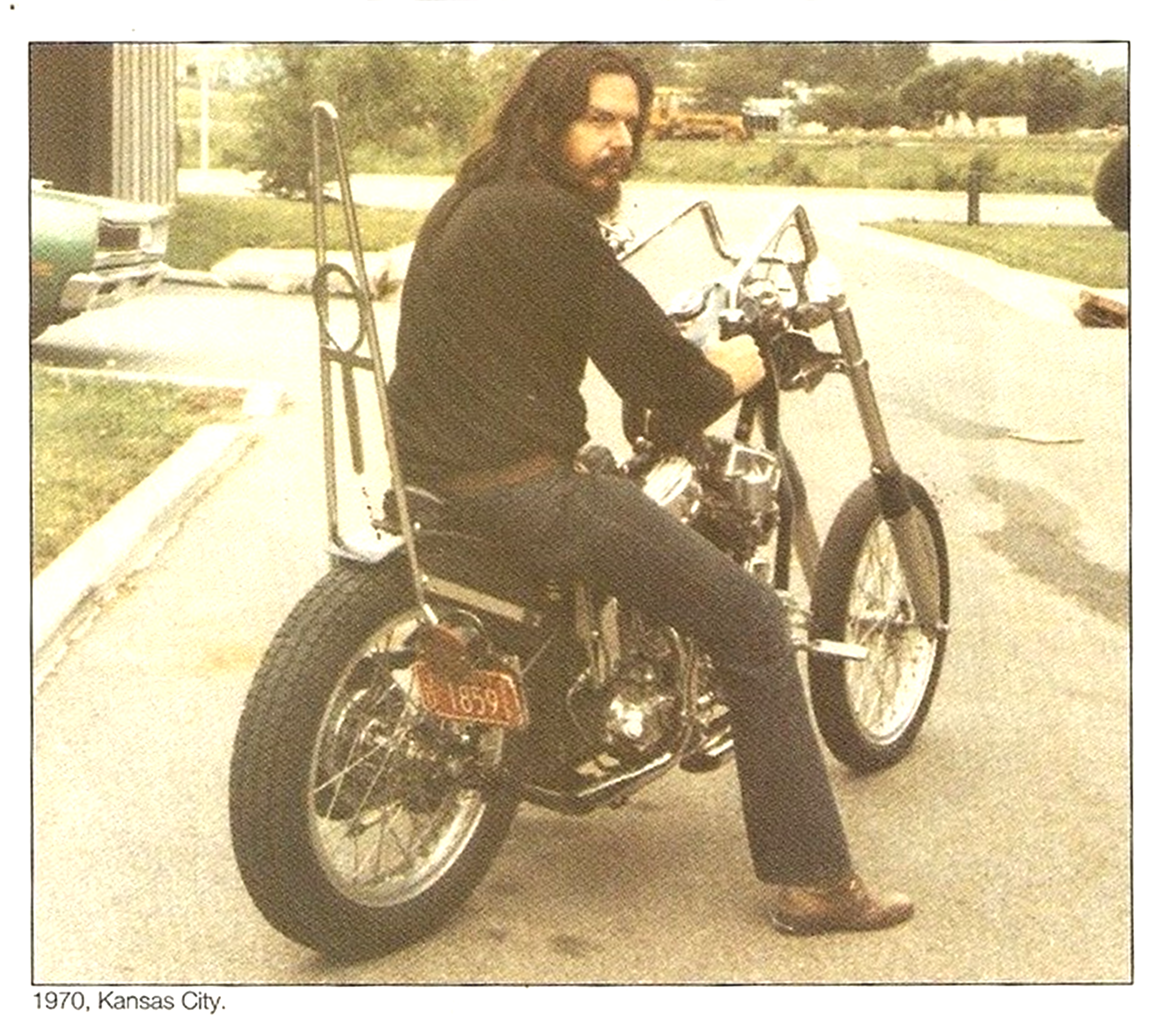
Hollywood Run was the painting Dave Mann’s friend and club brother Tiny showed to Choppers publisher Ed ‘Big Daddy’ Roth. Roth recognized Mann’s potential, quickly bought up as many of the artist’s paintings as he could, and turned them into a profitable line of posters.Another of Dave Mann’s early paintings for Ed ‘Big Daddy’ Roth features a wild desert party populated by outlaw bikers from numerous extant motorcycle clubs of the day.Dave Mann in 1970, aboard the panhead chopper he purchased from Hells Angels member Buzzard. BTW, Buzzard appears in Bill Ray’s book of photographs – Hells Angels of Berdoo ’65: Inside the Mother Charter (NYC, 2010, Bill Ray/Blurb) – and is mentioned in Hunter S. Thompson’s seminal work of ‘gonzo journalism’: Hell’s Angels: The Strange and Terrible Saga of the Outlaw Motorcycle Gangs(NYC, 1967, Random House)
In 1971 Mann answered an advert for a ‘motorcycle artist’, discovered in the back pages of a new biker magazine called Easyriders, and spent the remainder of his working life as in-house artist for the publication. His first centerfold painting for Easyriders appeared in October, 1971, and Mann reportedly produced artwork – centerfold paintings, story illustrations and adverts – for every issue from that first to his retirement in 2003, shortly before he passed away. His final piece, Sunset, appeared in the May 2004 issue.
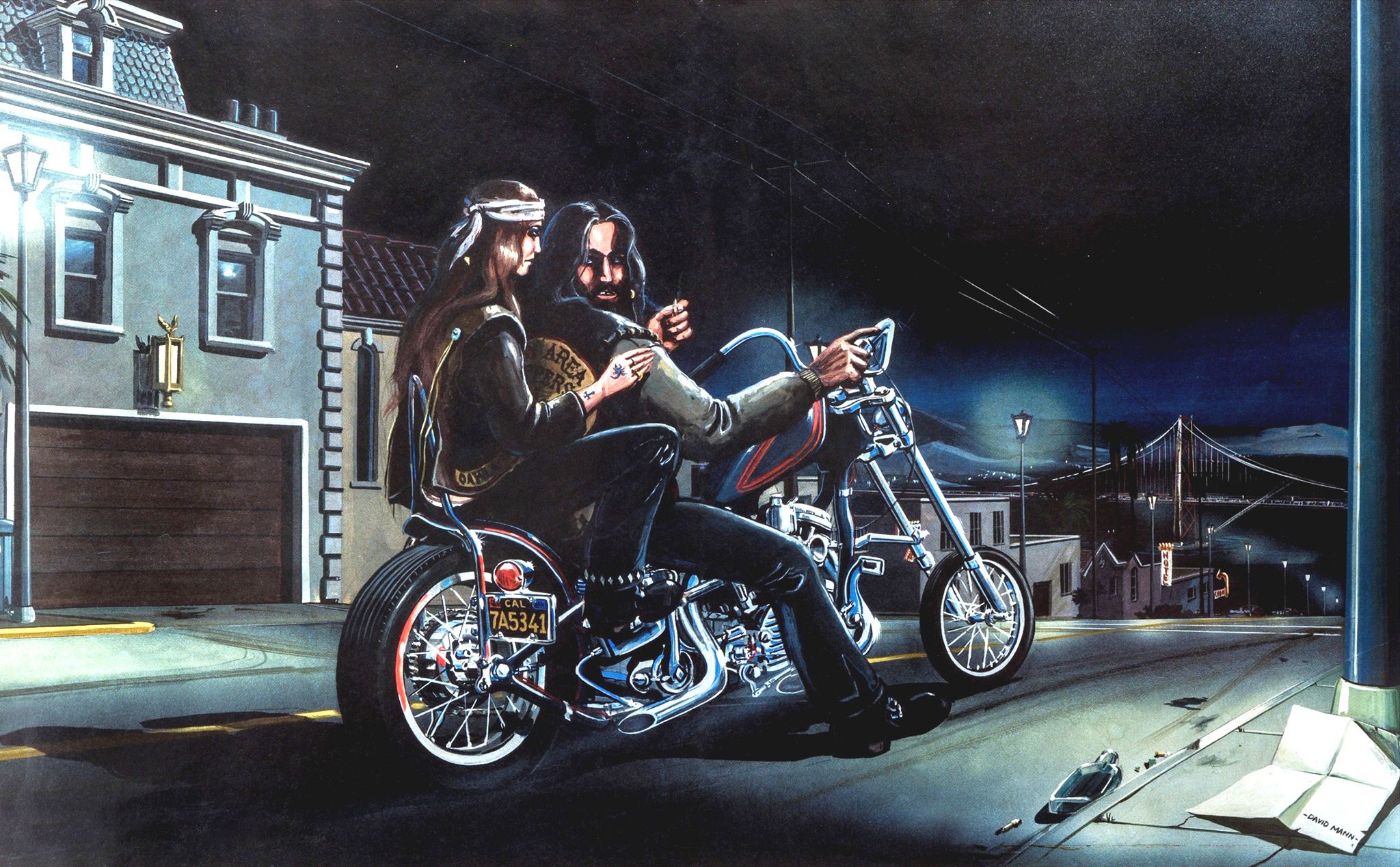
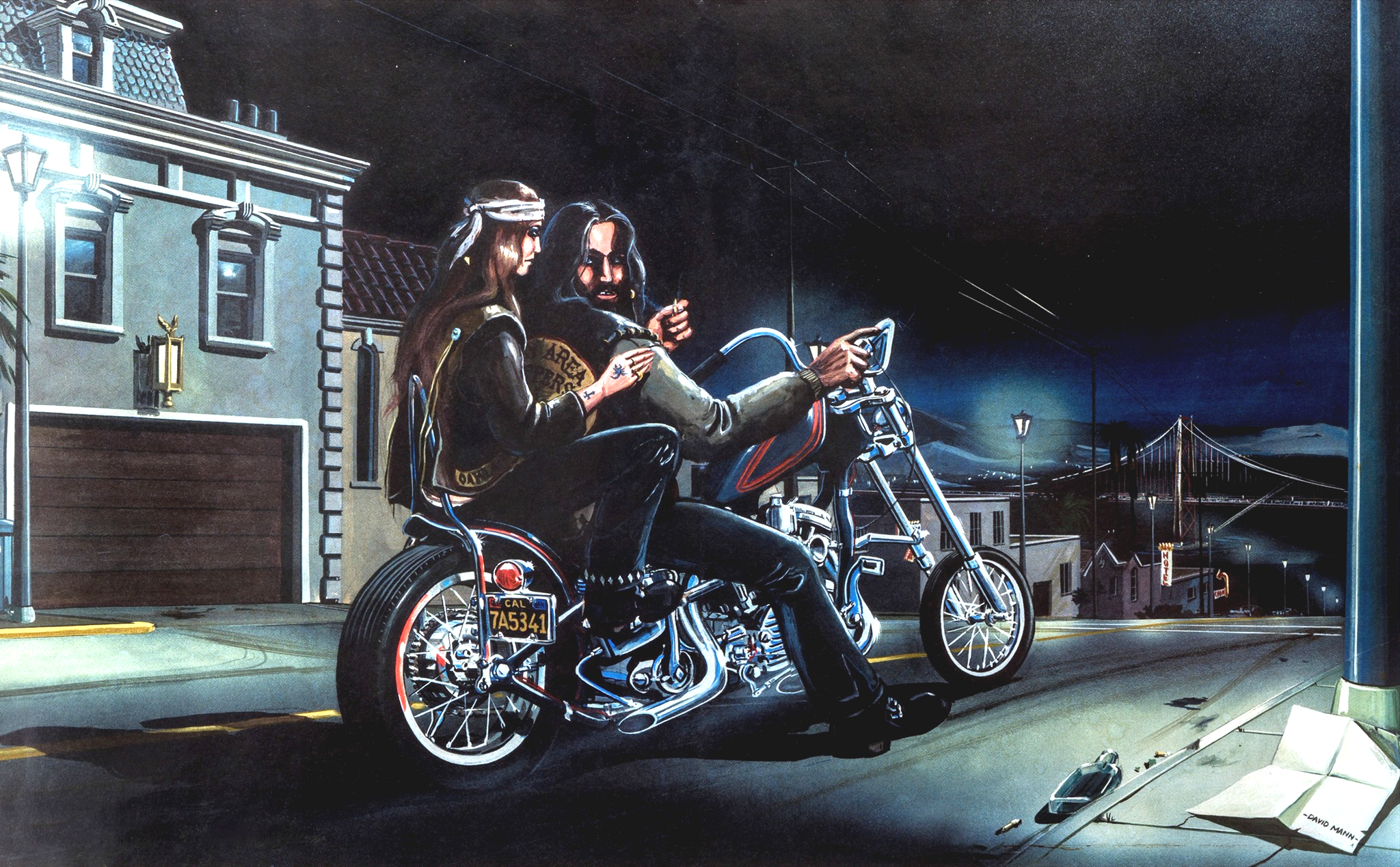
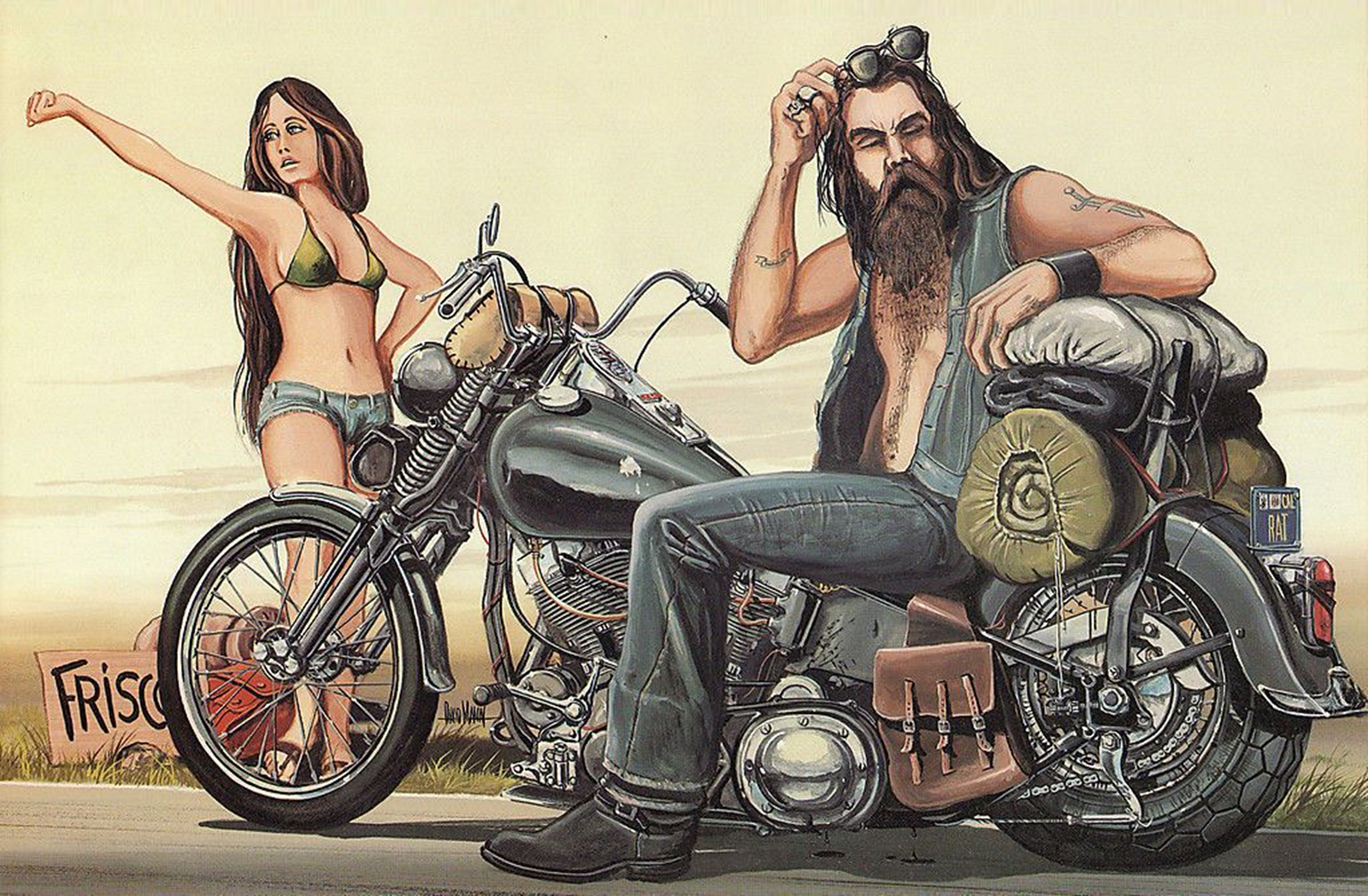
One last toke for the road. Titled ‘Frisco Nights‘ or ‘One More for the Road‘, this was Dave Mann’s first-ever centerfold for Easyriders. It appeared in the magazine’s third issue, in October, 1971. Mann reportedly created art for every issue between this and his final piece (below) published in May, 2004, along with additional illustrations for other magazines, book publishers, friends and collectors. That’s a hard-working artist!.
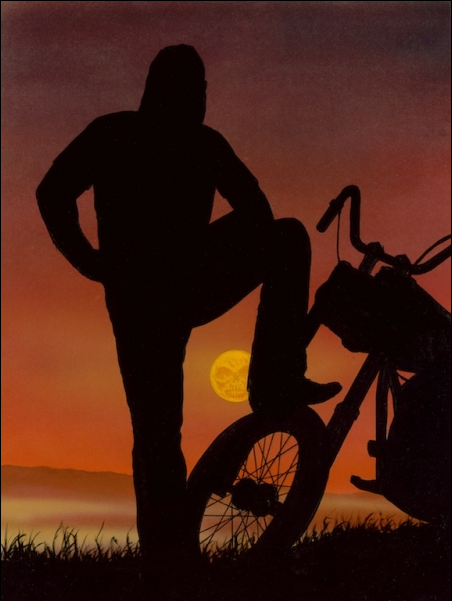
Aptly, Sunset, May 2004 was Mann’s last original piece for Easyriders.
REPRESENT!
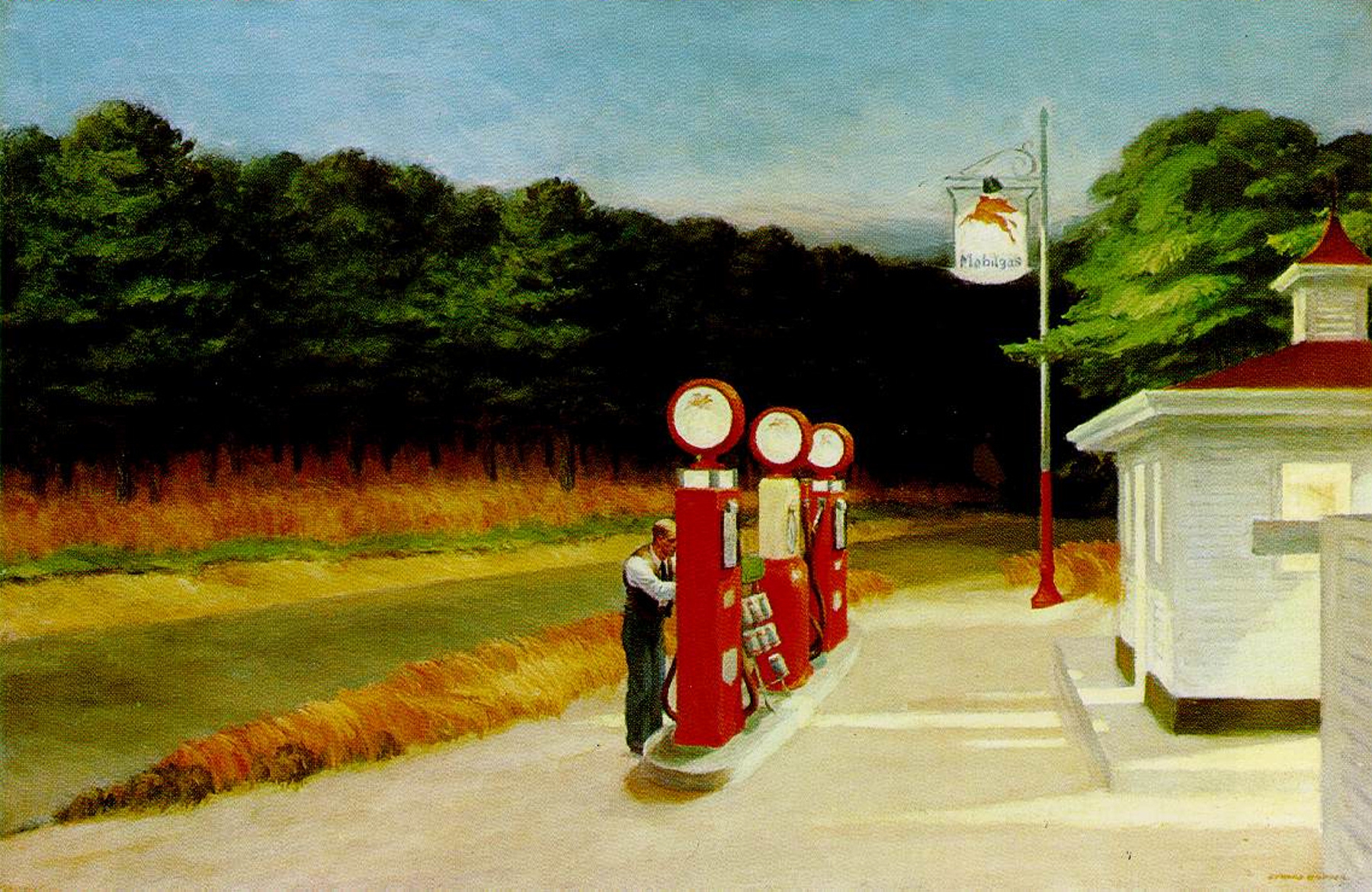
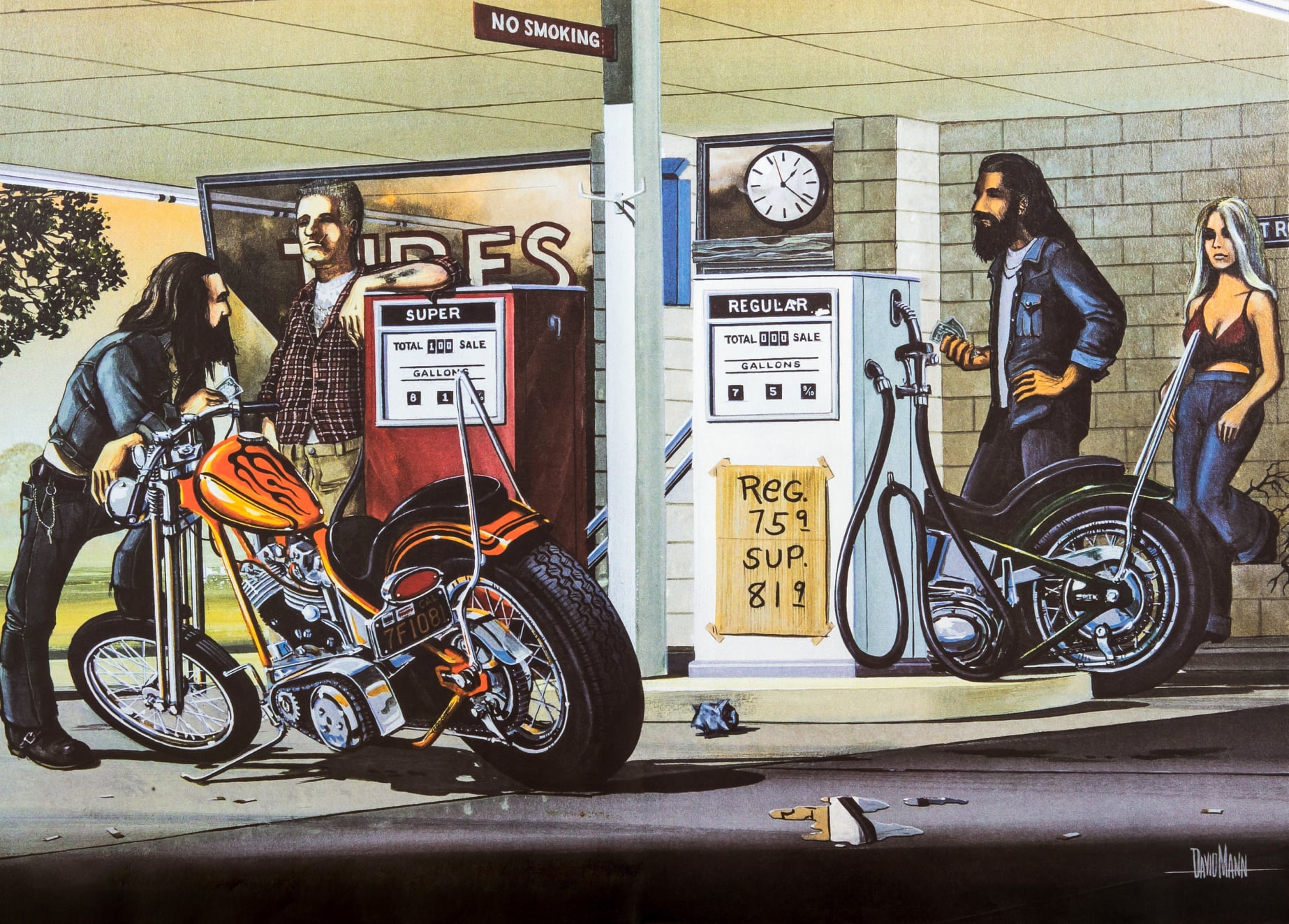
His earliest works were primitive – a cross between illustration and caricature – but as he gained experience Mann’s work took on a style reminiscent of the American painter Edward Hopper, who is best known for his iconic Nighthawks(1942). Look at the figures in Hopper’s work, and compare them to Mann’s. I certainly see the influence.
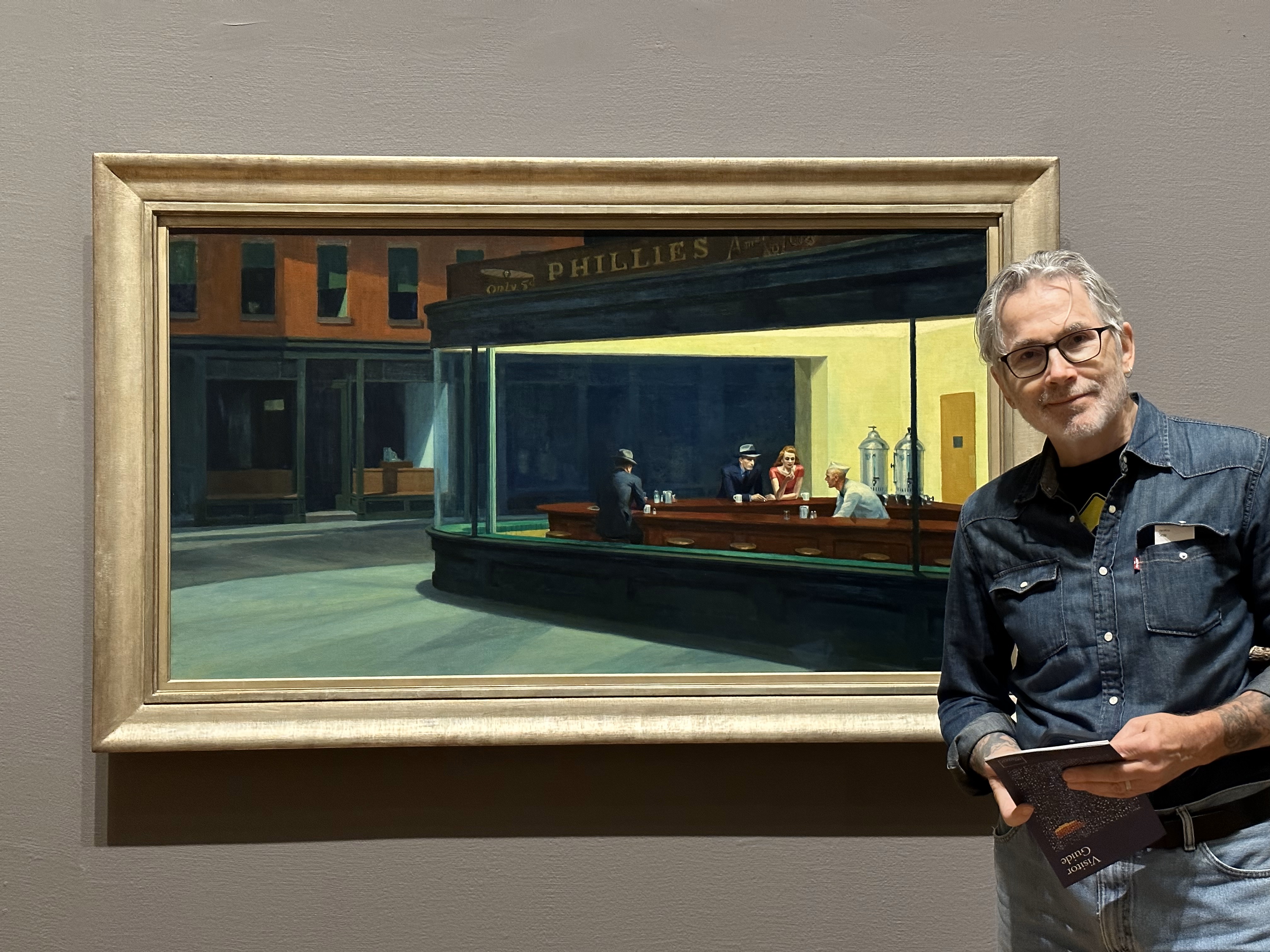
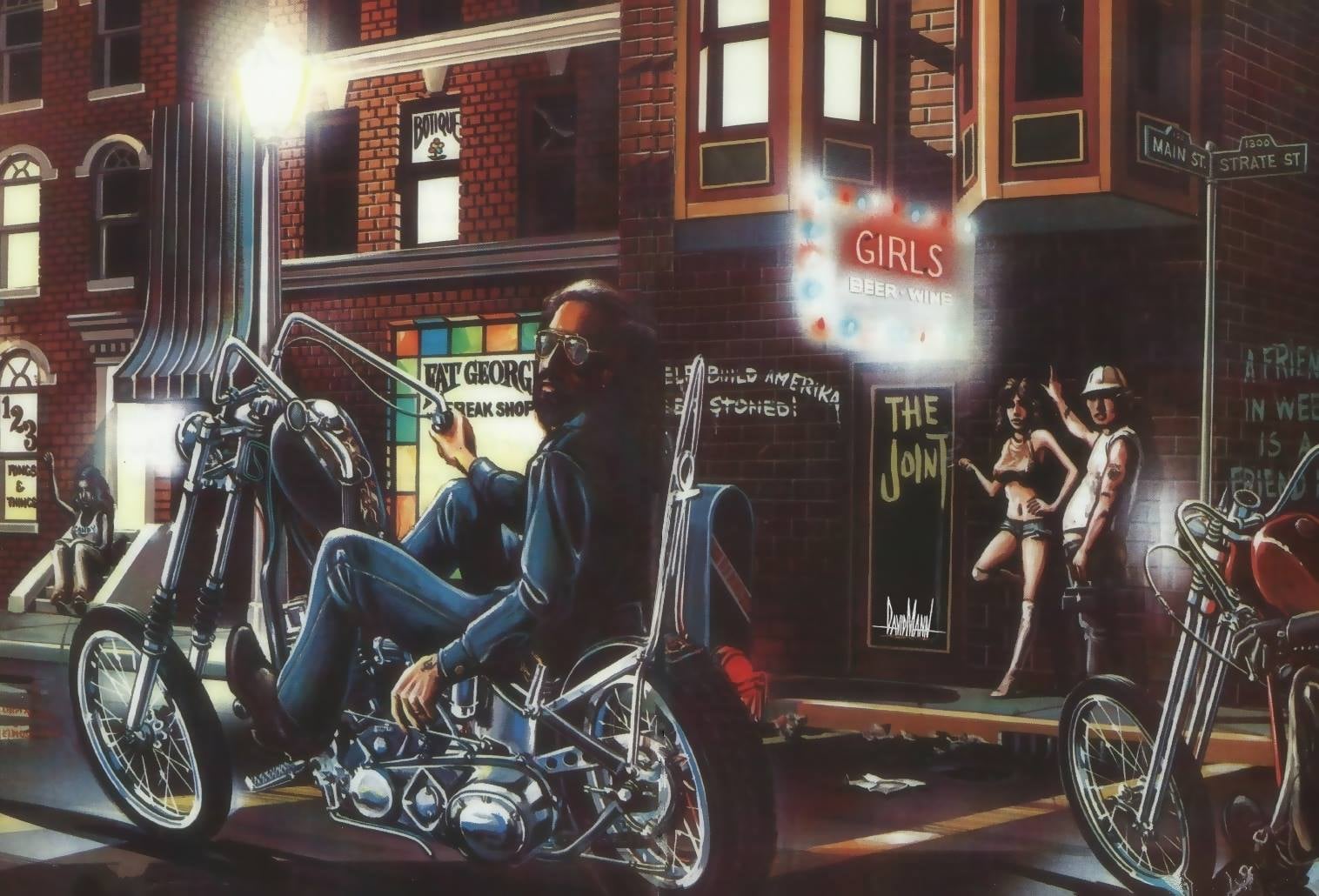
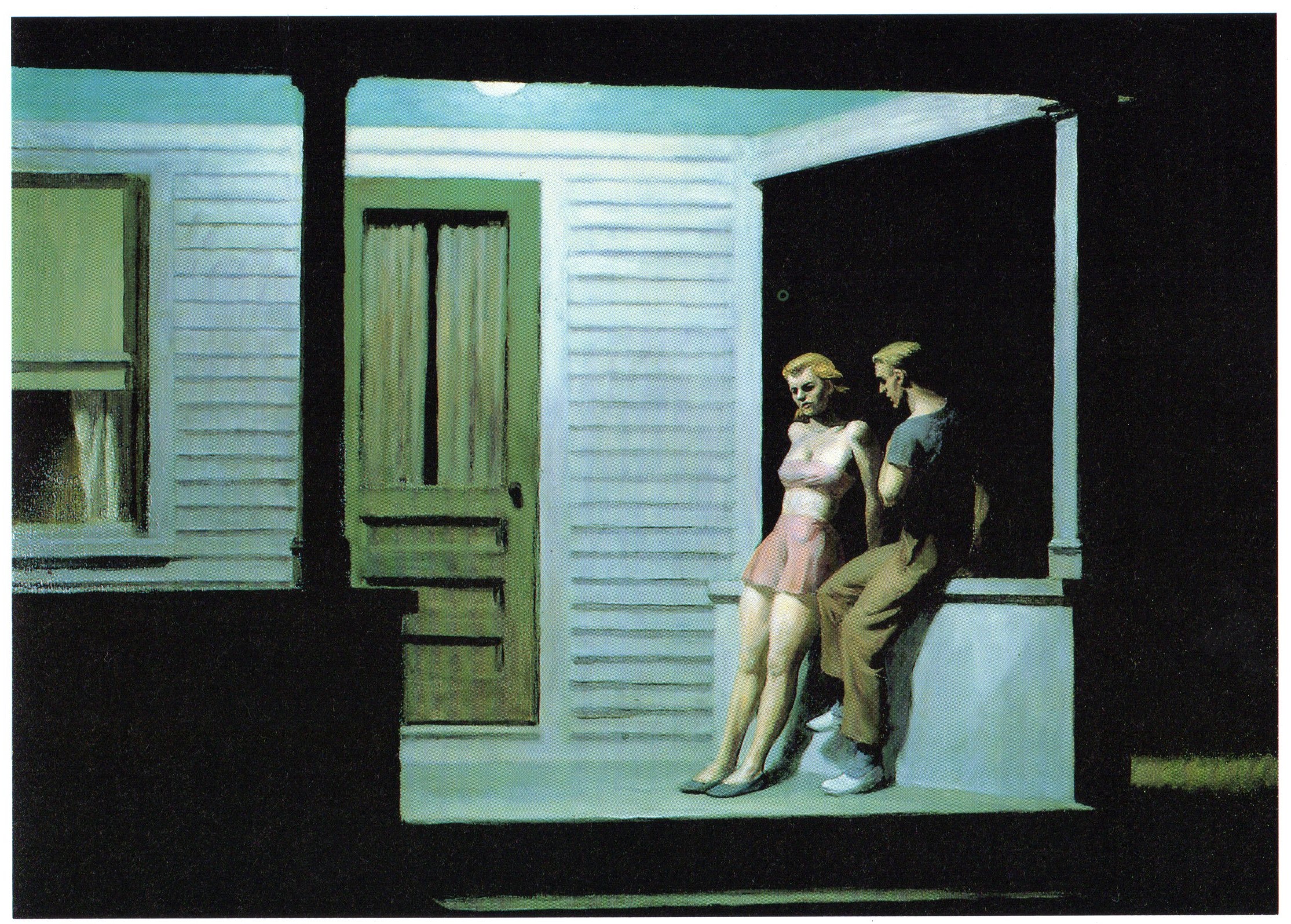
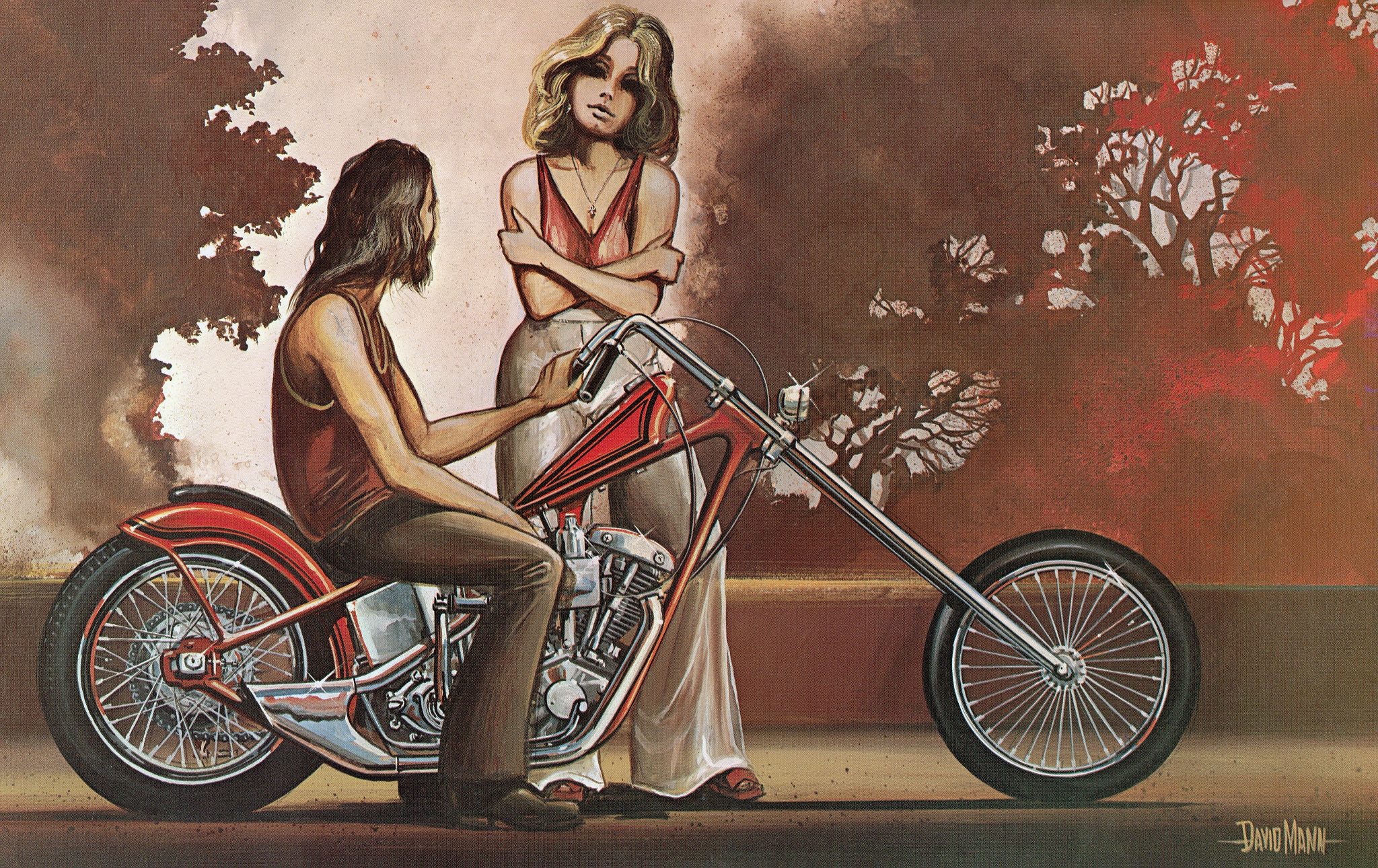
Edward Hopper The Nighthawks(1942)On a road trip that took me to the National Motorcycle Museum at Anamosa, Iowa, on the day they closed forever, and the Harley-Davidson Museum in Milwaukee, I also got to visit the Art Institute of Chicago, where the original Nighthawks lives. My wife managed to catch me and the painting alone in the one split-second when it wasn’t surrounded by admirers!David Mann Midnight Run(June, 1972)Edward Hopper Summer Evening (1947)David Mann Pick-Up (Want Some Candy?)January 1974 Edward Hopper Gas (1940)David Mann Gas Stop (1967)
More than technique or style, however, Hopper and Mann shared the desire to illustrate and elevate the prosaic, the quotidian, the mundane everyday doings of regular people historically overlooked by representational artists. For Hopper it might be patrons seated in a late-night diner – an apparent oasis of light and warmth in an otherwise dreary cityscape – sharing space and yet isolated from one another, silent, bored. For Mann it could be the streetwalker ignoring her john to watch the more attractive, more enticing biker cruise by on his radical panhead chopper. Hopper might present a sweet moment between a young couple on a dark summer evening – you can almost hear the crickets singing – while Mann’s swain straddles a raked and stretched shovelhead as he chats up the object of his affections on a crisp autumn afternoon….
You get the point.
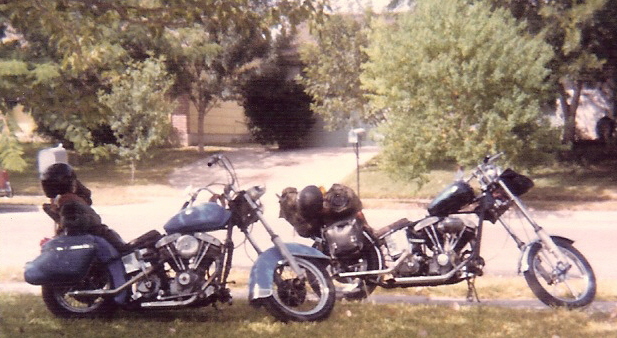
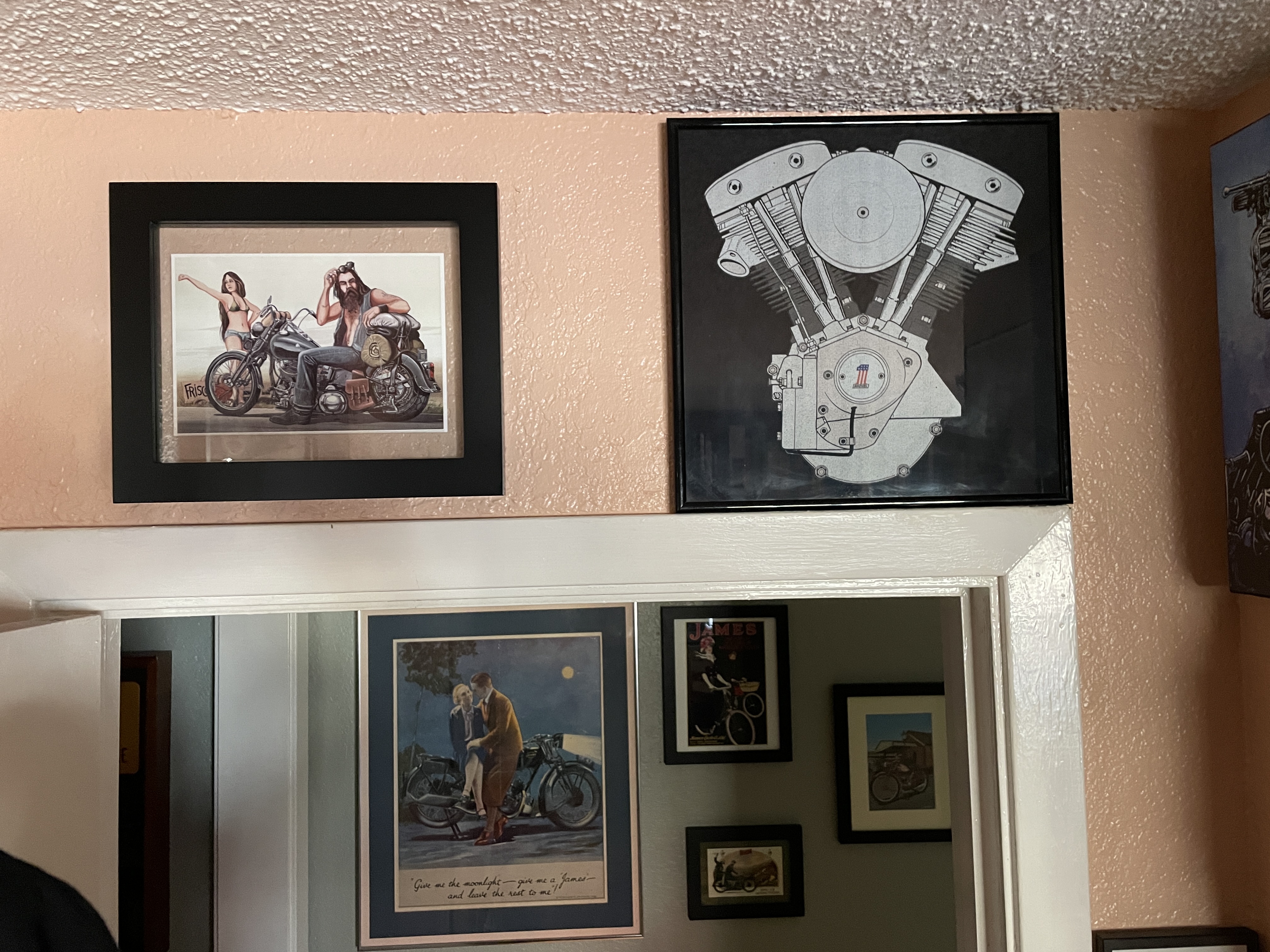
The Dilemma (September 1976) is one of my favorite Mann paintings of all time; I even have a small print of it framed above my office door. Dave’s attention to the minute details of this road-weary ‘rat’ panhead and rider is mind-boggling. Note the cracked and taped-together taillight lens, chipped paint on the fuel tank, mismatched tool bags strapped to the front forks and oil drips on the pavement below. Look at the rider’s military tattoos, too; his ragged cut-off vest, heavy engineer boots and greasy Levi’s, doubled up for added protection. Then there’s the quiet humor of the scene – a hot hippie hitchhiker headed to that Haven of Hedonism, San Francisco, and the biker with no place to put her! Sadly, this actually happened to my partner and I on our way to Sturgis. Our bikes were laden with camping gear, and we had no room to pick up two hitchhiking honeys we encountered just south of Oklahoma City! 😒 My rigid 1974 shovelhead and T.R.’s rigid jockey-shift ‘73 shovelhead chopper on the first Friday of August, 1982, packed and ready for the run to Sturgis.The Dilemma and the design for my Shovel Shop t-shirts. In the hall, vintage adverts for the Famous James motorcycles. See my post below about the marque, its history and my history with it.
And by ‘centerfold’ I merely refer to the fact that Mann’s work appeared in the center pages of each issue, where it could be removed (as so many of us did) and turned into a poster. Although many of his paintings included idealized images of women, his purpose was to document our lives as bikers, not provide masturbation motivation for horny teenagers!
STRAIGHT ON FOR YOU!
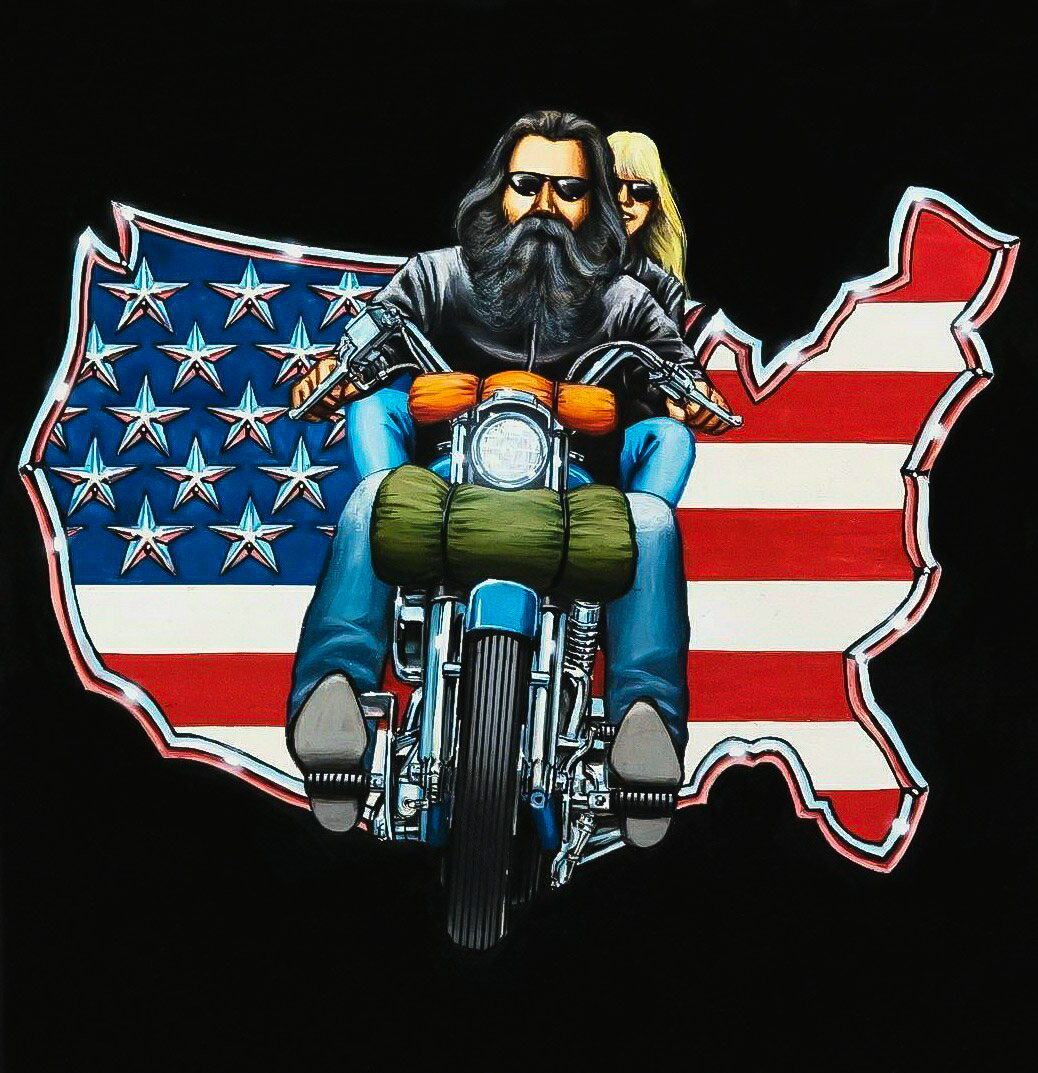
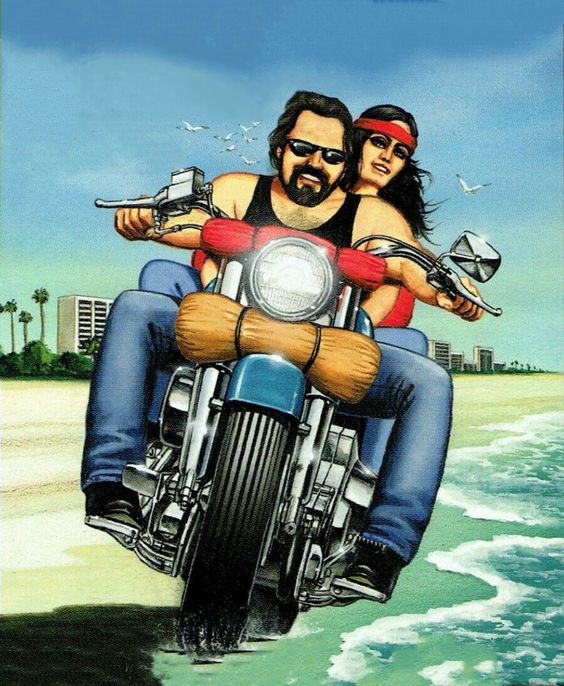
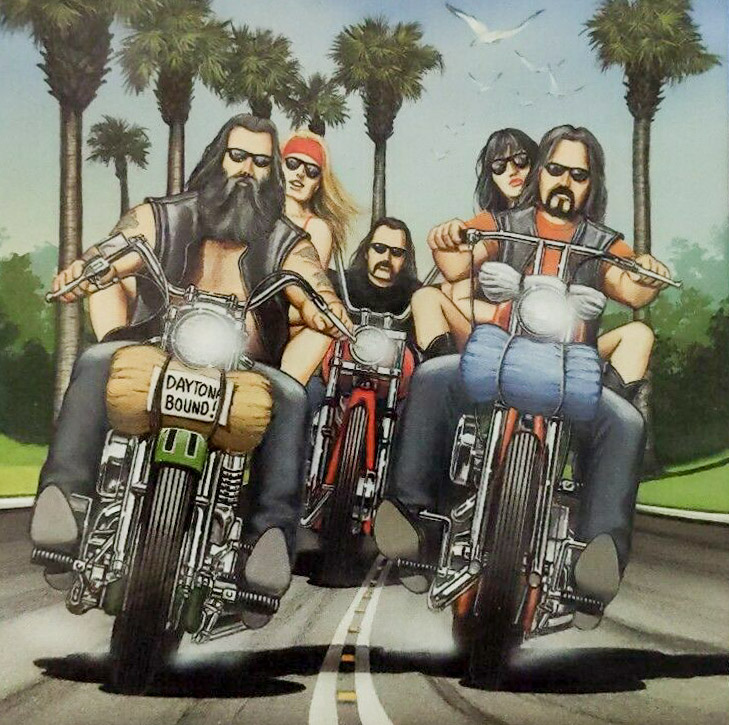
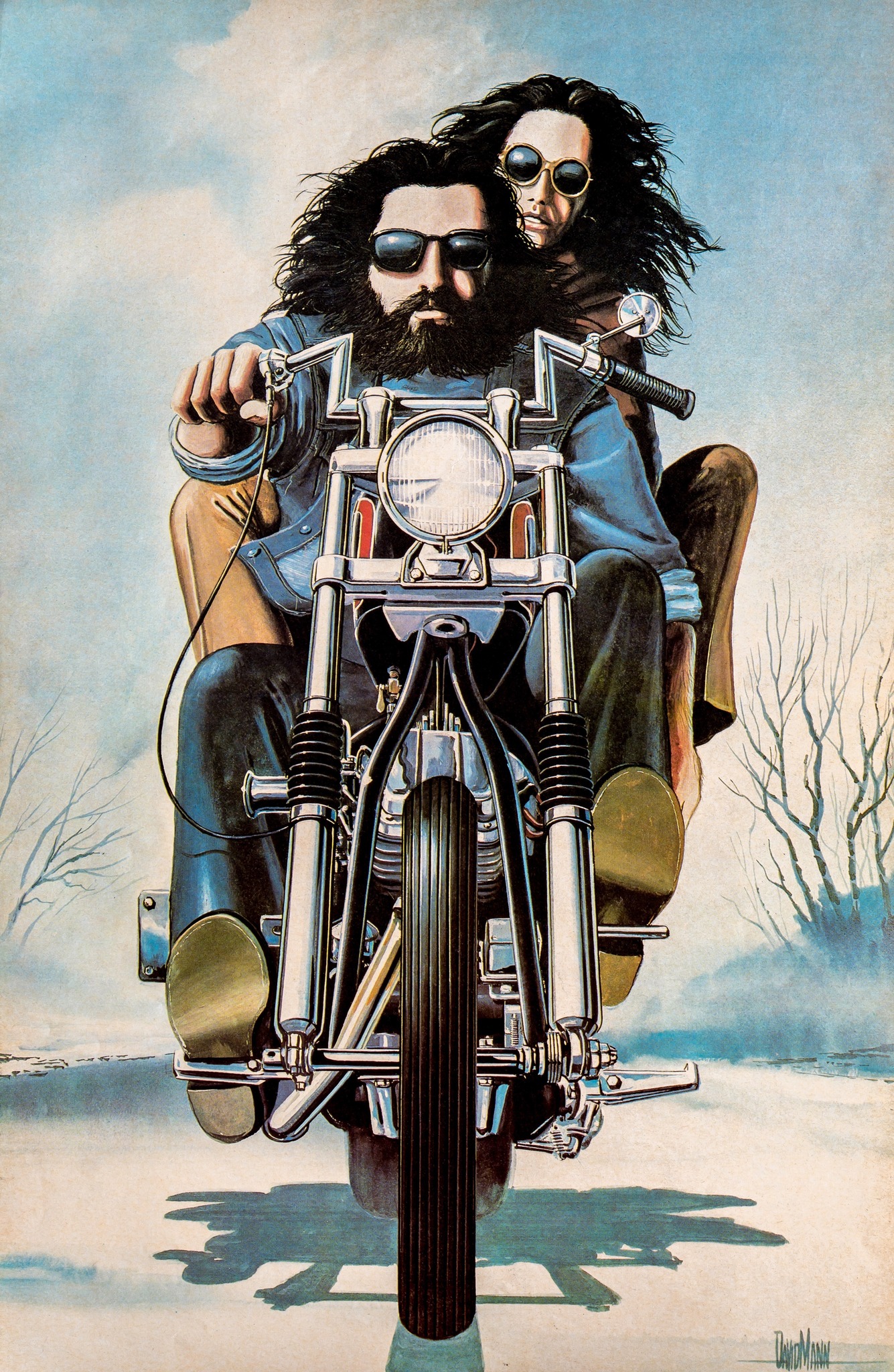
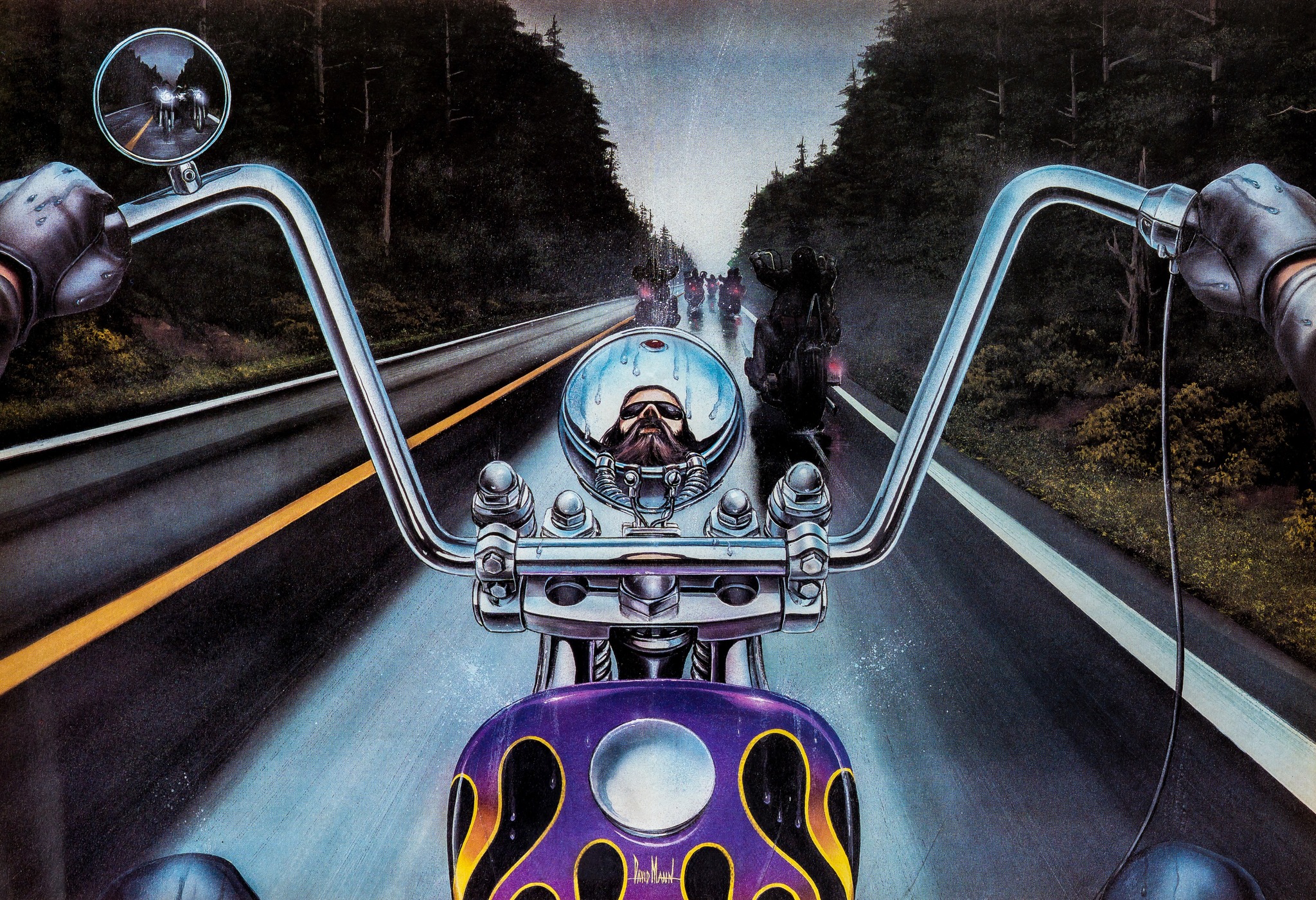
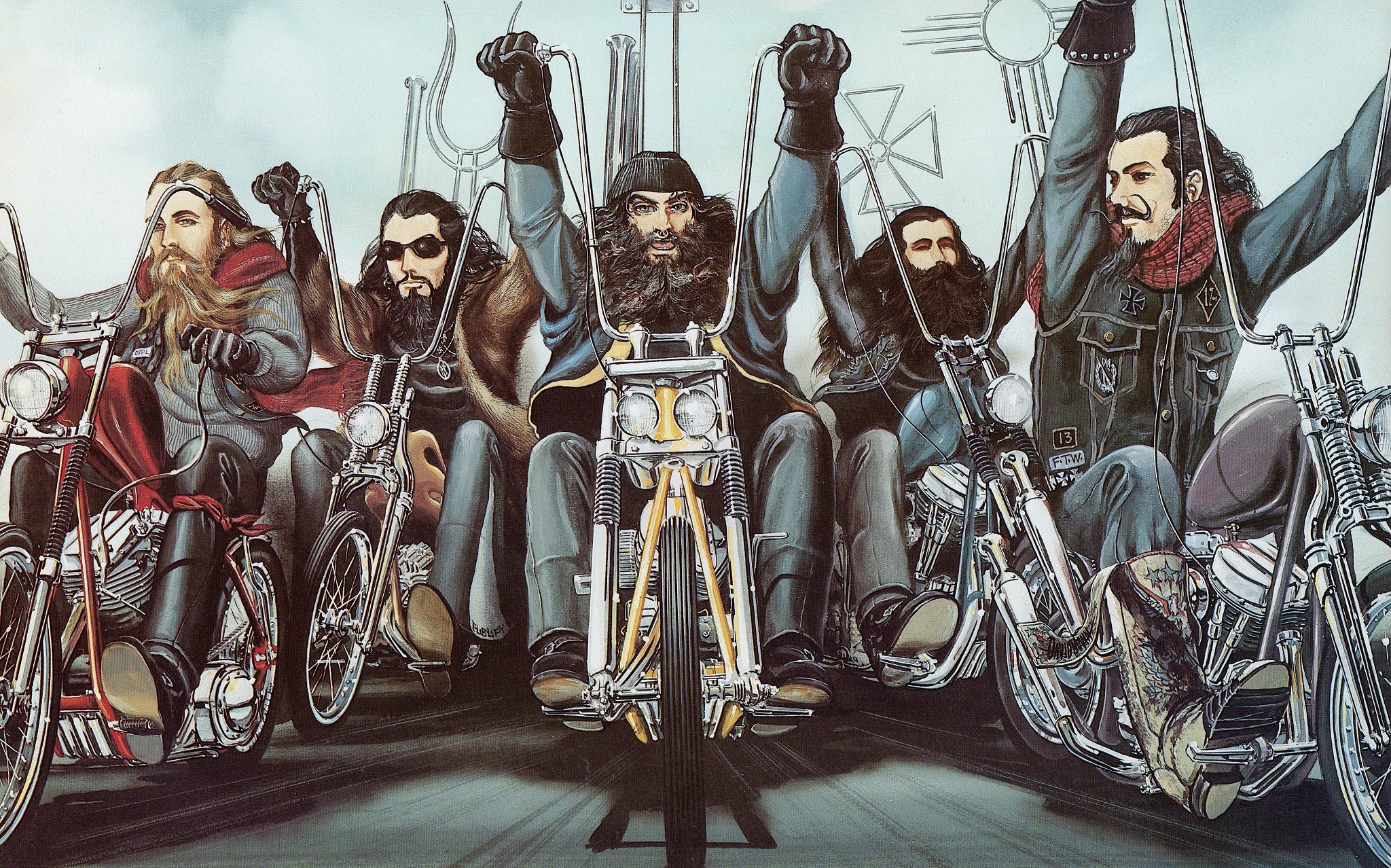
One perspective Mann relied on was full frontal….
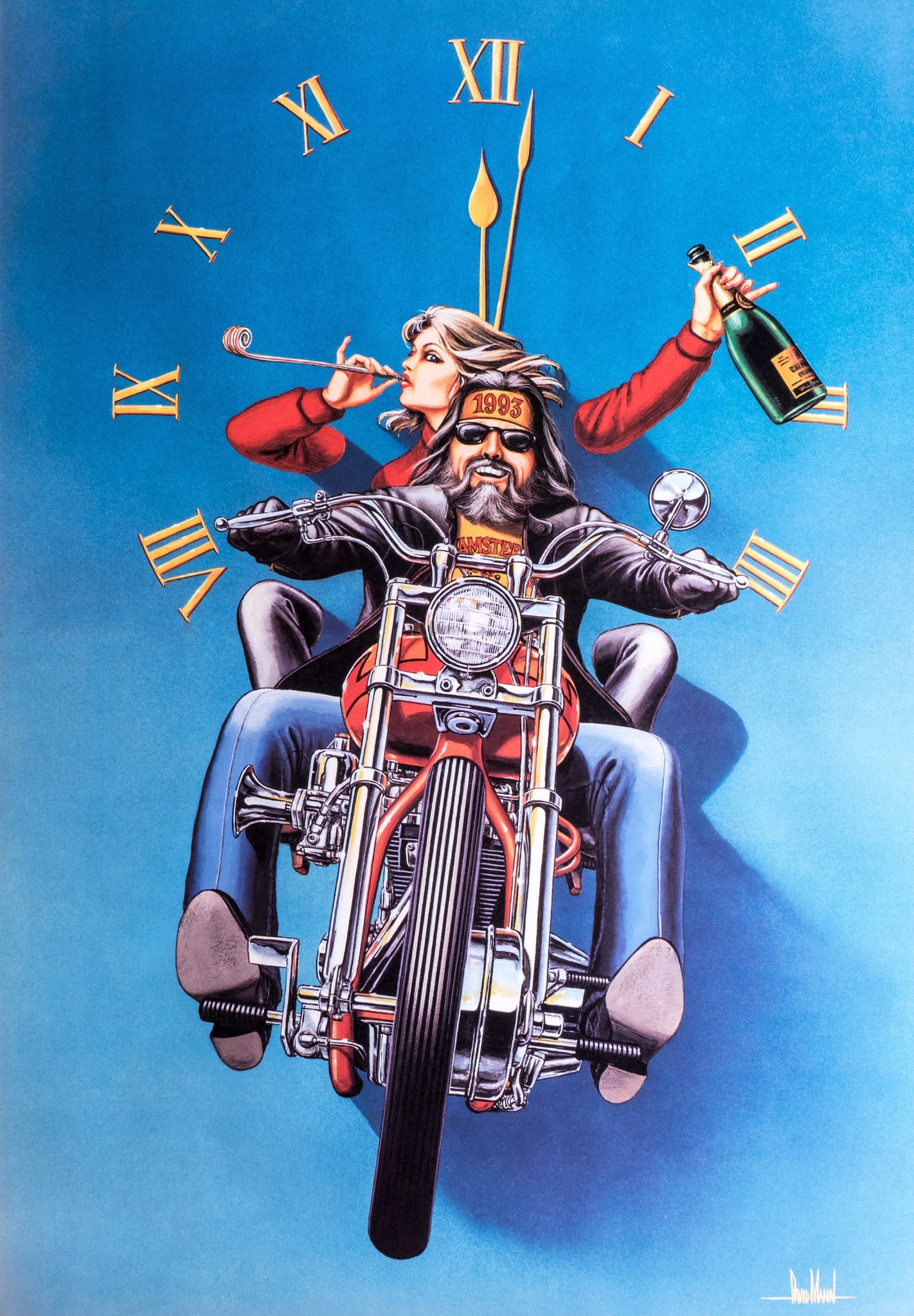
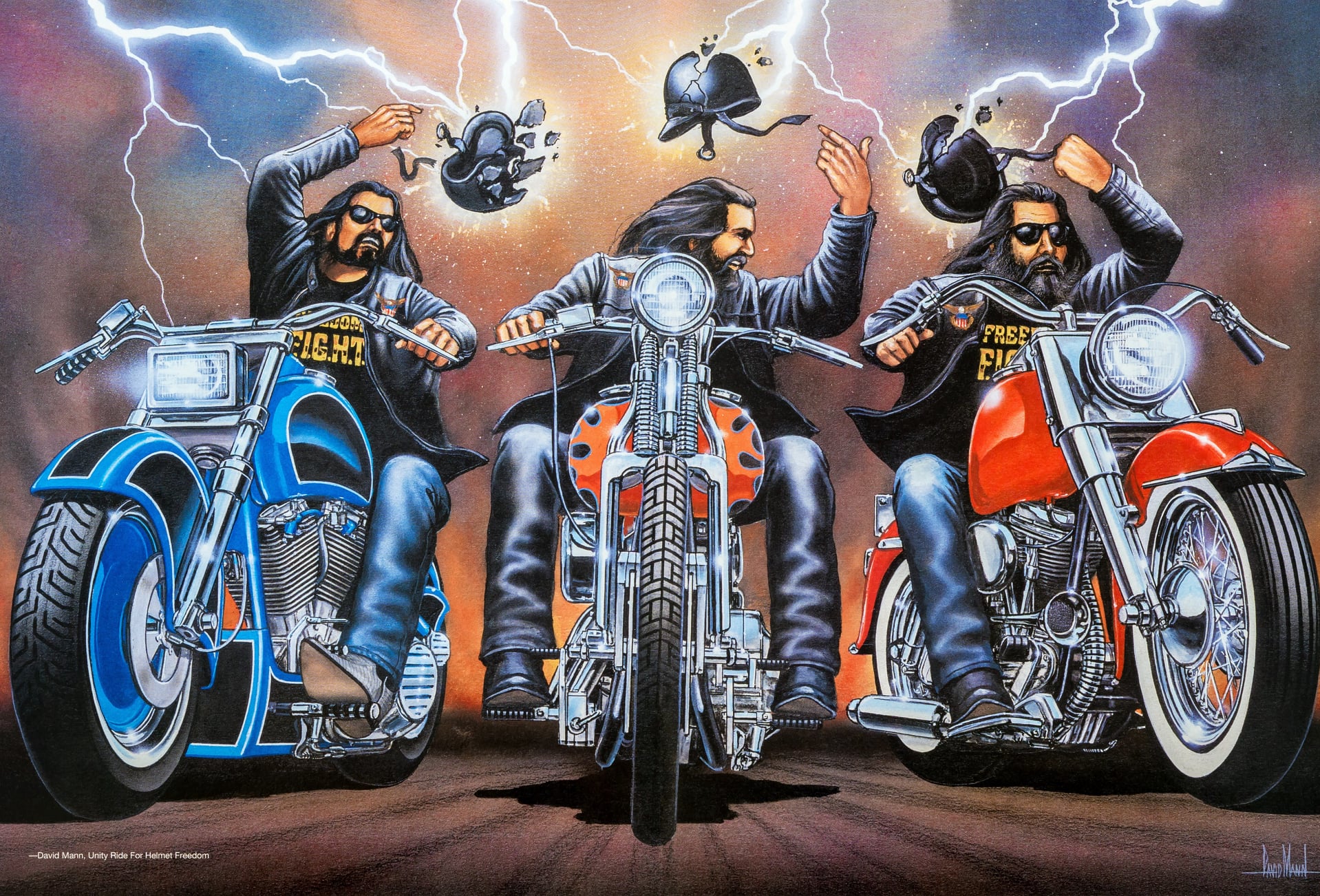
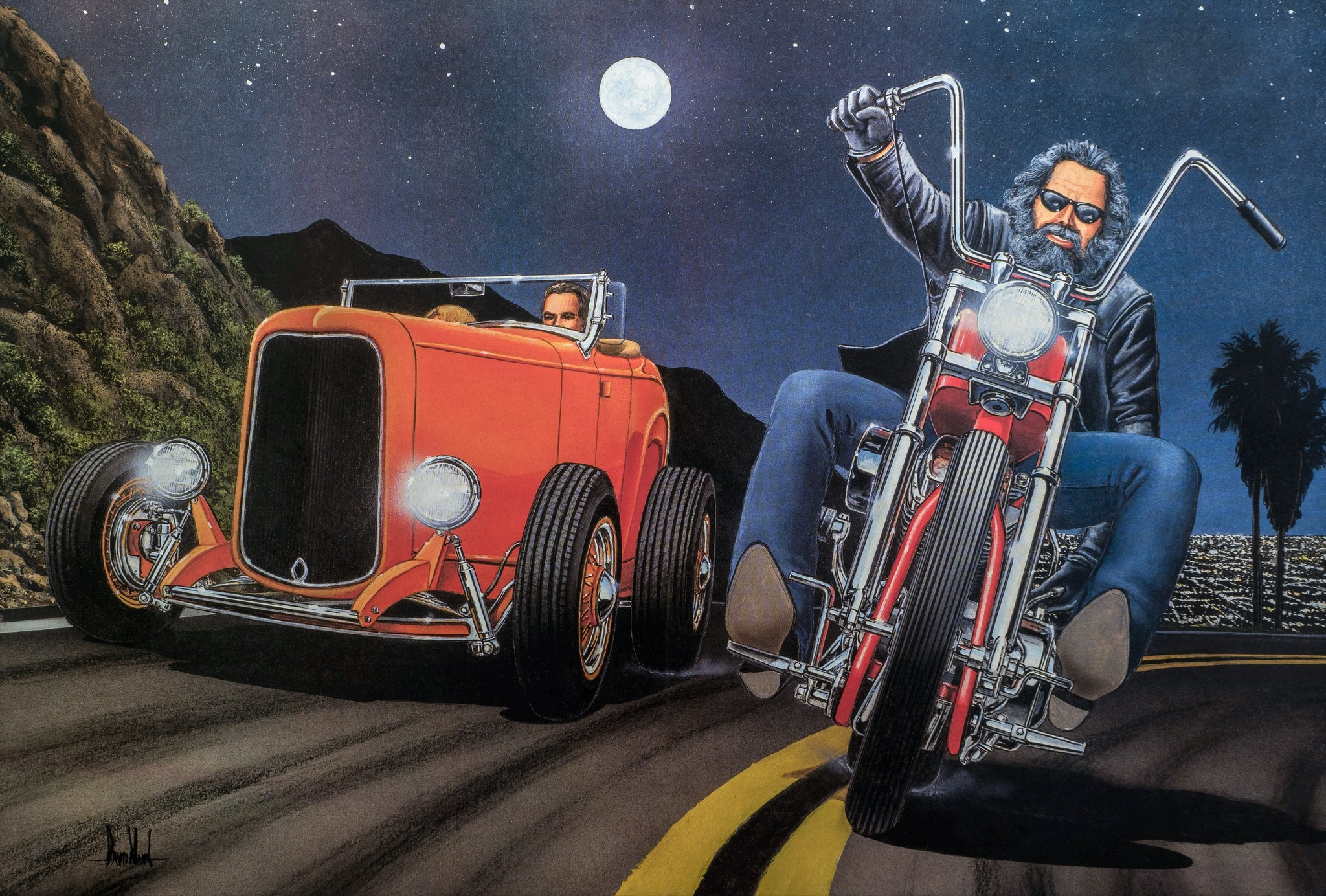
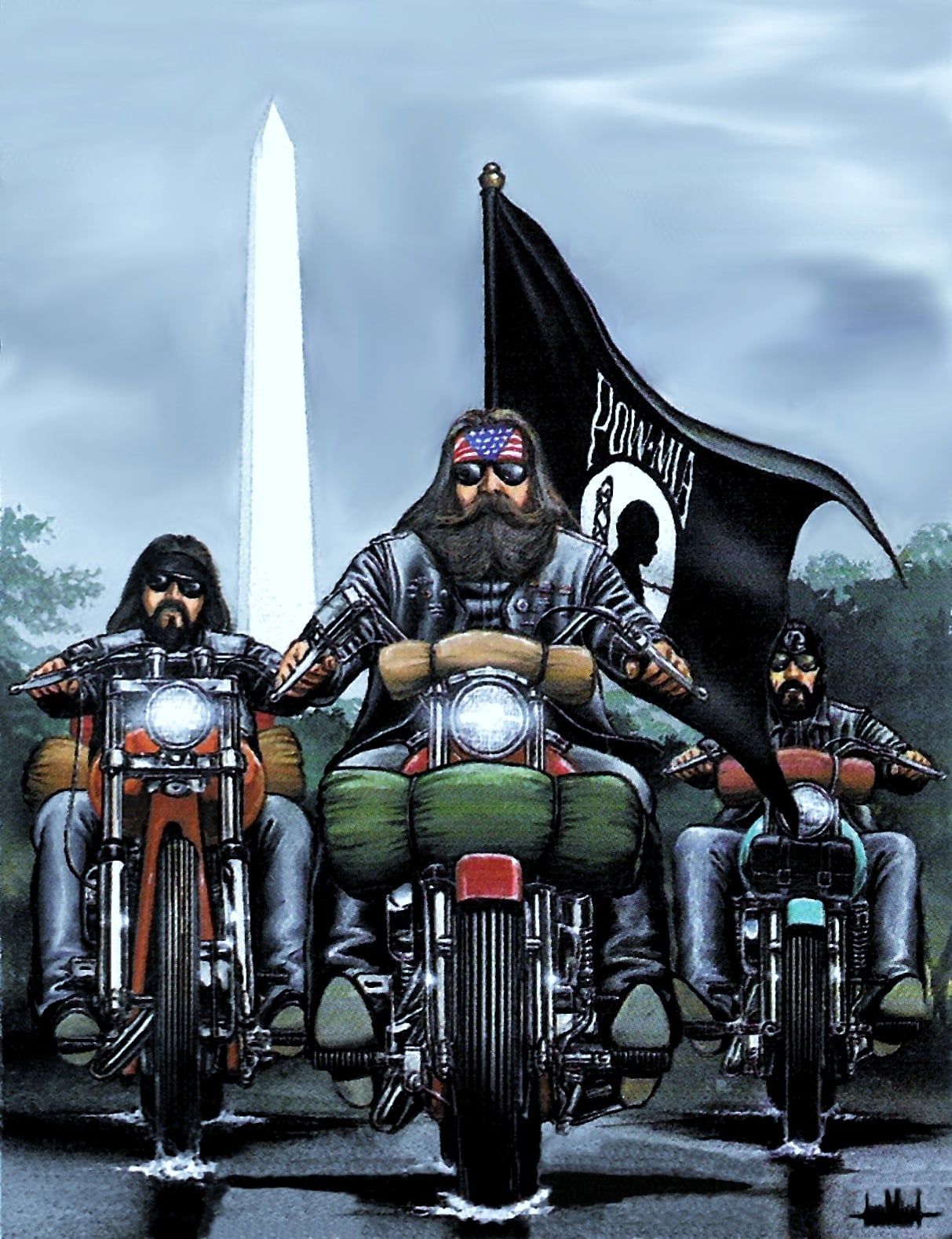
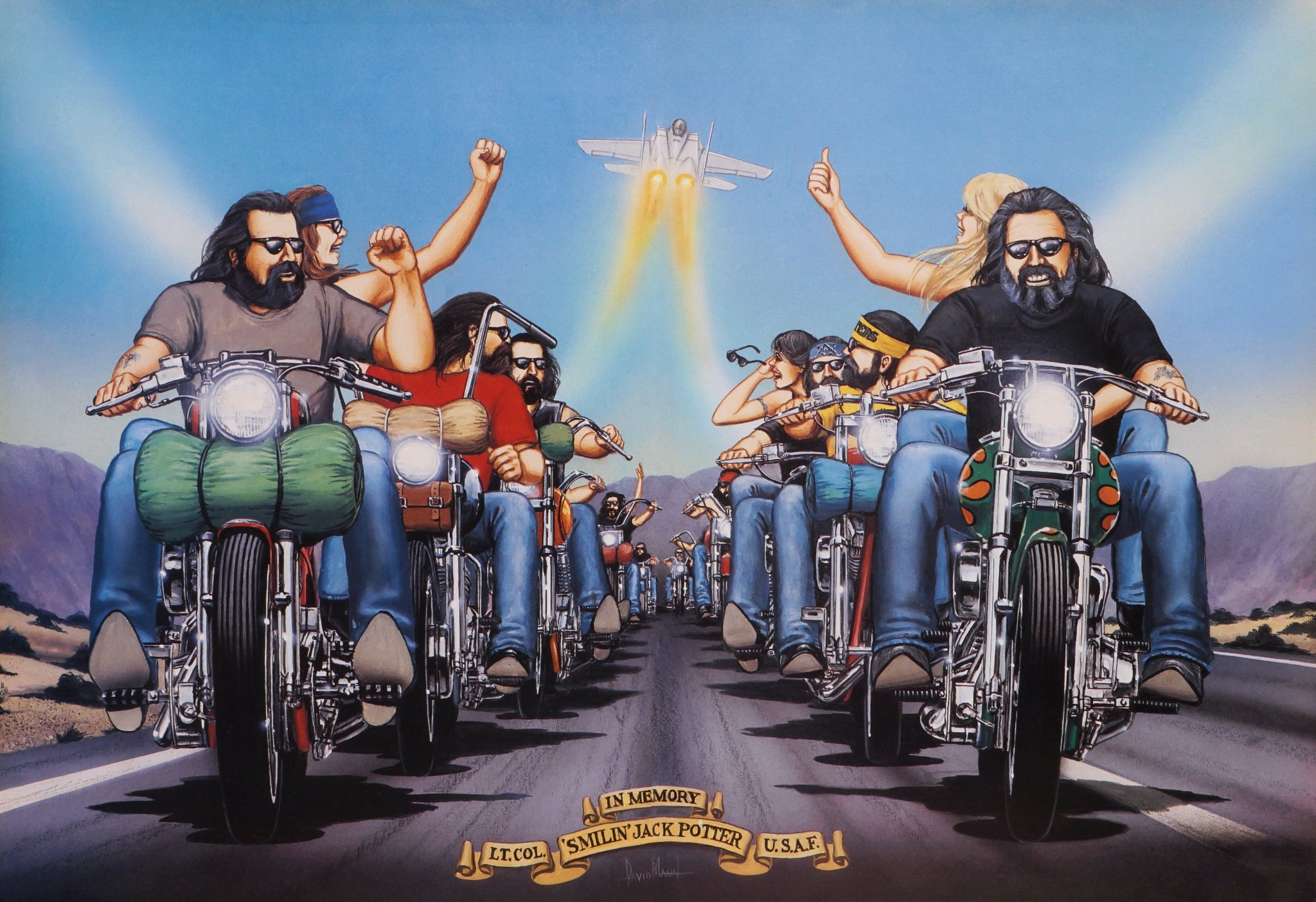
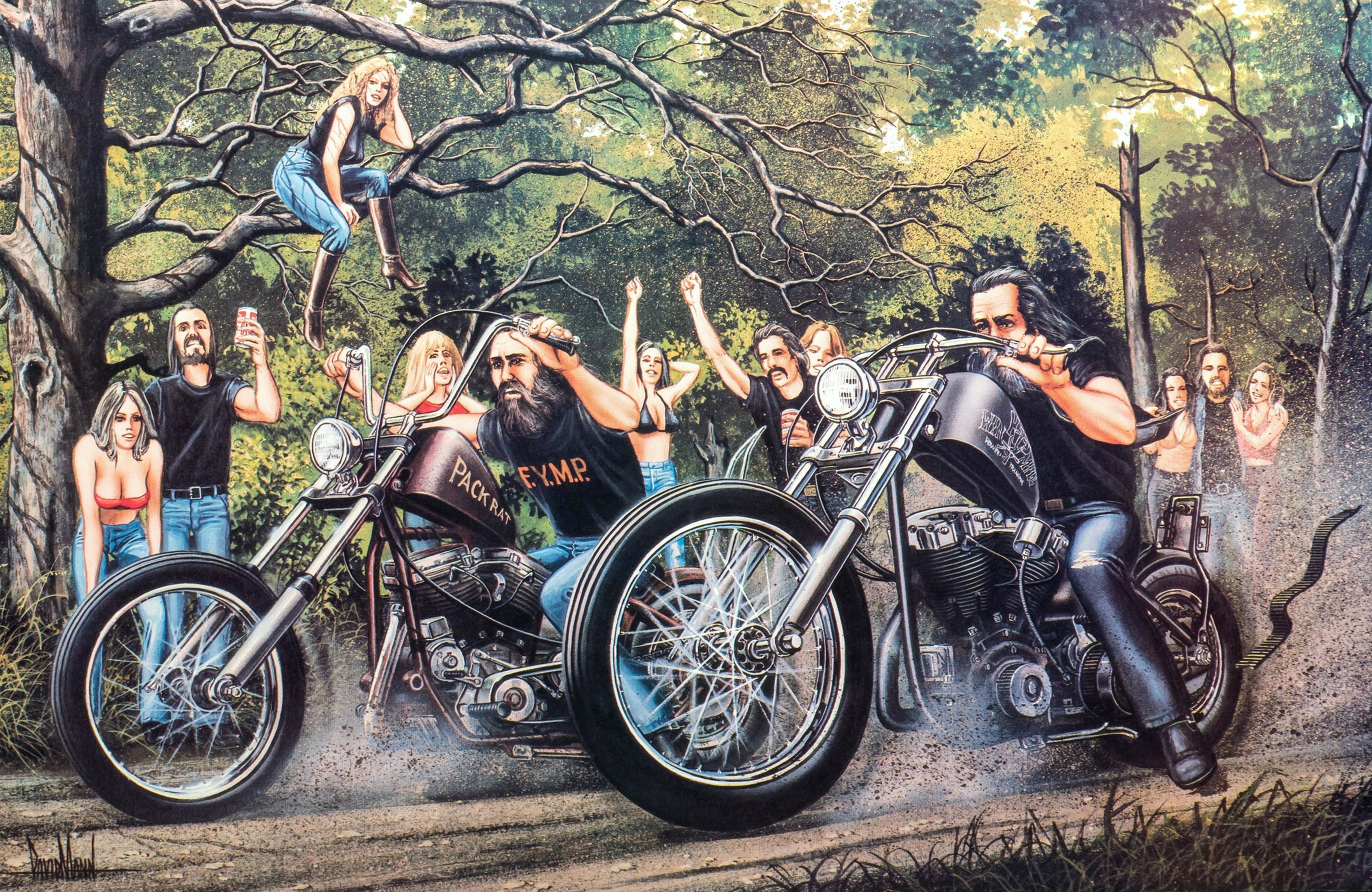
….from his earliest efforts. This is Pacific Coast Highway Run, 1964Easyriders Video #43 cover artEasyriders Video #40 cover artEasyriders Video #29 cover artEasyriders Bikes & Babes Video cover artWinter Ride, date unknownA Cold Winter Ride, story illustration from Easyriders January 1990Excelsior-Henderson, October 1998First Ride of the Year, January 1993Helmet Protest, January 1996, highlighted a political position dear to most bikers’ hearts: the freedom to choose whether or not to wear a helmet when we ride. Even many of us who wear helmets by choice still believe the decision should be ours alone, and not left some government bureaucrat who has never ridden a motorcycle in his life. Mann revisited this theme over and over again through the years. This piece also shows his ability to capture complex objects like motorcycles at different angles in the same painting.Inside Pass appeared in BIKER, July 2000. Dave was as skilled in painting automobiles as he was motorcycles, and capturing the action of two moving vehicles pitted in a wheel-to-wheel race.Run to the Wall , date unknown. Many bikers are military veterans, and believe no service member should be left behind, so the cause of POWs and MIAs affects us deeply.In Memory of Lt. Col. ‘Smilin’ Jack Potter, U.S.A.F. is a loving tribute to Jacquie’s father.Even in self-portraiture: Dave Mann with Jacquie
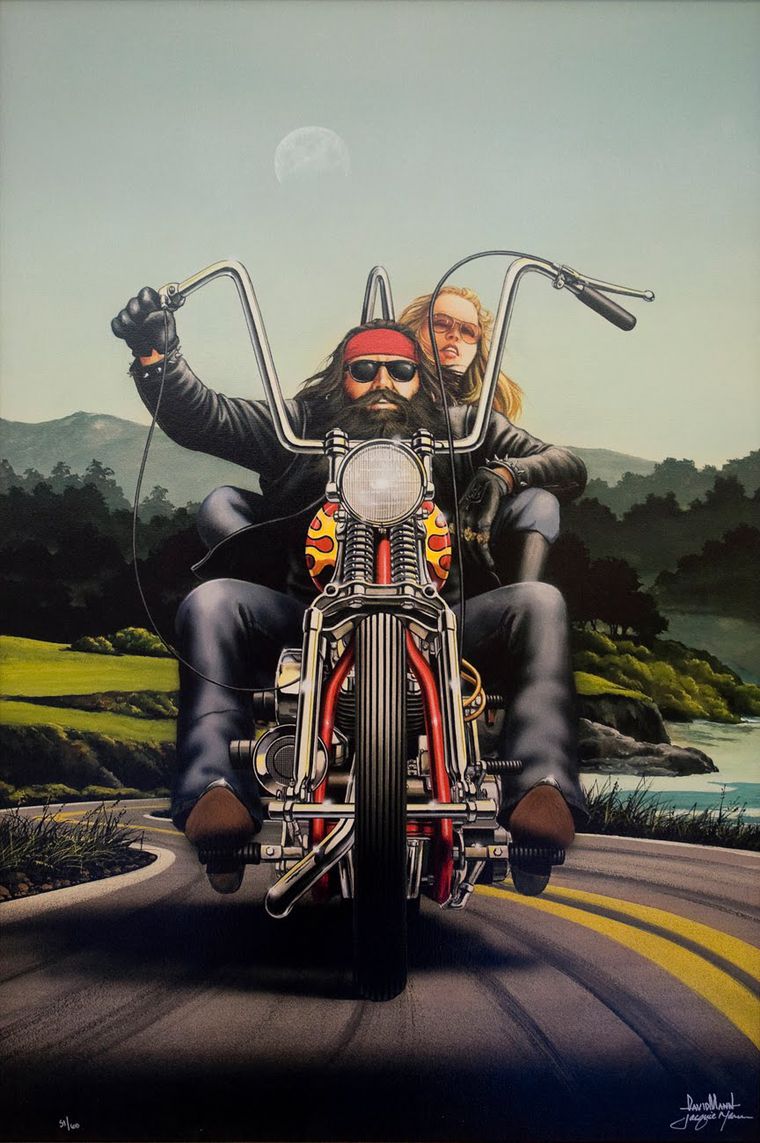
Here is another of my favorites, a classic piece by Dave Mann:
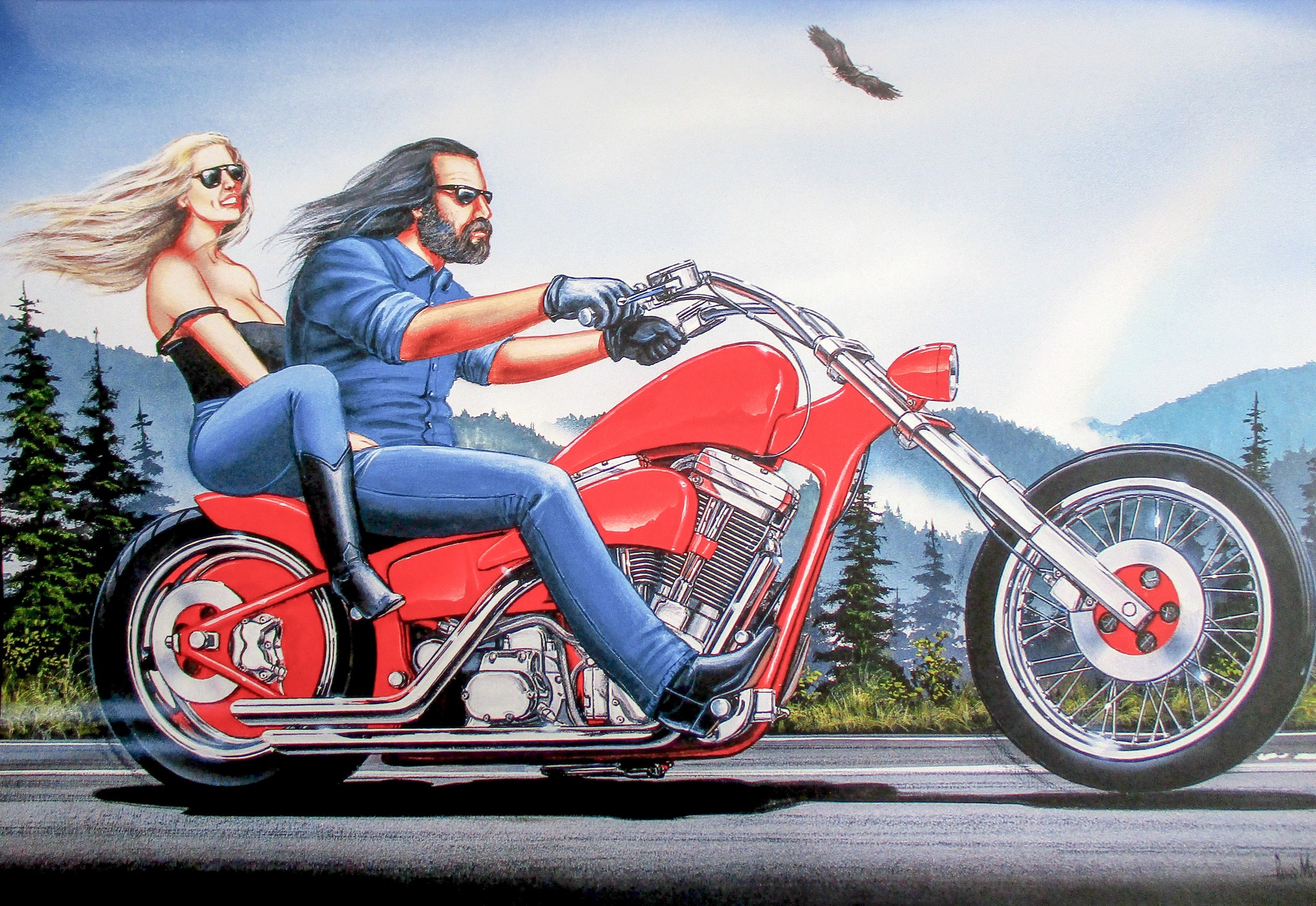
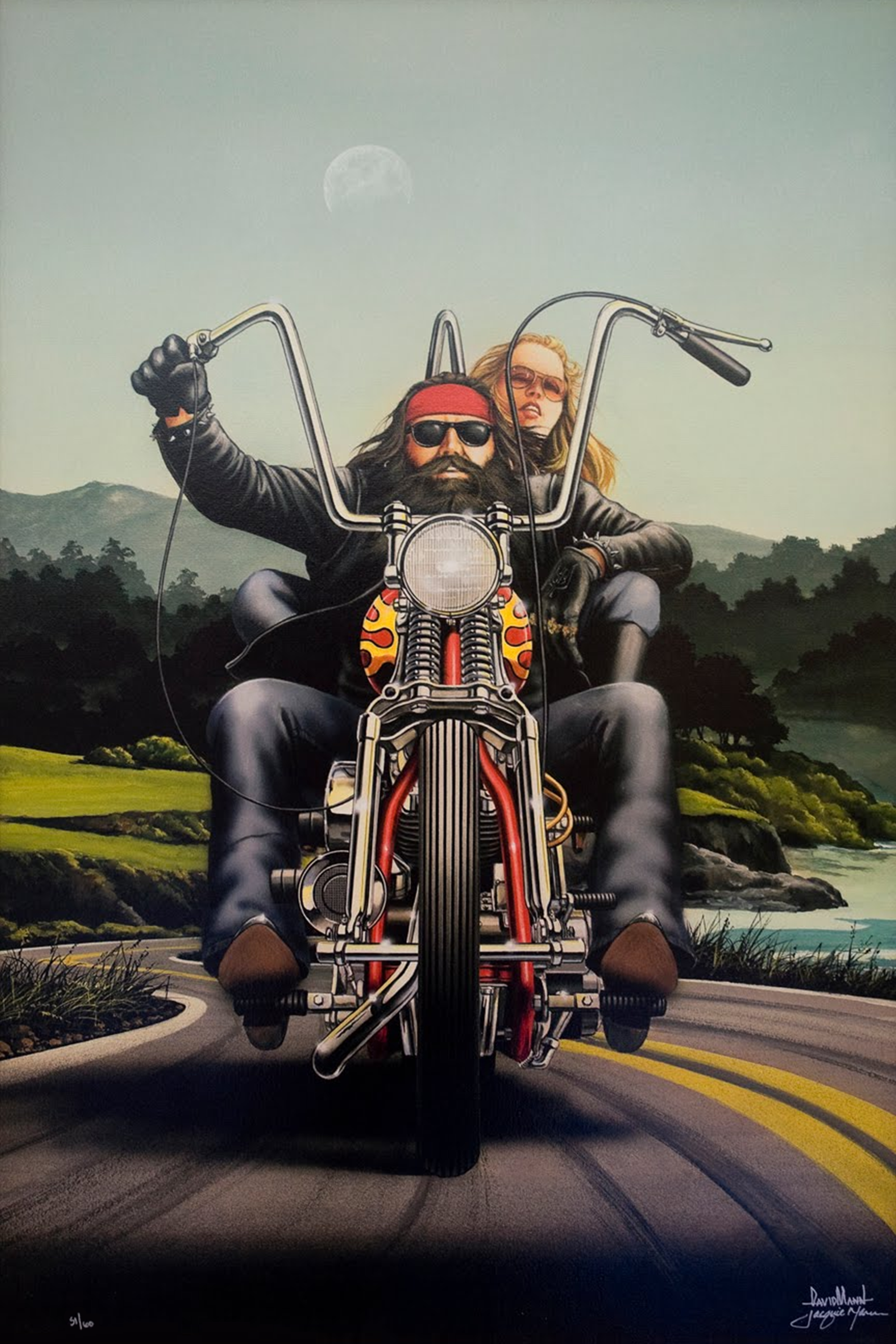
Another favorite Mann painting. I’m unsure of the title – it may be First Ride of Spring – but I love the way it captures one of the happier moments in a biker’s life: hauling ass up a scenic road with his woman tucked in behind. I used this as inspiration for my own piece, seen below: a t-shirt design I created for the Motorcycle Rights Organization ABATE of Texas back in 1989.
My design as it appeared on t-shirts. This artwork predates the introduction of computers into my artistic toolkit, so please be kind. The central image was all done by hand, and the lettering created letter by letter, line by line with Letraset ® rub-on letters. Much to my surprise Letraset fonts are still available! 😱
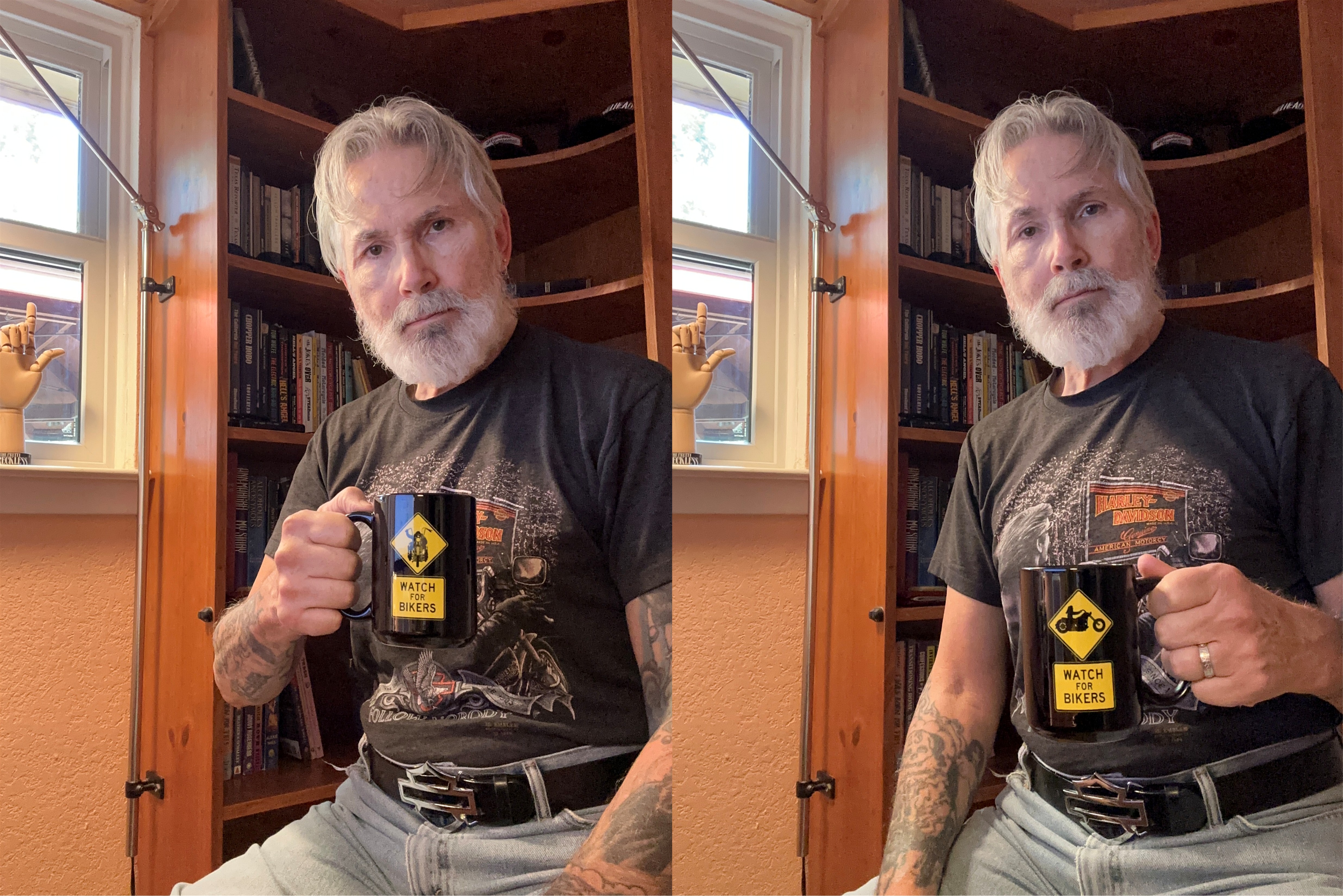
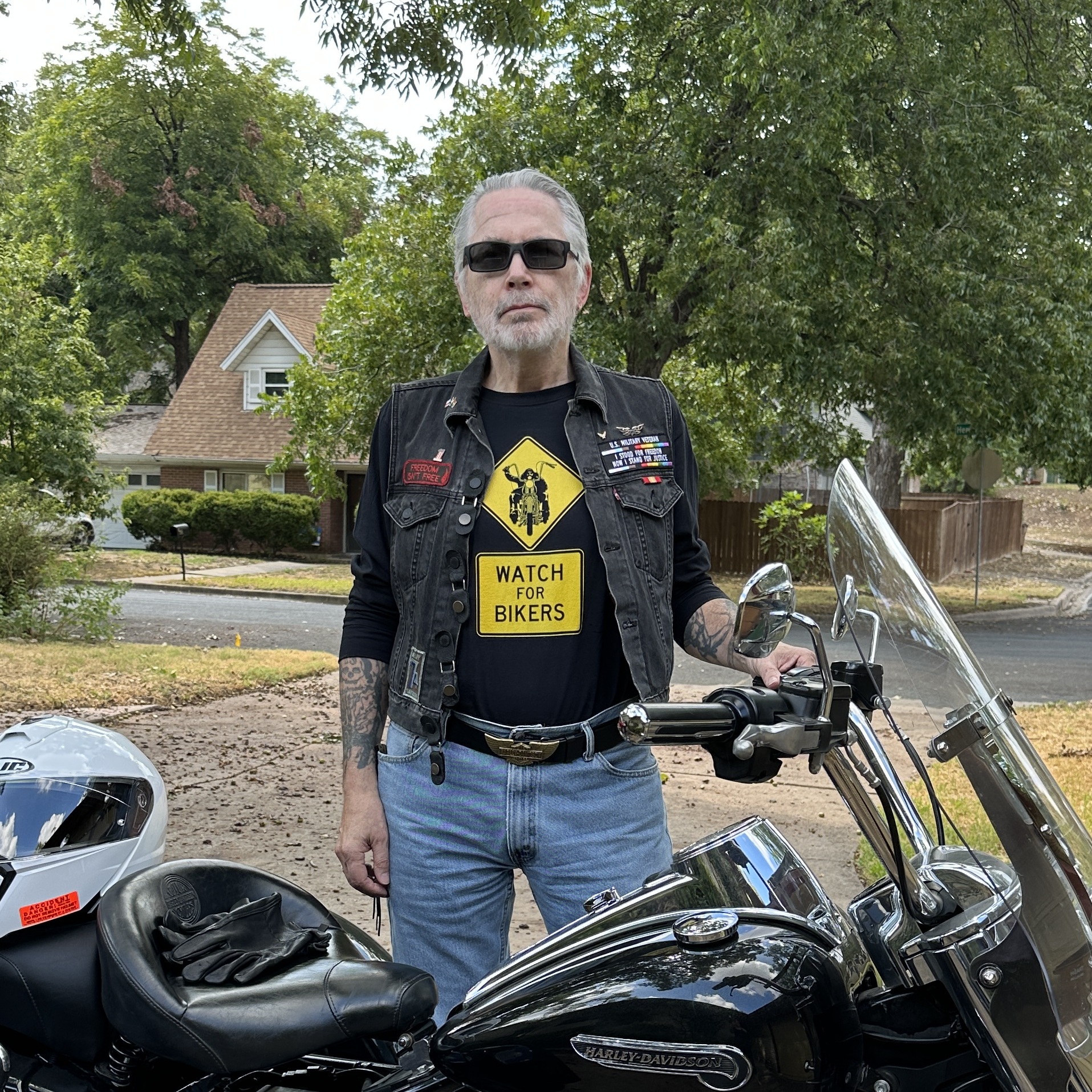
I was able to reuse that image on some recent creations: my Watch for Bikerscoffee mugs and…. ….and the matching Watch for Bikerst-shirts, both reasonably priced at my Shovel Shopstore at Etsy..
Mann returned to that theme many times in his career.
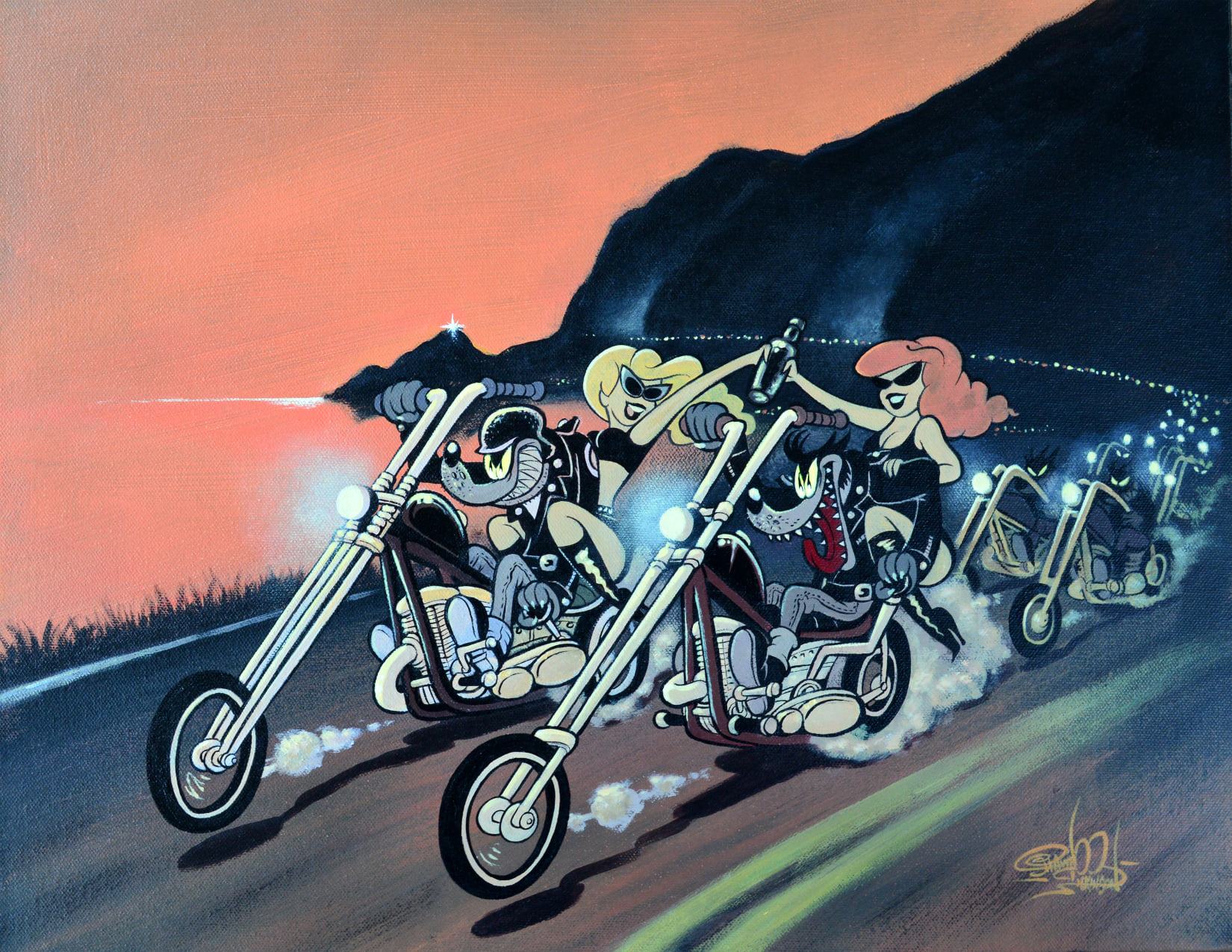
Coming at You, April 1975It even inspired this homage by artist Shawn Dickinson, titled Wild and Wolfy….….and another titled Werewolves on Wheels, Shawn’s tribute to Dave Mann’s In the Wind on a Friday Night….….and the original: In the Wind on a Friday Night, August 1972
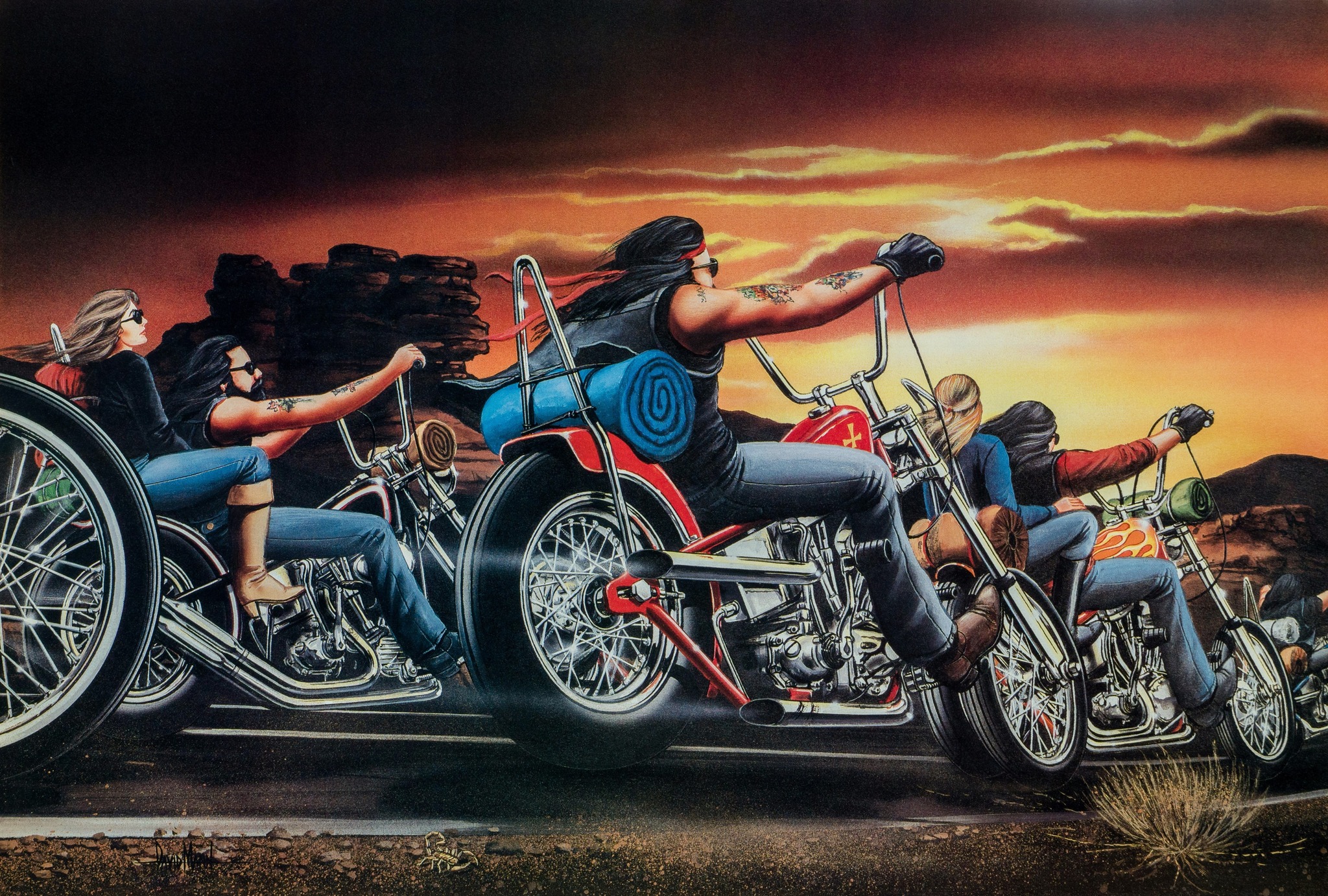
Another favorite was the reverse: the motorcycle moving in a straight line away from the viewer. He used both angles to great effect.
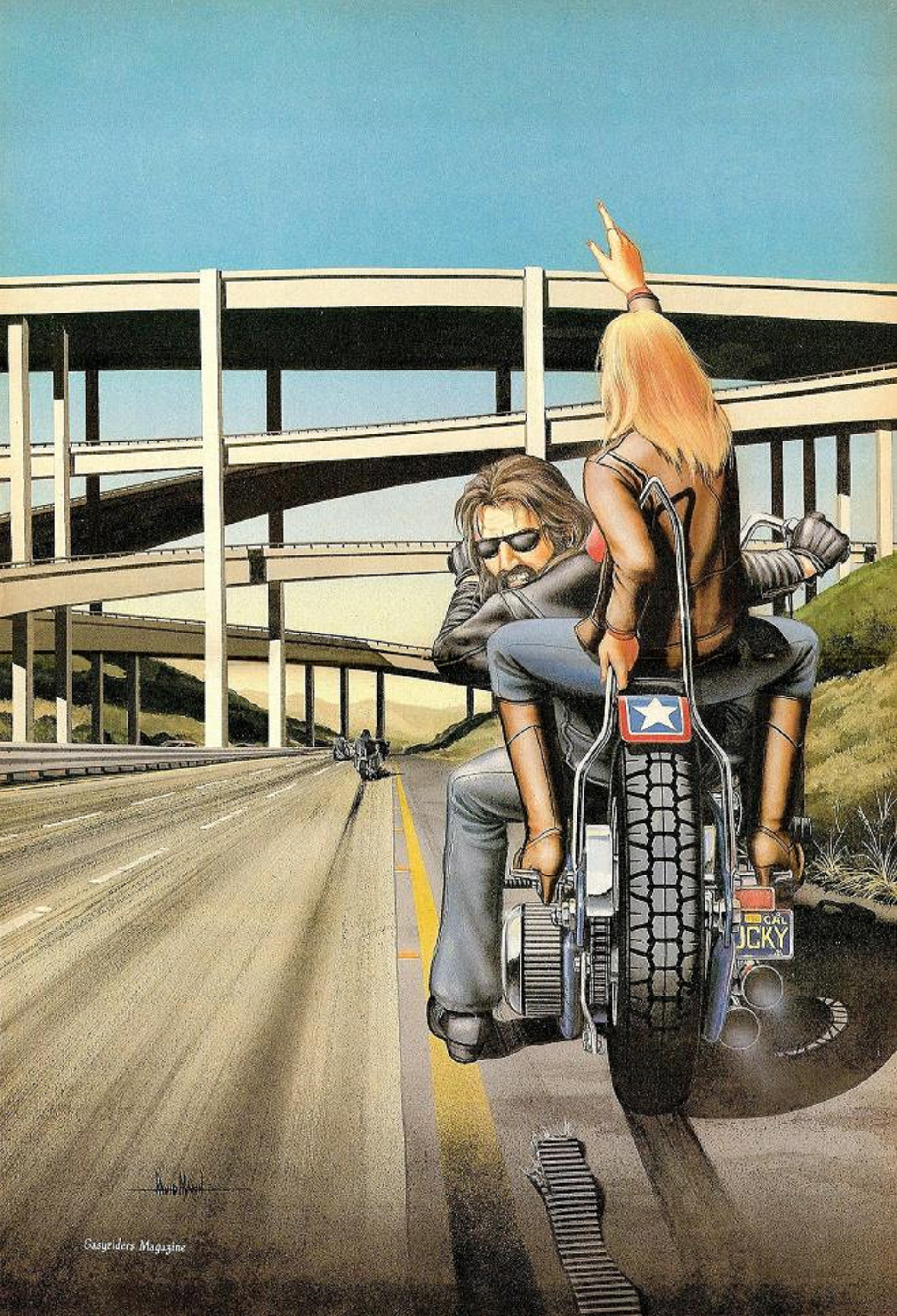
Mann’s follow-up to Coming at You appeared in a Jammers Handbook. Mann’s attention to detail extended even to the smallest things, like the oil spatter up this passenger’s left shoulder, excess lubricant slung off the rear drive chain at speed. You could always spot a biker chick by those chain tracks, and you could tell if she was packin’ on a Big Twin or Sporty by which shoulder was marked. I pissed off more than one woman passenger when their nicest tops ended up ruined that way! 🤷♀️
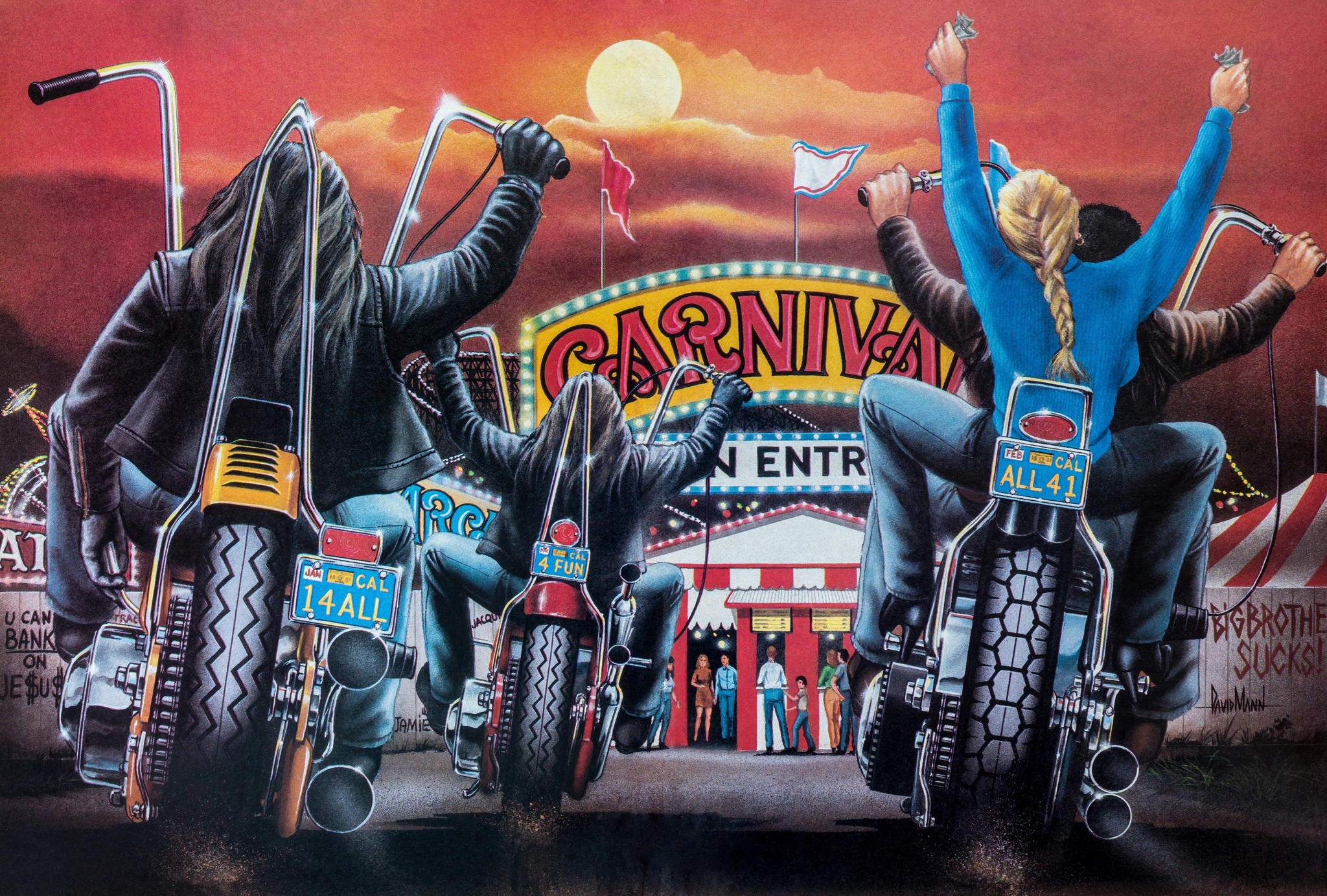
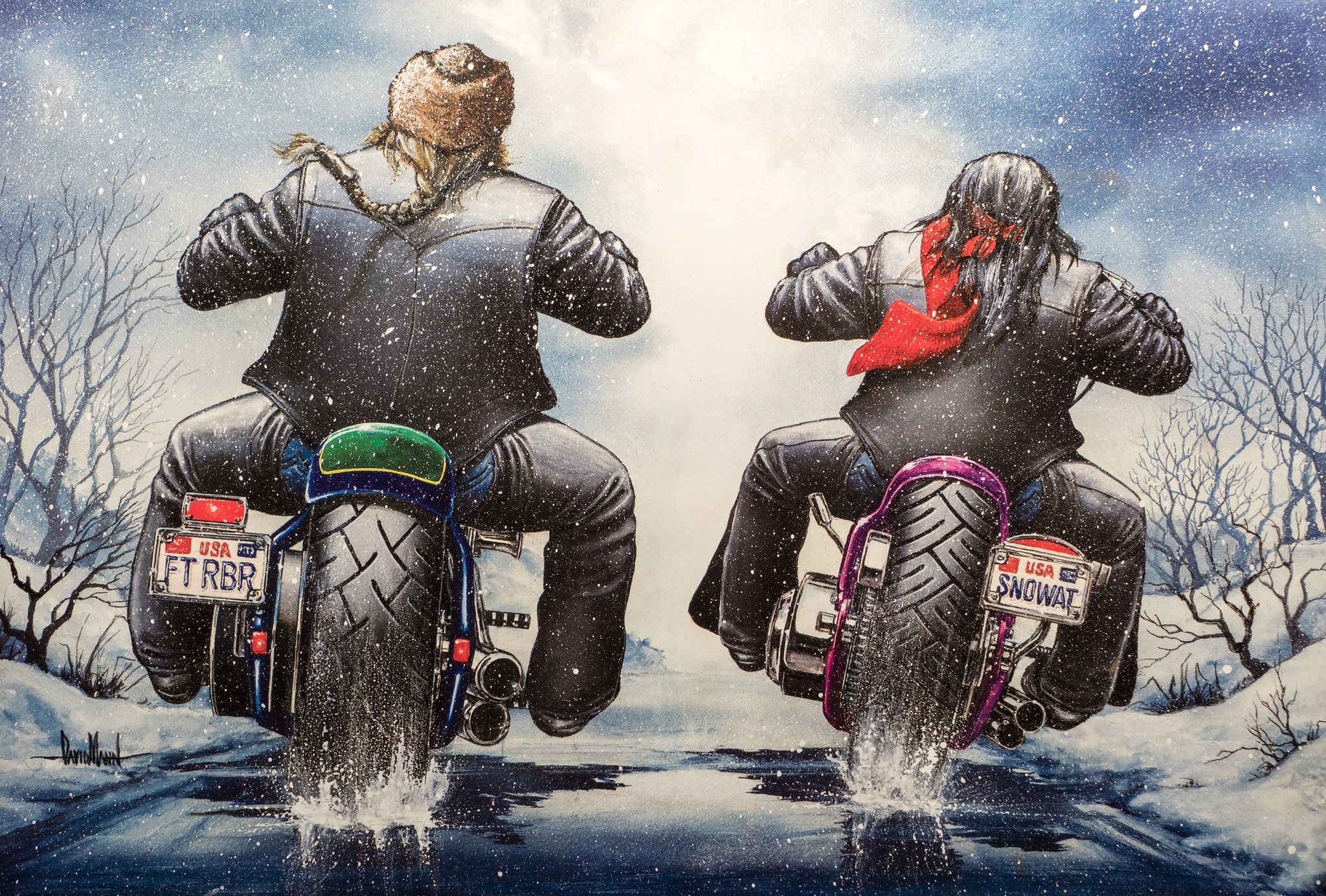
Carnival, September 1987. Note the graffiti at right.Snow What appeared in BIKER, February 2003FREEDOM was a fundraising poster for some friends in Cleveland.Storm Jammin’ appeared in EasyridersMarch 1989 and again in BIKER in October 2005. This one gets me because I took a soggy ride like this, from Austin to East Texas, to lay to rest a friend who died too soon…. as if there were any other kind. 😒
THE DAYS OF OUR LIVES
Mann’s technical abilities as an artist are undeniable but, as clearly demonstrated here, for those of us who ride it was Mann’s ability to illustrate the everyday aspects of our lives as bikers which so endeared him to us. He captured the emotional element – the ‘inner landscape’ Ms. Graham referenced in her quote – in painting after painting.. It might be two bikers blasting down an L.A. freeway, beards and club colors flapping in the wind, as one passes a joint to the other.
Hollyweed, November 1976. Note the altered ‘Hollywood’ sign high above the highway.
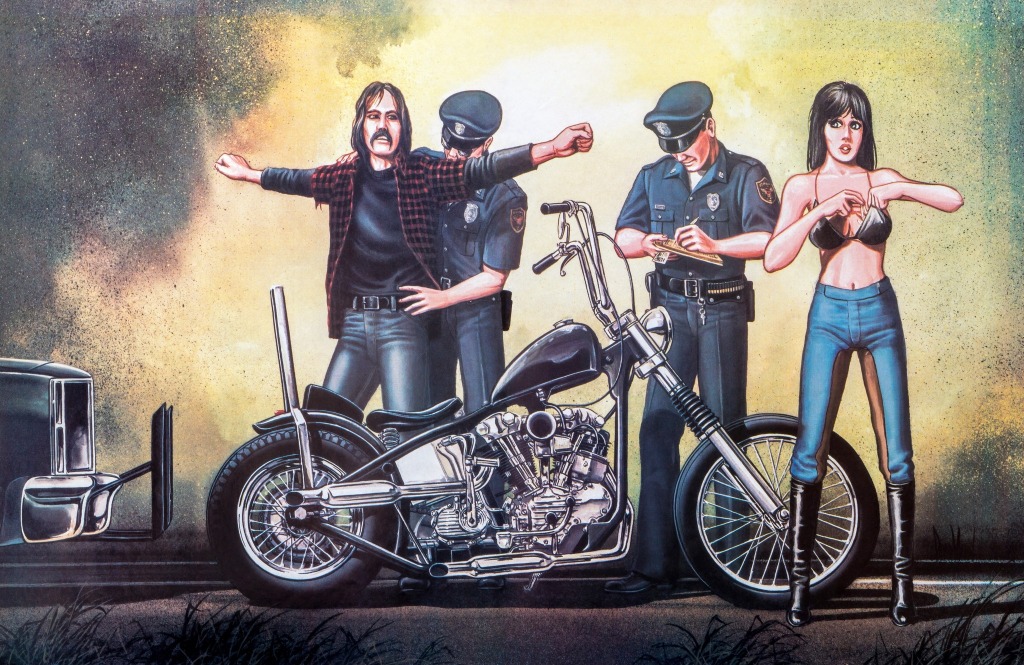
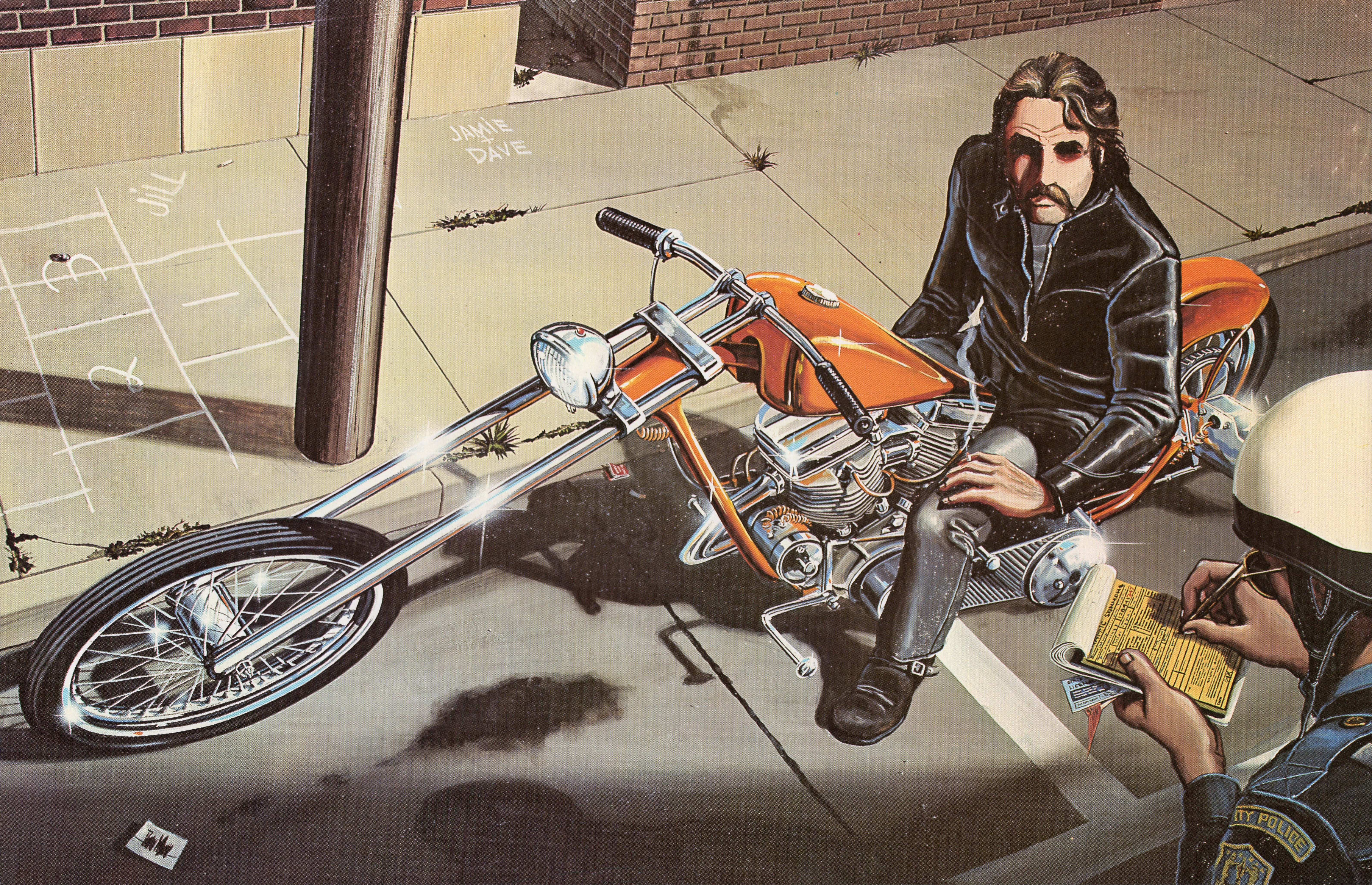
It might be a biker on his low, lean, radically stretched chopper, glaring balefully at the cop writing out a traffic ticket.
Busted, December 1974. Damn cops ruin everything, don’t they?
It might be a woman frustrated and angry because her old man, the insensitive prick, just passed a beer joint when she desperately needed a potty break….
Hey, What About….! December 1982.
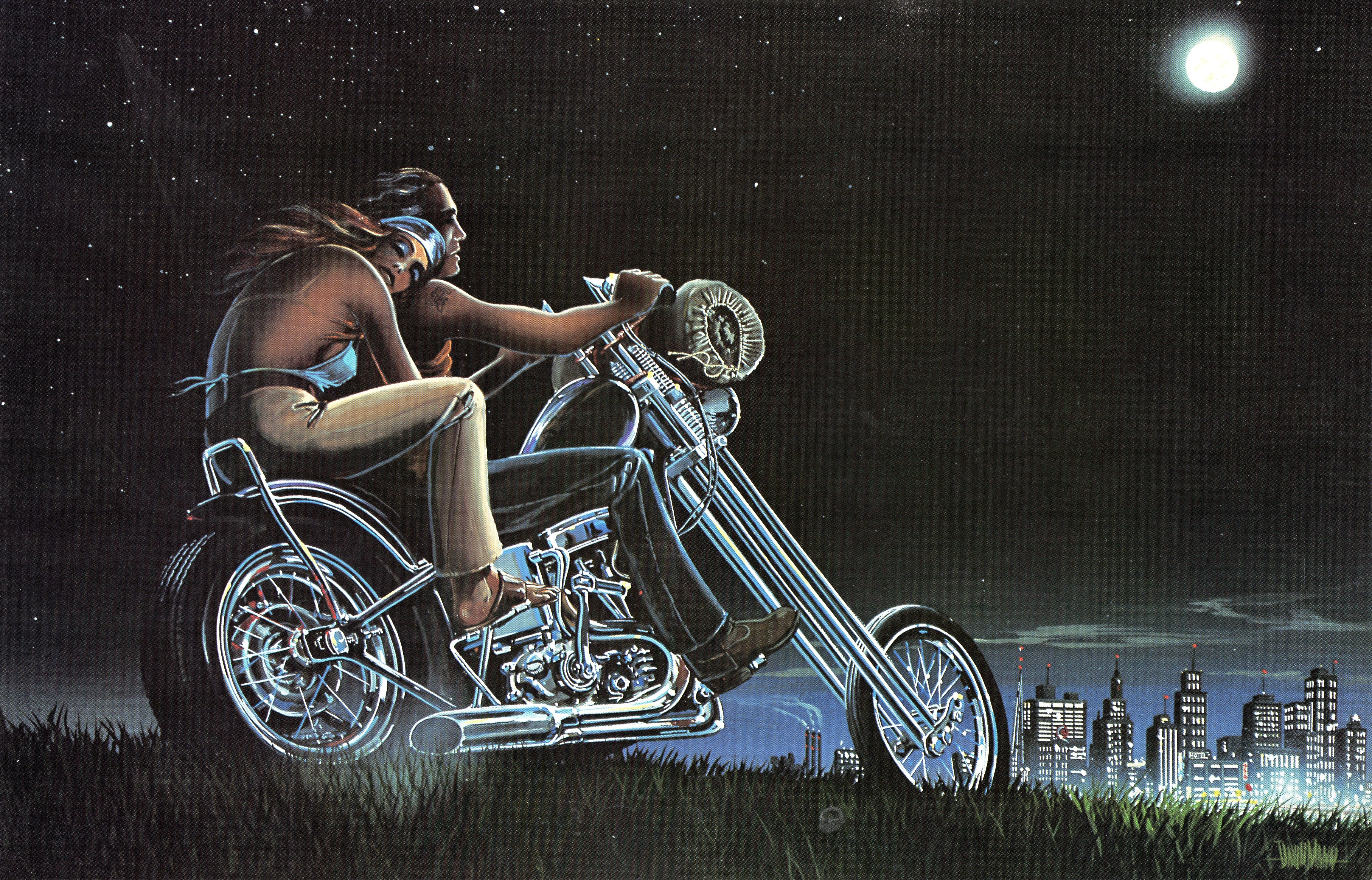
….or another one of my favorites. showing a woman curled up against her man’s back, safe and secure and sleepy after a weekend of riding and camping out under the stars, while he steers his radical chopper back to the brightly-lit city in the distance.
Homeward Bound, January 1975
One of Dave Mann’s most iconic images has been stolen and reproduced on everything from t-shirts and coffee mugs to wall tapestries, area rugs and more. In ‘Ghost Rider’ Mann equates the hard-riding biker at the foreground to the hard-riding ghostly cowboy keeping pace with him. Some of the later reproductions went the politically correct route of erasing the SS lightning bolts Mann’s biker has on his fuel tank….
….and that’s a topic for a whole ‘nother post! 😎
Ghost Rider, November 1983. Unofficial (read: stolen, ripped off, plagiarized) iterations of the image, on tapestries, t-shirts, et cetera, excised the SS lightning bolts from the fuel tank in a lame attempt at political correctness. If you see the Ghost Rider without lightning bolts you’re most likely looking at a fake.
Mann covered breakdowns and break-ups, club life and solo riders, sleek choppers and road-warrior rat bikes, and brought to each painting the same skill and dedication to detail. He was our Frederic Remington, and we loved him for it.
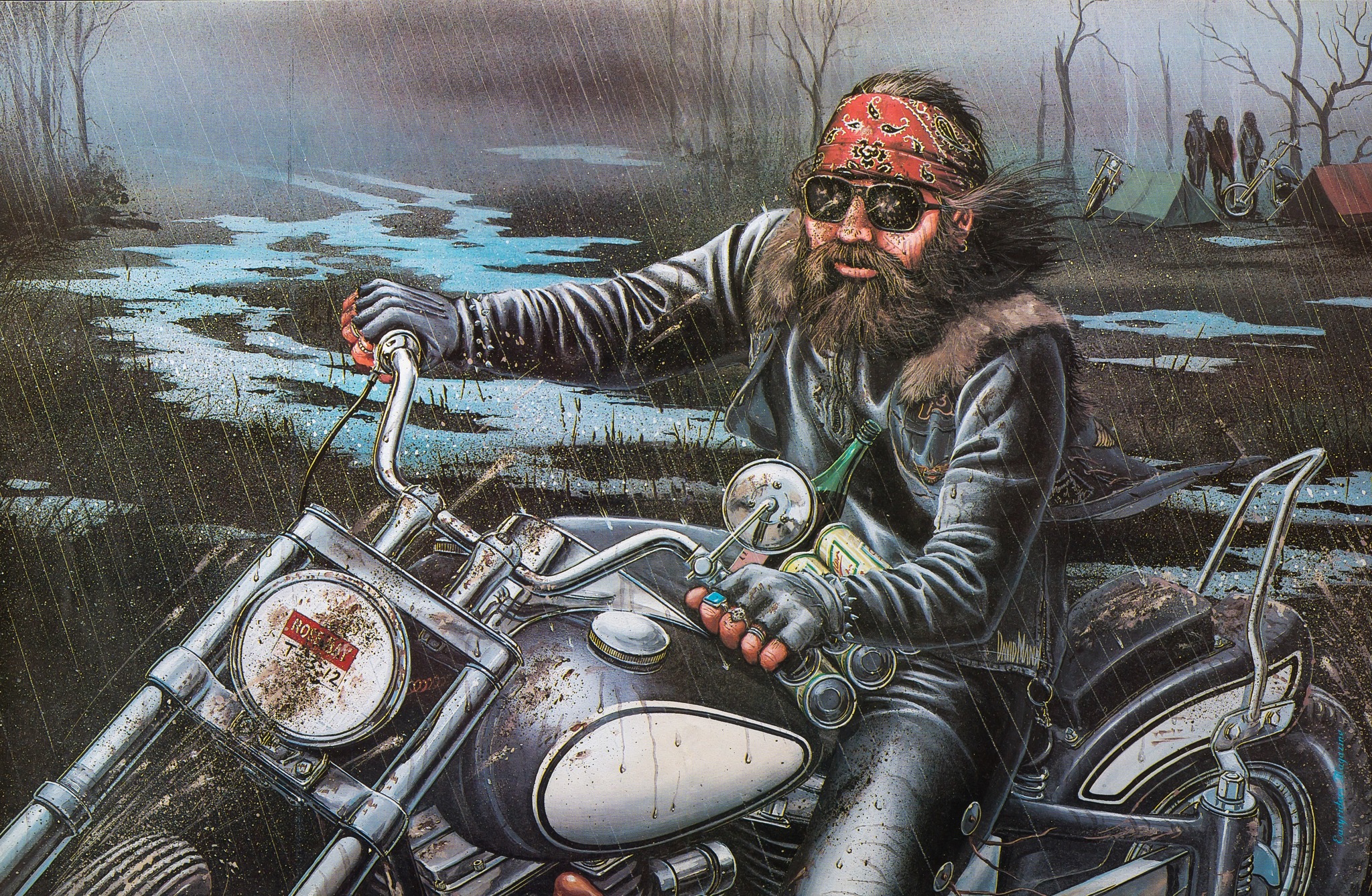
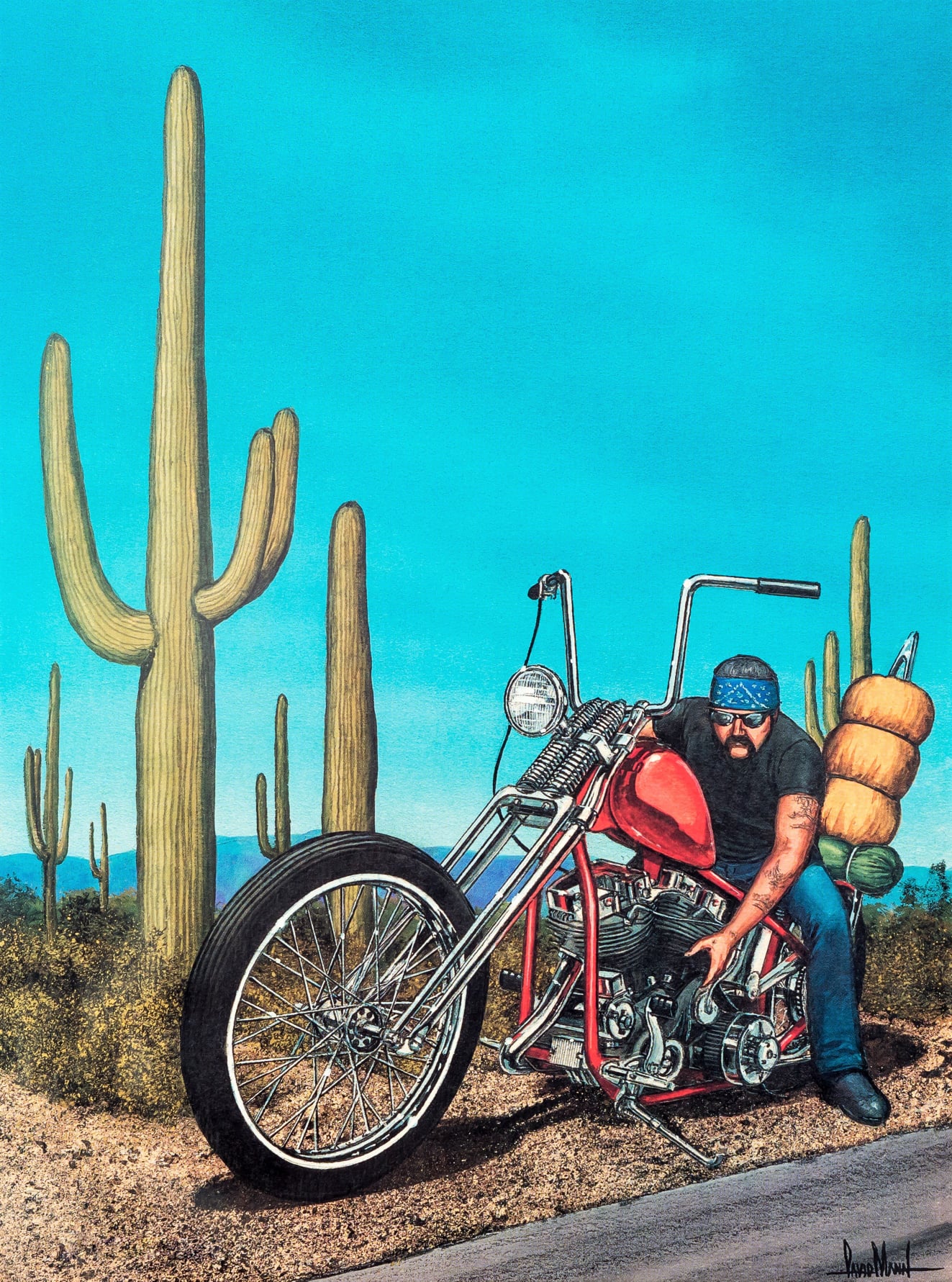
Another favorite. Anyone who rides very long at all has been in a similar situation….
Middle of Nowhere, June 1981
….but try to make the best of it! 😆
Beer Run, July, 1978. It’s a dirty job, but someone has to do it!😁
BREAKING DOWN AND CRACKING UP!
Paul Simon once sang ‘Everything put together sooner or later falls apart,’ and that’s as true of motorcycles as anything else. In numerous paintings, Dave Mann captured the frustration and helplessness of that instant when your machine fails, and you realize there’s nothing you can do about it except sit and wait, or go for help.
Broken Primary Belt, October 1981.I’ve been here! 😡 Primary Belt, January 2002.
In the early ’80s, on a ride through the Central Texas Hill Country southwest of Austin, I stripped the teeth off my primary drive belt while pulling up a steep hill. Thankfully, I wasn’t alone. It grieved me to interrupt my friends’ ride that way, but I was stuck.
BTW, that was one of the very few times my shovelhead rode home in the back of a truck.
One of the reasons I have always been psychotic about building my bikes to be bulletproof, and making sure I can fix all but the worst breakdowns with tools and spare parts in my road kit is because I cannot stand to be that helpless, hapless rider stranded beside the road. I’d rather have people depend on me than have to impose on friends or, worse still, depend on the kindness of strangers.
In this instance, when I got the bike home and went to replace the wasted primary belt, I learned that I couldn’t have replaced the belt by the side of the road even if I’d had a spare belt with me; that the inner primary cover (which can’t be removed without an impact wrench and clutch-hub puller) wouldn’t let me take the belt off the engine pulley! Since I had the inner primary cover off anyway, I took the opportunity to grind down the bosses on the inner primary so that I couldtake the belt off without removing the inner primary, the next time the need arose. That’s just how I roll! 😁
As an aside: I will never understand why some riders get angrywhen I mention tool kits and roadside repairs in that context. Seems to me everyone is better off if I can fix the problem by the side of the road and get on with the ride, rather than be forced to wait for a wrecker or a buddy with a trailer to come fetch me. Still, I’ve had riders – every one of them the sort I call ‘Born Again Bikers’ – get absolutely incensed at the notion that I am capable in that regard, as if my competence was – dare I say it? – a challenge to their manhood…. 🙄
And that’sa whole ‘nother post, too! 😏
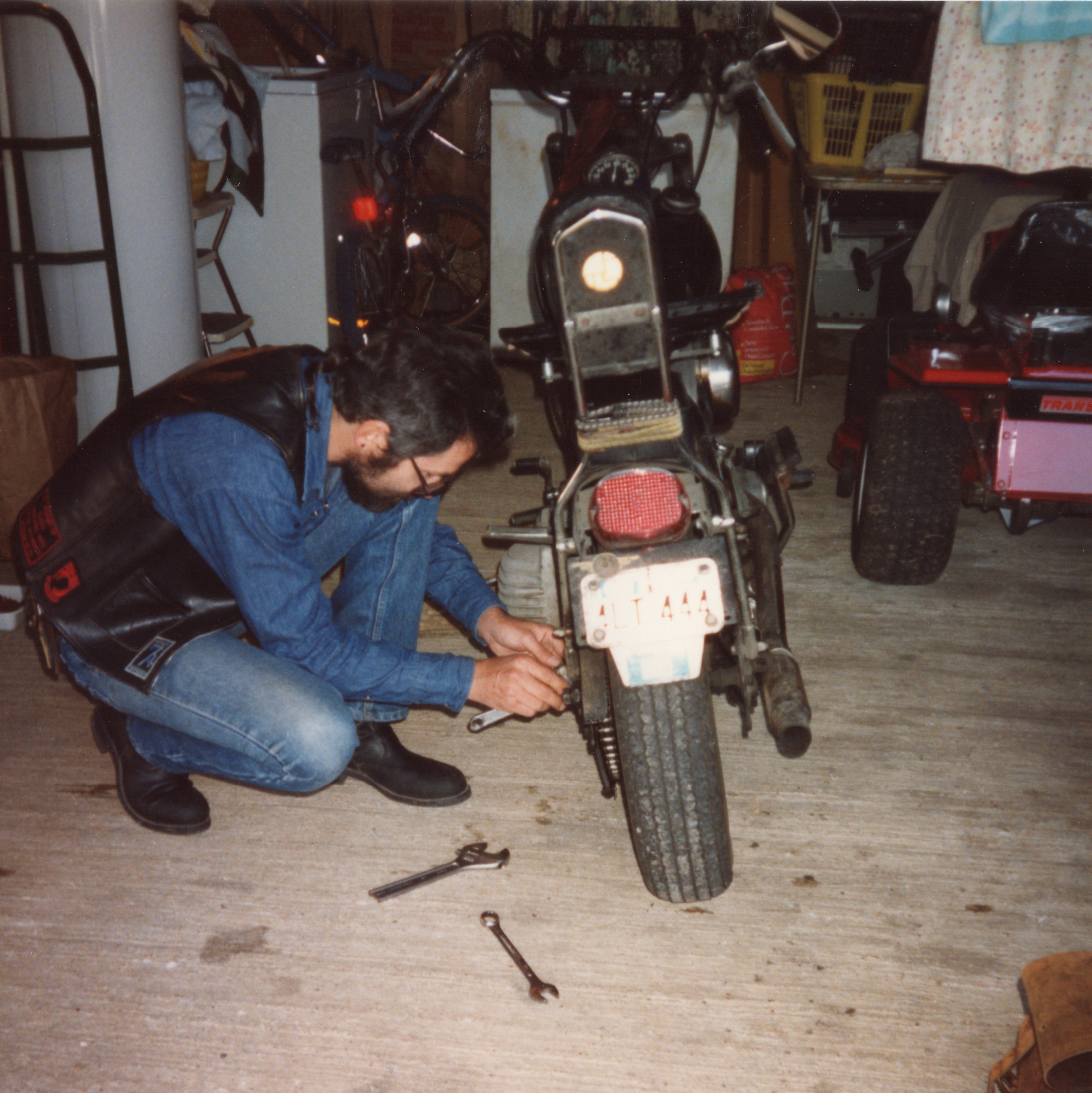
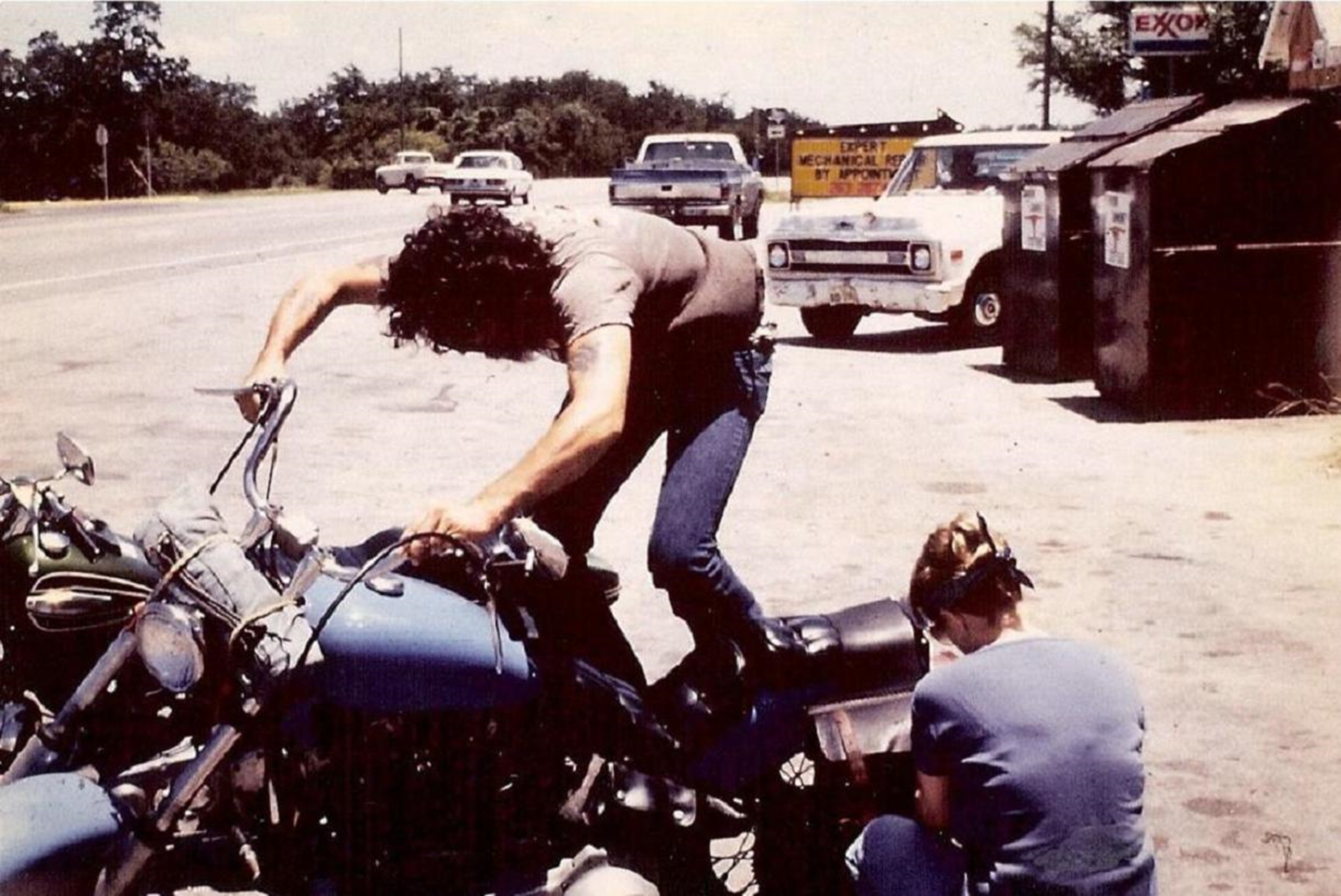
Oh, look! There I am making a minor repair to my shovelhead while on a run to the annual ‘Blow-In’ at Jim’s Motorcycle Shop in Axtell. Because I had the know-how and tools to accomplish that task, our group ride was not interrupted. Fifteen minutes of wrench twiddling, a quick test-ride, and then me and my date and my gaggle of buddies were back out on the road again! 😎Lucky… or not. Broken Belt Bummer, March 1988.That kind of breakage happens often enough that it showed up in at least three of Dave Mann paintings, and in addition to my own adventure, I’ve seen it happen right in front of my eyes. Dog Breath, a good ol’ boy from Tennessee who worked with me at Bud’s, broke a belt on the street in front of the shop, trying to hotrod his shovelhead. Don’t see good ol’ steel chain doing something like that, do ya? 😆 Or do ya? Check out the next painting.
Of course, it could be worse. You could be well and truly fucked, like this poor couple….
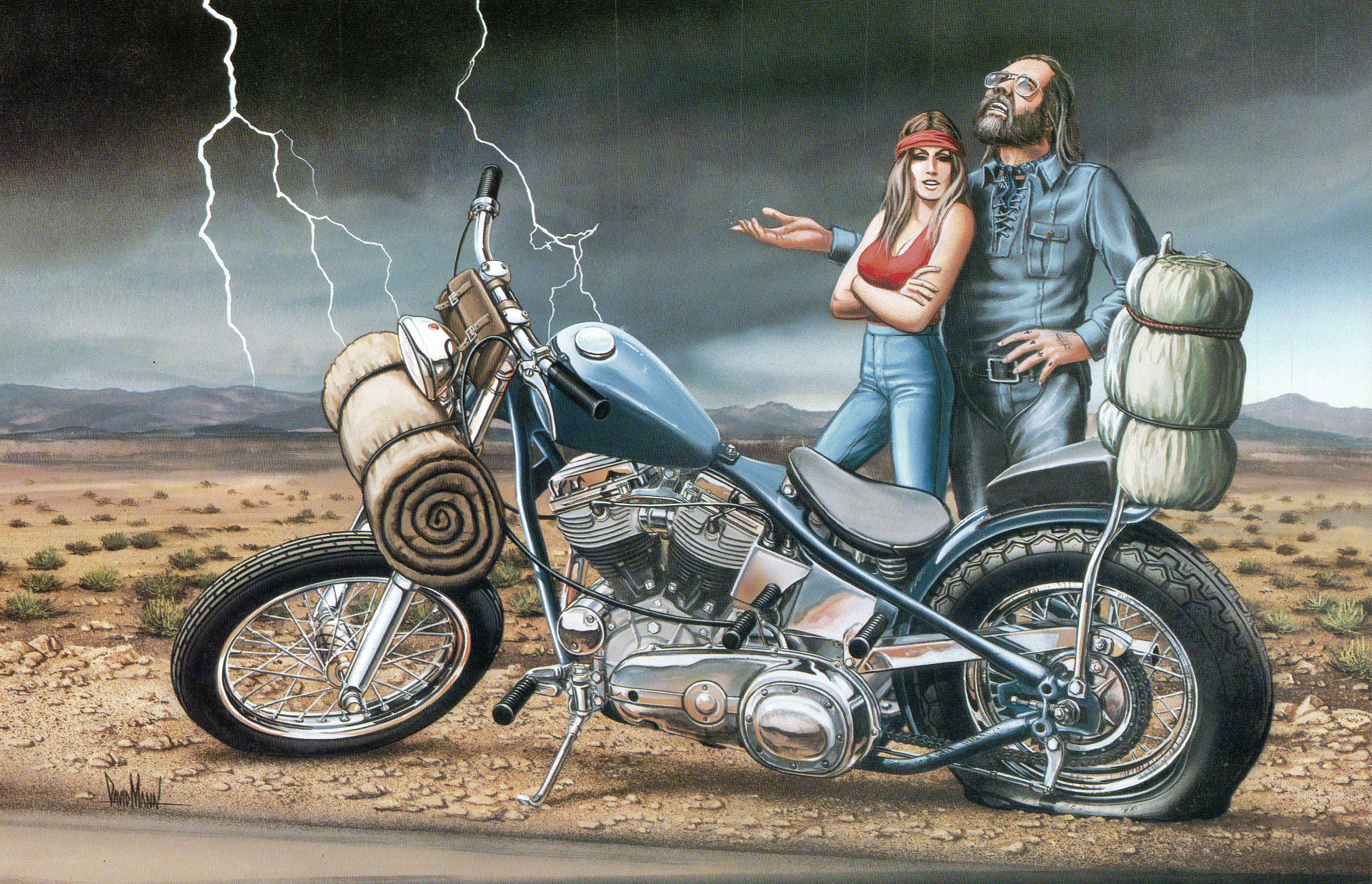
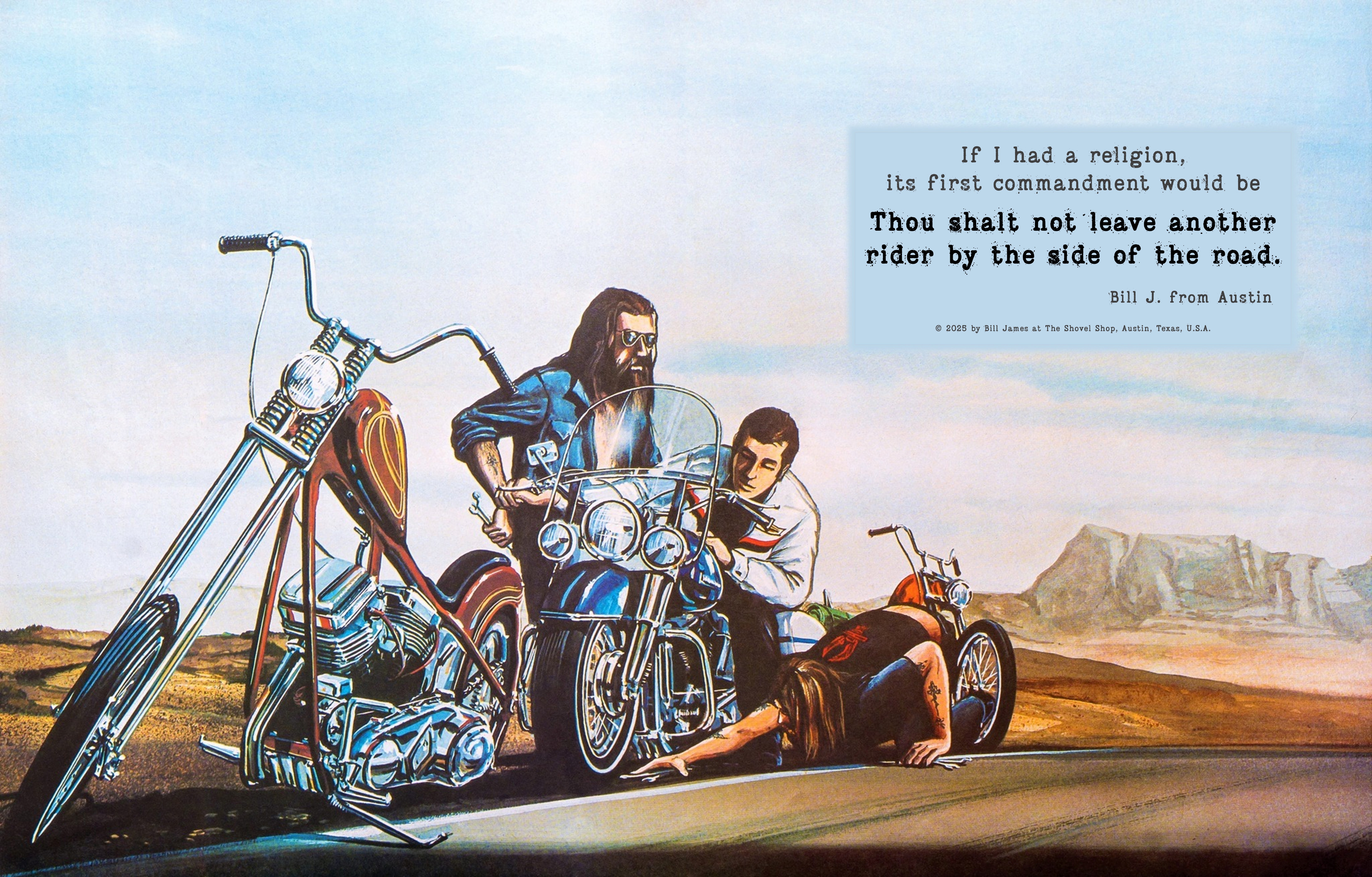
Fuckin’ Rain! Thunderstruck! September, 1982. I have seen smaller images of this painting for years, and noticed the rain and the woman retrieving the broken drive chain. It wasn’t until I discovered a larger image on the Dave Mann Facebook page (link at bottom of column) that I spotted the broken spokes on the rear wheel. If that doesn’t make you want to flip off the sky gods nothing will! However, if you should break down anywhere near me, I promise you I’ll lend a hand.When We Do Wrong, February 1975, originally had a quote attributed to the Hells Angels of the 1960s:
When We Do Right, No One Remembers When We Do Wrong, No One Forgets
but I decided to repurpose the art for a quote of my own; something I say whenever the topic of helping brokedown riders is discussed. I’ve had enough strangers go out of their way to help me when I needed it. The only way I can repay their kindness is by passing it on to others.
BIKER’S CODE
However, if you’re lucky enough to break down while riding with others, the Biker’s Code says ‘No biker left behind.’ By hook or crook or boot or rope, you’re both getting home.
This is titled Dark Roadside Repairs (April 1982) but it’s obvious to anyone who wrenches on bikes (or has ridden long enough to run out of gas) that the guy on the green bike (with a small Sportster tank) has run out of gas, and the guy on the black bike (with the larger-capacity fat bob tanks) has dropped his fuel line and is draining petrol into a beer can salvaged out of the ditch, to get the guy on the green bike to the next service station. I have done that, and had it done for me, so I made the task a lot simpler by running a single tank held in place with a big rubber band. I could just remove the rubber band, take the fuel line loose, lift the tank off my bike and give the other guy all the fuel he’d need. No muss, no fuss, no scrounging for ‘clean enough’ beer cans or bottles in roadside ditches! Unfortunately, that trick doesn’t work with fat bobs!Sunrise Sunday Morning, Texas Panhandle, June 30, 1991
And if all else fails….
Push Home, November, 1978
Another scene most riders will recognize (or cringe from): the bike that just…. Will. Not. Start! I’ve never owned a Sportster, but I started my share during my years of working at Bud’s. I’ve also been that pissed at my shovel, when it’s been particularly coldblooded and cantankerous. Fortunately for me, those instances have been few and far between….
….and the next sound you hear will be me knockin’ on wood! 😱
Damn Sporty!February, 1979Won’t Start, May 1979Kickin’ the Bitch, Bee Caves, Texas, circa 1982. Photo by Bob Wilson, a rider from Pennsylvania who owned the forest green boattail FX seen at left. The young woman rummaging in my saddlebag was my live-in girlfriend, Lea.
Sadly, our machines aren’t the only things that betray us.
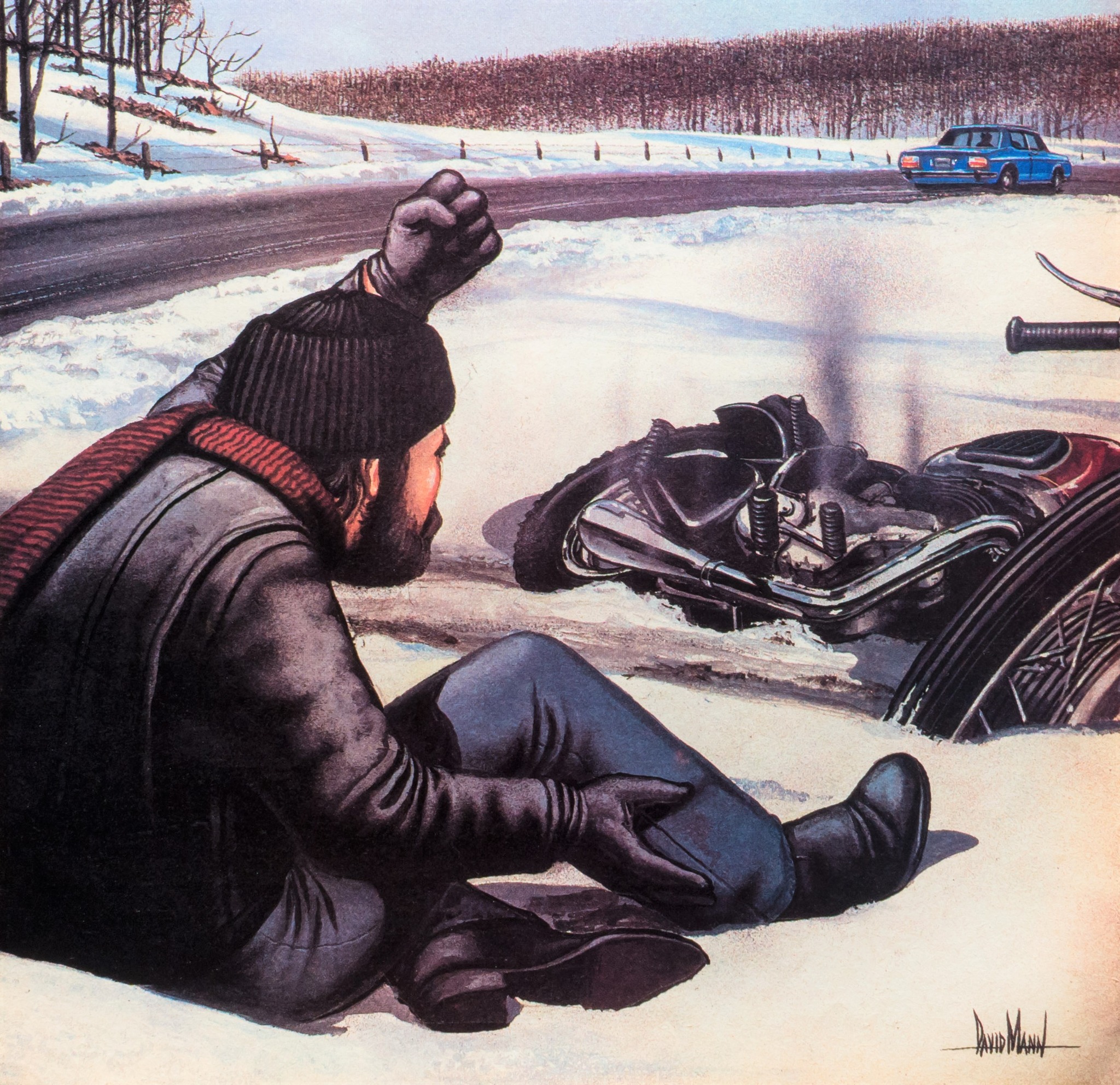
You can feel the rider’s frustration at the cager who recklessly or maliciously ran him off the road, then drove off and left him. This appeared in January 1986, as a story illustration.
Bikers are all too familiar with the cager who seems to have it in for us. Popular wisdom advises riders Don’t ride as if they can’t see you; ride as if they’re aiming for you! Unfortunately, I know from bitter experience that sometimes they actually are aiming for us!
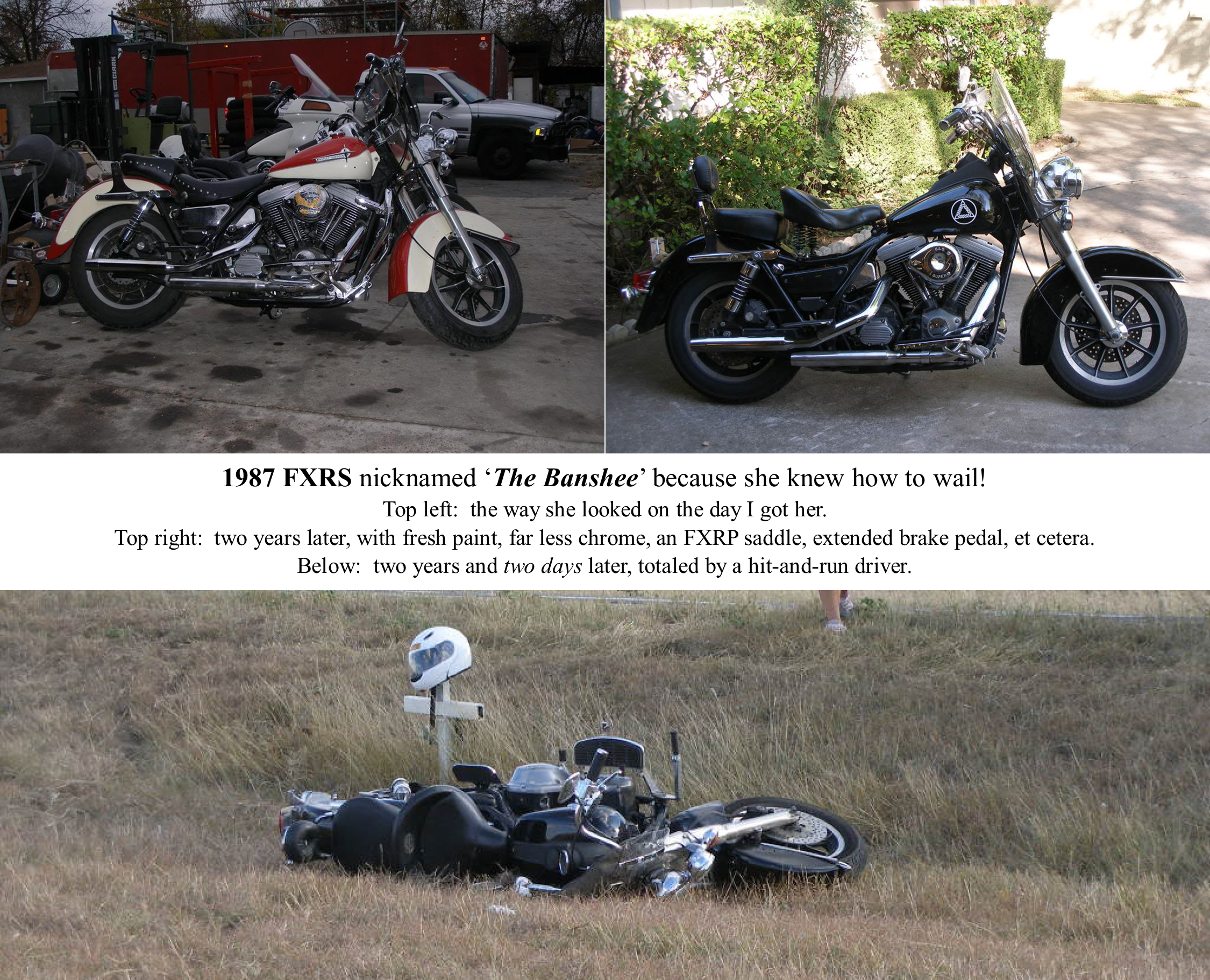
This is the 1987 FXRS I spent two years rebuilding and adapting to my disabilities. I added the finishing touches to her on a Friday afternoon. Two days later, on a beautiful sunlit Sunday in late October, Jackie and I were riding on a narrow two-lane road east of Taylor, Texas, when a kid in a pickup going the opposite direction decided to pass a slower-moving automobile. He crossed the double-yellow line, looked me right in the eye and kept on coming. Then he drove away, leaving us for dead. 🤬
Fortunately, neither of us were badly injured, but the bike was totaled. FMTT! I got to enjoy my new-to-me FXRS for less than forty-eight hours before it was snatched away from me! Forty-eight fucking hours! Damn, I was pissed! Still am, in fact!
But if one of the bastards does nail you, what can you do but heal as best you can, and dream of getting back in the wind where you belong?
Medicating a Broken Leg, October 1976
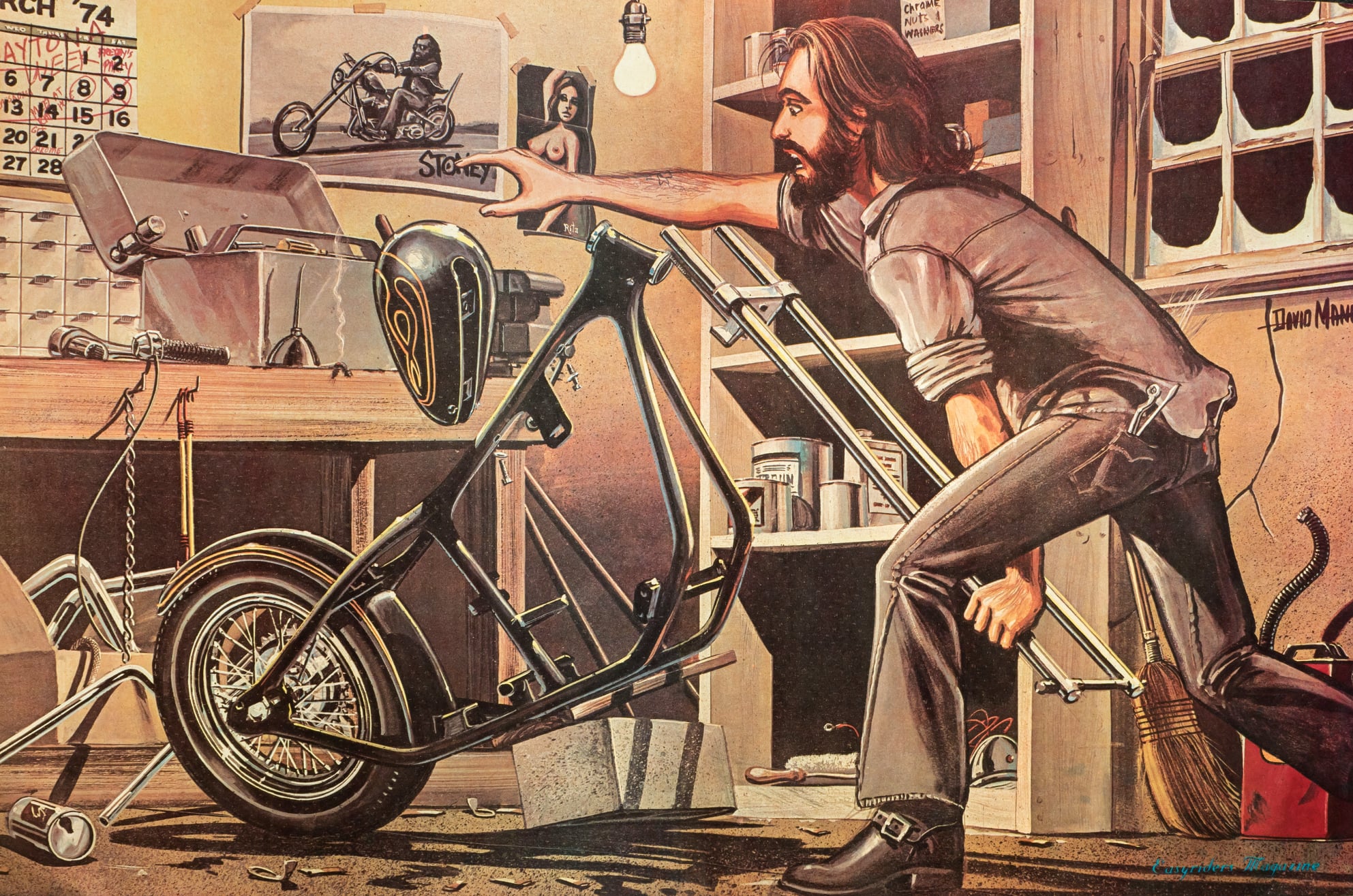
If you’ve ever built a motorcycle, you’ll recognize the anguished look on this fellow’s face, as he watches his freshly painted fuel tank head for a collision with the garage floor.
Oh, Shit! 1974
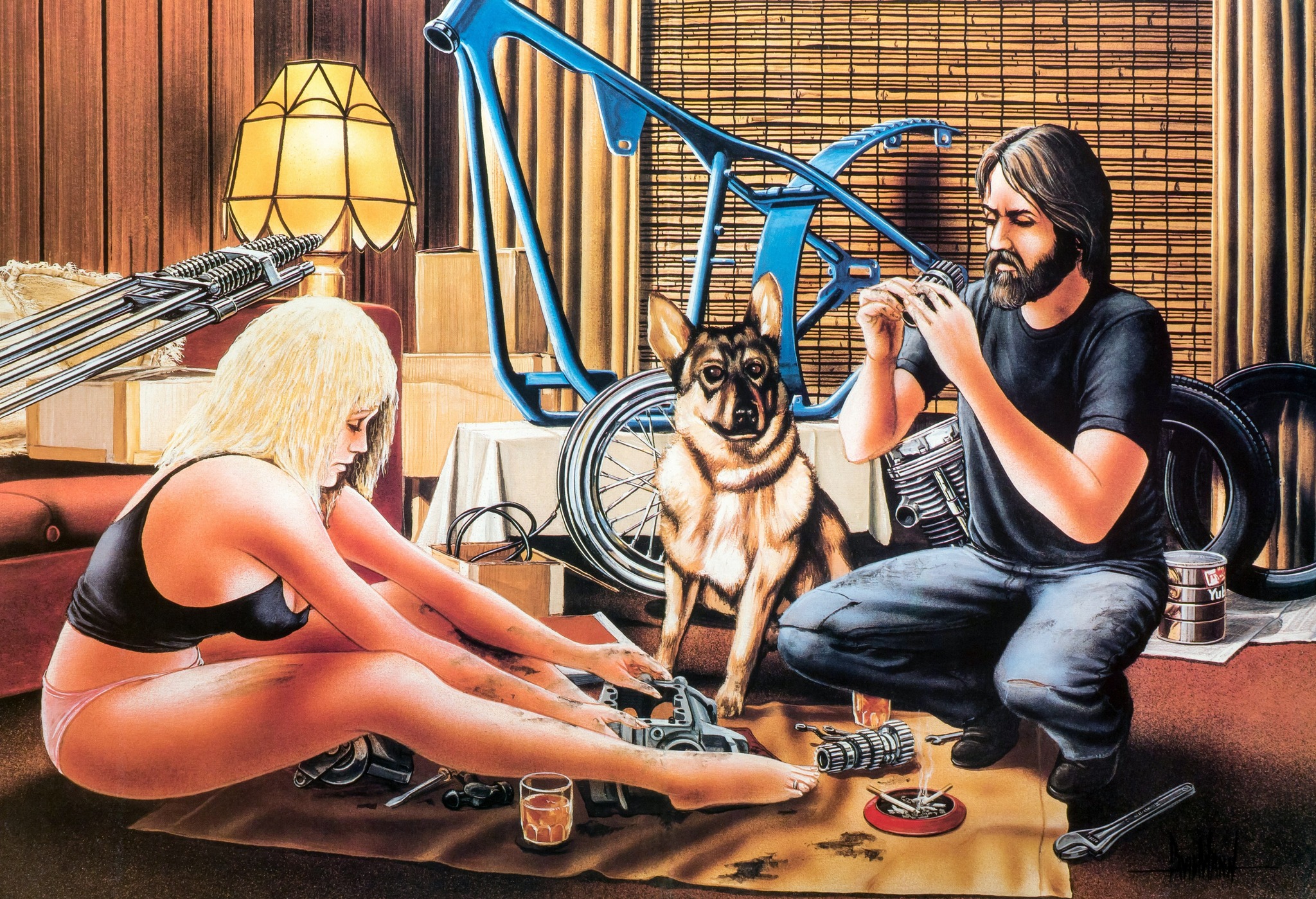
Mayhaps he needs a helper. Maybe a curvaceous blonde? Someone half-naked, perhaps? Yeah, that’ll do the trick! 😆
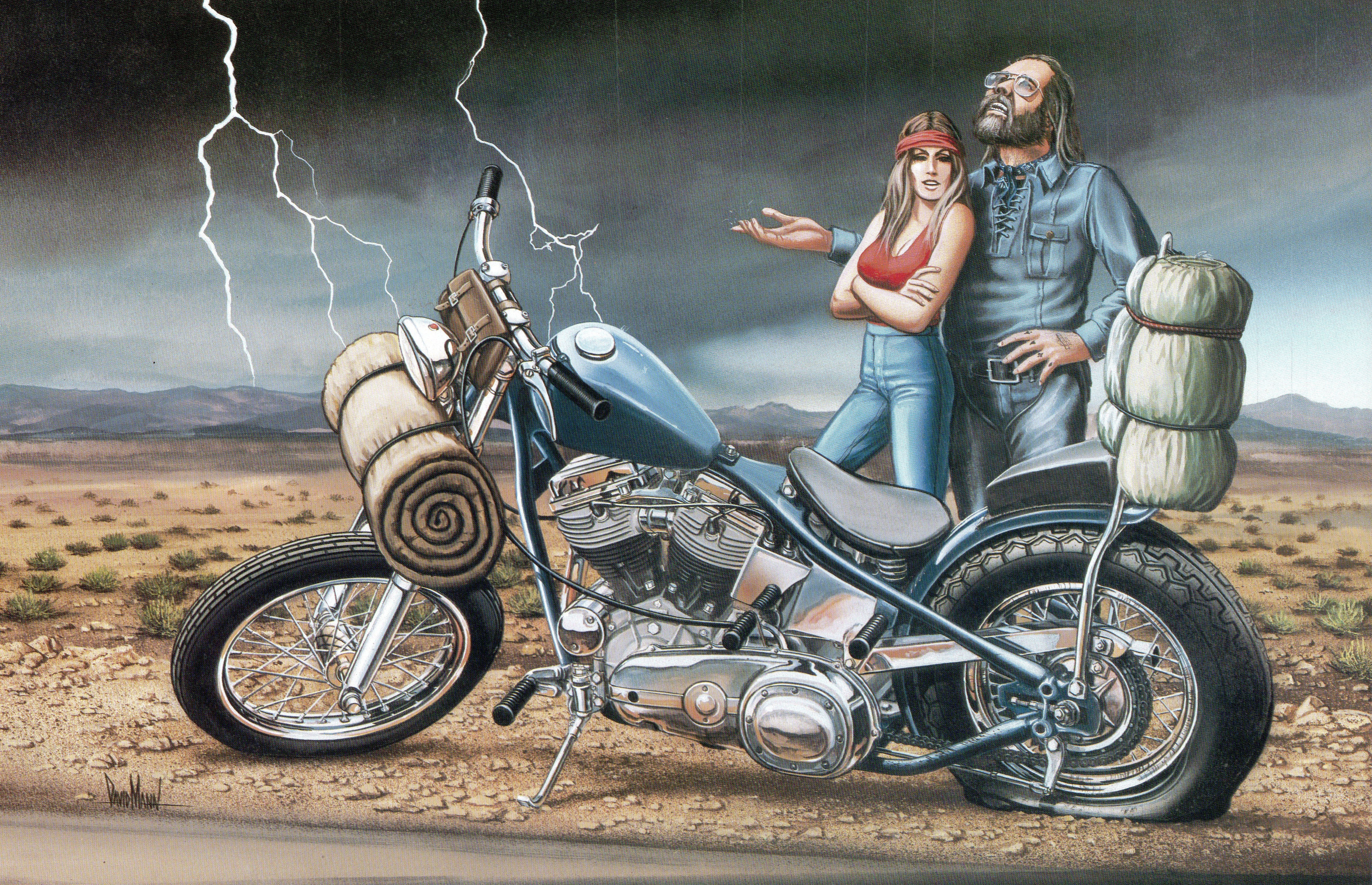
In Mann’s art, women are primarily placed in secondary roles as backrests, bike washers, beer fetchers and sexual conquests. In Mann’s world, women rarely ride their own. In fact, of the hundreds of paintings Mann produced, I’ve only found a baker’s dozen thus far depicting women riders. However, to his credit, man or woman, when he painted them he brought the same skills, artistic integrity and vision to bear.
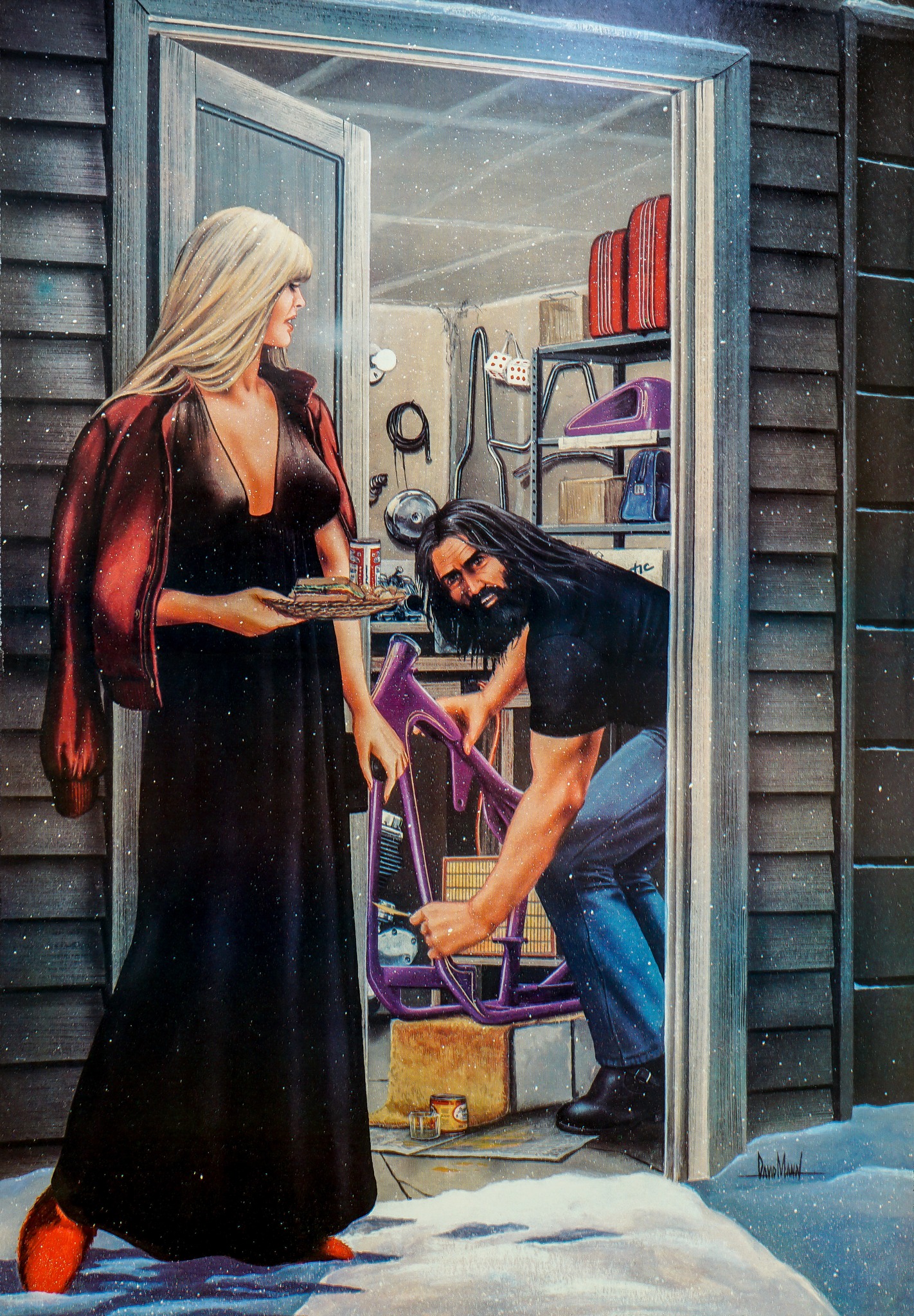
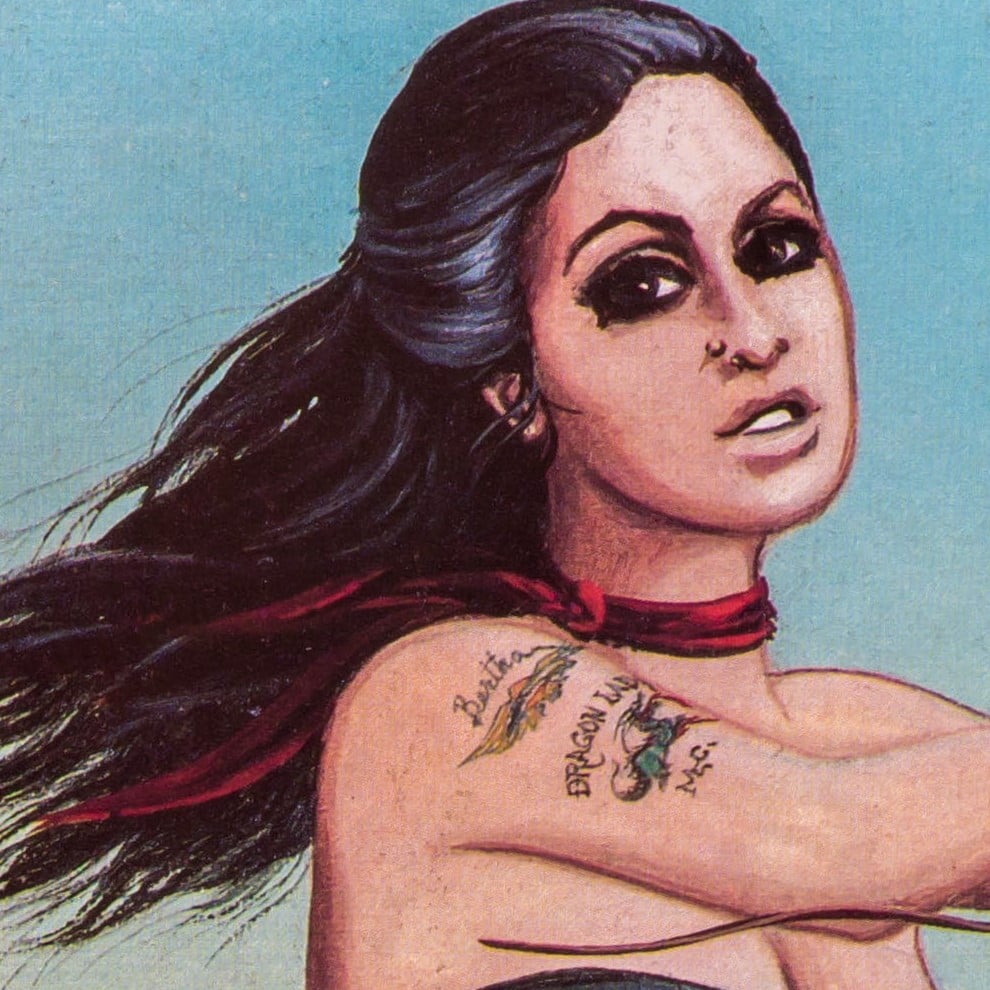
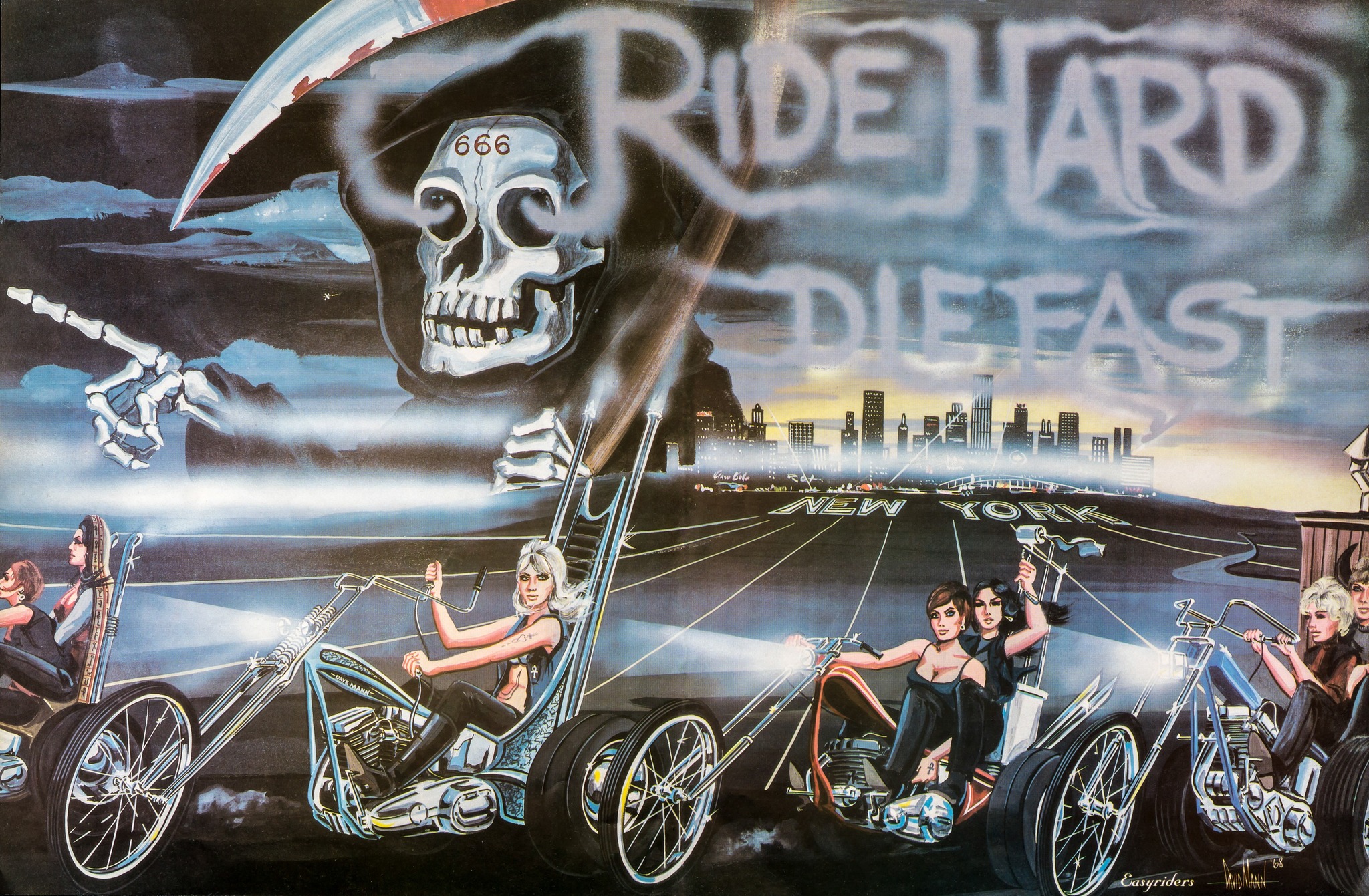
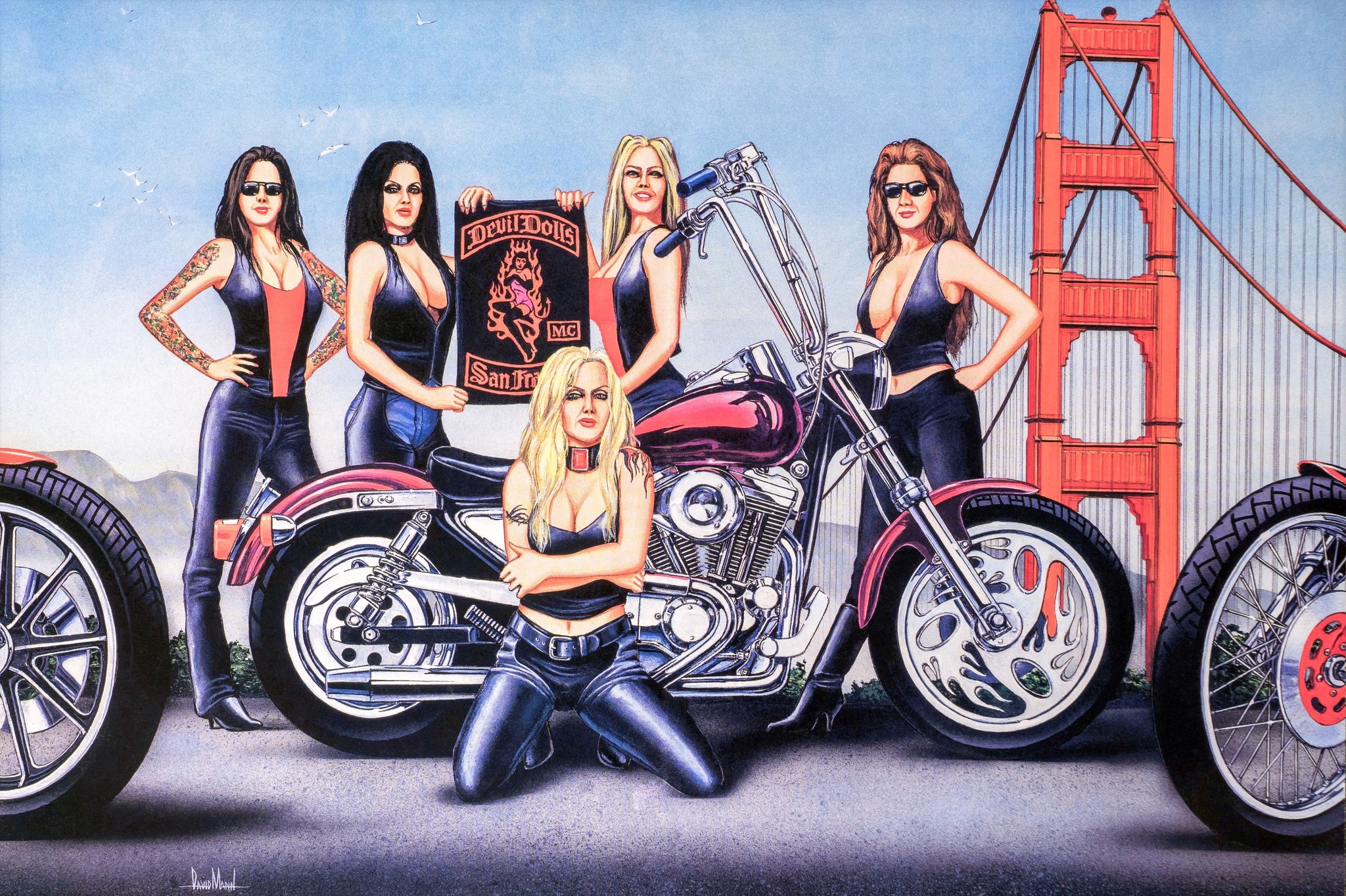
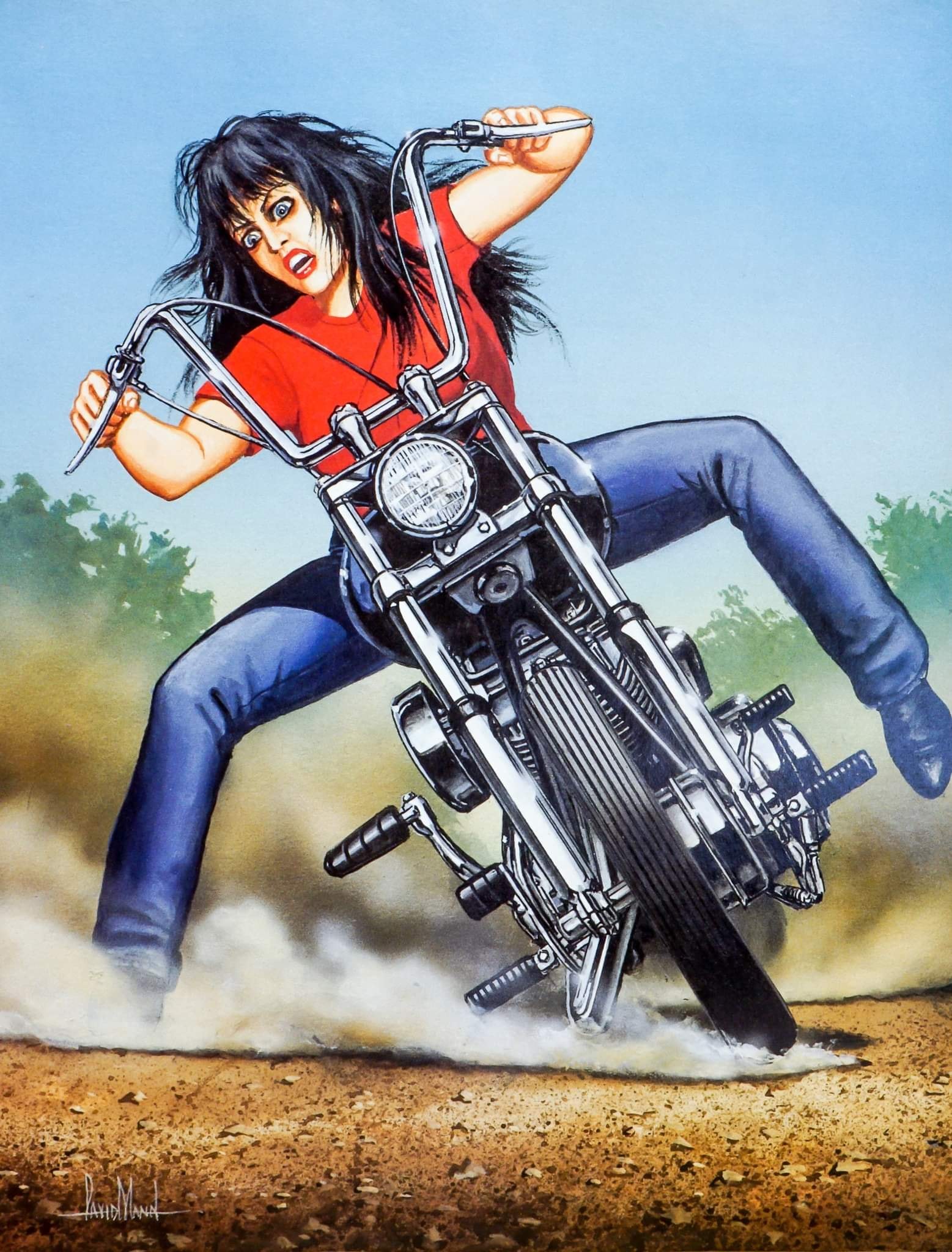
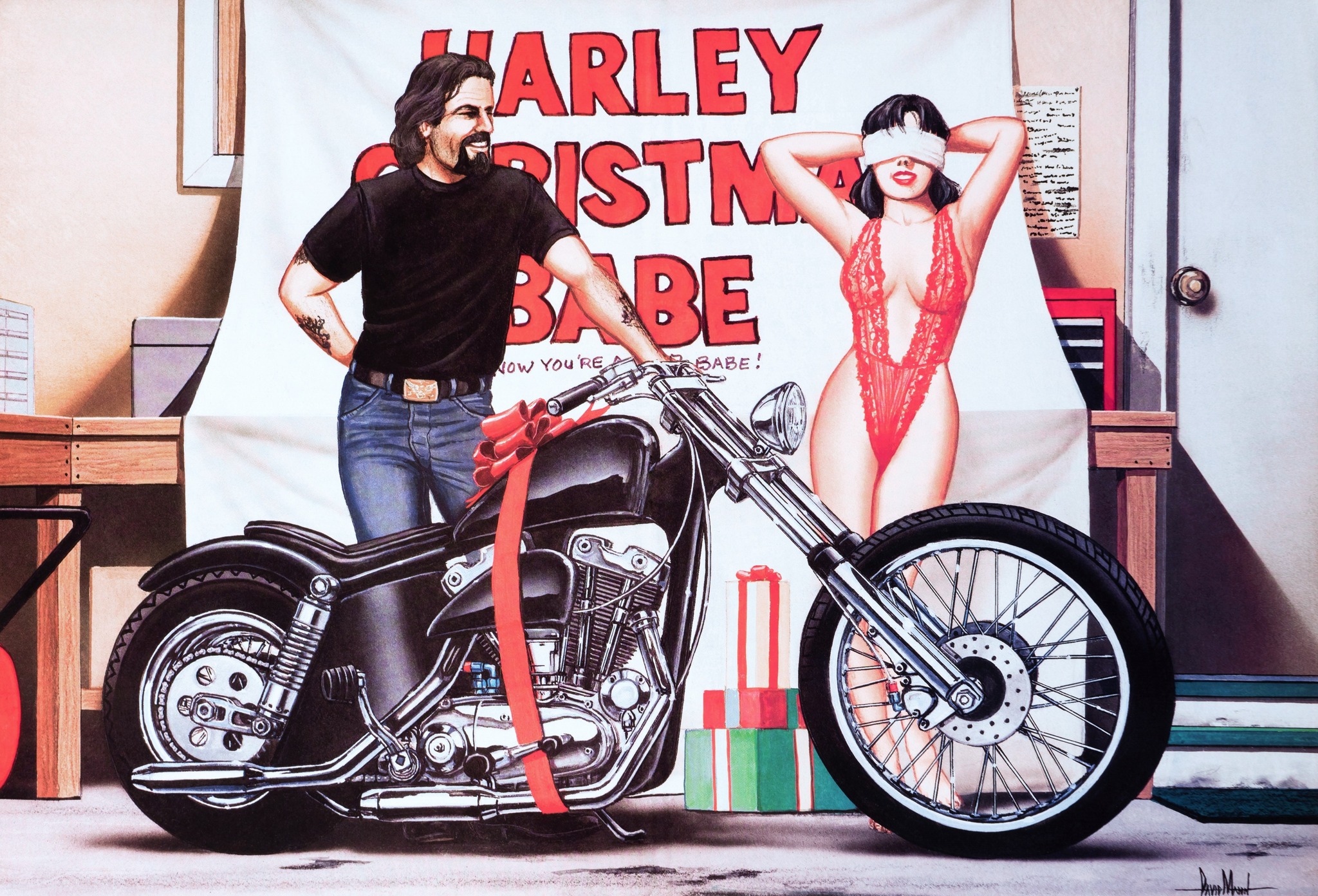
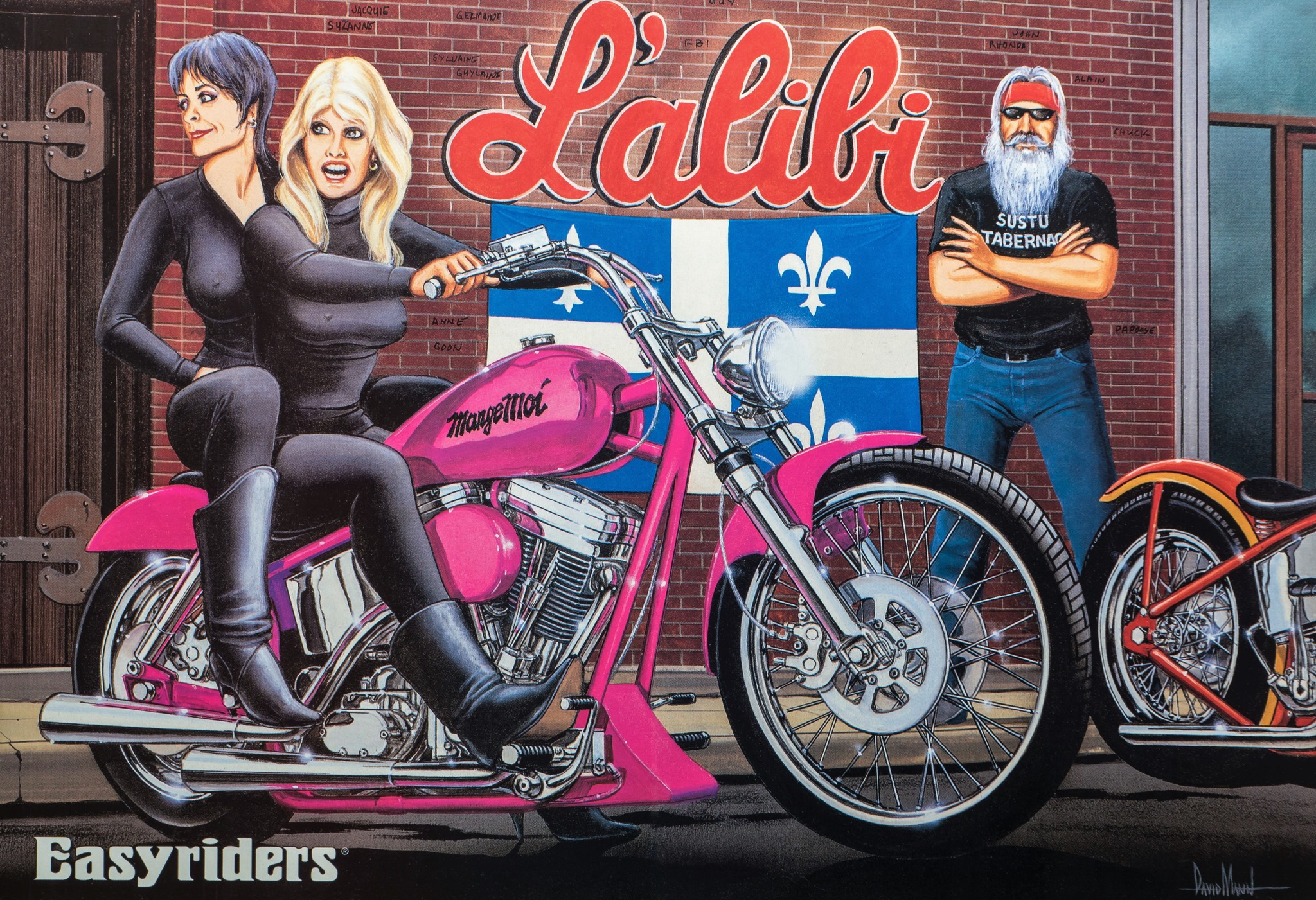
Big Bertha, December 1976, A woman on her own bike was still something of a novelty to a lot of bikers in the ’70s, even though women have been active in motorcycling from the very beginning. Look up the Van Buren sisters, or Effie and Avis Hotchkiss, for starters. Bertha, Dragon Ladies MCRide Hard, Die Fast, 1968Devil Dolls MC in BIKER(March, 2001) is a real-life ‘outlaw’ club for women.I Just Don’t Give Up, July 1999, was a story illustration. She’s riding a Servicar with a homemade taco box on the back. 45″ Servicars and solo rides were a popular choice for women riders back in the ’60s and ’70s – I dated a woman who rode a 45″ solo in the early ’80s – but nowadays women ride anything the boys can ride, from high-tech high-speed sportbikes by the Japanese and European marques to full-dress Harleys and Indians.Jesus Chrysler, April 1998His and Hers, July 1987. Sportsters for the girls and Big Twins for the boys, with matching paint jobs. The boys are quite amused that they’ve got the women packing all the gear So much for chivalry!Solo Flight, a story illustration from Easyriders, November 1999. Coincidentally, November 1999 is when my solo flight ended! 😁Jackie and I got hitched at the end of that month, and (with apologies to Prince) partied like it was 1999. 😆Merry Christmas, Babe! This appeared in BIKER, December, 1999. Technically, the woman is not riding the bike, but she is receiving one as a Christmas gift. I think we can safely assume she’ll be riding as soon as the snow melts, and she gets some leather on over that lacy lingerie! 😏L’alibi, March 1997. Mann’s wife, Jacquie, made frequent appearances in her husband’s work for Easyriders. She’s shown here at the controls of a hot pink Evo constructed in Pro-Street Style.Easyriders Video #13 cover artWild Women Don’t Worry, Wild Women Don’t Sing the Blues! I have no idea what the actual title is, but every time I see this painting that old tune by the late folk-blues singer Judy Roderick comes to mind.…….and Wild Women will look good on the cover of an Easyriders tattoo video!
Finally, what could be finer than doing something you love, like riding, and looking over to see the person you most love in this world enjoying the same thing?
Sunday Morning, July 1979.
I FOUGHT THE LAW AND THE LAW WON!
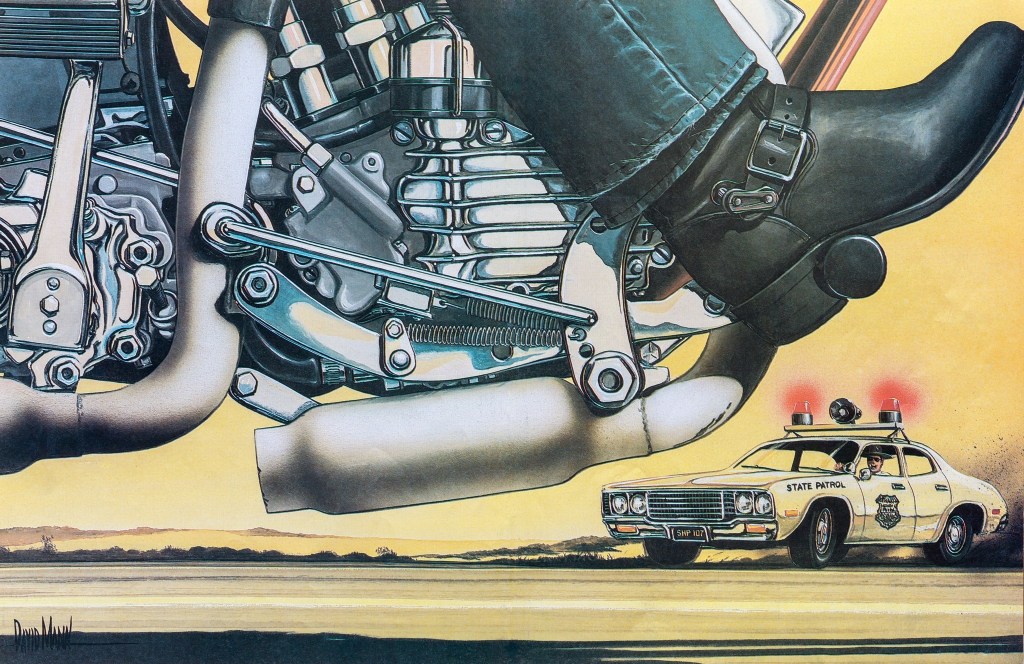
One of the downsides of biker life is the occasional brush with the law.
Noise Infraction, September 1977.
I’ve gotten a couple of these over the years. One was right after I’d installed brand new mufflers on my bike! Turns out I was riding my motorcycle in that trooper’s personal ‘No Biker Zone’. I’ve learned there are a lot of those in this state. 🙄 I’ve come to see ‘too loud’ tickets as a sort of ‘road-use tax’; nothing to do but pay the piper, no pun intended. 😏
My best road dog learned that the hard way. We were jamming through West Texas enroute to the Four Corners region when we were tagged by a state trooper near Sweetwater, Texas. On a busy Interstate Highway packed full of noisy highballing tractor-trailers and speeding cagers, he spotted us coming the opposite direction, doubled back and pulled us over. The fuckwad actually claimed he could hear our exhausts over the noise of the semis and pickup trucks, despite the fact that my exhaust system was in excellent condition and my partner’s was almost new. The trooper ignored the modified pickup that blasted past us as we stood there (leaving us all with tinnitus) and wrote us both tickets for ‘exhaust too loud.’
The first time I received a ‘too loud’ ticket, over a decade earlier, I was incensed because, as it happened, my mufflers were brand-new at the time. How could this asshole write me a ticket? I went so far as to call the State Attorney General’s office, to see if this was even legal, and was told the law leaves ‘too loud’ to the discretion of the officer making the traffic stop.
At the time I was incensed. The state is going to leave something like that up to officer discretion? Geez! The potential for abuse is staggering. How can you defend against an officer’s opinion, when it’s given the weight of evidence in a court of law? Well, you can’t, so I paid up….
….and that’s how I gained the ‘road-use tax’ perspective. If you can’t fight it, just find a way to accept it.
However, I later realized that ‘officer discretion’ is actually a good thing for us. It beats the hell out of decibel meters!
Think about it: the occasional cop may decide your pipes are too loud and ding you for ’em, but with a decibel meter? With a goddam decibel meter, every cop will be writing tickets for pipes too loud. When it comes to cops, better the few than the majority.
In fact, I’m so opposed to decibel meters, and the threat they pose to those of us who ride large-displacement American motors, that I resigned my membership in the American Motorcyclist Association when they made the incomprehensible decision to donate decibel meters to police departments. Seriously!?! What the ever-lovin’ fuck were they thinking? I doubt they miss my $50 annual dues, but I sleep better at night knowing I’m not arming our enemies and making life worse for my fellow riders.
Anyhoo, in the Sweetwater incident, I paid my fine before we left the jurisdiction. I am scrupulous about such things, because I never want to give a cop an excuse, like an unpaid traffic ticket, to pull me off my bike. If they want me they’re gonna have to make something up!
However, my partner, who had never been through this, was overcome with righteous indignation, and swore he’d fight this outrage. Sure enough, when we got back from our week on the road, he had his motorcycle inspected, gathered all pertinent documentation, closed his clinic for two days and hied himself out to Sweetwater to wage war against injustice.
The upshot? He lost two days out of his practice, the cost of travel to Sweetwater and overnight accommodations, and had to pay a fine and ‘court costs’ amounting to more than three times what I’d paid the day I got the ticket. I refrained from saying ‘I told you so,‘ but I did tell him so! 😆 As I said: nothing to do but pay the piper and get on down the road.
A final note: I mentioned the Sweetwater stop to my attorney at the time, who specialized in motorcycle-related law, and he said ‘Oh, that was Trooper _______.’ Apparently, the fellow who stopped us was renowned statewide for his hatred of bikers. 🤷♀️ Whatcha gonna do?
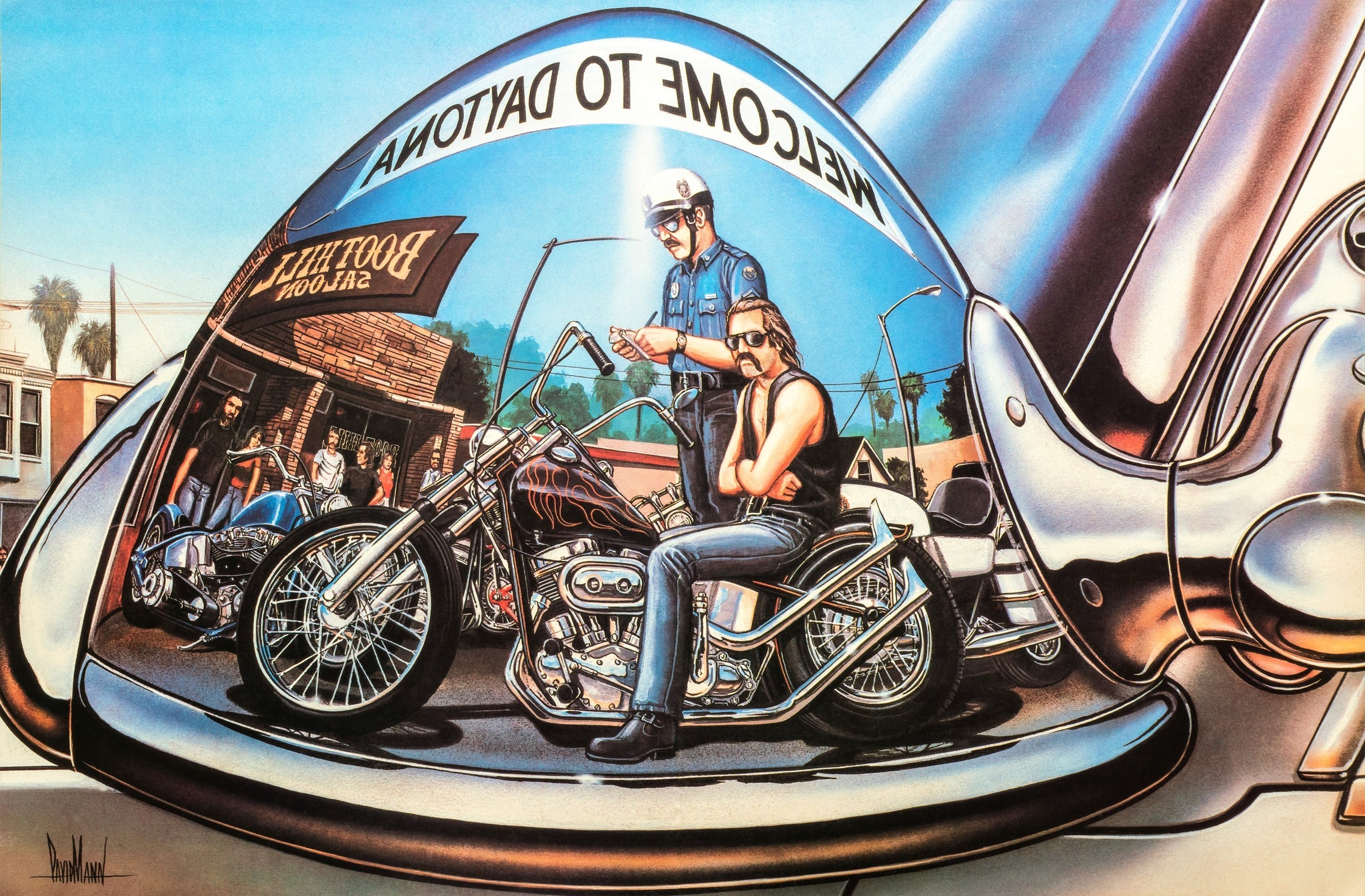
Welcome to Daytona Ticket in IRON HORSE, June, 1981
We’ve all had close calls like this one, too.
Nobody Talks, Everybody Walks, September 1981Run Heat, July 1975.In the early ’80s I was part of a pack of about thirty or forty motorcycles enroute to a party at Lake Buchanan when we got jacked up by a battalion of LEOs of every stripe. Every cop in the county must have been there! We had local yokels, county mounties, smokies, probably a dogcatcher or two, all drawing down on us with shotguns and automatic rifles! It was a nice day for a ride with friends until the po-po came ’round. They ran us through the mill – license, tags, VINs, warrantless searches – and came up with exactly one warrant, for an unpaid traffic ticket. Out of forty of us, they got to arrest one! I guess we weren’t the roving band of criminal kingpins they thought we’d be! 😂
But sometimes the heat is more than just an inconvenient wants-and-warrants stop or speeding ticket. Prosecutors and LEOs seem to be convinced that bikers – particularly patchholders or independents on Harleys – are career criminals simply because they identify as bikers. As a result, too many bikers, many of them innocent, have wasted years inside prison walls. Mann showed their lives, as well.
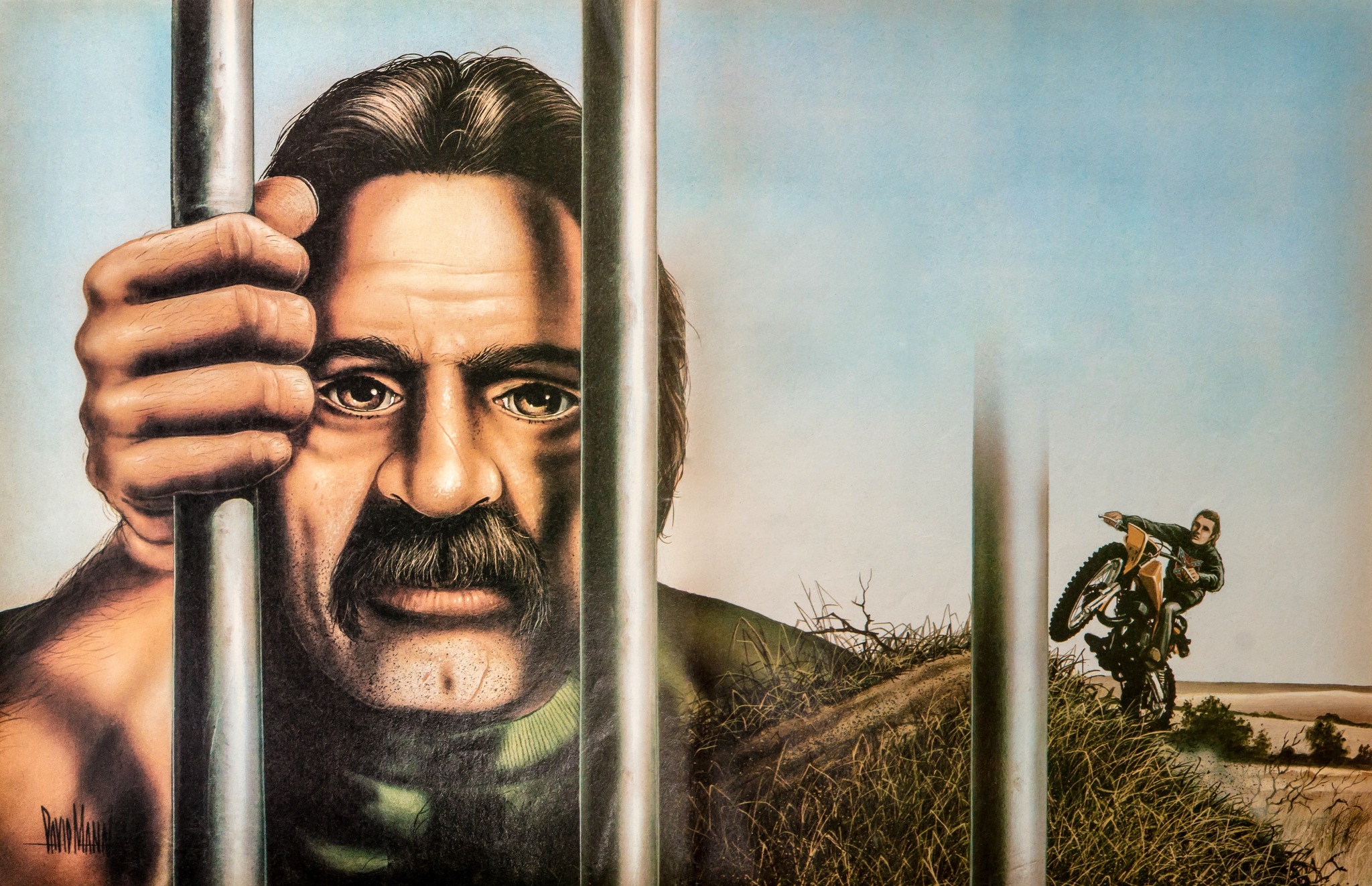
Bum Beef illustrated a short story in Easyriders. FWIW, I never saw a prisoner’s toilet looking that nasty. In my experience, most cons keep their houses spotless, and especially their toilets.Prison Memoriesillustrated another short story, about a convict who watches a young dirt-biker tearing up the fields outside the barred windows of his cell, and how the boy inspires him. One way that Easyriders stood out from all the other motorcycle magazines was with its publication of short fiction by a number of talented authors. Larry ‘Rabbit’ Cole was a particular favorite, as was Jody Via. (More on Jody Via in the footnotes to my history of Easyriders magazine.)
Although Easyriders went downhill in the late ’80s and ’90s, I take great pride in the fact that Easyriders published the first short story I ever sold! 😁 Sadly, Dave Mann did not create the illustration for it. What a feather in my cap that would have been!
If anyone cares, I will post a couple of short stories I have written in a future entry.
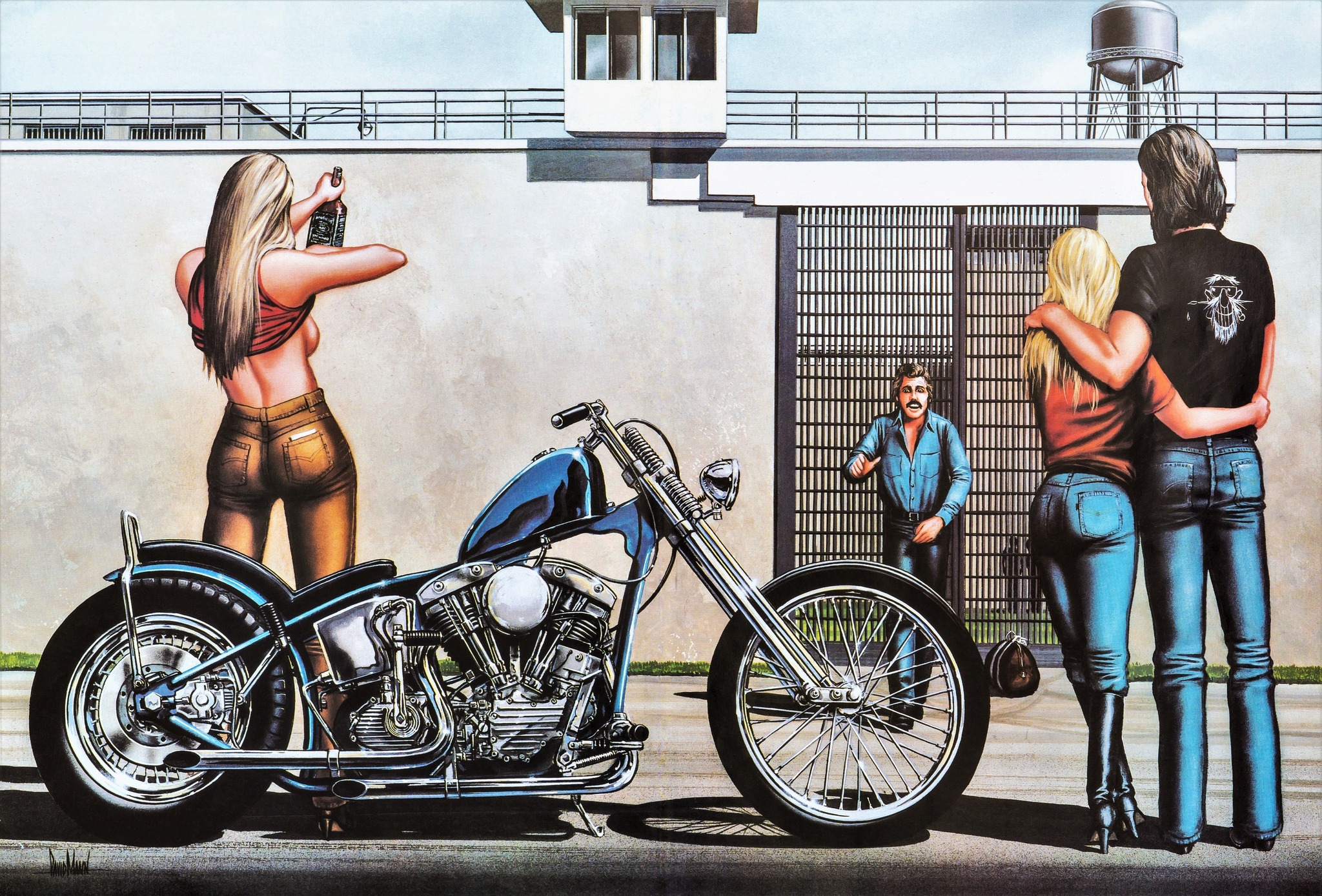
On a brighter note, here Mann captures the joy on a rider’s face as he clears those gates. The first things he sees are his girl, a bottle of Jack, and his prized shovelhead chop. As an added bonus: Dave Mann and Jacquie stand at far right, ready to welcome him back to the world.
Prison Release, August 1982
HISTORY LESSON
Mann knew the history of our tribe, too, from the streets of Hollister, California, where it all began….
Wild One, March 1993, celebrates the ‘Hollister Riot’ of 1947, a raucous motorcycle rally and party that allegedly got out of hand, and gave rise to the whole outlaw biker phenomenon. In response to negative press about the incident, a spokesman for the American Motorcycle Association (as it was then known) reportedly claimed the rowdies at Hollister were ‘outlawed’ by the AMA, which meant they would not be permitted to take part in AMA-sanctioned events. The AMA later went on to assure America that ‘99% of motorcyclists are upstanding, law-abiding citizens.’
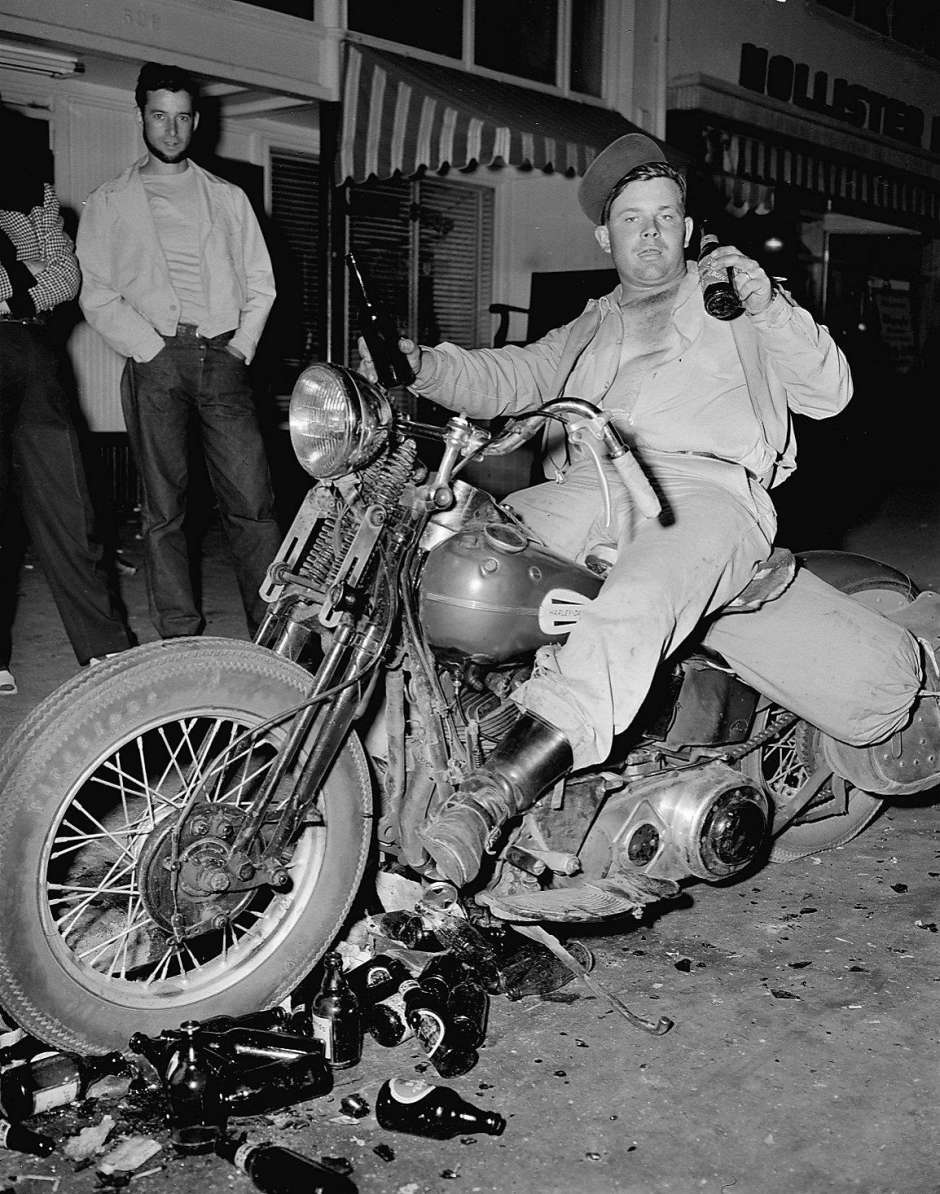
Much to the AMA’s chagrin, it turned out the remaining 1% were just fine with the notion of being ‘outlaws’ – part of the elite rejected by the ‘straight’ association – and were soon sporting patches declaring themselves ‘one-percenters’. The honor is jealously guarded by those who claim it, and anyone wearing the ‘1%’ patch or tattoo had best be prepared to defend it! The infamous ‘Hollister riots’ photograph by Barney Peterson, which appeared in LIFE two weeks later, cemented in the minds of most Americans the image of motorcyclists as lawless, drunken ruffians. Unfortunately, the photo was staged. Peterson, assigned to cover the story, arrived too late to witness any of the ‘riot’ itself. Not wanting to miss out on his commission, he grabbed this fellow, later identified as Eddie Davenport of nearby Tulare. Peterson sat him on a motorcycle parked at the curb and artfully arranged bottles around the motorcycle, to make it seem the entire town was overrun by drunks on two wheels! His ploy worked: the photo hit the wire services and was picked up by LIFE
I’ve penned a lengthy article about the history and aftermath of the incident at Hollister here.
….through the early days of the custom bike scene.
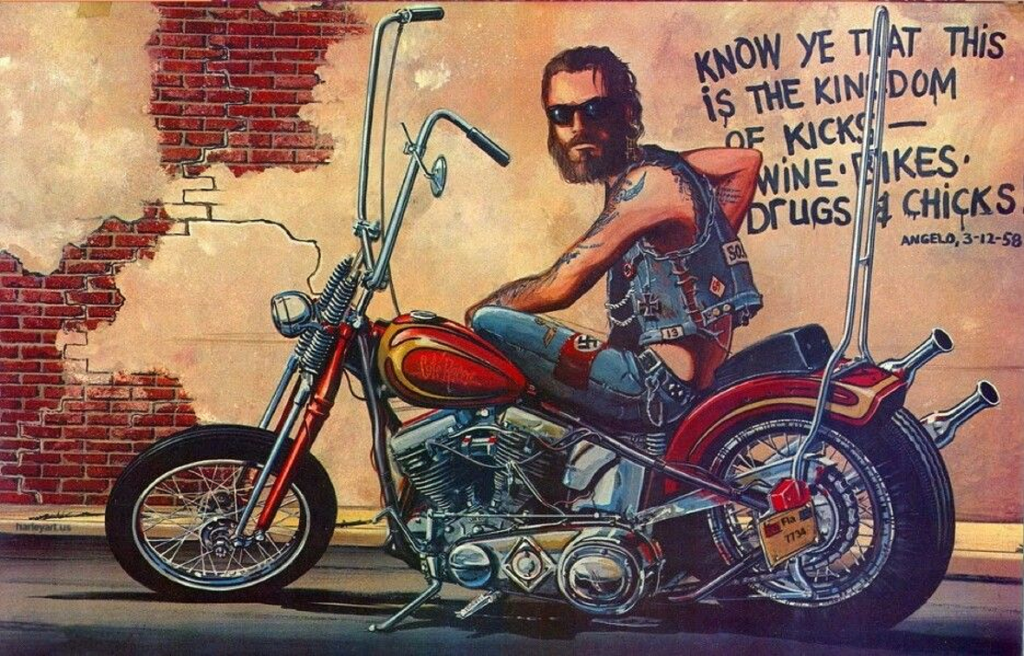
Ape Hanger Days (December, 1973) is one of Mann’s most widely recognized and reproduced images, topped only by Ghost Rider (November, 1983). From the bared brick behind the stucco wall to the ragged cut-off Levi’s jacket and the grease spattered on the rim and sidewall of the rear tire, the detail is astounding, and Angelo’s sweet little panhead is period correct and perfect in every way! The swastika is also period correct, although to Angelo the broken cross likely did not mean what it signifies today.Only the gods know how many motorcycles (and paintings, and drawings, and tattoos…. see below) Dave Mann’s works have inspired. This is a note-for-note replica of Angelo’s panhead from ‘Ape Hanger Days‘ by a fellow from Florida named Hollywood Tig.
A RABBIT HOLE:
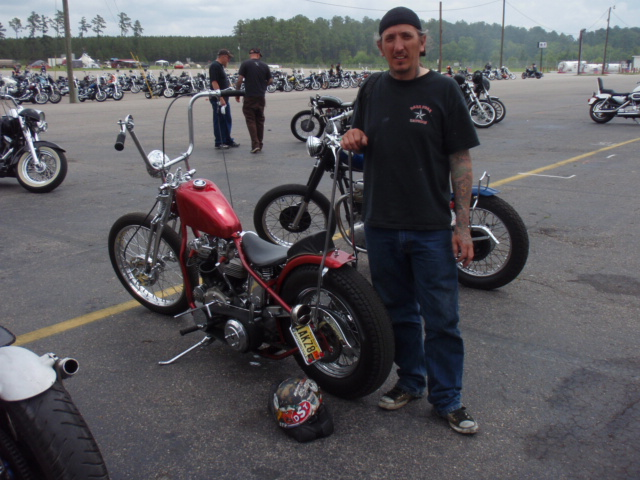
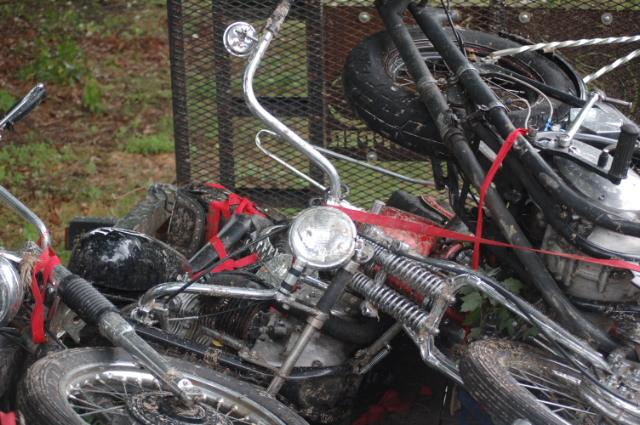
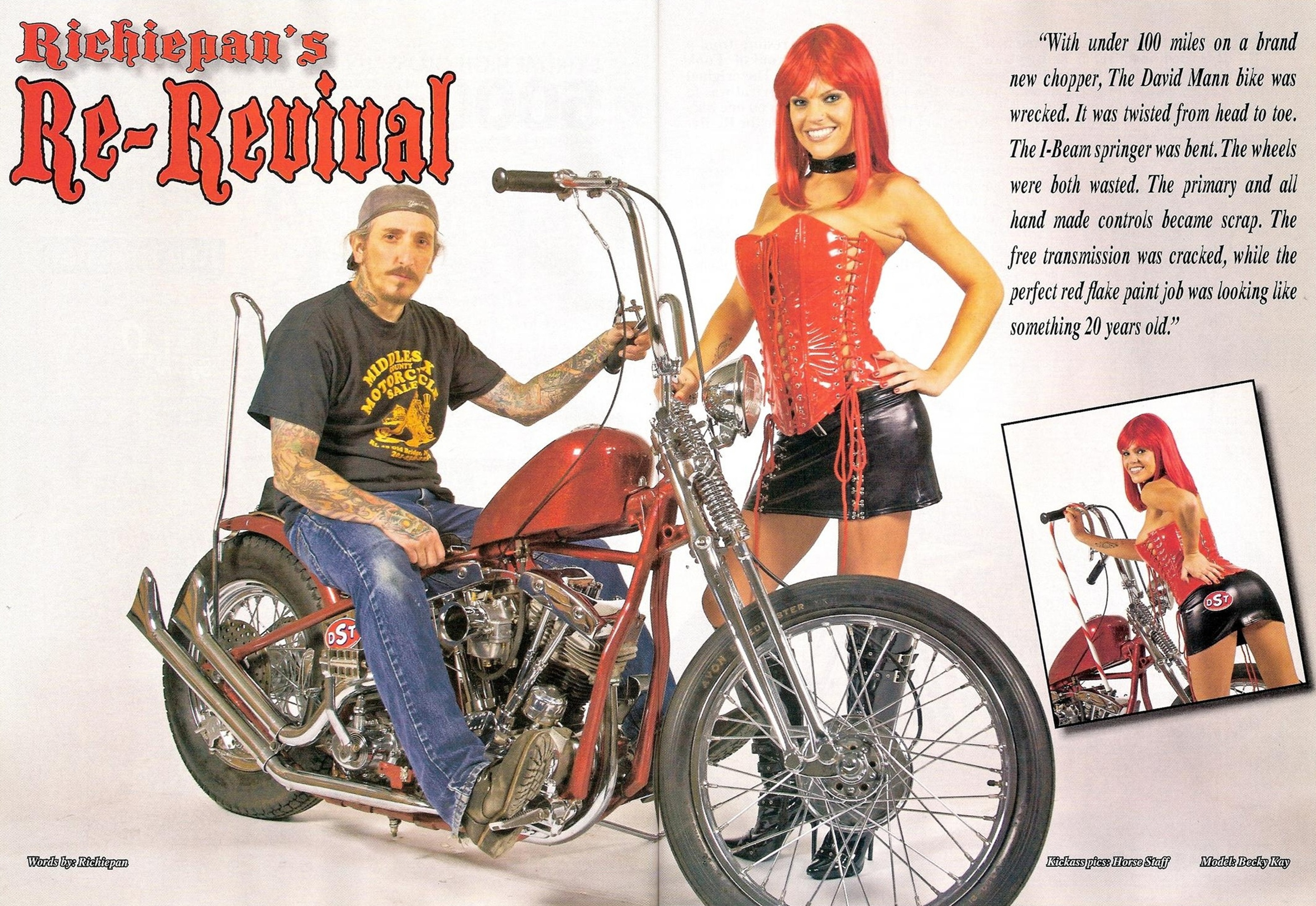
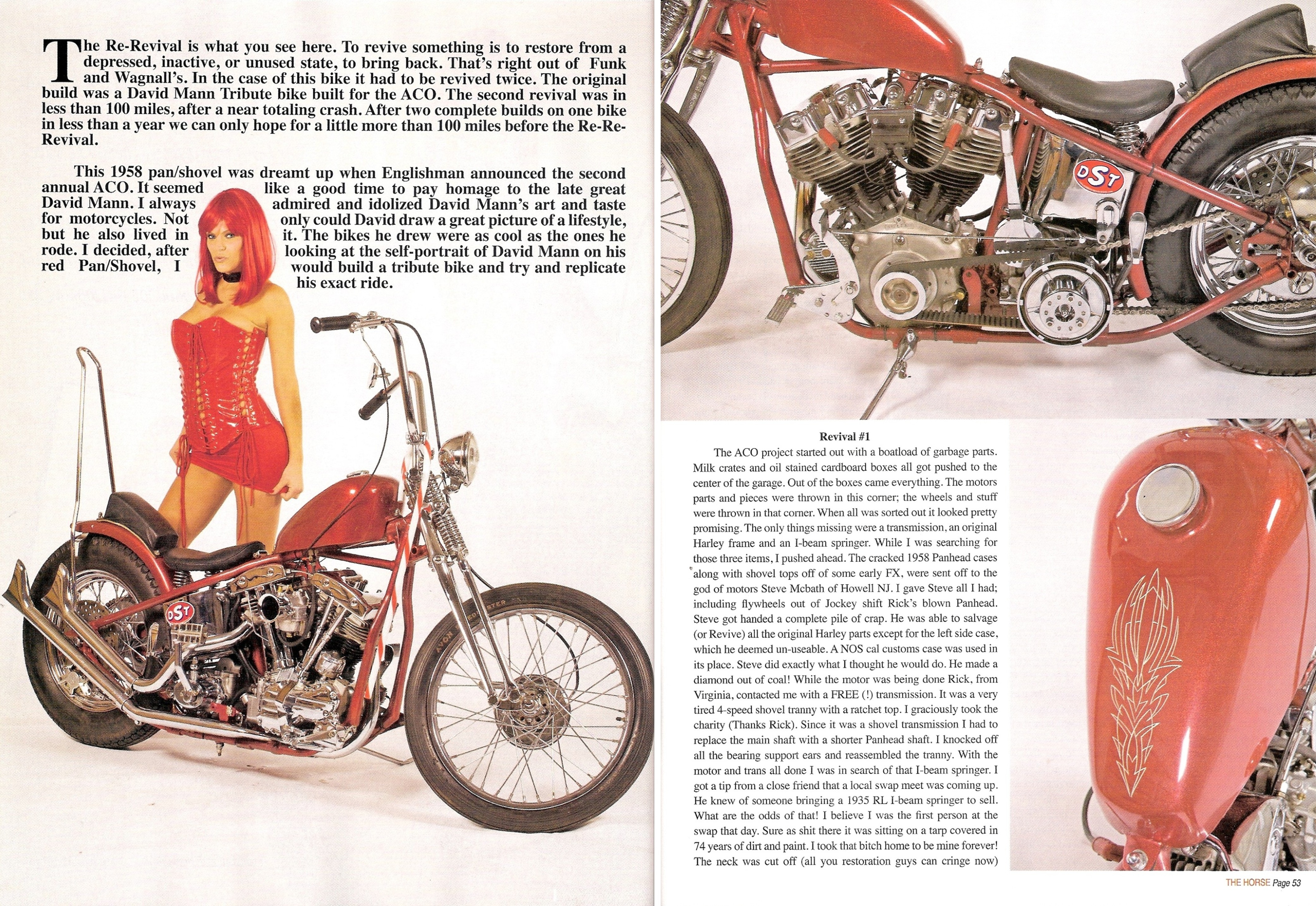
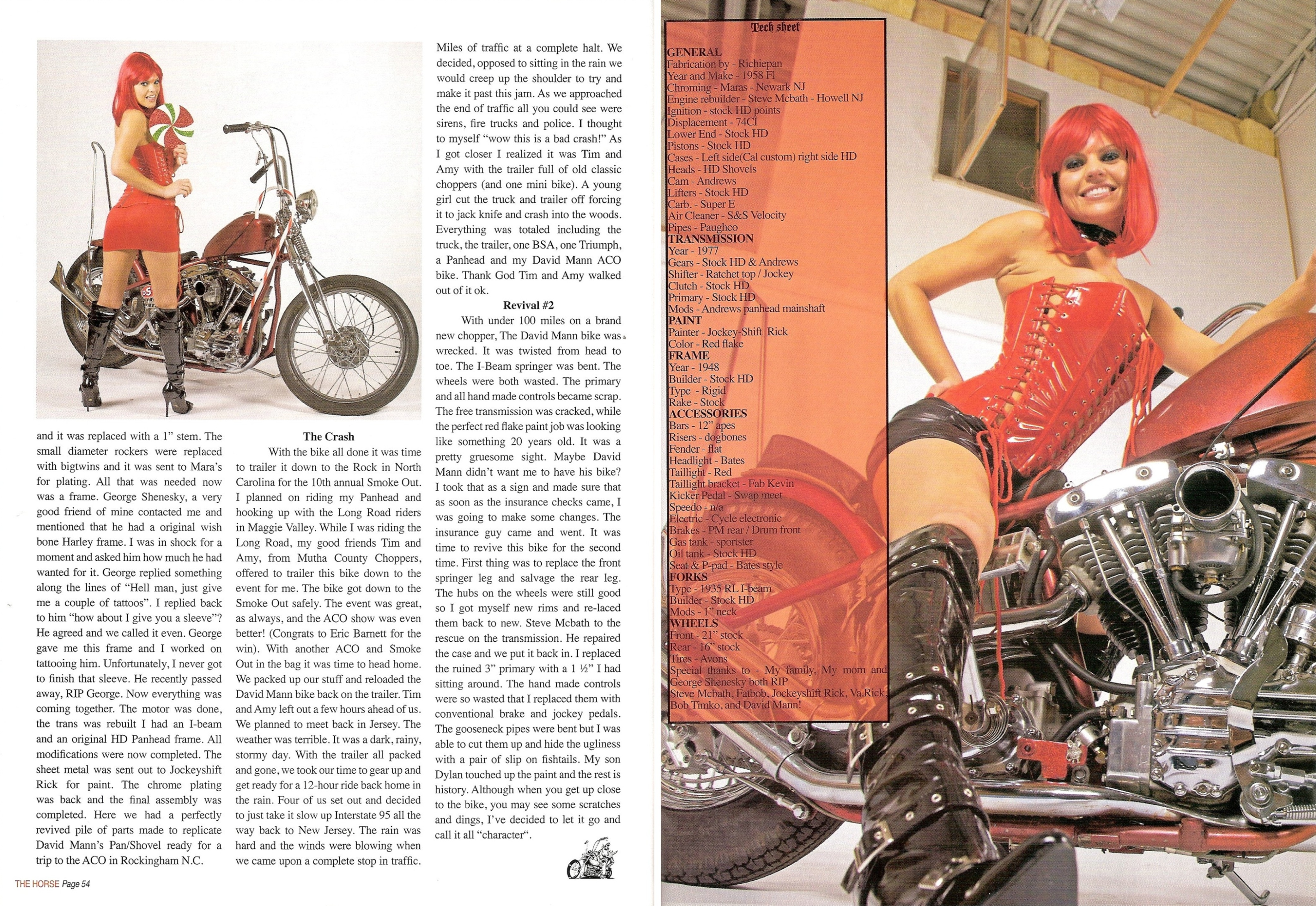
If you’ll excuse me, I’m going to go down another rabbit hole for just a moment, to show you another painstaking replica: the late tattoo artist Richiepan’s reproduction of Dave Mann’s own red rigid-framed shovelhead, as pictured below.
Crazy Dave’s Broad-Slide, AKA Slip-Slidin’ Away or Brodie! above.Dave often appeared in his own artwork. This image is particularly prized by fans because it features his shovelhead in action, showin’ class in front of a joint named ‘The Shores’, not far from where Dave and Jacquie lived. Below is Richiepan’s tribute bike.Richiepan’s tribute bike in its prime.Richiepan with his tribute to Dave Mann, prior to the disaster.The Dave Mann tribute bike, and several others, after the trailer broke loose from the truck.Oh, the humanity!
Here’s a write-up on Richiepan’s build from the December 2009 issue of The Horse/Backstreet Choppers:
My Old Gang (May 1979) depicts a number of Mann’s brothers in the El Forastero Motorcycle Club. Per David’s Facebook page (link at bottom of column) they are, from left: Tom Fugle, Greycat, Tiny, Skip Taylor and Dan Jungroth. They are often featured in Mann’s other paintings, as well.
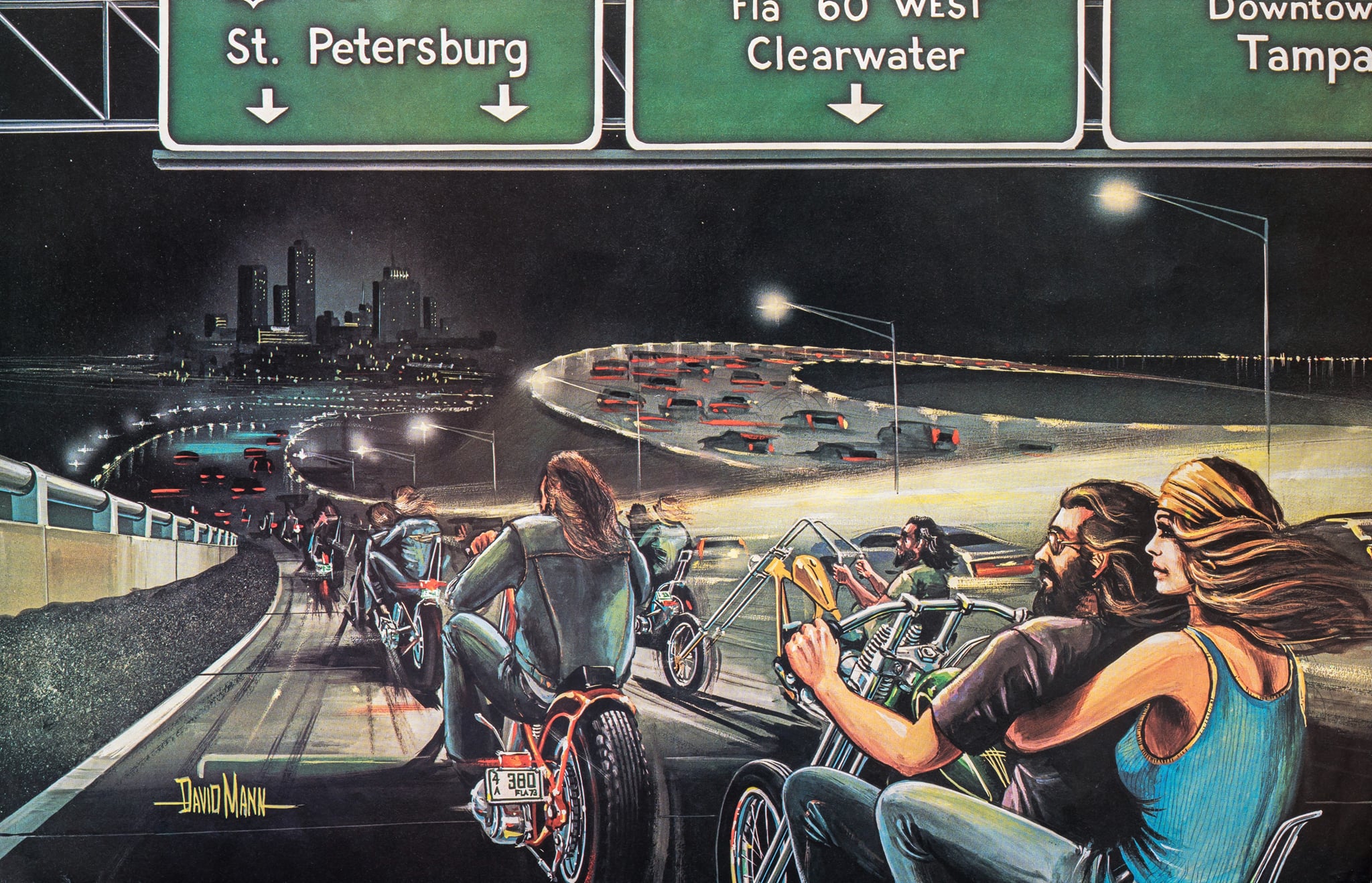
….the custom bike movement of the Seventies….
Florida Freeway, October 1973
….the Eighties….
Family, August 1986
….the Nineties….
Cruisin’ Colorado, August 1998
….and into the new century.
Mondo, June 2001, is Mondo Parra of Denver’s Choppers, a respected custom builder from a long-lived, well known and historic chopper shop.
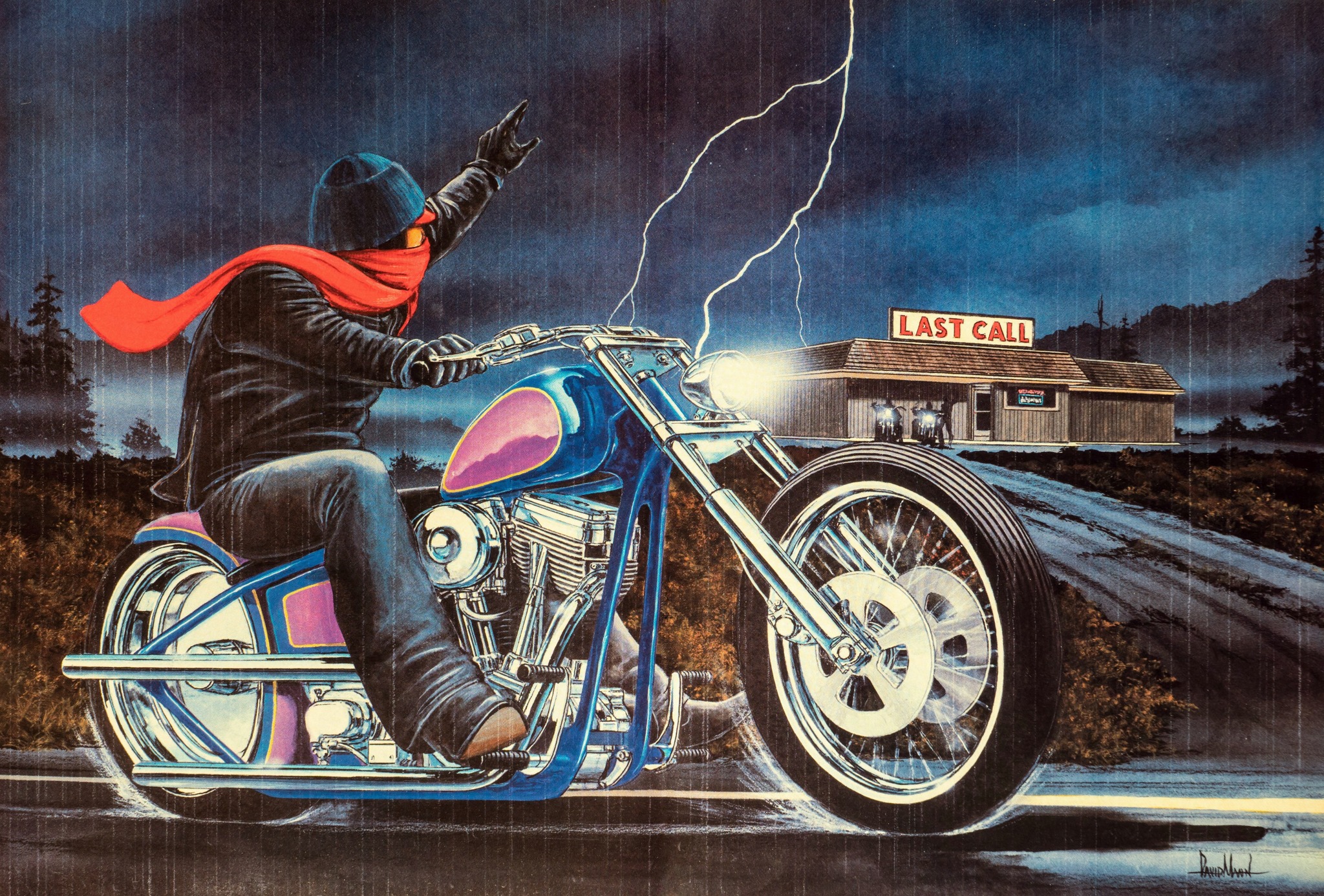
He gave us the prophetically named Last Call….
Last Call, painted shortly before he retired, appeared in BIKERJune 2003
….and a glimpse into the future, come what may.
Future Riders appeared in BIKEROctober, 1999
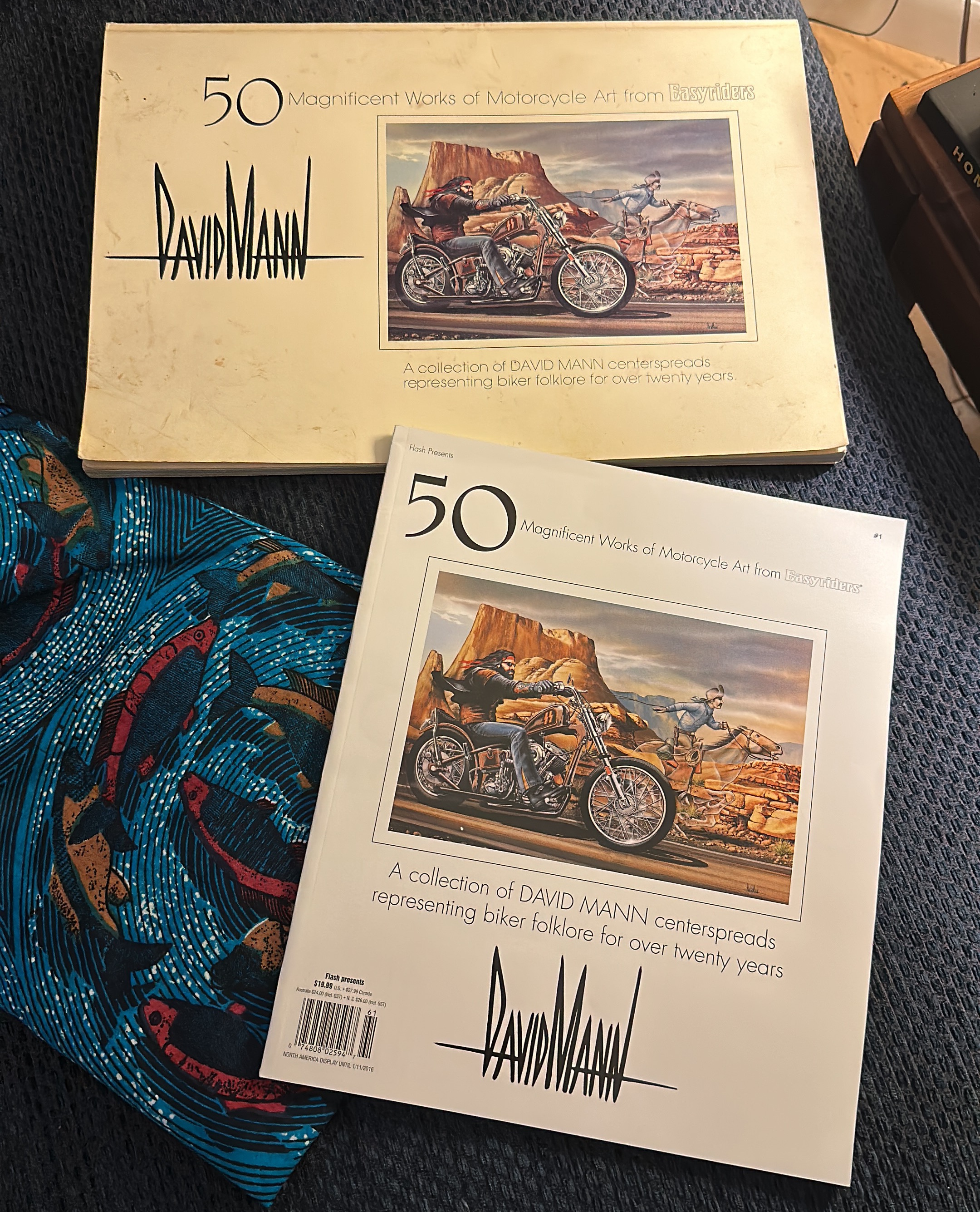
Unlike Vincent van Gogh, David Mann didn’t have to die to become well-known. He had the satisfaction of knowing his talents were appreciated. There were frequent letters to the editors, lauding his works. Poster prints of his most popular paintings sold like hotcakes. Then there was the large-format book of his work released in 1987, which quickly sold out and is now highly collectible. Even the cheapie reprints Paisano Publications released in 2016 and 2017 are going for stupid money on eBay.
There’s the 1987 original, a gift from my best road dog, and the 2016 reprint. Same artwork and pretty good printing, but thinner, cheaper paper. The publisher released four of these, gathering artwork from all the publications David Mann painted for – Easyriders, Iron Horse, Biker, American Rodder,et cetera – and packaged them to make a quick buck off the now deceased artist. My understanding is that David’s widow, Jacquie, never saw a dime of that money. Not cool! 😡
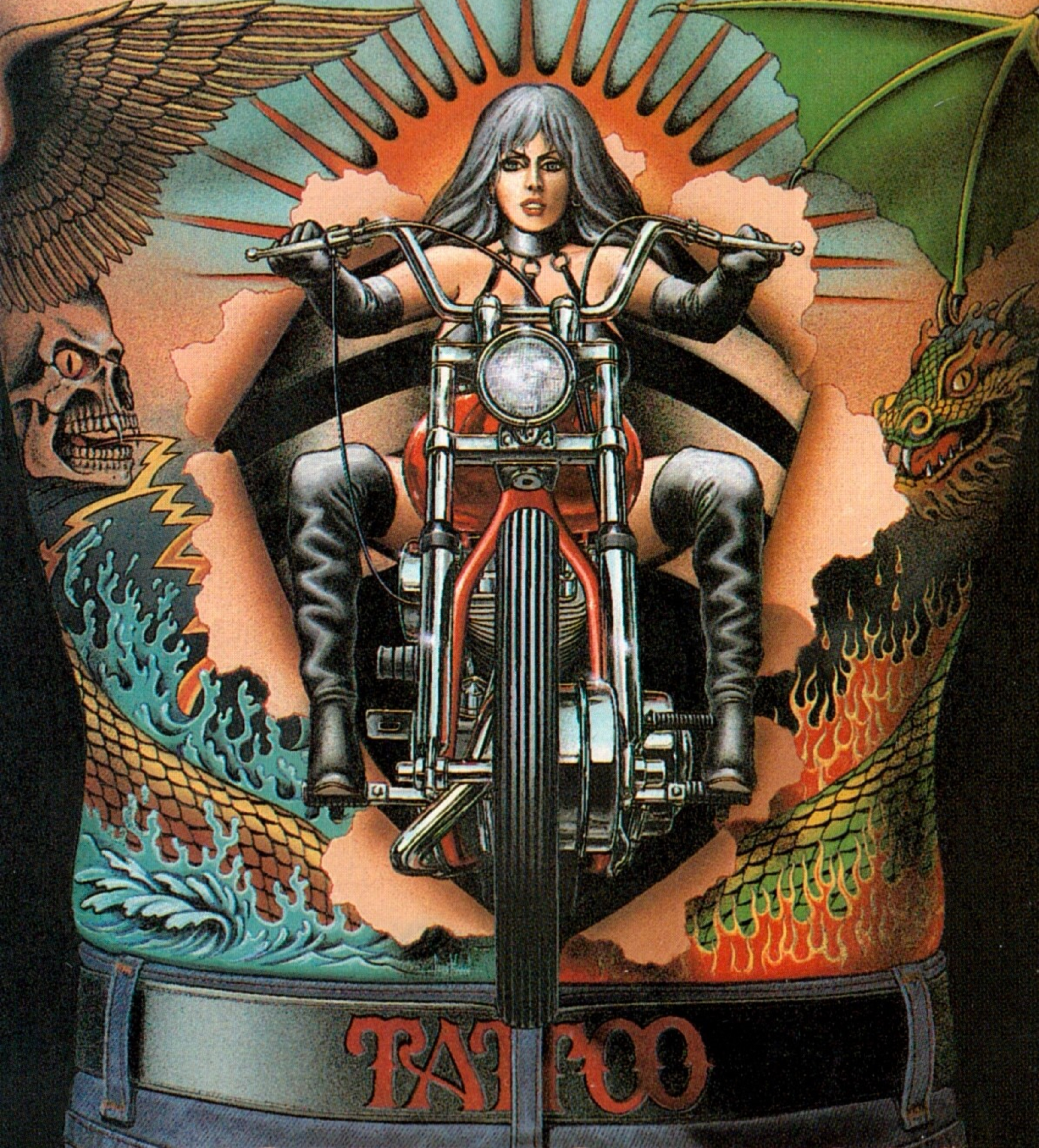
Then there are the tattoos: so, so many tattoos! I mean, bikers like tattoos anyway, but they really like tattoos of Dave Mann’s art! Just Google ‘David Mann tattoos‘ and see what comes up. 😮
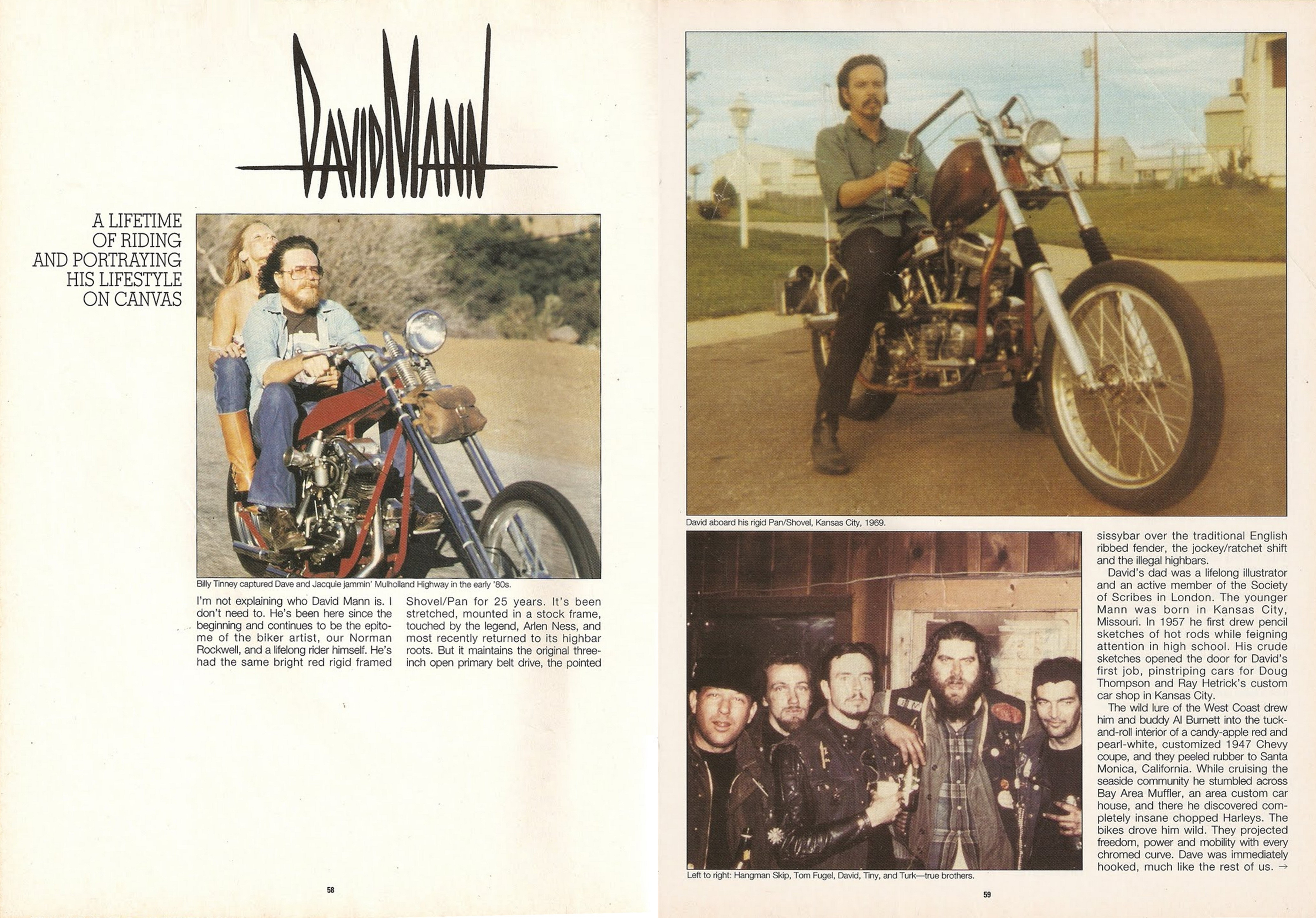
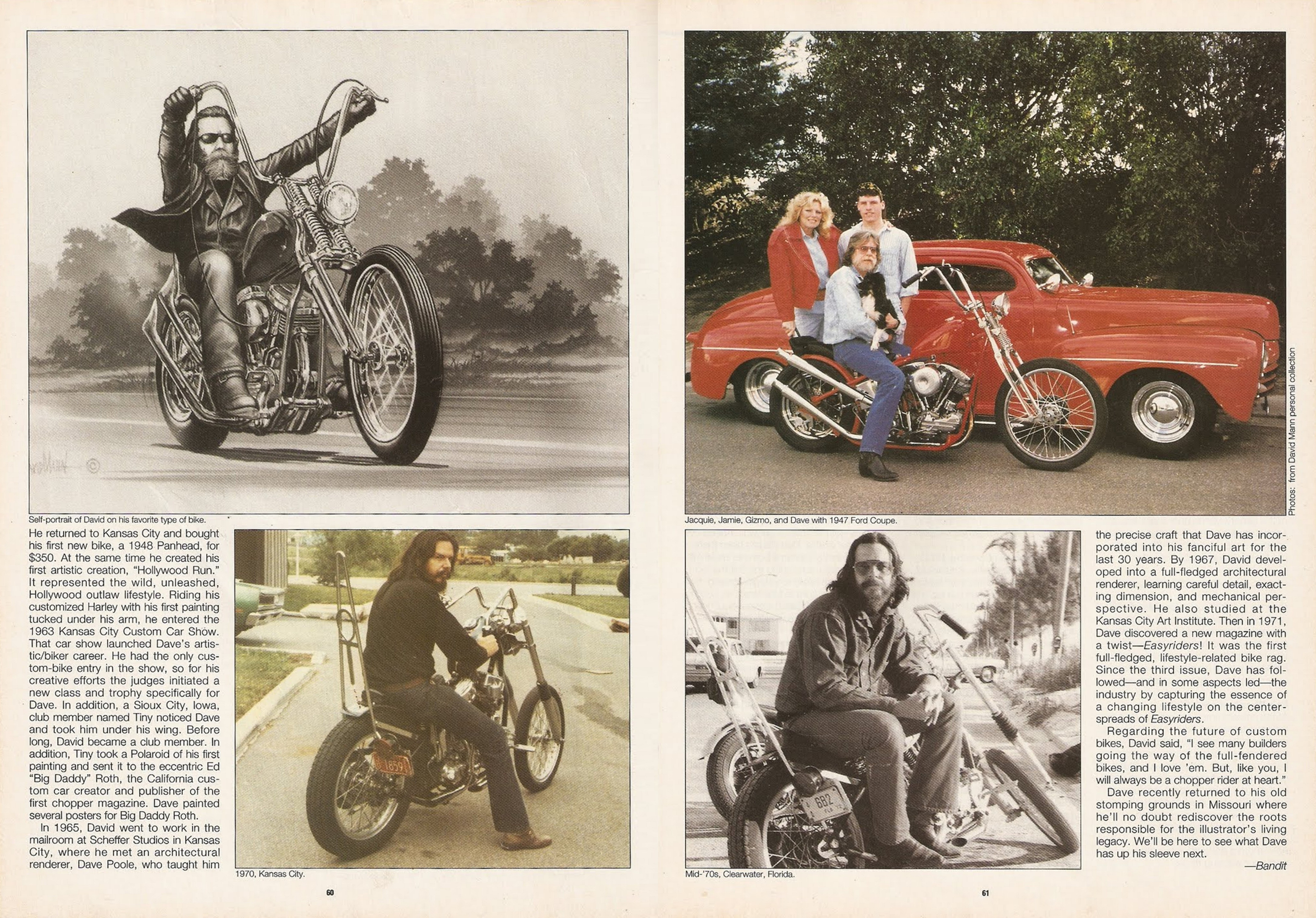
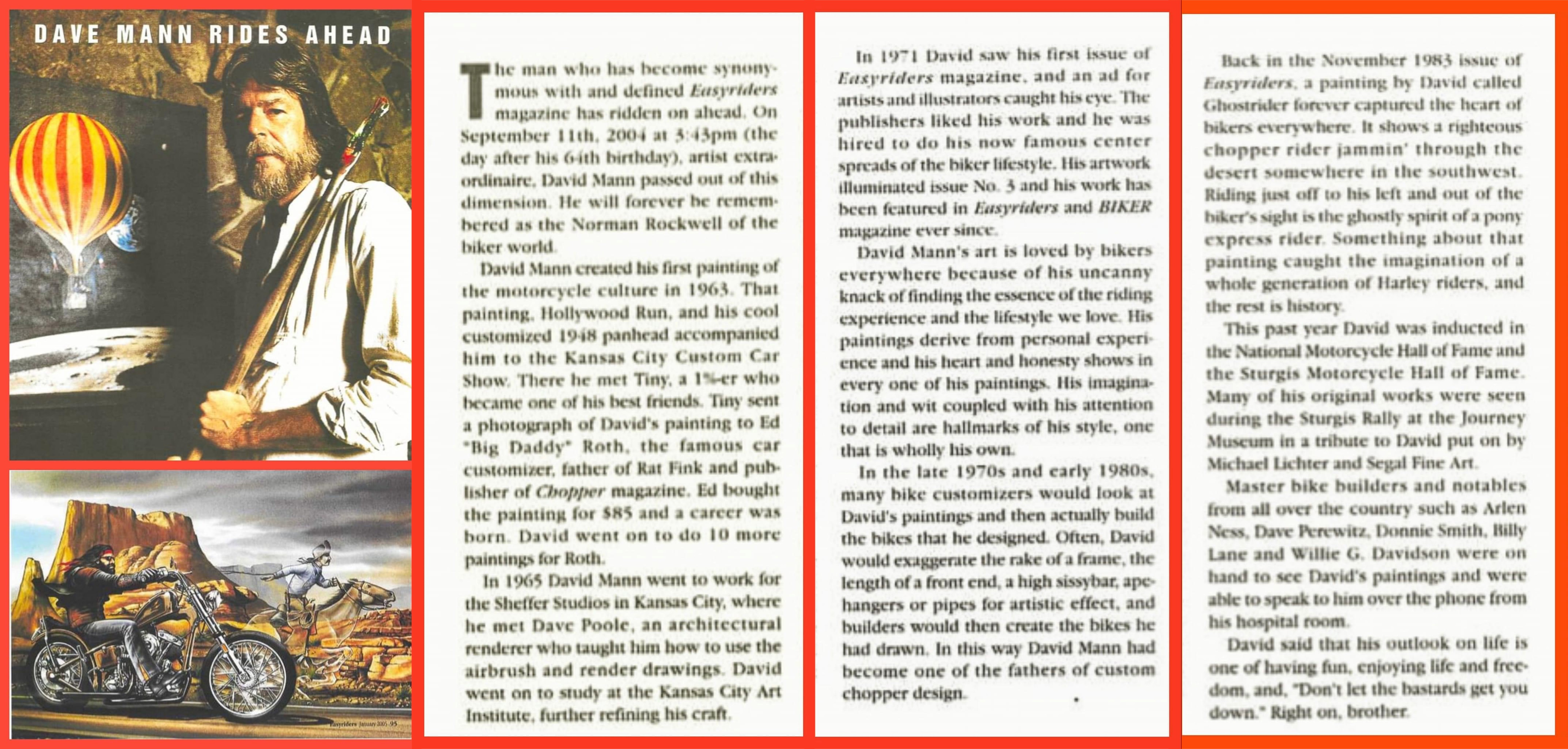
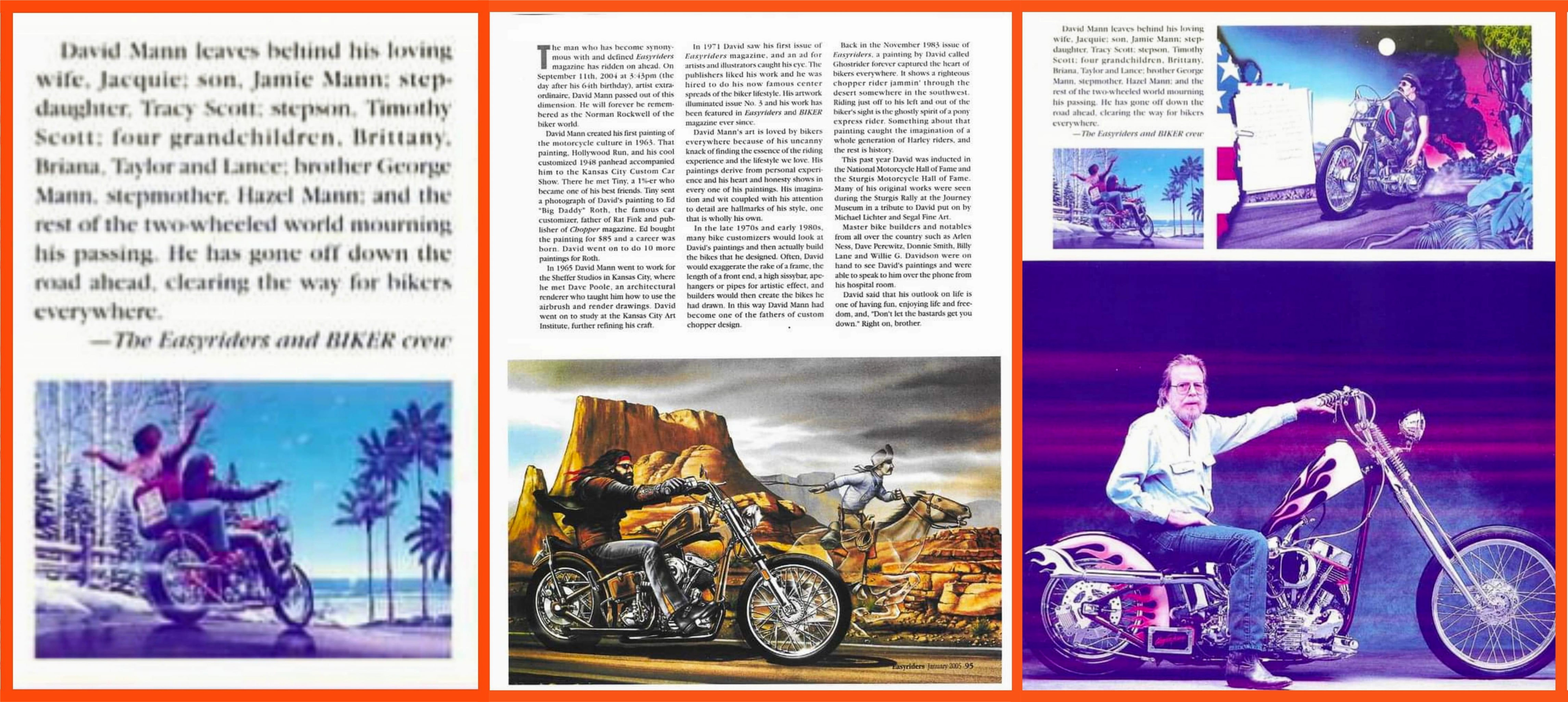
Finally, there was this tribute to David Mann from the pages of Easyriders; just a biographical sketch and a heartfelt appreciation of the still-living artist. I can’t recall what issue it was in and the interwebs are keeping stum about it. I’ll add the date of publication ASAP, if I ever find it.
‘ART IS ETERNAL, FOR IT REVEALS THE INNER LANDSCAPE, WHICH IS THE SOUL OF MAN’
As noted at the top of this page, artists have the power to move us with their words, their images, their sculpture and dance and film – to limn the ‘inner landscape’ of absolute strangers – and David Mann had that ability, in spades!
HEARTBREAKING….
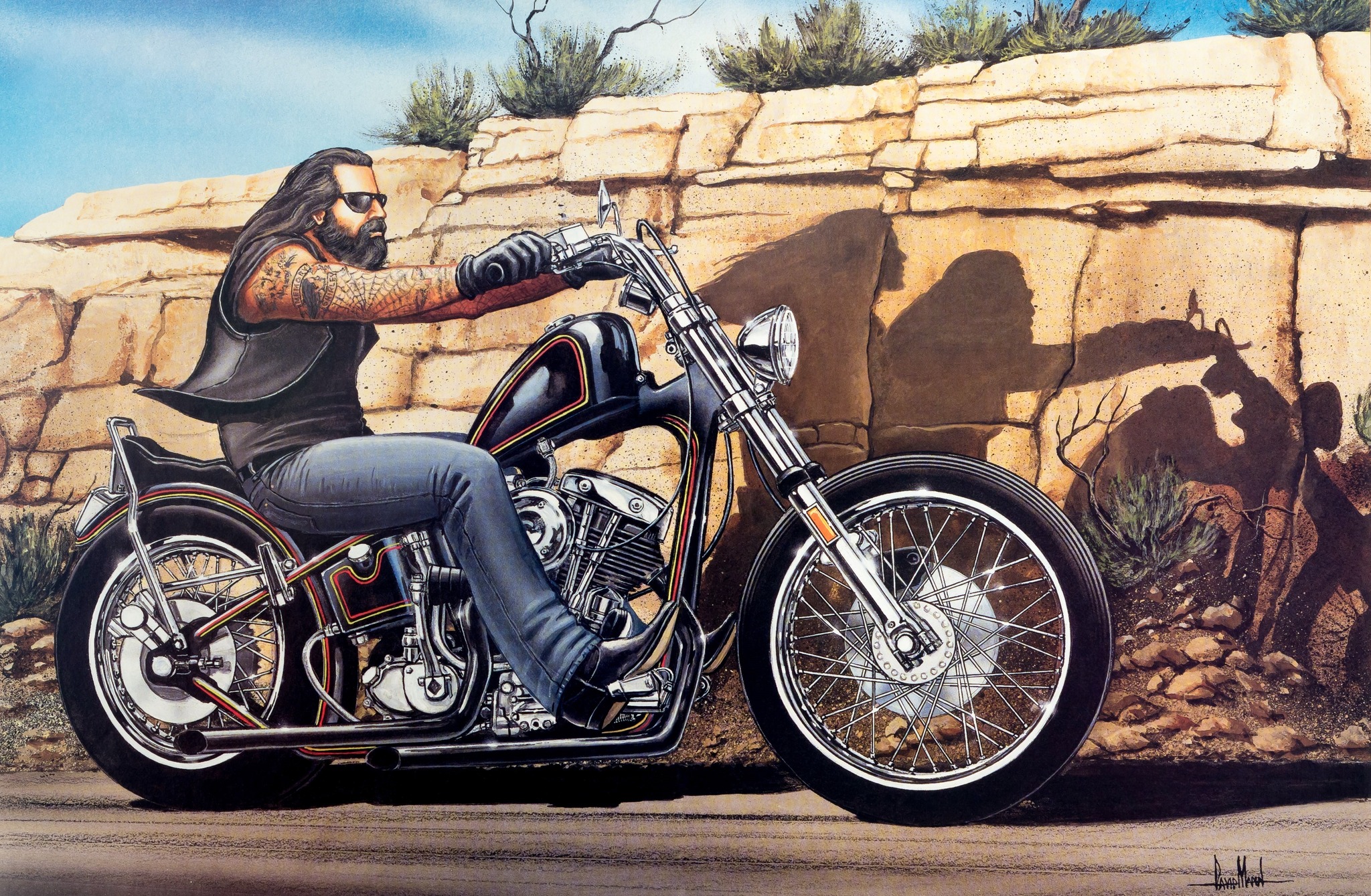
So many incredible paintings, but one of the images that most touches me is this one, depicting a rider on his rigid shovelhead; the biker and bike from Ghost Rider, sans SS lightning bolts and ethereal cowboy. This time, the biker is alone in the desert hills, but the shadows on the rock behind him tell us he’s missing his woman, wishing she were still packing behind him for the long ride, tucked in behind him where she belongs. The tattoo on his arm and the title – In Memory Of… – suggest that she is not just out of his life, but altogether gone from this world. So much emotion and history packed into one small frame!
Thankfully, I’ve never lost a lover to death, but I have lost brothers, friends and kinfolk, and I do know the ache of yearning for something you once had, and will never have again.
In Memory Of…, appeared in the August 1999 issue of BIKER. As noted below, it was painted with magazine staffer Clean Dean in mind. Dean had recently lost his wife to cancer, and Dave thoughtfully used Dean and Karen as models for the shadow figure on the rock wall.
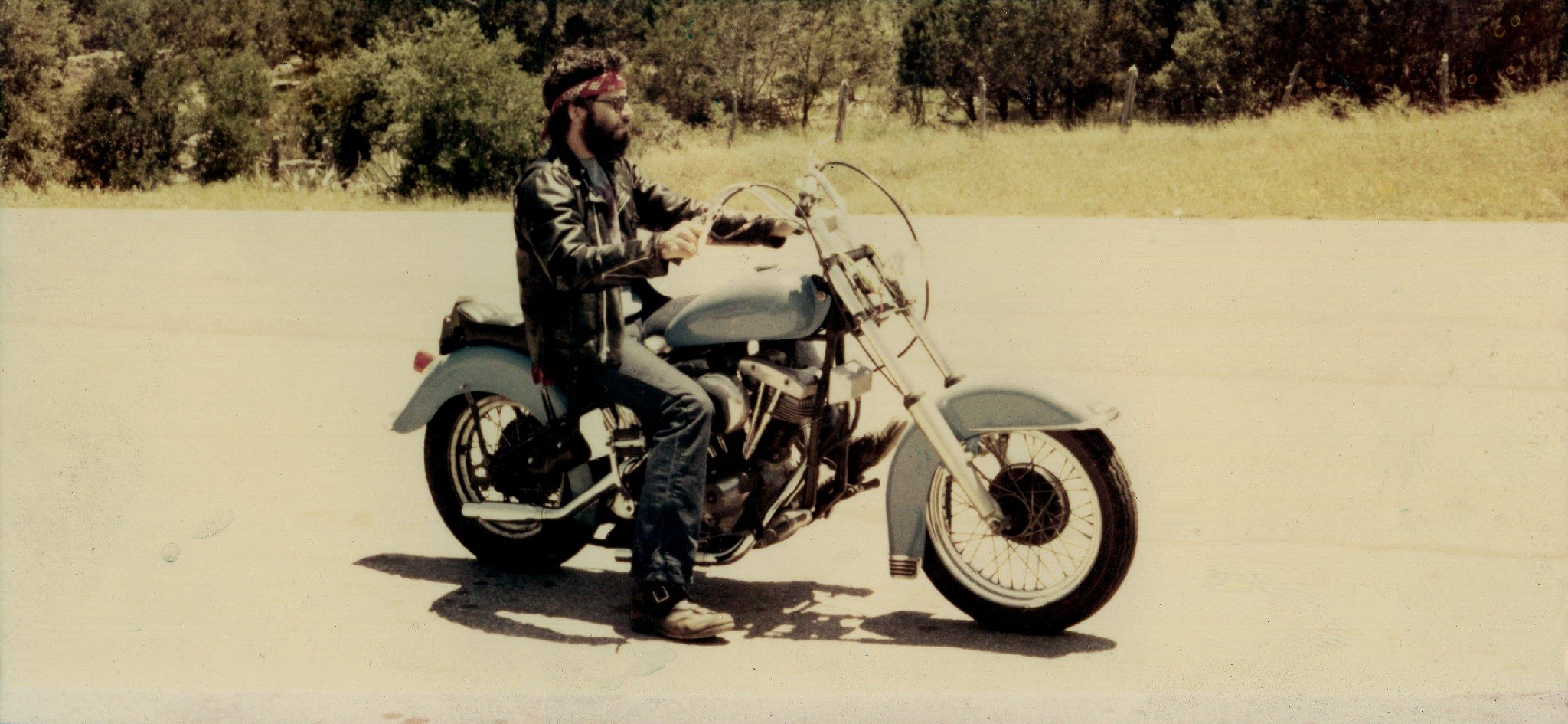
Finally, another look at the artist himself, seated on his beloved shovelhead.
Here’s the Mann himself in happier days, with the shovelhead that inspired Richiepan’s replica. He is pictured with his brother ‘Wild Bill’ and friend Squirrel.
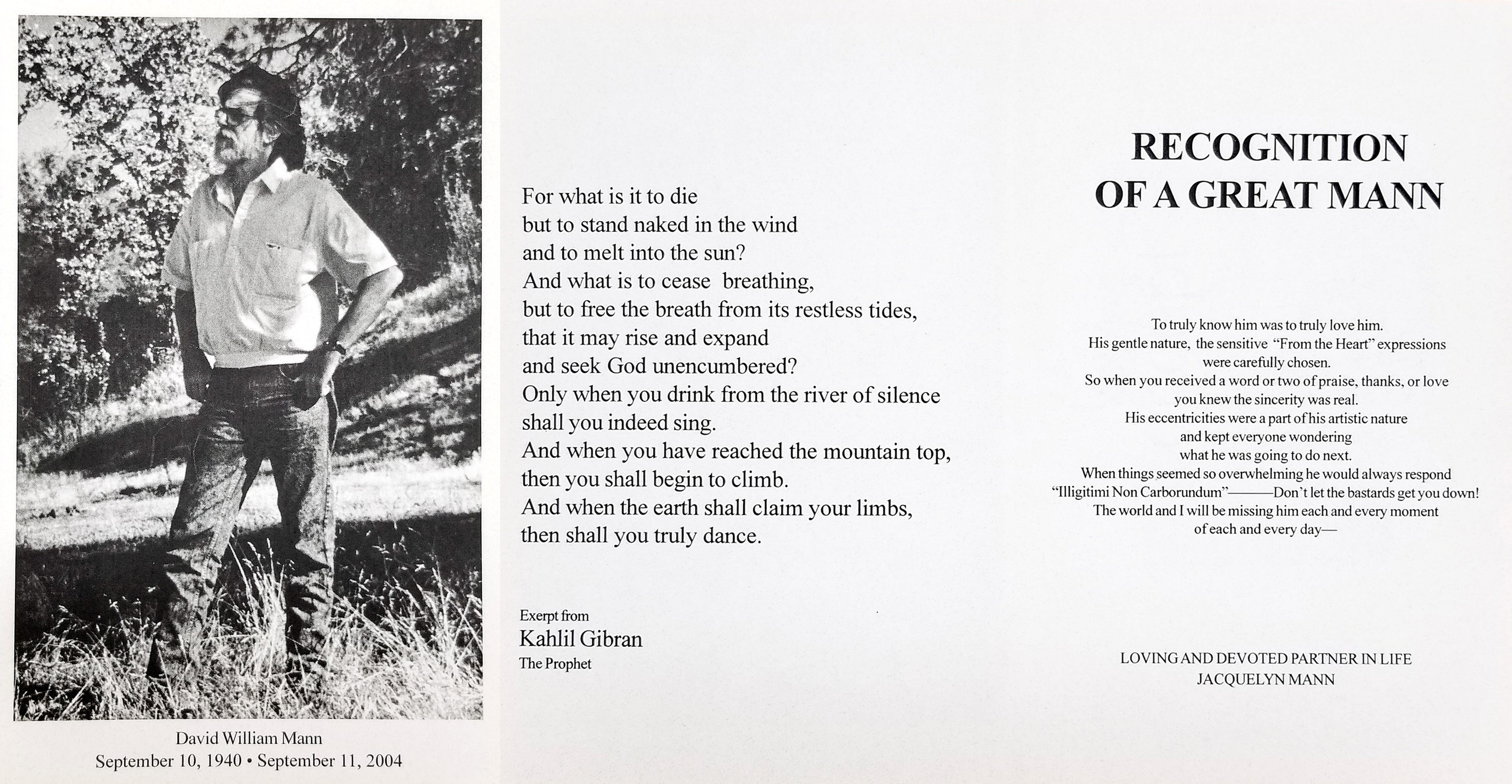
DAVID WILLIAM MANN, September 10th, 1940 to September 11th, 2004. R.I.P.
Recognition of a Great MannThis tribute appeared in Easyriders January 2005, part IThis tribute appeared in Easyriders January 2005, part II
SCANDINAVIAN countries are known for their long dark winters. Causing those Viking knights to take refuge in their homes, only to come back out again in Spring. As a Head of Design at a Norwegian distillery, Swedish born (but 1/4th Norwegian..) David Höök is dealing with liquor all day long, so rather than drinking those dark freezing nights away, he was looking for another way to get through the winter period.
Only a couple of years ago he took up the art of customizing when he suddenly had space available after buying a new house.
Softie for Softails
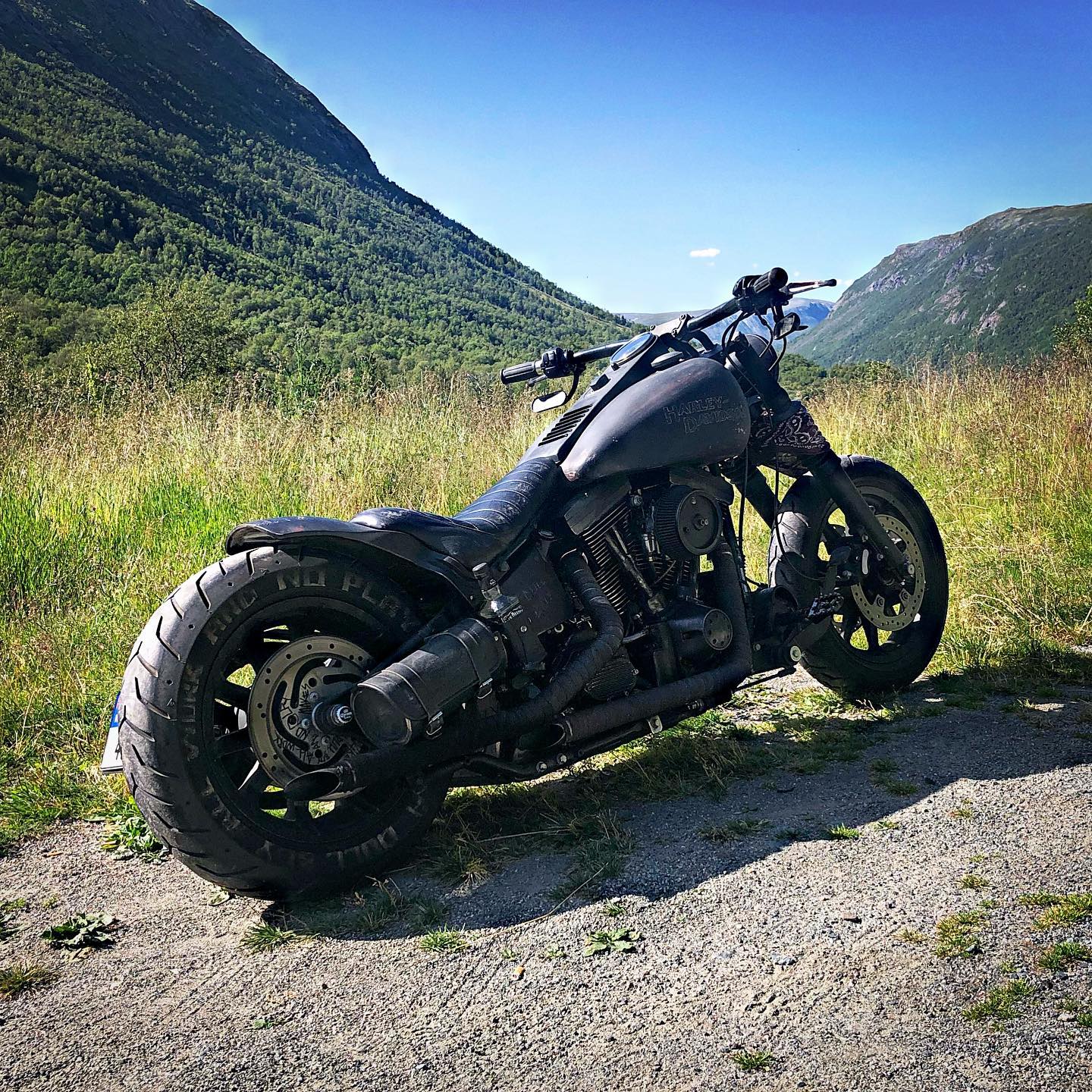
David is a softie for Harley softails and he decided to use this frame for his winter project. The combination with a late generation Evo 1340cc engine felt like the right choice for him. Upon making his mind up he locked himself up in his shed only to reappear in Spring with this ‘Dull Boy’! (see video)
‘Dull Boy’?
The nickname got us wondering where he got the inspiration from. Looking at the way the bike came out, we would have expected stuff like ‘mean machine’ or ‘nasty nailer’.
David explains: “At first I considered to make it look like a newer H-D Breakout, but then I saw a late night re-run of the 1980’s movie “The Shining” with Jack Nicholson and it has one of my favourite movie scenes of all time where the proverb “All work and no play makes Jack a dull boy” is central.”
“I decided there and then to build the bike based on that and it felt natural to make it look like it had been through a lot. I always plan my builds thoroughly in advance to the smallest of details so I had the everything pretty much worked out to before I started on the bike.”
Please elaborate
Whilst on the subject of sources of inspiration, Bikebrewers team decide to pry a little bit deeper. On our query where his vision for this build originated the Viking builder retorted:
“Being the bike nerd I am, I spend a lot of time looking at bikes on Instagram, Pinterest, etc., picking up ideas here and there. Last year I came upon the work of Joe Morris (Jmoto Speedshop and Gallery) and something clicked.
His work really opened my eyes to drawing and painting on bikes, instead of just painting everything black as I had done on my previous builds. As a kid, I used to spend a lot of time drawing and worked as an illustrator for quite some time, but lost interest in this art along the way.
Thinking of bikes as a “canvas” provided me with at creative outlet that I didn’t know I had missed.”
“Gentlemen, roll up your sleeves and light those torches”
With the creative part in place, it was time to get dirty and dive into the technical stuff. According to David he did not meet too many serious challenges working this project. The only minor obstacle was fitting the Road King rear wheel into the frame. It took him a lot of lathing and grinding to get the job done, but other than that things went fairly easy.
Meeting hurdles during a build often requires outside insights before being able to take the next step. “So David, when was the moment you needed an extra hand? “ we asked him.
“My brother, who has a lathe, helped me turn down the rear pulley to fit the 20mm belt and I left the seat to an upholsterer to cover it in leather. I’ve started to learn to do this kind of work myself now though. I like to be able to do everything on my builds, and I really enjoy working with leather.”
Final words • What do you like the most? o “The spare fuel bottle” • Anything particular we need to know about this project? o “It has “All work and no play makes make Jack a dull boy” written in places you would never think of…” • Last but not least, how does it ride? o “Like a dream”
Details of the build
• Estimated budget: € 13-14K • 1998 Harley Davidson FXSTC, nicknamed “Dull Boy” • Stock Evo 1340 with S&S Super E carb, Andrews EV-27 cam, adjustable pushrods and Crane Cams single fire ignition • Cycle Shack drag pipes • Lowered 1.5-2″ front and rear. Progressive shocks and springs • Wheels are from 2009+ Road King. 17×3 with 130×80 in the front and 16×5 with 200×60 in the rear. • Pulley is modified to fit a 20mm belt. • Lower fork legs and brake calipers are also from 2009+ Touring models • Handlebar is a 40″ Highway Hawk Fat Flyer bar. • Headlight a 6.5″ housing modified to house the stock H-D 5.75” headlight. • Mirrors are Arlen Ness mini ovals. • Extended forward controls • Braided brake lines from HEL Performance • Kellermann Atto DF tail/indicator lights • Front indicators are small LED’s from Dock66.de • Custom made seat • Custom made rear fender • Left swingarm bag is from bikebeauty (I’ve added the wear and the lettering). • The right one is from bikersgearaustralia
Builder’s details: • Name: David Höök • Location: Oslo, Norway • Day job: Head of design at a distillery. • E-mail: david@dullboycustoms.com • Website: www.dullboycustoms.com • Facebook: dullboycustoms • Instagram: davidhook
To which I replied:
IMO, rat bikes are organic creatures that evolve over time. They slowly accumulate a patina of baked-on oil, mud and rust. They rack up dings and tweaks and cracks, and develop quirks that render the bike virtually unrideable to anyone but its owner. Maybe a part replaced on the fly doesn’t match the rest of the bike. Maybe something off a Honda or Hodaka was jiggered to fit your Harley, or vice-versa. Maybe it’s a Sportster tank on a Knucklehead, an Evo engine stuffed in a Panhead frame, or the forks off a ’66 cop bike bolted to an AMF-era Shovelhead. Maybe a good road dog gifts you a sticker, a bandana or some other memento, so you slap it on there, somewhere, and it gives you an excuse to tell everyone who asks about the great partner who gave it to you….
….and so it goes. The end product (if a rat bike can ever truly be an ‘end product’) is a machine of unquestionable authenticity and experience, skillfully crafted by mileage and time.
Buildinga ‘rat bike’ is, conversely, the ultimate in poseur pretense and inauthenticity: far worse than throwing mud on the bike you trailered to Sturgis to make it look like you rode the entire way, or taking sandpaper to a new pair of boots to make them look scuffed and well-worn. People who don’t know any better might think your fresh-from-the-workshop ‘rat bike’ is all kinds of nifty, but you will always know in your heart of hearts that it’s just a facsimile, a knockoff, a cheap shortcut to the real deal.
None of this is intended to take away from David Höök’s abilities as a builder of motorcycles. He can obviously be thorough, thoughtful and attentive to detail. Were he to turn his talents to building a proper chopper, or a new twist on the café or bobber or street pro, or even a straight-up custom Softail a la the Fat Boy, I feel certain Mr. Höök could create something more worthy of his talents. If this ‘Dull Boy’ is actually, honestly, the very best he can do, then I fear Mr. Höök truly is a dull boy, and no amount of beer will fix that.
I was eager to see if Mr. Betist might share my critique with his readers. 🤷♀️ Instead, he deleted the entire article! 🤣🤣🤣
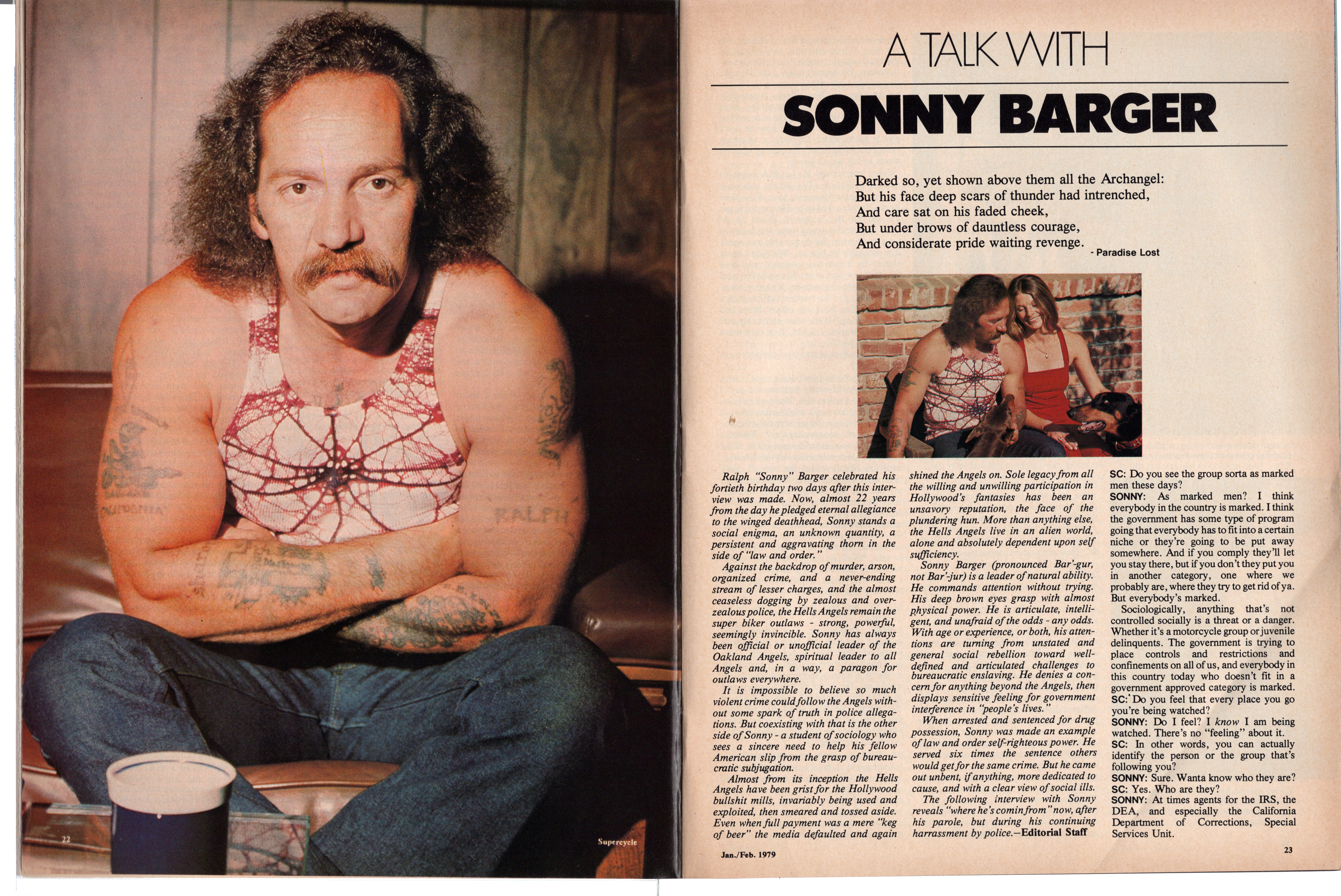
Sonny Barger joined the Hells Angels Motorcycle Club the same year I was born, and was still a member in good standing when he passed away on June 29th, 2022. That’s one long career!
Myself, I never met the man – to the best of my knowledge I never met any member of his club – but Barger was still a big influence in my life. He features prominently in Hunter S. Thompson’s Hell’s Angels: The Strange and Terrible Saga of the Outlaw Motorcycle Gangs (Random House, 1967) and parts of Tom Wolfe’s The Electric Kool-Aid Acid Test (Farrar Straus Giroux, 1968), and my nascent view of what it meant to be a motorcyclist – the life path I’d already chosen for myself – was informed by Barger’s and his brothers’ exploits. Not for me the ‘nicest people on a Honda’ as the infamous mid-’60s advert suggested. I would be a biker….
….and that’s what I did.
HELLS ANGELS ATTACH ANTIWAR PROTESTERS, AND SONNY LEARNS HOW TO USE THE PRESS
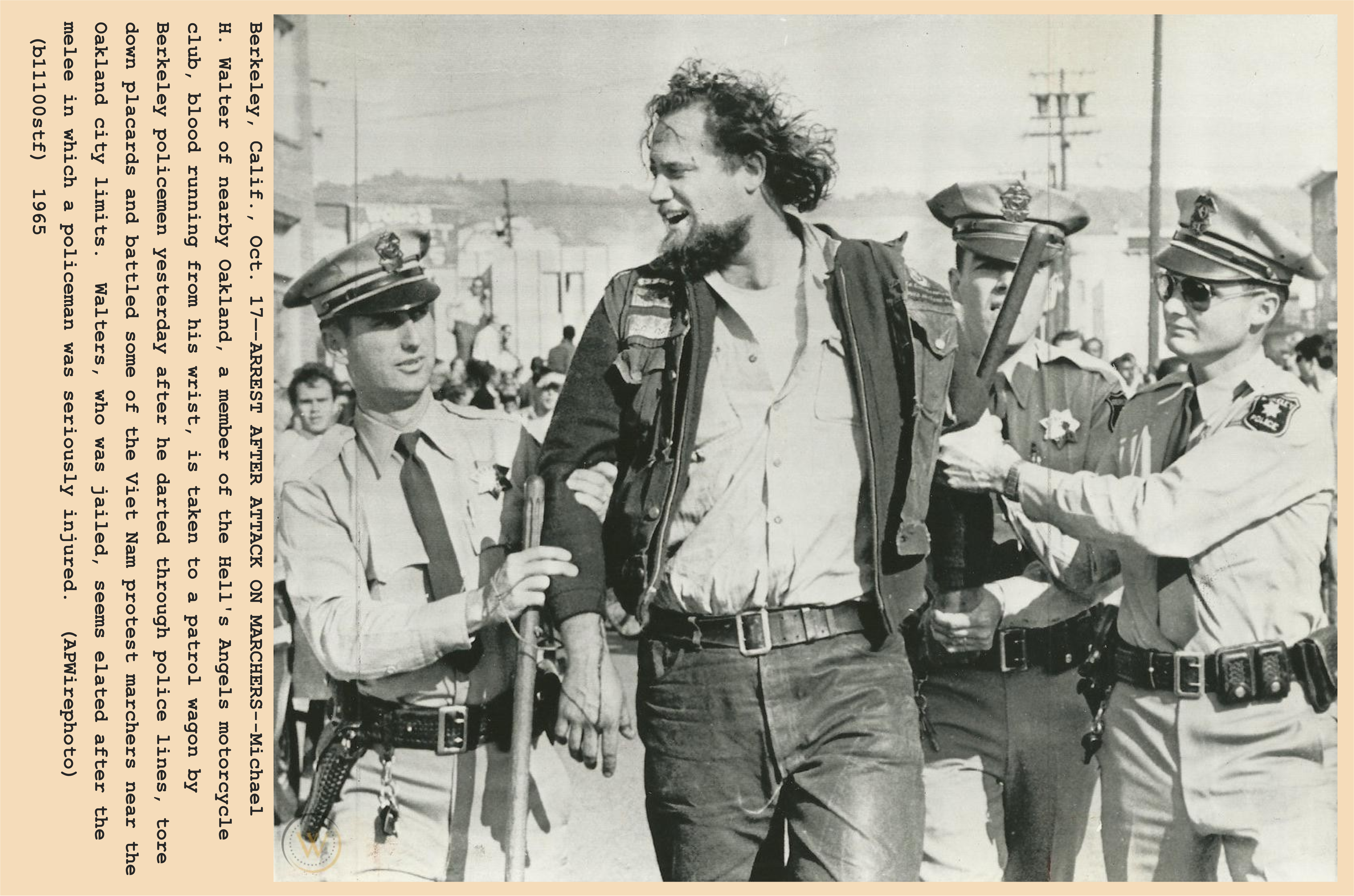
Aside from Evel Knievel, who was much more masochist than motorcyclist, Sonny Barger is assuredly the most famous biker in the world, and was in the news numerous times throughout his tenure. For example, after members of the Oakland chapter of the Hells Angels, which Sonny served as President, broke up an antiwar demonstration in October, 1965, Sonny held a press conference in which he foreswore violence against future protests because ‘Any physical encounter would only produce sympathy for this mob of traitors.’ He also read a telegram he’d sent then-President Lyndon Johnson, volunteering his club brothers for ‘behind the line duty in Vietnam’ as ‘a crack group of trained gorillas [sic]’ who would ‘demoralize the Vietcong and advance the cause of freedom.’
Hells Angel MC member Michael Walter is led away after attacking antiwar protesters in 1965.Sonny Barger holds press conference in November, 1965, to renounce violence against antiwar protesters and read a telegram sent to President Lyndon B. Johnson. He suggested Hells Angels members serving as ‘a crack team of trained gorillas [sic] would demoralize the Vietcong and advance the cause of freedom.’
ALTAMONT FREE CONCERT, DECEMBER 6th, 1969
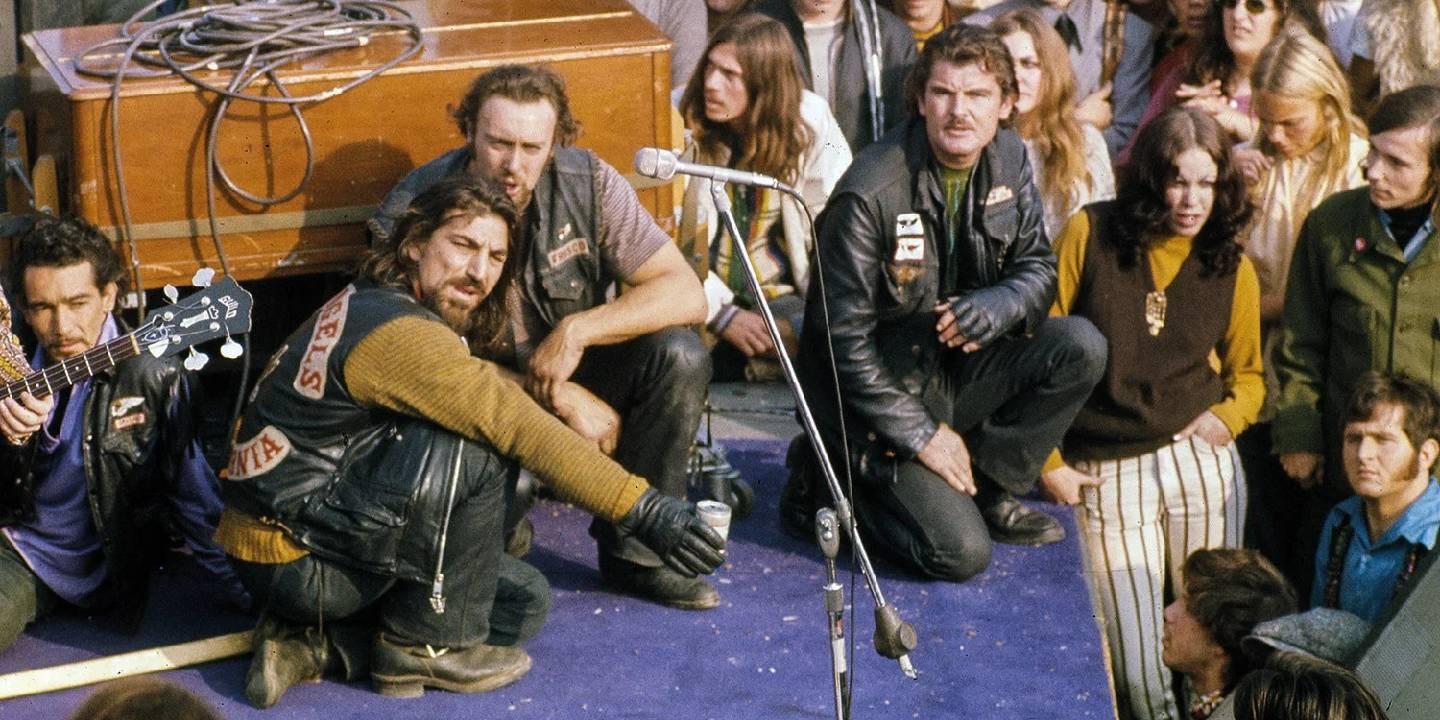
Hells Angels members on stage at the Altamont Free Concert, December 6th, 1969.
Sonny was also the voice of the Hells Angels after the disastrous Altamont Speedway concert in December, 1969, which resulted in the stabbing death of an eighteen-year-old African American named Meredith Hunter. Although accounts differ as to why they were present, the Angels had been sitting on the front edge of the low-slung stage, acting as a human barrier between the crowd and the performers. Hunter, who had been tossed off the stage by Hells Angels during a previous altercation, returned with a handgun and began waving it around, firing at least one shot into the crowd. Hells Angel member Alan Passaro stabbed and disarmed Hunter, who later died of his wounds.
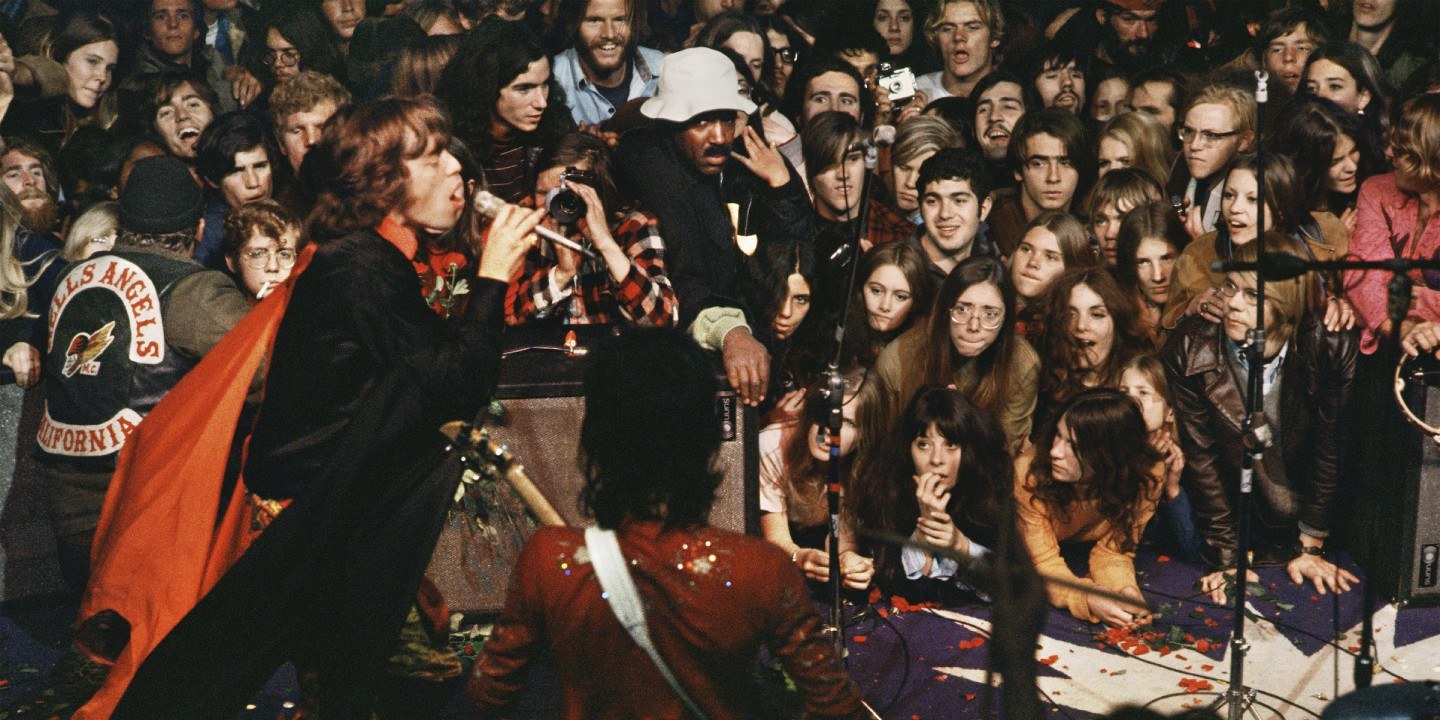
Rolling Stones singer Mick Jagger prances on stage surrounded by Hells Angels MC members. So many mistakes in such a tiny space — stage built too low to the ground, inadequate professional security to protect performers and equipment, the band’s lengthy delay in starting their set (reportedly because Jagger wanted cover of darkness to go with his ‘Satanic’ imagery) — but the biggest mistake of all was the band’s assumption that American Hells Angels would be the same relatively mild-mannered rough boys as their British counterparts. The Stones had used UK Angels as security at concerts over there, and took for granted that these California blokes would be just as obliging and well-behaved. 🙄
The next morning, as the talking heads on local radio station KSAN attempted to unravel the chaotic stream of events, Sonny Barger called in and gave his club’s side of the story – the only official statement the club ever offered about the concert or the killing. Barger defended his patch holders, telling radio host Stefan Ponek ‘You can say anything you want and you can call them people flower children and this and that, and there was three hundred thousand people there approximately or whatever they say, and I guarantee you that the largest majority of them were there to have a good time, but there was a couple thousand of them that was there looking for trouble.’
Jagger tried to coax the crowd — which had been drinking, drugging and brawling in the hot sun all afternoon — into mellowing out and behaving like good little flower children…. to no avail.
Brushing aside the host’s attempt to cut in, Barger went on to say ‘Some of them people out there ain’t a bit better than what some of the people think of the worst of us, man, and it’s about time they realized it….’
In this screenshot from the documentary Gimme Shelter, ill-fated Meredith Hunter, in the pistachio green suit can be seen brandishing a pistol as his girlfriend Patty Bredehoft, in the white crochet vest, attempts to calm him. Witnesses claim Hunter fired into the crowd, and Barger alleges that an Angel was struck by a bullet from Hunter’s firearm.
The incident at Altamont and Barger’s telephone call to the radio station were captured on film by documentarians Albert and David Maysles and Charlotte Zwerin, and the resulting movie, Gimme Shelter, was released in 1970. One week after its premiere Hells Angel Alan Passaro went on trial, charged with murdering Meredith Hunter. However, when the film was played in court, it clearly showed Passaro acting in defense of self and third parties, and he was acquitted of all charges.
In this screenshot from the documentary Gimme Shelter, Meredith Hunter is taken down by Hells Angel Alan Passaro. It annoys the fuck out of me when I hear people claim ‘those mean ol’ Hells Angels murdered poor li’l Meredith Hunter.’ 🤬 So far as I’m concerned, Alan Passaro deserved a medal for valor for going up against a wild-eyed gunman, armed with nothing but a knife and brass cojones. His bravery protected his brothers, the performers and stagehands, and every innocent concertgoer in that crowd who could have been wounded or killed by Hunter’s reckless gunplay. Instead, because he was one of ‘those mean ol’ Hells Angels,’ Passaro was indicted on a charge of murder. However, when the jury say these scenes from the documentary, they voted (quite properly, IMO, to acquit Alan Passaro. In 1985 Passaro died in a drowning police considered ‘suspicious’ (although no foul play was ever confirmed) but rumors that a second, unidentified assailant may have been involved in Hunter’s death kept the Altamont case open until 2005. In May of that year, the Alameda County Sheriff’s Office dismissed the theory that a second Hells Angel member took part in the fatal scuffle.
HOLLYWOOD CALLS….
American International, filmmaker Roger Corman’s outfit, was responsible for classic biker exploitation films like The Wild Angels, the Peter Fonda/Nancy Sinatra vehicle which helped kickstart the careers of actress Diane Ladd, director Peter Bogdanovich, stuntman Gary Littlejohn, character actor Michael J. Pollard, et alia. Corman was also involce in the production of movies like Devil’s Angels (1967, an underrated classic), Naked Angels (1969), Angels Die Hard (1970), Angels Hard as They Come (1971), The Dirt Gang (1972), The Darktown Strutters (1975, featuring African American women on wildly customized VW-powered trikes! 😮 ), Deathsport (1978), Fast Charlie… The Moonbeam Rider (1979), The Dirt Bike Kid (1985), The Lawless Land (1988), Nam Angels (1989) and Back to Back (1989).
Given the Hells Angels’ hard-won reputation as thuggish brutes prone to violence and lawlessness, Barger was preternaturally media savvy – an excellent spokesman for his club and a wily self-promoter. He finagled parts for himself and other Angels in a couple of biker films – Hells Angels on Wheels with Adam Roarke and future Easy Rider star Jack Nicholson, and Hells Angels ’69, starring ’60s heartthrob Jeremy Slate, who later played the biker gang leader in The Born Losers.
In his memoir, Sonny reports that ‘Sweet Cocaine’ (pictured above, on the set of the Hell’s Angels ’69 movie) was stolen while he was running errands one day. A few brutal hours later, he had his bike back, and the thieves were paying a dear price for their poor decision-making.
….BUT SO DO THE COPS
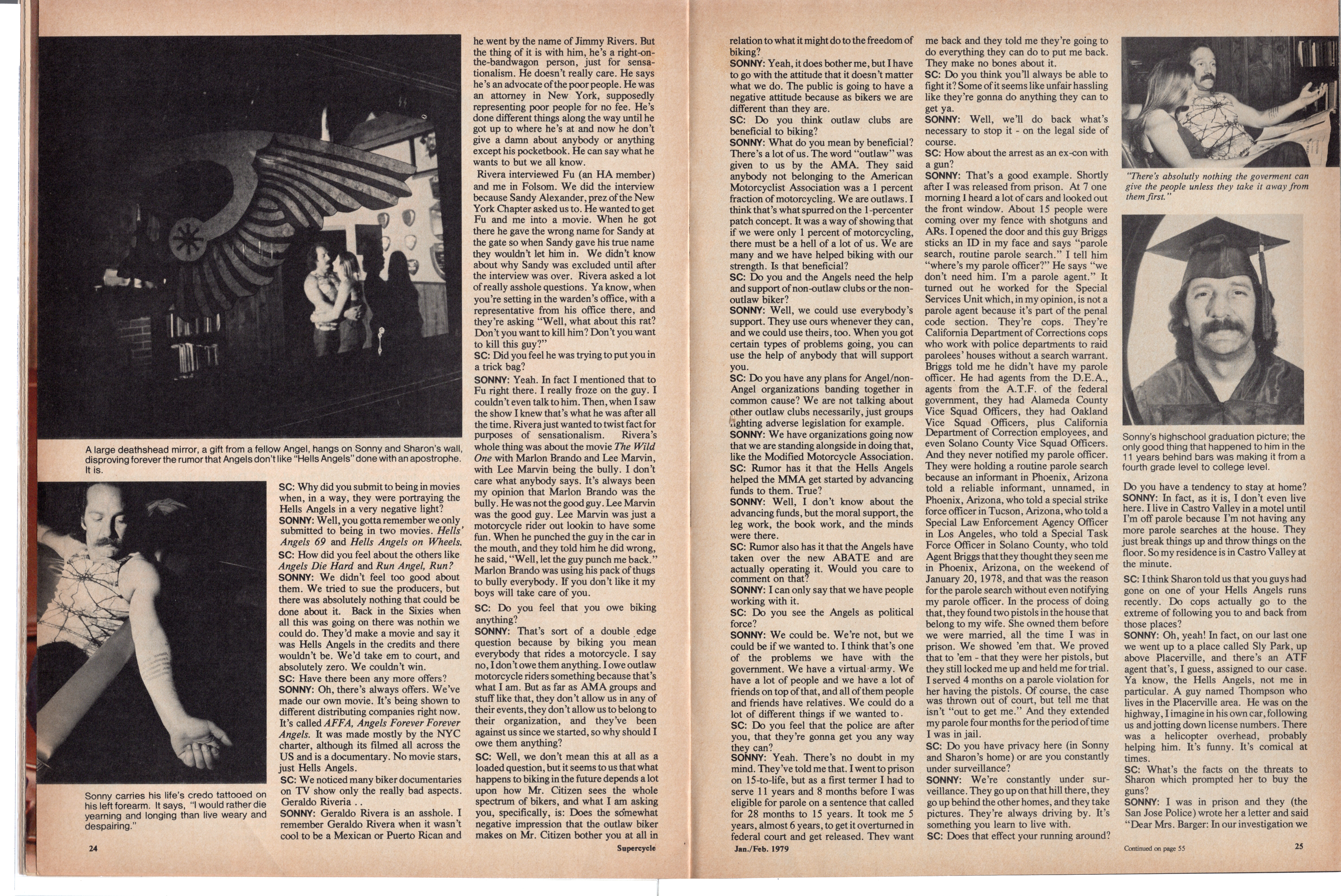
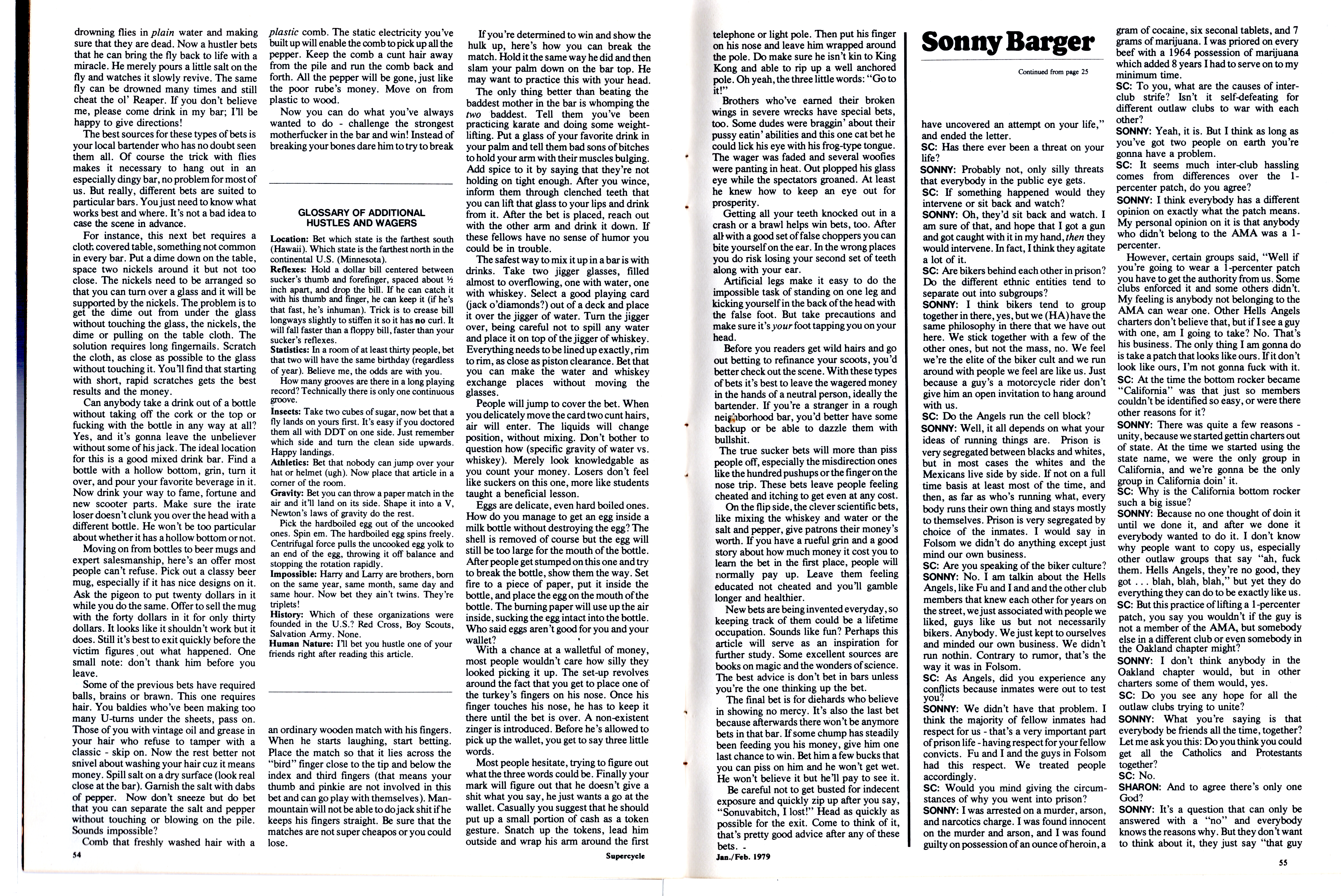
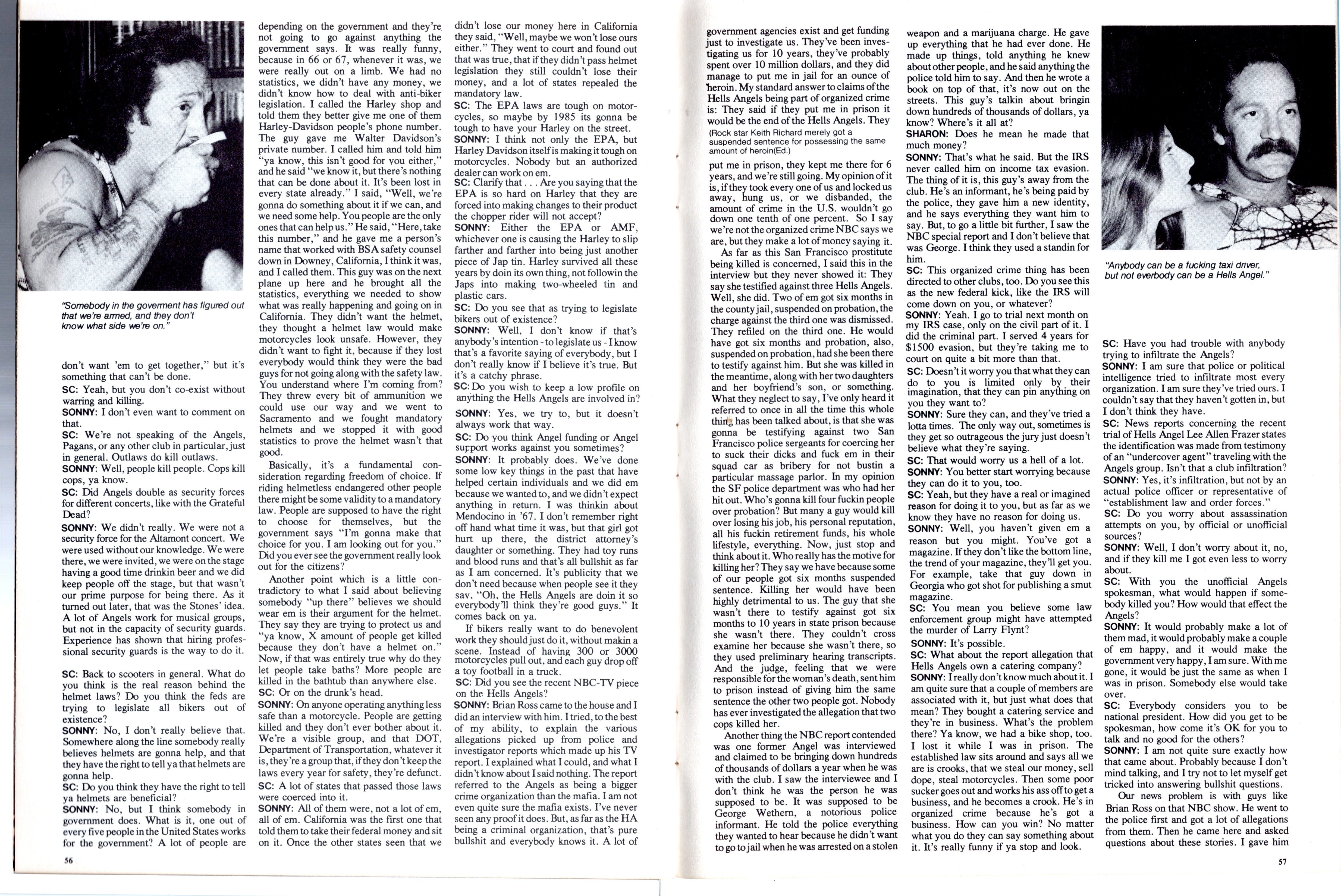
Barger was also in the headlines for numerous arrests on charges ranging from drugs and weapons charges to conspiracy and murder, and, while acquitted of the more serious charges, still spent several years in prison. During this time he gave several interviews to motorcycle magazines, including two for Supercycle, published in February and December, 1979.
Sonny speaks, and the ‘Voice of the American Biker’ listens.
SONNY BECOMES AN AUTHOR
During these years, and despite his numerous legal woes, Sonny discovered that he was a marketable commodity. The ‘Free Sonny’ t-shirts his wife sold during his incarceration were wildly popular, and other merchandise soon followed, but he really hit the jackpot when he teamed up with writers Keith and Kent Zimmerman and penned his memoir, Hell’s Angel: The Life and Times of Sonny Barger and the Hell’s Angels Motorcycle Club (William Morrow, 2000).
The book quickly became a best-seller, so he followed up with two biker-themed crime novels also co-authored by the Zimmerman Brothers – Dead in 5 Heartbeats and 6 Chambers, 1 Bullet (William Morrow, 2004 and 2006). He released a collection of road tales titled Ridin’ High, Livin’ Free: Hell-Raising Motorcycle Stories (William Morrow, 2003) and Freedom: Credos from the Road (William Morrow, 2005). Finally, with Darwin Holstrom, he co-authored Let’s Ride: Sonny Barger’s Guide to Motorcycling (William Morrow, 2010) in which he dissed American motorcycle manufacturer Harley-Davidson, for decades the only motorcycle Hells Angels were permitted to ride. In what can only be seen as heresy by those loyal to the brand, Barger wrote:
In terms of pure workmanship, personally, I don’t like Harleys. I ride them because I’m in the club, and that’s the image, but if I could I would seriously consider riding a Honda ST1100 or a BMW. We really missed the boat by not switching over to the Japanese models when they began building bigger bikes. I’ll usually say “Fuck Harley-Davidson.”
Sonny Barger
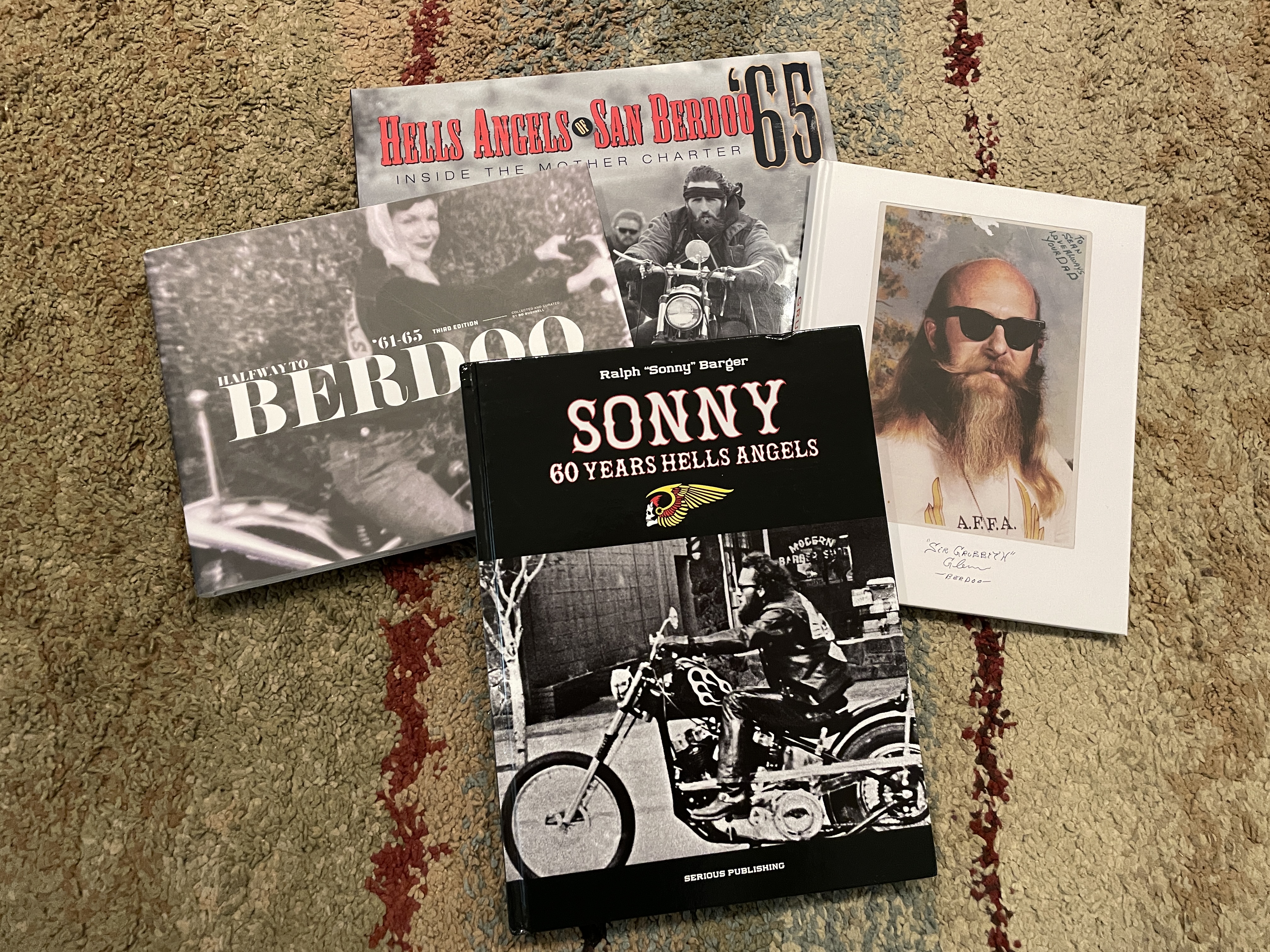
Sonny’s final contribution to the literature of motorcycling seems to be his massive scrapbook-styled tome, Sonny: 60 Years Hells Angels, published by the French imprint Serious Publishing in 2017. Copies are currently listed on Amazon at $357 USD! 😳 I swear, I did not pay even a fifth of that for my copy! 😎
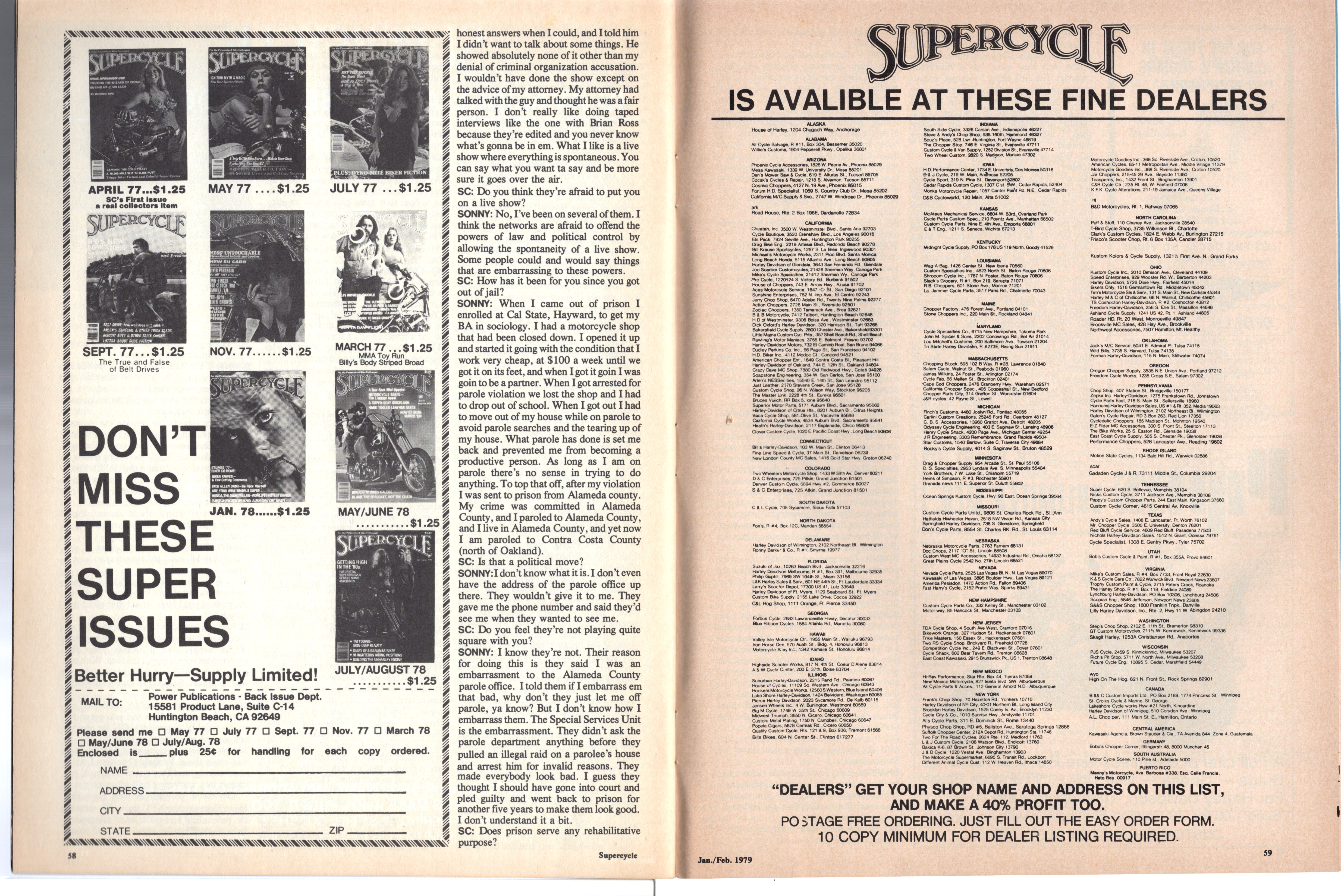
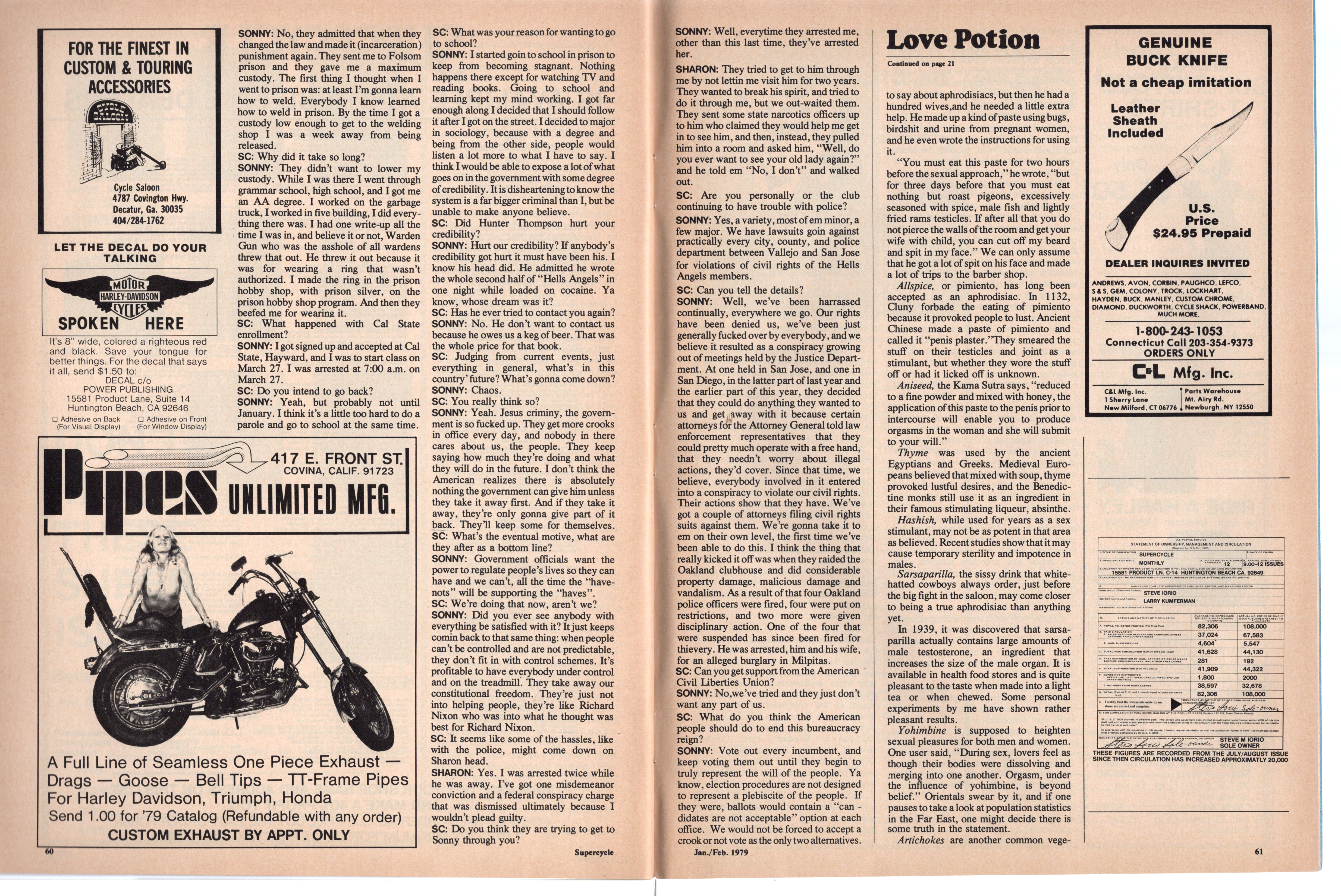
Anyway, here is the first of the two 1979 interviews:
Supercycle, February 1979Supercycle, February 1979Supercycle, February 1979Supercycle, February 1979Supercycle, February 1979Supercycle, February 1979
If enough folks are interested, I’ll post the second interview soon, along with some other articles about this and other clubs.
AS NOTED ABOVE: I am not associated with the Hells Angels Motorcycle Club (or any other club) and am only posting these images and this information in the interest of preserving and sharing the collective culture and history of the motorcycling world for historians and bikers like me, who are fascinated by it all. Sláinte!
Why I Ride a Slow, Uncomfortable, Unreliable, Noisy Motorcycle
Why I ride a Harley-Davidson with 17-inch ape hanger handlebars, a massive sissy bar that has the technical sophistication of a very large lawn mower?
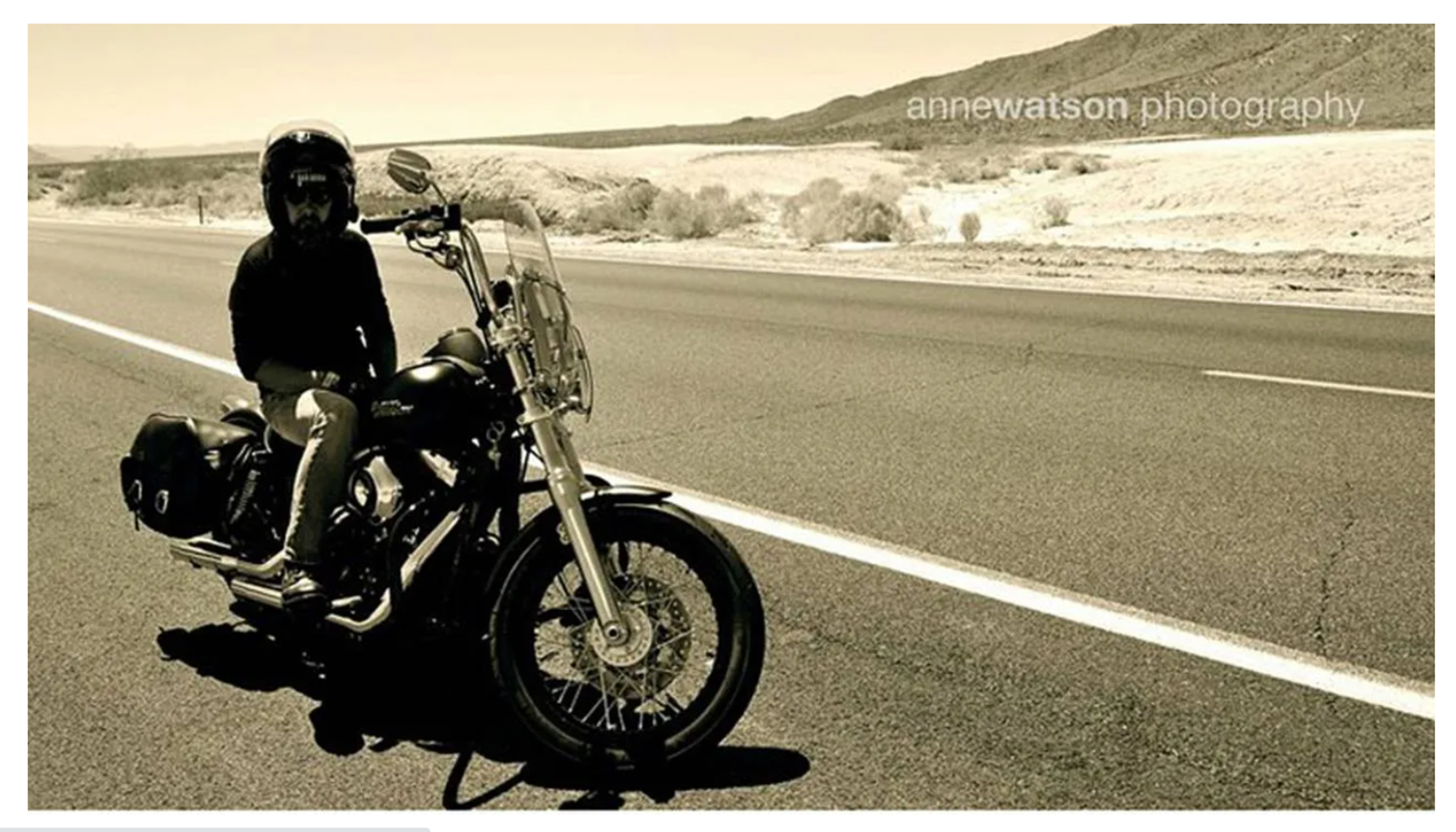
Photo by Anne Watson, annewatson photography
May 28, 2013 at 1:29pm ET by: Tim Watson
If you ever saw my motorcycle you’d think I was a complete idiot. You would ask yourself why on earth would someone ride something with 17-inch ape hanger handlebars, a massive sissy bar that looks like a throwback from an early 1970s biker film bolted to a motorcycle that has the technical sophistication of a very large lawn mower?
It’s also noisy. Very noisy. Under hard acceleration it sounds like a moose bellowing as if someone had just slammed its testicles in a car door.
I honestly didn’t want it to be like that. But when my bike left the Harley-Davidson factory its stock engine set-up meant it ran so lean that the heat from the air-cooled motor made it almost impossible to ride here in California when temperatures climb into the 80s.
So I changed out the stock pipes. But then I was told I needed a new air filter and a re-map of the engine. All of that didn’t make my motorcycle much faster but it did suddenly come alive. And it sort of cooled down.
Its exhaust can be truly obnoxious which is why I ride with a light hand on the throttle in built-up areas. When there’s nobody about and just me and an open road I revert to the moose bellowing. But after a while it can make even my head hurt and then I wonder about my sanity and why I ride this damned bike.
I have read and re-read the countless things I could do to make its V-twin 96-ci engine faster and perform better. But I’m not convinced. I look at my bike and I am not sure that it is either.
At idle it shakes like a carnival ride and if I look down for too long the vibrations make my vision go blurry and then my hands go numb.
I hate the fact every single bolt and fastening has to be glued in place to stop them falling out. Before each ride I always have to check it over so it doesn’t leave me standing at an intersection with nothing more than the handlebars, a seat and a pile of parts.
The ape hanger bars were an after thought. I’d seen some of the Mexican low rider motorcycles in my neighborhood with mean looking dudes using them on their bikes.
I’ll admit they look preposterous (not the Mexican dudes) and I have lost count of the number of people who ask me precisely why I have them. I can’t give them a satisfactory answer. I just like ape hangers.
I did have an idea once of how I wanted my bike to look. I thought a sort of 1950s bobber style with some classic retro parts. But it’s become a bit of a mish-mash and not quite how I envisaged it would turn out.
Photo by Tim Watson
I paid good money for a special order 32-inch sissy bar for the back of my bike. Some people have said looks like I am riding a remote control motorcycle or others have asked if I ever receive radio wave interference through it. It serves absolutely no purpose, rattles like hell all the time and makes getting on or off the bike a contortionist’s act. But I like the way it looks.
In a moment of madness I once took the front fender off. But this resulted in the bike and my face being sand blasted from road grit. Even an artfully tied bandana between the forks when it rained meant all that happened was a jet of water was thrown off the tire and straight up my nose. In a matter of hours the fender went back on.
I also kept the stock solo seat too. But if I were honest it would be more comfortable sitting on a piece of cardboard. There’s no back support and I feel I can ride over cigarette butts and tell you if they’re filtered or unfiltered. But I like the feedback from the road that it gives me even if on long rides it kills my back.
There’s an ugly gash on my bike’s left peg where I thought I could easily squeeze between a parked car and a wall to ride down a back alley. And there’s a dent the size of a dime on the front of the gas tank, caused by a rock flung out of a truck tire on the freeway. I’ve left it as a reminder of what that would have done to my face if the rock had hit me.
The factory fit rear brake light, which some say looks like a limp chrome dick, works intermittently. The rudimentary fuel gauge that may well have come off a 1960’s child’s pedal car some times pops out of the tank when I least expect it.
And I constantly have to check the primary plug for leaks as I over torqued it once during an oil change and stripped the thread. The chopper-style headlight I bought for it and which replaced the perfectly serviceable original light, is about as useful as a candle in the wind. But in daylight and probably only to my eyes it looks good.
Of course there are far better bikes out there I could have bought. There are many that are faster and nicer looking that probably have more engineering sophistication in their front brake lever than my entire motorcycle.
But herein lies the problem. For everything that irritates me about my bike it always without fail makes me smile every single time I get on it.
I have ridden it through empty deserts, up mountains and across, around and through nine states covering more than 8,000 miles in the process. I have nearly been taken out by an 18-wheeler on a downhill mountain pass and I once ran over a rattlesnake with it in the Mojave Desert.
My bike has taken me though some astonishing U.S. backwater towns in 100 plus degree heat and then a few hours later up into the mountains and over snow covered roads.
And, just like legendary Western lawman Wyatt Earp, I too once rode into Tombstone, Arizona, on it.
It’s my motorcycle. It drives me nuts at times but it’s been through a lot with me and has now become a part of my life. And for that reason alone I will never, ever sell it.
And my response? Well, it’s like this….
Why I Ride a Slow, Uncomfortable, Unreliable, Noisy Motorcycle
I too ride a motorcycle that is slower than the latest whiz-bang showroom models, but then, its powerplant is a forty-eight-year-old shovelhead which was tractor-engineered at birth and is still virtually box stock. It is smaller than the smallest late-model engine, still fitted with its factory carburetor and cam, rudimentary exhaust and (gasp!) a points-and condenser ignition system! That’s downright barbaric, isn’t it? and especially when you realize that my motorcycle has never had an electric starter. That’s right; kick-start only, kids, just the way Grandpa did!
My shovelhead does have solid lifters – more for reliability and convenience than performance – and a belt-drive primary. However, the belt is for convenience, as well, and whatever low-end performance boost it might have provided has been offset by the 25-tooth countershaft sprocket I installed to regain my highway top-end. My bike is built to go places, but I don’t have to break any land speed records making the trip.
And when I say ‘built to go places’ I mean that in every sense.
My motorcycle is not uncomfortable. It began its life as a 1974 FX 1200 Superglide, with the heavy OEM swingarm frame and lightweight narrow-glide forks. I played with different saddles and handlebars, added highway pegs and a set of wide-glide forks off a 1966 Police Special, but my motorcycle never became truly comfortable on long rides until I switched from the stock swingarm frame to an OEM 1954 rigid wishbone.
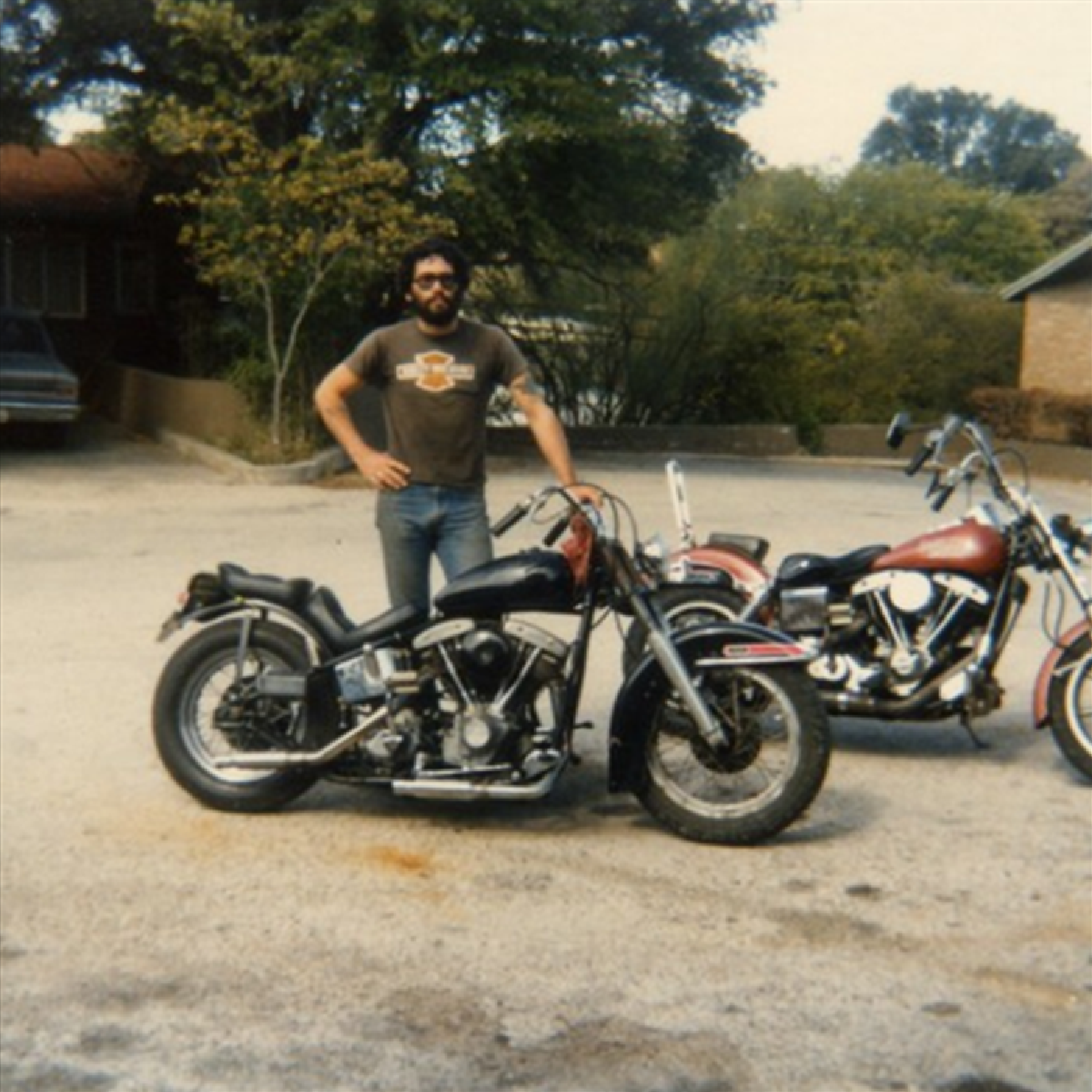
Me and The Bitch (and Rob Darnstaedt’s Low Rider) at the Terrace Apartments off South Congress Avenue in South Austin, circa 1979 or early 1980.
I can hear the Greek chorus now, shouting ‘Impossible! Absurd!’ but it’s true, nonetheless. With the rigid frame and a frame-mounted LaPera butt-bucket saddle, I have ridden all over the Central Plains and Rocky Mountain States, from Texas to South Dakota, from Louisiana to Arizona – numerous 500- and 600-mile days, at least one 1000-mile day, a lot of back roads and goat paths and well over a half-million miles all told – and never once regretted converting to a rigid frame.
Me and The Bitch at Sturgis, 1982.
And if you’re interested, my comfort depended on the way I set the bike up at the start, the way I pack for road trips and the way I learned to ride a rigid-framed motorcycle. It’s different than a swingarm
My motorcycle is not unreliable, either. Despite its origin as a ‘bowling ball bike’ manufactured during the worst of the AMF years at the Motor Company, when factory workers were allegedly sabotaging bikes in order to get back at miscreant management, my shovelhead was never an unreliable machine. In addition, I’ve had my fingers in every subassembly on my motorcycle, from handlebar wiring to wheel hubs, and did my damnedest to rebuild them right. That means plenty of Nylock, Loctite, lock-washers and safety wire, and the systematic removal of anything the bike does not need to function the way I need it to. No chrome covers or extra gewgaws; no colored lights or (shudder) a stereo; not even turn signals.
As a result of stripping my bike down and securing every part on it the best I possibly can, parts rarely vibrate loose. As a result of simplifying every system on the motorcycle the best I possibly can – seven wires for the entire wiring harness, for instance, rather than the seemingly endless coils of brightly-colored 16-gauge snaking hither and yon – I can usually troubleshoot problems with little fuss. As a result of knowing my motorcycle’s innermost workings, I am able to repair all but the most serious breakdowns parked under the nearest shade tree.
Finally, as a result of my efforts, I can count on one hand the number of times in the past 43 years my shovelhead has been forced to ride home in the back of a truck, with fingers left over.
And my motorcycle is not particularly loud, either. Louder than a Prius, yes, but so is a hummingbird fart, and my shovelhead is far quieter than a good many late-model Harleys. It is also a damned sight less irritating to adult ears than the wind-tunnel shriek of many metric sportbikes, whose riders are, ironically, so quick to whine about Harley riders giving them a bad name. Let’s not forget that’s a two-way street, kids.
And you will never find me parked outside some chic café with a lovely open-air patio, rapping on my open exhaust pipes as hapless diners cover their ears, or racing into my neighborhood in the wee hours, setting off car alarms and rattling window glass as I screech to a halt in my driveway. I have this funny thing about treating people as I’d want to be treated, see, and I wouldn’t want some overgrown man-child on his midlife-crisis-mobile destroying my peace and quiet.
See how easy that is?
But what is so compelling about a motorcycle with few creature comforts and only the bare minimum of safety equipment? Why would I choose it over a newer, faster, sleeker model with all the latest whistles and bells, and stick with it for almost four and a half decades?
Well, for me it’s like this:
Recent years have proven that anyone with a large enough credit limit can own a Harley-Davidson, a Victory or ersatz Indian, a Triumph, Moto Guzzi or Ducati, or any of the Pacific Rim brands. A swipe of the gold card, a push of a button, the snick of a gearshift and voila! Instant motorcyclist!
Bill kickin’ The Bitch circa 2002.
But how many of those men and women can climb aboard a motorcycle with a forty-eight-year-old engine cradled in a sixty-eight-year-old frame and pushing fifty-six-year-old front forks, and do the things I’ve done with it? How many can ride that motorcycle from Denver to Austin in a day after a week of 500-mile days, kickstart that engine on an icy-cold morning in the South Dakota Badlands or a hurricane-drenched night in Houston, or navigate the Black Canyon of the Gunnison with nothing but mechanical brakes and a four-speed transmission between them and the canyon rim? How many can tear down the better part of their bike at the roadside and put it back together again, and actually make it run? How many would even be willing to try?
I know I’m not the only greybeard out here on a rigid-framed dinosaur of a motorcycle. There are plenty of panheads and knuckleheads in daily use here and around the world, ridden by bikers who do every one of the things I’ve mentioned here. However, a lot more peoplecan’t do those things than can, and I really enjoy being part of that smaller circle.
Bill and The Bitch, still together all these years!
You may have noticed that I used to write for some of the magazines, back in the day. In the course of that pursuit I interviewed a woman whose husband ran a chopper shop in Killeen, Texas, in the late ’60s and early ’70s.
Louis Schange was killed in a freak bike accident in ’72, and when I met his widow, Nelda, in 1994, she still had all the photo albums and memorabilia from those days. She had a 1934 VLD in the shed (!) which she’d just sold to an American living in South America. She also had plenty of tales to tell about jumping on the bike to go touring several states, or hopping aboard and riding to Ohio just to take part in a hill climb… She had all sorts of adventures like that.
Nelda Schange and her daughter, Joy, in 1954. Joy was the one child who loved motorcycles as much as her parents. Sadly, she passed away at the age of 40.
As we leafed through the photo albums I said ‘These photos should be in a book, or a museum! There are several motorcycle museums that would love to have this stuff!’
Nelda shrugged and said ‘Oh, my children will probably just throw them out when I die.’ 😳 That broke my heart. The only one of her kids who liked motorcycles died a young woman, and the others didn’t give a shit about her, her life, their own father… 😡 I tried to get her to let me take the albums and copy them, at least but she wouldn’t cut for that. She let me take some pics of the VLD, gave me two photos for the article, and gifted me a vintage dealership sticker her husband picked up in Hawaii. She would not budge on the rest.
Nelda with her panhead in 1960
I published my interview, and tried to keep tabs on her through the friend who introduced us, but she died before I could even make another run at her, and I heard from her brother-in-law, who I met many years later, that her prediction came true. All that history lost!
It still breaks my heart. 😢
Nelda with Louis’ 1934 Harley-Davidson VLD. She maintained the bike for twenty-two years after Louis died, cleaning and lubricating it. I asked if she’d ever ridden it herself, and she said ‘Oh, no! That was Louis’ bike.’
A last note: take a moment to look at the photo above, and really think about what it represents. Twenty-two years after her husband died on a motorcycle, this woman – who looks like your average housewife – was still dedicated enough to his passion (and hers) to keep the VLD cleaned, properly lubricated, et cetera. She was dedicated enough to the love of her life to keep his memory alive, and retain all those souvenirs of their life on two wheels.
How many people would do that?
The VLD, ready to go to its new owner. So much history!
On a Q&A forum I found the following question: What is the point of riding on a motorcycle other than looking “cool.” Are there any physical advantages as compared to a car? I know the old adage says ‘the only stupid question is the one you didn’t ask,’ but the question that poster posed is dangerously close to a stupid question. I borrowed one reader’s answer as a starting point for my own rant.
The ‘point’ of riding a motorcycle is to ride the motorcycle. It is difficult to explain to someone who has never experienced it. People bandy about words like ‘freedom’ and ‘exhilaration’ but they are weak sauce compared to the reality. The reality is so, so much more.
Me and my ’74 shovel (aka ‘The Bitch’) in West Texas enroute to Alpine. Man, I justlove West Texas!
Again: the ‘point’ of riding a motorcycle is to ride the motorcycle.
It is difficult to explain to someone who has never experienced it. People bandy about words like ‘freedom’ and ‘exhilaration’ but they are weak sauce compared to the reality. The reality is so, so much more.
Me and The Bitch riding through the Black Canyon of the Gunnison, in the Colorado Rockies.
Seriously, how do you describe the challenge of leaning into a hard curve on a twisty mountain road in the Colorado Rockies, just a hair’s breadth from the high side that’s gonna hurt like hell if you don’t maintain your line? What words can match balling through the New Mexican desert alone on a star-studded night, with ghost shadows marching across the sands as the chill night air seeps through the seams in your leather jacket? Can language even begin to capture the feeling of blasting through the heart of Dallas on a Saturday evening, twenty or thirty of you in a pack, so there in that moment – so large and loud and alive – that the straights in their cars instinctively move aside to let you pass? How do you tell someone who’s never been there about rocking through a mountain pass on a chilly autumn morning, sun at your back and your best road dog at your side as you crest the Continental Divide and rumble down into the Black Canyon of the Gunnison? Can you make any sense at all of the delight you feel waking up in a rain-soaked tent in Rapid City, South Dakota, on your way to the annual rally at Sturgis, and laughing about it because Who fuckin’ cares? We’re at Sturgis, baby!
Into every life a little rain must fall…
And if that’s hard, try explaining how even the ‘bad stuff’ gets good, later. Things like riding through the wake of a hurricane in downtown Houston, water so high on the road that it’s burbling and bubbling at the ends of your exhaust pipes and dousing your ignition system. Things like spending a sleepless night camped on the banks of the Rio Grande, kept awake by the bitter cold and the new traveling companion who neglected to mention that he snores like a fuckin’ buzzsaw.
This is me riding through the Black Hills of South Dakota, doing a little sightseeing during the annual Black Hills Classic Motorcycle Rally, a gathering of the tribe that’s been going on since 1938.
Things like kneeling in the mud in a pouring rainstorm to help a stranger get his motorcycle started, because the biker’s code says you never leave another rider behind. Things like facing off with a shotgun-wielding deputy sheriff who is screaming at you and your buddies to get those goddam bikes out of there before he arrests the lot of you, because one of your buddies can’t get his bike started and the biker’s code says you never leave another rider behind. Things like your buddy suddenly remembering, after twenty minutes of trying to kickstart his shovelhead, that he installed a hidden kill switch as a security device just last week, and Oh, yeah! That’s why my bike won’t start….
One of my favorite works by Dave Mann: a loving couple two-up on a nice Spring day. Dave Mann’s monthly centerfold paintings for Easyriders captured every aspect, from the quiet pleasure of a run up the Pacific Coast Highway….….to the drag of getting beefed by some biker-hating cop. and everything in between.
….because every biker knows the best stories are the ones that really sucked in the moment.
Are there physical advantages? Well, let’s see…
Me and The Bitch and the Marlboro Man’s Softail on Skyline Drive, above Cañon City, CO.
There’s the fact that you’re out in nature, breathing fresh air, instead of being cooped up in a cage with the air conditioner on, guzzling fossil fuel and contributing to global warming. And let’s remember that motorcycling is not a sedentary activity the way driving a car is, either. The constant shifting of weight and the tensing and relaxing of different muscle groups actually burn calories, really, and help you maintain a healthier body. Add a kick-starter to your machine and you can just about sell your Nautilus!
Look at the grin on my face. I am on a motorcycle I just rebuilt from the ground up: new paint, polished aluminum, a few chrome touches like new exhaust pipes and handlebars…. There are few finer feelings in this world than what I was feeling in that moment. I wasn’t posing or profiling or showing off. I was just grooving on the feeling: my Harley, the wind, a bunch of good friends all riding together, heading for a party. I didn’t know someone was taking pictures, and didn’t even know the photographer, but sometime later he came into the motorcycle shop where I worked and gave me several excellent photos made that day. Wish I could remember his name (and if you see this, Mr. Photographer, shoot me a kite, eh?) but wherever he is, I bless him!
And for most riders there is also an emotional benefit to being in the wind. You see it in the slogans on biker t-shirts: Four wheels move the body, two wheels move the soul; Sometimes it takes a whole tank of gas before I can think straight; and You never see a motorcycle parked outside a psychiatrist’s office. I know that, for myself, nothing can clear the cobwebs and help me forget about a crappy day like some time in the saddle. It’s two-cylinder meditation. My mind is focused on the ride – the shifting of gears, the changes in pavement texture and potential hazards, traffic patterns, the weather, et cetera – and tending to all that frees your mind from the weight you carry.
To quote Jackson Browne: ‘It’s a peaceful, easy feeling…’
There are also the benefits of being a smaller vehicle in traffic, in those enlightened states that permit motorcycle ‘filtering’. This is the low-speed lane splitting which allows motorcyclists to work their way through stopped traffic. It gets them where they’re going faster and reduces carbon emissions. It also eases overall traffic congestion, which helps get everyone moving faster, further reducing emissions, et cetera. A real win-win. I just wish the Texas legislature would get on that bandwagon, rather than all the horrid, hateful ones they have seen fit to climb on lately.
I was in a pack of thirty or so motorcycles when we stopped for lunch at a roadhouse. Before we could get back on the road, we were surrounded by heavily-armed law enforcement officers, who drew down on us with AR-15s. They proceeded to run every one of us through the mill – driver’s license, tag number, VIN – just because they could; just to inconvenience us, just because that many bikers in one place absolutelymustmean something criminal was going on. They did get one guy, who had an outstanding warrant, but had to let the rest of us go.
Finally, in cities where land is at a premium, and motorists are desperate for parking spaces, motorcyclists require much less space than cars and trucks. If office buildings, colleges and malls would provide secure parking for motorcyclists, they could reduce the demand for parking by the drivers of full-sized vehicles, and again, contribute to lessening carbon emissions, fuel consumption, global warming, and so on.
So, it’s all that and more, and you notice that none of that has sweet fuck-all to do with being ‘cool.’ We ride because we’re riders. We don’t know any other way to be.
Darcie spotted the sidecar the moment I brought it home in the back of the pickup truck, and proudly informed us that it was her car!
A reader asked about the sidecar I attached to my Shovelhead back in the mid-’80s, which sent me off on a daylong squirrel hunt. As I didn’t have access to the interwebs way back then, I had a hard time learning anything about the sidecar. I knew it was a ‘Zephyr’ brand unit, but after that my search for info hit a brick wall.
I nicknamed it ‘Moon Unit’ because it looked kind of like a space capsule, but it was actually pretty well-built, with the rollbar-style cage around the body, a weatherproof roof and windshield, comfortable bucket seat with seatbelt and legroom enough for most adults, storage space behind the seat, and room for a dashboard-mounted stereo if one was desired. I personally consider a sound system on a motorcycle an abomination – I mean, who needs a stereo when they have the sweetest music in the world echoing out their exhaust pipes? – but I might have made an exception for the sidecar, if it would make Darcie happy..
However, in the course of researching the sidecar’s provenance and history I did come upon the United Sidecar Association, and founding member Hal Kendall. I joined USCA and purchased a couple of sidecar manuals Dr. Kendall had published. Looking back, I know I could not have gotten the sidecar safely and properly mounted on my Shovelhead’s OEM Harley-Davidson wishbone frame had it not been for the good doctor’s manuals, which are still available as downloads at the USCA’s Sidecar Library page.
Another essential to my task was the assistance of a motorcycle-savvy welder named Bill Mading (RIP) who owned BG&T Welding in Austin, just down the street from the cop shop. Bill was a dirtbike racer, which meant he understood the stresses and strains motorcycle frames must endure, and how to compensate for them. However, he was also a skilled enough artisan that he could weld aluminum and aluminum-alloy engine and transmission cases – not an easy trick, as those metals tend to warp from the heat of the welding process. Warped cases means uneven gasket surfaces, less-than-perfect seals between case halves, et cetera. Bud (Bud’s Motorcycle Shop) used Bill for all his delicate welding needs, and we never had a problem with a part Bill repaired.
Bastard applications call for bastard engineering. Between us, Bill Mading and I designed the lower mounts for the sidecar. At the rear we installed a vertical plate near the frame’s dovetail, which included a pin-style electrical connector for the sidecar’s lighting. Up front we replaced the OEM mechanical brake foot-pedal mount with a larger plate that could accommodate the mounting tabs we’d devised. NOT PICTURED:The top front mount was the OEM Harley-Davidson clamp assembly. I also replaced the standard front-fork triple trees, shown here, with Harley’s OEM adjustable rake trees. For added stability and handling I added an OEM steering damper, as well.
Between the manuals I’d received from Hal Kendall, and Bill Mading’s dedicated assistance, we were able to devise a bastard set of mounts for the sidecar. They weren’t pretty, but they by gollum worked! Enlarge the photo below for more information.
Everything one needs to mount an off-brand sidecar to an OEM wishbone frame.
I didn’t have the interwebs back in the Dark Ages of the 1980s, so finding out what I needed to know involved scouring magazines for any mention of sidecars, writing letters that were often ignored, calling long-distance (remember those days?) and running up my telephone bill, et cetera. Today? Ten minutes with a mouse and I had already gleaned scads of information! In fact, the first site I visited told me where the Zephyr was manufactured, and by whom, and even had a photo of a pretty snazzy brilliant yellow Zephyr sidecar!
ONE FINAL NOTE: If you are at all interested in sidecars, please consider a membership in the United Sidecar Association. It’s money well spent, IMO, and support for a great organization.
I got hooked on motorcycles as a child, when the boy next door gave me a ride around the block on his BMW. Unfortunately, I also got hooked on other things, as I stumbled through adolescence, ultimately drinking and drugging away any motorcycle money I might have saved. Finally, in my early twenties, after years of lusting after a bike, I got sober, got my finances together, and toddled off to find my motorcycle.
It had to be a Harley, of course. Hanging with outlaw bikers in my teens, and years of poring over Easyridersmagazines convinced me there could be no other choice. Hence, I took myself to the Harley-Davidson dealership on Burnet Road there in Austin.
I had spent months hanging out there, watching the sales manager fawn over prospective buyers. For whatever reason, he must have decided I wasn’t a serious prospect, because when I announced I was there to buy a bike he just flapped a hand at the door to the parking lot, said ‘The used bikes are outside,’ turned on his heel and walked away.
April 11th, 1979 to now: 42 years of true love !
I left, naturally – damn if I was going to spend my money with an asshole like that! – but as I was driving away I noticed a Harley parked at a used car lot two doors up the street from the dealership. I called a friend of mine named Wayne Agee – an experienced chopper builder, attorney and motorcyclists’ rights activist – and he very kindly went with me to scope it out.
What we found was a 1974 Harley-Davidson FX (kickstart-only) Superglide shovelhead with 6,000 miles on the clock, box stock except for 6″ overstock fork tubes. It was low and lean, black and mean and absolutely gorgeous. The salesman swore it was his personal bike – a story I dismissed as sales-speak at the time, but later learned was the absolutely truth. No matter. It was a Harley-Davidson Big Twin, and the prettiest thing I’d ever seen.
1974 FX 1200 Superglide as described in full-line sales brochure.
I didn’t have my motorcycle license yet, so Wayne test-rode the bike for me. The price was right and he gave it an enthusiastic thumbs-up, and I was sold! I went straight to my credit union to arrange financing, and the next day, April 11th, 1979, I went to take possession of my very first motorcycle. A five-minute tutorial on the machine – clutch up there, brakes here and here, shifter over there, one up and three down – and I was on my way.
1974 FX 1200 Superglide as it appeared on April 11th, 1979, at Northwest Hills Texaco, Austin, Texas. My 1963 Buick LeSabre is in the background.
I passed a motorcycle safety course when I was in the service – a requirement if I was going to ride a motorcycle on base – and took rides on other people’s machines whenever they were dumb enough to hand me the keys, but I was basically ignorant of riding technique. Of needs, I taught myself to ride by spending every possible moment on that bike, cruising the Farm-to-Market and Ranch-to-Market roads that snake across the Texas Hill Country west and south of Austin. I quickly realized I was born to this life; to be in the saddle, in the wind. Nothing before or since has brought me such pleasure and peace of mind, or felt so right.
1974 FX 1200 magazine advert. Note stylish matching helmet and brown leathers. I never had either of those things. Only reason I had a leather jacket going into my first winter of riding was that my folks sent me a birthday check big enough to cover a Sears moto jacket…. which, BTW, came in tall sizes and gave excellent service!
I began calling my shovel ‘The Bitch’ long before The Grateful Dead released their In The Dark album in 1987, but a couplet from the song ‘Tons of Steel’ describes her well:
“It’s one hell of an understatement to say she can get mean She’s temperamental; more of a bitch than a machine!”
However, the name was given tongue-in-cheek because, even though any machine will act up one way or another if you own it long enough, The Bitch has been a stout, faithful steed with plenty of heart and class.
September, 1979, Labor Day Weekend Harley Drags at Little River-Academy Raceway east of Temple.I stripped the tank emblems (which I could kick myself for, now) and replaced the stock saddle with alow-ride LaPera king-and-queen. I traded the stock headlight assembly for an original Bates unit Ifound on my very first trip to Bud’s Motorcycle Shop, replaced the stock buckhorn handlebars withbroomstick drag bars, and installed foward controls and highway pegs to accommodate my long legs.
The Bitch has been through a lot of changes over the years. I began by turning her into stripped-down cruiser, above. Then I converted her into a fat bob, below.
December 1979, on Congress Avenue, Austin, Texas, just south of Town Lake. I still had the drag bars,but I replaced the stock one-piece fuel tank with the more traditional-looking two-piece ‘fat bob’ tanks. These were the 3.5 gallon size commonly seen on early Police motorcycles. I loved the look,but unfortunately, the older fat bobs were prone to cracking and leaking. A lapful of gasoline at 60 MPH is never a good thing, and as a result,I never kept a set of the original fat bobs for very long.
Next, I built her into a version of the FL Sport – a dresser sans saddlebags and windshield – using the wide-glide forks Wayne sold me, and pieces sourced through his ‘chopper shop’ (which, as it happened, bore a striking resemblance to his law office) and Bud’s Motorcycle Shop. The photo below shows the project about halfway to completion.
1980, at Bud’s Motorcycle Shop, 2612 East First Street, Austin, Texas,just before I completed the makeover to a stripped-down dresser.I had removed as much of the chrome trim as I could, replaced the3.5 gallon fat bob fuel tankswith a 5 gallon set, swapped the narrowFX front forks for the wide glide I boughtfrom my friend Wayne, and traded the Superglide rear fender for thelonger,widerElectra-Glide tin.All that was left at this point was the dresser coversfor the rear shocksand the aluminum nacelle and full-sized headlight for the front.Then that damn rigid framed panhead showed up!
Just about the time I finished that project, with a full aluminum headlight nacelle off an old Electra-Glide, a friend let me throw a leg over his rigid panhead, and I was in love. The rigid was so much lighter (and cleaner looking) than the stock swingarm frame, and I just had to have one.
1980, in early winter, at Bud’s Motorcycle Shop, in front of the tin building that housed Bud’s original East Austin shop/showroom/office.
By then I was working at Bud’s Motorcycle Shop, and Bud helped me find a 1954 wishbone frame. I swapped the engine and transmission into the wishbone and slapped on some get-by fenders and fuel tank, above. Meanwhile, I sourced fresh tins for the bodyman, so I could keep riding while I got everything painted and ready to go.
1980 at the Terrace Apartments off South Congress Avenue in South Austin, Texas.The Bitch when I first put it in the rigid frame, prior to the complete makeover I had planned for it.I rode it like this until I was ready to tear it down and rebuild it.Note how dingy the aluminum on theengine and front forks looks.
After some dithering around I settled on a bright blue the same color the Austin Police Department used on their cars. I’d seen it referred to as ‘Ford Engine Blue’ and ‘Dodge Blue’, although APD’s press releases called it ‘Powder Blue’. Whatever the name, it was a close match to an original 1954 factory color Harley-Davidson named ‘Glacier Blue’.
Austin Police Department’s ‘Powder Blue’ cars, circa 1980s.
I took the shovel apart, rebuilt the engine, polished every bit of smooth aluminum I could get a buffing wheel or elbow grease to, and put it all back together.
1980, The Bitch in Glacier Blue, the day I completed the makeover. Note the shiny aluminum. That was alotof work !The Bitch in Glacier Blue, in the yard at Bud’s Motorcycle Shop, 2612 East First Street, Austin, Texas, where I was a proud Known Associate for over 35 years. Note the suicide clutch and slap-shifter. I liked the idea, but leaning on my brand-new engine for revs high enough to power the take-offs a suicide clutch demanded hurt my heart. Twenty-four hours later I went back to the hand clutch/foot shifter arrangement.
That rear fender was from a swingarm dresser with the hinge welded shut: a concept by Dave Hobday, a fellow employee at Bud’s, and skillfully executed by a body-man named Paul, who was left quadriplegic after a motorcycle wreck. Paul did the paint and body work for a number of custom builds at Bud’s shop, and in return we built him a three-wheeled shovelhead adapted to his disabilities. He later took the trike back to his home state of Massachusetts where he rebuilt it, doing most of the work himself, and did such a fine job that it ended up featured in Easyridersback when that was still a rag worth reading.Paul with a trike he has every reason to be proud of, featured in EasyridersJanuary 1985 issue.
I caught a lot of flak for that paint color the whole while the tins were hanging on the wall in my shop area, but once I put it all together I received nothing but compliments. As an added plus, I never had a car pull out in front of me the entire time I ran that color. Not once. They might not have been aware of motorcycles in traffic, but they by God noticed that cop-car blue!
1980, enroute to a party at Lake Buchanan, shortly after I completed the Glacier Blue makeover. That is the smile of one veryproud bike builder!1980 at Lake Buchanan, Texas.1981, Memorial Day races at Little River-Academy Raceway. I was winning my bracket until the timekeeper gave me the wrong ET card at the end of a run. I’d actually won that heat, but didn’t realize it until after the trophies were awarded. Just as well. If I’d won I probably would have been hooked on racing, and that is an expensive habit!September, 1981 at Lake Brownwood, Texas, with Lea, Bill Jones and Debbie.1982, a ride to the annual Black Hills Classic Motorcycle Rally at Sturgis, South Dakota, above.
Me and my buddy, T.R., left Austin on Friday after work, and took forty-eight hours to ride our rigid framed shovelheads about 1300 miles, from Austin, Texas, to Sturgis, South Dakota. That averages out to a measly 27 miles an hour! However, during that forty-eight hours we stopped regularly for sit-down meals, and tent-camped at the roadside both Friday and Saturday night. We also stopped at Hugo’s Harley-Davidson in Wichita that Saturday afternoon, where they kindly loaned my buddy a welder so he could repair his broken headlight bracket. Since we were in town anyway, we paid a visit to Truett & Osborn’s Speed Shop, too. Then we lost some time when I ran out of gas at sunrise on Sunday morning, and again when I had a leisurely visit with my brother’s in-laws in Kearney, Nebraska, later that morning, so I’m thinking our speed was a little better than 27 MPH !
A visit with my sister-in-law, who was staying on a ranch in Lusk, Wyoming.
On the way back to Texas, I stopped to visit my sister-in-law, who was staying on a ranch in Lusk, Wyoming. T.R. went on ahead, and I caught up with him at his friend’s tattoo shop north of Denver the next day. We crashed there, and then (because he had more time off than I did) he took off for the West Coast, while I made the 1000-mile run back to Austin in less than twenty-four hours.
At one point during my dash back to Austin, I stopped for a nap in a small Eastern Colorado town. Just as I was settling in on a picnic table in the local park, a boy on a dirt bike started buzzing around. He was just excited to see another motorcyclist, eager to ask me questions about where I’d been, where I was going, what kind of bike I had…. but I was hot and cranky. I snapped at him and ran him off.
After my nap I was in better sorts, and I felt bad about being a grump, so I rode around town until I found the boy, turning lazy circles in the dusty main street of whatever the hell town I was in. I flagged him down and apologized for getting owly earlier.
He said ‘That’s okay. My Dad gets that way sometimes.’
Fuck me! The last thing I wanted to be was some other adult who snarled at him when he just wanted to hang out and learn stuff. I stayed with him for a bit, answered his questions as best I could, and then got back on the road, hoping I’d left him with a better memory of our encounter.
1983, a ride out to see the Bluebonnets blossom. Going to see the wildflowers is an annual event in Central Texas, and the roadsides are lined with people posing their kids, dogs or, in my case, a motorcycle, amongst the the beautiful blossoms.1983, Bluebonnets and Indian Paintbrush at the roadside southeast of Austin.1984, at a scenic overlook near Kingsland, Texas. I was still a smoker, then, and deliberately trying to imitate the image of my father astride an Army Air Corp scooter at the end of World War Two. Later, without even meaning to, I did a much better job.1945, Lincoln, Nebraska, Tom James, Army Air Forces navigator, astride an AAF scooter, and 1994, me at Shiprock, New Mexico, astride The Bitch. It wasn’t until years after the photo at right was taken that I realized how alike we sat our machines.There’s my father in May of 1993, attending the vintage motorcycle show at Hanford, California. Top, he’s posing with a Cushman scooter like the one he rode in the service. Below, with an Indian Chief like the one he rode after he got out of the service. Interesting side note: my father knew that my brothers and I wanted motorcycles – that I was particularly crazy about the things – but we were forbidden to have even a Briggs & Stratton-powered minibike, which were all the rage at the time, let alone an actual motorcycle. He certainly never mentioned that he had been a rider himself! I didn’t learn of that until I’d had The Bitch for several years, and was in Seattle for my younger sister’s high school graduation. One afternoon, we dropped my mother off at a real estate seminar, and Dad and I were driving up Puget Sound to visit my younger brother at University. We’re motoring along, and all of a sudden, my father starts telling me about this Indian Chief he used to ride, how he won the money for it playing poker and bombed around the Baltimore area on it, until a get-off convinced him he’d probably be better served on four wheels than two. I looked at him, goggle-eyed, and said ‘Why am I just now hearing about this!?!’ He said, ‘I knew you boys wanted motorcycles, and I didn’t want to encourage you to do something I knew could be dangerous.’ In his way, he was just trying to be a good father, and I get that, but he and I were estranged most of my life. I was a rebellious doper and budding alcoholic, he was an inveterate alcoholic, and we were just too damned much alike. We rubbed each other wrong at every turn. Things got better between us when I got sober, and tons better when he followed suit a year and a half later, but I can’t help wondering how different those years could have been if we’d been able to bond over motorcycles. Because that’s what happened once the cat was out of the bag: we bonded over motorcycles because, as it turned out, he’d never gotten over his fascination with them! You know those old guys who come up to you in parking lots and say, ‘I used to have one o’ those things’? My Dad was one of those guys! So, while we didn’t spend those golden years of my adolescence sweating over greasy motorcycle parts, or trailering bikes out to the motocross track or whatever, we did have the last fourteen years of my father’s life to gab about bikes, bikers and two-wheeled adventures! RIP, Dad.
I made other changes as the years passed. I went back to black, changed fenders and tanks, ran a pogo-stick saddle and windshield for a while, added a sidecar so my stepdaughter could ride in safety and comfort, and put on mile after mile after mile…
1985, at the Flea Market on Highway 290 east of Austin.1986, at J.B. and Dana’s house on Romeria Drive, Austin, Texas.1986, at J.B. and Dana’s house on Romeria Drive, Austin, Texas, with my stepdaughter’s mother.1987, at home on Wilmes Drive in Austin, with the sidecar for my stepdaughter.That’s her tricycle in the grass, and our roommate’s chopped Honda in the shed.Another view of the sidecar setup.Our intrepid tricyclist and our friend Bam-Bam, as the grownups get ready to ride out to the Rattlesnake Round-Up in Taylor.1988, at Redwood Lodge, Lake Whitney, Texas.1989 Southeast Texas enroute to an ABATE Texas function.1990-11-18 at Benny and Carol’s house in McGregor, Texas. From left: Carol, Benny, Michelle, Bill and The Bitch, Laura, John and Clifford. 1991-06-30, on a solo ride from Austin to Estes Park, Colorado, where the brother I hadn’t seen in ten years was teaching at a mountain-climbing school. I call this oneSunrise Sunday Morning, Texas Panhandle, June 30, 1991. Not hard to guess that it was taken at a gas stop in the Texas Panhandle shortly after dawn.Later that day, crossing into New Mexico. I had seen Townes Van Zandt perform at the Cactus Cafe in Austin the night before I left – his plaintive song ‘Snowing On Raton’ was stuck in my head – and I was hell-bent on riding through Raton Pass. I did, too, in the middle of the night. The view from Highway 7 south of Estes Park when it was a quiet two-lane country road, before the casinos were built and the road became clogged with tourists.
Below: I stopped at the visitor’s center in Estes Park, to get directions to my brother’s school. As I dismounted I heard two Harleys, and looked up just in time to see a familiar motorcycle pulling into the parking lot of a fast food restaurant across the street. I finished my visit to to the center, crossed the road and stumbled into the Mickey D.’s (so stupefied from being on the road that I stepped on some poor man’s toe in the process) and sure enough…! In town no more than five minutes, and who should I run into but T.R. Evans – the man I rode to Sturgis with; a man I hadn’t seen in almost a decade – in Colorado for a vacation with his wife! 😳 How’s thatfor a small world!?!
1991, T.R. and Kimberley, with their motorcycles parked behind them.
They were both up there on their motorcycles, so when I wasn’t hanging with my brother I was riding around with T.R. and Kimberly.
1991, heading up into Rocky Mountain Nat’l Park.1991, atop Rocky Mountain Nat’l Park, at 12,000′.
However, hanging with my brother was its own kind of adventure! Lee was a professional climber and mountaineering instructor and guide most of his adult life…. and when I say ‘professional’ I mean that he made his living at it. In fact, he was in Estes Park to teach a course at a well-respected climbing school there.
Our first day, we went hiking in the national park there; pretty tame, and nothing this flatlander couldn’t handle. However, our next excursion was a completely new experience for me. We were going for my first-ever ‘technical’ rock climb.
The Flatirons outside Boulder, Colorado. Lee, a professional climber and guide most of his adult life, took me up the face of the middle one. See the vertical scar just below the peak? Remember that.
Now, I’d done some scrambling up the cliffs near our home when I was a kid, and I climbed billboards for a living, but I’d never done anything like this!
We started the day at his school, where he borrowed some specialty rock-climbing shoes and a harness. Then we drove to the base of The Flatirons. Just looking at them, it’s not hard to understand how they were named.
The Flatirons are a popular climbing spot; so much so that the local climbing club had installed eyebolts on the rock to make it easier and safer to climb. This morning, we were fortunate to have the rock to ourselves; a rarity, Lee told me. At the base of our chosen rock face, he gave me a quick tutorial on rock climbing dos and don’ts, and terminology like ‘belay’, and then we were off.
I’m pleased to report that I impressed him during my climb, choosing my hand- and footholds carefully, not getting stuck. We were roped off – the ‘technical’ part of technical climbing, but I never needed belaying.
My brother in his element.
Then we got to that vertical scar near the top of the rock. Lee wedged a tiny aluminum thingie – a cam-operated device a climber can tie off to, which expands its width when force is applied – and roped me to it. My next move was to trust that cam, my rope and harness and my older brother, and lean back, allowing that cam to bear my weight.
Remember the scar in the rock? I’m beside it in this photo, trusting my weight to the ropes, the tiny aluminum wedge I’m tied off to, shoved into a small crack in the rock face, and of course, my brother’s expertise. What a rush! By the way, that’s Denver in the distance.
There are no words to describe that moment of surrender to gravity and good fortune. First the fear: Am I doing this right? Will the cam hold? is this rope strong enough? That harness? That strap? Then comes the giddy realization that everything worked, you didn’t screw up, and you’re still alive! 👍🏼
Nothing like it!
The following summer, July, 1992, riding through the Black Canyon of the Gunnison, Colorado, with Peno and Steve.The Black Canyon of the Gunnison. Great riding country!We were attending a motorcycle rally in Montrose, Colorado, on the Western Slope. That’s Steve at left, and his burgundy-colored panhead behind him. Peno, at right, was my road dog for most of my best adventures during those years. I have just recently (April 2023) reconnected with both men.Peno on his shovelhead, with the flame-job paint he did himself.Steve on his panhead: one happybiker !1993, July 4th, a solo ride to meet up with a friend in Lake Eufala, Oklahoma.The friend in question, Byron, on his beautiful and relatively unmolested 1972 FLH with the original Brandywine paint.1993, Labor Day Weekend, a group ride to Lake Eufala, Oklahoma, to visit Byron. From left: Paul, Jeff, Peno, Bill and Melissa B.1994, July, ride through Four Corners region of Colorado, New Mexico, Arizona and Utah.Peno took this shot one-handed at about 65 MPH.1994, on IH35 in Belton, enroute to the annual Tri-County Toy Run.1995, on the bridge over Royal Gorge, Colorado. That time it was me and The Marlboro Man, a genuine cowboy named Don Sawyer (RIP). Don had been hired to judge a quarter-horse show in Colorado, so we loaded our bikes in a rented van and hauled them to Colorado Springs I’d spend the day exploring the mountains on my bike while he judged the horses, and at night we’d ride out to get supper and chase pretty girls.
Don would tell ’em we were brothers; there was some resemblance, TBH. He also told folks I was ‘Harley Davidson’ and he was ‘The Marlboro Man’ – after the Mickey Rourke/Don Johnson film – and then have a good laugh about it. We also did Skyline Drive above Cañon City; me on my shovel and The Marlboro Man on his Softail. A couple of years ago Jackie and I drove Skyline Drive in my van, and it gave her the willies the whole way over. Me, I love it!Don Sawyer on his Softail, on the road in Colorado. in 1995Don Sawyer on his Softail at Mikeska’s BBQ in Taylor, Texas. Any wonder he was known as The Marlboro Man? RIP, cowboy.2000, with Jackie on the back, at Monument Cafe, Georgetown, Texas, for breakfast with our friend Tina.2001, in Crawford, Texas, with Randy and Tina.2004, January, a winter ride on a back road near La Grange, Texas. High temp that day was 47 degrees.
In July, 2004, at the age of 48, I fell 35′ from a billboard structure, when a piece of the board’s face came loose. I rode the ladder I was standing on all the way to the hard rocky Hill Country earth, and ended up with an open compound fracture of my right leg, numerous fractures in my left mid-foot, and a burst fracture of my L-4 vertebra, which caused catastrophic nerve damage to the cauda equina that controls everything south of the waist, and I mean everything!
After fourteen days in hospital, numerous surgeries and a near-fatal hospital-borne infection, I went home to a wheelchair and a rented hospital bed, with lots more to come. Still, at the end of October I limped out to the driveway, kickstarted The Bitch and took it for a ride around the neighborhood.
2004, Halloween, and my first time on the bike since my on-the-job accident that July.
I’ve probably made smarter choices in life, but it seemed important at the time, and sure felt good!
2004, Halloween, and my first ride after my accident.
A lot has happened since then, including another makeover of The Bitch and a return to A) another blue paint job, B) another set of fat bob tanks, C) another pogo-stick and D) another windshield, all to accommodate my back and leg injuries. More about adapting motorcycles for disabled riders here and here, if you’re interested.
2008, and yet another makeover: late-model fat bobs (less likely to crack and leak) with a traditional pogo-stick saddle, adapted to fit the new fat bobs, and a windshield, to save my back muscles having to fight against the wind at highway speeds, but……my body no longer wants to cooperate.
The pogo-stick and windshield arrangement was good for a while, but remember the nerve damage I mentioned? Yeah, that nasty nerve damage has come back to haunt me.
One of the nastier tricks it plays on me (and the nasty tricks are legion, believe me!) is that my right knee gives out with no warning. It’s been doing it since I first got out of the hospital, but that particular trick has become more frequent as the years since my accident go by, to the point where I can no longer feel safe riding a two-wheeler, so….
…meet my new wish-list! I can either pony up the $25,000 to $30,000 people are askingforlate-model Harley three-wheelers, or stick my dearly beloved Bitch in a three-wheeled framelike the one Paughco offers,One way or the other, I have got to get back in the wind!
Watch this space for updates!
UPDATE, April 16, 2023:
Paughco no longer makes the frame I’d been saving my pennies for 🤬 and I searched all over for another manufacturer, to no avail. Plenty of swingarm frames, and a few neo-chop rigids, but nothing that mimicked the traditional Harley frame the way Paughco’s did. Since I’d lost touch with (or lost) the people I would trust to adapt my existing frame the old-school way, using a Servi-Car rear end, I caved and bought a 2016 Freewheeler. Less than a month later I reconnected with an old friend who – ain’t that the luck? – runs a custom frame shop in Dallas. 😤 Maybe after I recover from buying the Freewheeler he and I can talk about triking my shovel. Hope springs eternal!
Meanwhile, meet the newest addition to my family:
My new-to-me 2016 Freewheeler. It’s a long way from a stripped down rigid shovel, ain’t it? Now I just have to unlearn forty-four years of riding two-wheelers! 😂I took the FXRP saddle I’d souvenired from my totaled FXRS and had custom mounts built for it. Then I had Bob Lee Peña at Steelhorse Saddles in Liberty Hill, Texas, make a pillion pad for it. He did a great job – like a factory fit – and was really reasonable about it.All the good! Gets my hips level with my knees (important with injuries like mine) and works like a champ! Between that and the windshield, I can start rebuilding those atrophied mileage muscles!