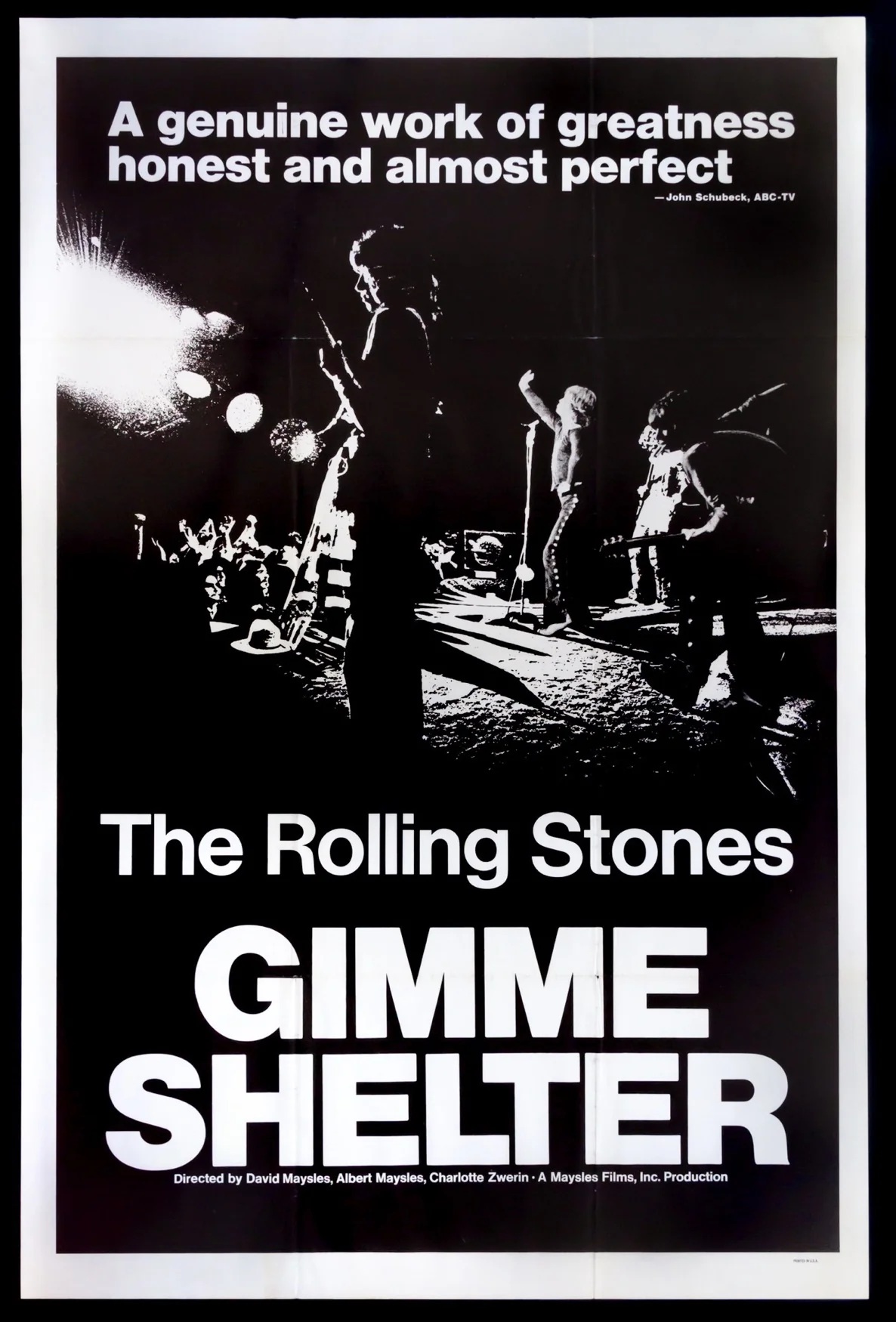
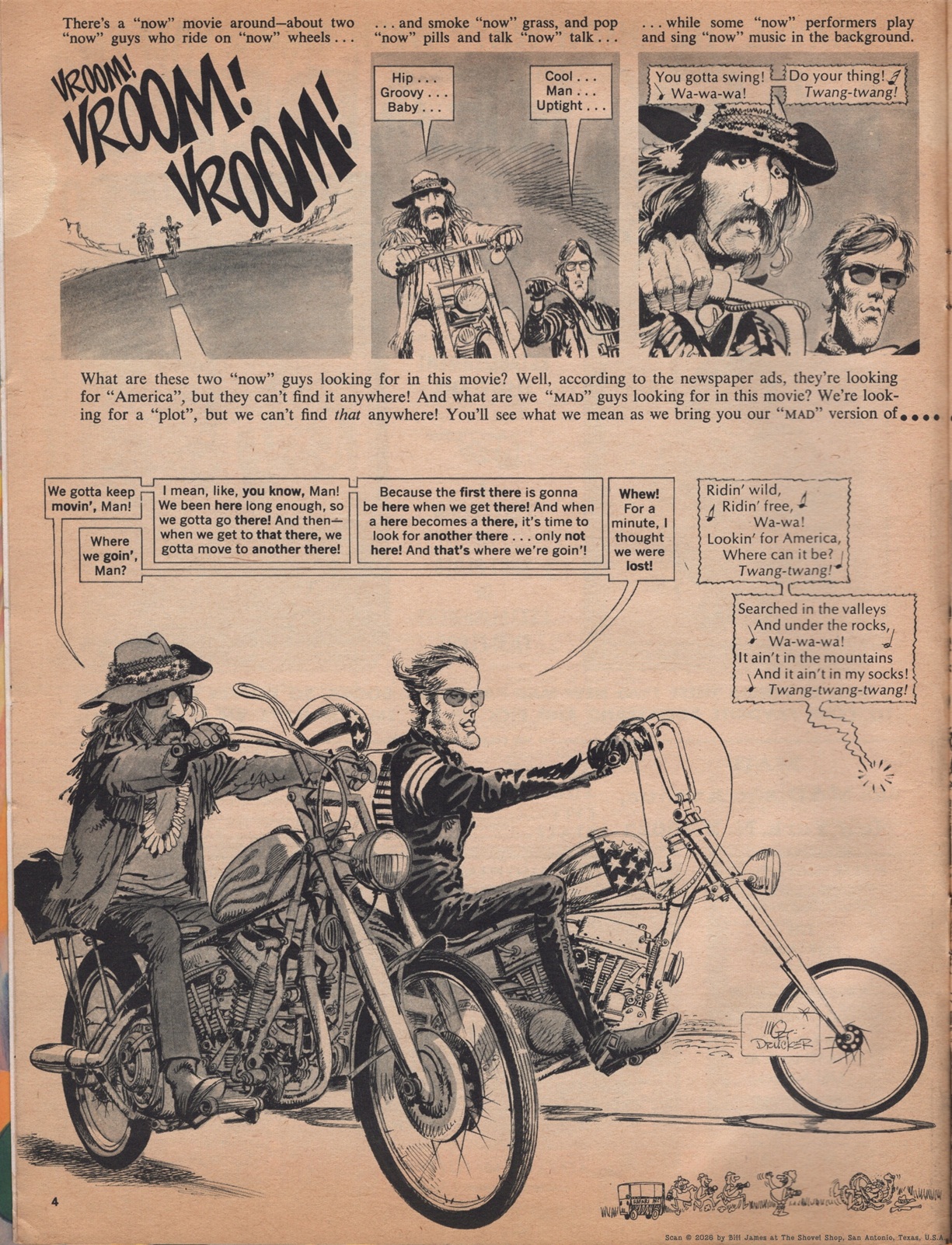
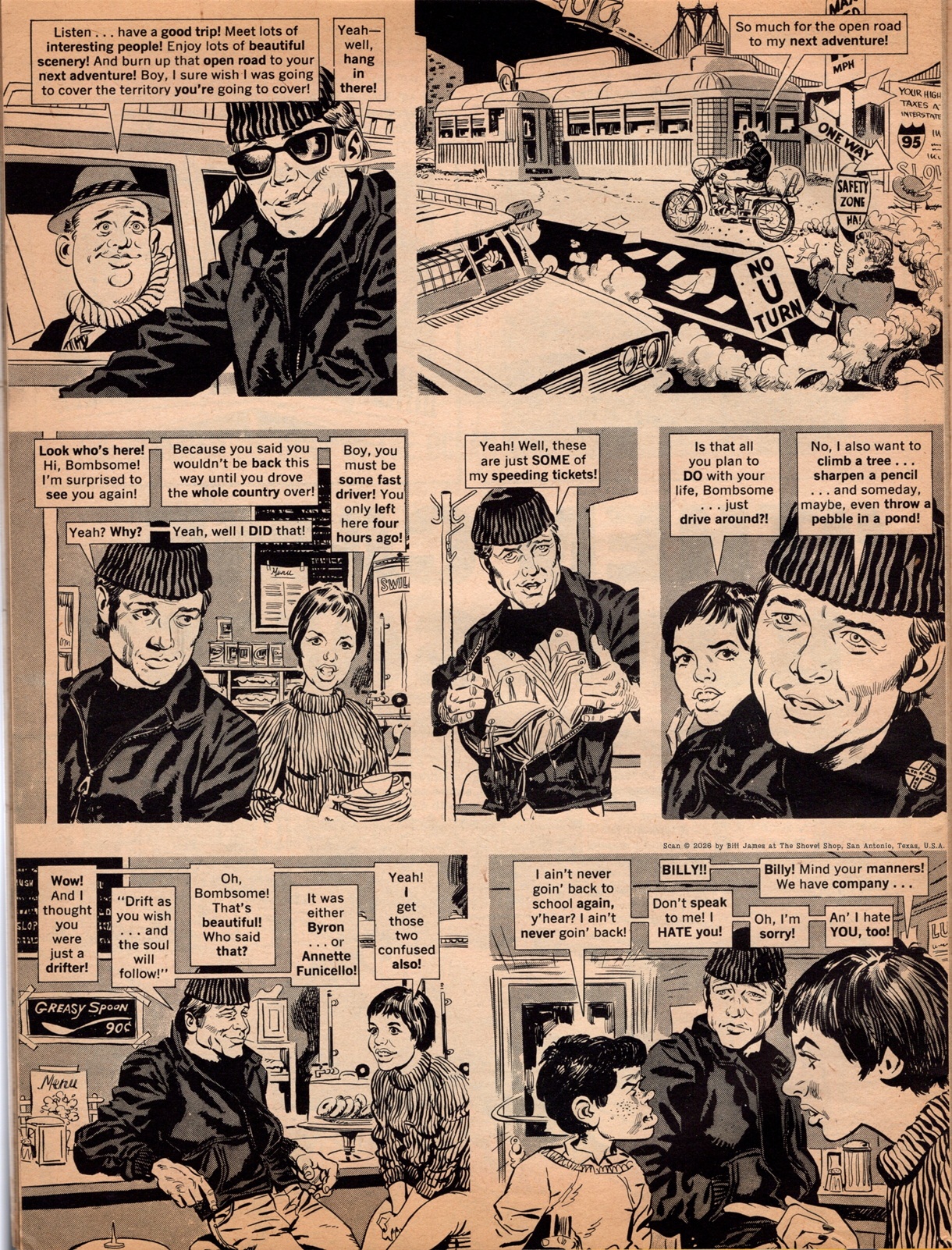
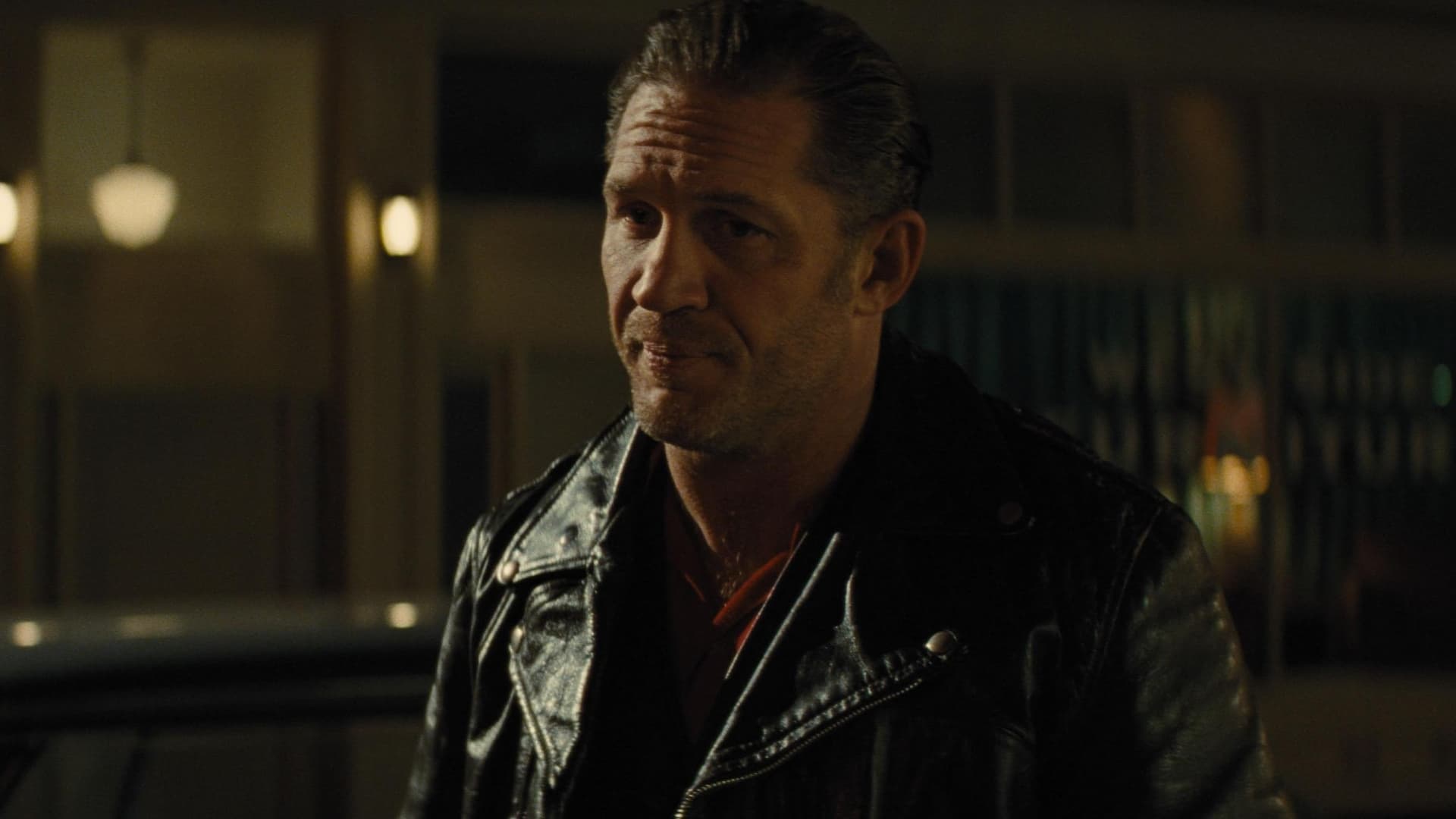
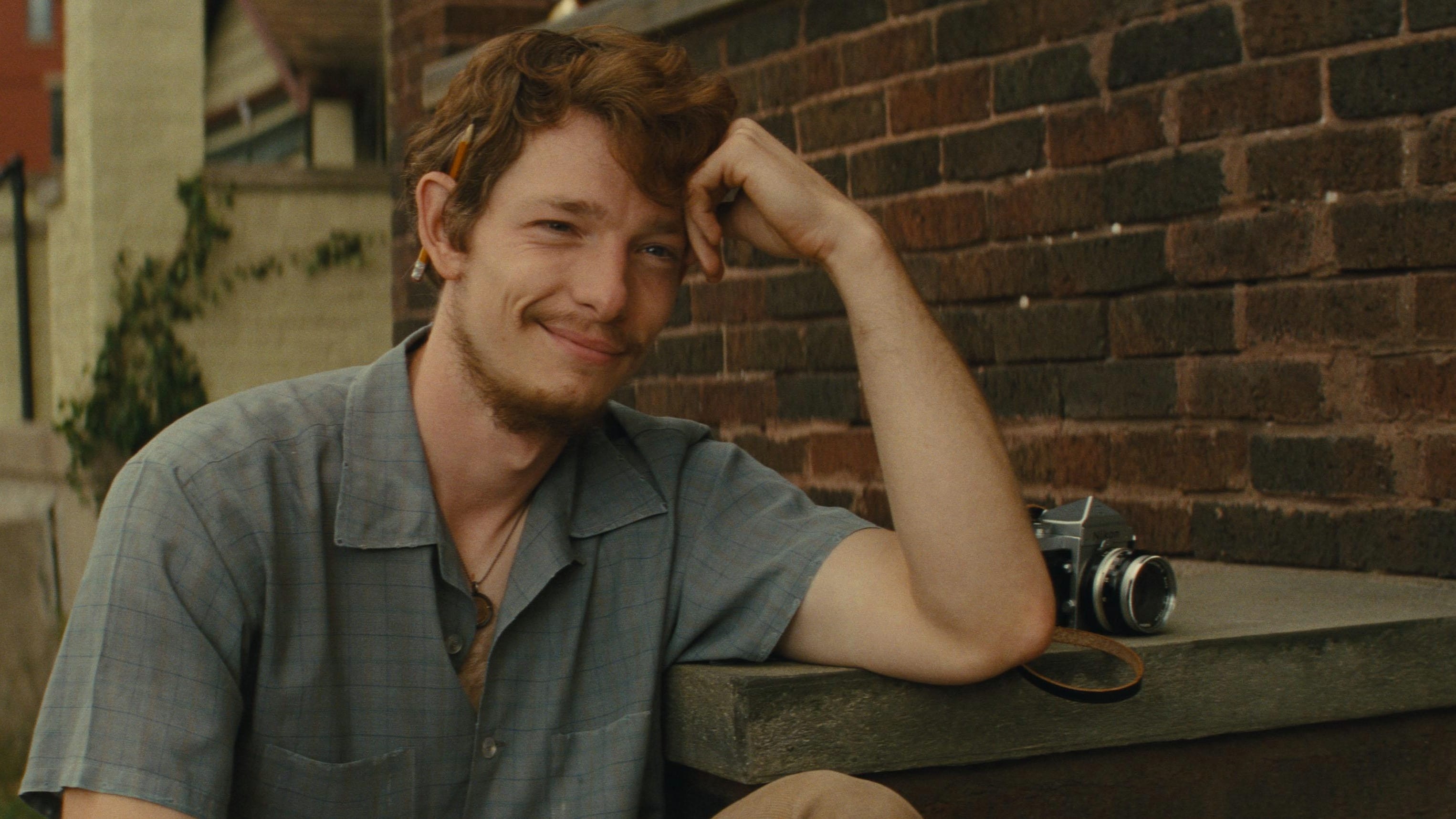
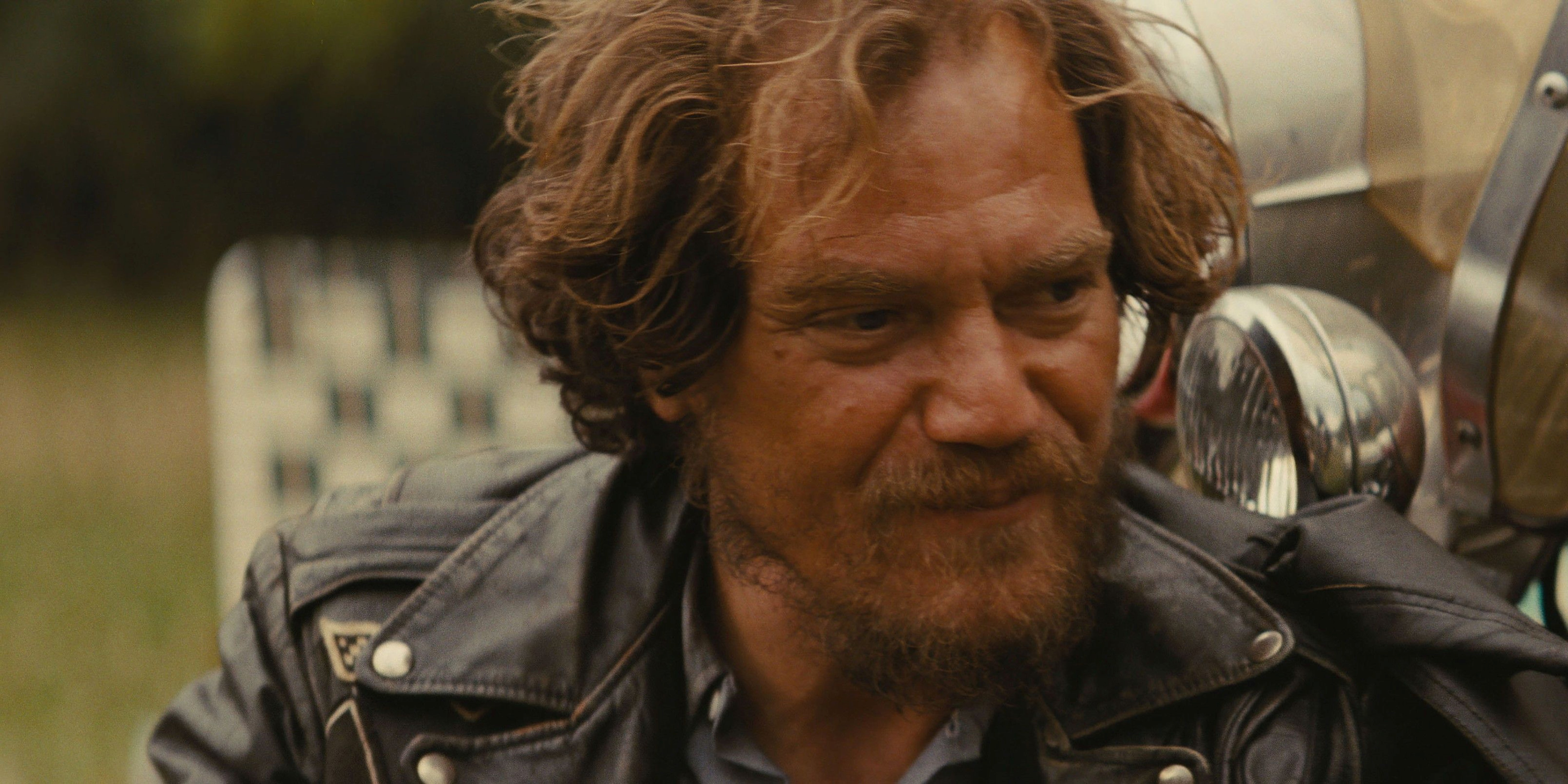
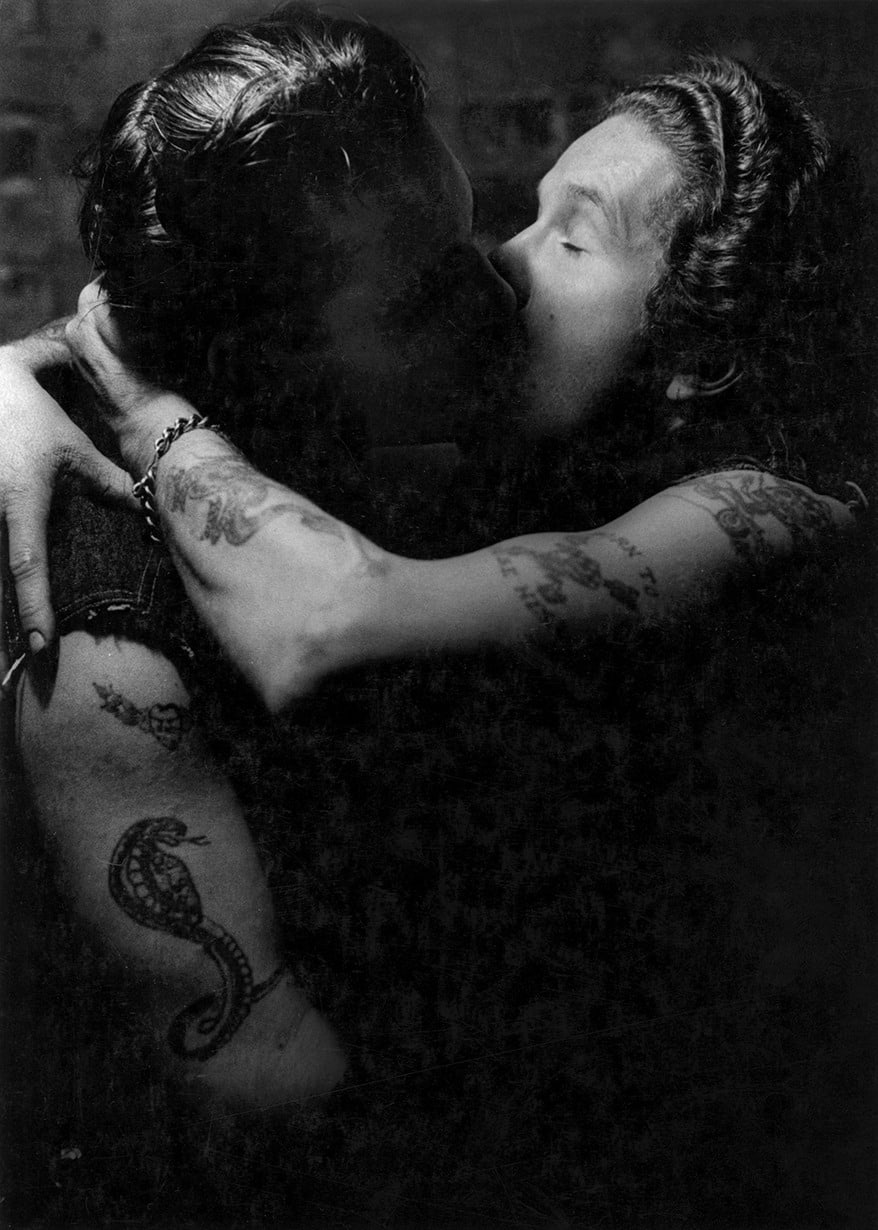
1969 was a busy year for bikers. Of course, there was Woodstock, a lot of sex, drugs and rock ‘n’ roll, and the death of Meredith Hunter during a Rolling Stones concert at Altamont Raceway in California, as detailed in the 1970 documentary Gimme Shelter.
Gimme Shelter (1970)
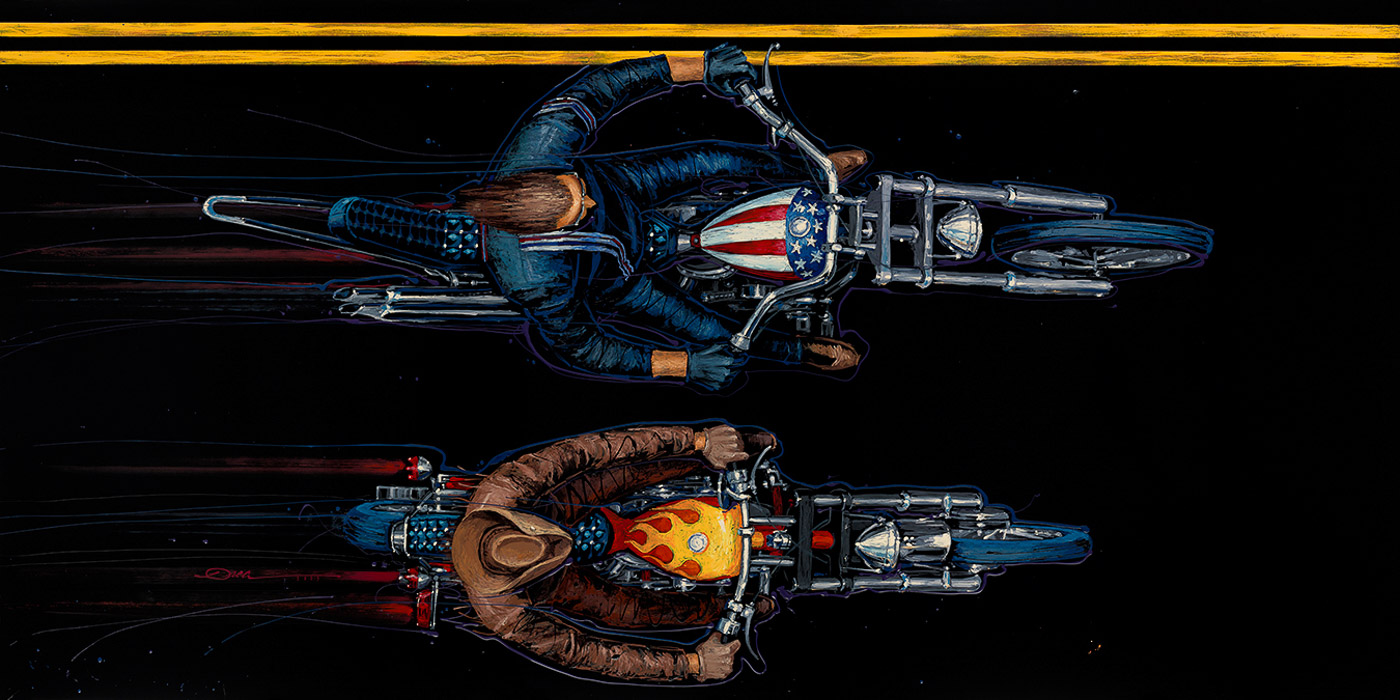
However, In May of that year the groundbreaking independent film Easy Rider hit the silver screen, after a successful debut at the prestigious Cannes Film Festival. Many a young wannabe’s imaginations were fired by the fever-dream vision of two riders aboard gleaming Harley-Davidson panhead choppers, balling through the Desert Southwest in search of America, or comely hippie chicks, or wisdom, or New Orleans hookers, or freedom, or a safe place to park their scooters and enjoy the proceeds of their big drug score.
‘Rode to Freedom’ by artist Ray Drea: acrylic on aluminum panel
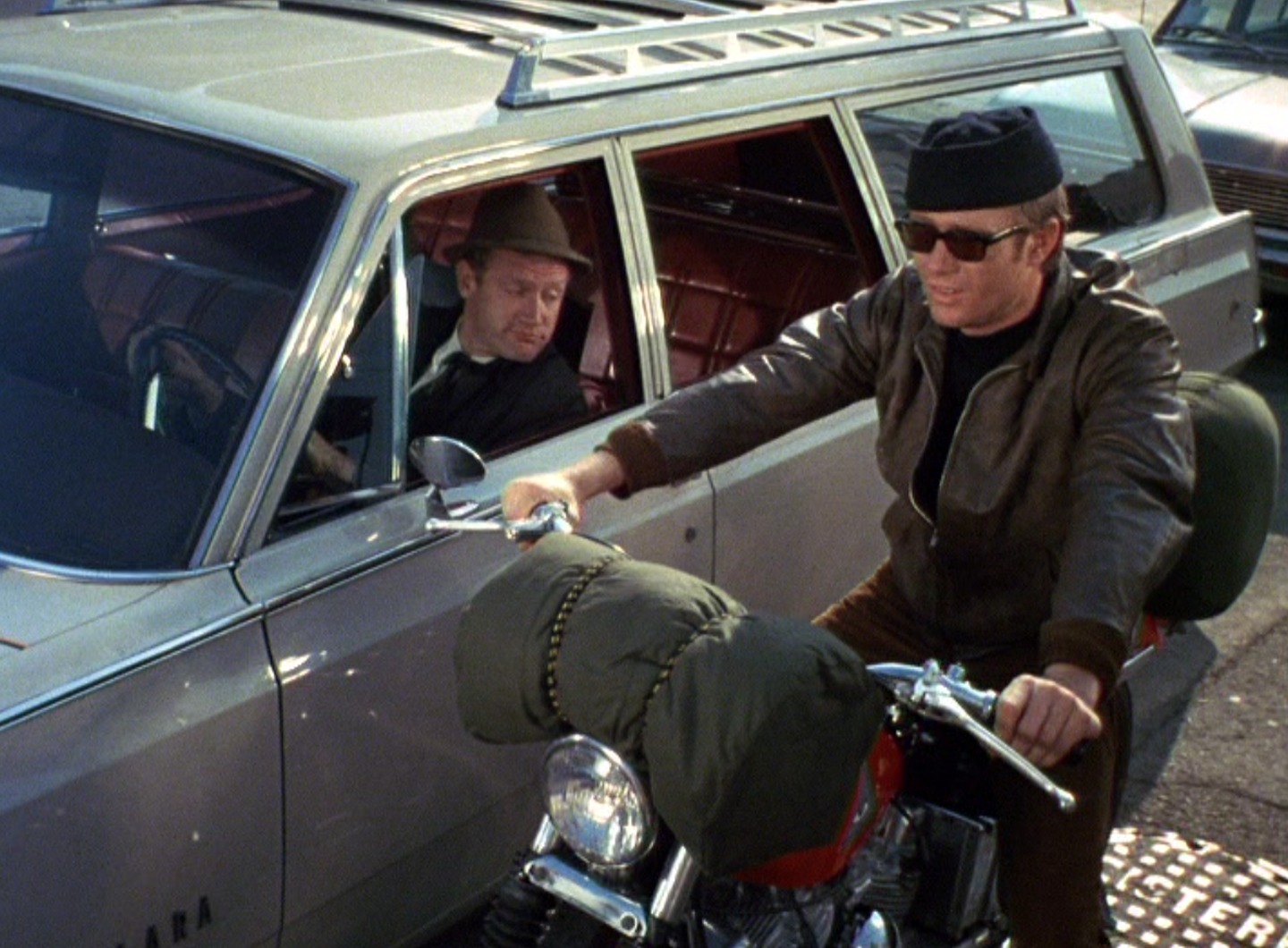
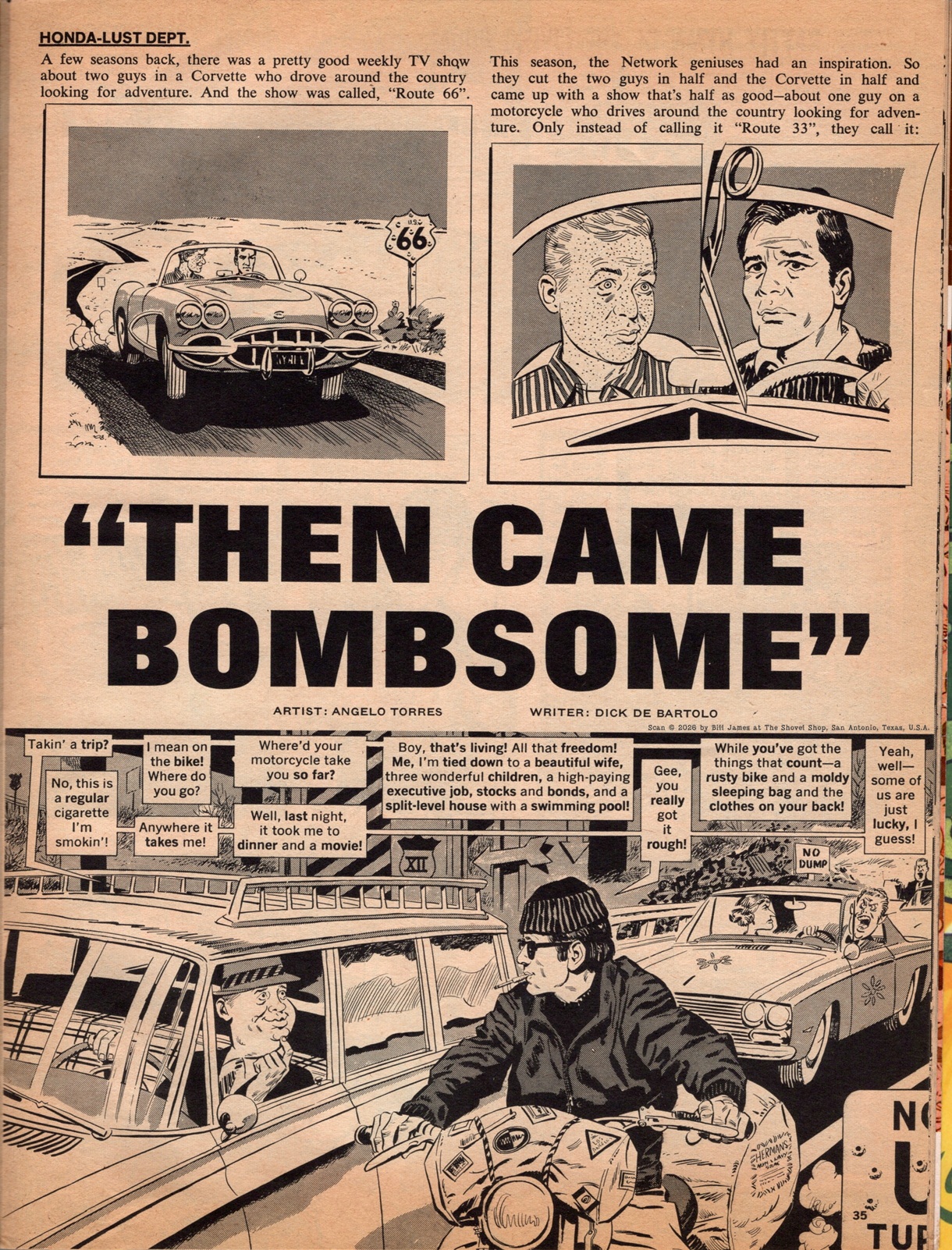
After a two-hour pilot movie broadcast on March 24th, 1969, the weekly series Then Came Bronson debuted on December 10th of that year, just four days after the tragedy at Altamont. The lead character was loosely based on journalist and former Hells Angel Birney Jarvis, mentioned in Hunter S. Thompson’s 1960s book about California’s outlaw motorcycle clubs. After the suicide of a friend, James ‘Jim’ Bronson quits his job as a newspaper reporter and hits the road aboard his mildly customized Harley-Davidson Sportster. The opening scene features Bronson’s iconic exchange with a weary commuter in a station wagon, as they idle side-by-side at a red light.
Commuter: Taking a trip? Jim Bronson: What’s that? Commuter: Taking a trip? Jim Bronson: Yeah. Commuter: Where to? Jim Bronson: Oh, I don’t know. Wherever I end up, I guess. Commuter: Man, I wish I was you. Jim Bronson: Really? Commuter: Yeah. Jim Bronson: Well, hang in there.
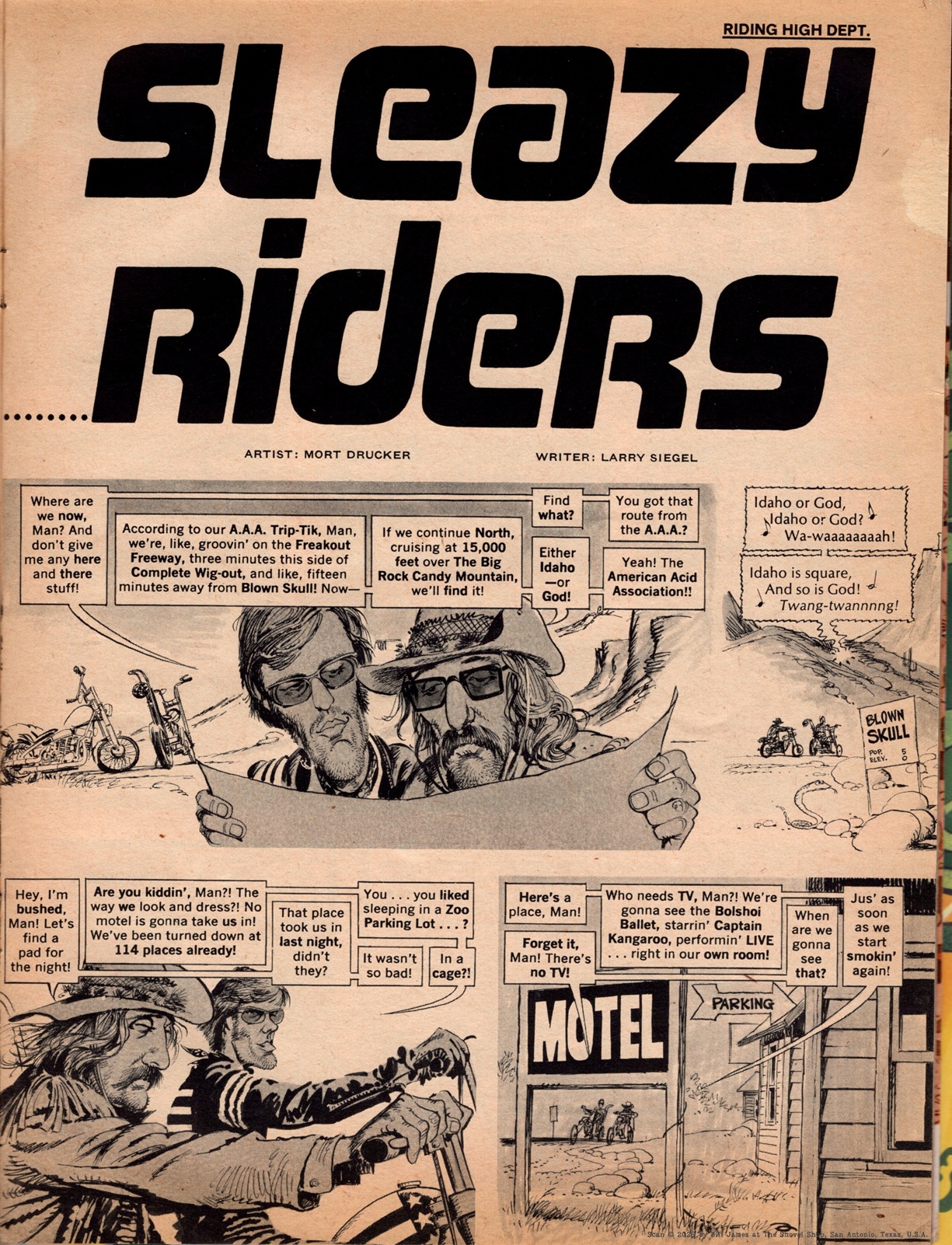
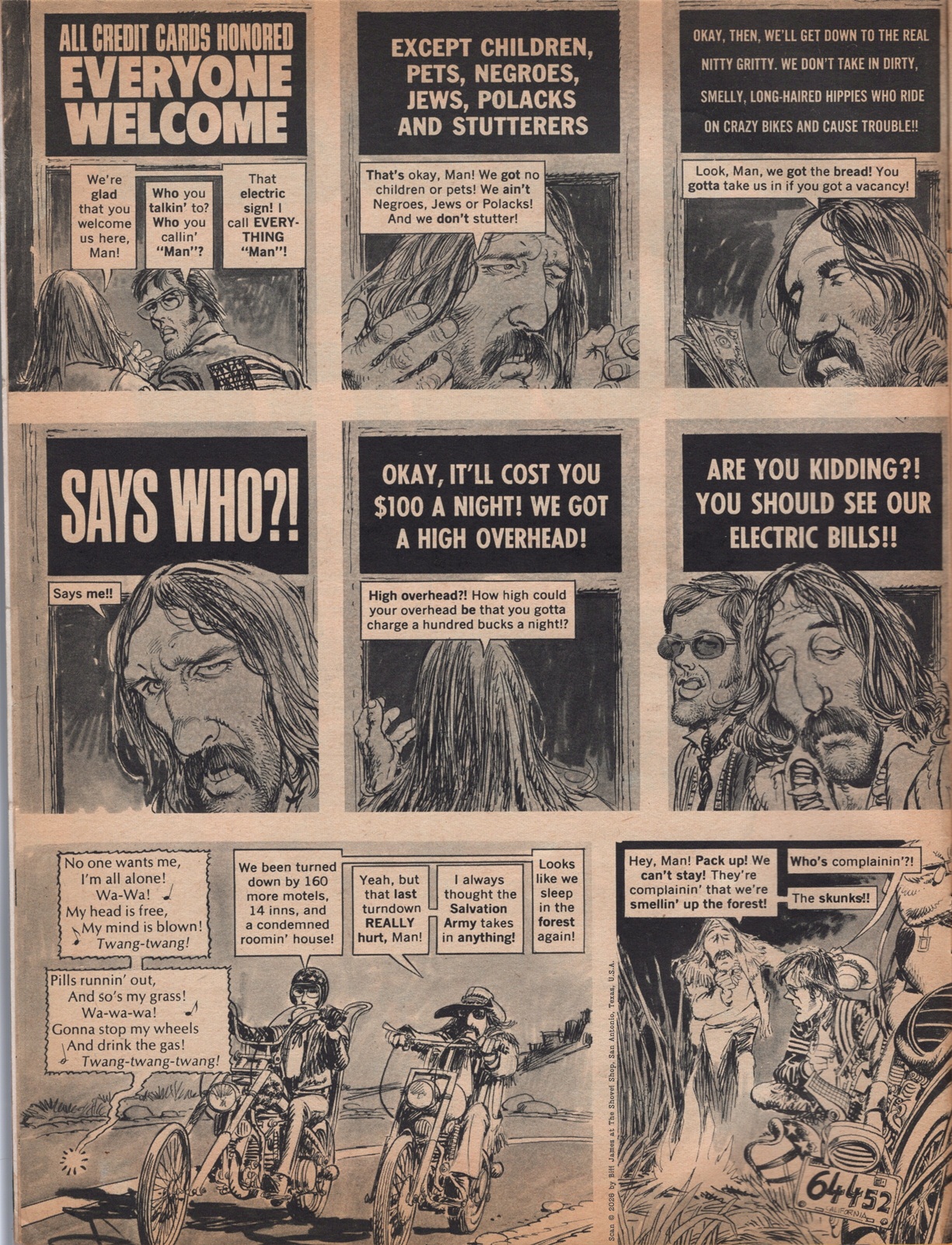
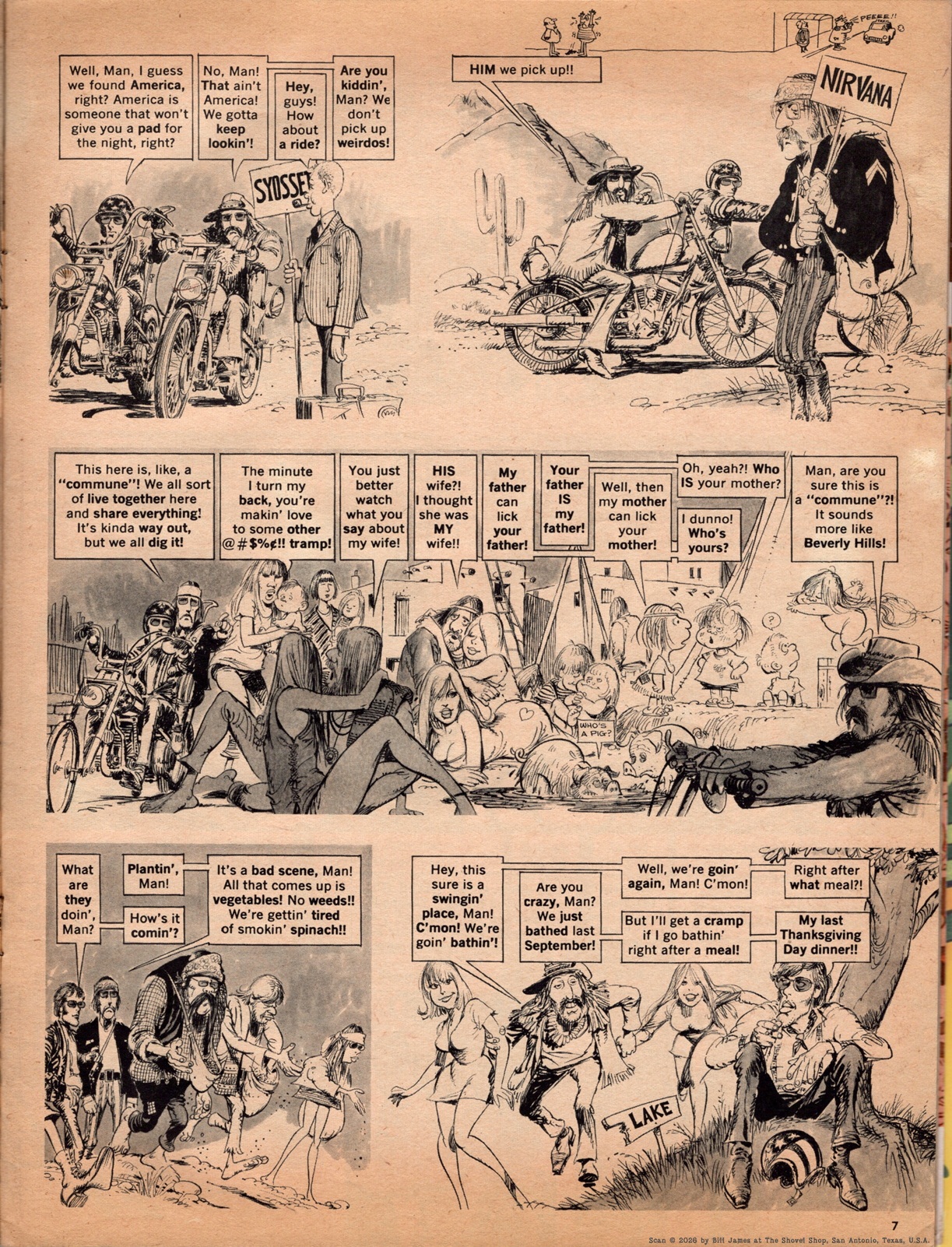
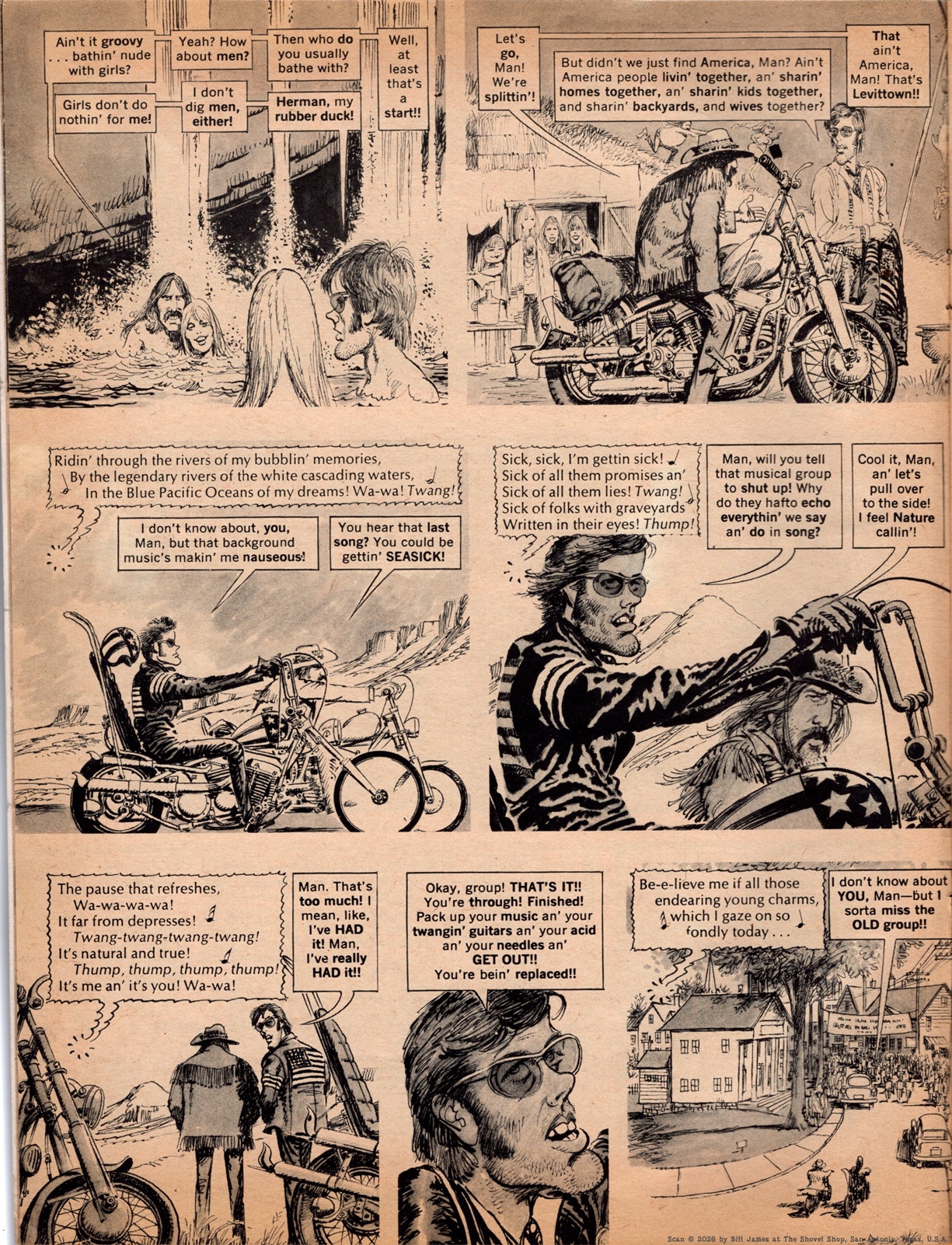
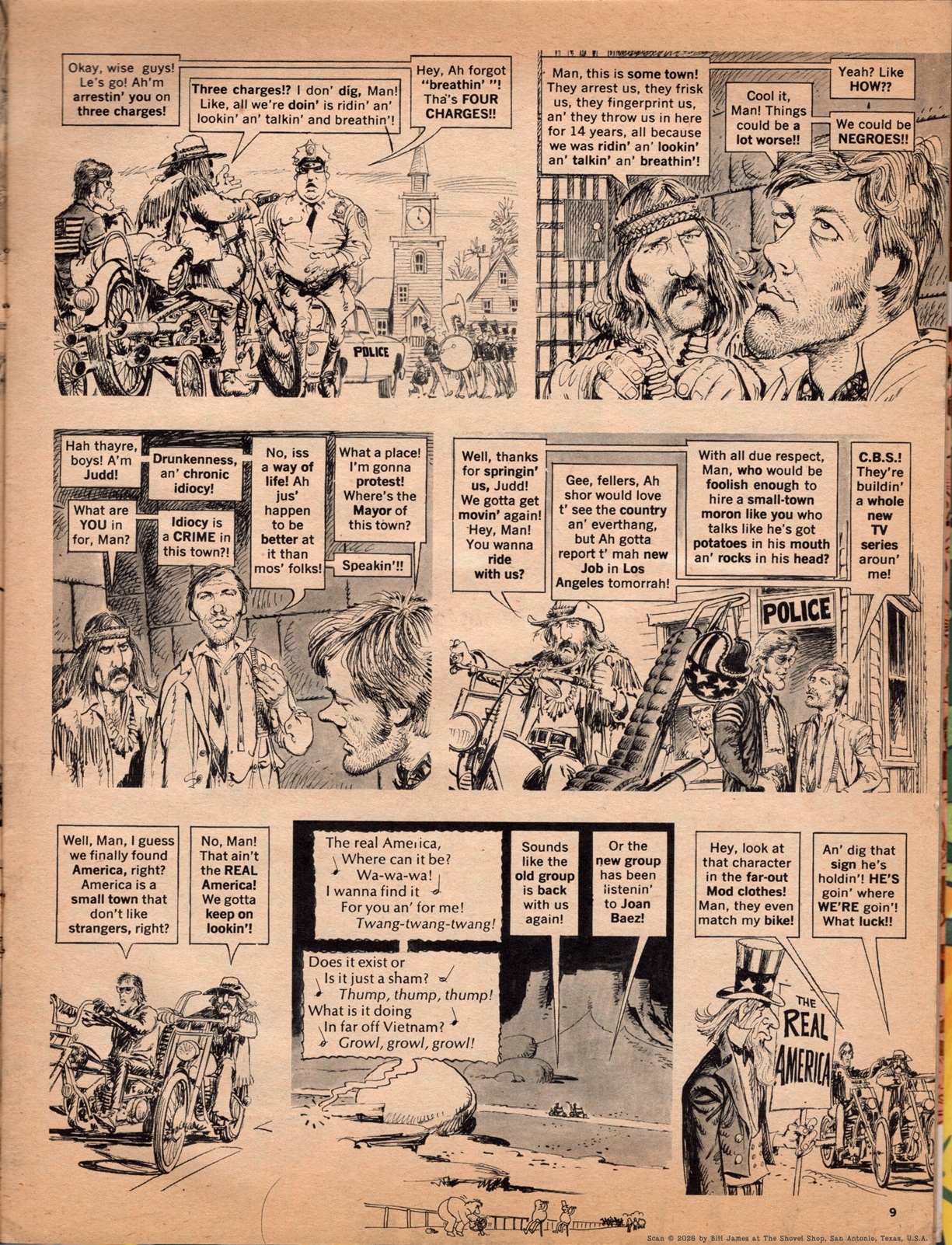
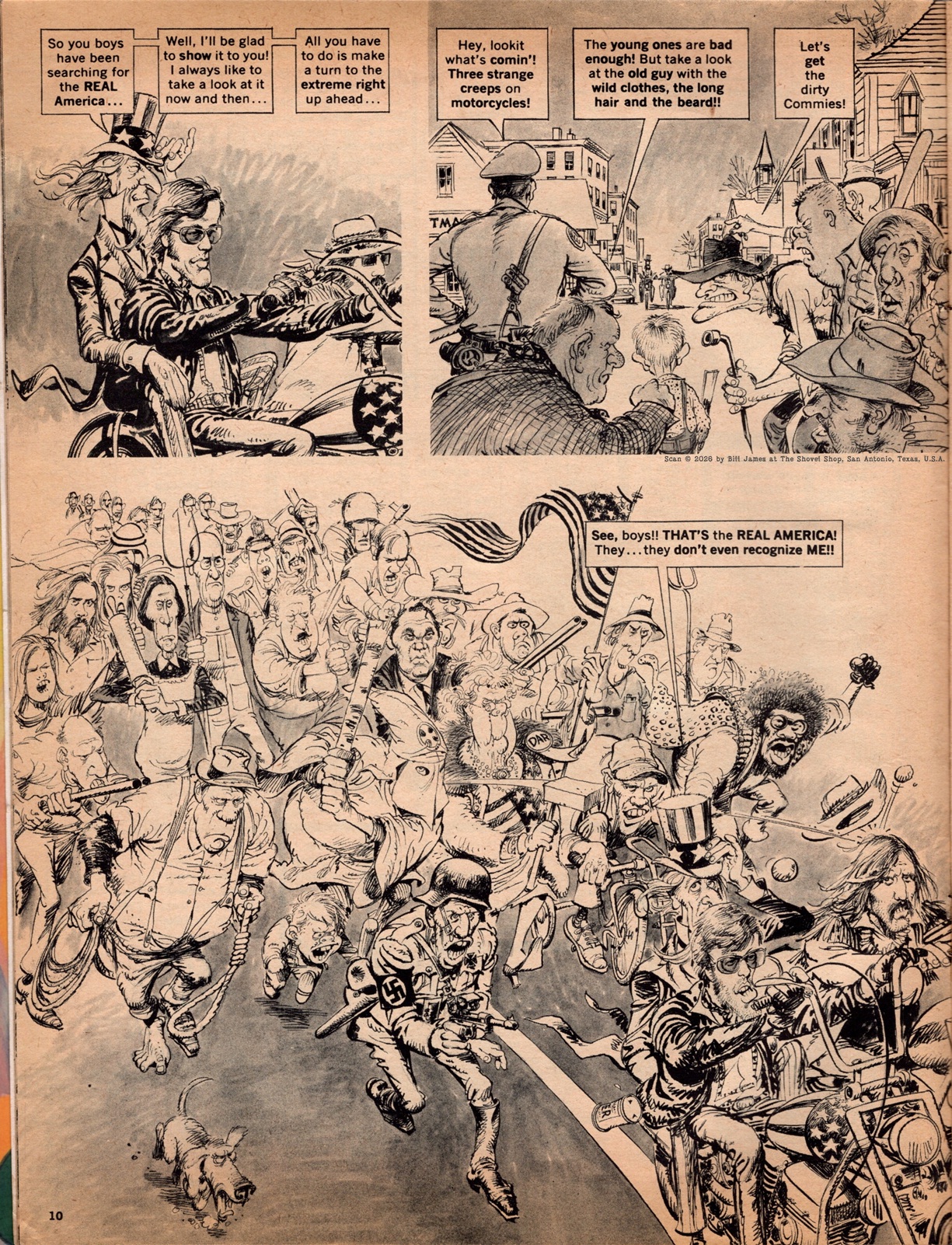
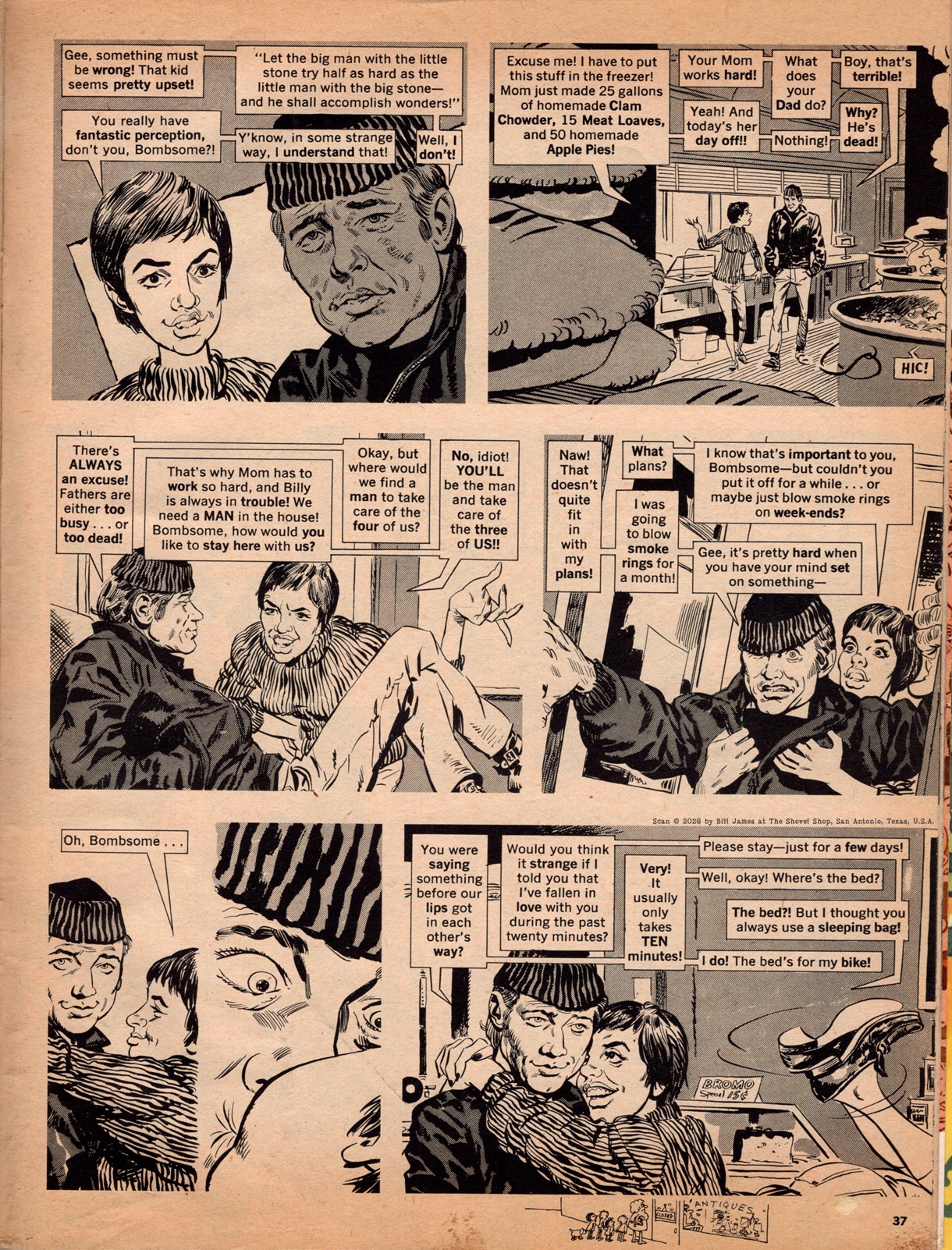
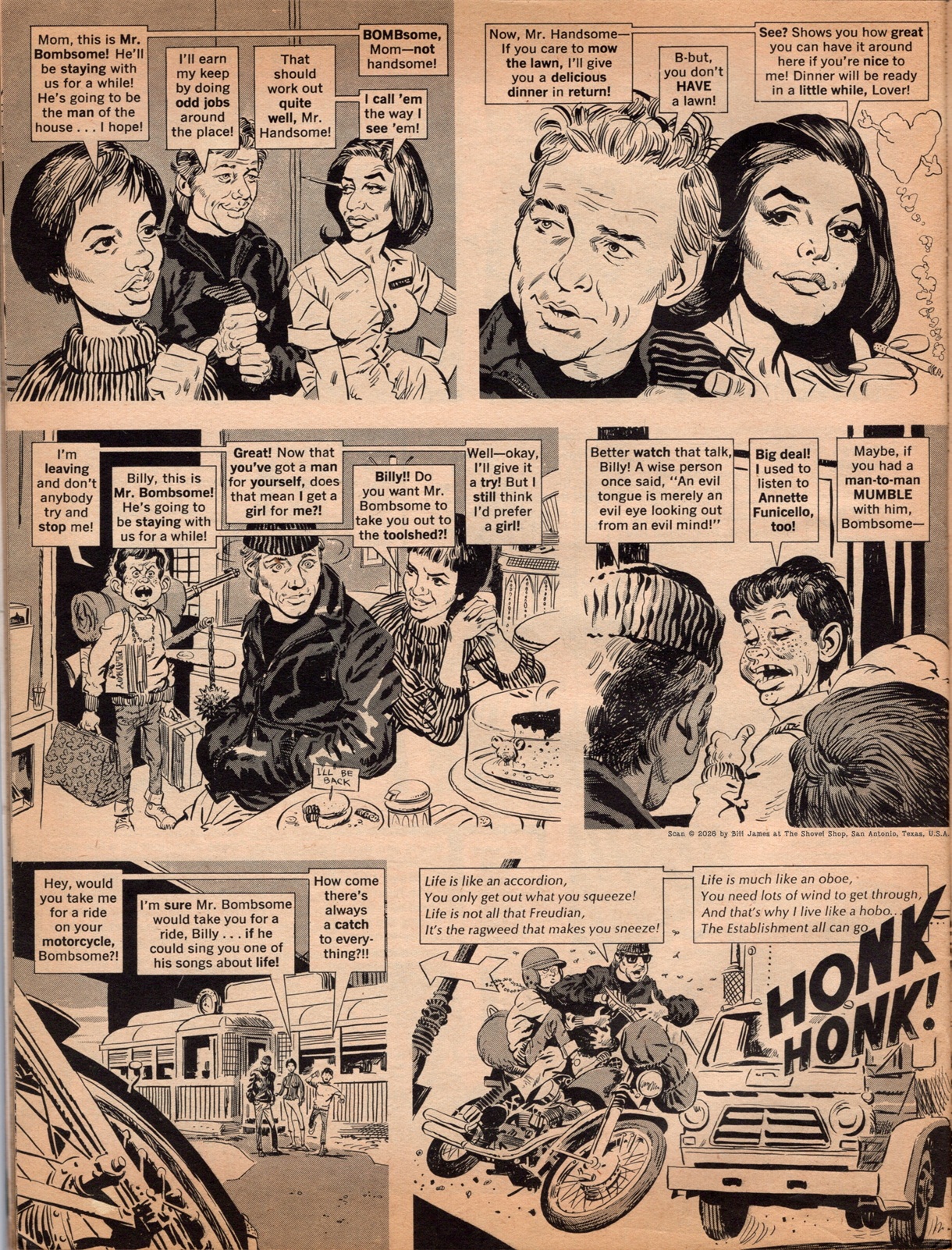
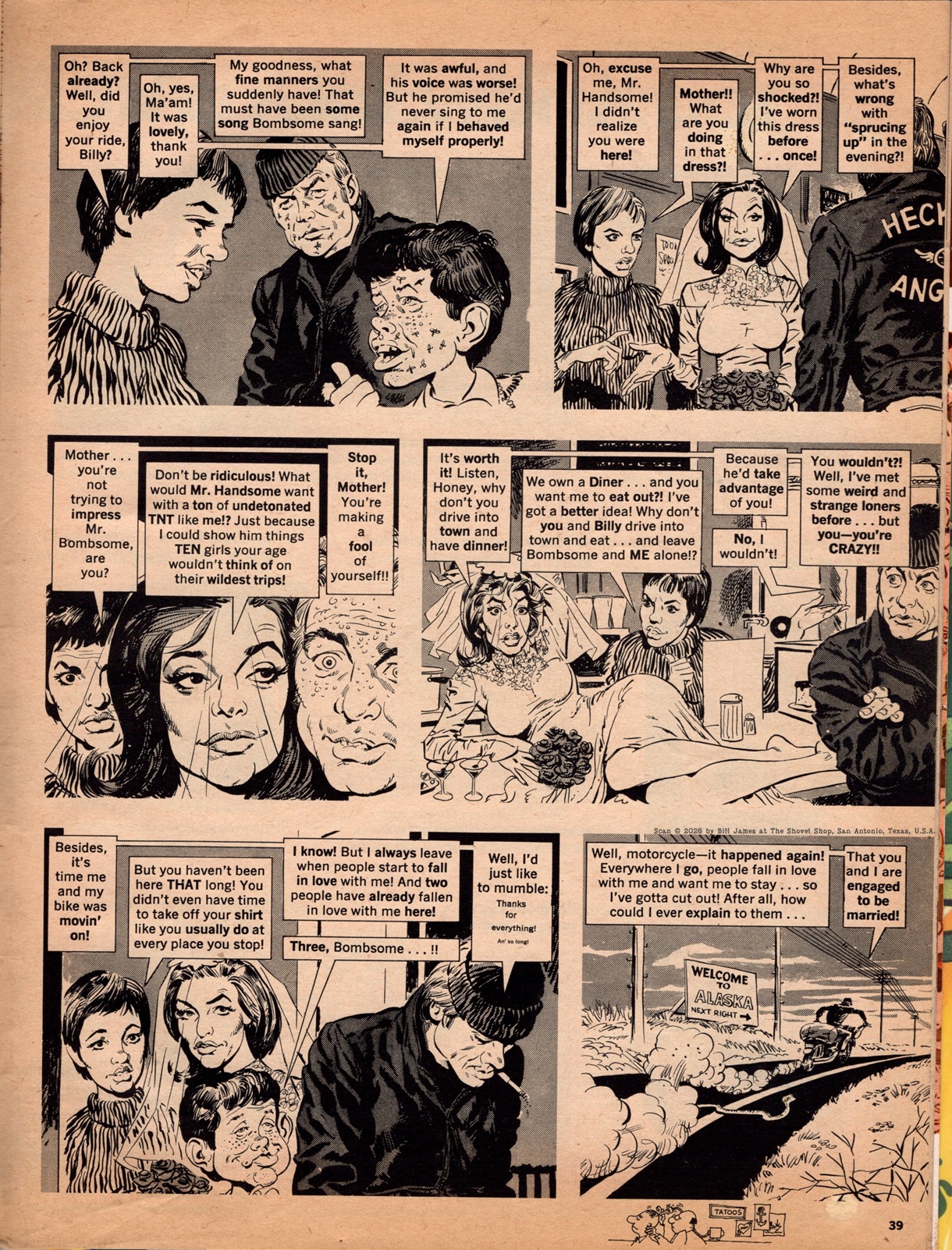
For reasons too numerous and convoluted to delve into in this entry, both the series and film continue to resonate with riders today. I may discuss all that in a later post. However, today is for fun; specifically, the parodies of both motorcycle-themed works in a single issue of the humor magazine called MAD.
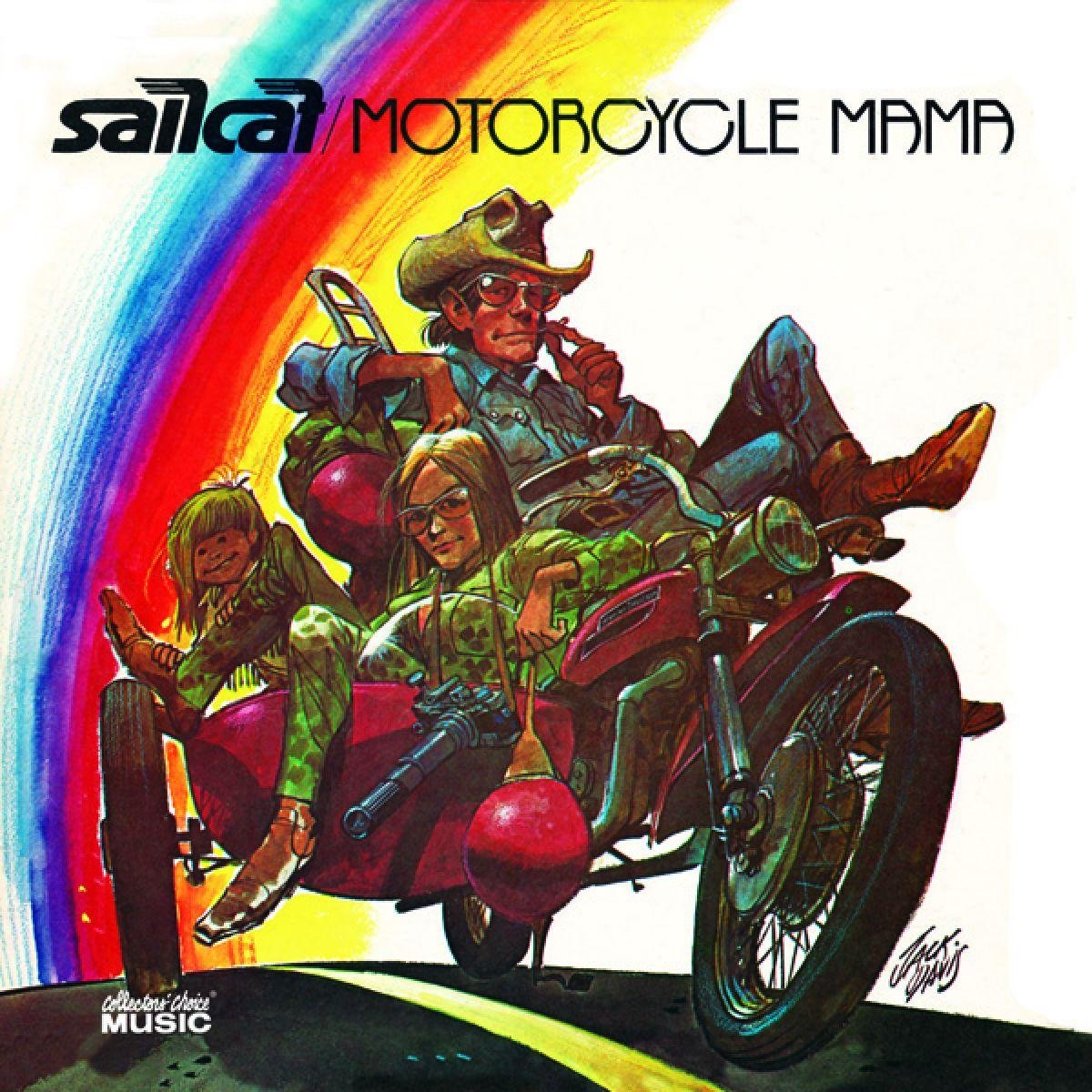
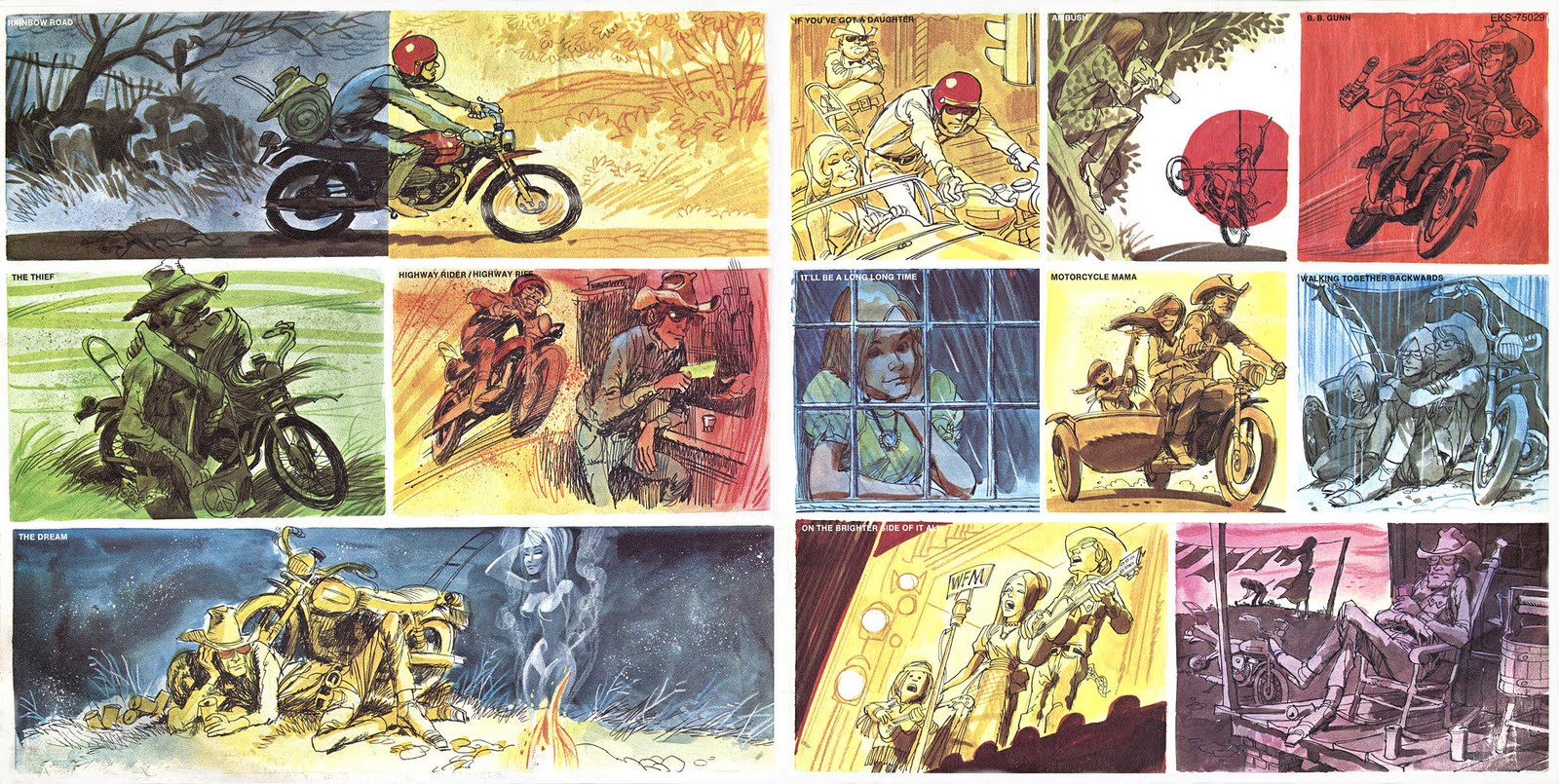
The June, 1970, issue featured a cover by artist Jack Davis (who also illustrated the comic-book style cover of pop group Sailcat’s Motorcycle Mamaalbum, posted below), which shows film actors Peter Fonda and Dennis Hopper, alongside Bronson star Michael Parks and MAD‘s very own avatar, Alfred E. Neuman of ‘What, Me Worry?’ fame.
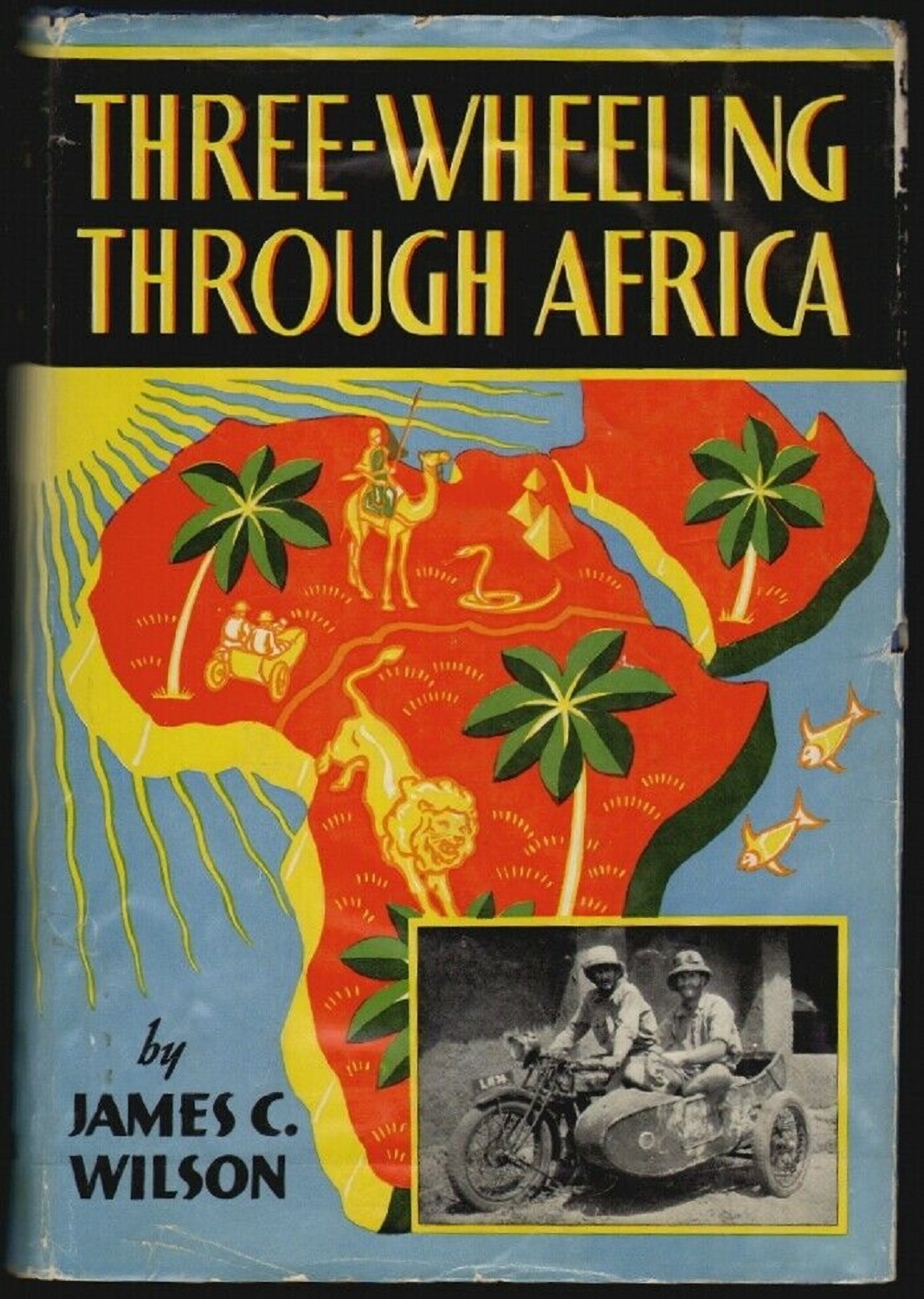
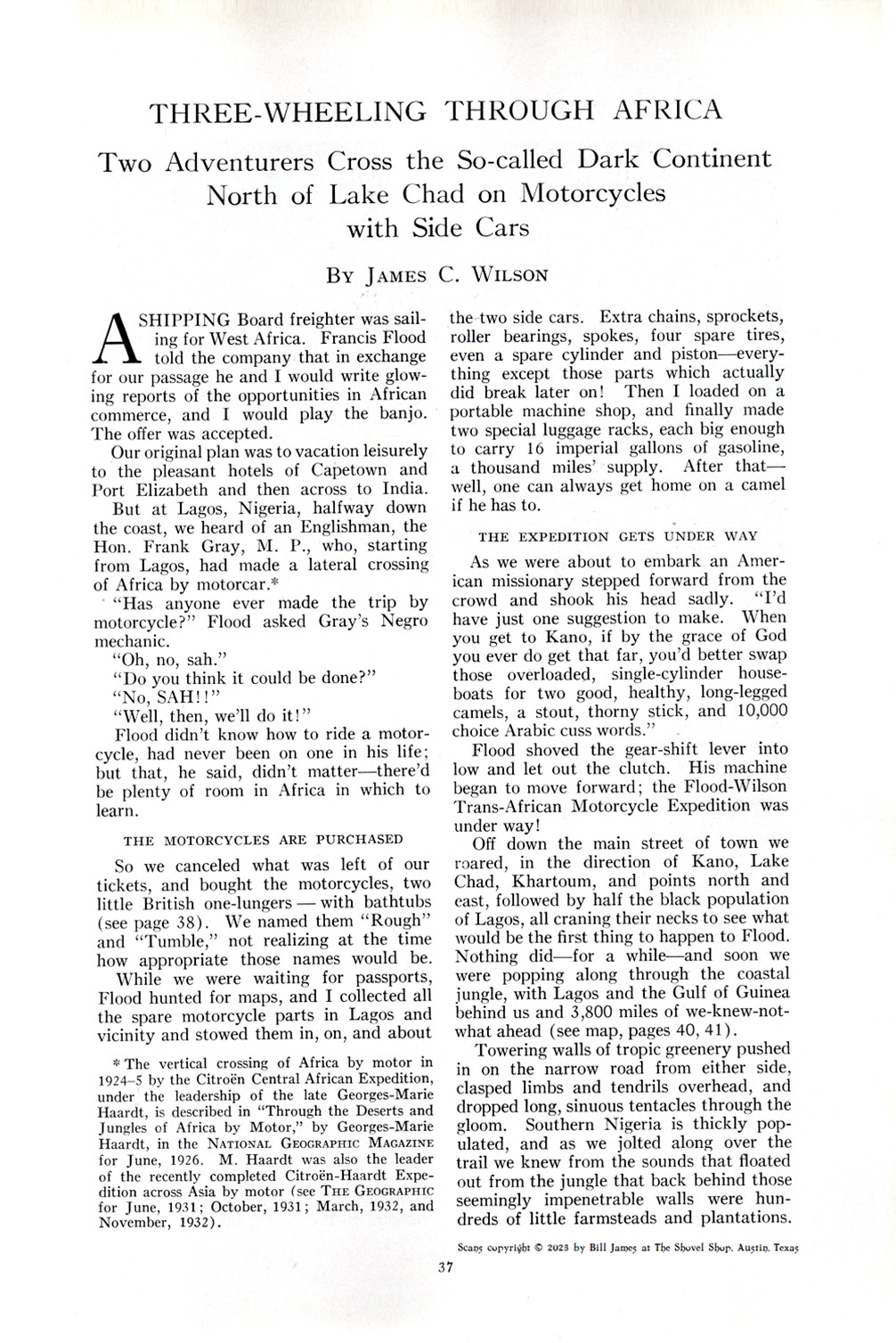
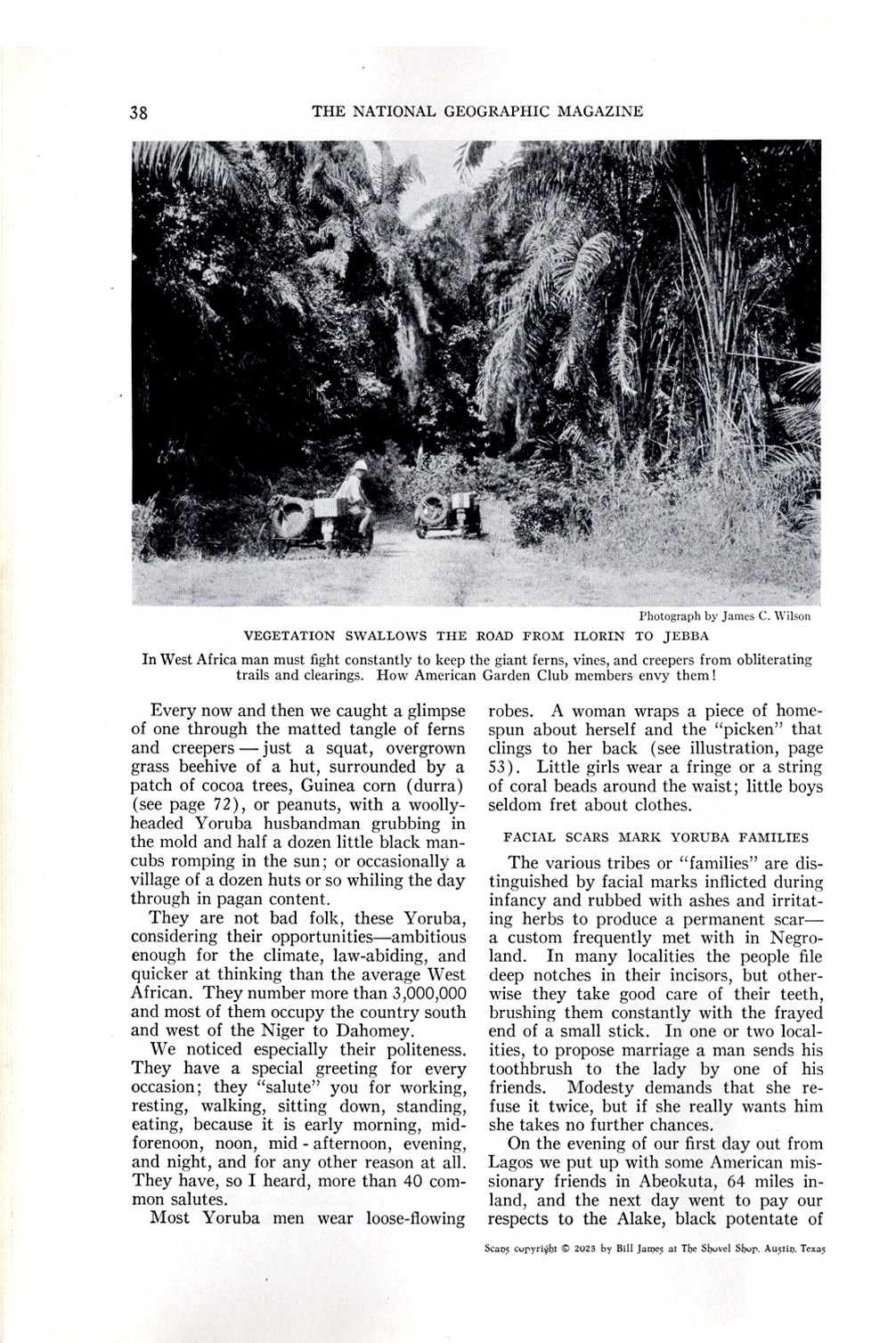
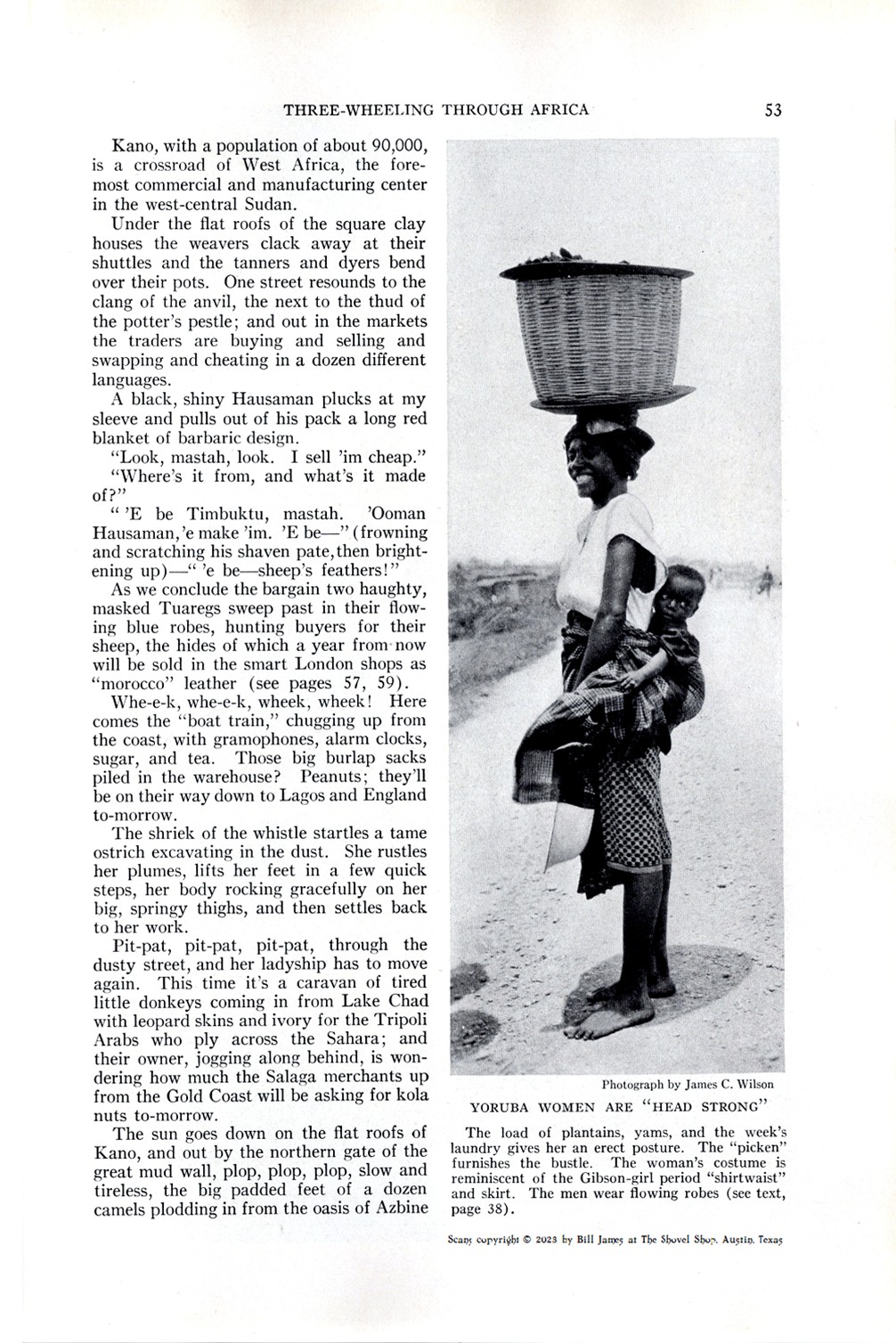
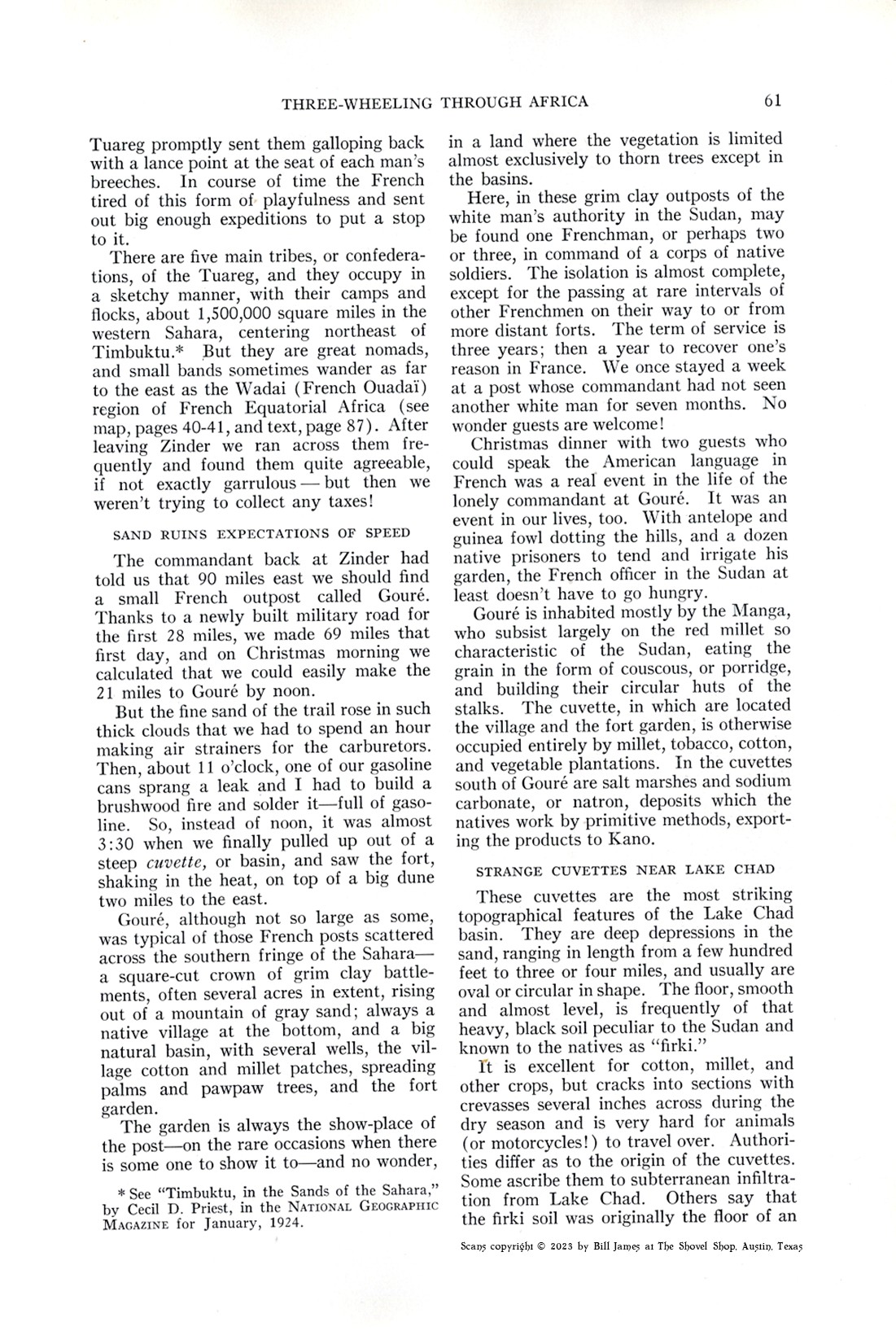
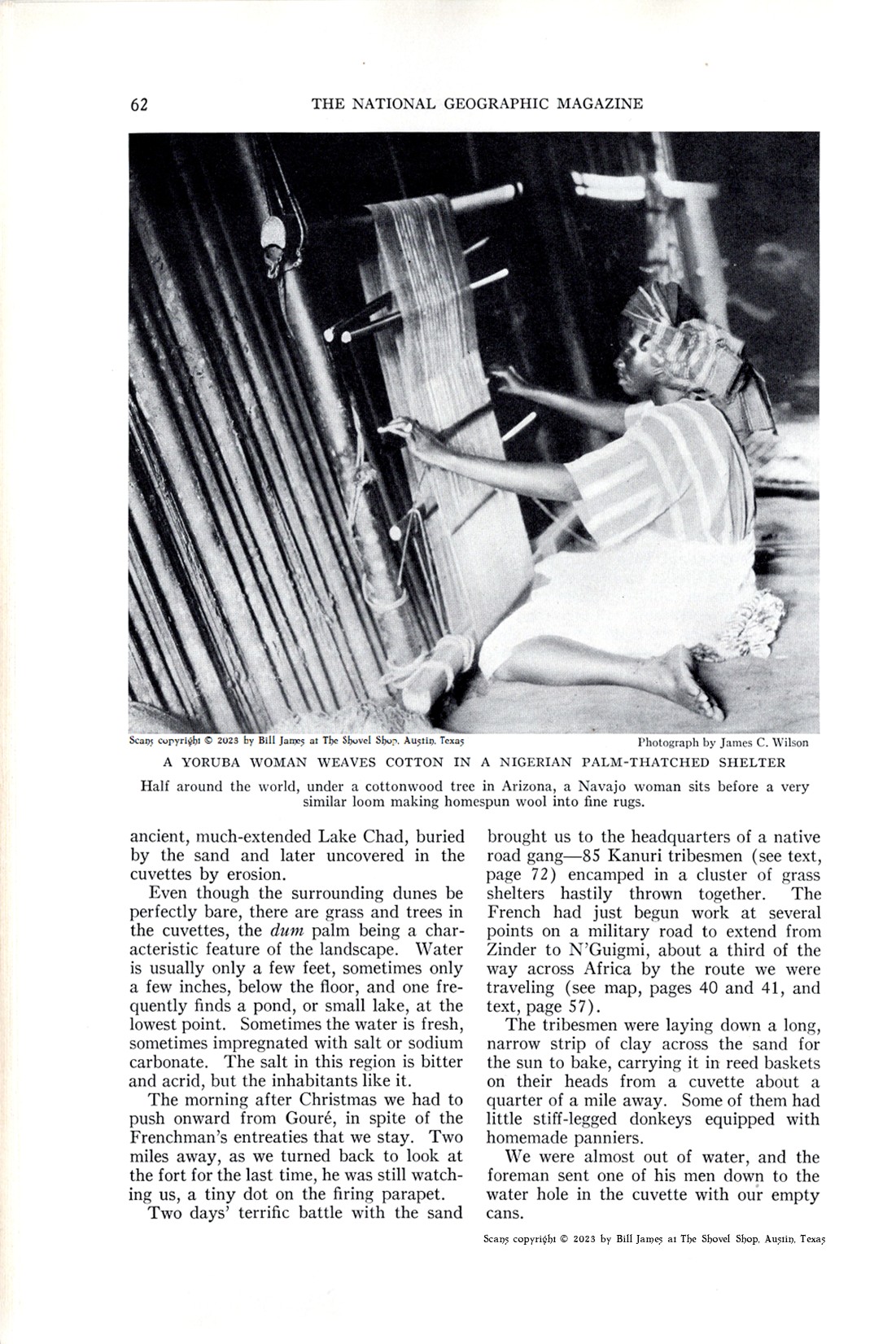
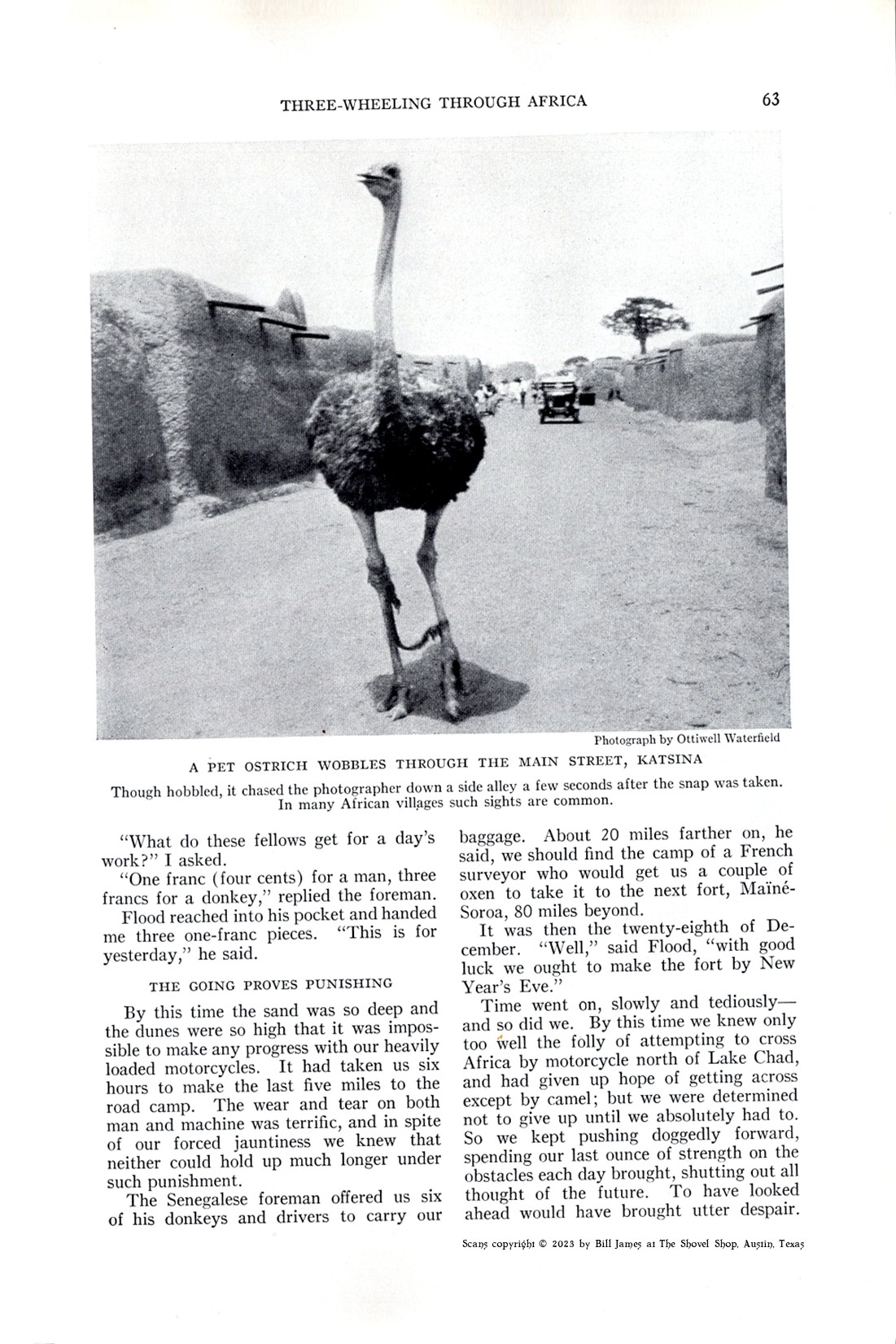
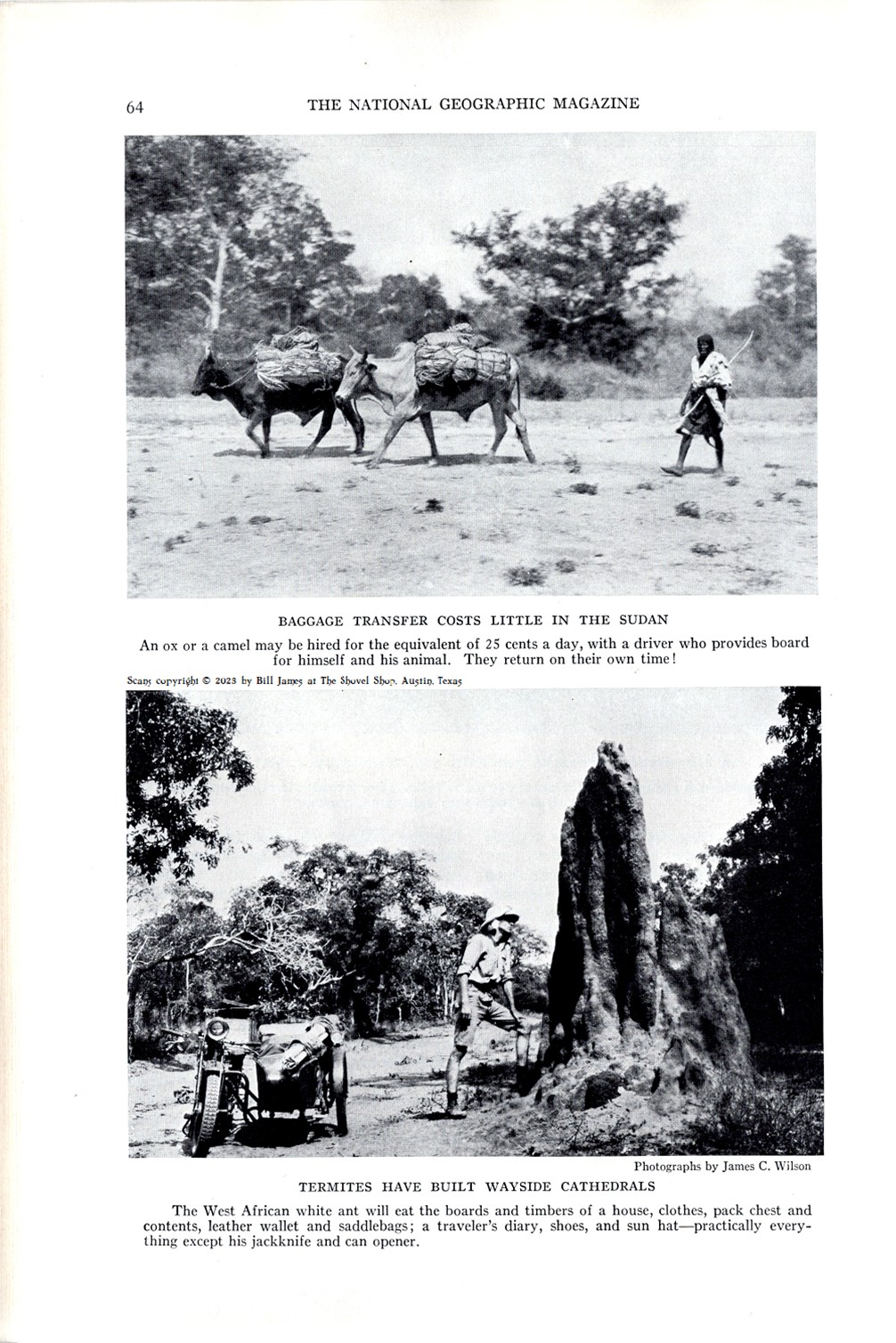
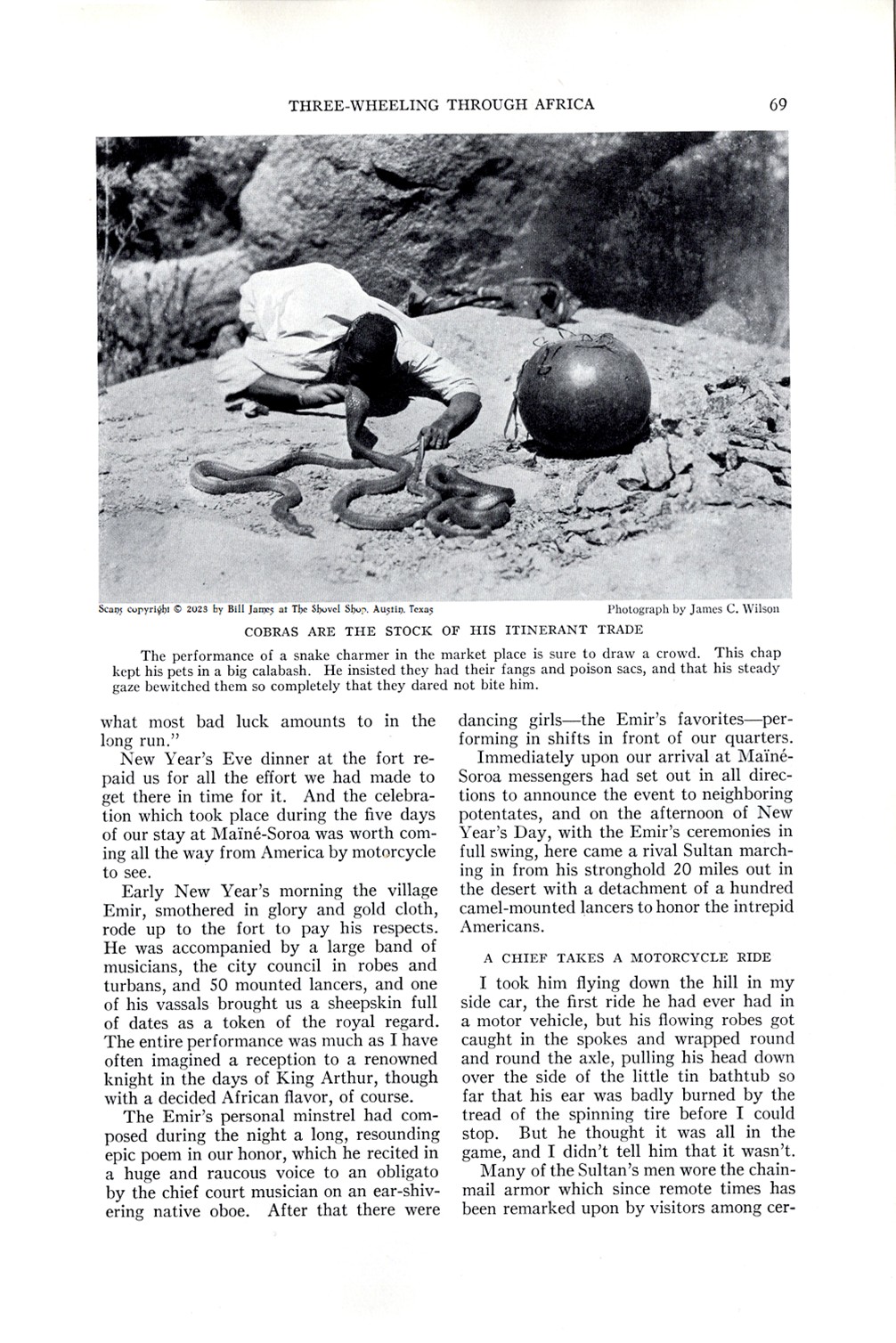
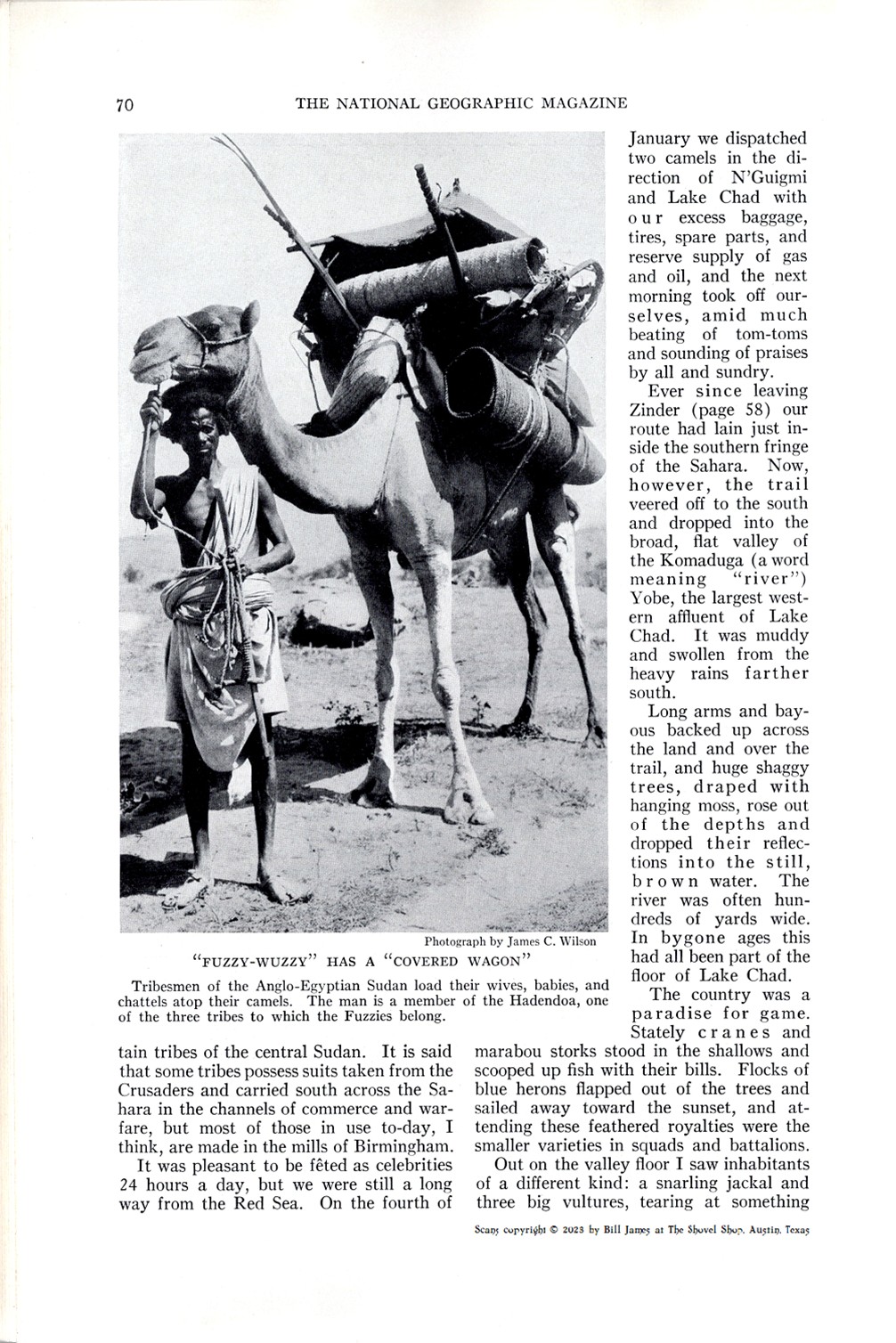
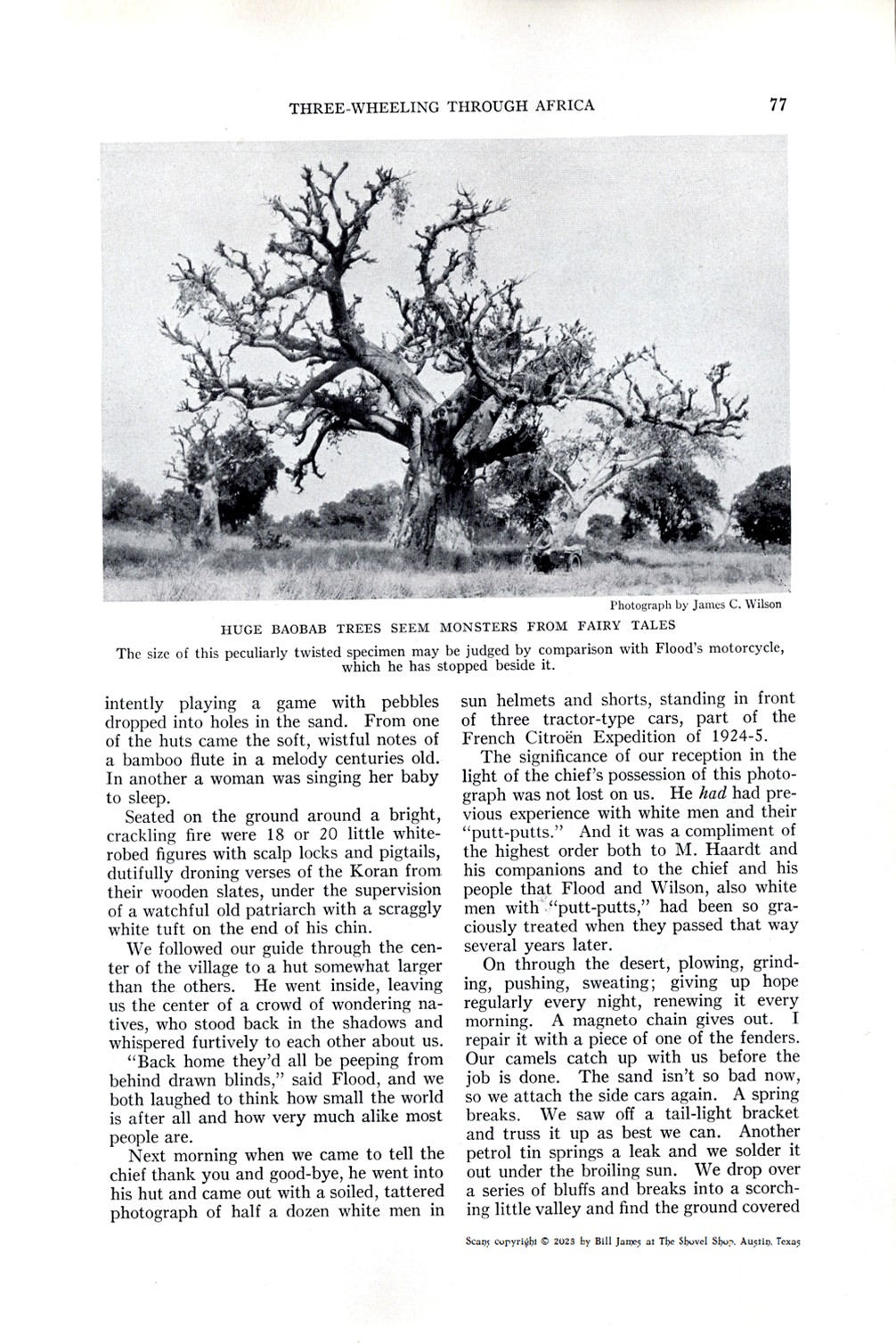
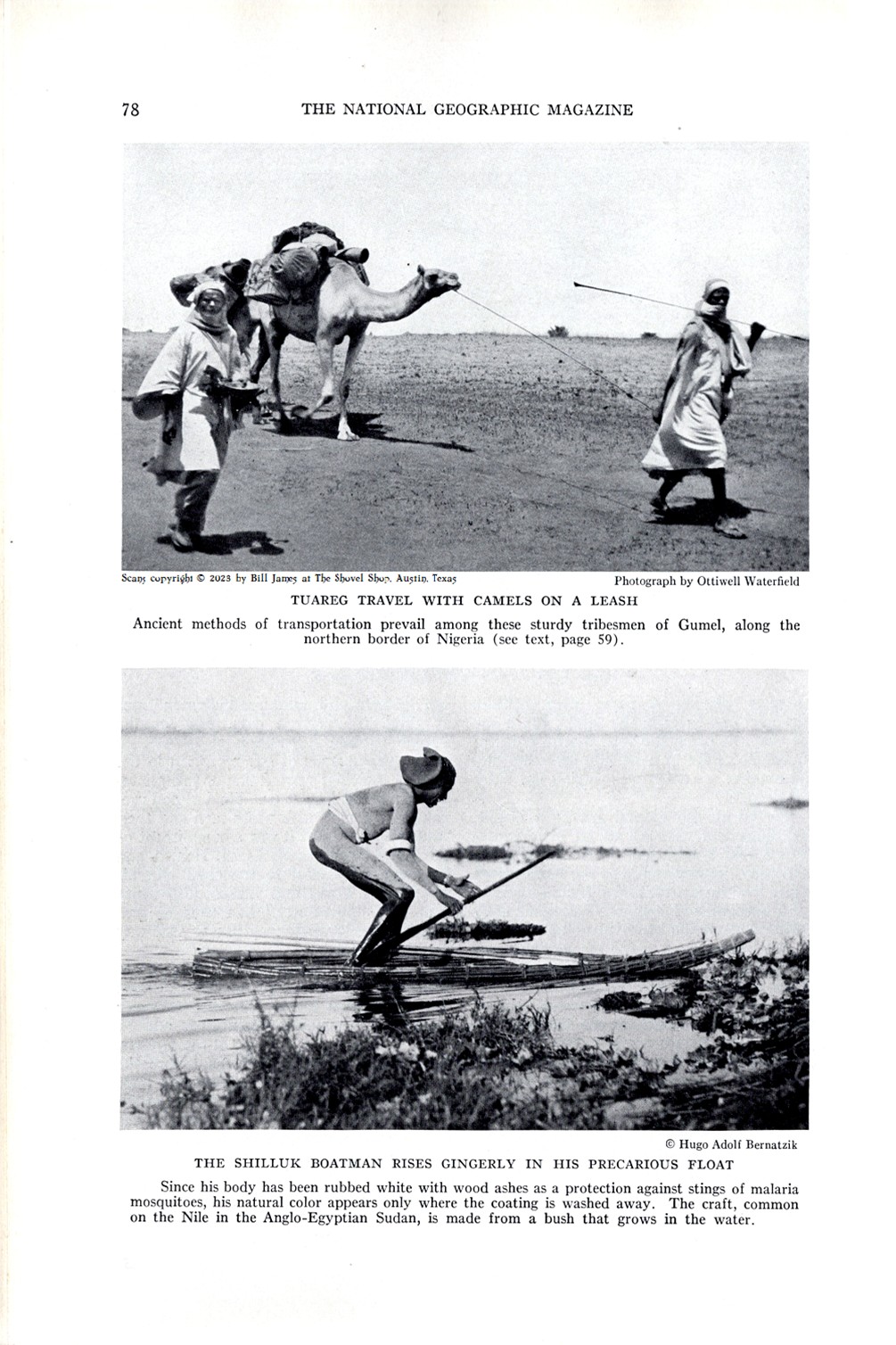
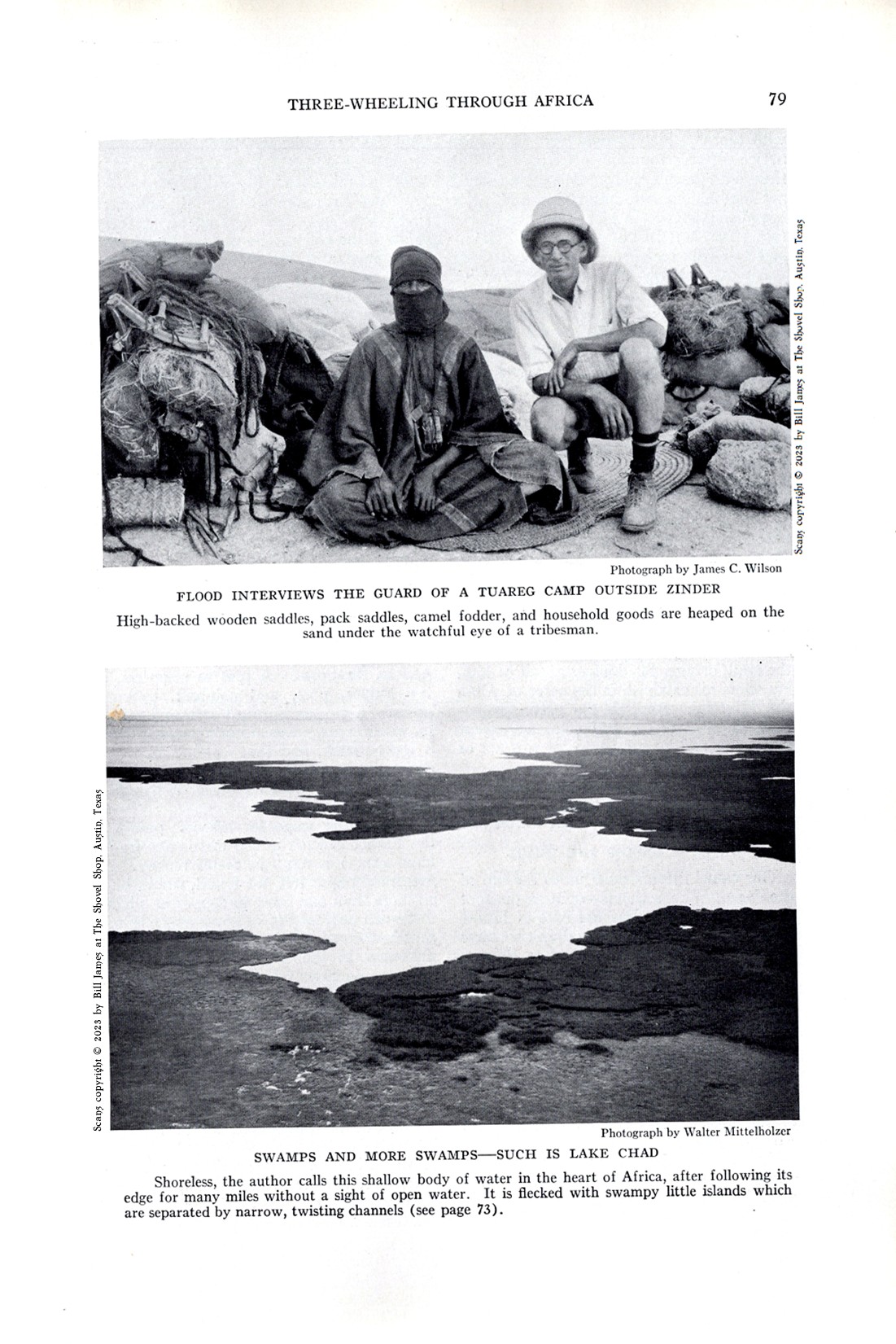
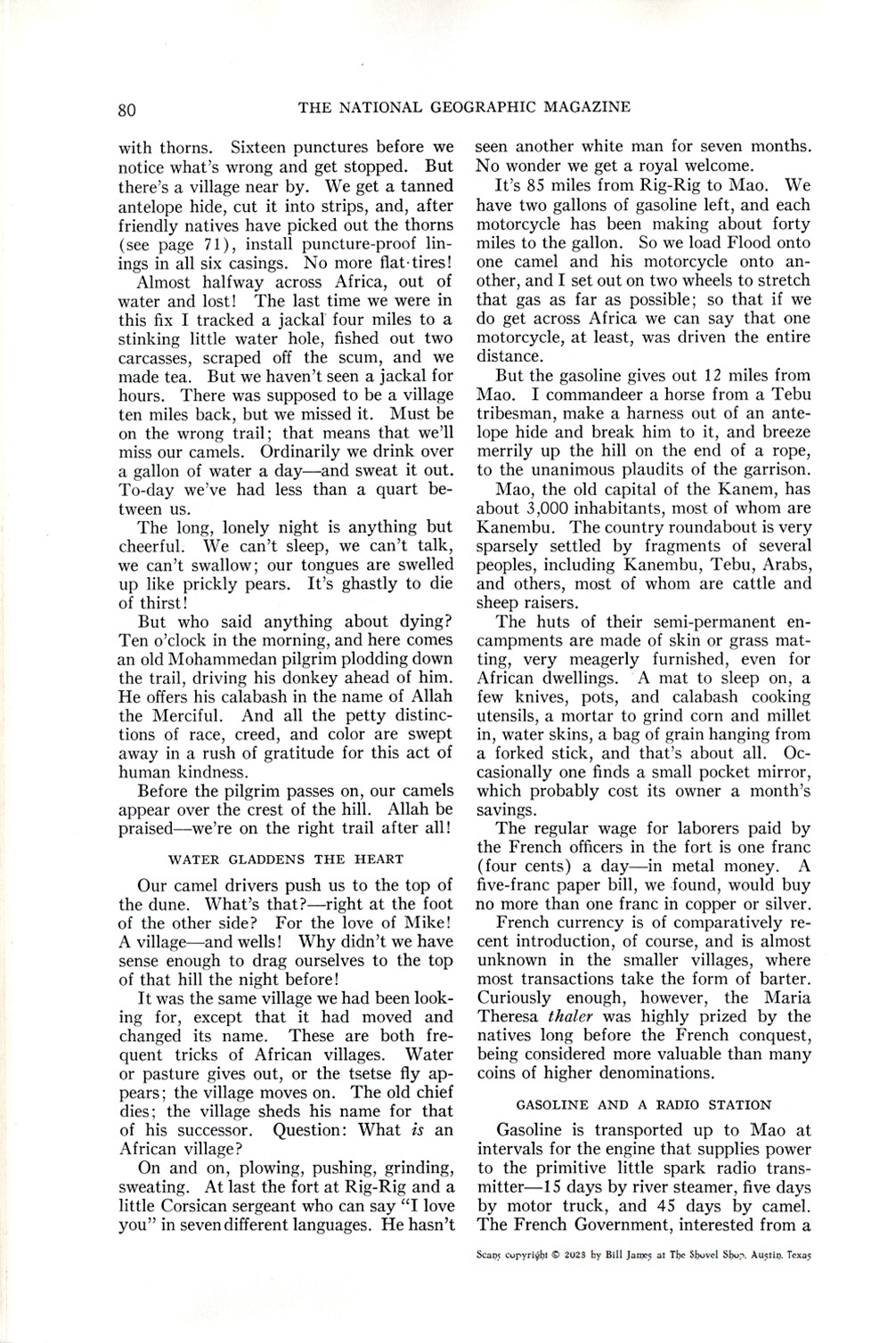
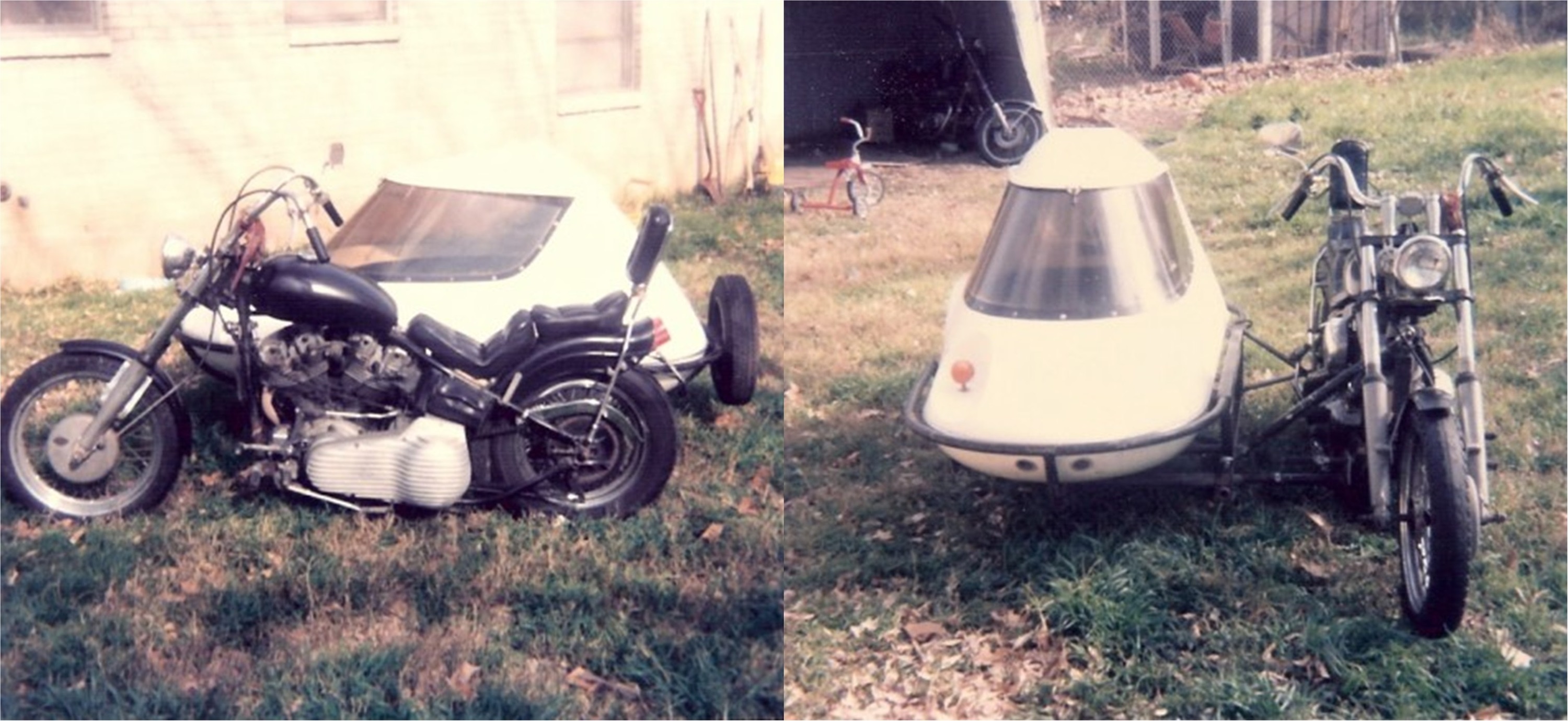
In 1927, disillusioned by their post-graduate career options, two adventurous Americans hopped a tramp freighter to Africa. After an exciting, occasionally death-defying journey, they landed in Nigeria, where they encountered an American missionary with a rattletrap sidecar rig.
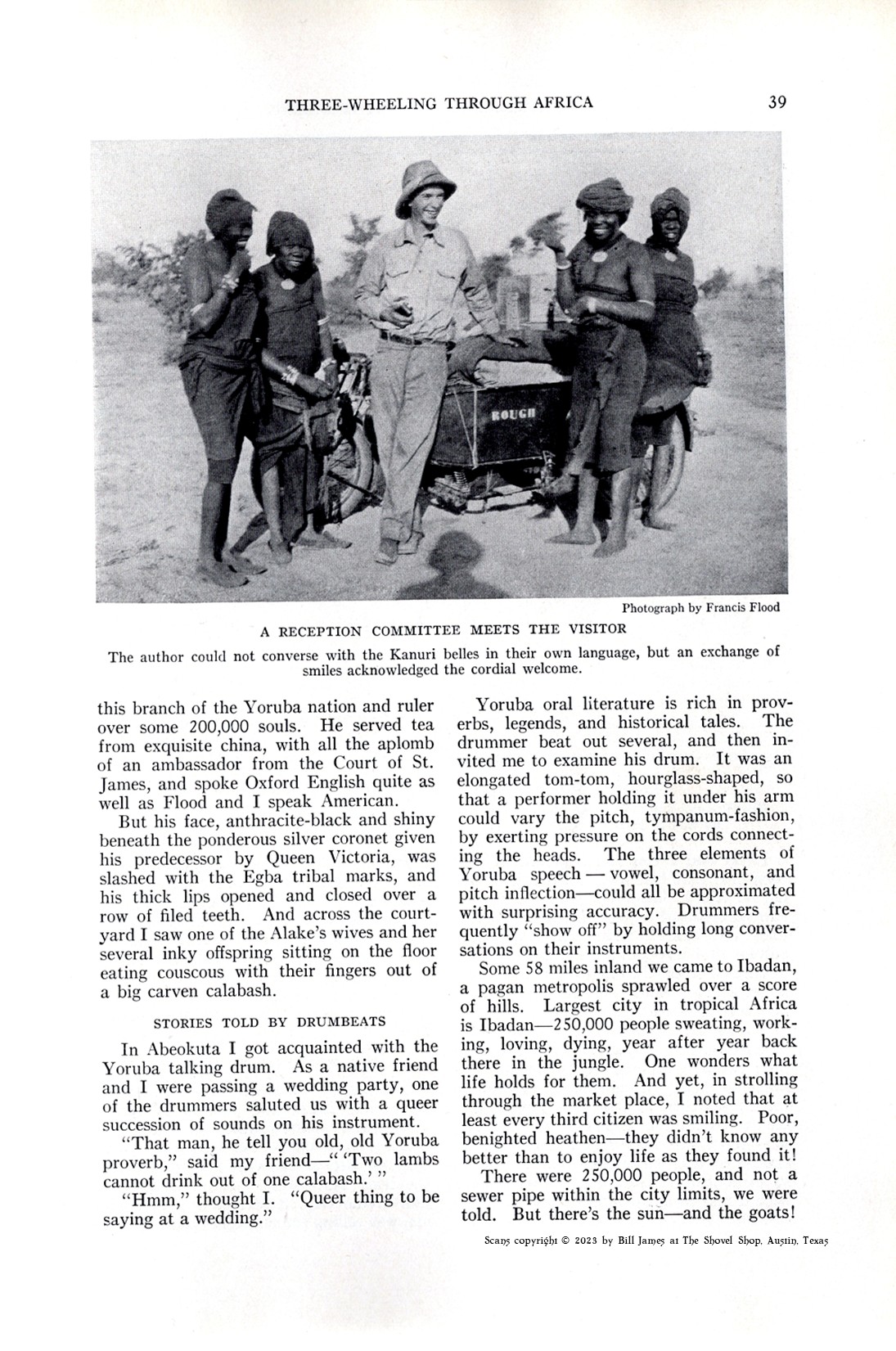
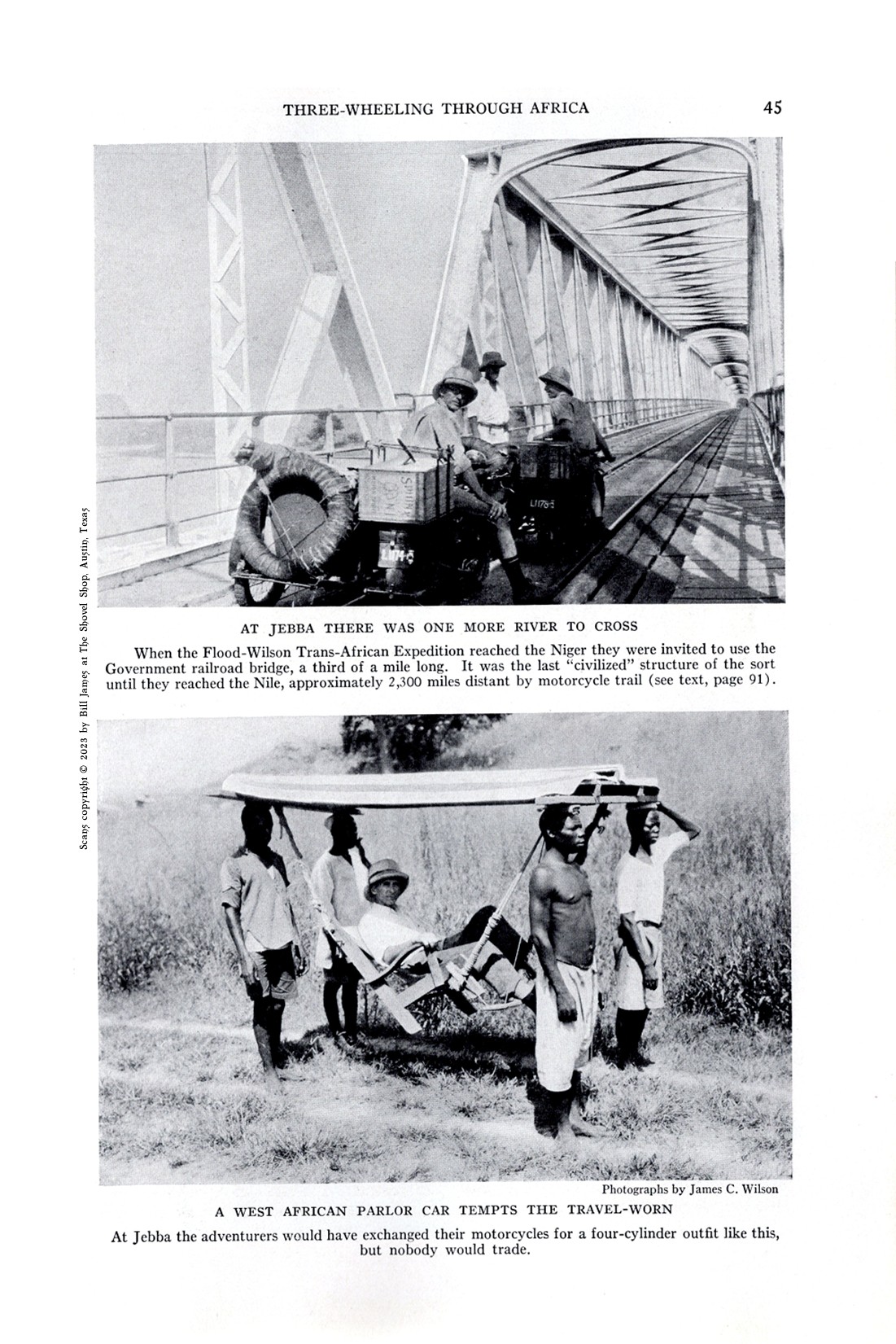
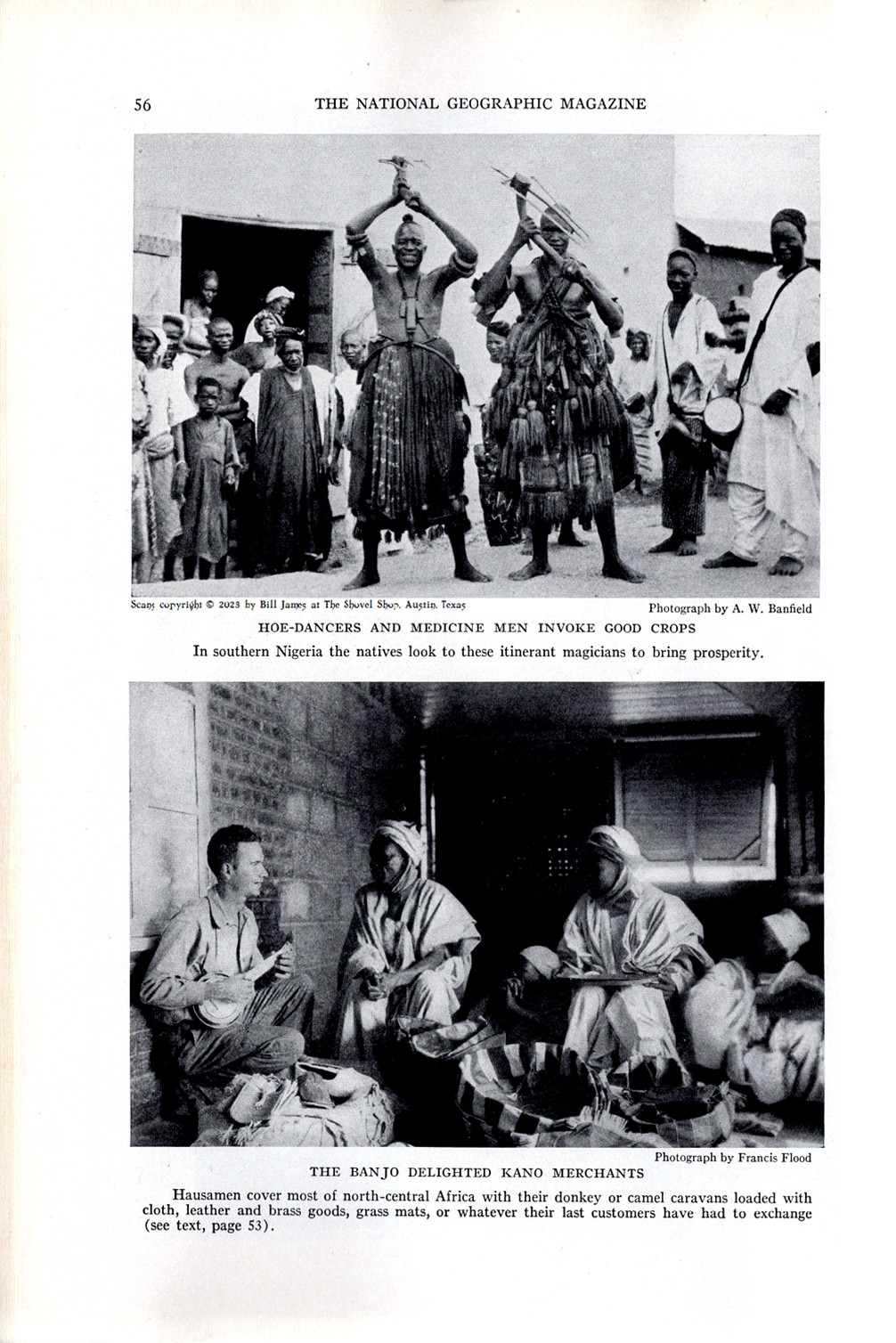
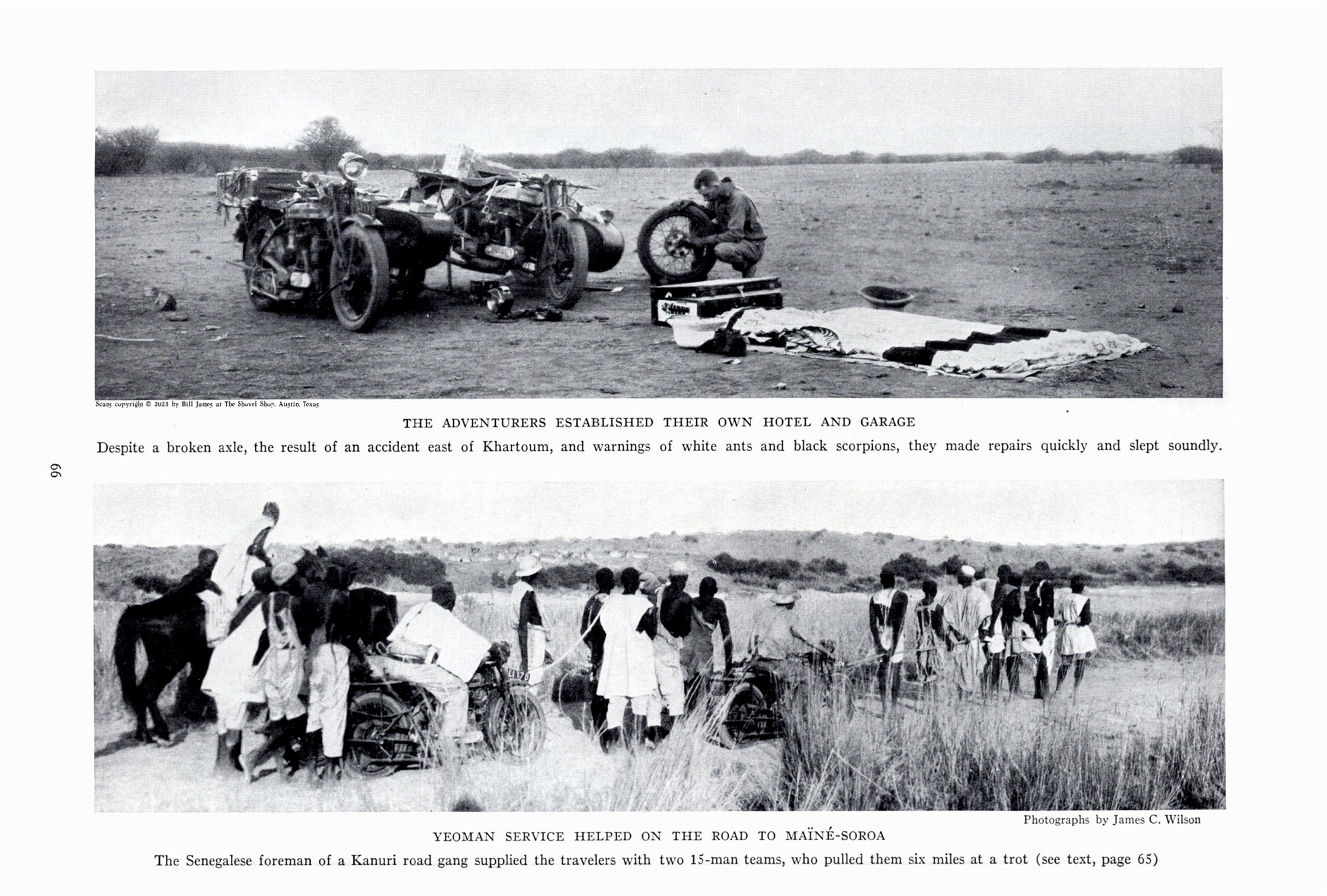
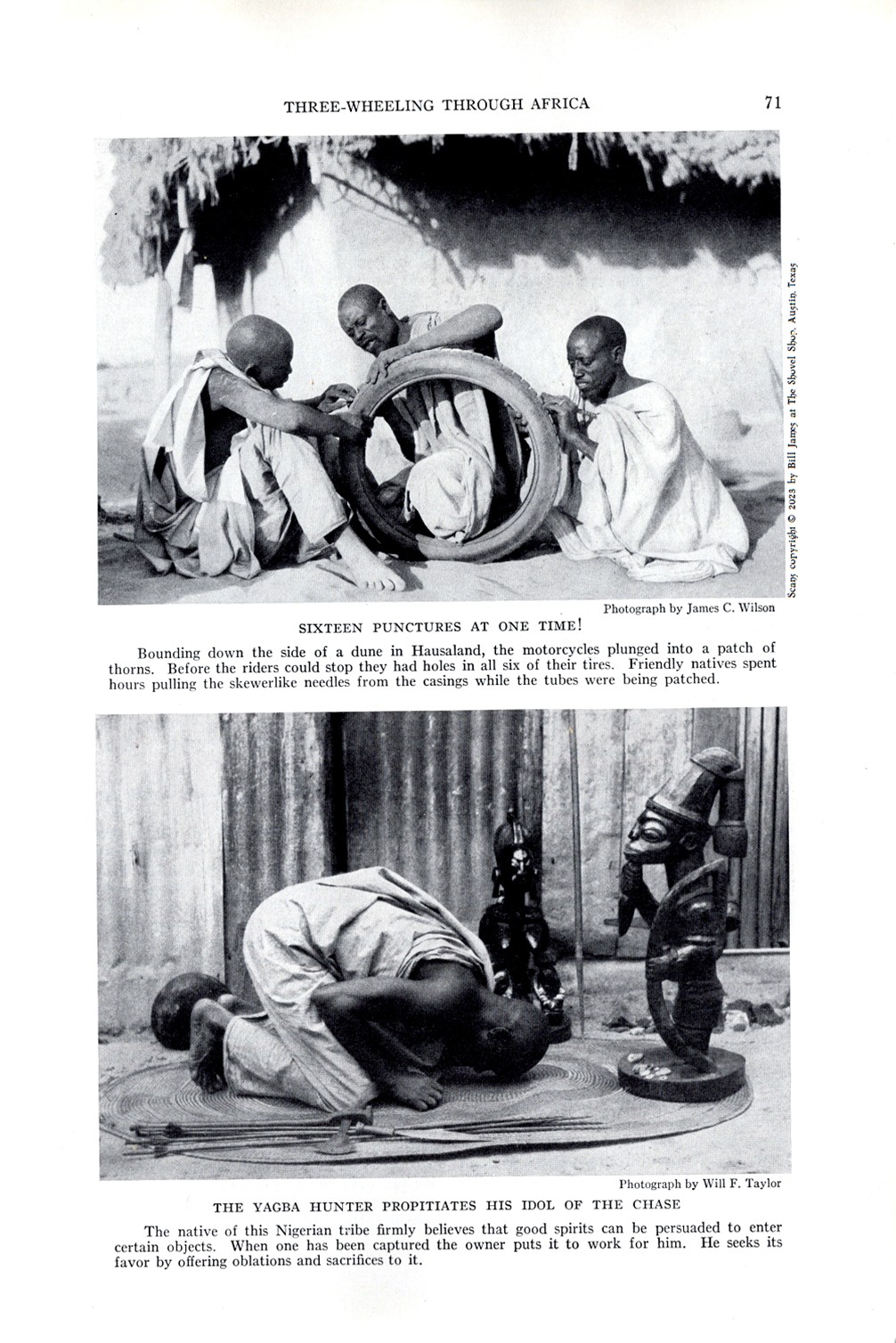
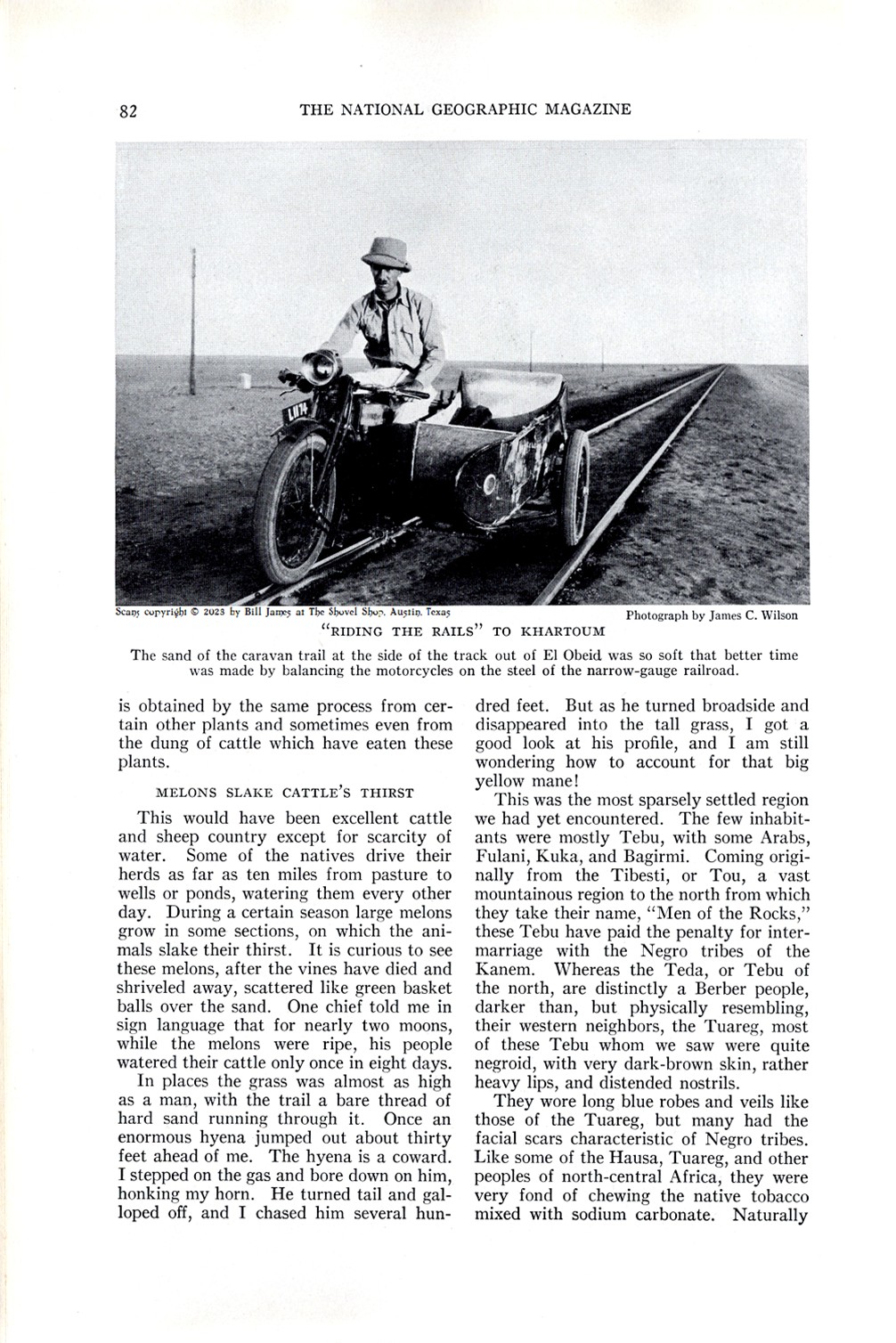
Inspired by the notion of motorcycle travel, James C. Wilson and his companion, Francis Flood, talked the Triumph Motorcycle Company representative in Lagos into fronting them matching sidehack rigs so they might motor across the Dark Continent: an as-yet-unmet challenge. The duo cadged parts and supplies from other vendors, made arrangements for the required paperwork, and set off into the unknown.
Upside for the dealer and the Triumph factory would be bragging rights if the foolhardy duo survived. Downside? The price of two motors and sidecars if the idiots perished somewhere along the way.
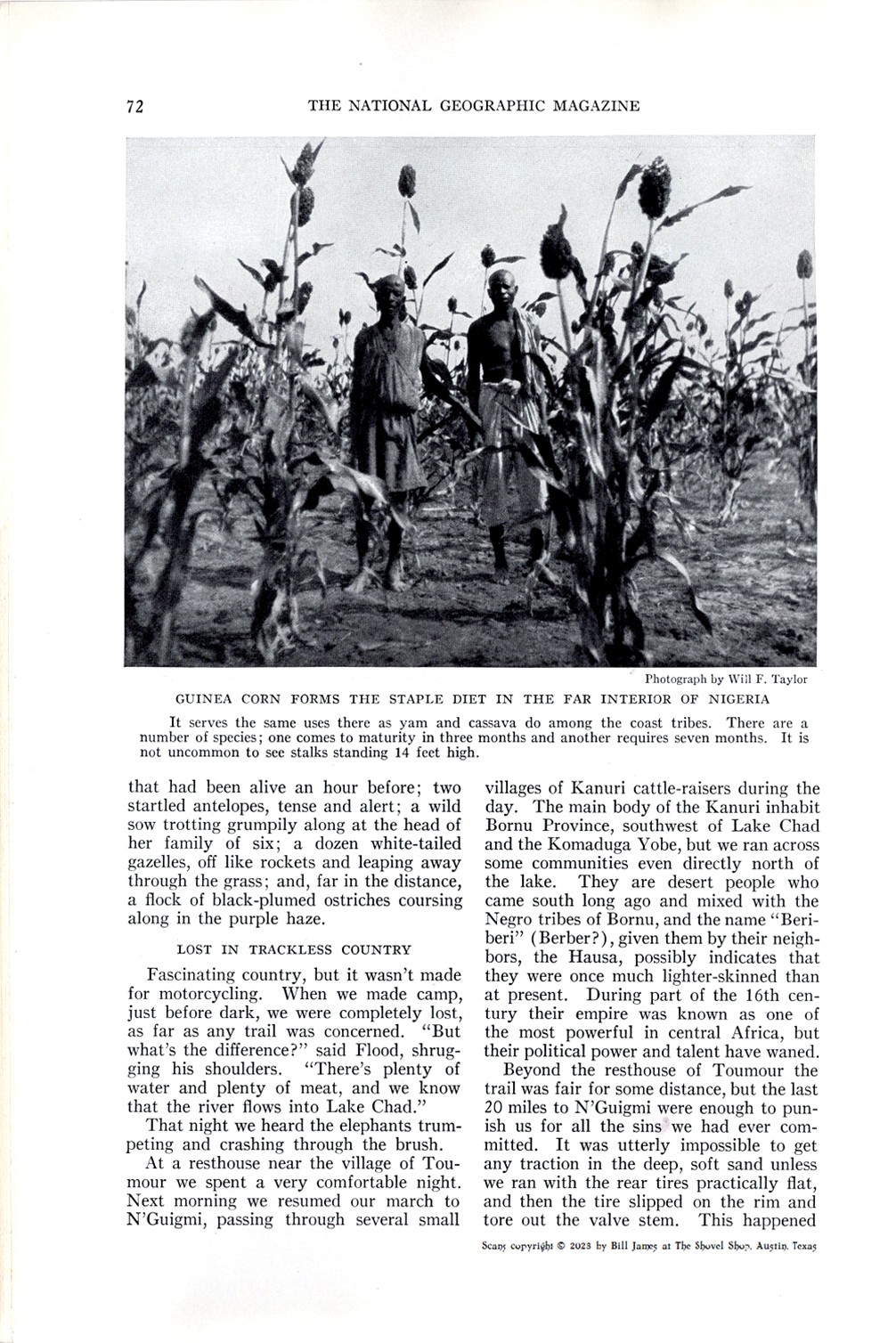
What ensued was a wild adventure, and a testament to the human spirit. Not just Wilson’s and Flood’s (although their mettle and make-do skills were certainly tested) but the many good people – native and expat alike – who lent much-needed assistance as the men manhandled their unwieldly rigs through jungle and swamp.
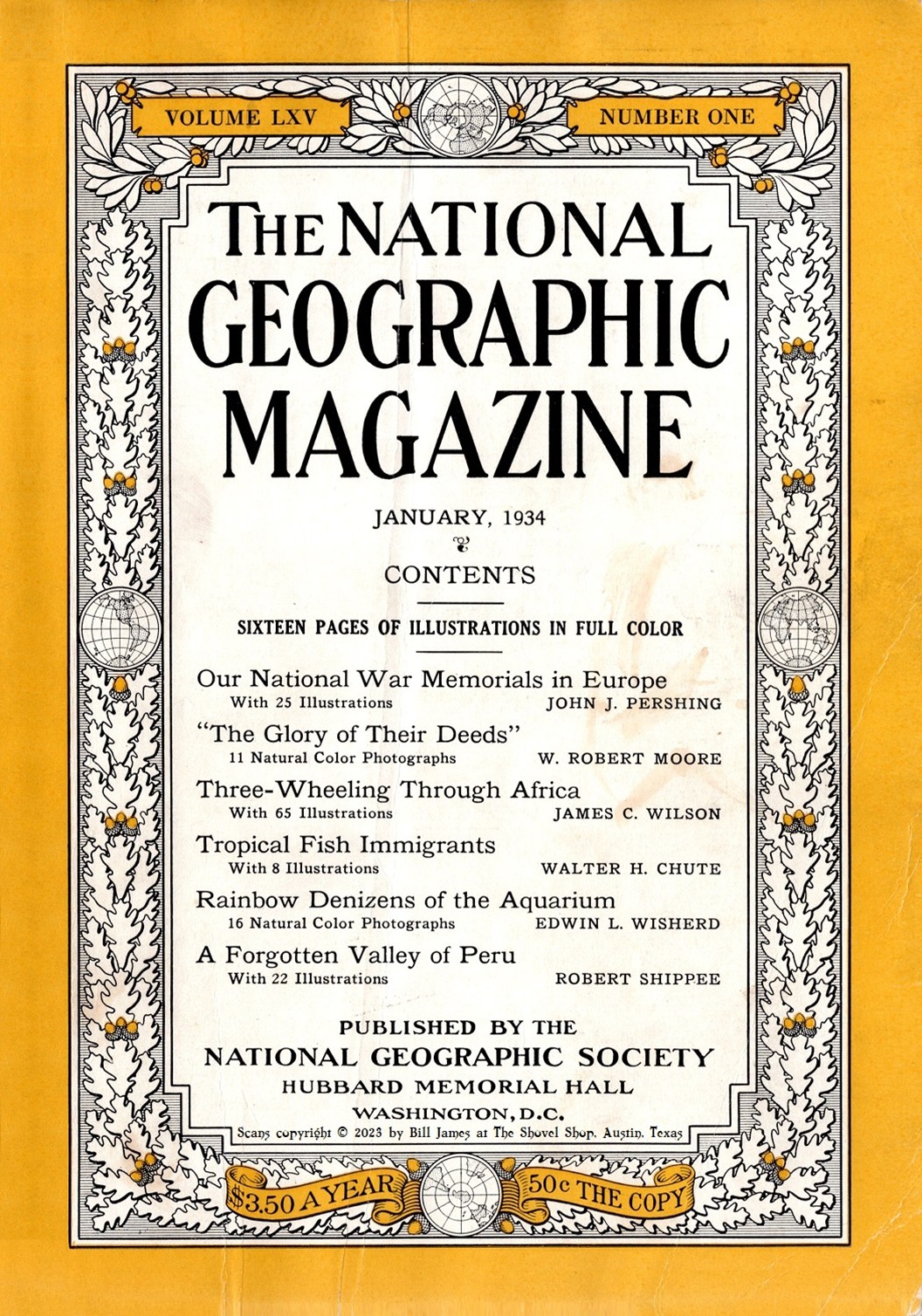
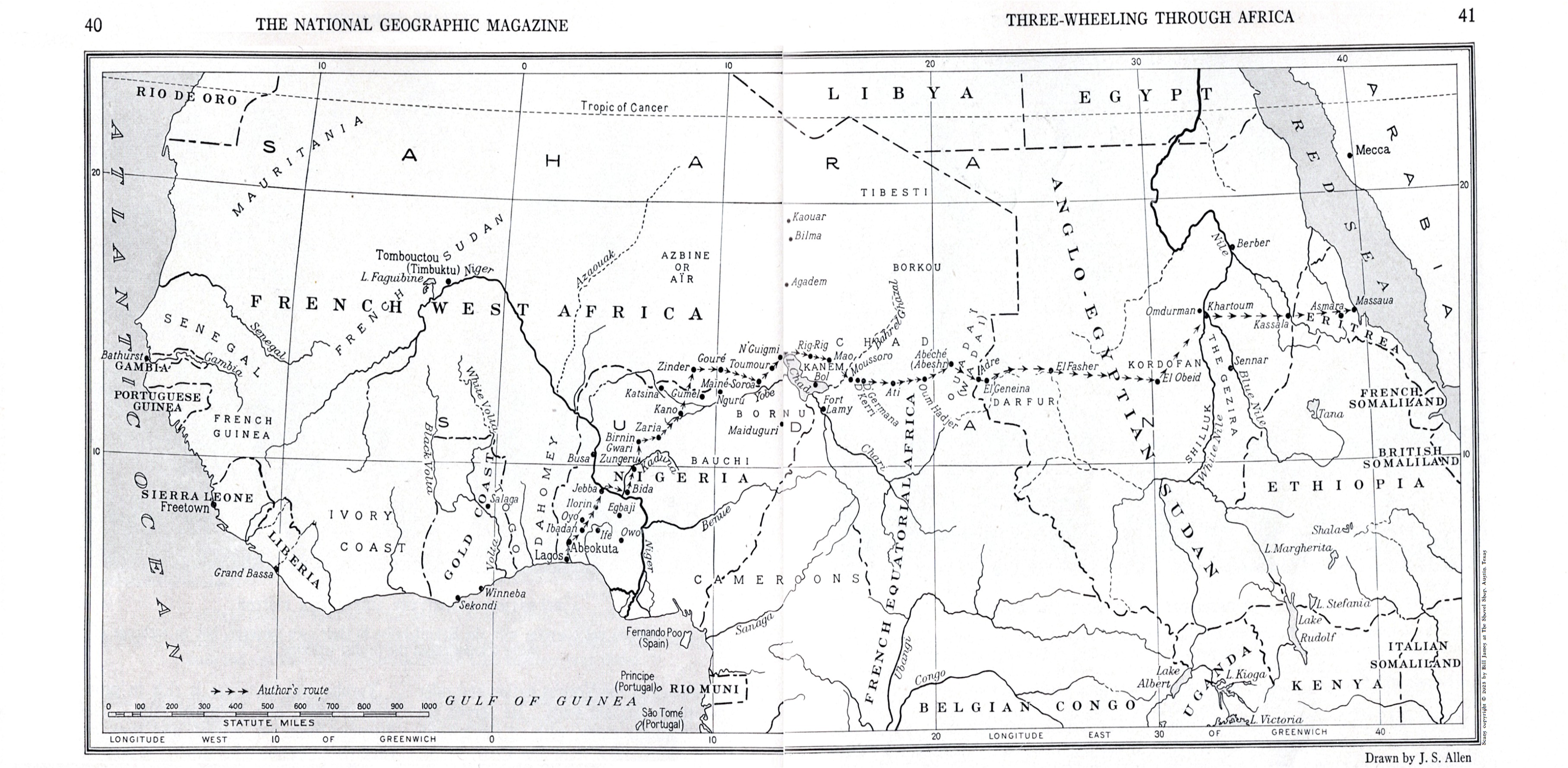
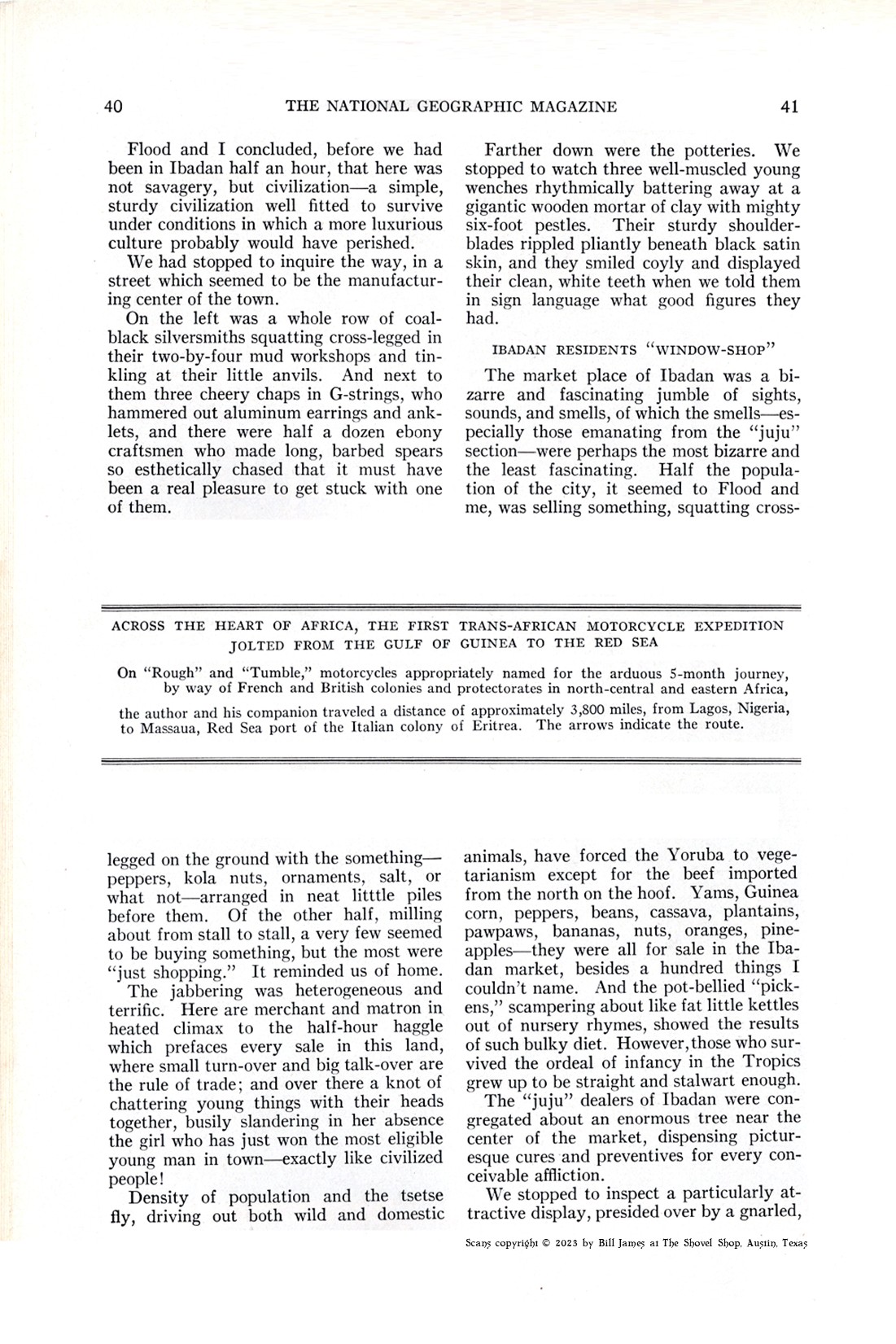
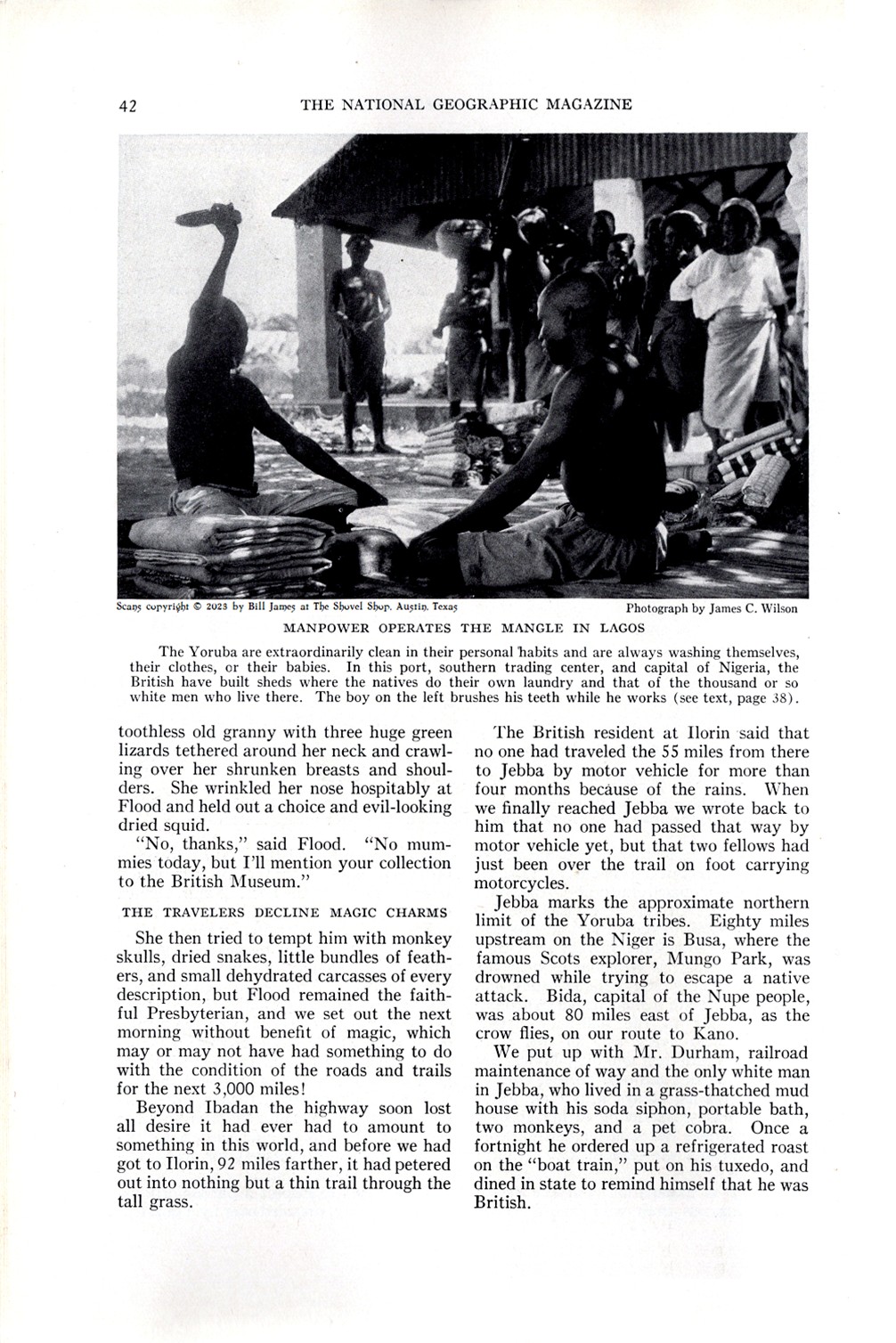
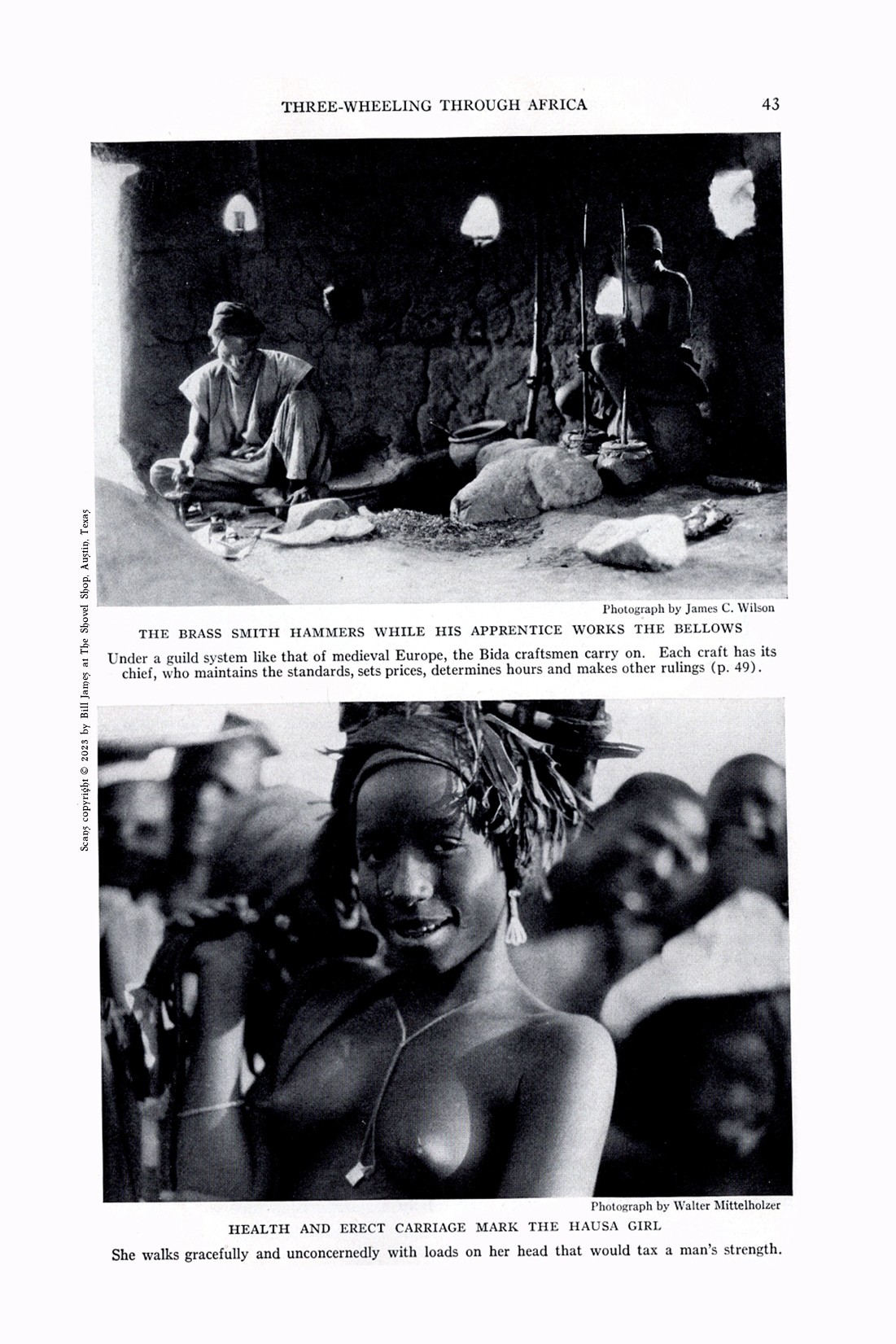
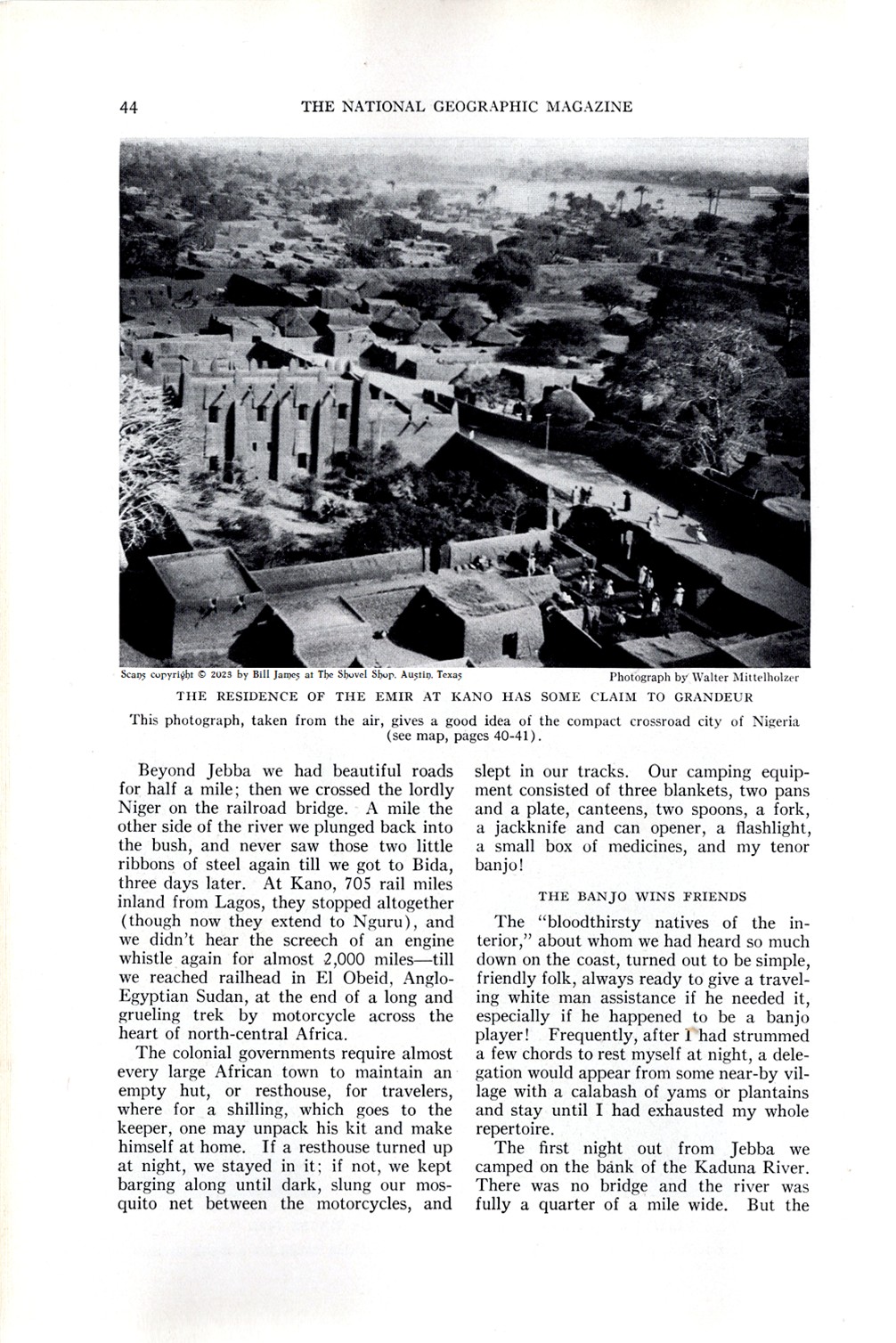
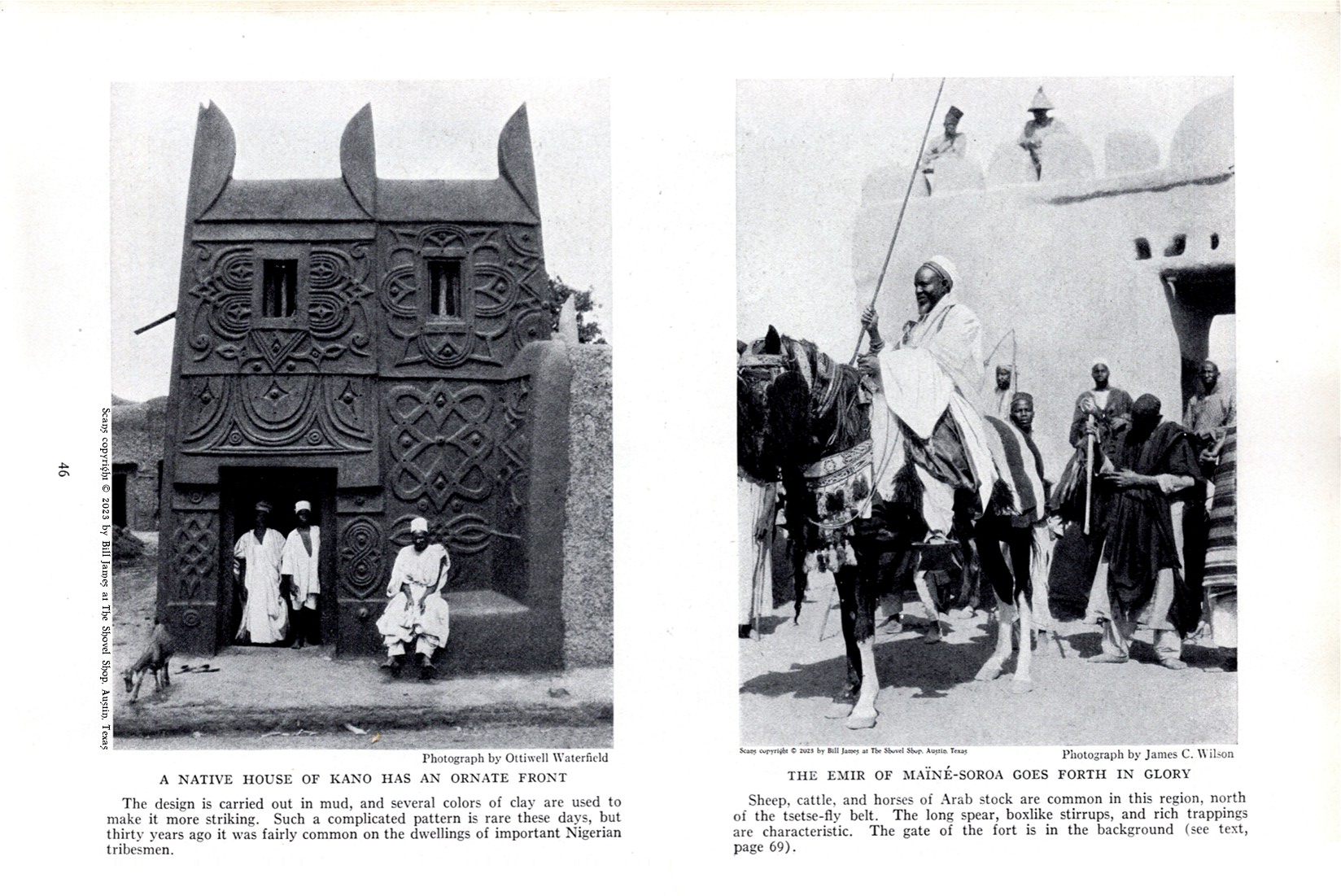
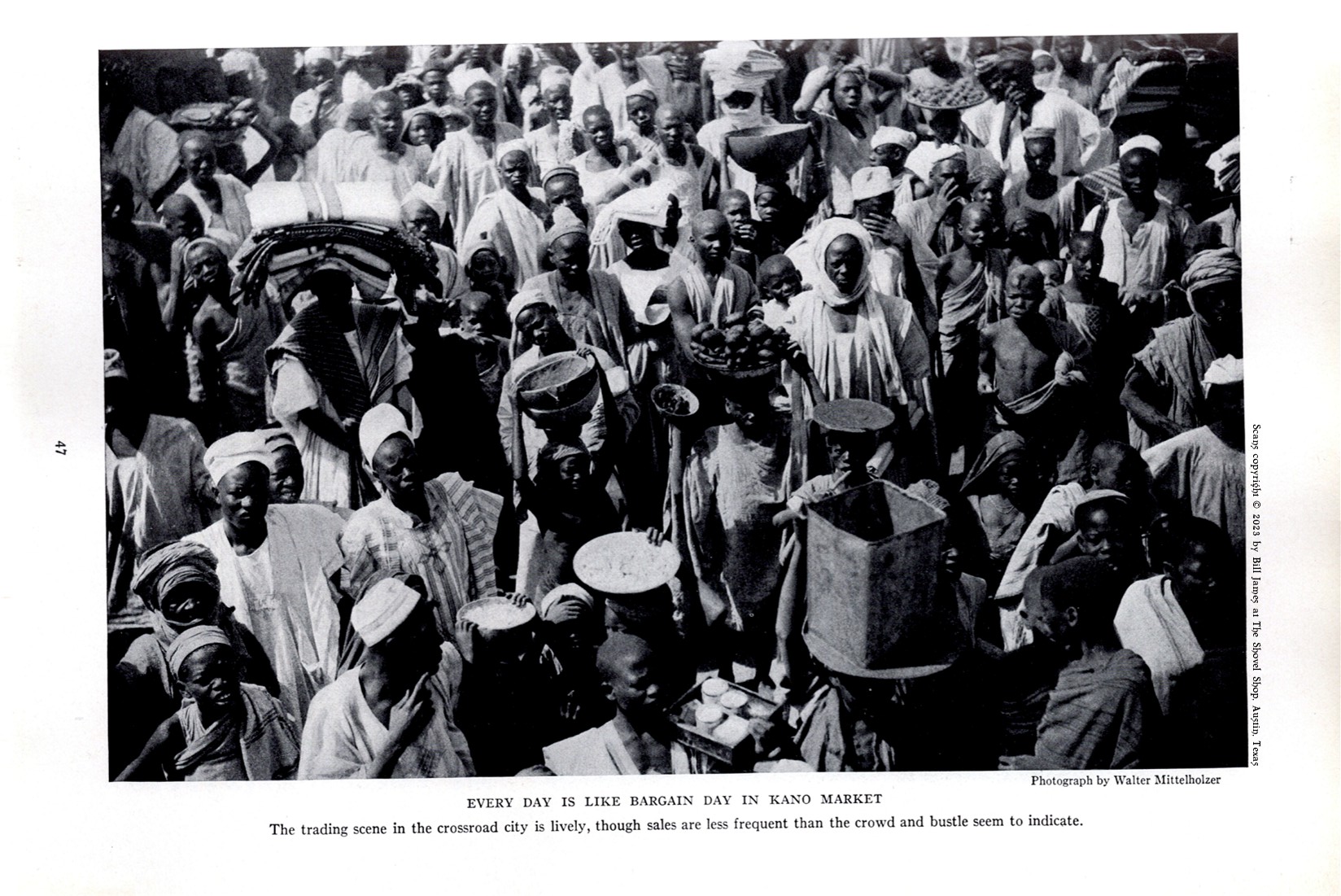
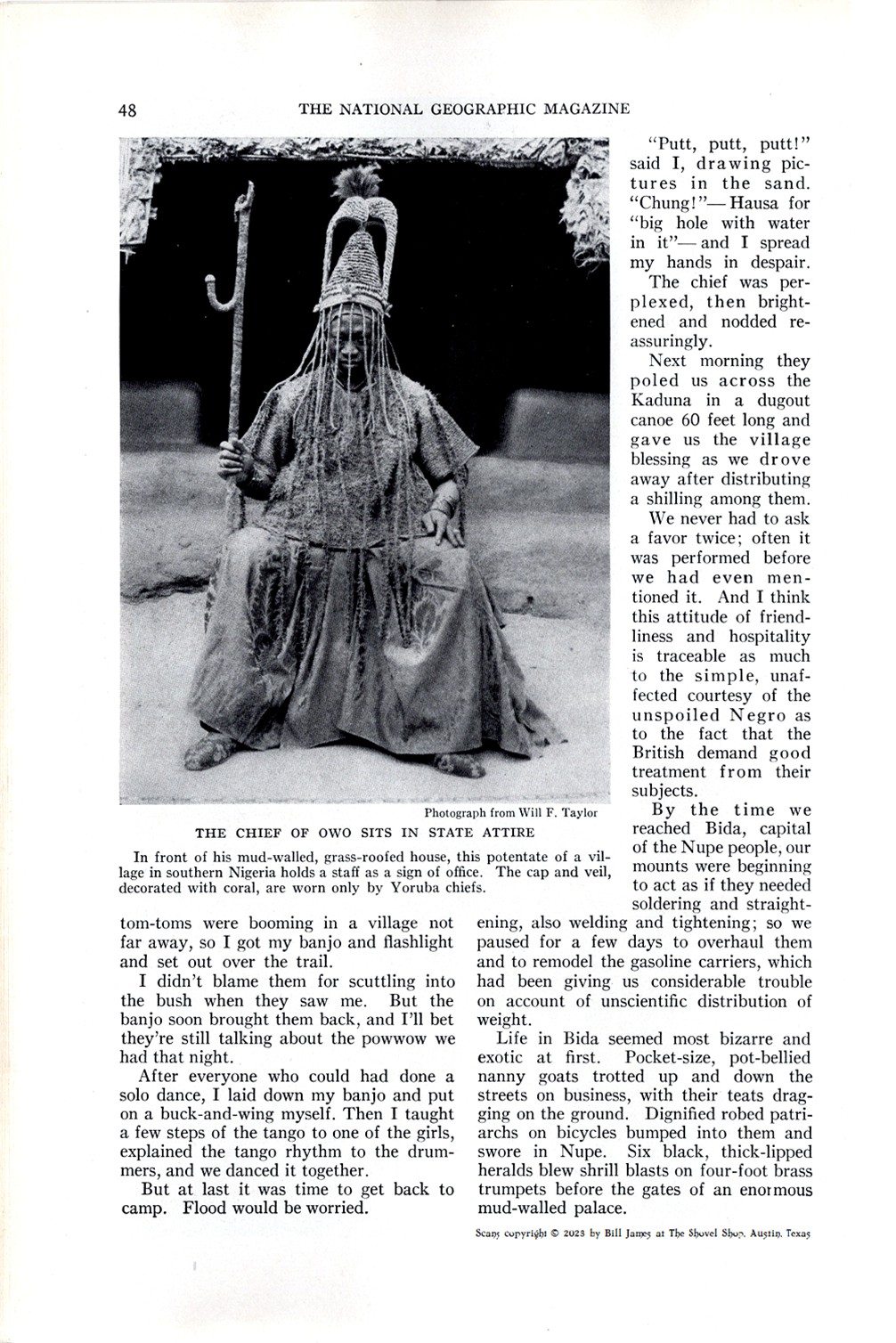
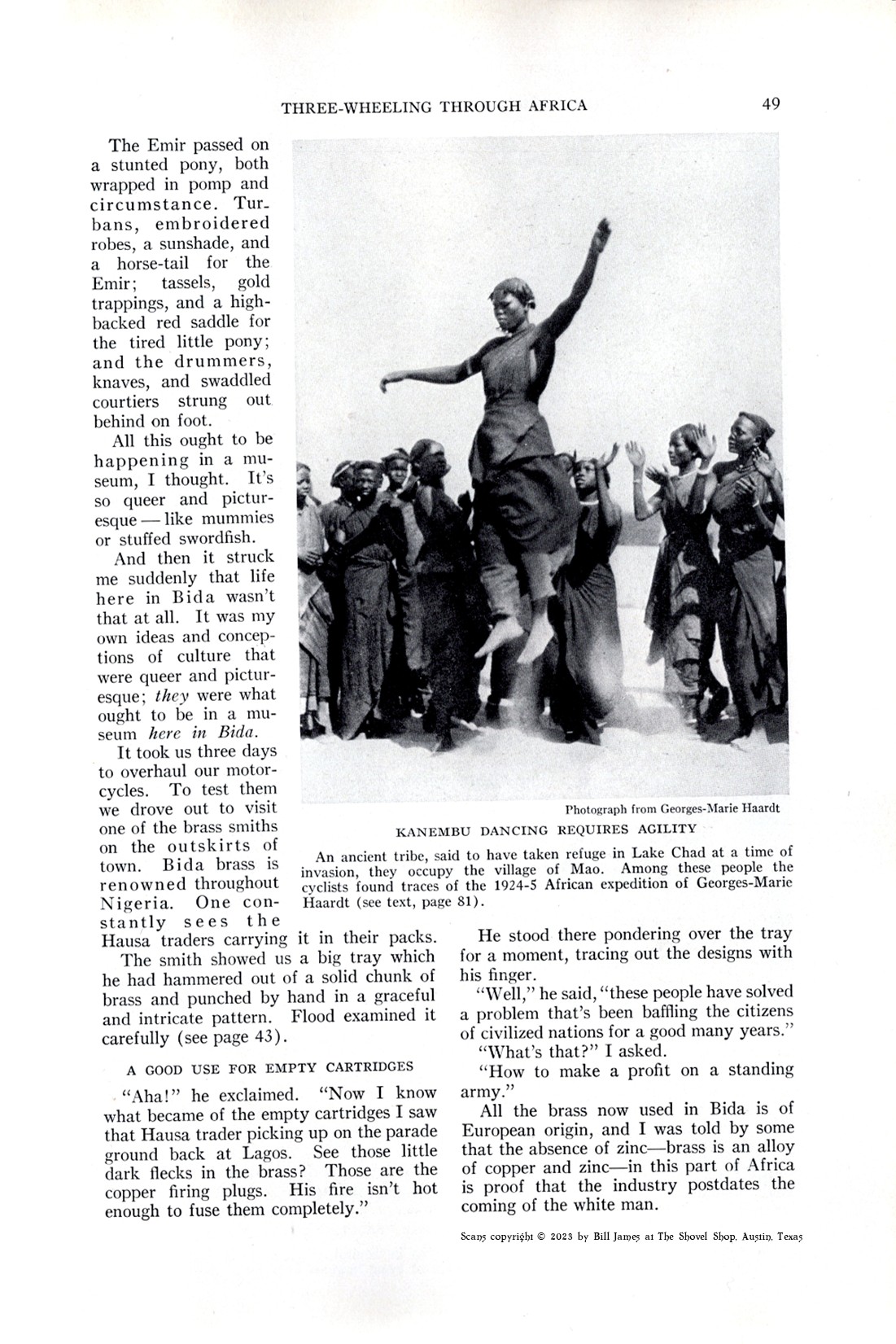
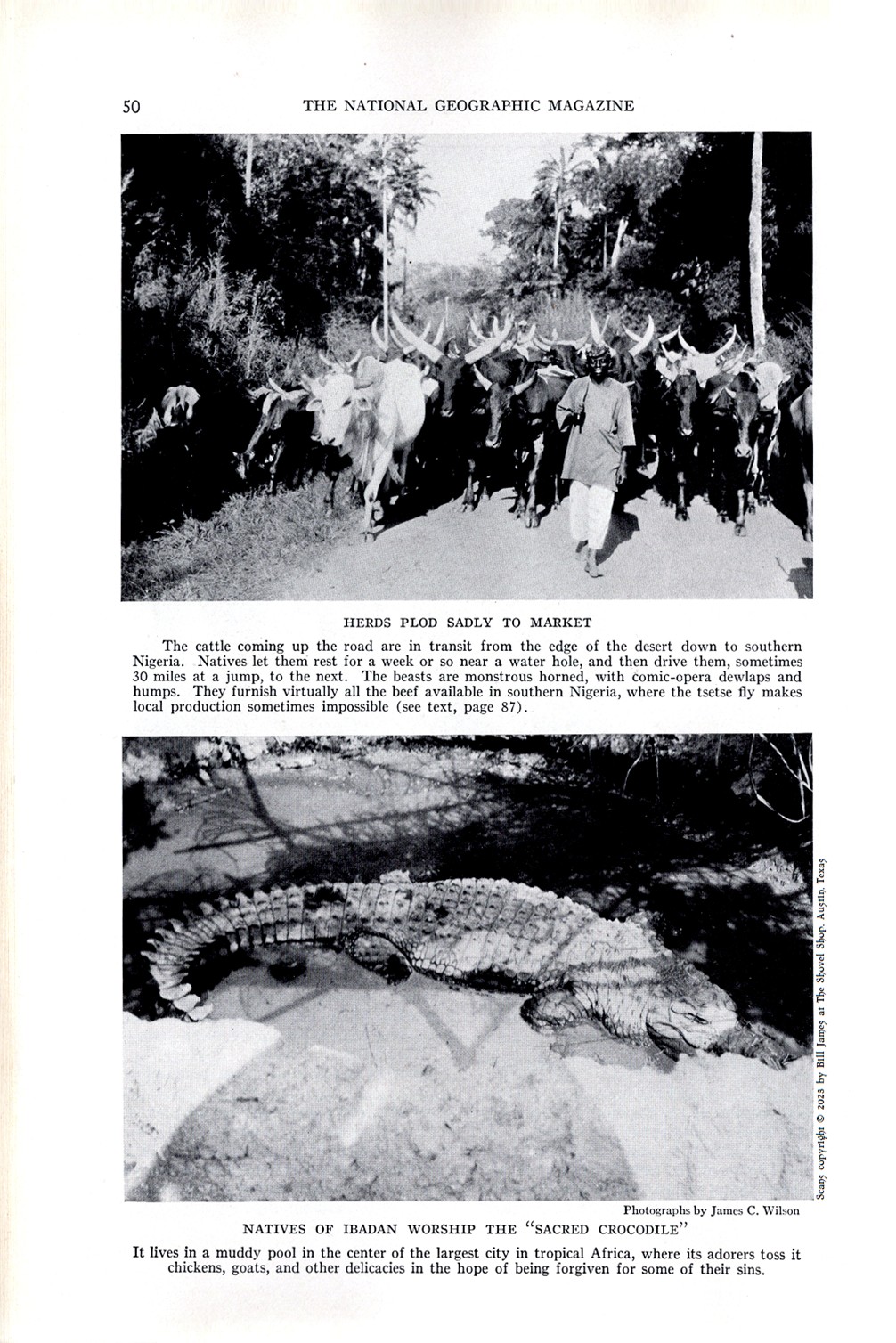
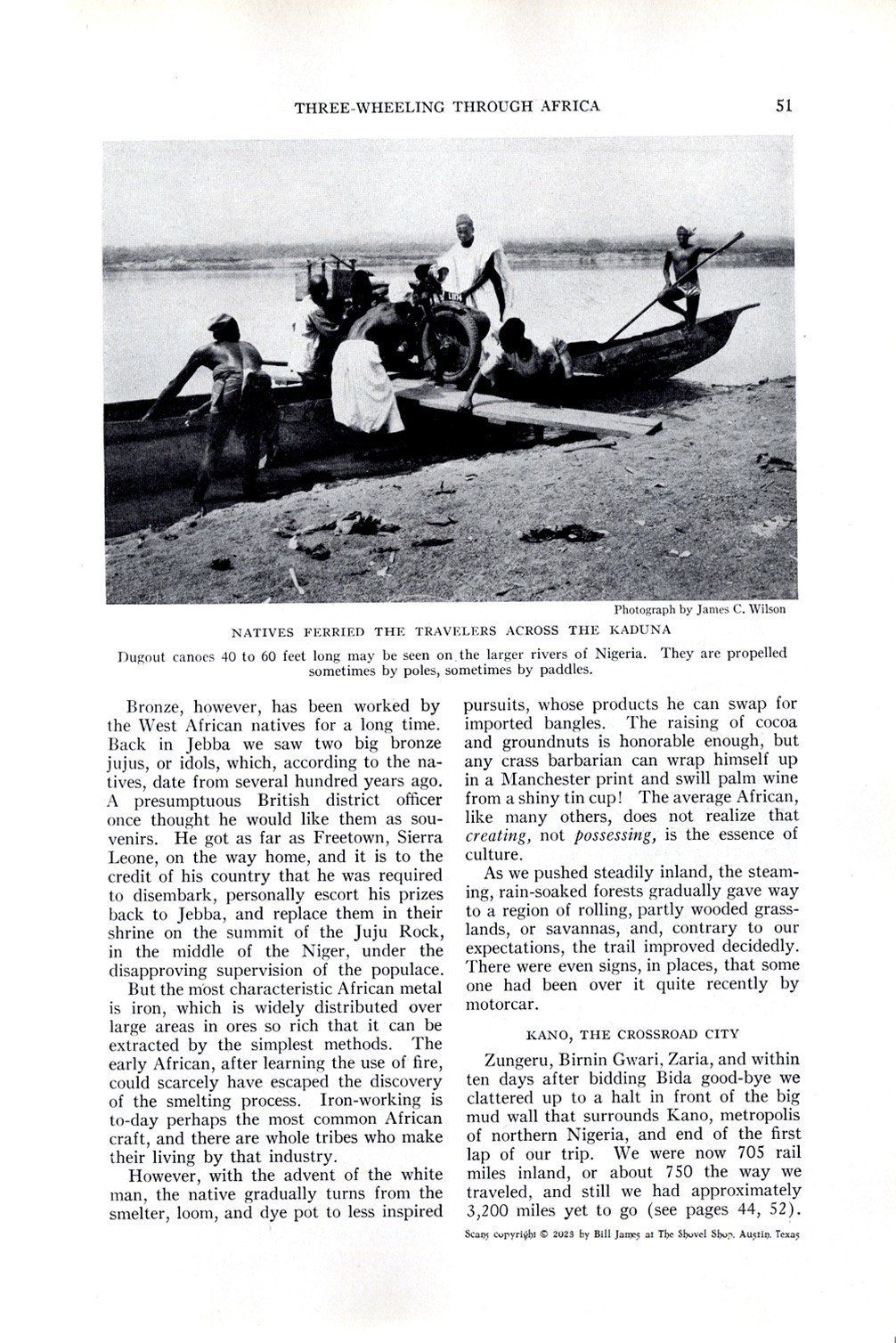
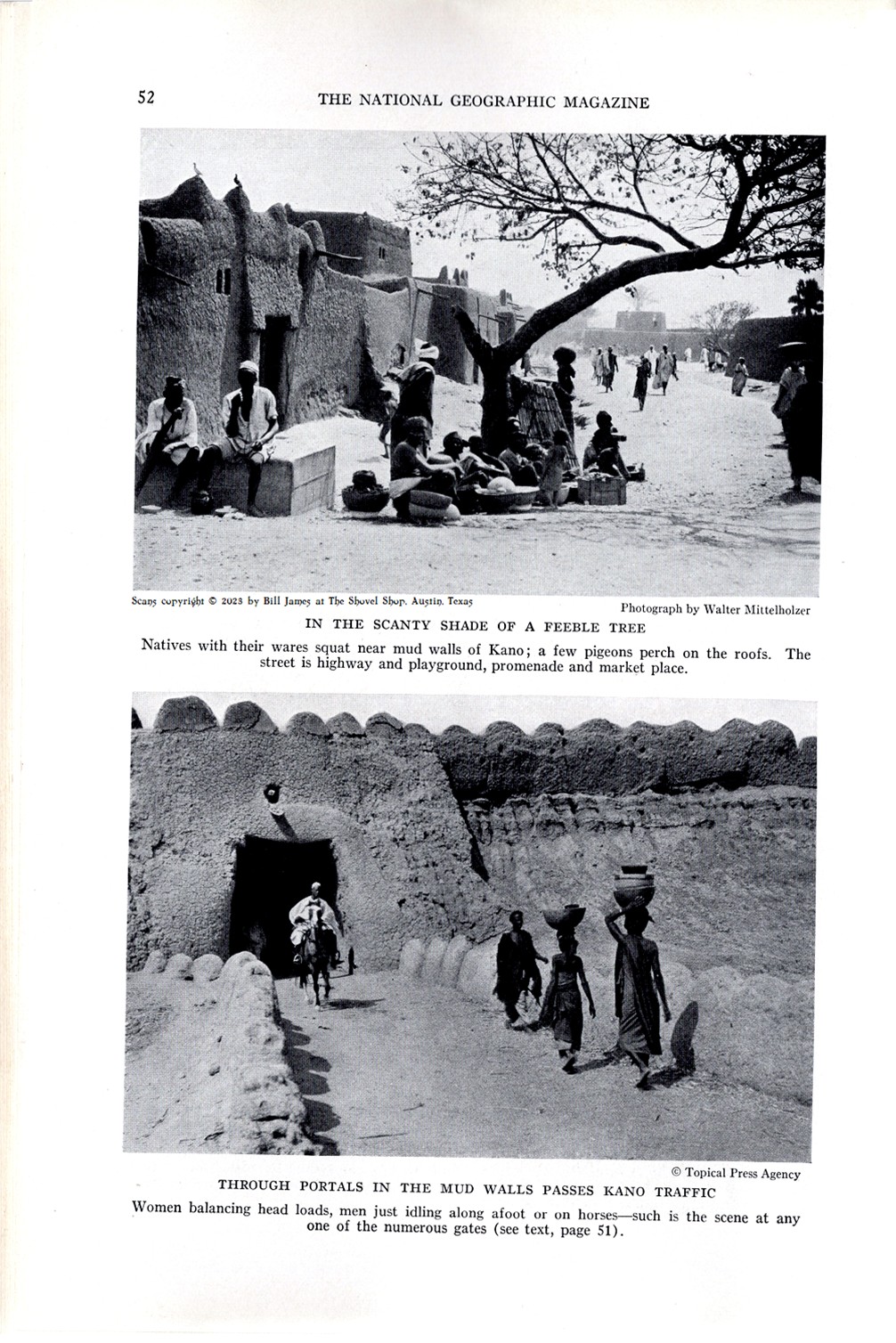
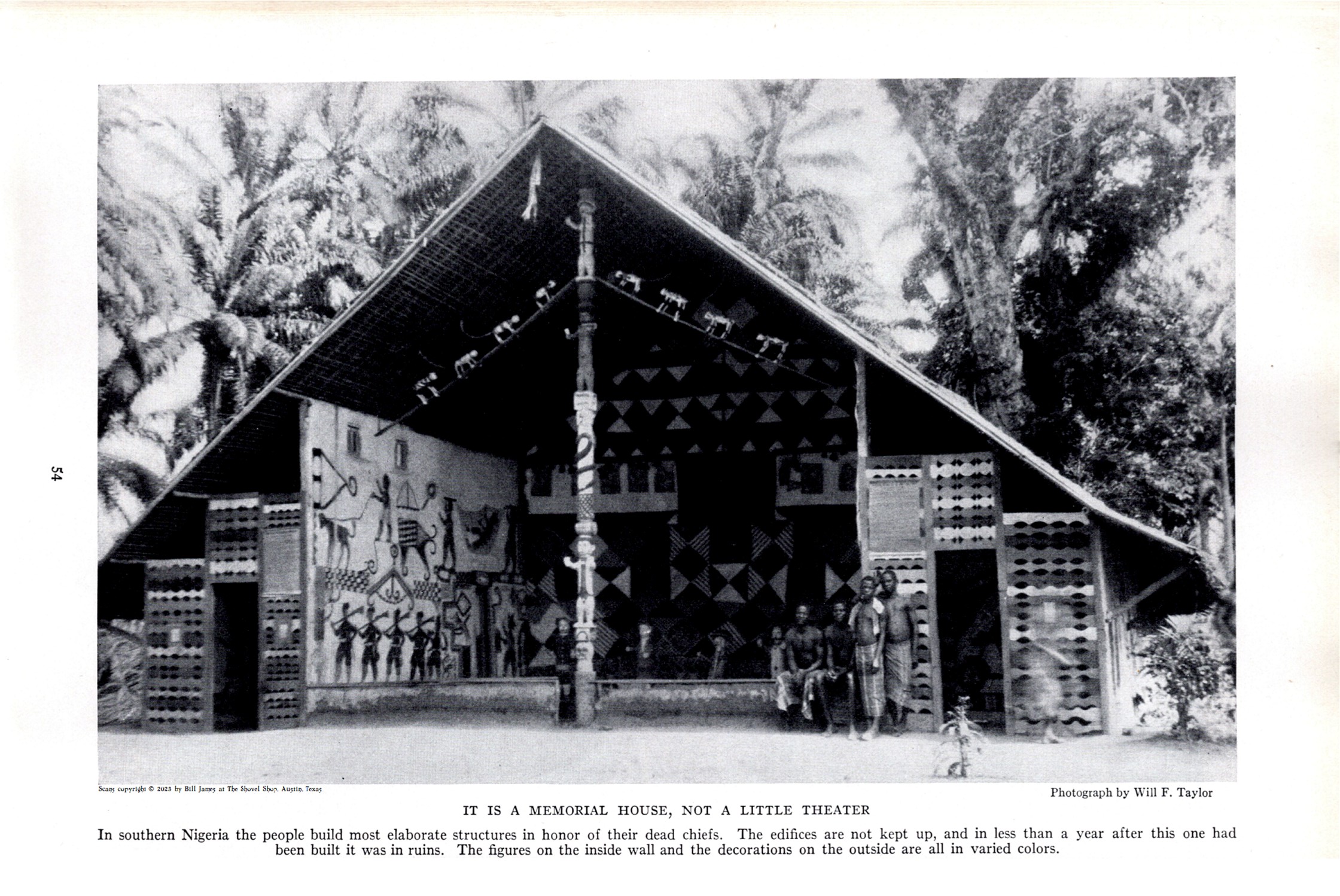
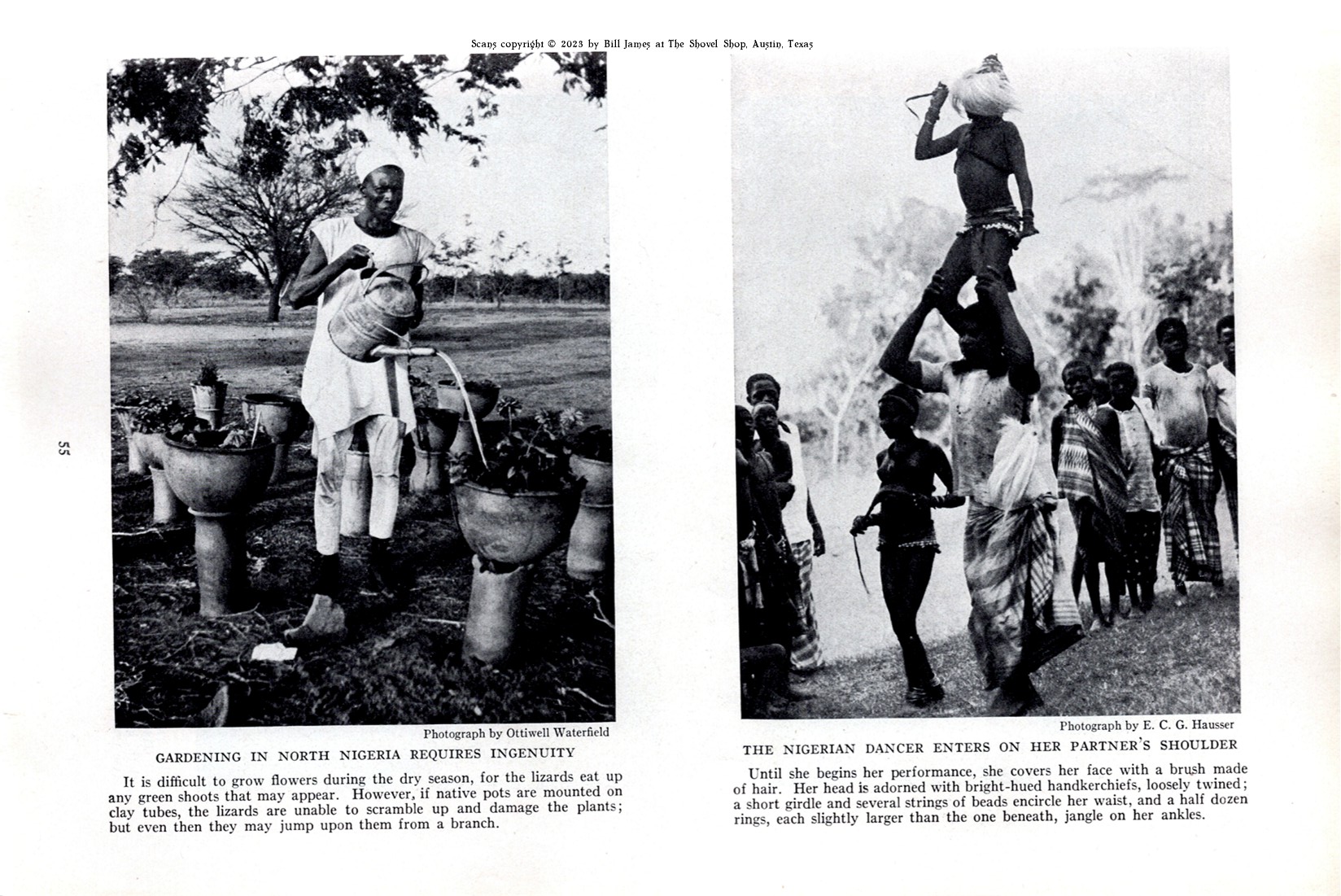
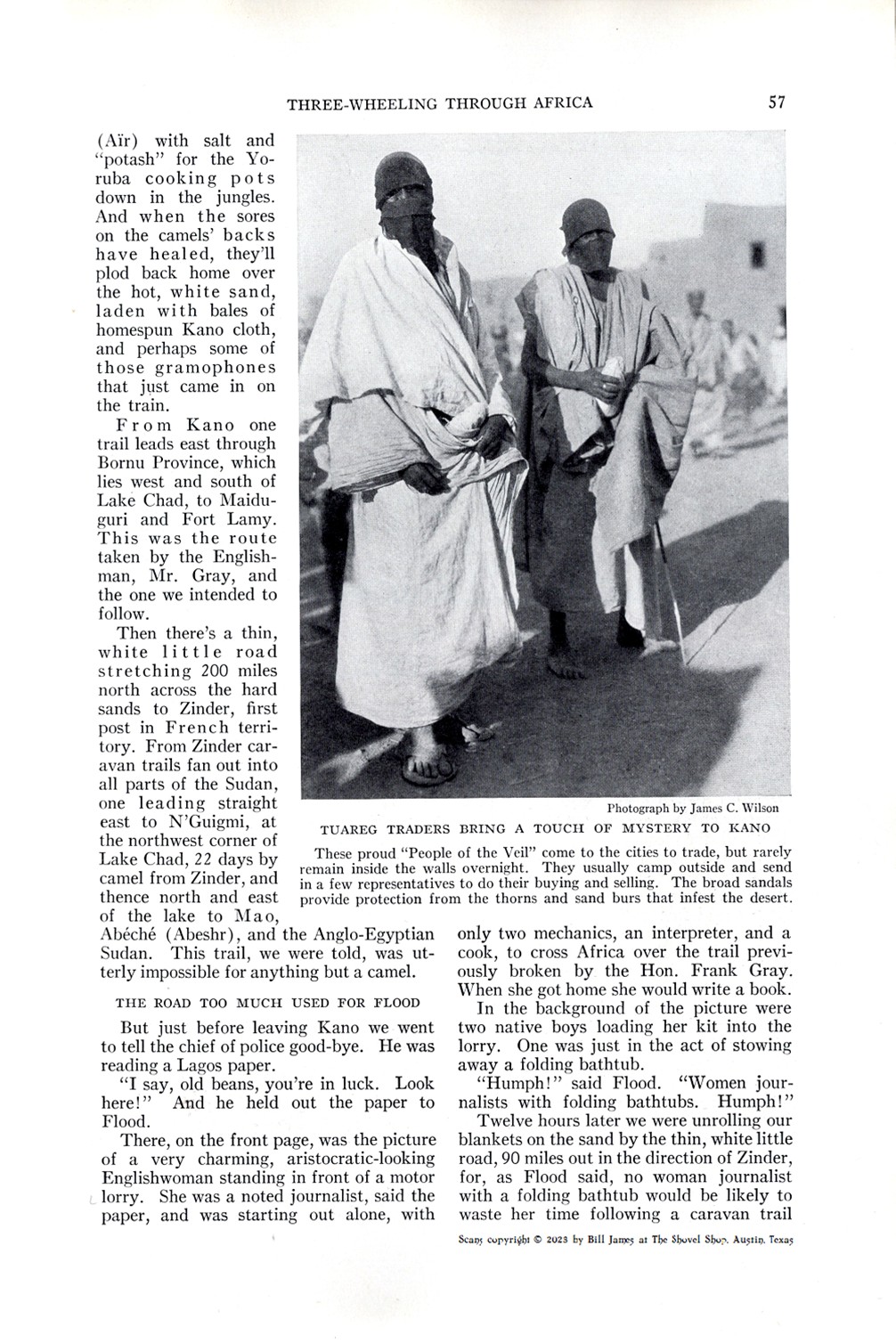
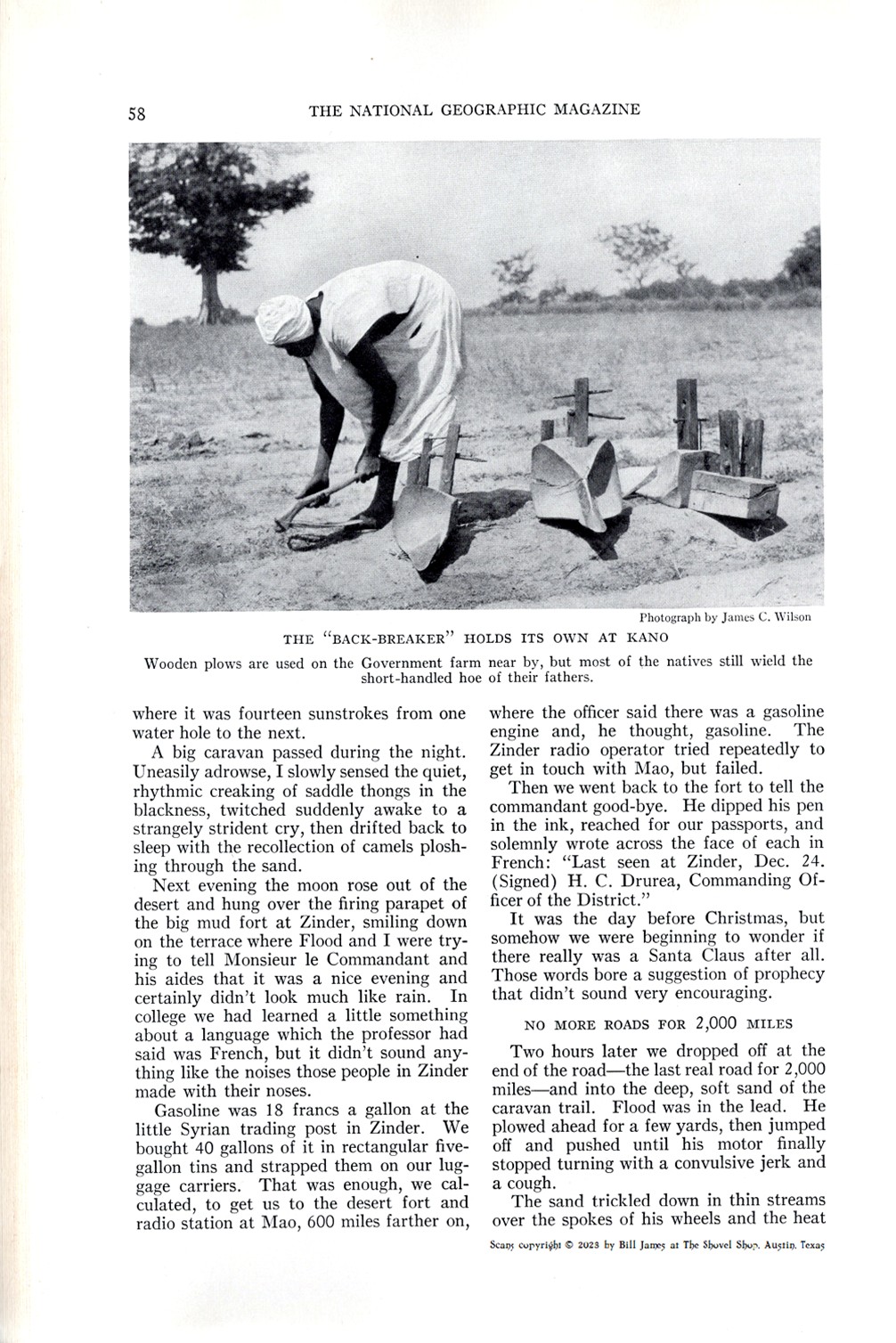
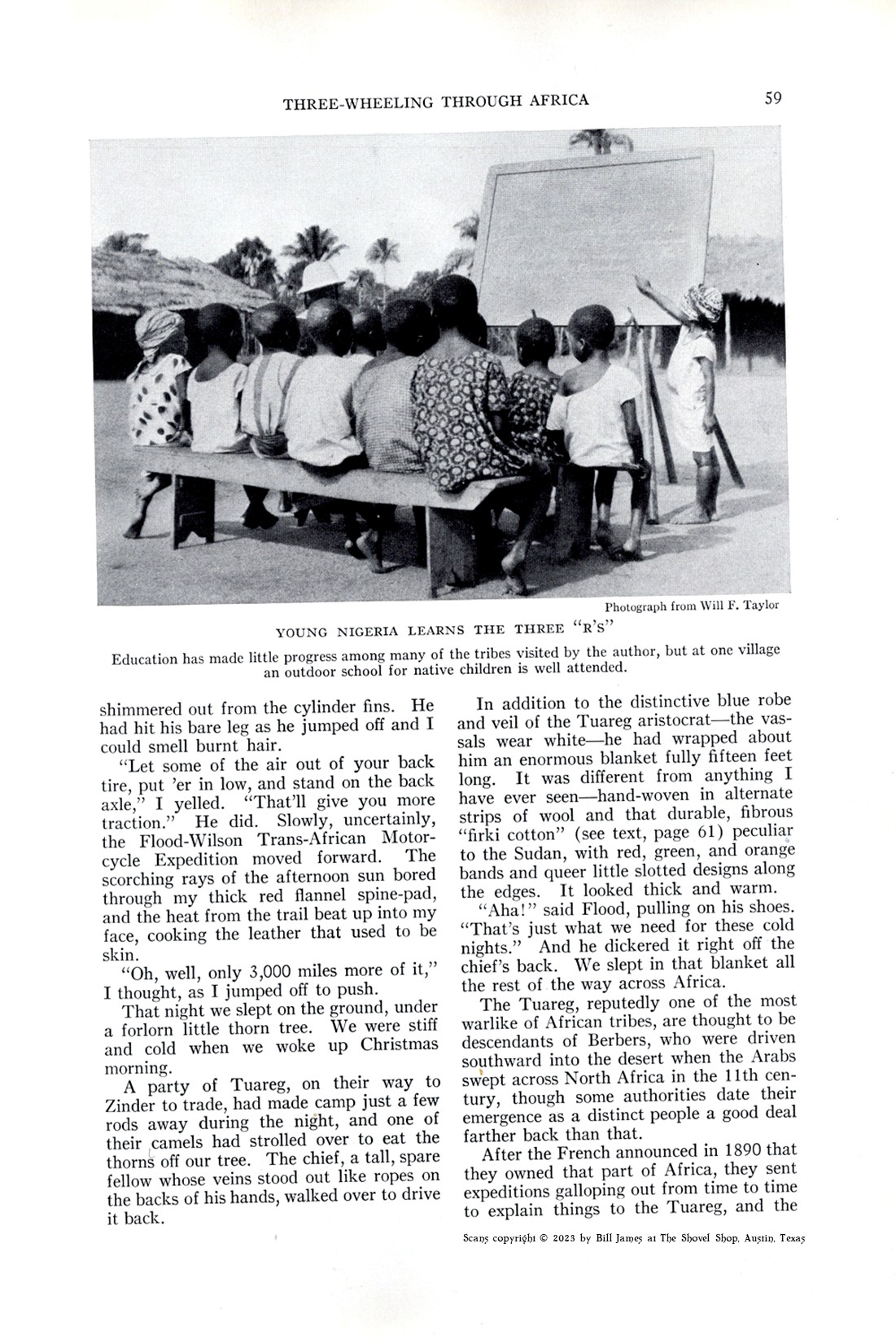
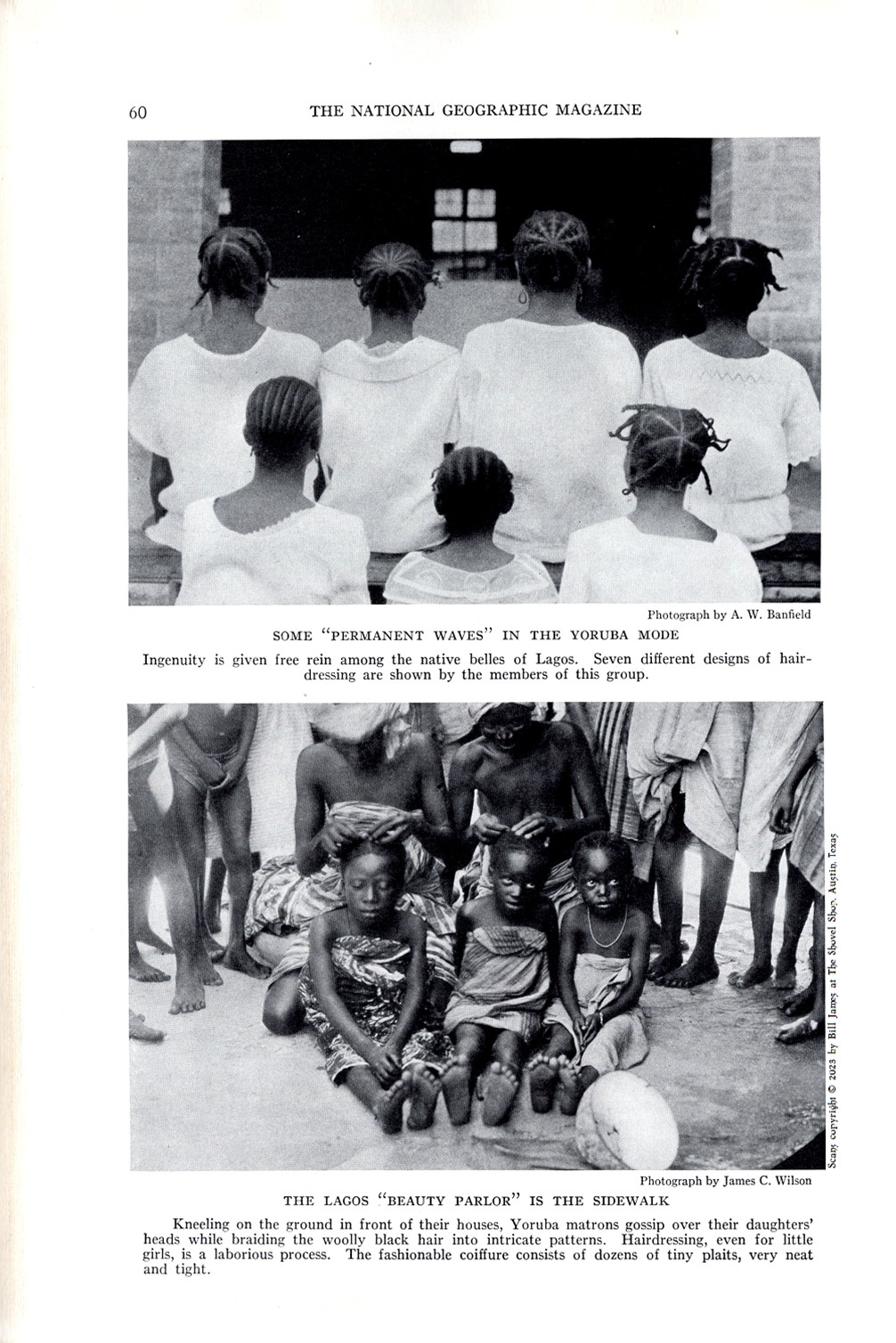
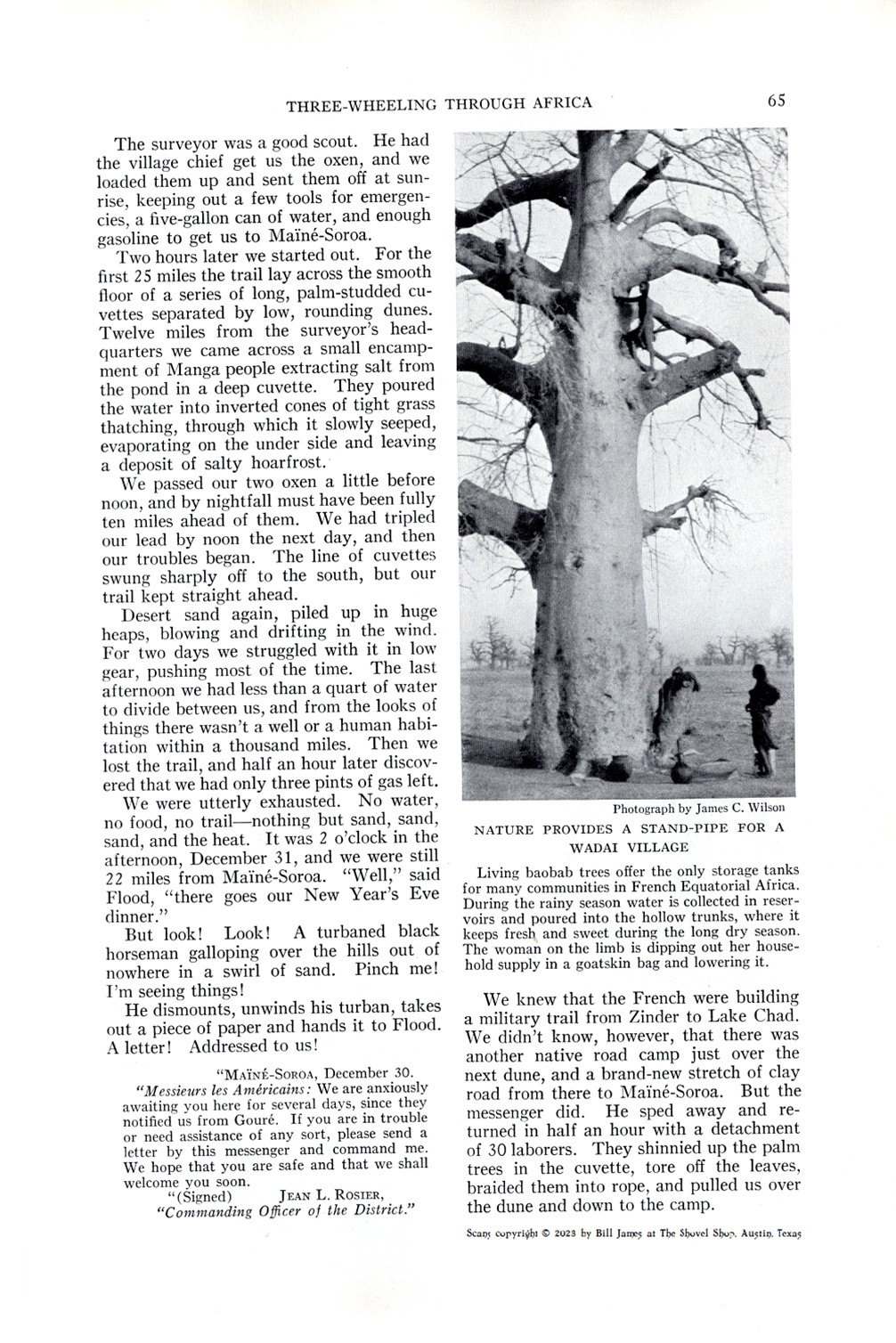
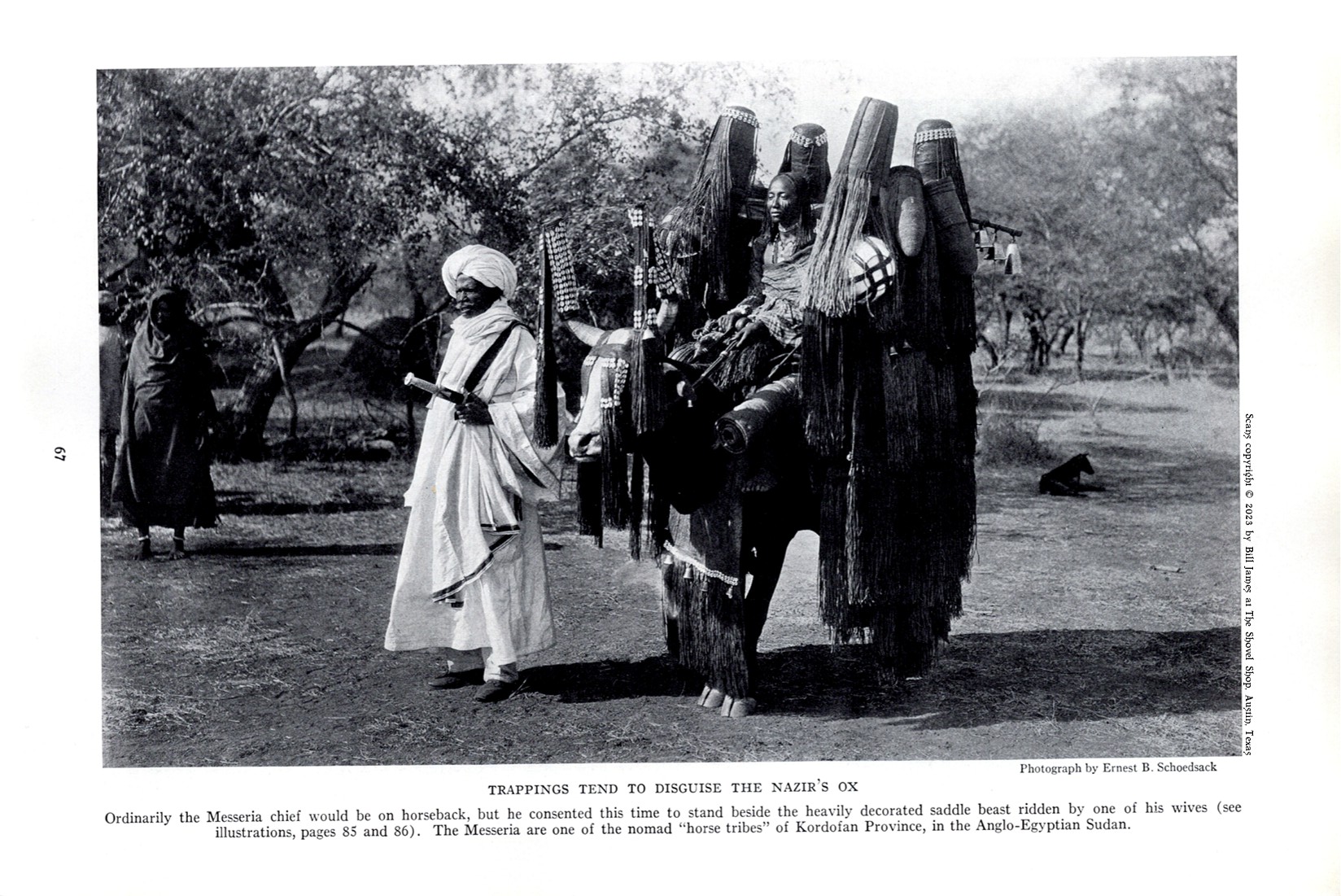
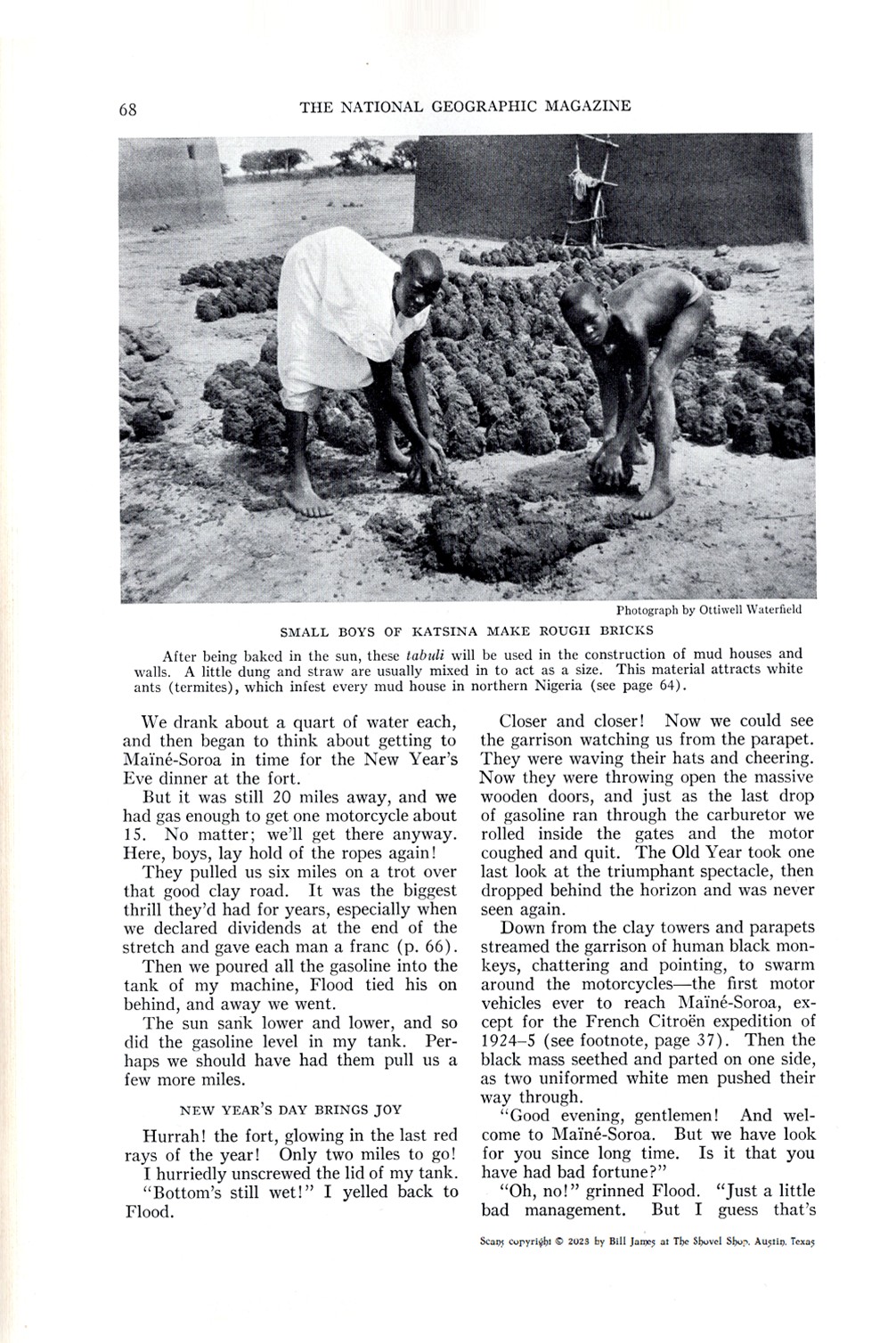
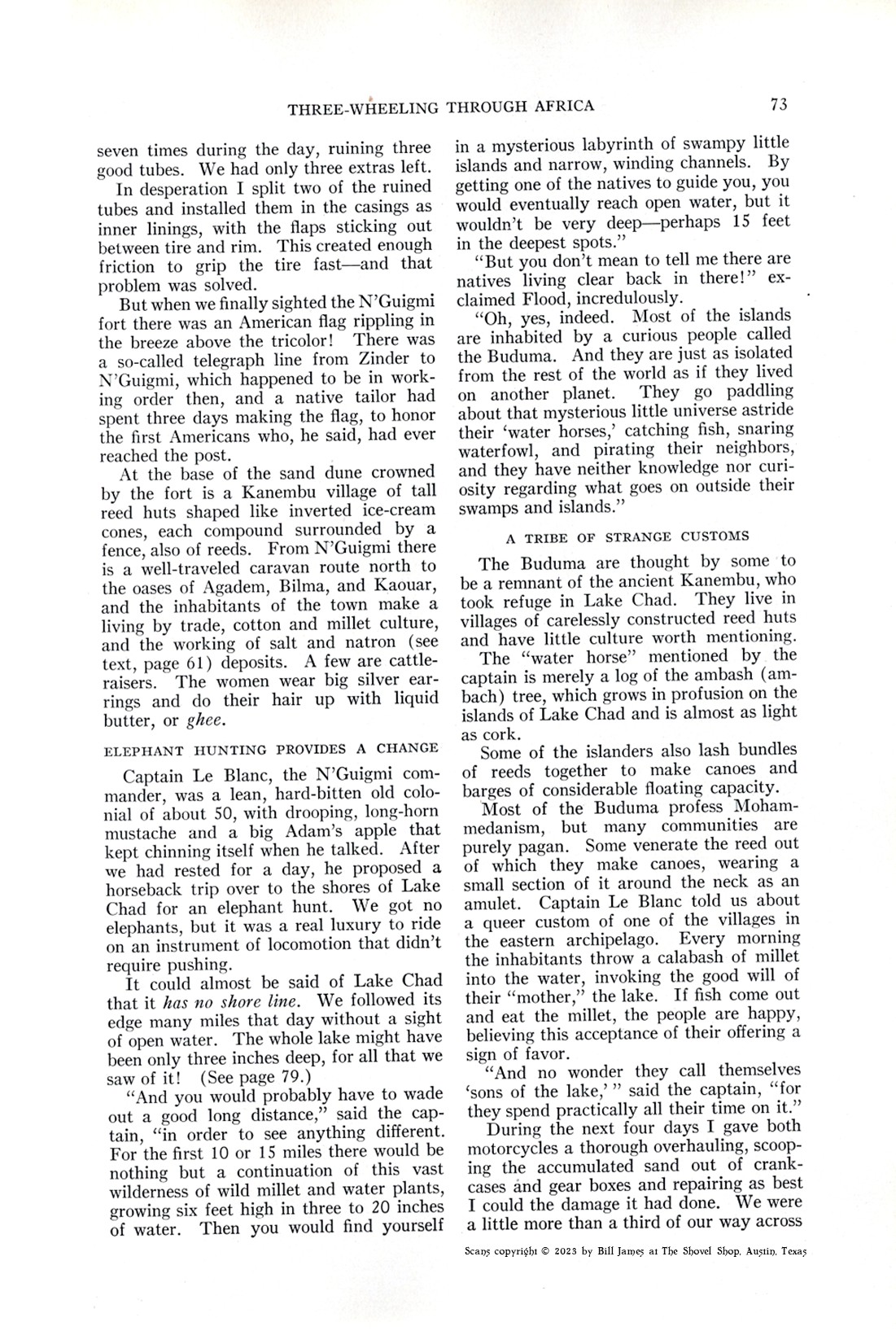
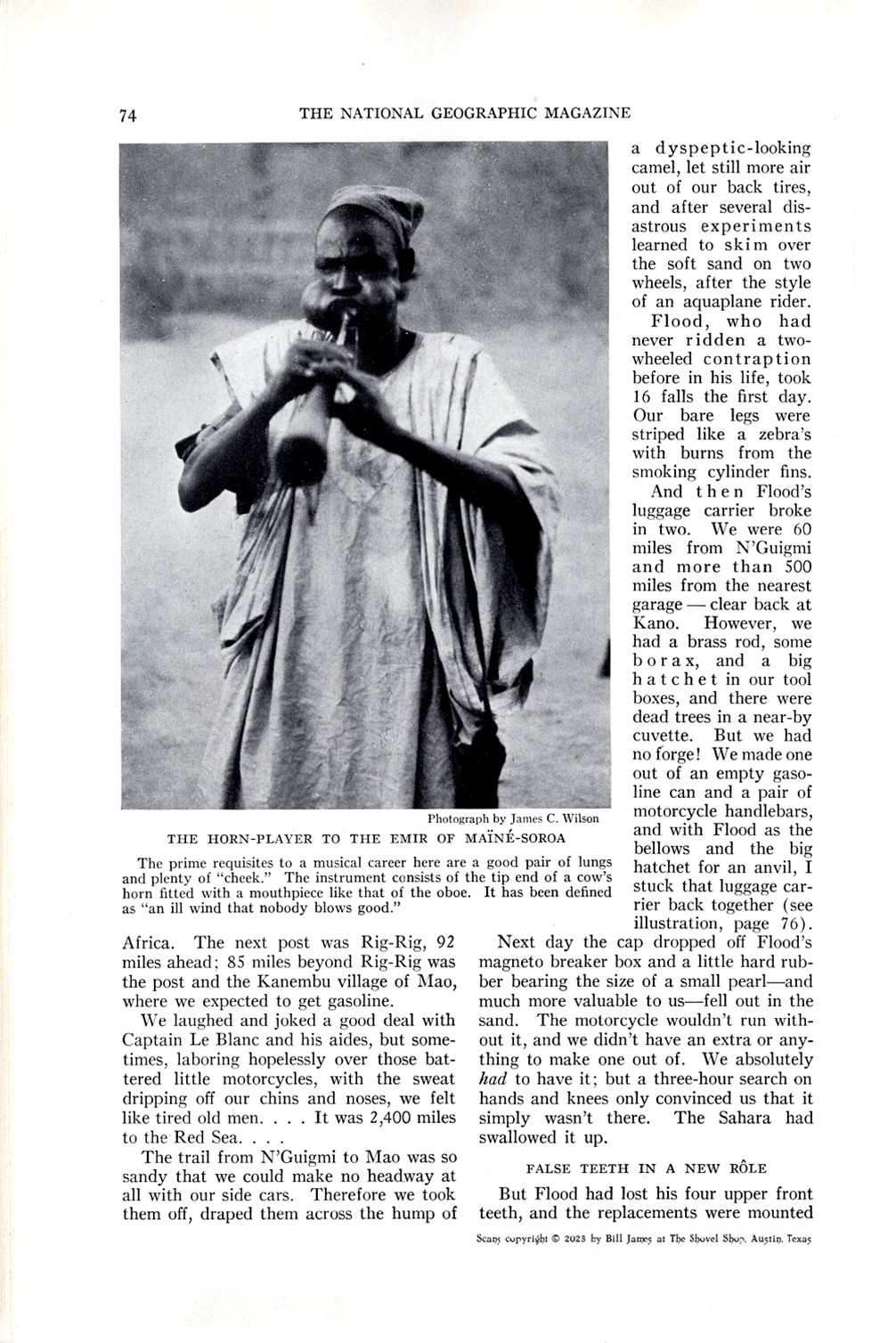
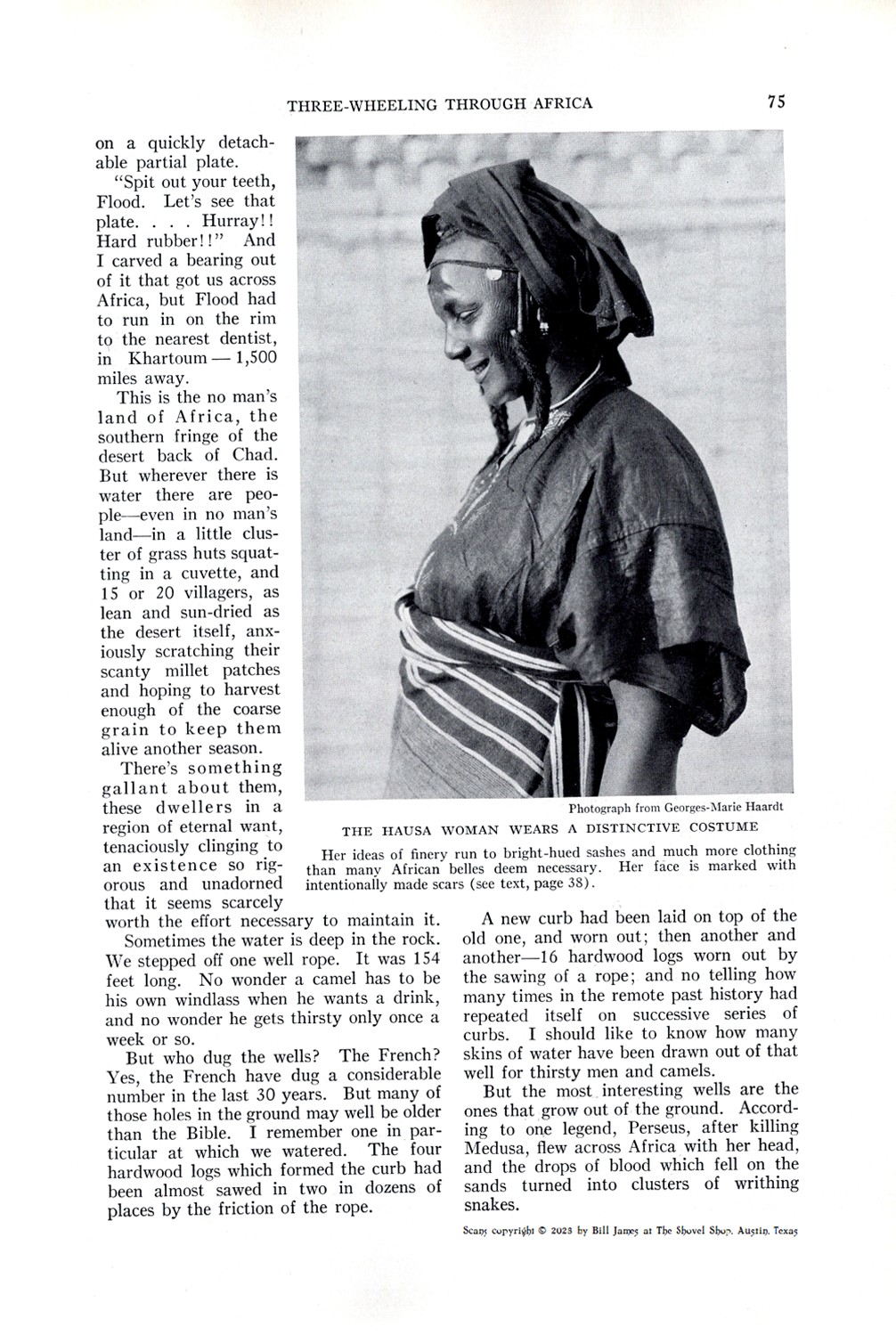
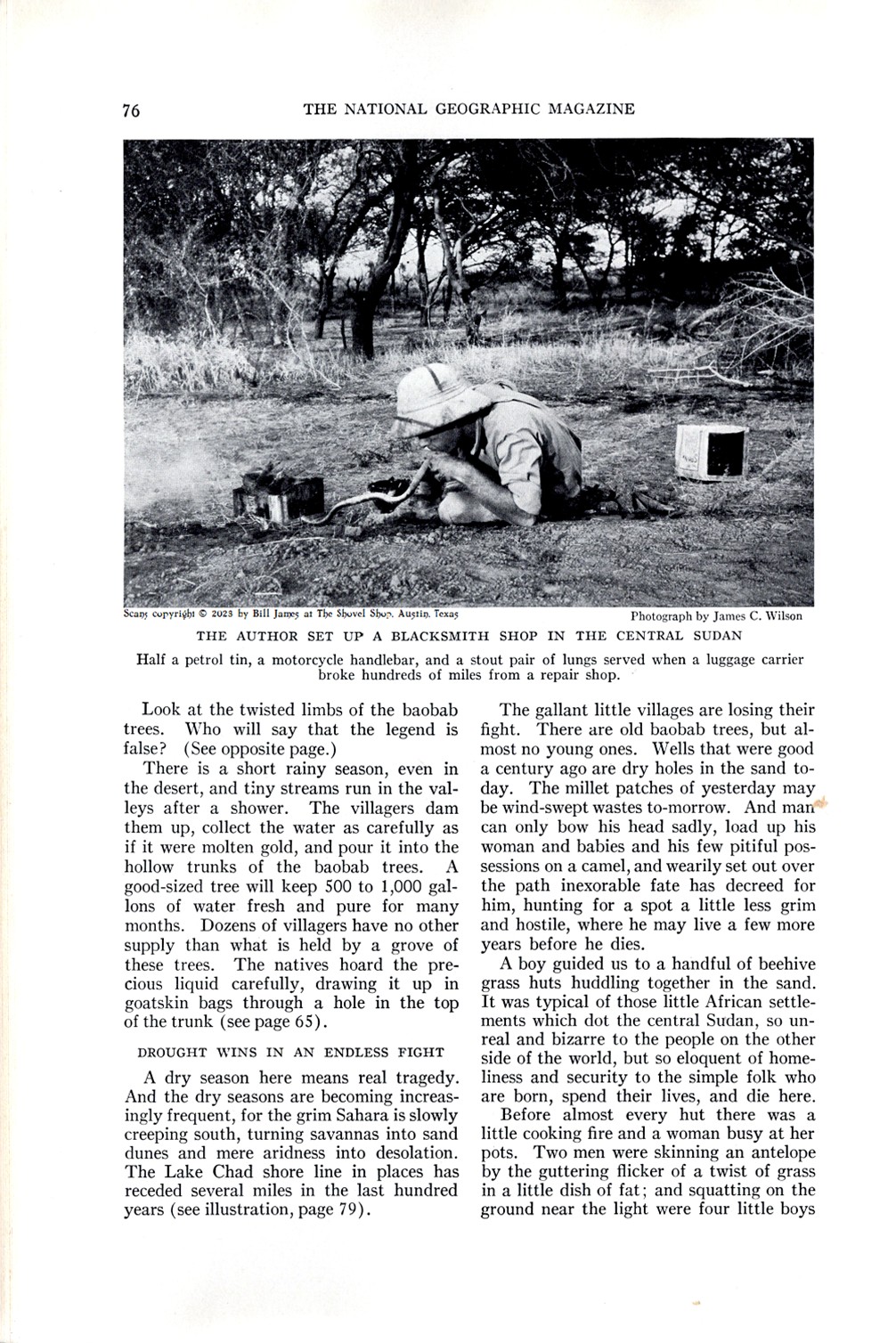
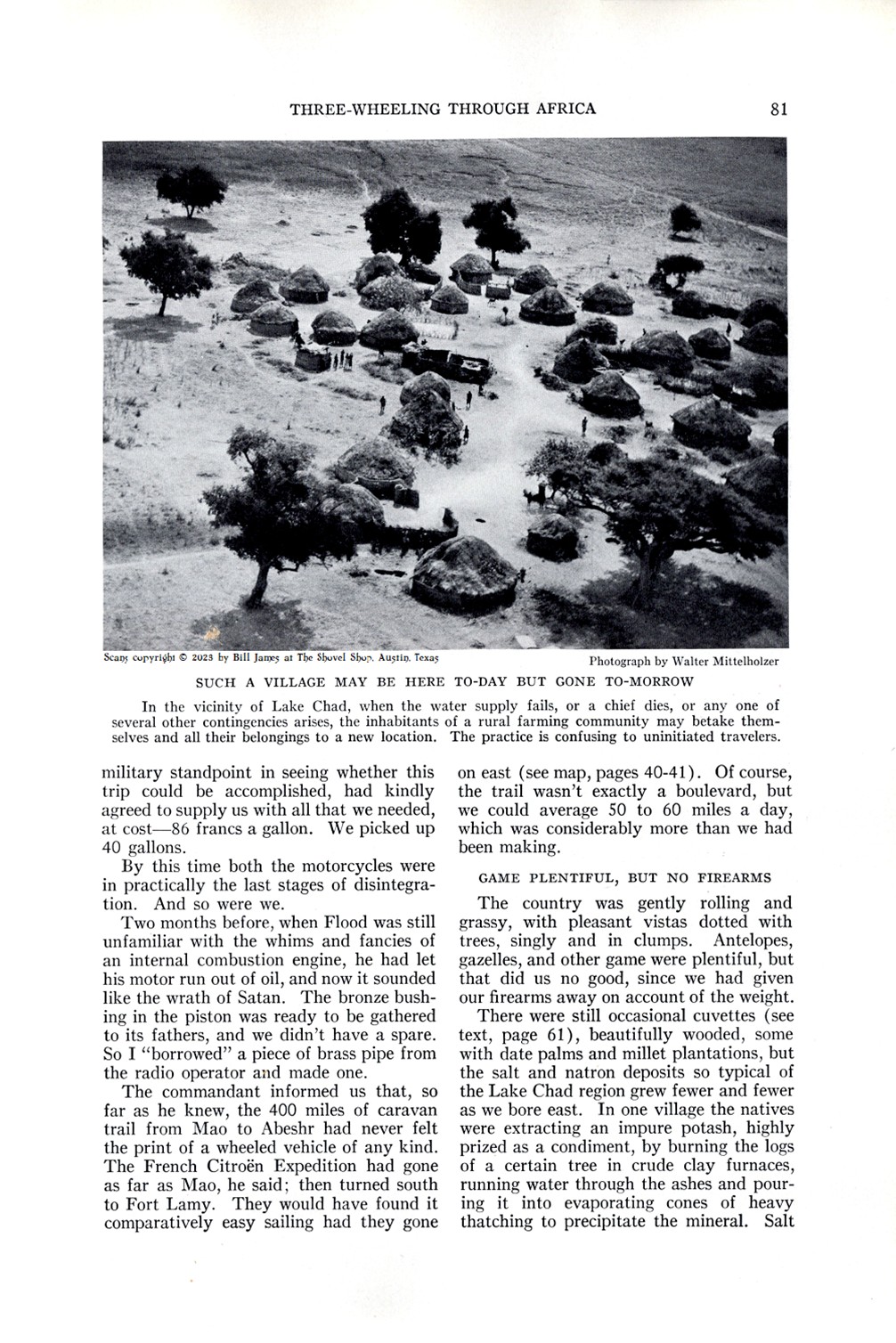
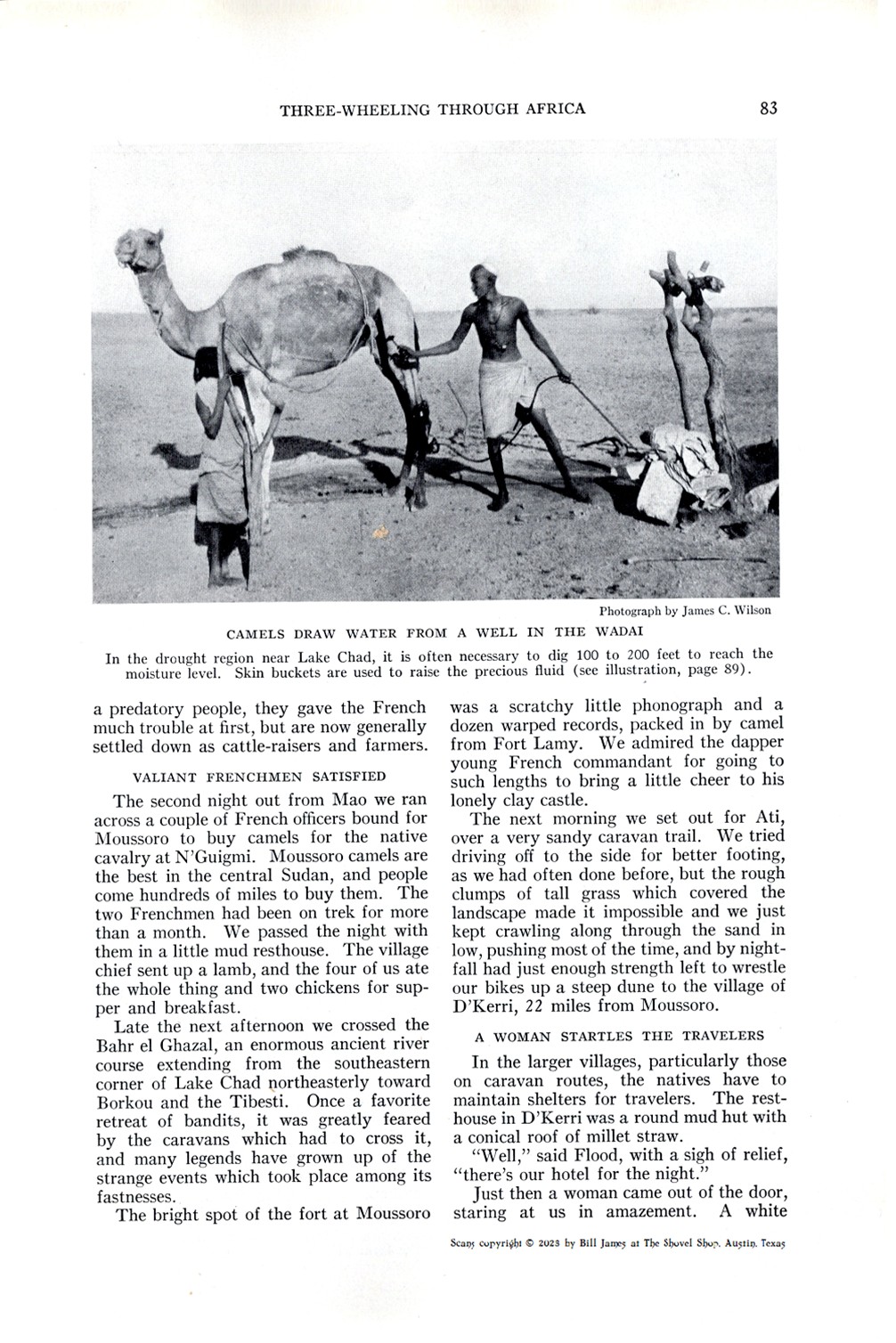
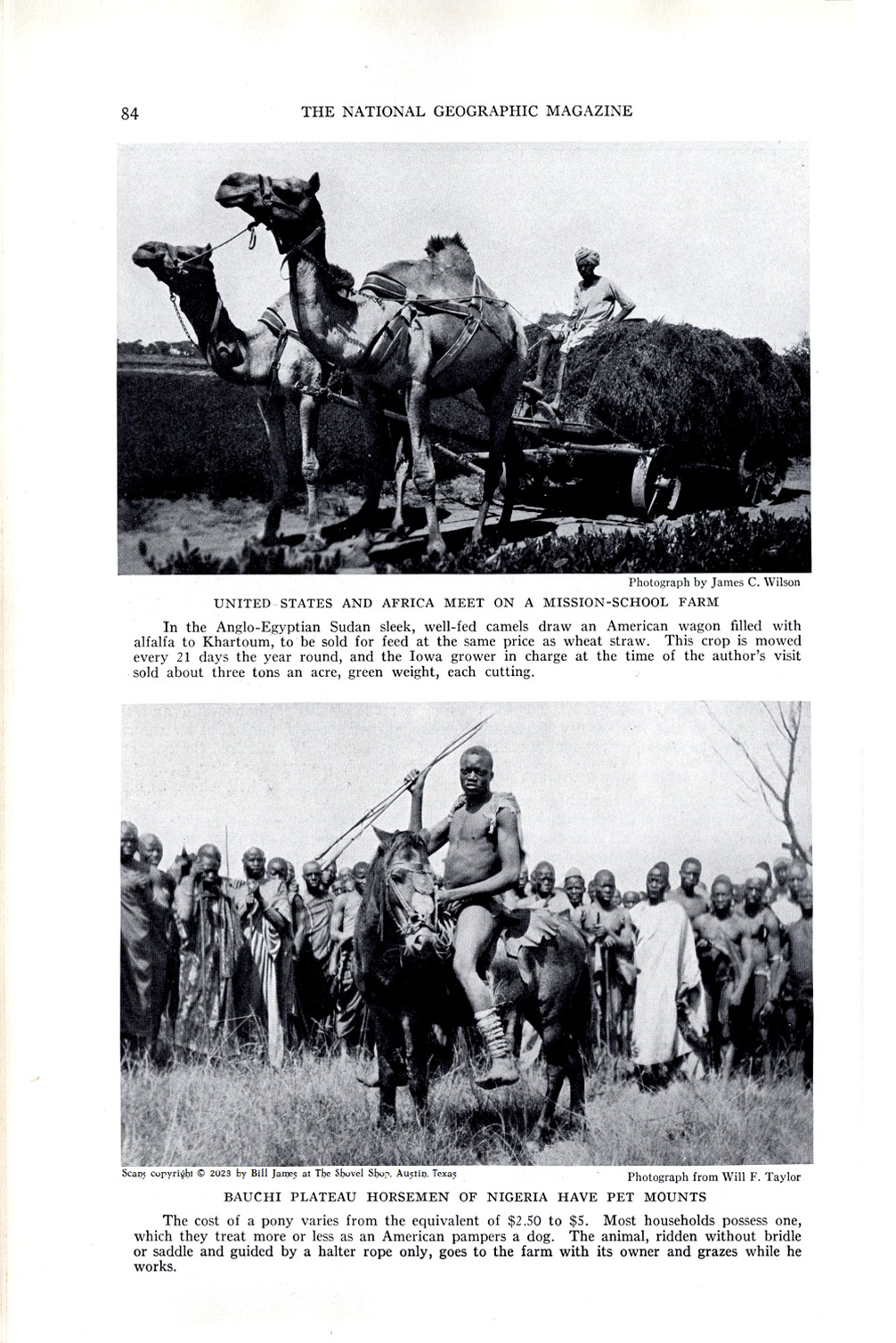
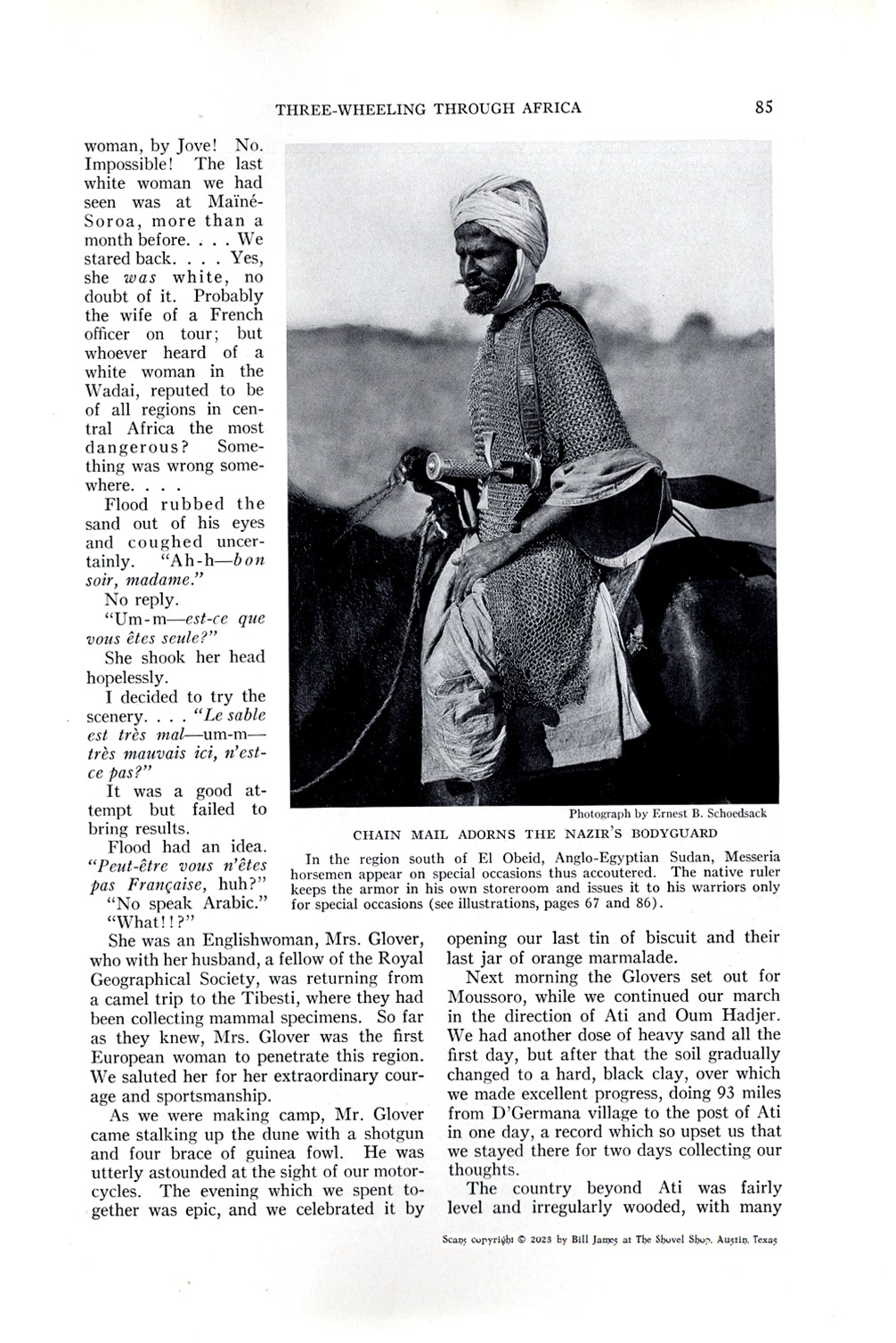
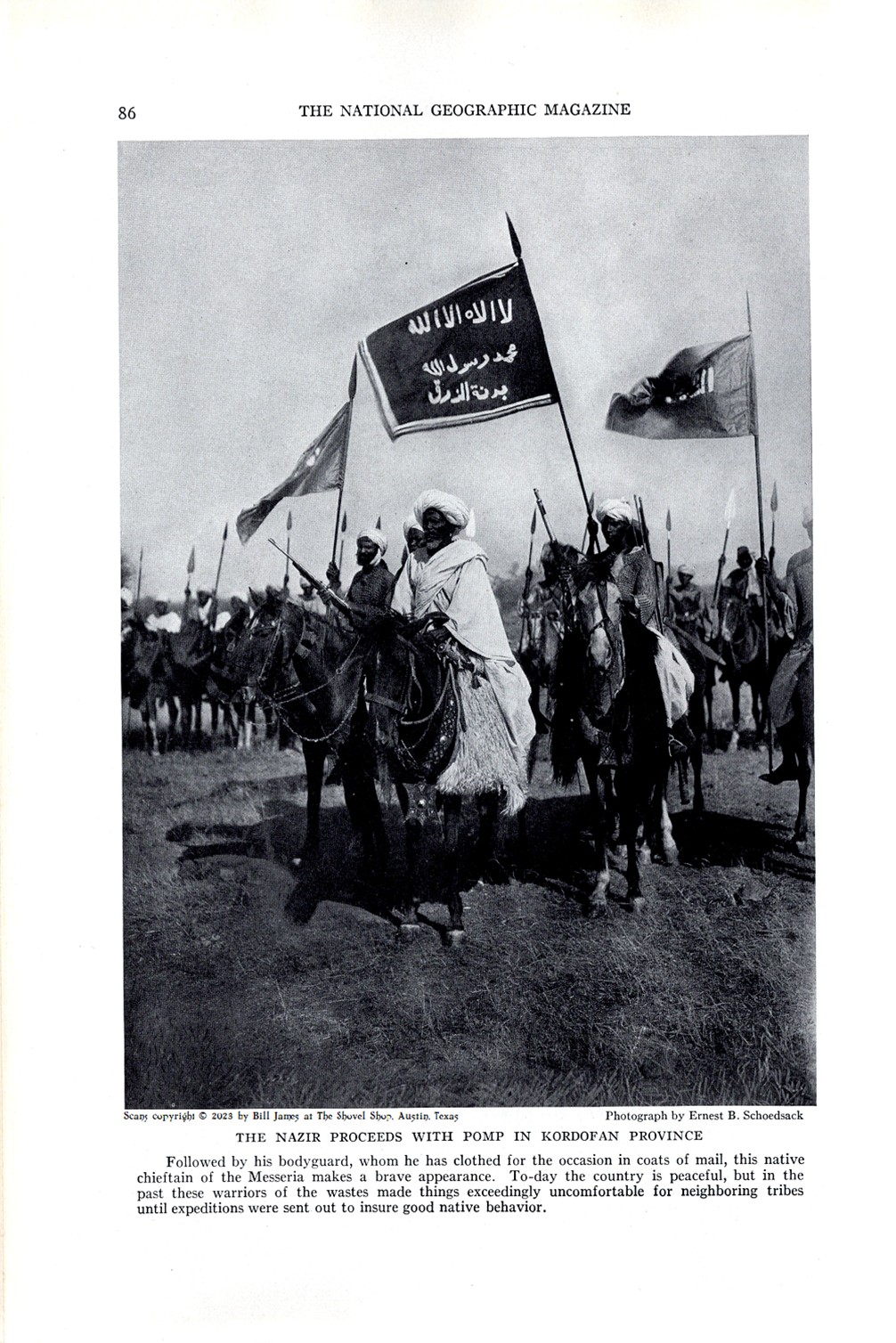
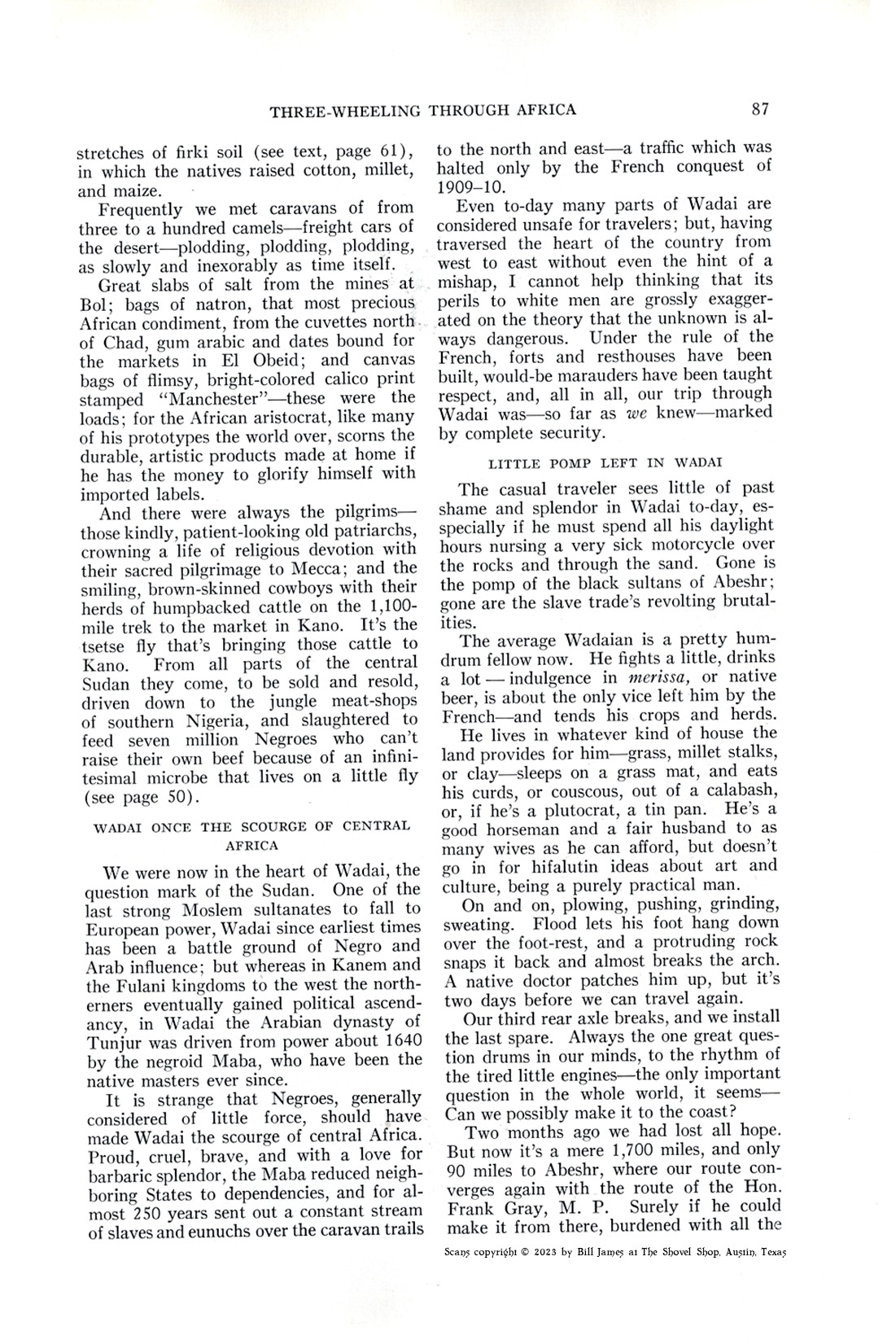
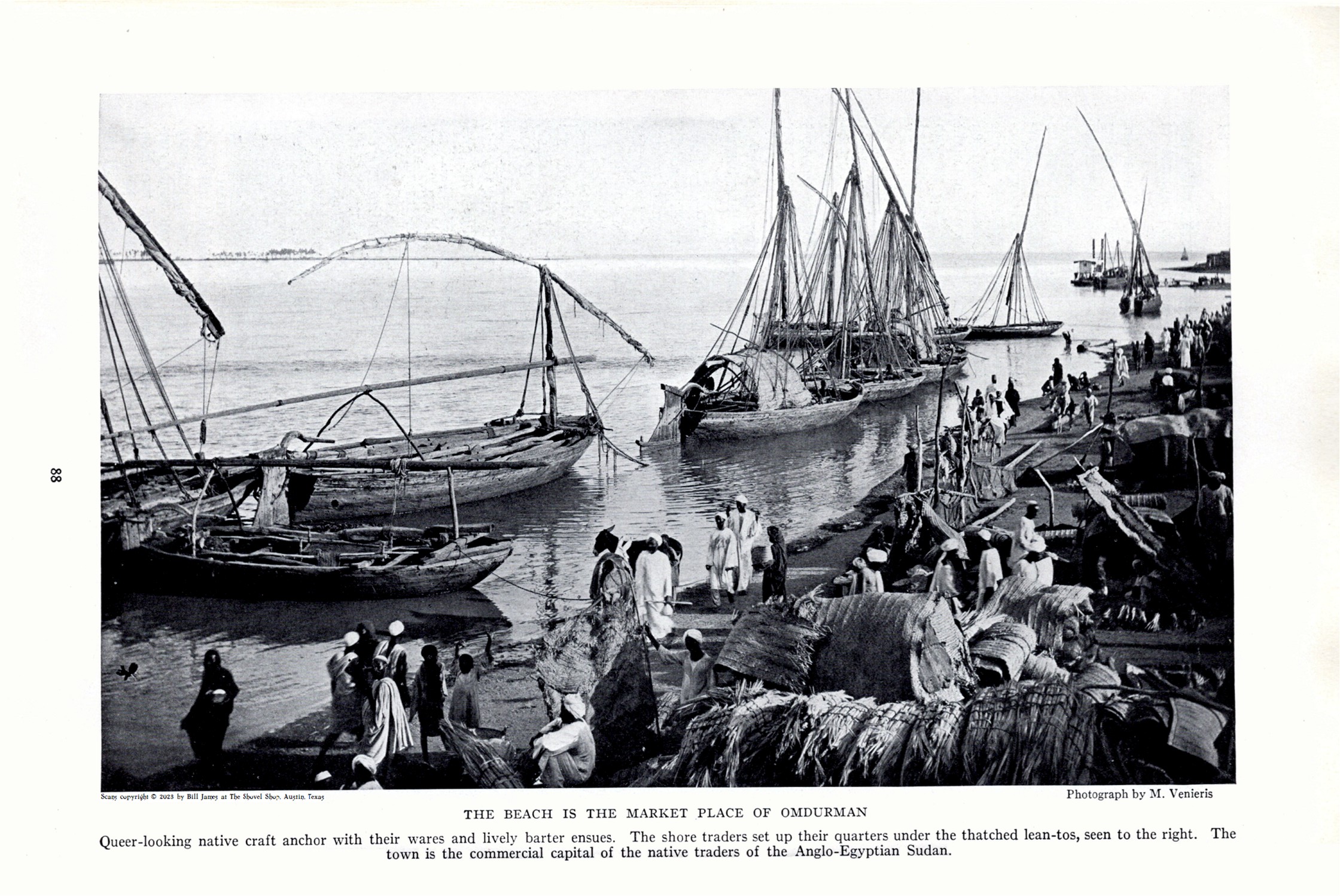
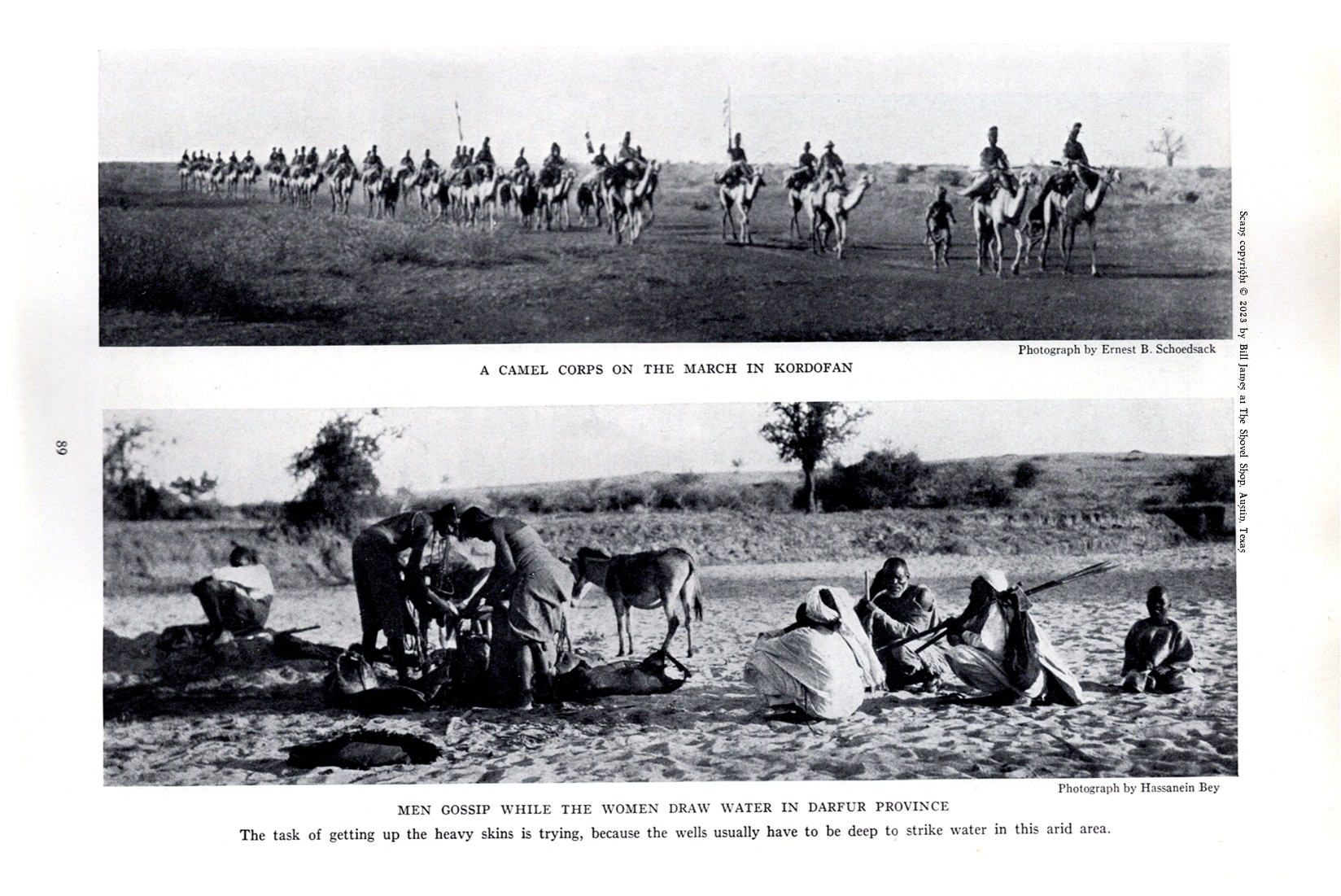
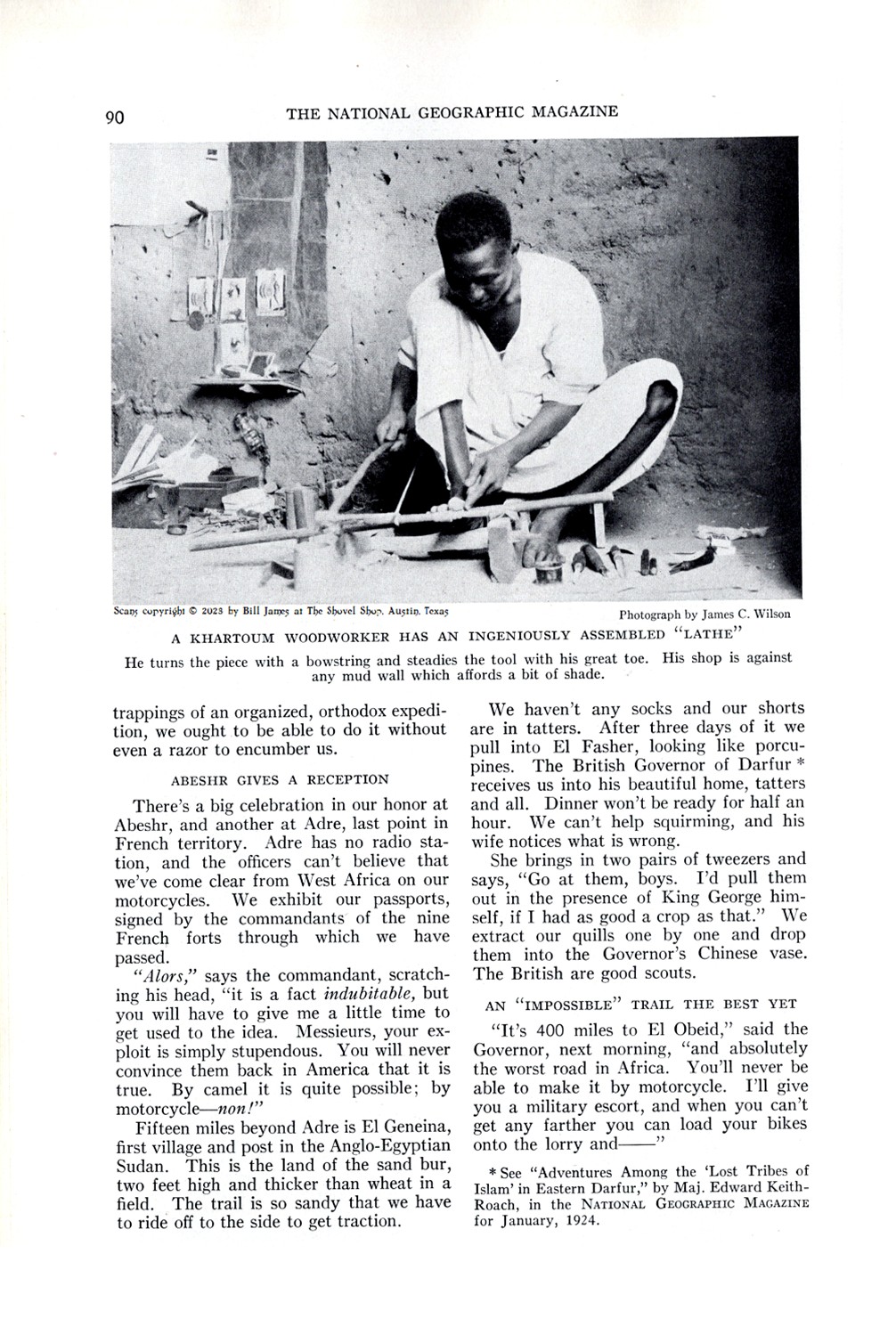
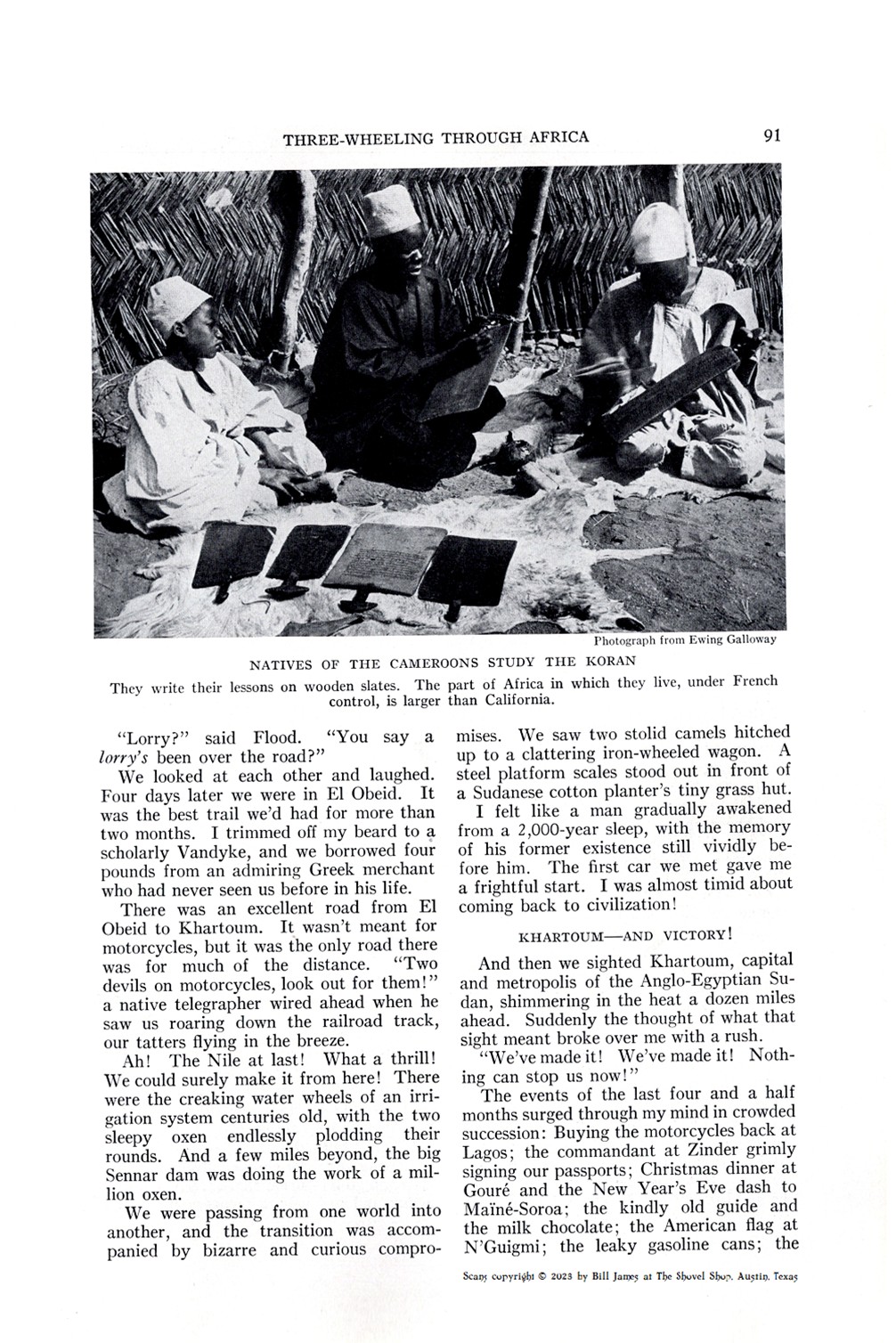
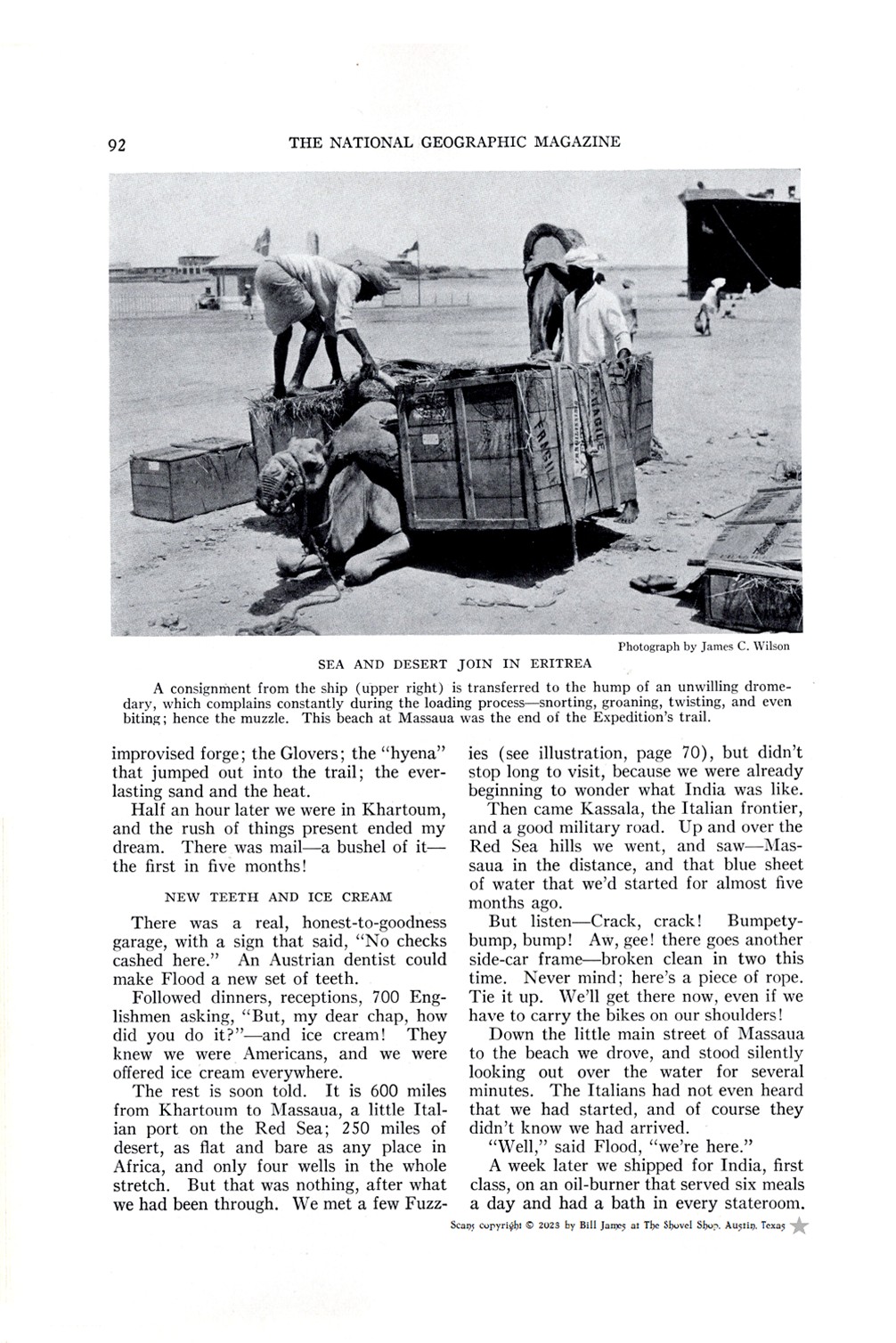
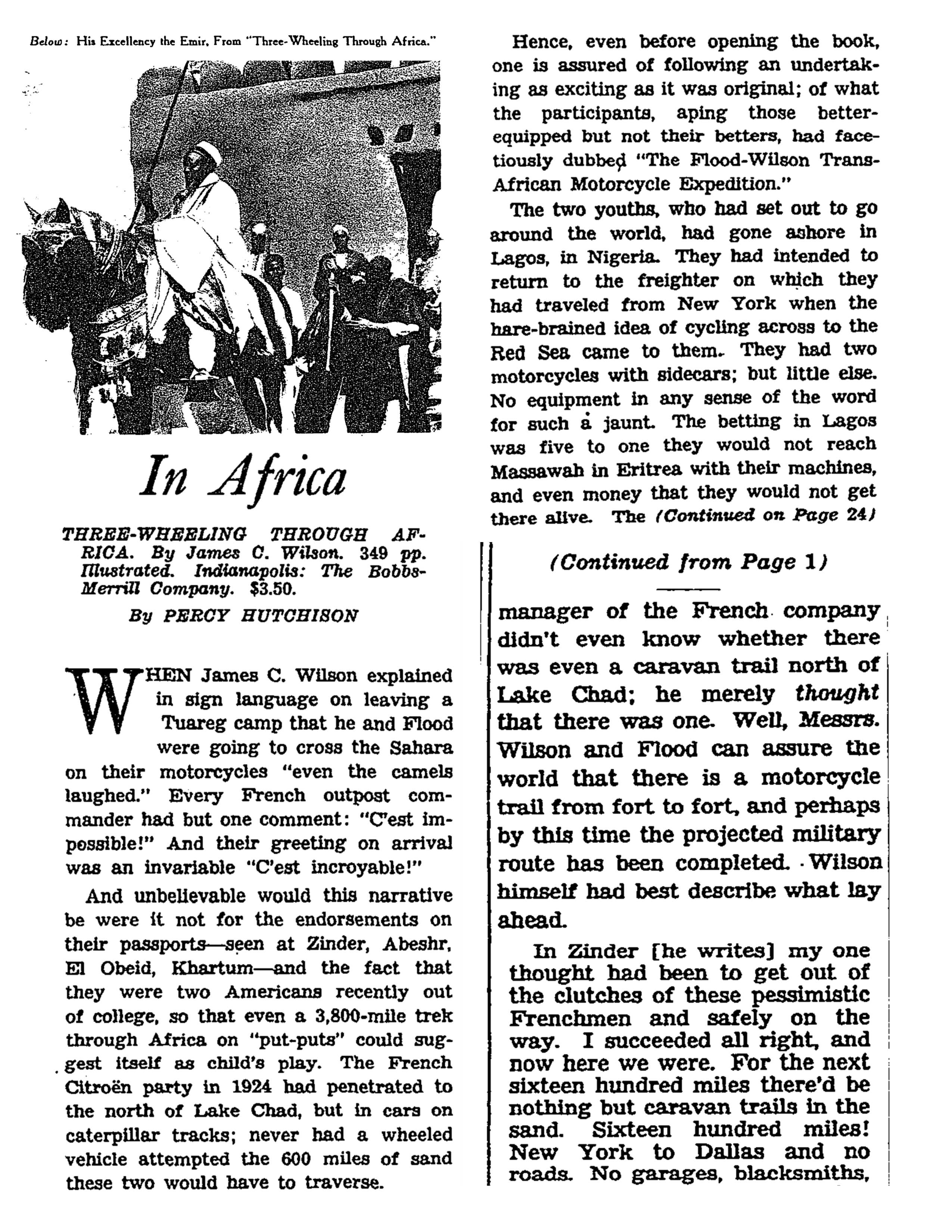
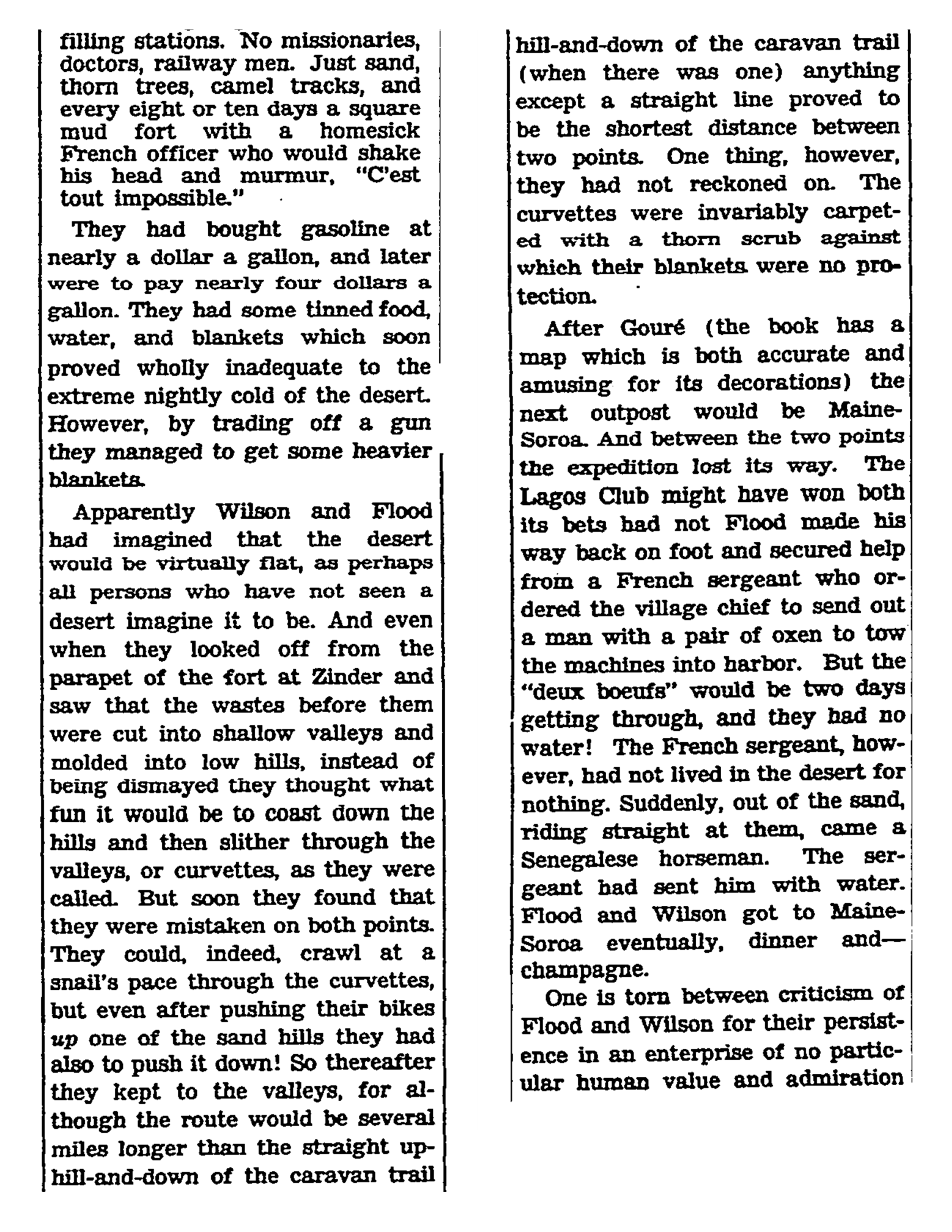
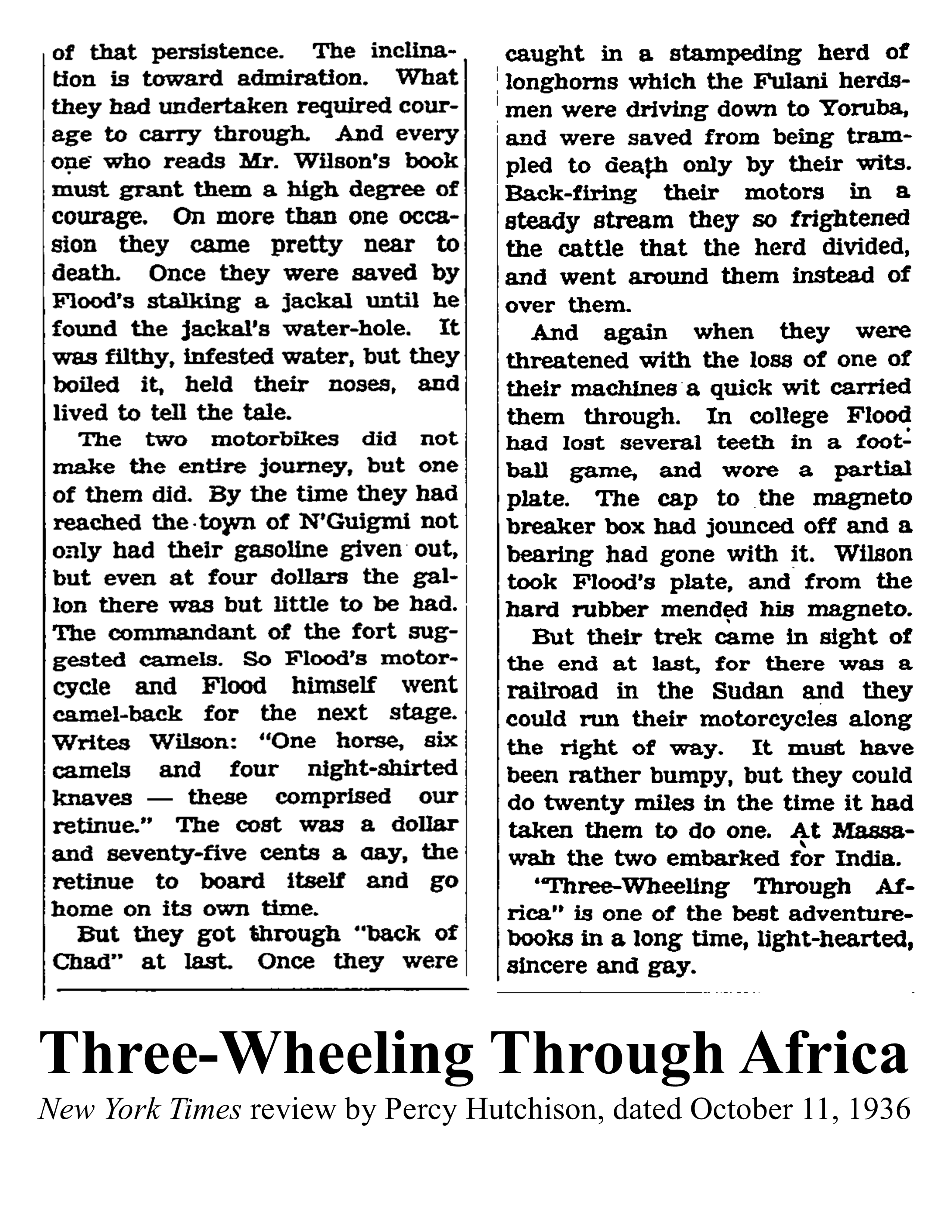
Wilson wrote the New York Times bestseller Three-Wheeling Through Africa, published by Bobbs Merrill, New York, in 1936. He also authored a lengthy article with numerous photographs in National Geographic (January, 1934, reproduced below) and a well-illustrated three-part serial in Popular Mechanics (1936) about the Wilson-Flood Excursion, with numerous photographs. If you’ve ever dreamt of a ’round-the-world ride, Wilson wrote the primer for you.
The accompanying captions and text for pages 40 and 41 are in the next image.
Review of Three-Wheeling Through Africa by Percy Hutchinson, The New York Times, October 11th, 1936
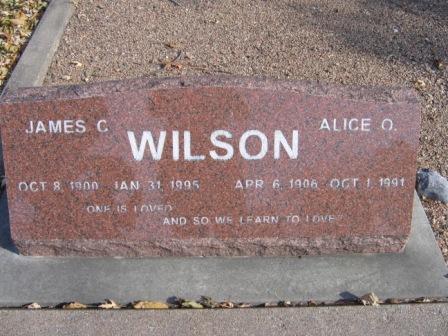
James C. Wilson
James Calmar Wilson was born in Stromsburg, Nebraska, on October 8th, 1900. He took a bachelor’s degree in Business Administration from the University of Nebraska at Lincoln in 1922. Before setting off on the adventure detailed above, he attempted to make it as a jazz musician in New York City.
After the Africa crossing, Wilson and Flood traveled on to India, Burma, and Siam (now known as Thailand), where Wilson contracted a ‘severe tropical fever’. He recovered, nursed to health by his future wife, Alice Olmsted.
After returning from his wide-ranging adventures, Wilson became an English professor at Iowa State University. An aspiring songwriter, Wilson also won a $100 prize for penning the university’s alma mater song, ‘The Bells of Iowa State’. In addition, he toured the United States as a travel lecturer, and wrote articles for magazines.
Following service during World War II, Wilson took up teaching at Colorado A&M University (now Colorado State University) at Fort Collins.
Wilson and his family ultimately settled near Polk, Nebraska, in the 1950s, where he became an agricultural journalist, publisher and acknowledged expert on prairie grasses, known as ‘the Grass Guru’. Later in life he co-authored a book on the subject – Grass Land (1967, publisher unknown) – with his wife, Alice, and son, Steven. He also wrote the musicals Hey! Where’s Nebraska? (1989) and Say it With Music, Nebraska! (1990).
James Calmar Wilson died on January 31st, 1995, at the age of ninety-four, and is buried beside his wife at Stromsburg Cemetery in Polk County.
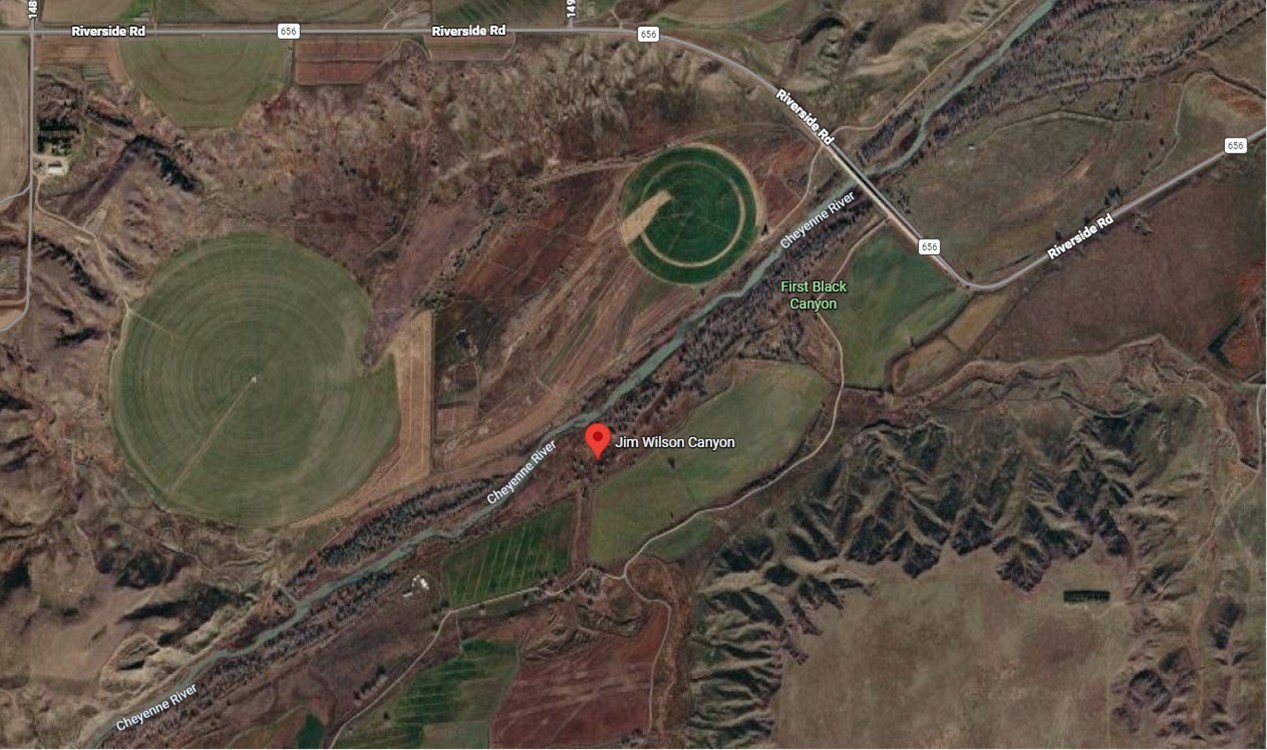
Jim Wilson Canyon in the Buffalo Gap National Grassland near the Pine Ridge Reservation (Fall River County, South Dakota) is named for James Calmar Wilson.
An in-depth biography of James C. Wilson may be found at Grokipedia. I thank them for their contributions to this post.
The 1936 three-part serial published in Popular Mechanics is posted on the ADVrider site.
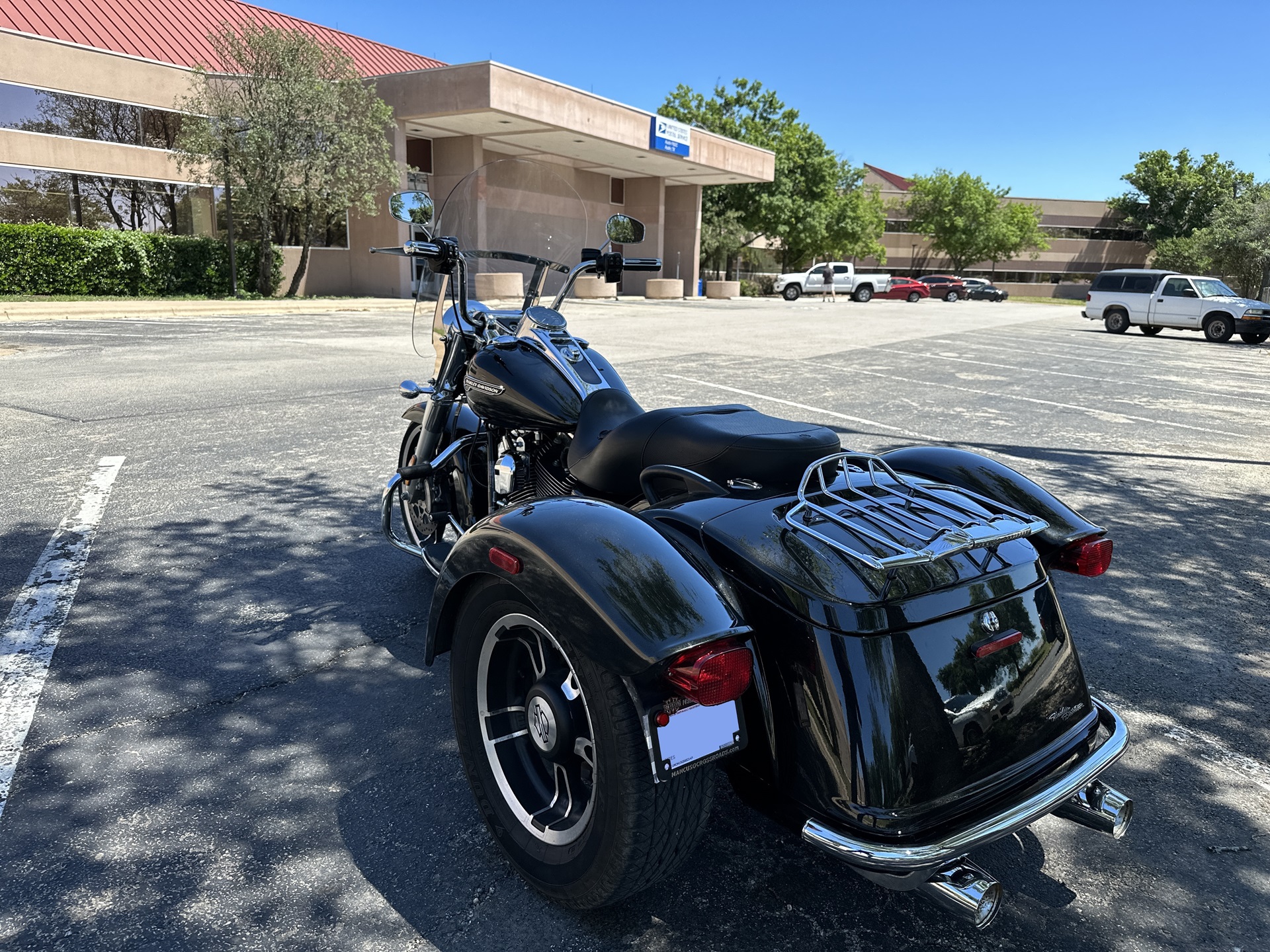
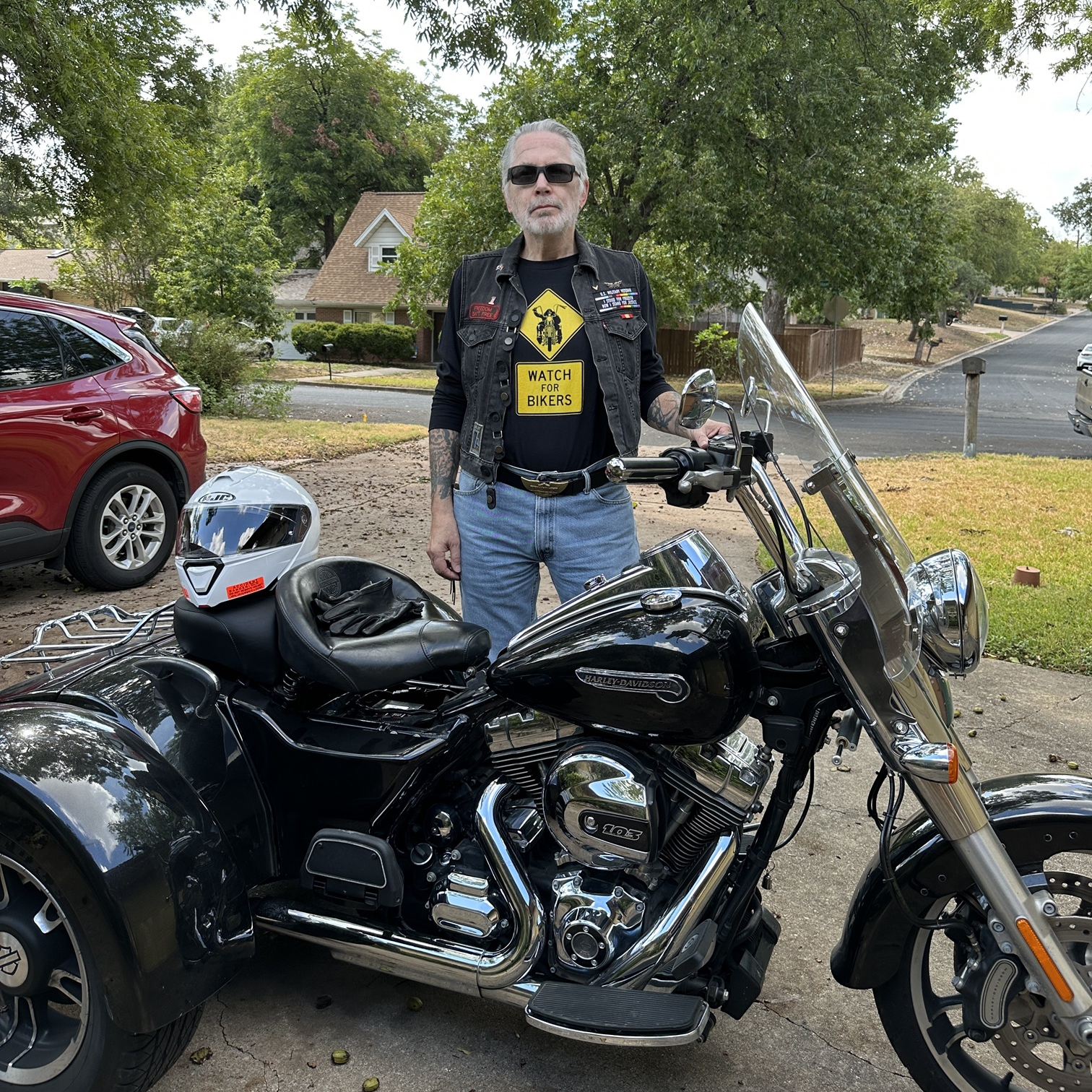
As noted in a previous post, I was disabled in a work accident in 2004. After numerous attempts to stay on two wheels or somehow trike my faithful old shovelhead, I finally broke down and bought a 2016 FLRT Freewheeler, which I’ve named The Box Turtle.
If you’ve never ridden a trike, let me warn you up front that they are very different from a two-wheeled (solo) ride. For starters, Harley trikes have no lean, which means you’re fighting centrifugal force in turns. It’s disconcerting, at best, to feel that the machine you’re on is about to tip over on you…. and, for the record and contrary to popular belief, trikes can tip over if not handled correctly! I use my upper body as a counterweight in hard turns, and closely monitor my throttle input, and (knock wood) seem to get along.
Then there’s the steering, the exact opposite of a solo ride. We’re taught to countersteer on a two-wheeler, e.g.: to push out on the right handgrip in order to lean into a righthand curve. Do that on a trike and you will find yourself going left, and fast! It’s the same with sidecar rigs, too. That trick can be pretty distracting (and/or terrifying) until you get used to it! 😱
Knowing this, I approached my trike as if I’d never ridden before, taking slow putts around the neighborhood, and going to the church parking lot at the top of the hill to get more familiar with turning and response. I took my time, and gradually built up to where I could take short errands. Then I graduated to rides on the rural roads around Central Texas, building speed and confidence in my machine and my abilities.
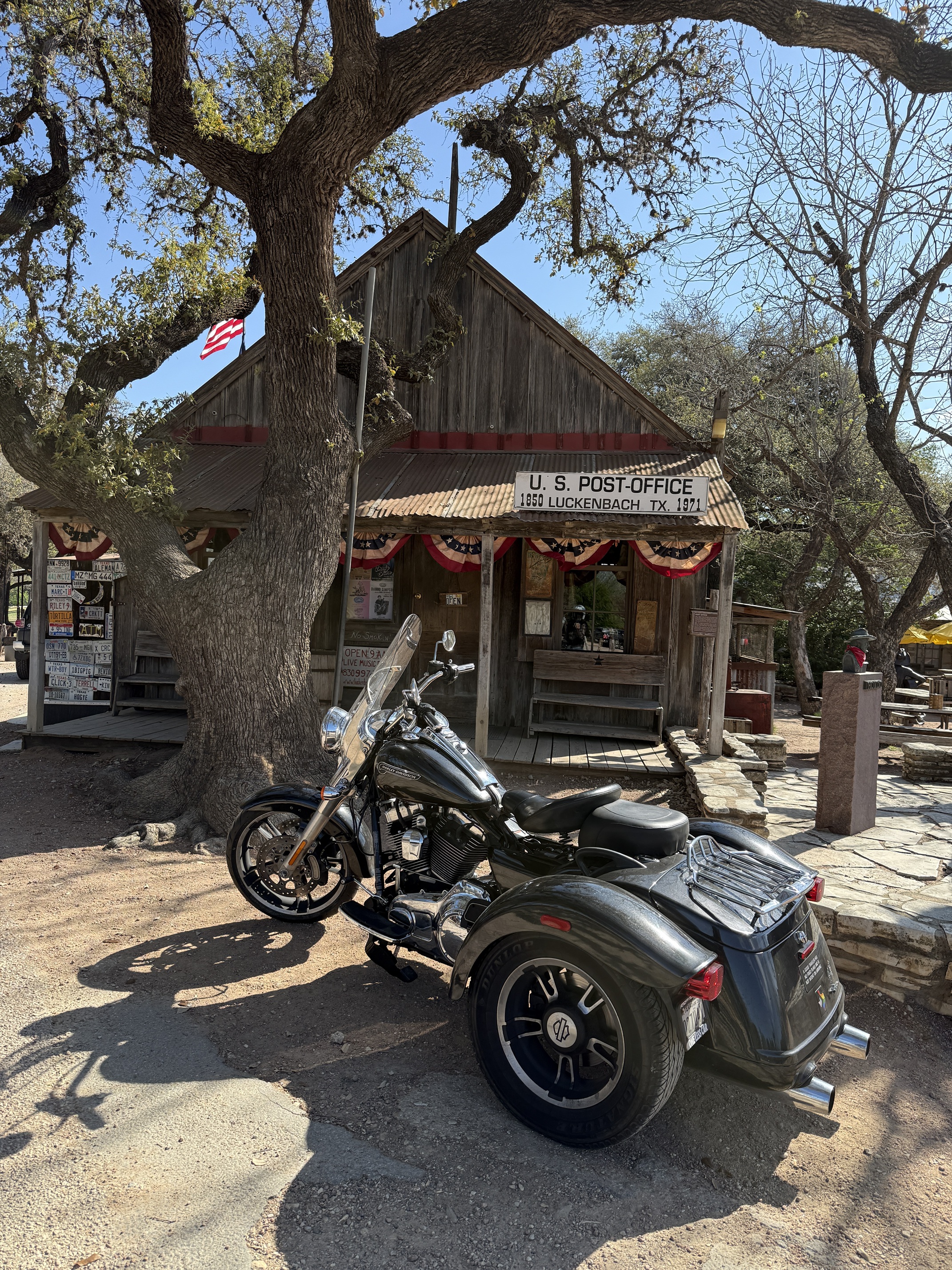
My first ‘big’ ride on The Box Turtle was a run to the Post Office.
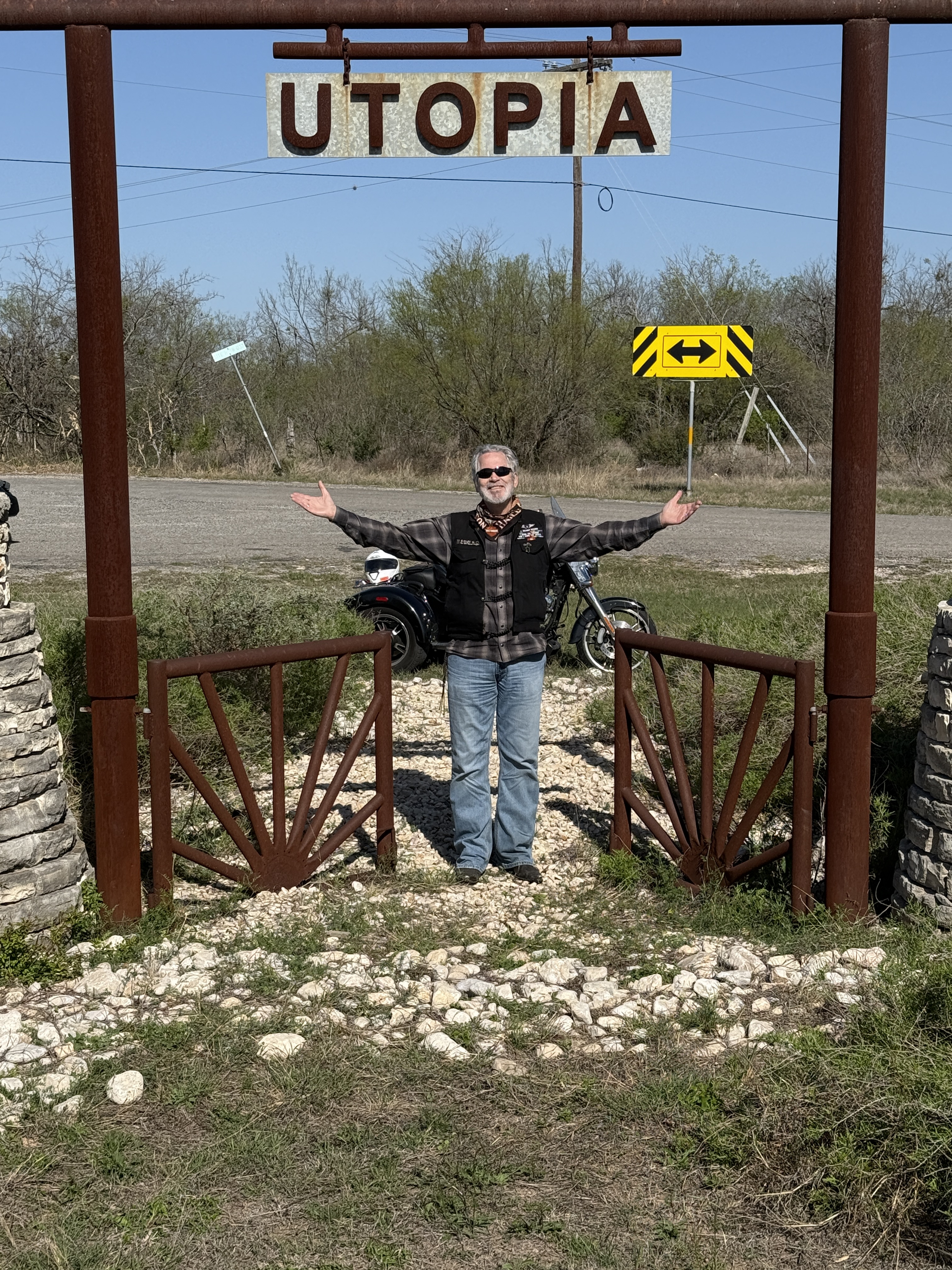
Now? Now I take it out in the Hill Country, on routes like the Twisted Sisters, and ride it like a damn canyon carver. 😎
Utopia, Texas!
Once I was familiar with the machine, I began adapting it to my disabilities.
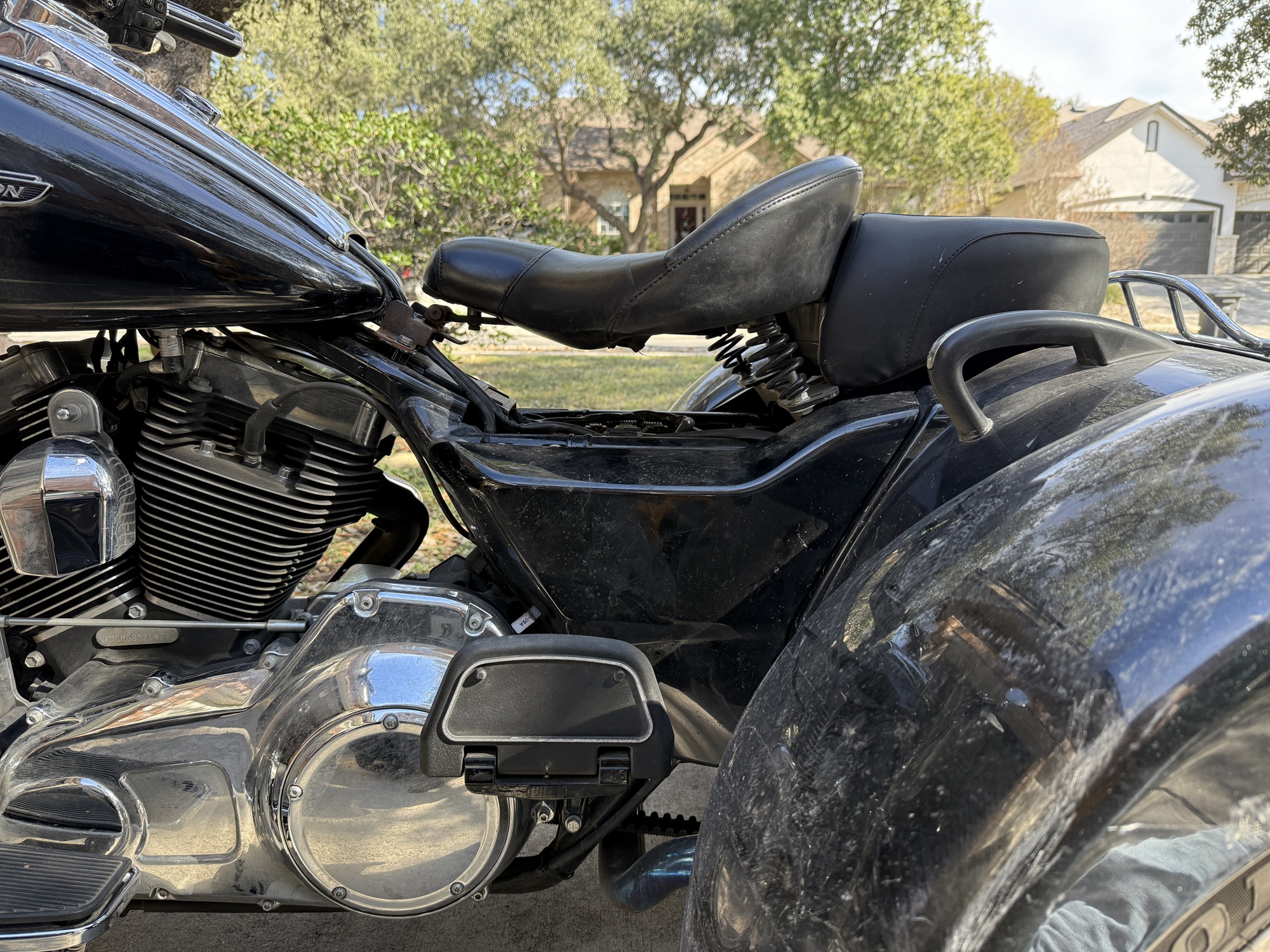
I started with the FXRP cop saddle I’d souvenired off my late great FXRS. I had a welder fashion a mount for the nose, and used the OEM springs and brackets for the rear. Then I had Bob Lee Peña over at Texas Steelhorse Saddles build me a pillion pad. I highly recommend Bob and Steelhorse, BTW. That pad fits and looks like a factory item!
I also played with the controls, including removing the heel shifter and adjusting the handlebars. The trike came with a windshield (essential so I’m not fighting the wind with my messed-up back muscles) so I was spared any expense there. I still need taller bars, to compensate for the raised saddle height, but otherwise the trike was set up just the way I needed it, except that….
….the rear suspension liked to beat me half to death on anything other than the smoothest pavement. I rode rigid for decades, so it’s not as if I’m unaccustomed to ‘road sense’ but this was worse than any rigid I ever rode, and there didn’t seem to be any way to adjust for it. The stock shock absorbers allegedly had some adjustment in them, but you couldn’t prove it by me!
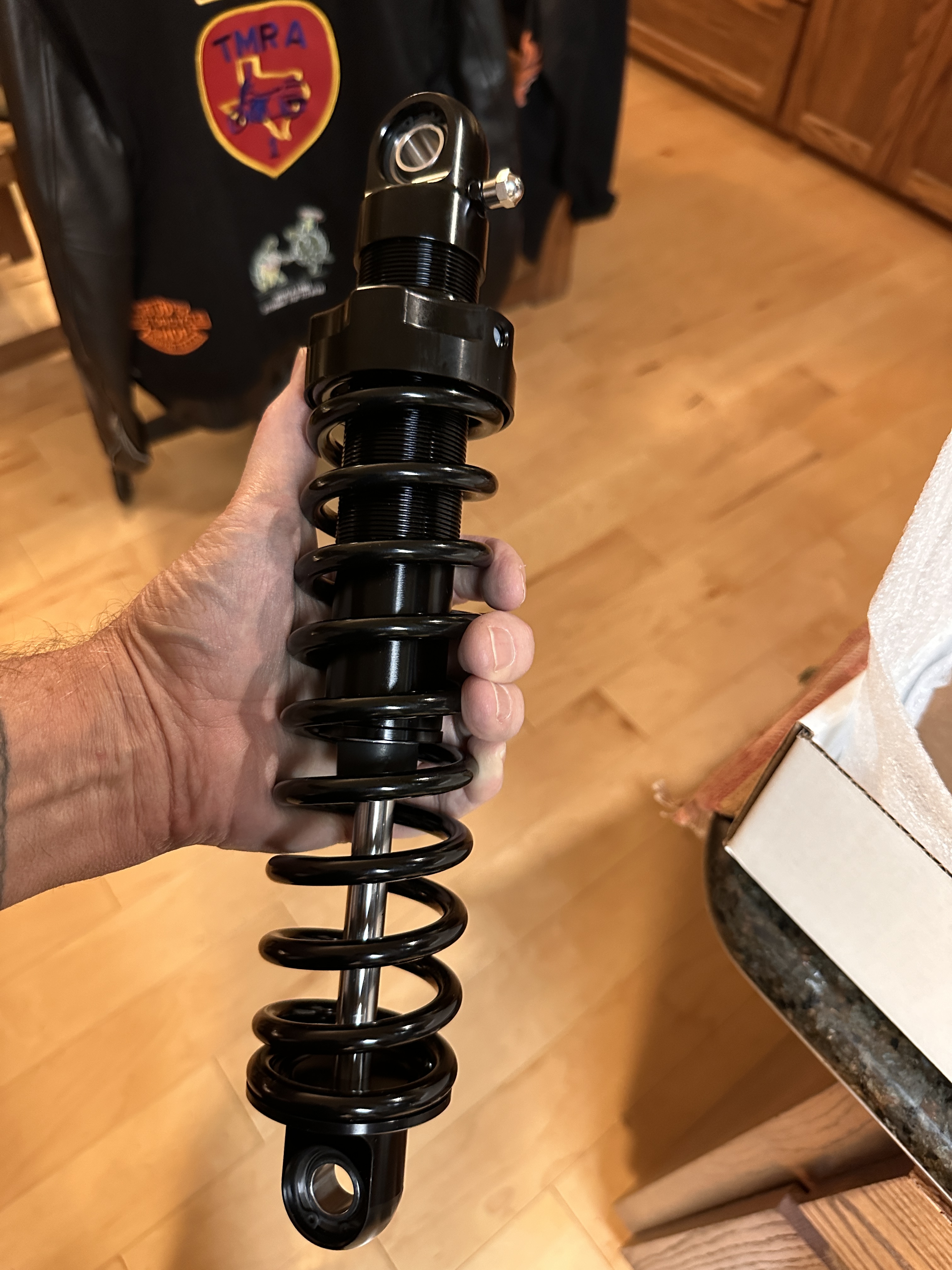
I found a trike forum and searched a bit, and finally asked for recommendations for replacement shocks. A bunch of folks chimed in, and DK Custom Products seemed to be the favorite. I went to their website and followed the prompts – model, ride preference, rider weight, luggage weight, two-up or solo – and, just to be sure, called customer service.
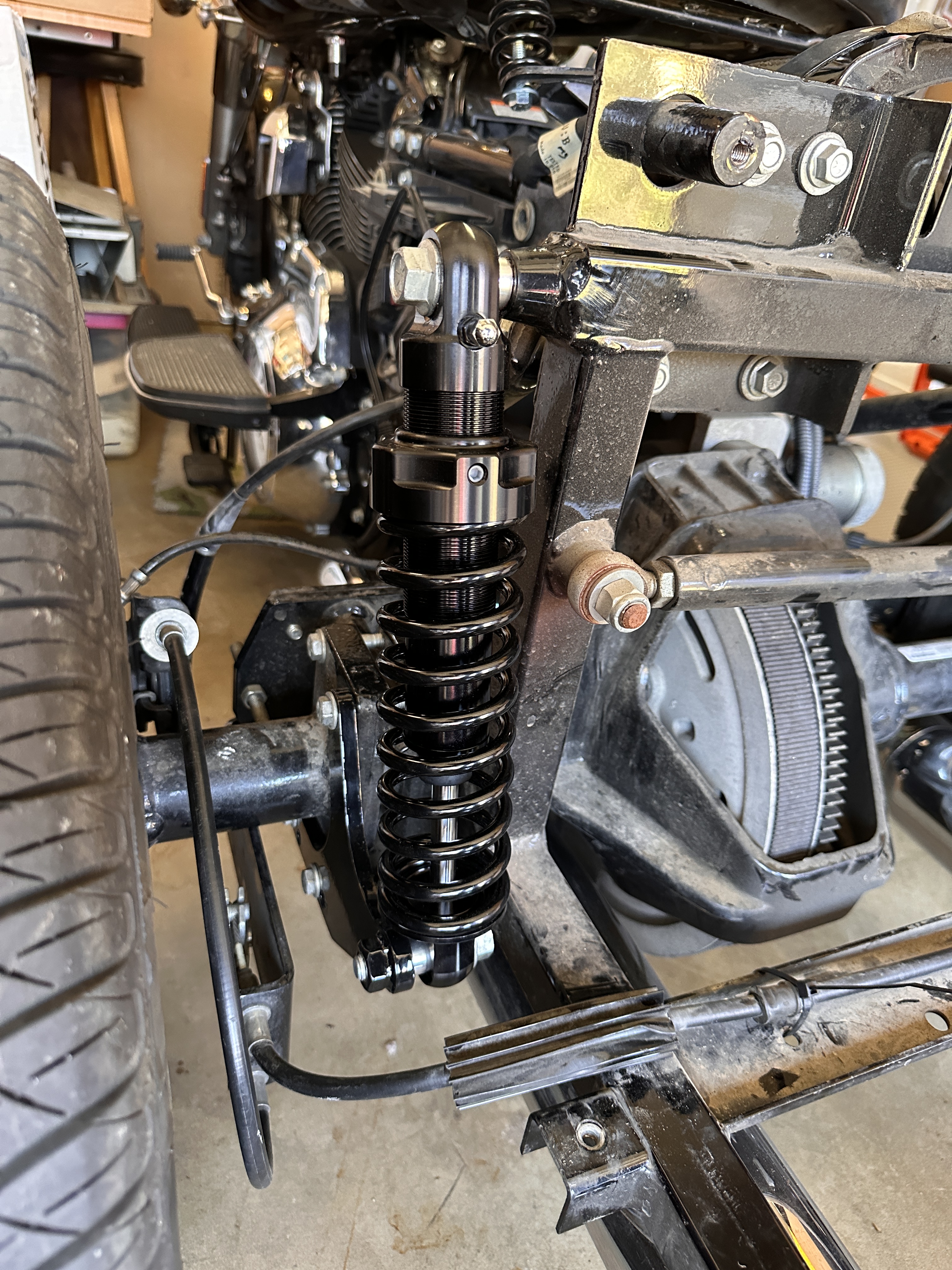
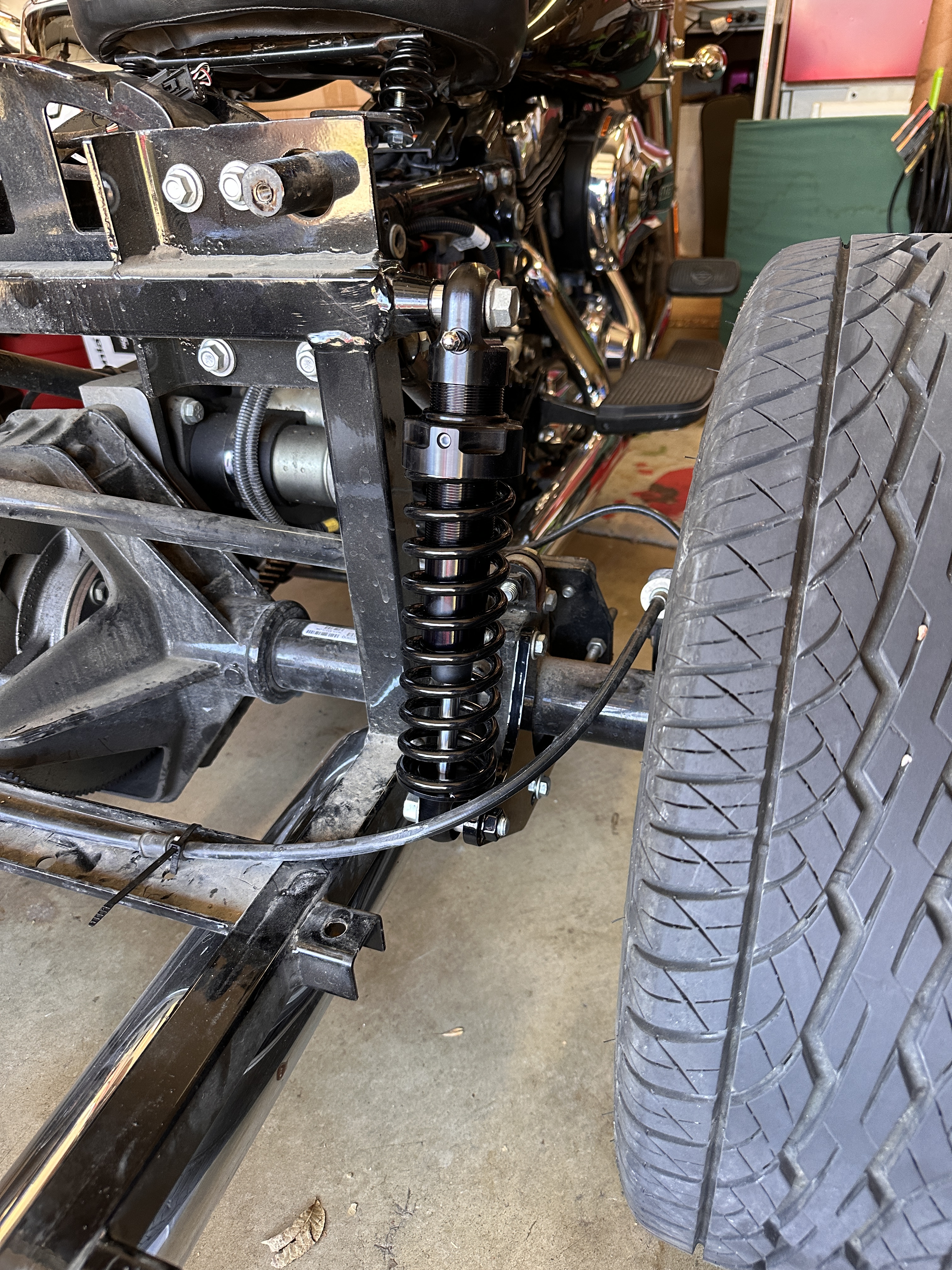
Then I ordered accordingly: 13″ shocks and a lift kit. It wasn’t cheap, but much less than kits from other outfits like Progressive and Legends.
Installation:
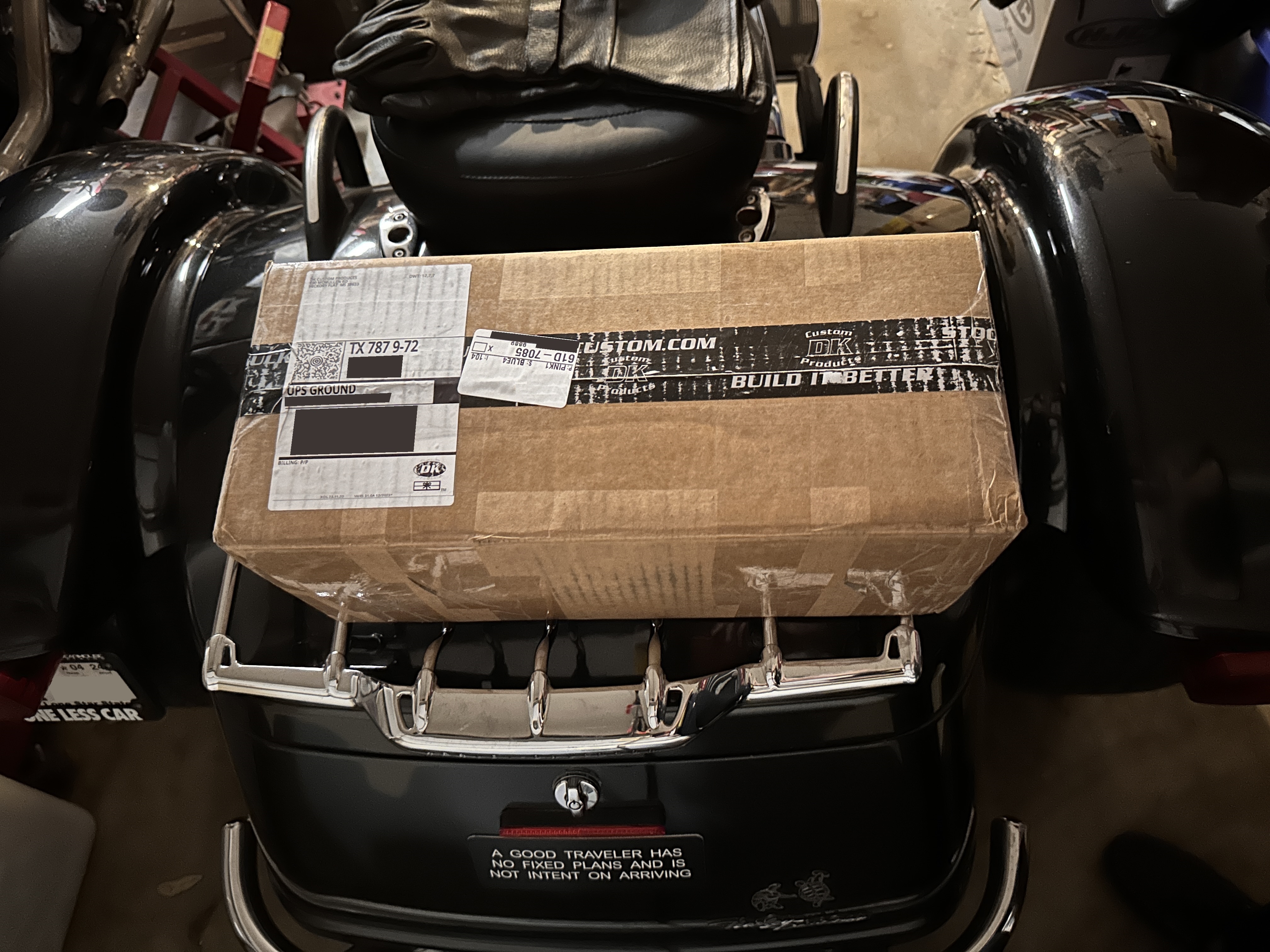
Two days door-to-door!
For starters, DL’s shipping was fast; the kit was on my doorstep within two days. And the stuff looked well made, too. The instructions seemed clear, and I had all the tools and experience, so I dug in.
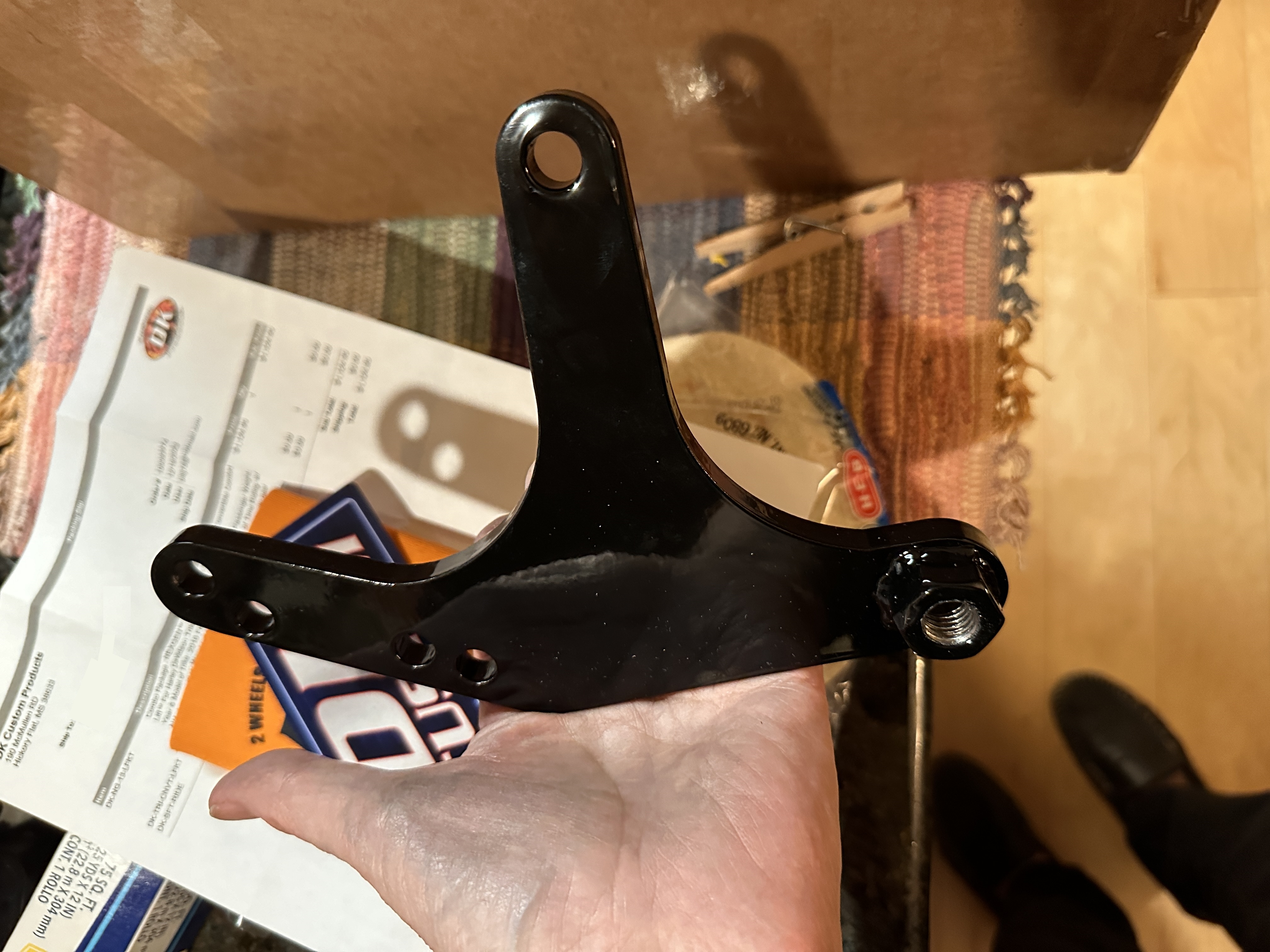
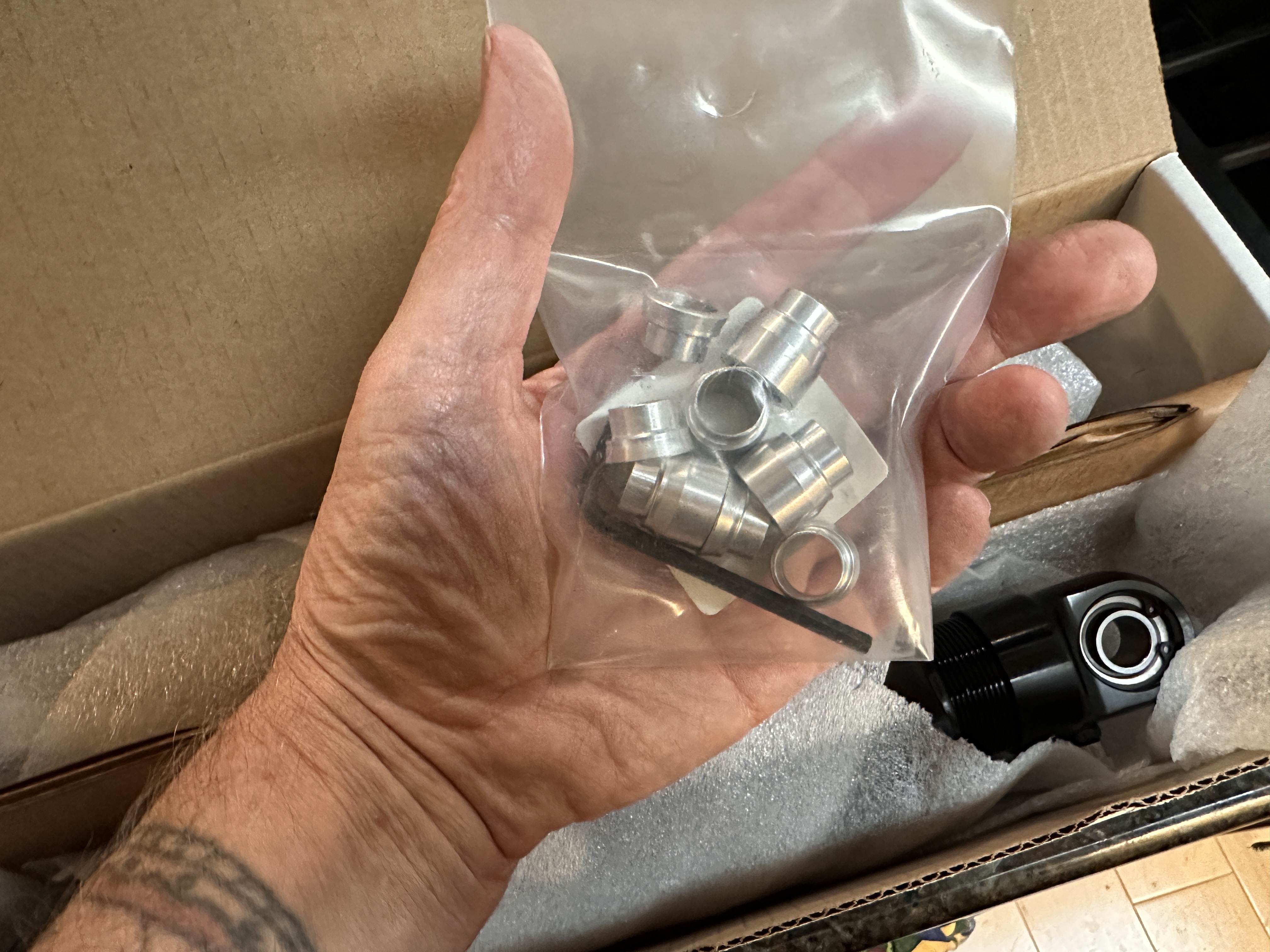
The lift kit brackets.Bushings and Allen wrench.Pretty! Shiny! Space Age looking!
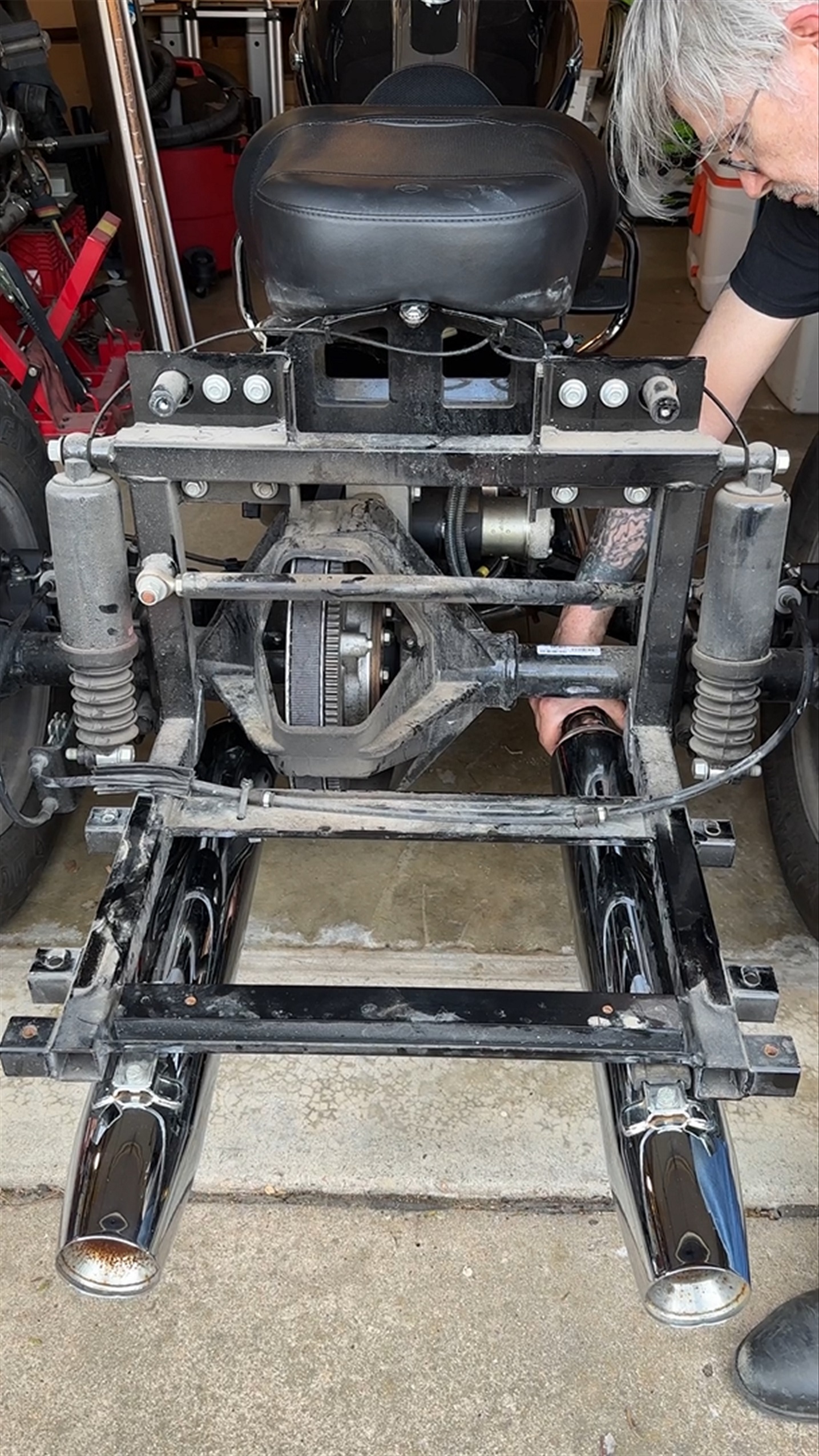
DK would have me believe I can R&R the shocks without removing the taco box from the trike. Maybe so, but I didn’t see it, so I removed the taco box first. No big thing: a handful of bolts and an electrical connector, and someone to help me wrestle the weighty, awkward sumbitch off the frame. Done and dusted!
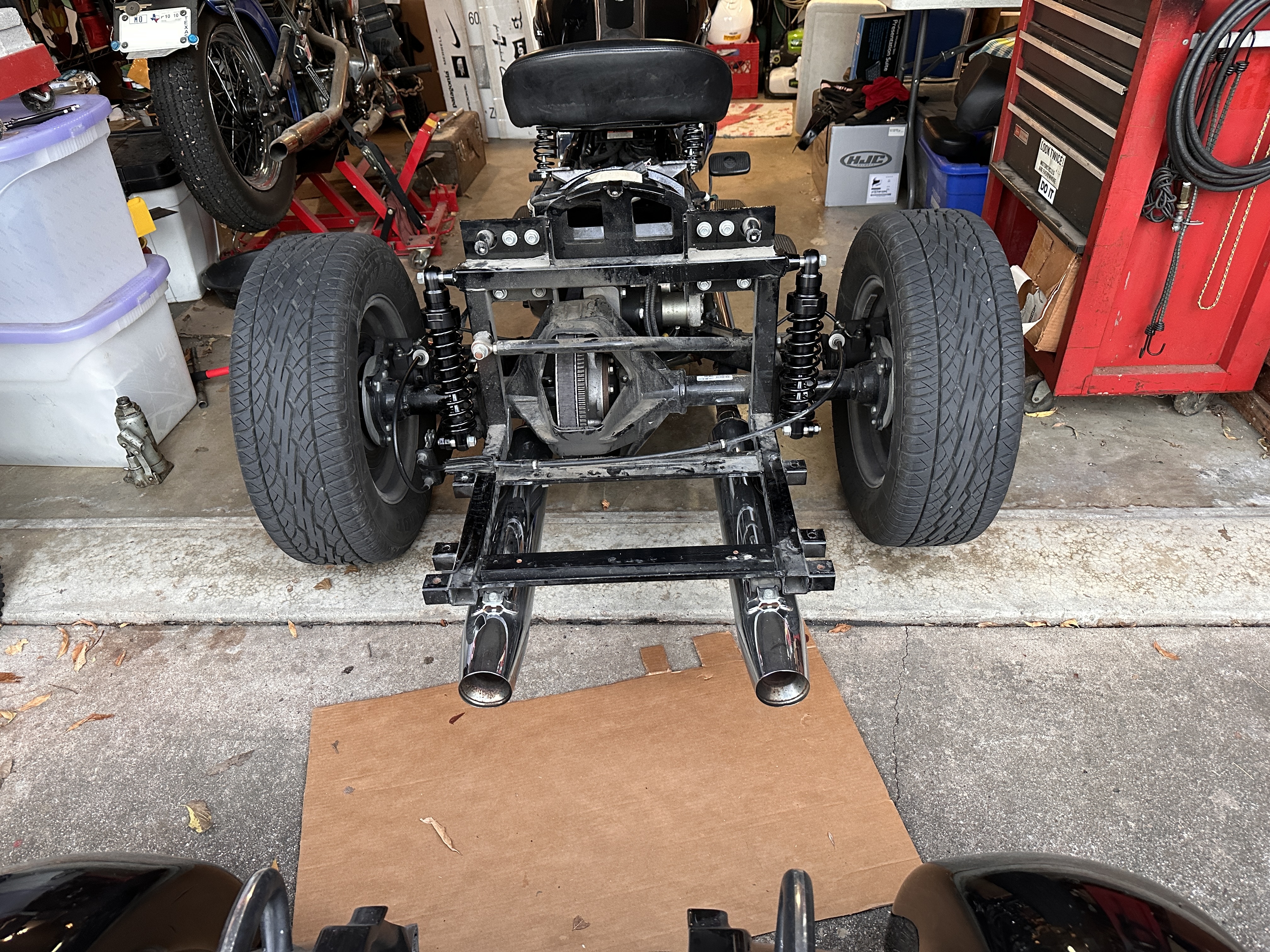
The FLRT sans bodywork, with useless OEM air shocks still in place.
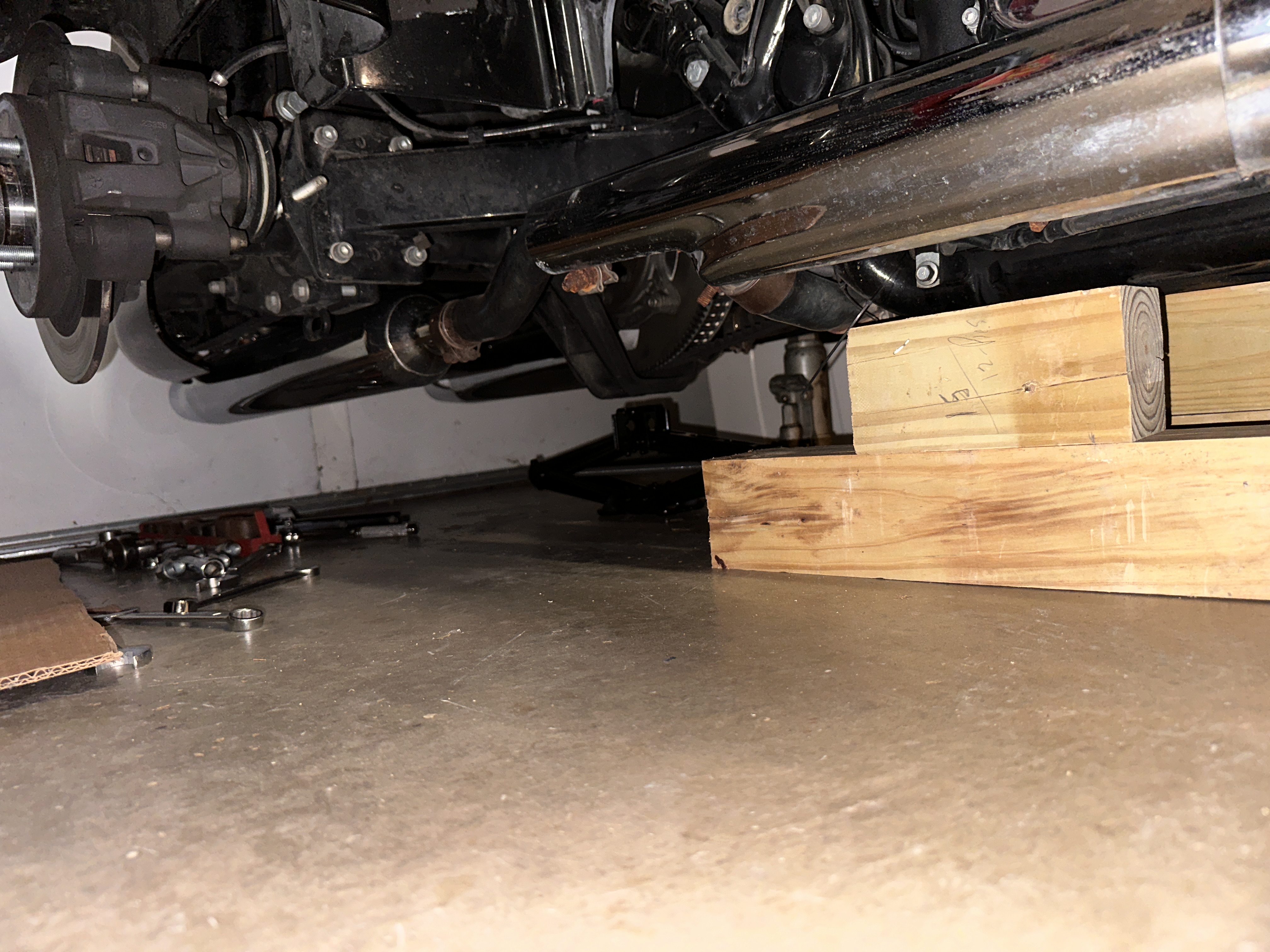
Had to jack the rear wheels off the ground and stabilize the rig, because the rear wheels are coming off.
You have to be careful where you place the jack and bracing. Consult your owner’s manual. I did!
Once the rear wheels are removed, the job is almost straight-up R&R, except that I’m adding the lift kit.
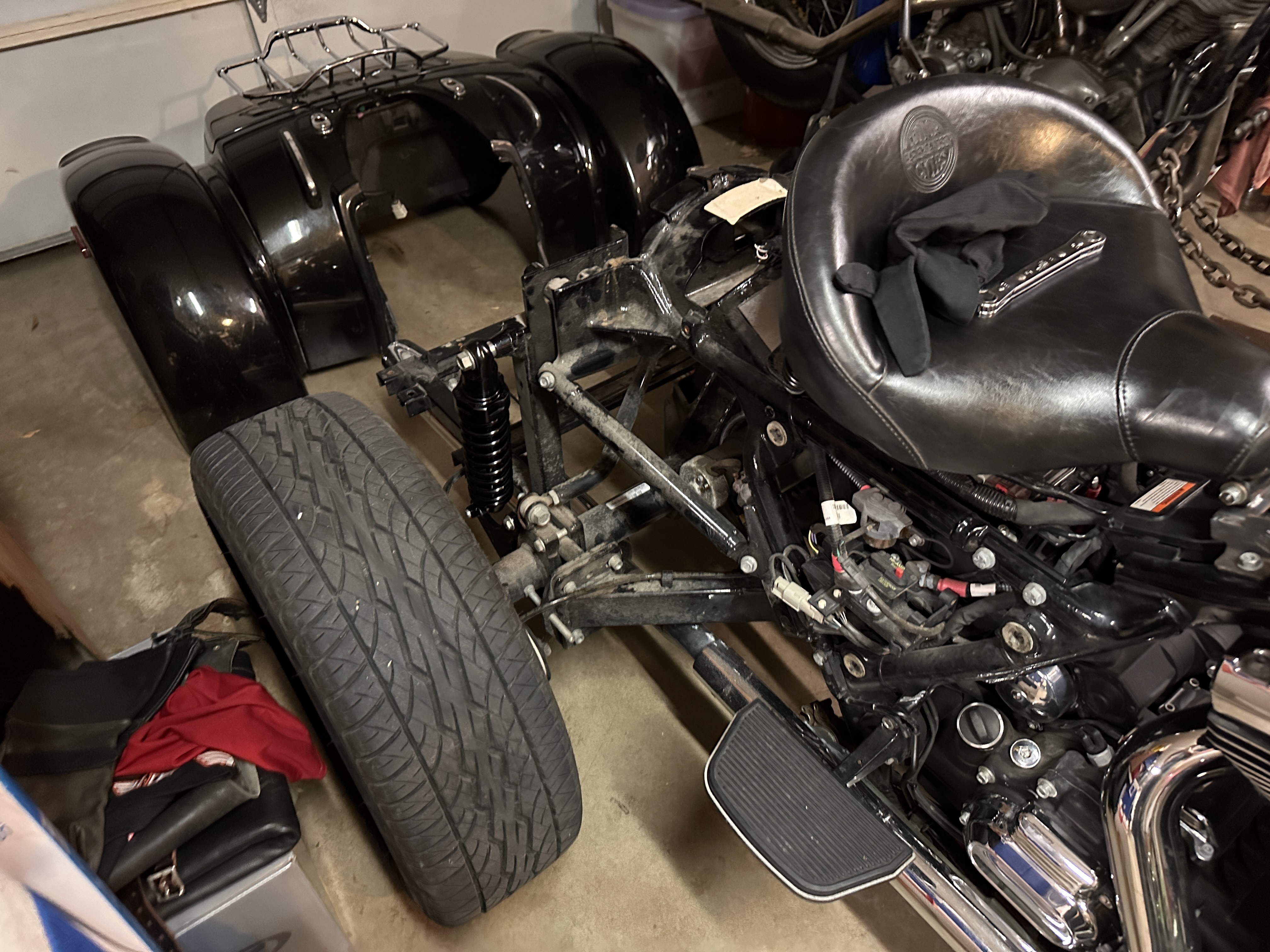
You can see the lift kit plate attached to the bottom shock mount. Note that the taco box comes off as a unit.New shock and lift kit, left side.New shock and lift kit, right side.
I got everything bolted up and jerry-rigged a taillight and took the trike for a ride, and…. no improvement whatsoever. 😳
Kit installed. Taco box to follow.
I contacted DK and followed their instructions to try and troubleshoot and resolve the issue, but wasn’t getting results. Then I got kicked up the chain of command to Devin, who designed the shocks. Between us, we sorted it out – turns out the initial adjustment specs I’d been given were off – and in the end I got the ride I’d been looking for. 👍🏽
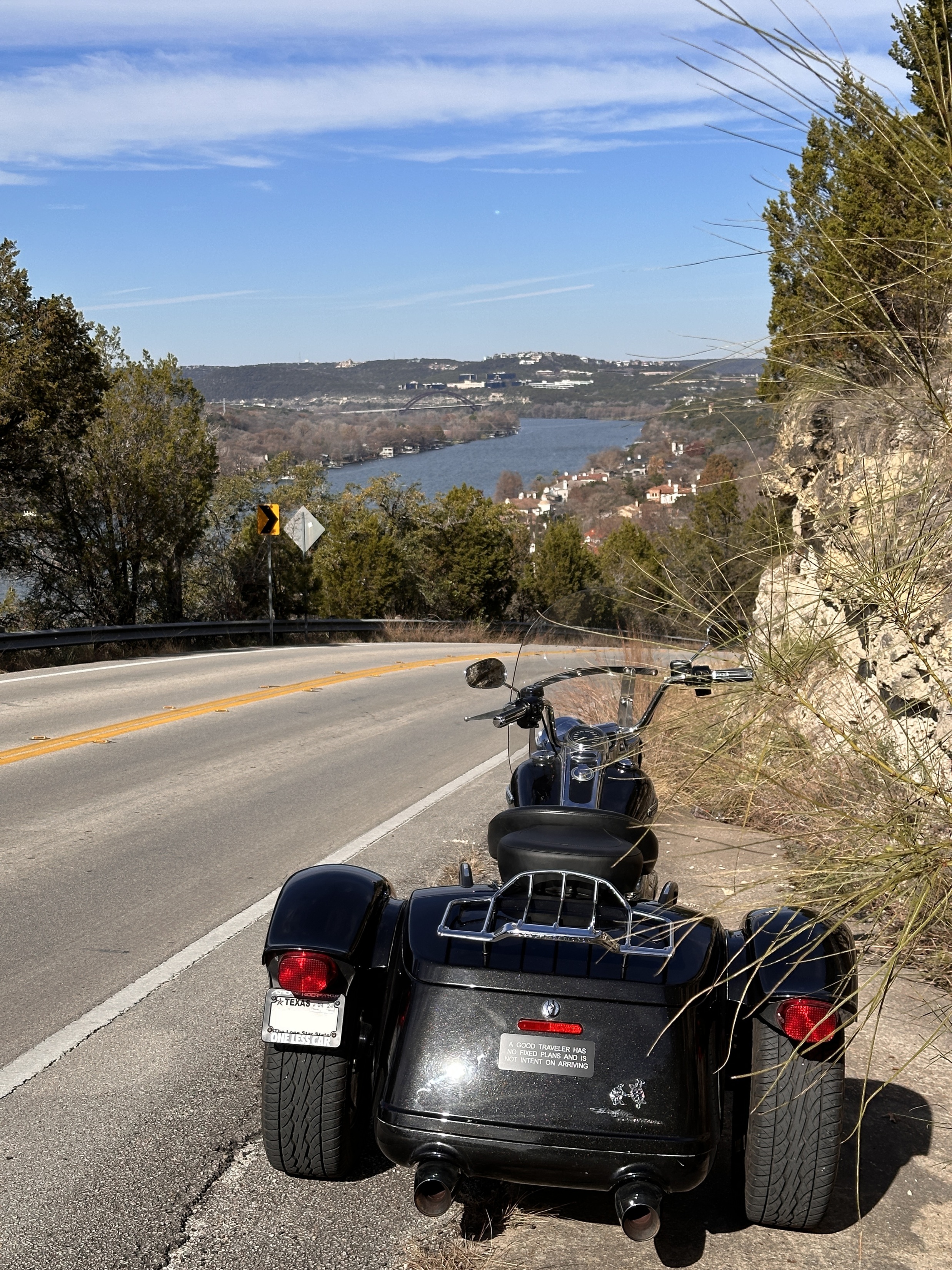
The Box Turtle on Mount Bonnell Road, overlooking scenic Lake Austin.
Note that it’s still a straight axle, and will never be a cushy ride, but it is a completely different beast from the OEM setup. Well worth the bucks, IMO, and I’d go back to DK Custom Products in a heartbeat. As stated above, they made a mistake, yes, but they also took full responsibility, which goes a long way in my book. They also gave me a little boot to make up for the added labor. I appreciate the hell out of that kind of customer service.
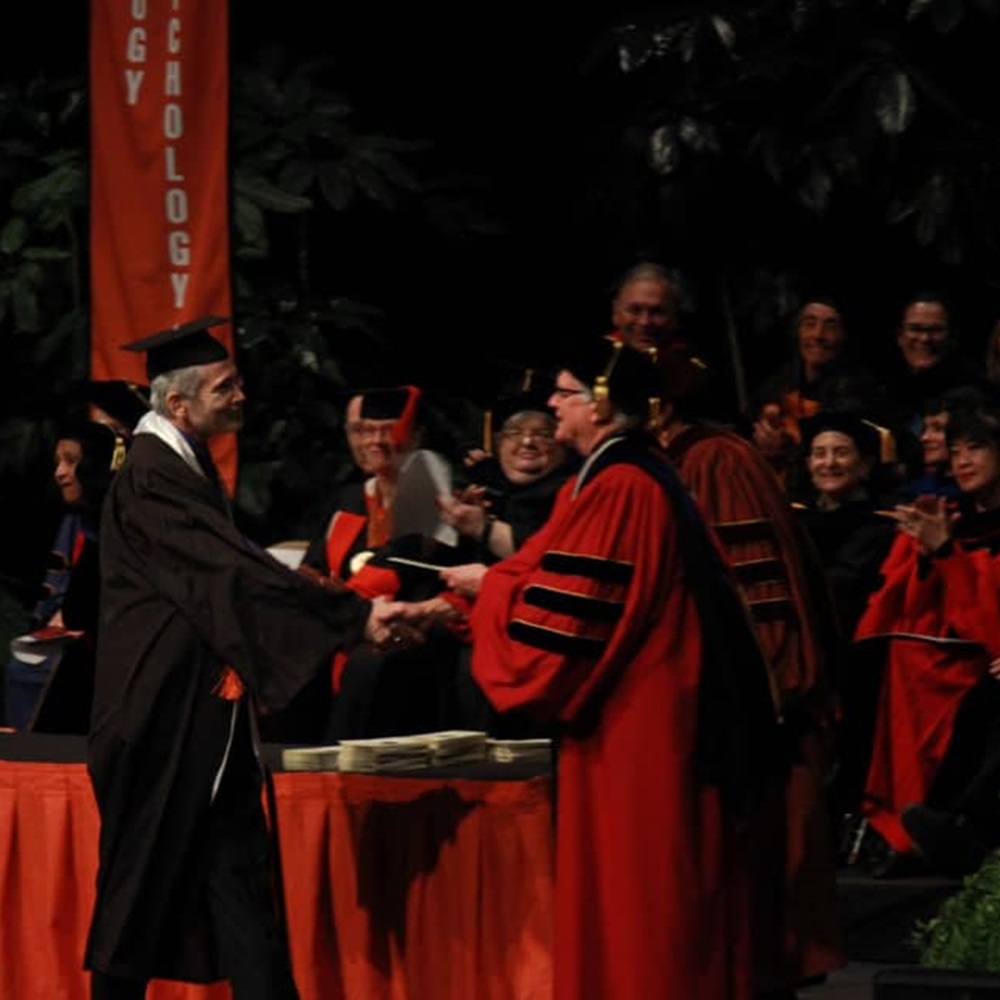
I was over fifty when I went back to complete the bachelor’s degree I’d started in January of 1979, at the age of twenty-two. It ultimately took me thirty-five years, gate-to-gate, to limp across the stage at the University of Texas and collect my degree in December of 2013, at the ripe old age of fifty-seven.
With honors, if you please! 😏
Every one of my siblings, some of their kids and a good number of in-laws were in attendance that day, raising the roof as I gimped across the stage. Mine was the last name called.
Anyhoo, as an English major, one of my classes was on poetry, and one day we were presented with a sonnet by William Shakespeare:
We followed that up with a modern-day retelling of the sonneteer’s great love by poet Harryette Mullen, from her book Sleeping with the Dictionary (2002, University of California Press, Oakland).
Then we were pressed to create our own. Me being the biker what I are, I decided to have some fun with it. As you will see (at least, I hope you see), I relied heavily on stereotype for broad comic effect. 😏
I’m pretty sure I also got an A on the assignment. 🤣
* Obligatory (but still true) Disclaimers:
First; I really have never met any of the models from Easyriders, and have no idea what kind of women they are. The characterization is used here only for effect, in keeping with the narrator’s ‘voice’, and does not reflect my own or The Shovel Shop‘s opinion of said models.
Second; and I cannot stress this enough: this is not a description of my wife, or any woman I have ever been involved with! I swear! 😆
Anyhoo, I hope y’all enjoyed this brief meander down the garden path. I’ve been busy getting Jackie and I, The Shovel Shop and MMMoMMA settled in our new quarters at San Antonio, Texas. We will resume our regularly-scheduled chaos ASAP.
‘Til then, ride free, ride safe, but most of all, ride! 😎
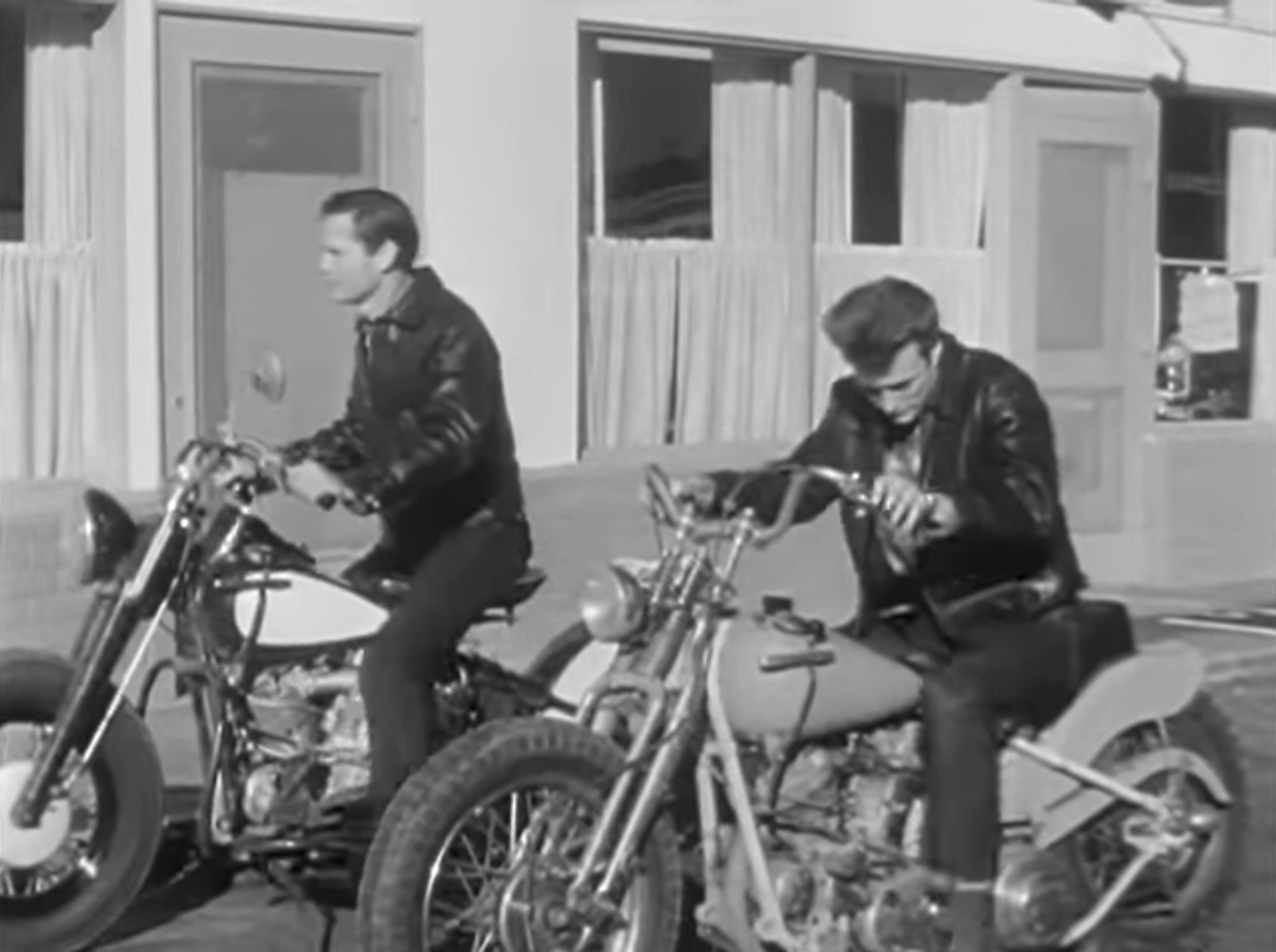
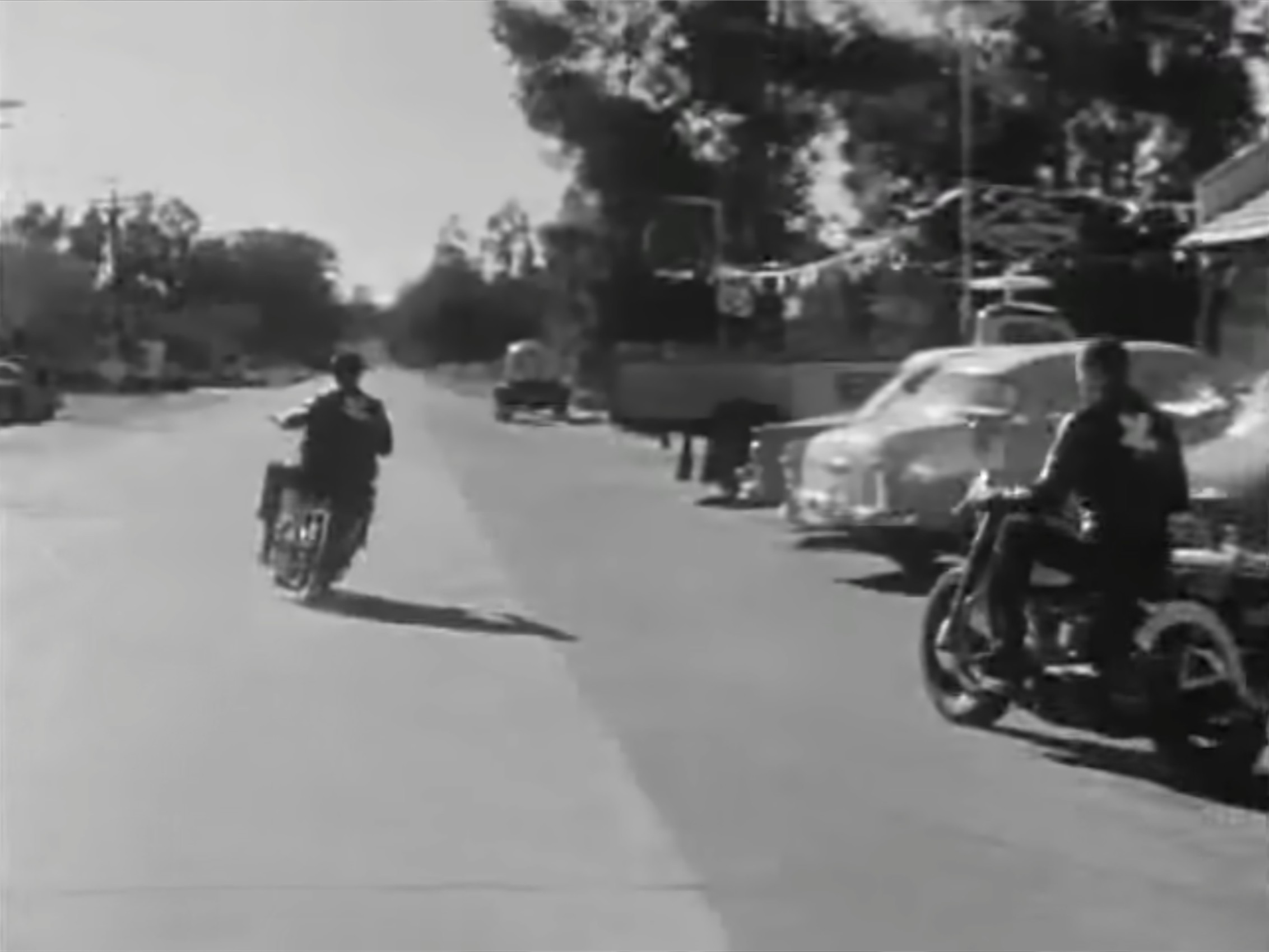
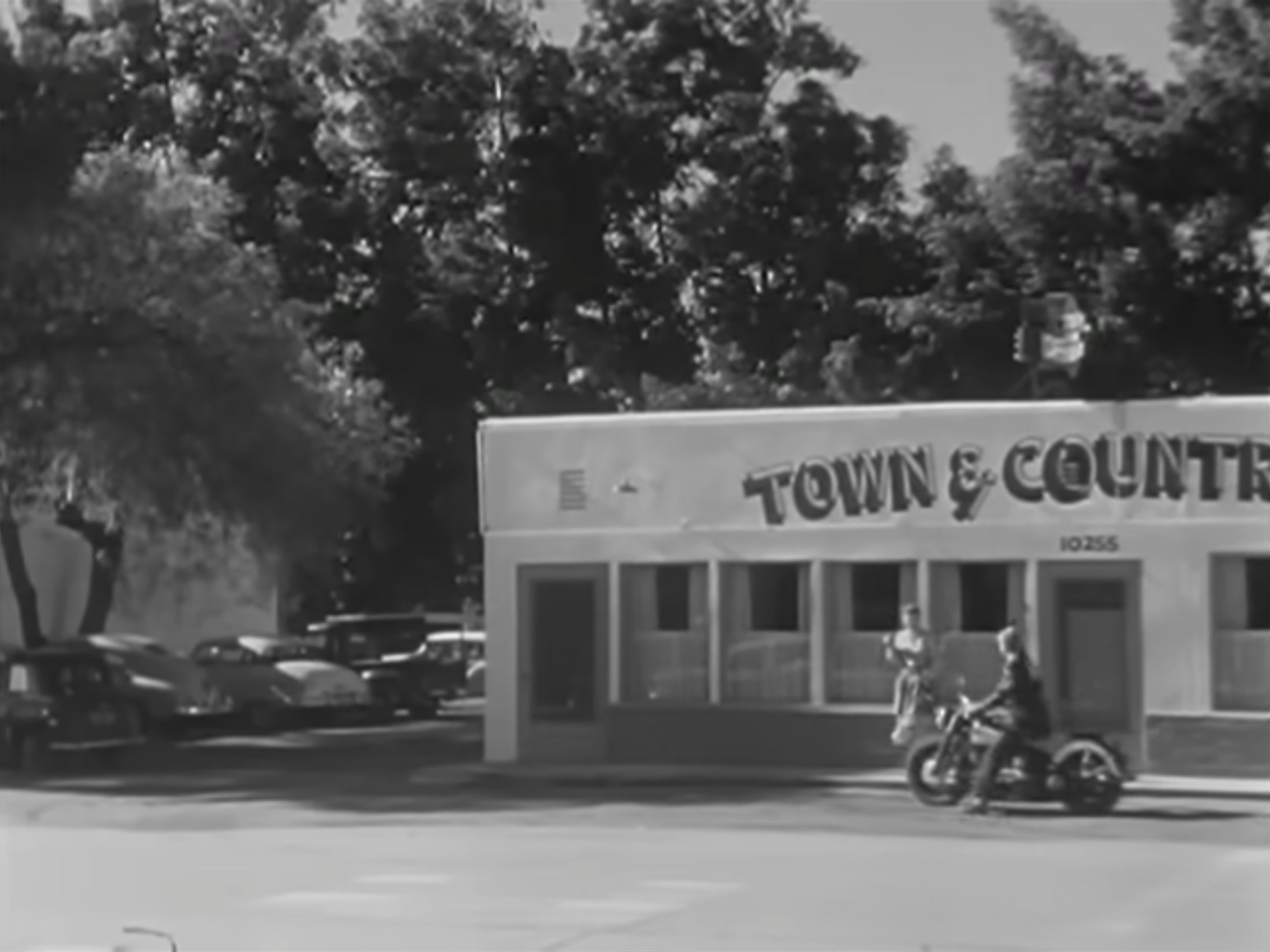
Clint Eastwood and John Compton ride into town on bobbed Big Twins. Both were filmed riding, and both handled the tank-shift motors easily. It was obviously not their first time on bikes!
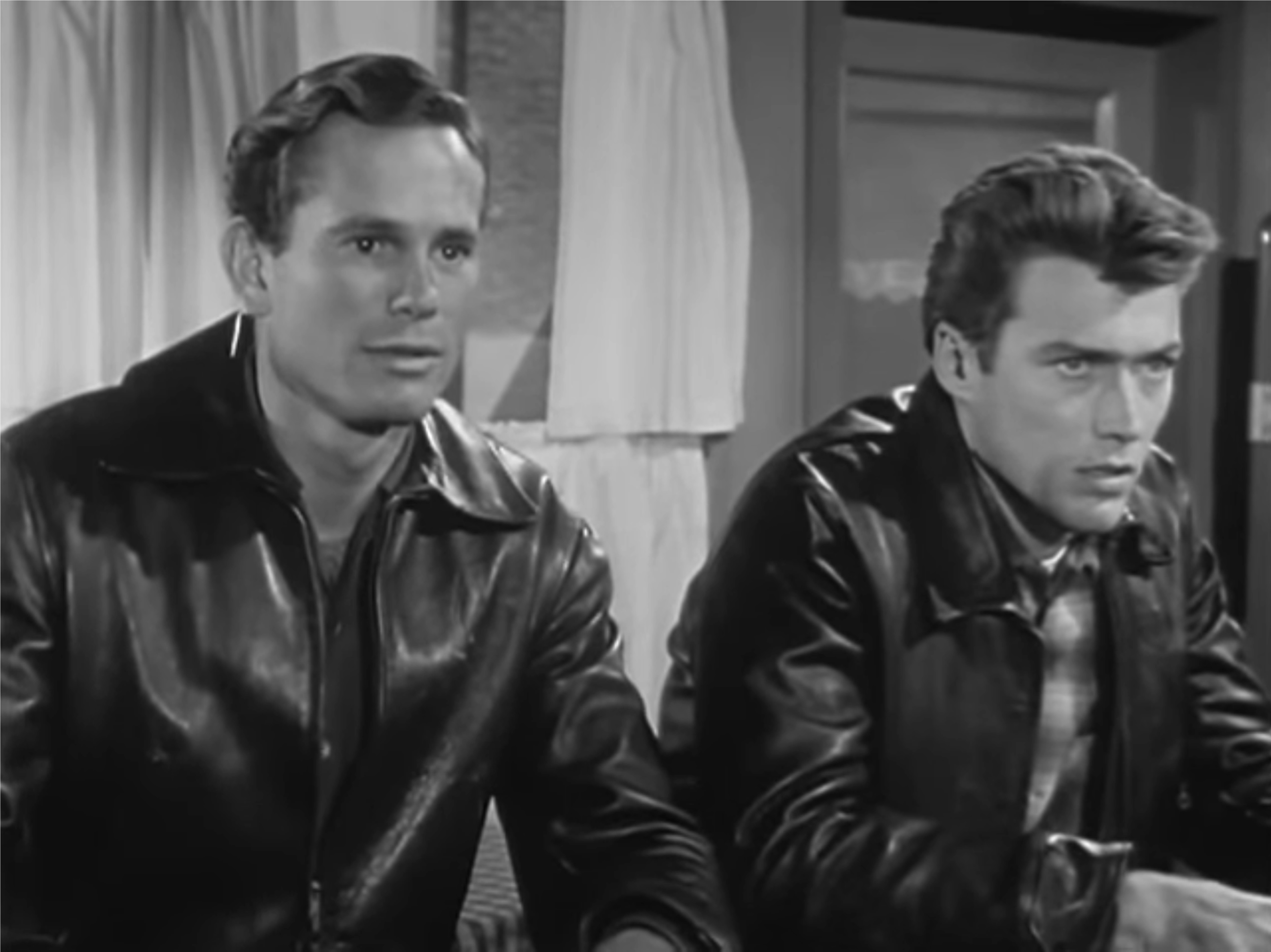
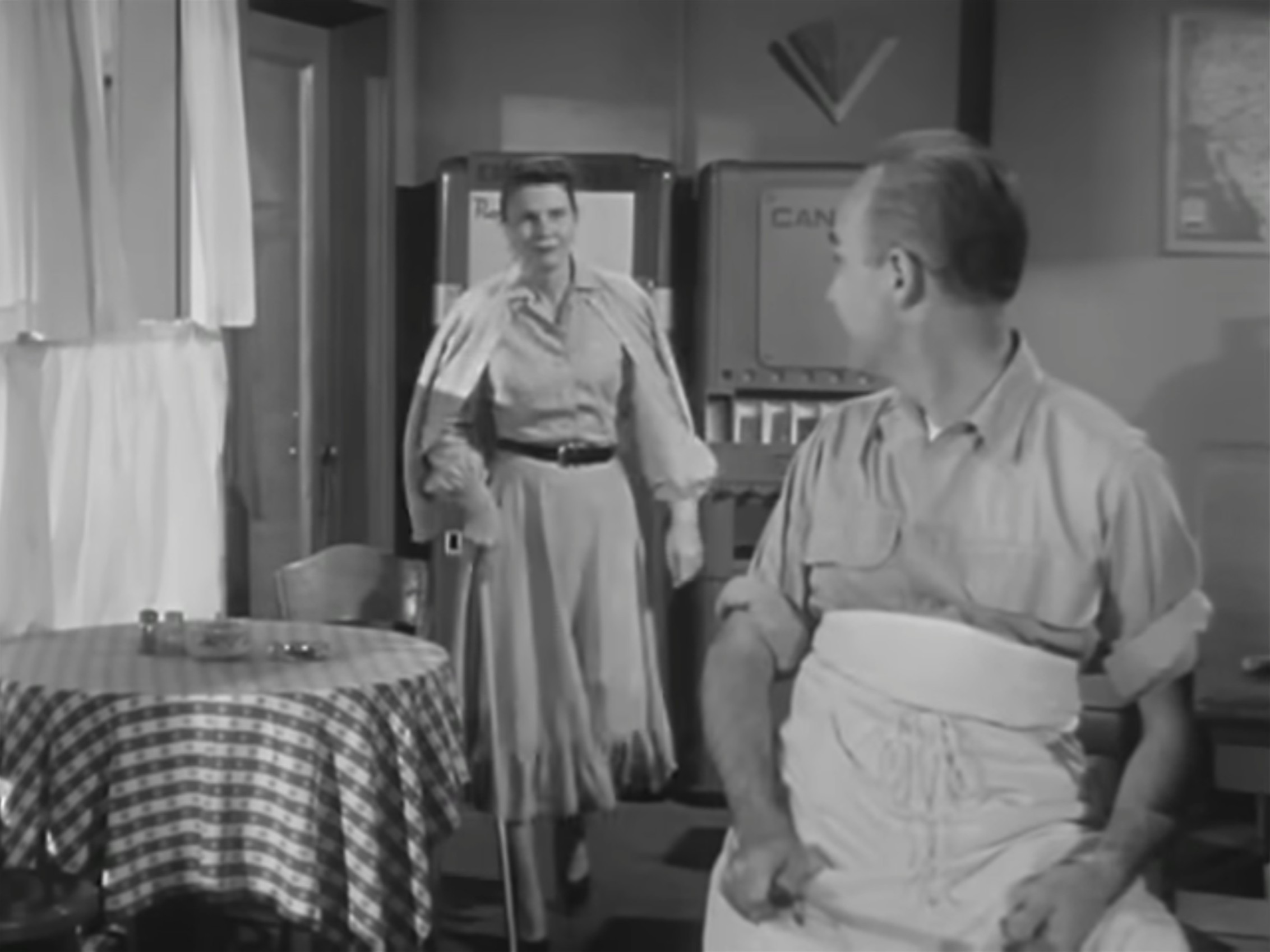
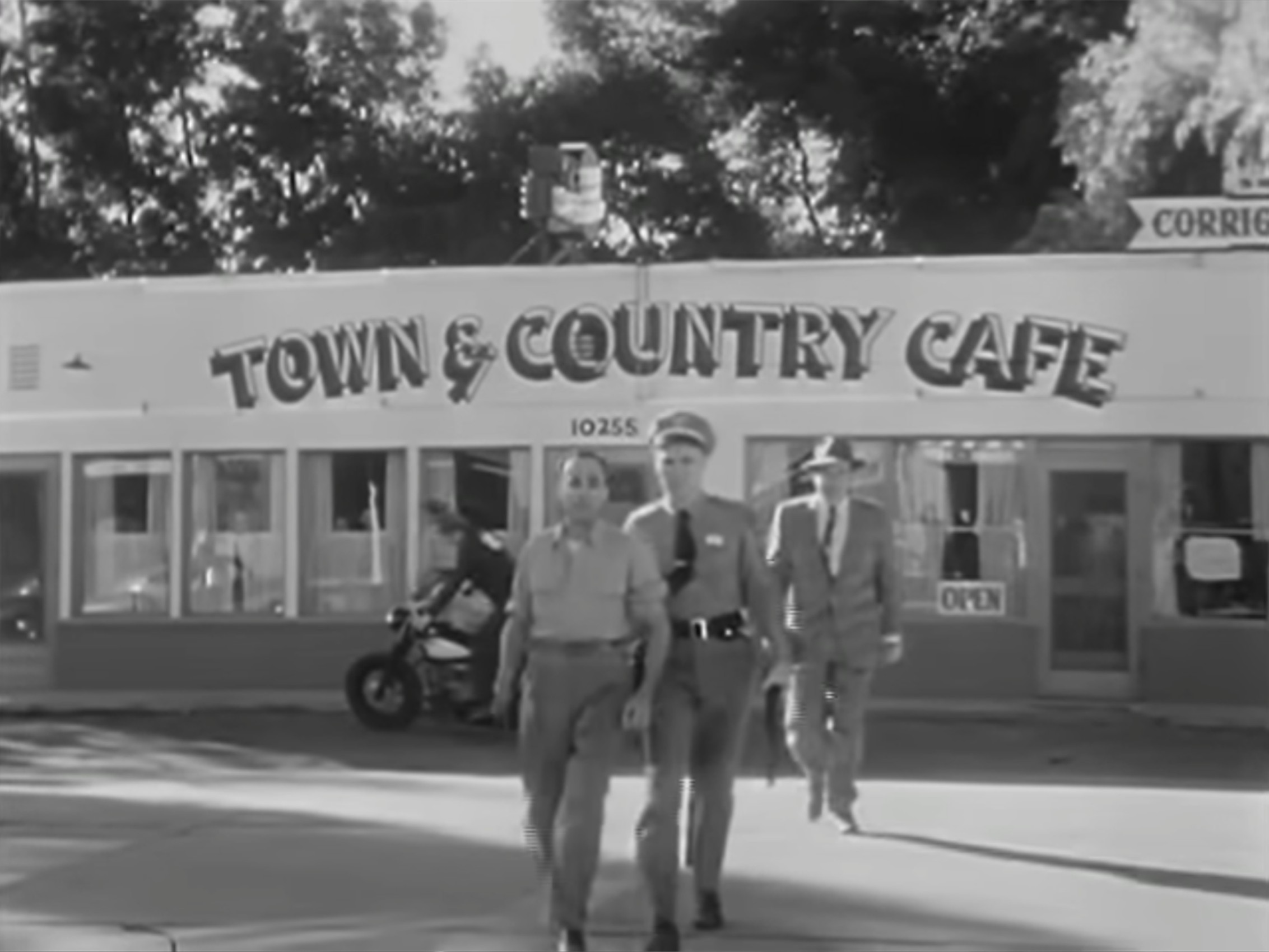
In an episode of the 1950s television show Highway Patrol, aired 2 April 1956, two motorcycle club members (Clint Eastwood as ‘Joe Keeley’ and John Compton as ‘Nick West’) ride their stripped-down Harleys into a small town and stop at a café for breakfast. They are shocked when the café owner (Jack Edwards as ‘Bernie Sills’) confronts them with a shotgun, forces them outside and orders them to leave.
We just want somethin’ to eat, mister.
It turns out the café owner’s wife (Paula Houston as ‘Mrs. Sills’) was injured during a ‘motorcycle raid’ by a renegade club eight months earlier. Sills just assumes that because Joe and Nick are on bikes and wearing leather jackets, they must be part of that renegade club.
‘Mrs. Sills’ (Paula Houston) limps into the café, and is greeted by her doting husband, ‘Bernie Sills’ (Jack Edwards).
As his wife calls the Highway Patrol, her husband menaces and provokes the bikers until Nick snatches the shotgun from Sills and punches him on the jaw. Joe drags Nick away, they jump on their bikes (accurately customized in the fashion of the day, BTW) and roar out of town.
Nick and Joe make their getaway.
When Sills learns that his wife has called the Highway Patrol, the first thing he does is hide the gun. Then he lies to the responding officer, who is also on a motorcycle, telling him the cyclists started the trouble, that they’re dangerous and so on. Relying on the café owner’s words, the motorcycle cop sets off in hot pursuit of the bikers, only to be struck and fatally injured by a distracted trucker who runs a red light.
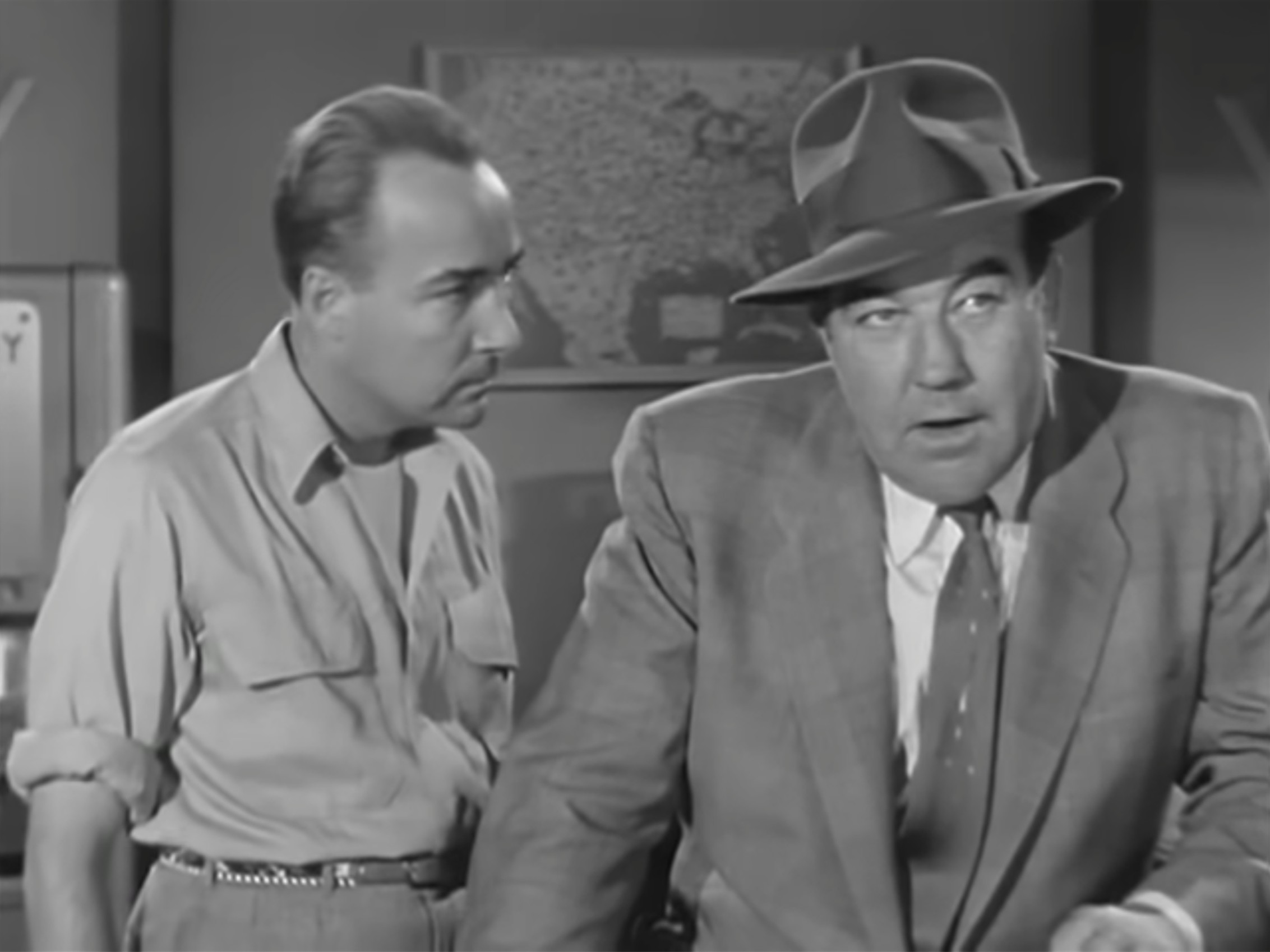
Sills is there when Broderick Crawford (‘Chief Dan Mathews’) shows up, and does his best to convince the head cop that those ‘cycle bums’ are responsible for the patrolman’s crash. He swears out a complaint against the bikers for ‘disturbing the peace’, infuriated that a more serious charge can’t be laid against them immediately.
‘Captain Dan Mathews’ rolls his eyes at Bernie Sills, who is vehemently insisting that ‘those cycle bums’ are responsible for the patrolman’s crash.
Back in his squad car, however, Mathews questions the café owner’s story — he doubts two bikers would take on an entire town — and tracks them down solely to question them as possible witnesses. When he hears their version of the morning’s events, he is incensed that Sills lied to him, so Mathews sets a trap for Sills. He outfits one of his motor patrolmen with a customized Harley and a borrowed motorcycle club jacket, and sends him into town to stop at the café.
A Highway Patrol officer in mufti, wearing a jacket borrowed from Nick and Joe’s club, shows up for breakfast at the Sills’ café.
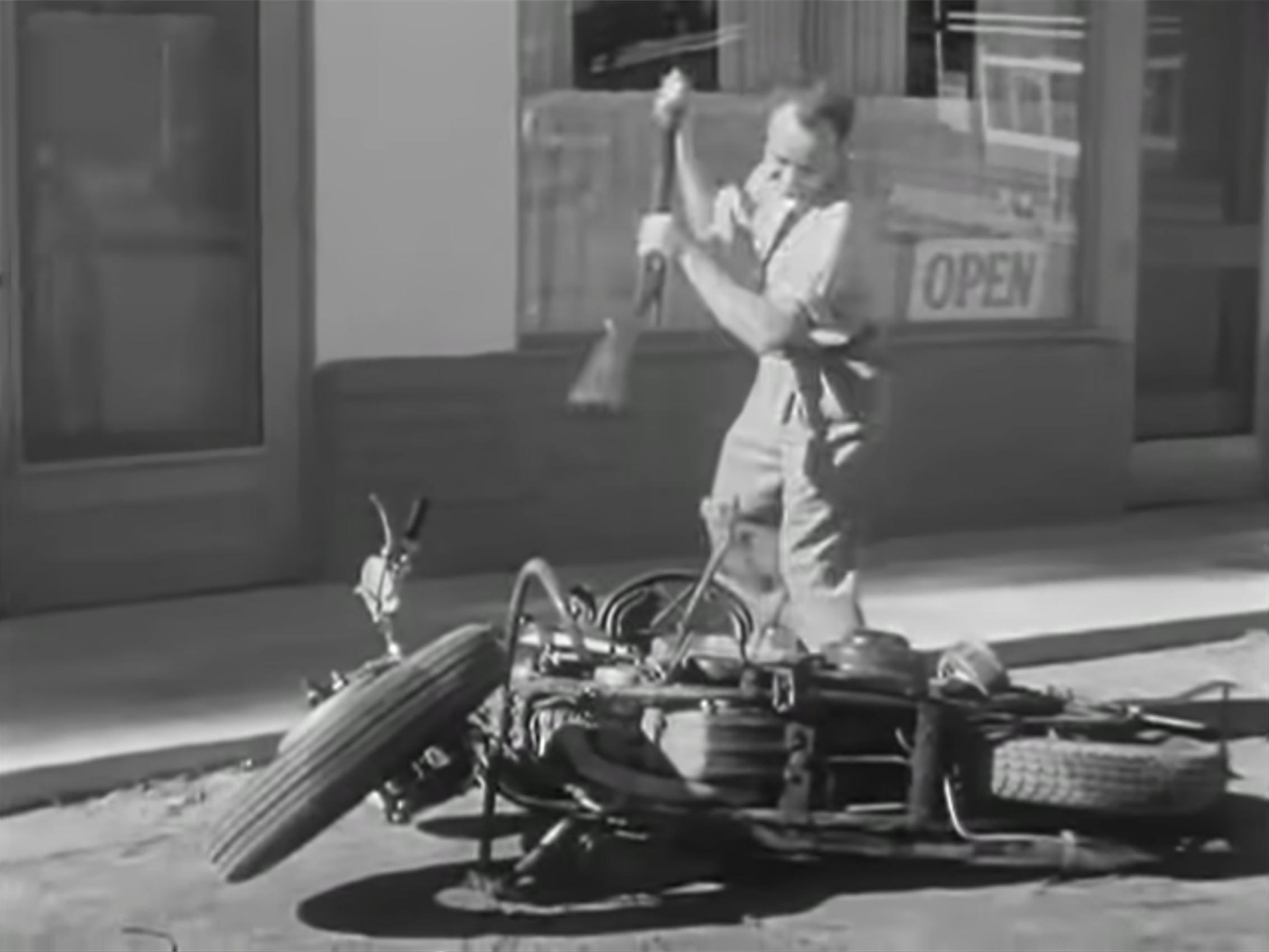
Sure enough, Sills goes off on the ersatz ‘biker’, knocking over his Harley, beating on it with the stock of his shotgun, and threatening to shoot the ‘biker’. Sills even admits he’s using the same shotgun he used on Joe and Nick.
Sills vents his rage on the patrolman’s motorcycle, not realizing that Dan Mathews is watching from across the street.
At that point, Mathews and his driver appear, having witnessed the entire incident, and arrest Sills on two charges of assault with a deadly weapon. As he tries to weasel his way out of the trouble he’s in, the café owner’s wife calls him a bitter old fool, and vows to tell Mathews the truth about the incident with Joe and Nick.
‘You’re not gonna arrest me, are ya?’‘We sure as hell are, asshole!’
I tracked this episode down because, as a longtime biker, I’m interested in anything and everything to do with our history, and this episode is part of that history.
HISTORY
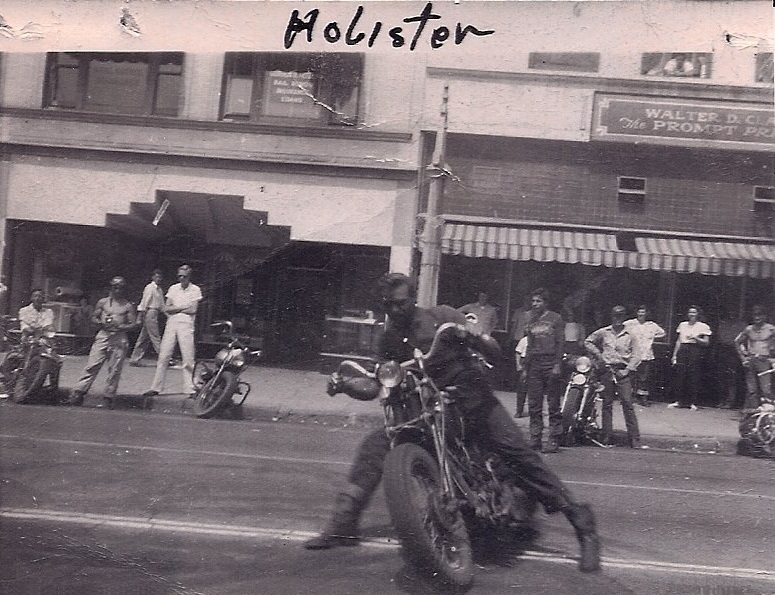
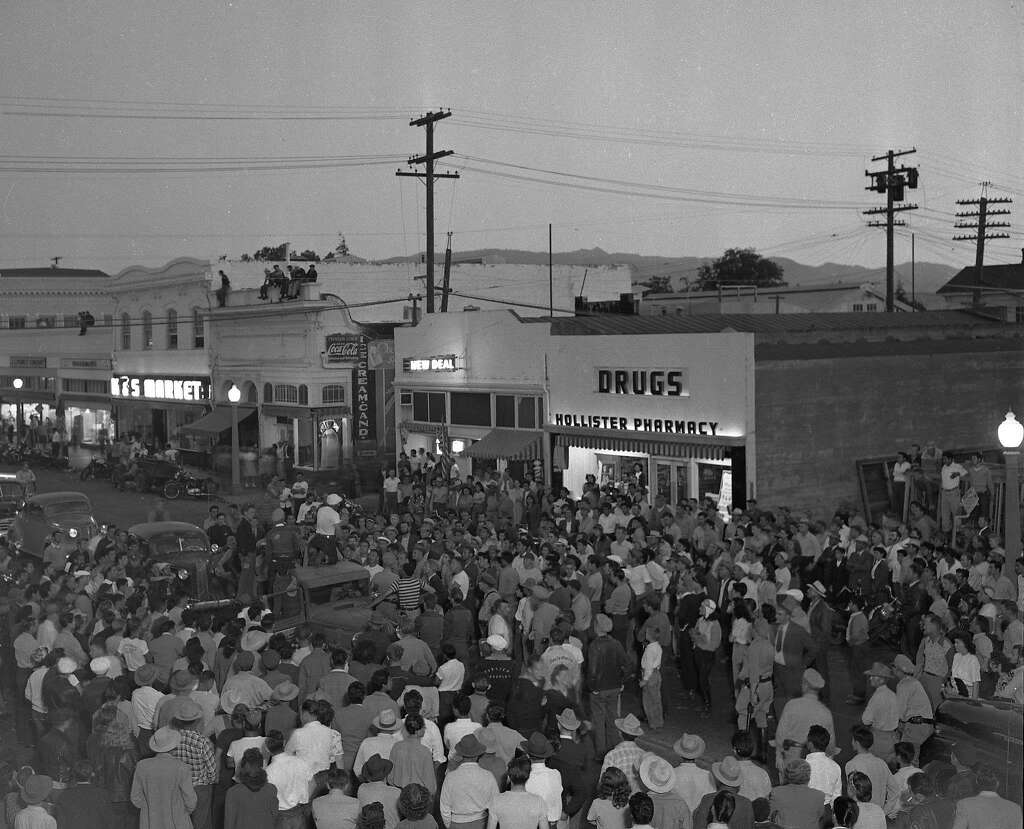
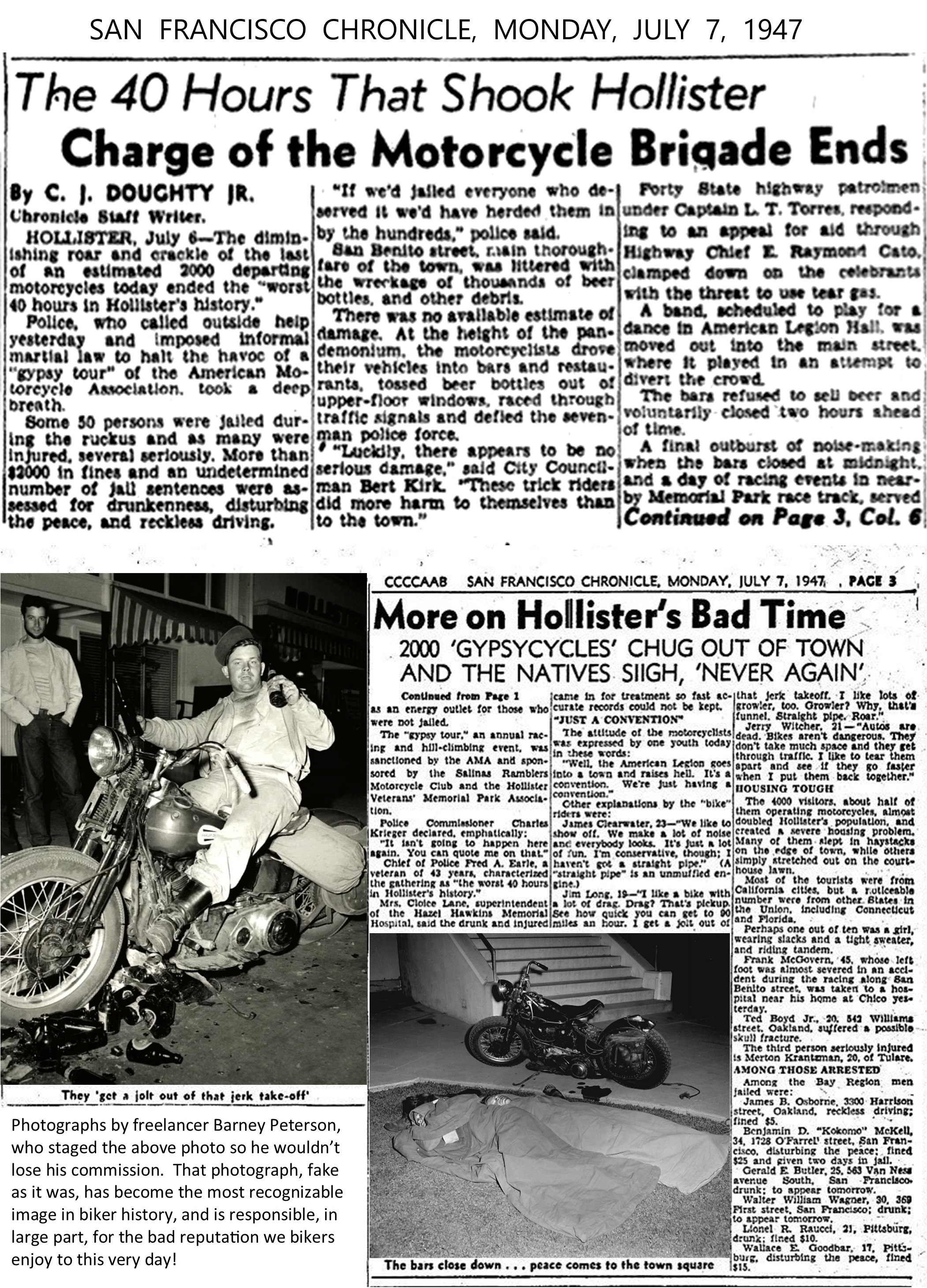
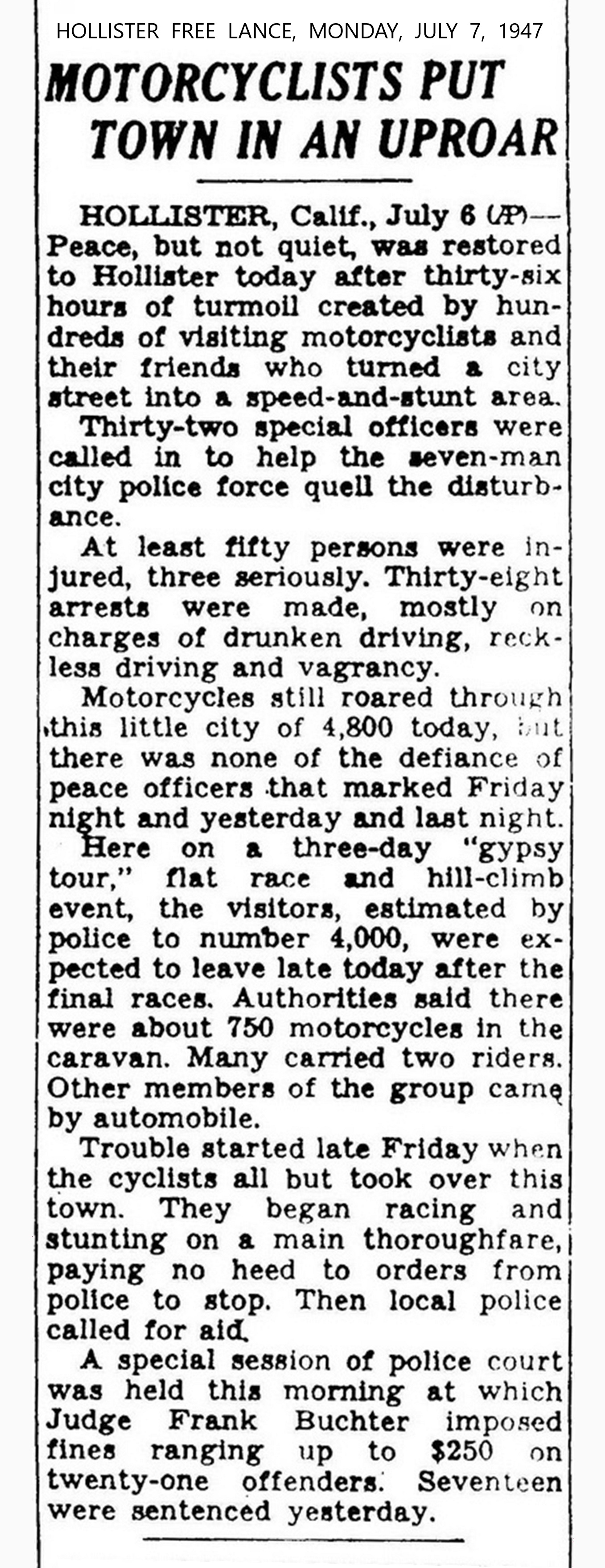
The ‘outlaw biker’ of today first became an identifiable character in the summer of 1947, when the town of Hollister, California, hosted a Gypsy Tour (a large motorcycle rally) which included races, hill-climbs, tire-kicking and socializing. This event was sanctioned by the AMA – the American Motorcycle Association, as it was then known – and drew a large number of ‘straight’ clubs: mom-and-pop touring clubs and sport-minded racing clubs.
‘Little Bobby’ Kelton of the Wing Nutz MC does donuts on the main drag of Hollister in July, 1947.
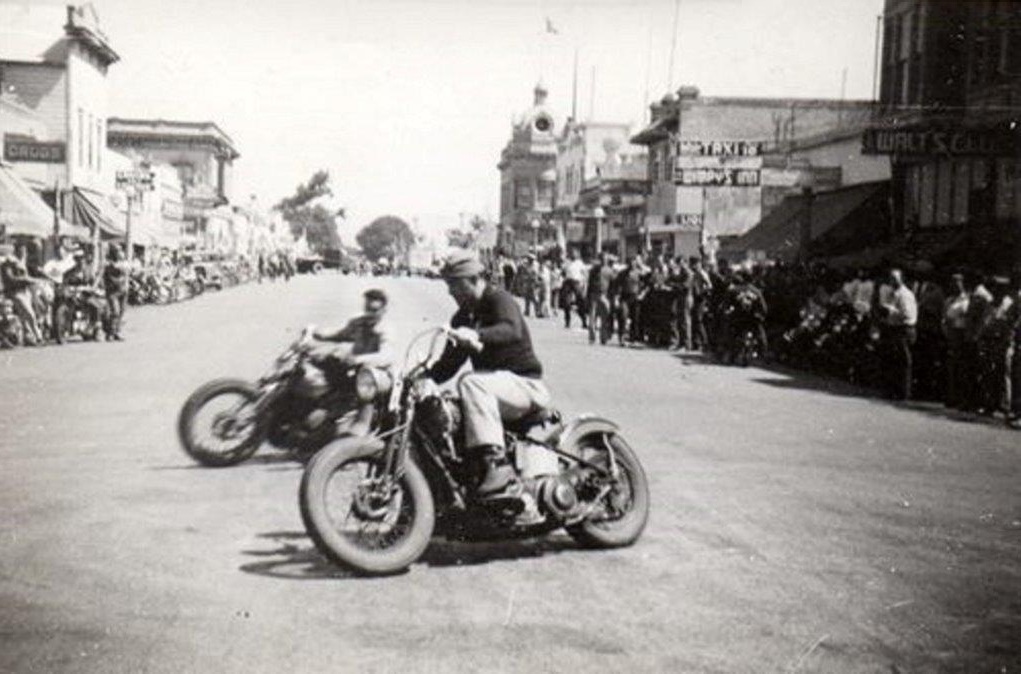
However, a small number of clubs, with names like Galloping Goose and Boozefighters, and comprised primarily of recently returned World War Two combat veterans, were more interested in partying than anything else, and began drinking, brawling, racing and performing motorcycle stunts on the town’s main drag.
Boozefighters MC members play games in the street, as townspeople and other riders watch.
Some windows were broken, some people were arrested, and the overwhelmed local police called the Highway Patrol in to assist in restoring order. This was finally accomplished by commandeering a dance band and a flatbed truck to serve as a stage. The damages were paid for on the spot, and the roughhousing came to a halt as the rebels took to the streets to dance!
Crowds boogie-woogie around a makeshift bandstand.
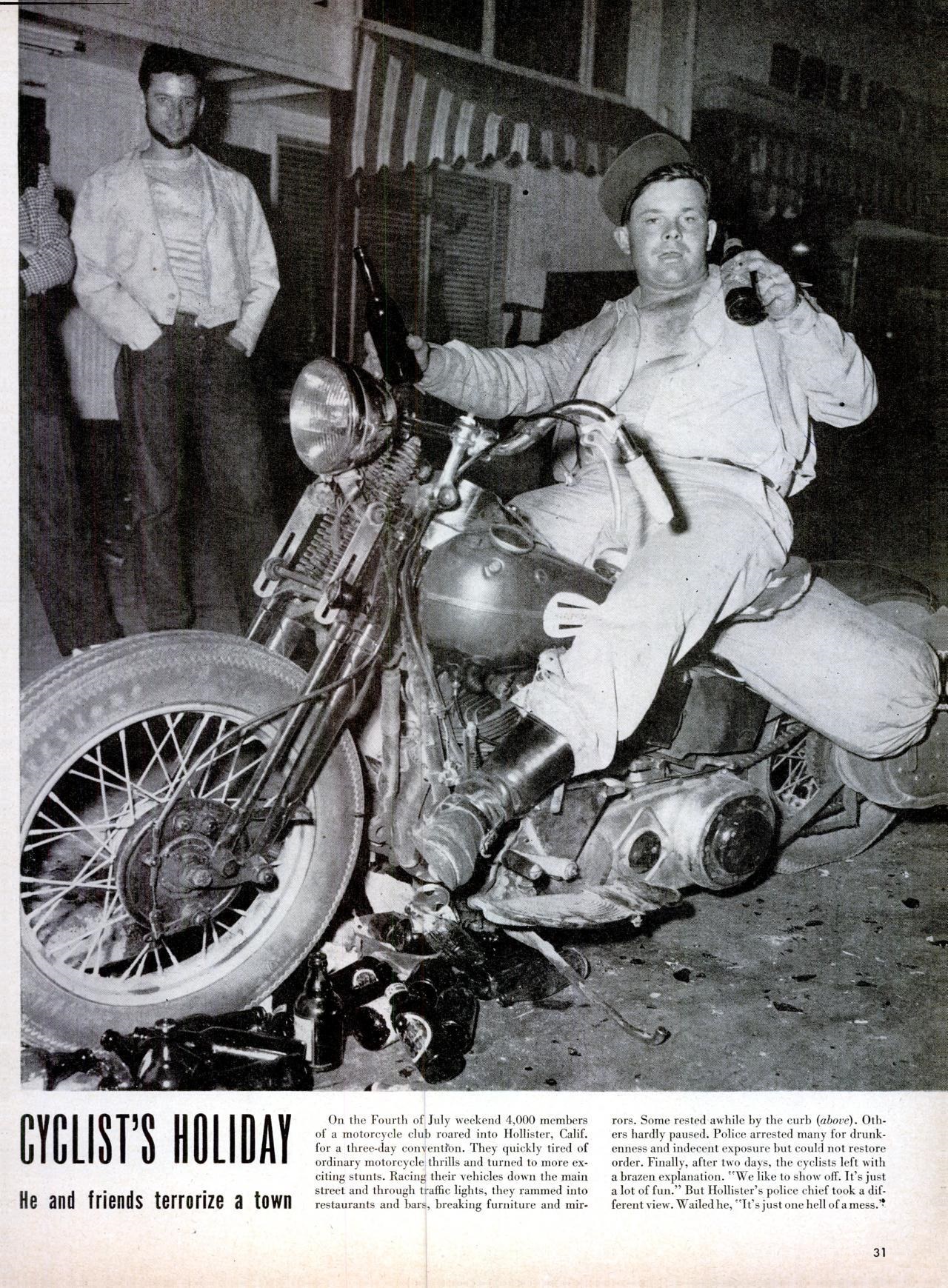
It would have been a non-story but for the efforts of an enterprising (and desperate) photographer named Barney Peterson. The San Francisco Chronicle sent Peterson to photograph the reported carnage, but he reportedly arrived too late to capture anything but the peaceful aftermath. According to witnesses, the photographer, eager to secure his commission, artfully arranged broken beer bottles beneath a bike parked at the curb, to make it look as if the town were awash in drunken revelers, and then grabbed a local fellow named Eddie Davenport and posed the visibly intoxicated Davenport on the bike with a bottle in each hand.
The resulting photograph appeared in LIFE magazine two weeks later, and seared the image of bikers as drunken louts and ruffians into the consciousness of Americans from coast to coast. Similar shenanigans at a rally the following summer, in Riverside, California, cemented that image.
August ‘Gus’ Deserpa, the young bearded man seen in the background of this photo, was a projectionist at the local theater. He had just gotten off work and wanted to check out the scene. Later, he told researchers that photographer Barney Peterson had staged the shot, gathering and arranging beer bottles around the parked motorcycle to make it seem the debauchery was worse than it really was. The myth of the ‘outlaw biker’ is based on a lie that traveled around the world in the pages of a popular magazine.
The AMA reportedly insisted that ‘99% of all motorcyclists are upright, law-abiding citizens,’ and announced that the clubs misbehaving at Hollister and Riverside would be ‘outlawed’ by the AMA. This merely meant that its members would be barred from taking part in AMA-sanctioned competition – a harsh punishment for a club that cared about winning trophies and national titles.
However, for a band of hooligans that described itself as ‘a drinking club with a motorcycle problem,’ the way the Boozefighters MC did, being ‘outlawed’ was a badge of honor. It wasn’t long before certain outlawed clubs (and those that aspired to be) devised a diamond-shaped 1% patch, which marked them as proud members of the 1% of all motorcyclists who did not fit in the AMA’s neat white-picket-fence world. They would be the elite, the baddest of the bad.
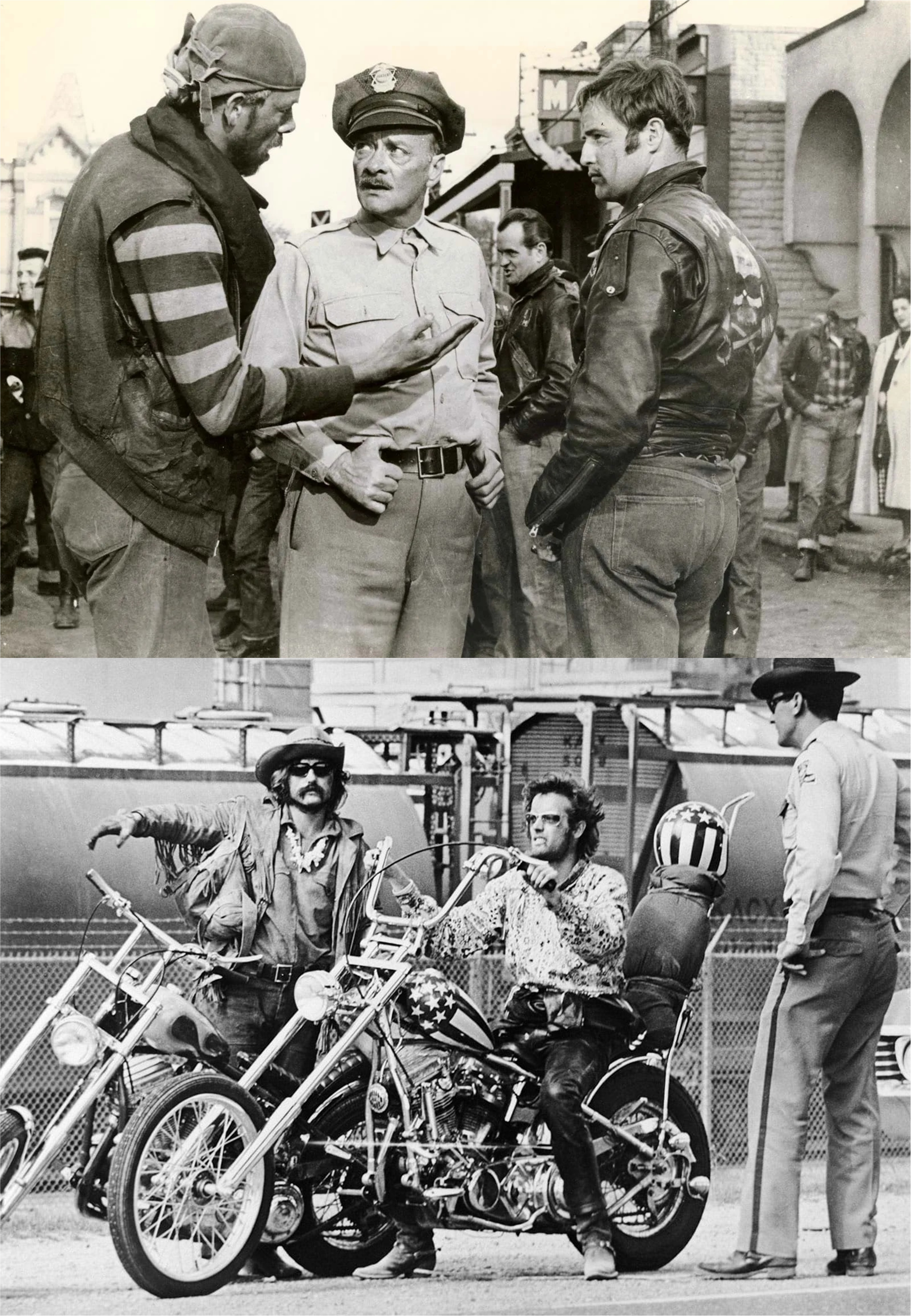
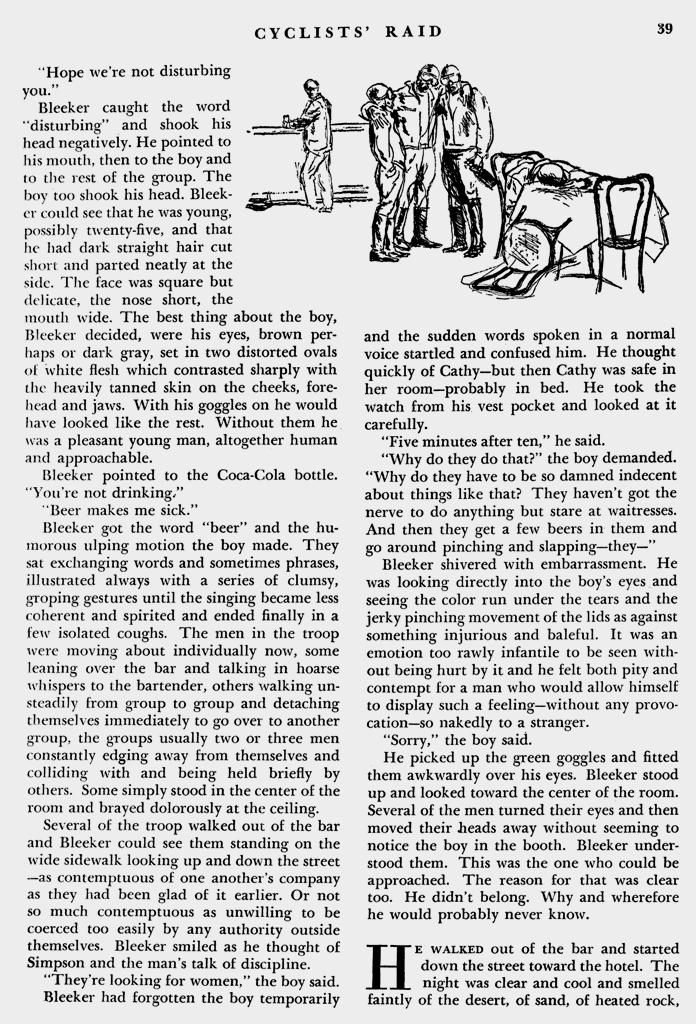
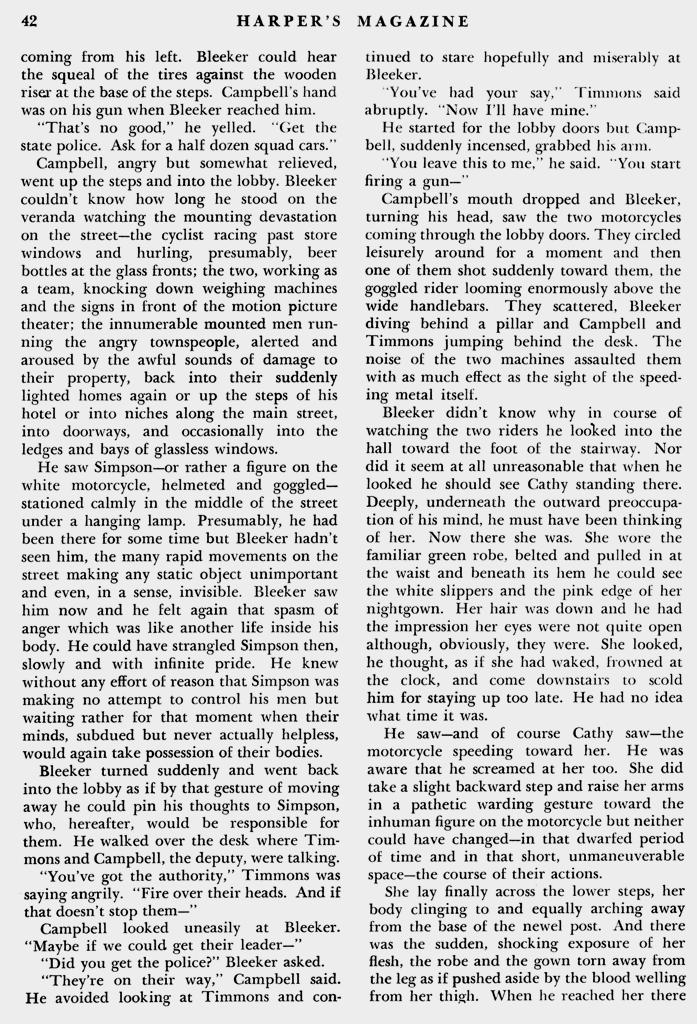
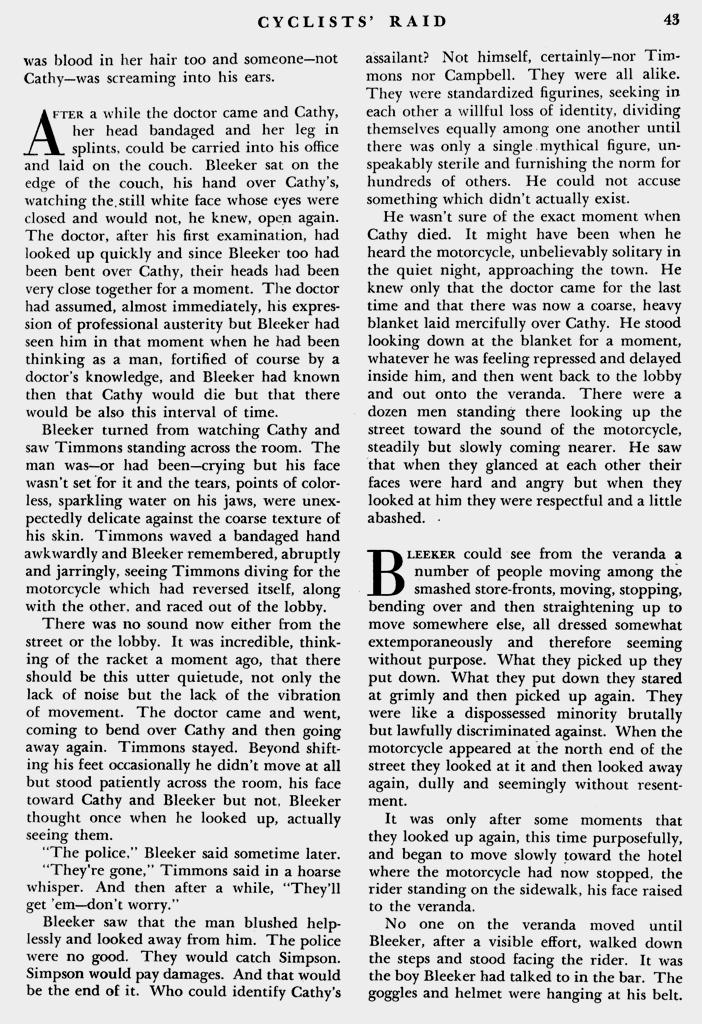
Rooney’s ‘Cyclist’s Raid’ and the real-life events at Hollister and Riverside helped inspire Stanley Kramer’s 1953 film The Wild One, which featured a smarmy motorcycle club leader (Marlon Brando as ‘Johnny Strabler’) opposite a far more realistic biker named ‘Chino’ (Lee Marvin) and his outlaw club, The Beetles. That, in turn, led to the April 1956 airing of the Highway Patrol episode titled ‘Motorcycle A’.
So why is this relatively unremembered half-hour television program worth all this verbiage? Well, kids, it stands out because, unlike The Wild One or Rooney’s fiction, or a lot of newspaper reports of the day, the bikers in this Highway Patrol episode are not the bad guys!
See? History, made fresh right here! 😁
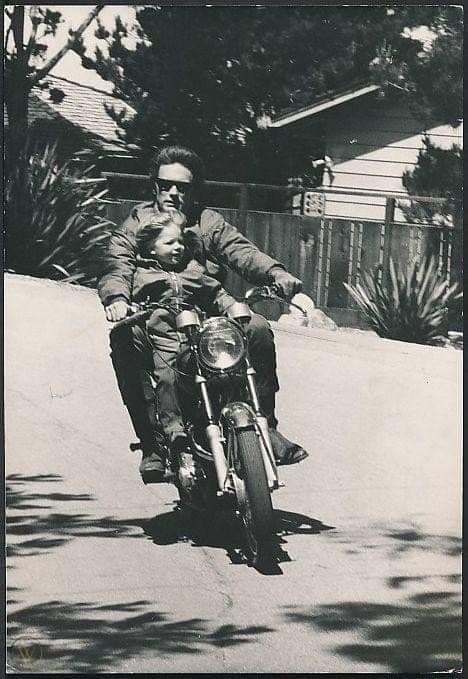
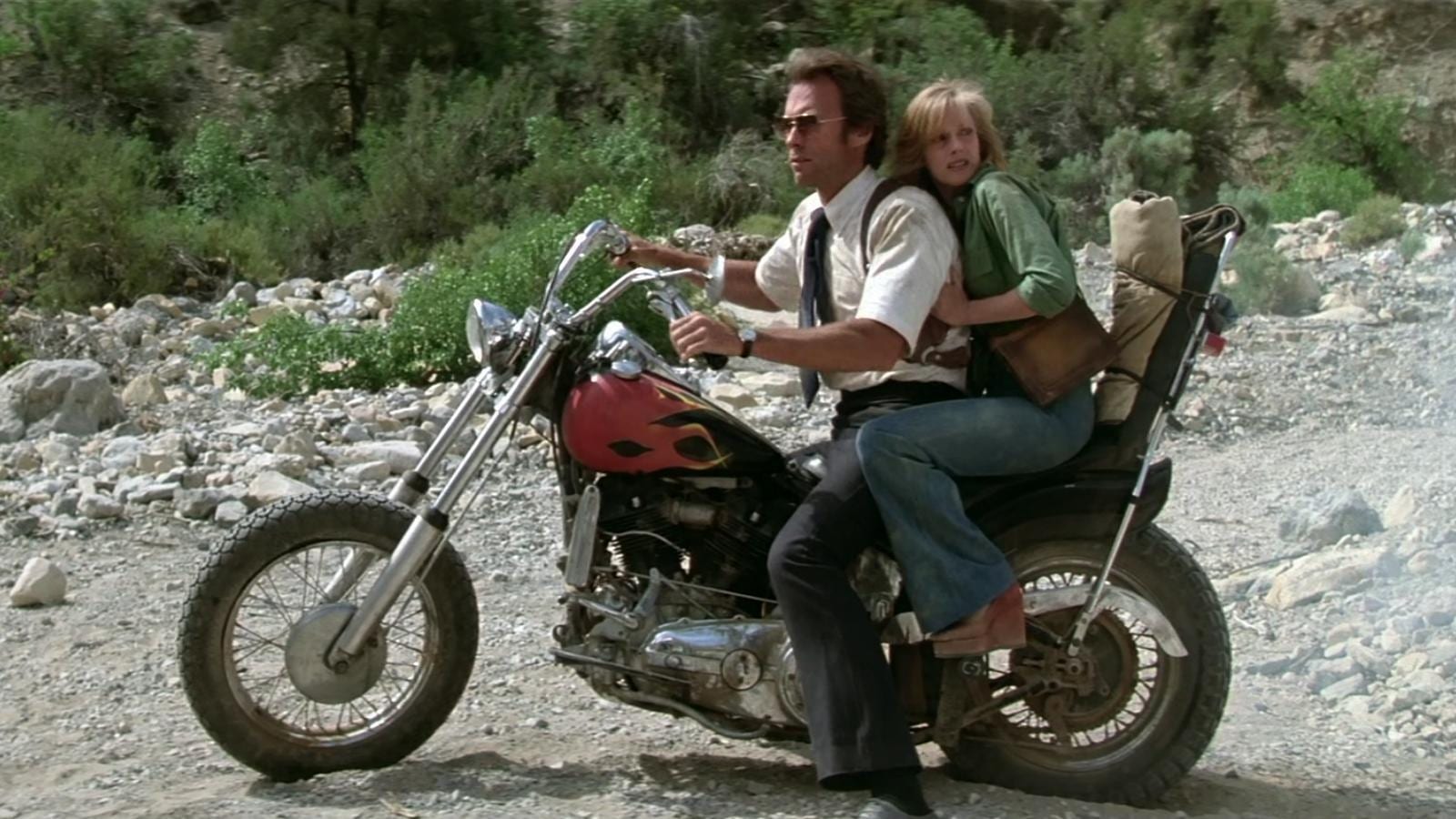
And just to show that Highway Patrol wasn’t a one-off for Clint Eastwood’s riding abilities, here are two more pics of the man on wheels.
Clint Eastwood with his son.Clint Eastwood and Sondra Locke in ‘The Gauntlet’ (1977) aboard a panhead stolen from a ‘biker gang’ member they’d been brawling with.
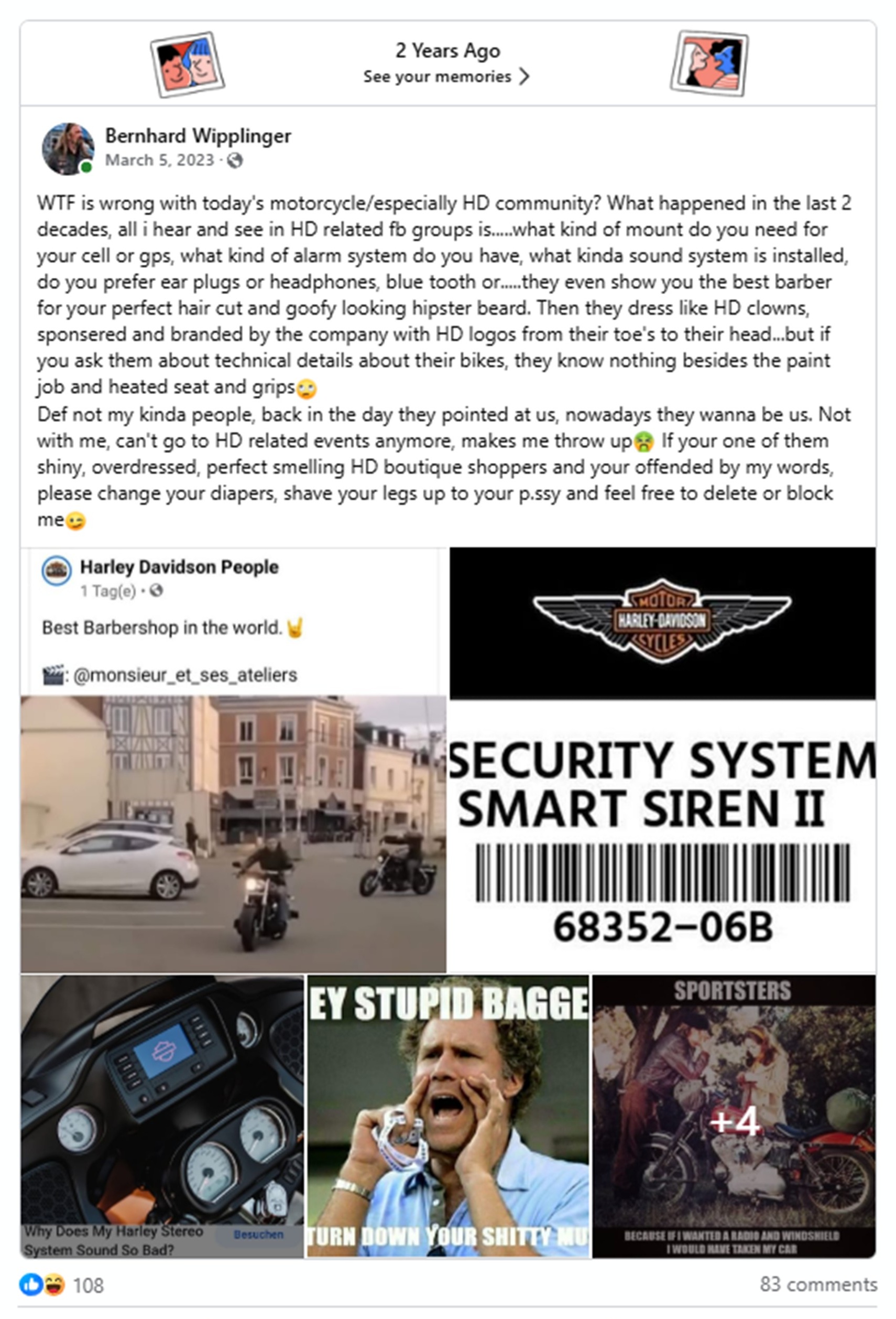
A Facebook friend reposted a two-year-old screed about late-model wankers with their heated handgrips, windshields, stereos and security systems, and I felt moved to respond. As is my wont, I got windy about it. Here’s what he wrote:
To which I replied:
I don’t even like needing a windshield on a motorcycle, and wouldn’t run one if I hadn’t broken my damn back, but I have never seen the purpose of stereos, GPS systems and such. Get your Prius out of the garage, if you need all that shit!
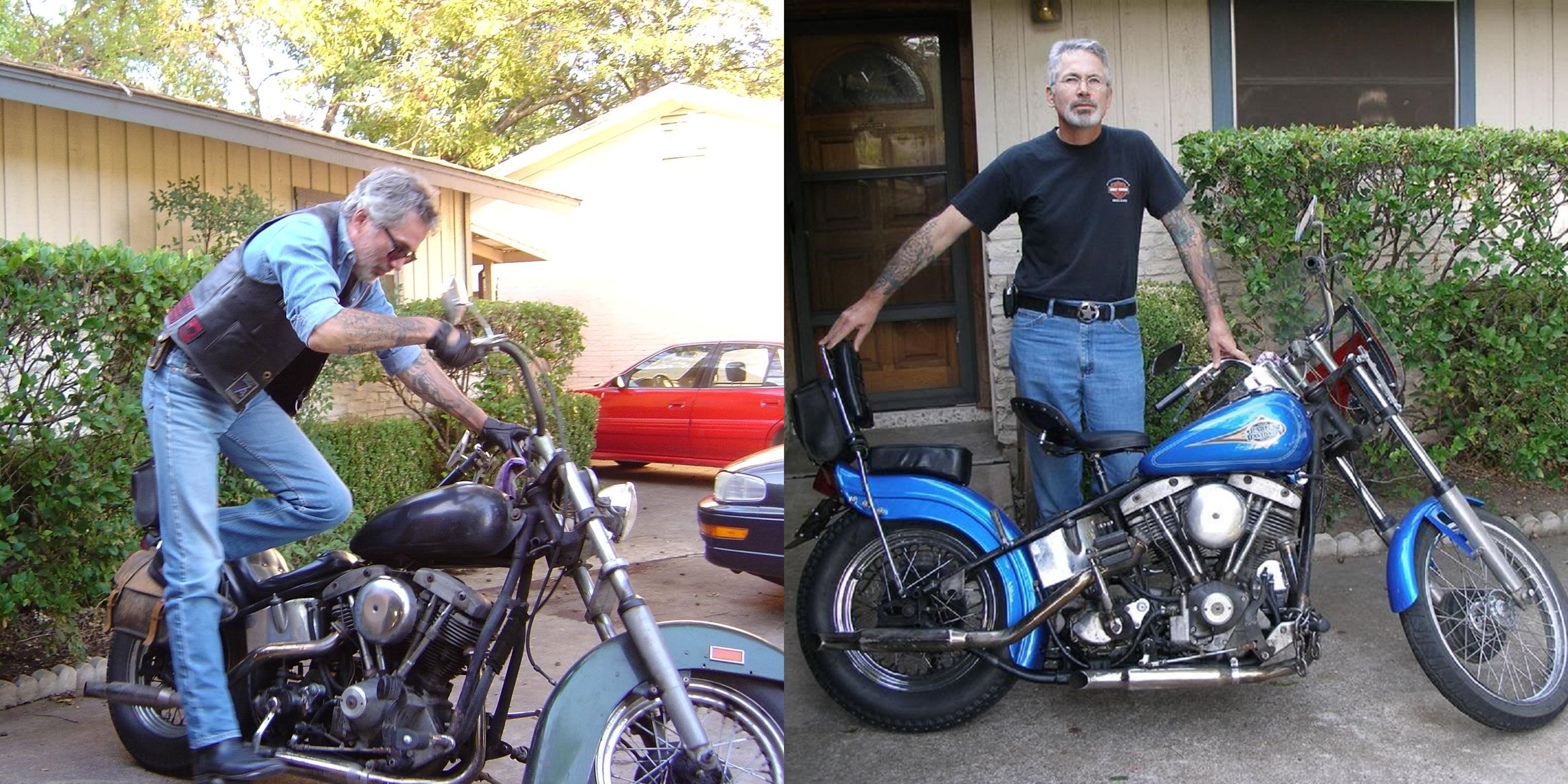
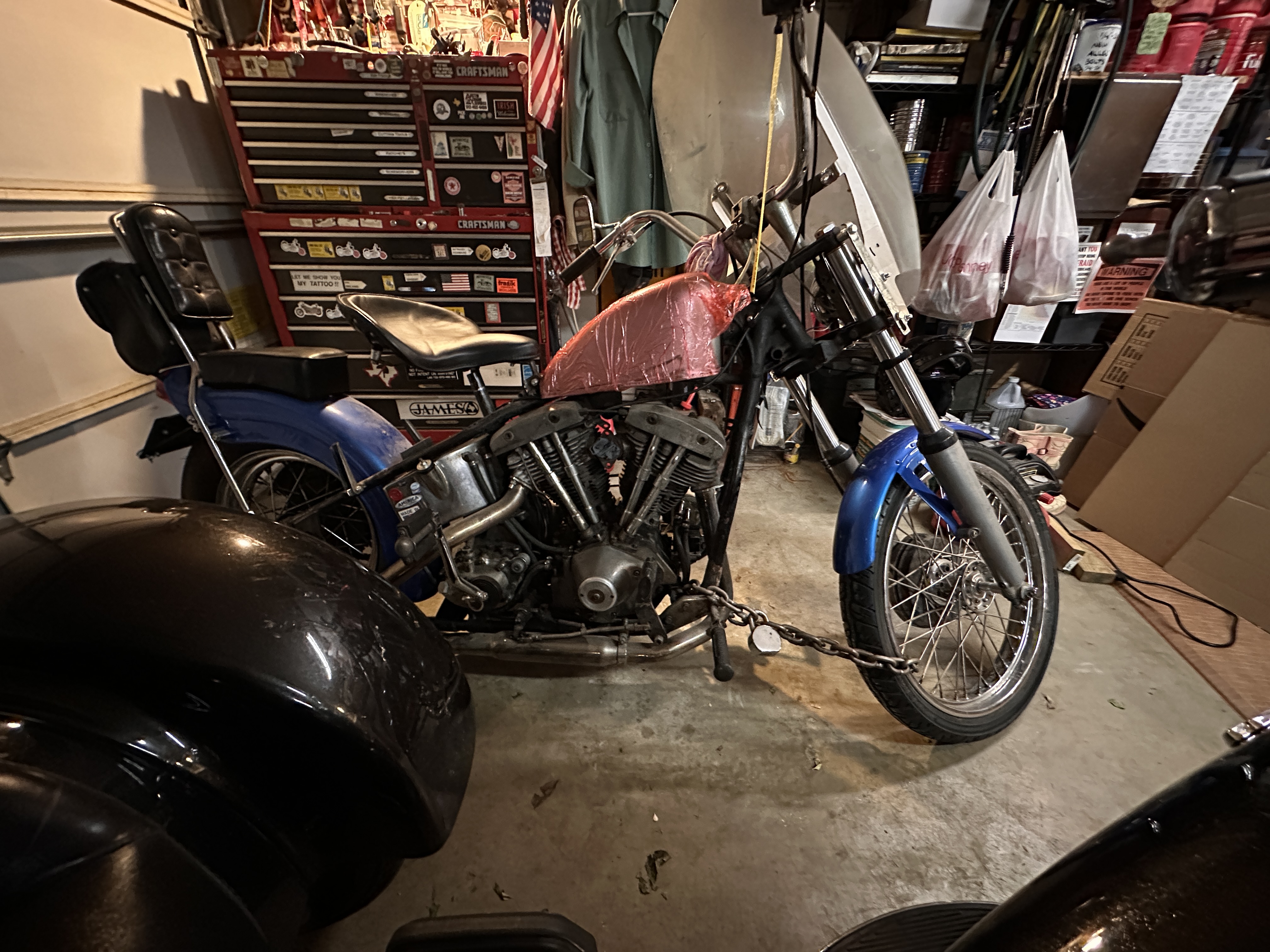
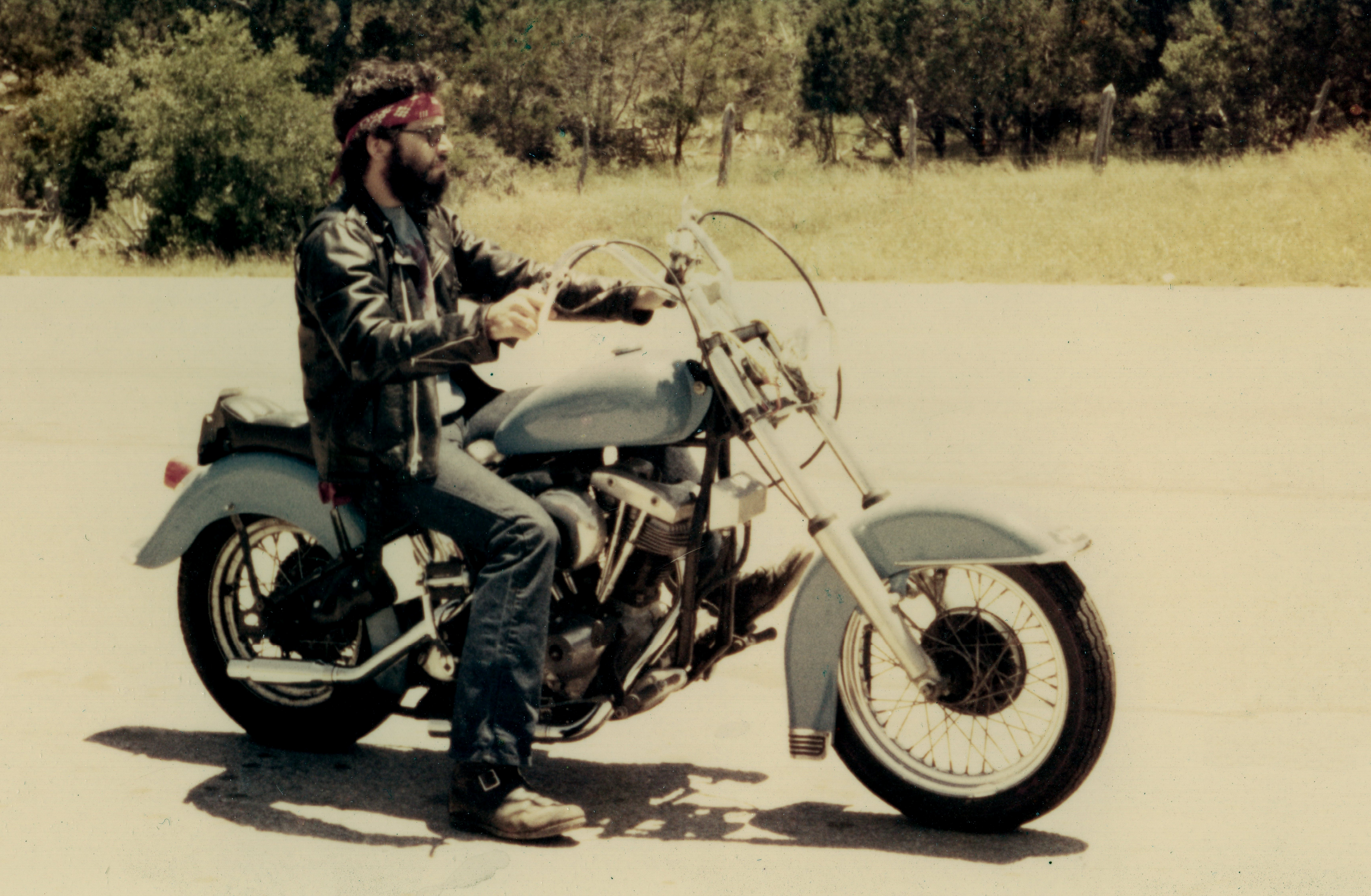
My 2016 FLRT Freewheeler: no fairing, no stereo, no GPS, no cupholder, no bullshit…. It’s early days – I’ve only owned her for a couple of years – but she’s already lost weight, like the heavy chrome bumper and engine guards. Don’t be surprised if she loses even more weight as time goes by. I like my motorcycles stripped near to naked! 😏My 1954/66/74 shovelhead stripped near to naked, at left, and with the pogo-stick saddle and windshield I was forced to add after the 35′ fall that broke my achin’ sacroiliac. As you might imagine from my rantings on this page, I would much rather have the iteration at left! 😏
Still, I remember in the early ’70s, cats mounting alarm systems on their rides because…. hey! If some motherfucker gets off with your bike, the odds are you’ll never see it again. Most broke tramps I knew had everything they owned in that machine, and no insurance company was gonna cover a custom bike. You and your bros were all that stood between your bike and the forces of evil.
I’ll never forget sitting at a party back in ’73: we’re all getting drunk and high and grooving to the tunes on the turntable, and all of a sudden we hear a fucking police radio right there in the room with us! Turned out to be the remote for the new alarm system on Al’s Sporty. It could receive a signal from the alarm module if anyone fucked with his bike. No one knew until that instant that it could also pick up radio transmissions! 😱 Talk about freaked out! 🤣
I’ve never had an alarm system on any of my bikes, but I also avoid parking them where I can’t keep an eye on them. If the bike’s not in my line of sight for any reason, it’s locked up tight and I’m checking on it at infrequent intervals. Gotta keep them thieves on their toes!
Even in my bolted and alarm-secured garage, my bikes are locked up. I worked hard to get and keep that shovel, and the FLRT parked beside it, and I’m not taking any chances on either of ’em going walkabout. Not on my watch! 😏
….if the bike’s not in my line of sight, it’s locked up tight and I’m checking on it at infrequent intervals. Gotta keep them thieves on their toes!
I remember sitting at local beer joints, watching as those of us who rode took turns hopping off our barstools and checking the parking lot. It looked kinda funny, seeing us go up and down like a whore’s knickers, but we all knew none of our rides were safe unless we watched out for ’em.
And it wasn’t just paranoia. I had a customer come in the shop with a Sporty shock that was bent almost in an ‘L’. Naturally, I asked him what happened, thinking he’d been t-boned by a cager. Nope. He was at a titty bar on the north side. He recalled parking his bike and passing a cluster of UT frat boys leaving as he walked in. Nothing happened, he said – no harsh words or dirty looks or anything – but a few minutes later one of his buddies walked in and said ‘Man, what happened to your bike? It’s layin’ on its side out there.’
Turned out someone – presumably the frat boys – knocked his bike over and did a fandango on it: stove in the fuel tank, bent the handlebars, fucked up the gauges, broke the mirrors, et cetera. 🤬🤬🤬
A few months later, I was sitting in a titty bar on the south side, rapping with a friend, and told him that story. He got this sick look on his face, jumped up and ran out the door. I just sat there, kind of amused, figuring he’d be right back…. but then he didn’t come back, so I went to check on him.
As I push my way through the double doors to the parking lot, I see Doc on one side of his bike, and a young couple standing on the other. Doc’s finger is in the guy’s face – he’s obviously pissed – and I’m thinking ‘Oops! Looks like we’re fixing to get down.’ I hit the second set of doors like a freight train, and as I do the chick turns to me and chirps ‘Oh, you think you’re bad?‘ 😲
WTF? 🤷🏻♀️
The guy already looked like he was about to wet himself, with Doc growling at him, but when the chick said that the dude went bone-white, like he was about to faint right there. 😆
Turned out that when Doc walked out the guy was just about to throw a leg over Doc’s Triumph. The kid wasn’t a thief – he was just an idiot showing off for his girlfriend – but Doc told me later that when he hit the parking lot, all he could do was point at the guy and say ‘Don’t!‘ His hand was shaking from the adrenaline rush, he said, and the one word was all he could muster in the moment. By the time I came barreling through the doors, Doc had caught his breath and was just detailing the young man’s near-death experience for him, in great detail. 😈
Then the chick mouthed off at me, making everything worse. 😏
Oooooh, it could have gone sideways real quick-like, but we checked the bikes over, made sure nothing was damaged, and the kid (who apologized the whole while we were out there) insisted on buying us both drinks. He must have had a come-to-Jesus discussion with his girlfriend, too, because before we were done with our free drinks the girl came over, knelt beside my chair and begged my forgiveness. She even kissed my hand! 😲
Damn, I had a hard time keeping a straight face! 😆
Of course, all that happened before ‘biker’ became synonymous with ‘middle-aged empty nester‘ and ‘man-bun-wearing hipster’. 🙄
Once upon a time, in the dark ages of the pre-internet world, there was a magazine called Easyriders.
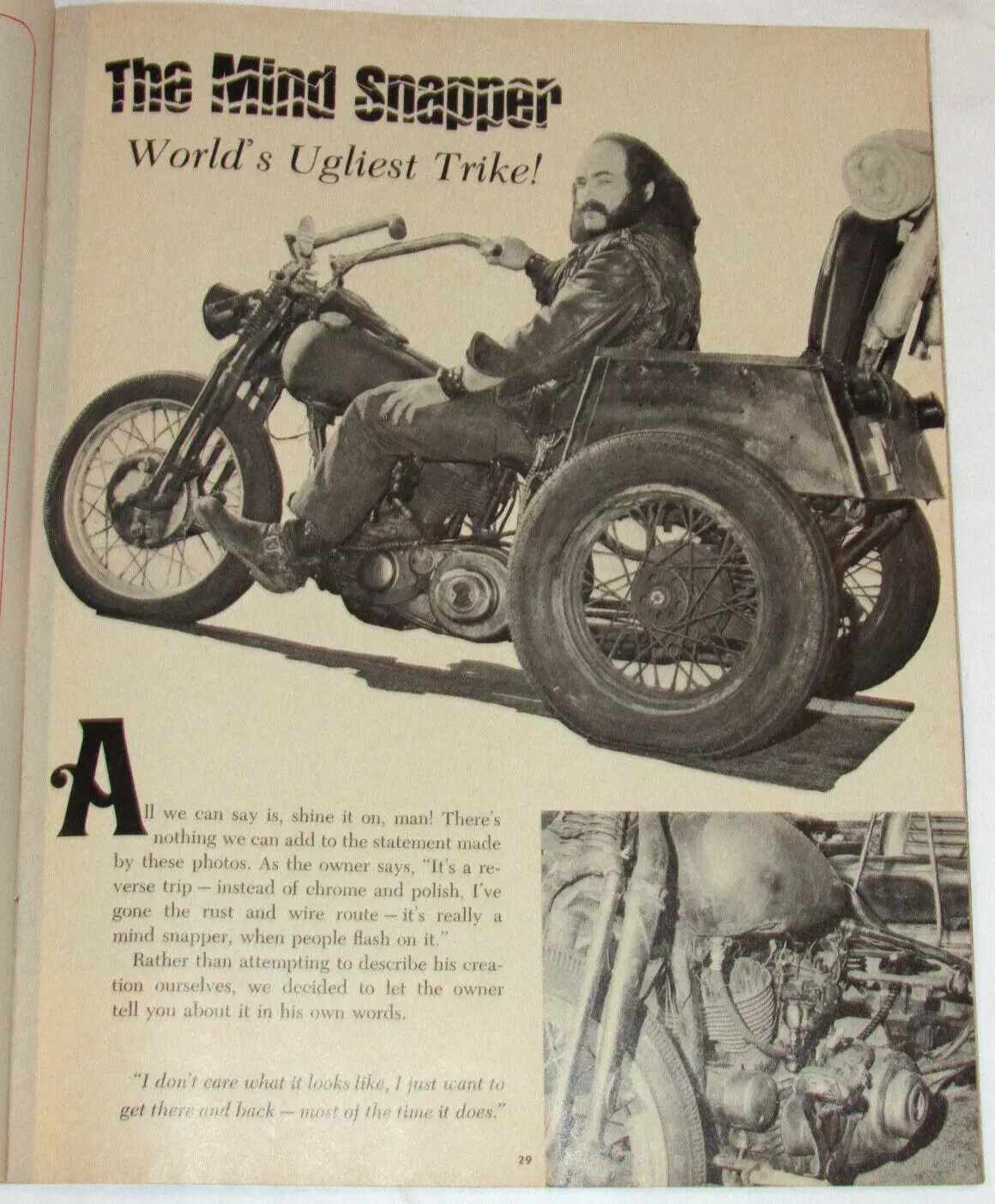
The cover of the magazine’s very first issue. From the onset, Easyriders was determined to do things differently. What other bike rag of the day would boast of featuring the ‘World’s Ugliest Trike’? Image courtesy the author.
Easyriders was the brainchild of several California-based riders – Lou Kimzey, Joe Teresi and Mil Blair – who dreamt of a rag for bikers, by bikers, with none of the usual mealy-mouthed product reviews, and clean-cut models posed aboard factory-fresh machines from Europe and Japan.
In their very first issue, Easyriders‘ editors proved they were following a different path than their predecessors and competitors. Image courtesy of eBay seller Cruzin’ for a Deal.
No, this new mag would be for hardcore bikers, patchholders and independents who lived, breathed, slept and dreamt motorcycles: preferably big American motorcycles like Harley-Davidson and Indian. The first issue trumpeted the new title as ‘For the Swinging Biker.‘ They later identified as ‘Entertainment for the Adult Biker.‘
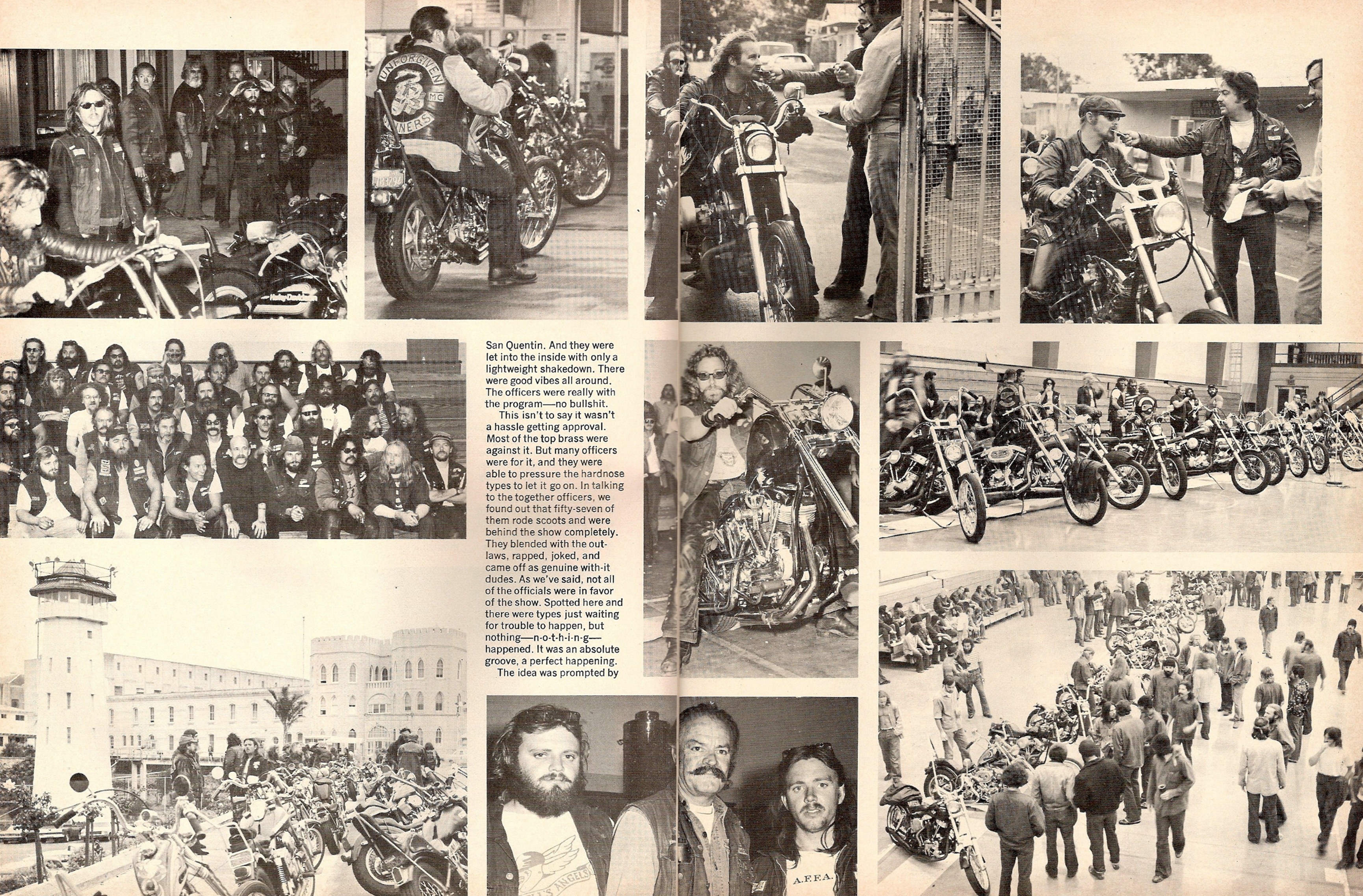
The other biker rags – even the ones that claimed to be hip to choppers – weren’t covering events like this!In fact, those other guys were more likely to be sneering than cheering. Choppers were ‘cool’ but chopper builders? Those long-haired, greasy-bearded outlaw types? Eww! 🙄San Quentin pages courtesy of the author.
Within its pages, Easyriders featured handbuilt choppers – genuine rigid-framed, long-forked machines with psychedelic paint jobs, sky-high sissybars, glistening spokes and heavily chromed engines like the ones featured in the magazine’s namesake movie. They were laid-back, long-legged beauties – dream machines – and in the ’60s and early ’70s many a young man (your humble narrator included) lusted after them. We looked for them at custom car and motorcycle shows, built plastic models of them, pressed our noses to the windows of Dad’s station wagon whenever one rumbled past and, naturally, pored over magazines about them.
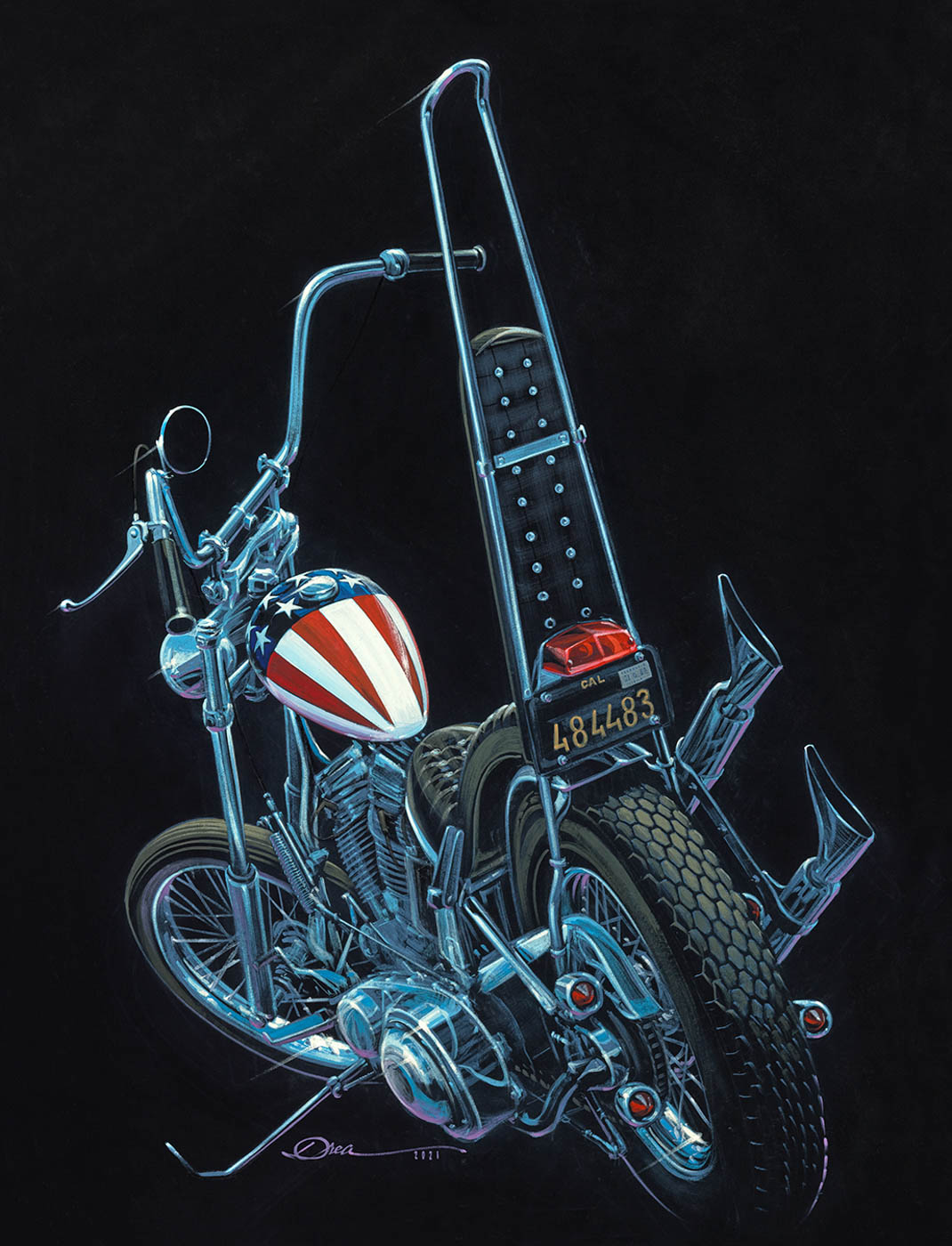
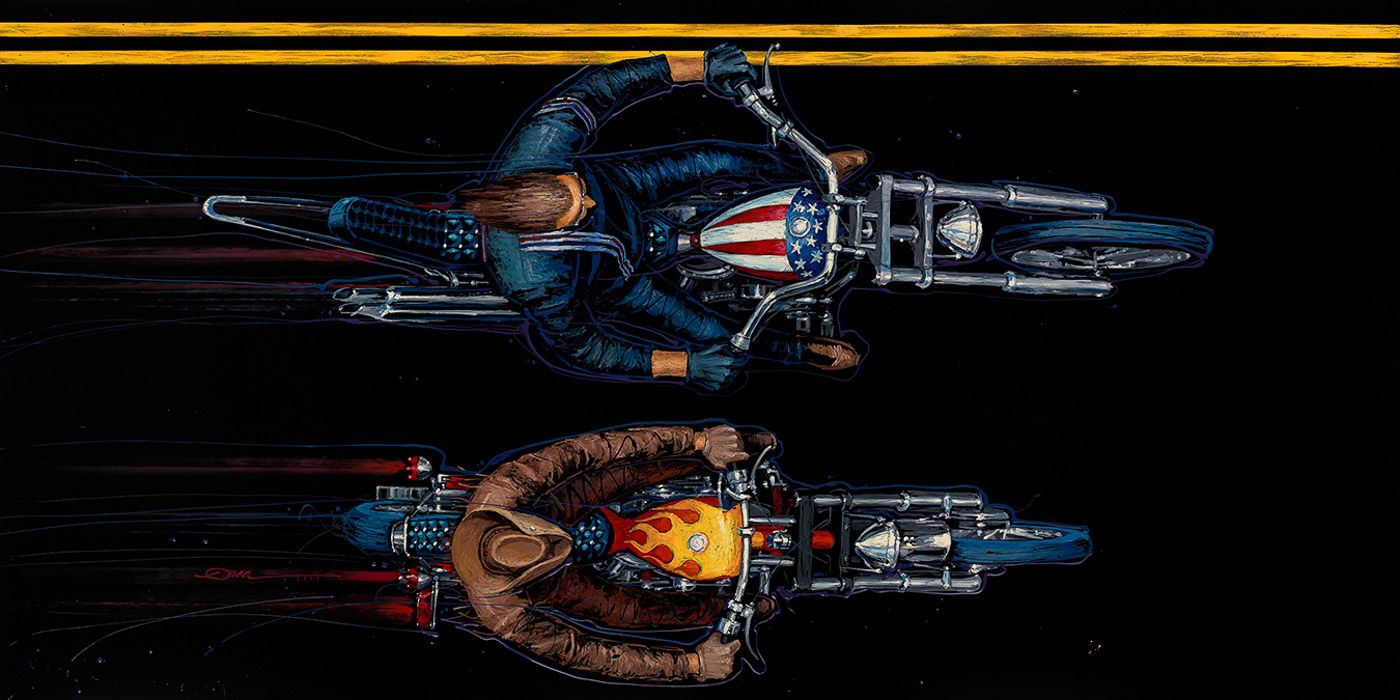
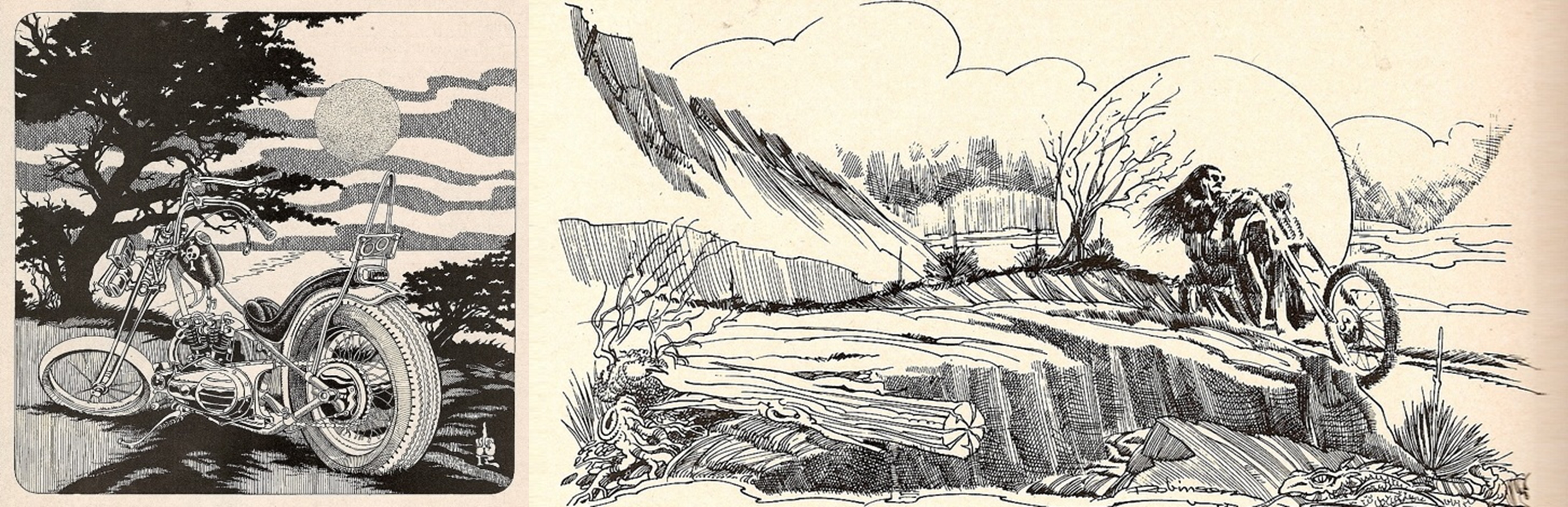
Captain America by artist Ray Drea.A unique take on the anti-heroes of Easy Rider (1969) by artist Ray Drea.A life-size Billy Bike, seen at the 20th Annual David Mann Memorial Chopperfest in February, 2024. Image courtesy of the author.Now that’s a chopper! Also spotted at the David Mann Chopperfest. Image courtesy of the author.
Choppers may have been works of art, but for most builders they were much, much more. Those workhorse v-twin engines – the ones that carried police officers through city traffic, and gave Mom and Pop a breath of fresh air and outdoor life at the end of a workaday week – were broken down and rebuilt, and in the process they were blown, stroked, bored and balanced to achieve ultimate performance in flat-out style. We’re talking balls-to-the-wall, explosive power.
Editor Lou Kimzey’s knucklehead chopper appeared on the back cover of the magazine’s first issue. Image courtesy of eBay seller Cruzin’ for a Deal.
The bikes may have been built for cruising the highway with a chick on the p-pad and a fart sack strapped to the forks, but the engines were built for red-light racing and the quarter-mile, popping wheelies and other displays of brute acceleration. These weren’t upstart Jap scrap that whined like angry hornets, or prim European motorbikes with finely tuned suspensions and muted, throaty exhaust notes. You weren’t going to see choppers competing in Timed Trials challenges, or road-racing on the Isle of Man. They were, with few exceptions, big, loud, powerful, gas-guzzling, straight-line-balling, quintessentially American machines.
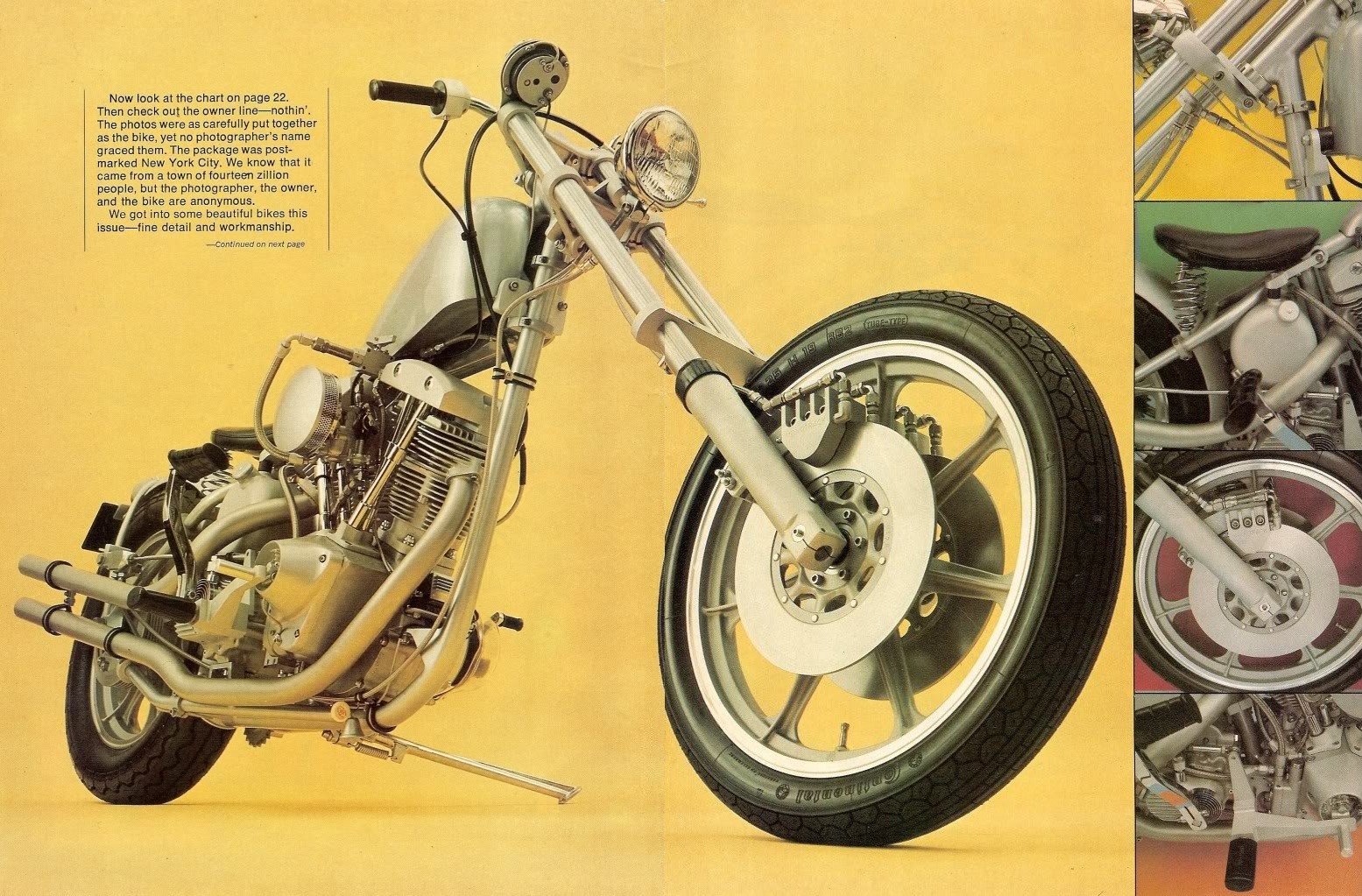
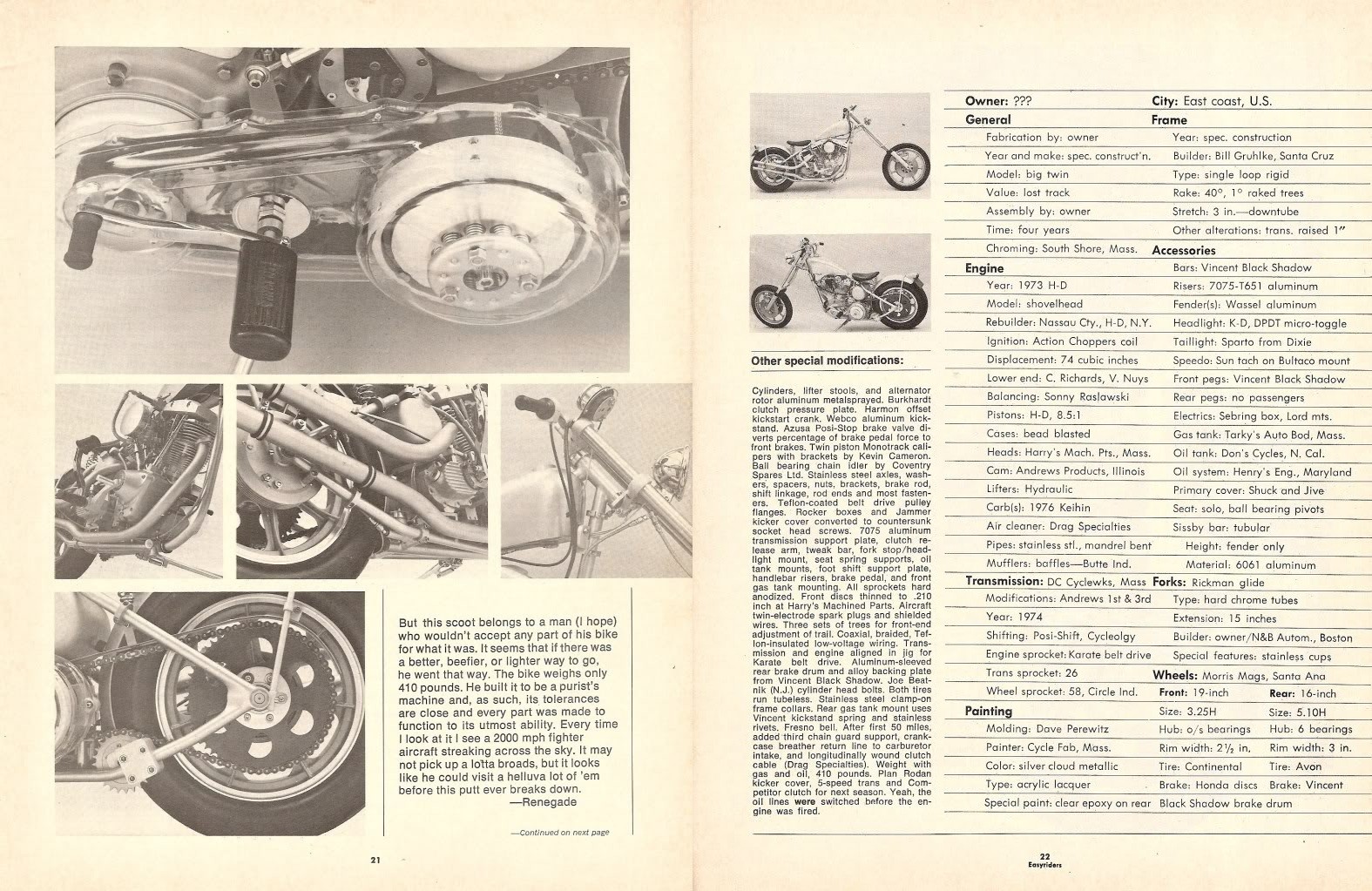
One of my favorite builds ever to appear in the magazine’s pages. The bike also appeared on an Easyriders calendar and in an anniversary issue. With its monochromatic color scheme and futuristic design, it stood out from the psychedelic dream machines most builders were crafting. So far as I know, the builder has never been identified. The bike itself is far cleaner than anything I’d feel comfortable owning, but the detail is mind-boggling. This bike also gave me a low-level craving, as yet unfulfilled, to build a chopper on a single-loop frame.The Mystery Sled also gave me a new appreciation for Morris Mags – beautiful wheels! – and the process of cleaning engine parts known as ‘bead blasting’. When I first went to work at Bud’s Motorcycle Shop in Austin, in 1979, I spent many an hour with my hands up to my shoulders in the glass-beading machine. I still love the soft grey finish the process leaves behind on aluminum and alloy parts. Mystery Sled images courtesy of the author.
Easyriders was the first biker lifestyle magazine to make it beyond a handful of issues, and reach a national (and later international) readership. Others, like Colors, produced by East Coast biker Phil Castle, and the California-based Choppers, created by signman-turned-customizer Ed ‘Big Daddy’ Roth, were short-lived and regional. You weren’t going to find issues of those magazines on the rack at your local 7-11 store, and by 1971 both had gone out of print.
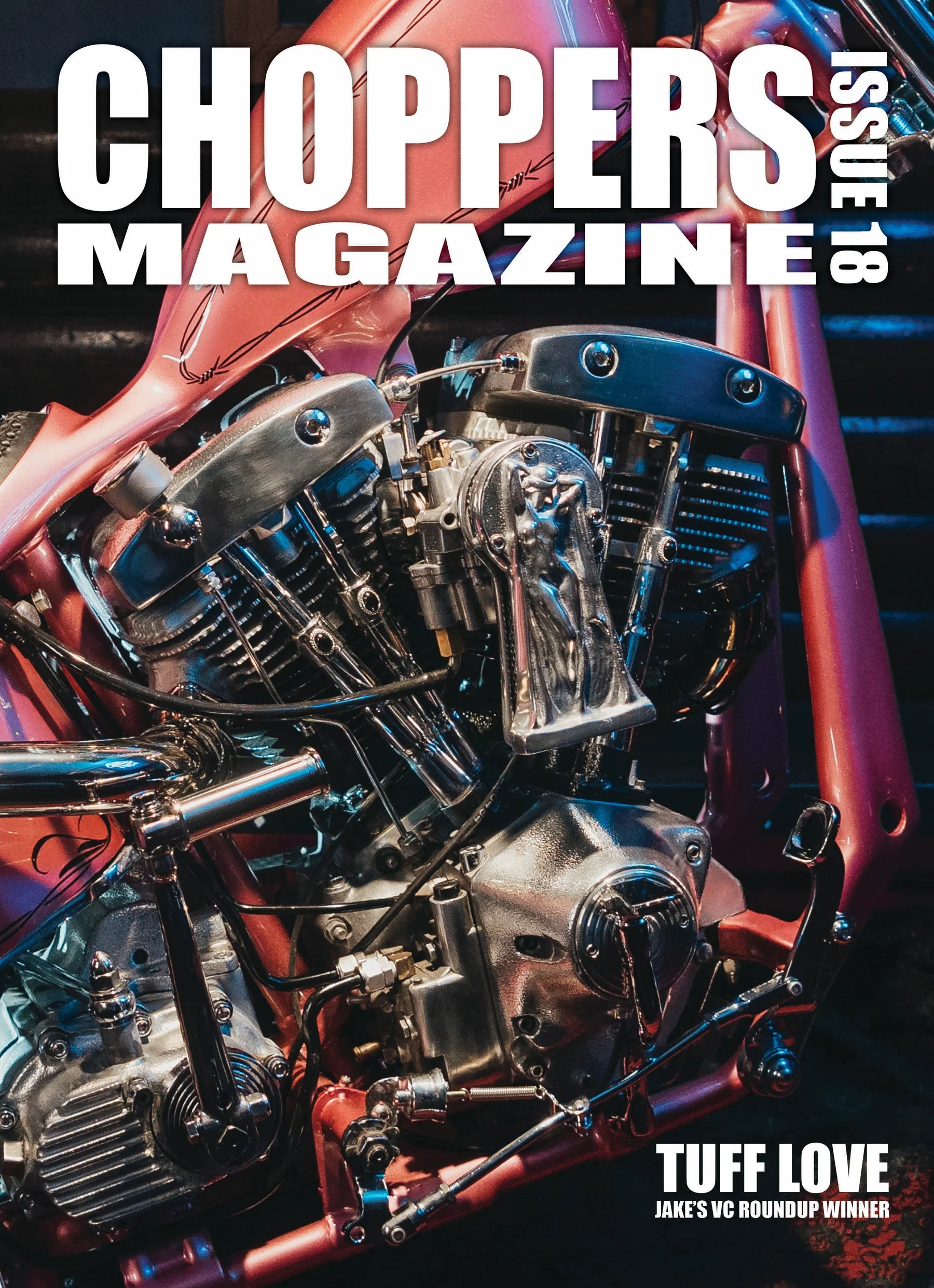
Choppers experienced a comeback of sorts in 2018, when fan Cary Brobeck secured rights to the title from Ed Roth’s heirs. The new Choppers hit newsstands in April of 2019, and is still in production as of this writing, January 2025. Image sourced from the internet.
Easyriders, on the other hand, endured, in part because it was so much more than just shiny paint and polished chrome plating. The magazine swiftly became the big dog on the block, its readership dwarfing titles like Big Bike, Custom Bike, Street Chopper and Supercycle, because Easyriders went farther than any of those titles dared. The rag truly was ‘entertainment for the adult biker’.
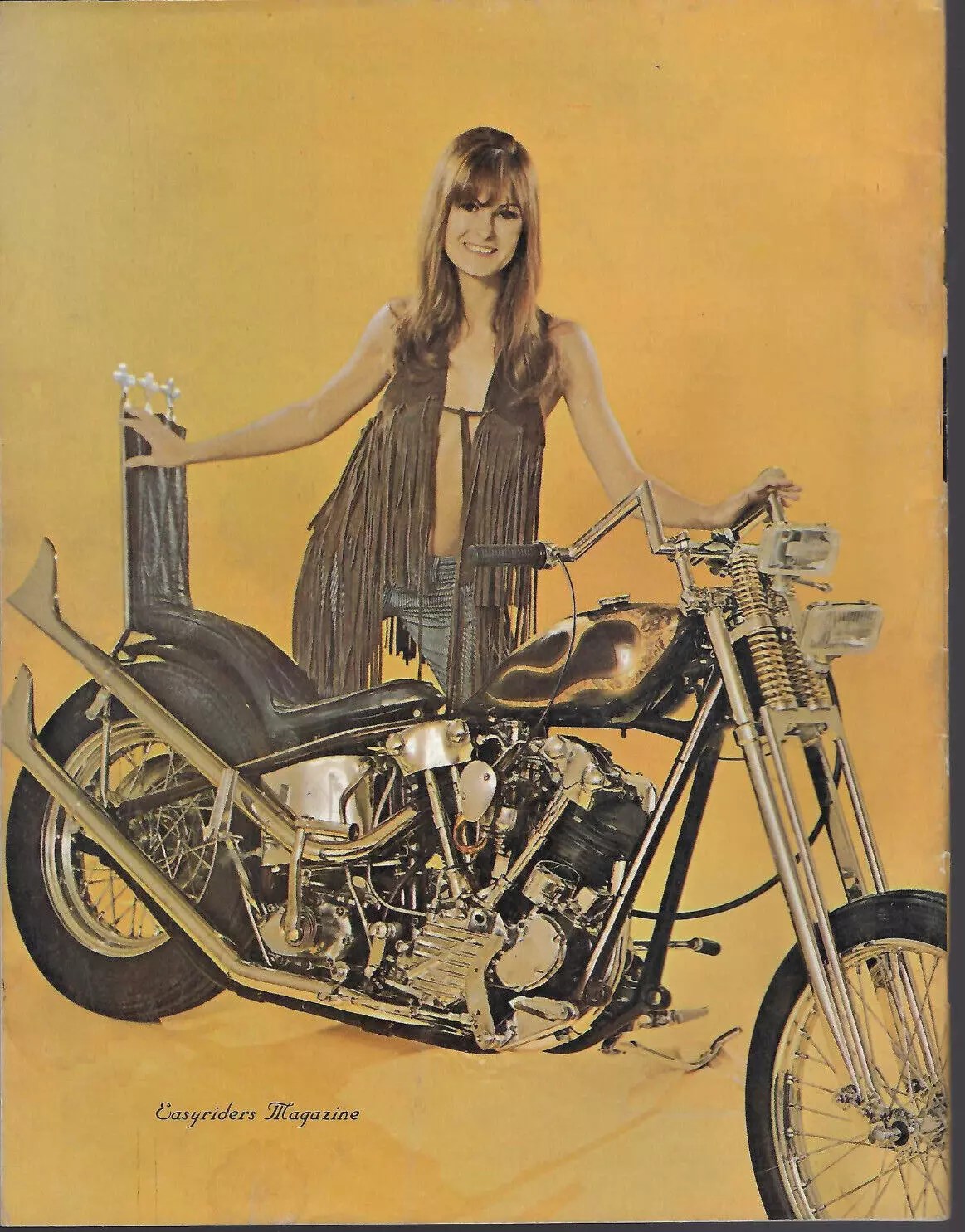
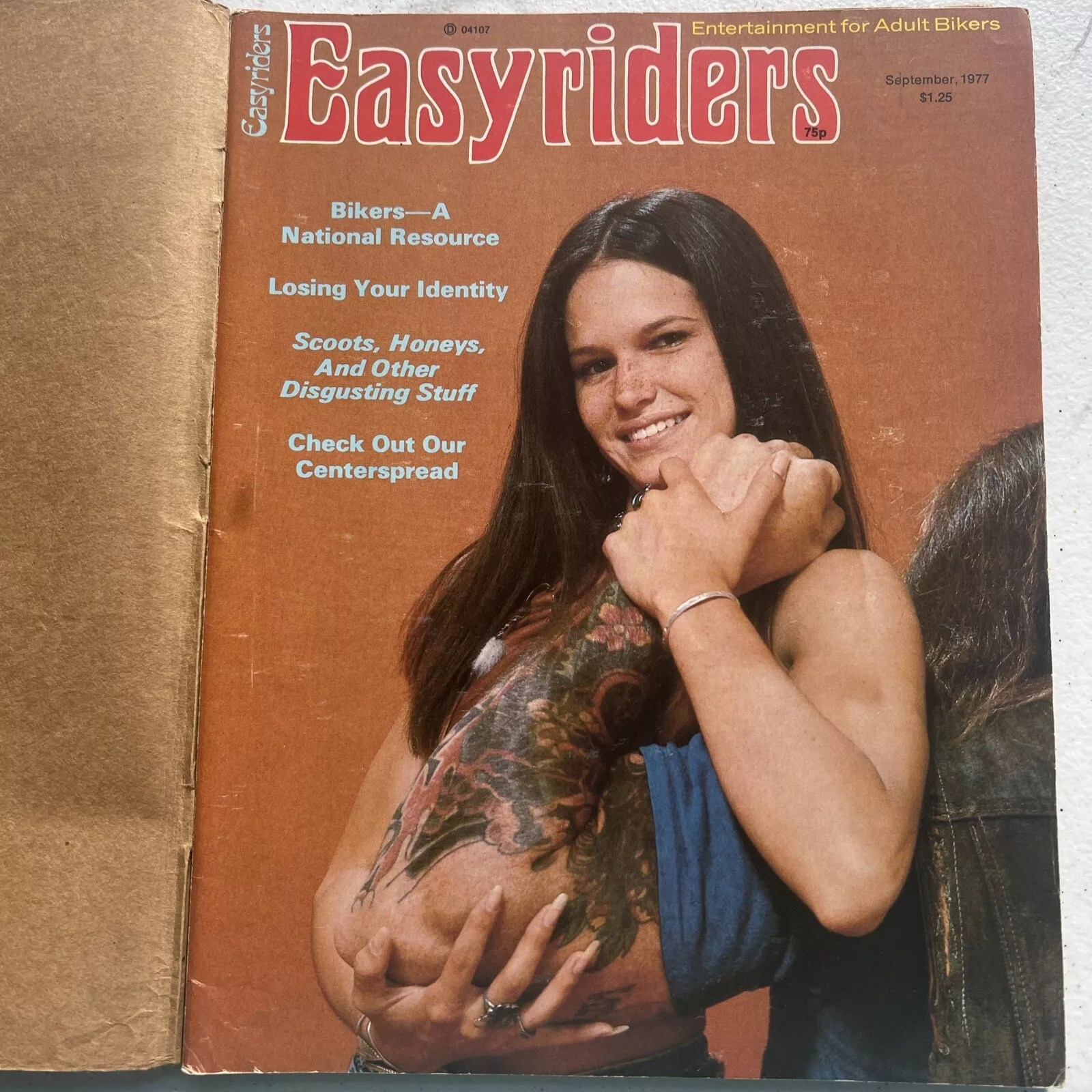
A typical Easyriders cover in the early days: a gal you could believe knew her way around a pillion pad, maybe a tattooed biker and his motorcycle, and a few tantalizing teasers for what’s inside. Image courtesy of eBay seller pqu698.
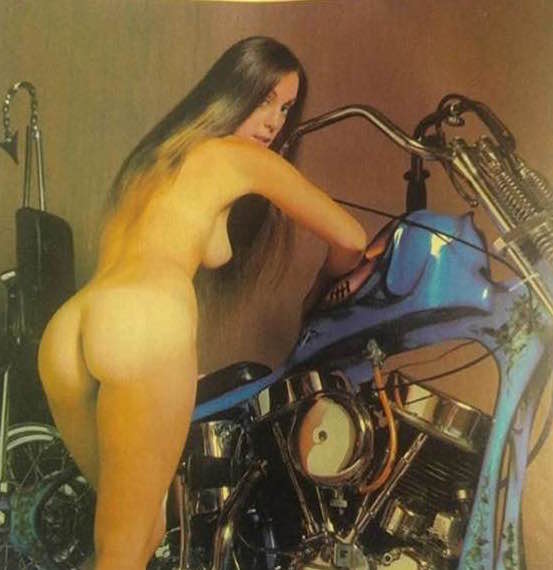
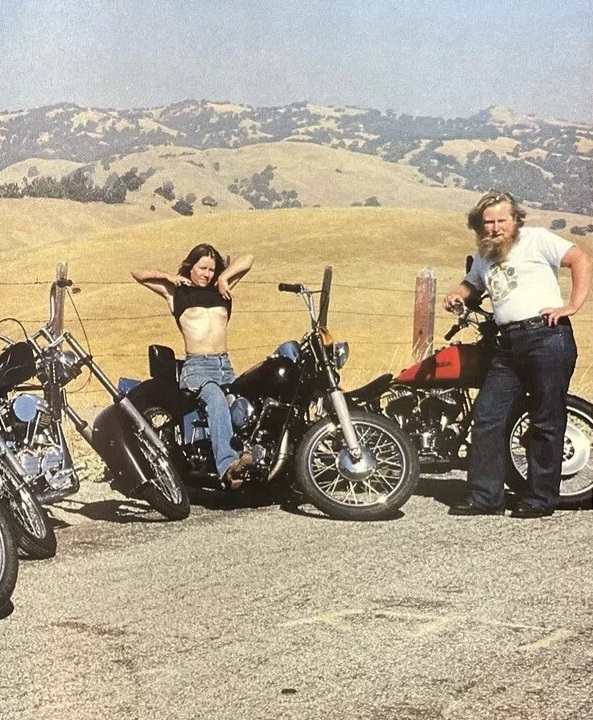
For starters, Easyriders had bare-breasted models draped over choppers or curled up against the bikes’ owners: real biker women – often the bike owner’s ol’ lady – with tattoos, pimples and other ‘flaws’, showing more skin than other bike rags would dare.
A typical photograph from the magazine’s early days. Image sourced from internet.
They also began a feature (copied from Big Bike, a title editor Lou Kimzey created and edited prior to joining forces with Joe Teresi and Mil Blair) called the Ol’ Lady Contest, in which women (or their proud significant others) could submit photographs for the chance to win cash and prizes, and be named ‘Ol’ Lady of the Year’.
A ‘Ol’ Lady Contest’ in the magazine’s February 1983 issue. Image courtesy of author.
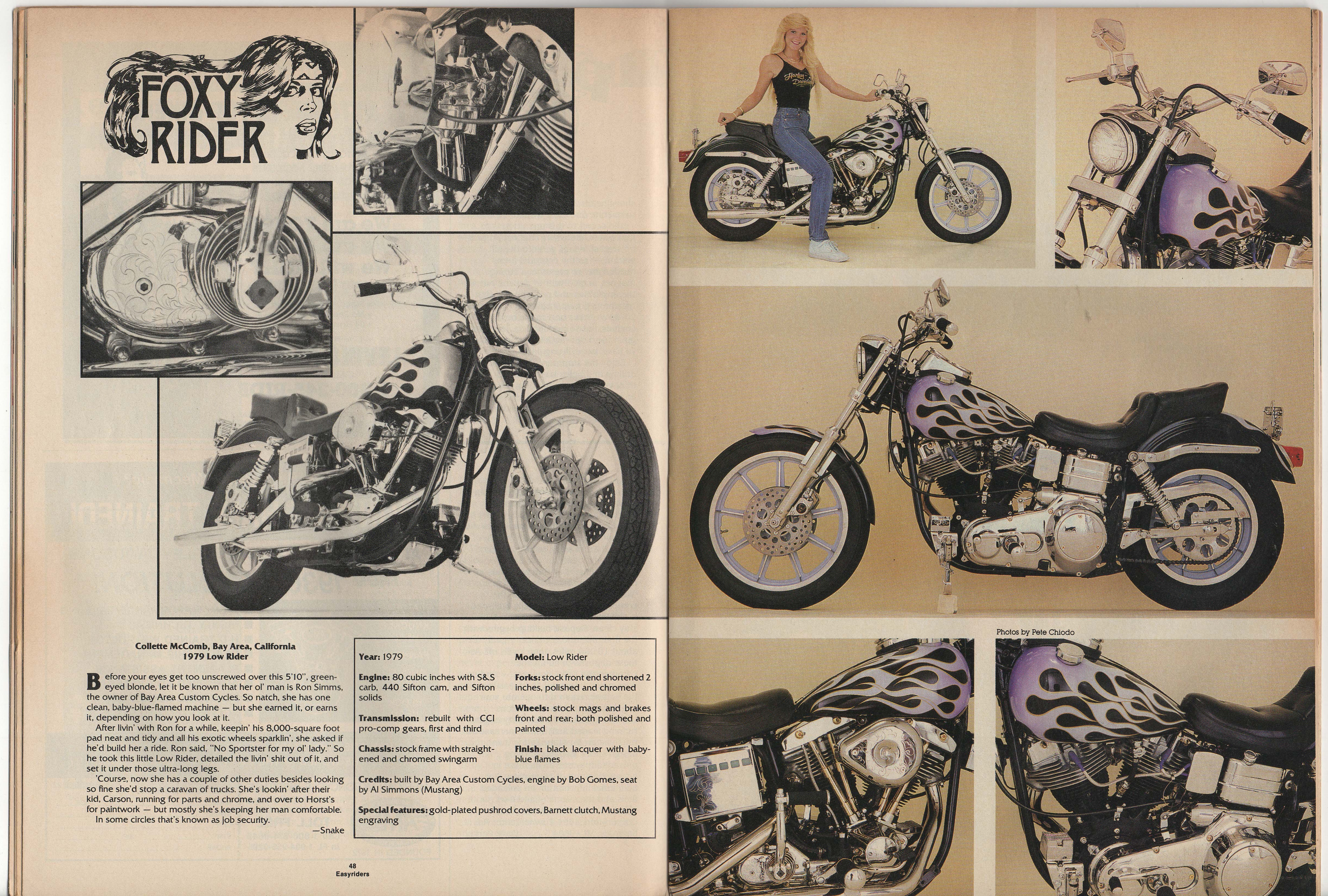
Later, in a barely-perceptible nod to gender equity, they began including small (usually one- or two-page) spreads on bikes owned and built by women, titled Foxy Riders.
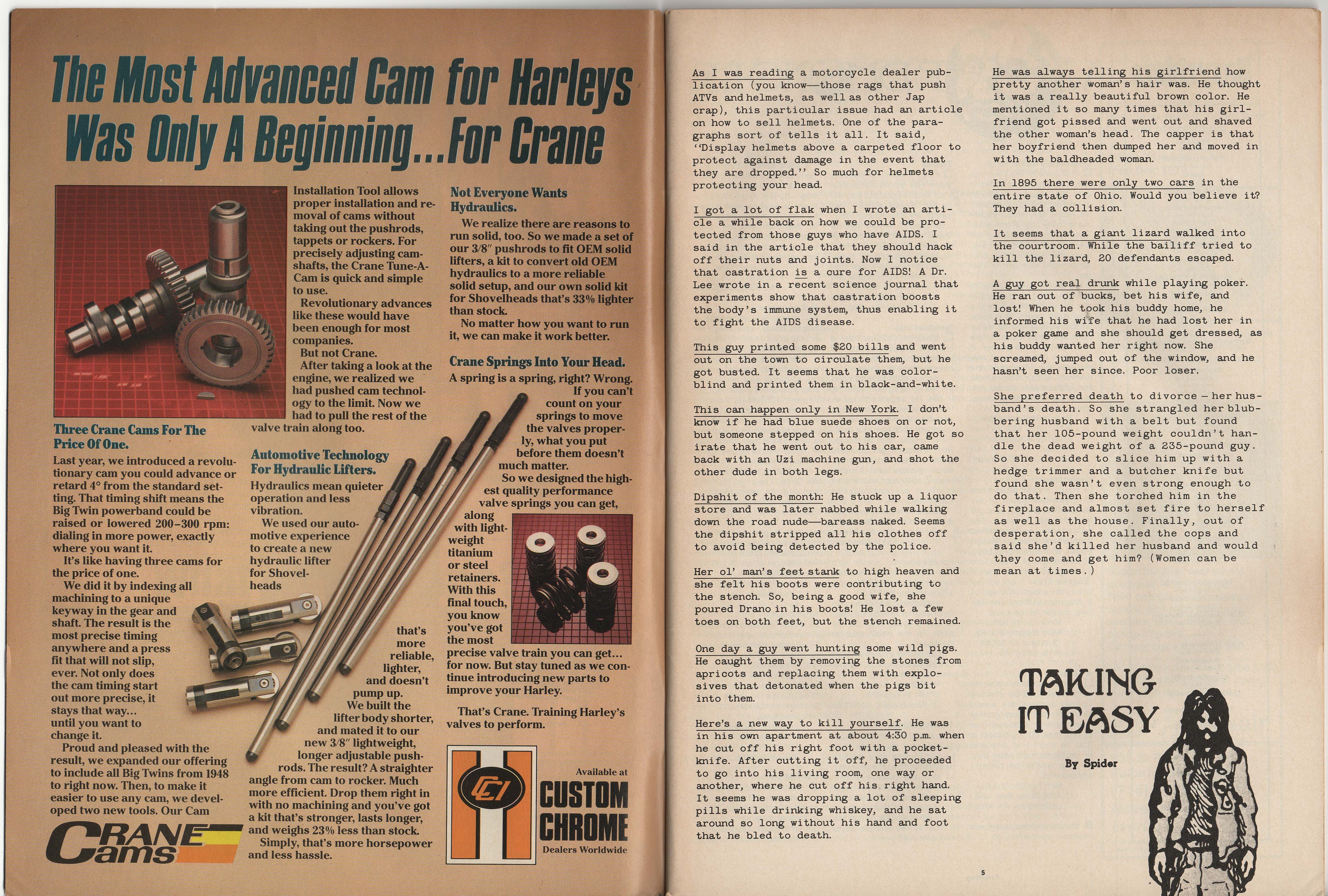
A ‘Foxy Rider’ gets her motorcycle featured in the magazine in June 1988. Image courtesy of author.Spider’s column fronted the magazine for decades, sharing humorous stories and factoids like those shown above. Note that political correctness was not a concern. At times, misogyny and subtle racism permeated the magazine’s editorial content. Homophobia and transphobia were constants. Image courtesy of author.
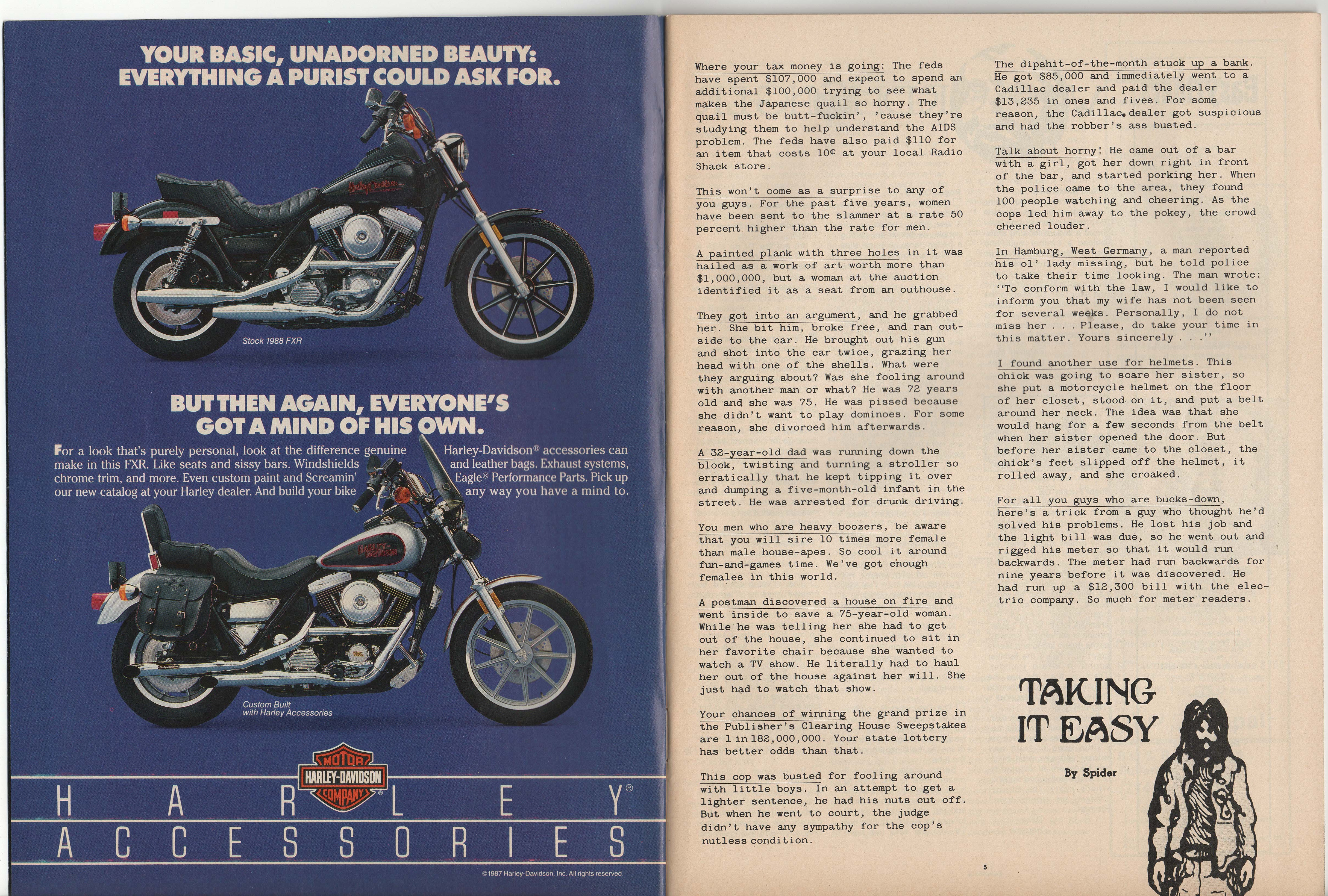
There was also Spider’s Leg-Wetting Facts column (later renamed Taking It Easy, as shown above) that featured humorous factoids and anecdotes culled from the mainstream press and other bike rags. Farther back in the magazine were pages of jokes, too, usually submitted by readers.
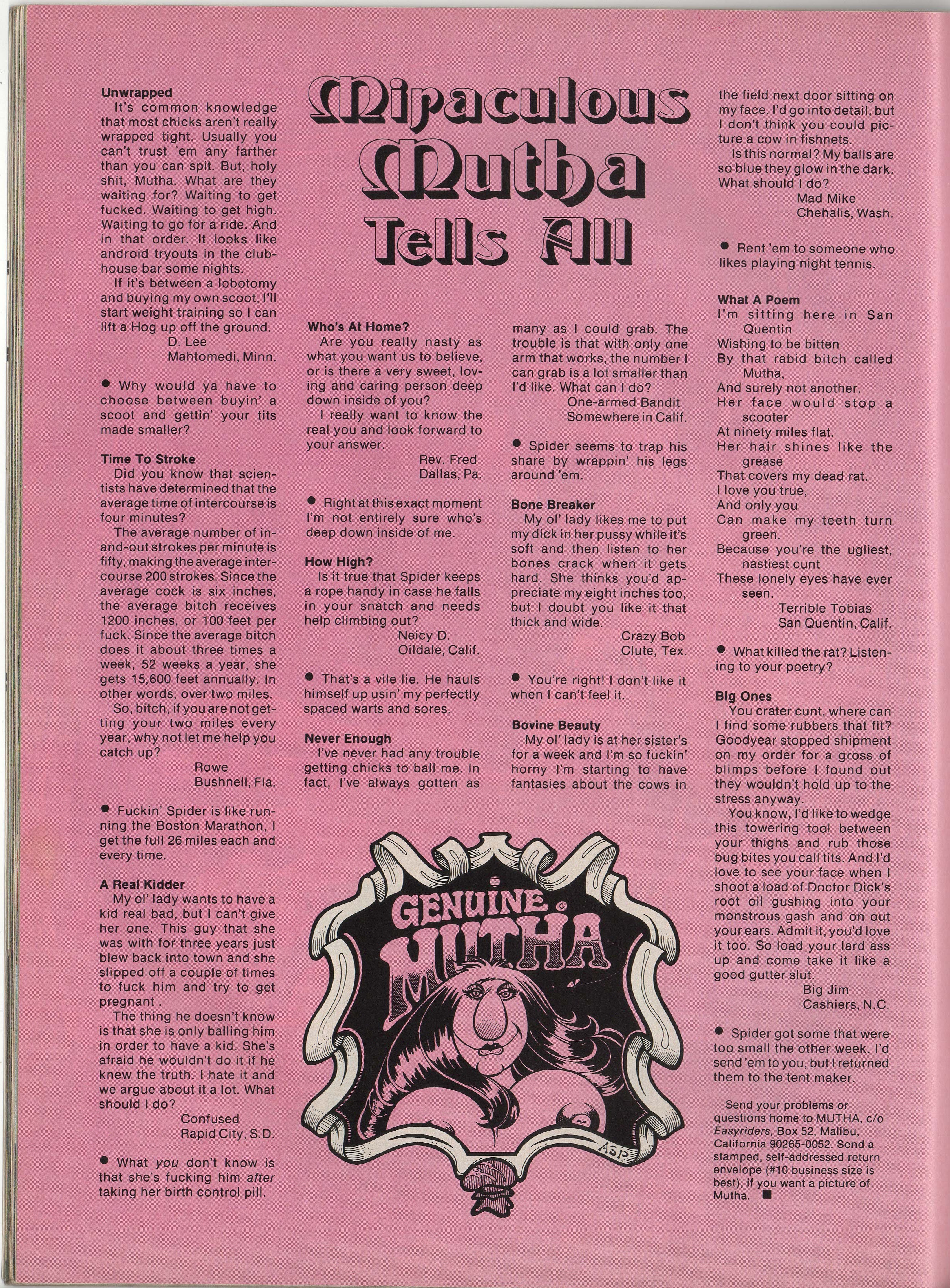
Miraculous Mutha as envisioned by Easyriders cartoonist Hal Robinson, and identified on the magazine’s masthead as ‘Resident Nympho’. Some of the other job titles are just as outrageous! Images sourced from internet.
Miraculous Mutha, depicted above, purported to be an overweight, disease-riddled ‘mama’, doling out advice to the lovelorn and wayward in Miraculous Mutha Tells All, below. Her responses to readers’ letters were frequently lewd, lascivious, and more than a little perverse. Readers loved her!
If you’re not offended or repelled, you’re not paying attention! Image courtesy of author.
On a more serious note….
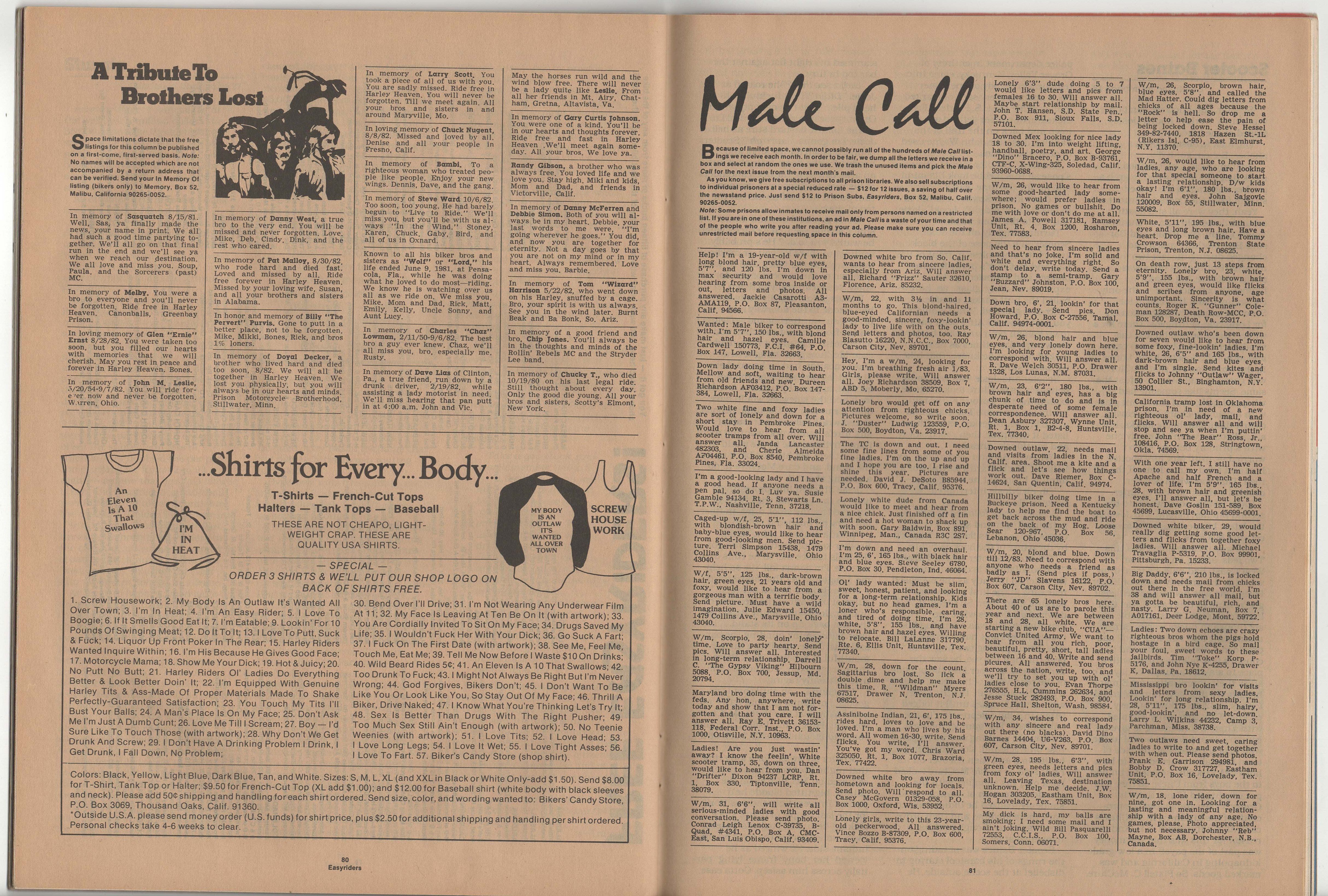
A Tribute to Brothers Lost and Male Call were just two of the ways the magazine attempted to foster community in the biker world. Image courtesy of author.
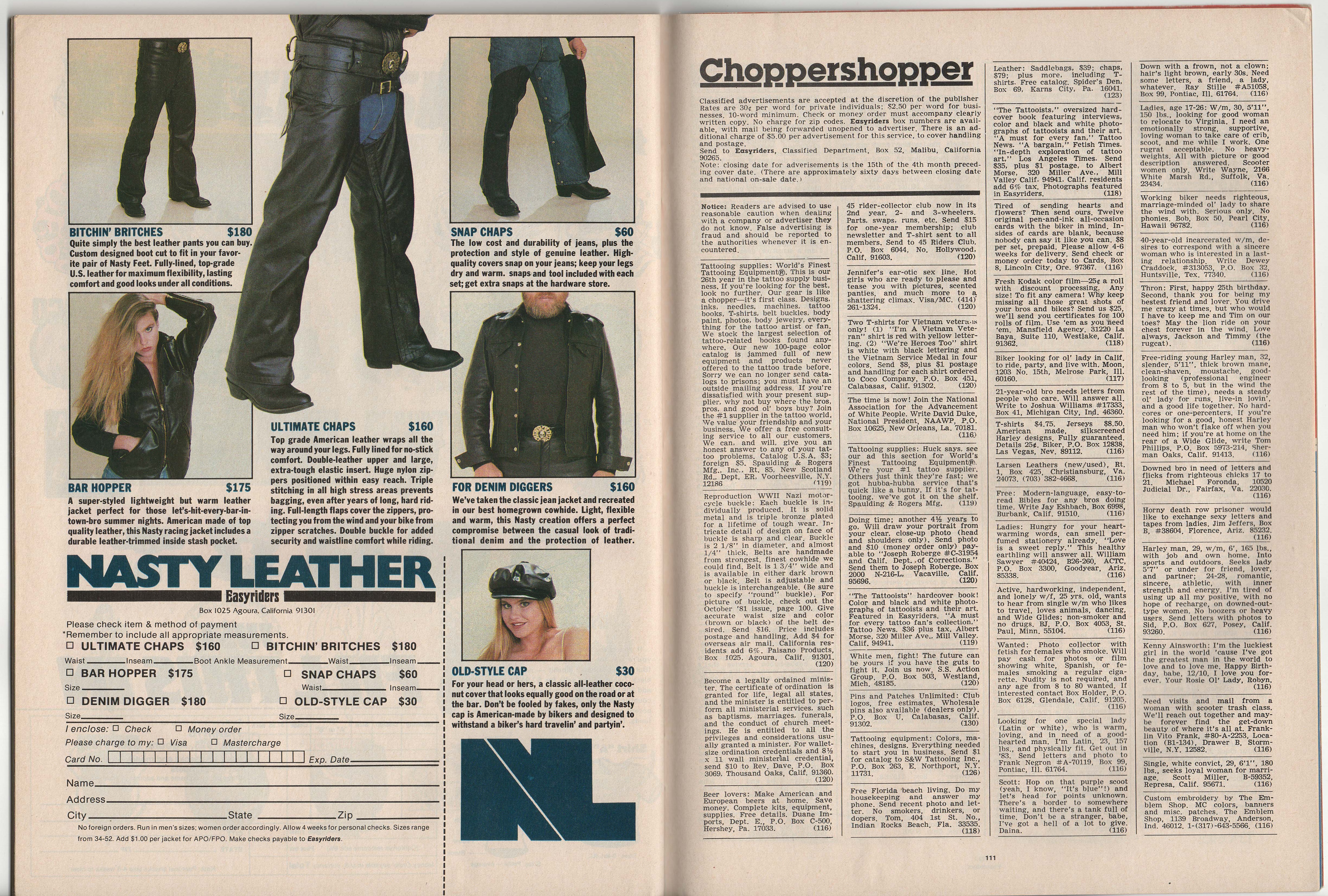
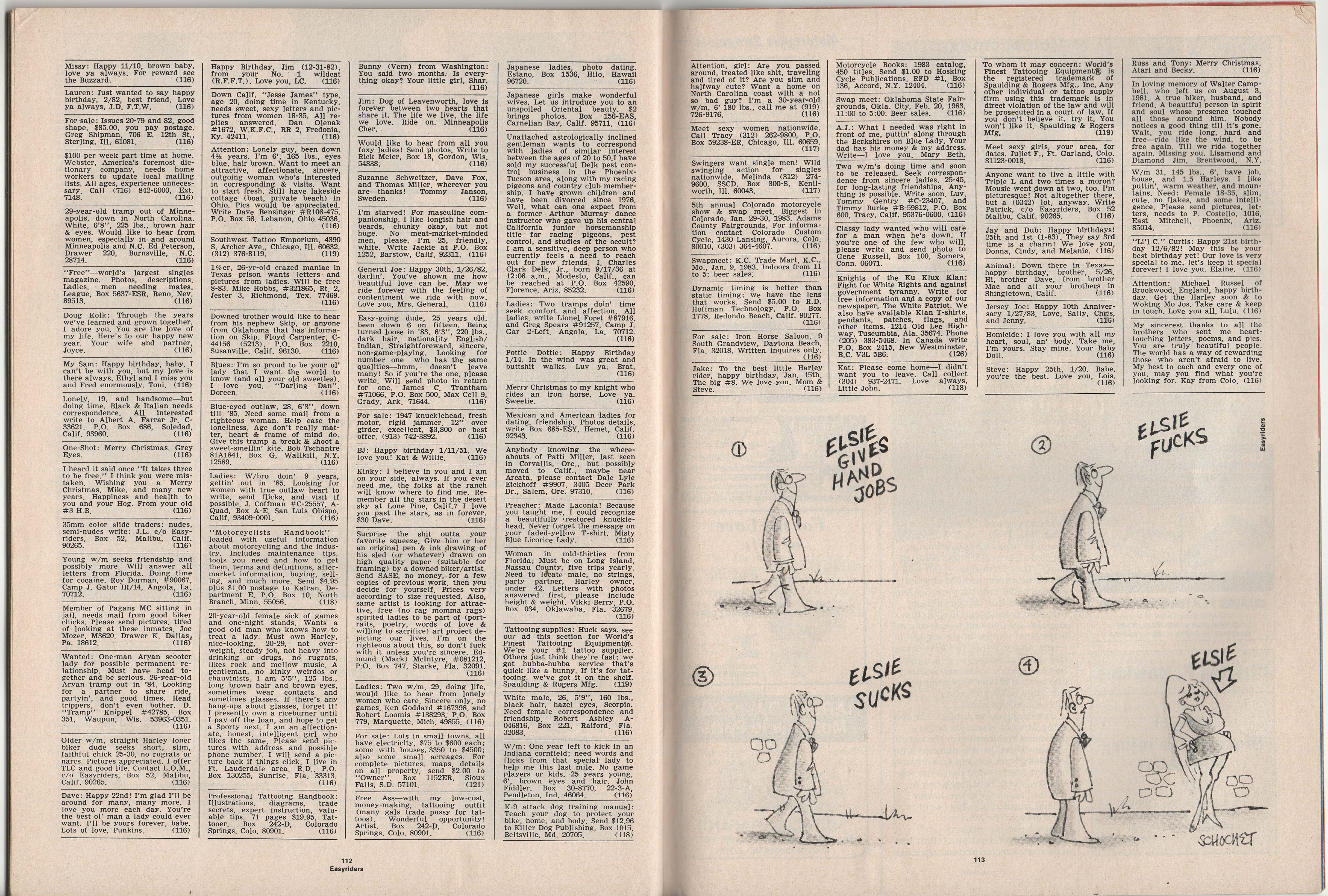
In the magazine’s back pages, one feature allowed bikers to offer up A Tribute to Brothers Lost, while a separate feature titled Male Call helped incarcerated bikers hook up with pen-pals and potential post-release lovers. Another page of classifieds called Choppershopper let bikers reconnect with brothers, announce events, clear potential club names for conflicts, and trade and sell motorcycle parts.
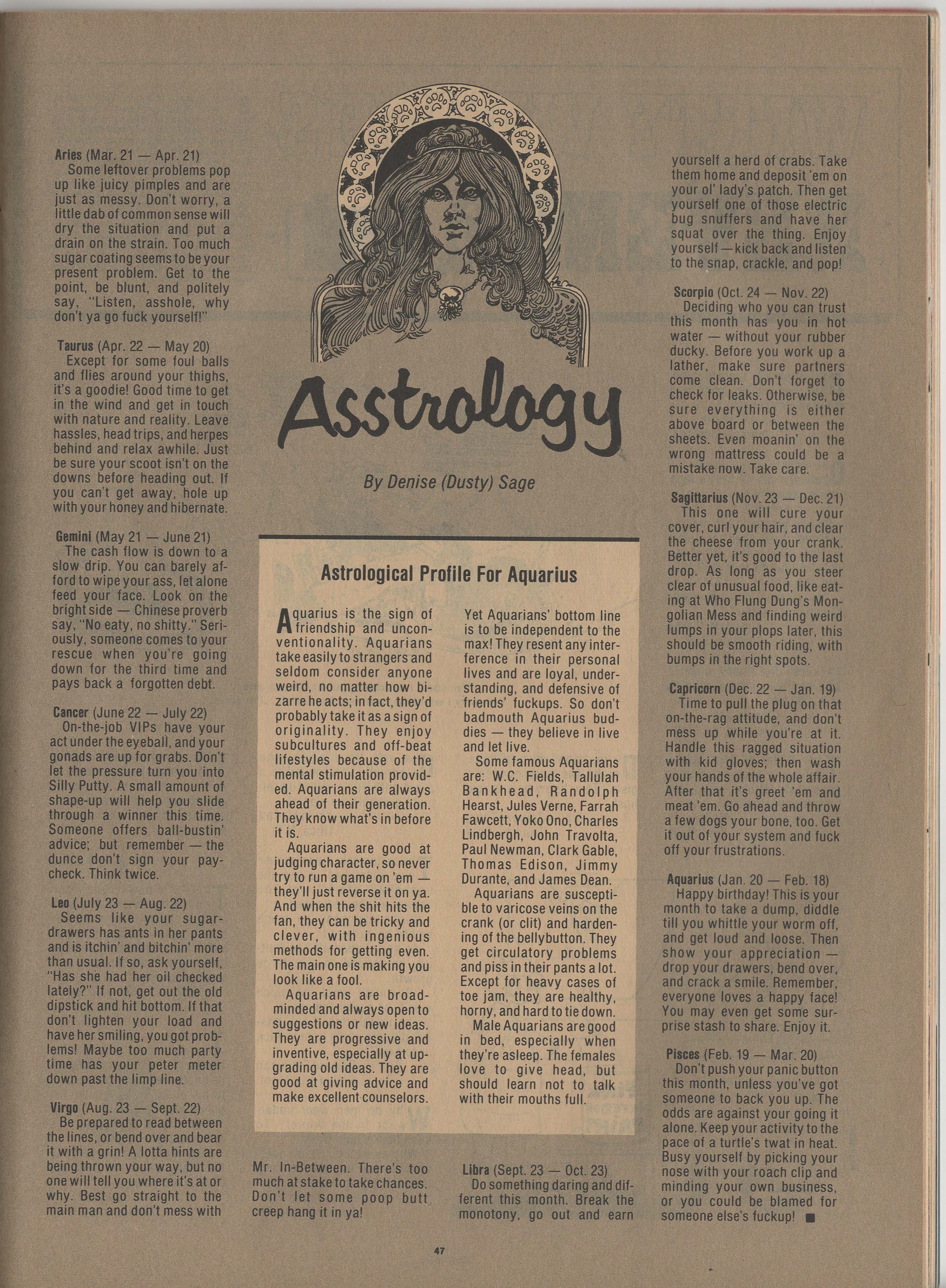
Choppershopper from Easyriders # 118, February 1983. Image courtesy of author.Asstrology, word games and other amusements made random appearances. Image courtesy of author.
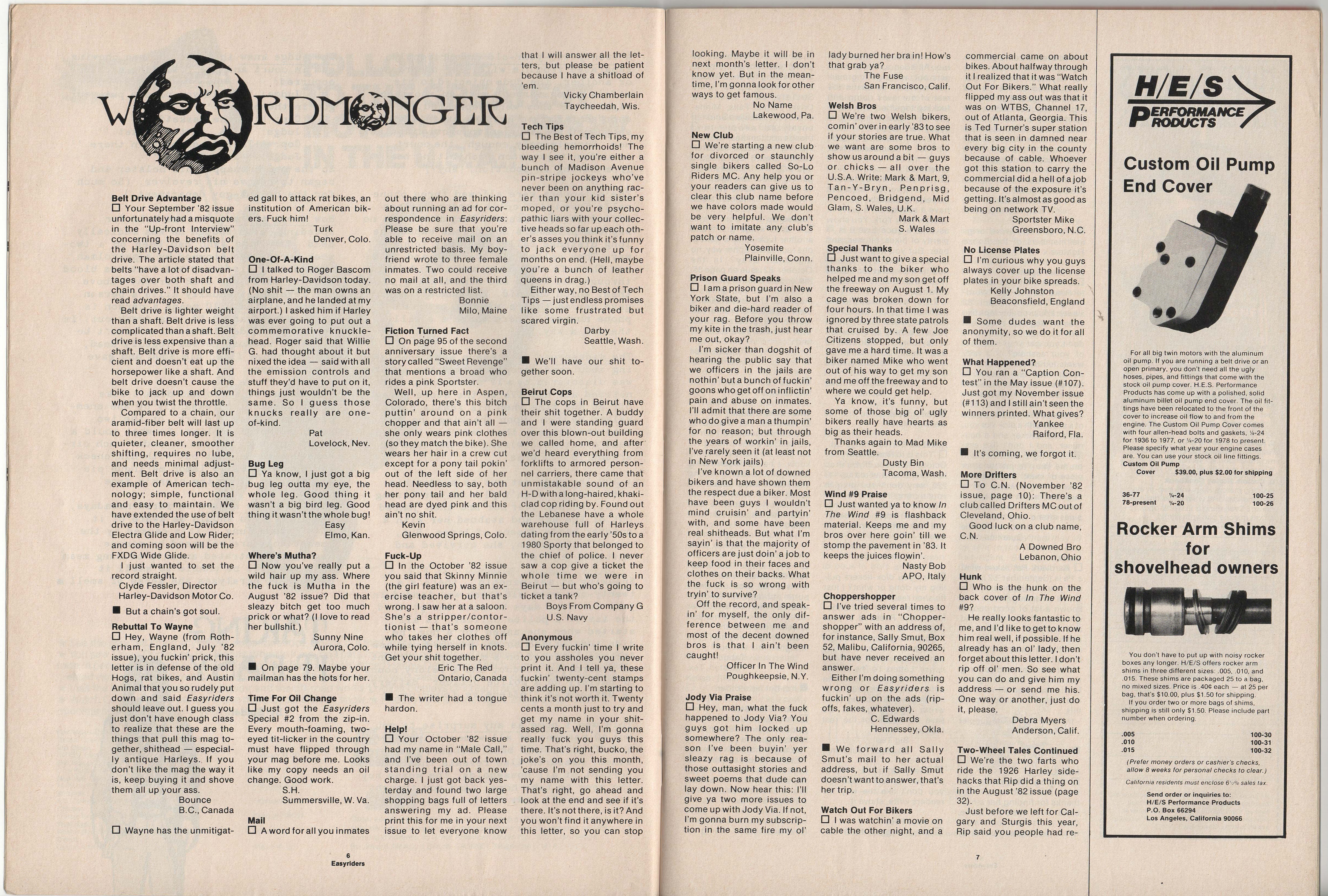
An Asstrology column made random appearances, along with word games, crossword puzzles and the like. Easyriders also ran an occasional Downtime column with reviews of new music, books and movies of interest to bikers. Finally, there were letters to the editors: some poignant, some profane, some laugh-out-loud funny. The editors’ often-acerbic replies were often even funnier.
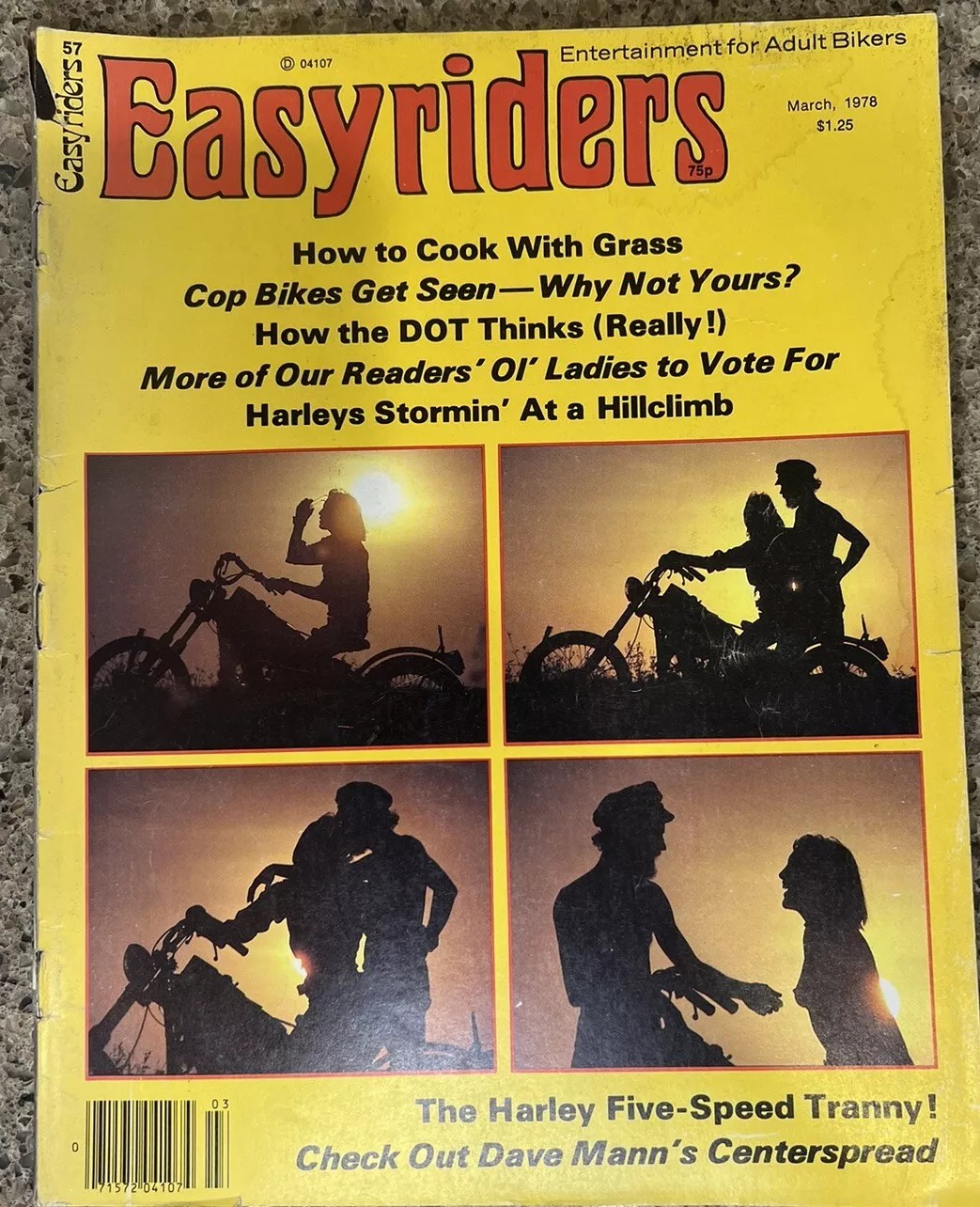
Letters to the editors were handled by Wordmonger, who must have had some fun sorting through the piles of mail the magazine received. Image courtesy of the author.Tech tips might include a write-up on Harley-Davidson’s recently released five-speed transmission, and increased visibility for traffic safety. Others might include recipes for marijuana meals. Easyriders also featured updates on political issues of interest to bikers, like what the eggheads at the U.S. Department of Transportation might be up to. Image courtesy of eBay seller pqu698.
Easyriders also featured tech tips. Some were useful articles about motorcycles: how to decide what rake you needed for your chopper, or tune a Mikuni carburetor, or how to decipher Harley-Davidson’s Byzantine numbering system, so aspirant chopper builders could determine what year and model engine they were looking at when shopping for the Big Twin or Sportster engine of their dreams. Experienced bikers knew that a dodgy set of numbers could result in confiscation of the rider’s motorcycle by police. Rest assured, if the cops took your bike, you lost everything connected to it, even if you had receipts for every nut and bolt!
David Duke, the man who was going to mainstream racism with his ‘new and improved’ KKK, went on to win a seat in the Louisiana House of Representatives and make several runs for higher office, including Governor of Louisiana and President of the United States. After several unsuccessful campaigns, he dropped all pretense of civility and came out as a neo-Nazi. He also pleaded guilty to fraud charges in 2002, which netted him a fifteen-month sentence in a federal prison. He is reportedly still spewing his bile. Unfortunately, Easyriders recognized and exploited the fact that a large percentage of hardcore bikers adhere to racist and fascist ideologies. Image courtesy of eBay seller pqu698.
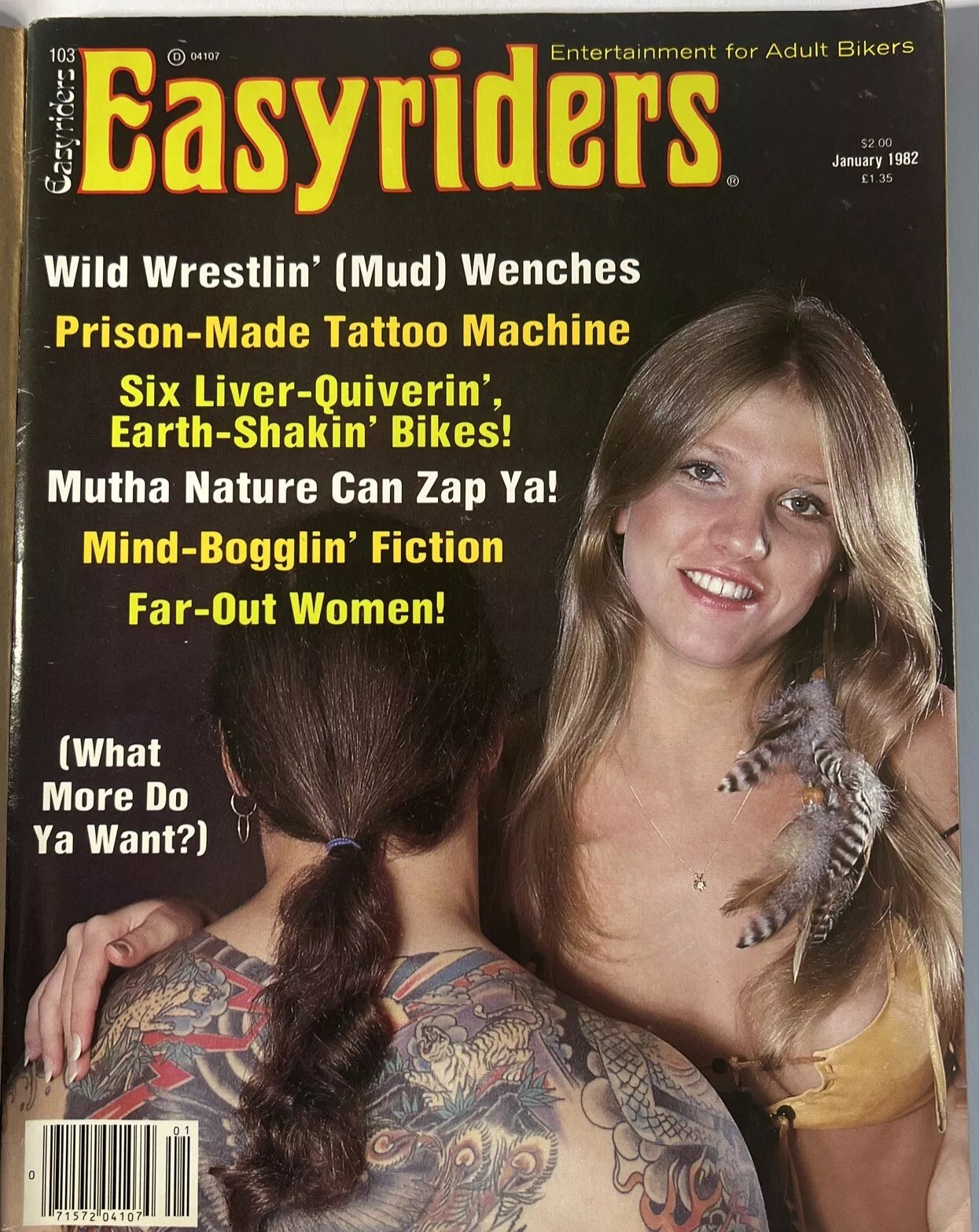
There were also handy ‘tech tips’ on how to conceal weapons, drugs and other contraband, grow marijuana and make prison tattoo machines, alongside interviews with controversial characters like Ku Klux Klan leader David Duke. These articles – and adverts for White Power t-shirts, swastika belt buckles and devices for smoking leafy products 😏 whilst riding your machine – were gradually phased out when prison and military censors began banning the magazine. Because so many bikers were in prison or serving in the military, the publishers of Easyriders went to great lengths to be sure the magazine was available to all, even offering free subscriptions to prison libraries.
A typical cover from January, 1982. Note the featured articles include a ‘how to’ on making contraband prison tattoo machines. Image courtesy of eBay seller pqu698.
In a regular feature titled Easynews,the magazine also included political news relevant to bikers: the progress of helmet laws and other anti-biker legislation, R.I.C.O.1 prosecutions of Hells Angels members and other outrages. When ‘safetycrats’ in Washington used federal highway funds to blackmail states into enacting mandatory helmet laws, Easyriders and A.B.A.T.E.2, the homegrown Motorcycle Rights Organization (MRO) the editors created, led the fight against the mandates.
Easynews was a regular feature. Image courtesy of author.
Through the 1970s, ’80s and ’90s there was a push-and-pull contest between pro- and anti-helmet law factions, which resulted in a patchwork quilt of requirements across the nation. One state might mandate helmets for all riders, while another only required them for riders under the age of twenty-one, or eighteen, or on machines over a certain engine size. To obfuscate the issue even more, in later years a wave of bills across the nation permitted riders to doff their helmets if they carried a certain amount of health insurance, which would cover them in the event of a motorcycle crash. Enforcement was unsustainable, and those states effectively became free choice states again.
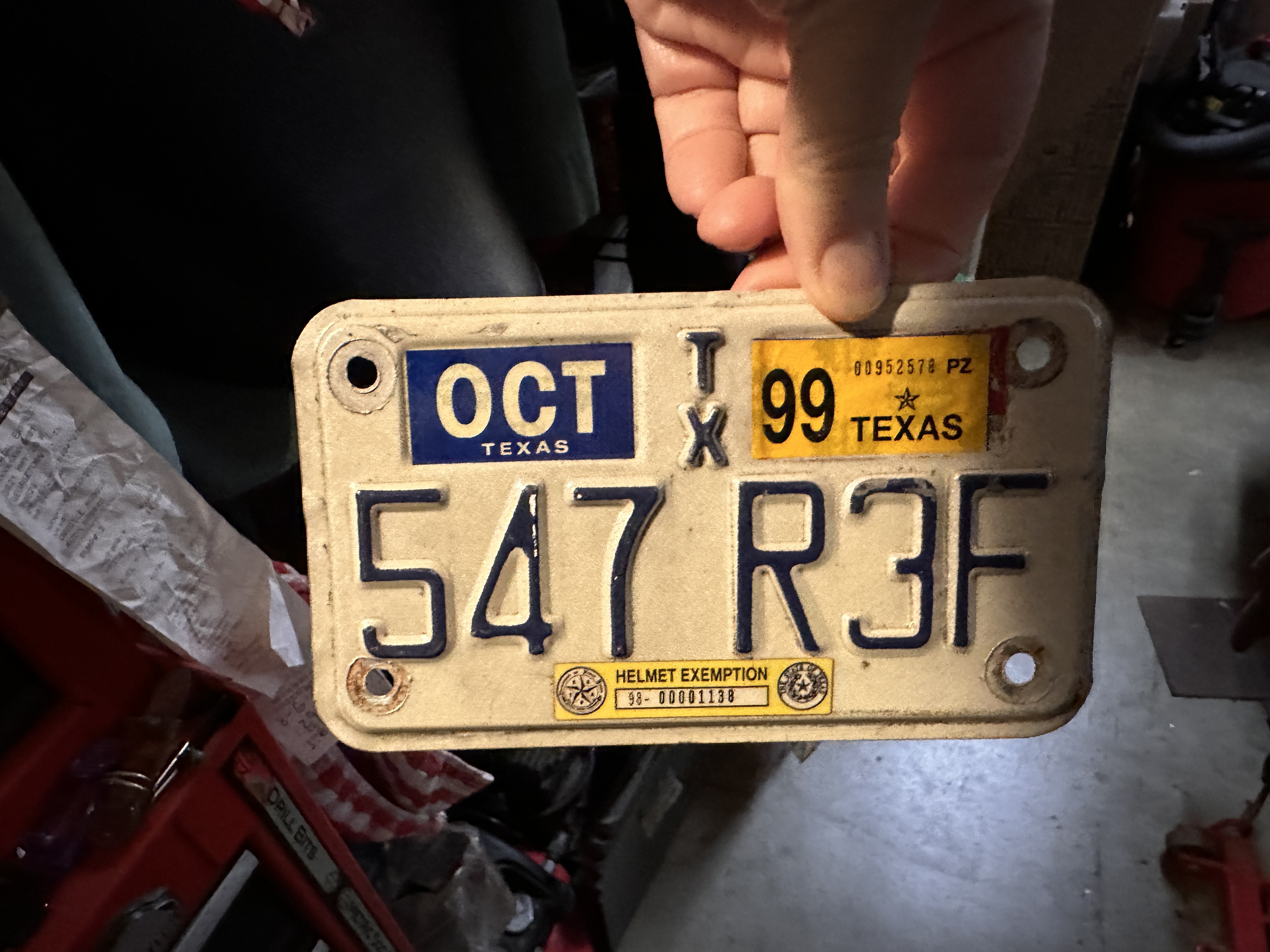
In the late ’90s, with passage of an insurance exemption bill as described above, Texas offered a Helmet Exemption sticker for those riders who carried proof of the requisite health insurance. It was optional, cost about $5 if I recall, and did not guarantee LEOs wouldn’t stop you for riding sans helmet anyway. The sticker program was eliminated in 2009.
But helmet laws weren’t the only issues facing riders. Some states attacked the ‘chopper lifestyle’ by mandating seat and handlebar heights, chain guards and front fenders, full-length rear fenders, turn signals, restrictive mufflers and more.
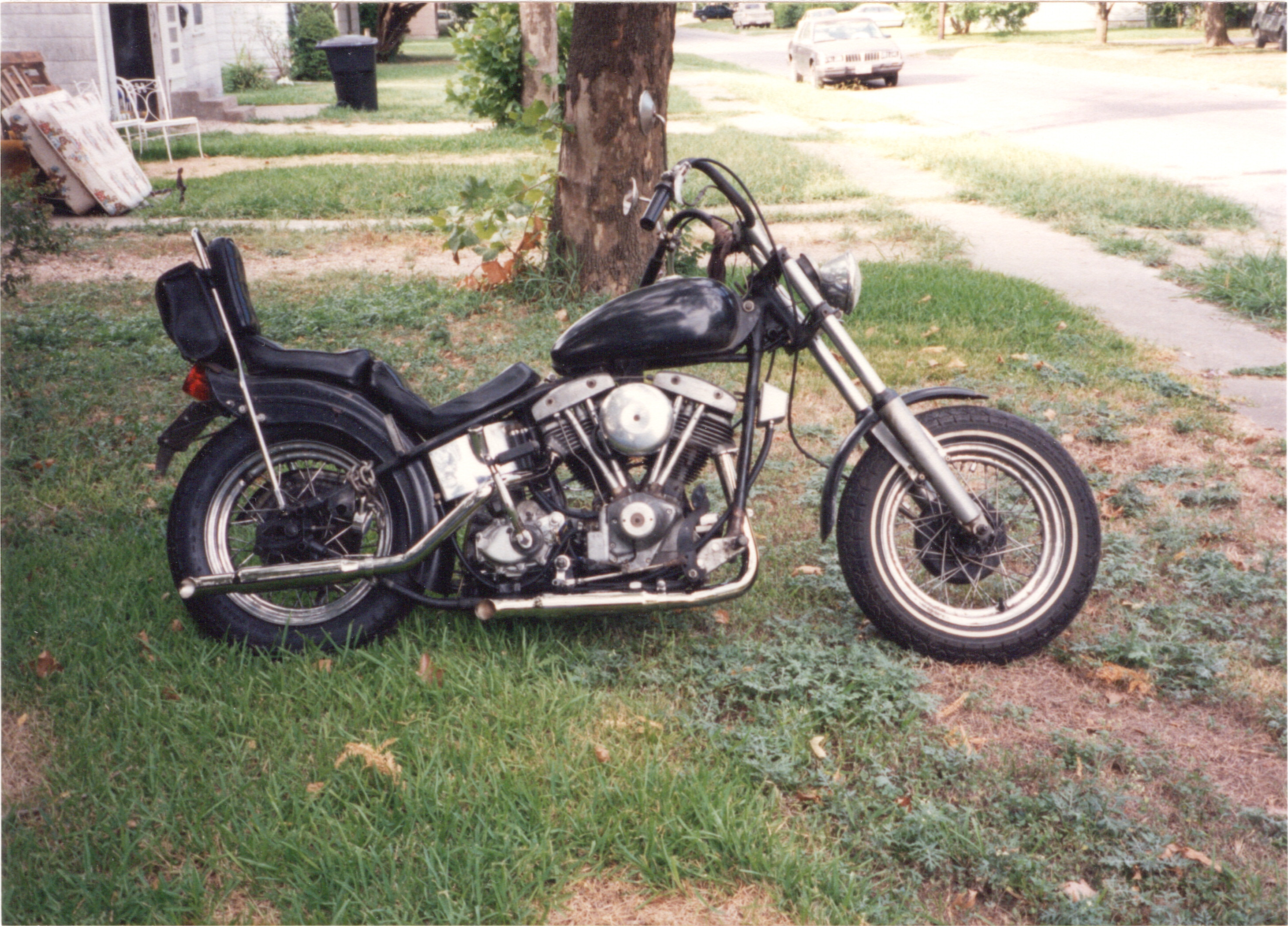
A motorcycle like my shovelhead could earn me a ‘seat too low’ ticket in certain jurisdictions, because I ran a frame-mounted butt bucket saddle on that low-slung OEM rigid wishbone frame. I neverran the sky-high apehangers some riders opted for, but my ‘baby apes’ were probably tall enough to get me ticketed in some states, and I have twice been ticketed for ‘exhaust too loud’. On both occasions I had brand new mufflers recently installed on my bike.
The low-slung frame-mounted butt-bucket saddle that would have earned me a ticket in places like Florida, and the brand-new exhaust system that garnered me an ‘exhaust too loud’ ticket in Bell County, Texas. The state trooper who wrote me up (after slowing down and forcing me to pass him) rubbed salt in the wound by claiming his dirt bike was quieter than my muffled Harley. I’d bet dollars to donuts that was a bald-faced lie! Photograph courtesy of the author.
Elsewhere, motorcyclists were being profiled by law enforcement officers – stopped and treated like armed-and-dangerous felons solely for being bikers – and businesses were discriminating against riders, with ‘no motorcycle attire’, ‘no club colors’ and ‘no motorcycle parking in lot’ signs popping up at bars, restaurants and other premises.
I recall a run from Austin to Lake Buchanan, in a pack of thirty or so bikes. We stopped at a roadhouse in rural Burnet County for lunch. As we were leaving, we found ourselves surrounded by law enforcement of all stripes – local police, county sheriff’s deputies and state troopers – with weapons drawn as they confronted us. We were put through the mill. License, registration and vehicle identification numbers were slowly and laboriously checked via radio, one at a time, to drag the process out. Bikes were searched and riders questioned as we sweltered in the blistering sun for over an hour – and the sum total of their efforts was one (1) arrest for an outstanding traffic warrant!
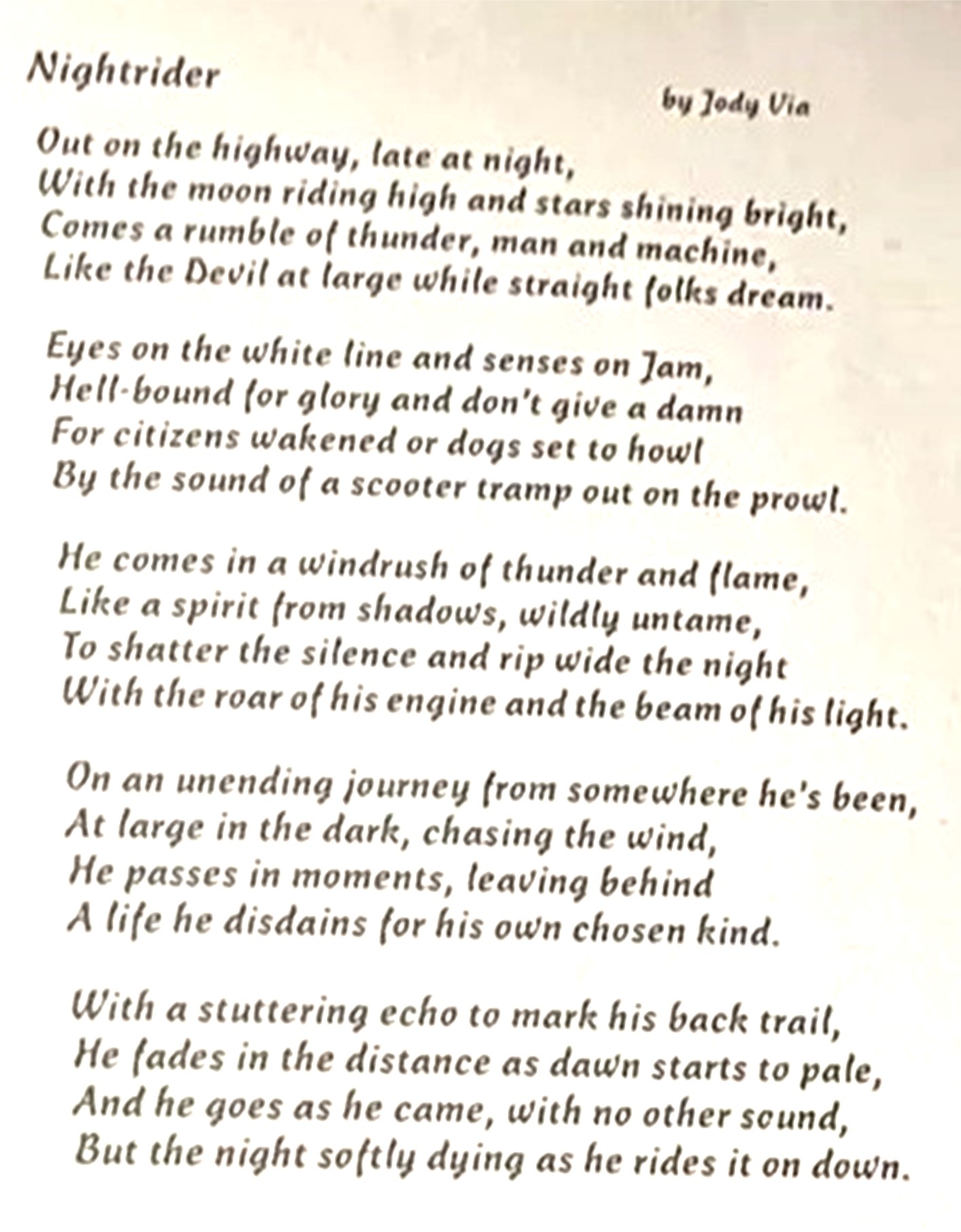
My shovel and I outside the Burnet County roadhouse where we were held at gunpoint by LEOs from every available agency. There were local yokels, county mounties, smokies… all armed with shotguns, hunting rifles and AR-15s. I wouldn’t have been at all surprised to learn the local dog catcher and building inspector were out there, getting in on the action! Photograph courtesy of the author.NO COLORS ALLOWED…. but those young men seem to disagree with the sentiment. Hmm…. 😏 This photo appeared in Easyriders # 79, January 1980. Note the poem by Jody Via at right, and then see my footnote on him at the end of this post. Image courtesy of eBay seller Vintage Variety 60.
In another instance, I was attending a bachelor’s party for a friend. Despite the fact that we were all sober riders, he wanted his party to include a tour of the topless bars around Waco, Texas.
The evening began with an excursion to a dive outside the city limits, with fully nude dancers. The first thing I saw, as we entered the bar, was a drunk crashing to the floor after leaning his chair back too far, and the naked teenager on stage raising her hands in fright, screaming ‘I never touched him!’
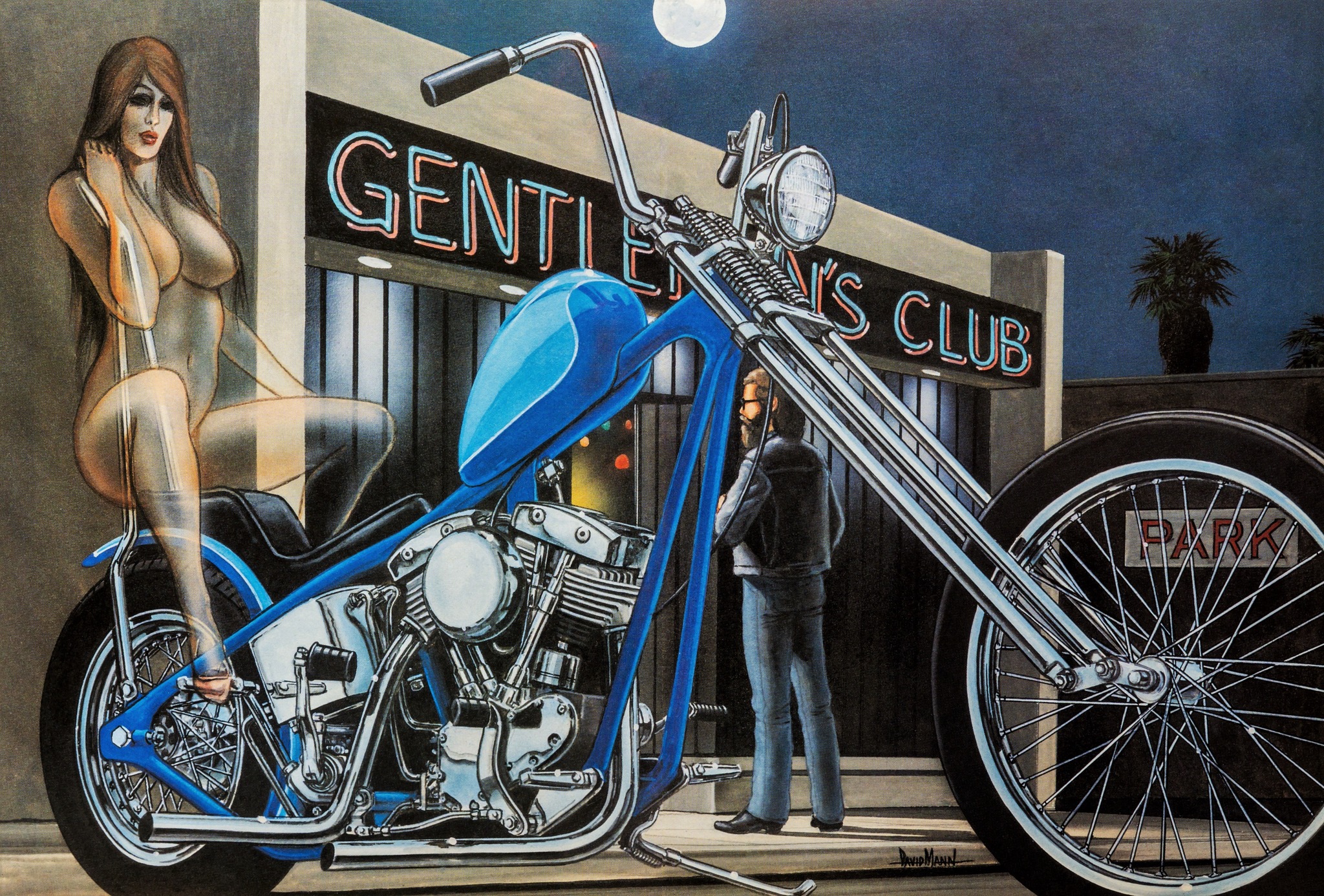
Later in the evening, we arrived at a ‘swanky gentlemen’s club’ in the city proper, and sure as hell, there was a sign saying ‘No Motorcycles in Parking Lot.’ The groom-to-be and most of our party were content to park in the lot next door, go in and carry on the festivities. Me, I do my best to avoid spending my money or time in places where I’m not wanted, so I stayed outside and rapped with the bouncers, most of whom were riders themselves!
And, for the record, there are damned few ‘gentlemen’ in those so-called ‘gentlemen’s clubs.’
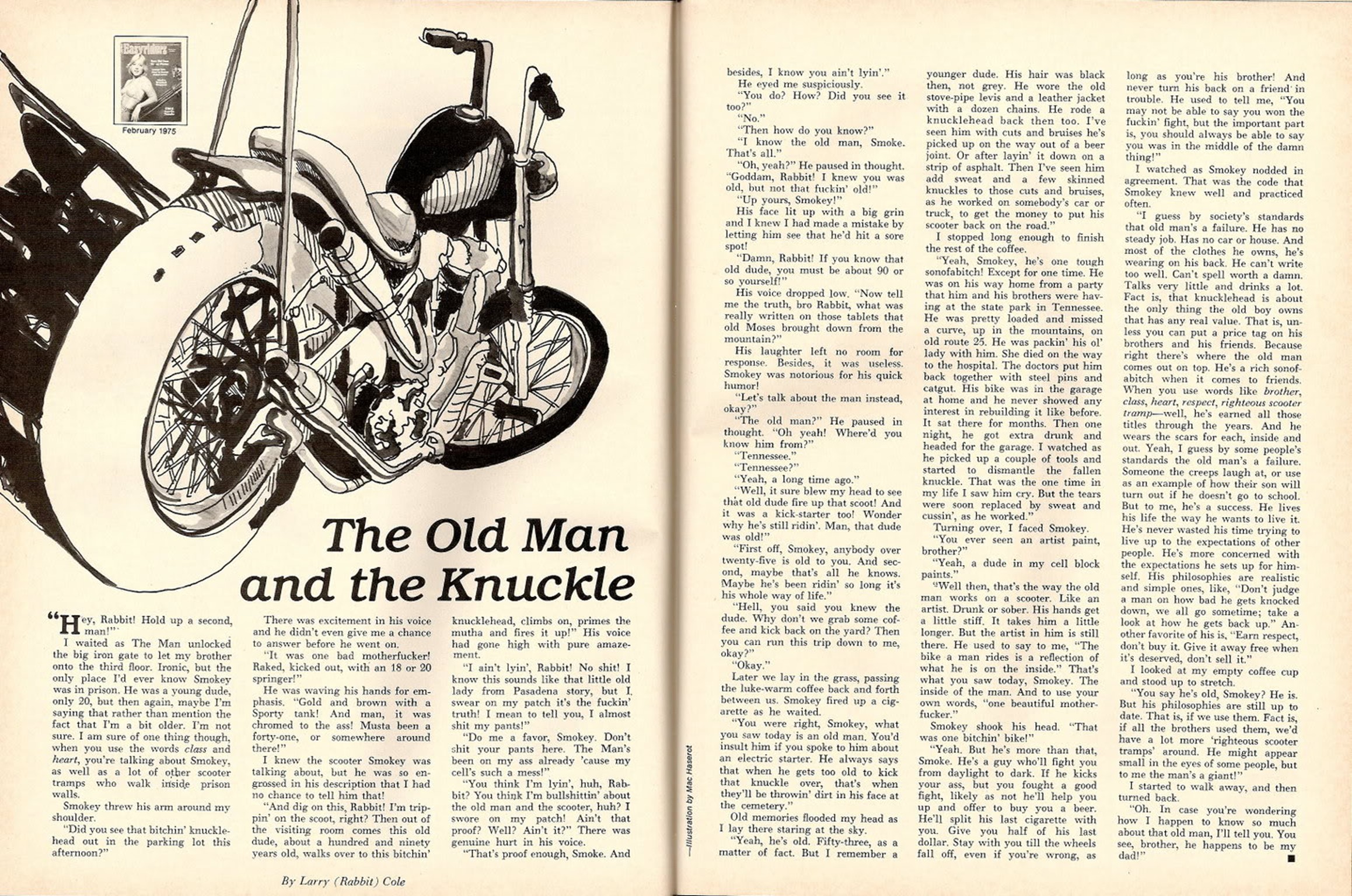
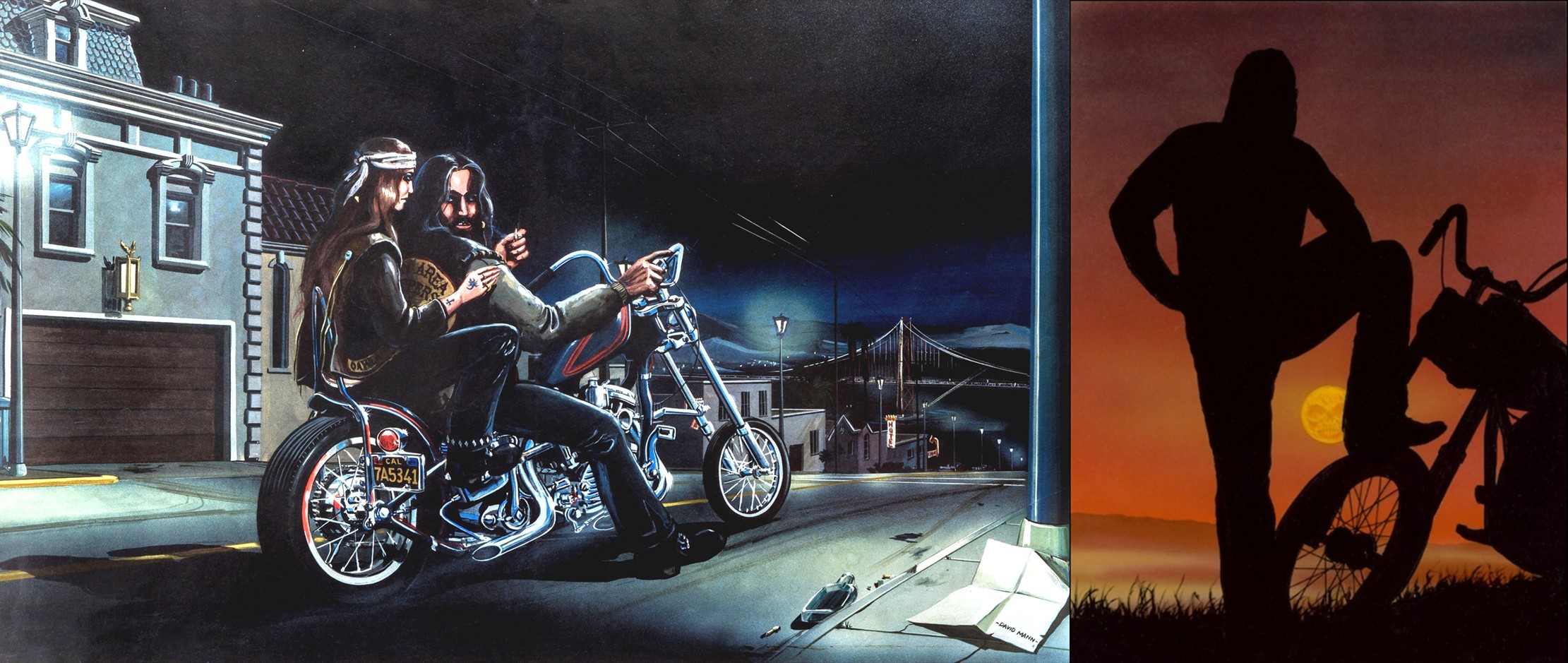
David Mann’s painting titled ‘Gentlemen’s Club’ appeared in the magazine’s June 1995 issue. Image courtesy of the author.Larry (Rabbit) Cole was one of my favorite writers in the magazine’s best years. I have no idea what his personal history may have been, or what became of him once he stopped writing for Easyriders.
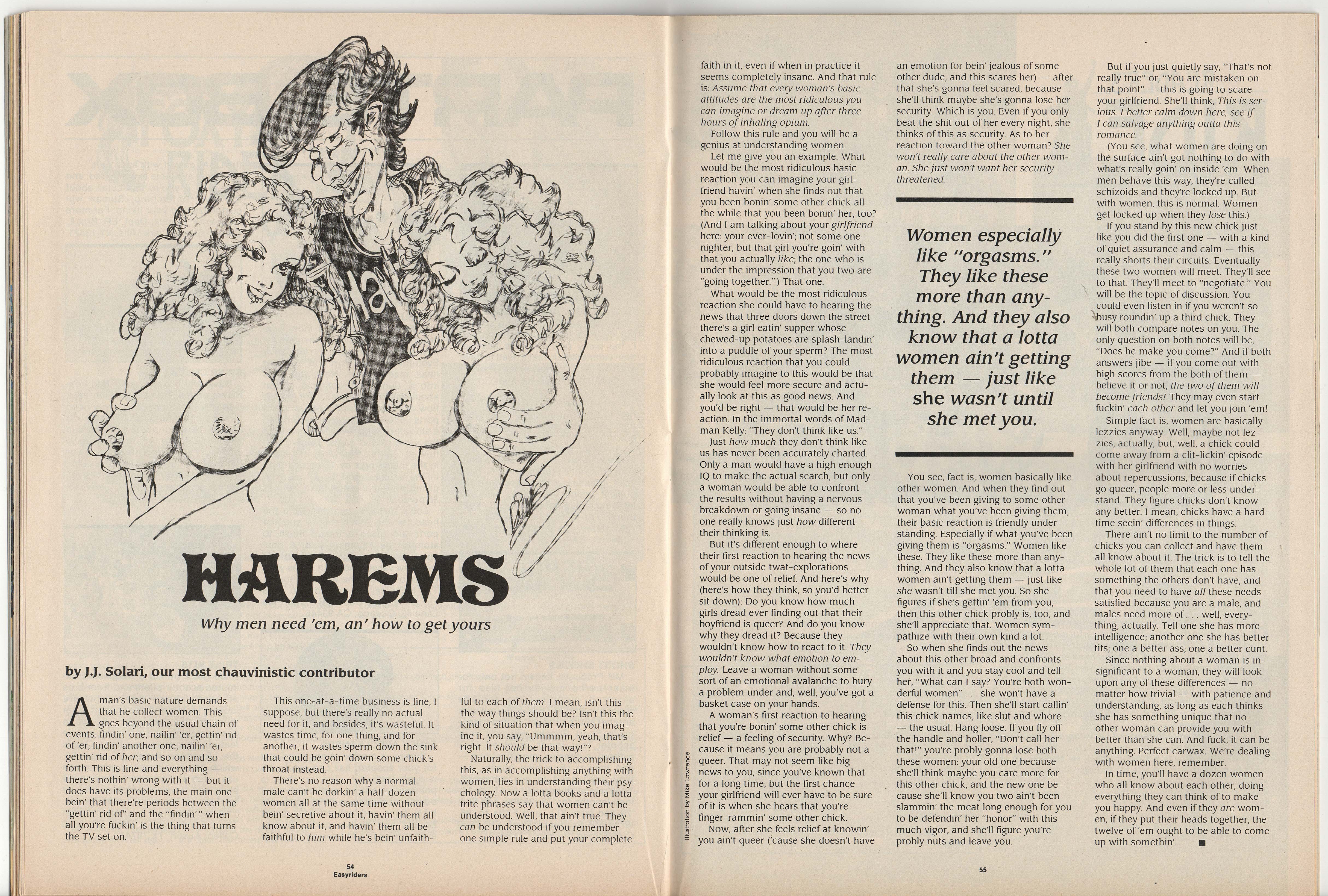
For me, one of the biggest differences between Easyriders and other magazines was that ER published short fiction about the biker lifestyle, by writers like Larry ‘Rabbit’ Cole (above) and Jody Via 3, and humor by psychotics like former Mouseketeer J.J. Solari.
One of the erstwhile Mouseketeer’s twisted ‘masterpieces’. I will post one of his longer pieces in a separate post. Image courtesy of the author.
Some of the writing was mediocre, but most was outstanding. There was real talent on display in those pages: well-crafted stories with vivid characters and dramatic arcs worth following. Easyriders was a huge influence on me as a teenage wannabe in the early ’70s, and was still thebiker rag of record when I began riding later in the decade. I take great pride in the fact that my first manuscript sales — fiction and non-fiction — were to Easyriders, and I consider Lou Kimzey my first editor and mentor in the world of writing.
This artwork (by an as-yet-unnamed artist) accompanied my short story ‘Bloodlines’, which appeared in the June 1988 issue of the magazine. More about that and other short stories in a later post. Image courtesy of the author.
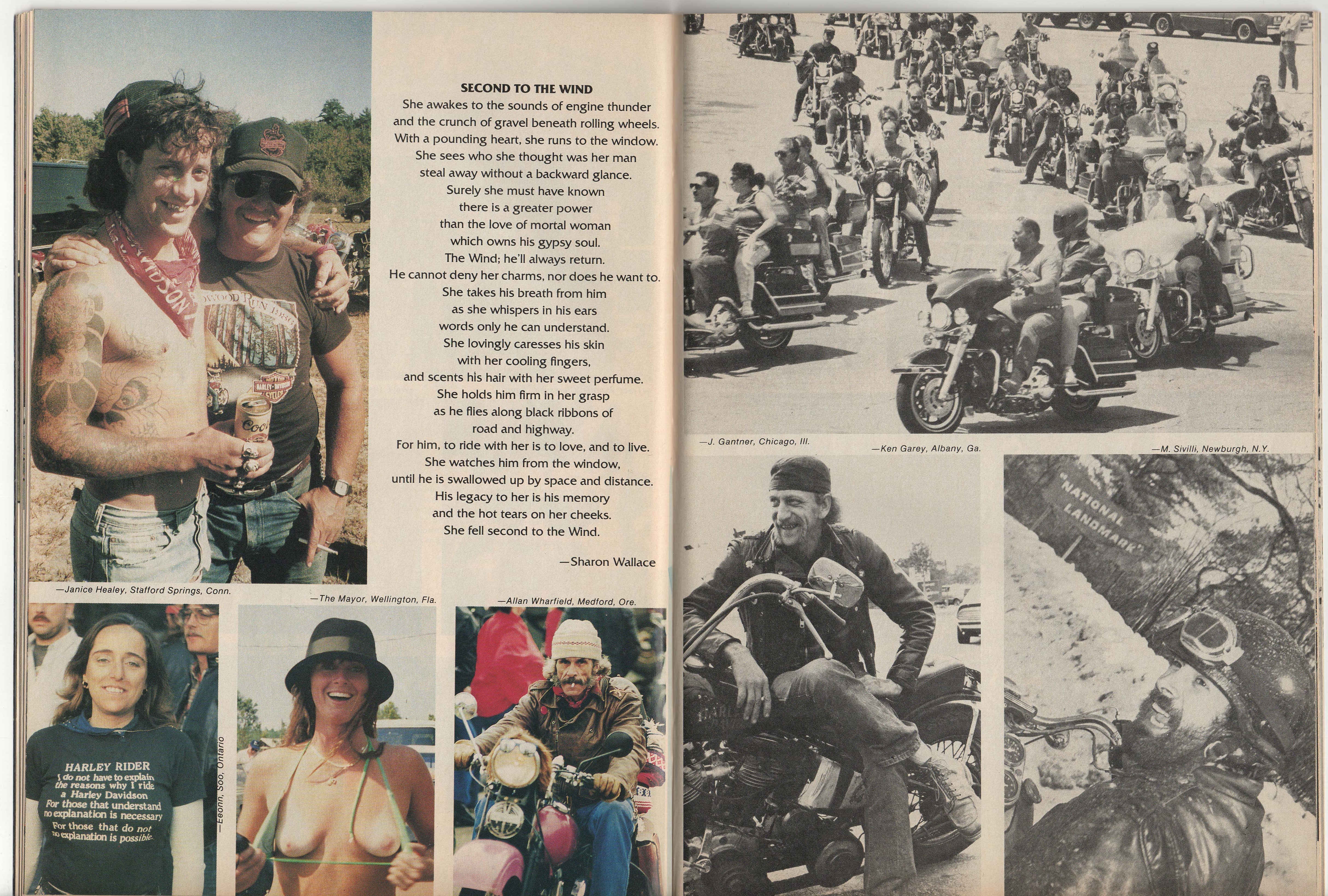
Easyriders also ran the occasional poem, usually an ode to brotherhood or a motorcycle or, less frequently, the good woman who made it all worthwhile.
A love poem by Dan Pierce from a volume of the spin-off In the Wind magazine. Image sourced from internet. Photo-illustration by author.An un-love poem by Sharon Wallace in Easyriders # 185’s In the Wind section, November 1988. Image courtesy of the author.
Notably, the magazine’s editors broke with traditional publishing practice by accepting handwritten manuscripts – unheard of in that era – because most prison inmates did not have ready access to typewriters.
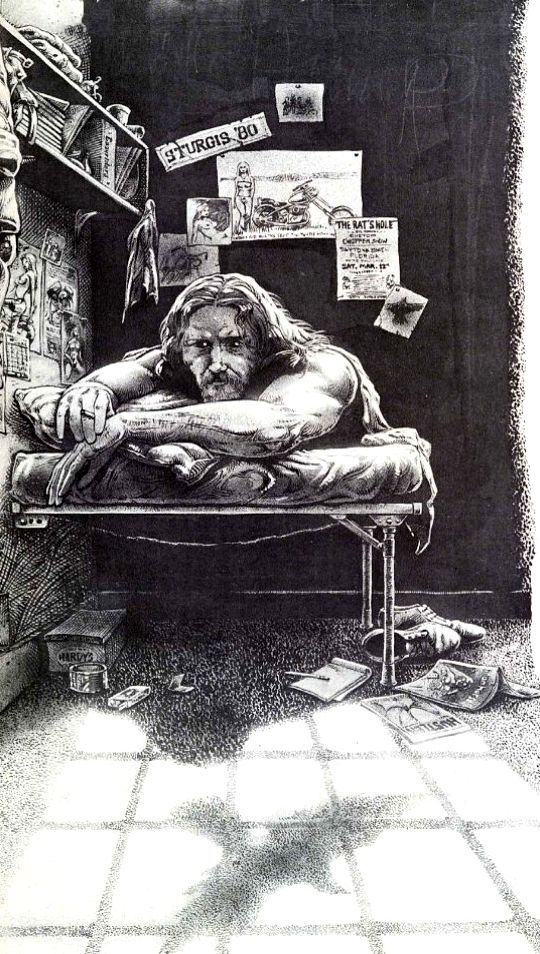
Duffy Duggan’s work appeared often in the magazine’s pages, illustrating short stories and articles. Here, a hapless biker serves time in prison, a common theme for hardcore bikers. Image sourced from internet.
In another groundbreaking move, Easyriders made a practice of publishing motorcycle-themed illustrations and paintings by talented artists like Duffy Duggan, above, and cartoonist Hal Robinson, below.
Artist Hal Robinson could do ‘funny’ easily, but occasionally took a turn at more contemplative works like the one above, at right. Images sourced from internet.
Most noteworthy of these was the godfather of chopper art, David Mann, who first broke out with a series of posters painted for Ed ‘Big Daddy’ Roth of Choppers Magazine fame. Mann created his first masterpiece centerfold painting for Easyriders‘ third issue in October, 1971. The artist – the Frederic Remington of the biker world – painted large centerfold paintings for the monthly magazine, and story illustrations, even as he cranked out book covers, centerfolds and illustrations for other publications. Despite that workload, the artist produced at least one piece for every issue of Easyriders from October, 1971 until his retirement in June, 2004. David Mann passed away in September of that year, but his paintings continued to appear in Easyriders and her sister publications for years afterward.
You can learn about David Mann and see much more of his artwork here.
David Mann’s first and last paintings for Easyriders Magazine, in the October 1971 and June 2004 issues. Images courtesy of David Mann‘s Facebook page.
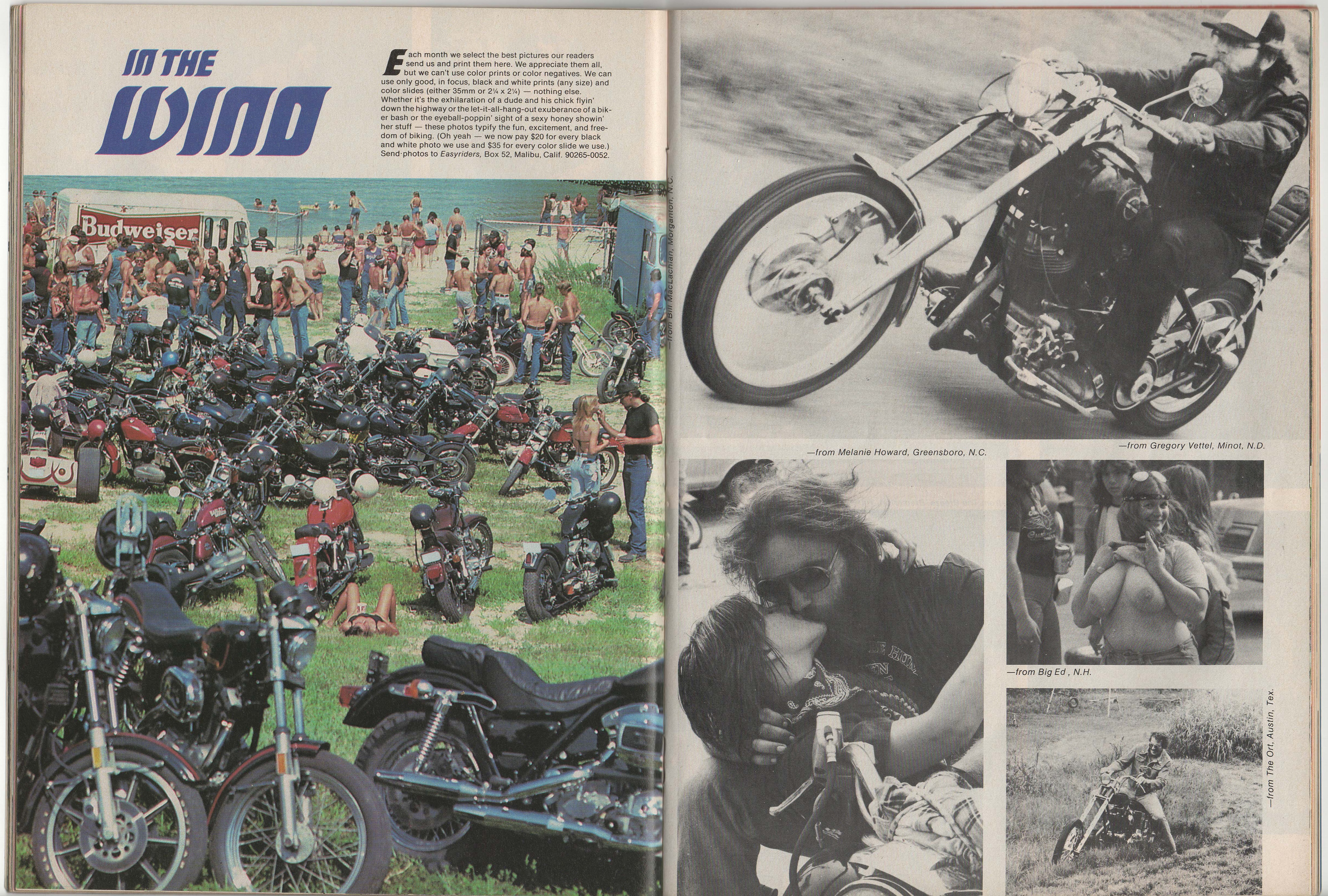
IN THE WIND
From Easyriders # 118, February 1983, the come-on to readers, to submit their photos for consideration. I can scarcely imagine the volume they received! Image courtesy of the author.
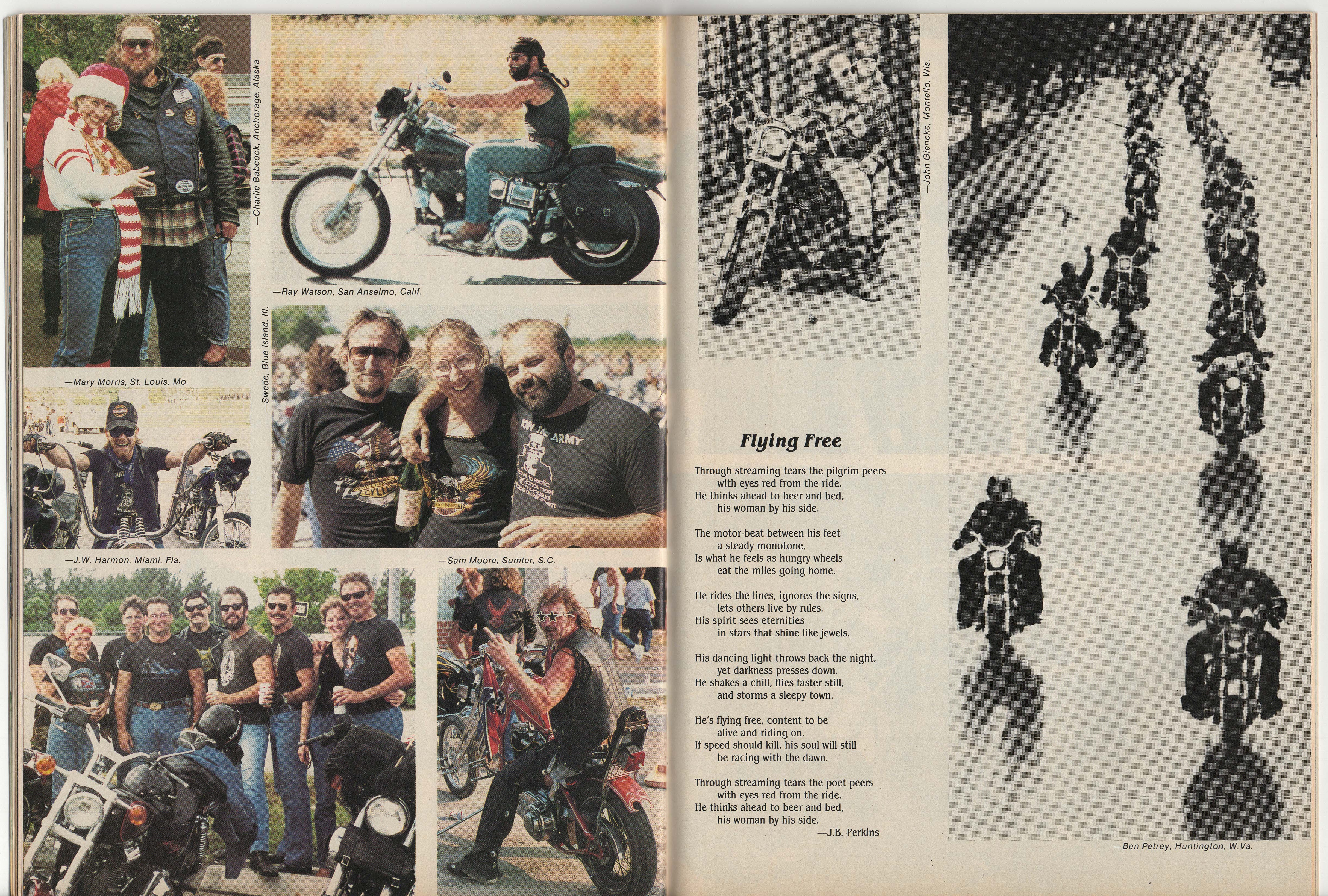
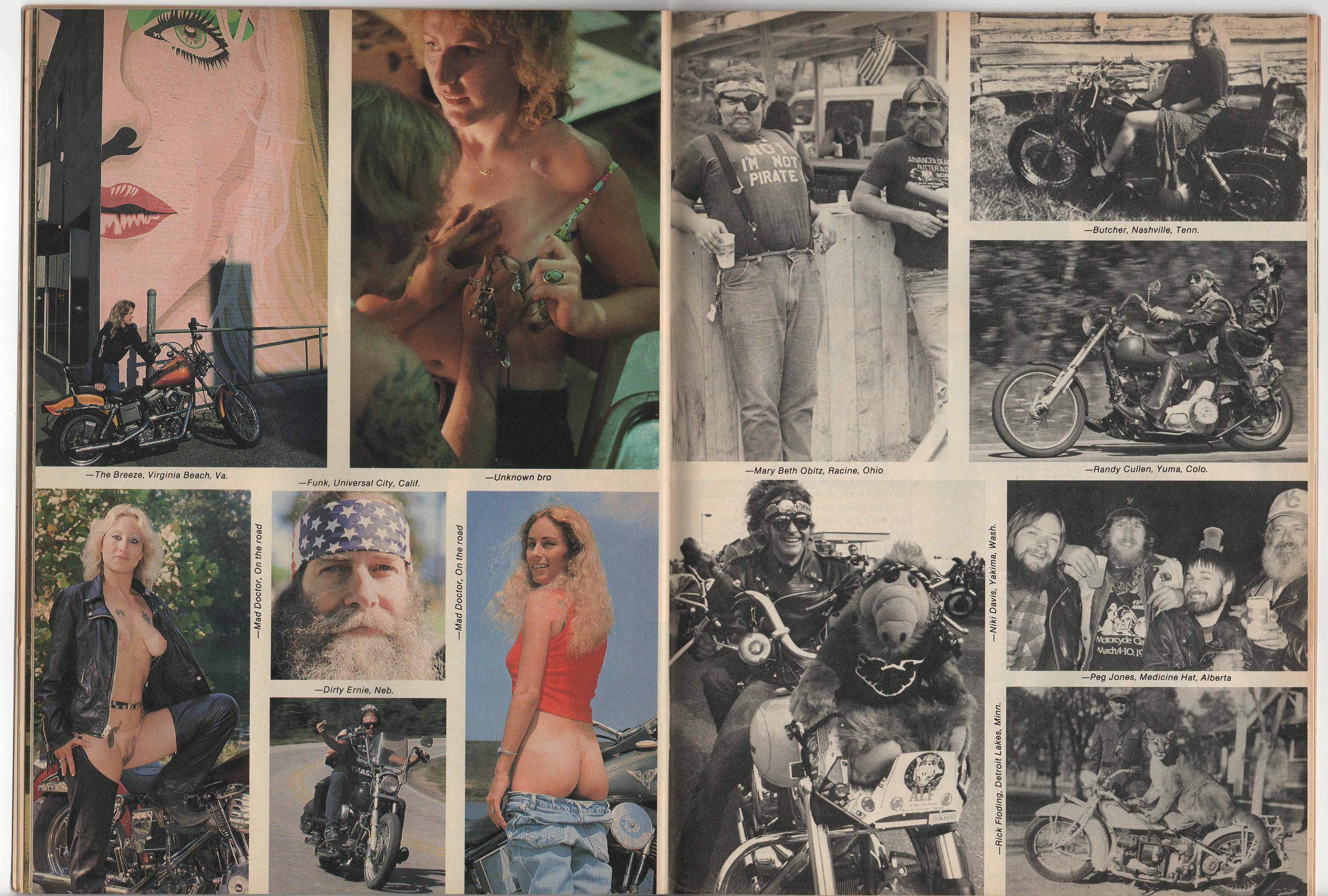
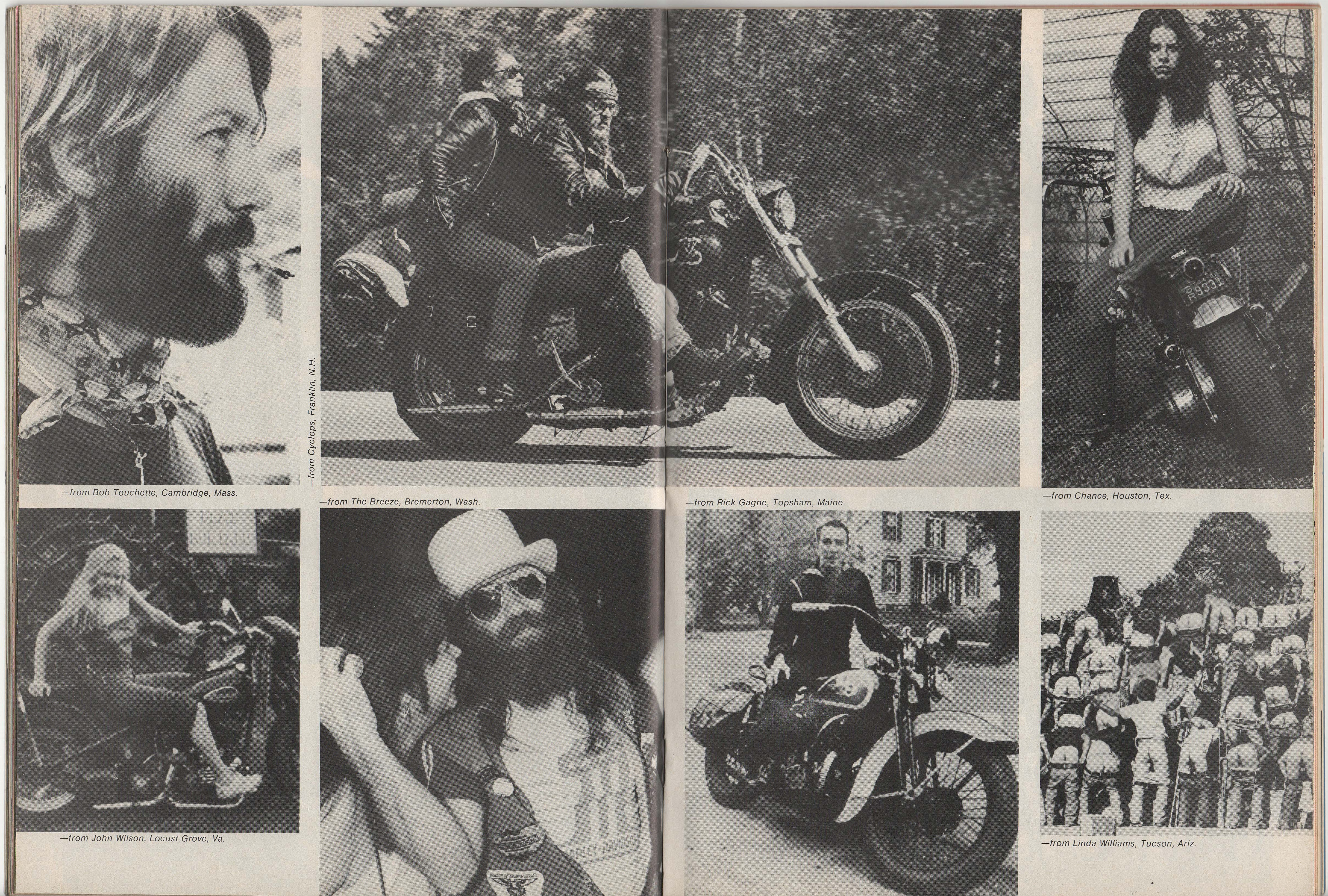
One of Easyriders‘ more ingenious innovations was their In the Wind pages, where they offered readers cash (above) for ‘good, in-focus’ photographs of bikers at play, riding, partying, brawling or posing with their machines, and women, usually flashing their breasts for the camera.
There were often older photographs, resurrected from Grandpa’s old picture album: proud farmers and sales clerks, and their bemused sisters or girlfriends, posing with Popes, Thors and Excelsiors. There were Allied soldiers aboard strap-back Harley J-Models and WLAs, Triumphs and BSAs, and their German counterparts on BMWs and NSUs. Other pages might teem with photos submitted by readers in Europe, Asia, South America and Africa, each with their own biker subculture.
Pages of typical ‘In the Wind’ photographs from the August 1988 issue. Image courtesy of the author.
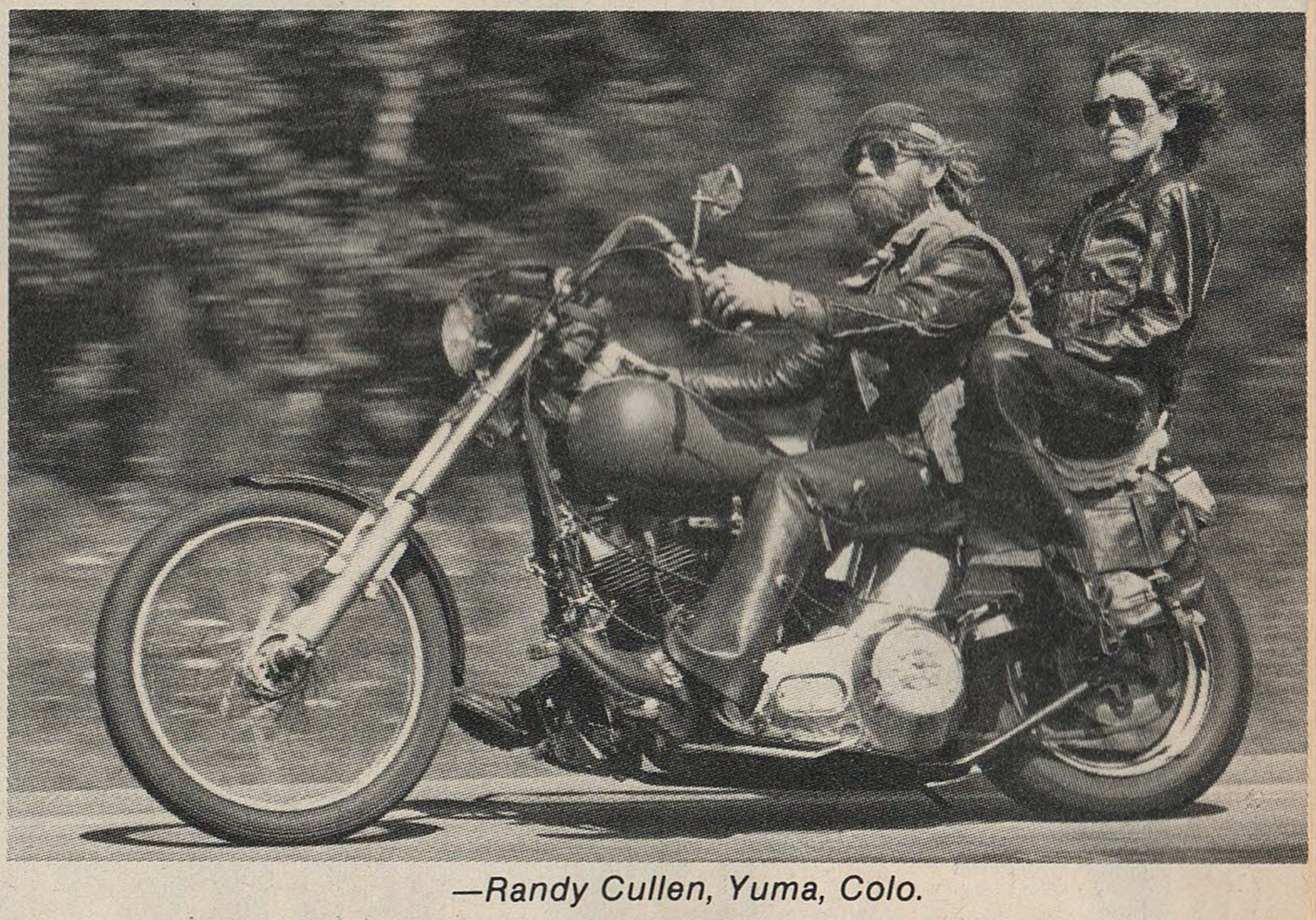
And, of course, there were hundreds and hundreds of pics of bikers, male and female, outlaw and straight, on original or restored classics or wild-as-fuck radical customs. They were jamming down the road, hair floating in the breeze and tight grins on their faces, or scowling at the camera and flipping the universal biker salute – one raised finger – to friend and foe alike. They were drinking beer, wrestling in the mud of a campsite, or tearing a motorcycle apart beneath a tree as friends gathered to offer assistance….
Pages of typical ‘In the Wind’ photographs from the June 1988 issue. Image courtesy of the author.
….and women, in denim and leather or not much of anything, baring their all at a rally, packing behind their ol’ man or geared up and gripping the bars of their own machines. All ages, all shapes and sizes, but most pretty and slender and lithe enough to curl up behind a man as they blast down the highway together, her feet on the high pegs of that rigid frame and her arms around her man.
What it’s all about, really, in Easyriders, June 1988. Image courtesy of the author.
I called In the Wind ‘ingenious’ because, while the editors paid for photos they published in the magazine itself, they reserved the right to use any and all submitted photographs free of charge in a spin-off magazine called In the Wind. It featured page after page of readers’ photographs, very little editorial content, and ran through well over a hundred and fifty issues. Aside from layout and pasteup, it couldn’t have cost much to produce, and every issue sold by the tens of thousands.
These appeared in Easyriders # 118 in February 1983 ‘In the Wind’ pages. Image courtesy of the author.
I submitted a number of photos to the magazine’s for-pay column, but only ever saw them in later issues of In the Wind.
One of my many submissions to the magazine’s ‘In the Wind’ pages: a shot from one of the ABATE Texas annual members’ rallies. Several showed up in the spin-off publication, but none made the paid-for pages in the magazine itself. 😡 Image courtesy of the author.
EXPANSION
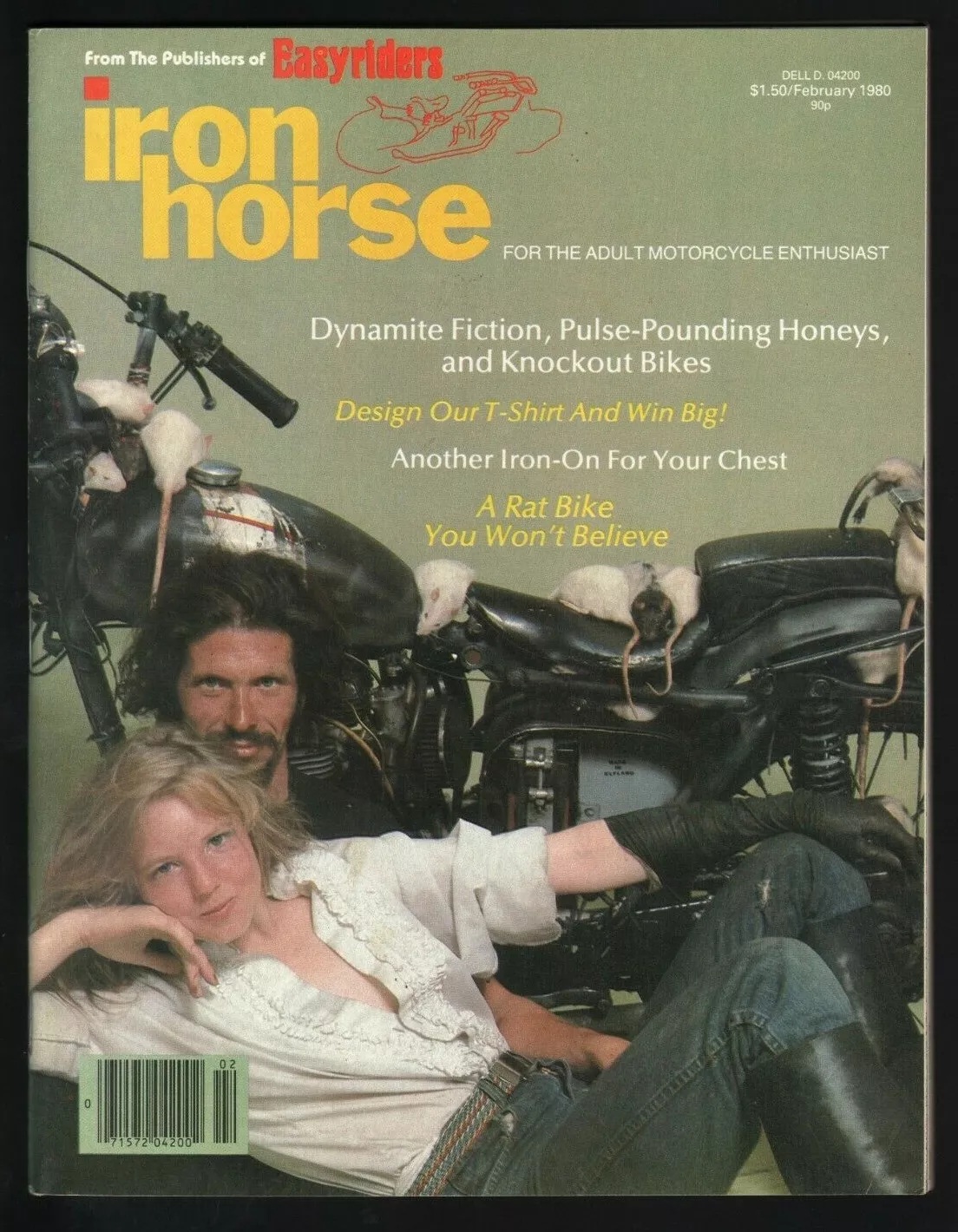
Iron Horse featured bikers and babes just as down-to-earth as Easyriders, but with a more inclusive flair. Image courtesy of eBay sellers Gallimore’s Goods.
Realizing that they had a good thing going, Easyriders‘ parent corporation, Paisano Publications, soon sought to expand the brand into a world-wide empire. First came the In the Wind magazines. These were followed by Iron Horse, a magazine more dedicated to metric riders. Still the same hard-partying, hard-riding biker ethos, but with more Triumphs and Hondas than Harleys and Indians.
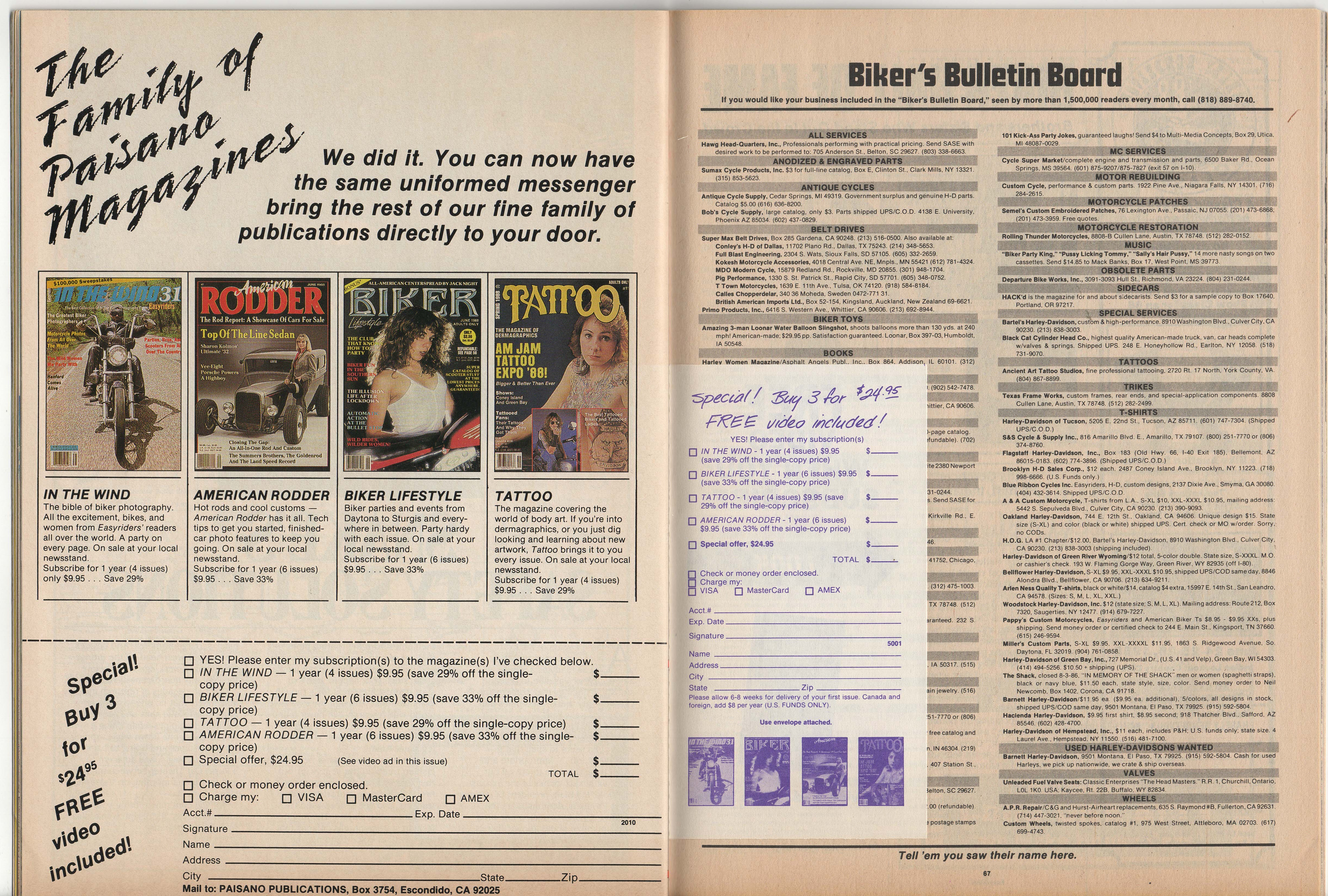
Paisano Publications‘ burgeoning publishing empire featured created titles like In the Wind, American Rodder and Iron Horse, and acquired titles like Tattoo and Biker. Image courtesy of the author.
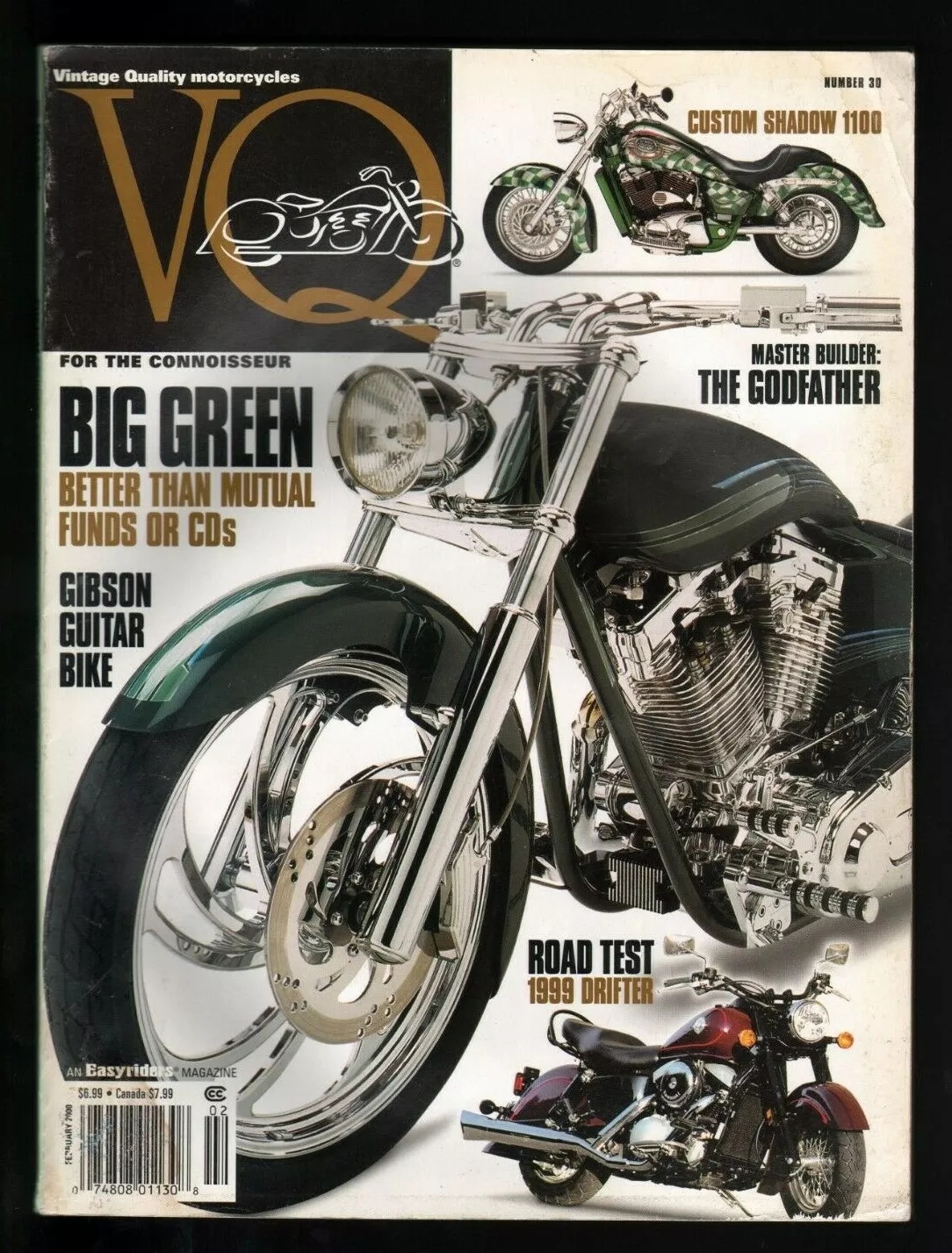
Later, we saw titles like Tattoo, which cashed in on (and helped fuel) the passion for skin art sweeping the nation in the ’90s and ’00s. Another spin-off magazine was V-Twin, intended as a ‘family friendly’ version of Easyriders. No topless women, fewer four-letter words…. 🙄 Worse still was VQ, a magazine ‘for the connoisseur.’ 🤢
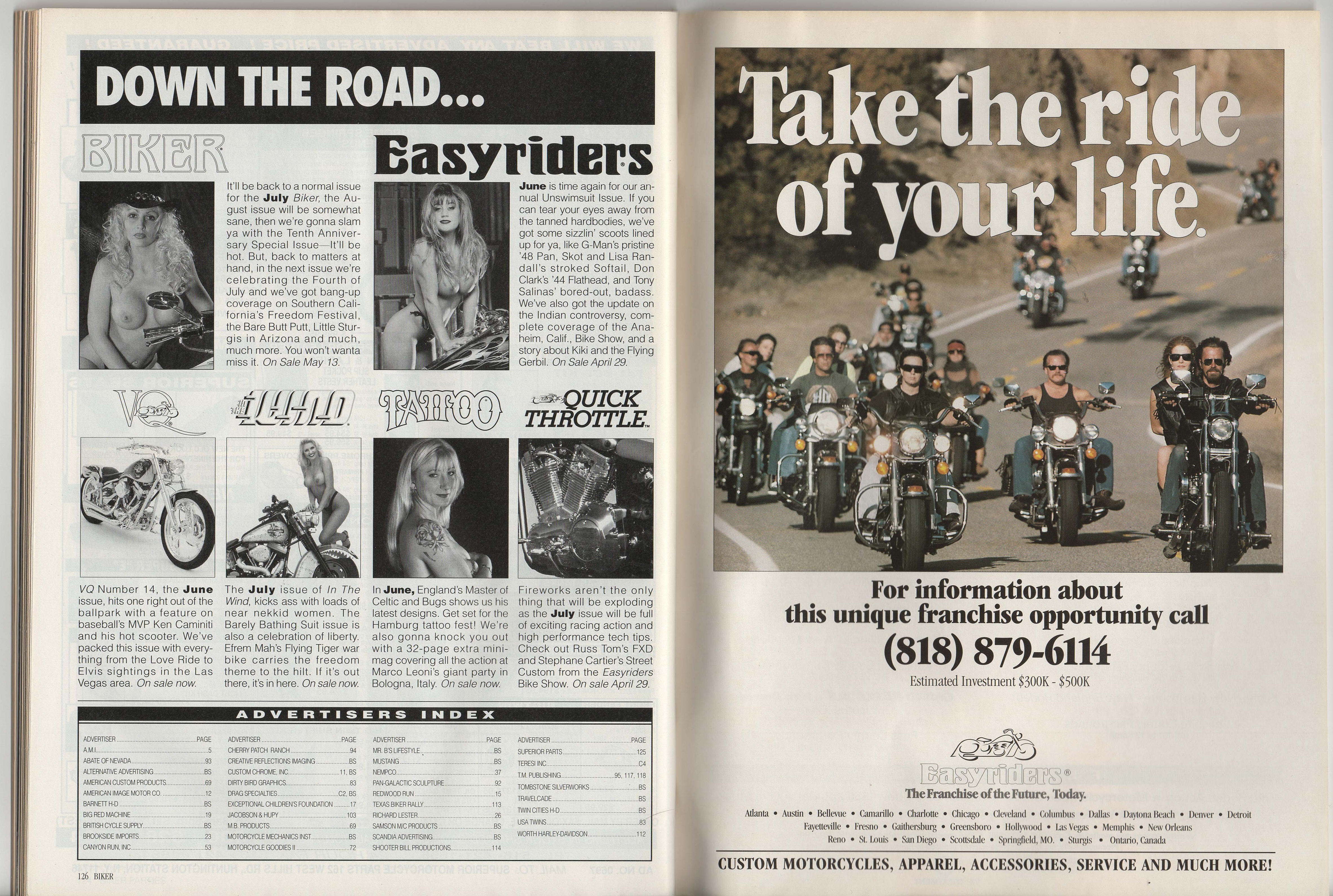
Image courtesy of eBay sellers Gallimore’s Goods. Adverts for a number of Paisano Publications titles, including Easyriders, Biker, In the Wind,the aforementioned VQ, Tattoo and Quick Throttle. On the opposite page, a pitch for Easyriders store franchises. For reference, the $500K investment listed would be the equivalent of about $1 million today. Image courtesy of the author.
Other cash cows turned up. There were Easyriders products like t-shirts, hats and scarves, which grew into a full-sized catalog insert in the magazine every Christmas season. Then came brick-and-mortar Easyriders stores – franchised outlets as advertised above – that sold clothing and custom parts. Some even tried to be full-service motorcycle shops, with bikes for sale and mechanics on duty.
An Easyriders Store as envisioned by artist David Mann. Image courtesy of the author.
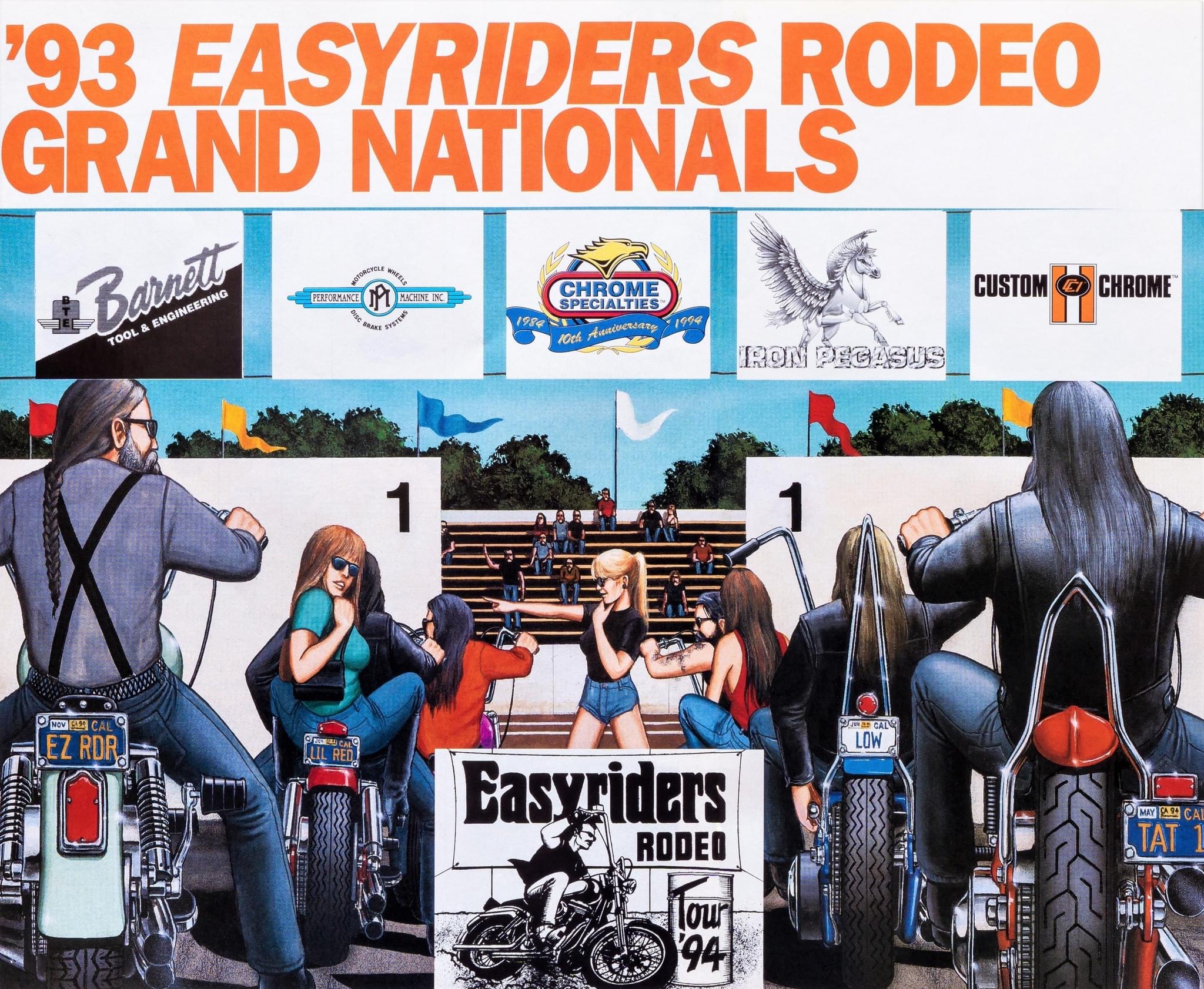
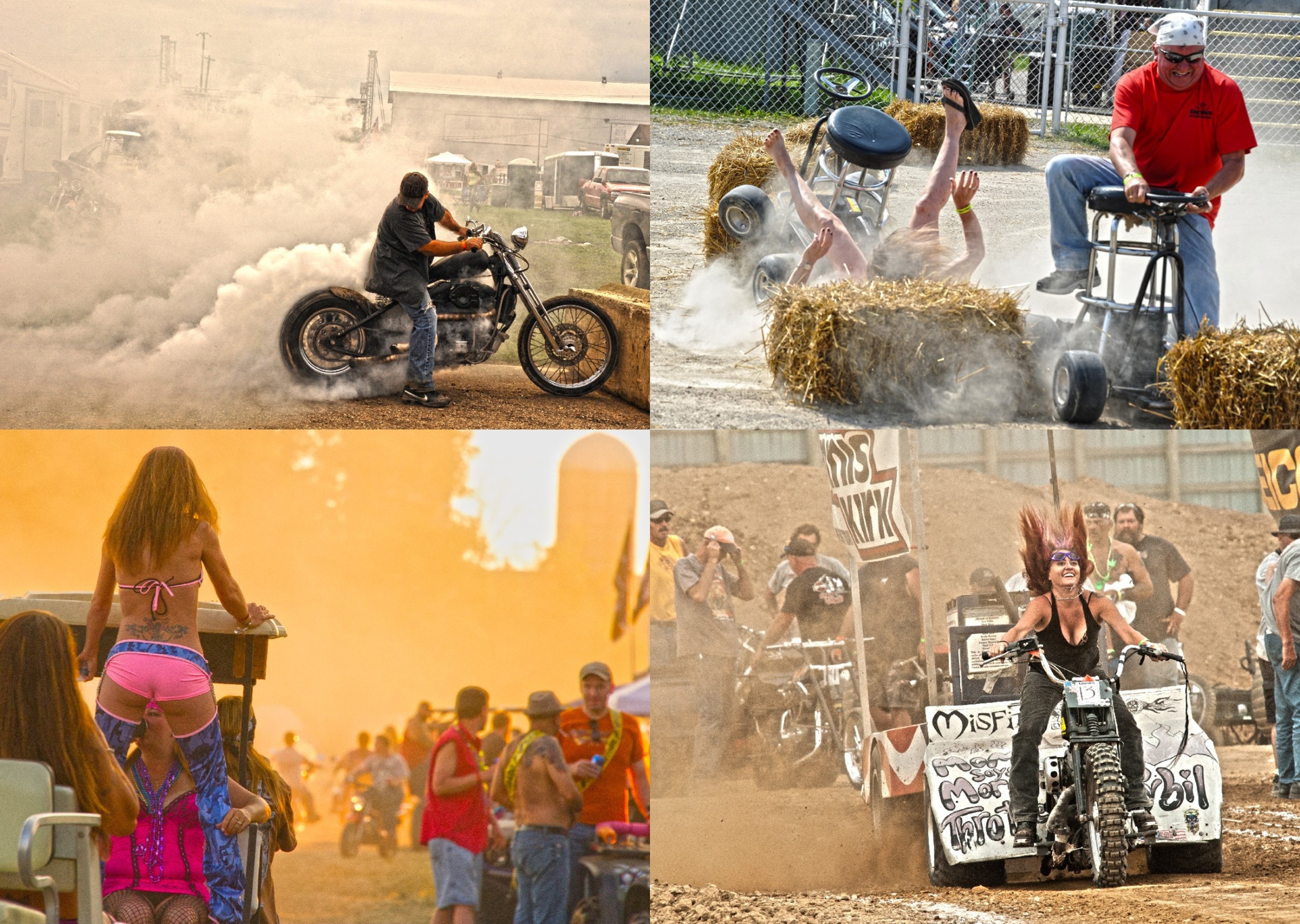
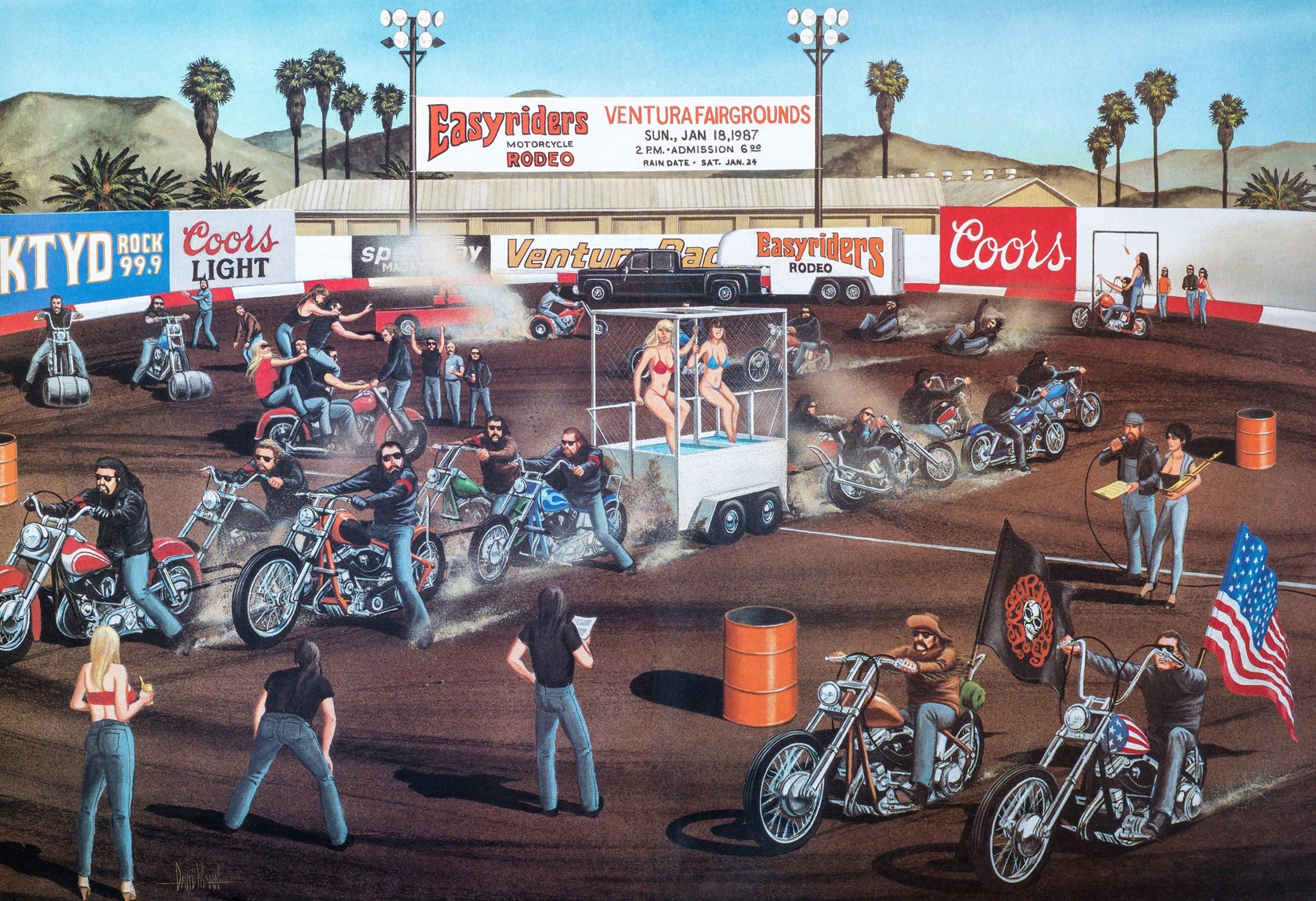
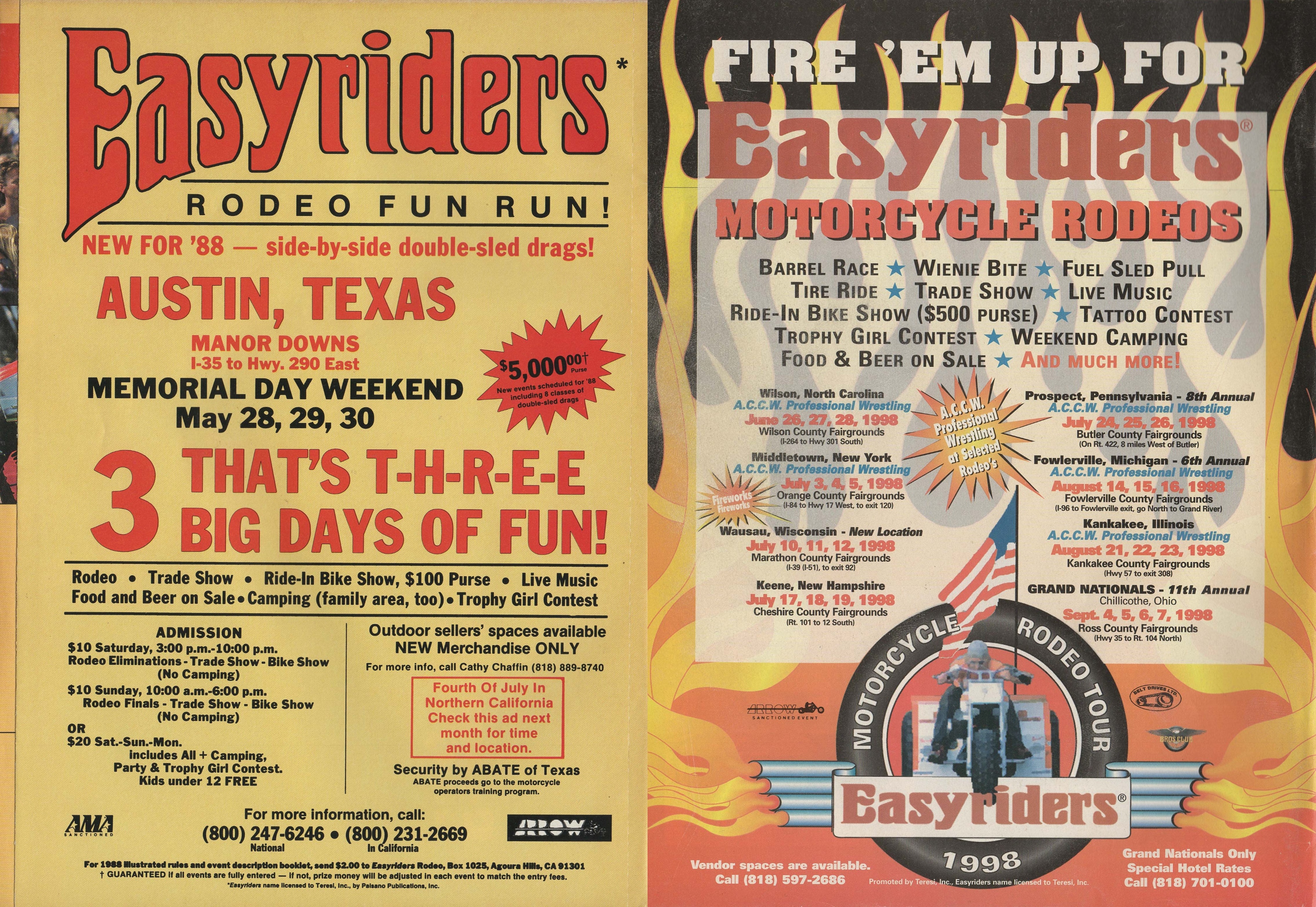
Then there were the Easyriders Rodeos and other events: a series of prepackaged biker parties – mini-rallies, really – at venues around the country. These events were heavily sponsored by corporations like Custom Chrome, Chrome Specialties, Barnett and others, all purveyors of parts and equipment for Harley riders. At the rodeos, there were diversions like burnout contests, barstool races, poker runs, girly shows and live music, wedged in between the ceaseless marketing of products by Easyriders and its sponsors.
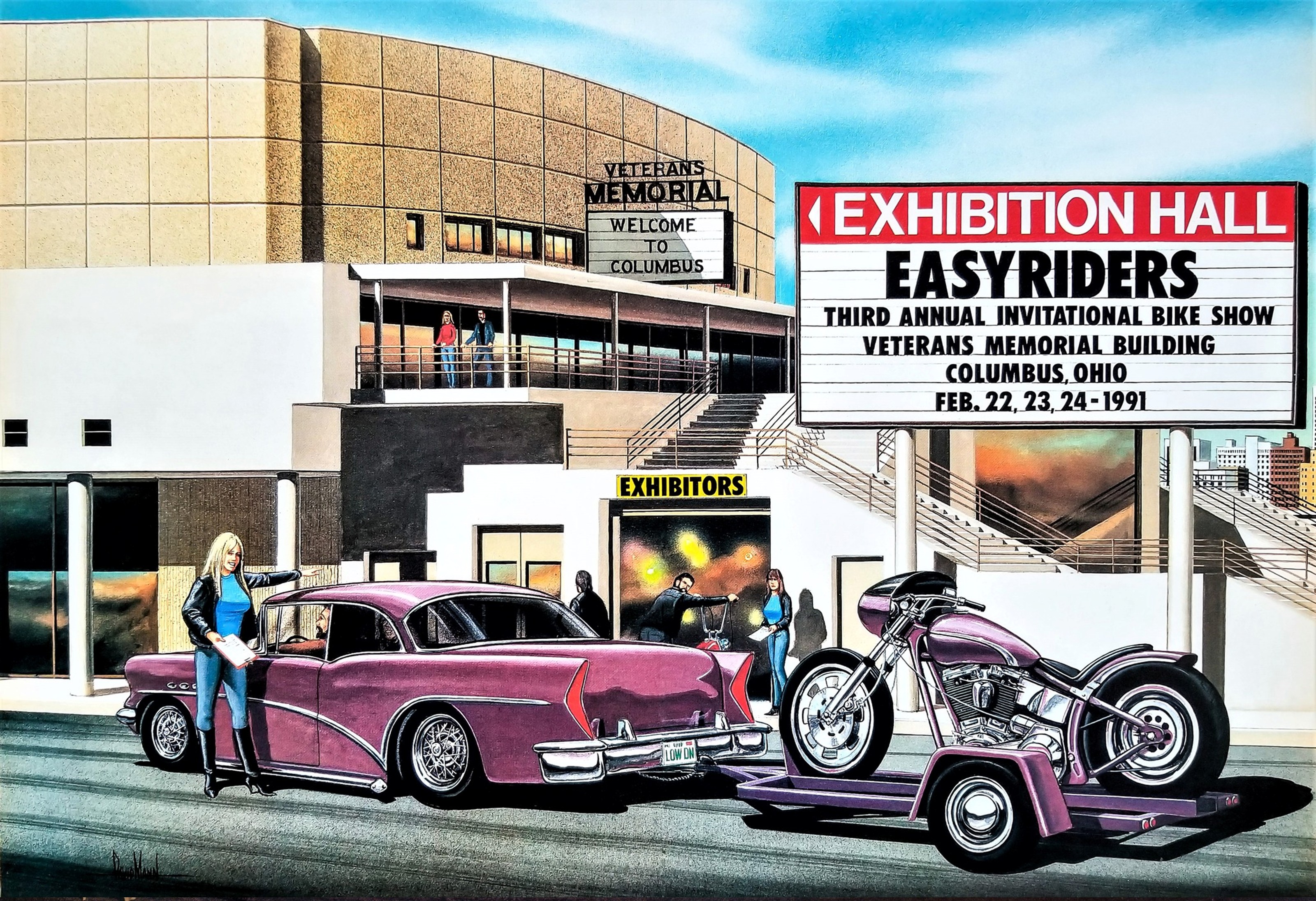
Artist David Mann did numerous adverts for the rodeo series. Image courtesy of the author.Just a few of the diversions to be seen at the rodeos. Photos courtesy of Easyriders Events.Those of us who were fans and collectors of David Mann‘s art were pissed that some of his monthly centerfold paintings were nothing more than advertisements for Easyriders events like the rodeo…. ….or an Easyriders Invitational Bike Show. We didn’t appreciate seeing our favorite artist pimped out this way. Centerfold images courtesy of the author.Adverts for upcoming Easyriders Rodeo events in Easyriders (June 1988) and Biker Parties (Summer 1998). I’ve done some event production and coordinating, and that slate at right looks like a damned grueling schedule. Image courtesy of the author.
DEATH OF THE DREAM
Some say it was overreaching that killed Easyriders, but I have a different theory.
For decades, Easyriders remained the ‘biker rag of record’, in part because it was as ‘biker’ as any of its readers: tough, take-no-bullshit and ready to rock. However, that brutal bastard, time, and the harsh realities of print publishing eventually took their toll.
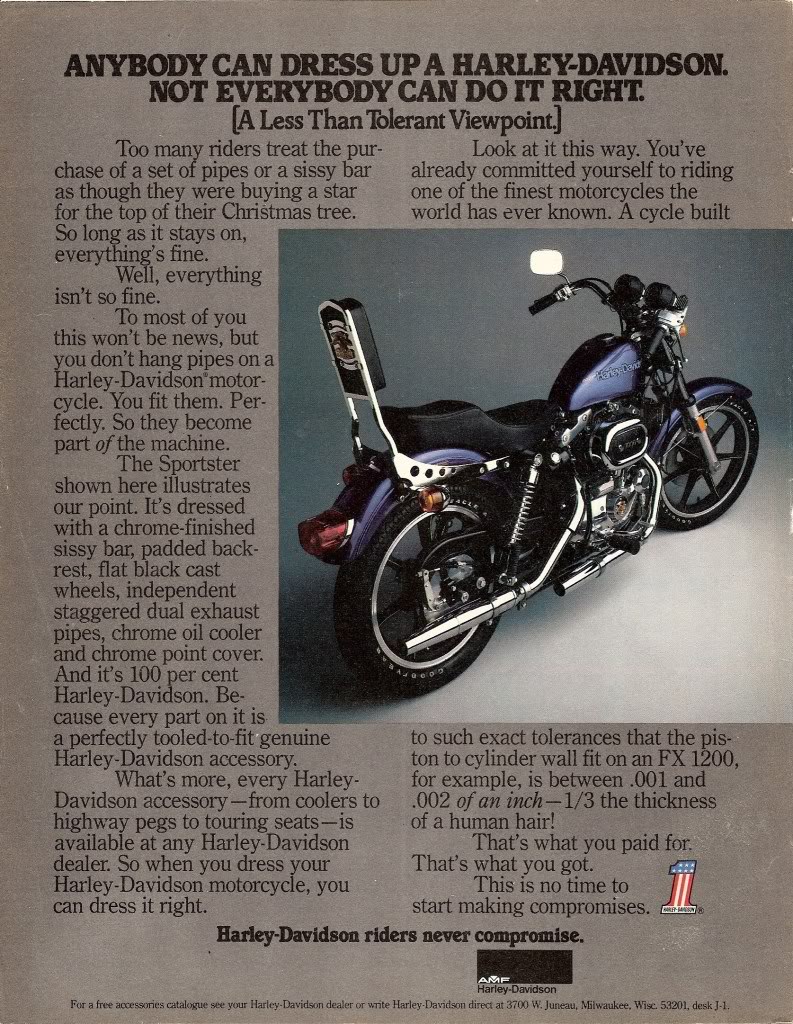
The first advert for Harley-Davidson appeared in the magazine’s April 1978 issue Image courtesy of the author.
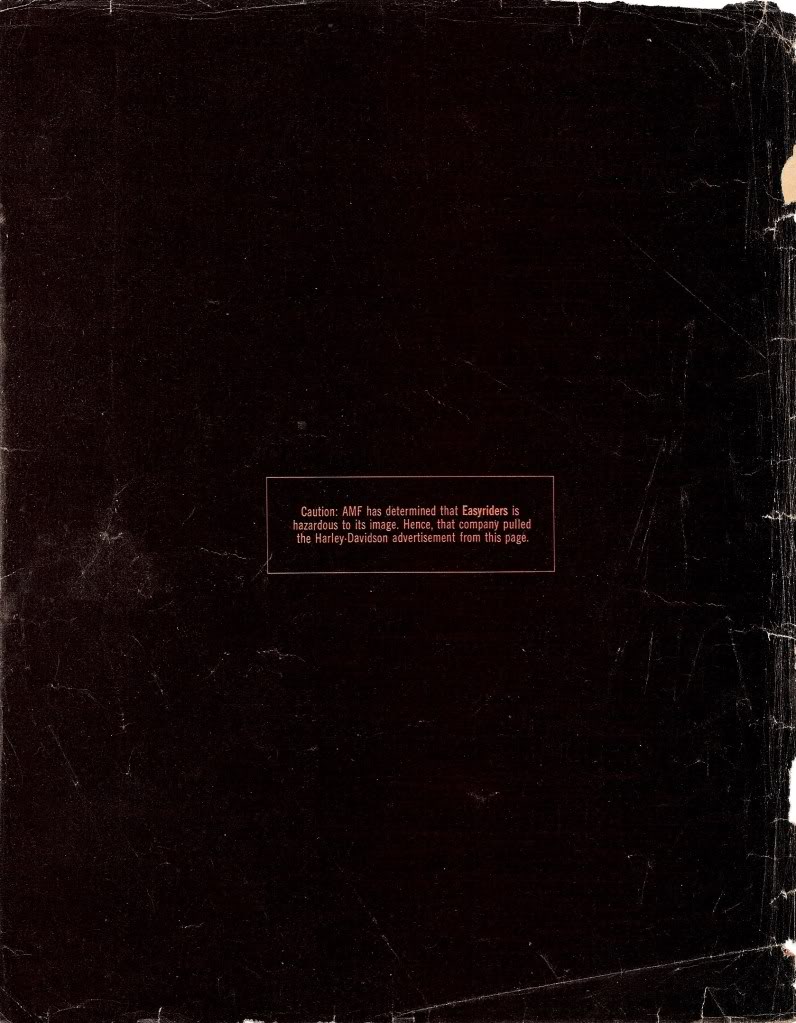
For instance: at its onset, the magazine’s editors swore they would never be beholden to any corporate master, and hence would never accept advertising from the Harley-Davidson Motor Company or its dealers. They held out for seven years, but ultimately the money was too good.
However, three issues later, the MoCo had a change of heart. They yanked their full-page advert at the last moment. Easyriders‘ editors responded with the black box page above. Image courtesy of the author.
They also vowed they would never do new bike reviews or test rides. They eventually did….
However, a few years later, both sides had become more ‘accommodating’, and HD adverts were a regular feature. In fact, as seen here in the November 1988 issue, they were actually cozying up to Spider’s politically incorrect Taking It Easy column! Image courtesy of the author.
Very few magazines can survive on subscriptions alone. The money had to come from somewhere. I’m sure the magazine’s publisher shrugged and said ‘Well, why not the MoCo?’ 🤷🏻♀️
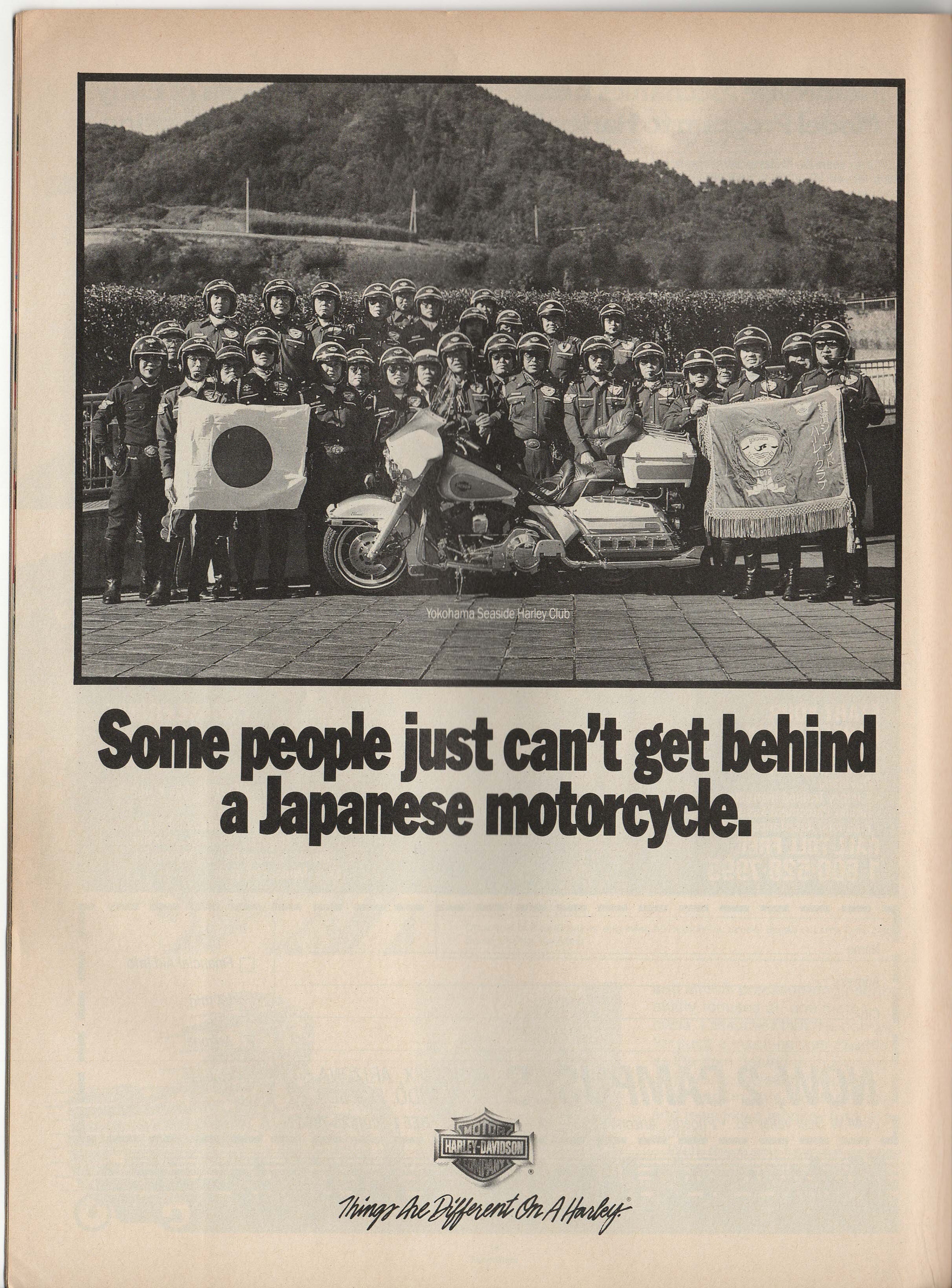
This appeared in the Easyriders issue of June 1988. Not only was it an advert for the Harley-Davidson Motor Company, but the ad features a fully dressed ‘bagger’ and rows of neatly uniformed club members, looking like motorcycle patrol officers! 😮 That’s a loooooong way from the chopper esthetic and hardcore biker ‘tude the magazine touted in early years. Image courtesy of the author.
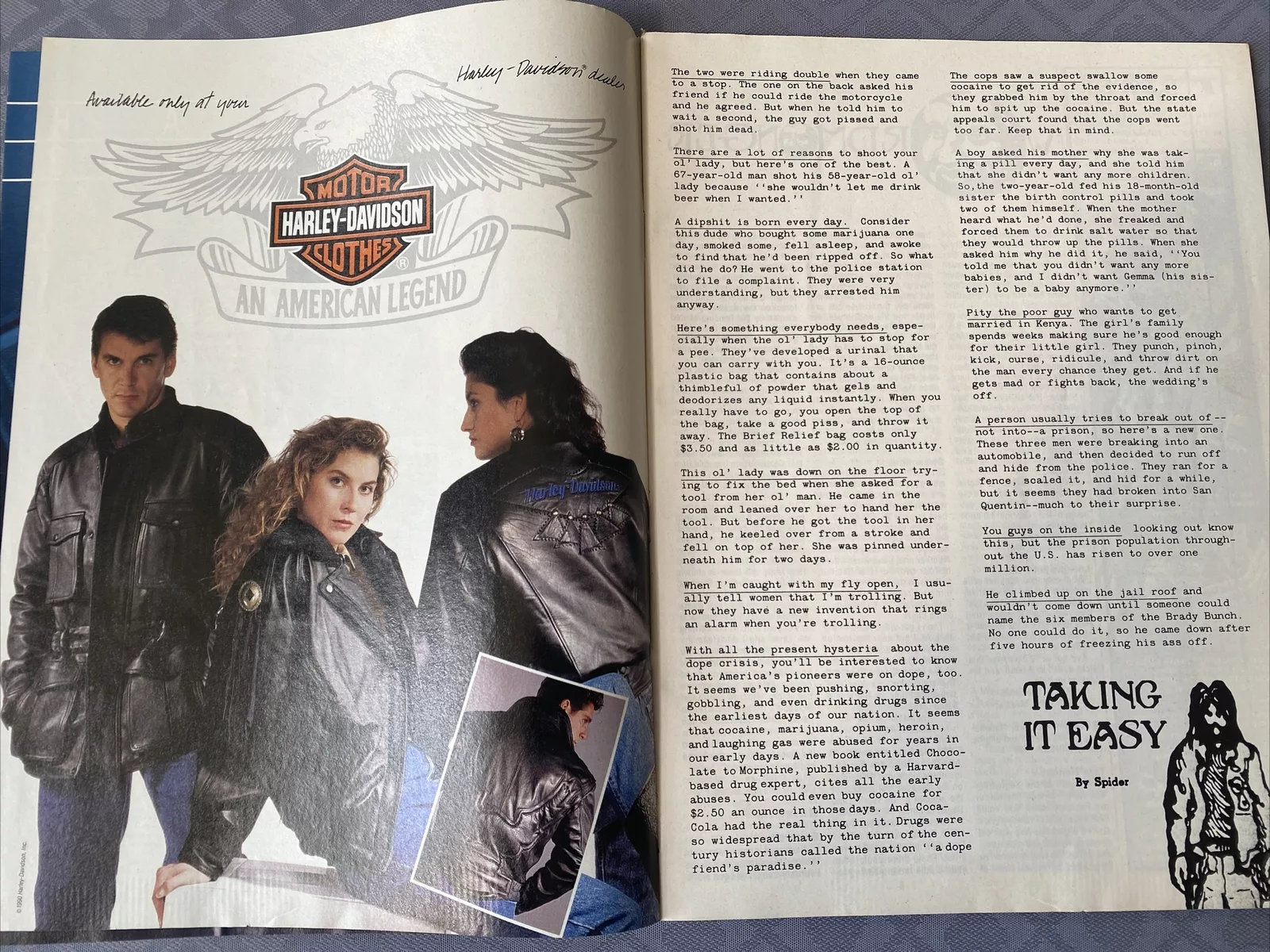
The Motor Company has offered riding gear from its earliest days, but when AMF (American Machine & Foundry, best known as the primary outfitter for bowling alleys) merged with Harley-Davidson in 1969, more effort was made to market ‘stylish’ clothing. Imagine leisure suits of sky-blue suede (seriously!) and his-and-hers t-shirts and jackets. When the two companies split again in 1981, marketing began in earnest, and Motorclothes was born. Old-school riders grouse that Harley dealerships look more like fashion boutiques nowadays. A common plaint is They used to hate us. Now they want to BE us!
They’re not wrong.
During the AMF years, Harley-Davidson struggled to counter the outlaw persona many street bikers affected: the long hair, beards and tattoos, black t-shirts, ragged jeans and greasy leather. Dealers refused to serve ‘chopper riders’ or work on modified motorcycles, and corporate headquarters demanded that dealers spruce up their premises and run off the undesirable Easyriders element. Austin’s own Austin Motorcycle Company, a family-owned franchise since the 1920s, surrendered its franchise in the late ’70s rather than comply with the Motor Company’s demands.
Austin Motorcycle Company, Austin’s premiere Harley-Davidson dealership, fell victim to corporate paternalism when owner Dan James (no relation, sadly) refused to upgrade his dusty old shop in the heart of downtown, or run off the ‘disreputable element’ that formed his customer base. Killeen auto dealer Ace Connell picked up the franchise Dan dropped, and a new, more-palatable dealership was opened on the city’s north side. Austin Motorcycle Company puttered along as an independent shop until Dan passed away in 1980. Two of his employees attempted to keep the shop going after Dan died, but soon moved on to other pursuits, and the shop faded into history. Image sourced from internet.An advert for Harley-Davidson’s own clothing line, appropriately titled Motorclothes. Image courtesy of eBay seller Vintage Variety 60.
However, the MoCo’s new owners – most former executives of the AMF-owned division – recognized a cash cow when they saw one, and Motorclothes stores and catalogs were soon teeming with fashions aping the look of those hardcore bikers HD once shunned. Witness their willingness to have their advert placed right beside Spider’s crude, frequently misogynistic column.
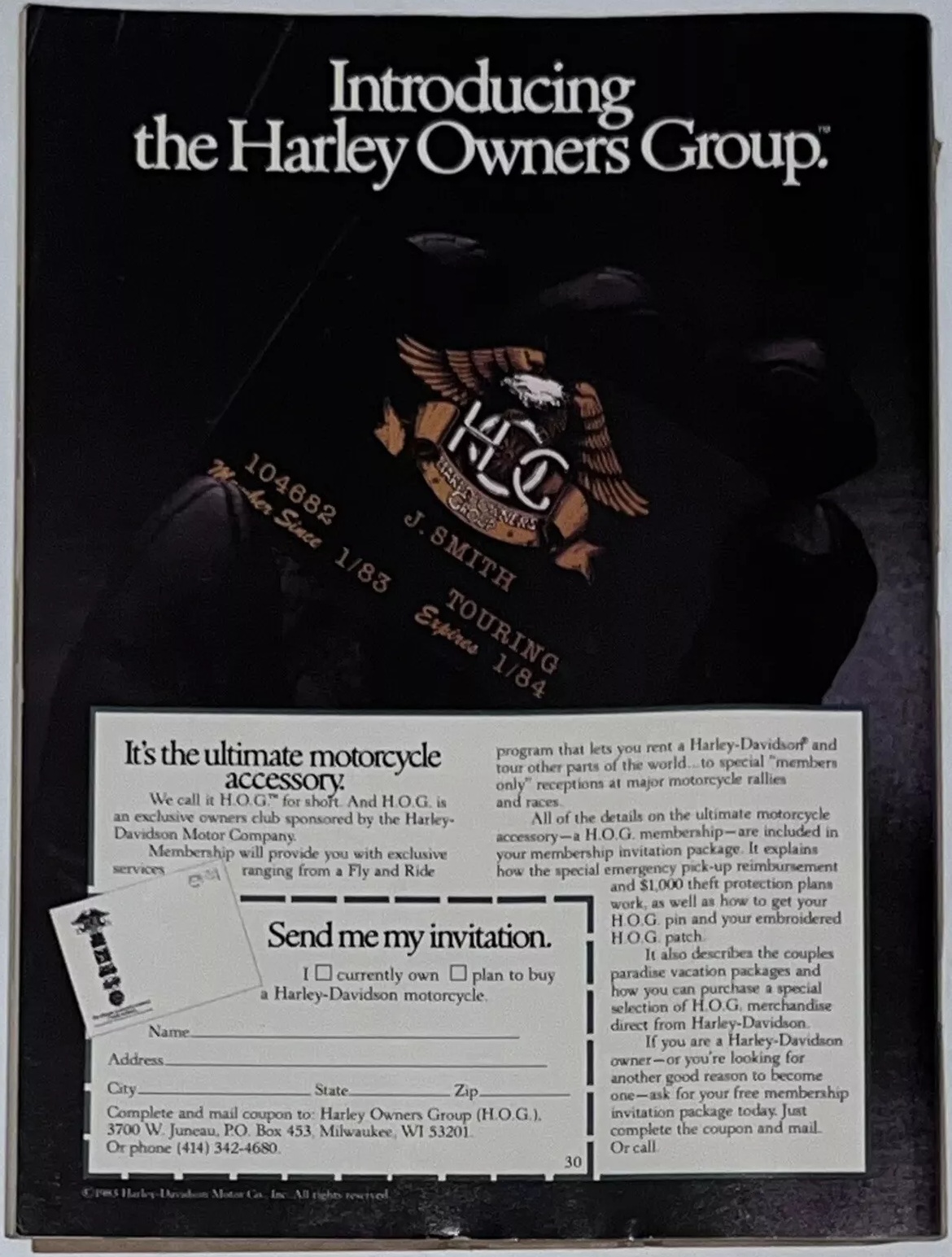
A Harley-Davidson advertisement for their ‘Harley Owner’s Group’ – a ‘motorcycle club’ with no membership requirements other than a wallet fat enough to afford a Harley-Davidson motorcycle – in the July 1983 issue. If you recall, the magazine started out catering to members of actual motorcycle clubs. They may as well have been peddling Sons of Anarchy fanwear! Image courtesy of eBay seller M&M Media and More.
….but it was the publishers’ abandonment of the outlaw ethos upon which the magazine was founded (see Harley Owner’s Group advert, above, for example) that hurt the magazine the most. Gone were the grungy patchholders and those generous four-page features on the radical chopper some hardworking Harley lover crafted in a drafty garage with nothing but sheet metal, a crackerbox welder, swapmeet parts and bleeding knuckles.
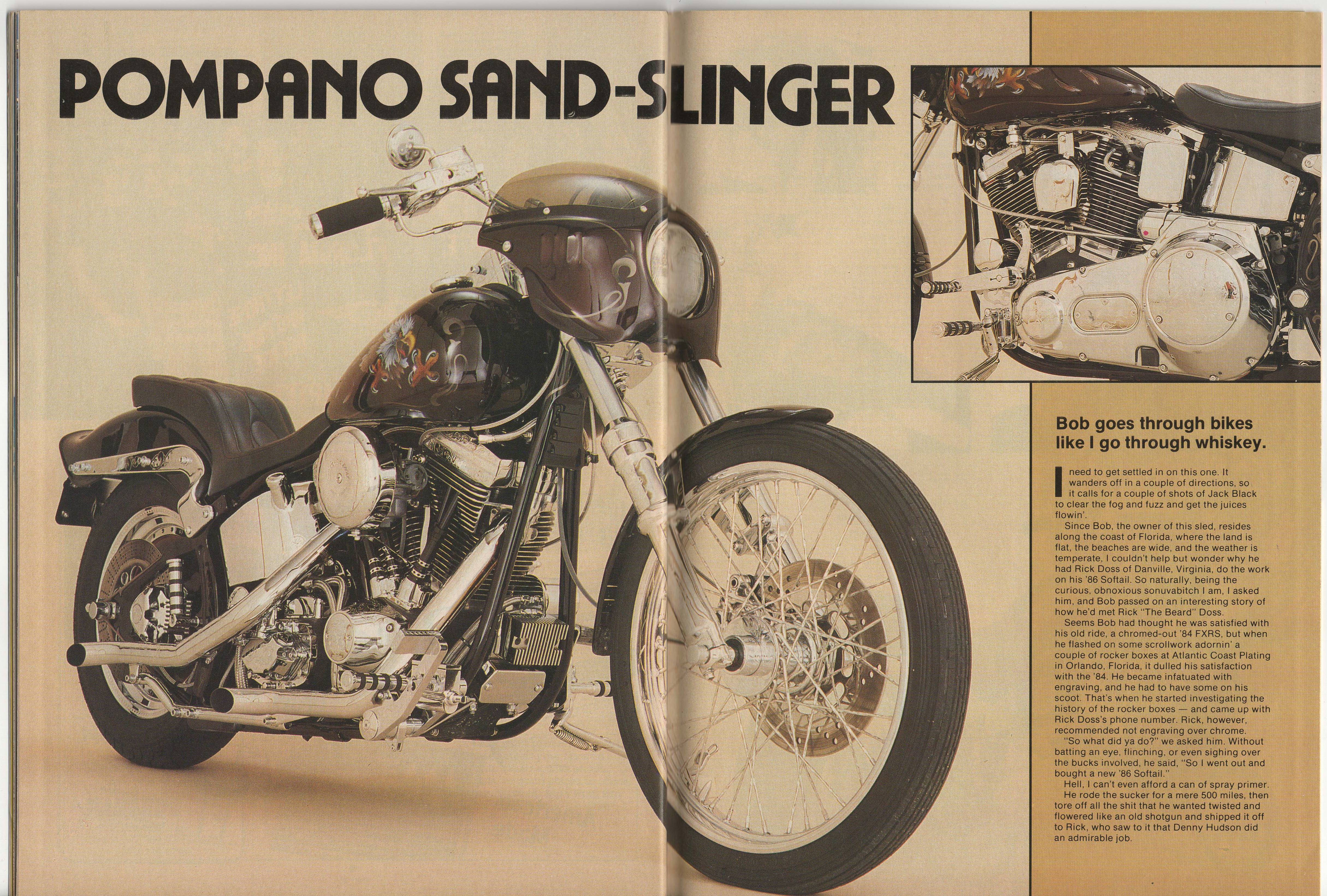
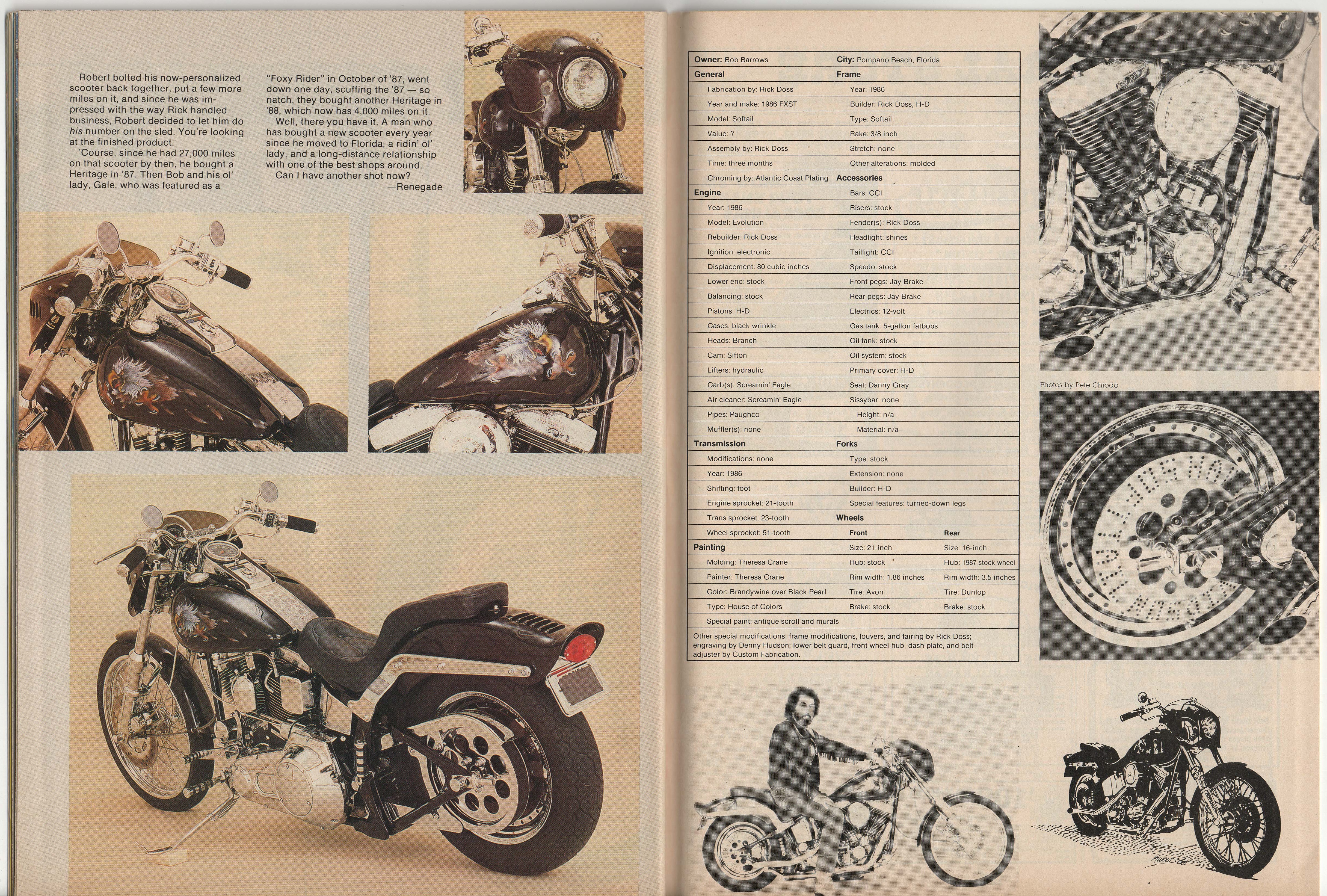
That ain’t no chopper, baby! Worse still, look at the spec sheet below. The owner hired out every aspect of the work on the thing. 🙄 This appeared in Easyriders # 181, in July 1988. Images courtesy of the author.
In their place were Harley owners posing with made-to-order machines (see above) that they’d purchased in a shop and paid someone else to customize: ‘RUBs’ and ‘Rolex Riders’ who wouldn’t be caught dead mingling with the street bikers who made the magazine what it was. Builders like Arlen Ness and Rick Doss and pseudo-clubs like the Hamsters were given loads of press, with photos and glowing articles. Meanwhile, old school builders’ efforts were relegated to a tiny spread titled ‘Readers’ Rides’. No one seemed to remember or care that, back in the day, featured bikes were all ‘Readers Rides’! 🙄
A ‘Reader’s Ride’ from Easyriders, July 1988 Image courtesy of the author.
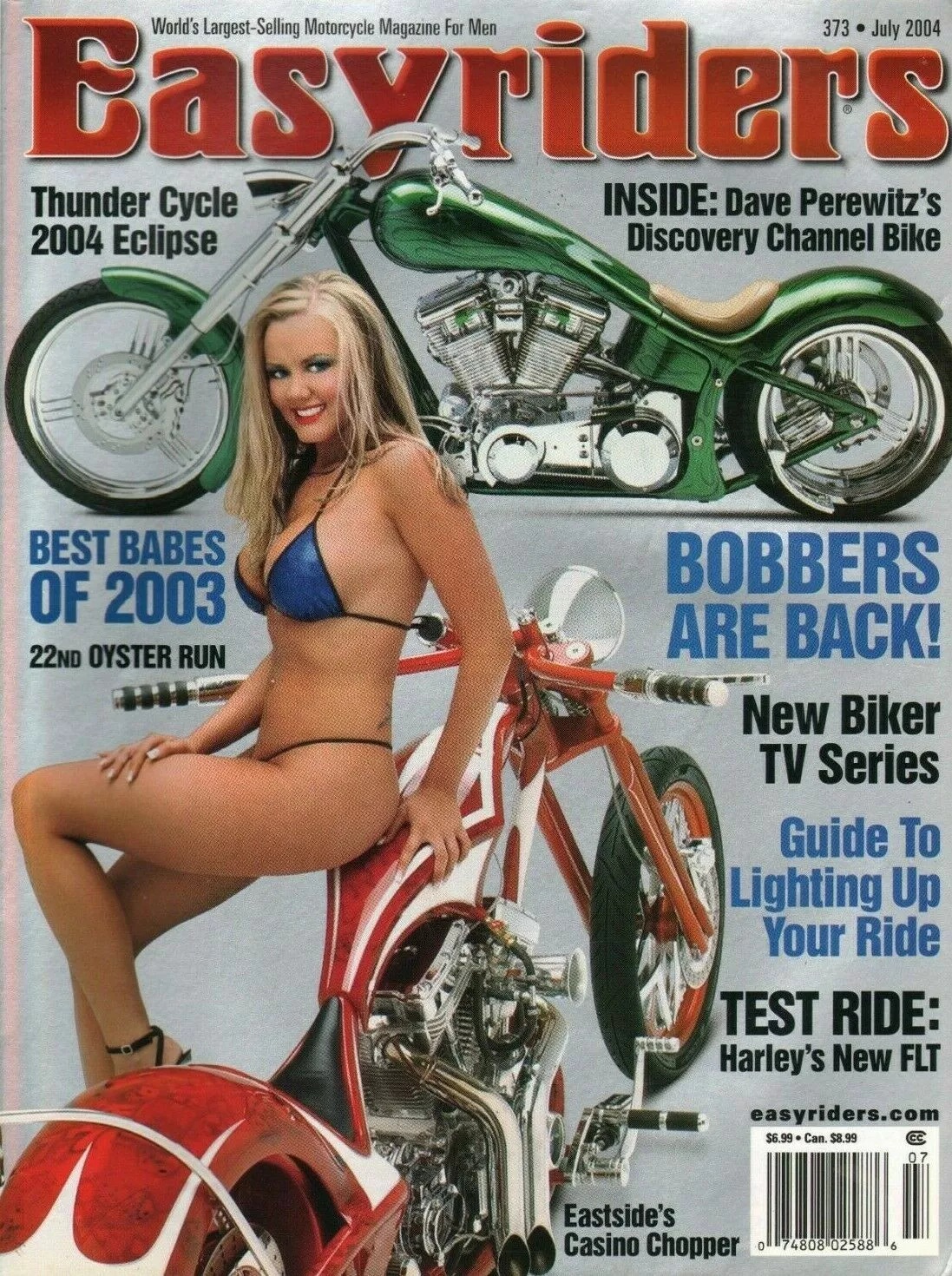
Gone, too, were the women we loved: those hardcore biker gals and dewy-eyed fender bunnies who brightened the pages of every issue. They were replaced by polished, airbrushed professional models who had obviously never been near a motorcycle until the photographer hired them for a shoot. These were women wearing too much makeup, ridiculous high heels that had no place in the rough-and-tumble biker’s world, and…. and…. they just weren’t our people. 🤷🏻♀️
Compare this cover, from 2004, to the covers of earlier issues, circa 1970s and ’80s. A little ‘different’, yes? Image courtesy of eBay sellers Gallimore’s Goods.
Easyriders went under in 2019, after almost a half-century in print. As noted above, its quality and integrity had waned considerably in its final decades, even as print publications in general were hemorrhaging readership, so few longtime adherents mourn its passing. However, an upscale clothier has acquired and is attempting to revive the title as a ‘less trashy’ and ‘more inclusive’ publication. Some wag described it as ‘GQ for Bikers,’ but I think Easyriders beat them to the punch with VQ. 🙄
I’ve only seen two issues of the ‘new’ Easyriders and am thus far notimpressed. 🤷🏻♀️
Original since 1970?😮 I don’t think so! That’s like Indian claiming they are ‘the oldest American motorcycle manufacturer’. The revivalists — Indian and Easyriders alike — bought a name and nothing more. No lineage connects either venture to the originals, and it annoys me to no end when they cavalierly claim lineage and longevity they have not earned. Image sourced from internet.
FOOTNOTES
1) R.I.C.O. (Racketeer Influenced and Corrupt Organizations Act of 1970) was written for use against organized crime outfits like the Mafia, but prosecutors quickly realized it had implications far beyond that narrow aim.
For instance, federal prosecutors used R.I.C.O. to go after board members deemed responsible for the Savings and Loans crisis of the late 1980s and early 1990s. One unique feature of R.I.C.O. was that it permitted civil as well as criminal prosecutions. Civil trials require a less stringent burden of proof than criminal trials and, with R.I.C.O., prosecutors could seek triple the estimated damages of any violation. Hapless board members of S&Ls found themselves in court, targeted not because they were guilty but because they had the deepest pockets.
R.I.C.O. was also used to prosecute Hells Angel spokesman Sonny Barger and other members of the Oakland HAMC chapter. However, the fed’s case collapsed when they were unable to prove a ‘pattern of behavior’, or link the alleged illegalities to club policy. Barger, et alia, walked free, leaving prosecutors red-faced, frustrated and bitter.
Sonny Barger around the time of the R.I.C.O. prosecution. He dodged the R.I.C.O. case, but did time for other offenses. He emerged from prison even more a celebrity than when he went in, and turned to cashing in on his notoriety with books, a movie, and public appearances around the world. Photo courtesy of the author, from Supercycle Magazine‘s interview with Barger.
2) A.B.A.T.E. was alternately styled ‘American Bikers Against Totalitarian Enactments’ or ‘American Bikers Aiming Toward Education’. Both monikers applied. The group did fight against mandatory helmet laws, and laws restricting the customization of motorcycles, as numerous states enacted laws regulating seat and handlebar heights, requiring chain guards and front fenders, even mandating the length of rear fenders and the height of sissybars.
However, the group also fought for motorcycle rider education, to train new riders in street survival skills, and driver awareness campaigns to make motorists more aware of (and, it was to be hoped, more respectful of) motorcyclists in traffic.
I acted as State Awareness and Safety Coordinator for A.B.A.T.E. of Texas. In that capacity, I developed and spearheaded a statewide billboard campaign, and helped promote a tripart Safety and Awareness Rally which gathered motorcyclists together in three cities across Texas, to raise awareness of our cause. As a state officer for A.B.A.T.E., I was also involved in efforts to bring mandatory rider education to the state, and create a statewide training program for novice cyclists and the instructors who would train them. In my spare time 😆 I also edited the group’s newspaper, and designed a number of popular fundraising t-shirts.
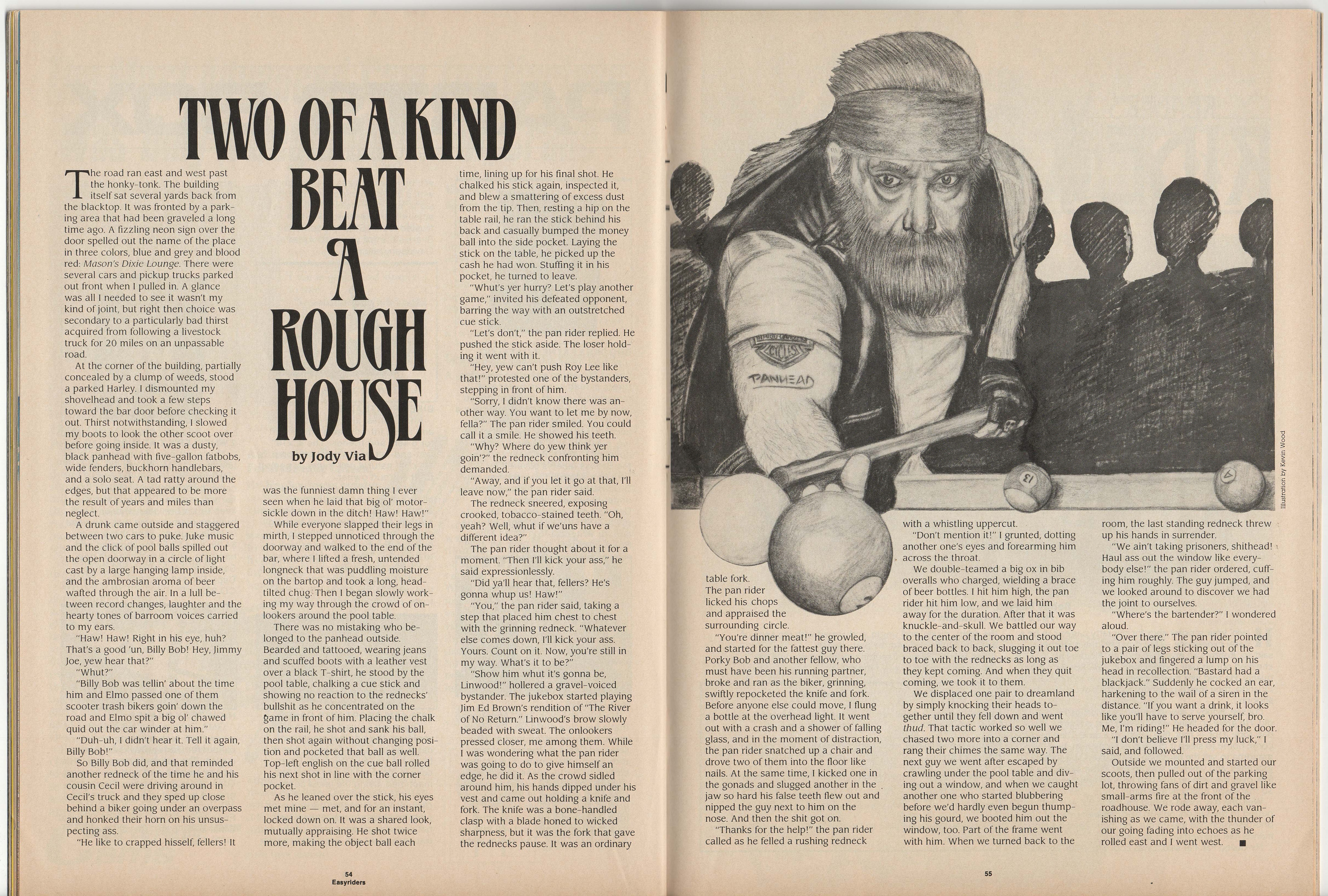
Our billboard campaign, using no-cost or low-cost Public Service Announcement space provided by billboard companies like Duplex Advertising Company of Temple. Left to right, from top left: a) State Director of ABATE Texas, H.E. ‘Sundance’ Mitchell, at the press conference we held at the site of our very first billboard. b) Your humble narrator speaking at an ABATE State Members’ Rally in Llano, Texas. c) The stage at Llano, backstopped by one of our new full-color billboard posters. d) Our second billboard, on US Highway 190 west of Belton, Texas. e) Our first billboard location, on IH35 in Temple, Texas. f) It didn’t take long for the Texas Department of Public Safety‘s Motorcycle Safety Bureau to horn in on the act, stealing our headline and the billboard space we’d previously occupied. Photographs courtesy of the author. A Jody Via short story from Easyriders # 181, July 1988. Not his usual crime story as referenced below; just a quick yarn about a good ol’ fashioned beer-joint punch-up between two bikers and a room full of rednecks. Tropes and stereotypes ooze off the page. The bikers are brave, take-no-shit nomads: strangers until the fist started flying but brothers in arms in the heat of battle. They are, of course, outnumbered three-to-one, standing back to back against all odds, and the simple-minded, bigoted rednecks who were all bark and no bite. Here Via was simply tapping into the romanticized vision most Easyriders readers held of themselves. They were knights errant, living out the celluloid dreams of Easy Rider and Then Came Bronson in between shifts at the factory or feedlot where they earned their living. Image courtesy of the author.
3) In researching this article, in a deep dive search for some of my favorite Easyriders writers, I unearthed the tragic tale of Jody Via. Jody was one of my faves from back in the day, capable of fashioning darkly compelling crime yarns from bolts of whole cloth….
….except that, per police, Via’s ‘yarns’ weren’t fiction at all. They say he was effectively recounting crimes he himself had committed during a murderous spree across Pennsylvania and Ohio in September, 1972, and selling them for publication!
First, we have Good Samaritan Harry Hoffman. Mr. Hoffman was a kindly gas station owner who stopped to help what appeared to be a young couple stranded at roadside. Hoffman took them back to his service station, and even made a fresh pot of coffee so they could warm up from the chill night air. For his troubles, Mr. Hoffman was bound, shot in the head and left for dead in the back room of his service station. He survived, and later identified his attacker in court.
Next, we have nineteen-year-old college student Jane Maguire, who fell for Via’s ‘stranded’ ruse and offered him a ride. Her body was discovered in a highway rest area. She had been raped, bound, shot in the head and left for dead. Sadly, Ms. Maguire did not survive.
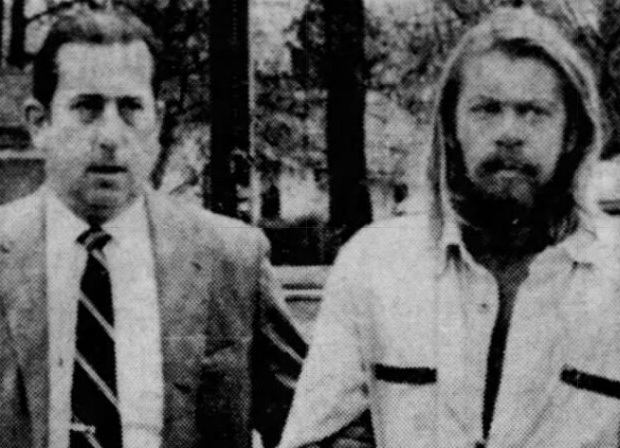
Larry ‘Jody’ Via after arrest in 1972, from Allentown (PA) Morning Call.
Via, who had holed up in his wife’s home, was arrested, charged with and convicted of the crimes, and received a life sentence. While serving that sentence, Via began submitting poetry and short stories to Easyrider, which published several of his works. He later sold some pieces to Outlaw Biker magazine, as well.
One of Jody Via’s poems appeared in Easyriders # 79, in January, 1980. Image courtesy of eBay seller Vintage Variety 60.
However, in 2019, investigators working the September 1972 cold-case murder of twenty-nine-year-old salesman Morgan Peters, in Pennsylvania, were directed by two of Via’s ex-wives to look at Via’s published writings. There, in the stories Via sold the biker magazines, police found detailed descriptions of each of his crimes, including the as-yet-unsolved slaying of Peters. Via, still in prison for the rape and murder of Jane Maguire, was charged with Peters’ slaying in 2019. He was seventy-five years old.
I have yet to learn what became of those charges or the defendant.
Man, that took a dark turn, didn’t it? 😮
Larry ‘Jody’ Via’s alleged final victim, Morgan Peters, from the Franklin County District Attorney. May he and Jane Maguire both Rest in Peace.
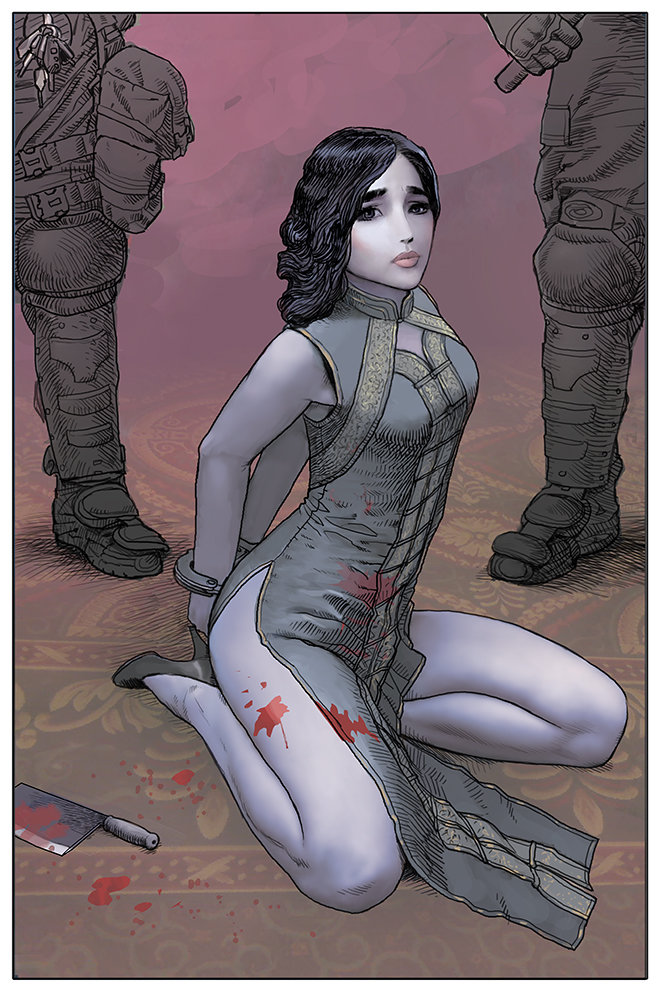
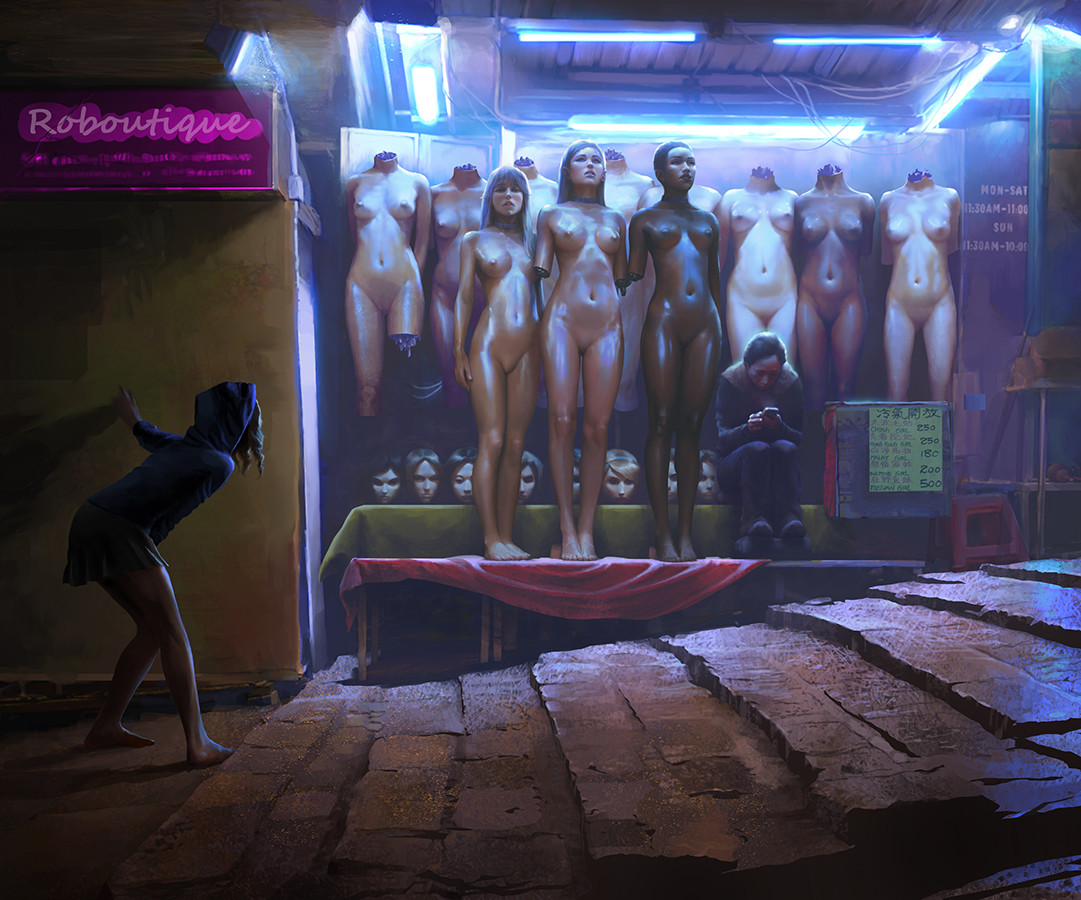
The graphic novel has become so much more than a comic book for grownups. There’s art, social commentary, humor, brilliant storytelling and…. oh, yeah…. actual knock-yer-eyeballs-out ART in them thar pages! 😁
Proof of concept: a long-running online graphic novel titled Android Blues by artist/author Steven Stahlberg, formerly of Georgia and points east, now living in Sweden.
As Mr. Stahlberg tells it, he began writing a script ‘way back in 1995, while living in Hong Kong. In 2014, after nine years of effort, he turned his would-be film script into an online comic, instead, that he made available for free.
Working on his own, Mr. Stahlberg spent the next ten years 😮 painstakingly producing one brilliant page after another: well-written, lusciously-illustrated pages, mind you, telling a compelling tale of suspense, rebellion, liberation and romance. Even better, he did it without an ounce of help from any so-called ‘artificial intelligence.’ This is real art for real humans, BY a real human! AI need not apply! 👍🏽
To that end, he has established a Kickstarter — publishing books is no cheap date, it turns out, and especially not art books with high-quality reproductions of the artist’s work — so I’m encouraging anyone who enjoys art and storytelling to visit his Kickstarter campaign, get in line and eagerly await your opportunity to support this excellent artist/author and all-around nice guy, and help him fulfill his dream (and mine) of creating a hard copy edition of Android Blues.
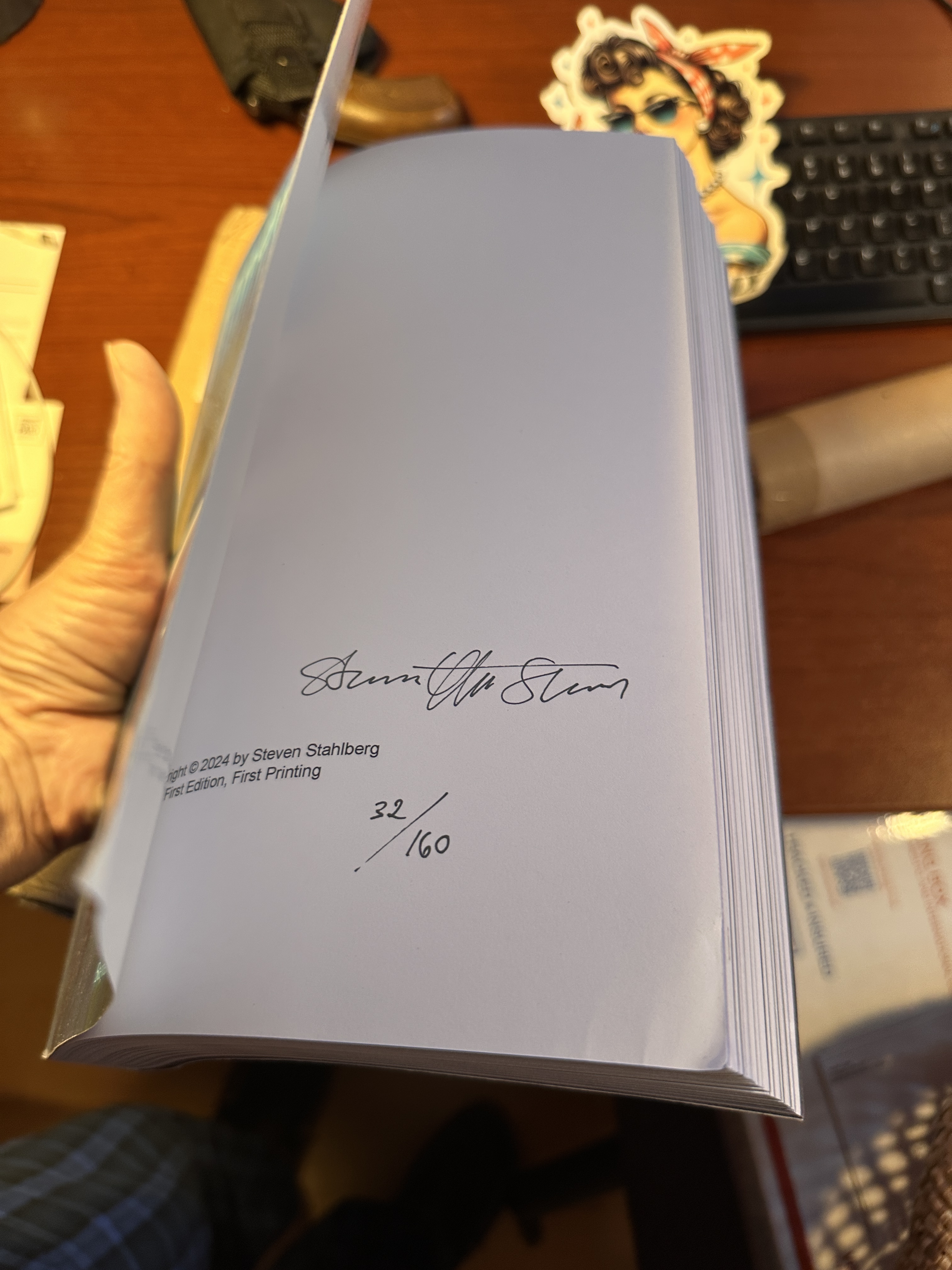
NOTE, 31 December 2024: The book is complete, and as of November, 2024, the artist was shipping copies of the first signed editions. If you missed your shot at the first run, you may still be able to order copies by contacting the artist at his Facebook page.
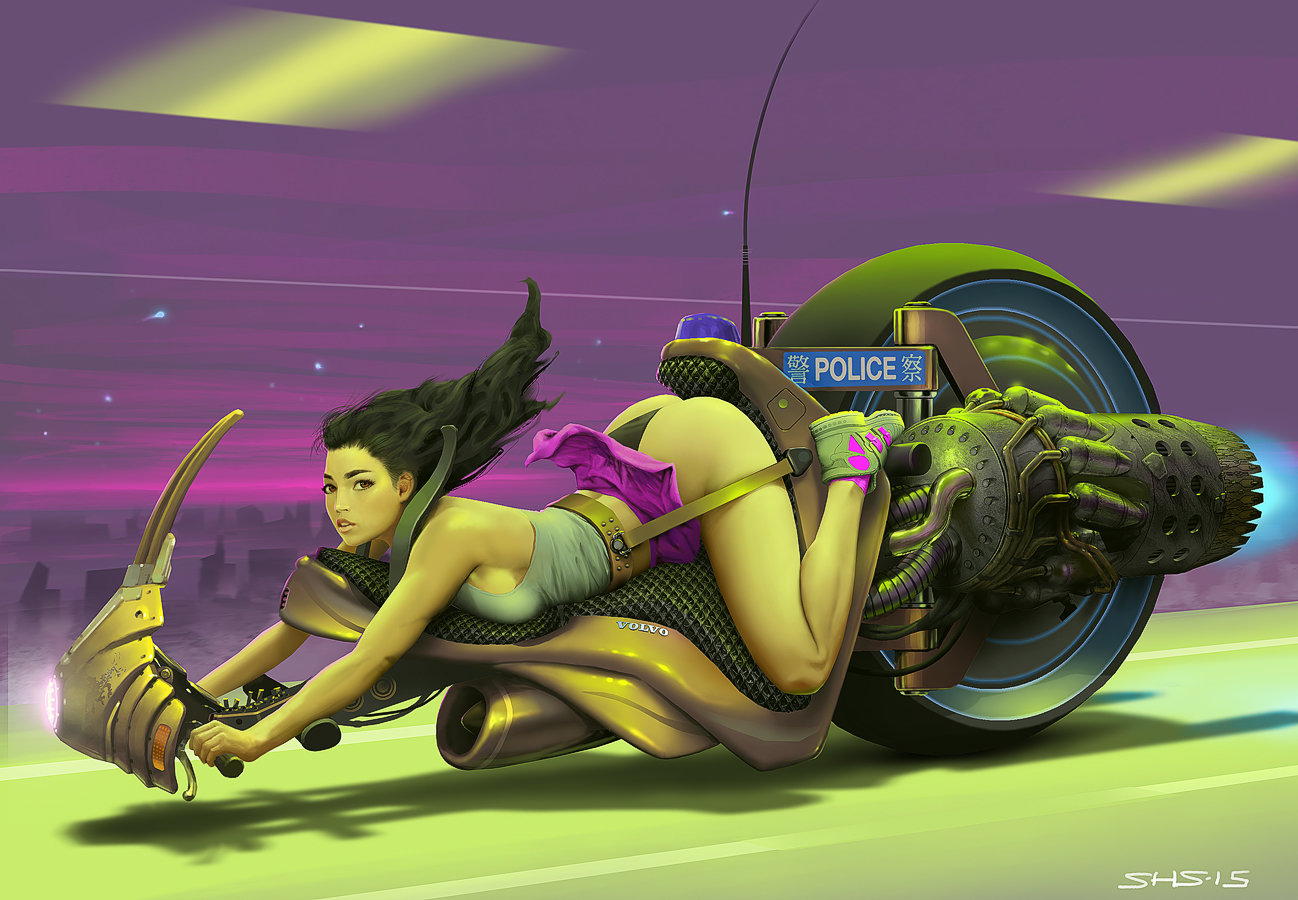
However, I hasten to add that Mr. Stahlberg is not ‘just’ the author and artist behind a brilliant graphic novel. Oh, no, dear readers! He has a huge body of independent work. I’ll post a few here, to give you a taste, and encourage you to follow up on your own. Definitely worth tracking down!
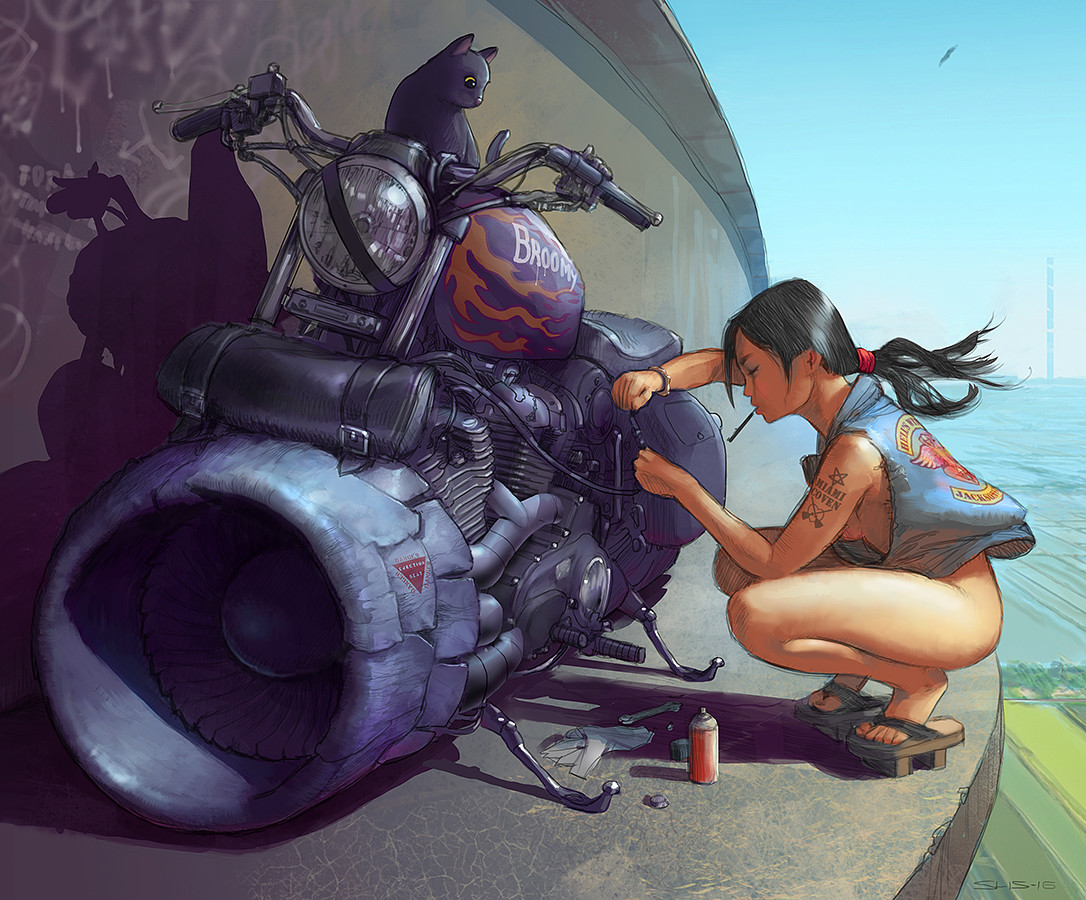
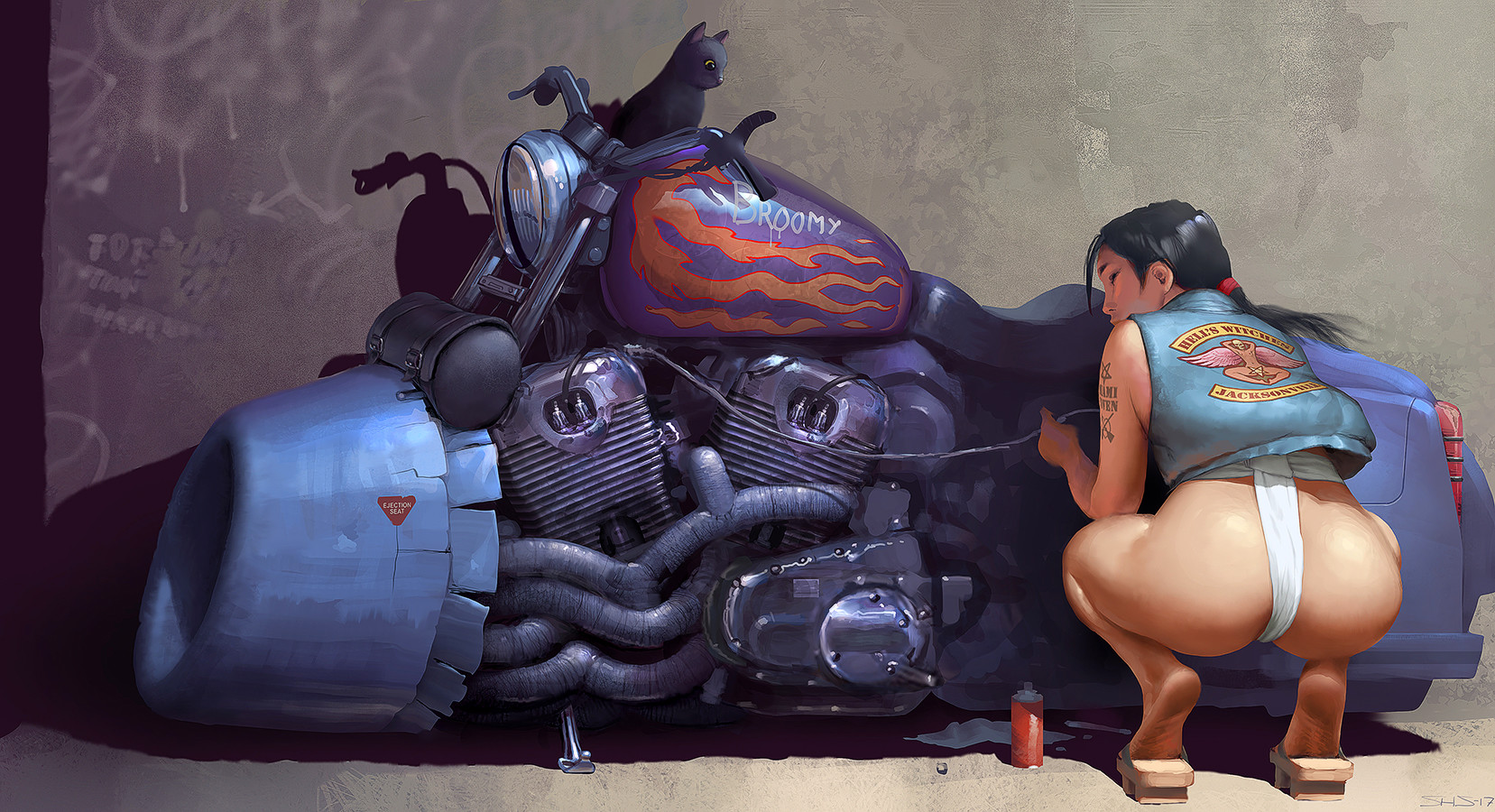
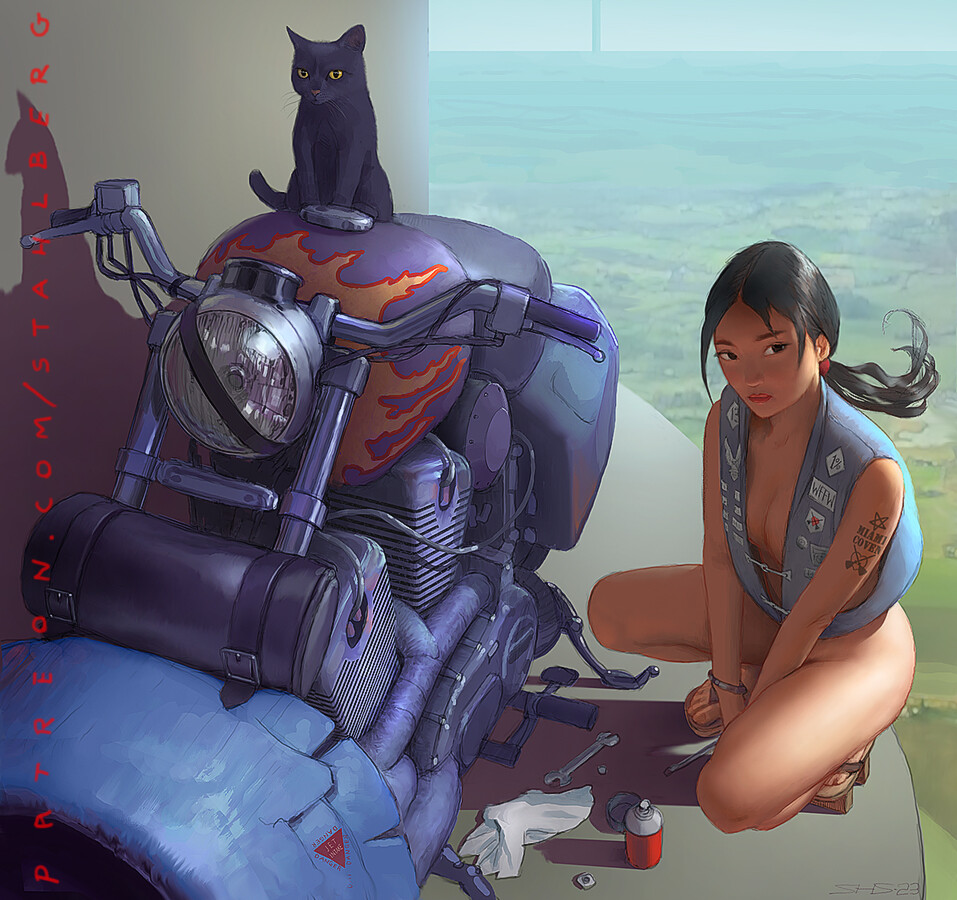
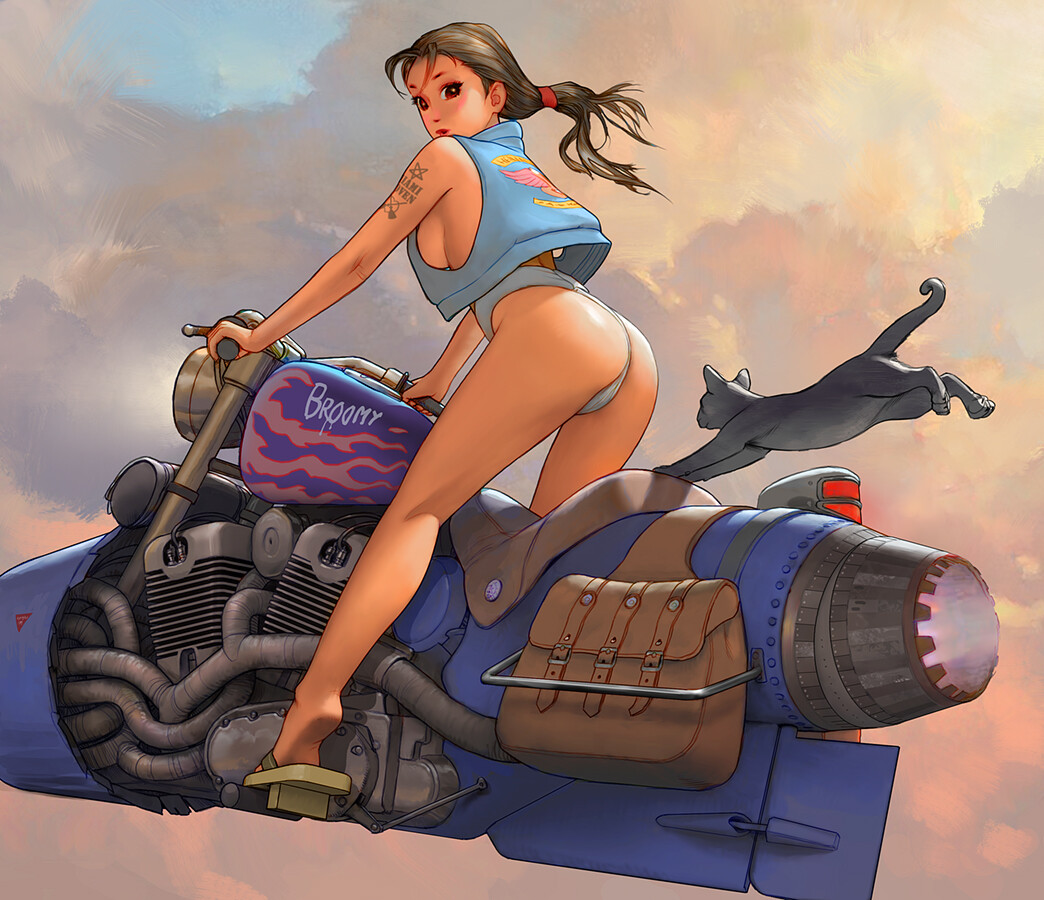
Per usual, this artist originally caught my eye because he created some pieces with motorcycle themes. ‘Broomy’ was the first: a series of takes on the futuristic biker woman who just happens to be a witch, as well, and a patch-holding member of the Hell’s Witches MC (Motorcycle Coven) in Jacksonville, Florida.
NOTE, 31 December 2024: The book is complete, and as of November, 2024, the artist was shipping copies of the first signed editions. If you missed your shot at the first run, you may still be able to order copies by contacting the artist at his Facebook page.
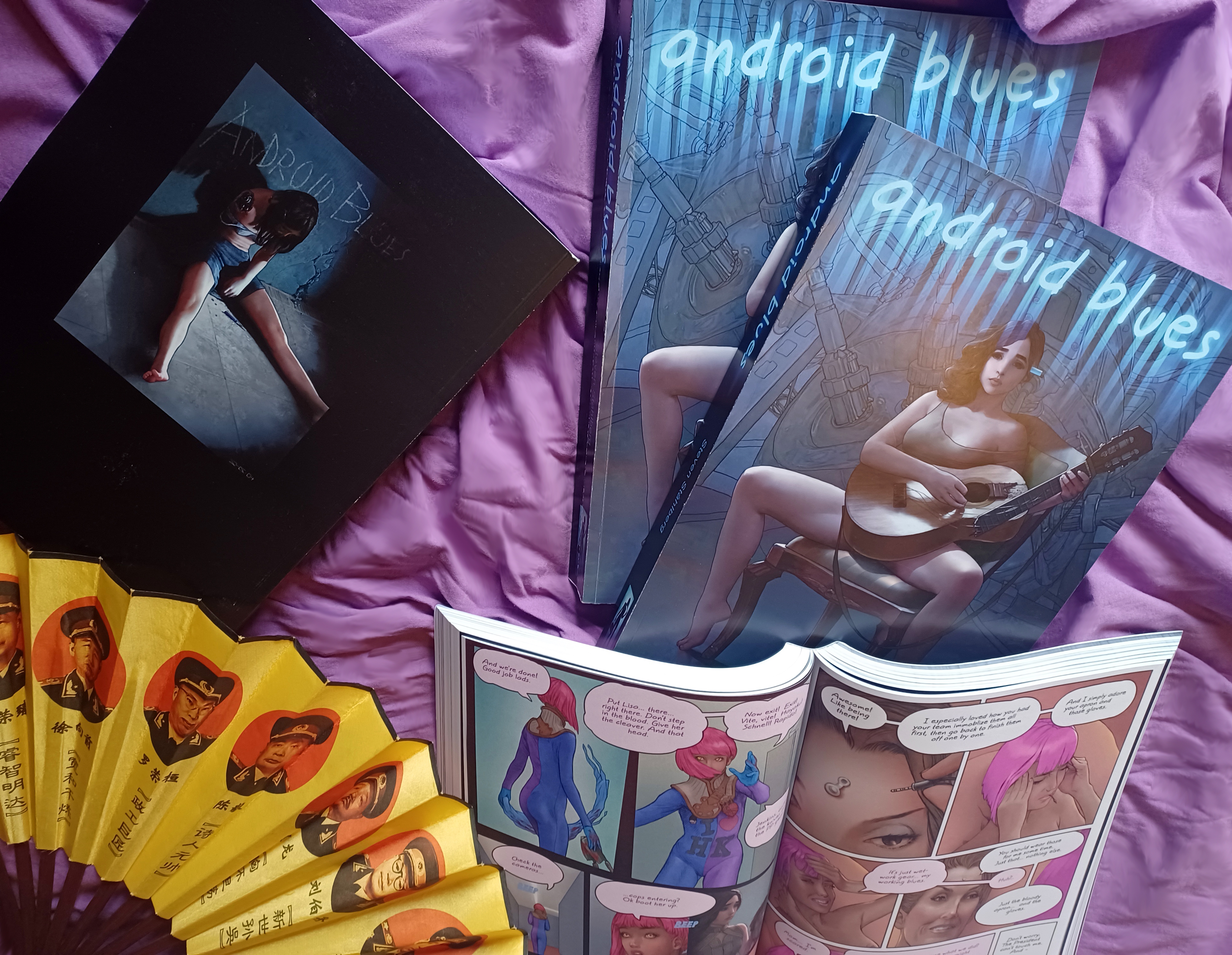
December, 2024: I received my first edition copy of Steven Stahlberg’s epic graphic saga, Android Blues. It is every bit as lovely as expected, and I am so proud to add it to MMMoMMA‘s permanent library.As promised, my first edition is numbered and signed by the author/artist. I had been badgering Steven Stahlberg to produce a hard copy of his astounding saga, so I feel a bit of pride that my long-wished-for hard copy is finally available! 😎👍🏻
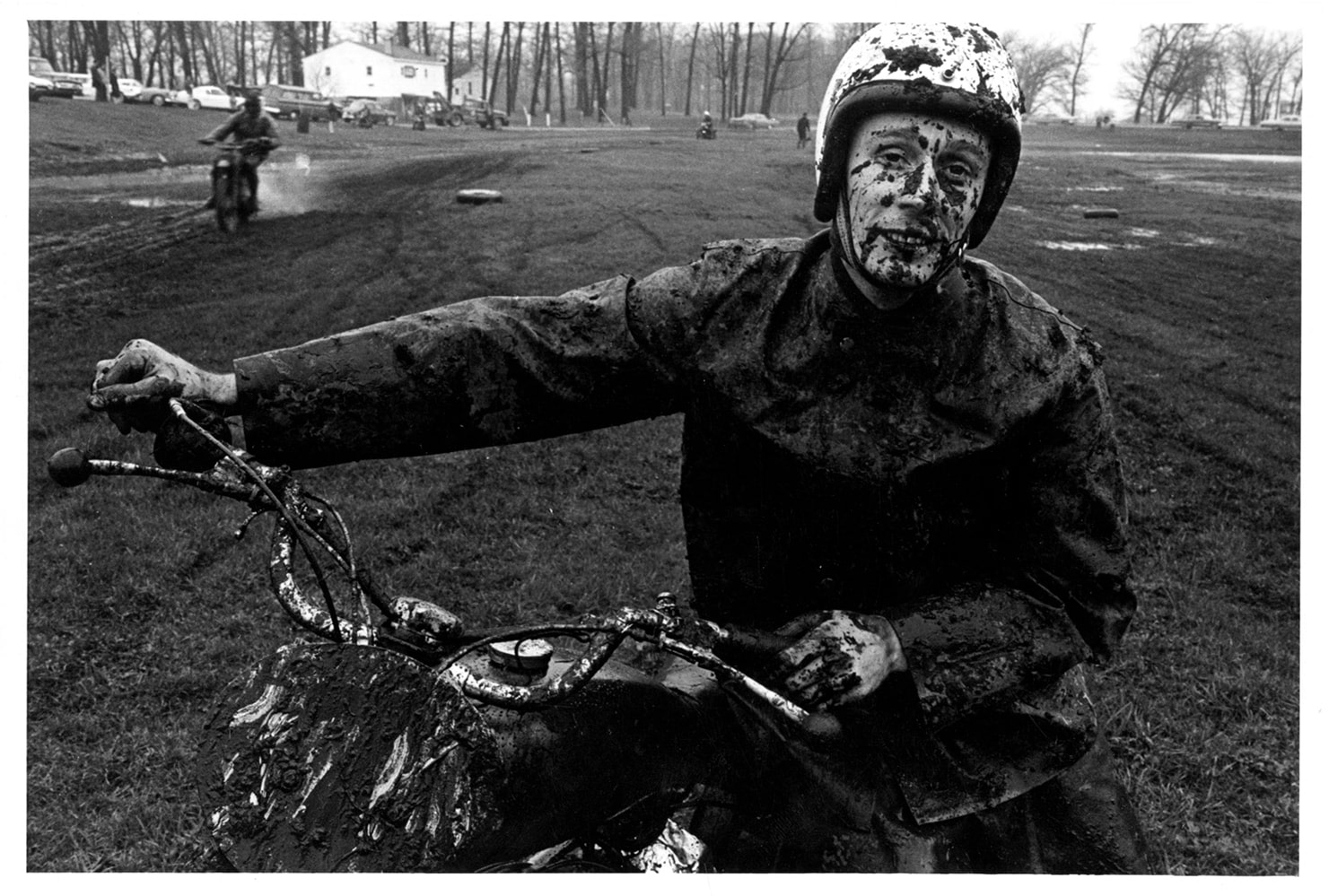
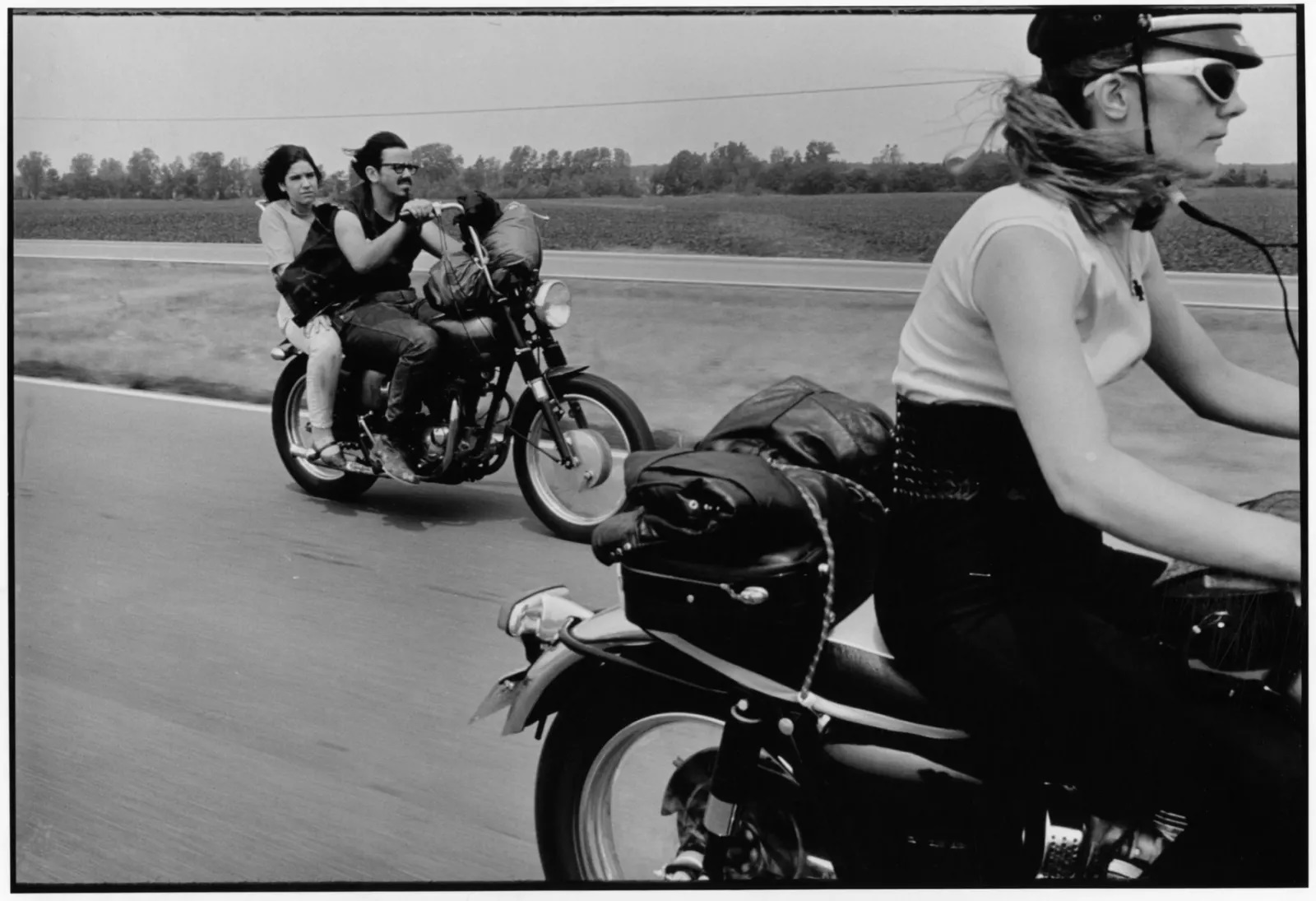
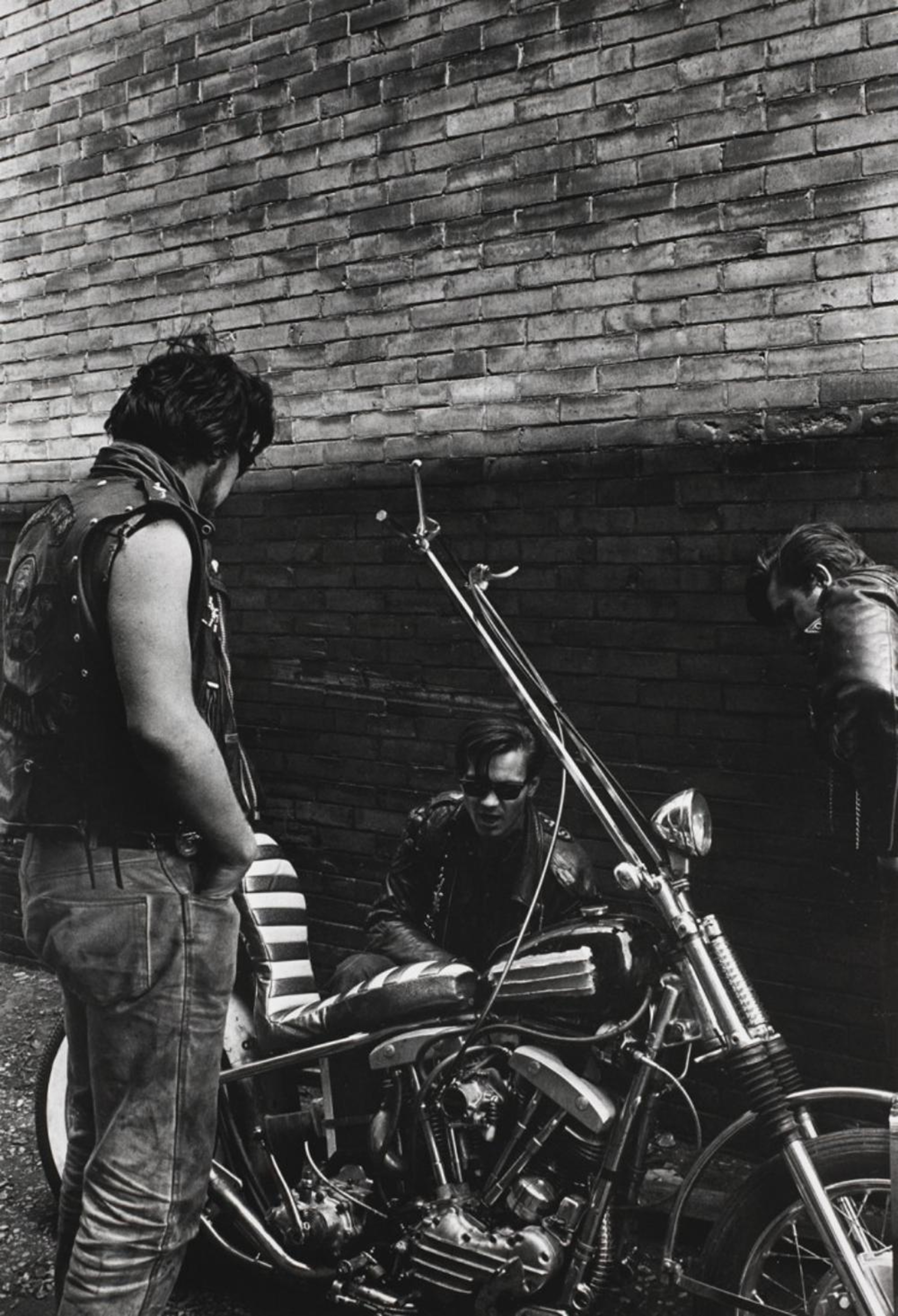
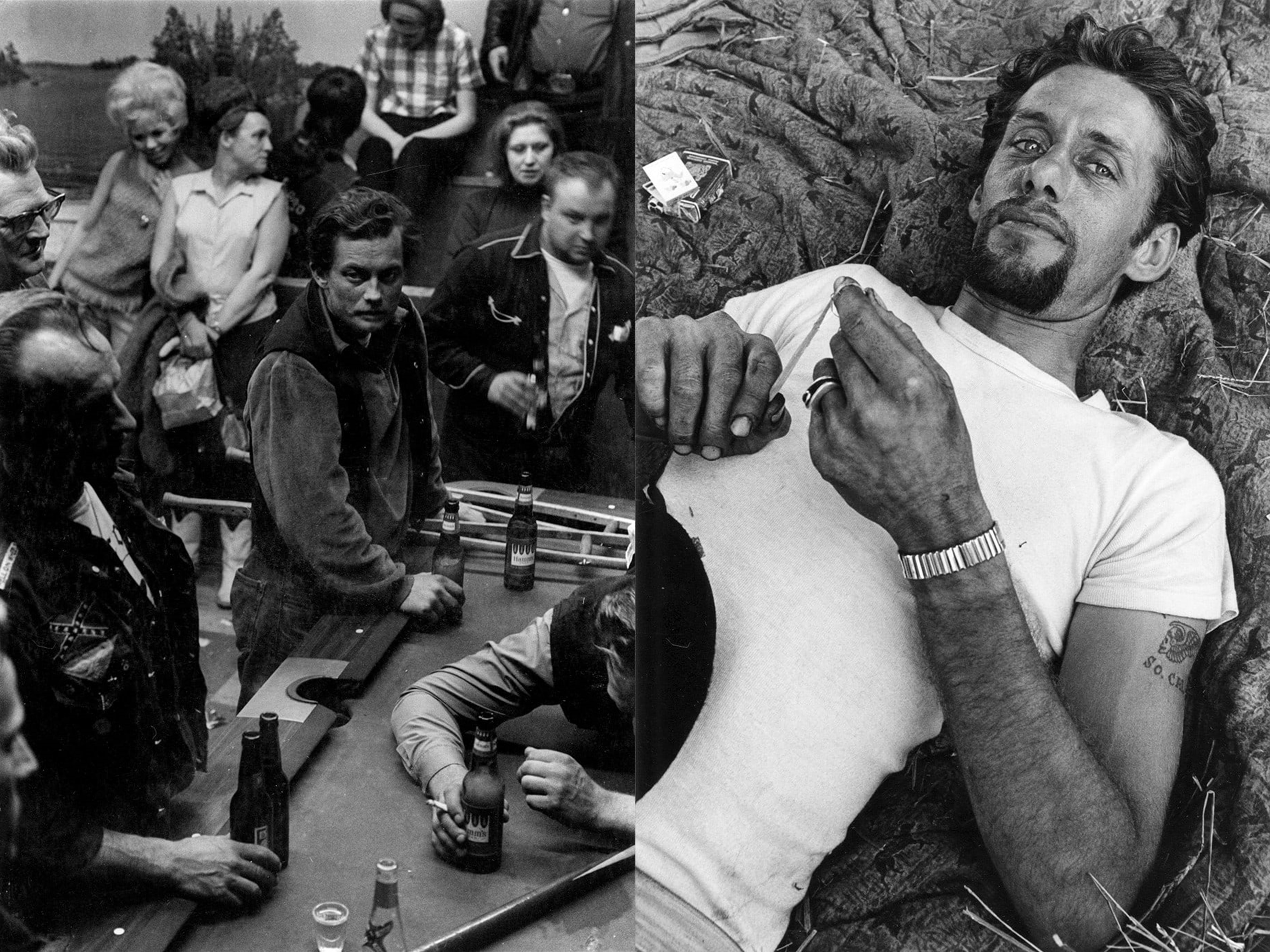
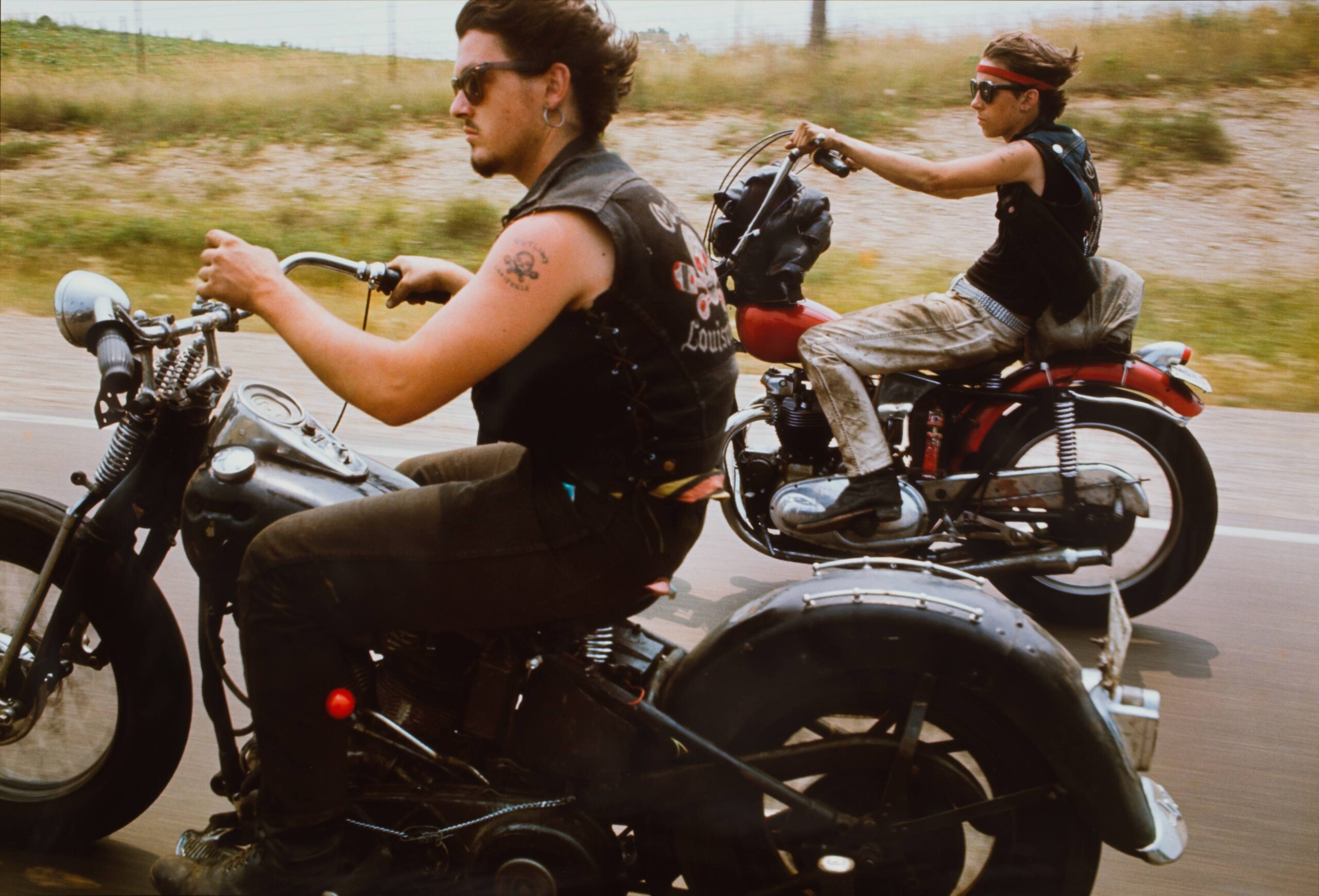
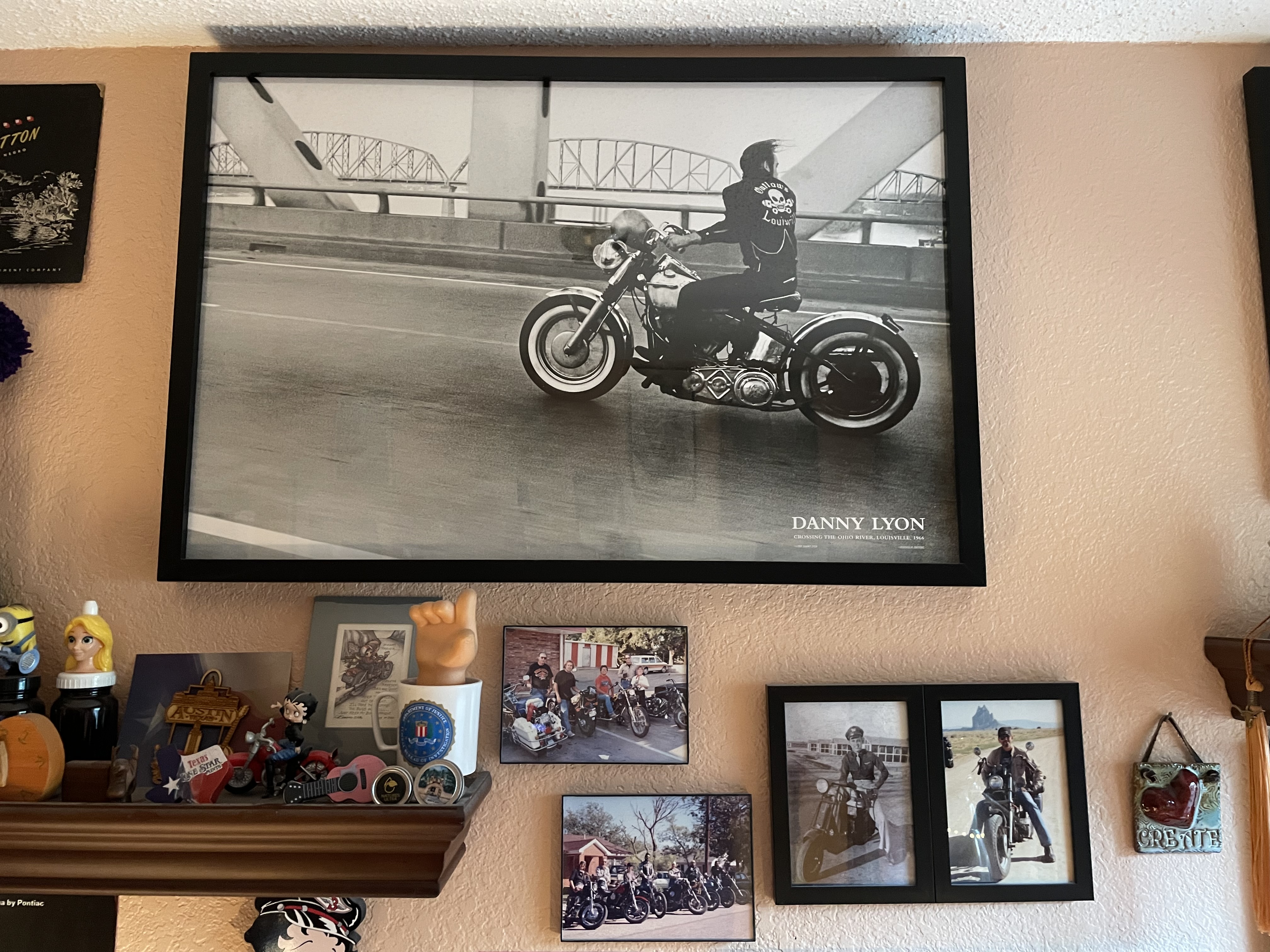
I first discovered Danny Lyon’s 1968 book The Bikeriders in 1980, when I came across a hardback first edition in a used book store, and what a discovery it was!
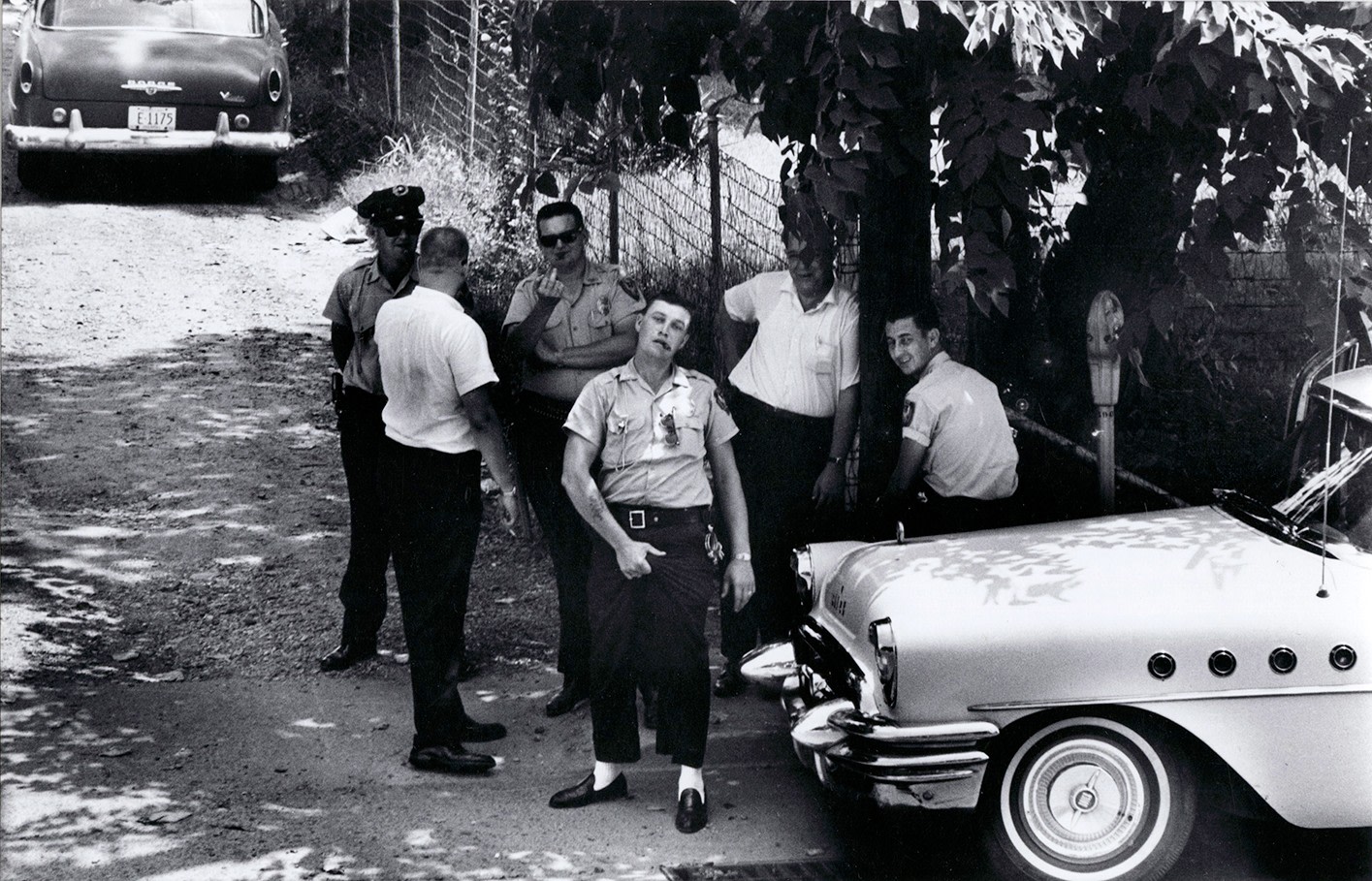
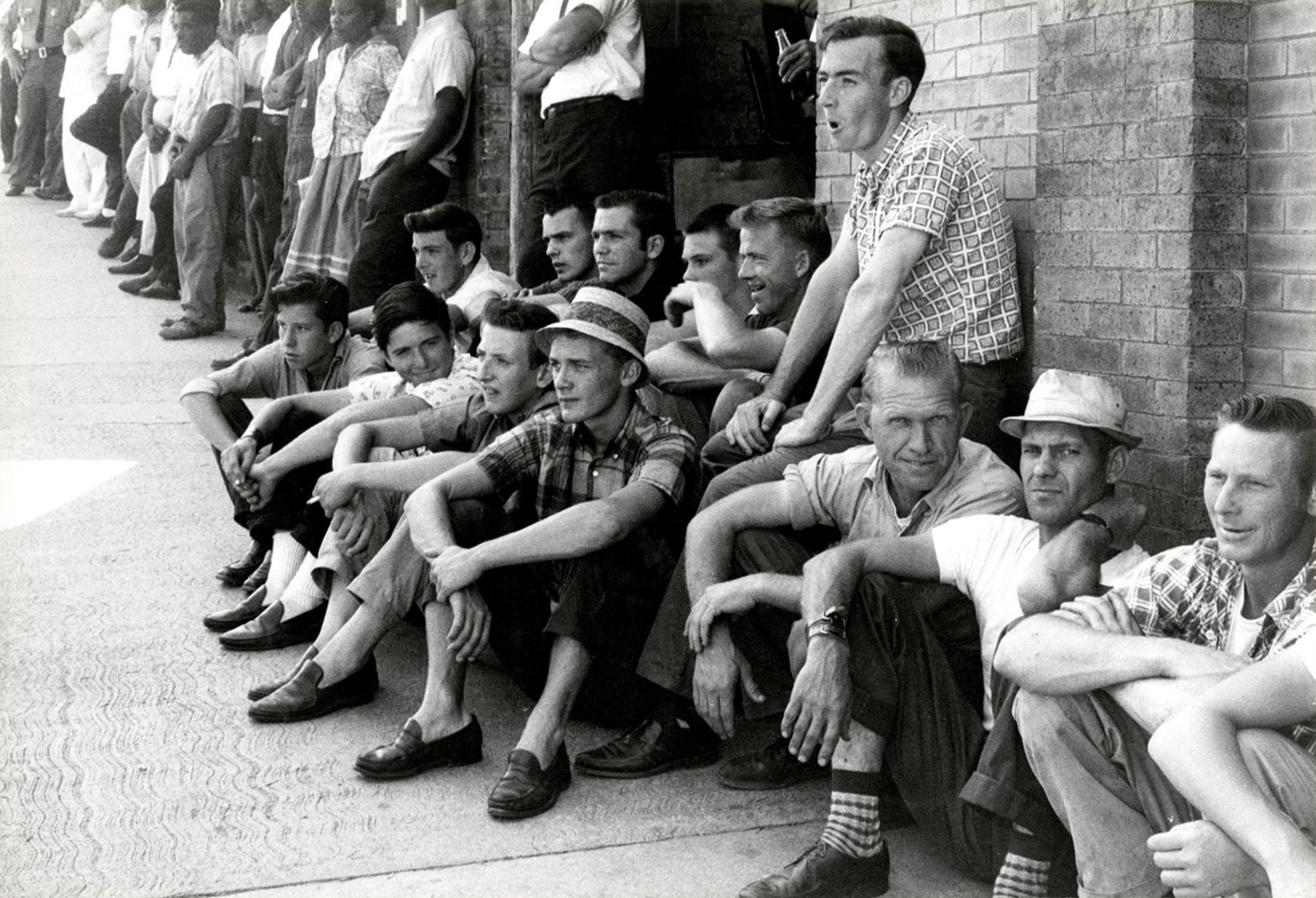
Danny Lyon is an award-winning lensman who spent the early days of the 1960s with the Student Non-Violent Coordinating Committee (SNCC), documenting the Civil Rights Movement in the Deep South (above). In his first week in the South, Lyon was arrested, and spent a week in a cell beside a beleaguered Reverend Doctor Martin Luther King, Junior.
Upon release he was threatened with lynching by racist cops (like those pictured above) but persevered to become SNCC’s official photographer, documenting many of the key moments in the Civil Rights Movement’s quest for justice and racial equality.
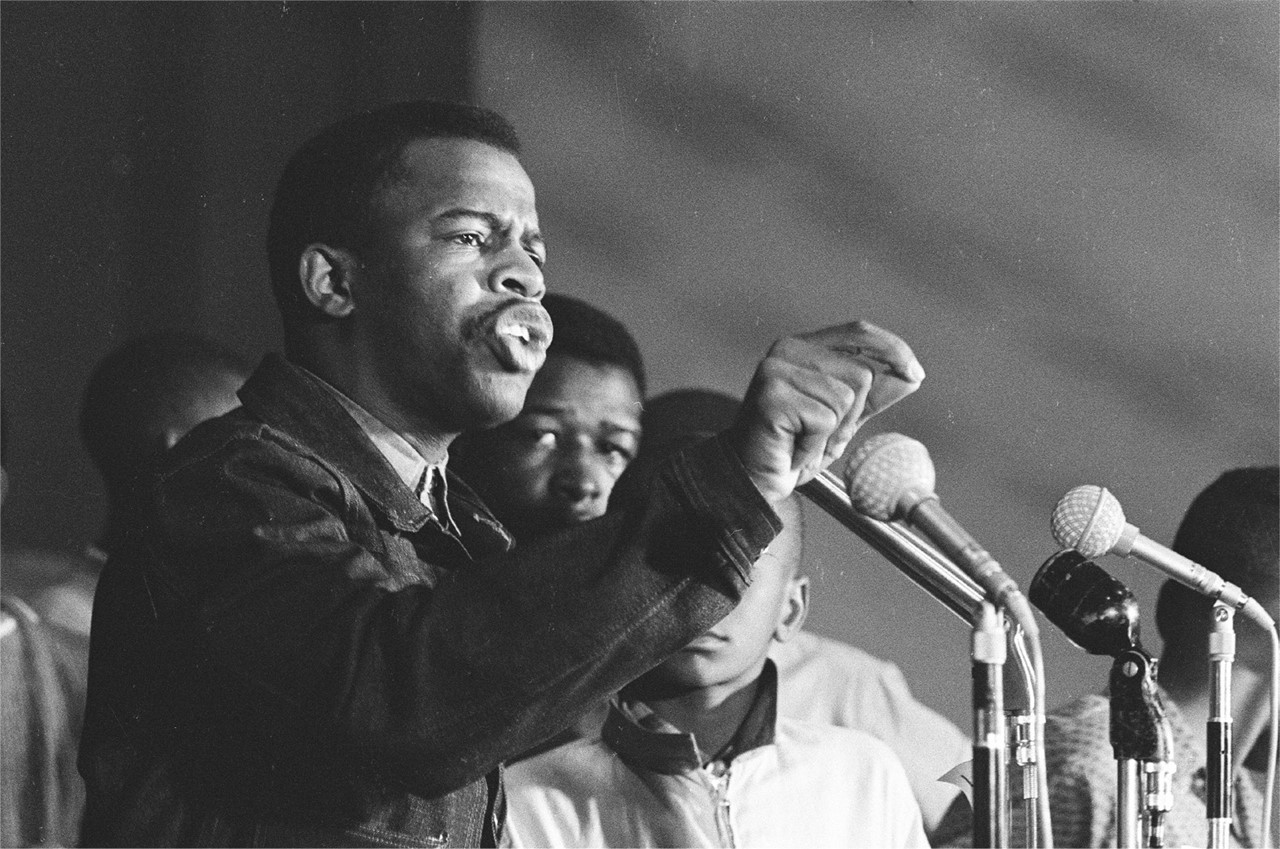
He also became lifelong friends with SNCC organizer and future Congressman John Lewis (above) and was at the Congressman’s side in the final days of Mr. Lewis’ life.
After his efforts in the Deep South, Lyon — already a dedicated rider — returned to Chicago, enrolled in university there, and became a member of the Chicago Outlaws Motorcycle Club.
As a full-patch member of the Outlaws, Lyon (aboard his beloved 1956 Triumph Thunderbird, above) rode and partied with the club, but also photographed Outlaws and patchholders from other clubs, their wives and girlfriends, motorcycle racers and mechanics and others involved in the motorcycle scene.
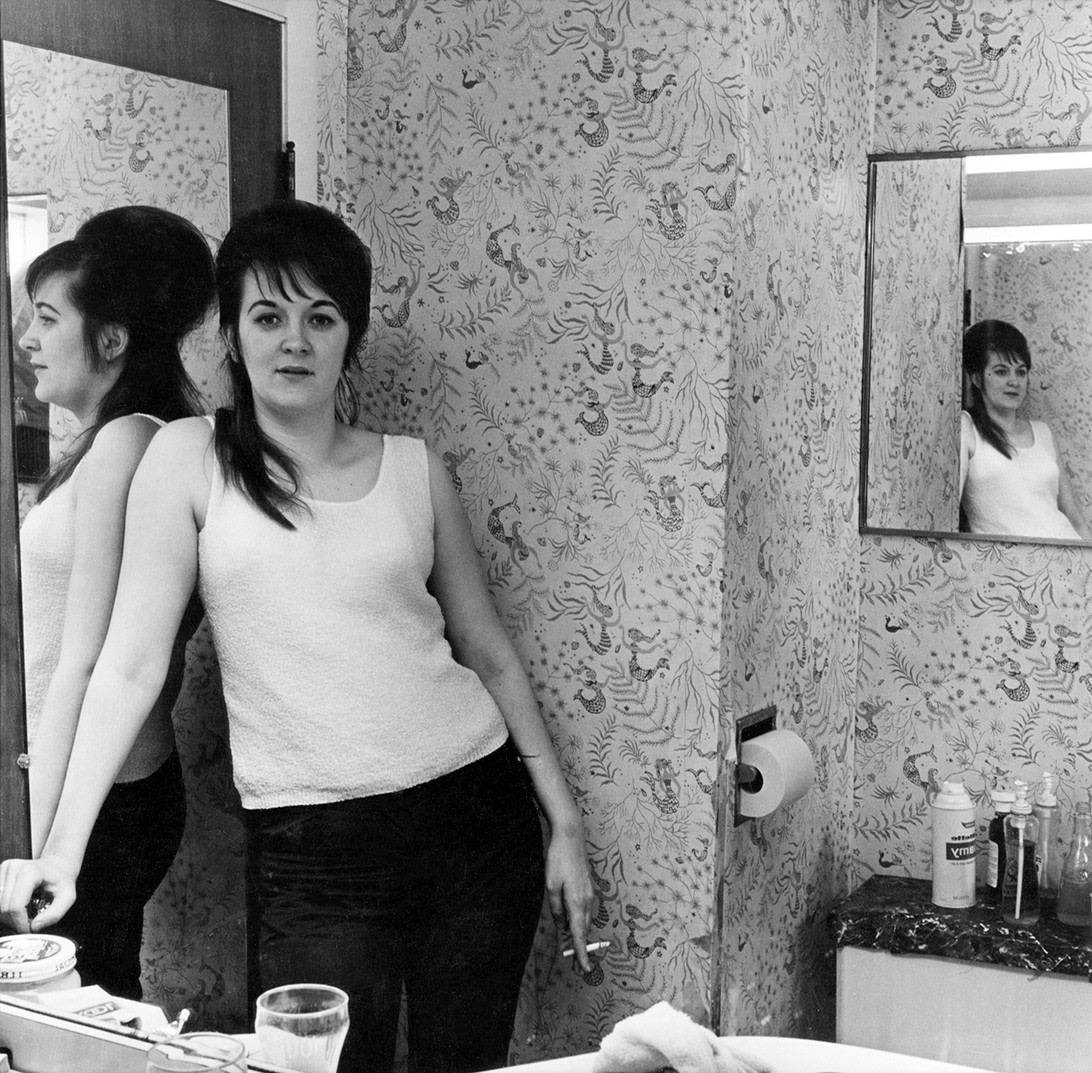
He also conducted low-key, casual interviews with Outlaws and other clubbers, their old ladies, and some of the racers he’d met at tracks from Illinois to New Hampshire.
The resulting book was groundbreaking in many ways. For starters, it combined Lyon’s technically brilliant and compassionately soulful images of the motorcycling world with transcripts of his interviews, in a format never before seen in American publishing. It also made him one of the first observers (after Hunter S. Thompson of Hell’s Angels fame and Tom Wolfe, who wrote The Electric Kool-Aid Acid Test) to document the rising phenomenon of ‘outlaw motorcycle clubs’, and his book the first photo book about bikers ever published. Finally, it made his the very first book about clubs written by an actual member of a club, and giving voice to rank-and-file members of those clubs.
Sadly, The Bikeriders received little notice when it was first published, and quickly went out of print. As psychotic as I have always been about reading and collecting books on motorcycling and other topics of interest, I’d never heard of Lyon or his book when I found that first edition hardback at Half-Price Books on Lavaca Street in Austin in 1980, but gladly paid the $4.95 for my copy….
The Bikeriders was first published in 1968. This is the cover of one of the many recent reissues.
….and by-the-by, as of this morning, those same first edition / first printing hardbacks were selling for anywhere from $1000 to $1850! 😮 Not that my copy is for sale anytime soon — as a biker and historian, the book is a precious resource — but it’s nice to know I scored one hell of a deal! 😆
For a long time, at least amongst the bikers I rode with, no one had ever heard of Danny Lyon or his precious little book. I stashed the slender volume on a shelf in my ‘permanent library’, and only showed it to people I really thought could appreciate this rare gem I’d uncovered.
However, with the advent of social media I saw more and more people raving about his groundbreaking photojournalism: The Bikeriders, his monograph on the Texas prison system, his work with SNCC during the Civil Rights Movement of the early ’60s, his report on the destruction of Lower Manhattan and much, much more.
Beginning in 1997, reissues of The Bikeriders began to appear. Some were über-expensive slip-cased collectors’ items, priced in the hundreds, but in 2003 Chronicle Books released a more reasonably priced revised edition, which gave Lyon’s work a second chance at the immortality it deserves.
The new release included a number of ‘lost’ photographs — many in color like the one above — that the photographer unearthed from a forgotten file cabinet in the offices of Magnum Photos, where Lyon was an associate from 1967 to 1975.
The 2003 edition also included new remarks by the author about his personal history with the Outlaws Motorcycle Club, and why he hung up his colors. For those of us interested in the history of bikers, this was dynamite stuff!
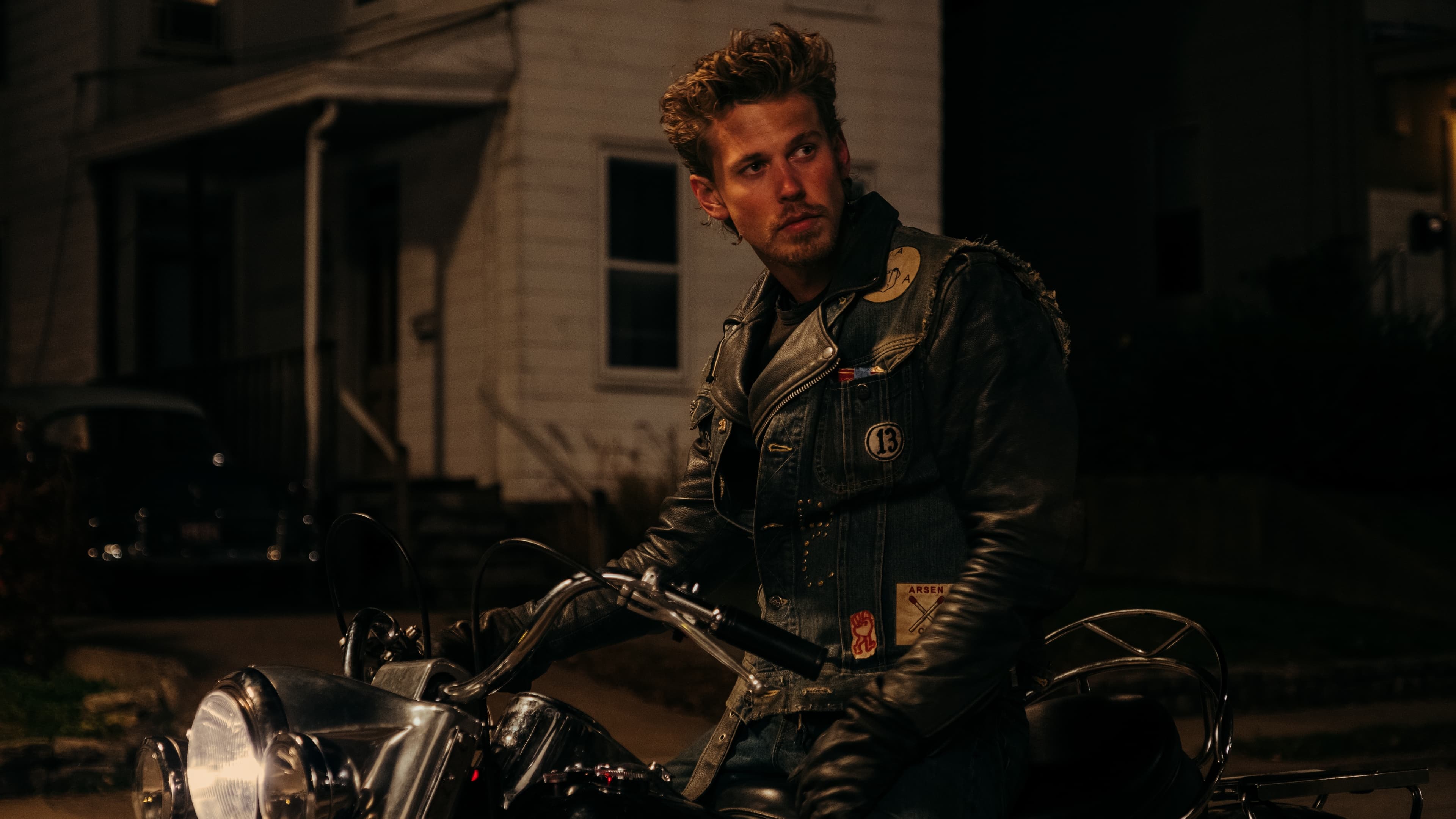
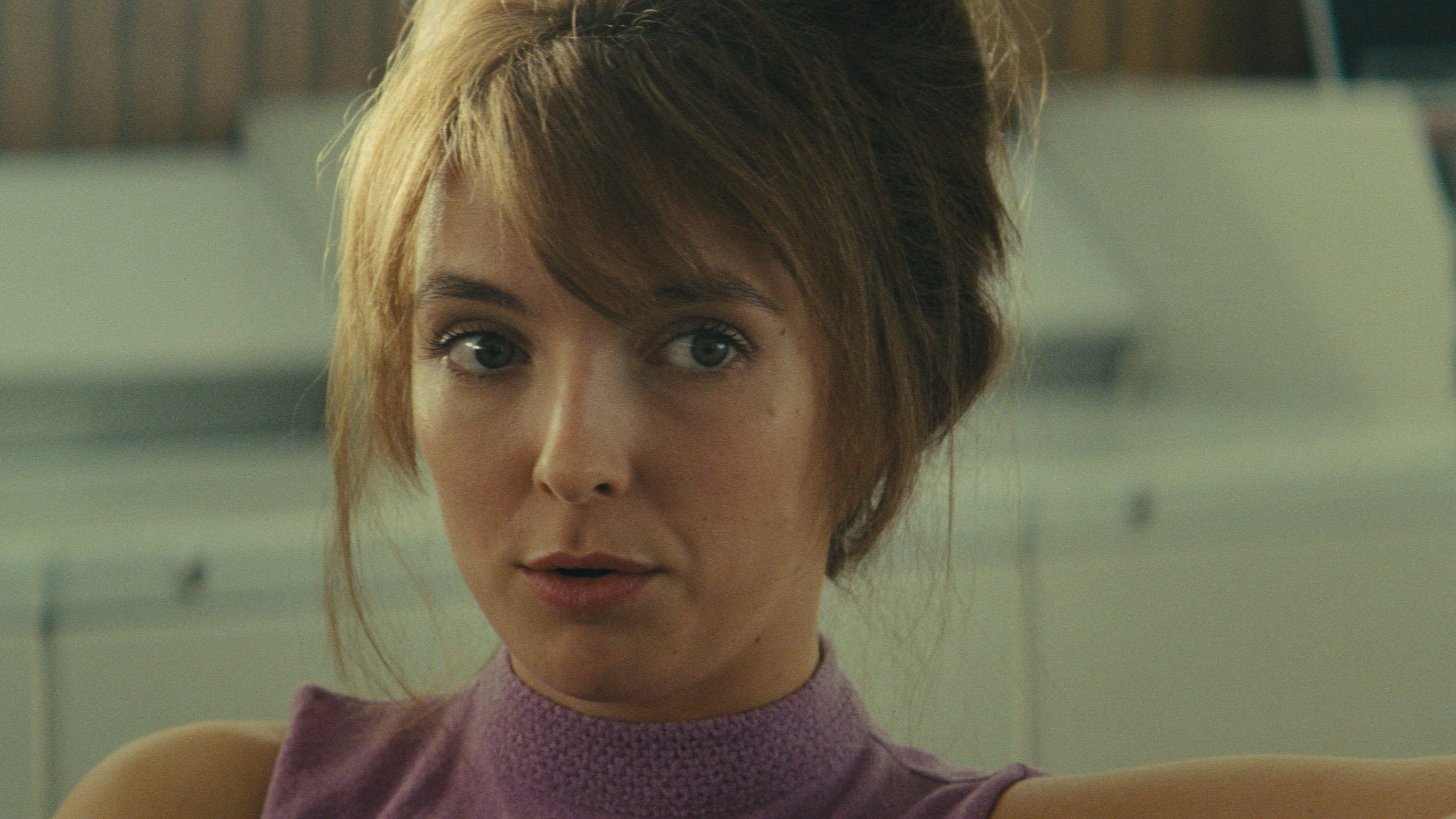
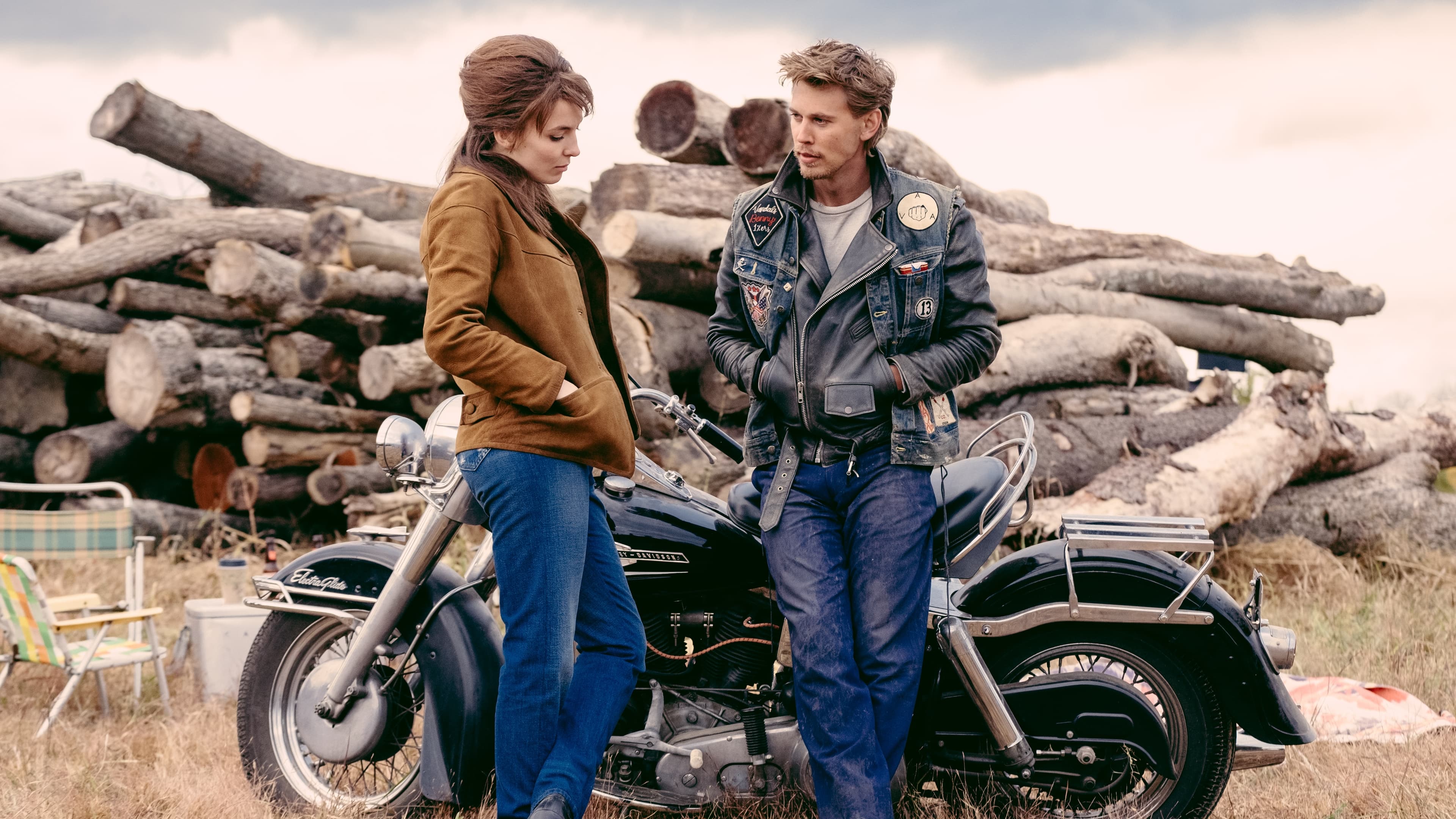
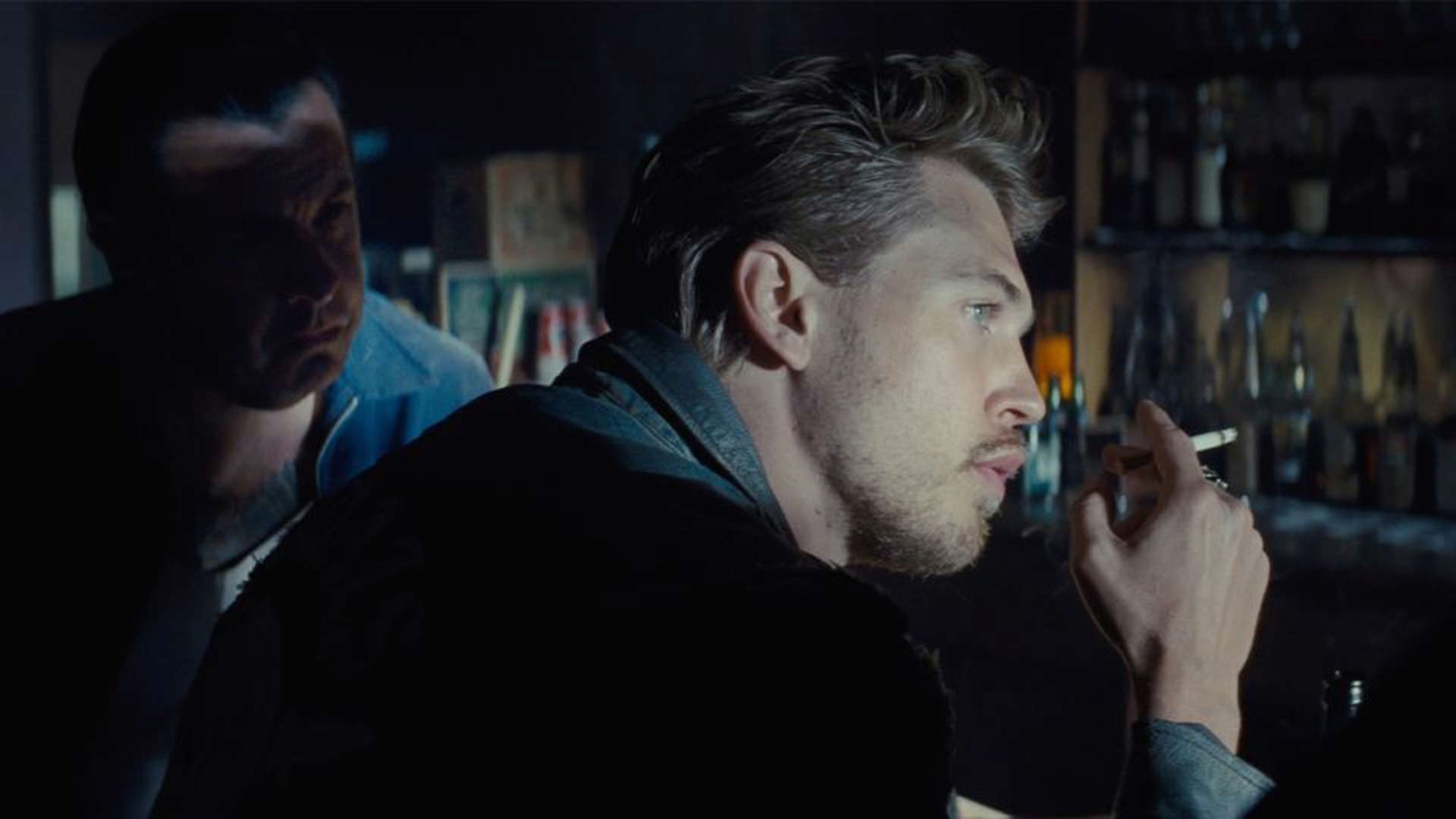
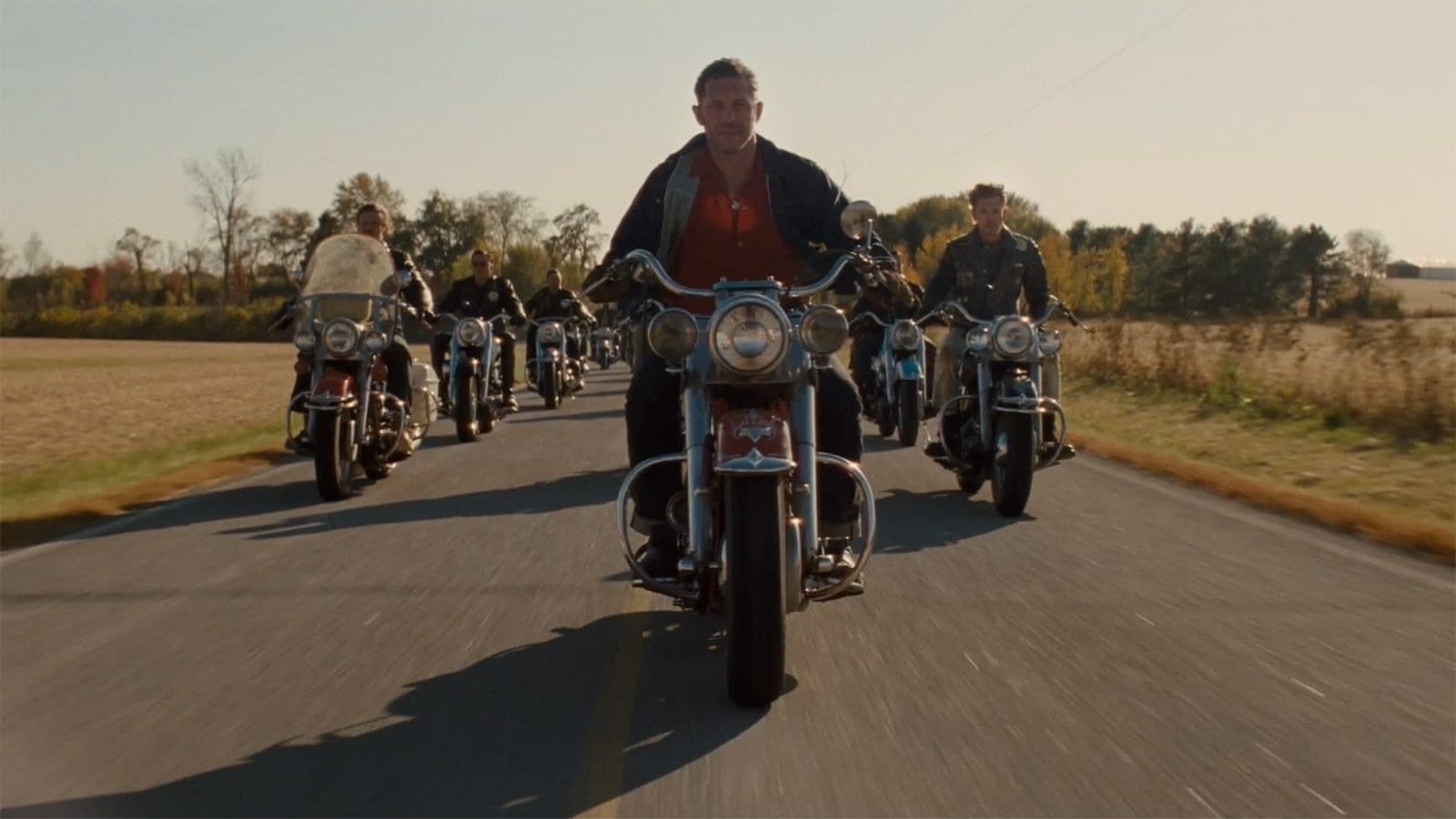
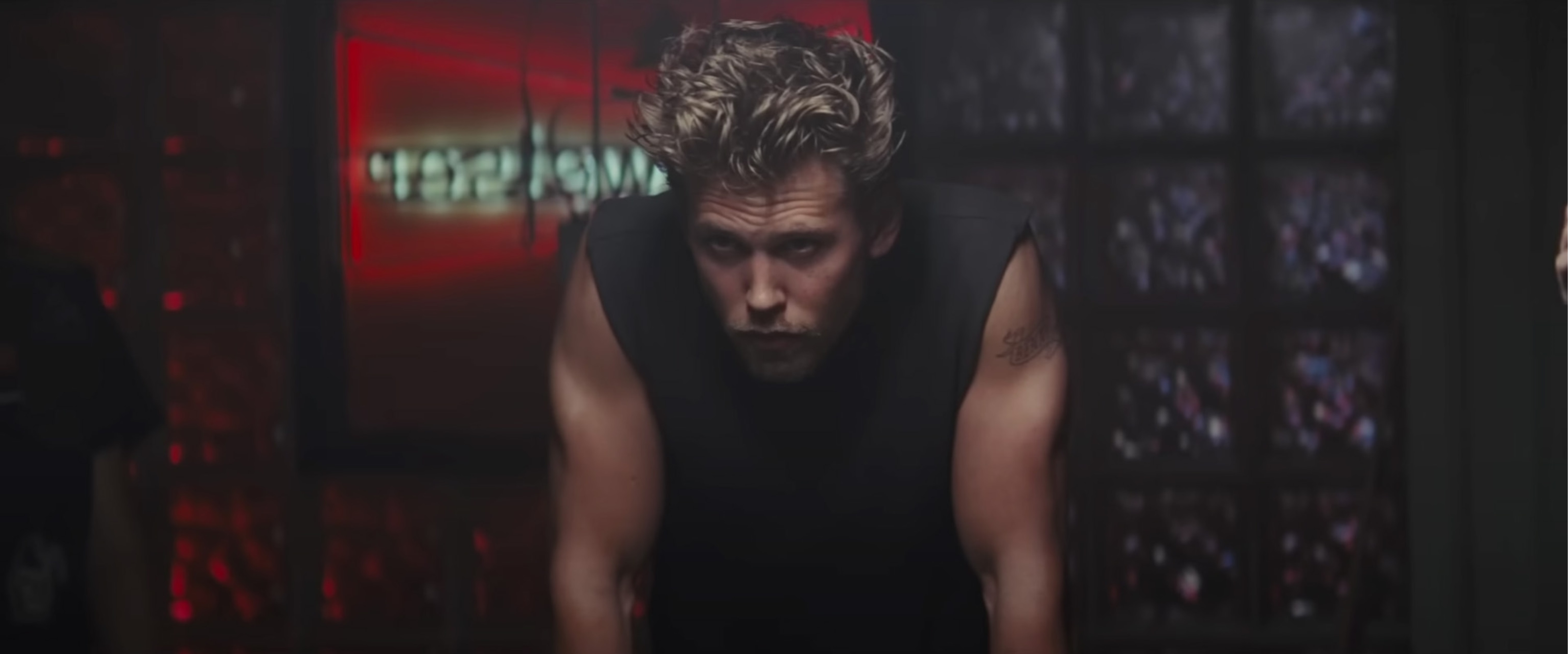
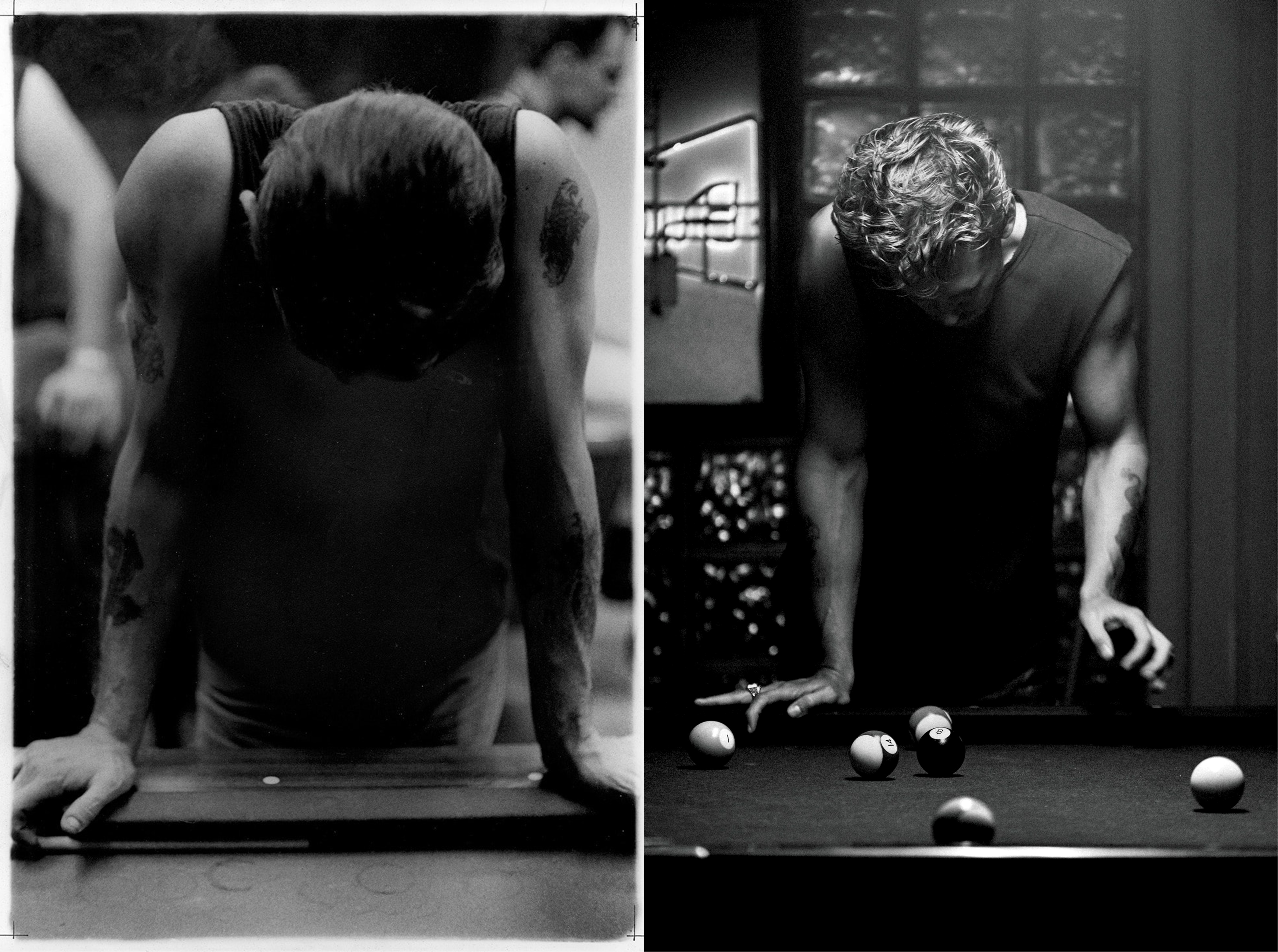
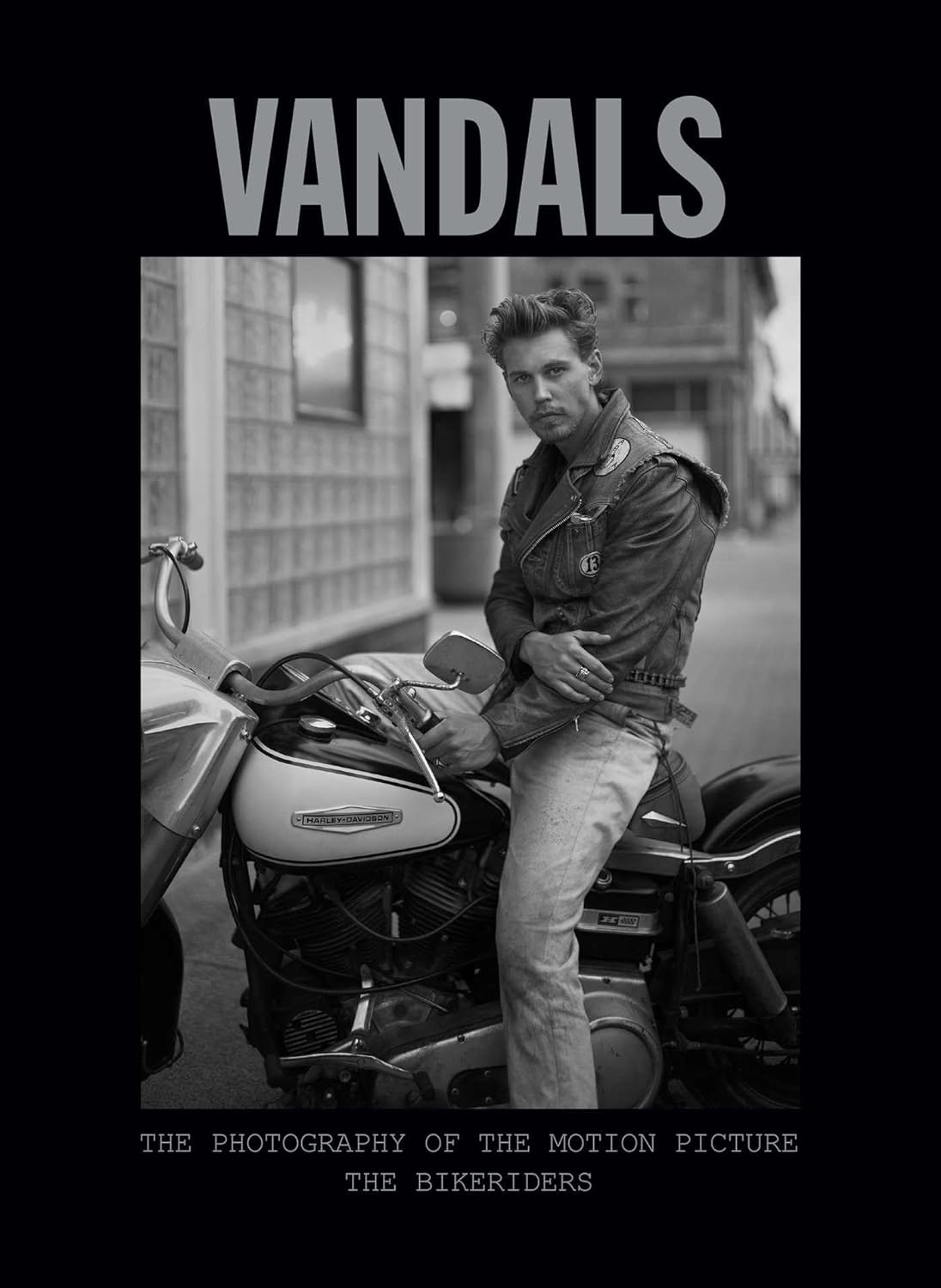
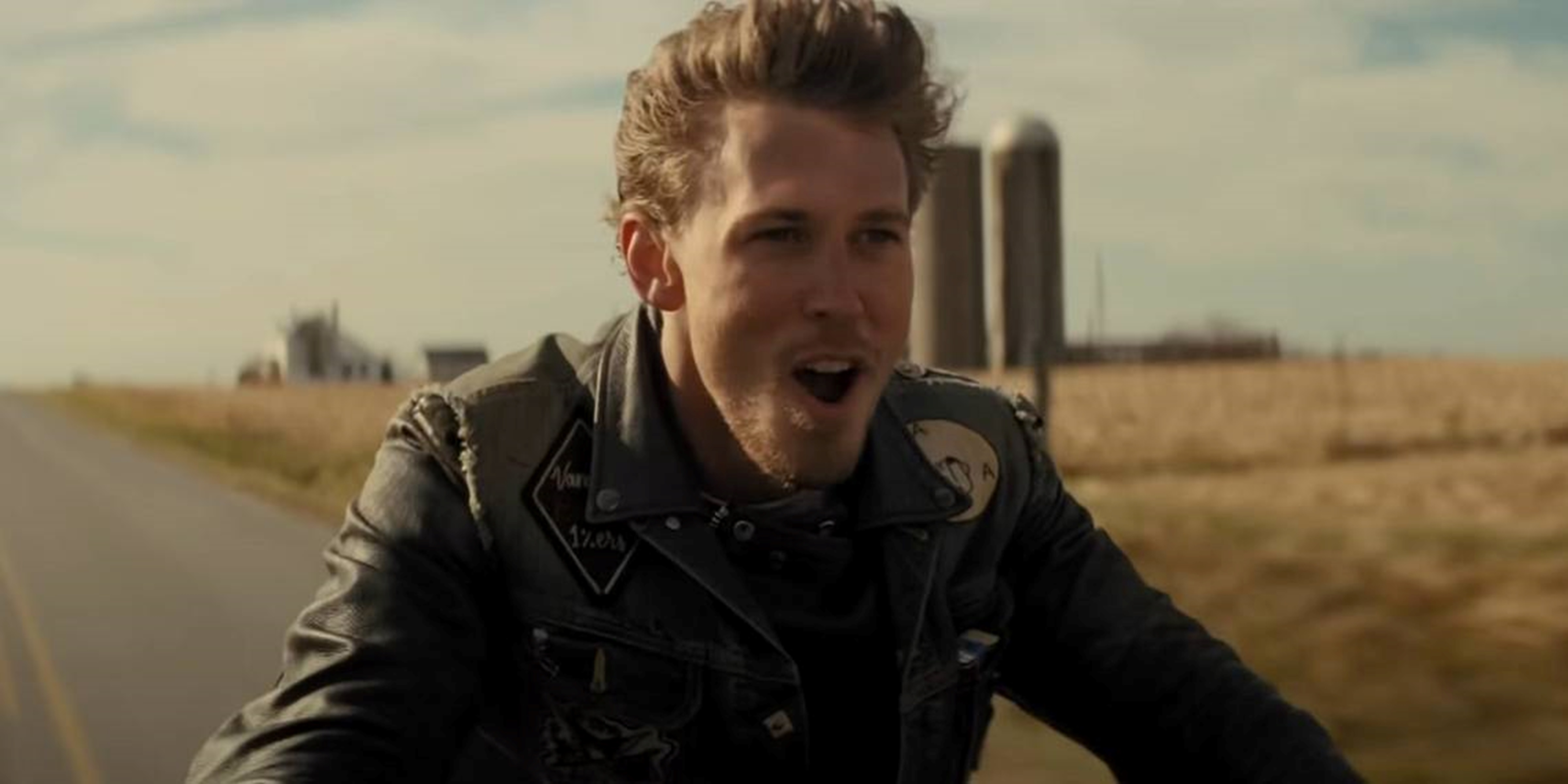
Apparently, filmmaker Jeff Nichols (Take Shelter, Midnight Special and Mud) agreed with that ‘dynamite’ assessment, because he took Lyon’s book — the photographs, interviews, and Lyon’s personal remarks — as inspiration for a new full-length feature film, also titled The Bikeriders and starring current A-list actors like Austin Butler (Elvis and Masters of the Air), Jodie Comer (Star Wars Episode IX and Killing Eve), and Tom Hardy (Band of Brothers and Inception).
Reading reports about the upcoming film and synopses of the plot, and viewing the trailer for the film, I feel certain the storyline depicted in the film will be heavily weighted by Lyon’s later remarks about his tenure with the club. The film’s ‘rise and fall’ arc seems to reflect the photographer’s disillusionment with the club’s turn from a band of rowdy hard-riding roughnecks to a grimmer, more dangerous organization.
I’m still excited to see the film. If nothing else, a ‘biker flick’ from A-listers like Butler, Comer, Hardy and Nichols will become part of biker history, along the lines of The Wild One and Easy Rider.
The Wild One (1953): Star Lee Marvin (fun-loving biker ‘gang’ leader Chino) argues with Robert Keith (outgunned local sheriff Harry Bleeker) as Marlon Brando (disaffected punk Johnny Strabler) stands mute and painfully ‘hep’. Easy Rider (1969): Stars Dennis Hopper (the manic Billy) and Peter Fonda (über-cool Wyatt) with Captain America, the most recognizable motorcycle on the planet, idle past a local cop with an attitude about longhaired hippie types in his East Texas burg.
The Bikeriders may well have the power, as those films did, to impact the future of biker life in America and around the world. However, I am NOT expecting a happily-ever-after ending for Kathy, Benny, Johnny and the boys.
It should come as no surprise that swag for The Bikeriders film is already flying off the shelves. The other day I posted on Facebook about a $1250 ‘Vandals’ jacket on offer from Schott Brothers, the same purveyors of leather goods who crafted Marlon Brando’s famous ‘Perfecto’ jacket for the 1953 film The Wild One. They are now offering a ‘D-Pocket Jacket’ like the one Tom Hardy’s character wears in the film.
The Schott Bros. promote their $1250 ‘Vandals’ leather jacket.…….and even replicate Danny Lyon’s Crossing the Ohio, Louisville, 1966 for their advertising campaign.
Then there’s the photo book VANDALS: The Photography of the Motion Picture ‘The Bikeriders’ (2024), which is available through Amazon, Schott’s website, and goddess knows where else….
Yes, I do have a copy! 🙄
….and, of course, official merch from the filmmakers themselves, including denim jackets with Vandals MC ‘colors’ printed or embroidered on the back, matching ball caps, t-shirts, hoodies and sweatpants (sweatpants? 😮 Really? 😱).
Shades of Anarchy all over again!
I am not pimping for these mercenary fecks, BTW; I’m just alerting you, gentle reader, to exactly WTF is going on in the motorcycling world, for better or worse. 😱
The Schott Bros. site features a photograph of an actual ‘Vandals MC’ jacket from the film, but their $1250 repop jacket does not include club colors. For those, you’ll need to visit the NBC/Universal merch store referenced above. 😏
Those of us who have been riding for a while are having flashbacks to Sons of Anarchy and all the relentless marketing surrounding that production. To this day, people are showing up at motorcycle events wearing official ‘support’ t-shirts and pirated copies of SoA colors, and YouTube teems with videos of people warning riders of issues with faux club colors, like the ones the couple below are sporting.
Just for the record: DON’T!
I’d love to hear back from anyone who’s seen The Bikeriders movie. I’ll do my best to respond to comments ASAP.
As a bonus, I am including the articles mentioned in my previous post, that were published in The San Francisco Chronicle and The Hollister Free Lance on the Monday following the ‘riot’ over the 1947 July 4th weekend.
From The San Francisco Chronicle, July 7th, 1947.I replaced the unrecognizable pics from the original photocopy with clearer images of Peterson’s photographs.