When I was maybe seven or eight the boy next door came home from college on a toaster-tank BMW, and was giving the neighbor kids rides around the block. I begged and pleaded with my Mom – ‘PleaseI’llbecarefulI’llhangontightPleasecanIgoCanIgoPleaseI’llbecarefulPlease….’ – until she finally gave in. Yay! 😁👍
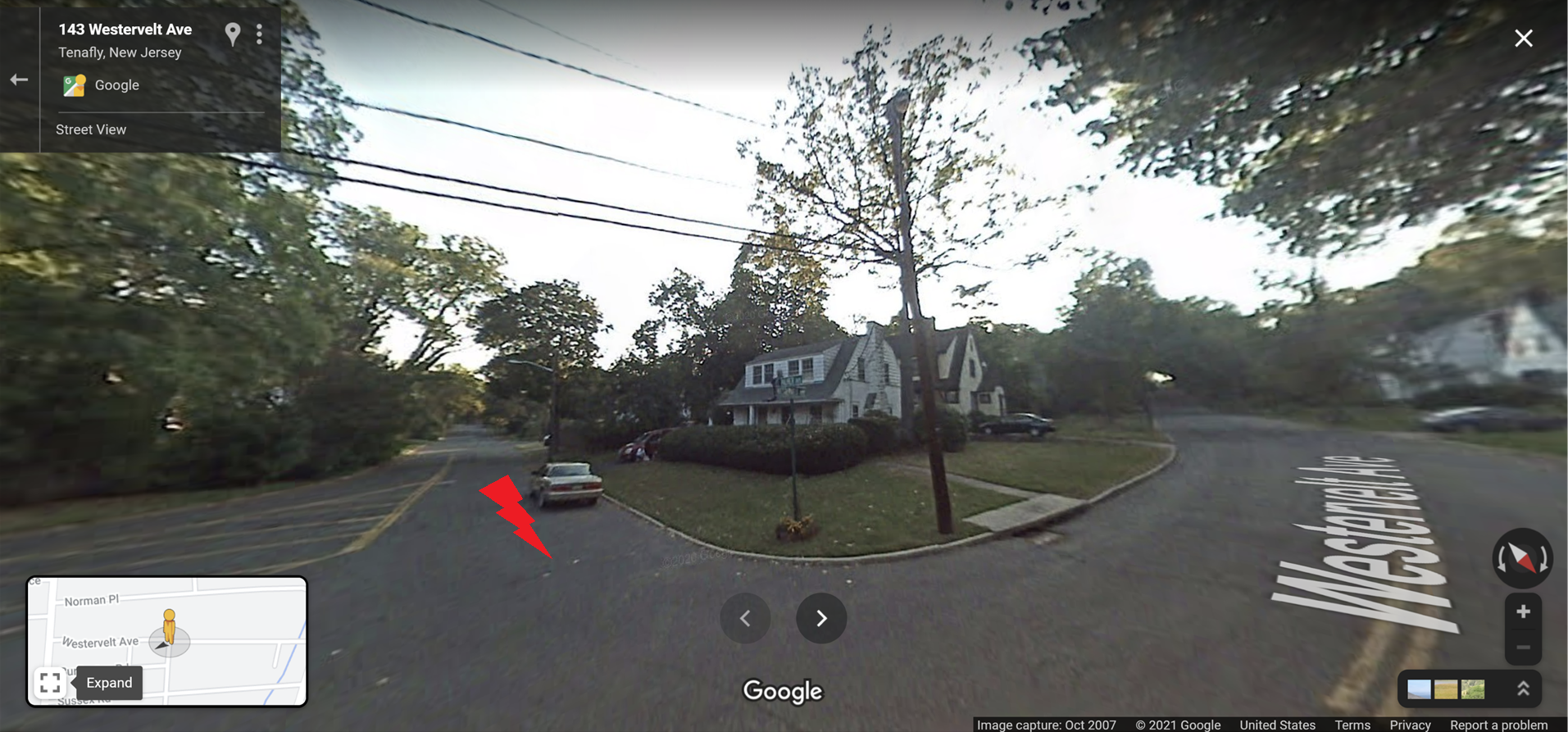
Gene and I were halfway around the block when I got this thought, like a crystal-clear voice in my head, that said ‘I’m going to HAVE one of these someday!’ The moment was so profound that, forty years later, I was able to take my wife to that exact spot and say ‘There! That’s where it all began!’ 🤷♀️
Right about there is where that lightning bolt inspiration struck me!
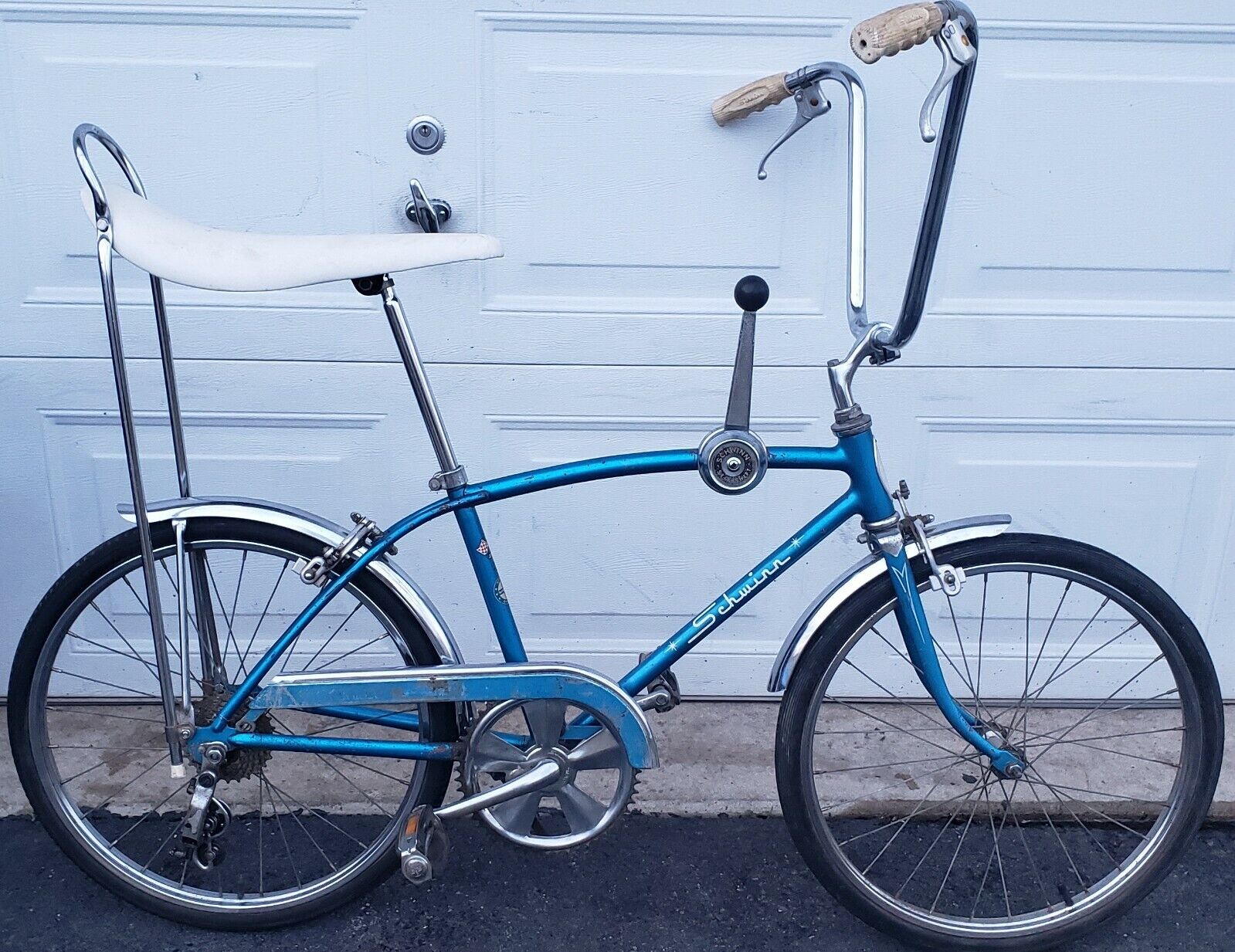
We were not allowed to have motorcycles when we were kids; not even minibikes, which were all the rage at the time. The closest I got to the chopper of my dreams was some plastic modelling kits and a Sting-Ray bicycle.
Not my Sting-Ray – this one is listed on eBay for $1200 😳 – but this is the color and year I had.
Of course, on the sly I rode anything with a motor – minibike, moped, dirtbike, whatever – whenever anyone was dumb enough to let me, but that wasn’t often. We lived in a ‘nice’ suburban town, and actual bikers were hard to find. The boy next door and Steve down the street, who had a BSA, were the only people I knew with real motorcycles, and they were never dumb enough to let me near the controls! 😆
As noted in previous posts, I spent my teen years drinking and drugging – a lot and very badly – and it wasn’t until I put all that aside, at the age of 21, that I could get serious about putting together the money for my first motorcycle. It took a year of sobriety to clean up my rather messy financial history, and working two jobs while going to school full-time on the GI Bill, but I finally got together the down-payment. With that in hand I got the nod from the credit union to begin shopping. Yay again! 😁👍
I toddled off to the Harley-Davidson dealership – I already knew I wanted a Harley – but the guy there was such a jackass that I turned around and walked out. Smart move, because half a block up the street I saw a Harley for sale in a used car lot. It was black, low, lean and mean, one of the prettiest things I’d ever seen, and looked like it might be everything I ever wanted.
I could not have been more right.
I called this biker I’d met in sobriety – a lawyer, of all things, who built choppers! – and asked him to come look at the bike with me. He came down and we went over the bike together. It was a 1974 Harley-Davidson Superglide FX with a 74 cubic inch shovelhead motor, a kickstarter (no electric start then or now) and disc brakes fore and aft. After he took it for a test ride (I did not yet have my motorcycle license) Wayne gave it the thumbs-up, and the deal was done. I completed the paperwork at the credit union, conveniently located just around the corner from the used-car lot, and spent a near-sleepless night as keyed up as a kid at Christmas.
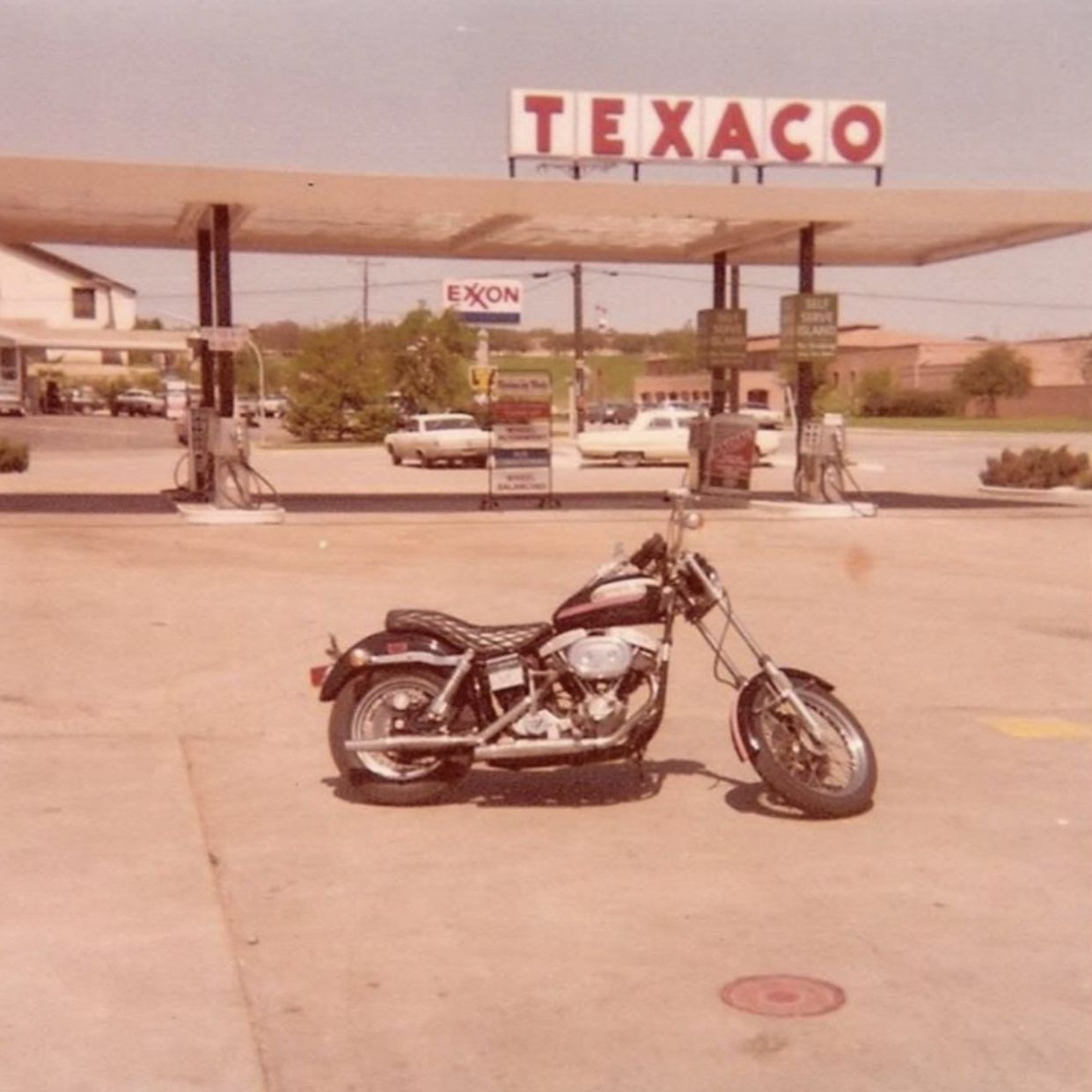
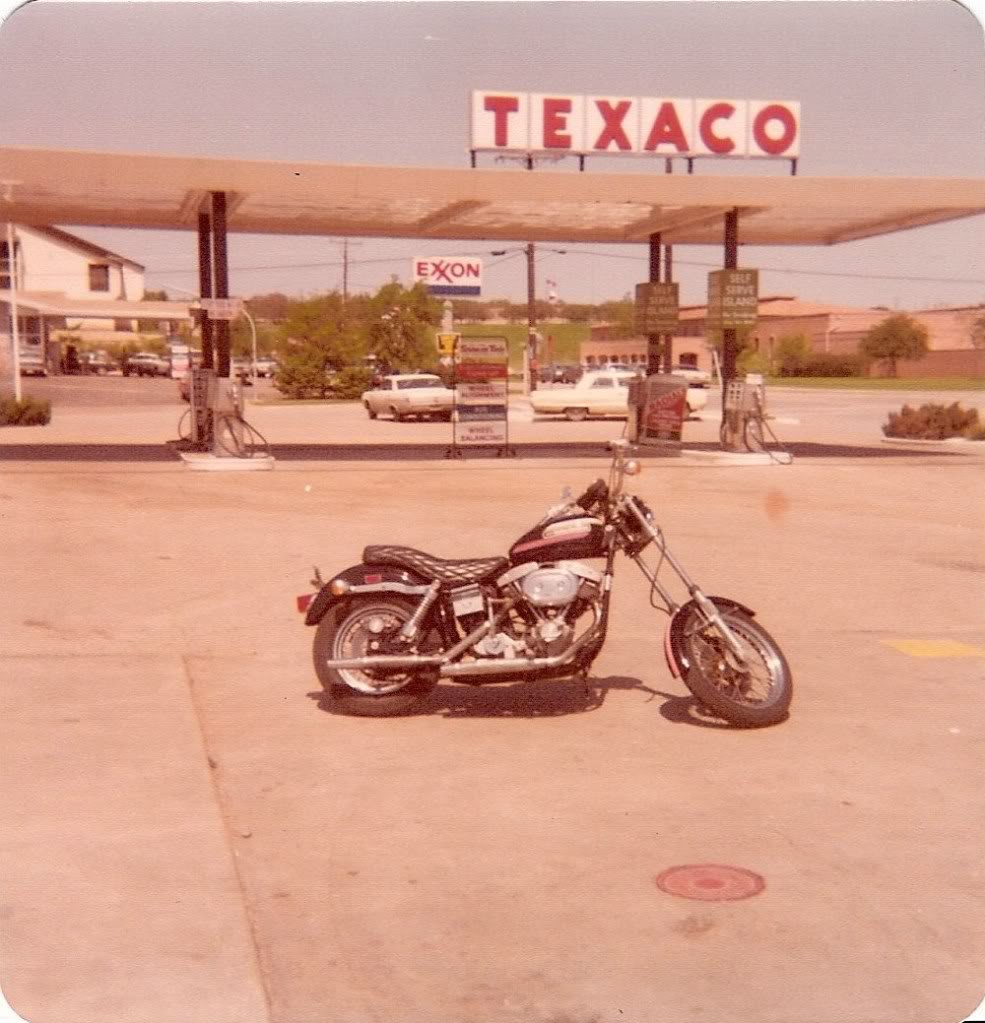
The next day – April 11th, 1979 – I threw my leg over my very first Harley for the very first time. That’s right: Forty-four years ago today I answered the call I heard that long-ago afternoon, on the back of Gene Graf’s BMW. After years of wishing and wanting and dreaming about it, I finally had me one of those things! 😎
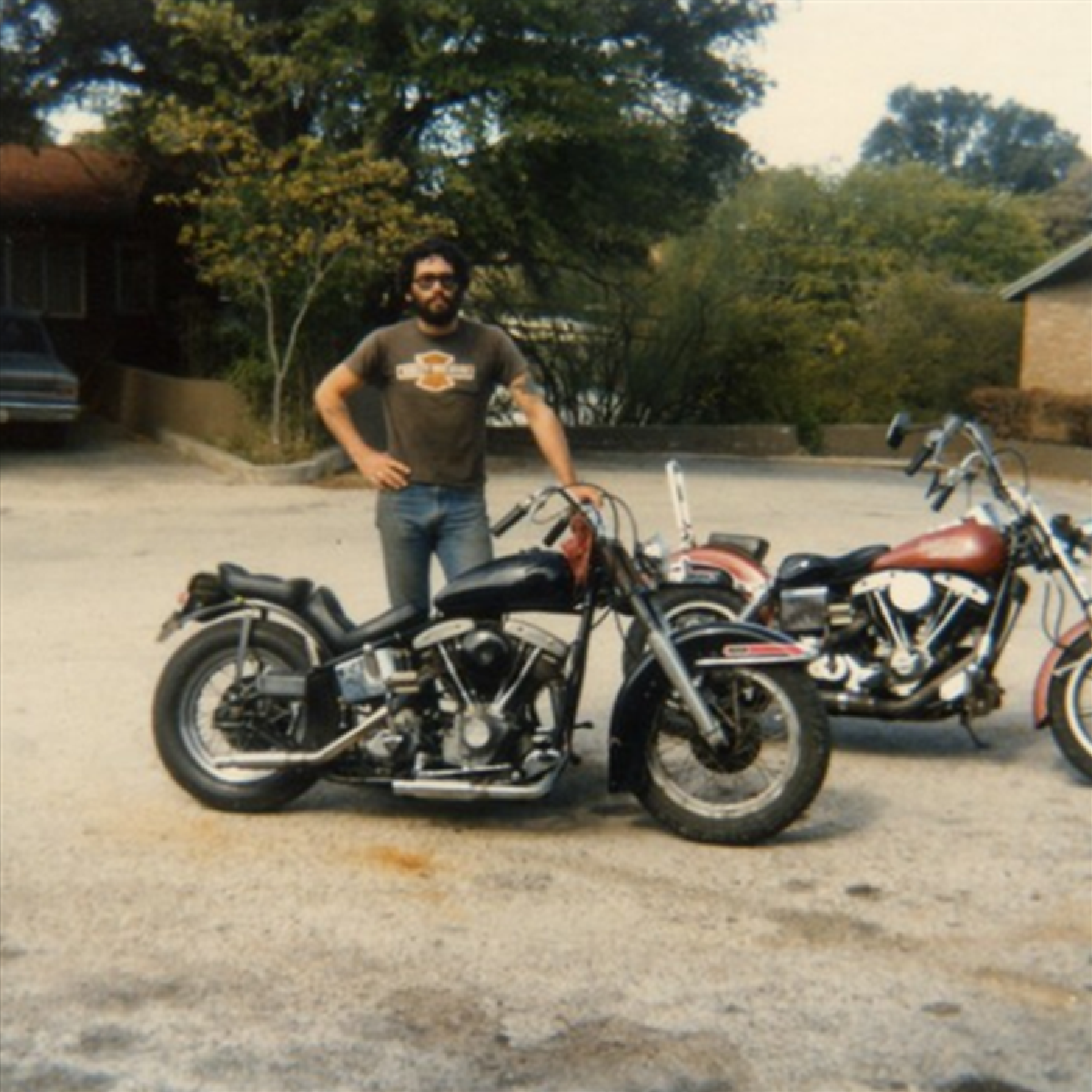
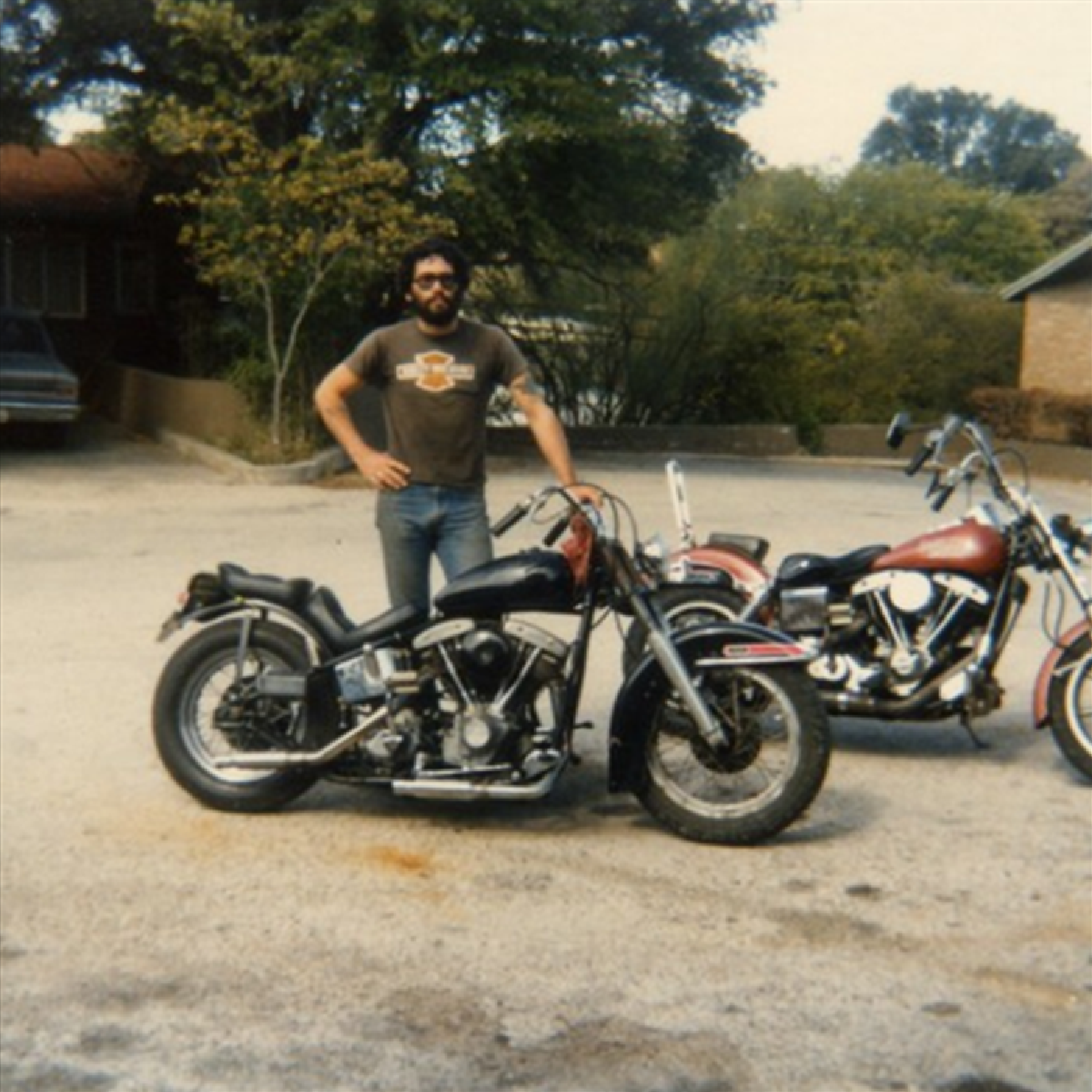
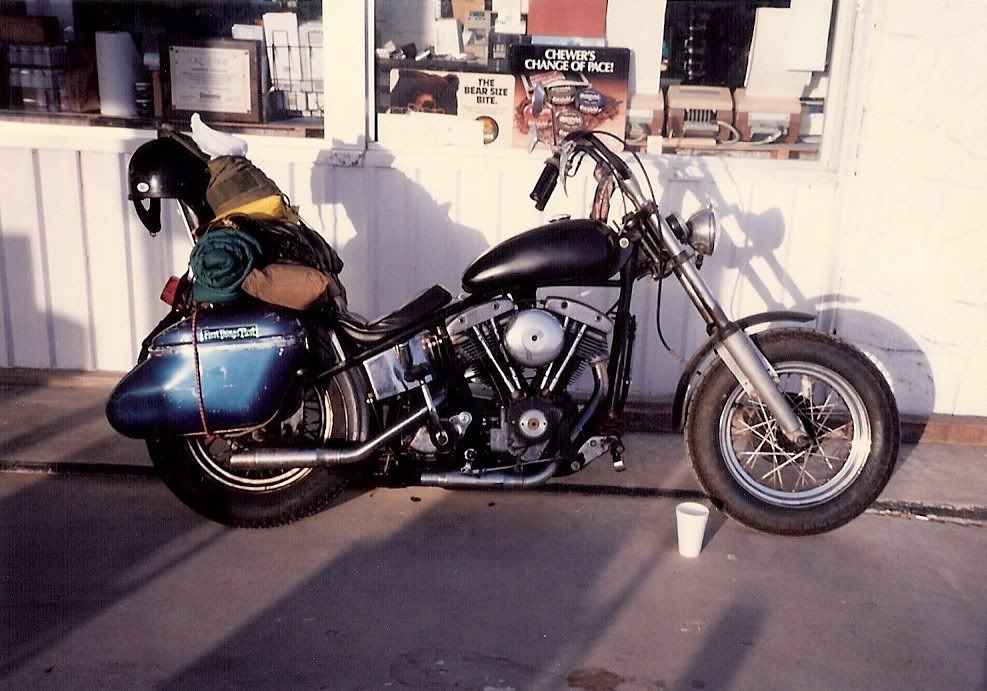
April 11, 1979, at Northwest Hills Texaco, where I worked at the time.
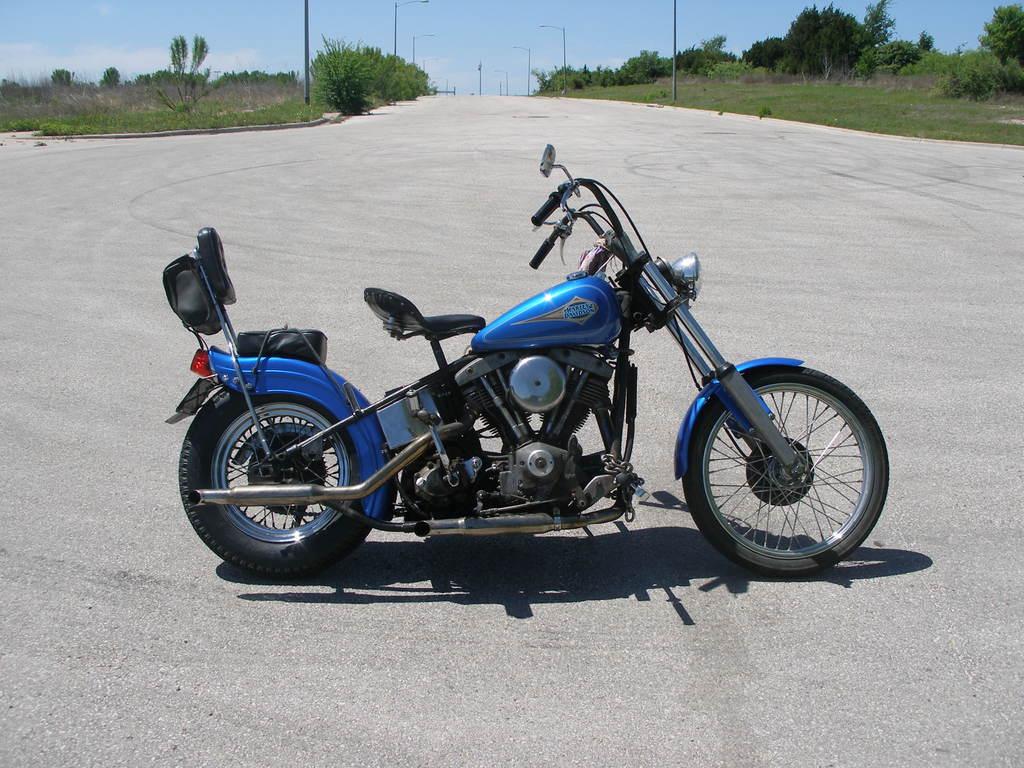
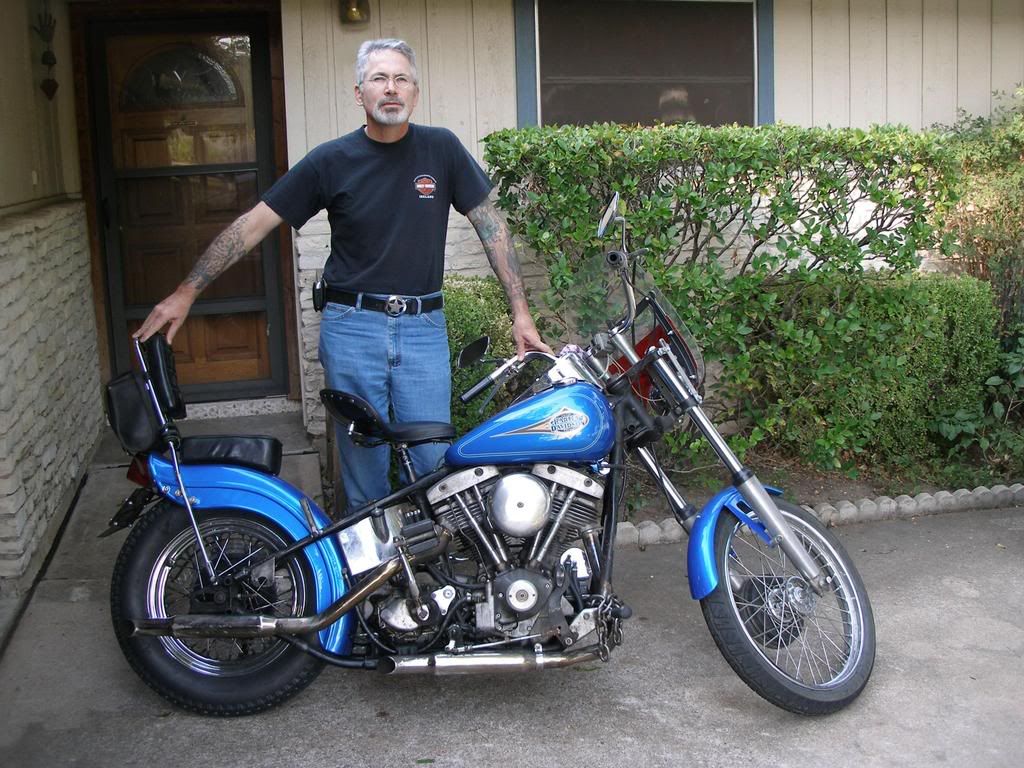
And forty-four years later, I still have that same motorcycle. I’ve had a few others along the way, but that one is my ride-or-die keeper. She (for she is a girl, make no mistake) is no longer black, and not as low or quite as lean as she was (neither am I, for that matter 😏 ) but she is still the prettiest thing I have ever seen. She’s still gorgeous, and righteous, and I still love her dearly.
Sad to say, a series of unfortunate events (primarily a disabling on-the-job accident) have kept me off my one true love (machine division) for several years, but I still harbor a hope that we may still find a way to be together again.
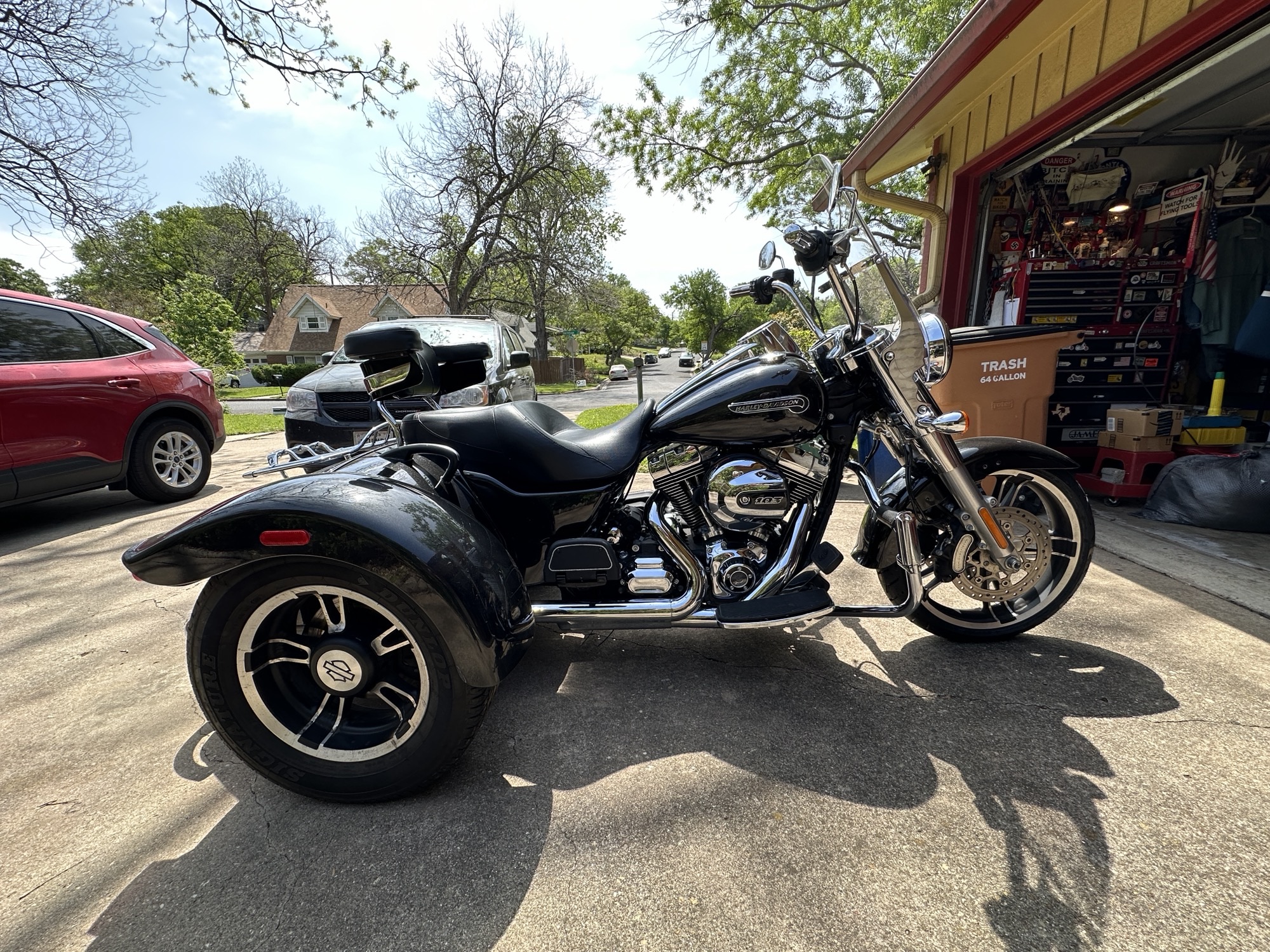
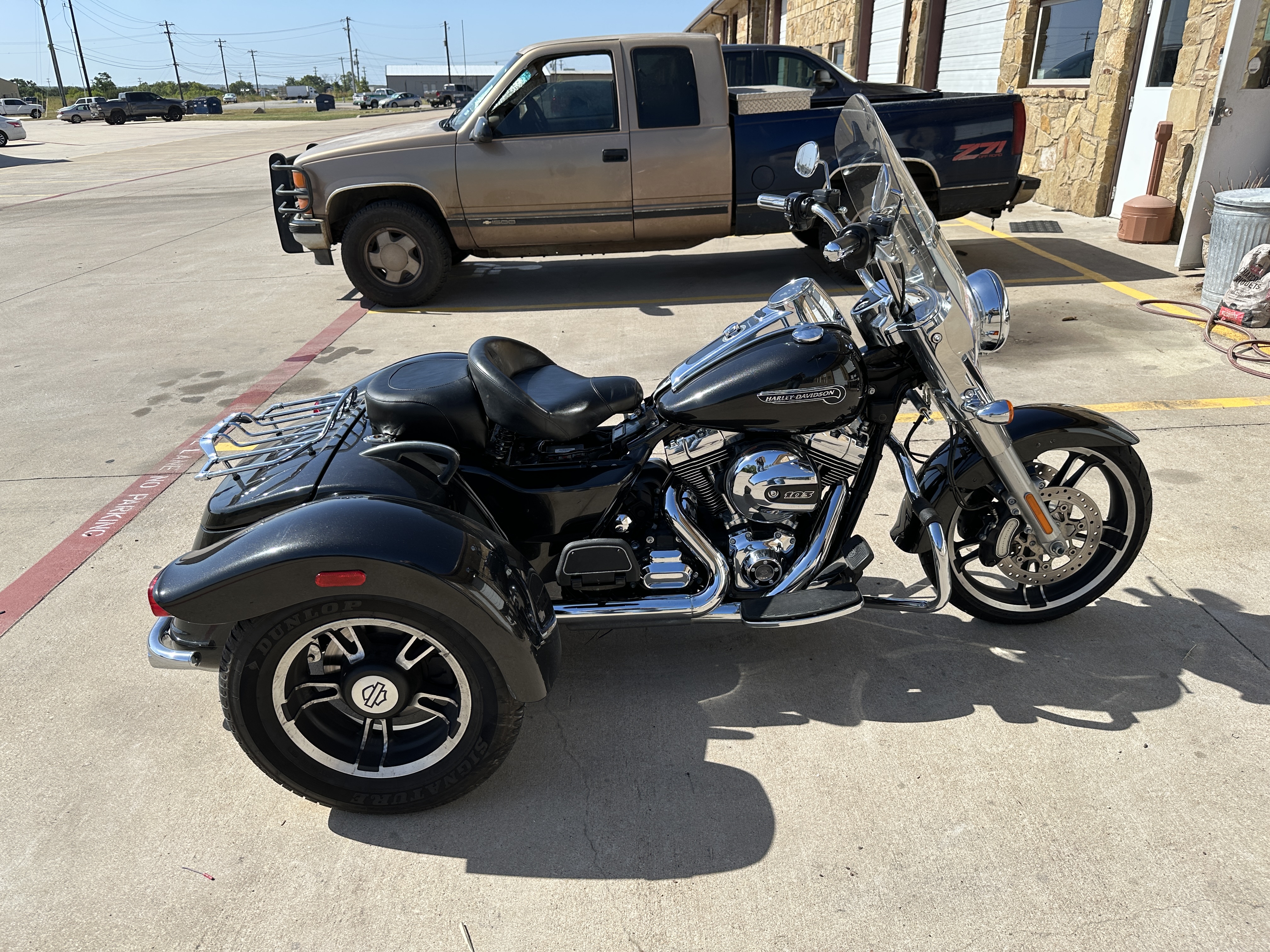
However, in the meanwhile, and with the support of my one true love (human division) I have secured a different bike, better suited to my disabilities. She’s big and fat and shiny and loud, and so new-fangled and complicated I dare not touch most of her more intimate components, but I’ve already had my hands on her, a little bit, doing little fix-its and adjustments, and once that happens love is sure to follow. She’ll never displace my shovelhead – seriously, what could? – but I have a good feeling about her. 🥰
My new-to-me 2016 Harley-Davidson Freewheeler. Now all I have to do is unlearn forty-four years of training, practice and instinct I’ve accumulated riding a two-wheeler, and learn the proper handling of a three-wheeler. For those who don’t know: it’s a very different style of riding!
So, Happy Anniversary to my 1974 Harley-Davidson FX – my beloved shovelhead – and thank you, thank you, thank you for all the years of joy and adventure you brought me. Let’s go for forty-four more, eh? 😁
Yes, sir, that’s my baby. No, sir, I don’t mean ‘maybe.’ Yes, sir, that’s my baby now!
And don’t you go getting jealous of the new kid. She’s just here to help. 😏
SCANDINAVIAN countries are known for their long dark winters. Causing those Viking knights to take refuge in their homes, only to come back out again in Spring. As a Head of Design at a Norwegian distillery, Swedish born (but 1/4th Norwegian..) David Höök is dealing with liquor all day long, so rather than drinking those dark freezing nights away, he was looking for another way to get through the winter period.
Only a couple of years ago he took up the art of customizing when he suddenly had space available after buying a new house.
Softie for Softails
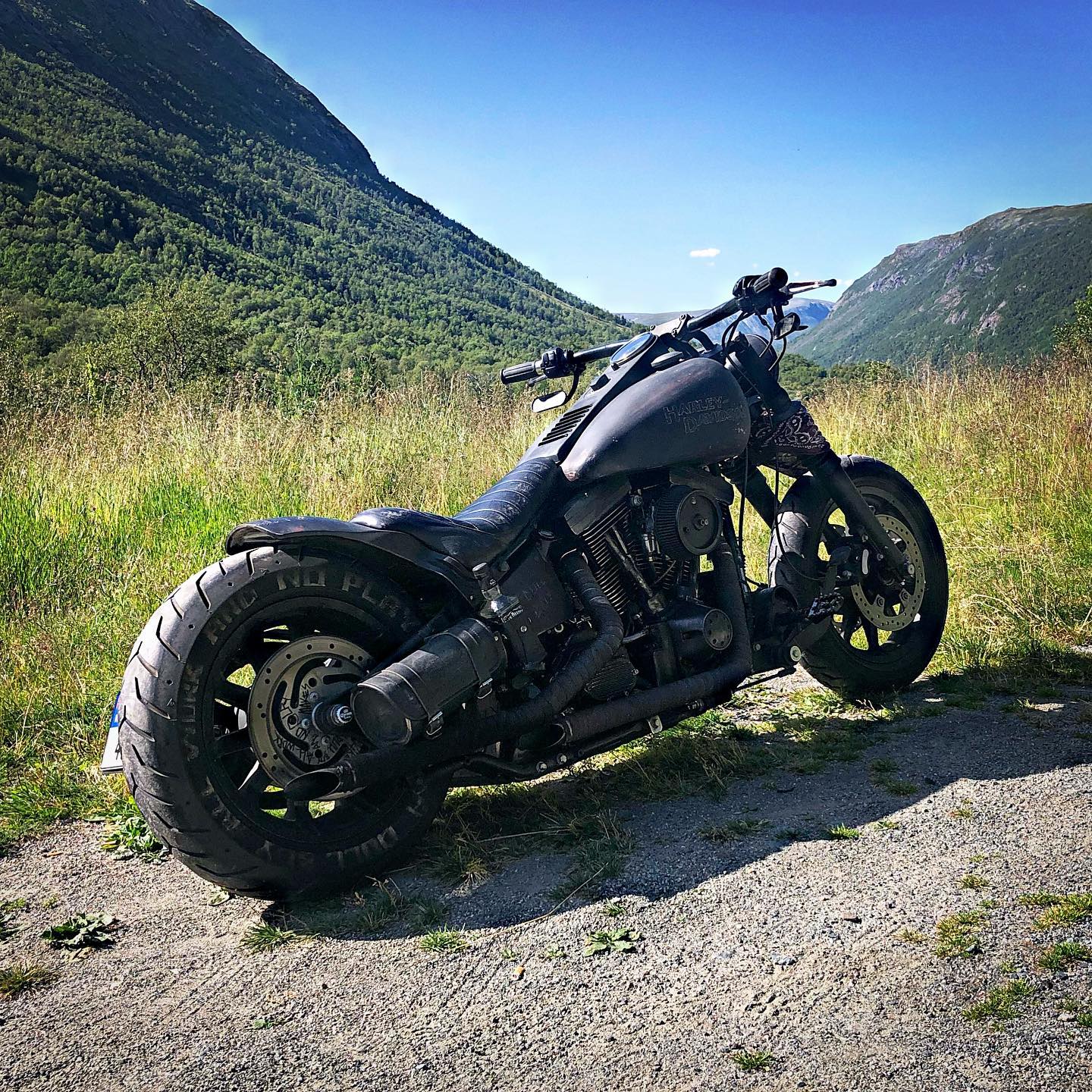
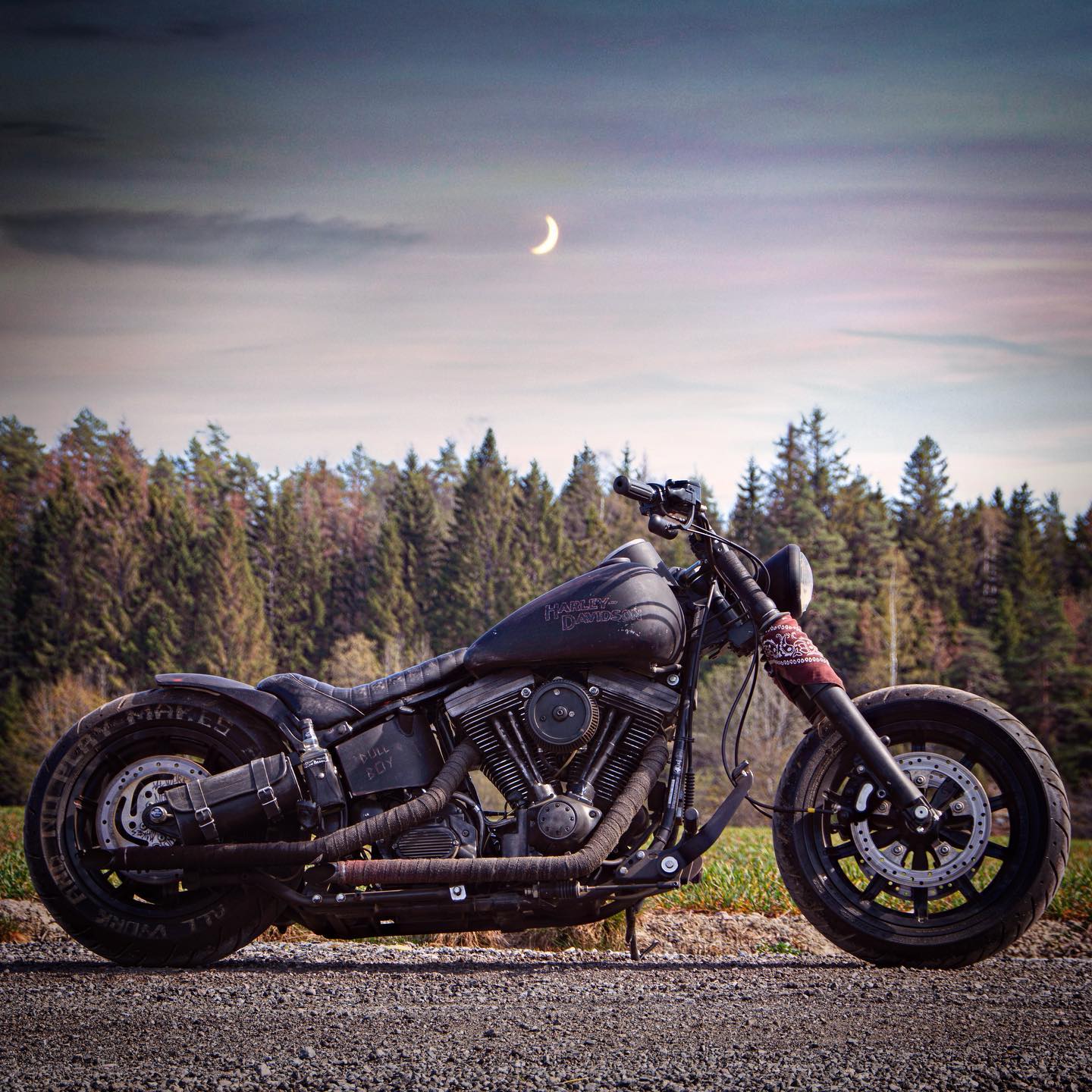
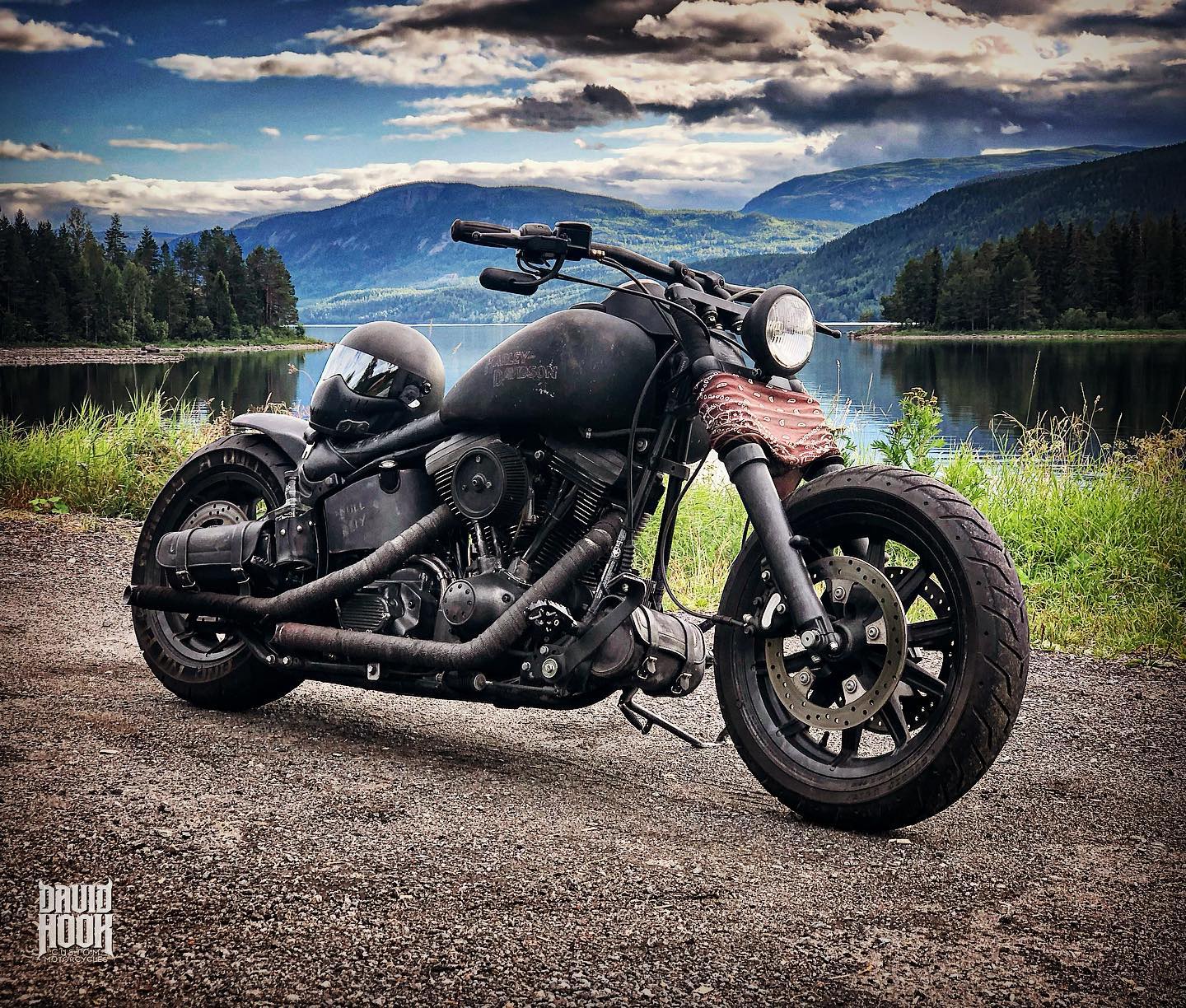
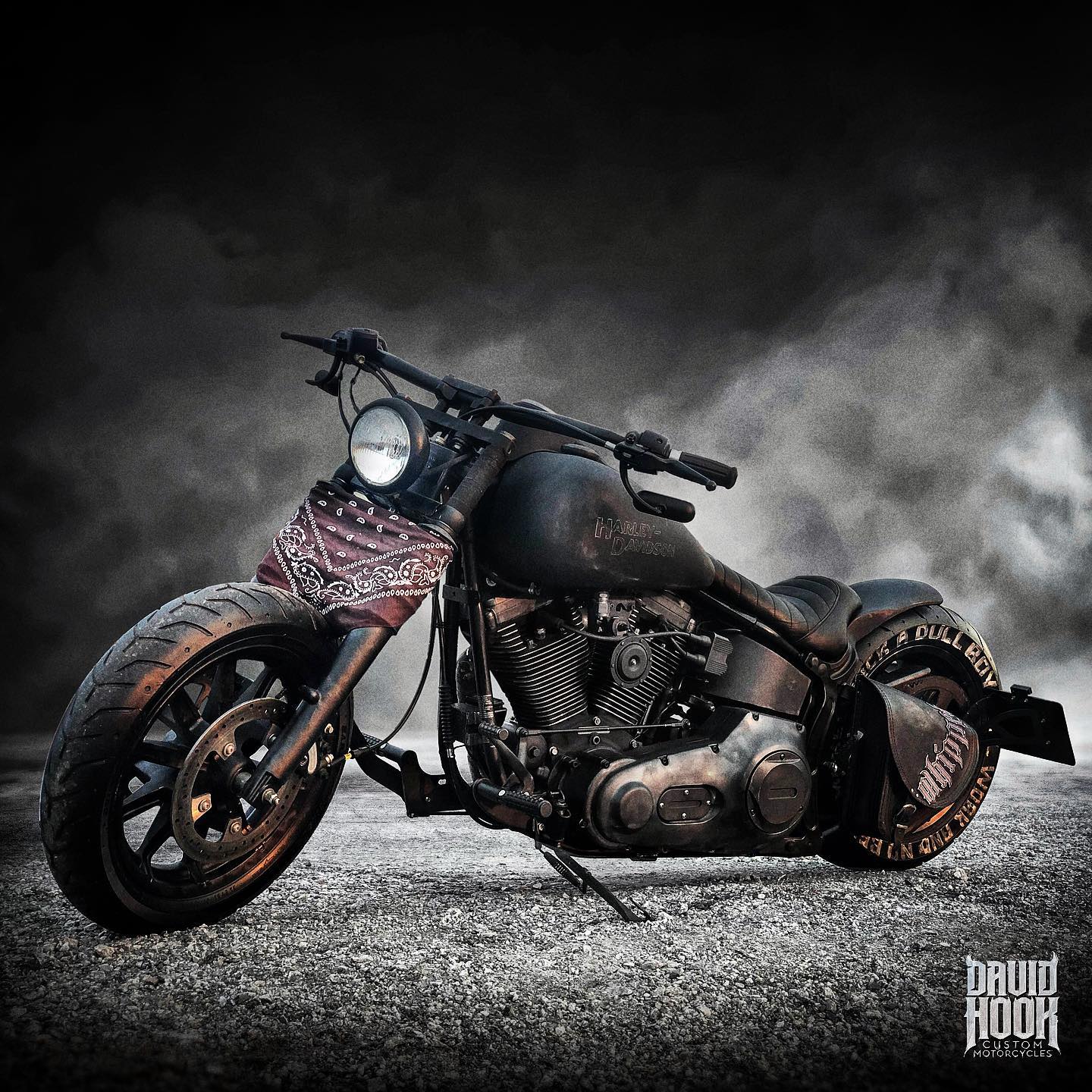
David is a softie for Harley softails and he decided to use this frame for his winter project. The combination with a late generation Evo 1340cc engine felt like the right choice for him. Upon making his mind up he locked himself up in his shed only to reappear in Spring with this ‘Dull Boy’! (see video)
‘Dull Boy’?
The nickname got us wondering where he got the inspiration from. Looking at the way the bike came out, we would have expected stuff like ‘mean machine’ or ‘nasty nailer’.
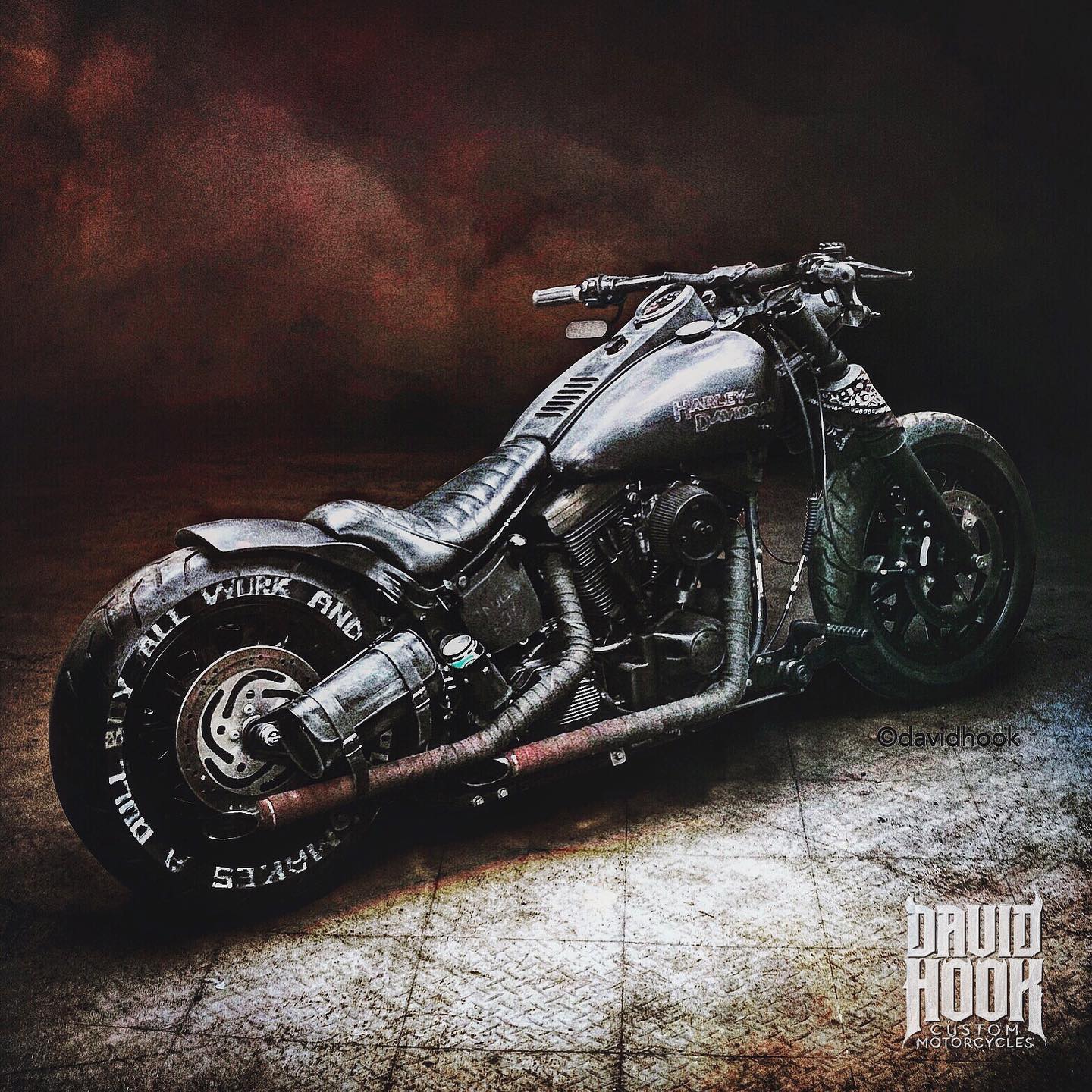
David explains: “At first I considered to make it look like a newer H-D Breakout, but then I saw a late night re-run of the 1980’s movie “The Shining” with Jack Nicholson and it has one of my favourite movie scenes of all time where the proverb “All work and no play makes Jack a dull boy” is central.”
“I decided there and then to build the bike based on that and it felt natural to make it look like it had been through a lot. I always plan my builds thoroughly in advance to the smallest of details so I had the everything pretty much worked out to before I started on the bike.”
Please elaborate
Whilst on the subject of sources of inspiration, Bikebrewers team decide to pry a little bit deeper. On our query where his vision for this build originated the Viking builder retorted:
“Being the bike nerd I am, I spend a lot of time looking at bikes on Instagram, Pinterest, etc., picking up ideas here and there. Last year I came upon the work of Joe Morris (Jmoto Speedshop and Gallery) and something clicked.
His work really opened my eyes to drawing and painting on bikes, instead of just painting everything black as I had done on my previous builds. As a kid, I used to spend a lot of time drawing and worked as an illustrator for quite some time, but lost interest in this art along the way.
Thinking of bikes as a “canvas” provided me with at creative outlet that I didn’t know I had missed.”
“Gentlemen, roll up your sleeves and light those torches”
With the creative part in place, it was time to get dirty and dive into the technical stuff. According to David he did not meet too many serious challenges working this project. The only minor obstacle was fitting the Road King rear wheel into the frame. It took him a lot of lathing and grinding to get the job done, but other than that things went fairly easy.
Meeting hurdles during a build often requires outside insights before being able to take the next step. “So David, when was the moment you needed an extra hand? “ we asked him.
“My brother, who has a lathe, helped me turn down the rear pulley to fit the 20mm belt and I left the seat to an upholsterer to cover it in leather. I’ve started to learn to do this kind of work myself now though. I like to be able to do everything on my builds, and I really enjoy working with leather.”
Final words • What do you like the most? o “The spare fuel bottle” • Anything particular we need to know about this project? o “It has “All work and no play makes make Jack a dull boy” written in places you would never think of…” • Last but not least, how does it ride? o “Like a dream”
Details of the build
• Estimated budget: € 13-14K • 1998 Harley Davidson FXSTC, nicknamed “Dull Boy” • Stock Evo 1340 with S&S Super E carb, Andrews EV-27 cam, adjustable pushrods and Crane Cams single fire ignition • Cycle Shack drag pipes • Lowered 1.5-2″ front and rear. Progressive shocks and springs • Wheels are from 2009+ Road King. 17×3 with 130×80 in the front and 16×5 with 200×60 in the rear. • Pulley is modified to fit a 20mm belt. • Lower fork legs and brake calipers are also from 2009+ Touring models • Handlebar is a 40″ Highway Hawk Fat Flyer bar. • Headlight a 6.5″ housing modified to house the stock H-D 5.75” headlight. • Mirrors are Arlen Ness mini ovals. • Extended forward controls • Braided brake lines from HEL Performance • Kellermann Atto DF tail/indicator lights • Front indicators are small LED’s from Dock66.de • Custom made seat • Custom made rear fender • Left swingarm bag is from bikebeauty (I’ve added the wear and the lettering). • The right one is from bikersgearaustralia
Builder’s details: • Name: David Höök • Location: Oslo, Norway • Day job: Head of design at a distillery. • E-mail: david@dullboycustoms.com • Website: www.dullboycustoms.com • Facebook: dullboycustoms • Instagram: davidhook
To which I replied:
IMO, rat bikes are organic creatures that evolve over time. They slowly accumulate a patina of baked-on oil, mud and rust. They rack up dings and tweaks and cracks, and develop quirks that render the bike virtually unrideable to anyone but its owner. Maybe a part replaced on the fly doesn’t match the rest of the bike. Maybe something off a Honda or Hodaka was jiggered to fit your Harley, or vice-versa. Maybe it’s a Sportster tank on a Knucklehead, an Evo engine stuffed in a Panhead frame, or the forks off a ’66 cop bike bolted to an AMF-era Shovelhead. Maybe a good road dog gifts you a sticker, a bandana or some other memento, so you slap it on there, somewhere, and it gives you an excuse to tell everyone who asks about the great partner who gave it to you….
….and so it goes. The end product (if a rat bike can ever truly be an ‘end product’) is a machine of unquestionable authenticity and experience, skillfully crafted by mileage and time.
Buildinga ‘rat bike’ is, conversely, the ultimate in poseur pretense and inauthenticity: far worse than throwing mud on the bike you trailered to Sturgis to make it look like you rode the entire way, or taking sandpaper to a new pair of boots to make them look scuffed and well-worn. People who don’t know any better might think your fresh-from-the-workshop ‘rat bike’ is all kinds of nifty, but you will always know in your heart of hearts that it’s just a facsimile, a knockoff, a cheap shortcut to the real deal.
None of this is intended to take away from David Höök’s abilities as a builder of motorcycles. He can obviously be thorough, thoughtful and attentive to detail. Were he to turn his talents to building a proper chopper, or a new twist on the café or bobber or street pro, or even a straight-up custom Softail a la the Fat Boy, I feel certain Mr. Höök could create something more worthy of his talents. If this ‘Dull Boy’ is actually, honestly, the very best he can do, then I fear Mr. Höök truly is a dull boy, and no amount of beer will fix that.
I was eager to see if Mr. Betist might share my critique with his readers. 🤷♀️ Instead, he deleted the entire article! 🤣🤣🤣
Why I Ride a Slow, Uncomfortable, Unreliable, Noisy Motorcycle
Why I ride a Harley-Davidson with 17-inch ape hanger handlebars, a massive sissy bar that has the technical sophistication of a very large lawn mower?
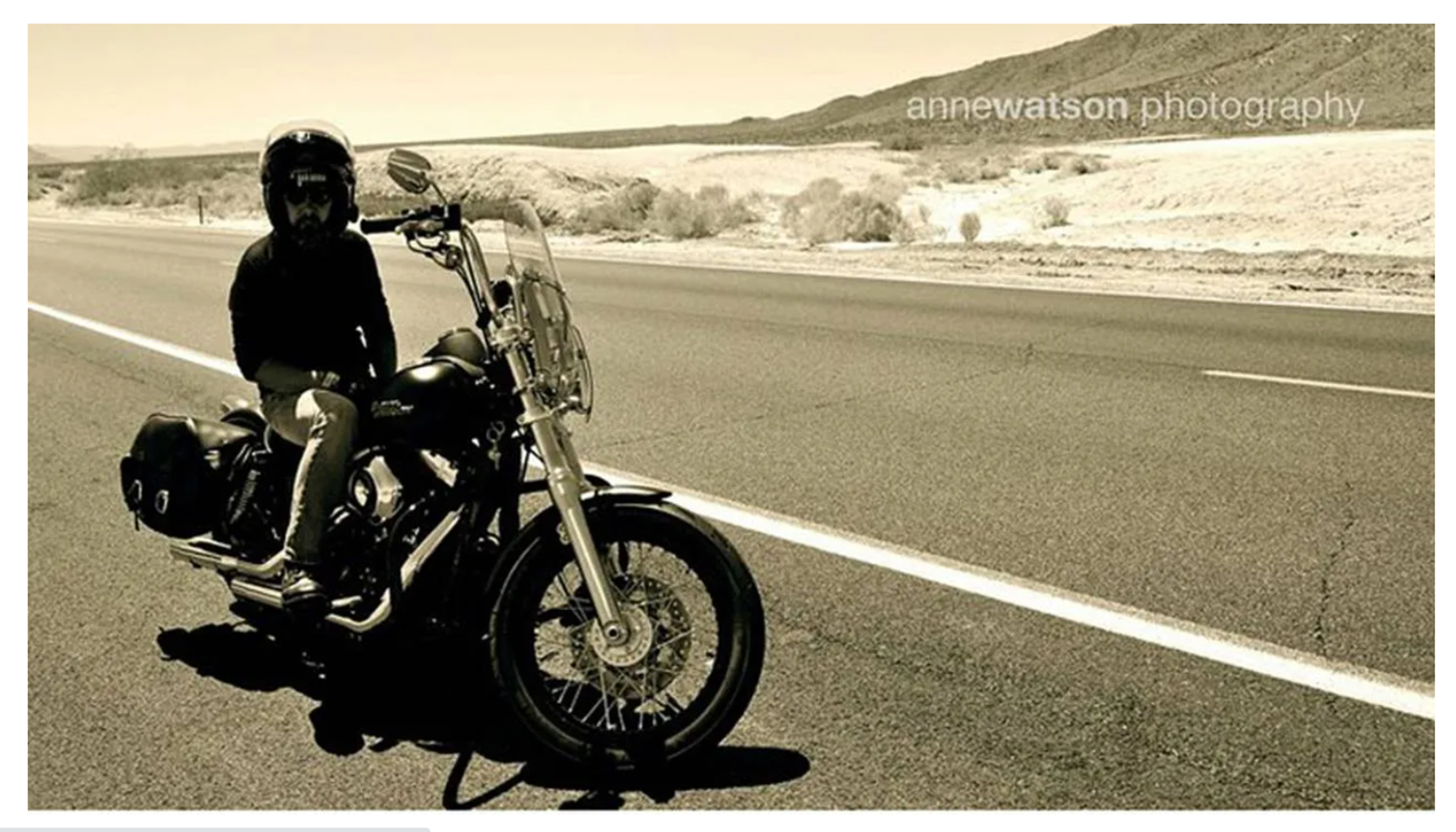
Photo by Anne Watson, annewatson photography
May 28, 2013 at 1:29pm ET by: Tim Watson
If you ever saw my motorcycle you’d think I was a complete idiot. You would ask yourself why on earth would someone ride something with 17-inch ape hanger handlebars, a massive sissy bar that looks like a throwback from an early 1970s biker film bolted to a motorcycle that has the technical sophistication of a very large lawn mower?
It’s also noisy. Very noisy. Under hard acceleration it sounds like a moose bellowing as if someone had just slammed its testicles in a car door.
I honestly didn’t want it to be like that. But when my bike left the Harley-Davidson factory its stock engine set-up meant it ran so lean that the heat from the air-cooled motor made it almost impossible to ride here in California when temperatures climb into the 80s.
So I changed out the stock pipes. But then I was told I needed a new air filter and a re-map of the engine. All of that didn’t make my motorcycle much faster but it did suddenly come alive. And it sort of cooled down.
Its exhaust can be truly obnoxious which is why I ride with a light hand on the throttle in built-up areas. When there’s nobody about and just me and an open road I revert to the moose bellowing. But after a while it can make even my head hurt and then I wonder about my sanity and why I ride this damned bike.
I have read and re-read the countless things I could do to make its V-twin 96-ci engine faster and perform better. But I’m not convinced. I look at my bike and I am not sure that it is either.
At idle it shakes like a carnival ride and if I look down for too long the vibrations make my vision go blurry and then my hands go numb.
I hate the fact every single bolt and fastening has to be glued in place to stop them falling out. Before each ride I always have to check it over so it doesn’t leave me standing at an intersection with nothing more than the handlebars, a seat and a pile of parts.
The ape hanger bars were an after thought. I’d seen some of the Mexican low rider motorcycles in my neighborhood with mean looking dudes using them on their bikes.
I’ll admit they look preposterous (not the Mexican dudes) and I have lost count of the number of people who ask me precisely why I have them. I can’t give them a satisfactory answer. I just like ape hangers.
I did have an idea once of how I wanted my bike to look. I thought a sort of 1950s bobber style with some classic retro parts. But it’s become a bit of a mish-mash and not quite how I envisaged it would turn out.
Photo by Tim Watson
I paid good money for a special order 32-inch sissy bar for the back of my bike. Some people have said looks like I am riding a remote control motorcycle or others have asked if I ever receive radio wave interference through it. It serves absolutely no purpose, rattles like hell all the time and makes getting on or off the bike a contortionist’s act. But I like the way it looks.
In a moment of madness I once took the front fender off. But this resulted in the bike and my face being sand blasted from road grit. Even an artfully tied bandana between the forks when it rained meant all that happened was a jet of water was thrown off the tire and straight up my nose. In a matter of hours the fender went back on.
I also kept the stock solo seat too. But if I were honest it would be more comfortable sitting on a piece of cardboard. There’s no back support and I feel I can ride over cigarette butts and tell you if they’re filtered or unfiltered. But I like the feedback from the road that it gives me even if on long rides it kills my back.
There’s an ugly gash on my bike’s left peg where I thought I could easily squeeze between a parked car and a wall to ride down a back alley. And there’s a dent the size of a dime on the front of the gas tank, caused by a rock flung out of a truck tire on the freeway. I’ve left it as a reminder of what that would have done to my face if the rock had hit me.
The factory fit rear brake light, which some say looks like a limp chrome dick, works intermittently. The rudimentary fuel gauge that may well have come off a 1960’s child’s pedal car some times pops out of the tank when I least expect it.
And I constantly have to check the primary plug for leaks as I over torqued it once during an oil change and stripped the thread. The chopper-style headlight I bought for it and which replaced the perfectly serviceable original light, is about as useful as a candle in the wind. But in daylight and probably only to my eyes it looks good.
Of course there are far better bikes out there I could have bought. There are many that are faster and nicer looking that probably have more engineering sophistication in their front brake lever than my entire motorcycle.
But herein lies the problem. For everything that irritates me about my bike it always without fail makes me smile every single time I get on it.
I have ridden it through empty deserts, up mountains and across, around and through nine states covering more than 8,000 miles in the process. I have nearly been taken out by an 18-wheeler on a downhill mountain pass and I once ran over a rattlesnake with it in the Mojave Desert.
My bike has taken me though some astonishing U.S. backwater towns in 100 plus degree heat and then a few hours later up into the mountains and over snow covered roads.
And, just like legendary Western lawman Wyatt Earp, I too once rode into Tombstone, Arizona, on it.
It’s my motorcycle. It drives me nuts at times but it’s been through a lot with me and has now become a part of my life. And for that reason alone I will never, ever sell it.
And my response? Well, it’s like this….
Why I Ride a Slow, Uncomfortable, Unreliable, Noisy Motorcycle
I too ride a motorcycle that is slower than the latest whiz-bang showroom models, but then, its powerplant is a forty-eight-year-old shovelhead which was tractor-engineered at birth and is still virtually box stock. It is smaller than the smallest late-model engine, still fitted with its factory carburetor and cam, rudimentary exhaust and (gasp!) a points-and condenser ignition system! That’s downright barbaric, isn’t it? and especially when you realize that my motorcycle has never had an electric starter. That’s right; kick-start only, kids, just the way Grandpa did!
My shovelhead does have solid lifters – more for reliability and convenience than performance – and a belt-drive primary. However, the belt is for convenience, as well, and whatever low-end performance boost it might have provided has been offset by the 25-tooth countershaft sprocket I installed to regain my highway top-end. My bike is built to go places, but I don’t have to break any land speed records making the trip.
And when I say ‘built to go places’ I mean that in every sense.
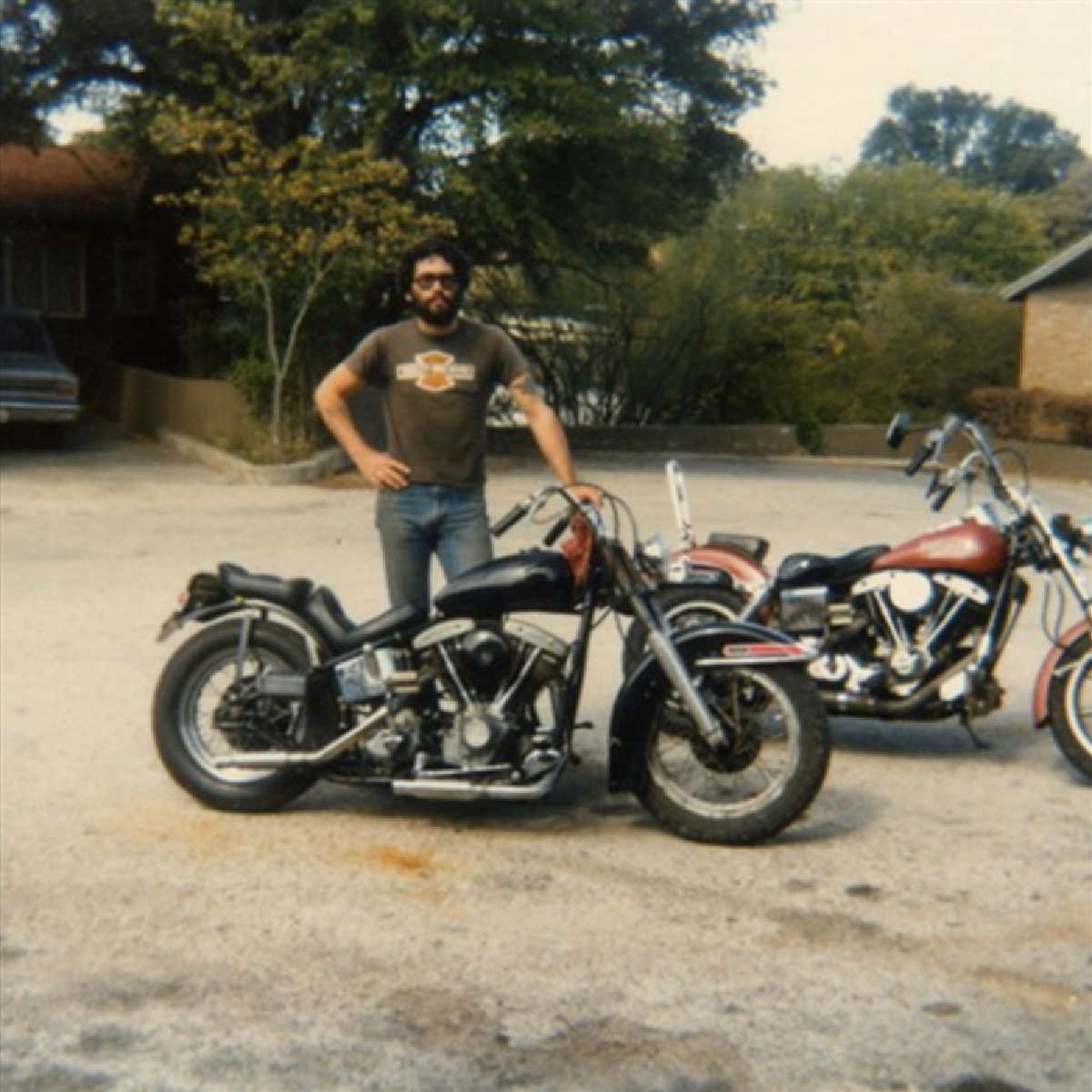
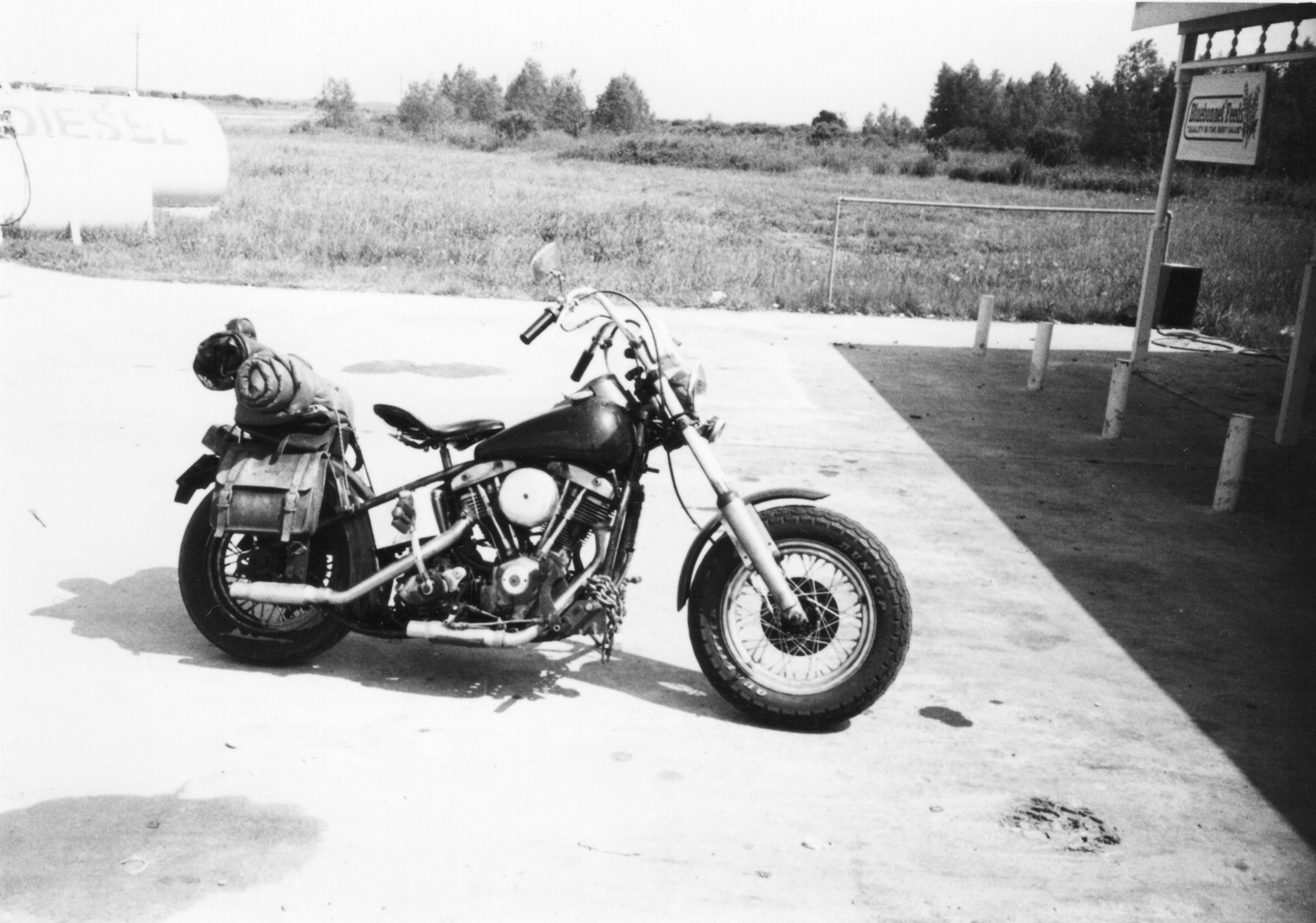
My motorcycle is not uncomfortable. It began its life as a 1974 FX 1200 Superglide, with the heavy OEM swingarm frame and lightweight narrow-glide forks. I played with different saddles and handlebars, added highway pegs and a set of wide-glide forks off a 1966 Police Special, but my motorcycle never became truly comfortable on long rides until I switched from the stock swingarm frame to an OEM 1954 rigid wishbone.
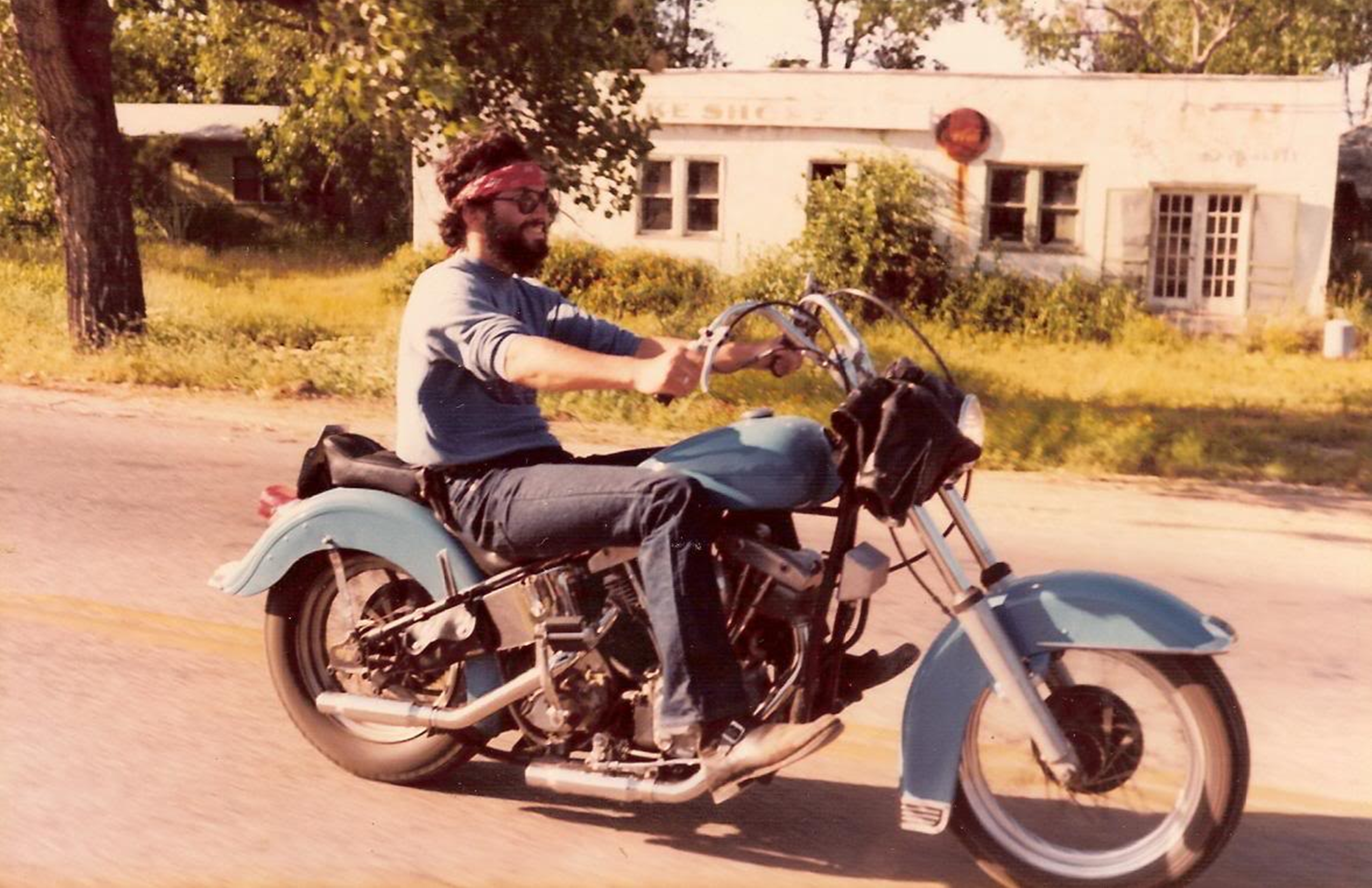
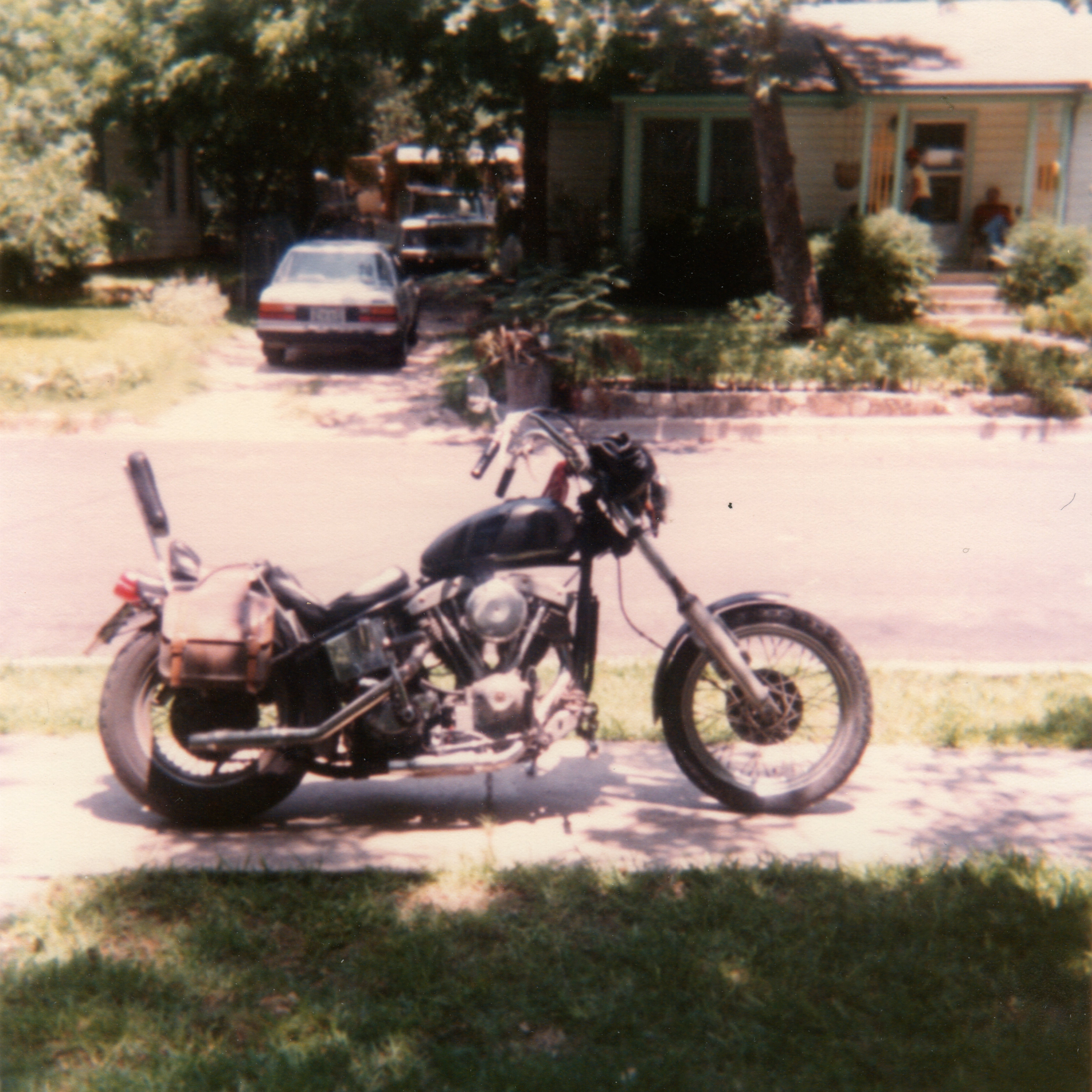
Me and The Bitch (and Rob Darnstaedt’s Low Rider) at the Terrace Apartments off South Congress Avenue in South Austin, circa 1979 or early 1980.
I can hear the Greek chorus now, shouting ‘Impossible! Absurd!’ but it’s true, nonetheless. With the rigid frame and a frame-mounted LaPera butt-bucket saddle, I have ridden all over the Central Plains and Rocky Mountain States, from Texas to South Dakota, from Louisiana to Arizona – numerous 500- and 600-mile days, at least one 1000-mile day, a lot of back roads and goat paths and well over a half-million miles all told – and never once regretted converting to a rigid frame.
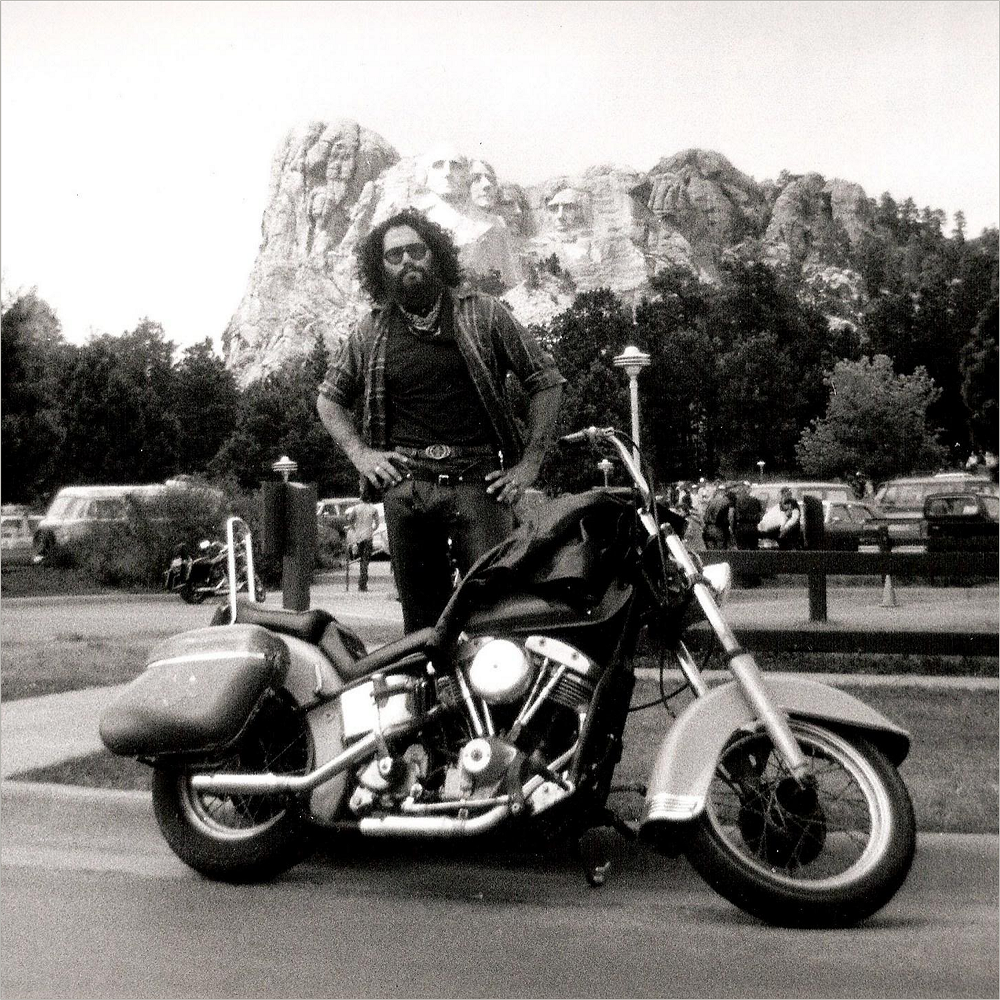
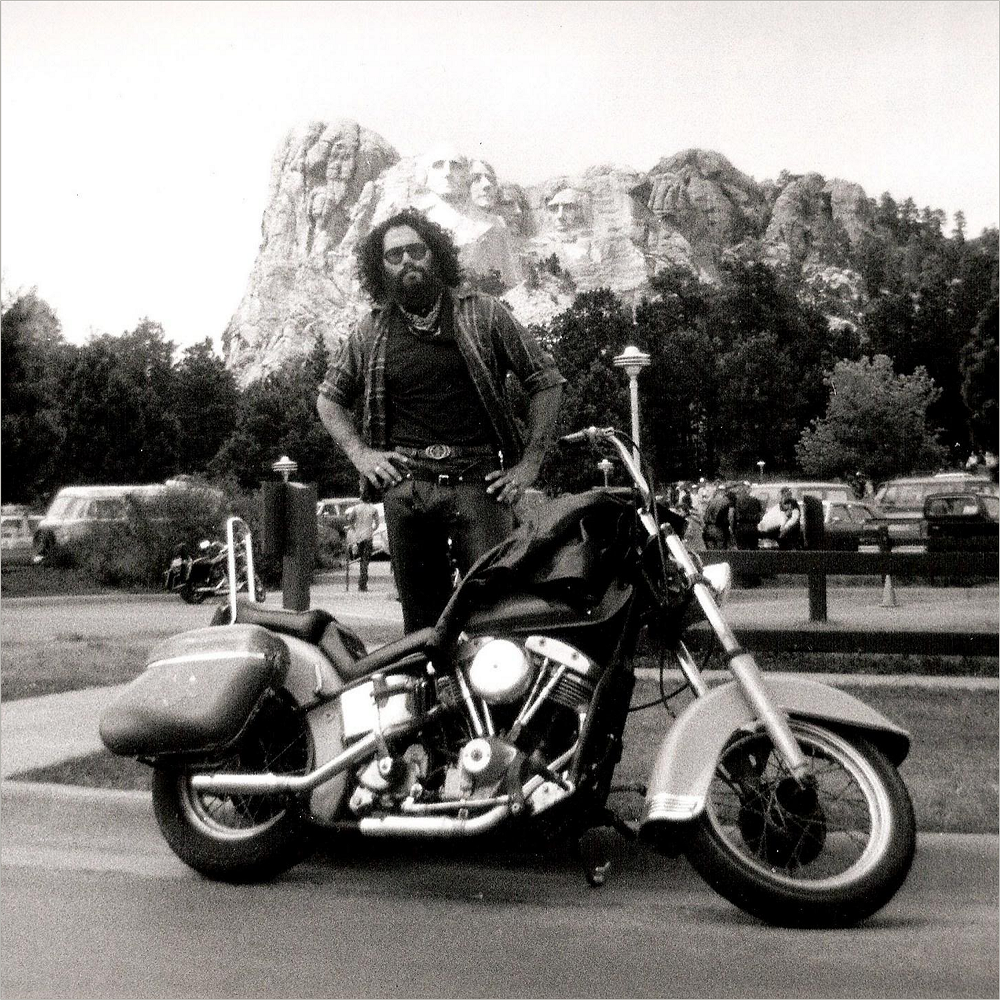
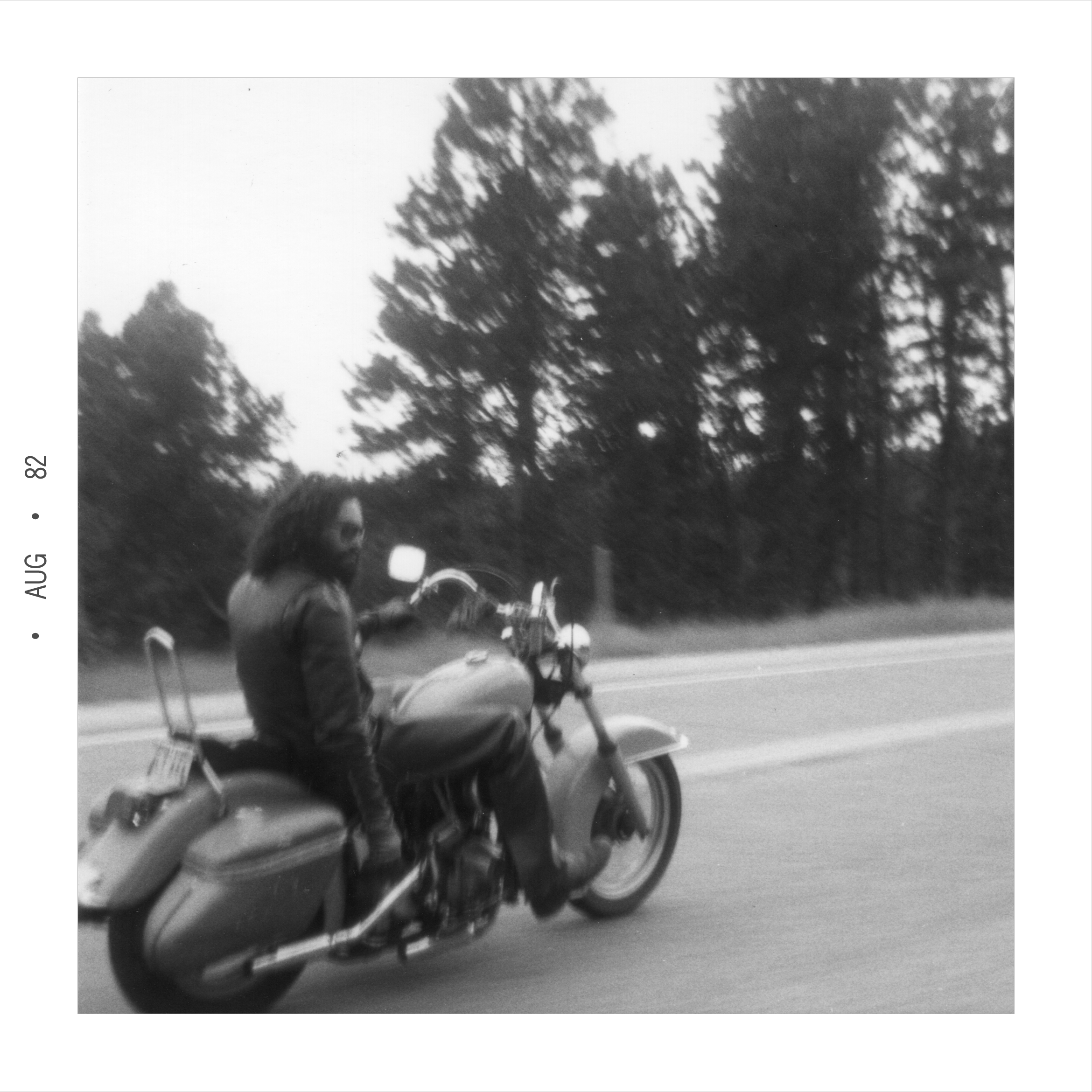
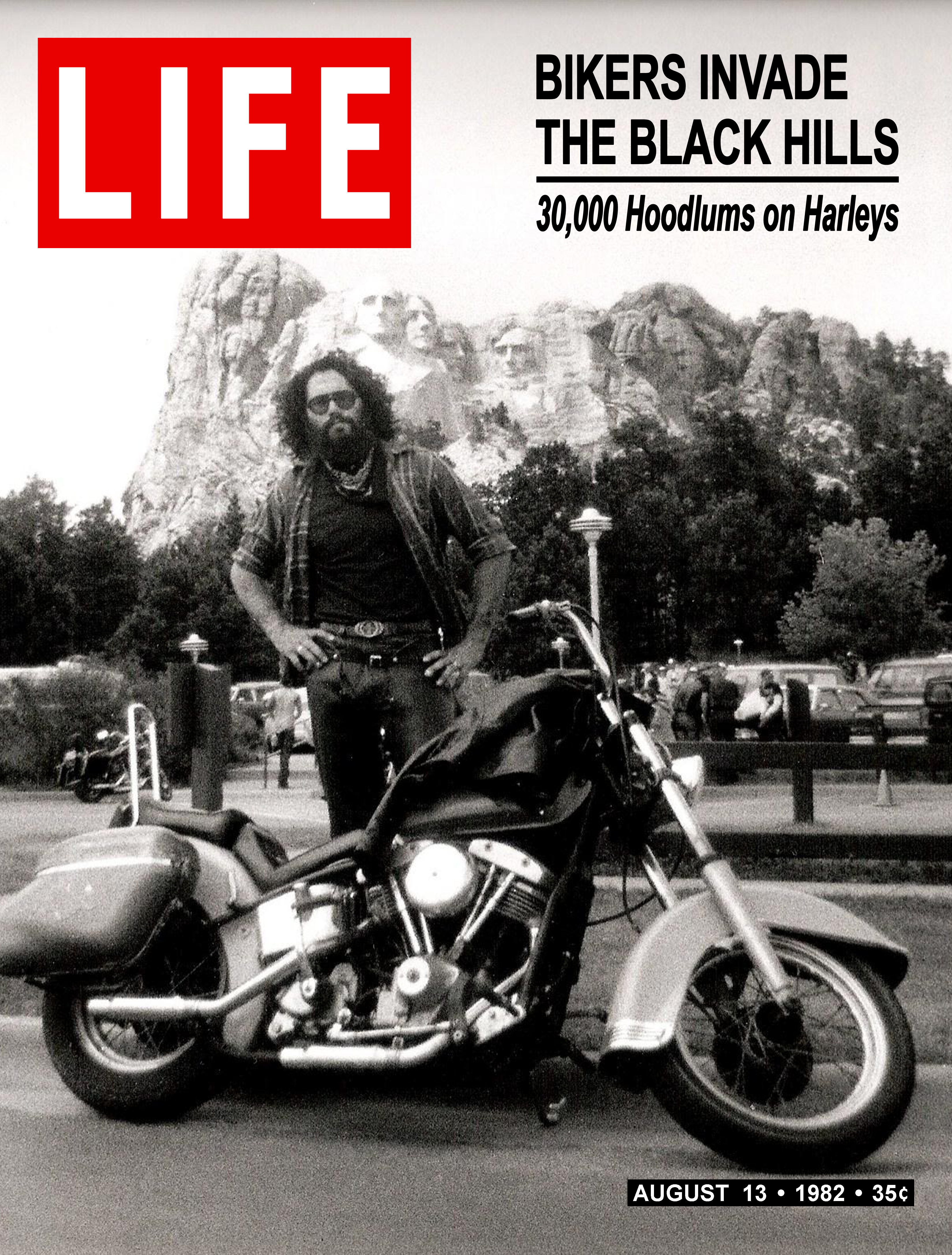
Me and The Bitch at Sturgis, 1982.
And if you’re interested, my comfort depended on the way I set the bike up at the start, the way I pack for road trips and the way I learned to ride a rigid-framed motorcycle. It’s different than a swingarm
My motorcycle is not unreliable, either. Despite its origin as a ‘bowling ball bike’ manufactured during the worst of the AMF years at the Motor Company, when factory workers were allegedly sabotaging bikes in order to get back at miscreant management, my shovelhead was never an unreliable machine. In addition, I’ve had my fingers in every subassembly on my motorcycle, from handlebar wiring to wheel hubs, and did my damnedest to rebuild them right. That means plenty of Nylock, Loctite, lock-washers and safety wire, and the systematic removal of anything the bike does not need to function the way I need it to. No chrome covers or extra gewgaws; no colored lights or (shudder) a stereo; not even turn signals.
As a result of stripping my bike down and securing every part on it the best I possibly can, parts rarely vibrate loose. As a result of simplifying every system on the motorcycle the best I possibly can – seven wires for the entire wiring harness, for instance, rather than the seemingly endless coils of brightly-colored 16-gauge snaking hither and yon – I can usually troubleshoot problems with little fuss. As a result of knowing my motorcycle’s innermost workings, I am able to repair all but the most serious breakdowns parked under the nearest shade tree.
Finally, as a result of my efforts, I can count on one hand the number of times in the past 43 years my shovelhead has been forced to ride home in the back of a truck, with fingers left over.
And my motorcycle is not particularly loud, either. Louder than a Prius, yes, but so is a hummingbird fart, and my shovelhead is far quieter than a good many late-model Harleys. It is also a damned sight less irritating to adult ears than the wind-tunnel shriek of many metric sportbikes, whose riders are, ironically, so quick to whine about Harley riders giving them a bad name. Let’s not forget that’s a two-way street, kids.
And you will never find me parked outside some chic café with a lovely open-air patio, rapping on my open exhaust pipes as hapless diners cover their ears, or racing into my neighborhood in the wee hours, setting off car alarms and rattling window glass as I screech to a halt in my driveway. I have this funny thing about treating people as I’d want to be treated, see, and I wouldn’t want some overgrown man-child on his midlife-crisis-mobile destroying my peace and quiet.
See how easy that is?
But what is so compelling about a motorcycle with few creature comforts and only the bare minimum of safety equipment? Why would I choose it over a newer, faster, sleeker model with all the latest whistles and bells, and stick with it for almost four and a half decades?
Well, for me it’s like this:
Recent years have proven that anyone with a large enough credit limit can own a Harley-Davidson, a Victory or ersatz Indian, a Triumph, Moto Guzzi or Ducati, or any of the Pacific Rim brands. A swipe of the gold card, a push of a button, the snick of a gearshift and voila! Instant motorcyclist!
Bill kickin’ The Bitch circa 2002.
But how many of those men and women can climb aboard a motorcycle with a forty-eight-year-old engine cradled in a sixty-eight-year-old frame and pushing fifty-six-year-old front forks, and do the things I’ve done with it? How many can ride that motorcycle from Denver to Austin in a day after a week of 500-mile days, kickstart that engine on an icy-cold morning in the South Dakota Badlands or a hurricane-drenched night in Houston, or navigate the Black Canyon of the Gunnison with nothing but mechanical brakes and a four-speed transmission between them and the canyon rim? How many can tear down the better part of their bike at the roadside and put it back together again, and actually make it run? How many would even be willing to try?
I know I’m not the only greybeard out here on a rigid-framed dinosaur of a motorcycle. There are plenty of panheads and knuckleheads in daily use here and around the world, ridden by bikers who do every one of the things I’ve mentioned here. However, a lot more peoplecan’t do those things than can, and I really enjoy being part of that smaller circle.
Bill and The Bitch, still together all these years!
On a Q&A forum I found the following question: What is the point of riding on a motorcycle other than looking “cool.” Are there any physical advantages as compared to a car? I know the old adage says ‘the only stupid question is the one you didn’t ask,’ but the question that poster posed is dangerously close to a stupid question. I borrowed one reader’s answer as a starting point for my own rant.
The ‘point’ of riding a motorcycle is to ride the motorcycle. It is difficult to explain to someone who has never experienced it. People bandy about words like ‘freedom’ and ‘exhilaration’ but they are weak sauce compared to the reality. The reality is so, so much more.
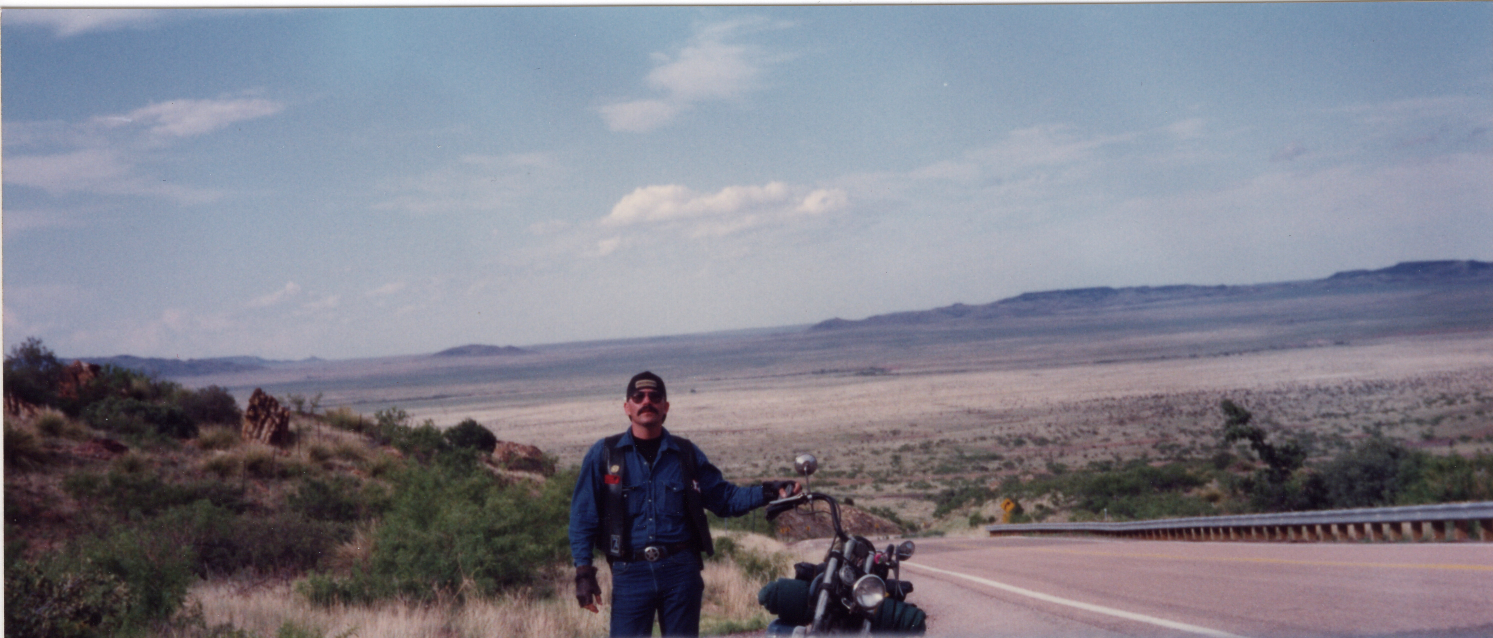
Me and my ’74 shovel (aka ‘The Bitch’) in West Texas enroute to Alpine. Man, I justlove West Texas!
Again: the ‘point’ of riding a motorcycle is to ride the motorcycle.
It is difficult to explain to someone who has never experienced it. People bandy about words like ‘freedom’ and ‘exhilaration’ but they are weak sauce compared to the reality. The reality is so, so much more.
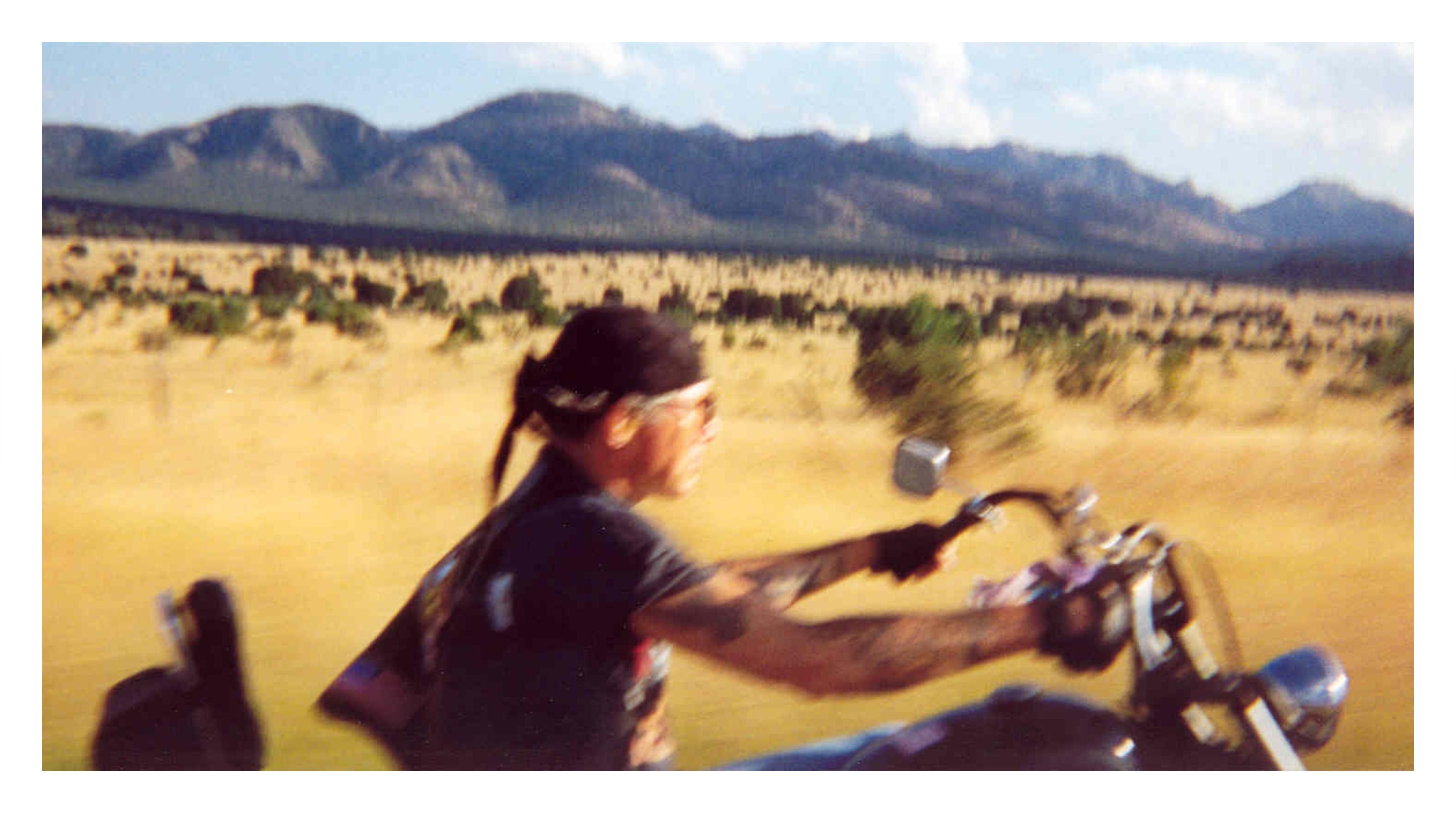
Me and The Bitch riding through the Black Canyon of the Gunnison, in the Colorado Rockies.
Seriously, how do you describe the challenge of leaning into a hard curve on a twisty mountain road in the Colorado Rockies, just a hair’s breadth from the high side that’s gonna hurt like hell if you don’t maintain your line? What words can match balling through the New Mexican desert alone on a star-studded night, with ghost shadows marching across the sands as the chill night air seeps through the seams in your leather jacket? Can language even begin to capture the feeling of blasting through the heart of Dallas on a Saturday evening, twenty or thirty of you in a pack, so there in that moment – so large and loud and alive – that the straights in their cars instinctively move aside to let you pass? How do you tell someone who’s never been there about rocking through a mountain pass on a chilly autumn morning, sun at your back and your best road dog at your side as you crest the Continental Divide and rumble down into the Black Canyon of the Gunnison? Can you make any sense at all of the delight you feel waking up in a rain-soaked tent in Rapid City, South Dakota, on your way to the annual rally at Sturgis, and laughing about it because Who fuckin’ cares? We’re at Sturgis, baby!
Into every life a little rain must fall…
And if that’s hard, try explaining how even the ‘bad stuff’ gets good, later. Things like riding through the wake of a hurricane in downtown Houston, water so high on the road that it’s burbling and bubbling at the ends of your exhaust pipes and dousing your ignition system. Things like spending a sleepless night camped on the banks of the Rio Grande, kept awake by the bitter cold and the new traveling companion who neglected to mention that he snores like a fuckin’ buzzsaw.
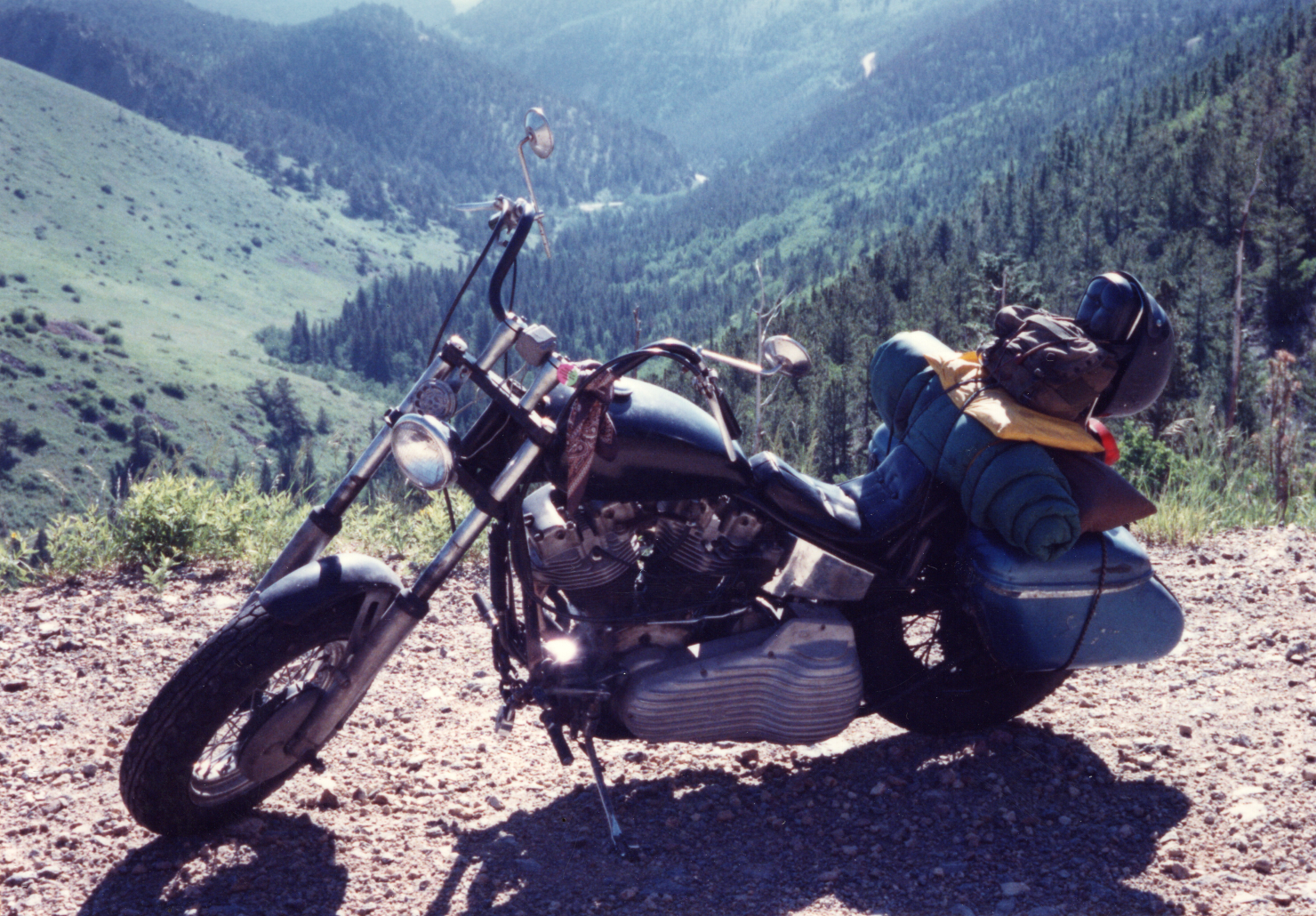
This is me riding through the Black Hills of South Dakota, doing a little sightseeing during the annual Black Hills Classic Motorcycle Rally, a gathering of the tribe that’s been going on since 1938.
Things like kneeling in the mud in a pouring rainstorm to help a stranger get his motorcycle started, because the biker’s code says you never leave another rider behind. Things like facing off with a shotgun-wielding deputy sheriff who is screaming at you and your buddies to get those goddam bikes out of there before he arrests the lot of you, because one of your buddies can’t get his bike started and the biker’s code says you never leave another rider behind. Things like your buddy suddenly remembering, after twenty minutes of trying to kickstart his shovelhead, that he installed a hidden kill switch as a security device just last week, and Oh, yeah! That’s why my bike won’t start….
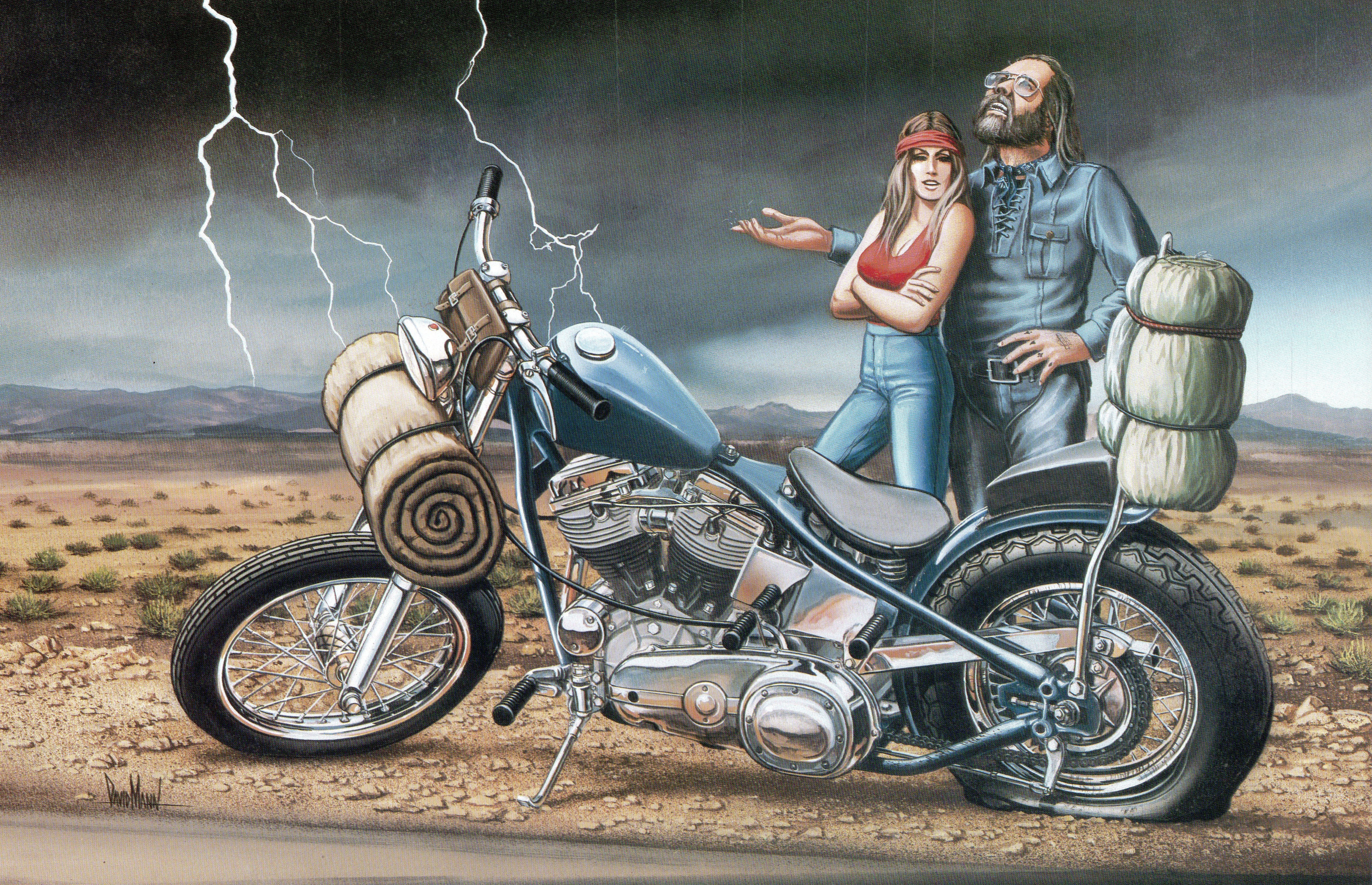
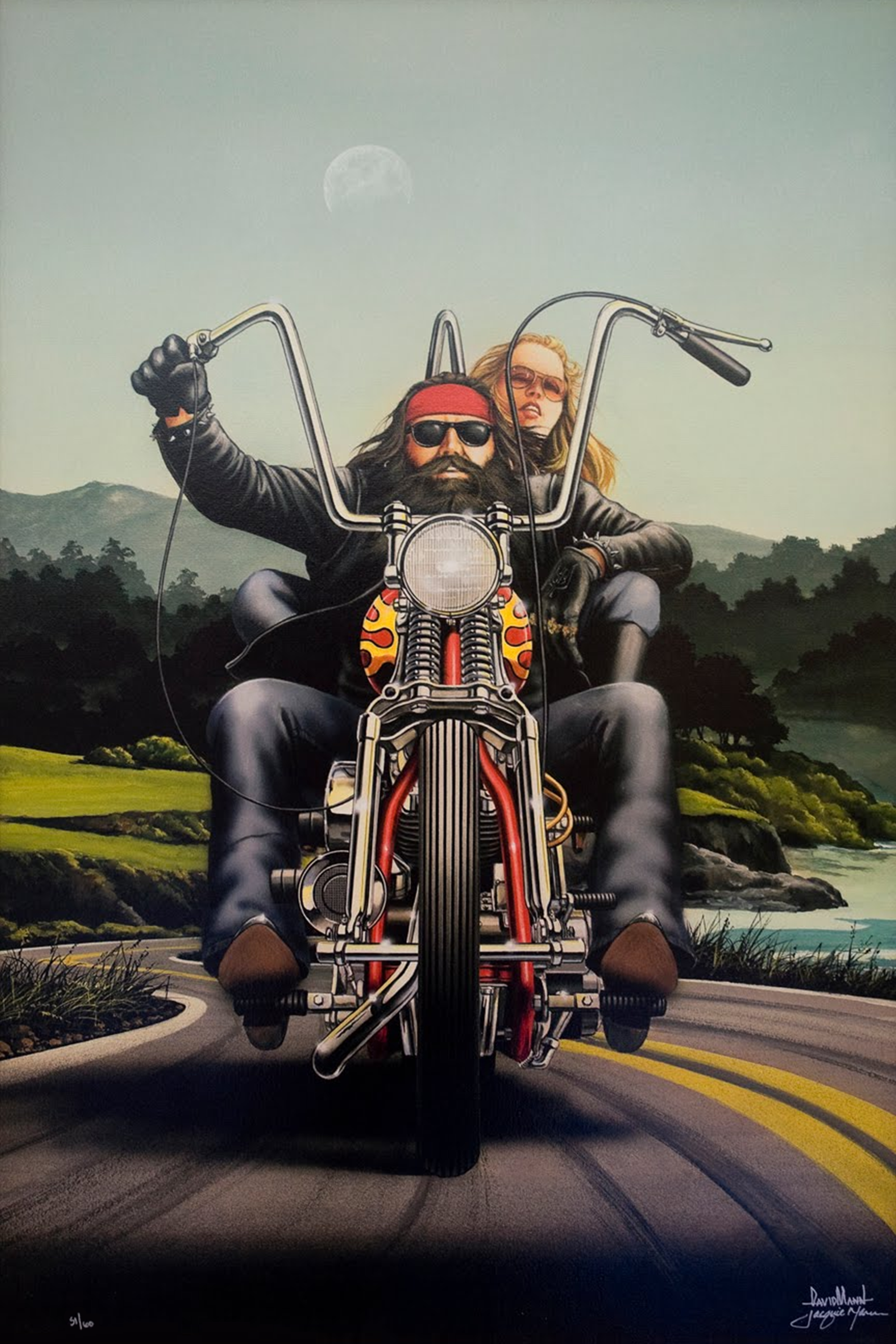
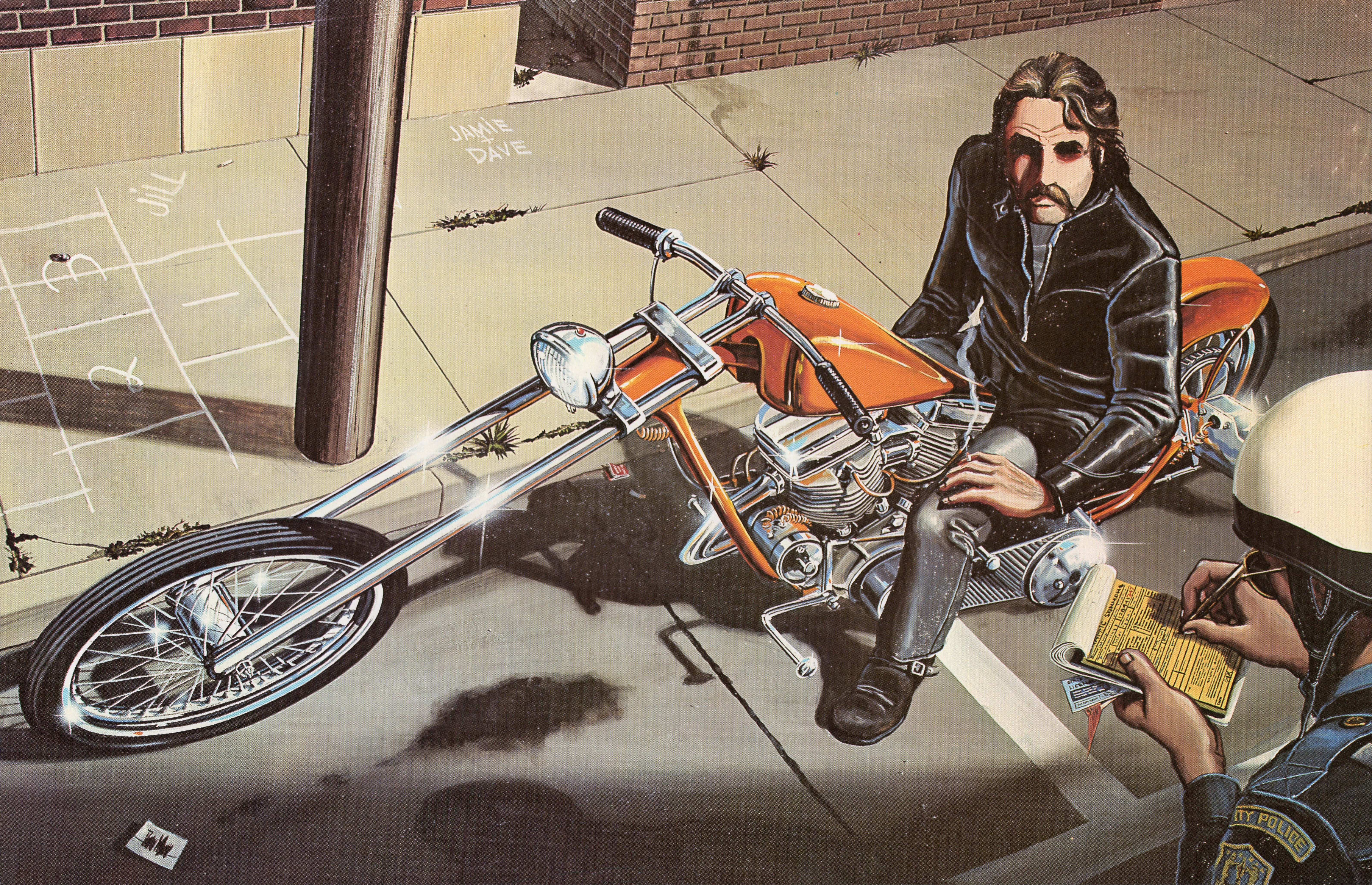
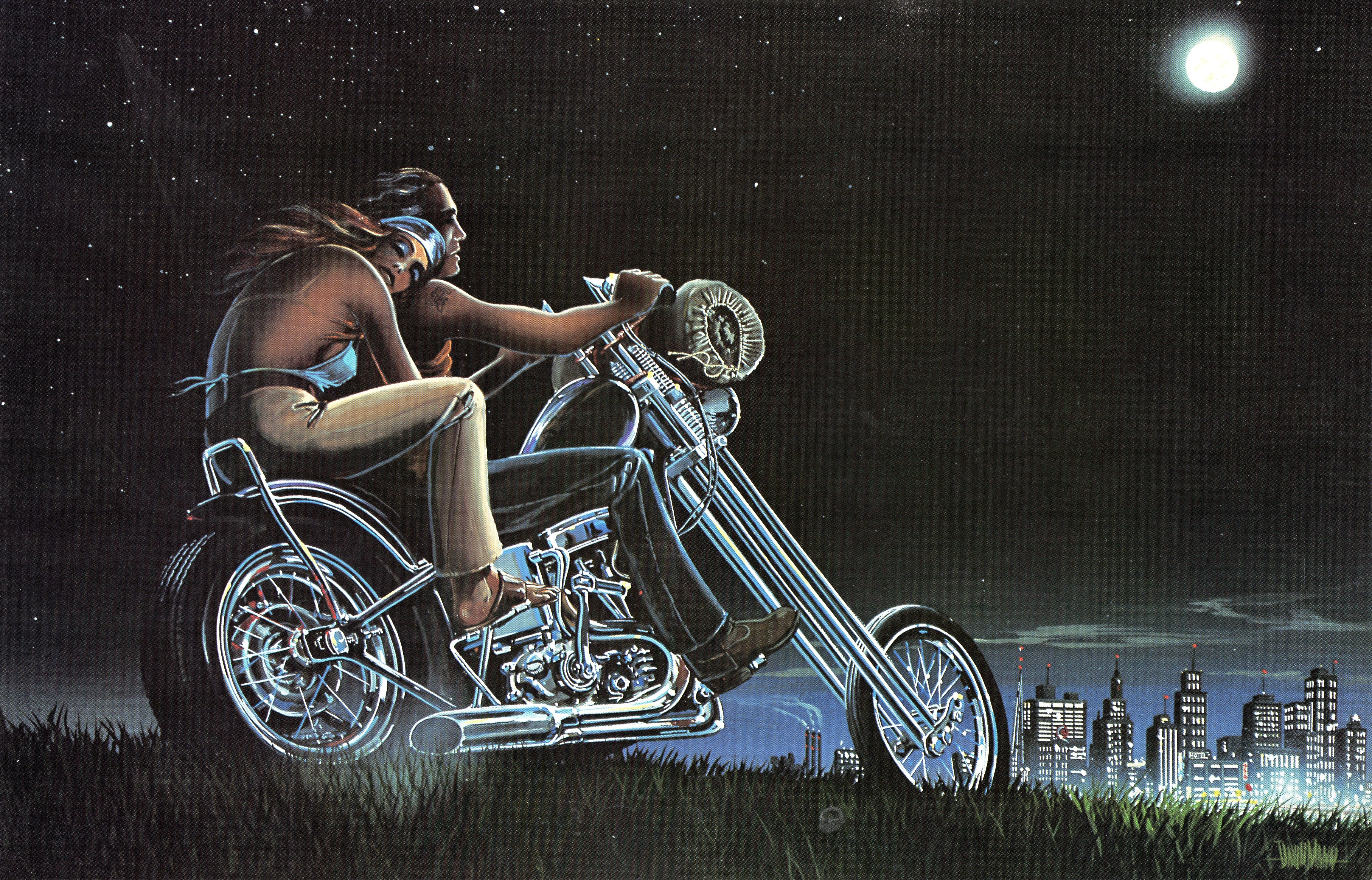
One of my favorite works by Dave Mann: a loving couple two-up on a nice Spring day. Dave Mann’s monthly centerfold paintings for Easyriders captured every aspect, from the quiet pleasure of a run up the Pacific Coast Highway….….to the drag of getting beefed by some biker-hating cop. and everything in between.
….because every biker knows the best stories are the ones that really sucked in the moment.
Are there physical advantages? Well, let’s see…
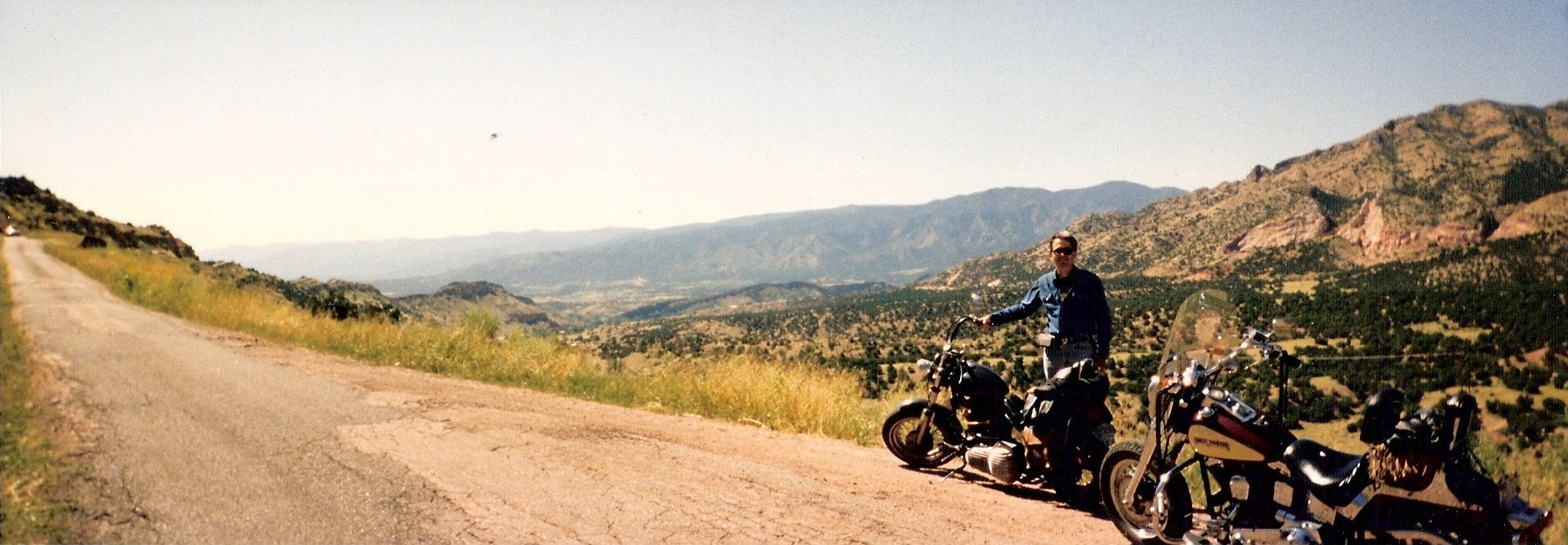
Me and The Bitch and the Marlboro Man’s Softail on Skyline Drive, above Cañon City, CO.
There’s the fact that you’re out in nature, breathing fresh air, instead of being cooped up in a cage with the air conditioner on, guzzling fossil fuel and contributing to global warming. And let’s remember that motorcycling is not a sedentary activity the way driving a car is, either. The constant shifting of weight and the tensing and relaxing of different muscle groups actually burn calories, really, and help you maintain a healthier body. Add a kick-starter to your machine and you can just about sell your Nautilus!
Look at the grin on my face. I am on a motorcycle I just rebuilt from the ground up: new paint, polished aluminum, a few chrome touches like new exhaust pipes and handlebars…. There are few finer feelings in this world than what I was feeling in that moment. I wasn’t posing or profiling or showing off. I was just grooving on the feeling: my Harley, the wind, a bunch of good friends all riding together, heading for a party. I didn’t know someone was taking pictures, and didn’t even know the photographer, but sometime later he came into the motorcycle shop where I worked and gave me several excellent photos made that day. Wish I could remember his name (and if you see this, Mr. Photographer, shoot me a kite, eh?) but wherever he is, I bless him!
And for most riders there is also an emotional benefit to being in the wind. You see it in the slogans on biker t-shirts: Four wheels move the body, two wheels move the soul; Sometimes it takes a whole tank of gas before I can think straight; and You never see a motorcycle parked outside a psychiatrist’s office. I know that, for myself, nothing can clear the cobwebs and help me forget about a crappy day like some time in the saddle. It’s two-cylinder meditation. My mind is focused on the ride – the shifting of gears, the changes in pavement texture and potential hazards, traffic patterns, the weather, et cetera – and tending to all that frees your mind from the weight you carry.
To quote Jackson Browne: ‘It’s a peaceful, easy feeling…’
There are also the benefits of being a smaller vehicle in traffic, in those enlightened states that permit motorcycle ‘filtering’. This is the low-speed lane splitting which allows motorcyclists to work their way through stopped traffic. It gets them where they’re going faster and reduces carbon emissions. It also eases overall traffic congestion, which helps get everyone moving faster, further reducing emissions, et cetera. A real win-win. I just wish the Texas legislature would get on that bandwagon, rather than all the horrid, hateful ones they have seen fit to climb on lately.
I was in a pack of thirty or so motorcycles when we stopped for lunch at a roadhouse. Before we could get back on the road, we were surrounded by heavily-armed law enforcement officers, who drew down on us with AR-15s. They proceeded to run every one of us through the mill – driver’s license, tag number, VIN – just because they could; just to inconvenience us, just because that many bikers in one place absolutelymustmean something criminal was going on. They did get one guy, who had an outstanding warrant, but had to let the rest of us go.
Finally, in cities where land is at a premium, and motorists are desperate for parking spaces, motorcyclists require much less space than cars and trucks. If office buildings, colleges and malls would provide secure parking for motorcyclists, they could reduce the demand for parking by the drivers of full-sized vehicles, and again, contribute to lessening carbon emissions, fuel consumption, global warming, and so on.
So, it’s all that and more, and you notice that none of that has sweet fuck-all to do with being ‘cool.’ We ride because we’re riders. We don’t know any other way to be.
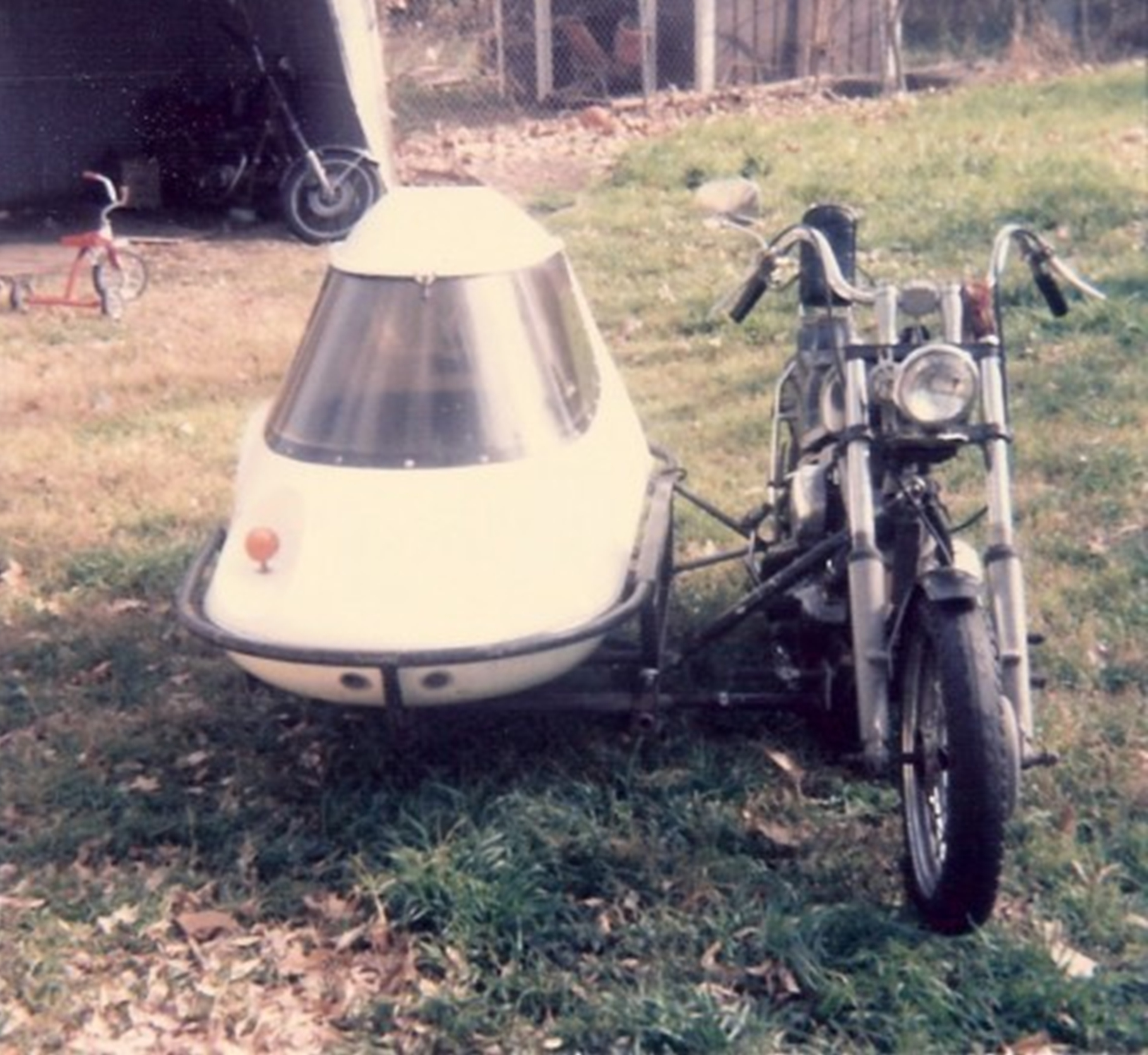
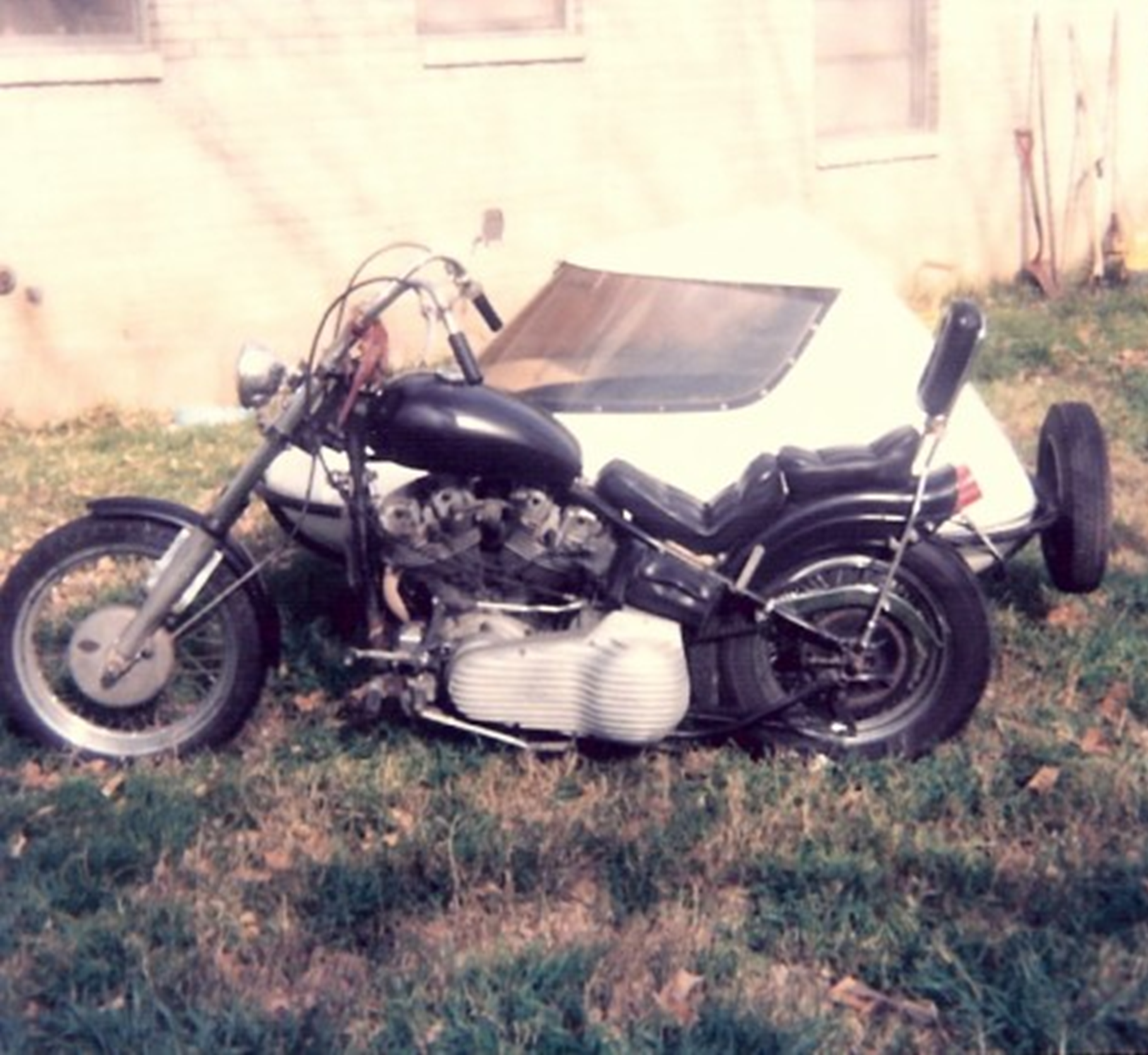
Darcie spotted the sidecar the moment I brought it home in the back of the pickup truck, and proudly informed us that it was her car!
A reader asked about the sidecar I attached to my Shovelhead back in the mid-’80s, which sent me off on a daylong squirrel hunt. As I didn’t have access to the interwebs way back then, I had a hard time learning anything about the sidecar. I knew it was a ‘Zephyr’ brand unit, but after that my search for info hit a brick wall.
I nicknamed it ‘Moon Unit’ because it looked kind of like a space capsule, but it was actually pretty well-built, with the rollbar-style cage around the body, a weatherproof roof and windshield, comfortable bucket seat with seatbelt and legroom enough for most adults, storage space behind the seat, and room for a dashboard-mounted stereo if one was desired. I personally consider a sound system on a motorcycle an abomination – I mean, who needs a stereo when they have the sweetest music in the world echoing out their exhaust pipes? – but I might have made an exception for the sidecar, if it would make Darcie happy..
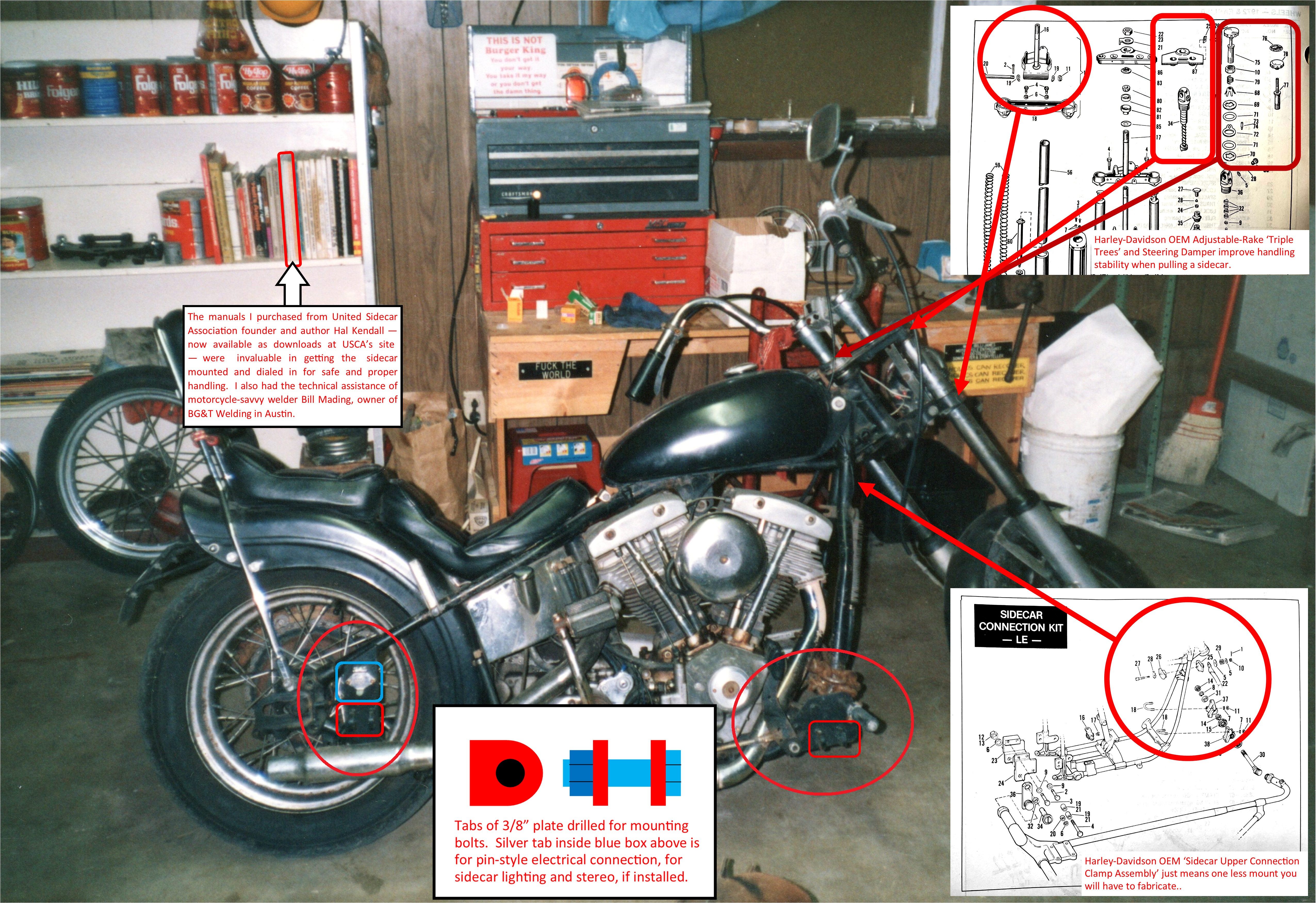
However, in the course of researching the sidecar’s provenance and history I did come upon the United Sidecar Association, and founding member Hal Kendall. I joined USCA and purchased a couple of sidecar manuals Dr. Kendall had published. Looking back, I know I could not have gotten the sidecar safely and properly mounted on my Shovelhead’s OEM Harley-Davidson wishbone frame had it not been for the good doctor’s manuals, which are still available as downloads at the USCA’s Sidecar Library page.
Another essential to my task was the assistance of a motorcycle-savvy welder named Bill Mading (RIP) who owned BG&T Welding in Austin, just down the street from the cop shop. Bill was a dirtbike racer, which meant he understood the stresses and strains motorcycle frames must endure, and how to compensate for them. However, he was also a skilled enough artisan that he could weld aluminum and aluminum-alloy engine and transmission cases – not an easy trick, as those metals tend to warp from the heat of the welding process. Warped cases means uneven gasket surfaces, less-than-perfect seals between case halves, et cetera. Bud (Bud’s Motorcycle Shop) used Bill for all his delicate welding needs, and we never had a problem with a part Bill repaired.
Bastard applications call for bastard engineering. Between us, Bill Mading and I designed the lower mounts for the sidecar. At the rear we installed a vertical plate near the frame’s dovetail, which included a pin-style electrical connector for the sidecar’s lighting. Up front we replaced the OEM mechanical brake foot-pedal mount with a larger plate that could accommodate the mounting tabs we’d devised. NOT PICTURED:The top front mount was the OEM Harley-Davidson clamp assembly. I also replaced the standard front-fork triple trees, shown here, with Harley’s OEM adjustable rake trees. For added stability and handling I added an OEM steering damper, as well.
Between the manuals I’d received from Hal Kendall, and Bill Mading’s dedicated assistance, we were able to devise a bastard set of mounts for the sidecar. They weren’t pretty, but they by gollum worked! Enlarge the photo below for more information.
Everything one needs to mount an off-brand sidecar to an OEM wishbone frame.
I didn’t have the interwebs back in the Dark Ages of the 1980s, so finding out what I needed to know involved scouring magazines for any mention of sidecars, writing letters that were often ignored, calling long-distance (remember those days?) and running up my telephone bill, et cetera. Today? Ten minutes with a mouse and I had already gleaned scads of information! In fact, the first site I visited told me where the Zephyr was manufactured, and by whom, and even had a photo of a pretty snazzy brilliant yellow Zephyr sidecar!
ONE FINAL NOTE: If you are at all interested in sidecars, please consider a membership in the United Sidecar Association. It’s money well spent, IMO, and support for a great organization.
I got hooked on motorcycles as a child, when the boy next door gave me a ride around the block on his BMW. Unfortunately, I also got hooked on other things, as I stumbled through adolescence, ultimately drinking and drugging away any motorcycle money I might have saved. Finally, in my early twenties, after years of lusting after a bike, I got sober, got my finances together, and toddled off to find my motorcycle.
It had to be a Harley, of course. Hanging with outlaw bikers in my teens, and years of poring over Easyridersmagazines convinced me there could be no other choice. Hence, I took myself to the Harley-Davidson dealership on Burnet Road there in Austin.
I had spent months hanging out there, watching the sales manager fawn over prospective buyers. For whatever reason, he must have decided I wasn’t a serious prospect, because when I announced I was there to buy a bike he just flapped a hand at the door to the parking lot, said ‘The used bikes are outside,’ turned on his heel and walked away.
April 11th, 1979 to now: 42 years of true love !
I left, naturally – damn if I was going to spend my money with an asshole like that! – but as I was driving away I noticed a Harley parked at a used car lot two doors up the street from the dealership. I called a friend of mine named Wayne Agee – an experienced chopper builder, attorney and motorcyclists’ rights activist – and he very kindly went with me to scope it out.
What we found was a 1974 Harley-Davidson FX (kickstart-only) Superglide shovelhead with 6,000 miles on the clock, box stock except for 6″ overstock fork tubes. It was low and lean, black and mean and absolutely gorgeous. The salesman swore it was his personal bike – a story I dismissed as sales-speak at the time, but later learned was the absolutely truth. No matter. It was a Harley-Davidson Big Twin, and the prettiest thing I’d ever seen.
1974 FX 1200 Superglide as described in full-line sales brochure.
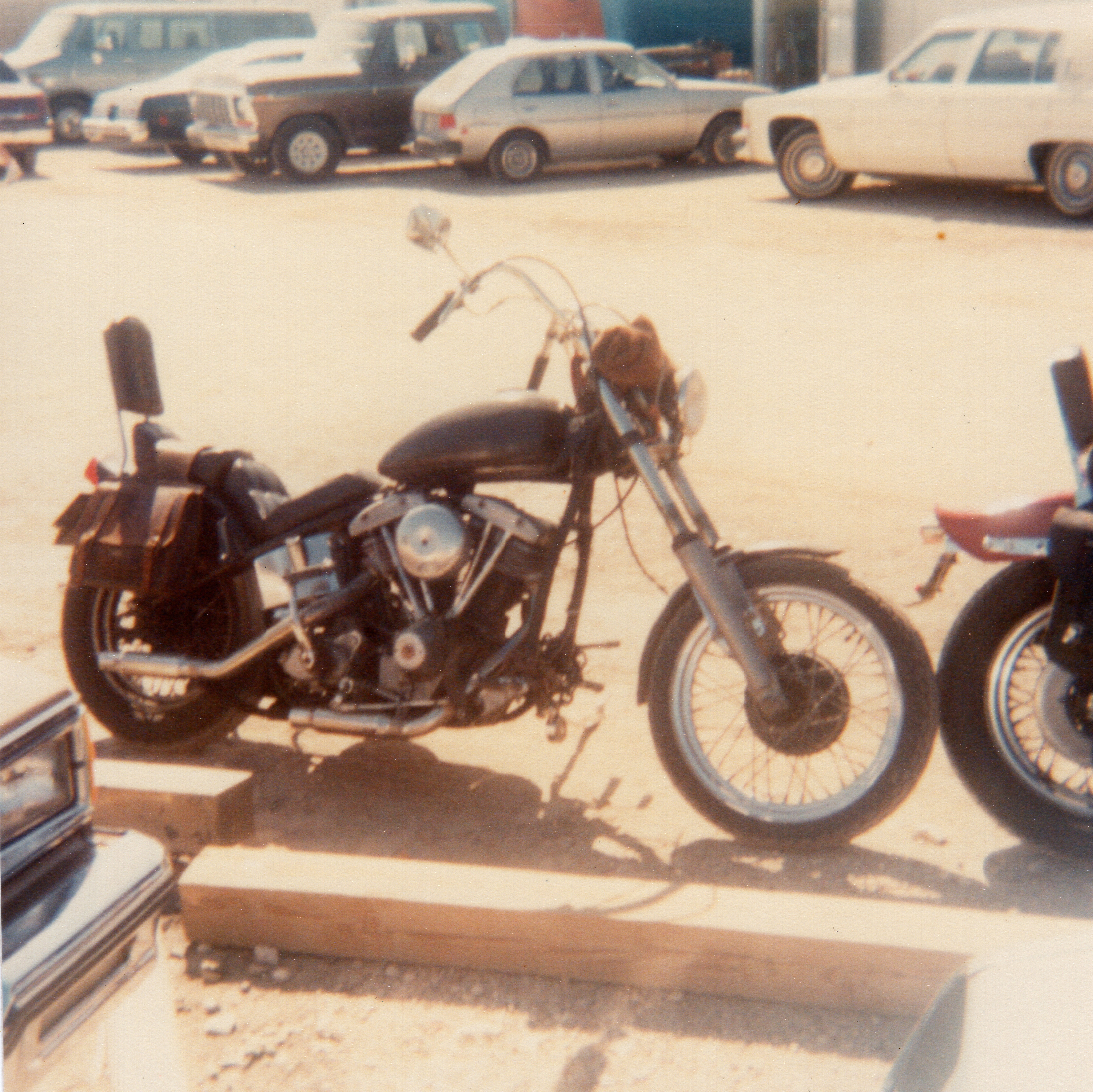
I didn’t have my motorcycle license yet, so Wayne test-rode the bike for me. The price was right and he gave it an enthusiastic thumbs-up, and I was sold! I went straight to my credit union to arrange financing, and the next day, April 11th, 1979, I went to take possession of my very first motorcycle. A five-minute tutorial on the machine – clutch up there, brakes here and here, shifter over there, one up and three down – and I was on my way.
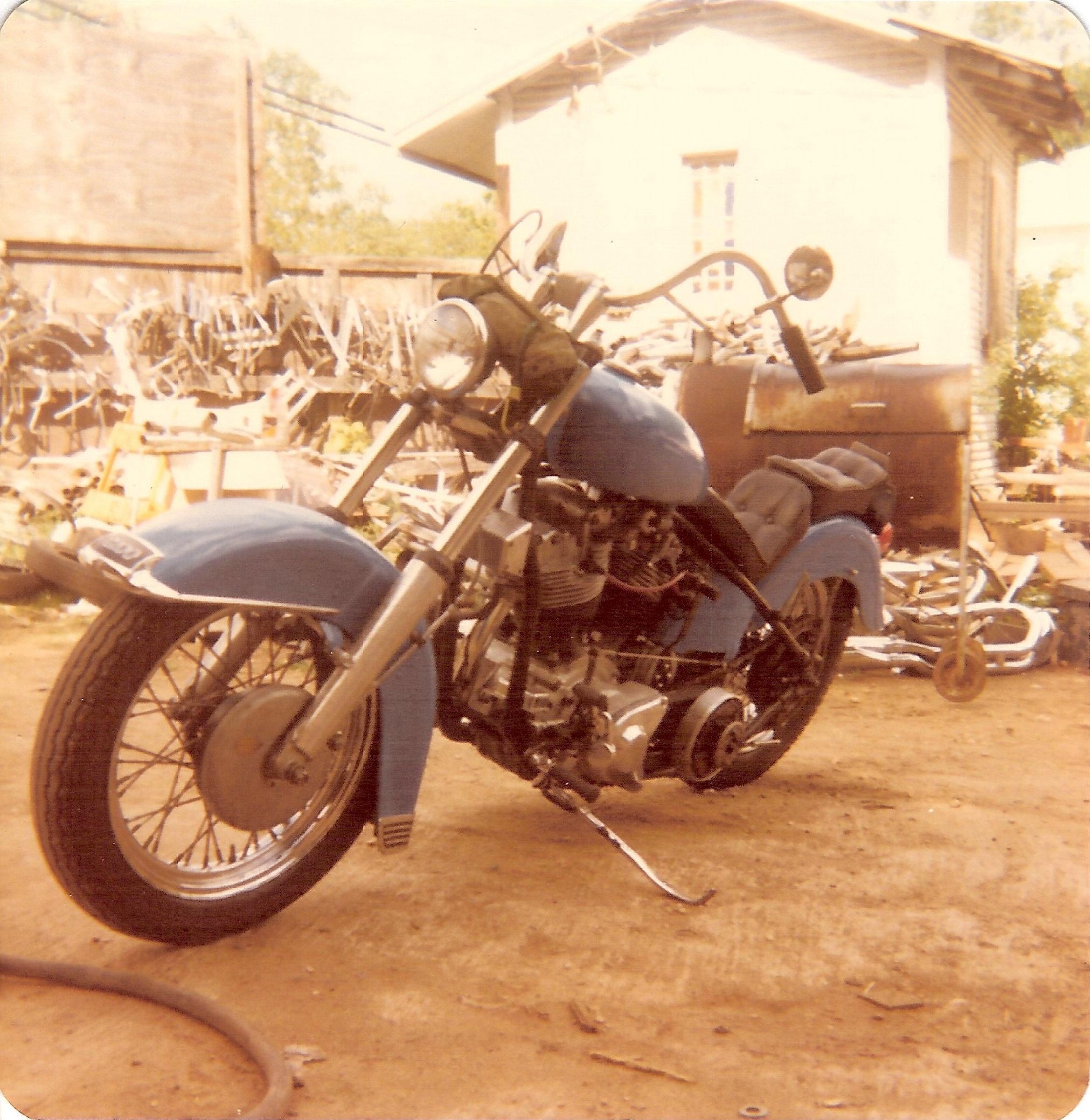
1974 FX 1200 Superglide as it appeared on April 11th, 1979, at Northwest Hills Texaco, Austin, Texas. My 1963 Buick LeSabre is in the background.
I passed a motorcycle safety course when I was in the service – a requirement if I was going to ride a motorcycle on base – and took rides on other people’s machines whenever they were dumb enough to hand me the keys, but I was basically ignorant of riding technique. Of needs, I taught myself to ride by spending every possible moment on that bike, cruising the Farm-to-Market and Ranch-to-Market roads that snake across the Texas Hill Country west and south of Austin. I quickly realized I was born to this life; to be in the saddle, in the wind. Nothing before or since has brought me such pleasure and peace of mind, or felt so right.
1974 FX 1200 magazine advert. Note stylish matching helmet and brown leathers. I never had either of those things. Only reason I had a leather jacket going into my first winter of riding was that my folks sent me a birthday check big enough to cover a Sears moto jacket…. which, BTW, came in tall sizes and gave excellent service!
I began calling my shovel ‘The Bitch’ long before The Grateful Dead released their In The Dark album in 1987, but a couplet from the song ‘Tons of Steel’ describes her well:
“It’s one hell of an understatement to say she can get mean She’s temperamental; more of a bitch than a machine!”
However, the name was given tongue-in-cheek because, even though any machine will act up one way or another if you own it long enough, The Bitch has been a stout, faithful steed with plenty of heart and class.
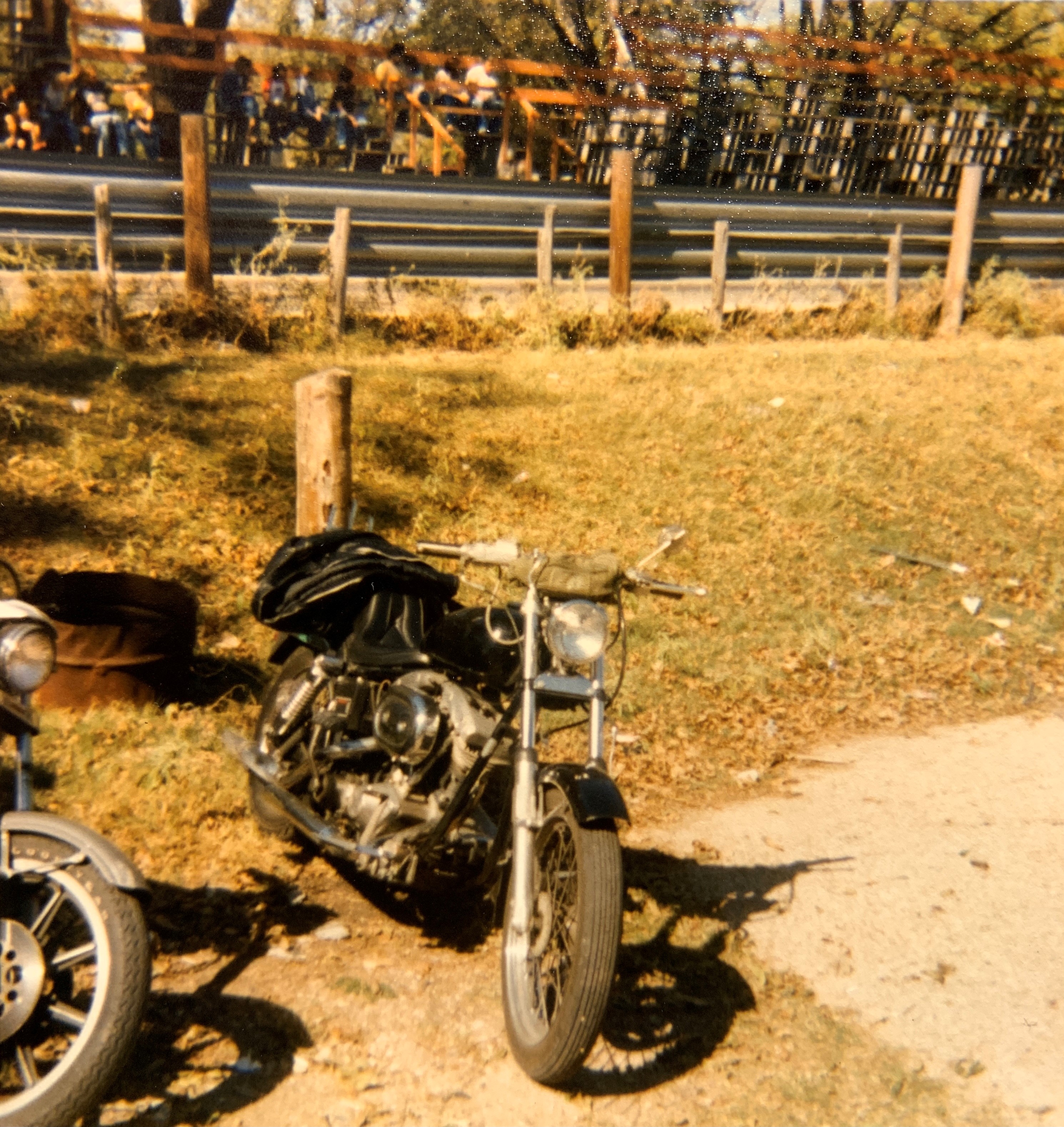
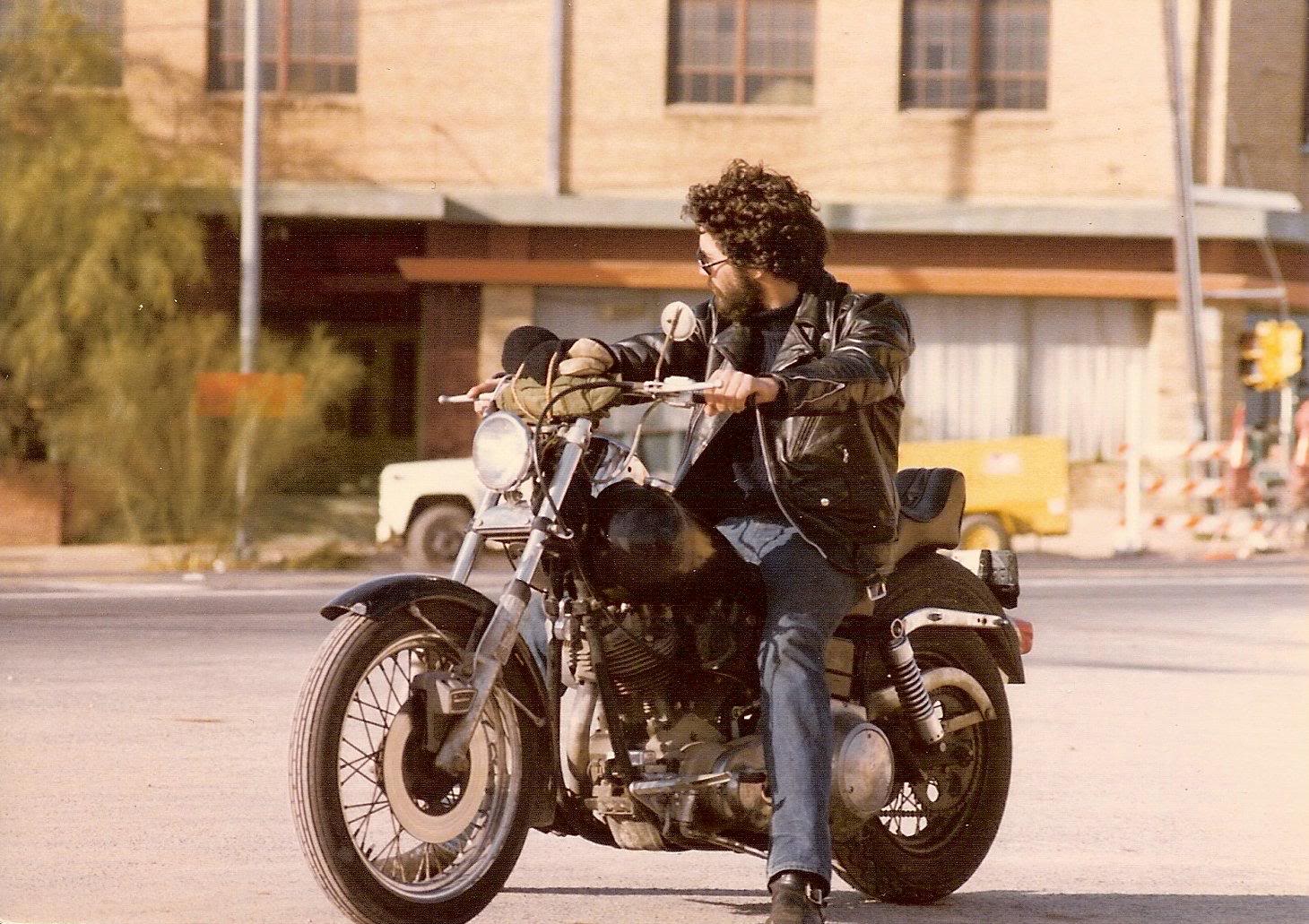
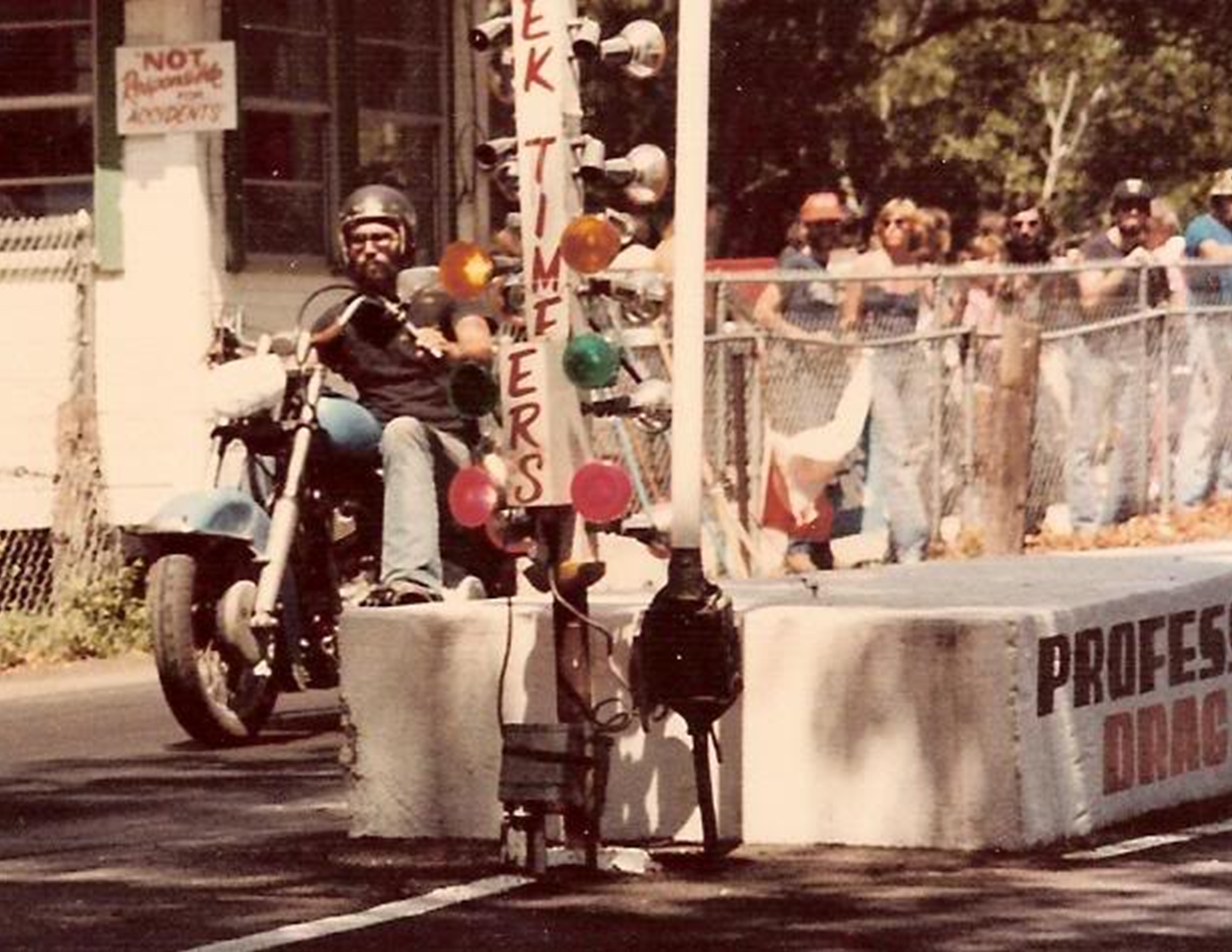
September, 1979, Labor Day Weekend Harley Drags at Little River-Academy Raceway east of Temple.I stripped the tank emblems (which I could kick myself for, now) and replaced the stock saddle with alow-ride LaPera king-and-queen. I traded the stock headlight assembly for an original Bates unit Ifound on my very first trip to Bud’s Motorcycle Shop, replaced the stock buckhorn handlebars withbroomstick drag bars, and installed foward controls and highway pegs to accommodate my long legs.
The Bitch has been through a lot of changes over the years. I began by turning her into stripped-down cruiser, above. Then I converted her into a fat bob, below.
December 1979, on Congress Avenue, Austin, Texas, just south of Town Lake. I still had the drag bars,but I replaced the stock one-piece fuel tank with the more traditional-looking two-piece ‘fat bob’ tanks. These were the 3.5 gallon size commonly seen on early Police motorcycles. I loved the look,but unfortunately, the older fat bobs were prone to cracking and leaking. A lapful of gasoline at 60 MPH is never a good thing, and as a result,I never kept a set of the original fat bobs for very long.
Next, I built her into a version of the FL Sport – a dresser sans saddlebags and windshield – using the wide-glide forks Wayne sold me, and pieces sourced through his ‘chopper shop’ (which, as it happened, bore a striking resemblance to his law office) and Bud’s Motorcycle Shop. The photo below shows the project about halfway to completion.
1980, at Bud’s Motorcycle Shop, 2612 East First Street, Austin, Texas,just before I completed the makeover to a stripped-down dresser.I had removed as much of the chrome trim as I could, replaced the3.5 gallon fat bob fuel tankswith a 5 gallon set, swapped the narrowFX front forks for the wide glide I boughtfrom my friend Wayne, and traded the Superglide rear fender for thelonger,widerElectra-Glide tin.All that was left at this point was the dresser coversfor the rear shocksand the aluminum nacelle and full-sized headlight for the front.Then that damn rigid framed panhead showed up!
Just about the time I finished that project, with a full aluminum headlight nacelle off an old Electra-Glide, a friend let me throw a leg over his rigid panhead, and I was in love. The rigid was so much lighter (and cleaner looking) than the stock swingarm frame, and I just had to have one.
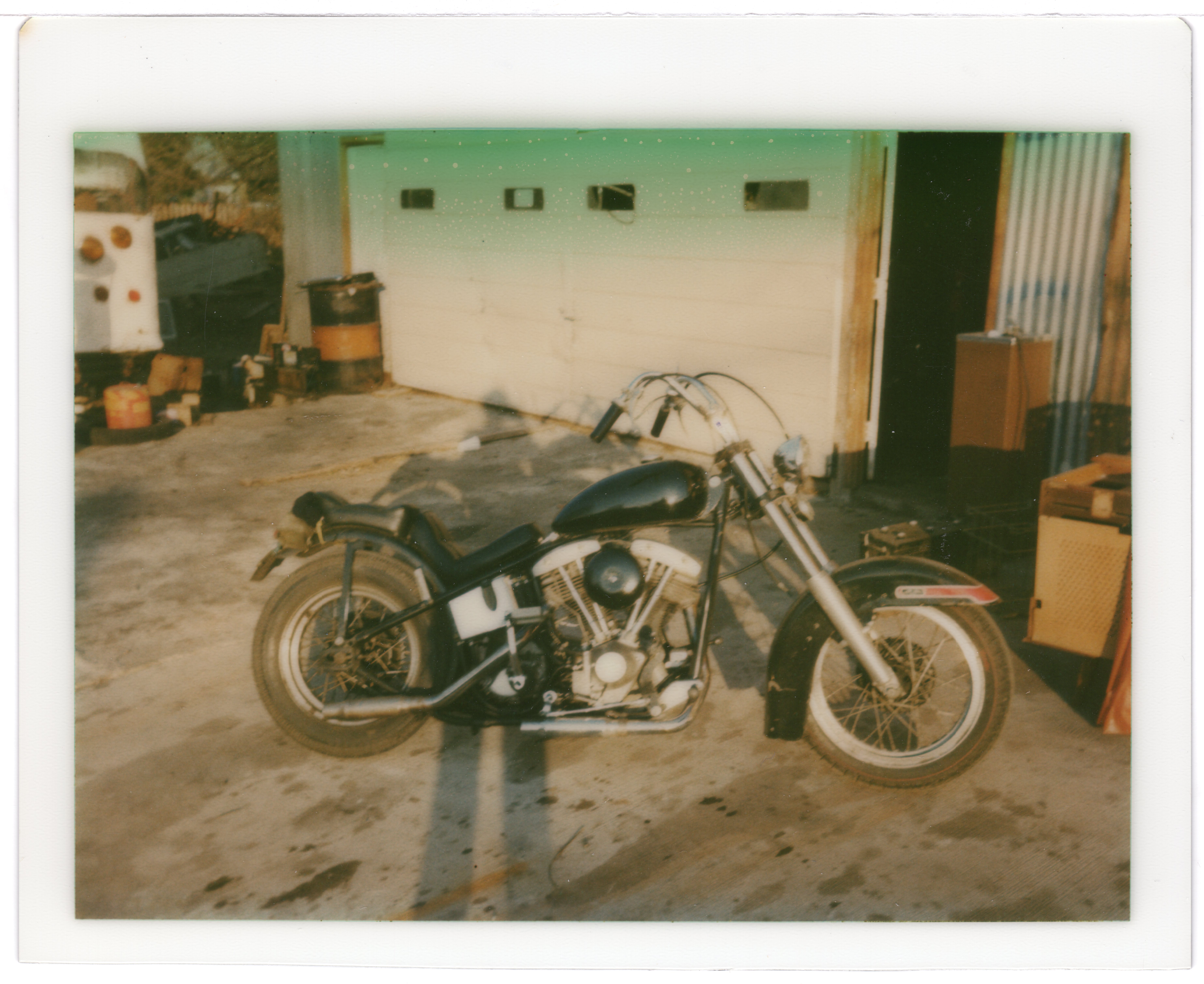
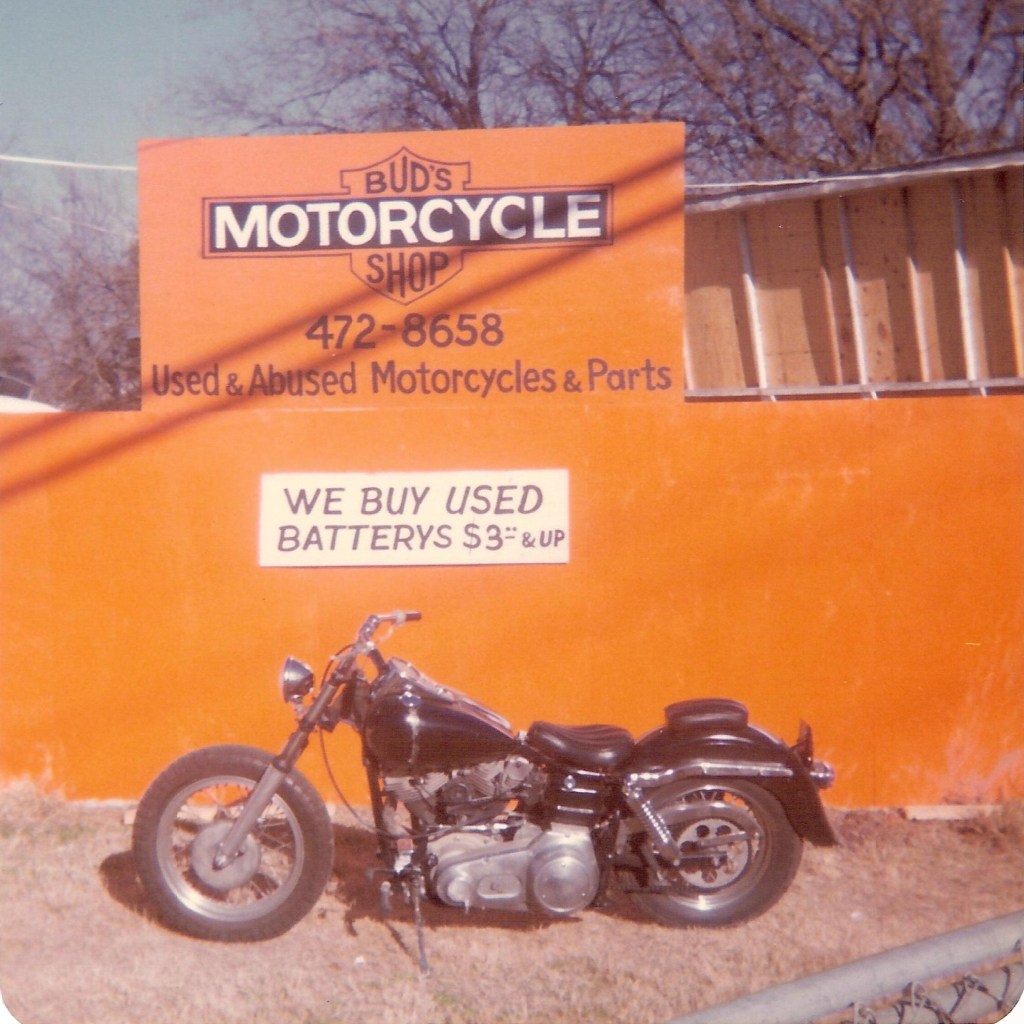
1980, in early winter, at Bud’s Motorcycle Shop, in front of the tin building that housed Bud’s original East Austin shop/showroom/office.
By then I was working at Bud’s Motorcycle Shop, and Bud helped me find a 1954 wishbone frame. I swapped the engine and transmission into the wishbone and slapped on some get-by fenders and fuel tank, above. Meanwhile, I sourced fresh tins for the bodyman, so I could keep riding while I got everything painted and ready to go.
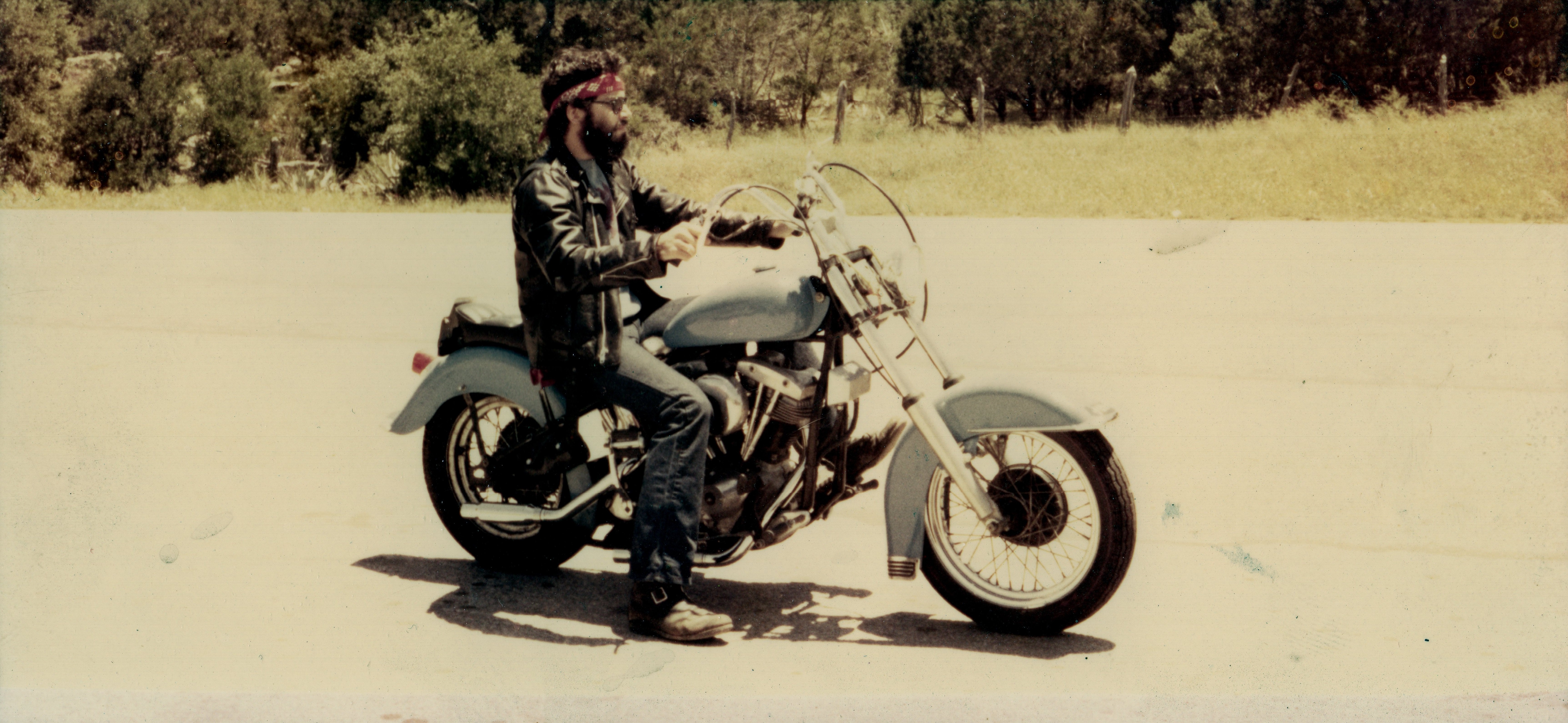
1980 at the Terrace Apartments off South Congress Avenue in South Austin, Texas.The Bitch when I first put it in the rigid frame, prior to the complete makeover I had planned for it.I rode it like this until I was ready to tear it down and rebuild it.Note how dingy the aluminum on theengine and front forks looks.
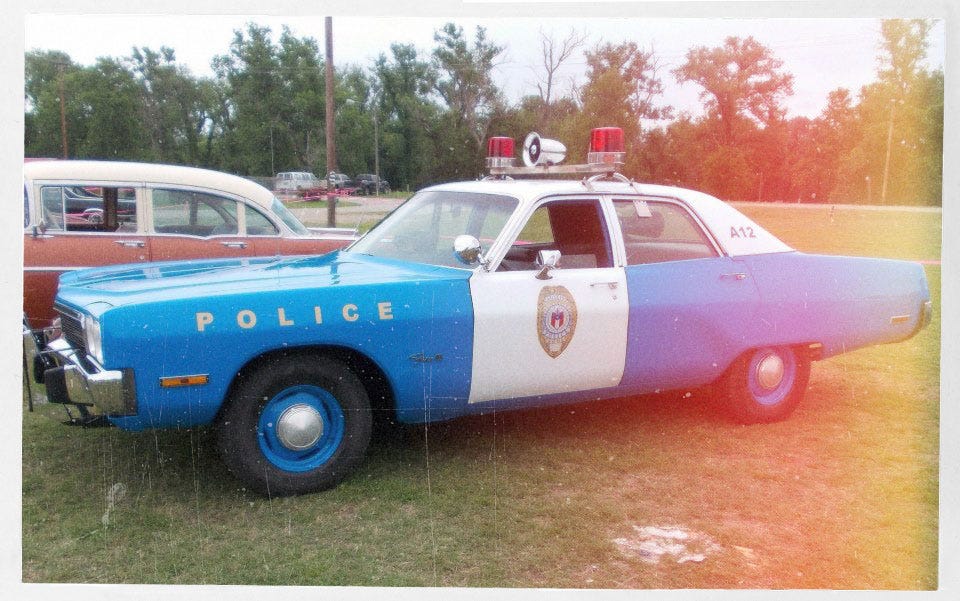
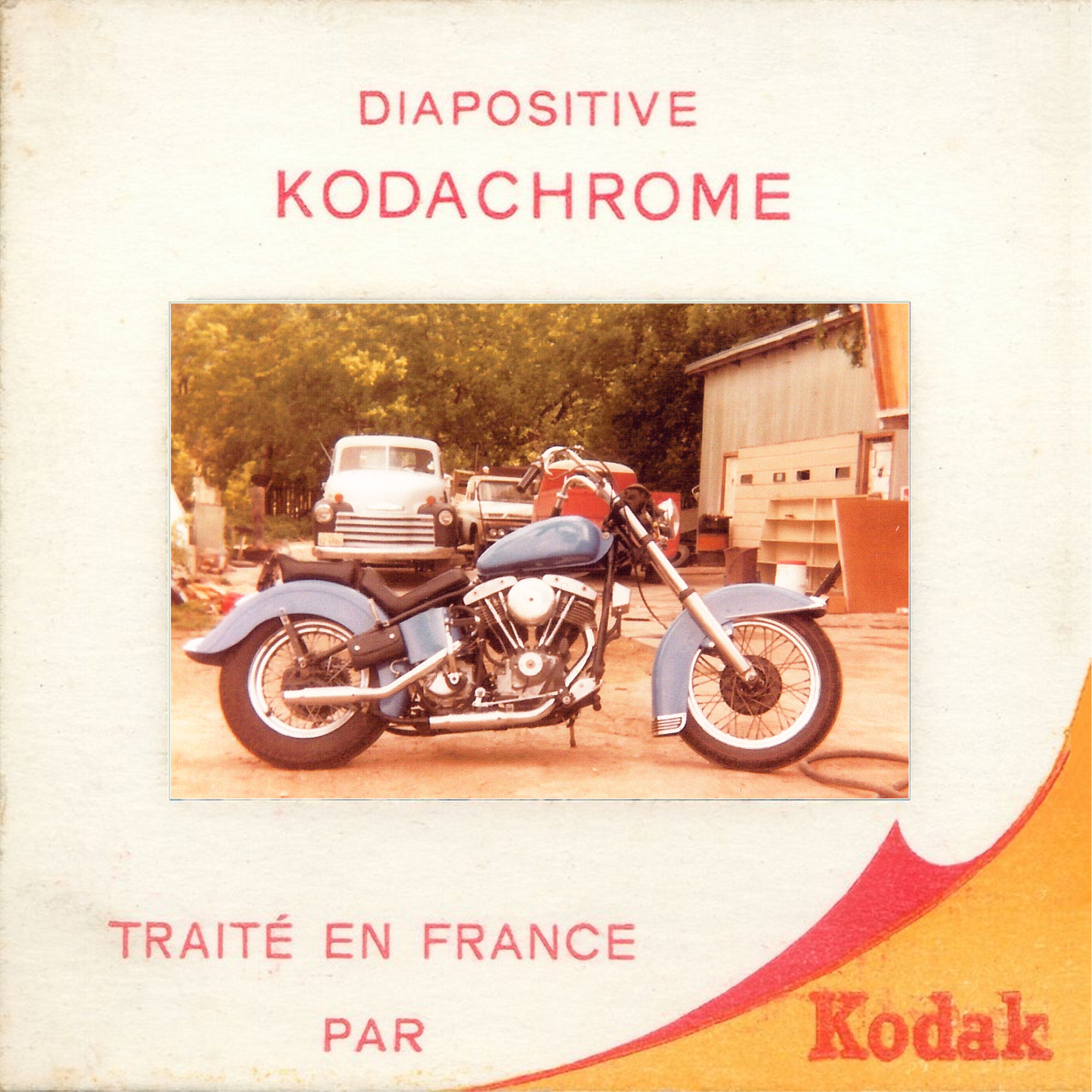
After some dithering around I settled on a bright blue the same color the Austin Police Department used on their cars. I’d seen it referred to as ‘Ford Engine Blue’ and ‘Dodge Blue’, although APD’s press releases called it ‘Powder Blue’. Whatever the name, it was a close match to an original 1954 factory color Harley-Davidson named ‘Glacier Blue’.
Austin Police Department’s ‘Powder Blue’ cars, circa 1980s.
I took the shovel apart, rebuilt the engine, polished every bit of smooth aluminum I could get a buffing wheel or elbow grease to, and put it all back together.
1980, The Bitch in Glacier Blue, the day I completed the makeover. Note the shiny aluminum. That was alotof work !The Bitch in Glacier Blue, in the yard at Bud’s Motorcycle Shop, 2612 East First Street, Austin, Texas, where I was a proud Known Associate for over 35 years. Note the suicide clutch and slap-shifter. I liked the idea, but leaning on my brand-new engine for revs high enough to power the take-offs a suicide clutch demanded hurt my heart. Twenty-four hours later I went back to the hand clutch/foot shifter arrangement.
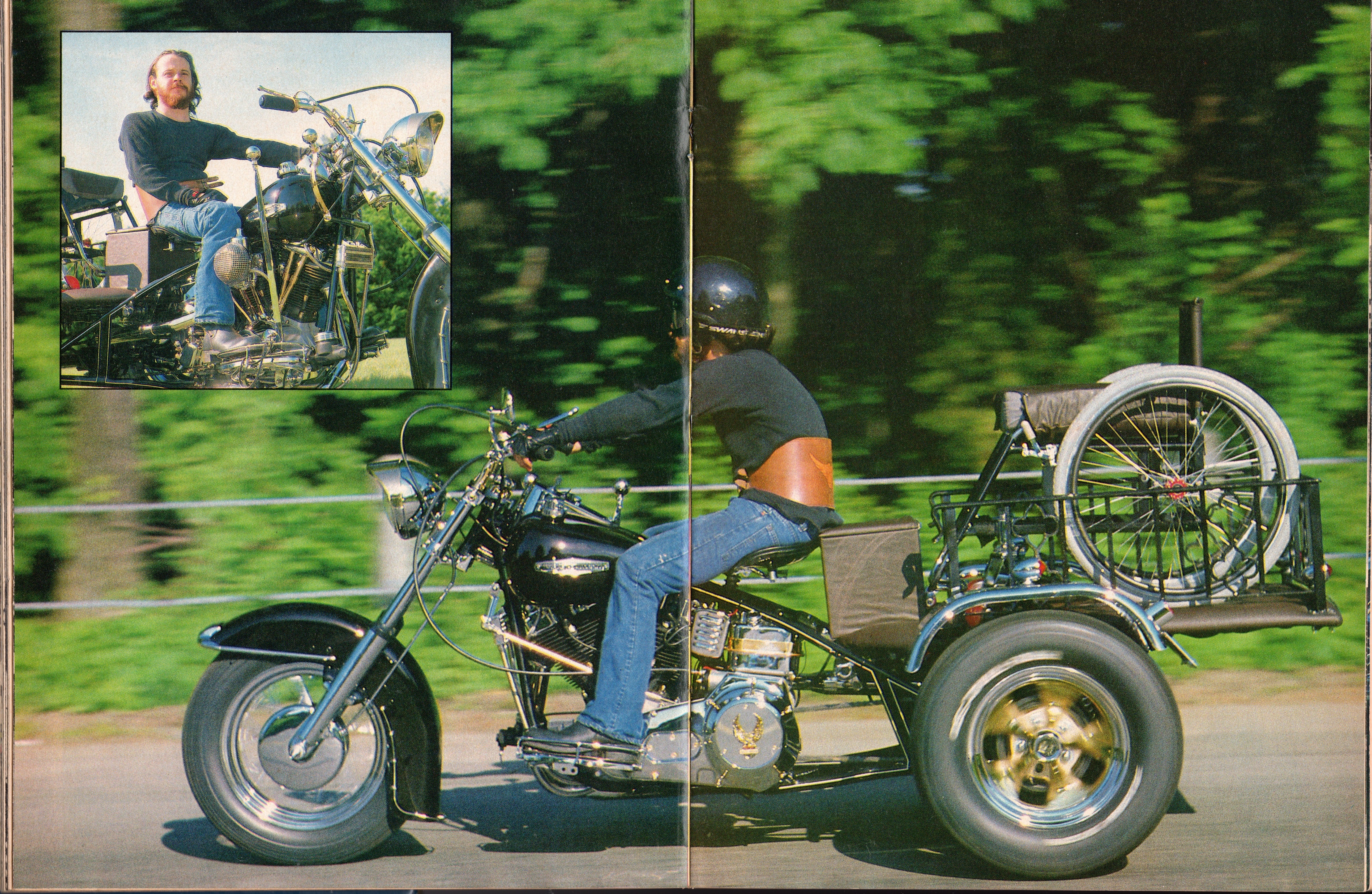
That rear fender was from a swingarm dresser with the hinge welded shut: a concept by Dave Hobday, a fellow employee at Bud’s, and skillfully executed by a body-man named Paul, who was left quadriplegic after a motorcycle wreck. Paul did the paint and body work for a number of custom builds at Bud’s shop, and in return we built him a three-wheeled shovelhead adapted to his disabilities. He later took the trike back to his home state of Massachusetts where he rebuilt it, doing most of the work himself, and did such a fine job that it ended up featured in Easyridersback when that was still a rag worth reading.Paul with a trike he has every reason to be proud of, featured in EasyridersJanuary 1985 issue.
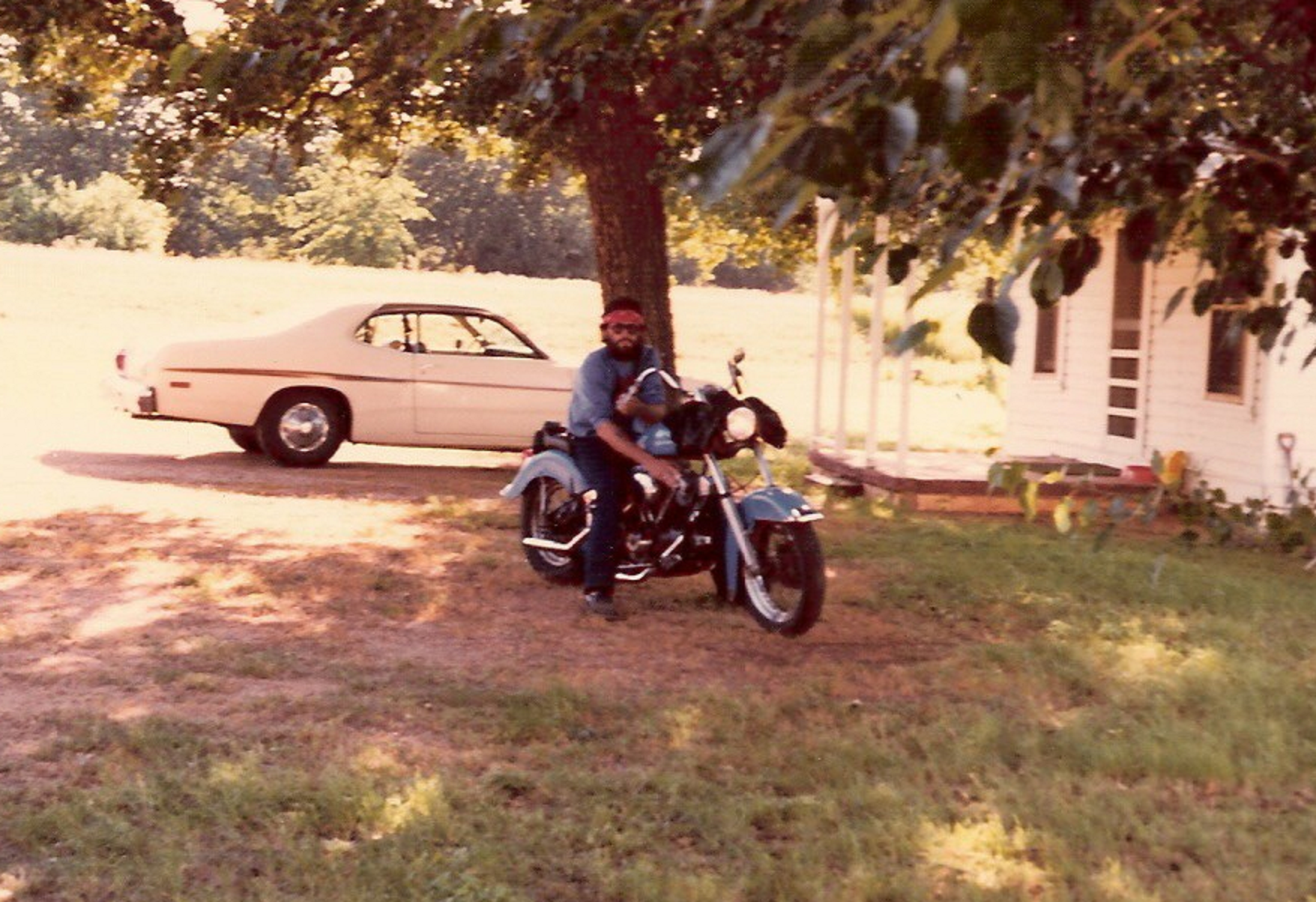
I caught a lot of flak for that paint color the whole while the tins were hanging on the wall in my shop area, but once I put it all together I received nothing but compliments. As an added plus, I never had a car pull out in front of me the entire time I ran that color. Not once. They might not have been aware of motorcycles in traffic, but they by God noticed that cop-car blue!
1980, enroute to a party at Lake Buchanan, shortly after I completed the Glacier Blue makeover. That is the smile of one veryproud bike builder!1980 at Lake Buchanan, Texas.1981, Memorial Day races at Little River-Academy Raceway. I was winning my bracket until the timekeeper gave me the wrong ET card at the end of a run. I’d actually won that heat, but didn’t realize it until after the trophies were awarded. Just as well. If I’d won I probably would have been hooked on racing, and that is an expensive habit!September, 1981 at Lake Brownwood, Texas, with Lea, Bill Jones and Debbie.1982, a ride to the annual Black Hills Classic Motorcycle Rally at Sturgis, South Dakota, above.
Me and my buddy, T.R., left Austin on Friday after work, and took forty-eight hours to ride our rigid framed shovelheads about 1300 miles, from Austin, Texas, to Sturgis, South Dakota. That averages out to a measly 27 miles an hour! However, during that forty-eight hours we stopped regularly for sit-down meals, and tent-camped at the roadside both Friday and Saturday night. We also stopped at Hugo’s Harley-Davidson in Wichita that Saturday afternoon, where they kindly loaned my buddy a welder so he could repair his broken headlight bracket. Since we were in town anyway, we paid a visit to Truett & Osborn’s Speed Shop, too. Then we lost some time when I ran out of gas at sunrise on Sunday morning, and again when I had a leisurely visit with my brother’s in-laws in Kearney, Nebraska, later that morning, so I’m thinking our speed was a little better than 27 MPH !
A visit with my sister-in-law, who was staying on a ranch in Lusk, Wyoming.
On the way back to Texas, I stopped to visit my sister-in-law, who was staying on a ranch in Lusk, Wyoming. T.R. went on ahead, and I caught up with him at his friend’s tattoo shop north of Denver the next day. We crashed there, and then (because he had more time off than I did) he took off for the West Coast, while I made the 1000-mile run back to Austin in less than twenty-four hours.
At one point during my dash back to Austin, I stopped for a nap in a small Eastern Colorado town. Just as I was settling in on a picnic table in the local park, a boy on a dirt bike started buzzing around. He was just excited to see another motorcyclist, eager to ask me questions about where I’d been, where I was going, what kind of bike I had…. but I was hot and cranky. I snapped at him and ran him off.
After my nap I was in better sorts, and I felt bad about being a grump, so I rode around town until I found the boy, turning lazy circles in the dusty main street of whatever the hell town I was in. I flagged him down and apologized for getting owly earlier.
He said ‘That’s okay. My Dad gets that way sometimes.’
Fuck me! The last thing I wanted to be was some other adult who snarled at him when he just wanted to hang out and learn stuff. I stayed with him for a bit, answered his questions as best I could, and then got back on the road, hoping I’d left him with a better memory of our encounter.
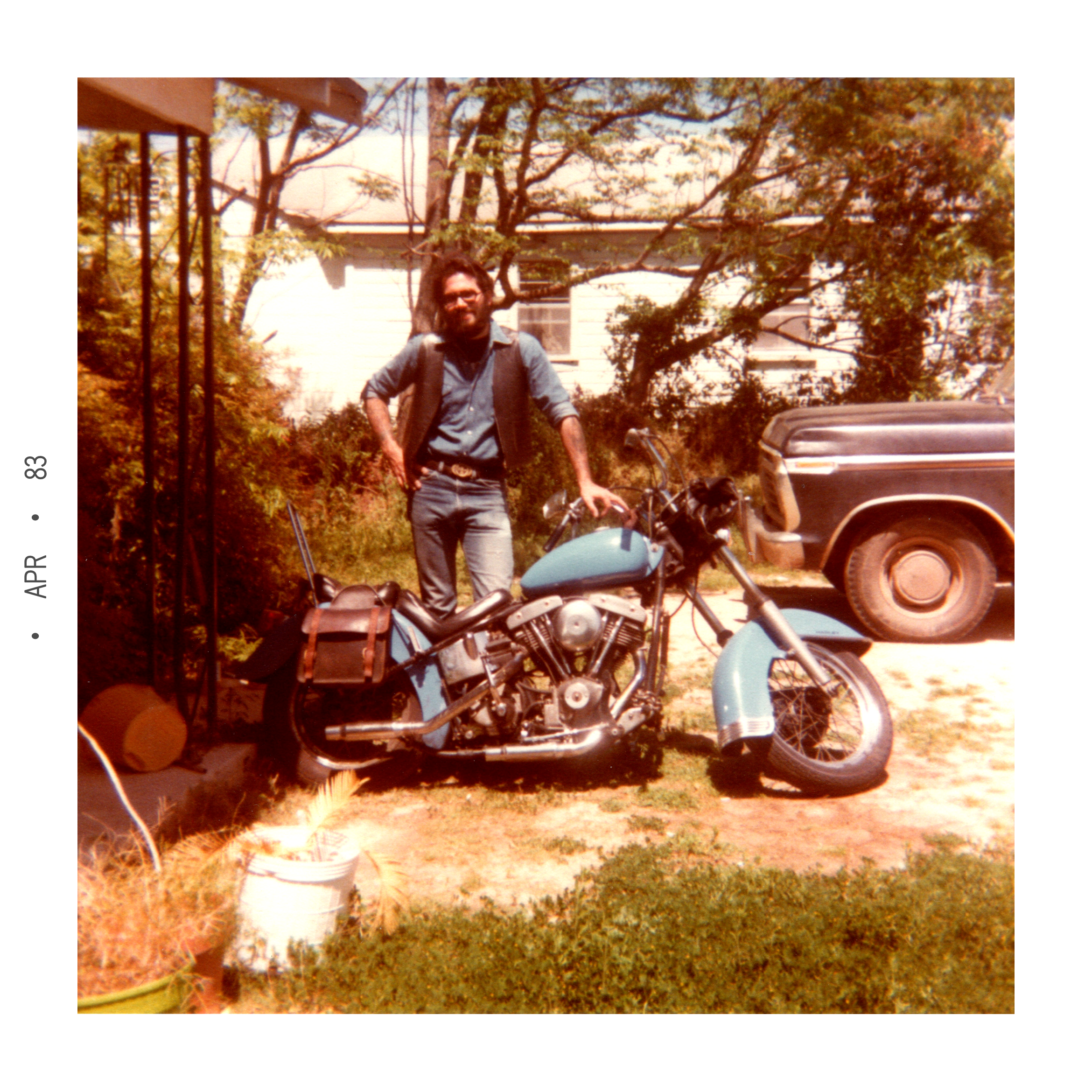
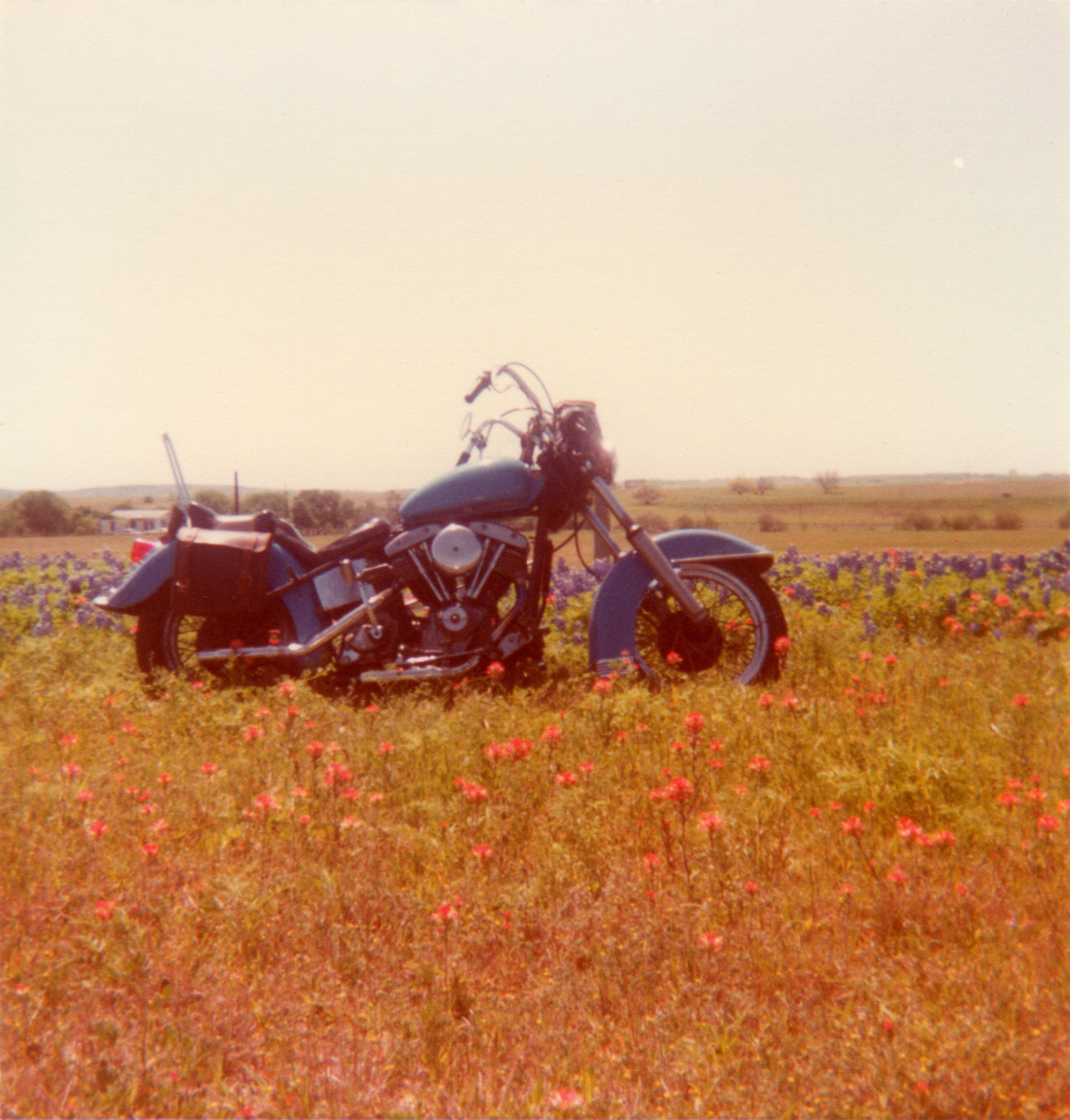
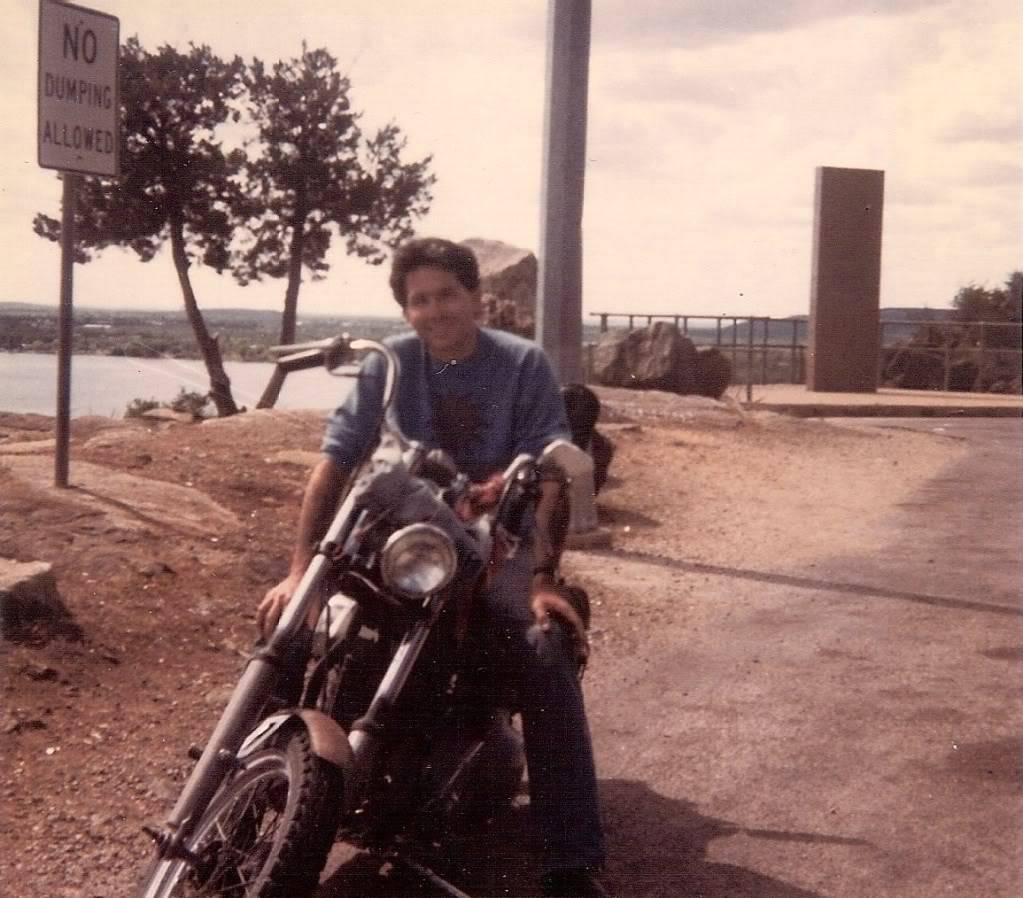
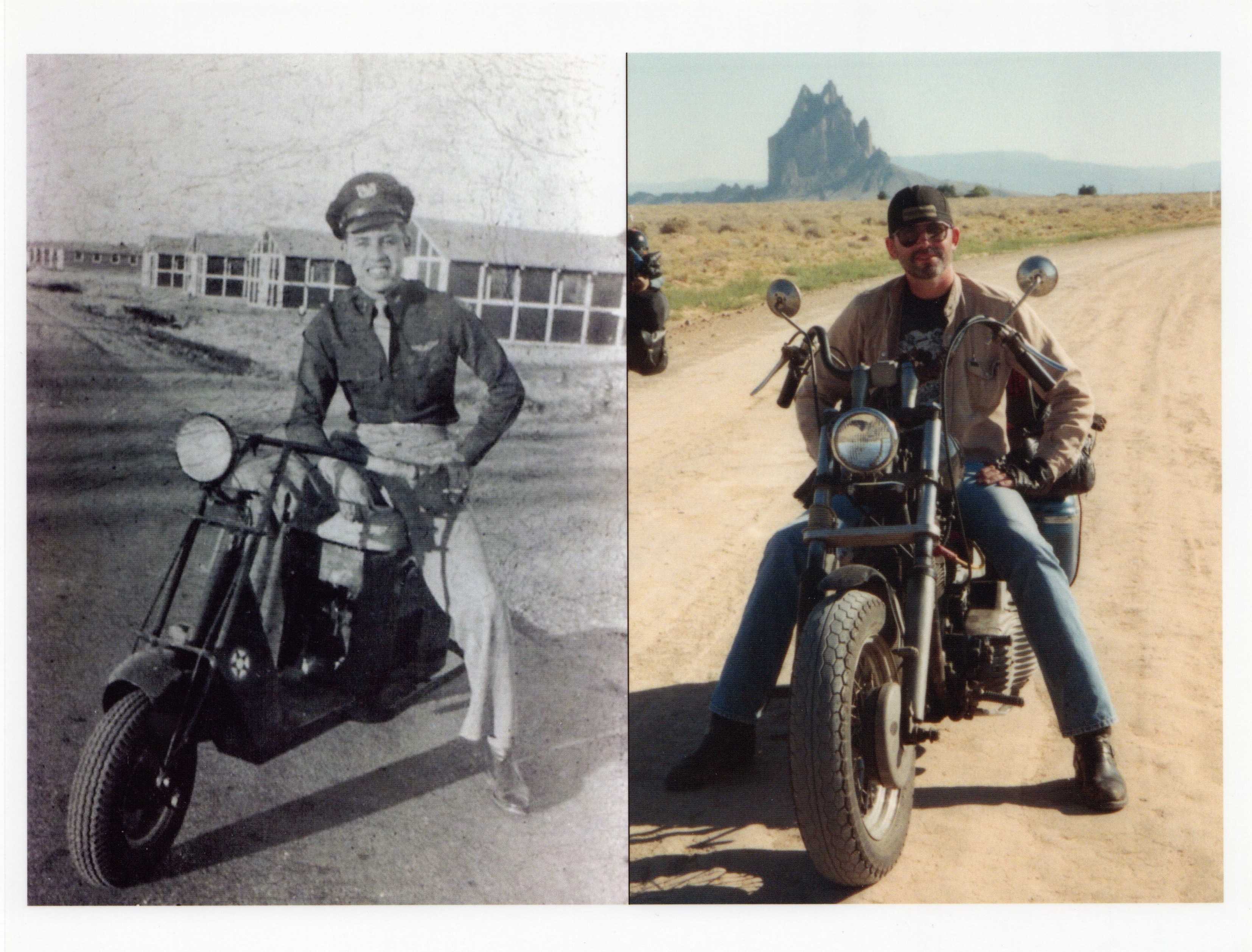
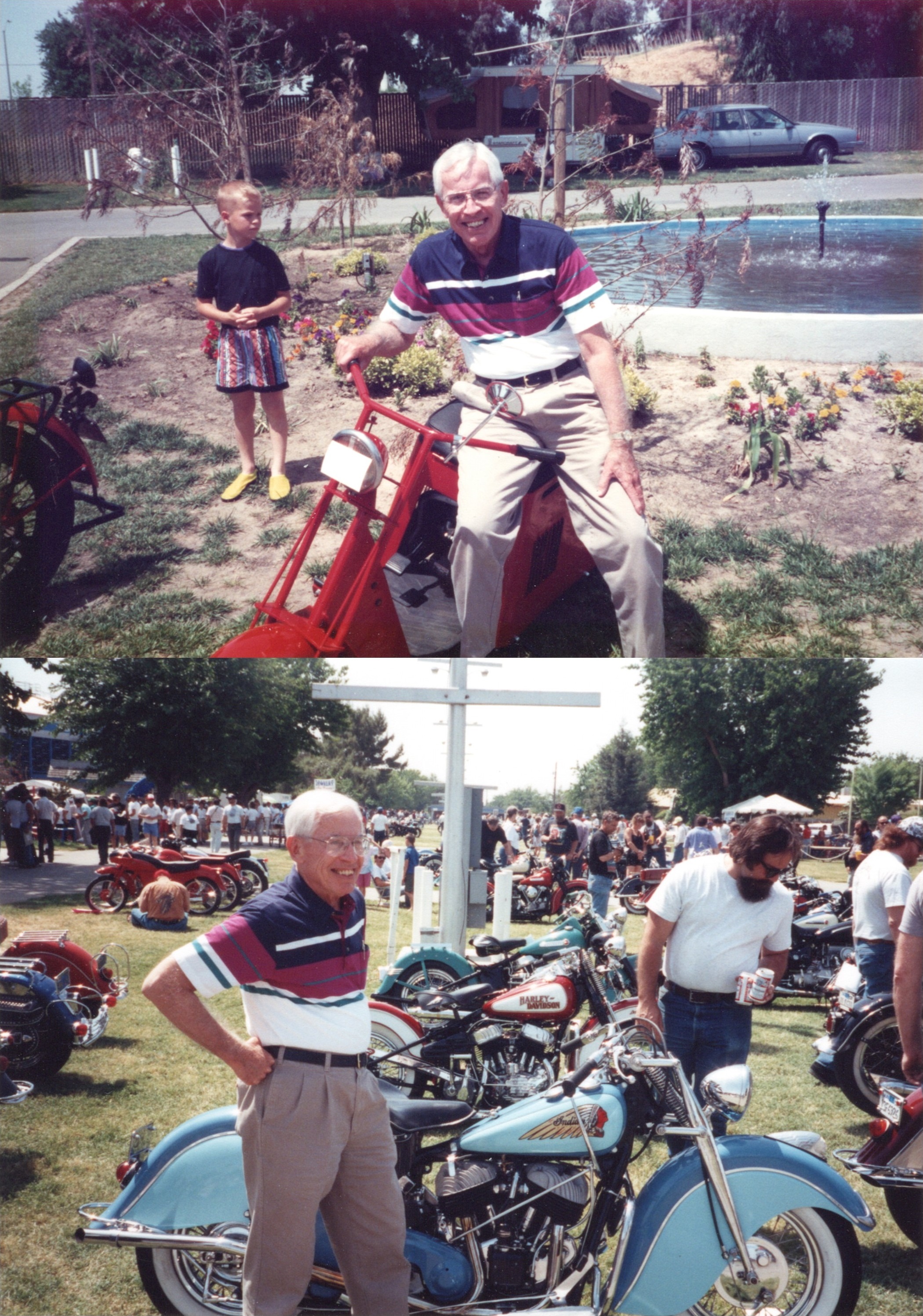
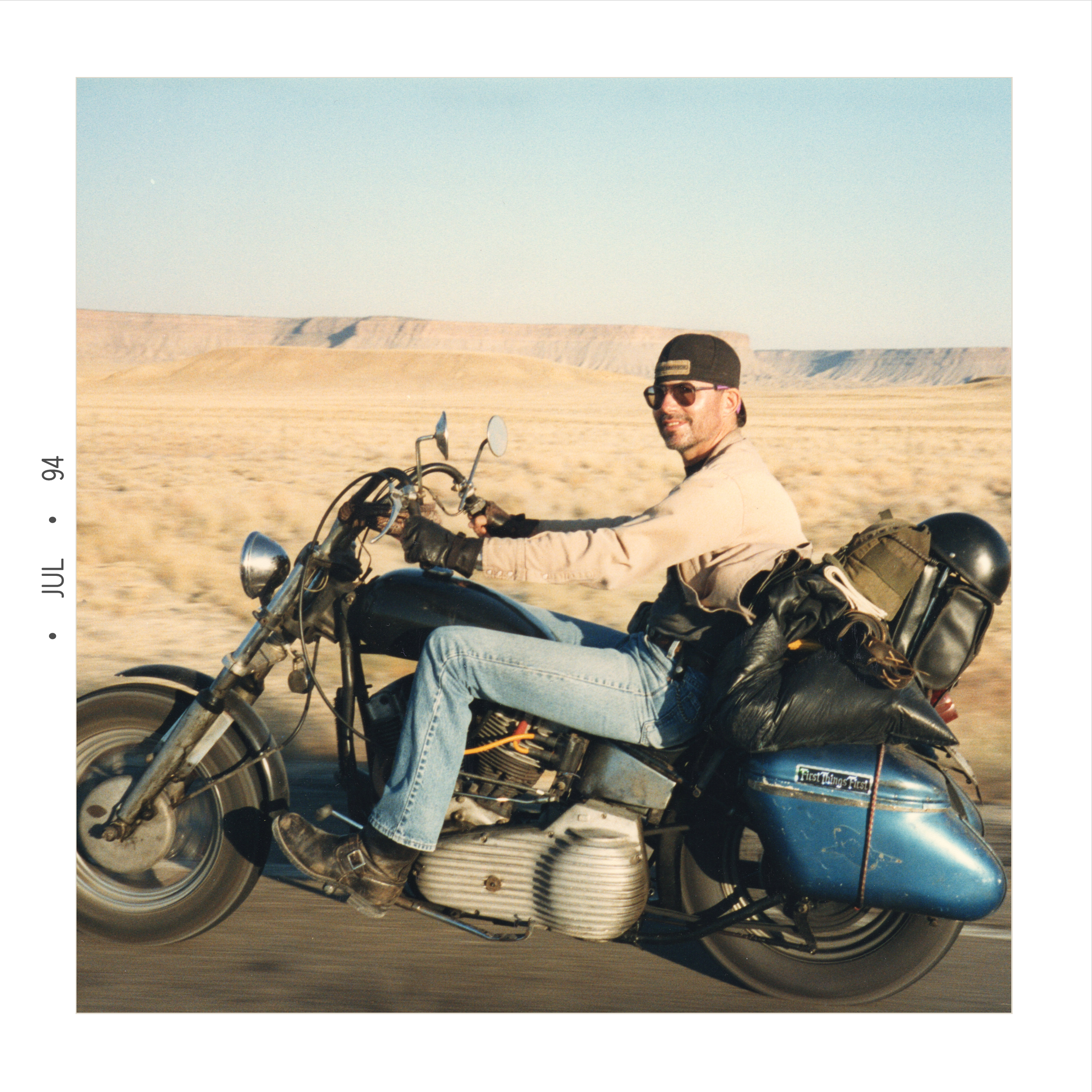
1983, a ride out to see the Bluebonnets blossom. Going to see the wildflowers is an annual event in Central Texas, and the roadsides are lined with people posing their kids, dogs or, in my case, a motorcycle, amongst the the beautiful blossoms.1983, Bluebonnets and Indian Paintbrush at the roadside southeast of Austin.1984, at a scenic overlook near Kingsland, Texas. I was still a smoker, then, and deliberately trying to imitate the image of my father astride an Army Air Corp scooter at the end of World War Two. Later, without even meaning to, I did a much better job.1945, Lincoln, Nebraska, Tom James, Army Air Forces navigator, astride an AAF scooter, and 1994, me at Shiprock, New Mexico, astride The Bitch. It wasn’t until years after the photo at right was taken that I realized how alike we sat our machines.There’s my father in May of 1993, attending the vintage motorcycle show at Hanford, California. Top, he’s posing with a Cushman scooter like the one he rode in the service. Below, with an Indian Chief like the one he rode after he got out of the service. Interesting side note: my father knew that my brothers and I wanted motorcycles – that I was particularly crazy about the things – but we were forbidden to have even a Briggs & Stratton-powered minibike, which were all the rage at the time, let alone an actual motorcycle. He certainly never mentioned that he had been a rider himself! I didn’t learn of that until I’d had The Bitch for several years, and was in Seattle for my younger sister’s high school graduation. One afternoon, we dropped my mother off at a real estate seminar, and Dad and I were driving up Puget Sound to visit my younger brother at University. We’re motoring along, and all of a sudden, my father starts telling me about this Indian Chief he used to ride, how he won the money for it playing poker and bombed around the Baltimore area on it, until a get-off convinced him he’d probably be better served on four wheels than two. I looked at him, goggle-eyed, and said ‘Why am I just now hearing about this!?!’ He said, ‘I knew you boys wanted motorcycles, and I didn’t want to encourage you to do something I knew could be dangerous.’ In his way, he was just trying to be a good father, and I get that, but he and I were estranged most of my life. I was a rebellious doper and budding alcoholic, he was an inveterate alcoholic, and we were just too damned much alike. We rubbed each other wrong at every turn. Things got better between us when I got sober, and tons better when he followed suit a year and a half later, but I can’t help wondering how different those years could have been if we’d been able to bond over motorcycles. Because that’s what happened once the cat was out of the bag: we bonded over motorcycles because, as it turned out, he’d never gotten over his fascination with them! You know those old guys who come up to you in parking lots and say, ‘I used to have one o’ those things’? My Dad was one of those guys! So, while we didn’t spend those golden years of my adolescence sweating over greasy motorcycle parts, or trailering bikes out to the motocross track or whatever, we did have the last fourteen years of my father’s life to gab about bikes, bikers and two-wheeled adventures! RIP, Dad.
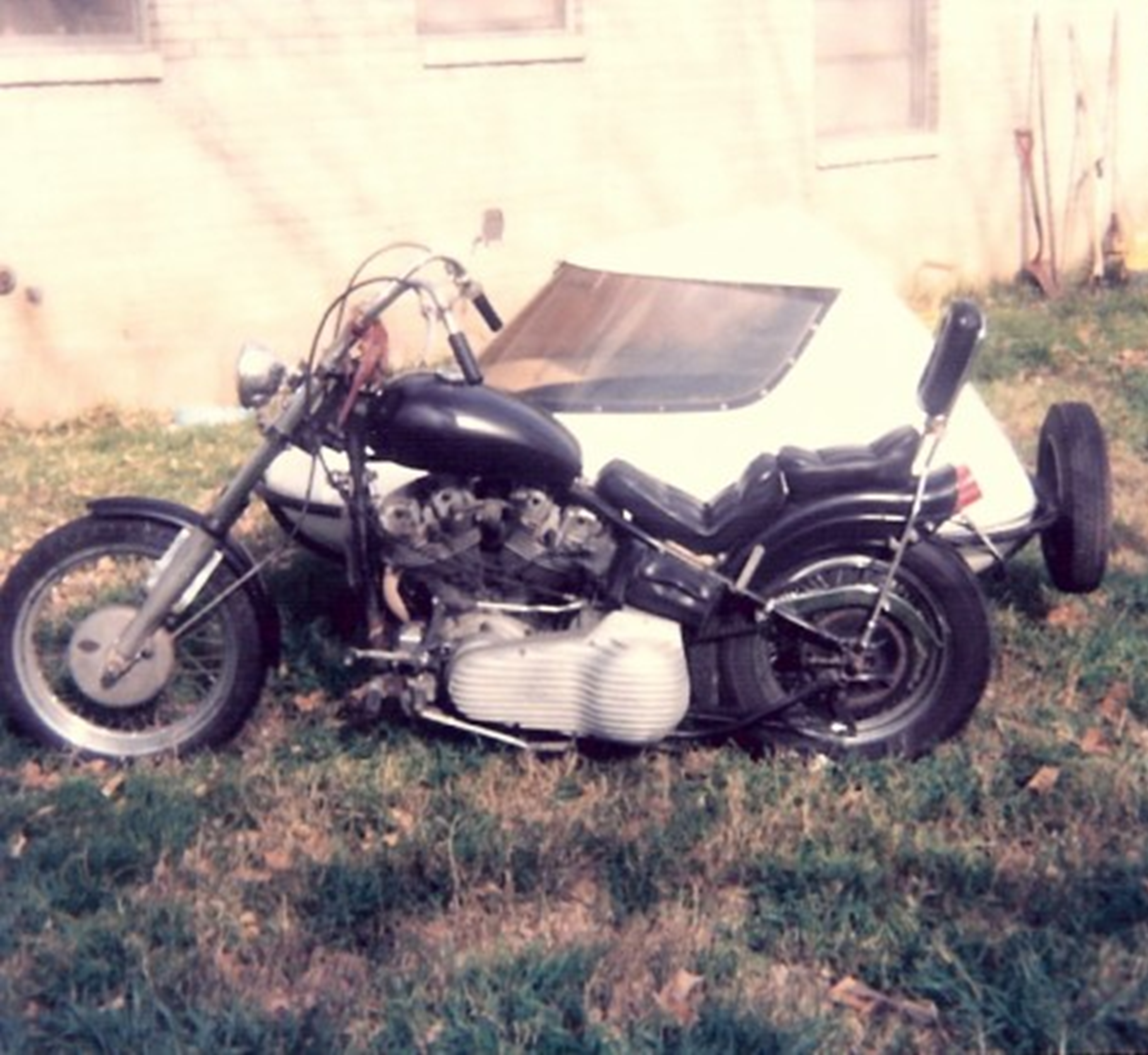
I made other changes as the years passed. I went back to black, changed fenders and tanks, ran a pogo-stick saddle and windshield for a while, added a sidecar so my stepdaughter could ride in safety and comfort, and put on mile after mile after mile…
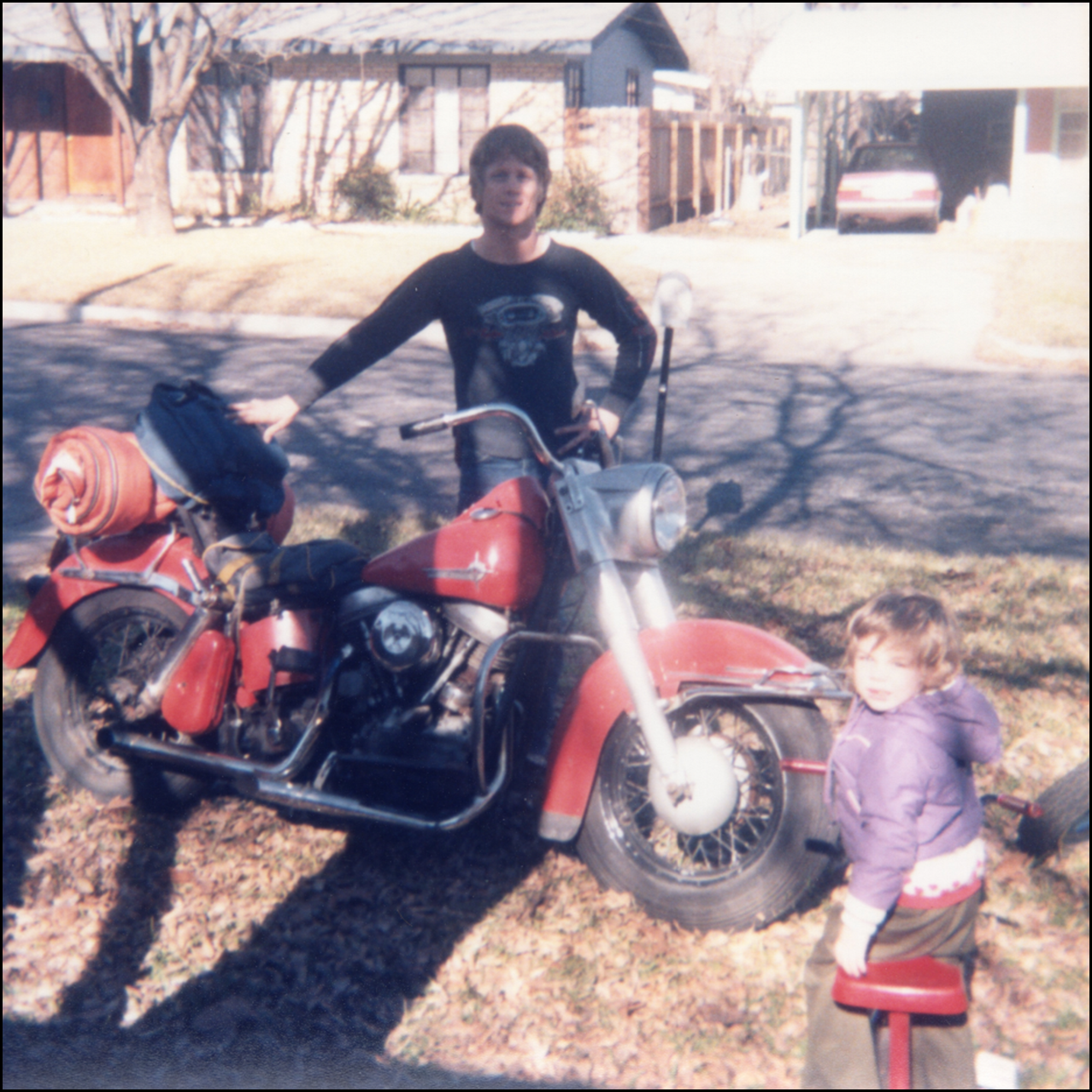
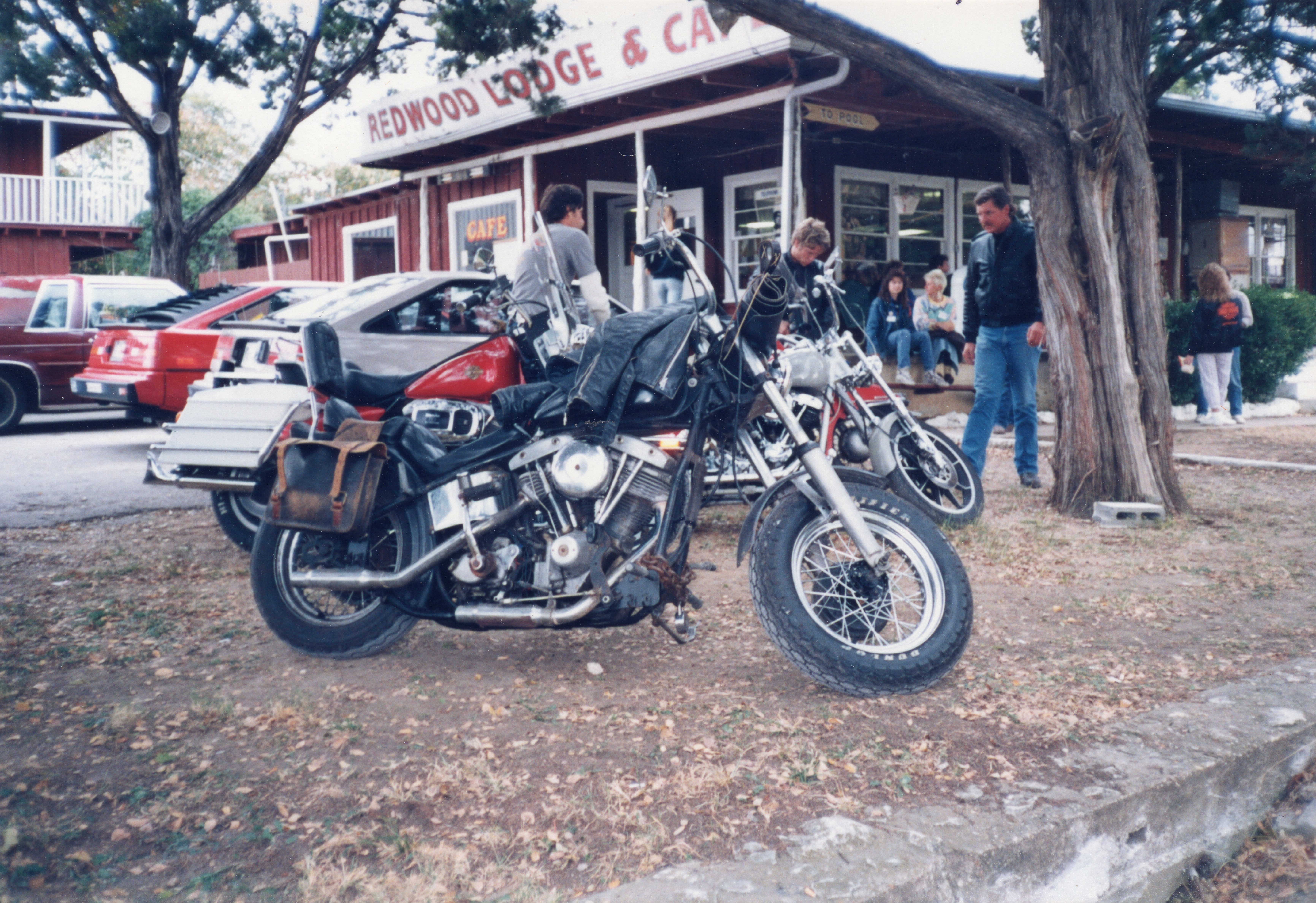
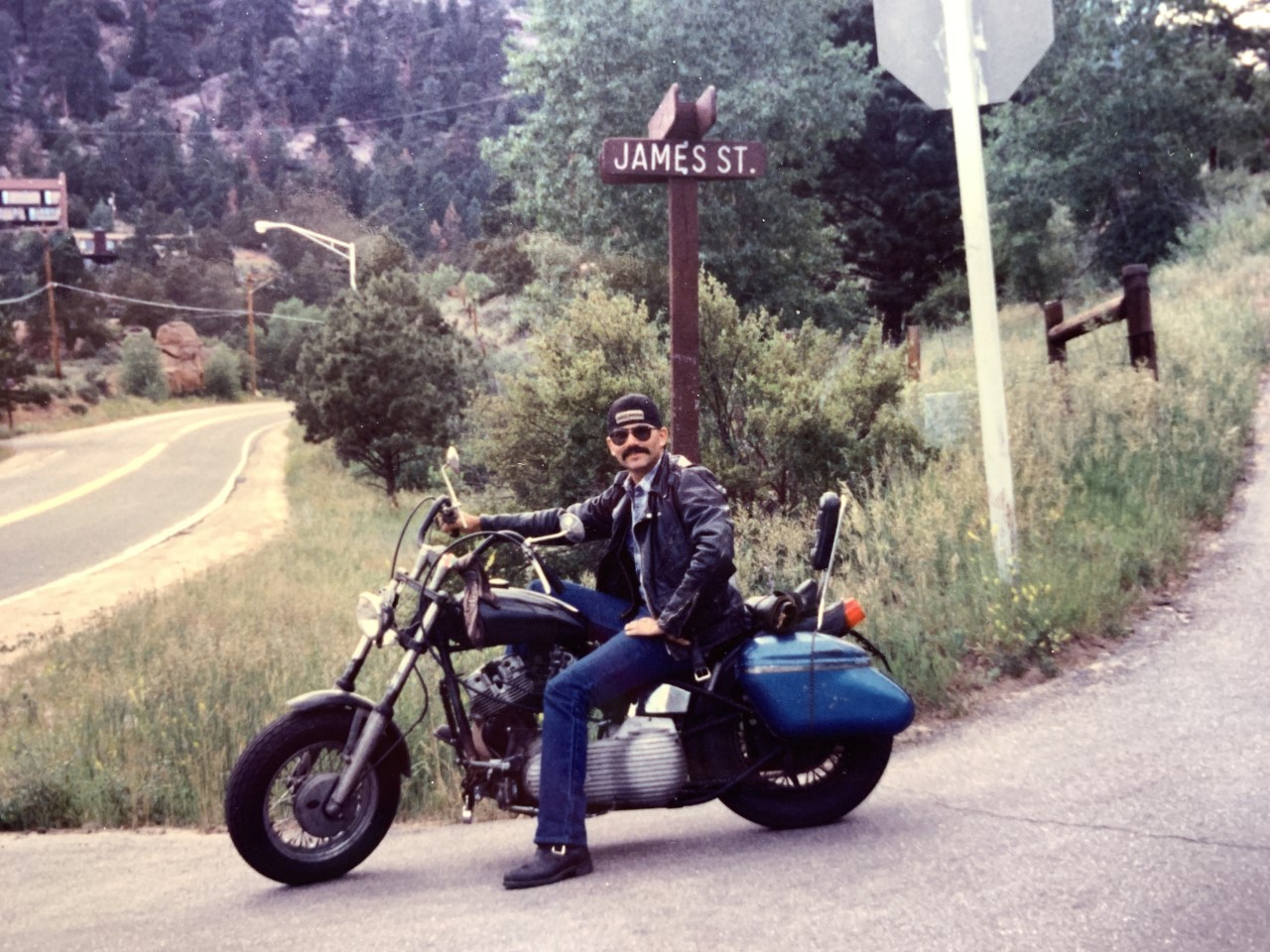
1985, at the Flea Market on Highway 290 east of Austin.1986, at J.B. and Dana’s house on Romeria Drive, Austin, Texas.1986, at J.B. and Dana’s house on Romeria Drive, Austin, Texas, with my stepdaughter’s mother.1987, at home on Wilmes Drive in Austin, with the sidecar for my stepdaughter.That’s her tricycle in the grass, and our roommate’s chopped Honda in the shed.Another view of the sidecar setup.Our intrepid tricyclist and our friend Bam-Bam, as the grownups get ready to ride out to the Rattlesnake Round-Up in Taylor.1988, at Redwood Lodge, Lake Whitney, Texas.1989 Southeast Texas enroute to an ABATE Texas function.1990-11-18 at Benny and Carol’s house in McGregor, Texas. From left: Carol, Benny, Michelle, Bill and The Bitch, Laura, John and Clifford. 1991-06-30, on a solo ride from Austin to Estes Park, Colorado, where the brother I hadn’t seen in ten years was teaching at a mountain-climbing school. I call this oneSunrise Sunday Morning, Texas Panhandle, June 30, 1991. Not hard to guess that it was taken at a gas stop in the Texas Panhandle shortly after dawn.Later that day, crossing into New Mexico. I had seen Townes Van Zandt perform at the Cactus Cafe in Austin the night before I left – his plaintive song ‘Snowing On Raton’ was stuck in my head – and I was hell-bent on riding through Raton Pass. I did, too, in the middle of the night. The view from Highway 7 south of Estes Park when it was a quiet two-lane country road, before the casinos were built and the road became clogged with tourists.
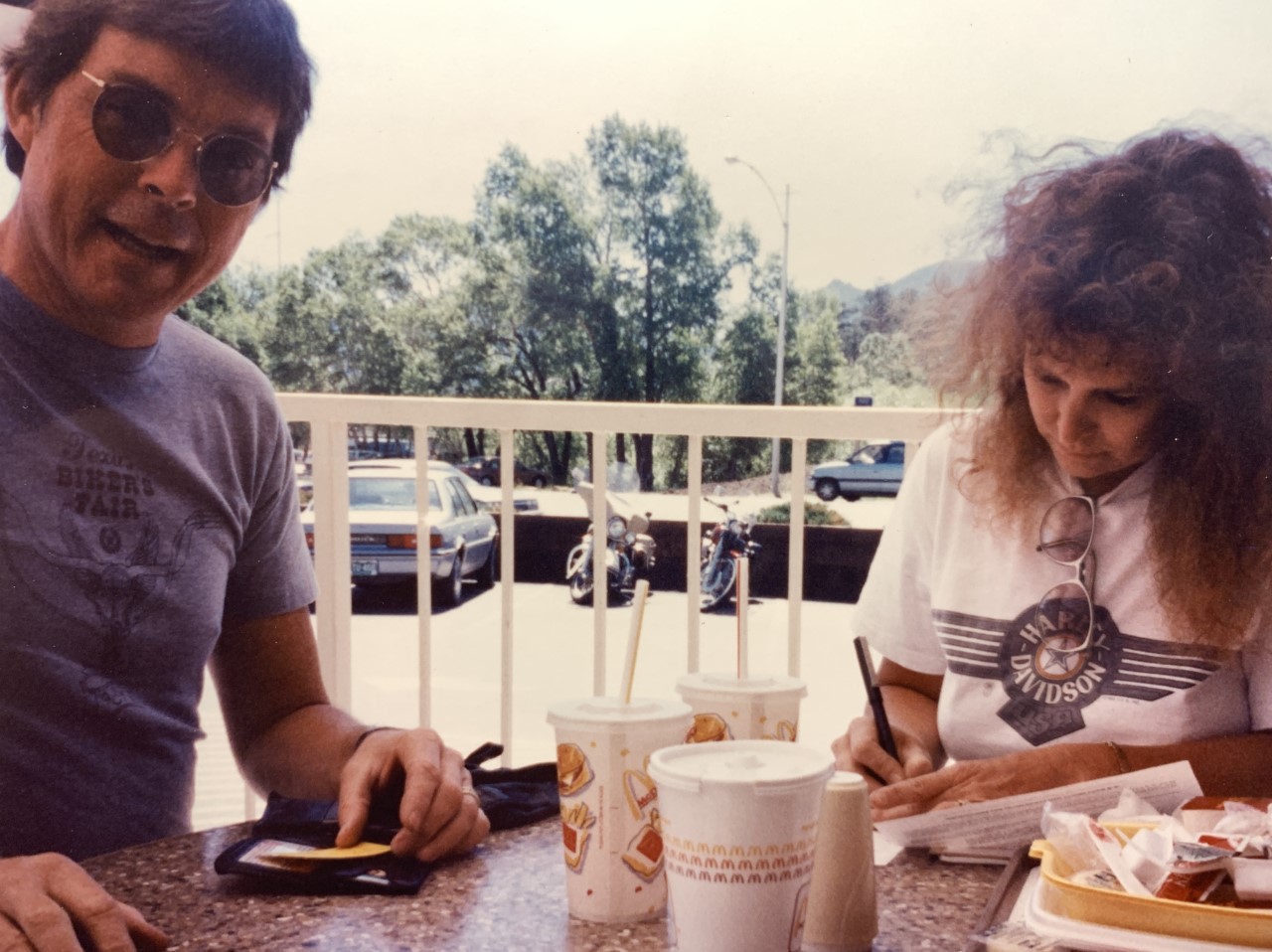
Below: I stopped at the visitor’s center in Estes Park, to get directions to my brother’s school. As I dismounted I heard two Harleys, and looked up just in time to see a familiar motorcycle pulling into the parking lot of a fast food restaurant across the street. I finished my visit to to the center, crossed the road and stumbled into the Mickey D.’s (so stupefied from being on the road that I stepped on some poor man’s toe in the process) and sure enough…! In town no more than five minutes, and who should I run into but T.R. Evans – the man I rode to Sturgis with; a man I hadn’t seen in almost a decade – in Colorado for a vacation with his wife! 😳 How’s thatfor a small world!?!
1991, T.R. and Kimberley, with their motorcycles parked behind them.
They were both up there on their motorcycles, so when I wasn’t hanging with my brother I was riding around with T.R. and Kimberly.
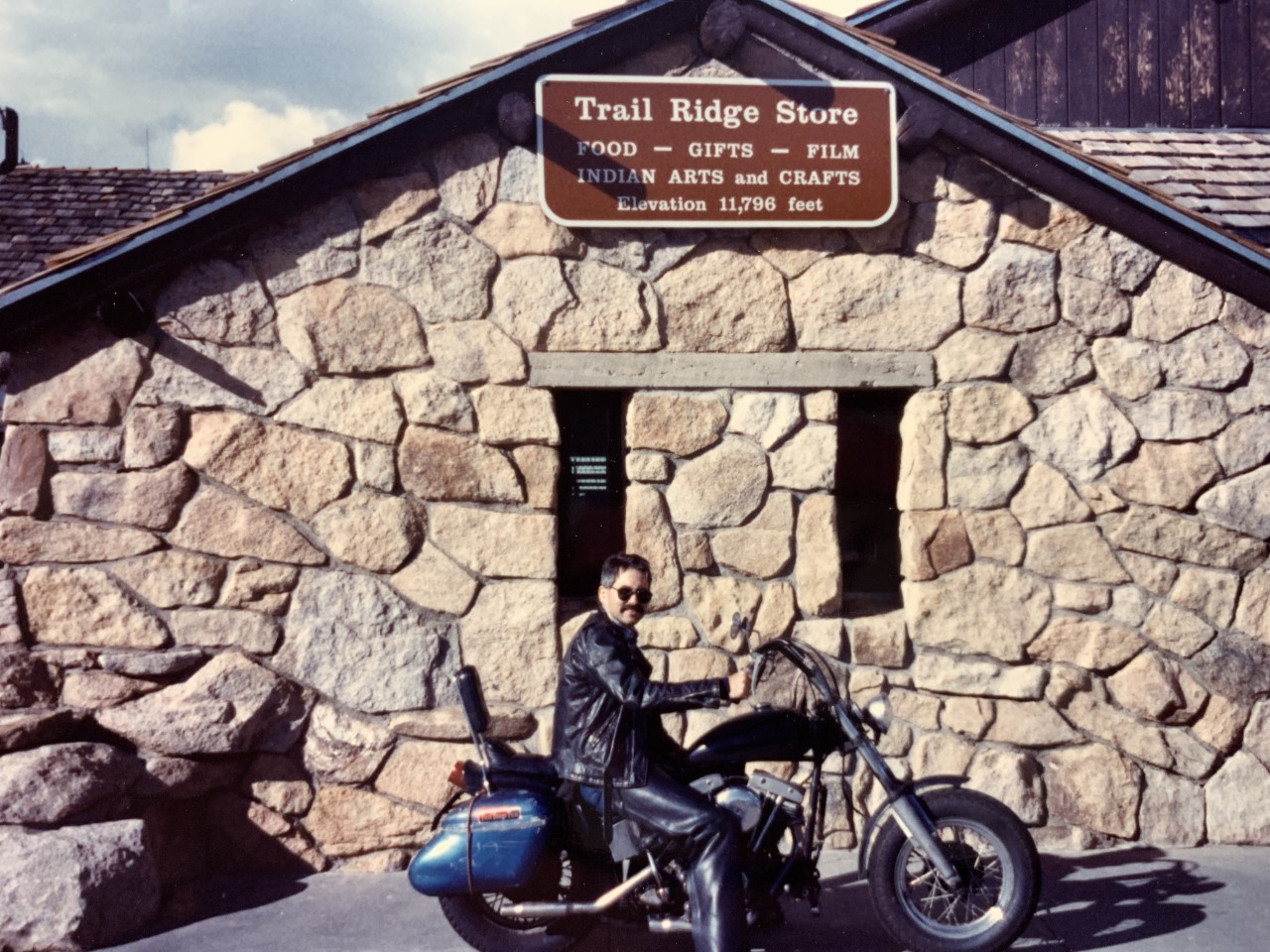
1991, heading up into Rocky Mountain Nat’l Park.1991, atop Rocky Mountain Nat’l Park, at 12,000′.
However, hanging with my brother was its own kind of adventure! Lee was a professional climber and mountaineering instructor and guide most of his adult life…. and when I say ‘professional’ I mean that he made his living at it. In fact, he was in Estes Park to teach a course at a well-respected climbing school there.
Our first day, we went hiking in the national park there; pretty tame, and nothing this flatlander couldn’t handle. However, our next excursion was a completely new experience for me. We were going for my first-ever ‘technical’ rock climb.
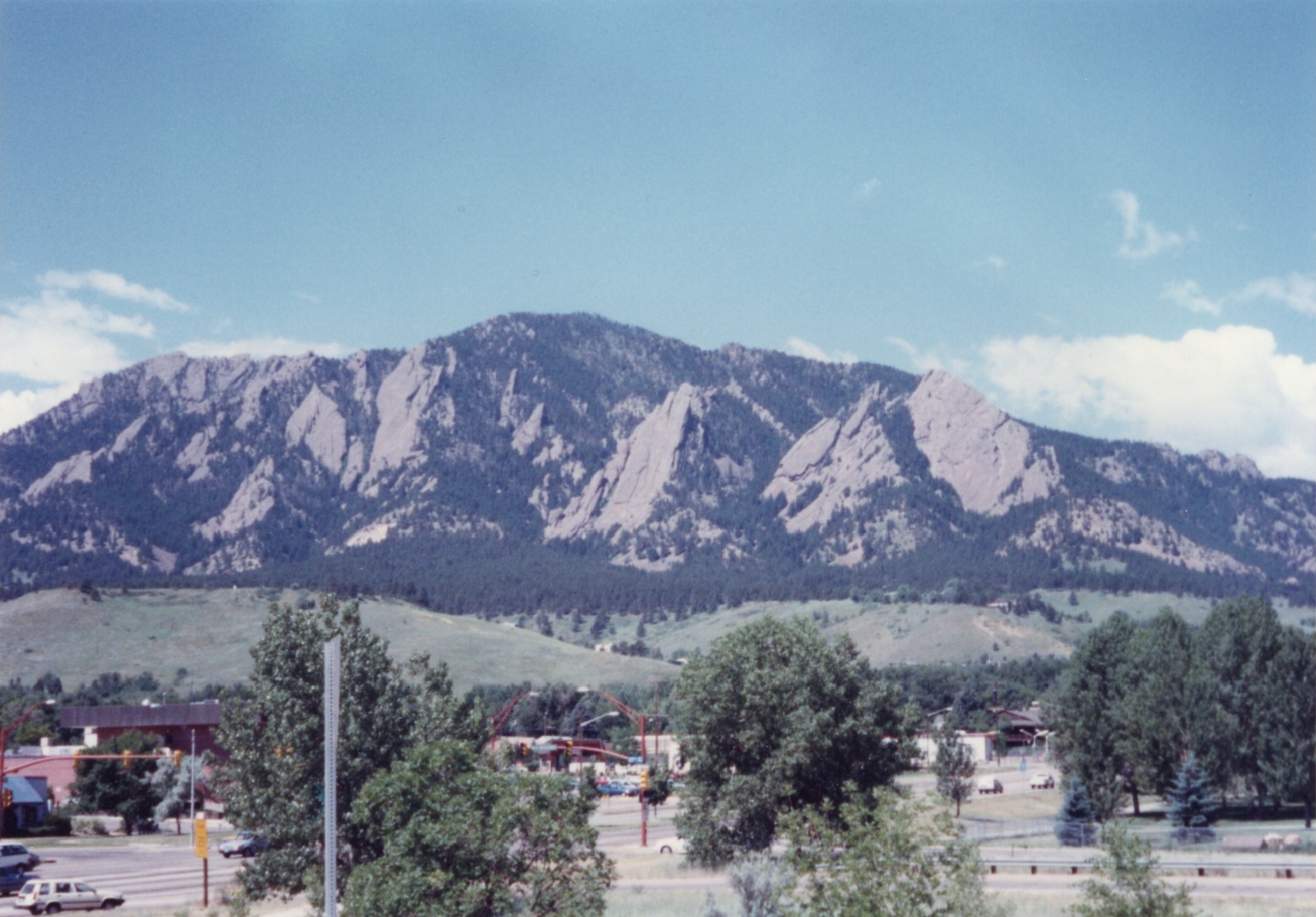
The Flatirons outside Boulder, Colorado. Lee, a professional climber and guide most of his adult life, took me up the face of the middle one. See the vertical scar just below the peak? Remember that.
Now, I’d done some scrambling up the cliffs near our home when I was a kid, and I climbed billboards for a living, but I’d never done anything like this!
We started the day at his school, where he borrowed some specialty rock-climbing shoes and a harness. Then we drove to the base of The Flatirons. Just looking at them, it’s not hard to understand how they were named.
The Flatirons are a popular climbing spot; so much so that the local climbing club had installed eyebolts on the rock to make it easier and safer to climb. This morning, we were fortunate to have the rock to ourselves; a rarity, Lee told me. At the base of our chosen rock face, he gave me a quick tutorial on rock climbing dos and don’ts, and terminology like ‘belay’, and then we were off.
I’m pleased to report that I impressed him during my climb, choosing my hand- and footholds carefully, not getting stuck. We were roped off – the ‘technical’ part of technical climbing, but I never needed belaying.
My brother in his element.
Then we got to that vertical scar near the top of the rock. Lee wedged a tiny aluminum thingie – a cam-operated device a climber can tie off to, which expands its width when force is applied – and roped me to it. My next move was to trust that cam, my rope and harness and my older brother, and lean back, allowing that cam to bear my weight.
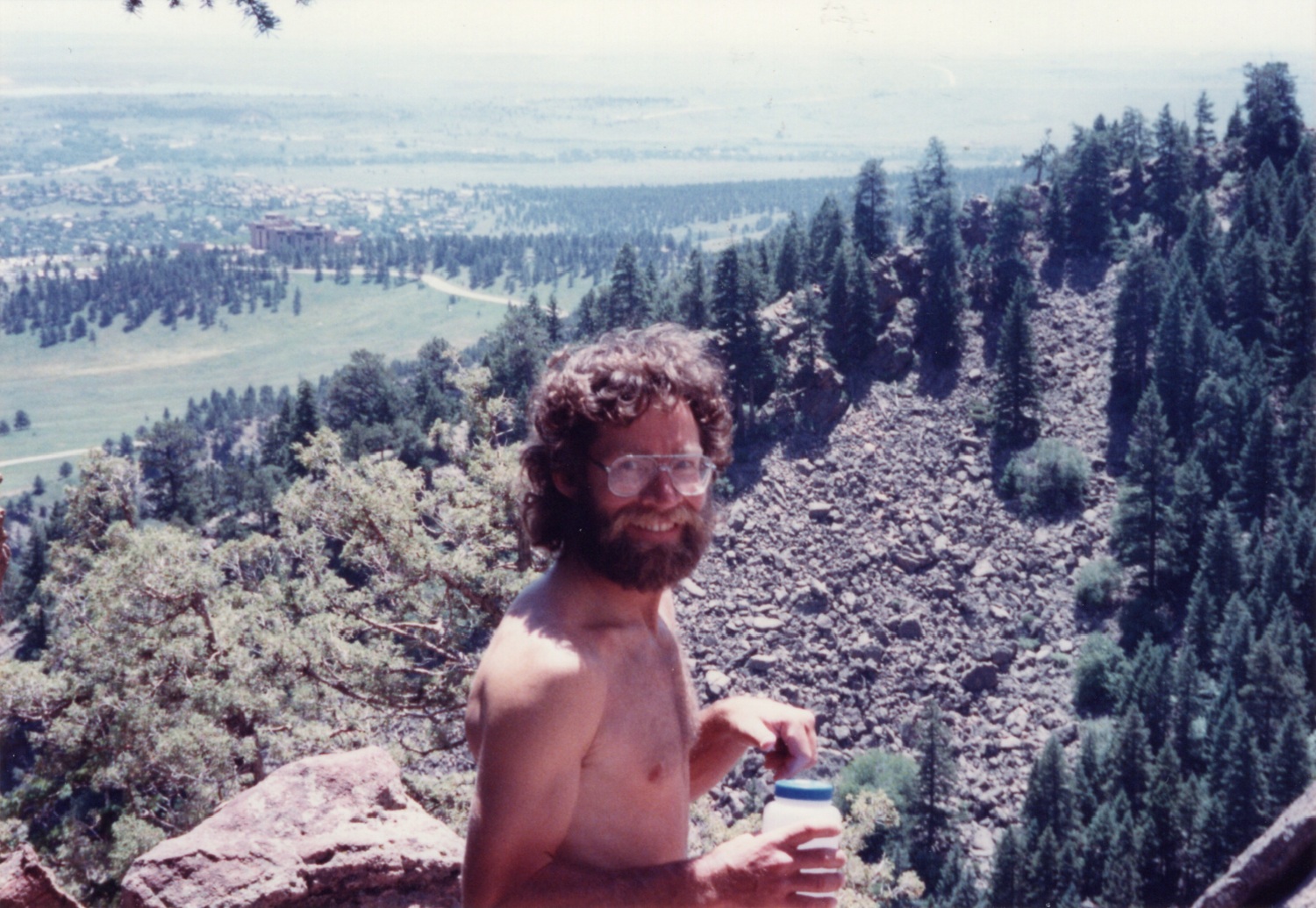
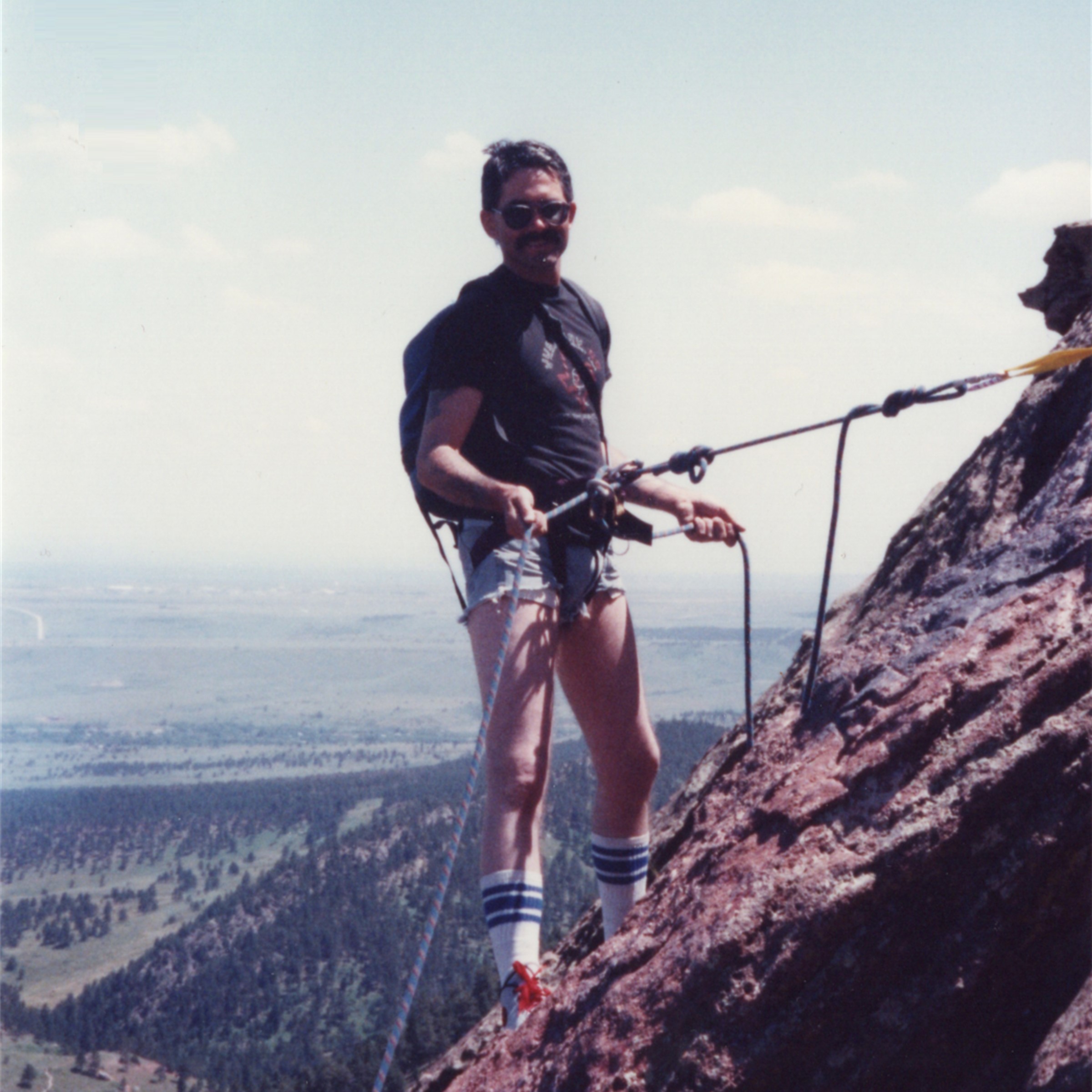
Remember the scar in the rock? I’m beside it in this photo, trusting my weight to the ropes, the tiny aluminum wedge I’m tied off to, shoved into a small crack in the rock face, and of course, my brother’s expertise. What a rush! By the way, that’s Denver in the distance.
There are no words to describe that moment of surrender to gravity and good fortune. First the fear: Am I doing this right? Will the cam hold? is this rope strong enough? That harness? That strap? Then comes the giddy realization that everything worked, you didn’t screw up, and you’re still alive! 👍🏼
Nothing like it!
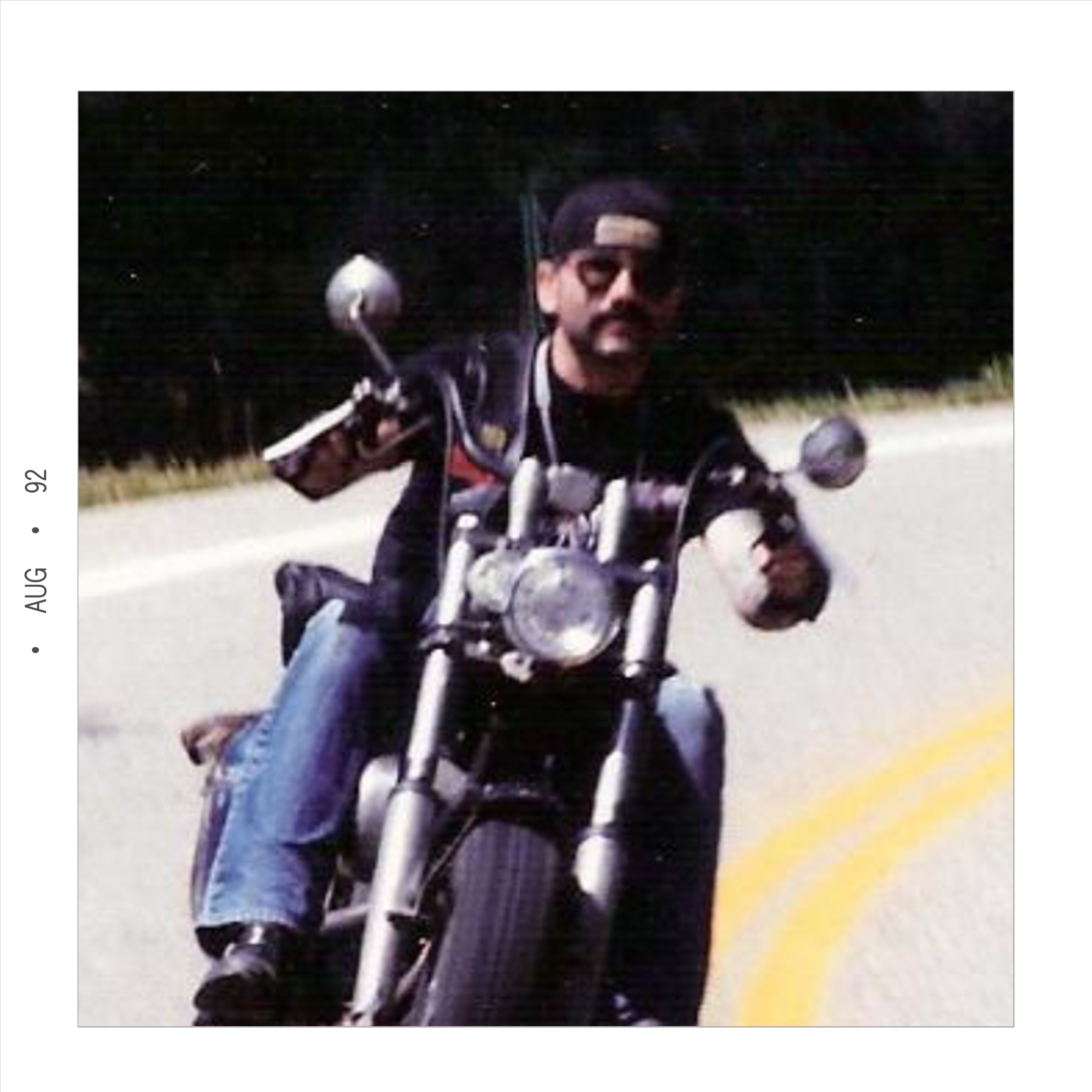
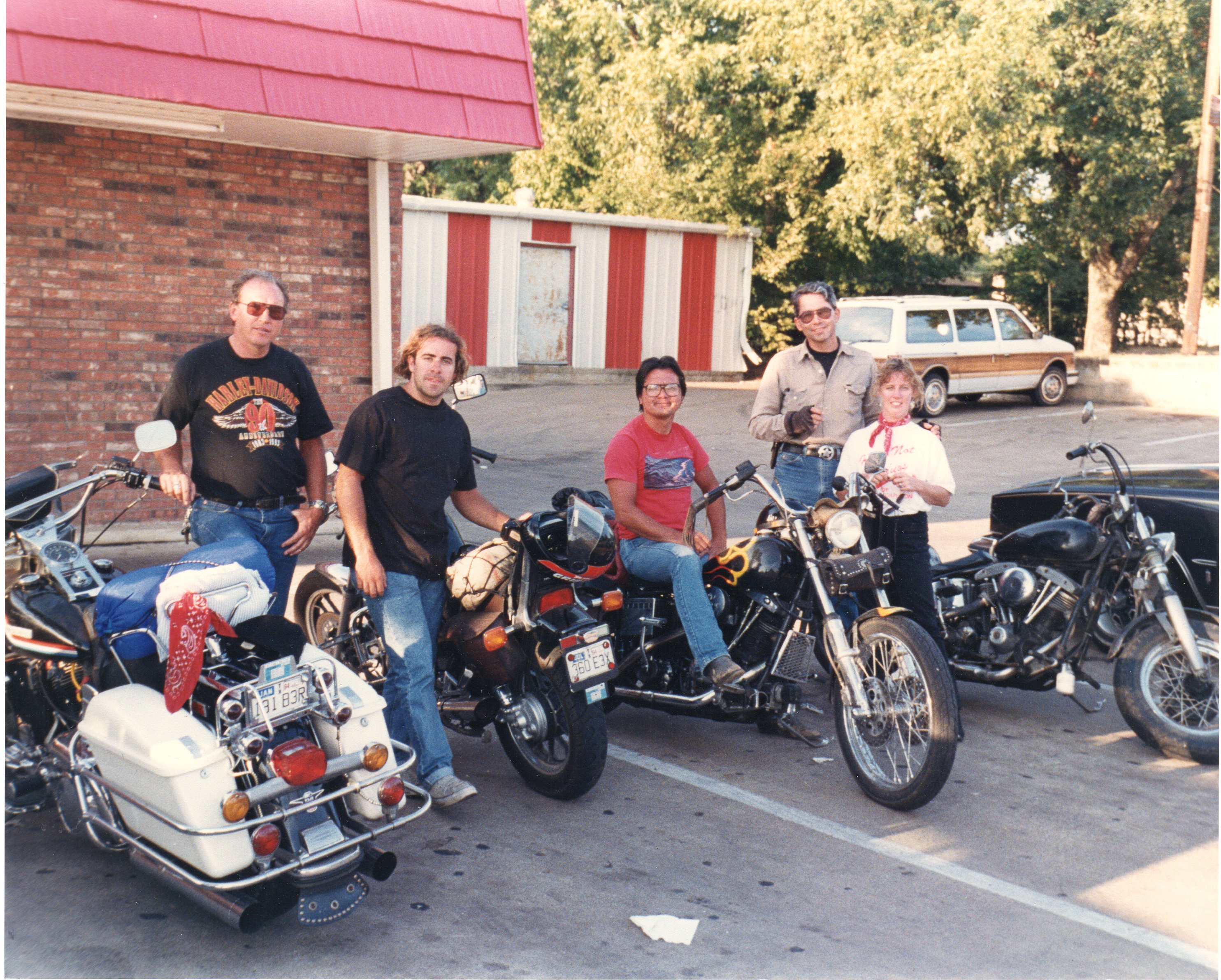
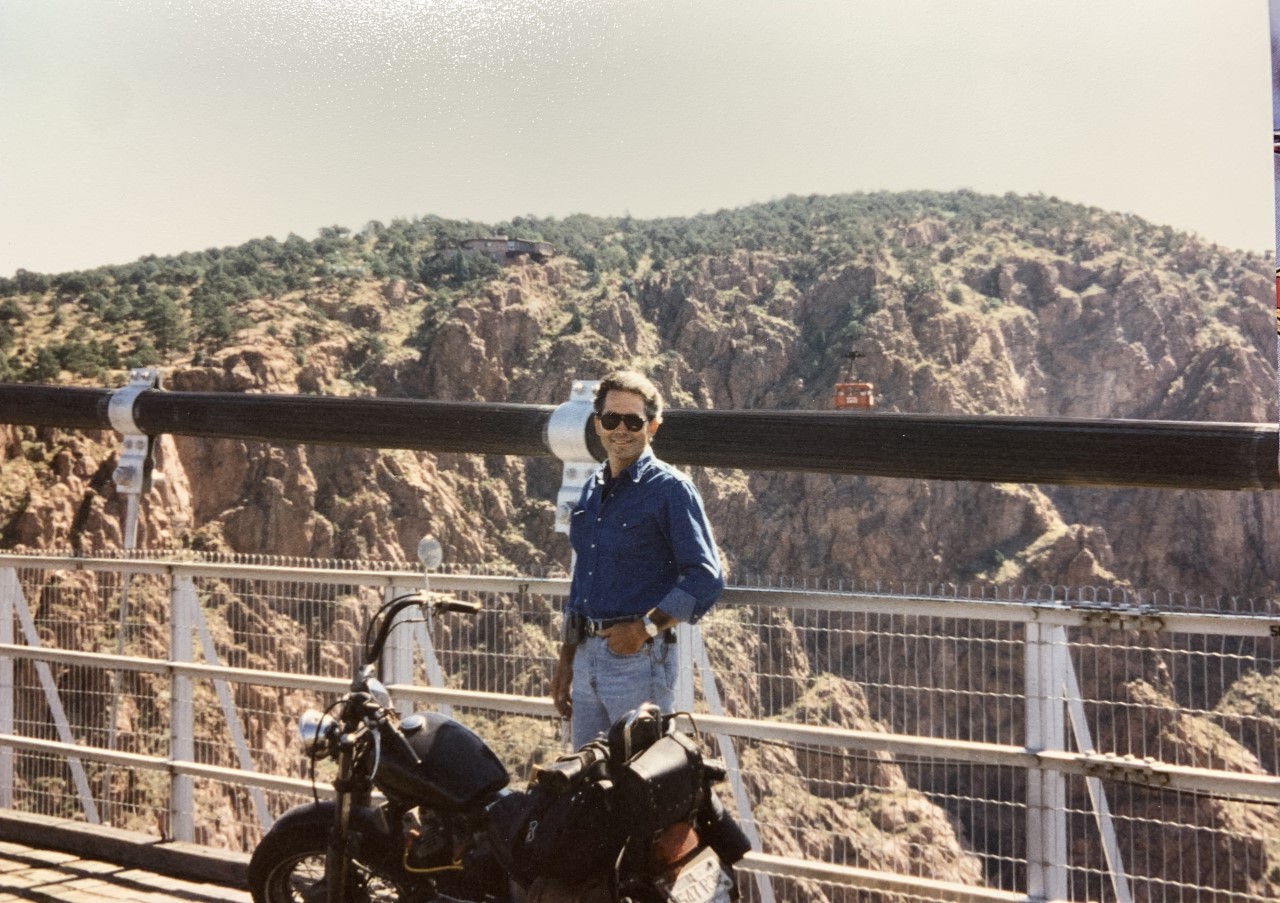
The following summer, July, 1992, riding through the Black Canyon of the Gunnison, Colorado, with Peno and Steve.The Black Canyon of the Gunnison. Great riding country!We were attending a motorcycle rally in Montrose, Colorado, on the Western Slope. That’s Steve at left, and his burgundy-colored panhead behind him. Peno, at right, was my road dog for most of my best adventures during those years. I have just recently (April 2023) reconnected with both men.Peno on his shovelhead, with the flame-job paint he did himself.Steve on his panhead: one happybiker !1993, July 4th, a solo ride to meet up with a friend in Lake Eufala, Oklahoma.The friend in question, Byron, on his beautiful and relatively unmolested 1972 FLH with the original Brandywine paint.1993, Labor Day Weekend, a group ride to Lake Eufala, Oklahoma, to visit Byron. From left: Paul, Jeff, Peno, Bill and Melissa B.1994, July, ride through Four Corners region of Colorado, New Mexico, Arizona and Utah.Peno took this shot one-handed at about 65 MPH.1994, on IH35 in Belton, enroute to the annual Tri-County Toy Run.1995, on the bridge over Royal Gorge, Colorado. That time it was me and The Marlboro Man, a genuine cowboy named Don Sawyer (RIP). Don had been hired to judge a quarter-horse show in Colorado, so we loaded our bikes in a rented van and hauled them to Colorado Springs I’d spend the day exploring the mountains on my bike while he judged the horses, and at night we’d ride out to get supper and chase pretty girls.
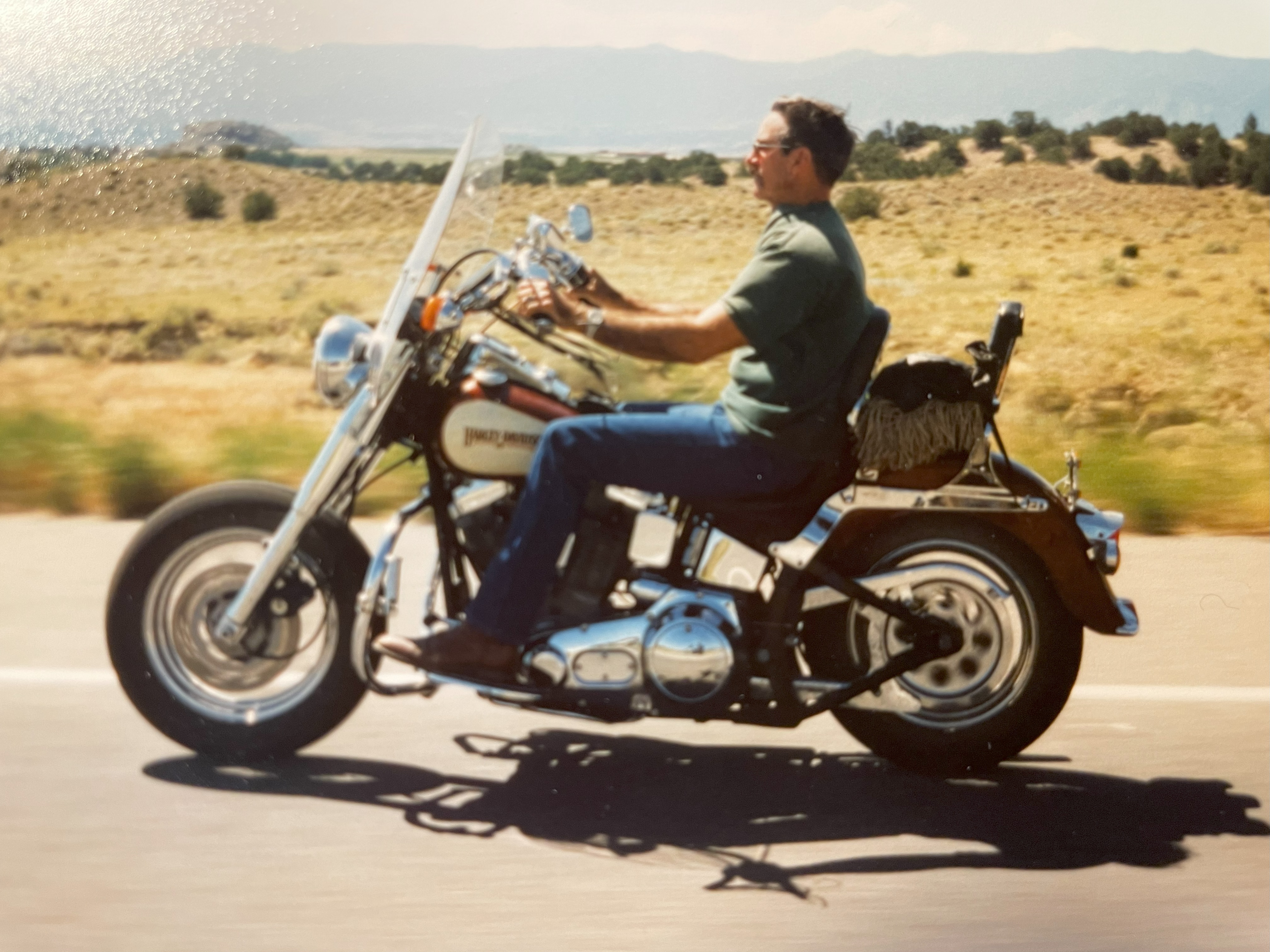
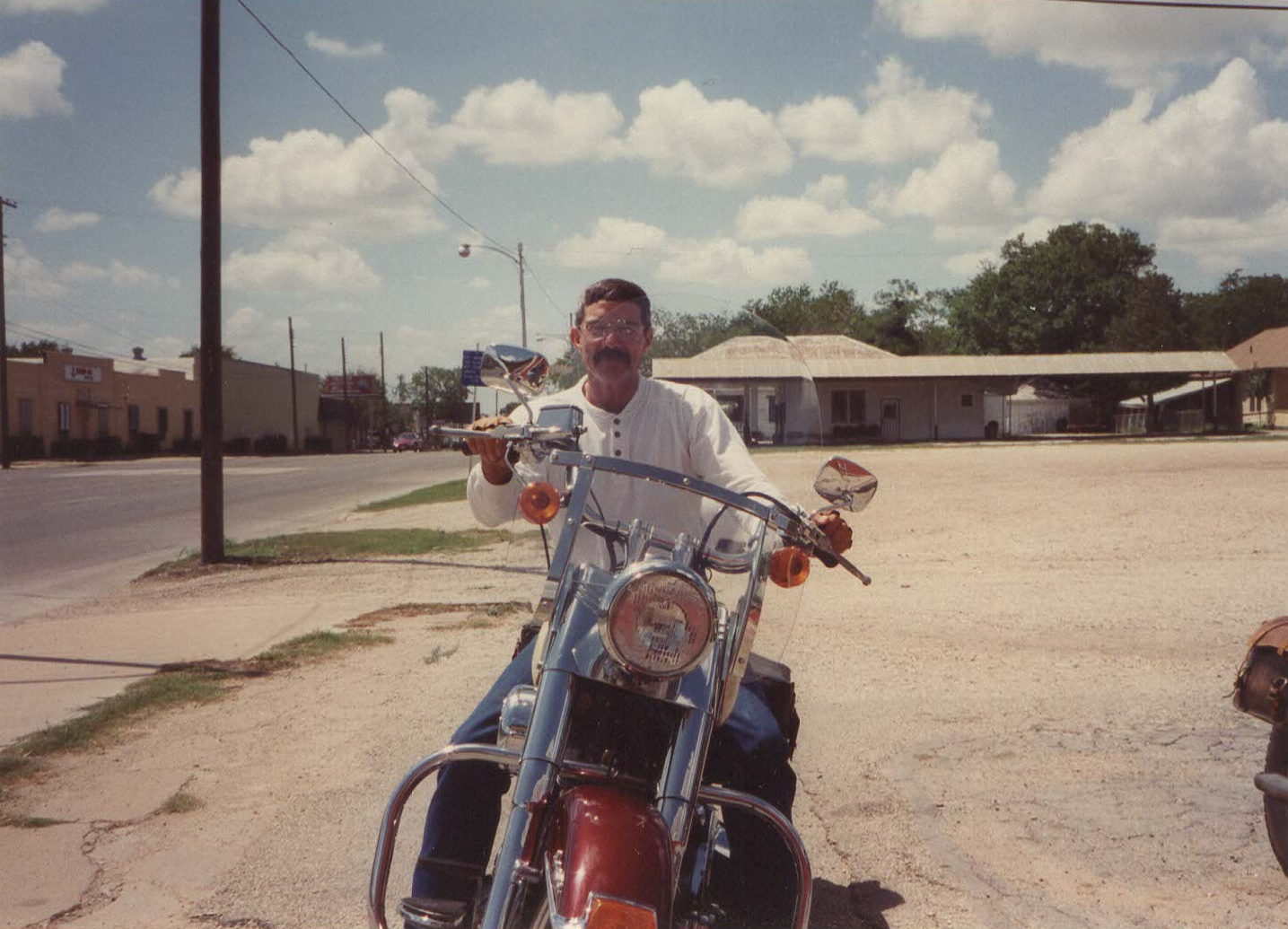
Don would tell ’em we were brothers; there was some resemblance, TBH. He also told folks I was ‘Harley Davidson’ and he was ‘The Marlboro Man’ – after the Mickey Rourke/Don Johnson film – and then have a good laugh about it. We also did Skyline Drive above Cañon City; me on my shovel and The Marlboro Man on his Softail. A couple of years ago Jackie and I drove Skyline Drive in my van, and it gave her the willies the whole way over. Me, I love it!Don Sawyer on his Softail, on the road in Colorado. in 1995Don Sawyer on his Softail at Mikeska’s BBQ in Taylor, Texas. Any wonder he was known as The Marlboro Man? RIP, cowboy.2000, with Jackie on the back, at Monument Cafe, Georgetown, Texas, for breakfast with our friend Tina.2001, in Crawford, Texas, with Randy and Tina.2004, January, a winter ride on a back road near La Grange, Texas. High temp that day was 47 degrees.
In July, 2004, at the age of 48, I fell 35′ from a billboard structure, when a piece of the board’s face came loose. I rode the ladder I was standing on all the way to the hard rocky Hill Country earth, and ended up with an open compound fracture of my right leg, numerous fractures in my left mid-foot, and a burst fracture of my L-4 vertebra, which caused catastrophic nerve damage to the cauda equina that controls everything south of the waist, and I mean everything!
After fourteen days in hospital, numerous surgeries and a near-fatal hospital-borne infection, I went home to a wheelchair and a rented hospital bed, with lots more to come. Still, at the end of October I limped out to the driveway, kickstarted The Bitch and took it for a ride around the neighborhood.
2004, Halloween, and my first time on the bike since my on-the-job accident that July.
I’ve probably made smarter choices in life, but it seemed important at the time, and sure felt good!
2004, Halloween, and my first ride after my accident.
A lot has happened since then, including another makeover of The Bitch and a return to A) another blue paint job, B) another set of fat bob tanks, C) another pogo-stick and D) another windshield, all to accommodate my back and leg injuries. More about adapting motorcycles for disabled riders here and here, if you’re interested.
2008, and yet another makeover: late-model fat bobs (less likely to crack and leak) with a traditional pogo-stick saddle, adapted to fit the new fat bobs, and a windshield, to save my back muscles having to fight against the wind at highway speeds, but……my body no longer wants to cooperate.
The pogo-stick and windshield arrangement was good for a while, but remember the nerve damage I mentioned? Yeah, that nasty nerve damage has come back to haunt me.
One of the nastier tricks it plays on me (and the nasty tricks are legion, believe me!) is that my right knee gives out with no warning. It’s been doing it since I first got out of the hospital, but that particular trick has become more frequent as the years since my accident go by, to the point where I can no longer feel safe riding a two-wheeler, so….
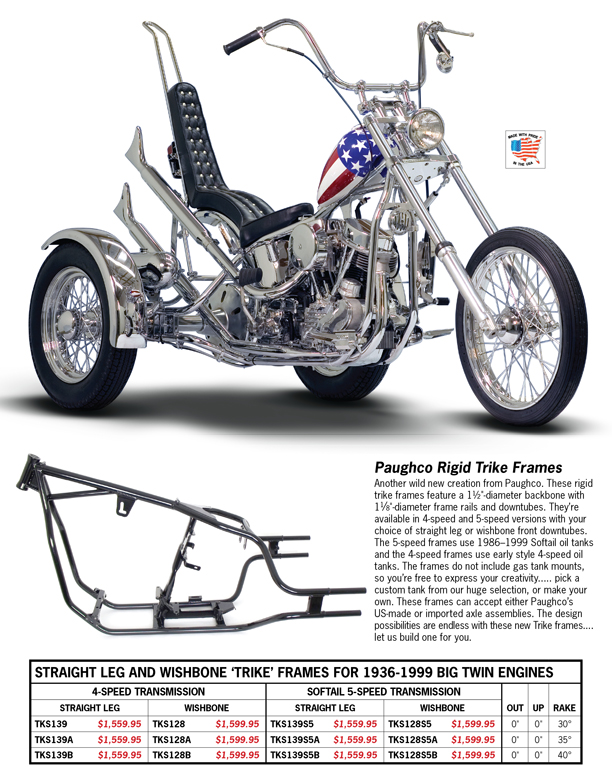
…meet my new wish-list! I can either pony up the $25,000 to $30,000 people are askingforlate-model Harley three-wheelers, or stick my dearly beloved Bitch in a three-wheeled framelike the one Paughco offers,One way or the other, I have got to get back in the wind!
Watch this space for updates!
UPDATE, April 16, 2023:
Paughco no longer makes the frame I’d been saving my pennies for 🤬 and I searched all over for another manufacturer, to no avail. Plenty of swingarm frames, and a few neo-chop rigids, but nothing that mimicked the traditional Harley frame the way Paughco’s did. Since I’d lost touch with (or lost) the people I would trust to adapt my existing frame the old-school way, using a Servi-Car rear end, I caved and bought a 2016 Freewheeler. Less than a month later I reconnected with an old friend who – ain’t that the luck? – runs a custom frame shop in Dallas. 😤 Maybe after I recover from buying the Freewheeler he and I can talk about triking my shovel. Hope springs eternal!
Meanwhile, meet the newest addition to my family:
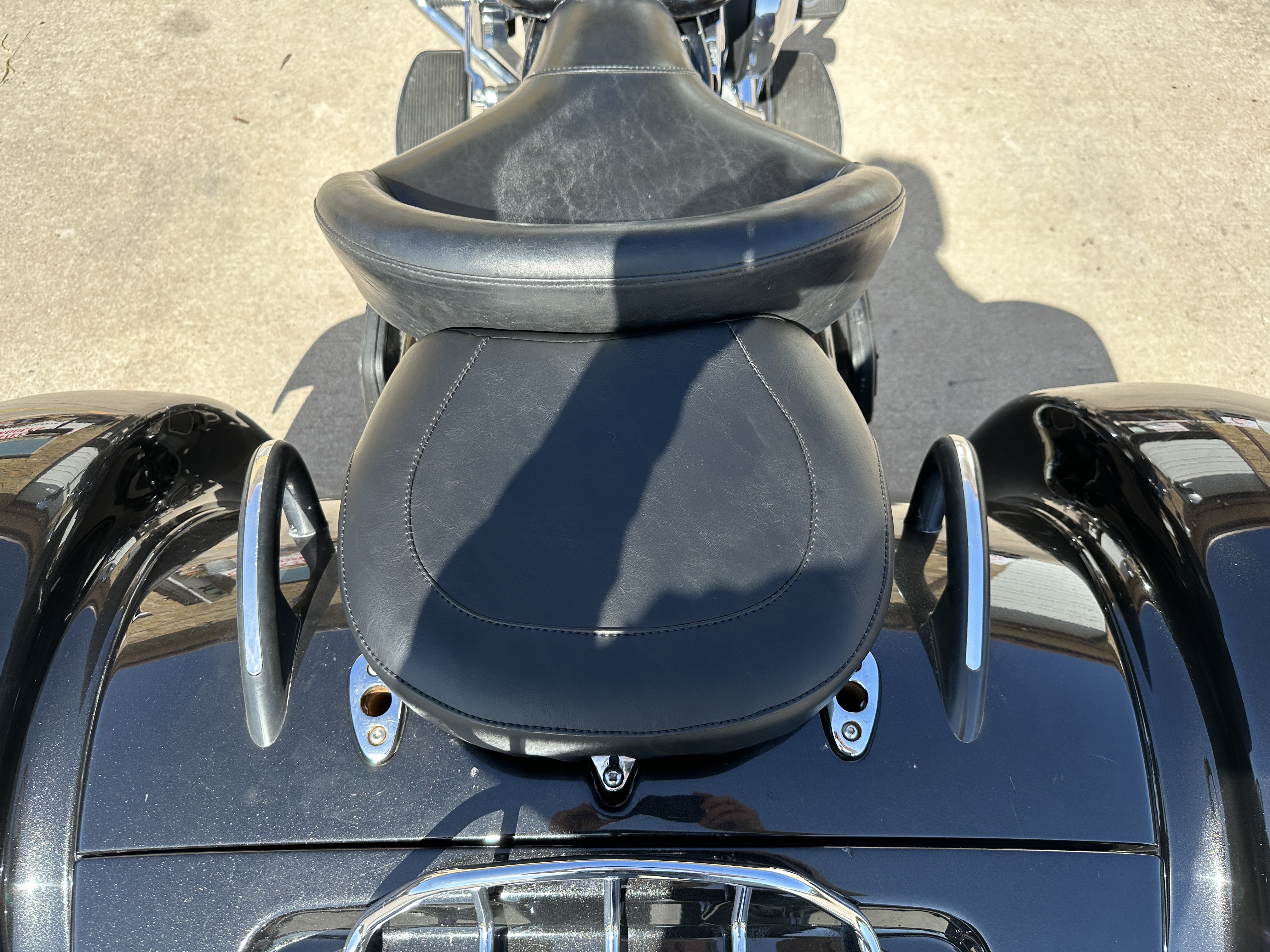
My new-to-me 2016 Freewheeler. It’s a long way from a stripped down rigid shovel, ain’t it? Now I just have to unlearn forty-four years of riding two-wheelers! 😂I took the FXRP saddle I’d souvenired from my totaled FXRS and had custom mounts built for it. Then I had Bob Lee Peña at Steelhorse Saddles in Liberty Hill, Texas, make a pillion pad for it. He did a great job – like a factory fit – and was really reasonable about it.All the good! Gets my hips level with my knees (important with injuries like mine) and works like a champ! Between that and the windshield, I can start rebuilding those atrophied mileage muscles!
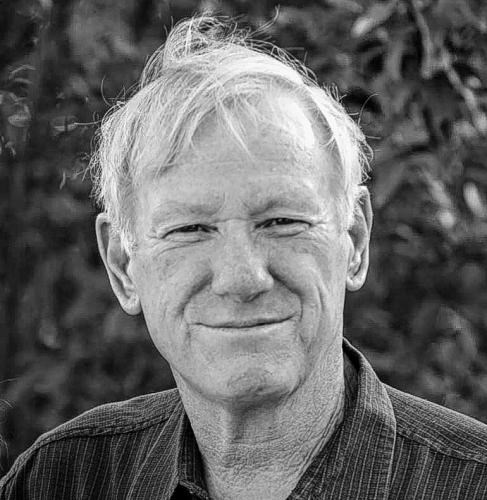
ABOVE: Bud Reveile on 7 January 2015, a couple of months before he passed away. All photographs by author unless otherwise noted.
Four years ago today we lost one of the best men I’ve ever had the privilege of knowing.
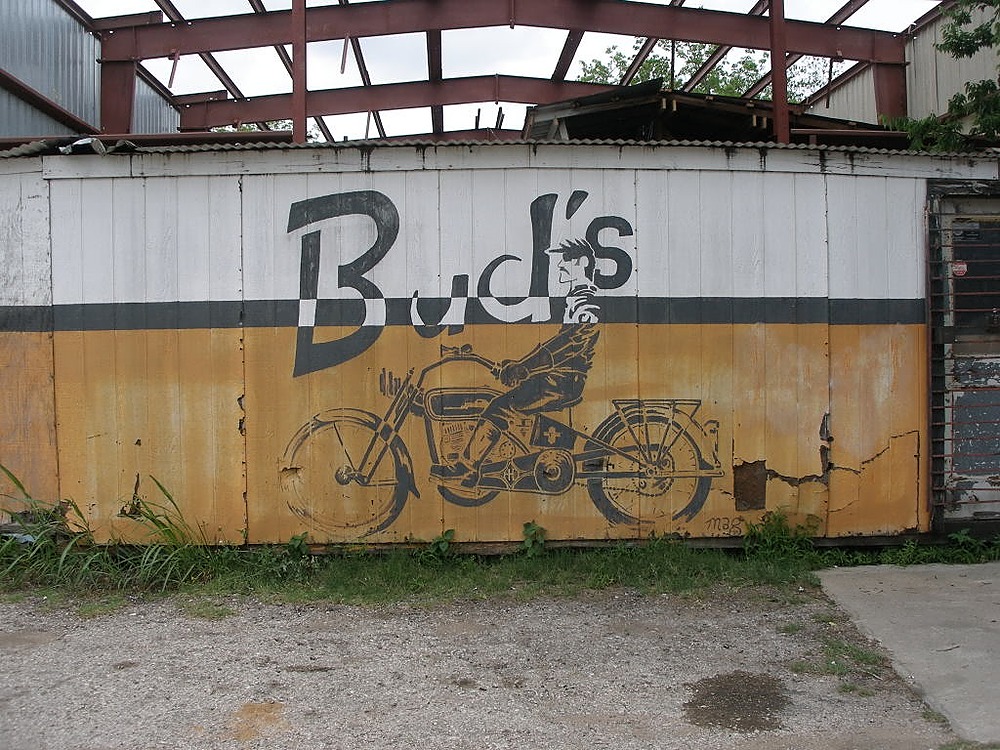
ABOVE: Bud’s front door at his shop’s penultimate address. Photographer unknown.
Bud Reveile was a Vietnam veteran; a U.S.M.C. tanker whose story was included in Oscar E. Gilbert’s Marine Corps Tank Battles in Vietnam. He was a devout Christian and family man, and a lifelong and benevolent member of the East Austin community.
ABOVE: My shovelhead right after I switched to a rigid frame in early ’80, in front of the tin shed that held Bud’s original “showroom” and mechanic’s bay. The notorious school bus is visible at top left.
Bud was also a dyed-in-the-wool Harley man, a walking encyclopedia of all things Harley-Davidson, and a natural-born good guy. He could talk to anyone – Bud maintained friendships with outlaw bikers and cops, Christians and atheists, bankers and b-girls and bums – and he did his level best to treat everyone with respect. He had very few enemies, and the only ones I ever met were only enemies because Bud wouldn’t give them something for nothing. He was a businessman – a true old-school horse-trader who worked hard to make a buck – but Bud was honest, and in all my years of knowing him I never saw him take advantage of anyone.
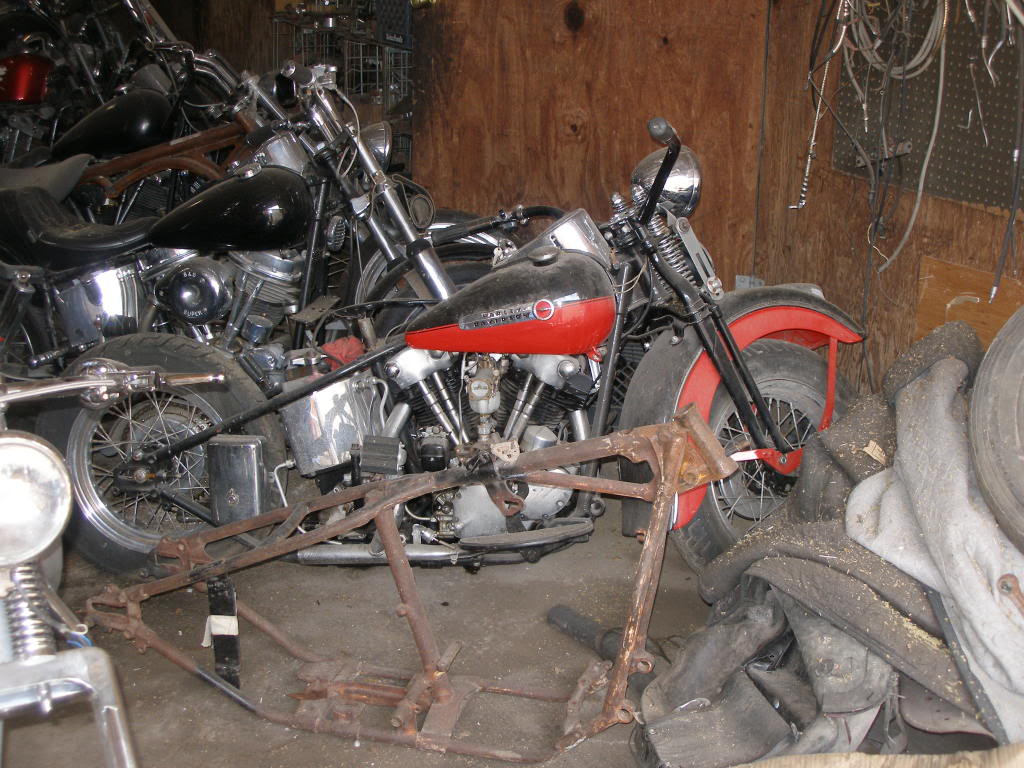
ABOVE: Knuckles and Pans and Shovelheads, oh my!
Bud built his business the old-fashioned way, beginning (just like Harley and the Davidsons themselves) in a backyard shed behind his North Austin home with some tools, a small collection of used motorcycle parts, and his experience working at Harley dealerships in California and Austin.
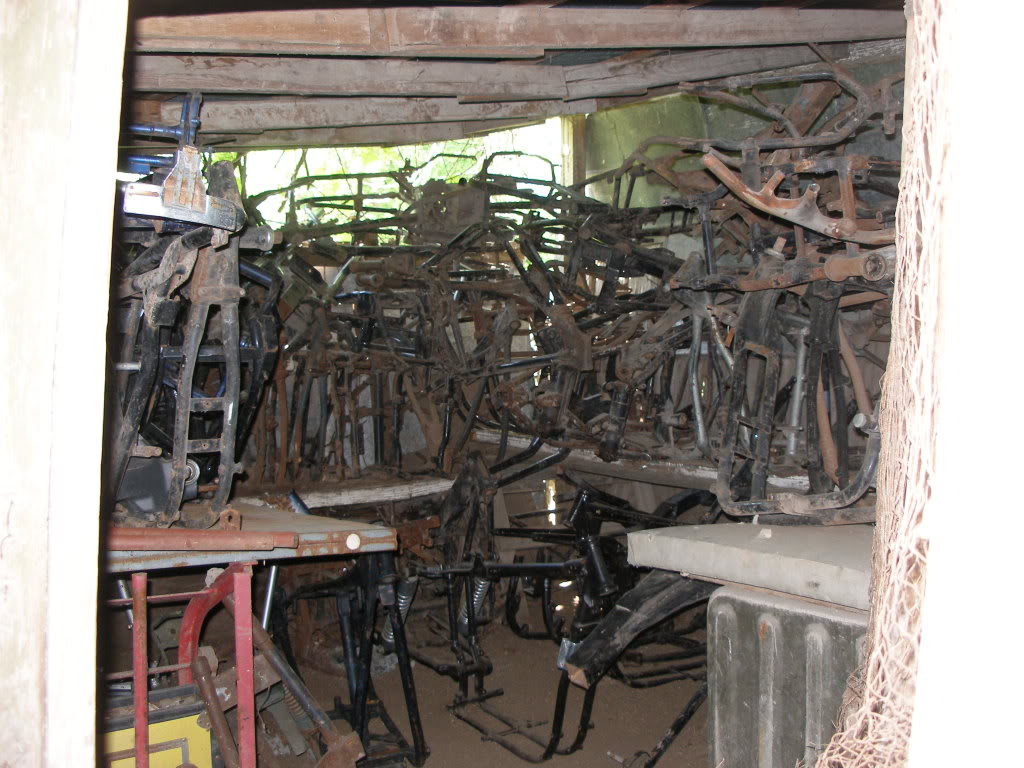
ABOVE: Frames, fork tubes, primary covers and more, just hanging from rafters or crammed into corners.ABOVE: Front forks, fenders and fat bob tanks as far as the eye can see!
In April of 1979 Bud moved his operations to the grounds of a defunct lumberyard in East Austin. There a Spartan tin shack – unheated in winter, un-air-conditioned in summer, noisy and dusty all year ‘round – served as mechanic’s bay, showroom and office, while erstwhile lumber bins held his burgeoning parts inventory.
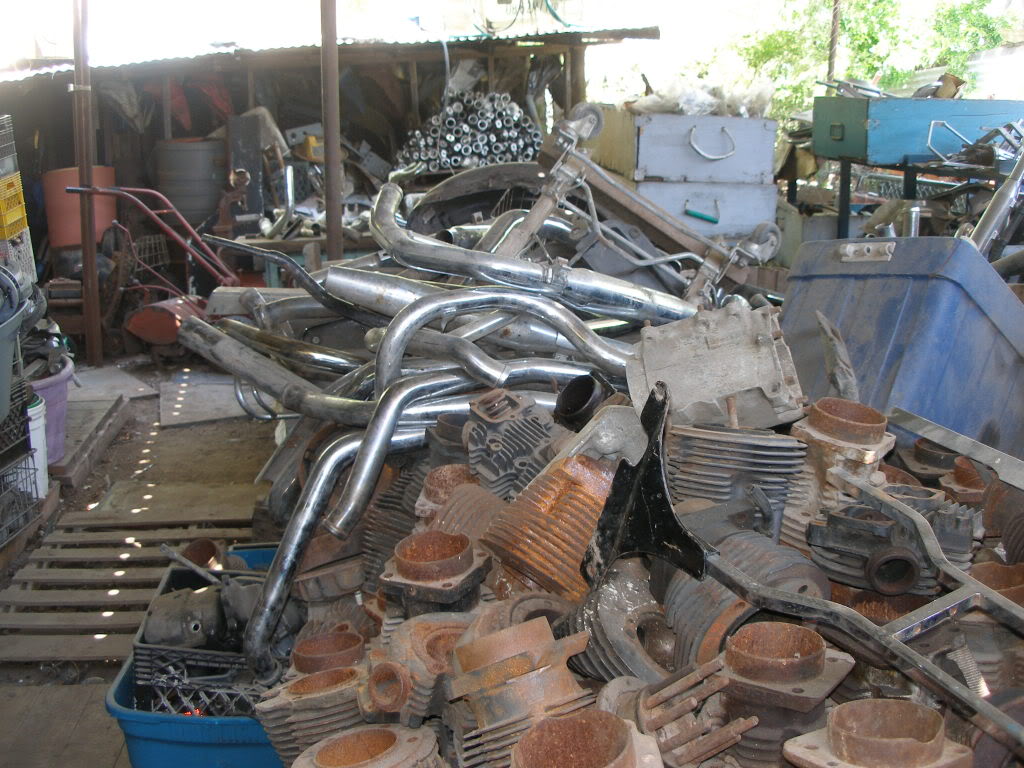
ABOVE: One man’s trash is another man’s ‘Damn! I can’t believe I found this!’ 😮
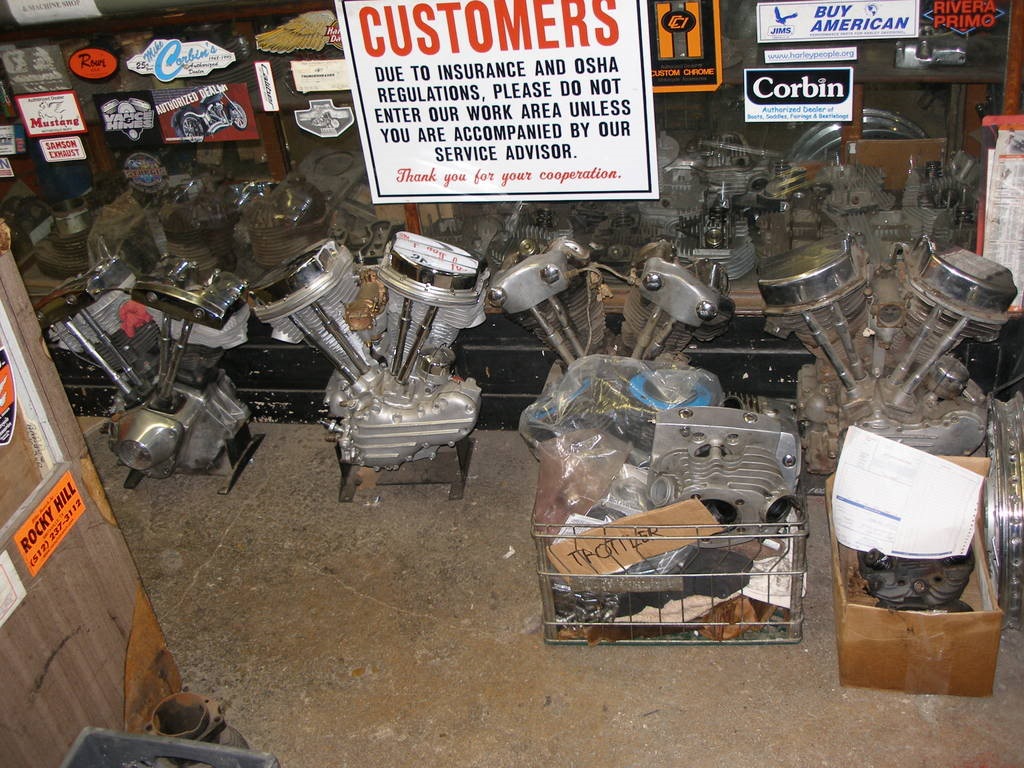
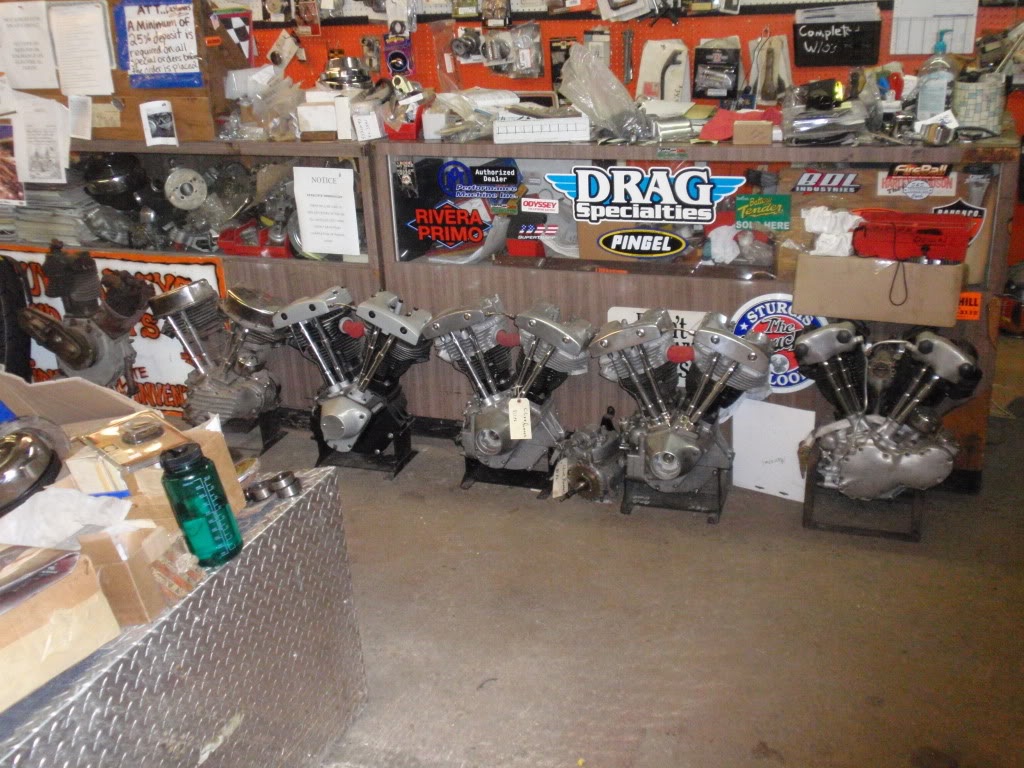
Over the following 36 years, Bud created a sprawling compound that eventually covered more than a quarter of a city block. In a ramshackle series of structures – some built, others acquired or repurposed and all interconnected – Bud kept aisles and aisles (and piles and piles) of old and odd motorcycle parts jumbled up in glorious disarray. There were tons of new old stock – OEM and aftermarket pieces painstakingly gathered from shops that were going out of business or dealerships purging their parts departments – and all stacked right alongside all the bent, broken, rusted, oil-soaked parts salvaged from a thousand different spent and clapped-out motorcycles.
ABOVE: If it came off a Harley, or might fit on one, Bud had it laying around somewhere!
There was everything a rider might need to repair an old machine, customize a new one or, for that matter, build herself one from the ground up. Visiting Bud’s shop was like stepping back in time to those halcyon days when Harley shops were unique, one from another, instead of the prefabricated corporate clothing boutiques they’ve degenerated into. For those of us who care about such things, Bud’s was Disneyland! 😎
ABOVE: Fifty years of Motor Company history sitting there! And if that’s not enough for ya….….let’s go for eighty years! 😎ABOVE: My shovelhead outside Bud’s perimeter fence, late 1979 or early ’80. Over the fence are the lumber stalls, now enclosed to create mechanics’ bays downstairs and parts storage upstairs.
I first met Bud in the late spring of 1979, when another biker gave me one of Bud’s cards. I had just gotten my first Harley, and wanted to learn everything I could about them. When I saw that Bud was the real deal, I quickly asked if I could become a shop hang-around. I would come in after work and on weekends, exchanging free labor for the occasional discount motorcycle part and a far more valuable education in all things Harley-Davidson. By the fall of that year I was working there full time, and in one way or another I kept working there for the next 36 years.
I just tell folks I forgot to quit! 😏
ABOVE: Originally the yard office for the lumberyard, that little shack became my home on more than one occasion. No heat, no A/C, no bathroom, but it kept me and my shovel out of sight of the repo man! 😏
Jack-of-all-trades what I was, I helped build various add-ons to the shop, including closing in the old lumber stalls to create additional mechanics’ bays, and reinforcing the second story so parts could be stored there. I ran electrical systems throughout as the business sprawled across first one, then two, and finally three separate lots known to all and sundry as 2612 East First Street. I worked as a shop grunt, with my elbows deep in the muck of the parts washer, became a parts man and mechanic, and even lived on-site for a while during periods of homelessness, doubling as night watchman while hiding my as-yet-unpaid-for shovel from the repo man. I also served as publicist, writing articles about Bud and the shop for national magazines, and provided backup on the rare occasion when a situation so demanded.
I just tell folks I was a Known Associate of the shop. 😎
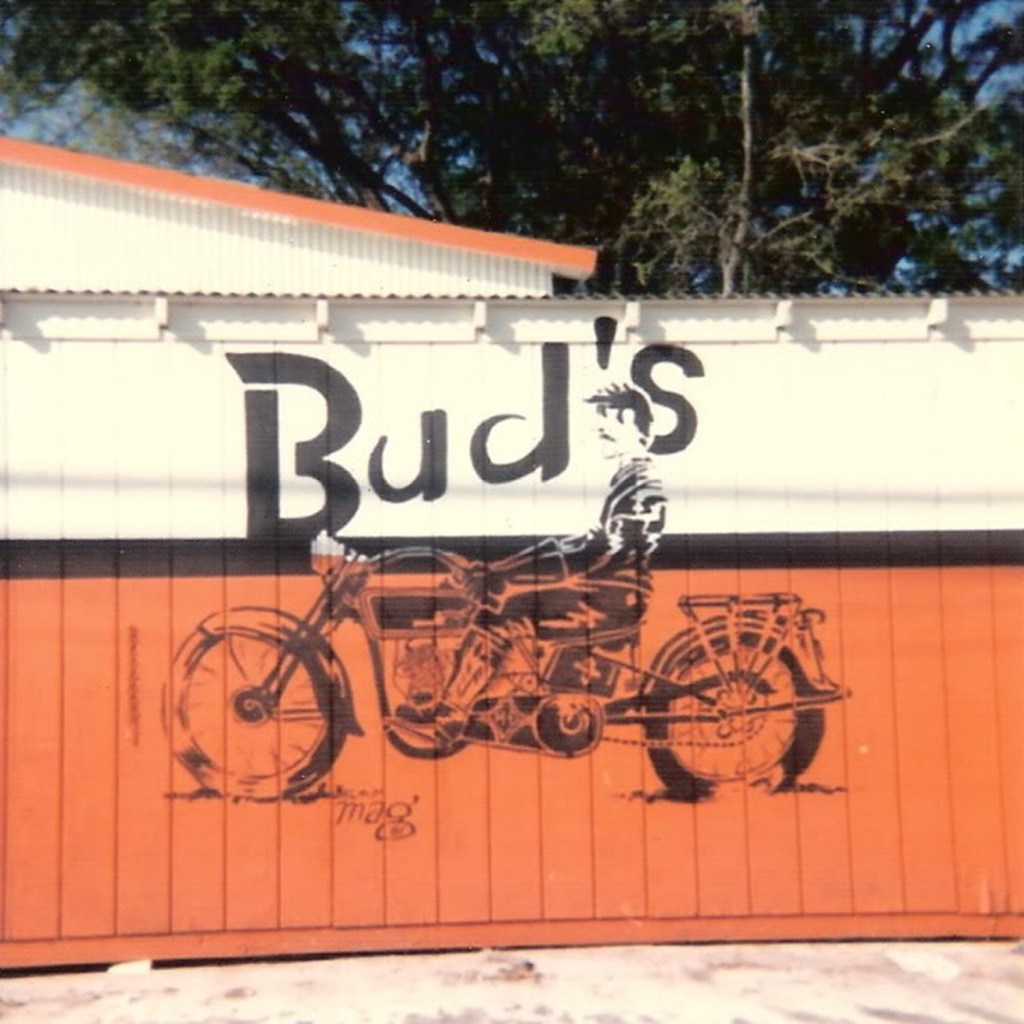
ABOVE: A profile I wrote about Bud, back in the summer of 1991.ABOVE: Bud’s logo, created and reproduced here by the artist Gaylyn Maxson, aka MAG.
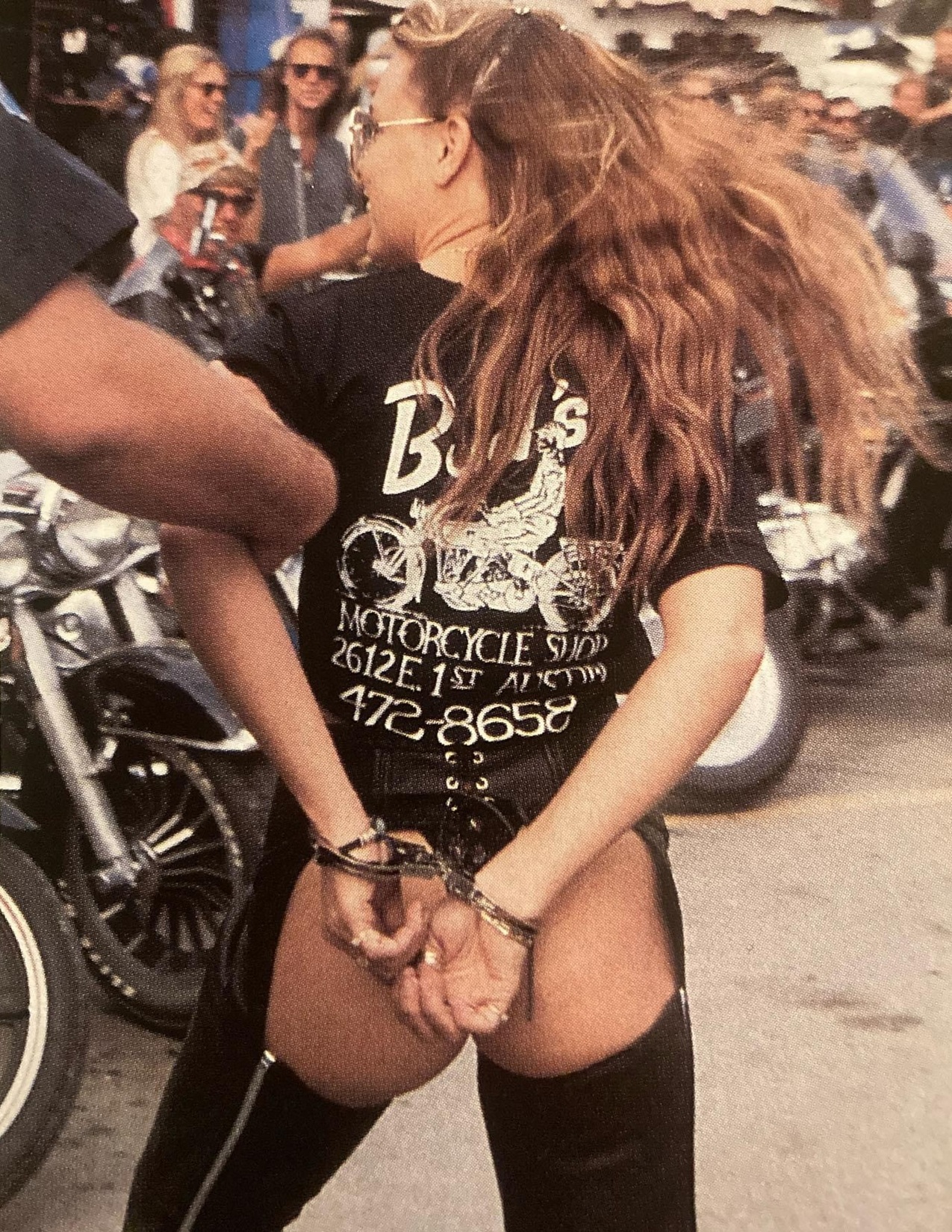
The same design also graced Bud’s business cards, bumper stickers, t-shirts…….although not all publicity is good publicity…. ….or it it? 😏 Photographer unknown.
I also traveled with Bud to swap meets all over hell and gone, driving his rattletrap school bus gutted of seats and packed full of the infamously New, Used and Abused parts that were Bud’s specialty: everything from trendy chrome gewgaws and one-off chopper parts to hard-to-find transmissions, carburetors, flywheels and cylinder heads. Sometimes it seemed as if we were carrying half of Bud’s inventory with us when we set out and, because Bud shopped even as he sold, frequently carried even more inventory back to Austin!
ABOVE: Collectible parts like the original Superglide fiberglass ‘boattail’ fenders and milk crates chockablock with various gems; a Harley builder’s Dreamland!ABOVE: Kids today call it ‘cluttercore’, but we just called it ‘Bud’s’. The Pearl Beer can was in memory of Colonel Worm (AKA James Hinds, R.I.P.). A fellow veteran of Vietnam, he worked for Bud as a paint-and-body man.
All those parts, BTW, were haphazardly stacked in rectangular metal trays, and part of my job as grunt was to hump the damn things in and out of the bus at every stop. Bud was a “recycler” before recycling was trendy – those metal trays were actually old medicine chests salvaged from a downtown hotel slated for demolition – and when filled with panhead four-speed gears, ironhead cylinders, shovelhead connecting rods and the like, they were heavy and sharp-edged enough to take off fingers! I hated them with a passion, but even those trays couldn’t diminish the joy of traveling in Bud’s circle, meeting bikers and shop owners from around the world, and learning the ins and outs of doing business the East Austin Way.
ABOVE: Frames, frames and more frames, from Servi-Car and Sportster to Big Twins of all ages, rigid and swingarm, custom and OEM…. even sidecars!
Of course, Bud also became one of my best, most reliable friends. He always seemed glad to see me, to step out and share a meal or just hole up in his cramped little office and visit for a while. There wasn’t much we couldn’t discuss, either, from faith and fear to family and friends, flatheads to Twin Cams, the war, the rallies at Sturgis and Daytona, the swap meet circuit, the biker books we both enjoyed and exchanged and, naturally, the latest gossip from the motorcycling scene. Toward the end, we talked about what was happening to him, and steps he needed to take to be at peace as he crossed that final bridge. Like everyone who loved him, I did what I could to help, but it wasn’t enough. If it could have done any good, I would have cheerfully given up blood, sweat and body parts to help him recover, or at least not suffer quite so much.
ABOVE: Buddy Merle Reveile, October 21st, 1950 to March 23rd, 2015, from his online obituary at Legacy.com
The day Bud died I exchanged texts with another longtime friend who had known Bud in the days when he worked at the old Harley-Davidson dealership in town. I wrote that our world just became a much smaller place. He agreed, writing “Smaller, sadder, and much more lonely.”
Above: Artist Norman Bean, who worked as a mechanic in Bud’s shop even as he honed his skills as a fine artist, created this tribute to our friend, titled ‘Emergency Tool Kit.’ My copy is framed and has pride of place in my collection of moto art. For those of us who knew and relied on Bud, he was an ’emergency tool kit’, always at the ready to help us fix whatever was broken and adjust whatever was out-of-kilter. Prints of this and other paintings by Norman Bean may be found at https://normanbean.carbonmade.com/
I miss my friend every day, but I remain grateful that he was my friend. Through Bud I got to be part of a grand tradition in American motorcycling – the small independent shop that was the backbone of the bikers’ world. Bud’s was a near-mythical place packed full of history disguised as scrap metal – a funky, messy mélange of mechanic and machinist’s shop, motorcycle museum and meeting hall – and it was a BLAST! Man, I’m glad I got to be there!
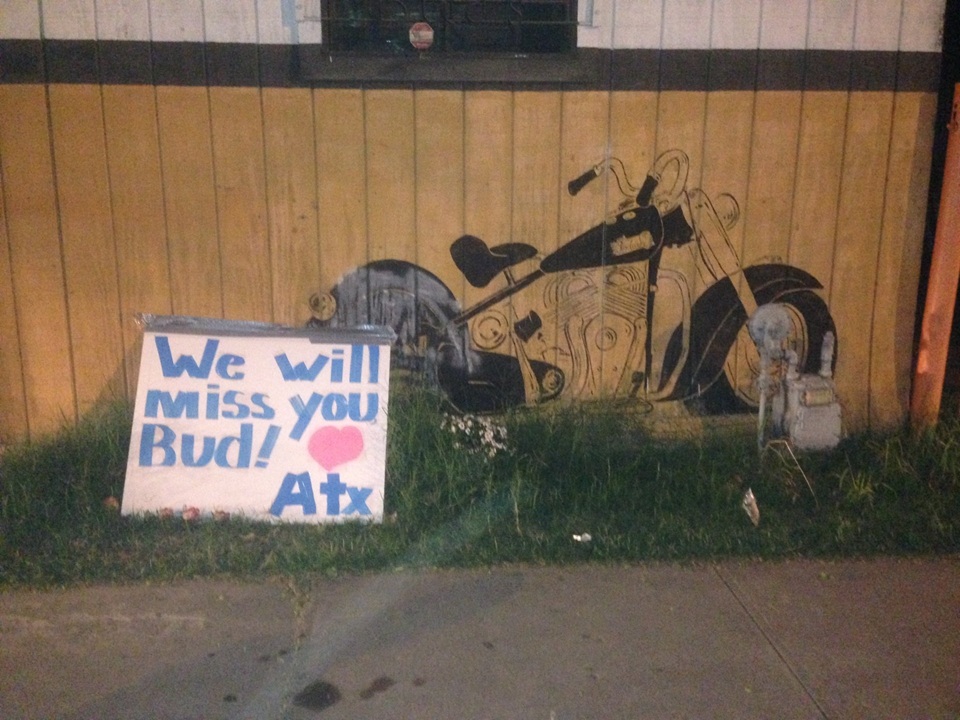
ABOVE: Bud’s Motorcycle Shop circa early 2000s; the old wooden building overshadowed by the three-story steel building Bud completed shortly before his passing.ABOVE AND BELOW: Memorials left for Bud in the days following his passing. Photographs courtesy of J.C. Cruz.A very clean old school chopper belonging to J.C. Cruz, a longtime customer and friend of the shop, is parked outside the front door just days after Bud died in 2015. Photograph courtesy of J.C. Cruz.
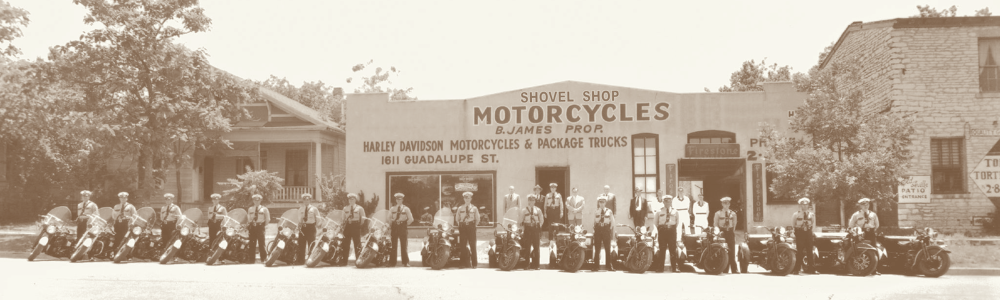




















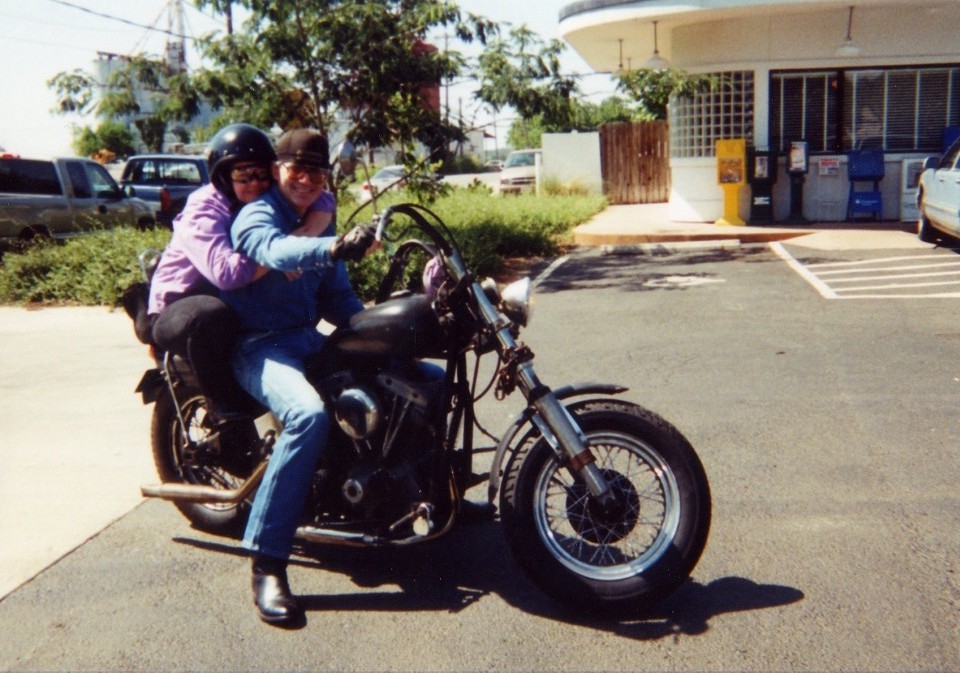

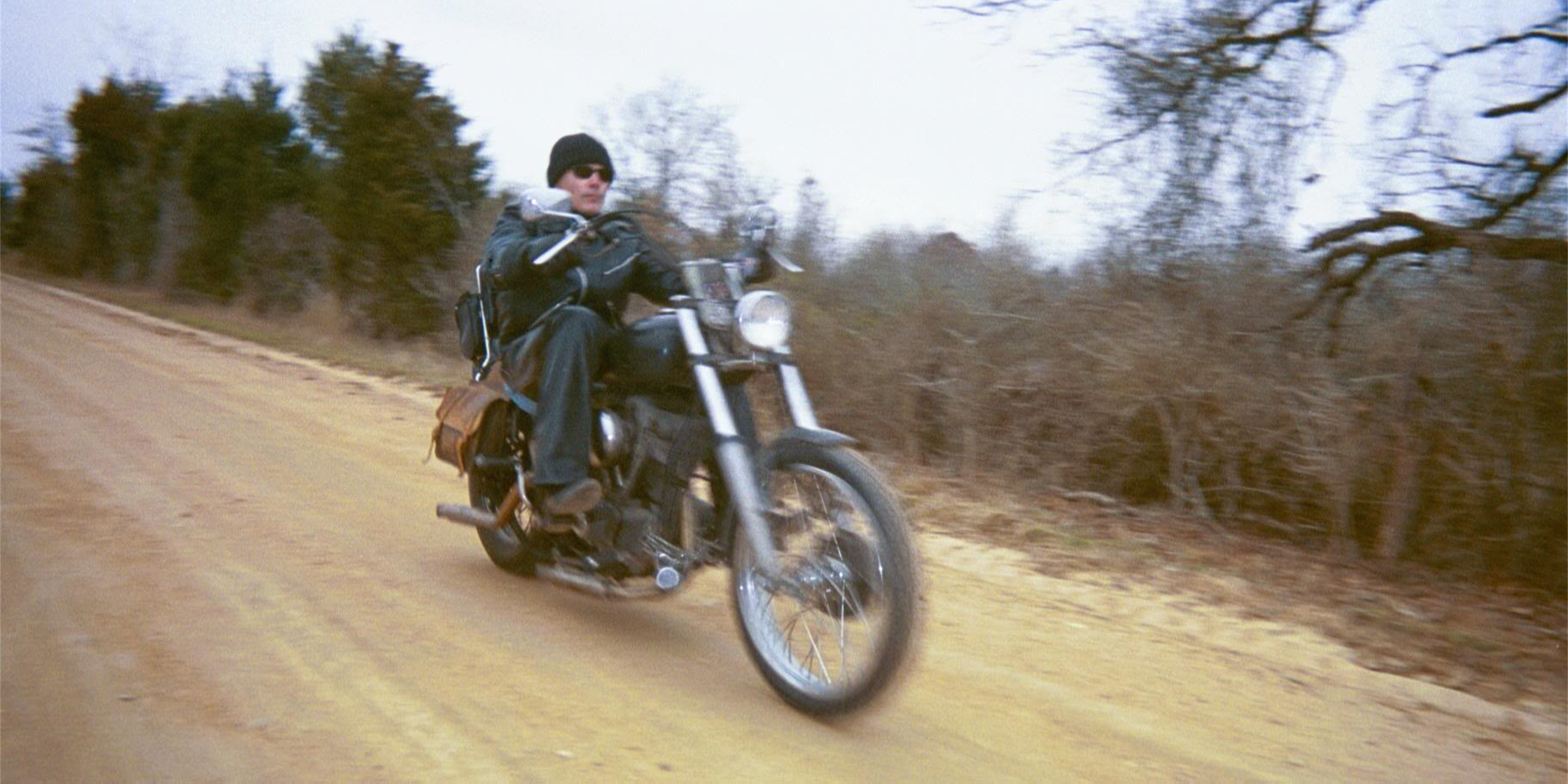
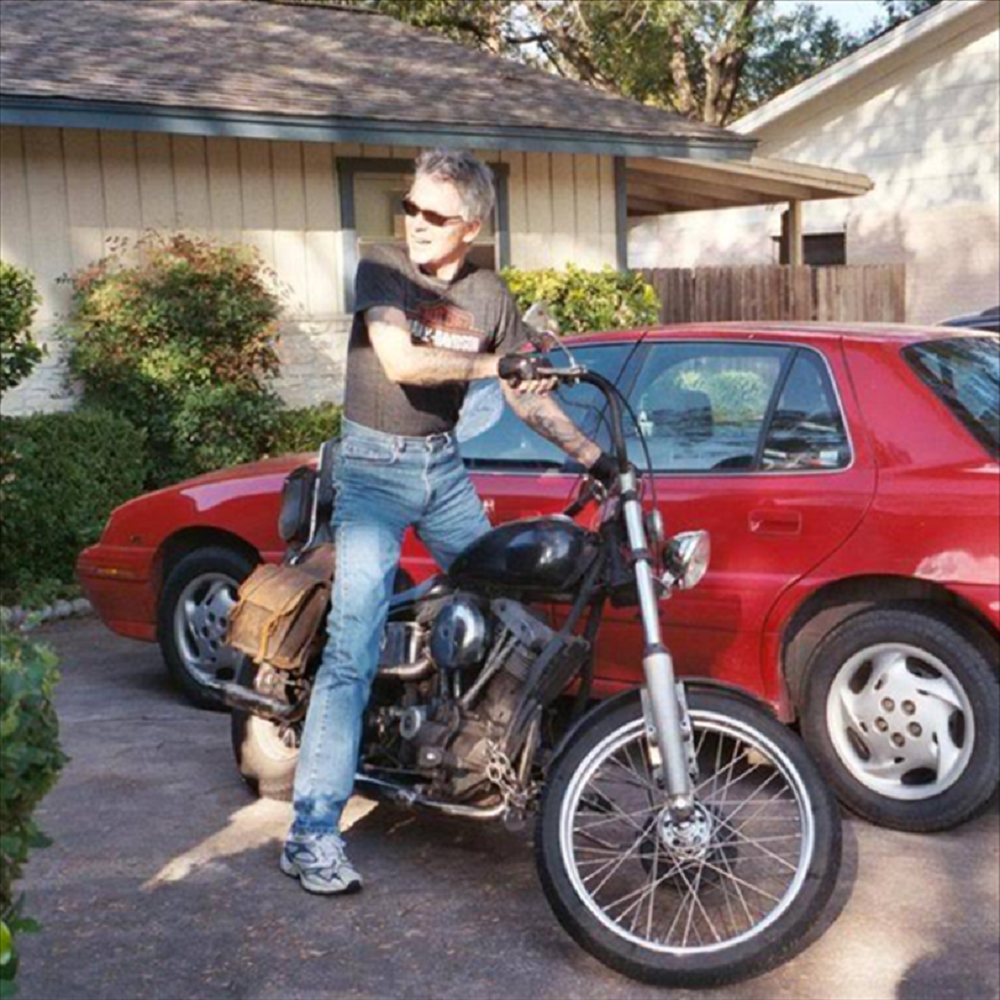
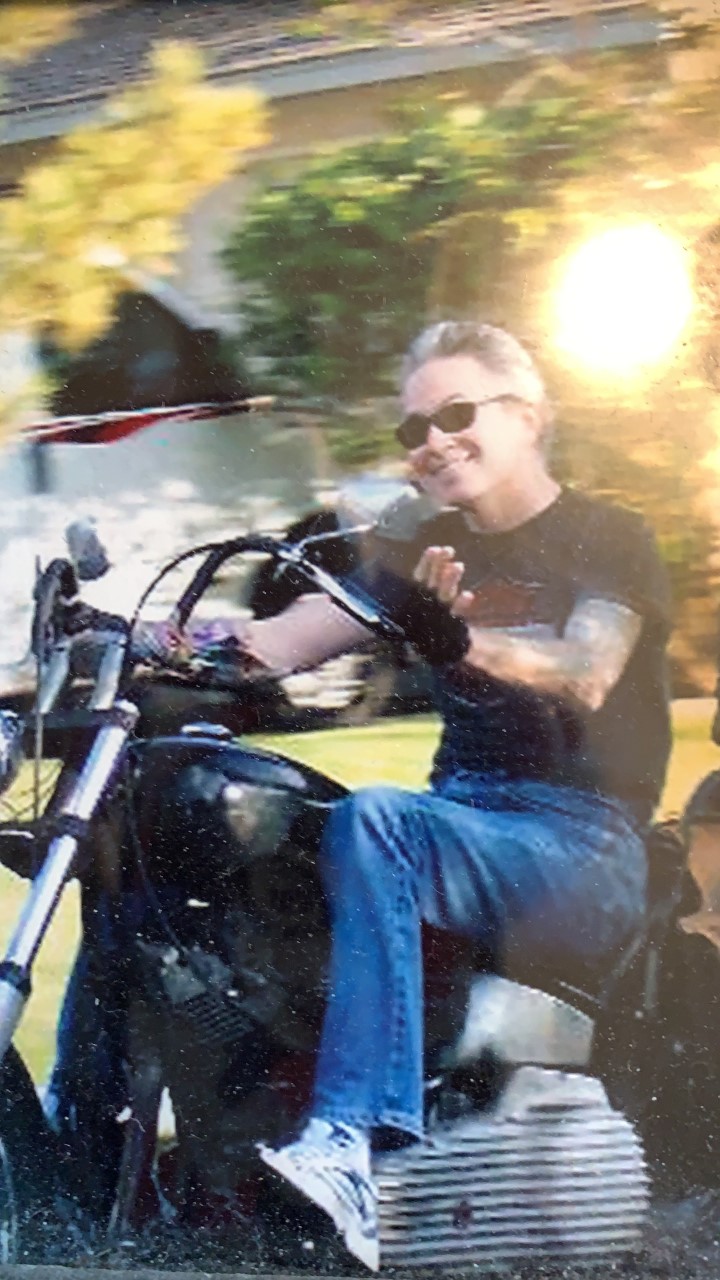











 The Shovel Shop