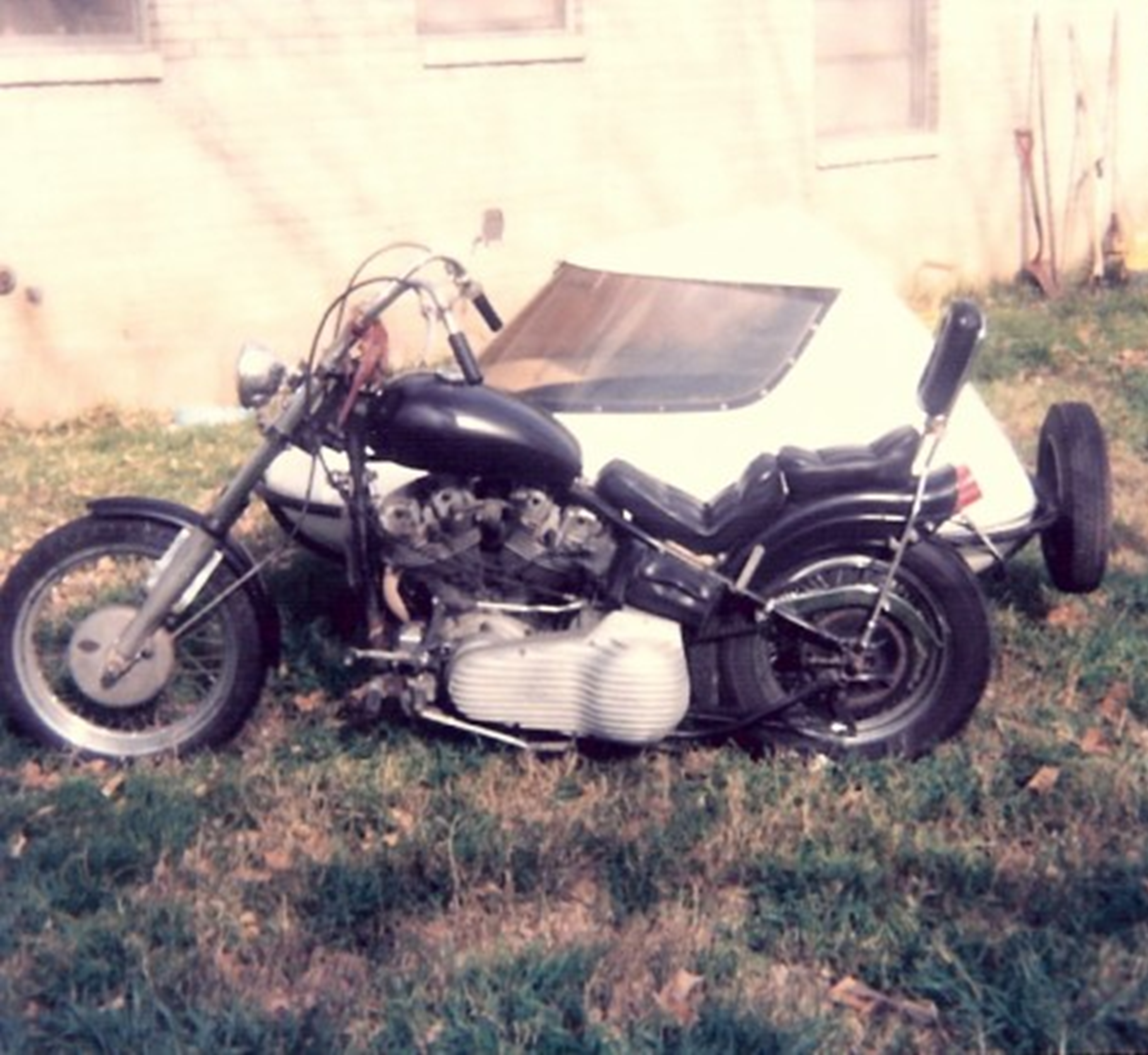
Darcie spotted the sidecar the moment I brought it home in the back of the pickup truck, and proudly informed us that it was her car!
A reader asked about the sidecar I attached to my Shovelhead back in the mid-’80s, which sent me off on a daylong squirrel hunt. As I didn’t have access to the interwebs way back then, I had a hard time learning anything about the sidecar. I knew it was a ‘Zephyr’ brand unit, but after that my search for info hit a brick wall.
I nicknamed it ‘Moon Unit’ because it looked kind of like a space capsule, but it was actually pretty well-built, with the rollbar-style cage around the body, a weatherproof roof and windshield, comfortable bucket seat with seatbelt and legroom enough for most adults, storage space behind the seat, and room for a dashboard-mounted stereo if one was desired. I personally consider a sound system on a motorcycle an abomination – I mean, who needs a stereo when they have the sweetest music in the world echoing out their exhaust pipes? – but I might have made an exception for the sidecar, if it would make Darcie happy..
However, in the course of researching the sidecar’s provenance and history I did come upon the United Sidecar Association, and founding member Hal Kendall. I joined USCA and purchased a couple of sidecar manuals Dr. Kendall had published. Looking back, I know I could not have gotten the sidecar safely and properly mounted on my Shovelhead’s OEM Harley-Davidson wishbone frame had it not been for the good doctor’s manuals, which are still available as downloads at the USCA’s Sidecar Library page.
Another essential to my task was the assistance of a motorcycle-savvy welder named Bill Mading (RIP) who owned BG&T Welding in Austin, just down the street from the cop shop. Bill was a dirtbike racer, which meant he understood the stresses and strains motorcycle frames must endure, and how to compensate for them. However, he was also a skilled enough artisan that he could weld aluminum and aluminum-alloy engine and transmission cases – not an easy trick, as those metals tend to warp from the heat of the welding process. Warped cases means uneven gasket surfaces, less-than-perfect seals between case halves, et cetera. Bud (Bud’s Motorcycle Shop) used Bill for all his delicate welding needs, and we never had a problem with a part Bill repaired.
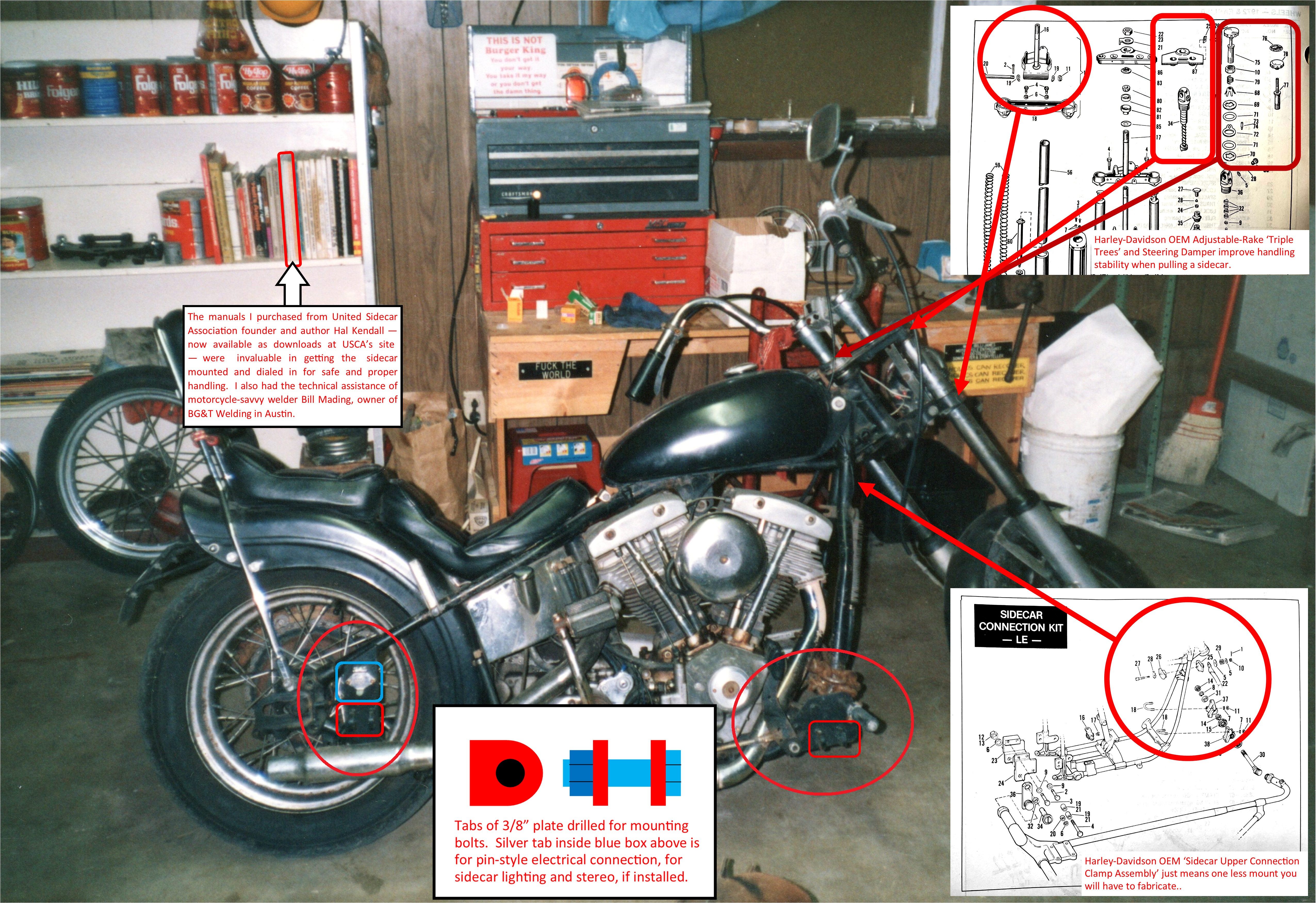
Bastard applications call for bastard engineering. Between us, Bill Mading and I designed the lower mounts for the sidecar. At the rear we installed a vertical plate near the frame’s dovetail, which included a pin-style electrical connector for the sidecar’s lighting. Up front we replaced the OEM mechanical brake foot-pedal mount with a larger plate that could accommodate the mounting tabs we’d devised. NOT PICTURED:The top front mount was the OEM Harley-Davidson clamp assembly. I also replaced the standard front-fork triple trees, shown here, with Harley’s OEM adjustable rake trees. For added stability and handling I added an OEM steering damper, as well.
Between the manuals I’d received from Hal Kendall, and Bill Mading’s dedicated assistance, we were able to devise a bastard set of mounts for the sidecar. They weren’t pretty, but they by gollum worked! Enlarge the photo below for more information.
Everything one needs to mount an off-brand sidecar to an OEM wishbone frame.
I didn’t have the interwebs back in the Dark Ages of the 1980s, so finding out what I needed to know involved scouring magazines for any mention of sidecars, writing letters that were often ignored, calling long-distance (remember those days?) and running up my telephone bill, et cetera. Today? Ten minutes with a mouse and I had already gleaned scads of information! In fact, the first site I visited told me where the Zephyr was manufactured, and by whom, and even had a photo of a pretty snazzy brilliant yellow Zephyr sidecar!
ONE FINAL NOTE: If you are at all interested in sidecars, please consider a membership in the United Sidecar Association. It’s money well spent, IMO, and support for a great organization.
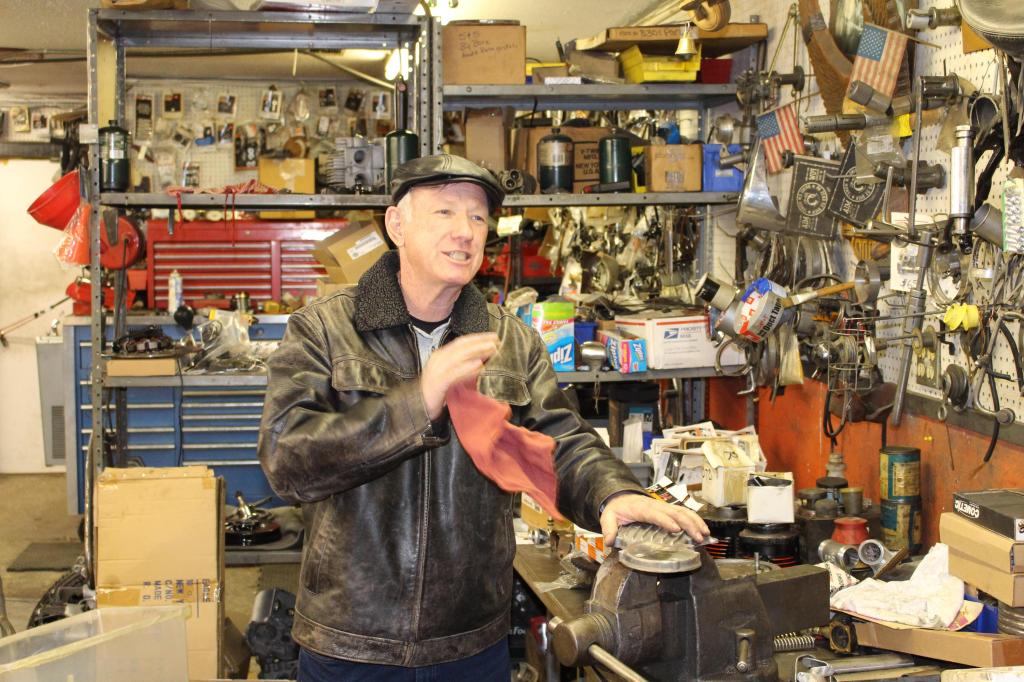
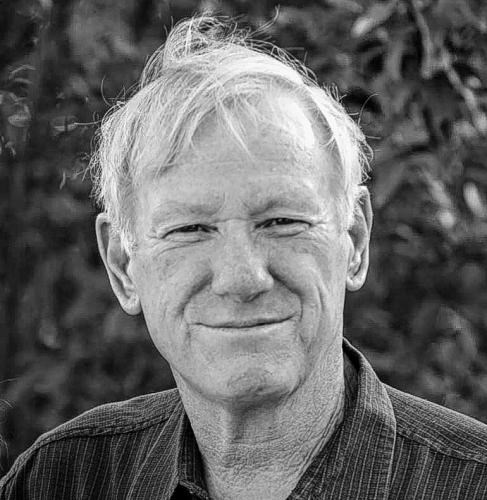
ABOVE: Bud Reveile on 7 January 2015, a couple of months before he passed away. All photographs by author unless otherwise noted.
Four years ago today we lost one of the best men I’ve ever had the privilege of knowing.
ABOVE: Bud’s front door at his shop’s penultimate address. Photographer unknown.
Bud Reveile was a Vietnam veteran; a U.S.M.C. tanker whose story was included in Oscar E. Gilbert’s Marine Corps Tank Battles in Vietnam. He was a devout Christian and family man, and a lifelong and benevolent member of the East Austin community.
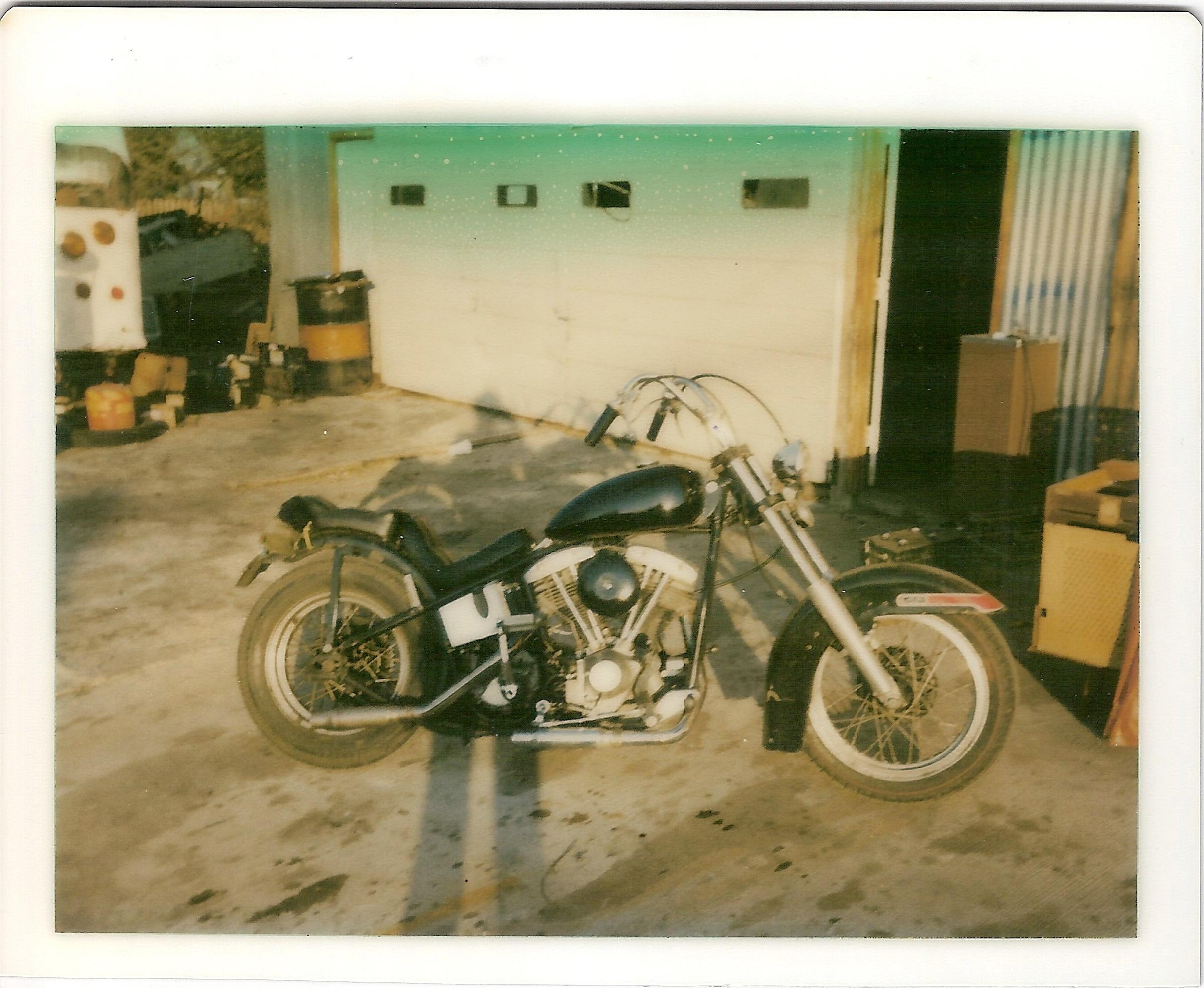
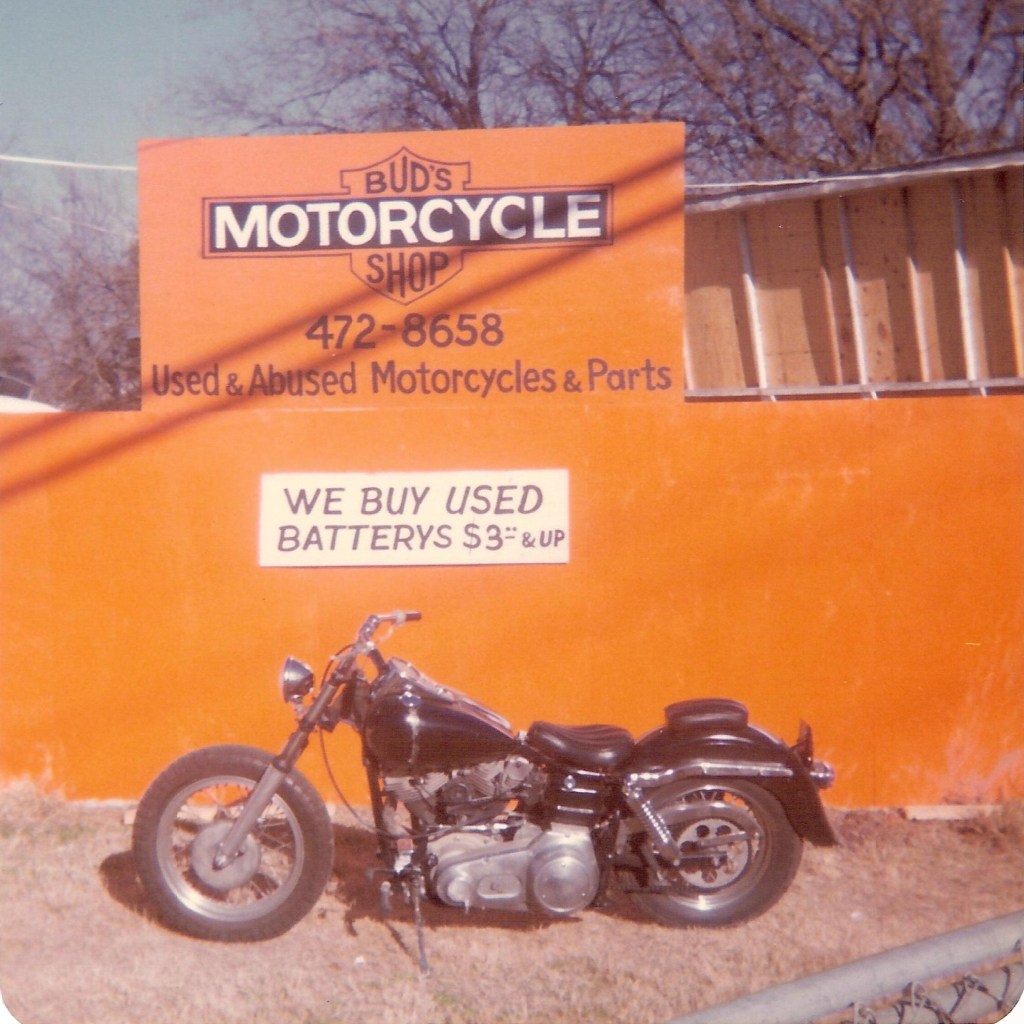
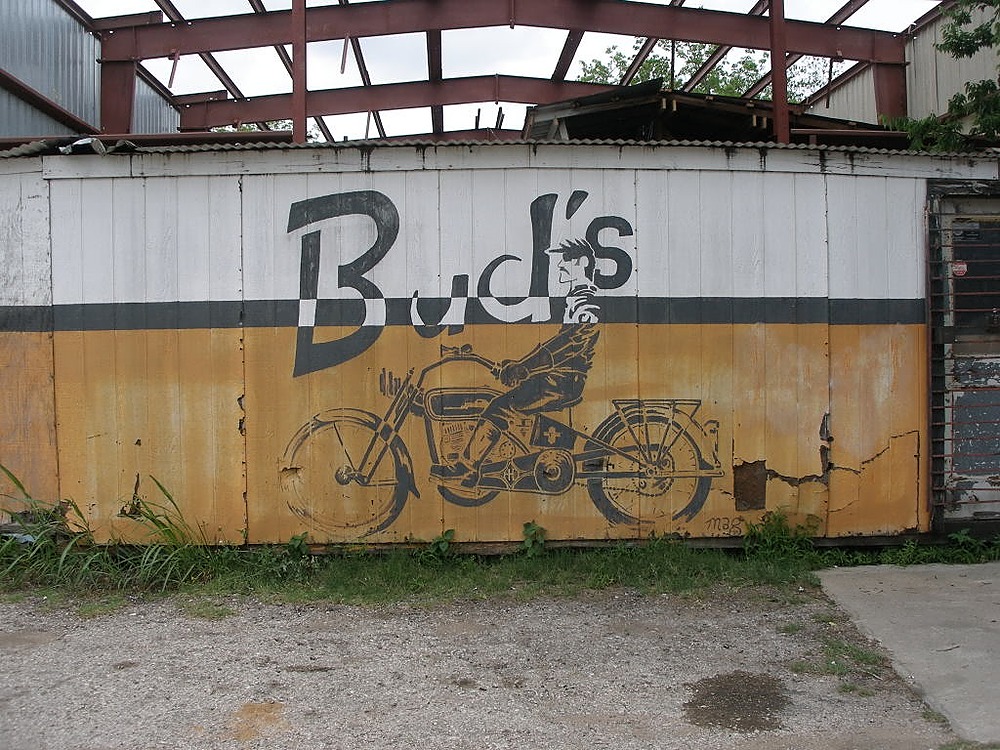
ABOVE: My shovelhead right after I switched to a rigid frame in early ’80, in front of the tin shed that held Bud’s original “showroom” and mechanic’s bay. The notorious school bus is visible at top left.
Bud was also a dyed-in-the-wool Harley man, a walking encyclopedia of all things Harley-Davidson, and a natural-born good guy. He could talk to anyone – Bud maintained friendships with outlaw bikers and cops, Christians and atheists, bankers and b-girls and bums – and he did his level best to treat everyone with respect. He had very few enemies, and the only ones I ever met were only enemies because Bud wouldn’t give them something for nothing. He was a businessman – a true old-school horse-trader who worked hard to make a buck – but Bud was honest, and in all my years of knowing him I never saw him take advantage of anyone.
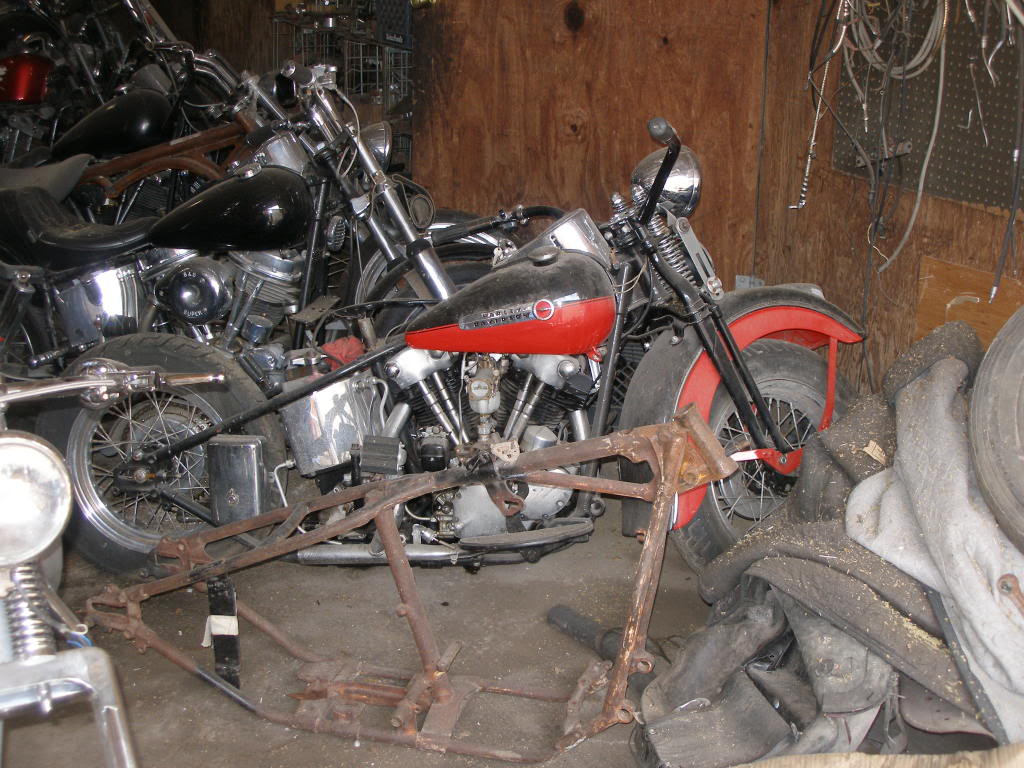
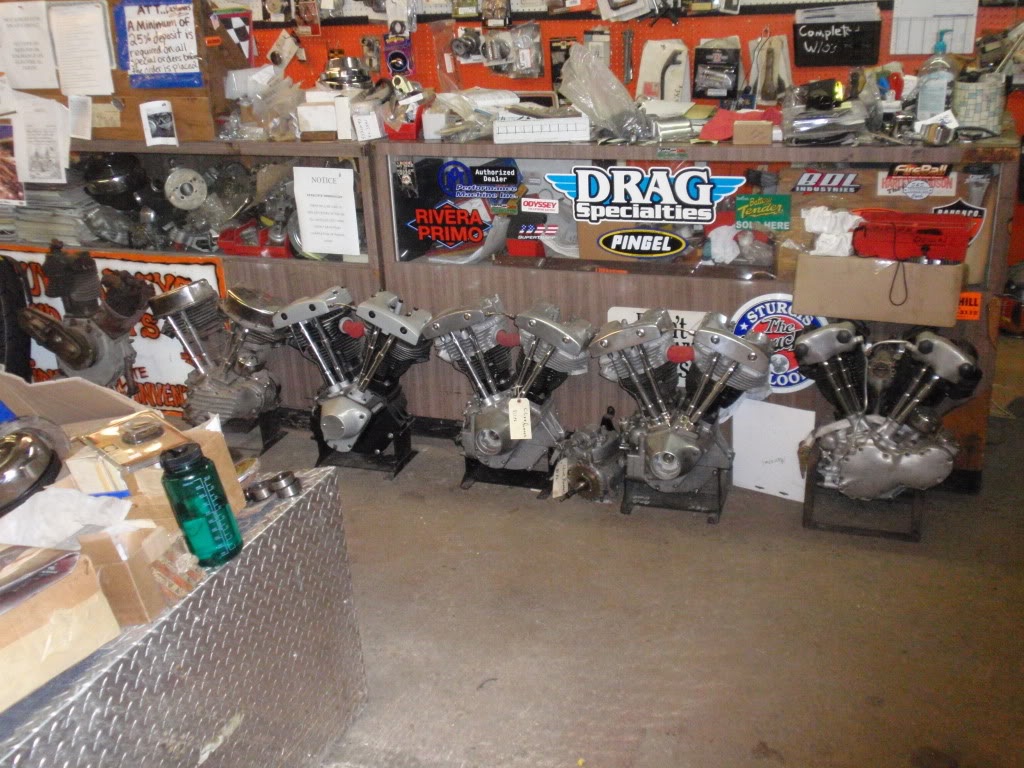
ABOVE: Knuckles and Pans and Shovelheads, oh my!
Bud built his business the old-fashioned way, beginning (just like Harley and the Davidsons themselves) in a backyard shed behind his North Austin home with some tools, a small collection of used motorcycle parts, and his experience working at Harley dealerships in California and Austin.
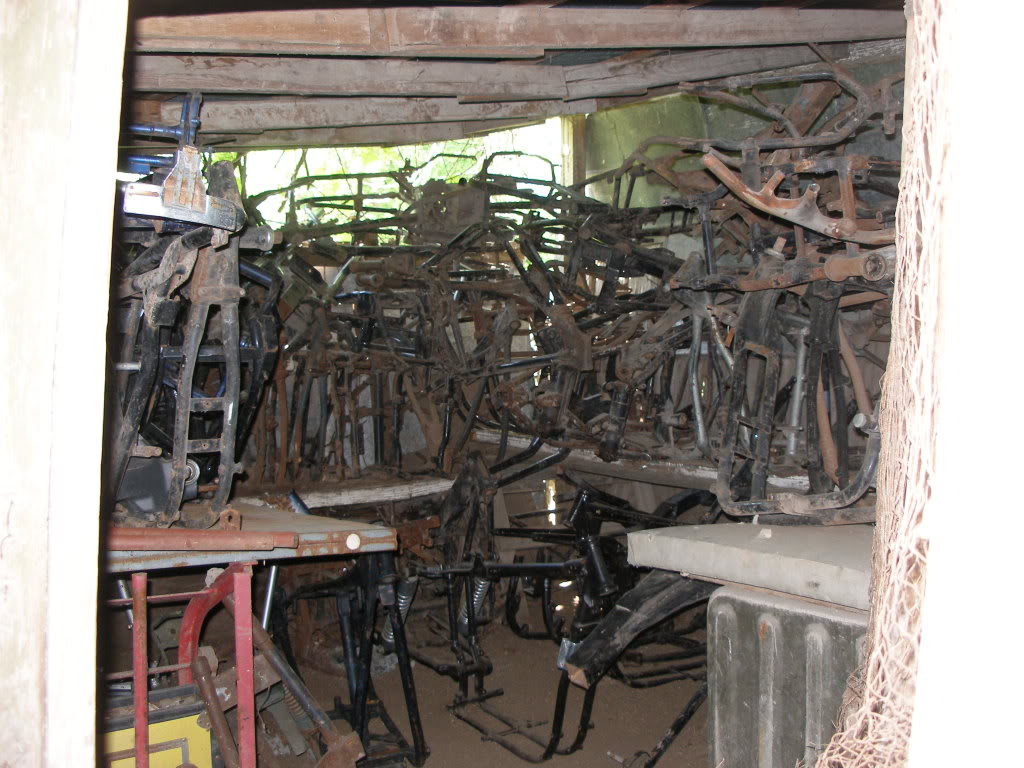
ABOVE: Frames, fork tubes, primary covers and more, just hanging from rafters or crammed into corners.ABOVE: Front forks, fenders and fat bob tanks as far as the eye can see!
In April of 1979 Bud moved his operations to the grounds of a defunct lumberyard in East Austin. There a Spartan tin shack – unheated in winter, un-air-conditioned in summer, noisy and dusty all year ‘round – served as mechanic’s bay, showroom and office, while erstwhile lumber bins held his burgeoning parts inventory.
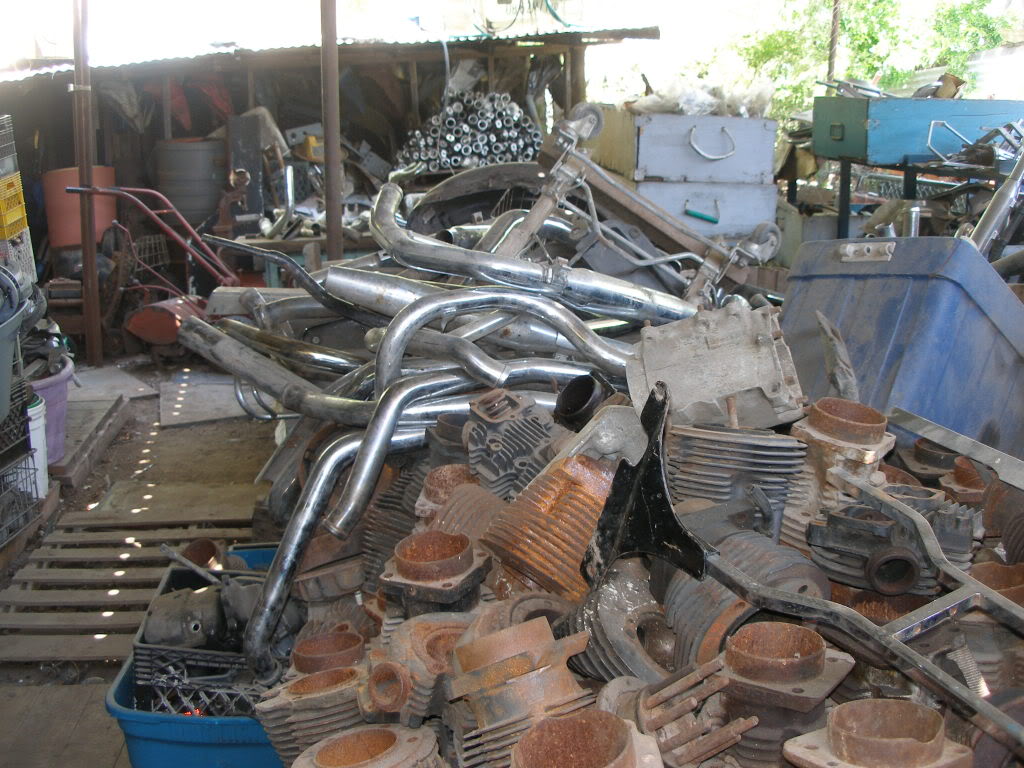
ABOVE: One man’s trash is another man’s ‘Damn! I can’t believe I found this!’ 😮
Over the following 36 years, Bud created a sprawling compound that eventually covered more than a quarter of a city block. In a ramshackle series of structures – some built, others acquired or repurposed and all interconnected – Bud kept aisles and aisles (and piles and piles) of old and odd motorcycle parts jumbled up in glorious disarray. There were tons of new old stock – OEM and aftermarket pieces painstakingly gathered from shops that were going out of business or dealerships purging their parts departments – and all stacked right alongside all the bent, broken, rusted, oil-soaked parts salvaged from a thousand different spent and clapped-out motorcycles.
ABOVE: If it came off a Harley, or might fit on one, Bud had it laying around somewhere!
There was everything a rider might need to repair an old machine, customize a new one or, for that matter, build herself one from the ground up. Visiting Bud’s shop was like stepping back in time to those halcyon days when Harley shops were unique, one from another, instead of the prefabricated corporate clothing boutiques they’ve degenerated into. For those of us who care about such things, Bud’s was Disneyland! 😎
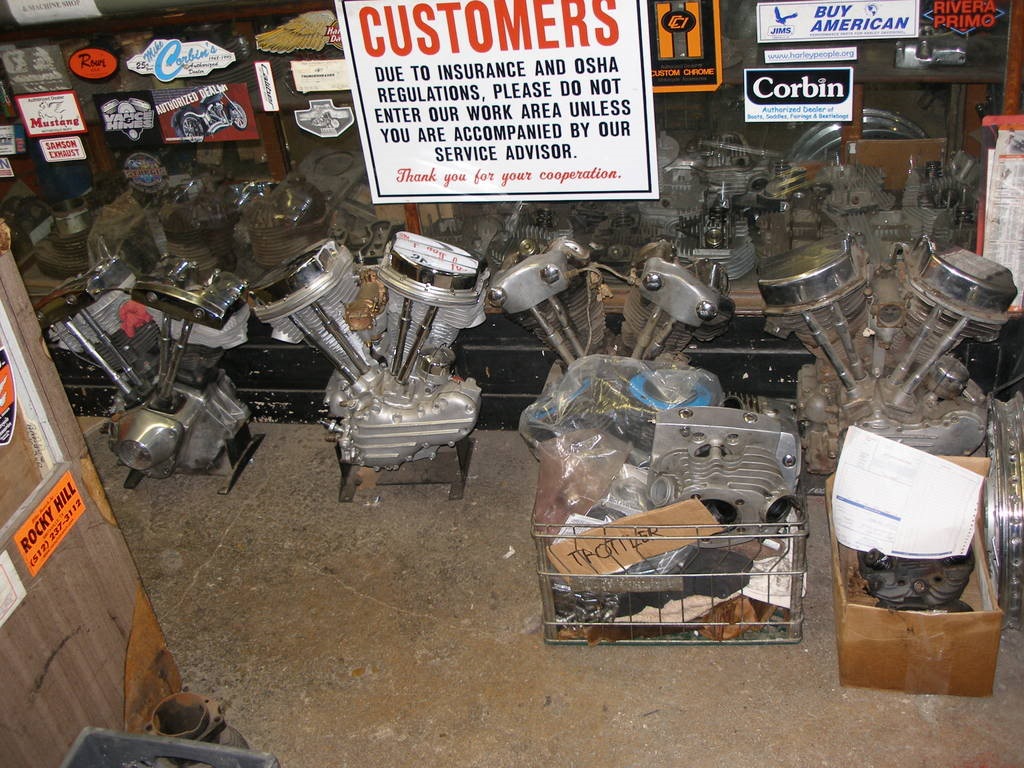
ABOVE: Fifty years of Motor Company history sitting there! And if that’s not enough for ya….….let’s go for eighty years! 😎ABOVE: My shovelhead outside Bud’s perimeter fence, late 1979 or early ’80. Over the fence are the lumber stalls, now enclosed to create mechanics’ bays downstairs and parts storage upstairs.
I first met Bud in the late spring of 1979, when another biker gave me one of Bud’s cards. I had just gotten my first Harley, and wanted to learn everything I could about them. When I saw that Bud was the real deal, I quickly asked if I could become a shop hang-around. I would come in after work and on weekends, exchanging free labor for the occasional discount motorcycle part and a far more valuable education in all things Harley-Davidson. By the fall of that year I was working there full time, and in one way or another I kept working there for the next 36 years.
I just tell folks I forgot to quit! 😏
ABOVE: Originally the yard office for the lumberyard, that little shack became my home on more than one occasion. No heat, no A/C, no bathroom, but it kept me and my shovel out of sight of the repo man! 😏
Jack-of-all-trades what I was, I helped build various add-ons to the shop, including closing in the old lumber stalls to create additional mechanics’ bays, and reinforcing the second story so parts could be stored there. I ran electrical systems throughout as the business sprawled across first one, then two, and finally three separate lots known to all and sundry as 2612 East First Street. I worked as a shop grunt, with my elbows deep in the muck of the parts washer, became a parts man and mechanic, and even lived on-site for a while during periods of homelessness, doubling as night watchman while hiding my as-yet-unpaid-for shovel from the repo man. I also served as publicist, writing articles about Bud and the shop for national magazines, and provided backup on the rare occasion when a situation so demanded.
I just tell folks I was a Known Associate of the shop. 😎
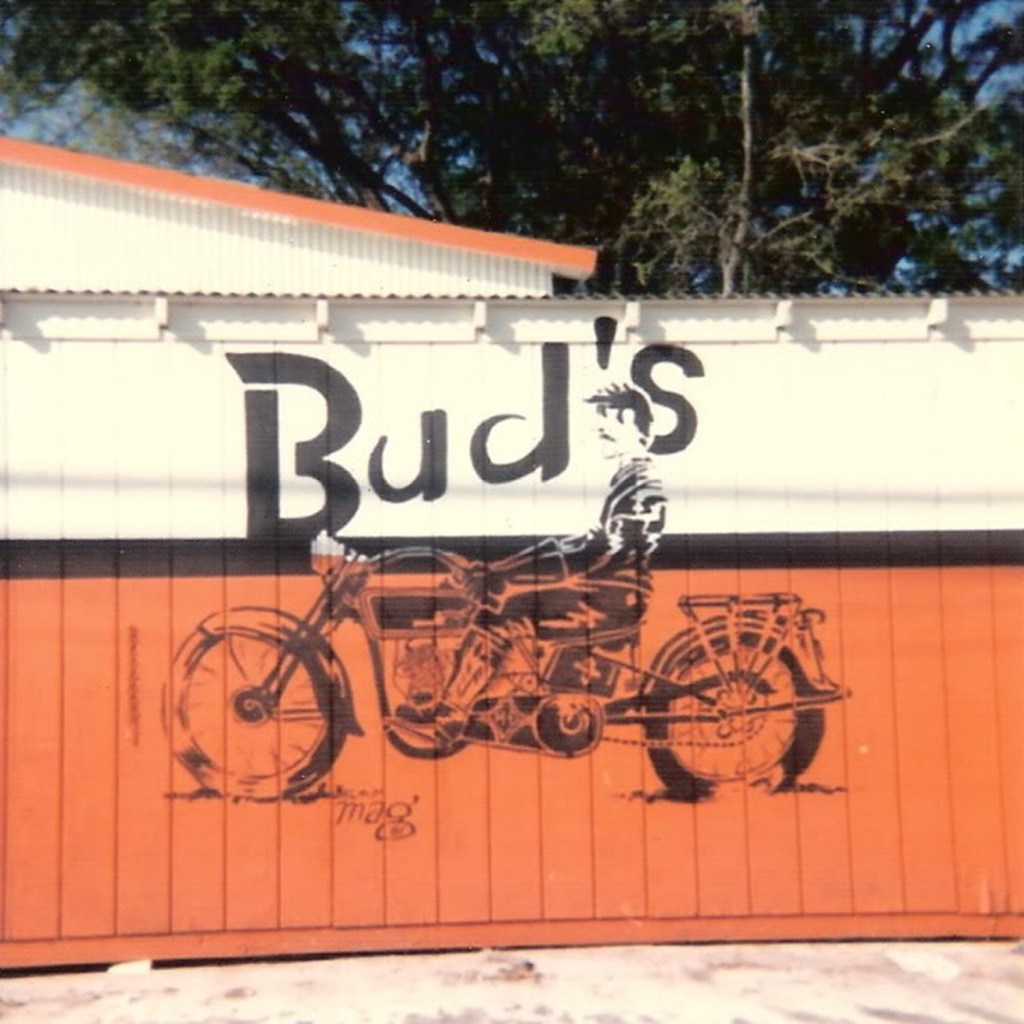
ABOVE: A profile I wrote about Bud, back in the summer of 1991.ABOVE: Bud’s logo, created and reproduced here by the artist Gaylyn Maxson, aka MAG.
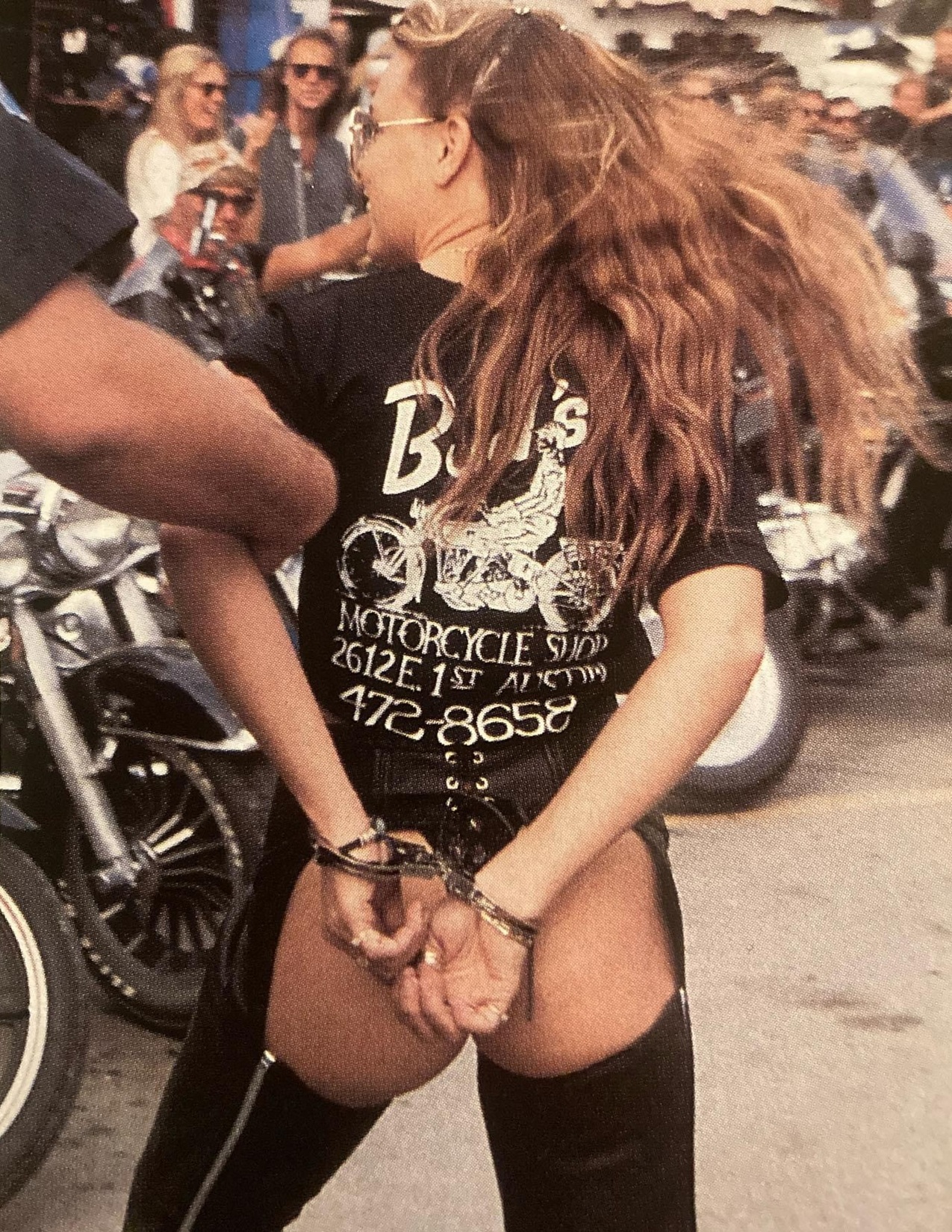
The same design also graced Bud’s business cards, bumper stickers, t-shirts…….although not all publicity is good publicity…. ….or it it? 😏 Photographer unknown.
I also traveled with Bud to swap meets all over hell and gone, driving his rattletrap school bus gutted of seats and packed full of the infamously New, Used and Abused parts that were Bud’s specialty: everything from trendy chrome gewgaws and one-off chopper parts to hard-to-find transmissions, carburetors, flywheels and cylinder heads. Sometimes it seemed as if we were carrying half of Bud’s inventory with us when we set out and, because Bud shopped even as he sold, frequently carried even more inventory back to Austin!
ABOVE: Collectible parts like the original Superglide fiberglass ‘boattail’ fenders and milk crates chockablock with various gems; a Harley builder’s Dreamland!ABOVE: Kids today call it ‘cluttercore’, but we just called it ‘Bud’s’. The Pearl Beer can was in memory of Colonel Worm (AKA James Hinds, R.I.P.). A fellow veteran of Vietnam, he worked for Bud as a paint-and-body man.
All those parts, BTW, were haphazardly stacked in rectangular metal trays, and part of my job as grunt was to hump the damn things in and out of the bus at every stop. Bud was a “recycler” before recycling was trendy – those metal trays were actually old medicine chests salvaged from a downtown hotel slated for demolition – and when filled with panhead four-speed gears, ironhead cylinders, shovelhead connecting rods and the like, they were heavy and sharp-edged enough to take off fingers! I hated them with a passion, but even those trays couldn’t diminish the joy of traveling in Bud’s circle, meeting bikers and shop owners from around the world, and learning the ins and outs of doing business the East Austin Way.
ABOVE: Frames, frames and more frames, from Servi-Car and Sportster to Big Twins of all ages, rigid and swingarm, custom and OEM…. even sidecars!
Of course, Bud also became one of my best, most reliable friends. He always seemed glad to see me, to step out and share a meal or just hole up in his cramped little office and visit for a while. There wasn’t much we couldn’t discuss, either, from faith and fear to family and friends, flatheads to Twin Cams, the war, the rallies at Sturgis and Daytona, the swap meet circuit, the biker books we both enjoyed and exchanged and, naturally, the latest gossip from the motorcycling scene. Toward the end, we talked about what was happening to him, and steps he needed to take to be at peace as he crossed that final bridge. Like everyone who loved him, I did what I could to help, but it wasn’t enough. If it could have done any good, I would have cheerfully given up blood, sweat and body parts to help him recover, or at least not suffer quite so much.
ABOVE: Buddy Merle Reveile, October 21st, 1950 to March 23rd, 2015, from his online obituary at Legacy.com
The day Bud died I exchanged texts with another longtime friend who had known Bud in the days when he worked at the old Harley-Davidson dealership in town. I wrote that our world just became a much smaller place. He agreed, writing “Smaller, sadder, and much more lonely.”
Above: Artist Norman Bean, who worked as a mechanic in Bud’s shop even as he honed his skills as a fine artist, created this tribute to our friend, titled ‘Emergency Tool Kit.’ My copy is framed and has pride of place in my collection of moto art. For those of us who knew and relied on Bud, he was an ’emergency tool kit’, always at the ready to help us fix whatever was broken and adjust whatever was out-of-kilter. Prints of this and other paintings by Norman Bean may be found at https://normanbean.carbonmade.com/
I miss my friend every day, but I remain grateful that he was my friend. Through Bud I got to be part of a grand tradition in American motorcycling – the small independent shop that was the backbone of the bikers’ world. Bud’s was a near-mythical place packed full of history disguised as scrap metal – a funky, messy mélange of mechanic and machinist’s shop, motorcycle museum and meeting hall – and it was a BLAST! Man, I’m glad I got to be there!
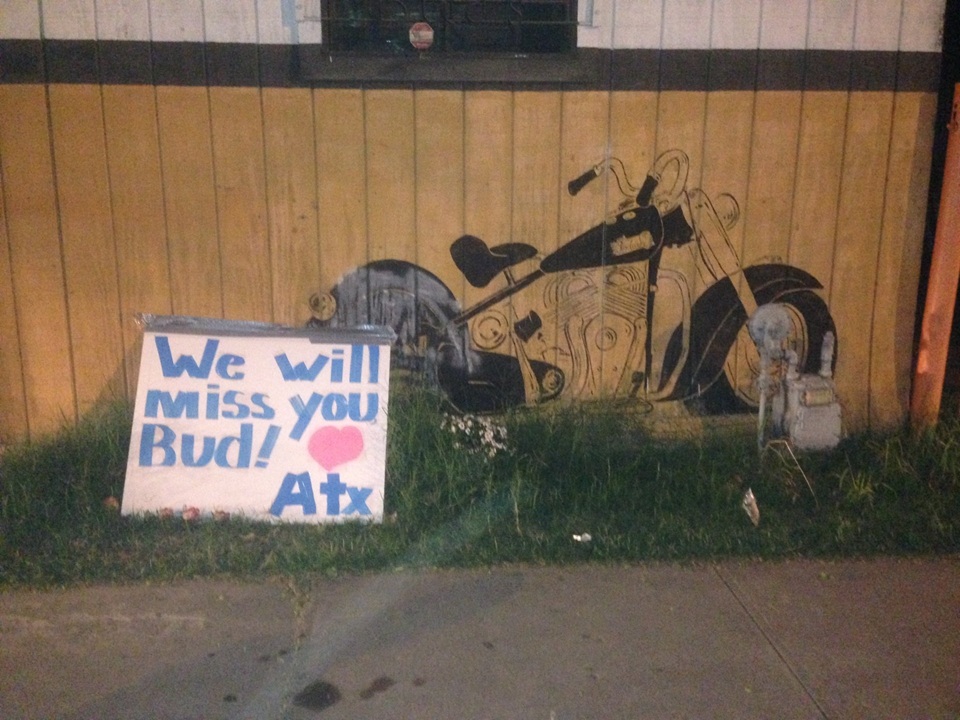
ABOVE: Bud’s Motorcycle Shop circa early 2000s; the old wooden building overshadowed by the three-story steel building Bud completed shortly before his passing.ABOVE AND BELOW: Memorials left for Bud in the days following his passing. Photographs courtesy of J.C. Cruz.A very clean old school chopper belonging to J.C. Cruz, a longtime customer and friend of the shop, is parked outside the front door just days after Bud died in 2015. Photograph courtesy of J.C. Cruz.
I’ve been doing a little research on songwriter Bob Dylan. Like most riders, I already knew about his mysterious wreck near Woodstock, New York, in 1966, where he dumped his Triumph, injured himself to an unknown degree, and went into seclusion for a while.
However, in reading through books about Dylan, interviews with people who knew him prior to his arrival in Greenwich Village, and his own Chronicles: Volume One (2004) I turned up a few references to Harleys, time spent running with the biker boys in his hometown, even being a bit of a “rough, tough” character. I don’t know how true any of that is, but he apparently did spend some time around riders, as seen in the photos below.
1956, with a friend’s Harley-Davidson FL:
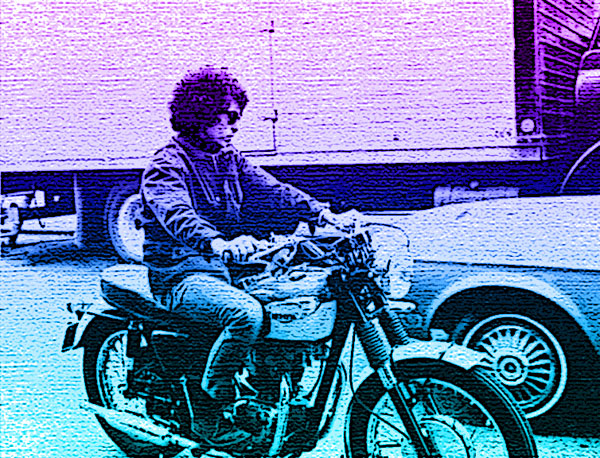
1966, on the Triumph he later wrecked:
I always cringe at this one, because for some reason he’s dangling his feet – not a smart thing to do and goofy-lookin’ to boot!
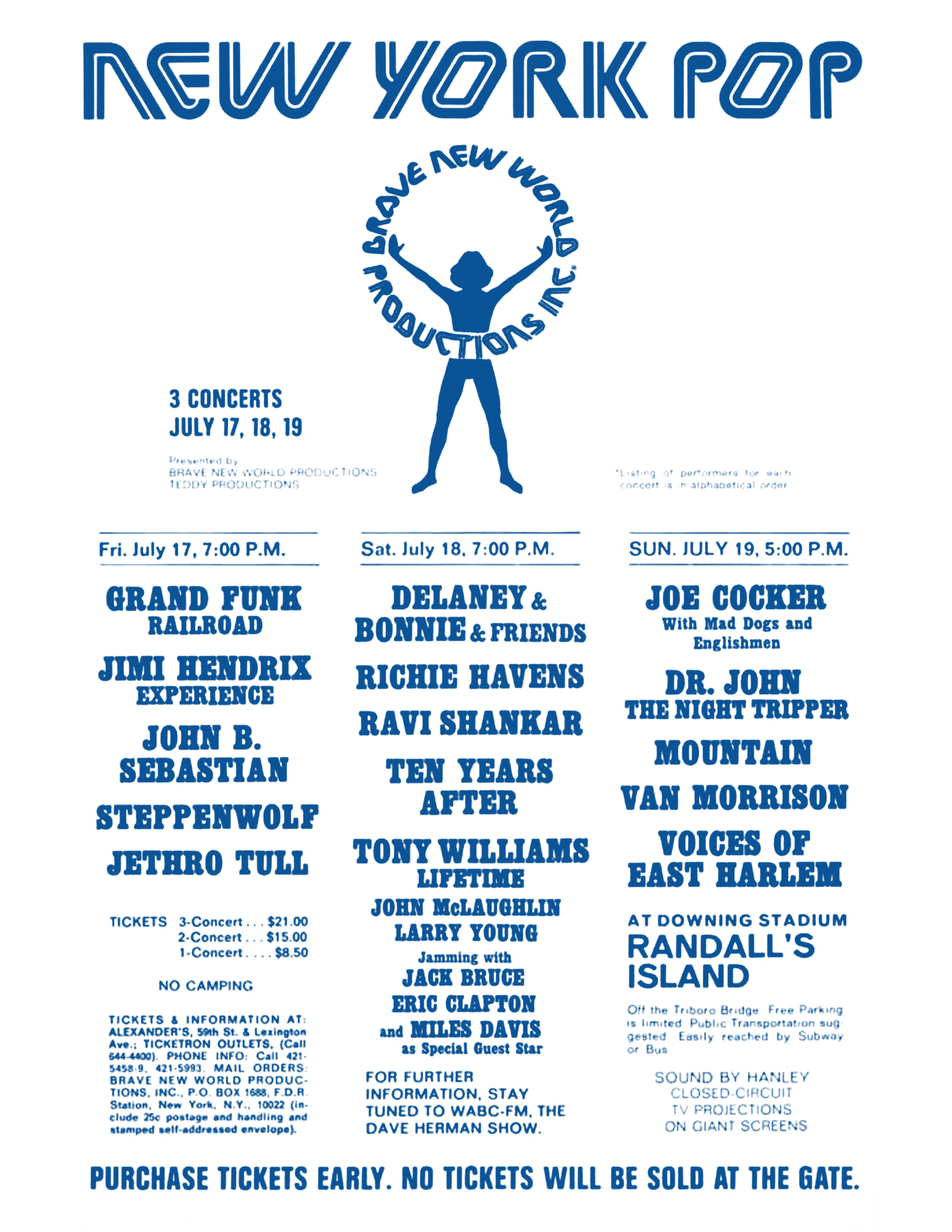
The passenger below is identified as John Sebastian of The Lovin’ Spoonful, who went on to have a solo career as a folkie in the early ’70s. He was one of five acts on the bill at the very first real concert I ever attended*, at Randall’s Island, New York City, on July 17th, 1970. The others were Jethro Tull, Steppenwolf, Grand Funk Railroad and some guy named Jimi…. Jimi Henderson, or Hendricks, or some such. I wonder whatever became of that fellow? 🤷🏻♀️
I’m not sure of the year – probably mid-’60s – but Dylan appears to be riding a Yamaha….
….and in 2004, back on a Harley-Davidson!
One more, of the man on an entirely different kind of bike….
.…but wearing a motorcycle club jacket. Go figure!
UPDATE: 28 SEPTEMBER 2023
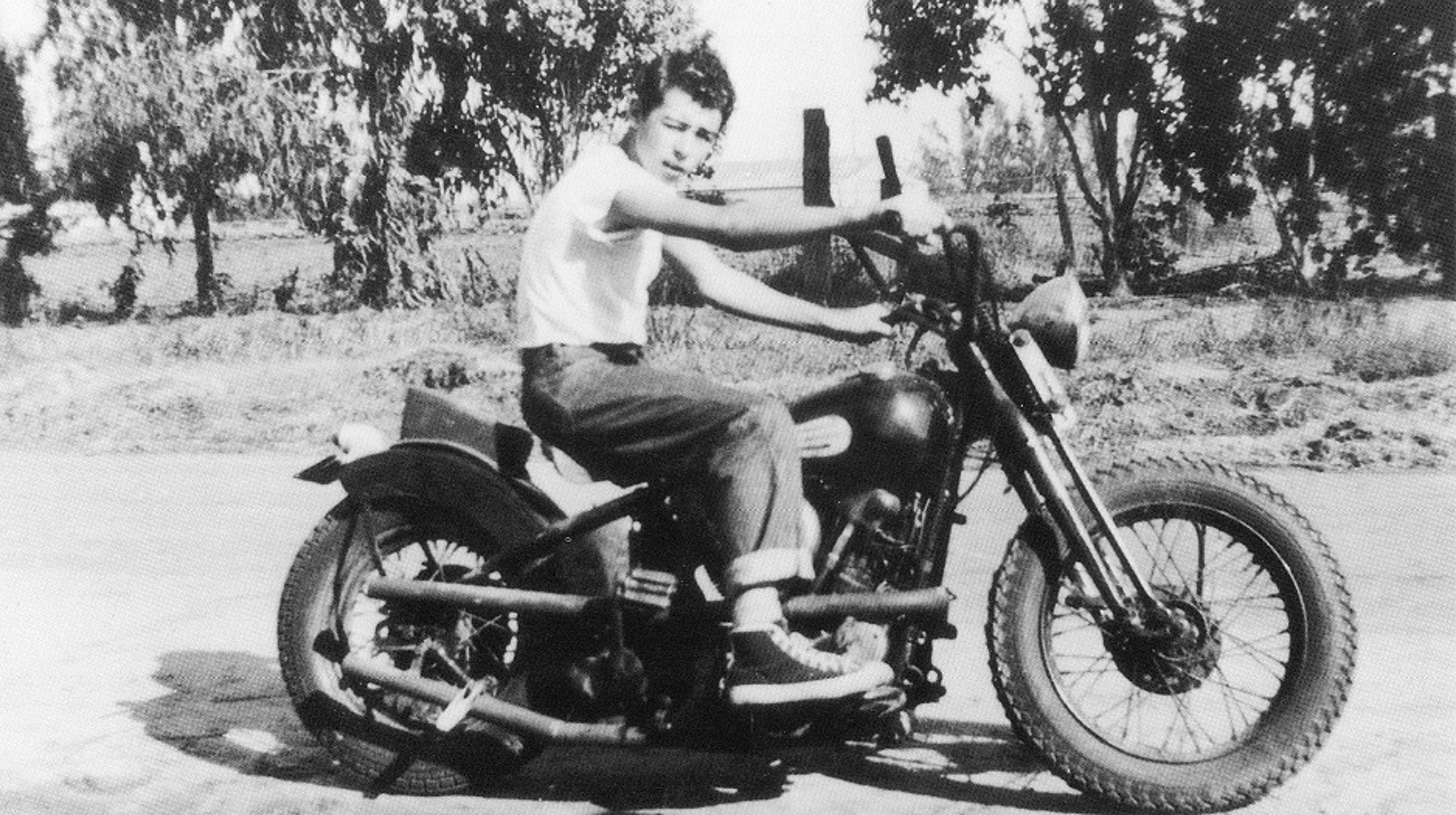
When I first published this article a little over ten years ago, I included the photo seen below. The image appeared in a book about Harleys, and although the rider was unnamed, the text placed the rider in the vicinity of Dylan’s hometown of Hibbing, Minnesota. Between that and the rider’s resemblance to a young Bob Dylan (and some wishful thinking and exuberance on my part) I initially felt safe in making the leap. However, my journalistic integrity niggled at me — I couldn’t swear that the knucklehead rider was, in fact, Bob Dylan — so I removed the photo.
Later, a post at Revzilla confirmed my original suspicion, so I am reposting the knucklehead photo.
Bob Dylan as a teenager, aboard a Harley-Davidson knucklehead bobbed in the post-war fashion, but still popular in the mid-’50s when this photo was taken.
….but wait! There’s more!
It has since come to light that Bob’s father, Abram Zimmerman, was also a rider. The photo below shows a young Mr. Zimmerman in 1938, aboard a Harley-Davidson flathead. The ‘F.C.’ carved on the battery box is for the Flying Cuyunas Motorcycle Club, founded by Duluth-based miners from the now-inactive Cuyuna Range. The pennant on the handlebars is apparently from the Beaver Bay MC, a friendly club the FCMC shared rides with.
Like father, like son? The resemblance is uncanny. Reports suggest that, while Mr. Zimmerman gave up riding motorcycles prior to beginning his family, he purchased a Harley-Davidson 45″ WL for Bob when Bob was a teenager. Apparently, Bob traded up at some point to the larger, faster knucklehead he’s pictured on.
Funny thing but, like Bob’s father, Abram, my father rode motorcycles prior to beginning his family. Unfortunately, and unlike Abram, my father was not about to buy his kids motorcycles. He never even told us that heonce rode, despite the fact that my brothers and I all had two-wheeled fever to some extent. Hell, we weren’t even allowed to have mopeds or minibikes!. 🙄
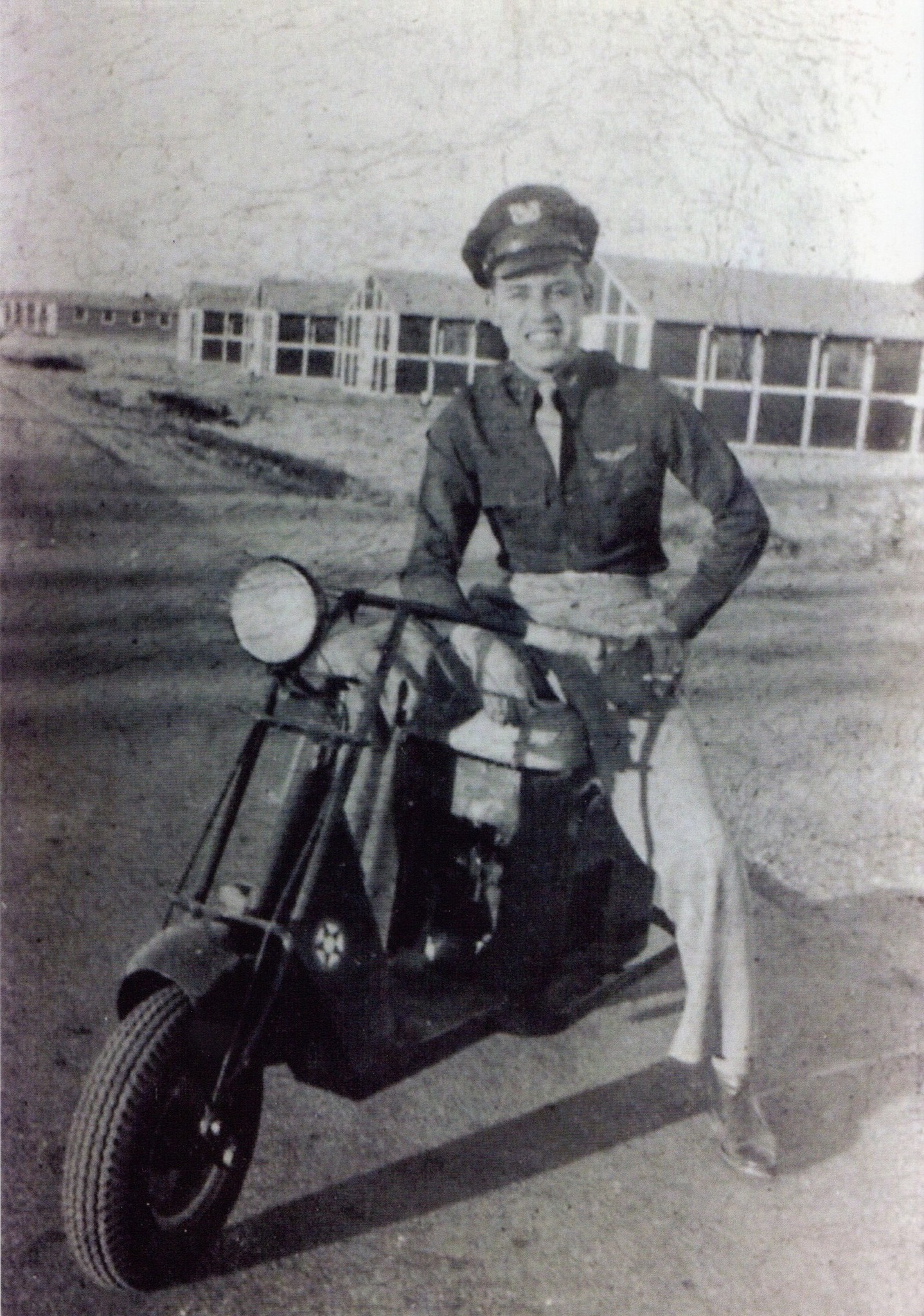
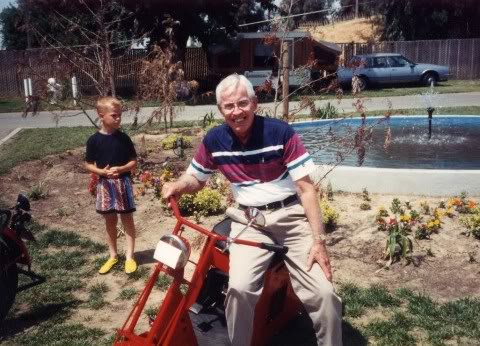
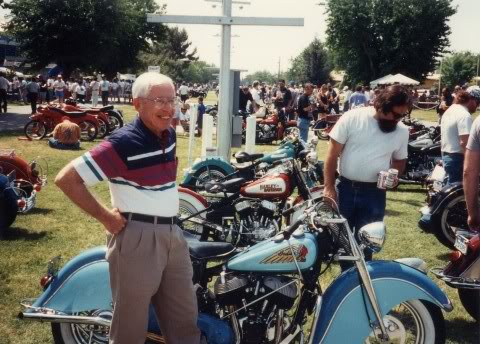
It wasn’t until I became an adult and had owned my first Harley for several years that I learned about my father’s history with motorcycles: that he won the money for his Indian Chief in a poker game 😎, that he rode after the war 🤠, that he had a get-off serious enough to convince him motorcycles were not the best choice for a family man 😮, and that — most importantly — he never got over his love of the damn things!🤷🏻♀️He never told us about his motorcycling exploits when we were kids because he didn’t want to risk encouraging us to do something he knew to be dangerous 🤔, but once I had my own bike it was something we could share; something we bonded over in the final years of his life. In fact, I am always patient with the oldtimers who approach me to say, ‘I used to have one of those….’ in part because my father was one of those guys! 😁The only pic I have of my father on a ‘motorcycle’ back in the day: an Army Air Forces Cushman scooter at an airfield in Lincoln, Nebraska, in 1945.My father at the Hanford, California, vintage motorcycle show on May 1st, 1993, sitting on a Cushman like the one he rode during the war.My father at the 1993 Hanford Cycle Show & Swap with an Indian Chief like the one he rode after the war.Dad in 1945 at Lincoln, Nebraska, and your humble narrator in 1994 at Shiprock, New Mexico. I didn’t realize how alike my father and I sat our machines until years after the Shiprock photo was taken. The photos are now framed together in my office, and again in my living room. 😎
* The New York Pop Festival was actually an ambitious effort to recreate the three days of Woodstock (held the previous August) within the city limits. It turned out to be overly ambitious, but the first night — the one I attended — was freakin’ awesome!!! 🤘🏽 Look at that line-up!
I have written an essay about the New York Pop Festival — the production history, my experiences and the impact it had on my life — and will use that to create a separate post about the concert ASAP. For now, though, just look at that price: $8.50 to see five of the biggest names in rock music! 😮
















 The Shovel Shop