Once upon a time, in the dark ages of the pre-internet world, there was a magazine called Easyriders.

Image courtesy the author.
Easyriders was the brainchild of several California-based riders – Lou Kimzey, Joe Teresi and Mil Blair – who dreamt of a rag for bikers, by bikers, with none of the usual mealy-mouthed product reviews, and clean-cut models posed aboard factory-fresh machines from Europe and Japan.
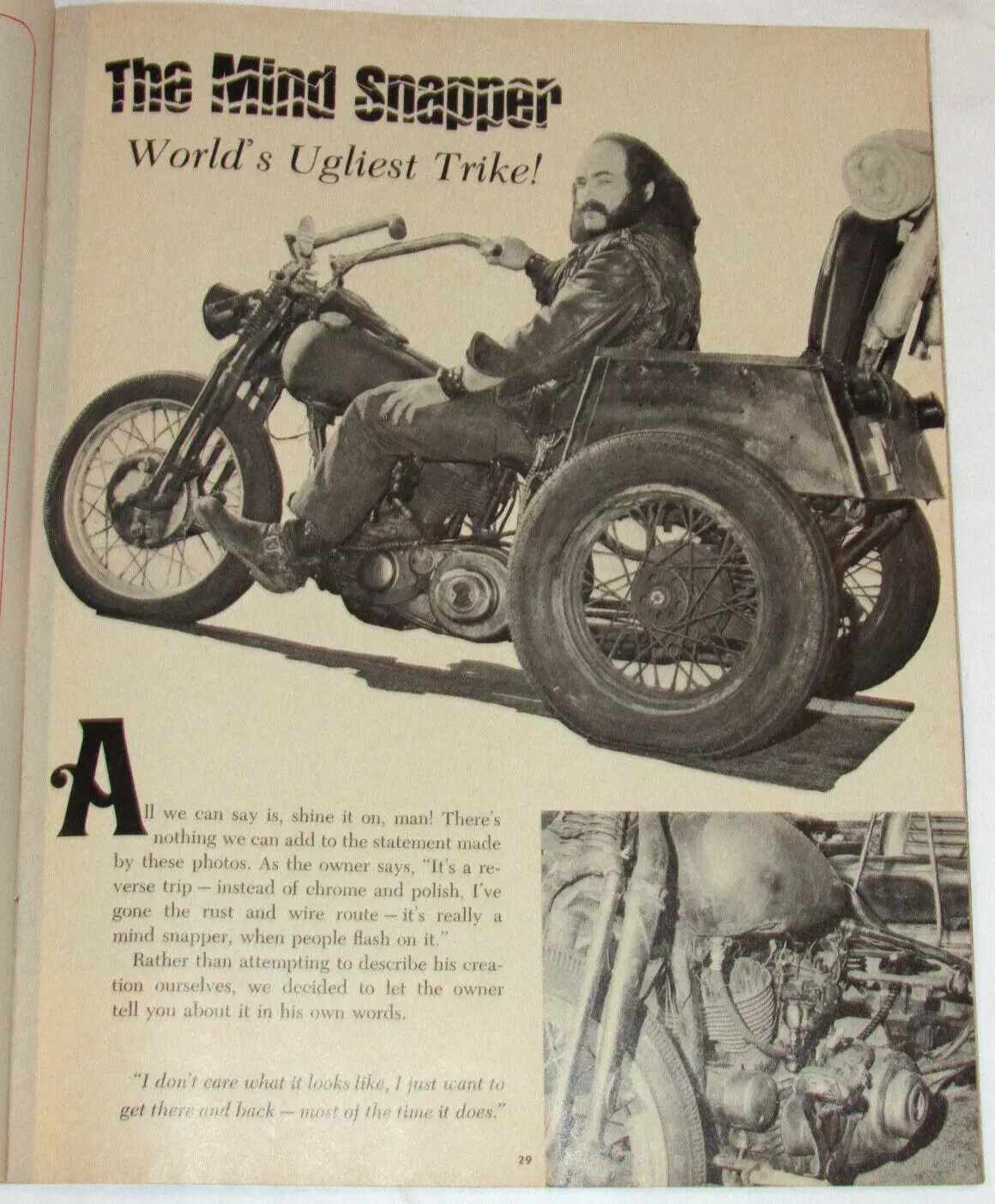
Image courtesy of eBay seller Cruzin’ for a Deal.
No, this new mag would be for hardcore bikers, patchholders and independents who lived, breathed, slept and dreamt motorcycles: preferably big American motorcycles like Harley-Davidson and Indian. The first issue trumpeted the new title as ‘For the Swinging Biker.‘ They later identified as ‘Entertainment for the Adult Biker.‘


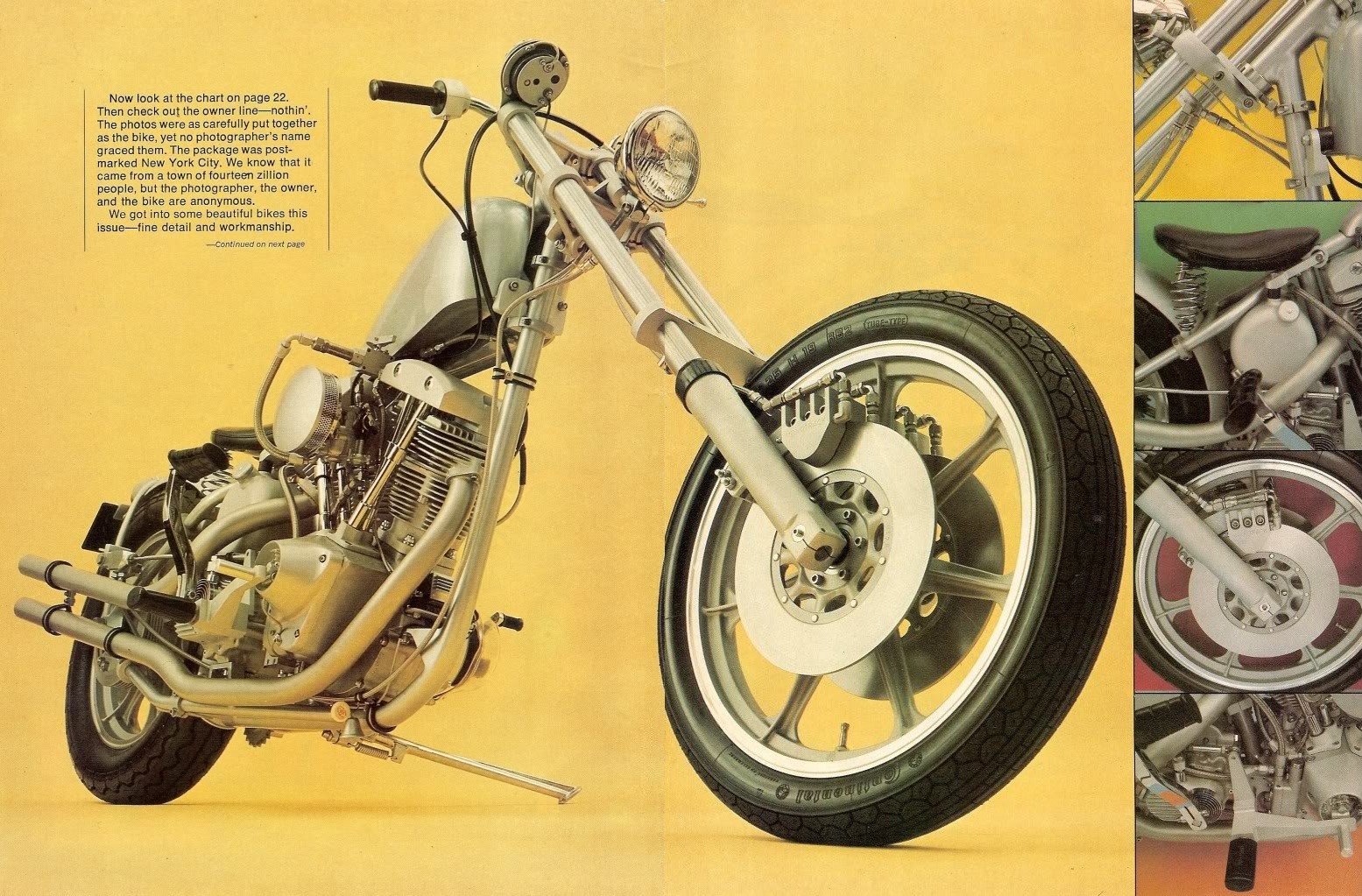
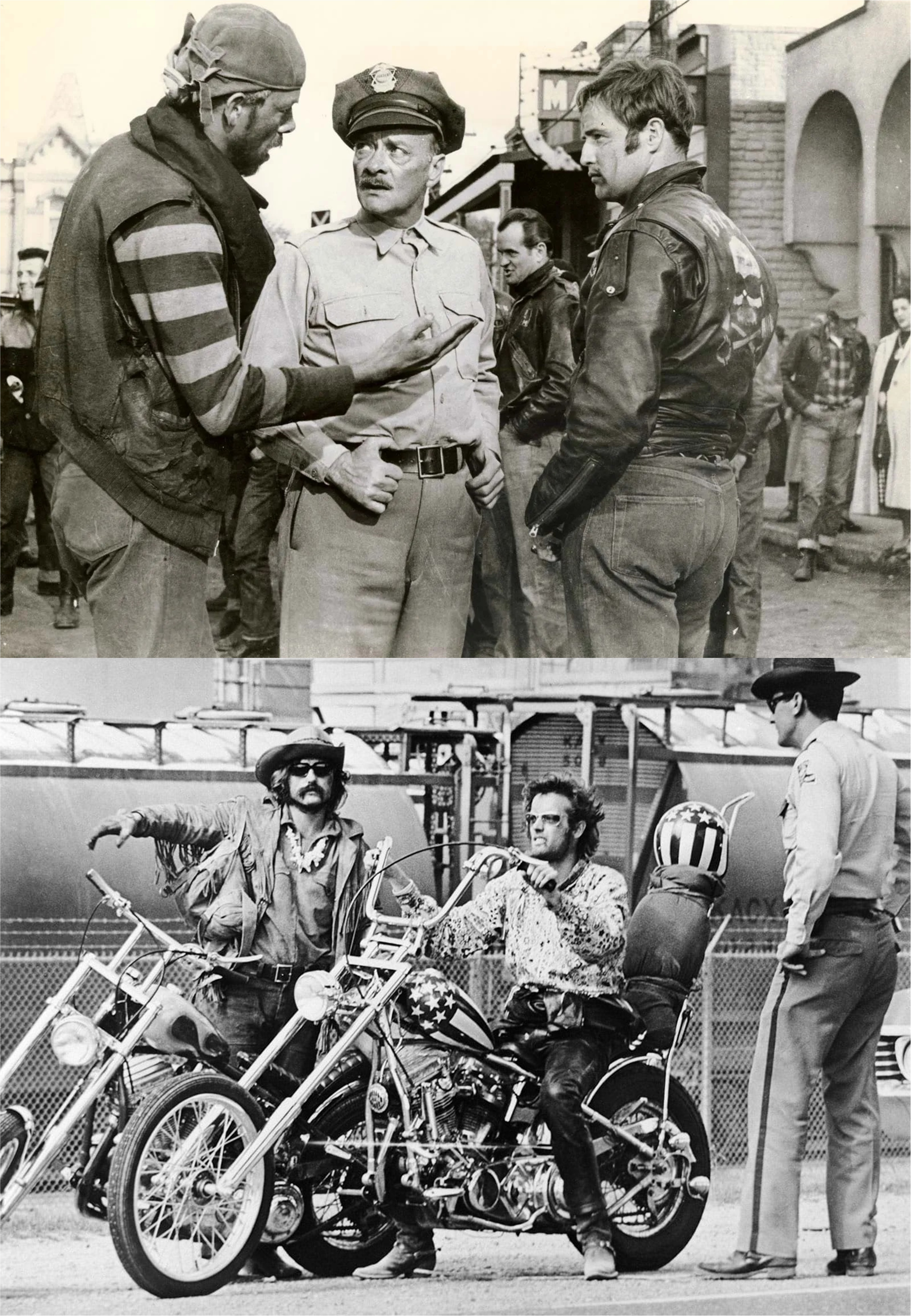
Within its pages, Easyriders featured handbuilt choppers – genuine rigid-framed, long-forked machines with psychedelic paint jobs, sky-high sissybars, glistening spokes and heavily chromed engines like the ones featured in the magazine’s namesake movie. They were laid-back, long-legged beauties – dream machines – and in the ’60s and early ’70s many a young man (your humble narrator included) lusted after them. We looked for them at custom car and motorcycle shows, built plastic models of them, pressed our noses to the windows of Dad’s station wagon whenever one rumbled past and, naturally, pored over magazines about them.
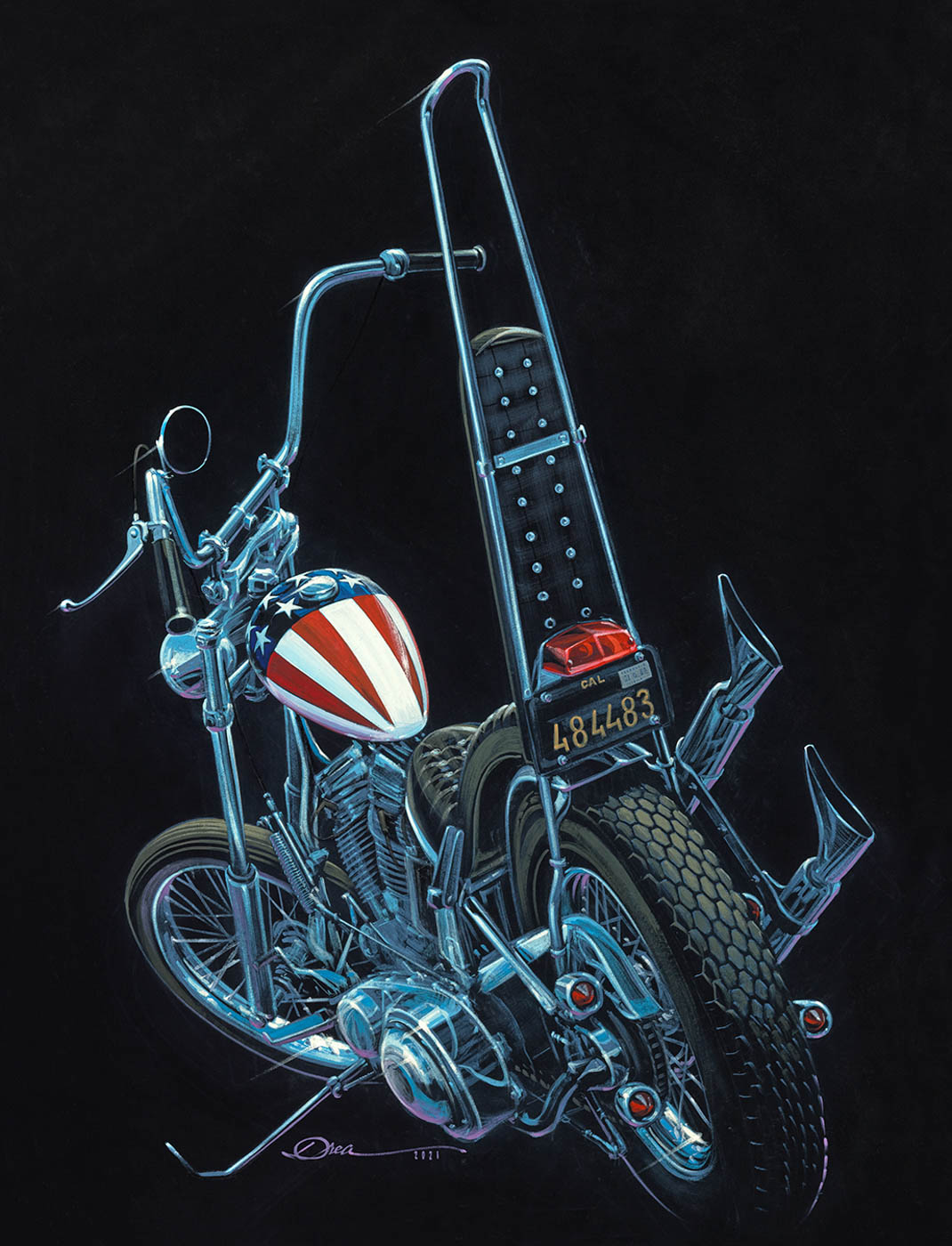
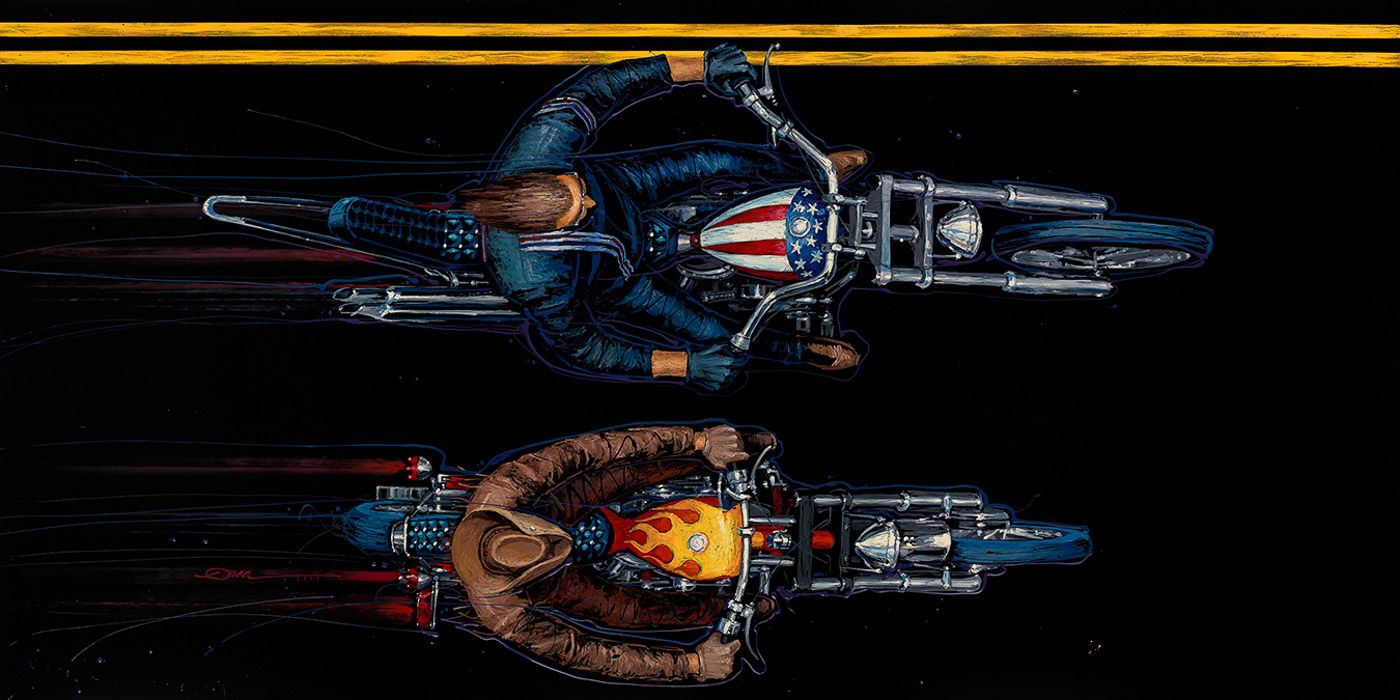

Image courtesy of the author.

Image courtesy of the author.
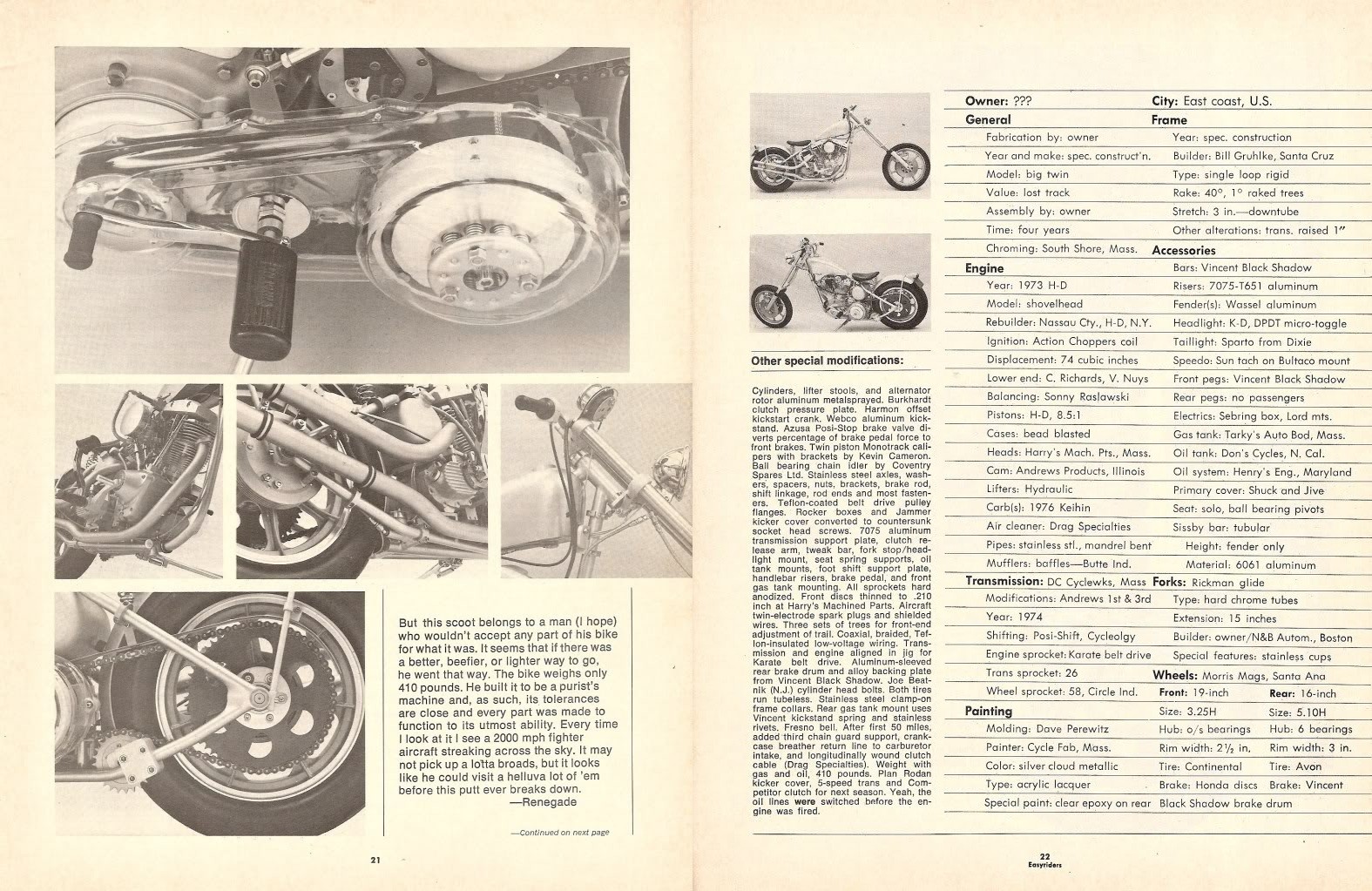
Choppers may have been works of art, but for most builders they were much, much more. Those workhorse v-twin engines – the ones that carried police officers through city traffic, and gave Mom and Pop a breath of fresh air and outdoor life at the end of a workaday week – were broken down and rebuilt, and in the process they were blown, stroked, bored and balanced to achieve ultimate performance in flat-out style. We’re talking balls-to-the-wall, explosive power.
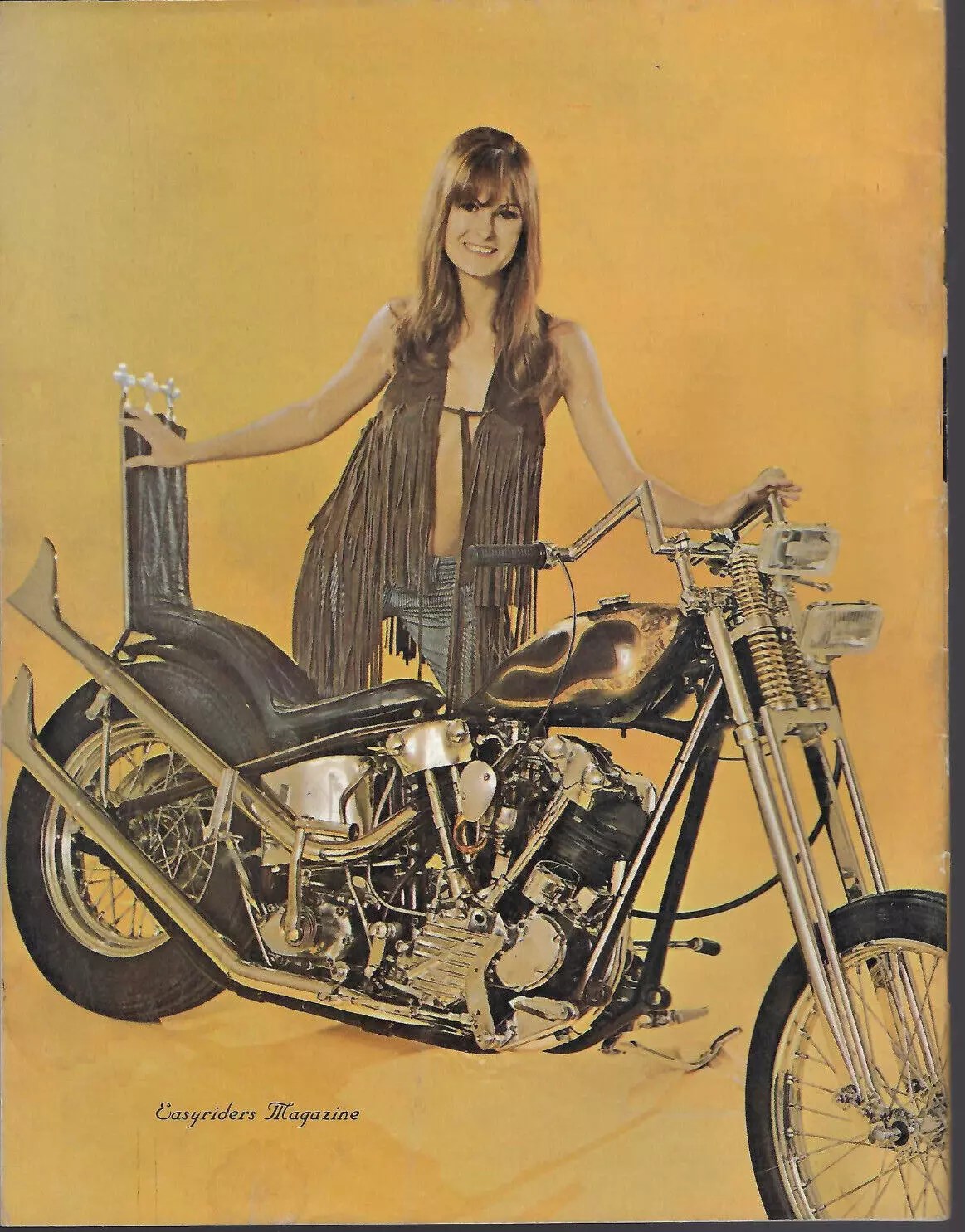
Image courtesy of eBay seller Cruzin’ for a Deal.
The bikes may have been built for cruising the highway with a chick on the p-pad and a fart sack strapped to the forks, but the engines were built for red-light racing and the quarter-mile, popping wheelies and other displays of brute acceleration. These weren’t upstart Jap scrap that whined like angry hornets, or prim European motorbikes with finely tuned suspensions and muted, throaty exhaust notes. You weren’t going to see choppers competing in Timed Trials challenges, or road-racing on the Isle of Man. They were, with few exceptions, big, loud, powerful, gas-guzzling, straight-line-balling, quintessentially American machines.

Mystery Sled images courtesy of the author.
Easyriders was the first biker lifestyle magazine to make it beyond a handful of issues, and reach a national (and later international) readership. Others, like Colors, produced by East Coast biker Phil Castle, and the California-based Choppers, created by signman-turned-customizer Ed ‘Big Daddy’ Roth, were short-lived and regional. You weren’t going to find issues of those magazines on the rack at your local 7-11 store, and by 1971 both had gone out of print.
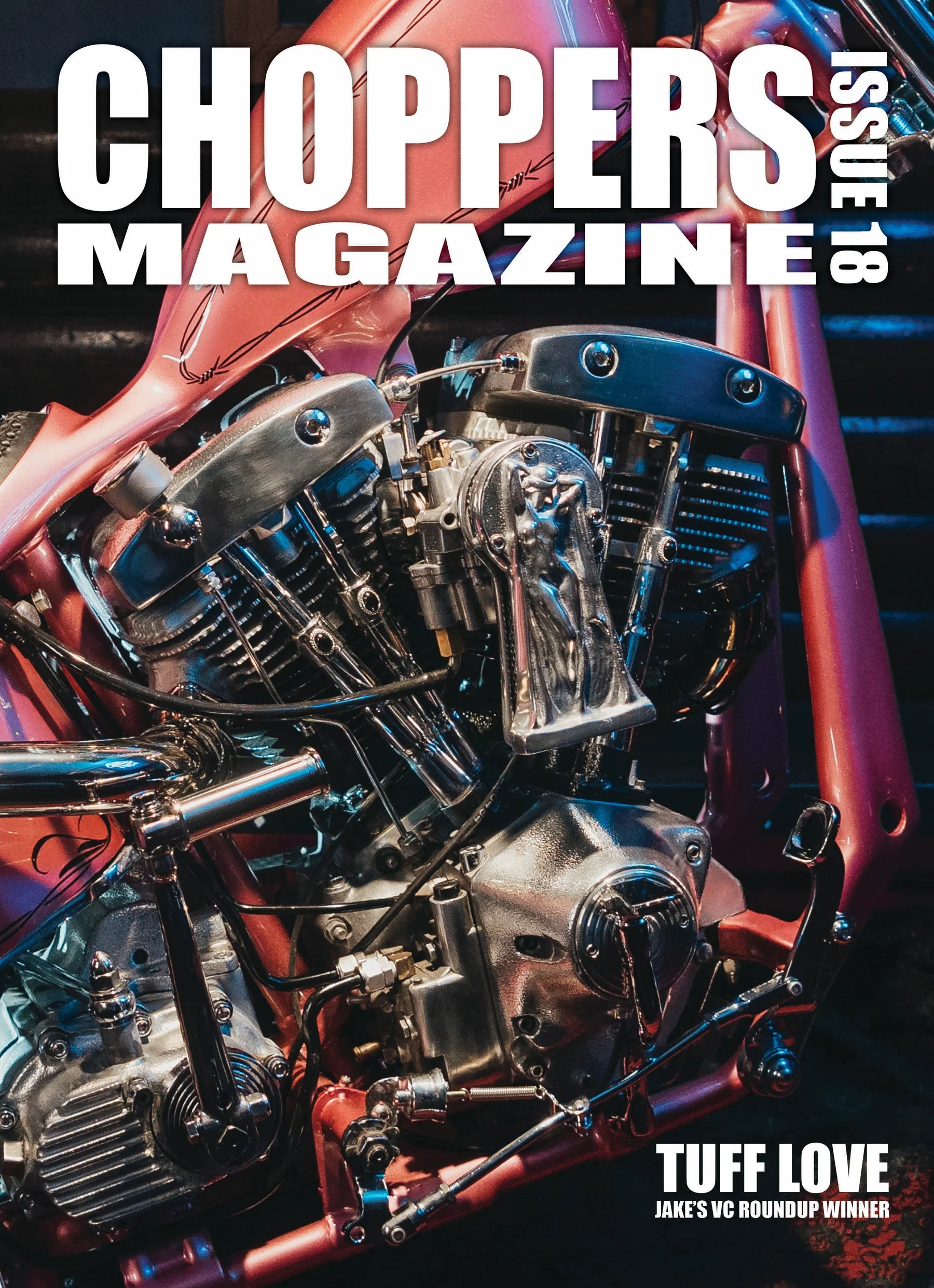
Image sourced from the internet.
Easyriders, on the other hand, endured, in part because it was so much more than just shiny paint and polished chrome plating. The magazine swiftly became the big dog on the block, its readership dwarfing titles like Big Bike, Custom Bike, Street Chopper and Supercycle, because Easyriders went farther than any of those titles dared. The rag truly was ‘entertainment for the adult biker’.
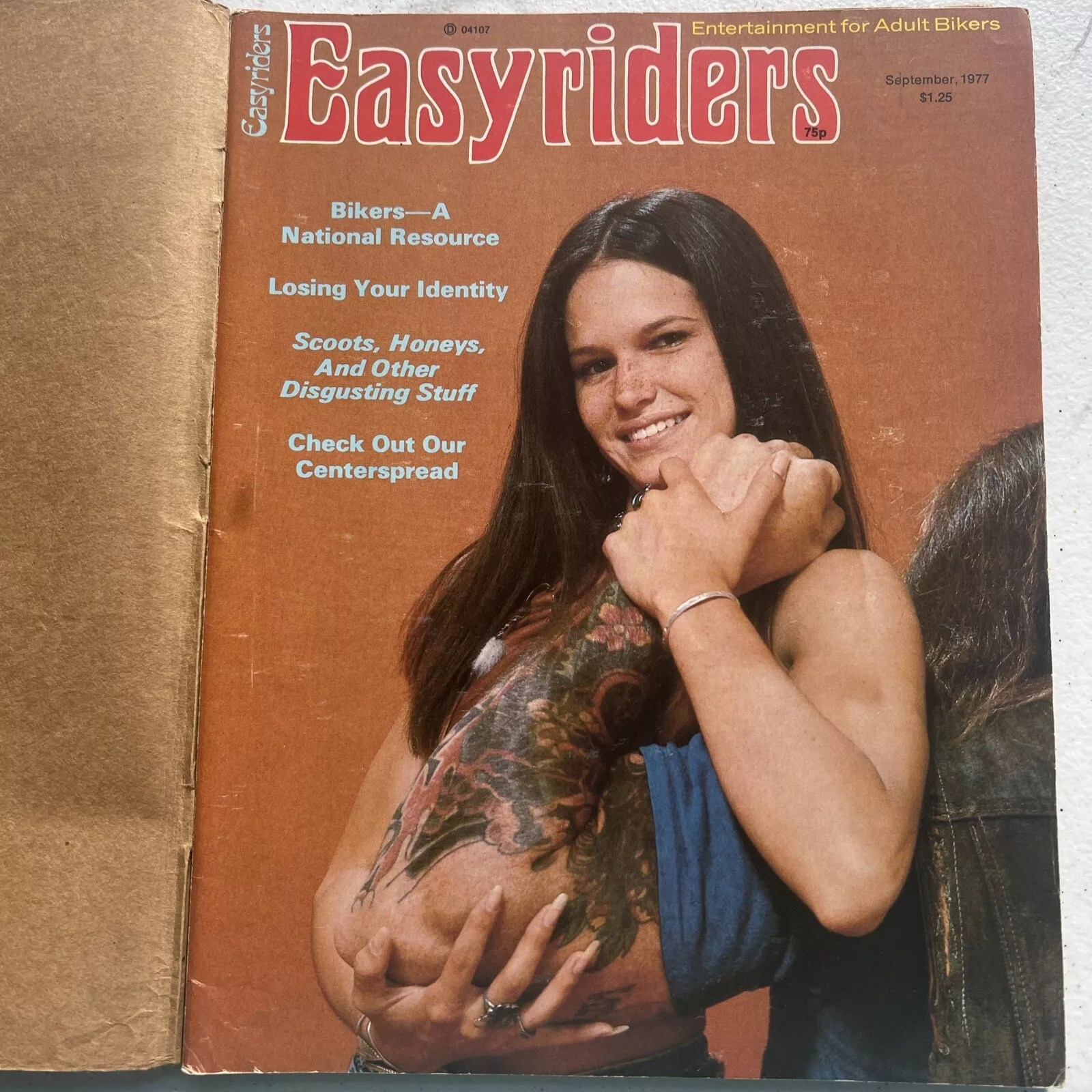
Image courtesy of eBay seller pqu698.
For starters, Easyriders had bare-breasted models draped over choppers or curled up against the bikes’ owners: real biker women – often the bike owner’s ol’ lady – with tattoos, pimples and other ‘flaws’, showing more skin than other bike rags would dare.
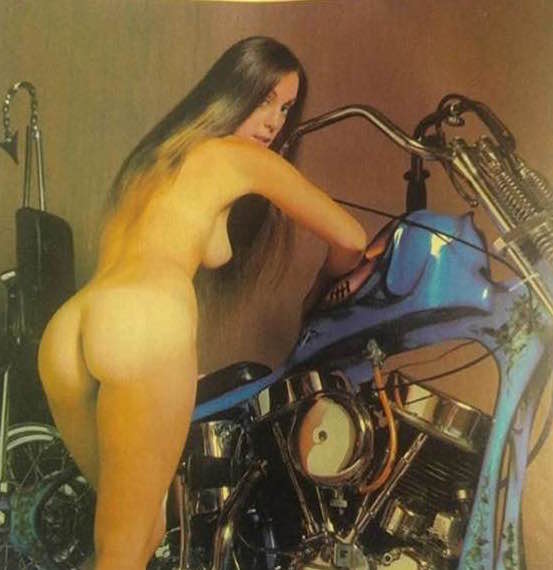
Image sourced from internet.
They also began a feature (copied from Big Bike, a title editor Lou Kimzey created and edited prior to joining forces with Joe Teresi and Mil Blair) called the Ol’ Lady Contest, in which women (or their proud significant others) could submit photographs for the chance to win cash and prizes, and be named ‘Ol’ Lady of the Year’.

Image courtesy of author.
Later, in a barely-perceptible nod to gender equity, they began including small (usually one- or two-page) spreads on bikes owned and built by women, titled Foxy Riders.
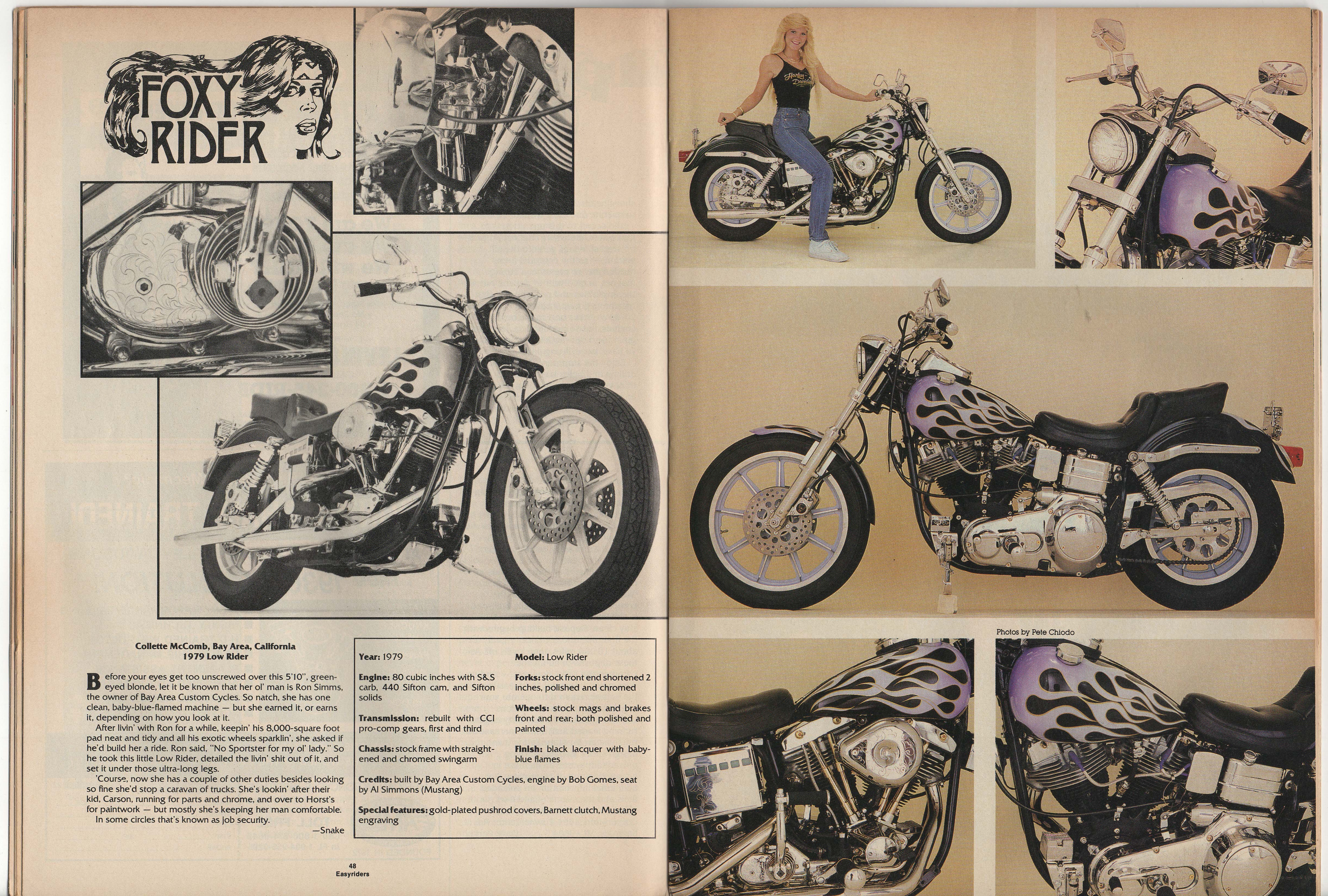
Image courtesy of author.
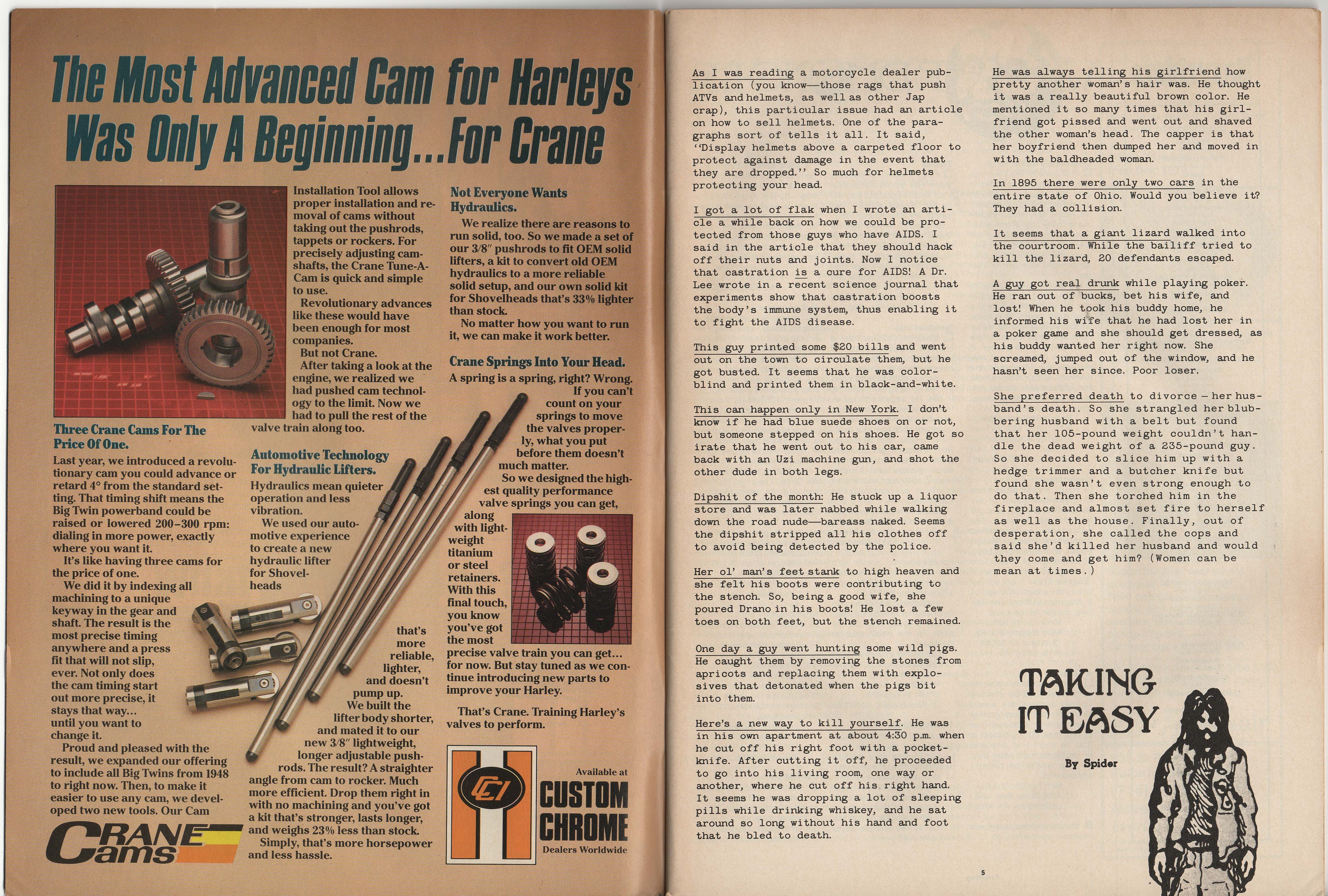
Image courtesy of author.
There was also Spider’s Leg-Wetting Facts column (later renamed Taking It Easy, as shown above) that featured humorous factoids and anecdotes culled from the mainstream press and other bike rags. Farther back in the magazine were pages of jokes, too, usually submitted by readers.

Images sourced from internet.
Miraculous Mutha, depicted above, purported to be an overweight, disease-riddled ‘mama’, doling out advice to the lovelorn and wayward in Miraculous Mutha Tells All, below. Her responses to readers’ letters were frequently lewd, lascivious, and more than a little perverse. Readers loved her!
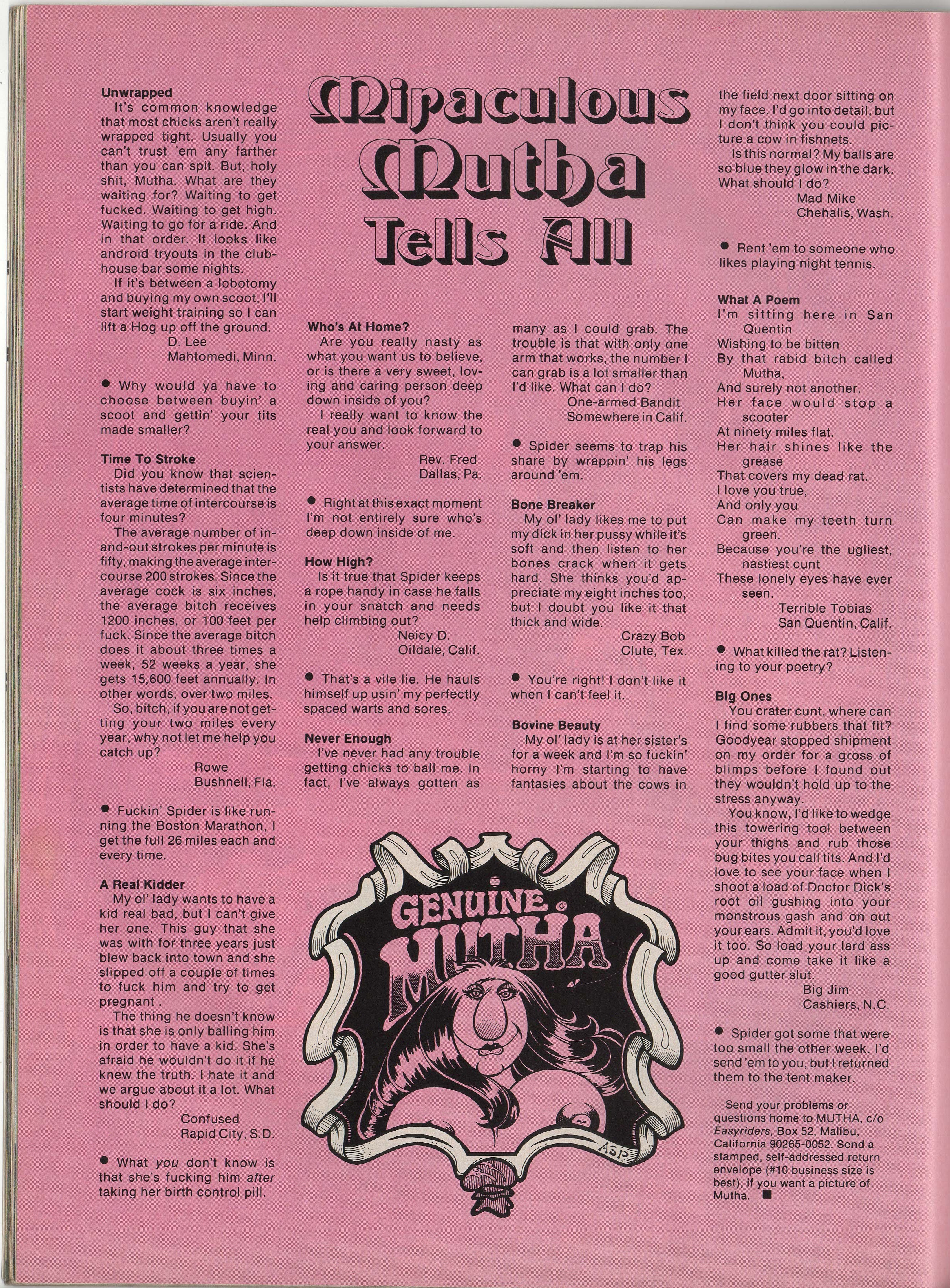
Image courtesy of author.
On a more serious note….
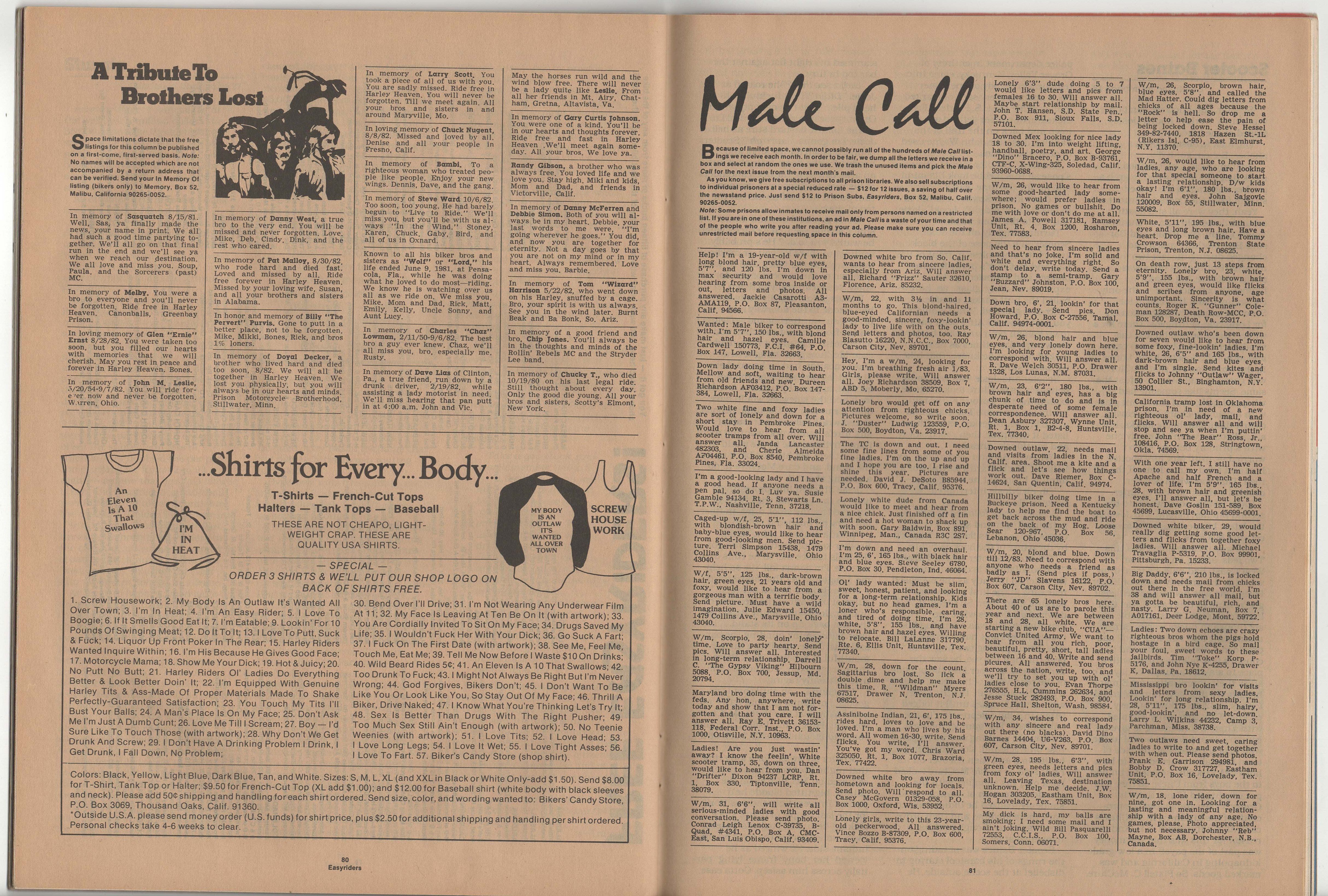
Image courtesy of author.
In the magazine’s back pages, one feature allowed bikers to offer up A Tribute to Brothers Lost, while a separate feature titled Male Call helped incarcerated bikers hook up with pen-pals and potential post-release lovers. Another page of classifieds called Choppershopper let bikers reconnect with brothers, announce events, clear potential club names for conflicts, and trade and sell motorcycle parts.
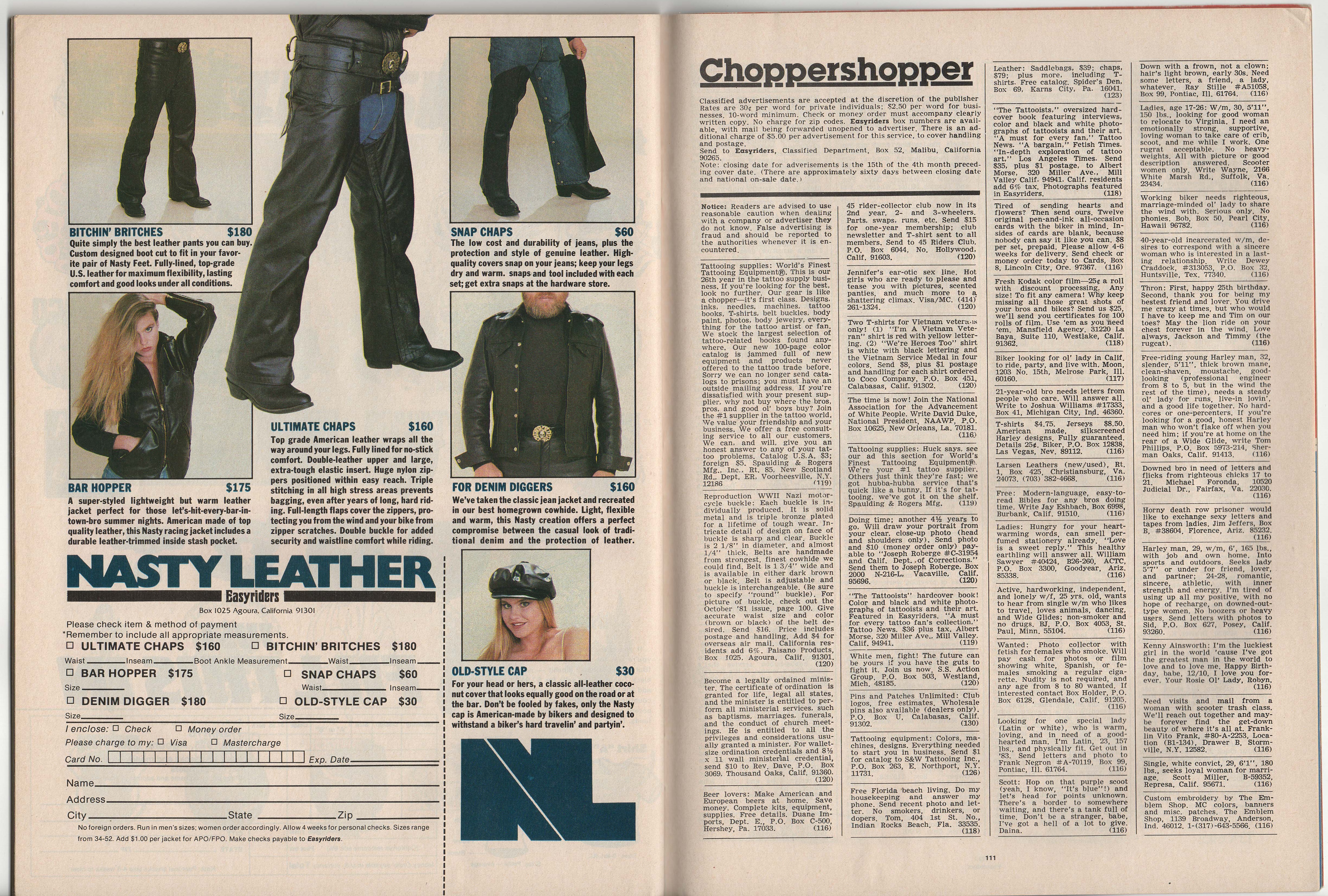
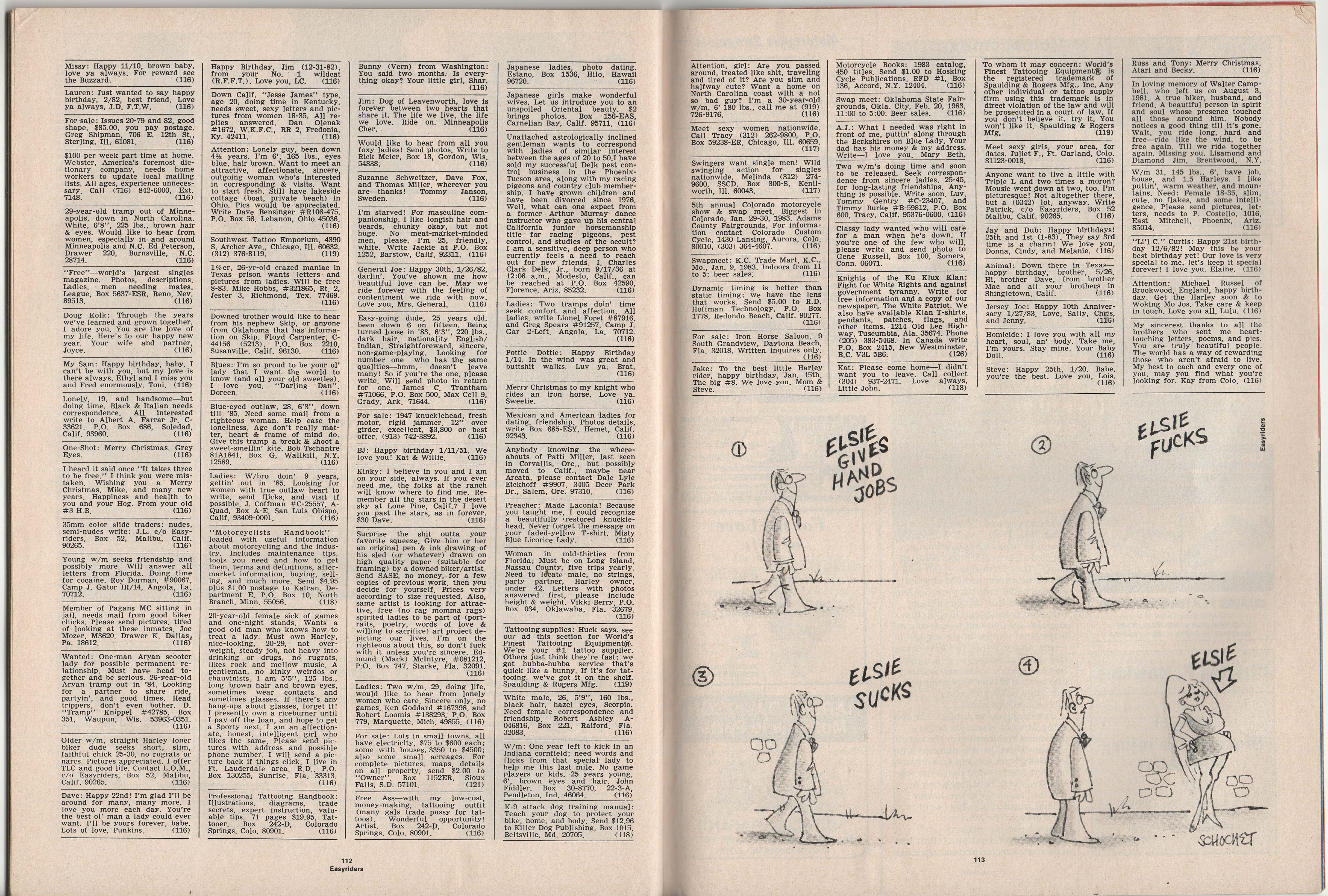
Image courtesy of author.
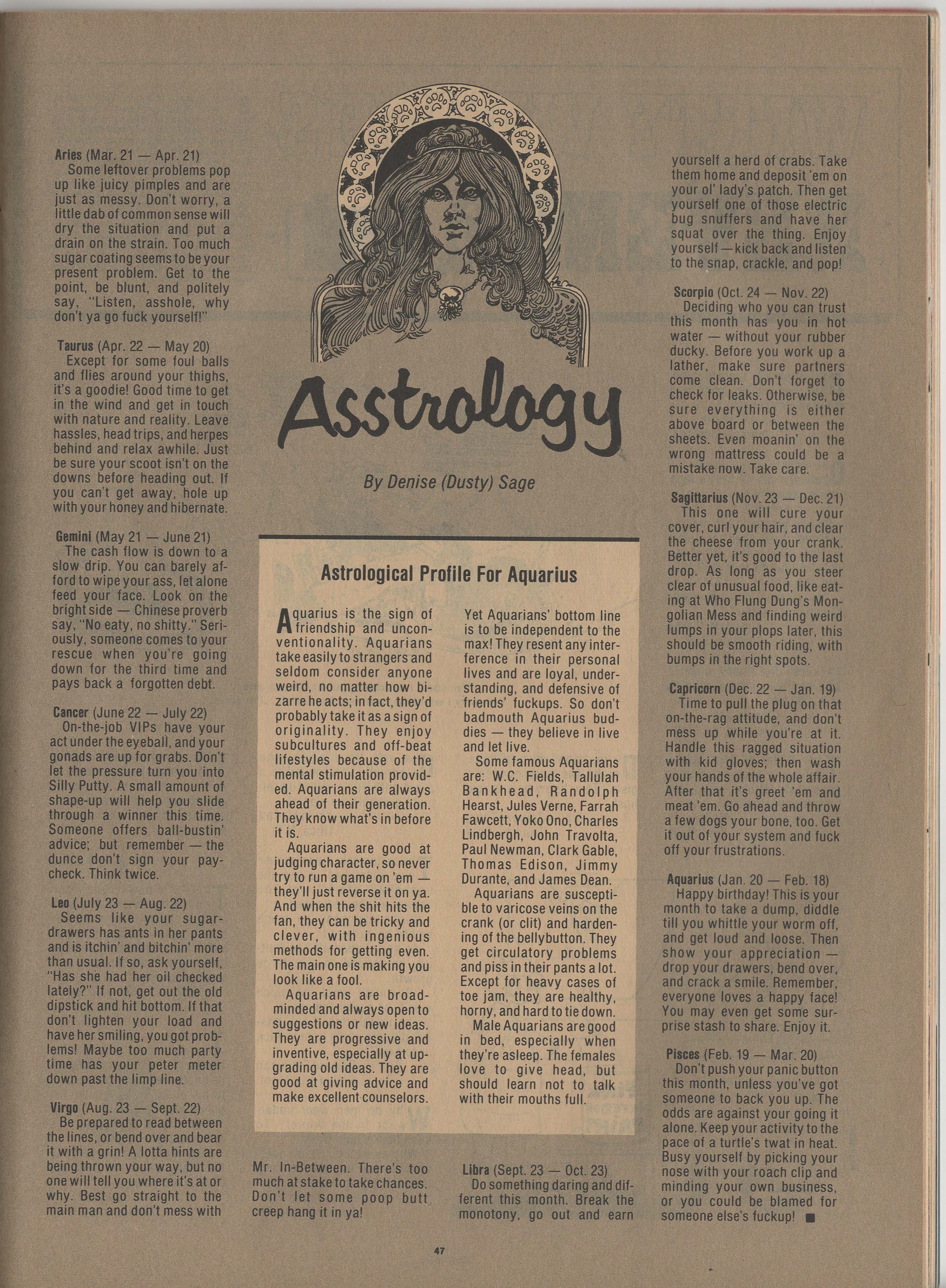
Image courtesy of author.
An Asstrology column made random appearances, along with word games, crossword puzzles and the like. Easyriders also ran an occasional Downtime column with reviews of new music, books and movies of interest to bikers. Finally, there were letters to the editors: some poignant, some profane, some laugh-out-loud funny. The editors’ often-acerbic replies were often even funnier.
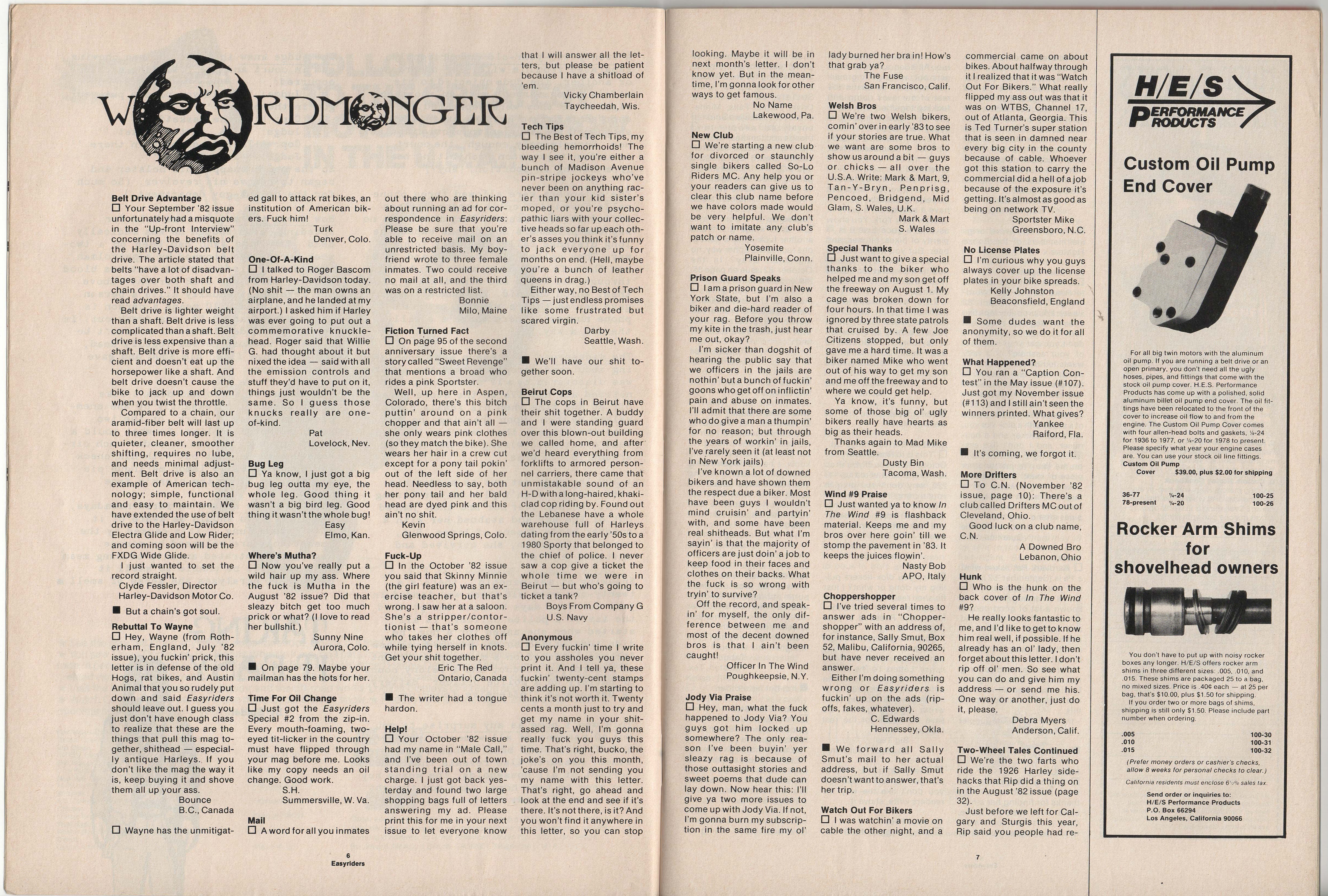
Image courtesy of the author.
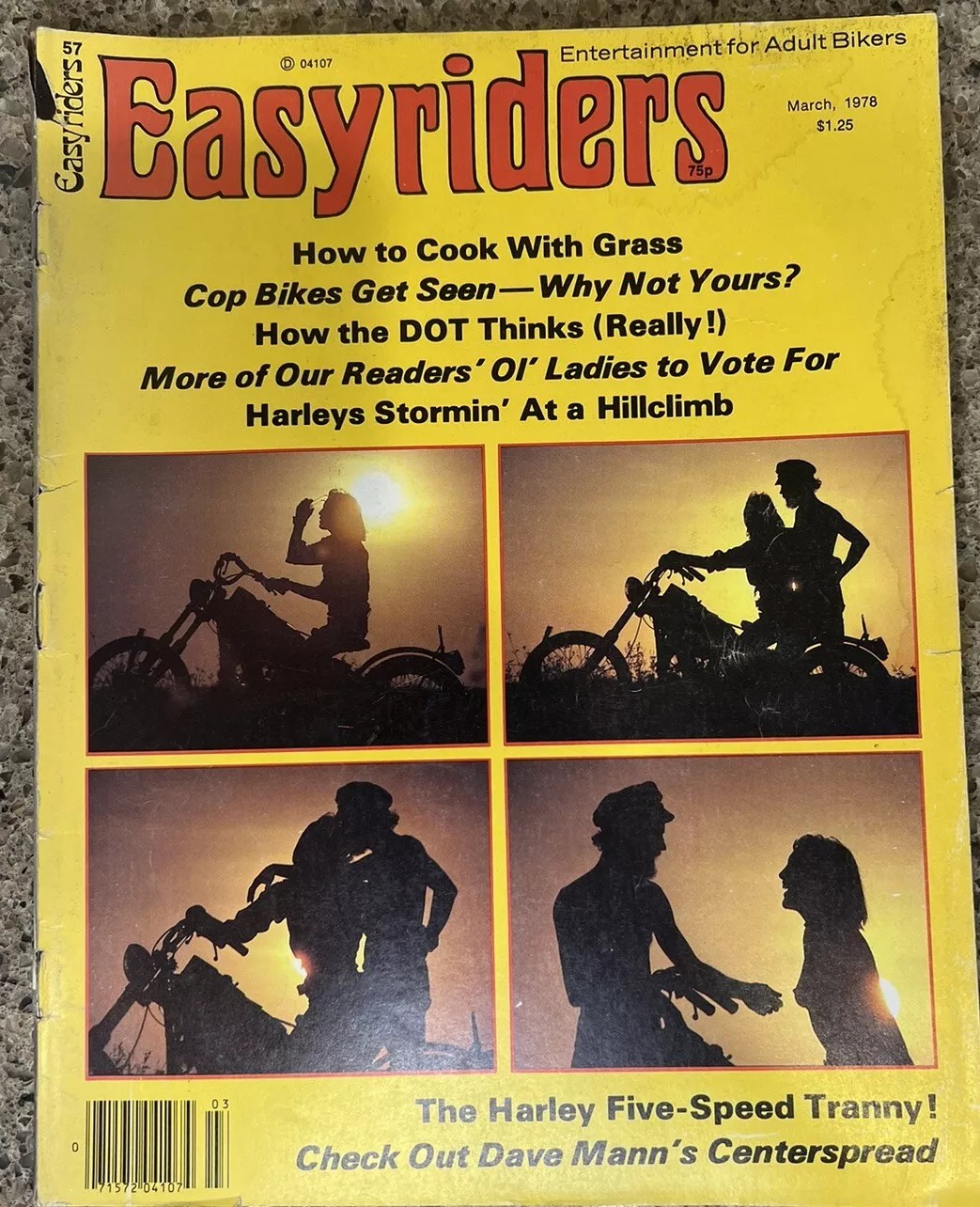
Image courtesy of eBay seller pqu698.
Easyriders also featured tech tips. Some were useful articles about motorcycles: how to decide what rake you needed for your chopper, or tune a Mikuni carburetor, or how to decipher Harley-Davidson’s Byzantine numbering system, so aspirant chopper builders could determine what year and model engine they were looking at when shopping for the Big Twin or Sportster engine of their dreams. Experienced bikers knew that a dodgy set of numbers could result in confiscation of the rider’s motorcycle by police. Rest assured, if the cops took your bike, you lost everything connected to it, even if you had receipts for every nut and bolt!

Image courtesy of eBay seller pqu698.
There were also handy ‘tech tips’ on how to conceal weapons, drugs and other contraband, grow marijuana and make prison tattoo machines, alongside interviews with controversial characters like Ku Klux Klan leader David Duke. These articles – and adverts for White Power t-shirts, swastika belt buckles and devices for smoking leafy products 😏 whilst riding your machine – were gradually phased out when prison and military censors began banning the magazine. Because so many bikers were in prison or serving in the military, the publishers of Easyriders went to great lengths to be sure the magazine was available to all, even offering free subscriptions to prison libraries.
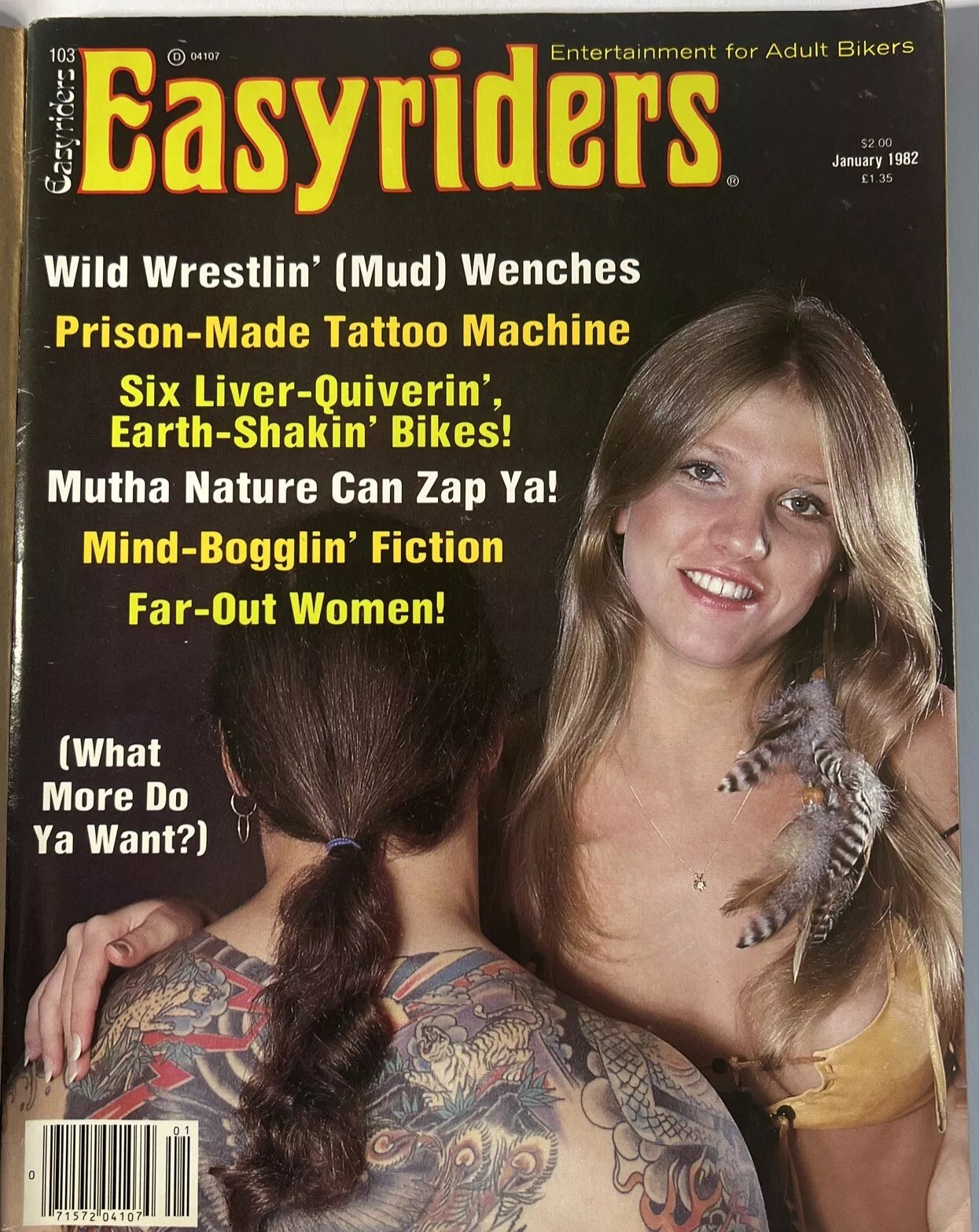
Image courtesy of eBay seller pqu698.
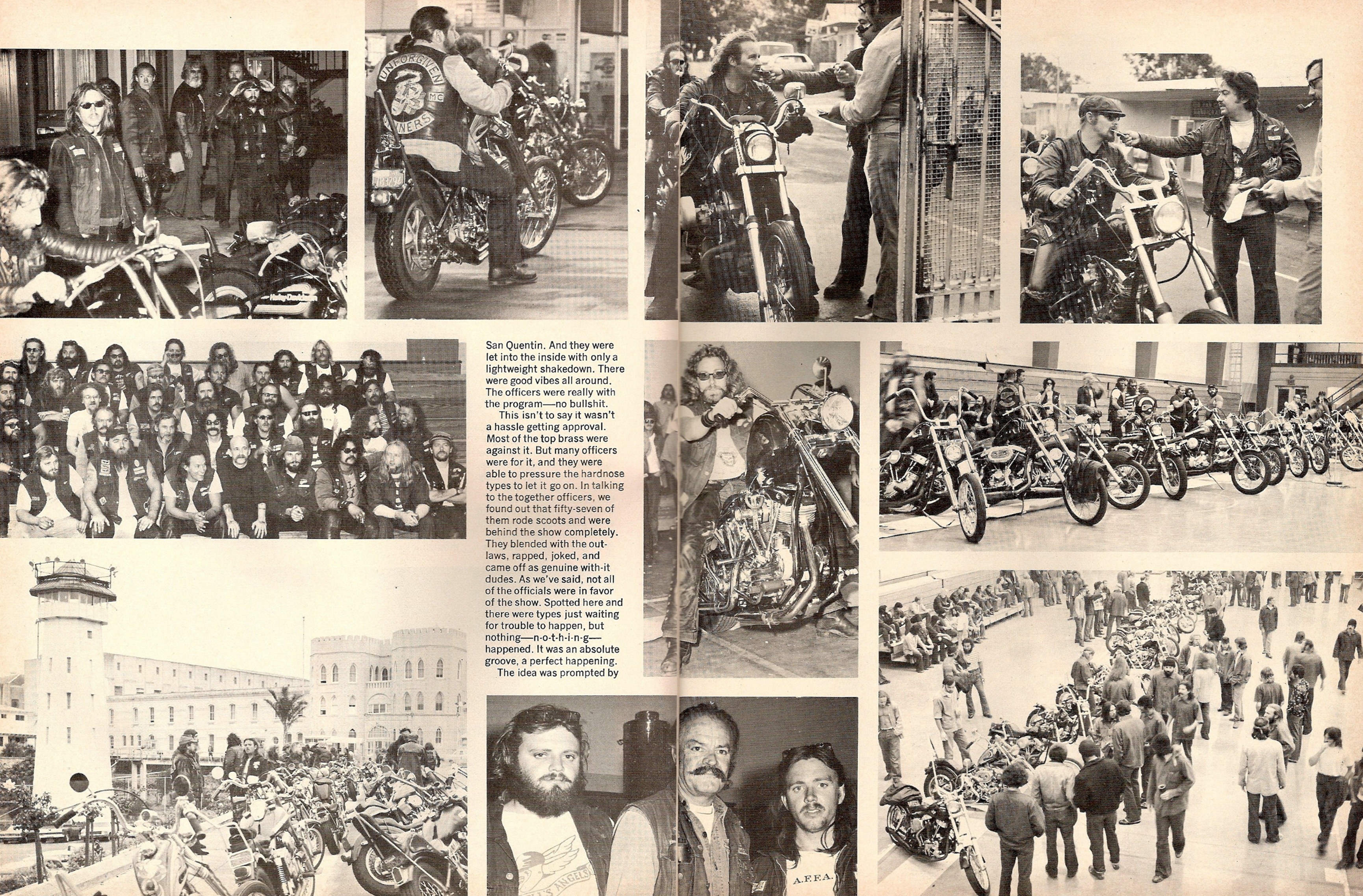
In a regular feature titled Easynews, the magazine also included political news relevant to bikers: the progress of helmet laws and other anti-biker legislation, R.I.C.O. 1 prosecutions of Hells Angels members and other outrages. When ‘safetycrats’ in Washington used federal highway funds to blackmail states into enacting mandatory helmet laws, Easyriders and A.B.A.T.E. 2, the homegrown Motorcycle Rights Organization (MRO) the editors created, led the fight against the mandates.

Image courtesy of author.
Through the 1970s, ’80s and ’90s there was a push-and-pull contest between pro- and anti-helmet law factions, which resulted in a patchwork quilt of requirements across the nation. One state might mandate helmets for all riders, while another only required them for riders under the age of twenty-one, or eighteen, or on machines over a certain engine size. To obfuscate the issue even more, in later years a wave of bills across the nation permitted riders to doff their helmets if they carried a certain amount of health insurance, which would cover them in the event of a motorcycle crash. Enforcement was unsustainable, and those states effectively became free choice states again.
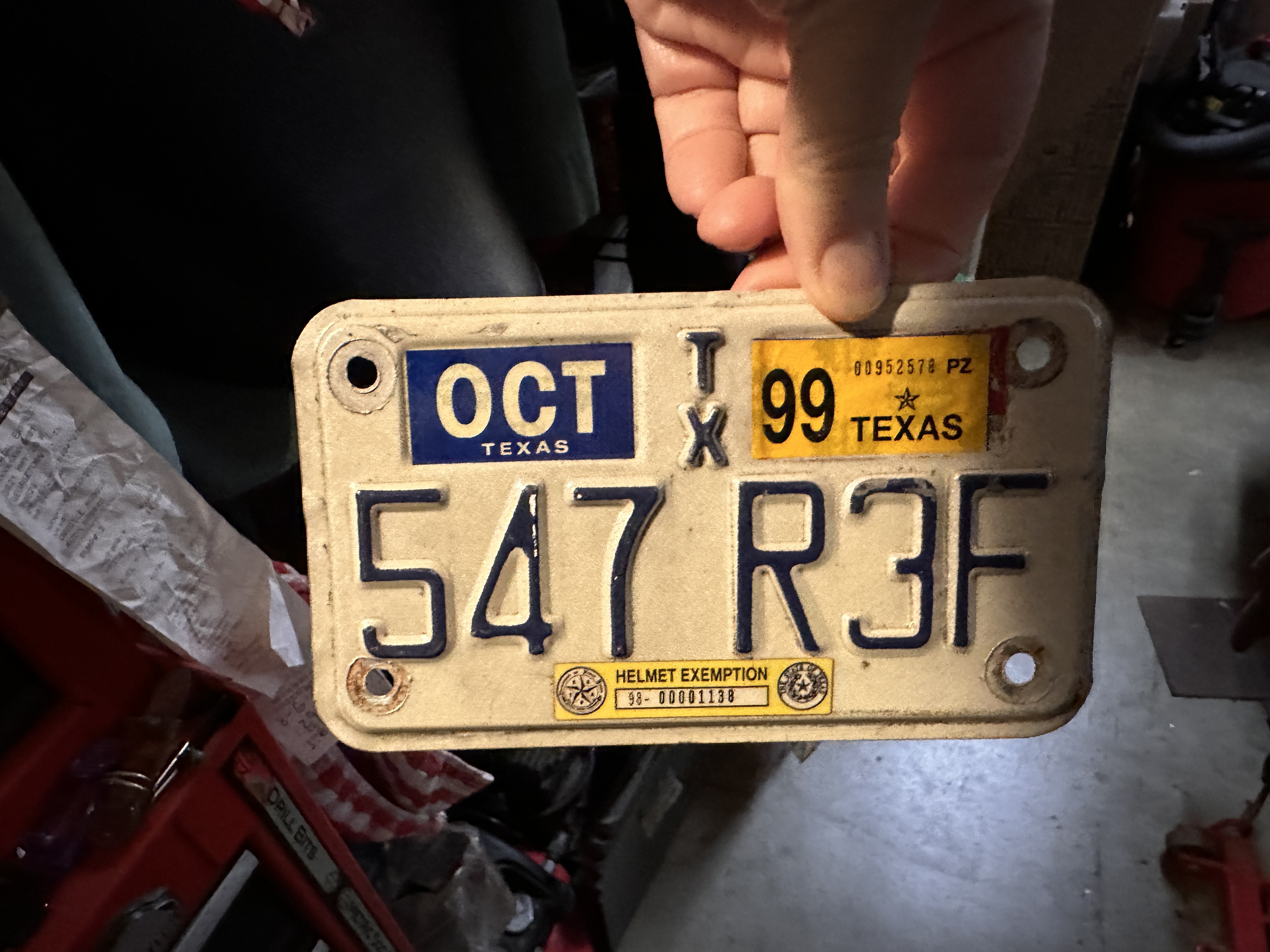
But helmet laws weren’t the only issues facing riders. Some states attacked the ‘chopper lifestyle’ by mandating seat and handlebar heights, chain guards and front fenders, full-length rear fenders, turn signals, restrictive mufflers and more.
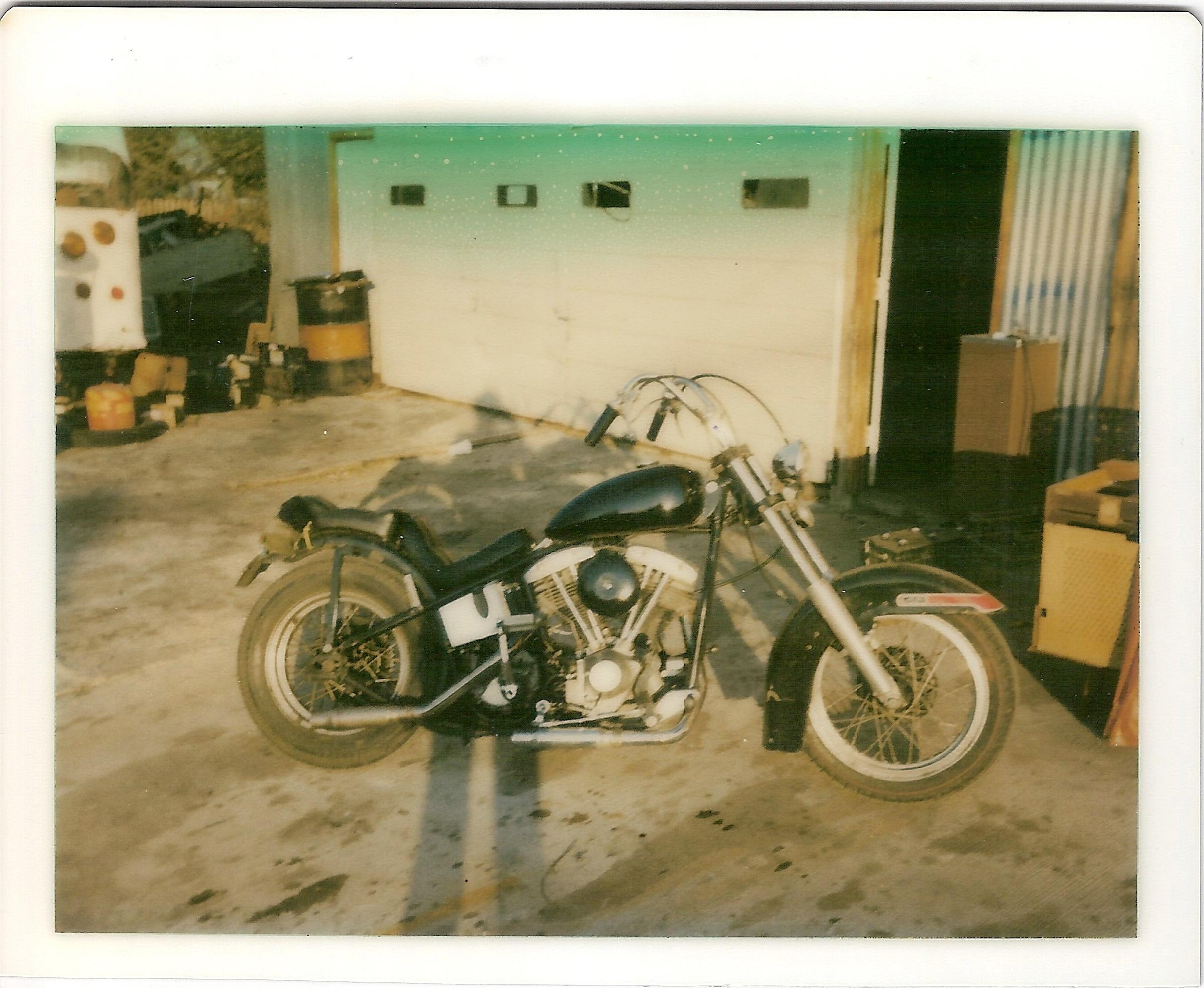
A motorcycle like my shovelhead could earn me a ‘seat too low’ ticket in certain jurisdictions, because I ran a frame-mounted butt bucket saddle on that low-slung OEM rigid wishbone frame. I never ran the sky-high apehangers some riders opted for, but my ‘baby apes’ were probably tall enough to get me ticketed in some states, and I have twice been ticketed for ‘exhaust too loud’. On both occasions I had brand new mufflers recently installed on my bike.
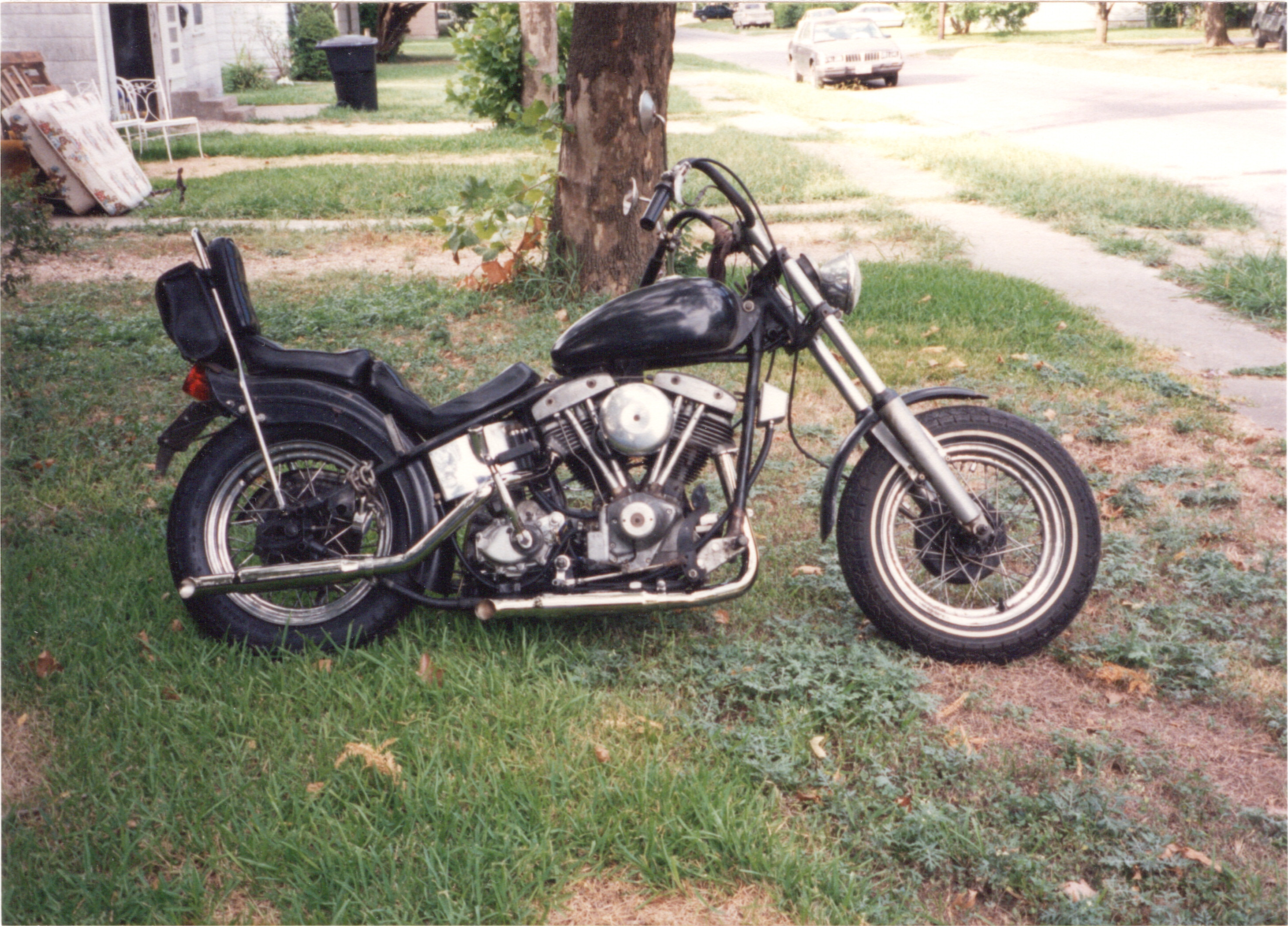
Photograph courtesy of the author.
Elsewhere, motorcyclists were being profiled by law enforcement officers – stopped and treated like armed-and-dangerous felons solely for being bikers – and businesses were discriminating against riders, with ‘no motorcycle attire’, ‘no club colors’ and ‘no motorcycle parking in lot’ signs popping up at bars, restaurants and other premises.
I recall a run from Austin to Lake Buchanan, in a pack of thirty or so bikes. We stopped at a roadhouse in rural Burnet County for lunch. As we were leaving, we found ourselves surrounded by law enforcement of all stripes – local police, county sheriff’s deputies and state troopers – with weapons drawn as they confronted us. We were put through the mill. License, registration and vehicle identification numbers were slowly and laboriously checked via radio, one at a time, to drag the process out. Bikes were searched and riders questioned as we sweltered in the blistering sun for over an hour – and the sum total of their efforts was one (1) arrest for an outstanding traffic warrant!
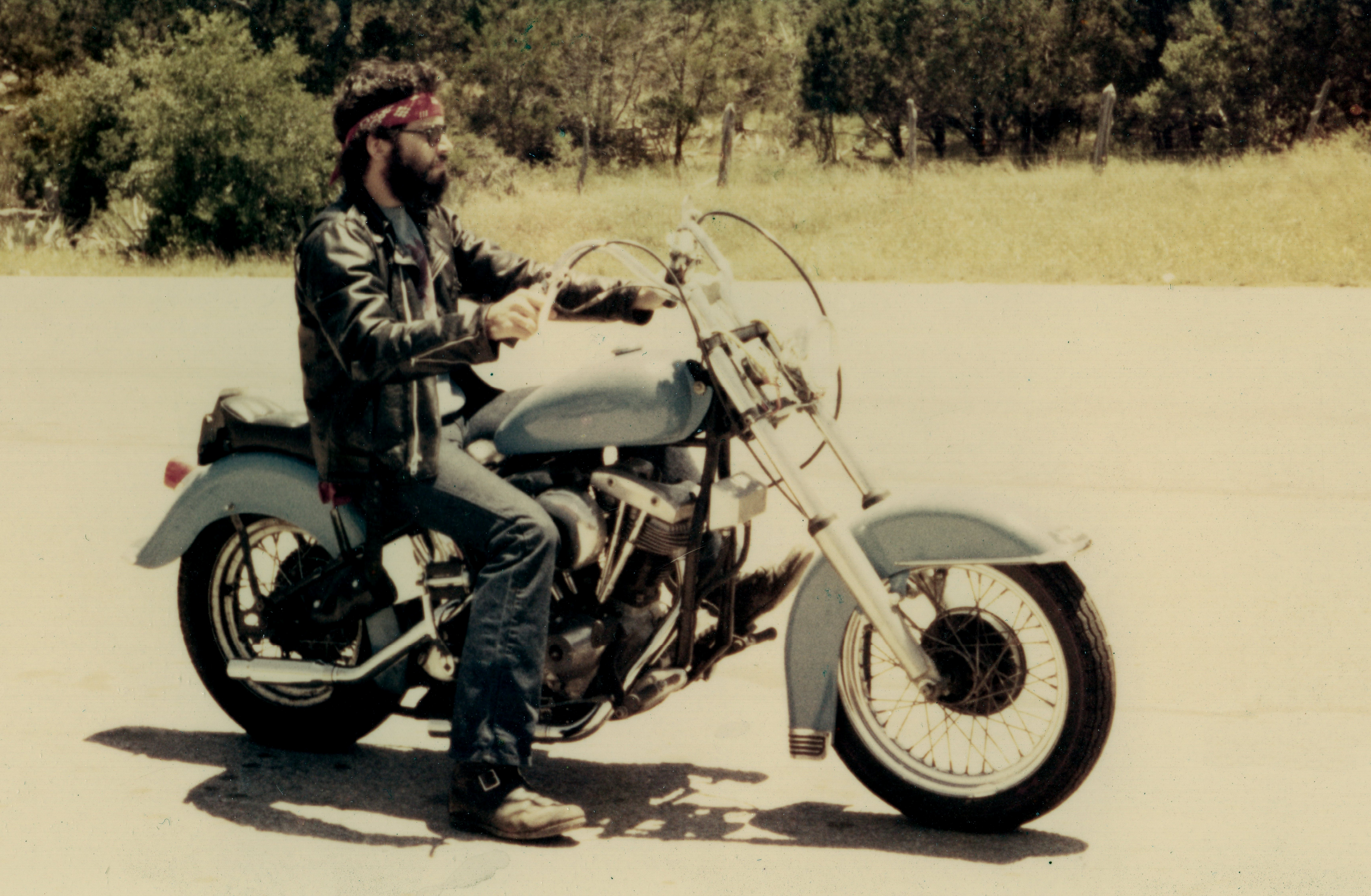
Photograph courtesy of the author.

Image courtesy of eBay seller Vintage Variety 60.
In another instance, I was attending a bachelor’s party for a friend. Despite the fact that we were all sober riders, he wanted his party to include a tour of the topless bars around Waco, Texas.
The evening began with an excursion to a dive outside the city limits, with fully nude dancers. The first thing I saw, as we entered the bar, was a drunk crashing to the floor after leaning his chair back too far, and the naked teenager on stage raising her hands in fright, screaming ‘I never touched him!’
Later in the evening, we arrived at a ‘swanky gentlemen’s club’ in the city proper, and sure as hell, there was a sign saying ‘No Motorcycles in Parking Lot.’ The groom-to-be and most of our party were content to park in the lot next door, go in and carry on the festivities. Me, I do my best to avoid spending my money or time in places where I’m not wanted, so I stayed outside and rapped with the bouncers, most of whom were riders themselves!
And, for the record, there are damned few ‘gentlemen’ in those so-called ‘gentlemen’s clubs.’
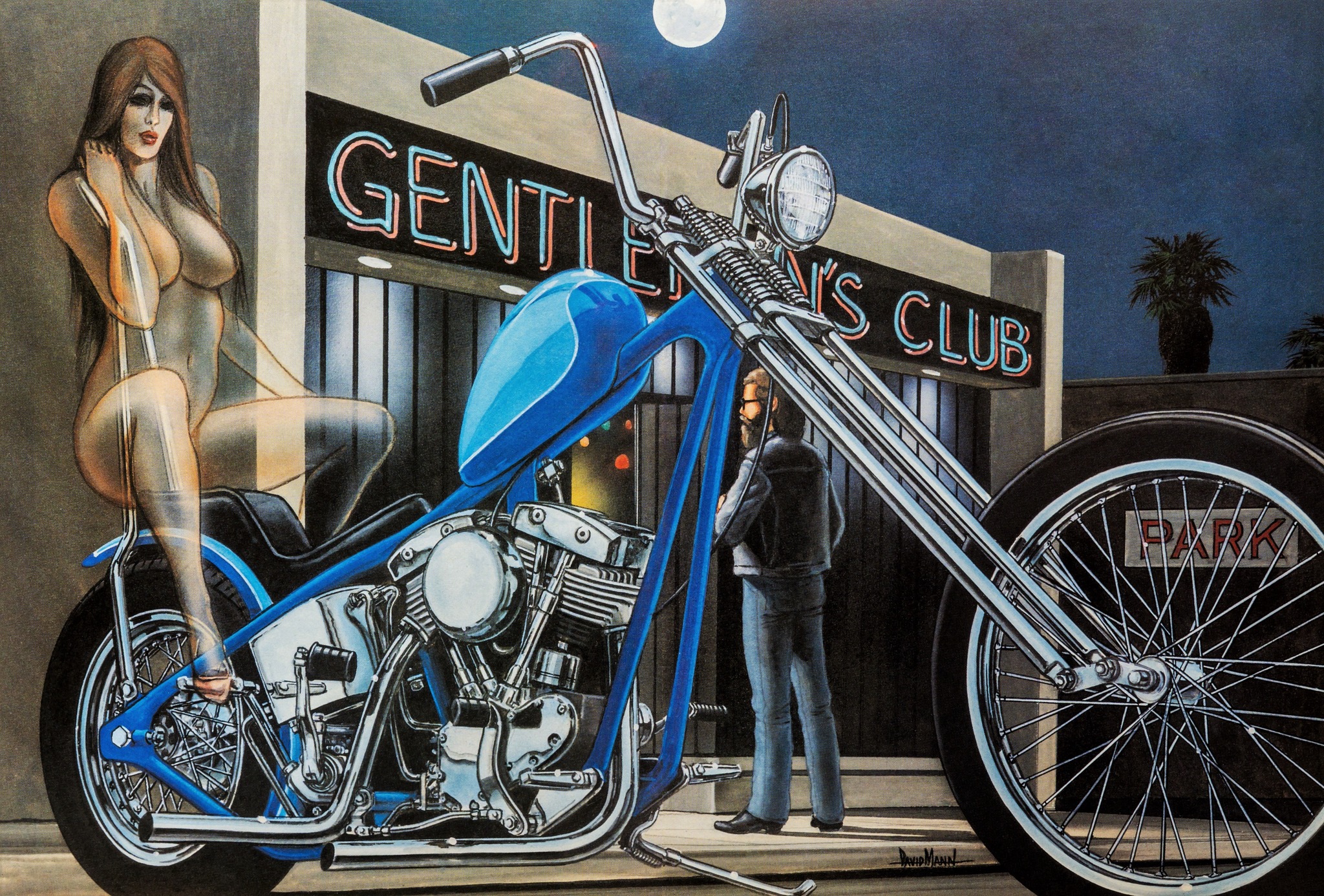
Image courtesy of the author.
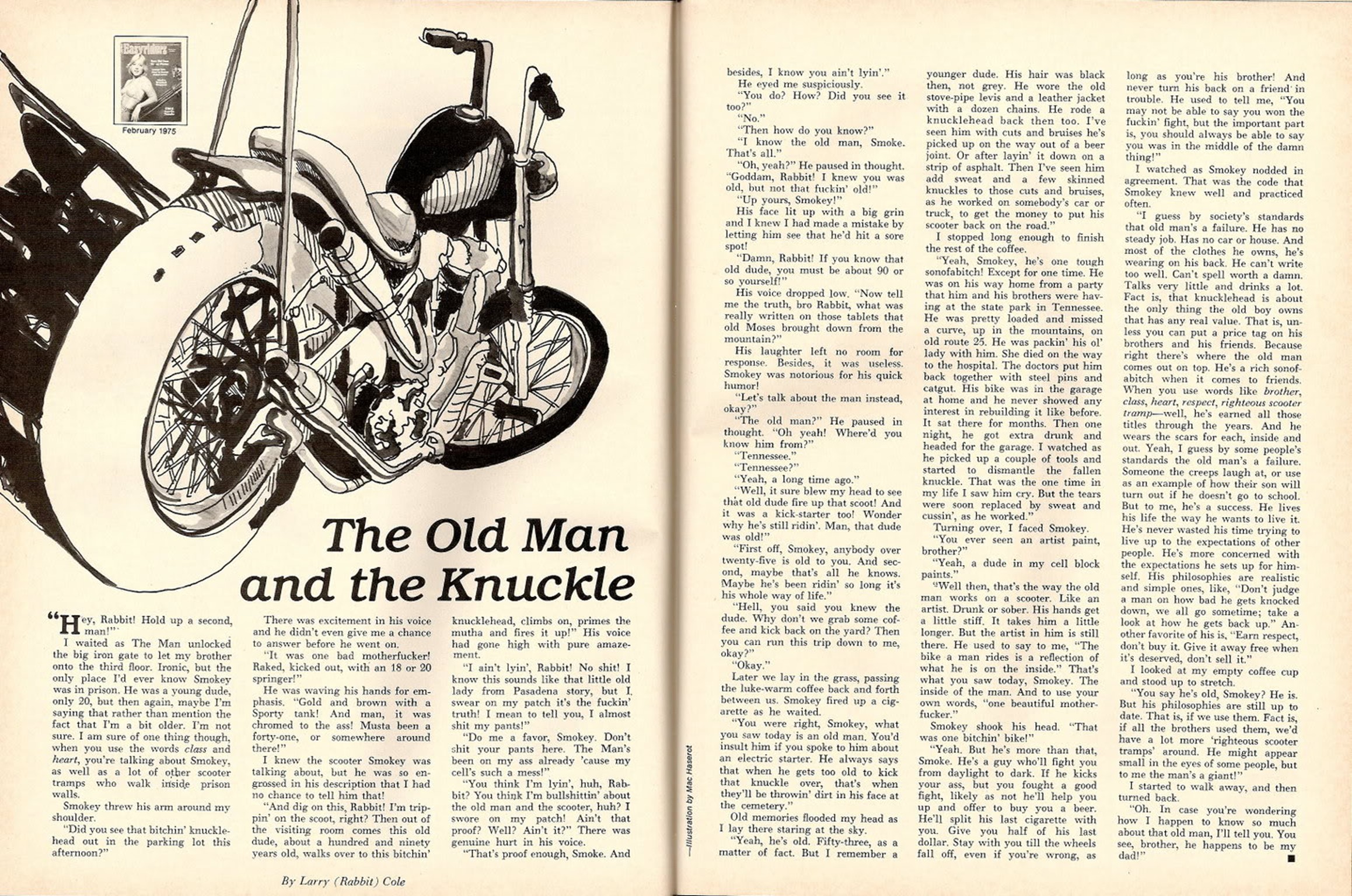
For me, one of the biggest differences between Easyriders and other magazines was that ER published short fiction about the biker lifestyle, by writers like Larry ‘Rabbit’ Cole (above) and Jody Via 3, and humor by psychotics like former Mouseketeer J.J. Solari.
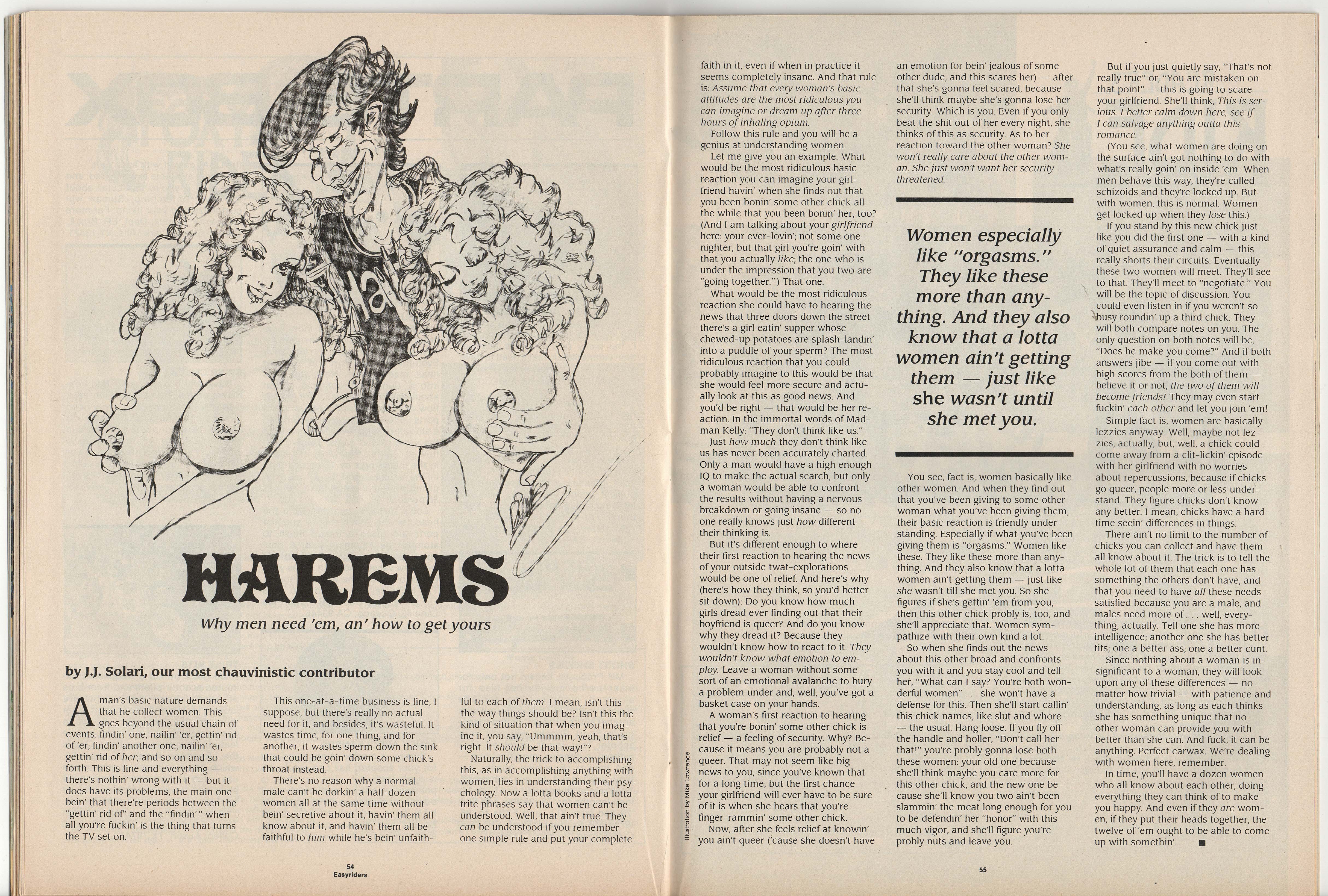
Image courtesy of the author.
Some of the writing was mediocre, but most was outstanding. There was real talent on display in those pages: well-crafted stories with vivid characters and dramatic arcs worth following. Easyriders was a huge influence on me as a teenage wannabe in the early ’70s, and was still the biker rag of record when I began riding later in the decade. I take great pride in the fact that my first manuscript sales — fiction and non-fiction — were to Easyriders, and I consider Lou Kimzey my first editor and mentor in the world of writing.

Image courtesy of the author.
Easyriders also ran the occasional poem, usually an ode to brotherhood or a motorcycle or, less frequently, the good woman who made it all worthwhile.

Image sourced from internet. Photo-illustration by author.
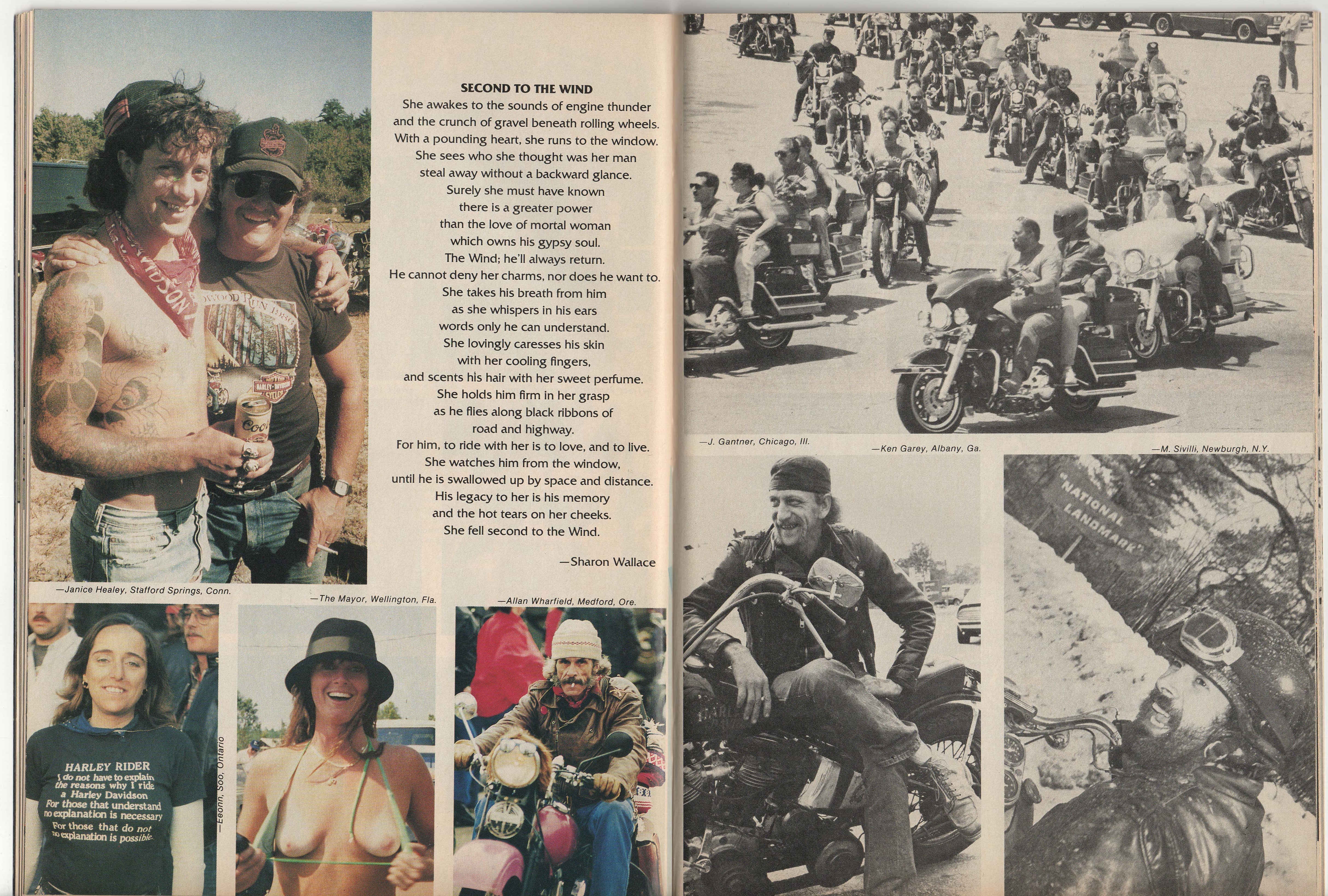
Image courtesy of the author.
Notably, the magazine’s editors broke with traditional publishing practice by accepting handwritten manuscripts – unheard of in that era – because most prison inmates did not have ready access to typewriters.
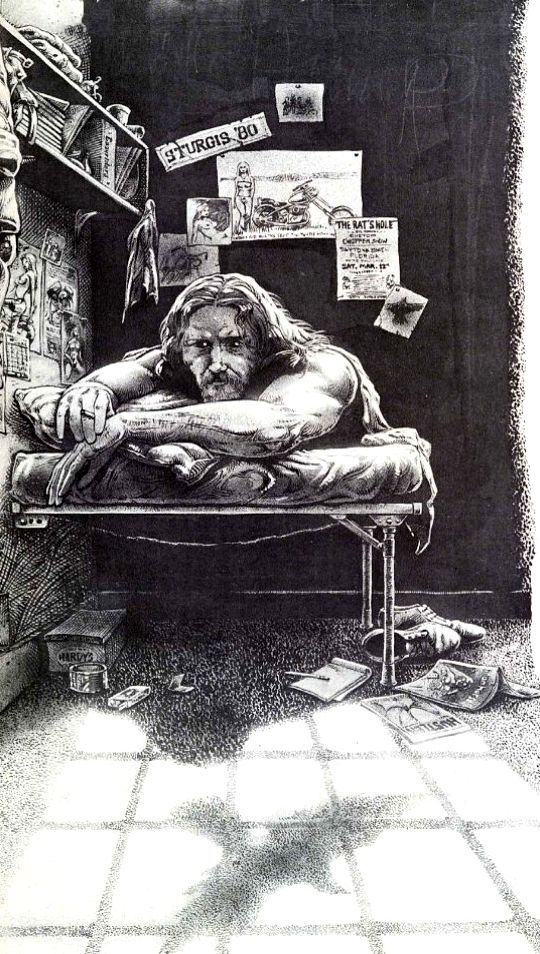
Image sourced from internet.
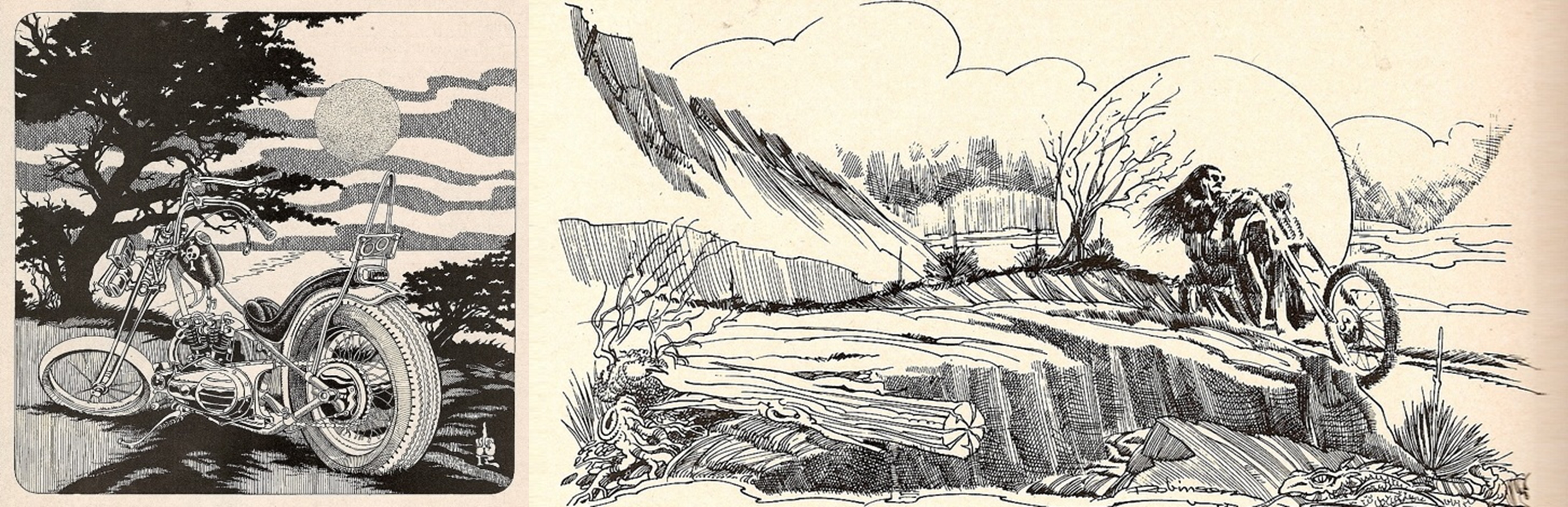
In another groundbreaking move, Easyriders made a practice of publishing motorcycle-themed illustrations and paintings by talented artists like Duffy Duggan, above, and cartoonist Hal Robinson, below.
Images sourced from internet.
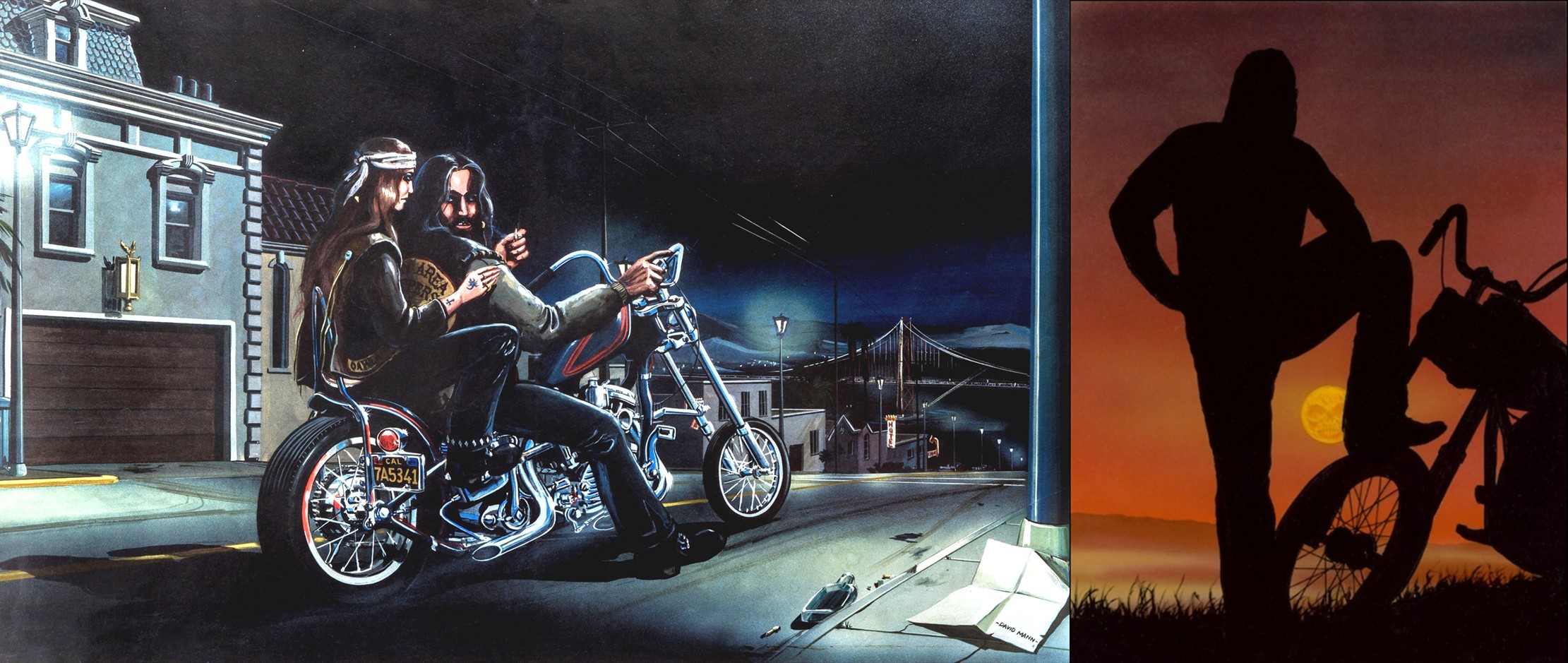
Most noteworthy of these was the godfather of chopper art, David Mann, who first broke out with a series of posters painted for Ed ‘Big Daddy’ Roth of Choppers Magazine fame. Mann created his first masterpiece centerfold painting for Easyriders‘ third issue in October, 1971. The artist – the Frederic Remington of the biker world – painted large centerfold paintings for the monthly magazine, and story illustrations, even as he cranked out book covers, centerfolds and illustrations for other publications. Despite that workload, the artist produced at least one piece for every issue of Easyriders from October, 1971 until his retirement in June, 2004. David Mann passed away in September of that year, but his paintings continued to appear in Easyriders and her sister publications for years afterward.
You can learn about David Mann and see much more of his artwork here.
Images courtesy of David Mann‘s Facebook page.
IN THE WIND
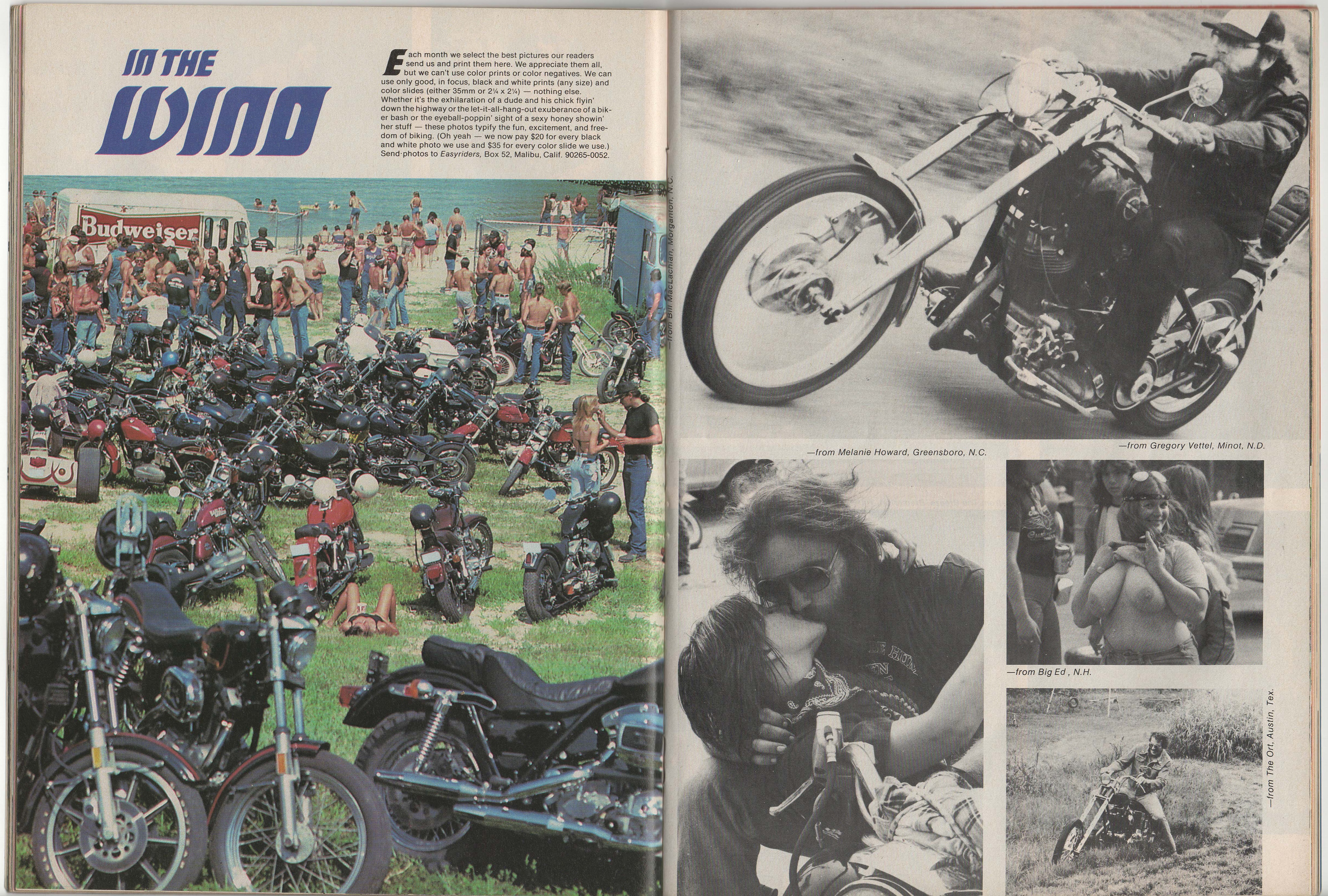
Image courtesy of the author.
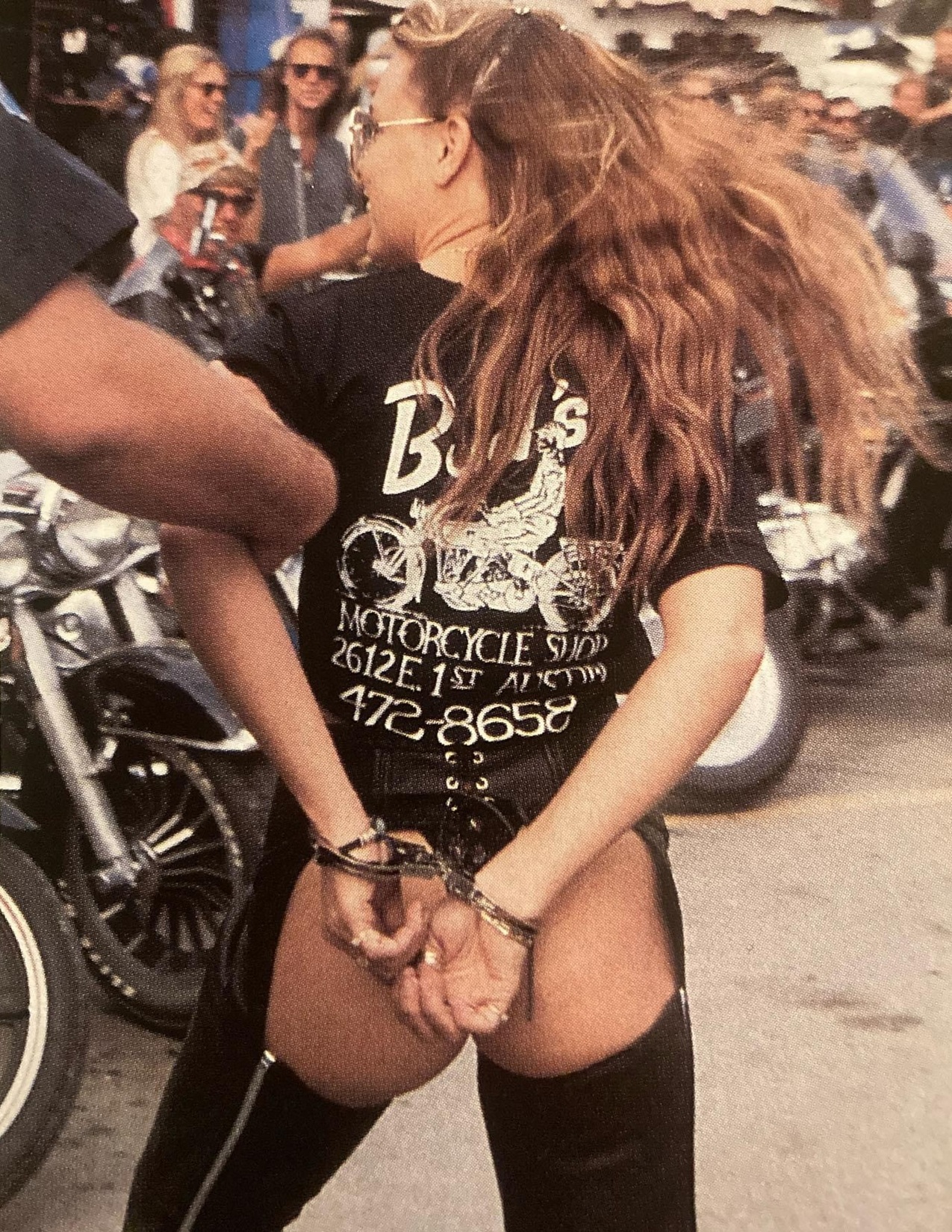
One of Easyriders‘ more ingenious innovations was their In the Wind pages, where they offered readers cash (above) for ‘good, in-focus’ photographs of bikers at play, riding, partying, brawling or posing with their machines, and women, usually flashing their breasts for the camera.
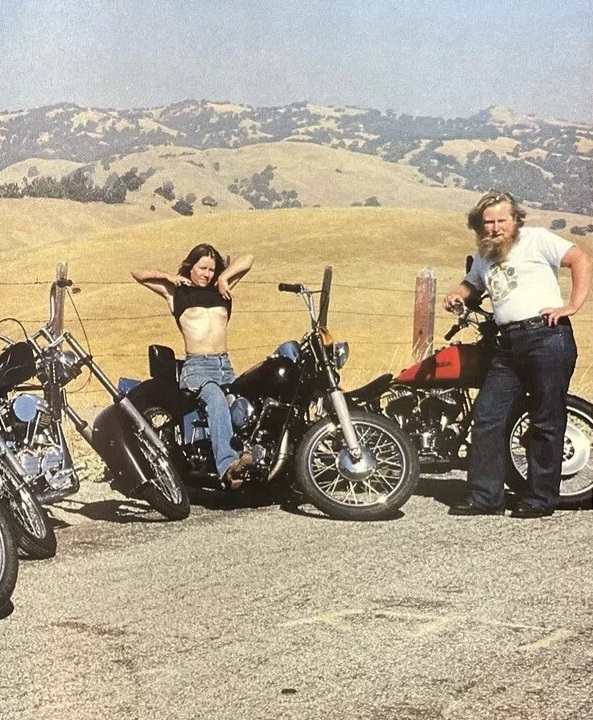
Image courtesy of eBay seller Touched by Time Treasures.
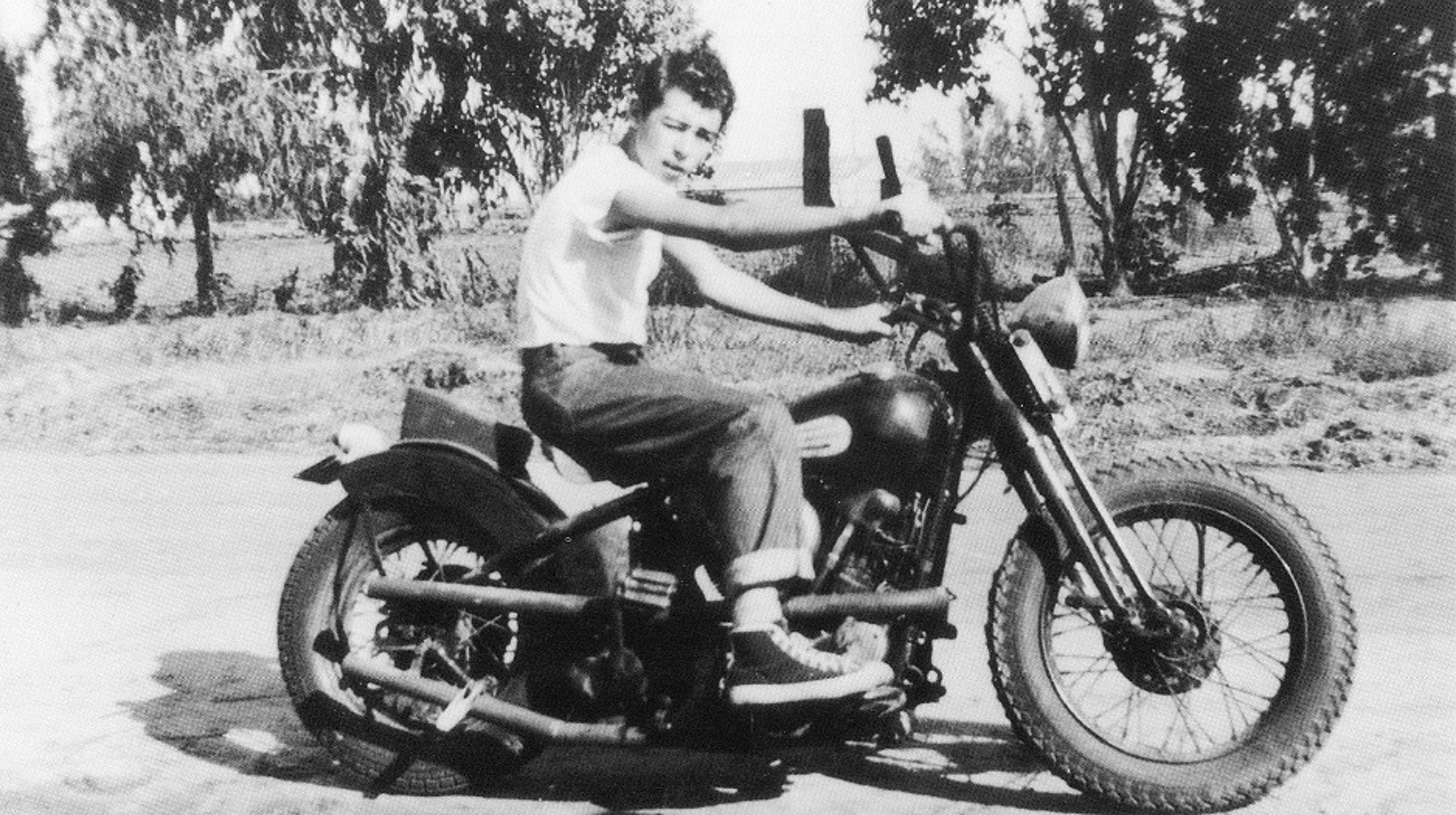
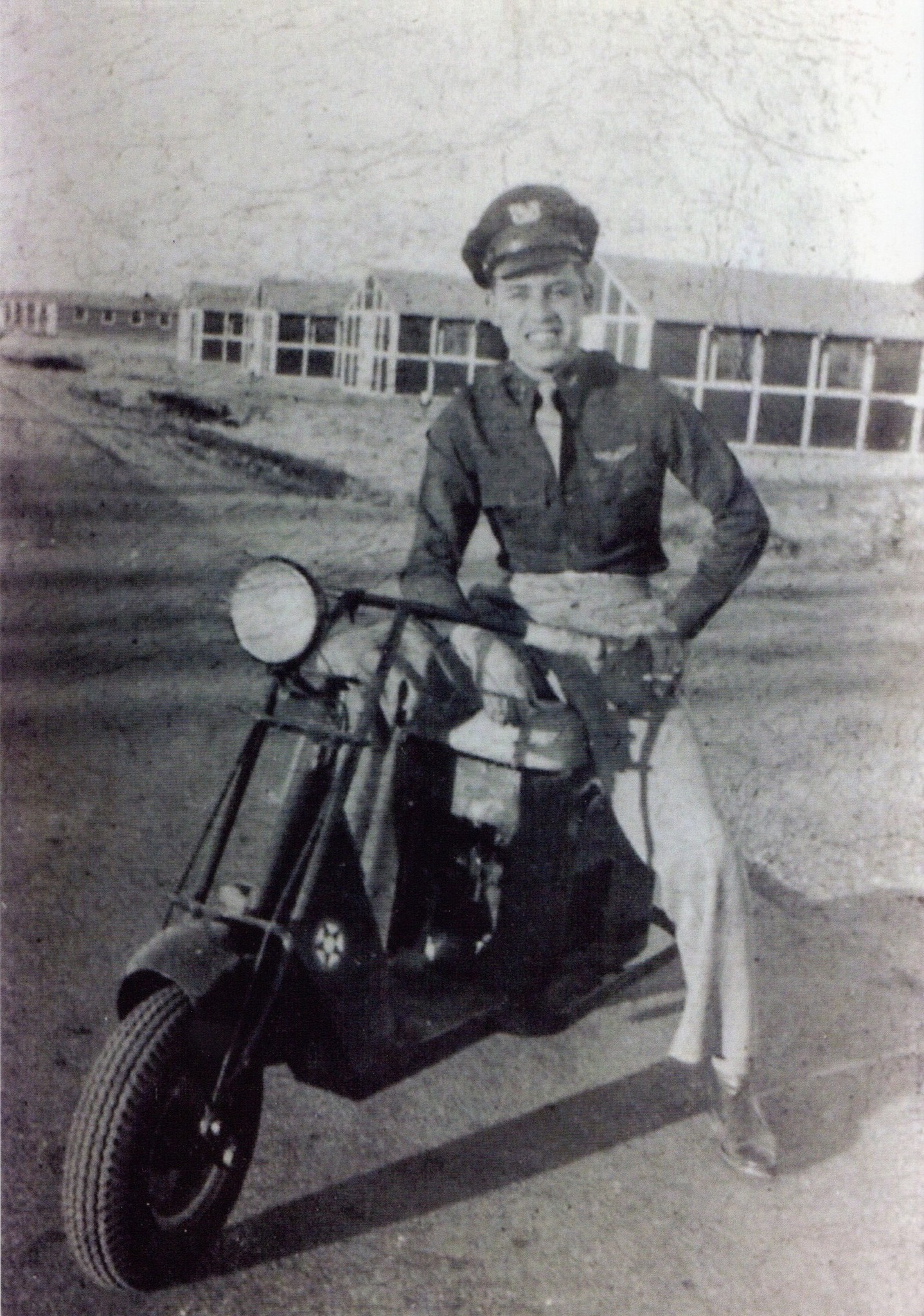
There were often older photographs, resurrected from Grandpa’s old picture album: proud farmers and sales clerks, and their bemused sisters or girlfriends, posing with Popes, Thors and Excelsiors. There were Allied soldiers aboard strap-back Harley J-Models and WLAs, Triumphs and BSAs, and their German counterparts on BMWs and NSUs. Other pages might teem with photos submitted by readers in Europe, Asia, South America and Africa, each with their own biker subculture.
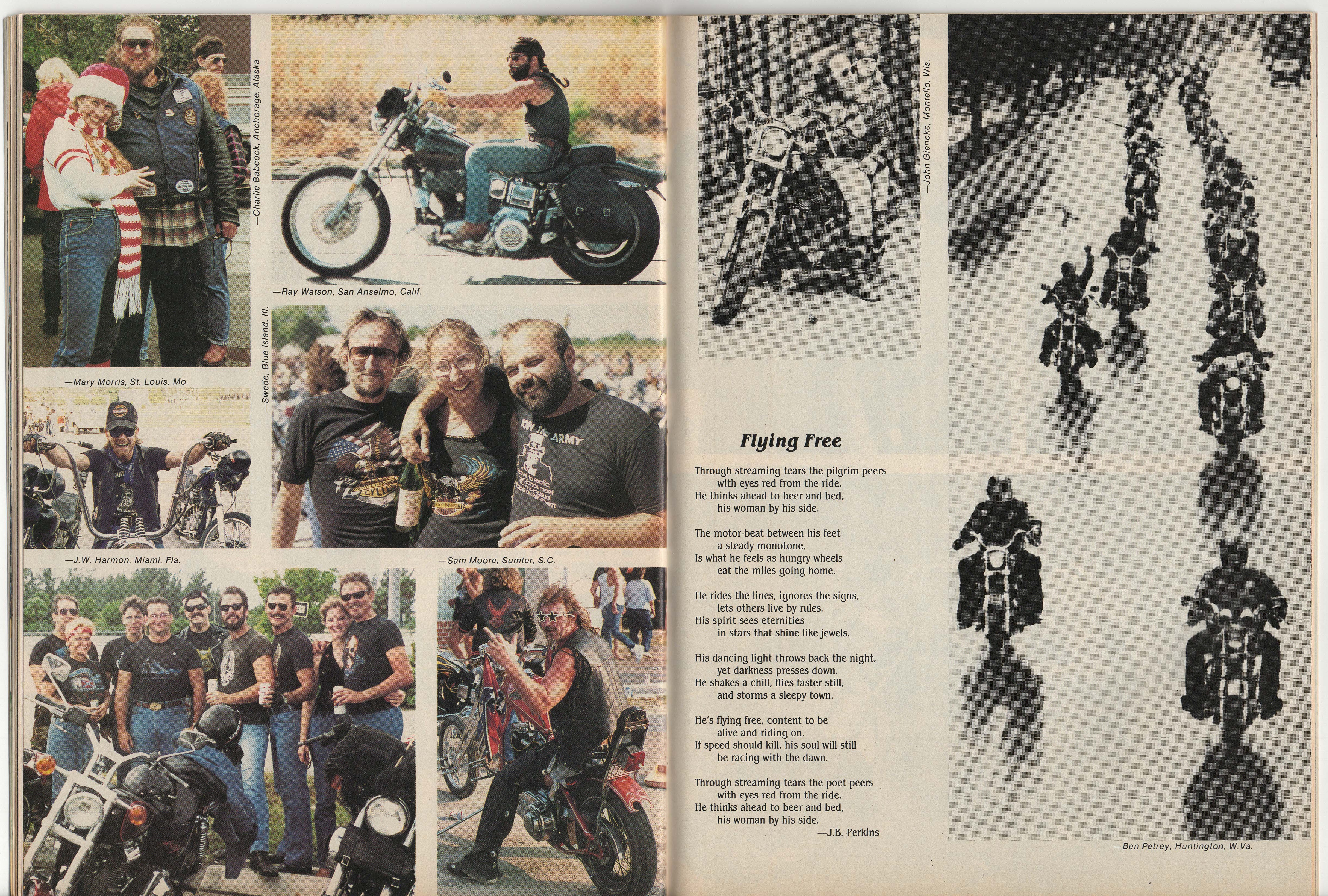
Image courtesy of the author.
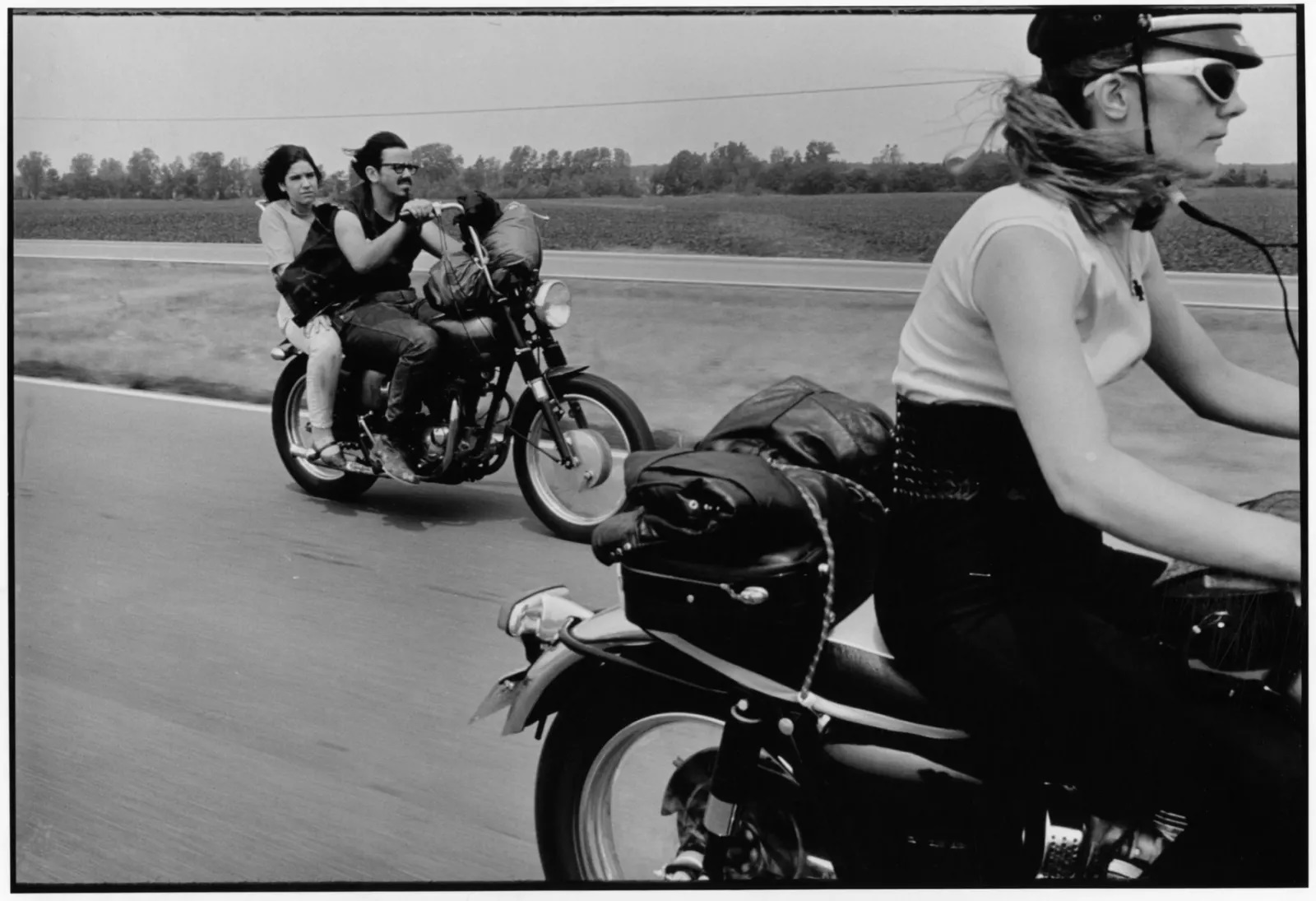
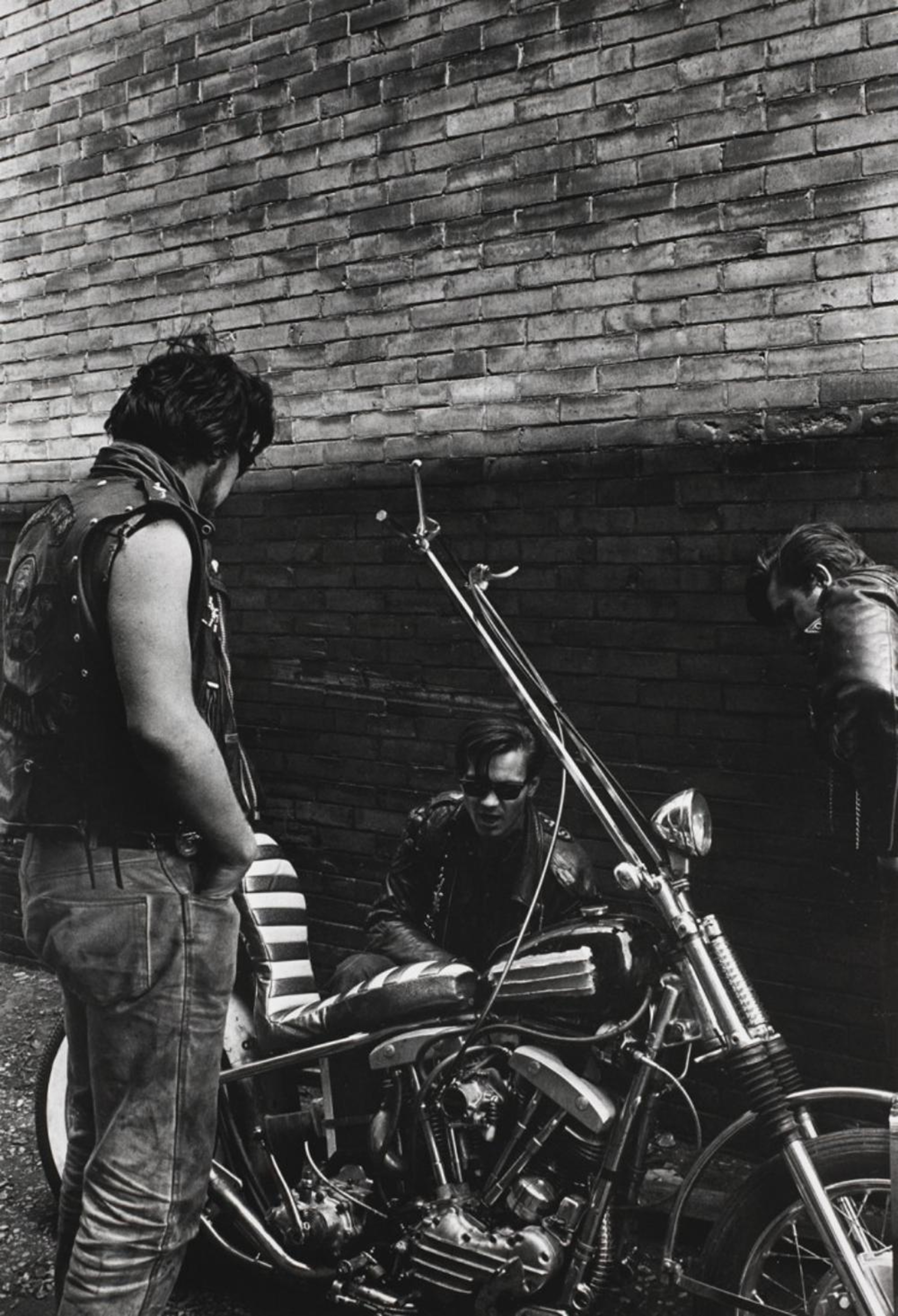
And, of course, there were hundreds and hundreds of pics of bikers, male and female, outlaw and straight, on original or restored classics or wild-as-fuck radical customs. They were jamming down the road, hair floating in the breeze and tight grins on their faces, or scowling at the camera and flipping the universal biker salute – one raised finger – to friend and foe alike. They were drinking beer, wrestling in the mud of a campsite, or tearing a motorcycle apart beneath a tree as friends gathered to offer assistance….
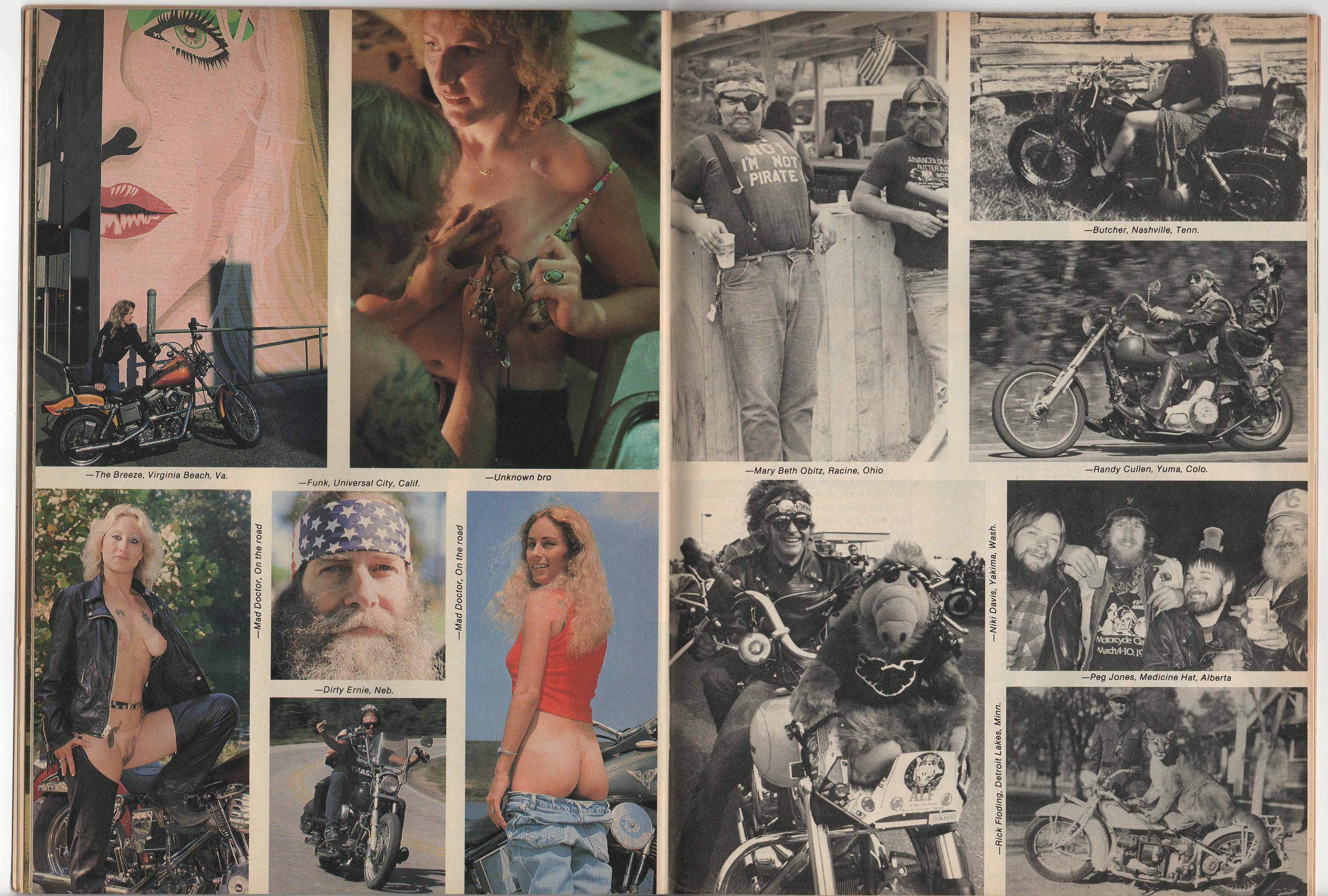
Image courtesy of the author.
….and women, in denim and leather or not much of anything, baring their all at a rally, packing behind their ol’ man or geared up and gripping the bars of their own machines. All ages, all shapes and sizes, but most pretty and slender and lithe enough to curl up behind a man as they blast down the highway together, her feet on the high pegs of that rigid frame and her arms around her man.
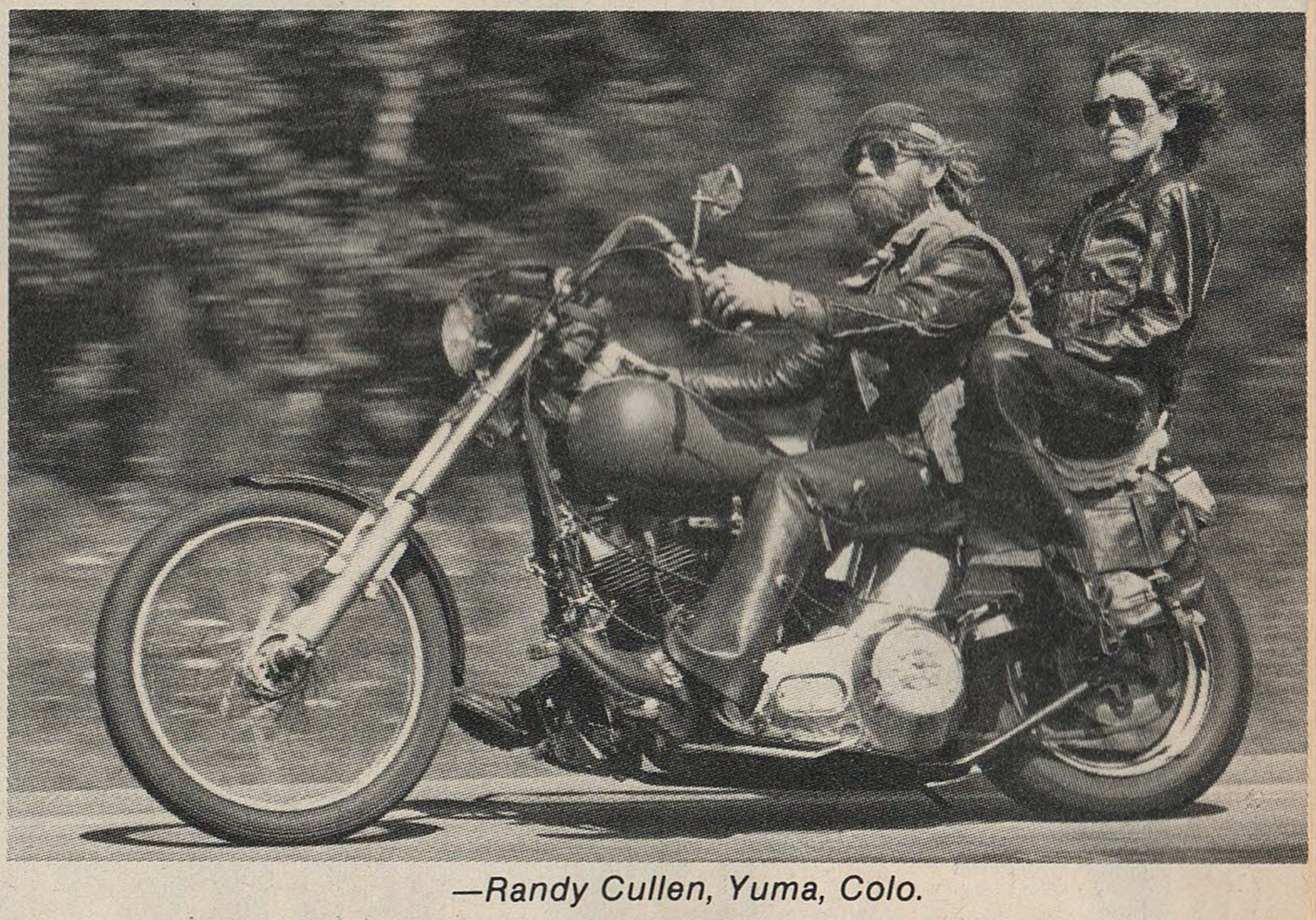
Image courtesy of the author.
I called In the Wind ‘ingenious’ because, while the editors paid for photos they published in the magazine itself, they reserved the right to use any and all submitted photographs free of charge in a spin-off magazine called In the Wind. It featured page after page of readers’ photographs, very little editorial content, and ran through well over a hundred and fifty issues. Aside from layout and pasteup, it couldn’t have cost much to produce, and every issue sold by the tens of thousands.
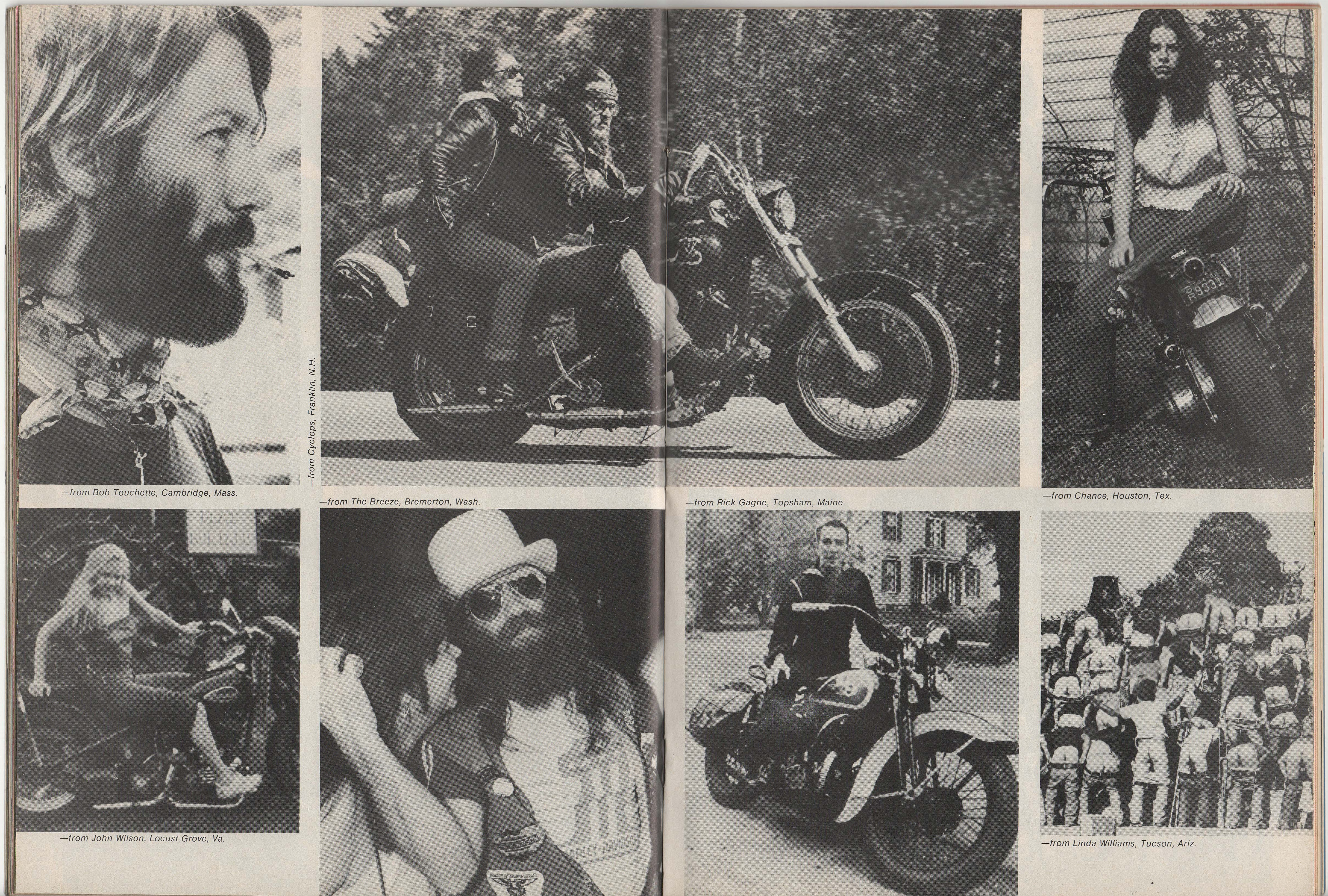
Image courtesy of the author.
I submitted a number of photos to the magazine’s for-pay column, but only ever saw them in later issues of In the Wind.
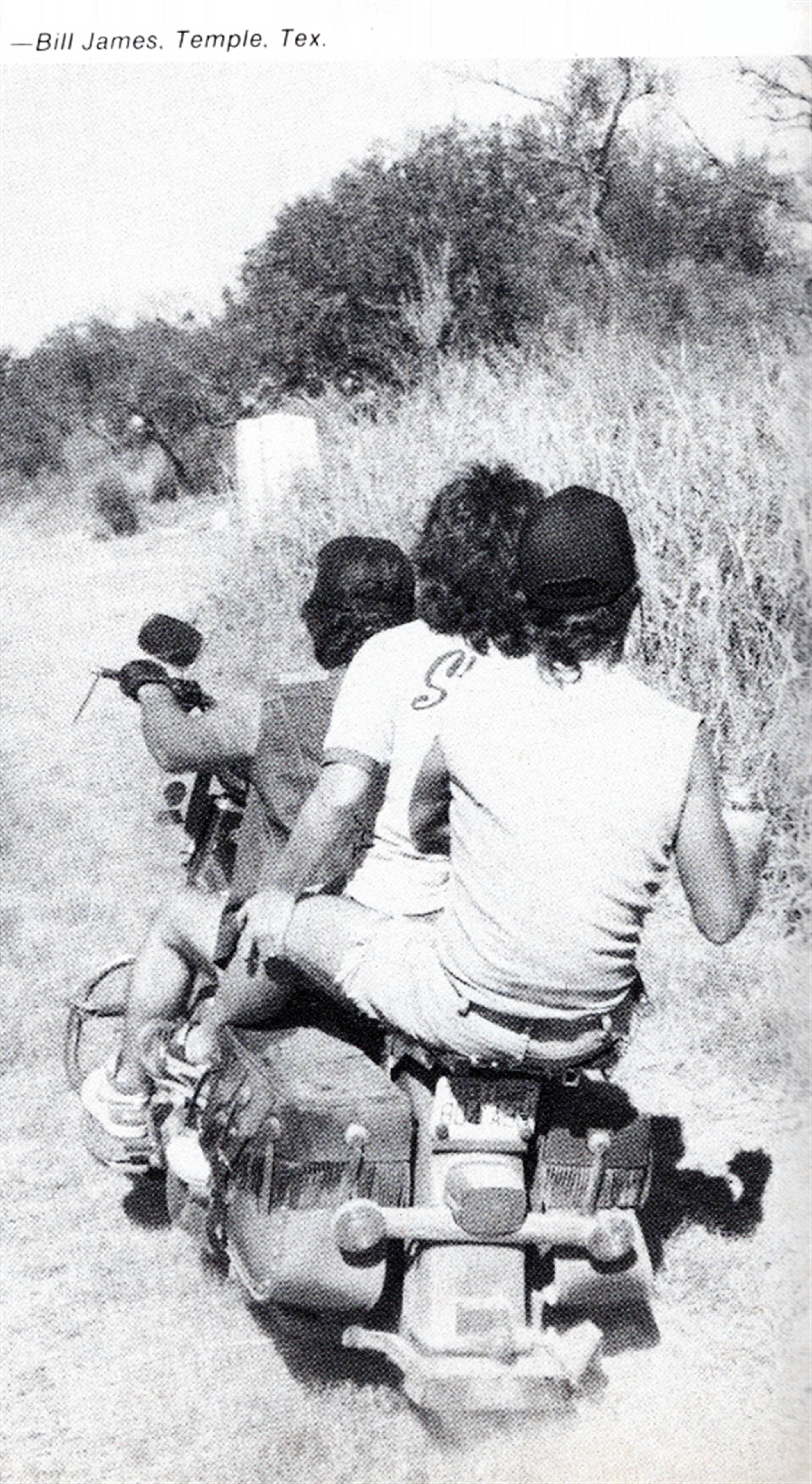
Image courtesy of the author.
EXPANSION
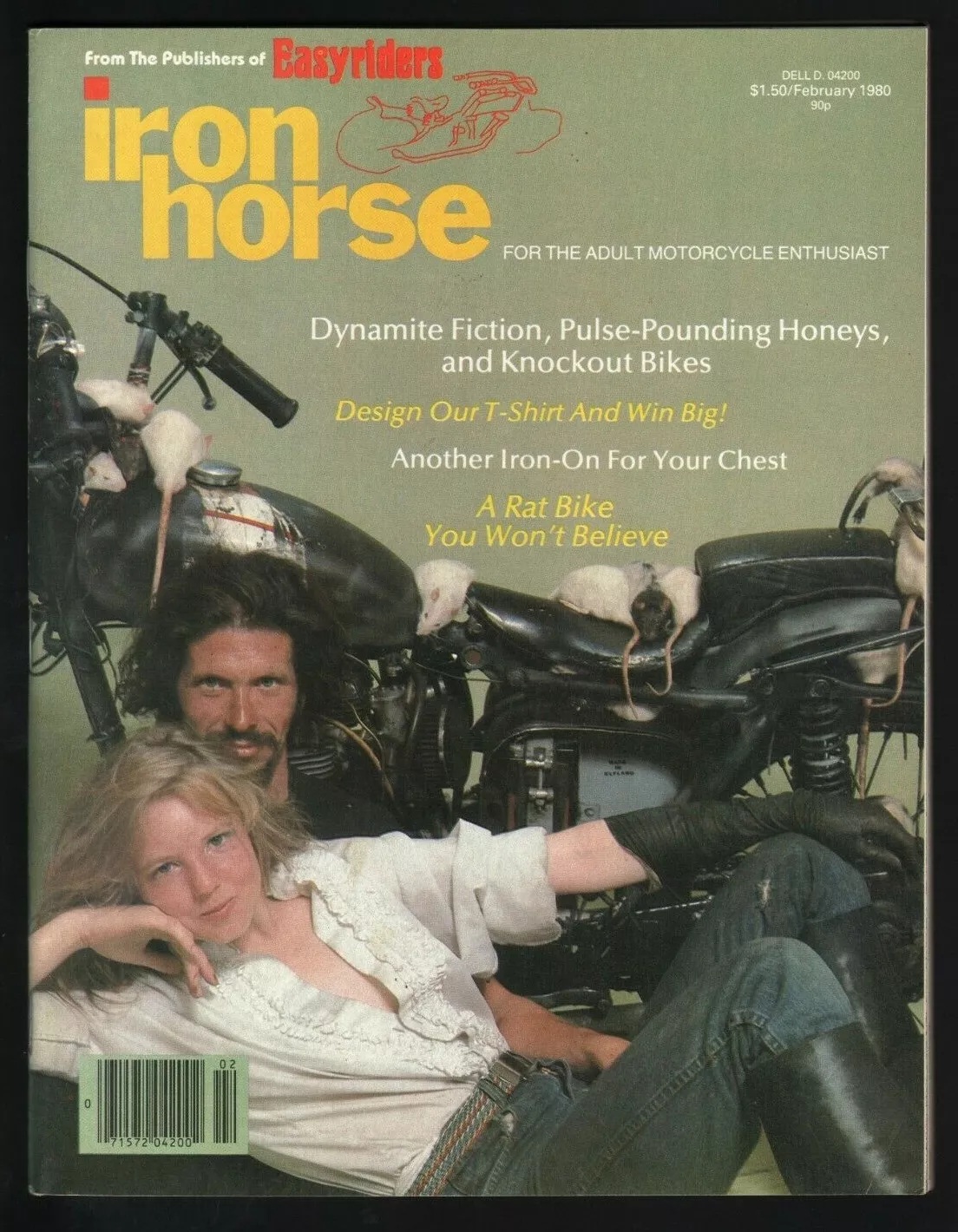
Image courtesy of eBay sellers Gallimore’s Goods.
Realizing that they had a good thing going, Easyriders‘ parent corporation, Paisano Publications, soon sought to expand the brand into a world-wide empire. First came the In the Wind magazines. These were followed by Iron Horse, a magazine more dedicated to metric riders. Still the same hard-partying, hard-riding biker ethos, but with more Triumphs and Hondas than Harleys and Indians.
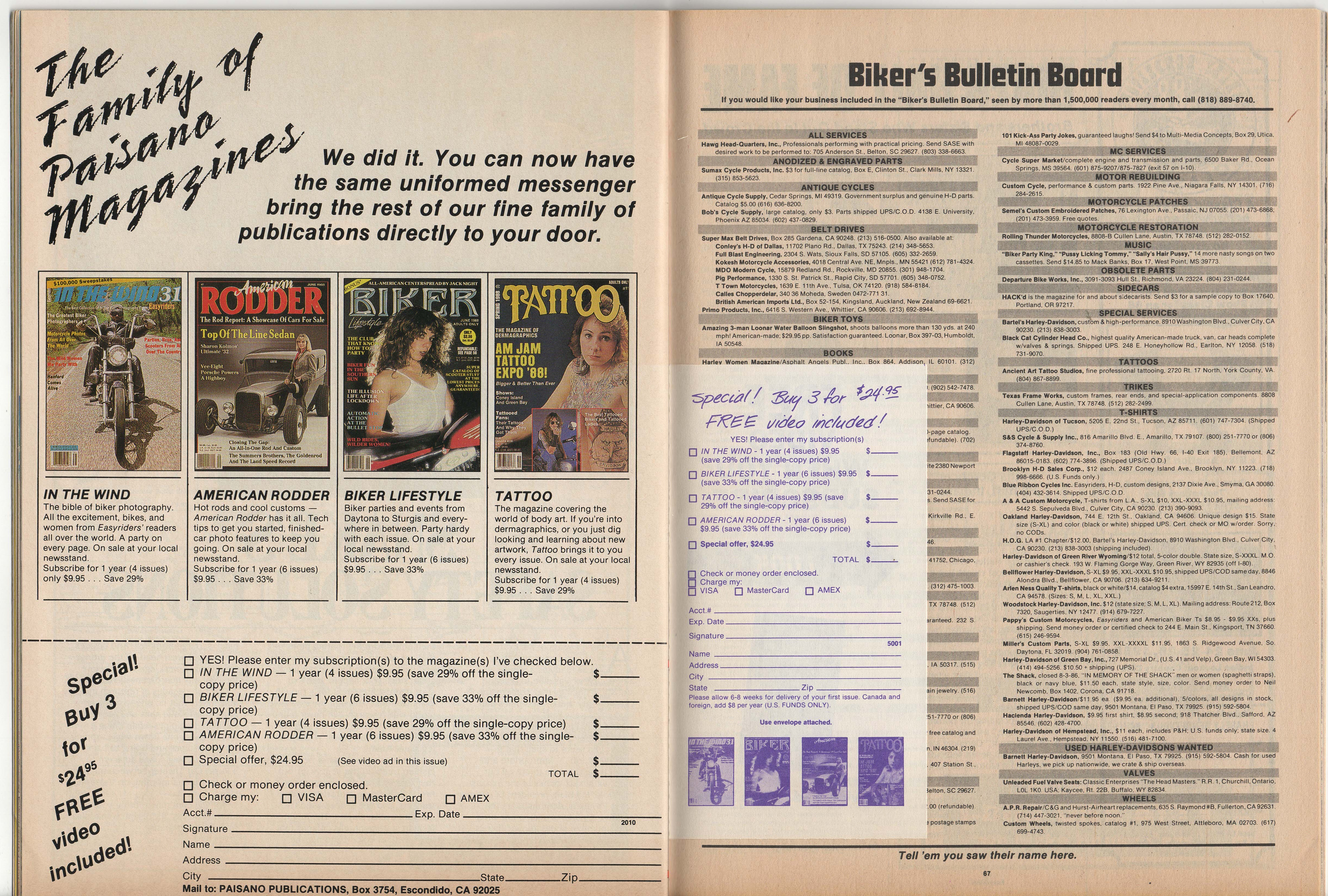
Image courtesy of the author.
Later, we saw titles like Tattoo, which cashed in on (and helped fuel) the passion for skin art sweeping the nation in the ’90s and ’00s. Another spin-off magazine was V-Twin, intended as a ‘family friendly’ version of Easyriders. No topless women, fewer four-letter words…. 🙄 Worse still was VQ, a magazine ‘for the connoisseur.’ 🤢
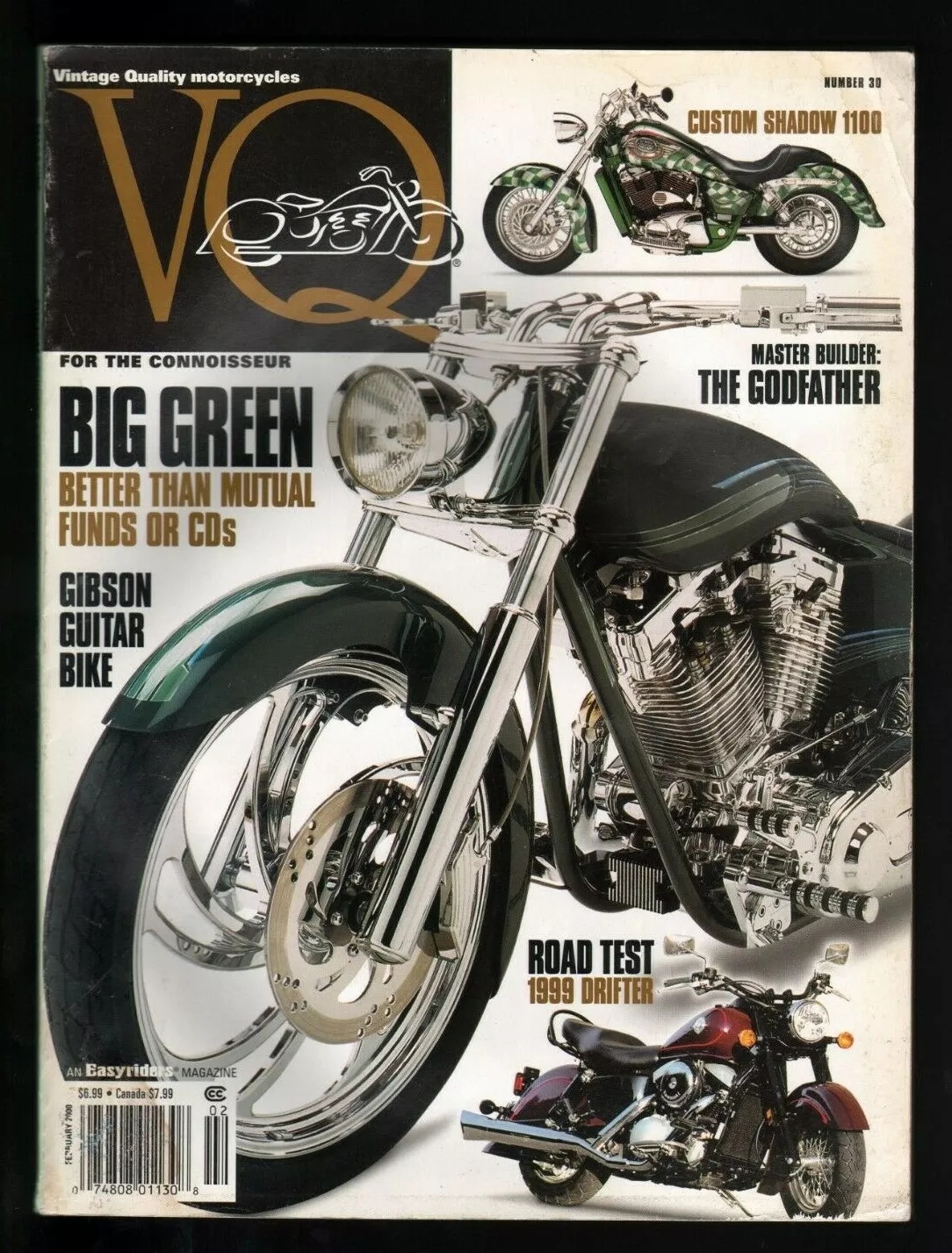
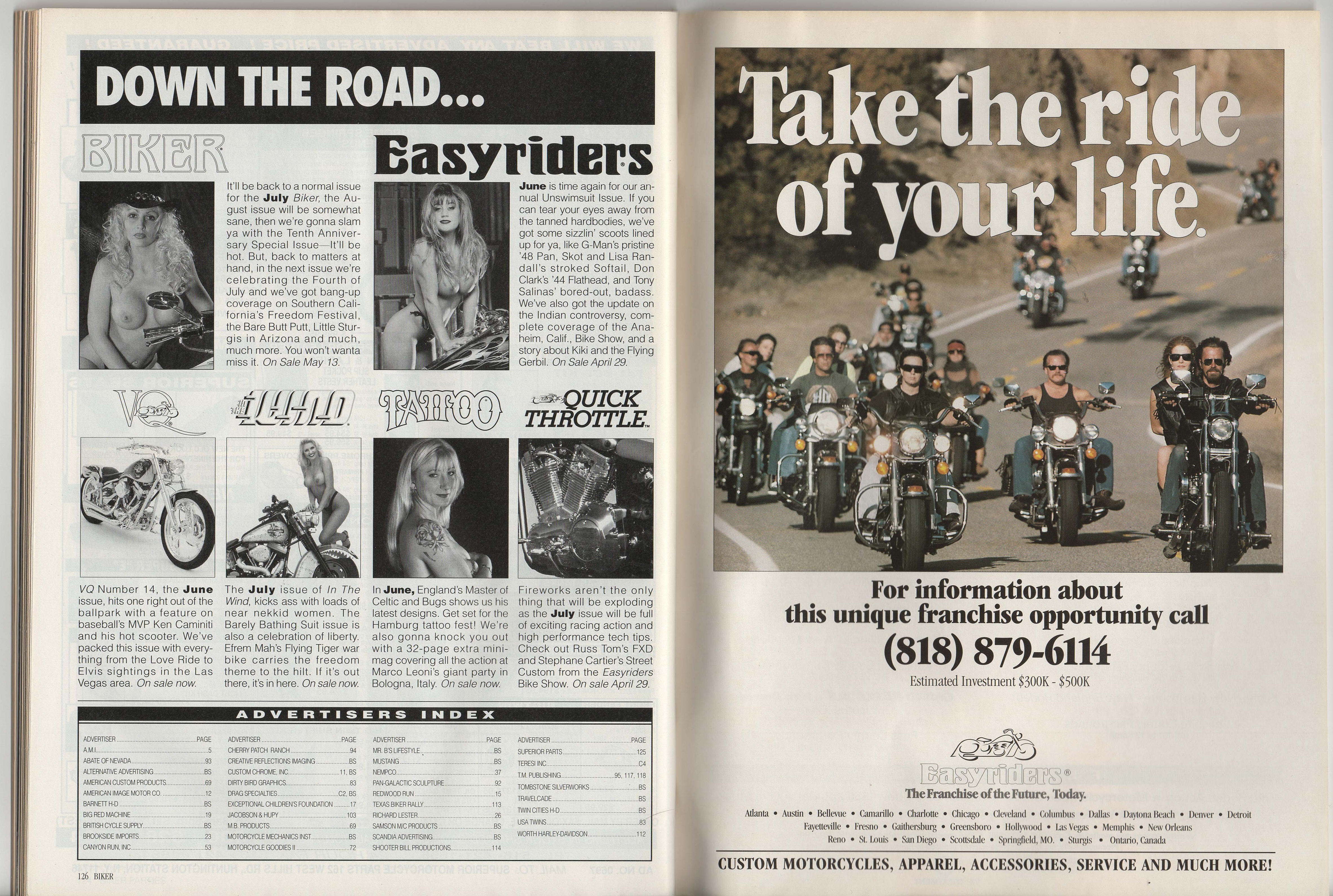
Image courtesy of the author.
Other cash cows turned up. There were Easyriders products like t-shirts, hats and scarves, which grew into a full-sized catalog insert in the magazine every Christmas season. Then came brick-and-mortar Easyriders stores – franchised outlets as advertised above – that sold clothing and custom parts. Some even tried to be full-service motorcycle shops, with bikes for sale and mechanics on duty.

Image courtesy of the author.
Then there were the Easyriders Rodeos and other events: a series of prepackaged biker parties – mini-rallies, really – at venues around the country. These events were heavily sponsored by corporations like Custom Chrome, Chrome Specialties, Barnett and others, all purveyors of parts and equipment for Harley riders. At the rodeos, there were diversions like burnout contests, barstool races, poker runs, girly shows and live music, wedged in between the ceaseless marketing of products by Easyriders and its sponsors.
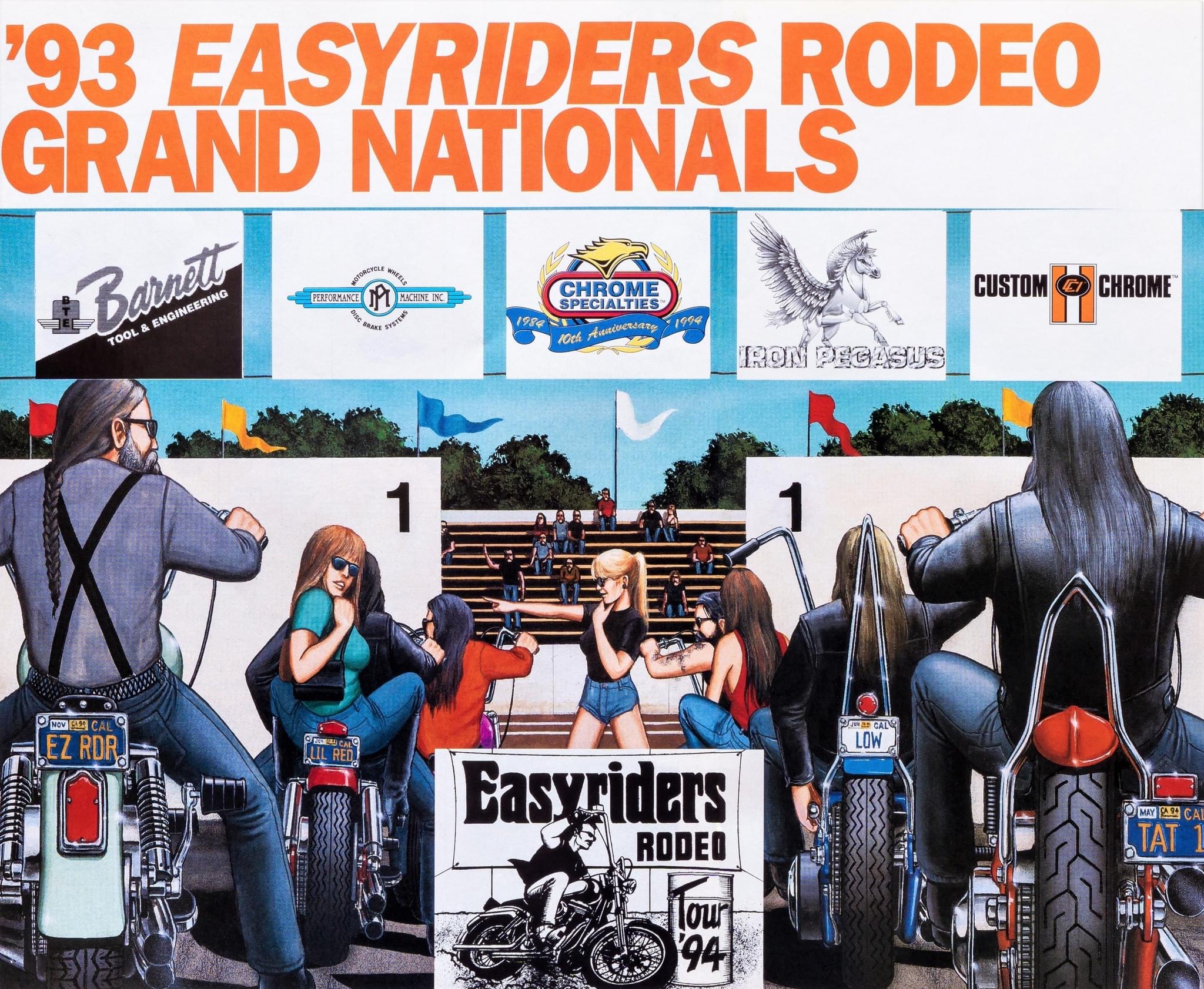
Image courtesy of the author.
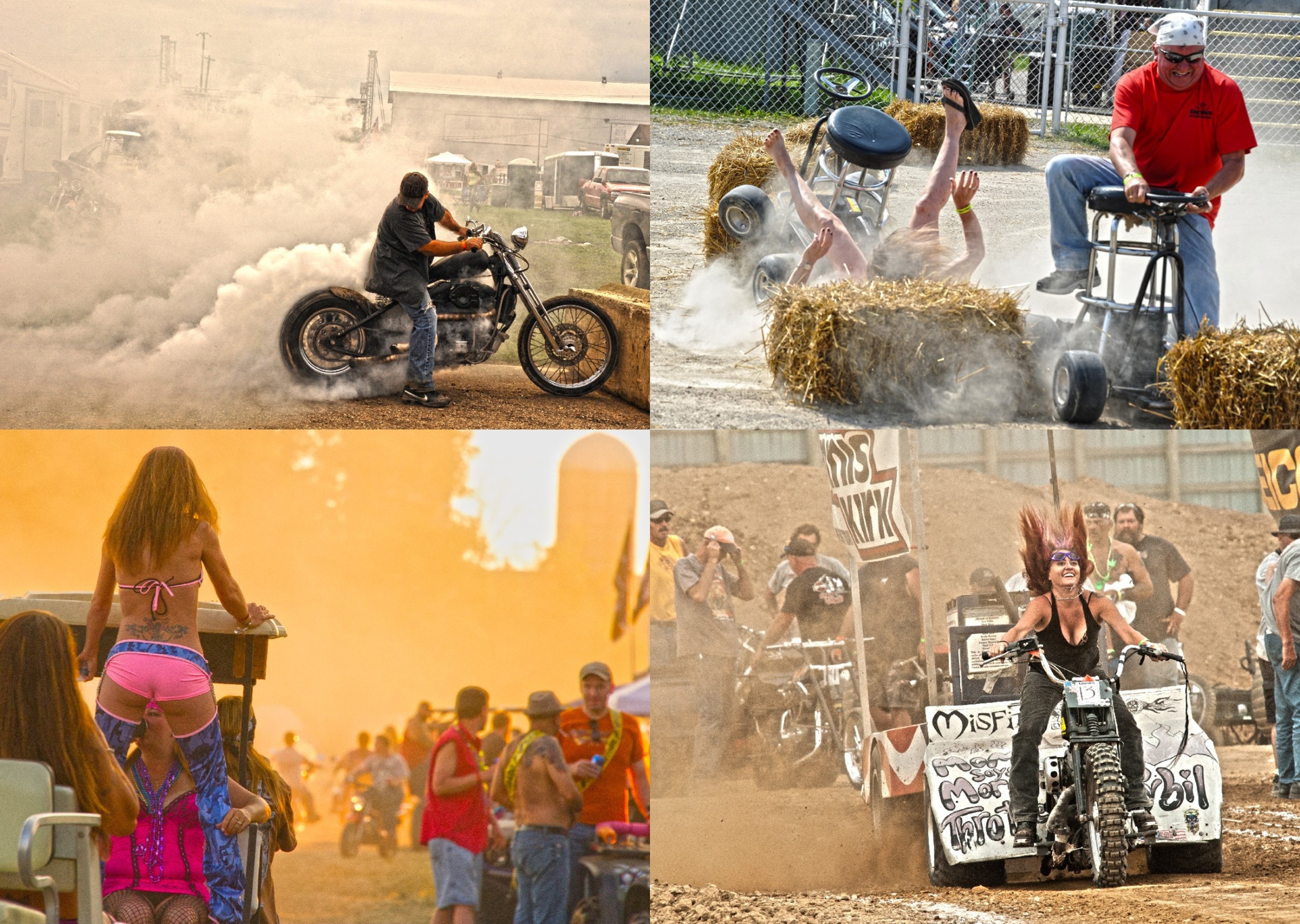
Photos courtesy of Easyriders Events.
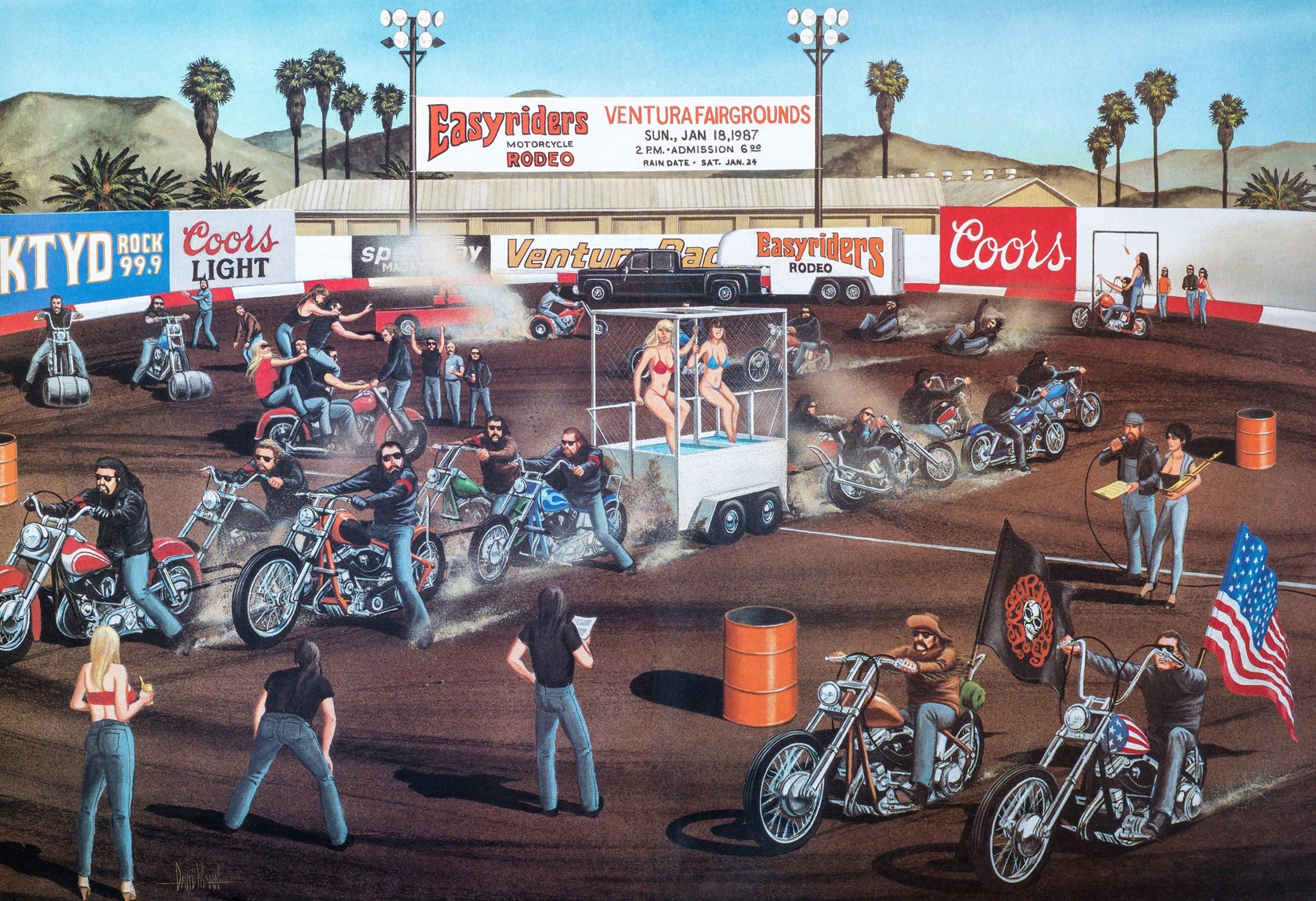
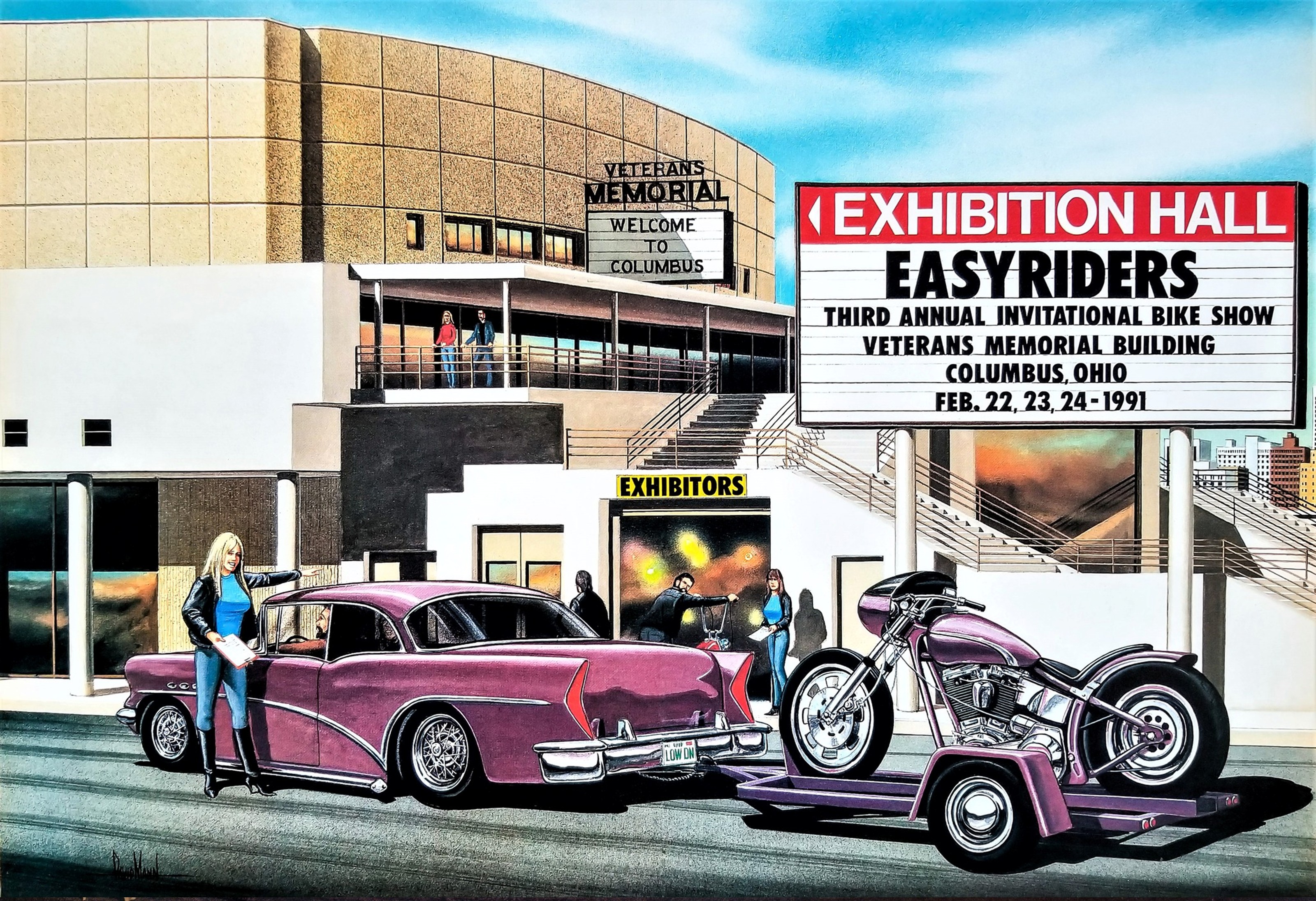
Centerfold images courtesy of the author.
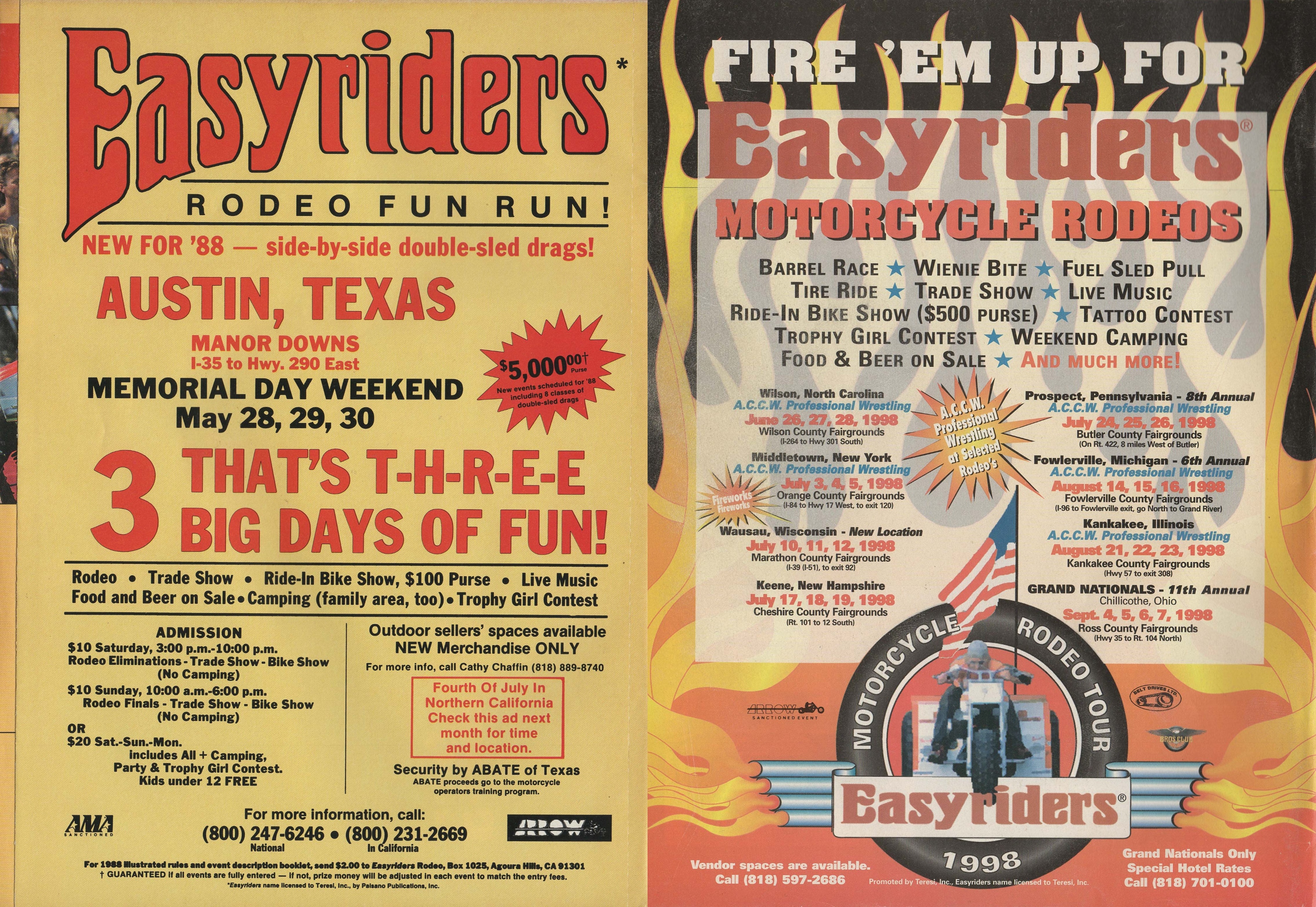
Image courtesy of the author.
DEATH OF THE DREAM
Some say it was overreaching that killed Easyriders, but I have a different theory.
For decades, Easyriders remained the ‘biker rag of record’, in part because it was as ‘biker’ as any of its readers: tough, take-no-bullshit and ready to rock. However, that brutal bastard, time, and the harsh realities of print publishing eventually took their toll.
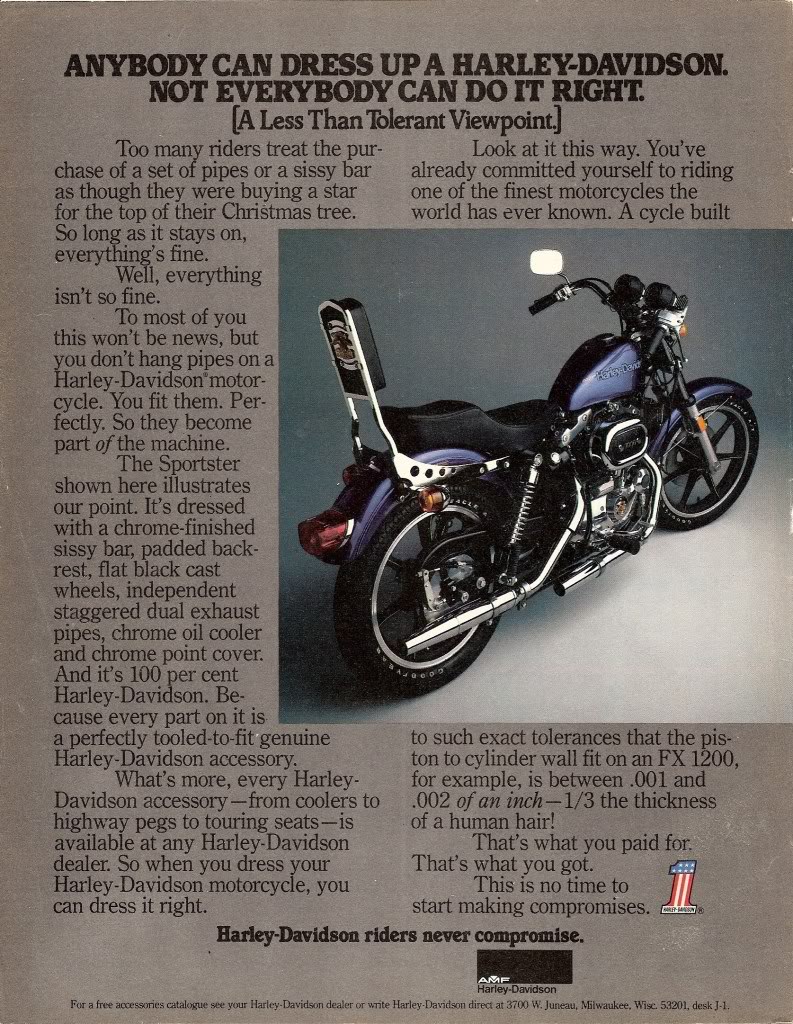
Image courtesy of the author.
For instance: at its onset, the magazine’s editors swore they would never be beholden to any corporate master, and hence would never accept advertising from the Harley-Davidson Motor Company or its dealers. They held out for seven years, but ultimately the money was too good.
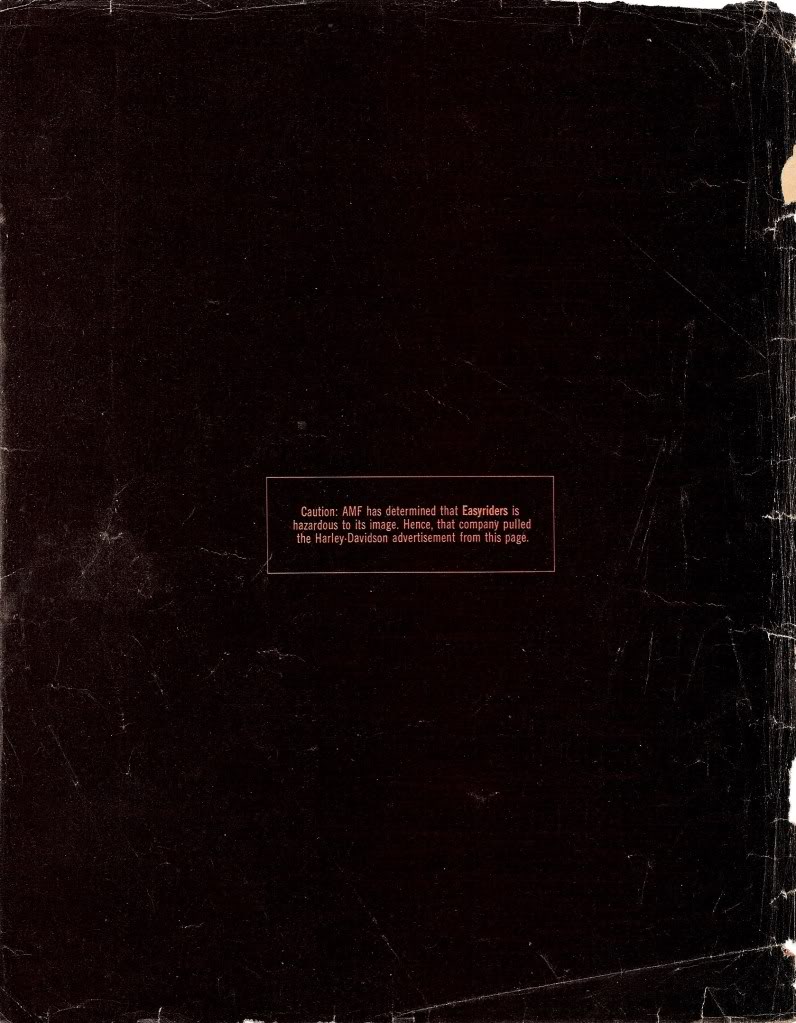
Image courtesy of the author.
They also vowed they would never do new bike reviews or test rides. They eventually did….
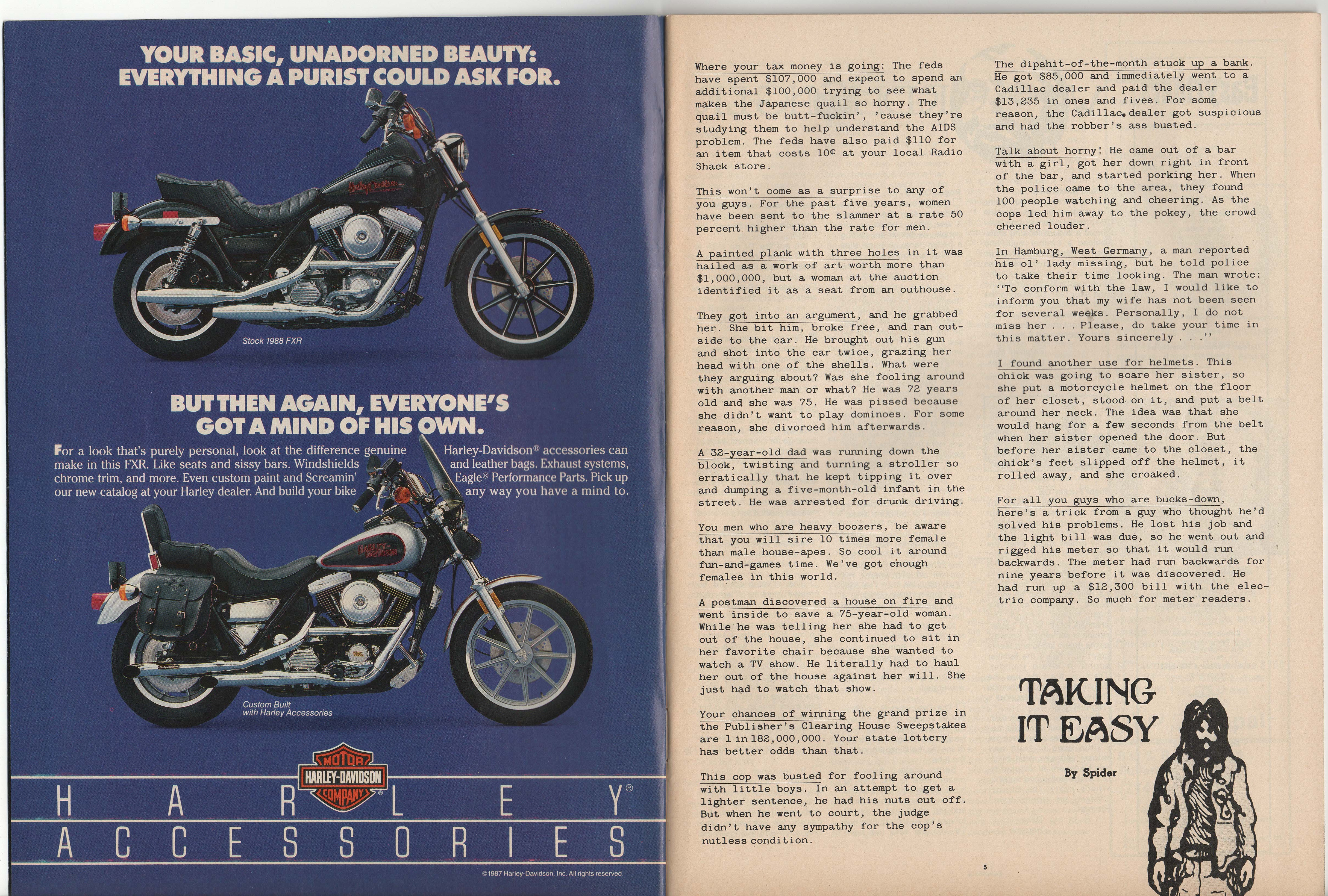
Image courtesy of the author.
Very few magazines can survive on subscriptions alone. The money had to come from somewhere. I’m sure the magazine’s publisher shrugged and said ‘Well, why not the MoCo?’ 🤷🏻♀️
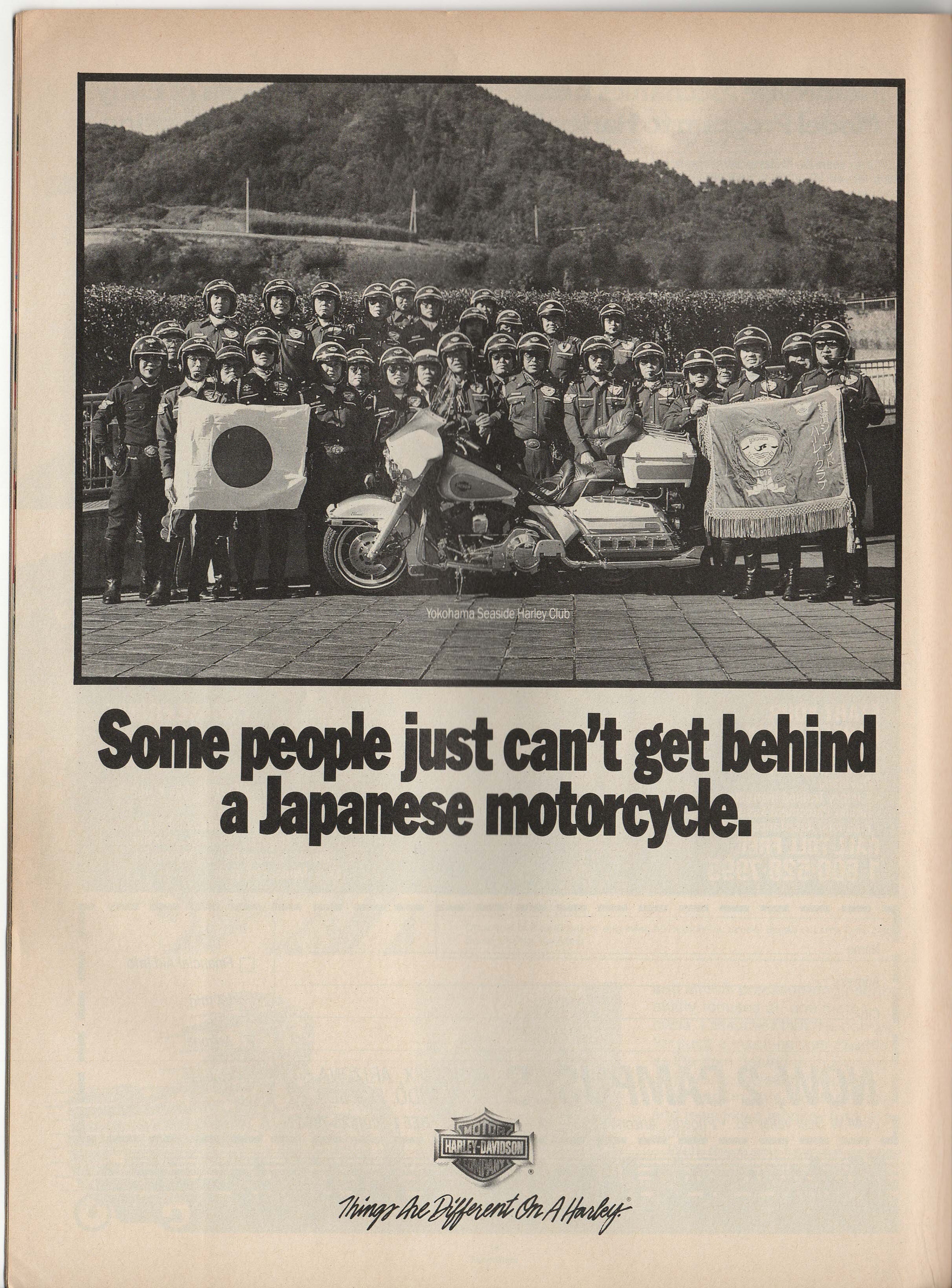
Image courtesy of the author.
The Motor Company has offered riding gear from its earliest days, but when AMF (American Machine & Foundry, best known as the primary outfitter for bowling alleys) merged with Harley-Davidson in 1969, more effort was made to market ‘stylish’ clothing. Imagine leisure suits of sky-blue suede (seriously!) and his-and-hers t-shirts and jackets. When the two companies split again in 1981, marketing began in earnest, and Motorclothes was born. Old-school riders grouse that Harley dealerships look more like fashion boutiques nowadays. A common plaint is They used to hate us. Now they want to BE us!
They’re not wrong.
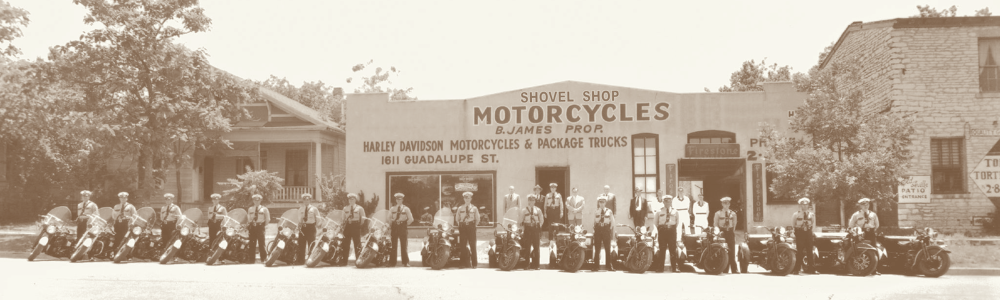
During the AMF years, Harley-Davidson struggled to counter the outlaw persona many street bikers affected: the long hair, beards and tattoos, black t-shirts, ragged jeans and greasy leather. Dealers refused to serve ‘chopper riders’ or work on modified motorcycles, and corporate headquarters demanded that dealers spruce up their premises and run off the undesirable Easyriders element. Austin’s own Austin Motorcycle Company, a family-owned franchise since the 1920s, surrendered its franchise in the late ’70s rather than comply with the Motor Company’s demands.

Image sourced from internet.
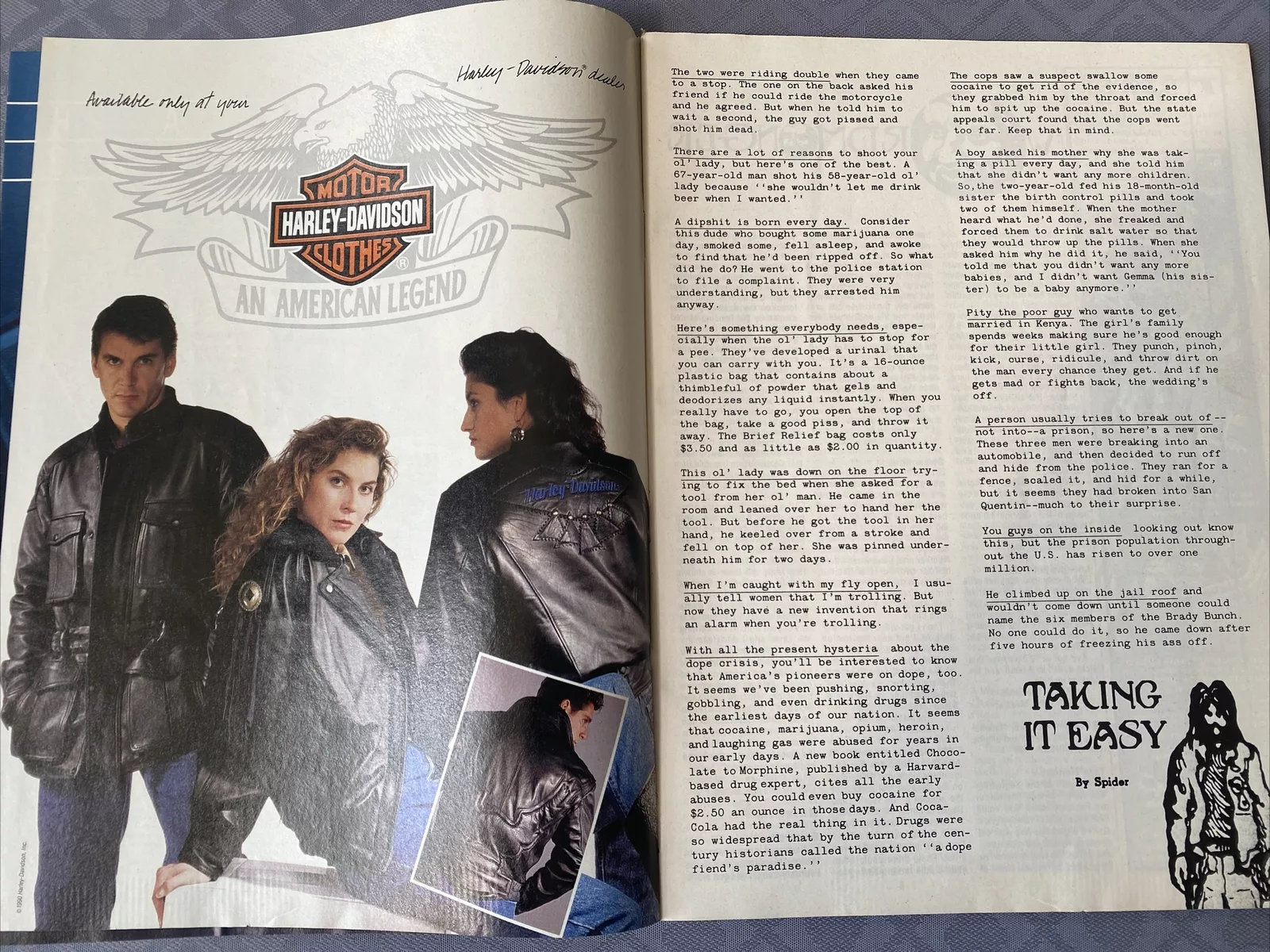
Image courtesy of eBay seller Vintage Variety 60.
However, the MoCo’s new owners – most former executives of the AMF-owned division – recognized a cash cow when they saw one, and Motorclothes stores and catalogs were soon teeming with fashions aping the look of those hardcore bikers HD once shunned. Witness their willingness to have their advert placed right beside Spider’s crude, frequently misogynistic column.
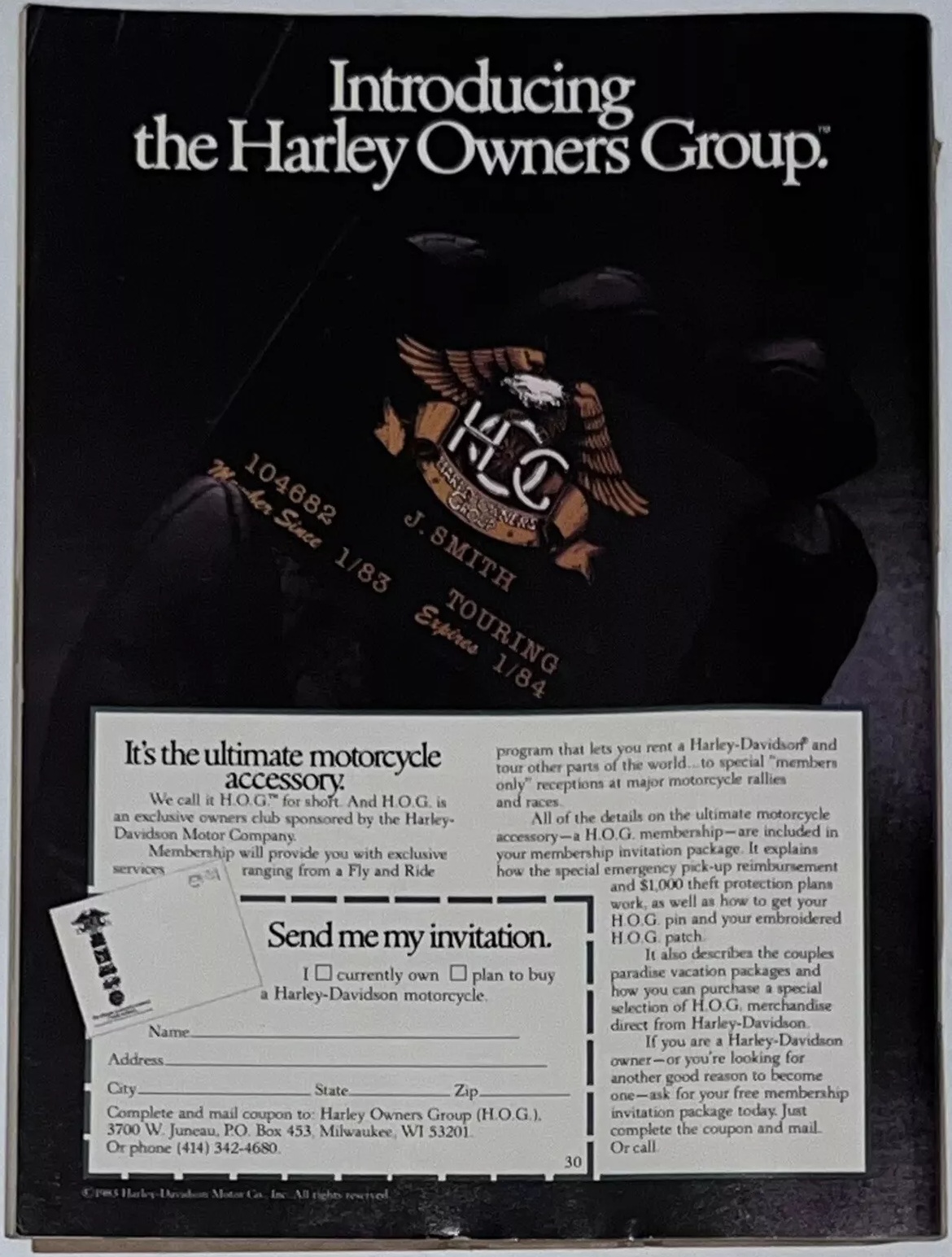
Image courtesy of eBay seller M&M Media and More.
….but it was the publishers’ abandonment of the outlaw ethos upon which the magazine was founded (see Harley Owner’s Group advert, above, for example) that hurt the magazine the most. Gone were the grungy patchholders and those generous four-page features on the radical chopper some hardworking Harley lover crafted in a drafty garage with nothing but sheet metal, a crackerbox welder, swapmeet parts and bleeding knuckles.
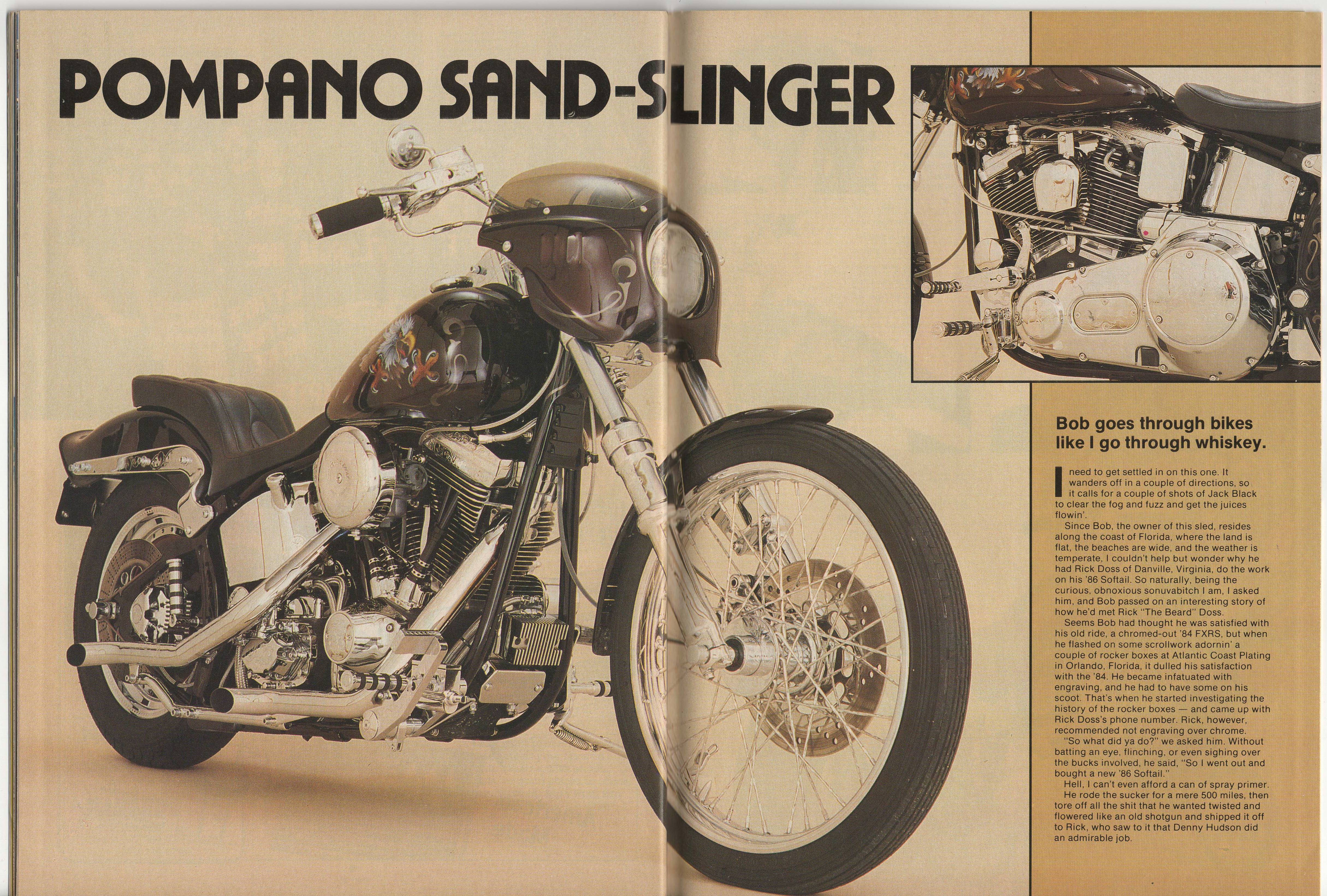
Images courtesy of the author.
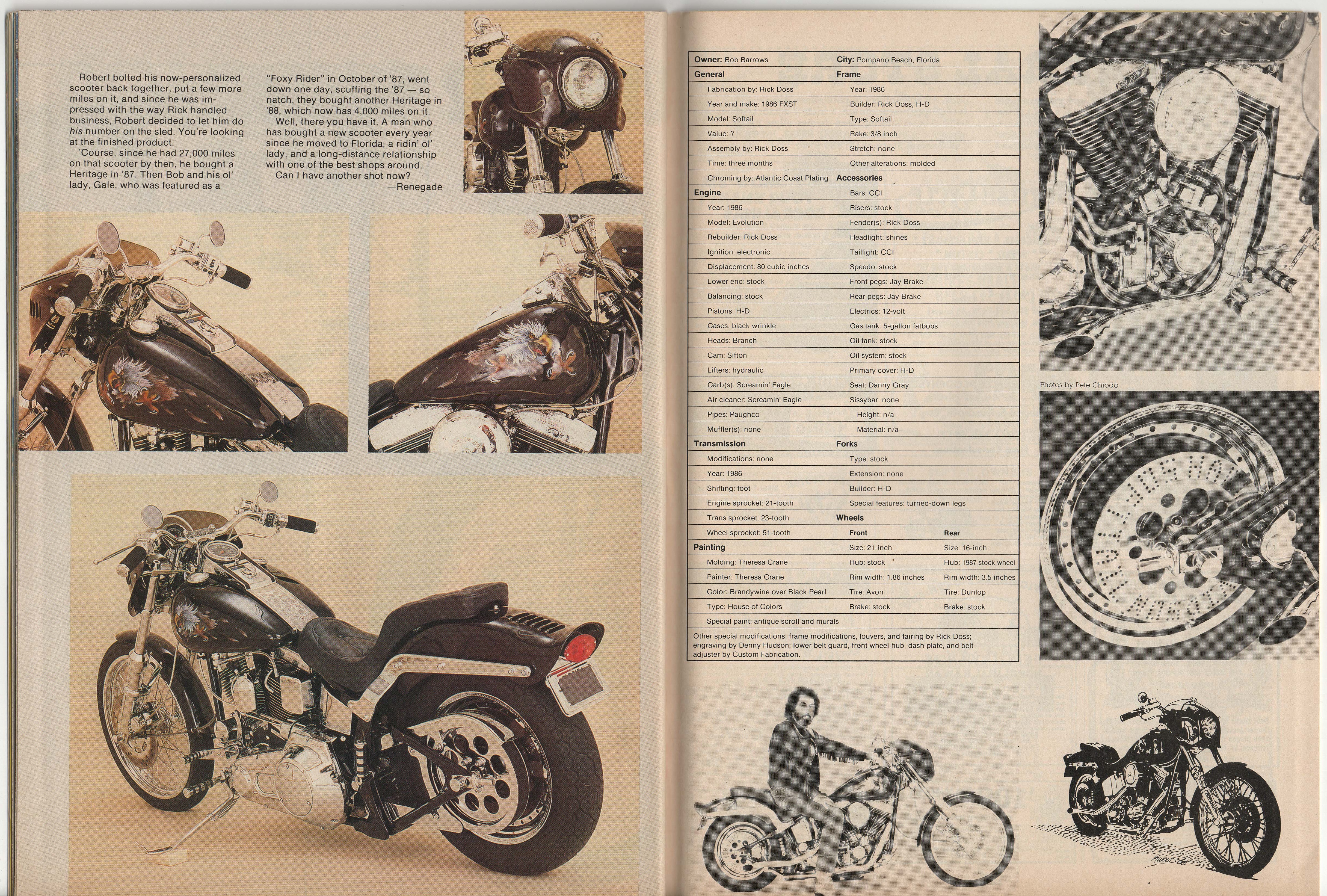
In their place were Harley owners posing with made-to-order machines (see above) that they’d purchased in a shop and paid someone else to customize: ‘RUBs’ and ‘Rolex Riders’ who wouldn’t be caught dead mingling with the street bikers who made the magazine what it was. Builders like Arlen Ness and Rick Doss and pseudo-clubs like the Hamsters were given loads of press, with photos and glowing articles. Meanwhile, old school builders’ efforts were relegated to a tiny spread titled ‘Readers’ Rides’. No one seemed to remember or care that, back in the day, featured bikes were all ‘Readers Rides’! 🙄

Image courtesy of the author.
Gone, too, were the women we loved: those hardcore biker gals and dewy-eyed fender bunnies who brightened the pages of every issue. They were replaced by polished, airbrushed professional models who had obviously never been near a motorcycle until the photographer hired them for a shoot. These were women wearing too much makeup, ridiculous high heels that had no place in the rough-and-tumble biker’s world, and…. and…. they just weren’t our people. 🤷🏻♀️
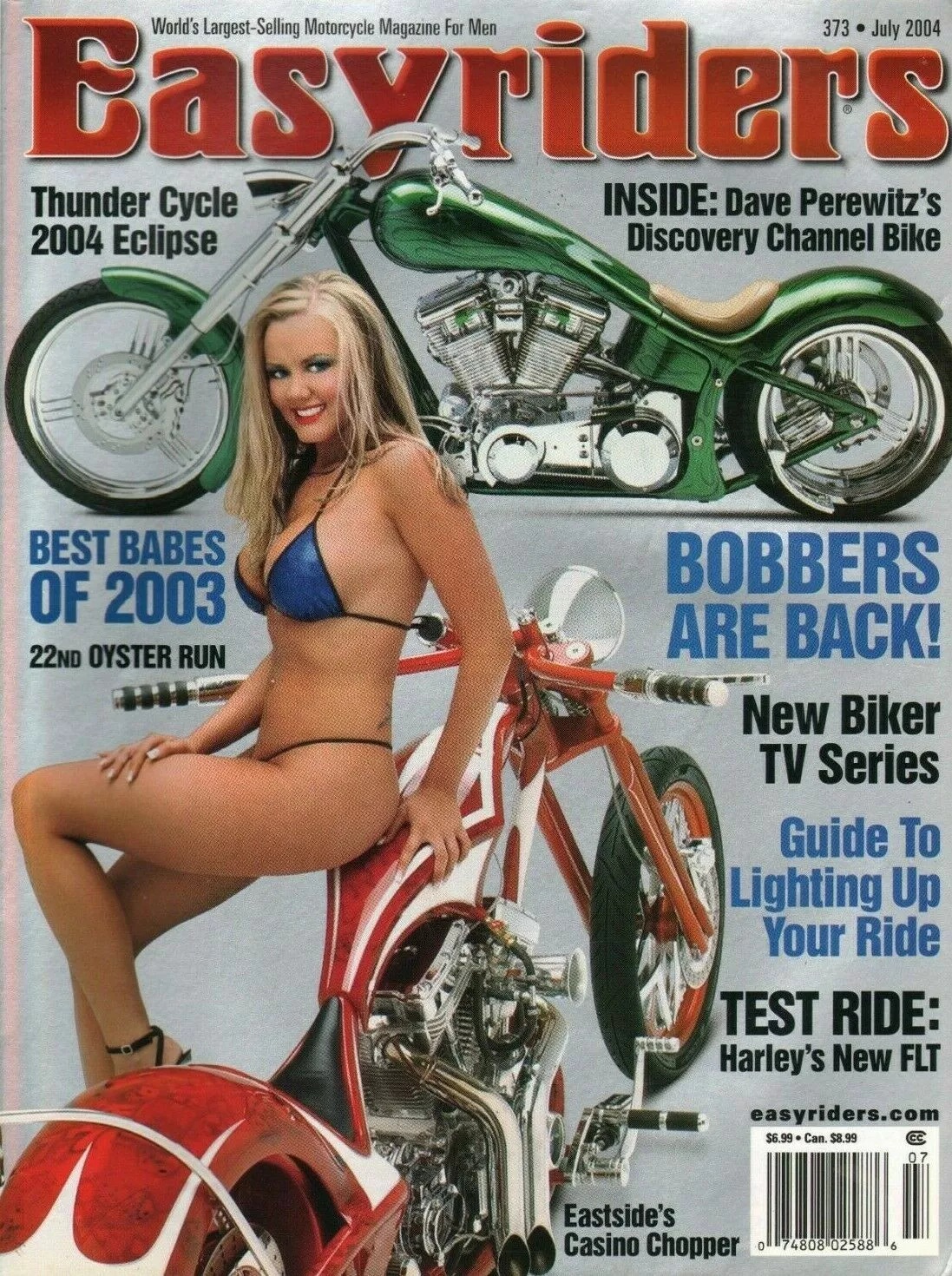
Image courtesy of eBay sellers Gallimore’s Goods.
Easyriders went under in 2019, after almost a half-century in print. As noted above, its quality and integrity had waned considerably in its final decades, even as print publications in general were hemorrhaging readership, so few longtime adherents mourn its passing. However, an upscale clothier has acquired and is attempting to revive the title as a ‘less trashy’ and ‘more inclusive’ publication. Some wag described it as ‘GQ for Bikers,’ but I think Easyriders beat them to the punch with VQ. 🙄
I’ve only seen two issues of the ‘new’ Easyriders and am thus far not impressed. 🤷🏻♀️

Image sourced from internet.
FOOTNOTES
1) R.I.C.O. (Racketeer Influenced and Corrupt Organizations Act of 1970) was written for use against organized crime outfits like the Mafia, but prosecutors quickly realized it had implications far beyond that narrow aim.
For instance, federal prosecutors used R.I.C.O. to go after board members deemed responsible for the Savings and Loans crisis of the late 1980s and early 1990s. One unique feature of R.I.C.O. was that it permitted civil as well as criminal prosecutions. Civil trials require a less stringent burden of proof than criminal trials and, with R.I.C.O., prosecutors could seek triple the estimated damages of any violation. Hapless board members of S&Ls found themselves in court, targeted not because they were guilty but because they had the deepest pockets.
R.I.C.O. was also used to prosecute Hells Angel spokesman Sonny Barger and other members of the Oakland HAMC chapter. However, the fed’s case collapsed when they were unable to prove a ‘pattern of behavior’, or link the alleged illegalities to club policy. Barger, et alia, walked free, leaving prosecutors red-faced, frustrated and bitter.

Photo courtesy of the author, from Supercycle Magazine‘s interview with Barger.
2) A.B.A.T.E. was alternately styled ‘American Bikers Against Totalitarian Enactments’ or ‘American Bikers Aiming Toward Education’. Both monikers applied. The group did fight against mandatory helmet laws, and laws restricting the customization of motorcycles, as numerous states enacted laws regulating seat and handlebar heights, requiring chain guards and front fenders, even mandating the length of rear fenders and the height of sissybars.
However, the group also fought for motorcycle rider education, to train new riders in street survival skills, and driver awareness campaigns to make motorists more aware of (and, it was to be hoped, more respectful of) motorcyclists in traffic.
I acted as State Awareness and Safety Coordinator for A.B.A.T.E. of Texas. In that capacity, I developed and spearheaded a statewide billboard campaign, and helped promote a tripart Safety and Awareness Rally which gathered motorcyclists together in three cities across Texas, to raise awareness of our cause. As a state officer for A.B.A.T.E., I was also involved in efforts to bring mandatory rider education to the state, and create a statewide training program for novice cyclists and the instructors who would train them. In my spare time 😆 I also edited the group’s newspaper, and designed a number of popular fundraising t-shirts.

Photographs courtesy of the author.
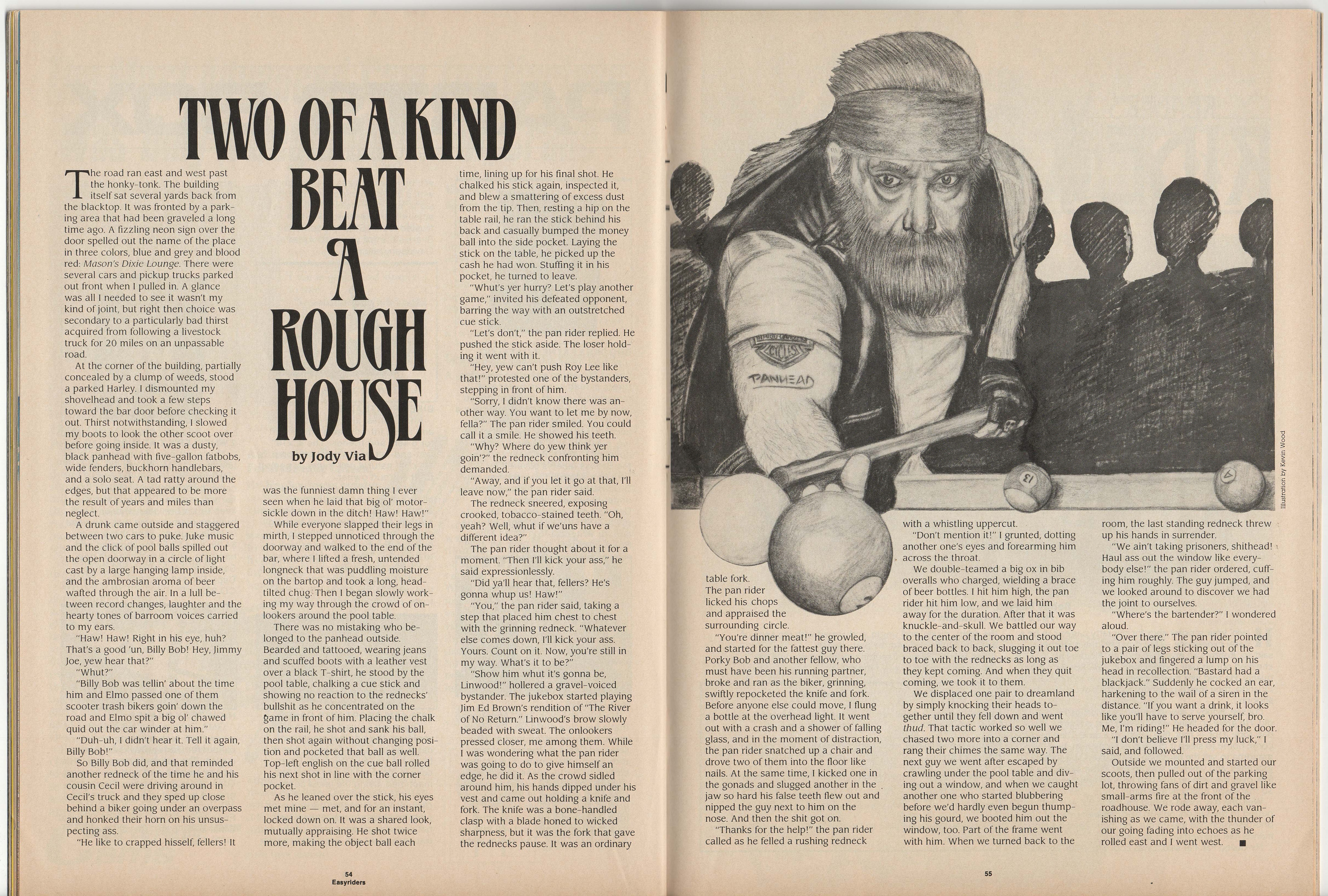
Image courtesy of the author.
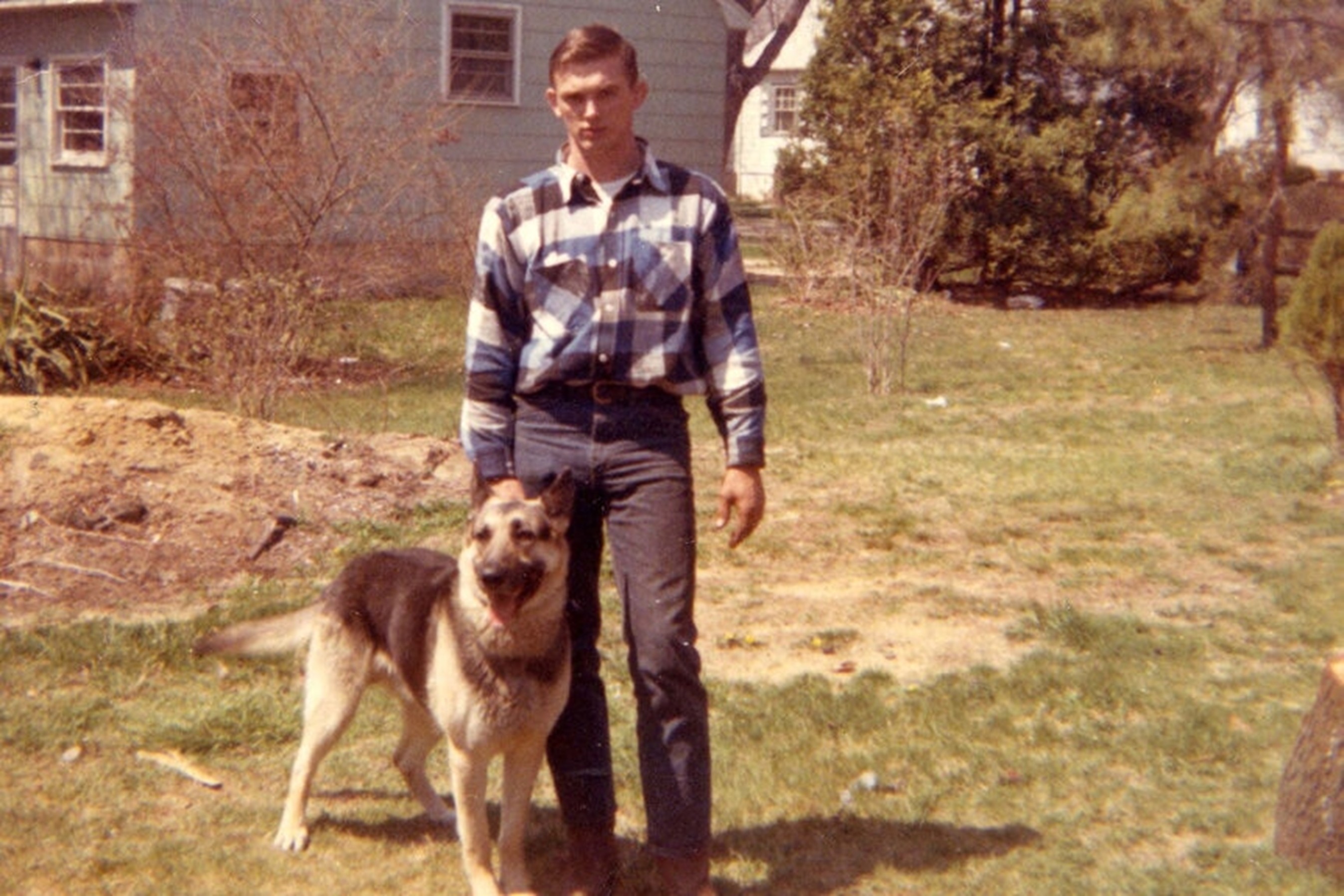
3) In researching this article, in a deep dive search for some of my favorite Easyriders writers, I unearthed the tragic tale of Jody Via. Jody was one of my faves from back in the day, capable of fashioning darkly compelling crime yarns from bolts of whole cloth….
….except that, per police, Via’s ‘yarns’ weren’t fiction at all. They say he was effectively recounting crimes he himself had committed during a murderous spree across Pennsylvania and Ohio in September, 1972, and selling them for publication!
First, we have Good Samaritan Harry Hoffman. Mr. Hoffman was a kindly gas station owner who stopped to help what appeared to be a young couple stranded at roadside. Hoffman took them back to his service station, and even made a fresh pot of coffee so they could warm up from the chill night air. For his troubles, Mr. Hoffman was bound, shot in the head and left for dead in the back room of his service station. He survived, and later identified his attacker in court.
Next, we have nineteen-year-old college student Jane Maguire, who fell for Via’s ‘stranded’ ruse and offered him a ride. Her body was discovered in a highway rest area. She had been raped, bound, shot in the head and left for dead. Sadly, Ms. Maguire did not survive.
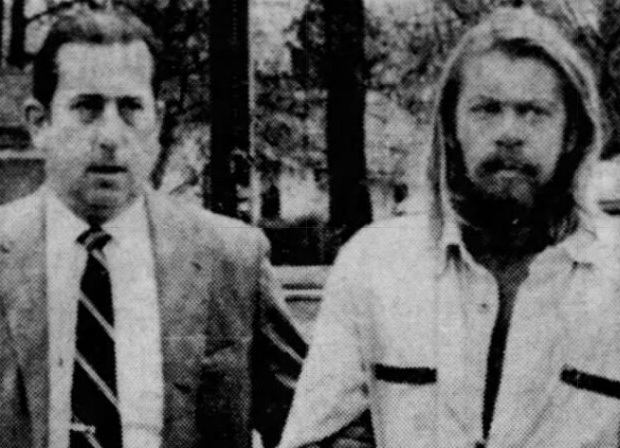
Via, who had holed up in his wife’s home, was arrested, charged with and convicted of the crimes, and received a life sentence. While serving that sentence, Via began submitting poetry and short stories to Easyrider, which published several of his works. He later sold some pieces to Outlaw Biker magazine, as well.
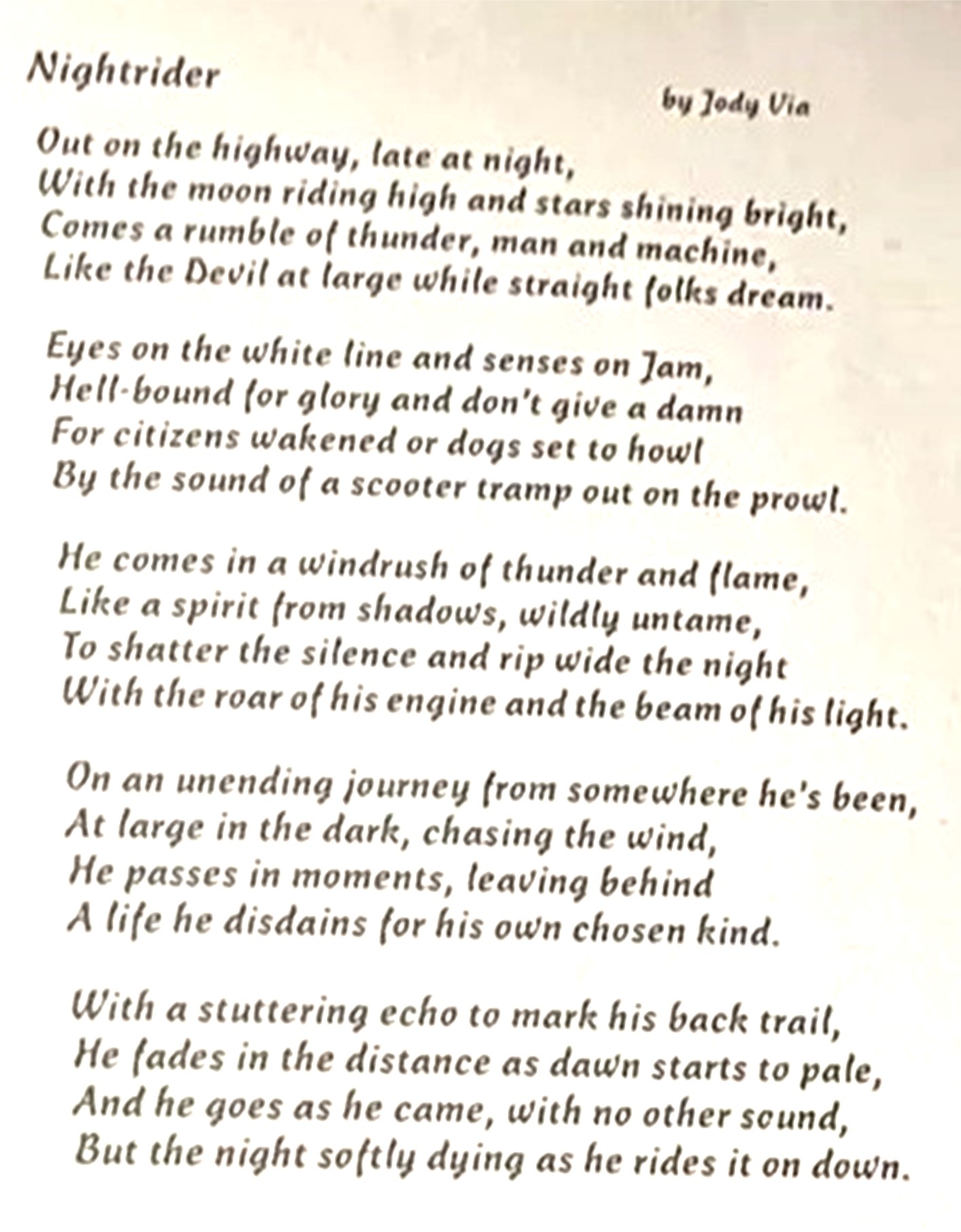
Image courtesy of eBay seller Vintage Variety 60.
However, in 2019, investigators working the September 1972 cold-case murder of twenty-nine-year-old salesman Morgan Peters, in Pennsylvania, were directed by two of Via’s ex-wives to look at Via’s published writings. There, in the stories Via sold the biker magazines, police found detailed descriptions of each of his crimes, including the as-yet-unsolved slaying of Peters. Via, still in prison for the rape and murder of Jane Maguire, was charged with Peters’ slaying in 2019. He was seventy-five years old.
I have yet to learn what became of those charges or the defendant.
Man, that took a dark turn, didn’t it? 😮




































 The Shovel Shop