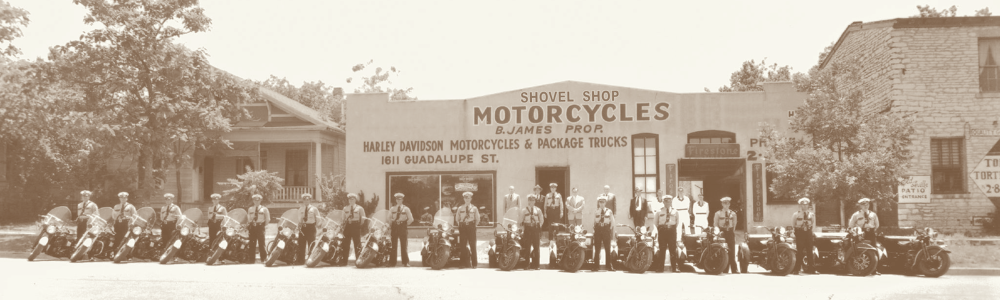
(chal’enj)n. anything that calls for special effort
Copyright © 2023 by Bill James at The Shovel Shop, Austin, Texas. Photograph of Jane Strand (above) © 1988, 2023 by Bill James at The Shovel Shop, Austin, Texas.
What would you do if life – an accident or illness or hereditary condition – stopped you from doing the thing you most enjoy?

I initially got interested in adapting motorcycles for use by riders with physical disabilities in the early ’80s, when I helped design and construct a shovelhead-powered trike for a military veteran who’d been paralyzed in a motorcycle wreck. Paul (seen in photo above) was classified as quadriplegic, which, FYI, does not necessarily mean a person is paralyzed from the neck down, as I’d always assumed. Rather, it simply means the normal functions of all four limbs are affected by the injury or condition. In Paul’s case, that meant he had no use of his legs, and while his right arm was almost fully functional, his left had only limited strength and range of motion. He could make a partial fist – enough to operate a hand clutch and help steer a motorcycle – but couldn’t operate a jockey shift or brake lever.
Now, bear in mind that in the 1980s none of the well-known motorcycle manufacturers were producing three-wheeled motorcycles. Harley-Davidson still offered sidecars, but the Motor Company’s venerable Servi-Car (popular with police and fire departments, delivery services and automotive repair shops) ended its forty-one-year run in 1973, and no one was rushing to fill that slot.
As an aside: circa 1982, Honda reportedly produced a prototype three-wheeler based on their CX500 – an estimated 250 units overall – for U.S. Police Departments. I have a distinct (and very pleasant memory) of seeing a female Austin Police Department officer in full moto-cop regalia, including knee boots and leather jacket, blasting through downtown traffic on one such prototype with her long blonde hair streaming behind her. 😍 Unfortunately, the bikes didn’t make the cut and never went into full production, and I never saw my jackbooted goddess again. 🥺😢😭
Anyhoo, as I was saying….
No one was cranking out three-wheeled motorcycles back then, and aside from some knucklehead-powered prototypes constructed at the onset of World War II, the Motor Company had never produced a Big Twin trike. That meant virtually everything we needed to make Paul’s bike function as required had to be designed and created in-house.
The chassis consisted of an OEM early shovelhead swingarm frame grafted to a rigid Servi-Car rear section. It had originally been built for a local biker who was shot in the leg by an off-duty APD officer during a traffic confrontation on Guadalupe Street, near the entrance to the Austin State Hospital. The cop claimed he was in fear for his life, naturally, and walked away without consequence. Meanwhile, the unarmed and now disabled biker was left to fend for himself, and put together the three-wheeler.
After a while, Rod assumed he was healed up enough to get back on two wheels, so my boss at the motorcycle shop got the trike frame. Unfortunately, Rod wasn’t as healed as he thought he was, because shortly after getting back on his panhead he tipped his bike over while trying to park it in a grassy area pocked with hillocks and treacherous low spots. When he tried to catch himself his right (injured) leg gave way, putting him right back on the disabled list.
However, by then we were already well into the construction of Paul’s trike.
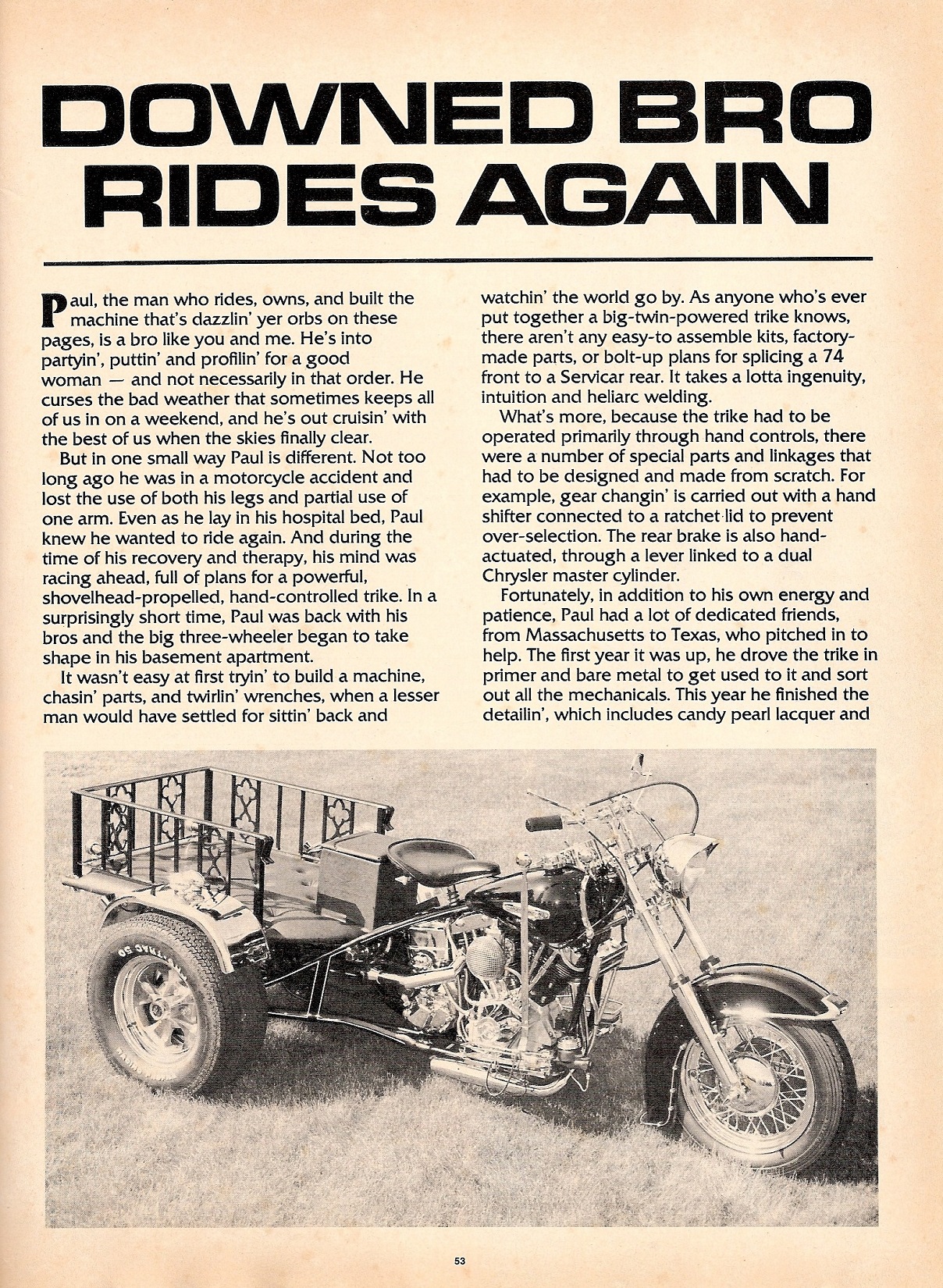
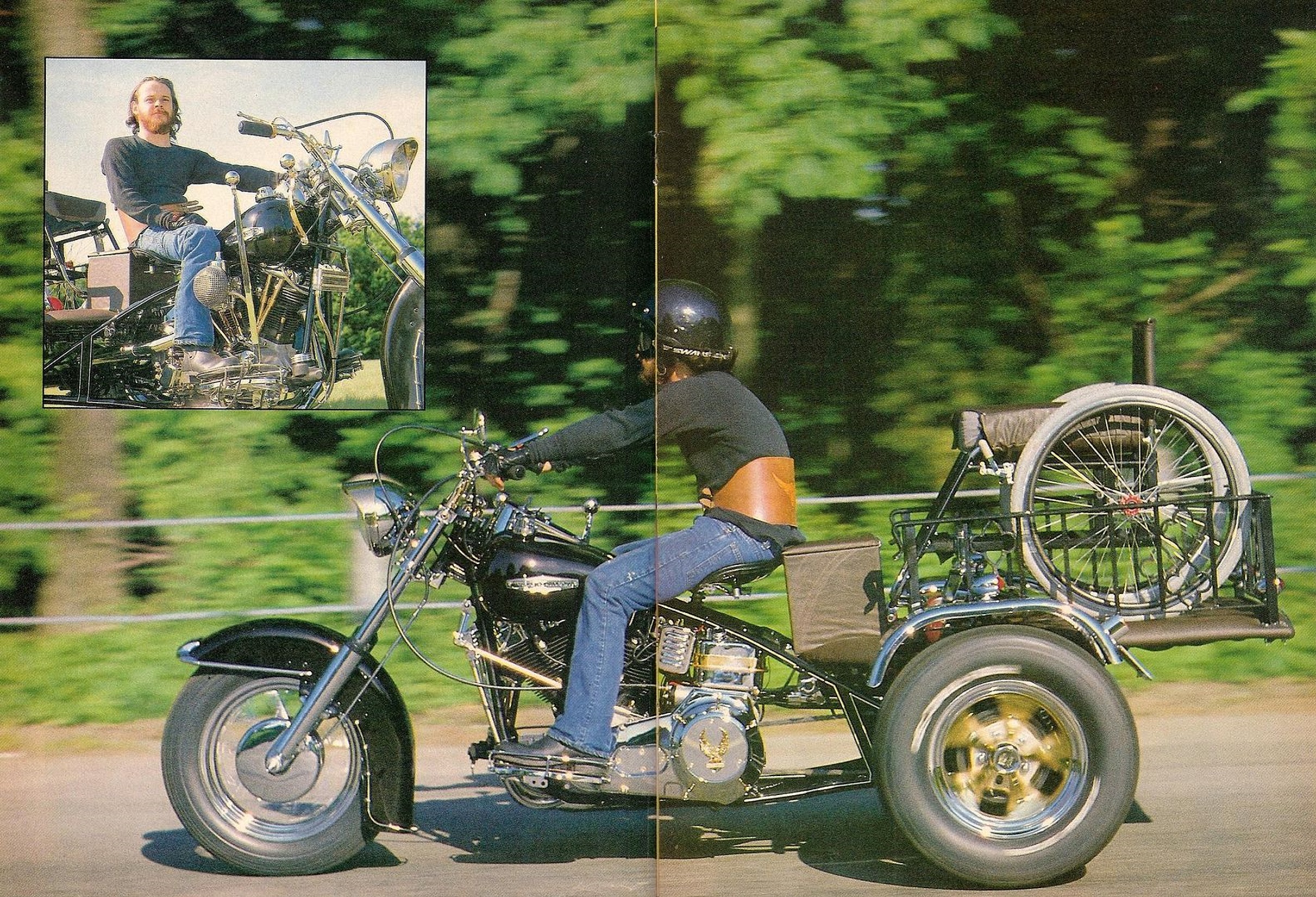
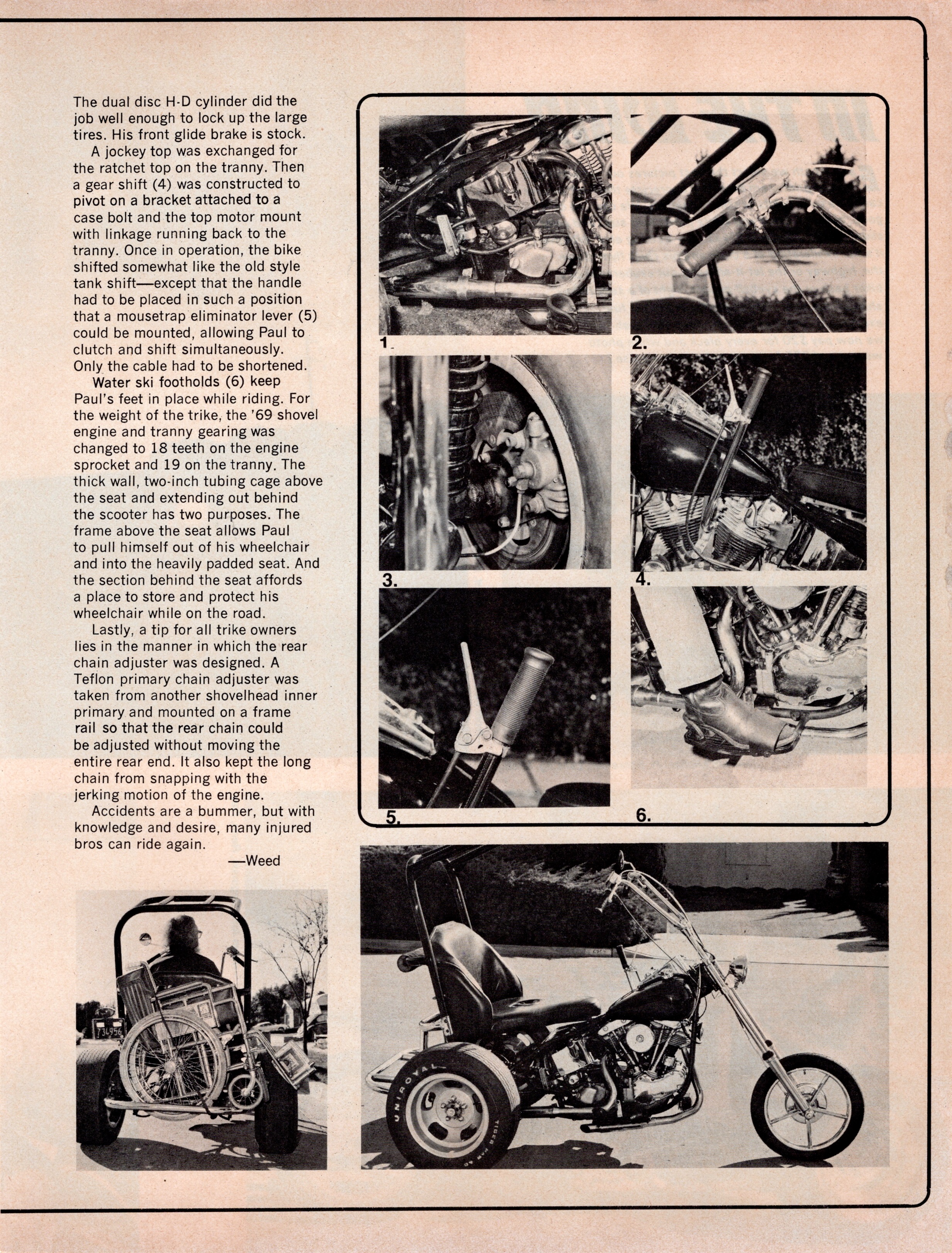
The Easyriders spread from January, 1985, seen below, shows the details of Paul’s unique trike: crossover shifter mechanism, linked front and rear brakes, custom floorboards, et cetera. What the magazine doesn’t show is that, while we got the trike running and dialed in, and fine-tuned the hand-controls and other adaptations, Paul was bartering with the shop’s owner, trading custom paint and bodywork to cover the costs of the build. Paul was a gifted body man, and I was very proud to run the tins he’d shaped and painted for me during that time.

1980: My 1974 shovelhead, recently transplanted into this OEM 1954 wishbone frame, sports tanks and fenders shaped (where needed) and painted by Paul. This was the first frame-off rebuild I’d ever done, and I remain very proud of the finished project! A lot of people who looked askance at my choice of colors when the painted tins were hanging on the wall in my shop area admitted I’d chosen well, and created a striking custom build.
Once we got the trike dialed in, while it was still all bare metal and grey primer, we turned it over to Paul, who soon returned to his home in Massachusetts. There, he took the bike apart and detailed the thing, putting his expertise and artistry as a body man to work, and doing much of the physical labor himself. Paul built an extended platform behind the pogo-stick saddle to hold his wheelchair, and the custom-built ultralight wheelchair itself. He also cleaned up the rough metal we’d used to fashion some of his controls, added a lot of gold and chrome plating, and painted the machine a rich ebony black with striped accents on the frame. Aside from the unique aspects of its construction, the machine was a beautiful custom motorcycle, deserving of its place in the pages of the world’s most widely-read biker magazine.
By the time we completed Paul’s trike, I had become fascinated with the process of modifying motorcycles for use by handicapped riders, and enamored of the spirit and ingenuity that went into each adaptation. I began clipping articles from newspapers and magazines – anything referencing handicapped riders or drivers – and adverts and announcements about new parts that looked as if they might prove useful in adaptations. I photographed adapted bikes wherever I found them, and spoke to the riders if possible.
Over time, I accumulated a hefty file of information in those pre-internet days, and acted as a clearinghouse for that info. Primarily through Letters to the Editors columns of motorcycle magazines I made that information available free of charge to any and all takers.

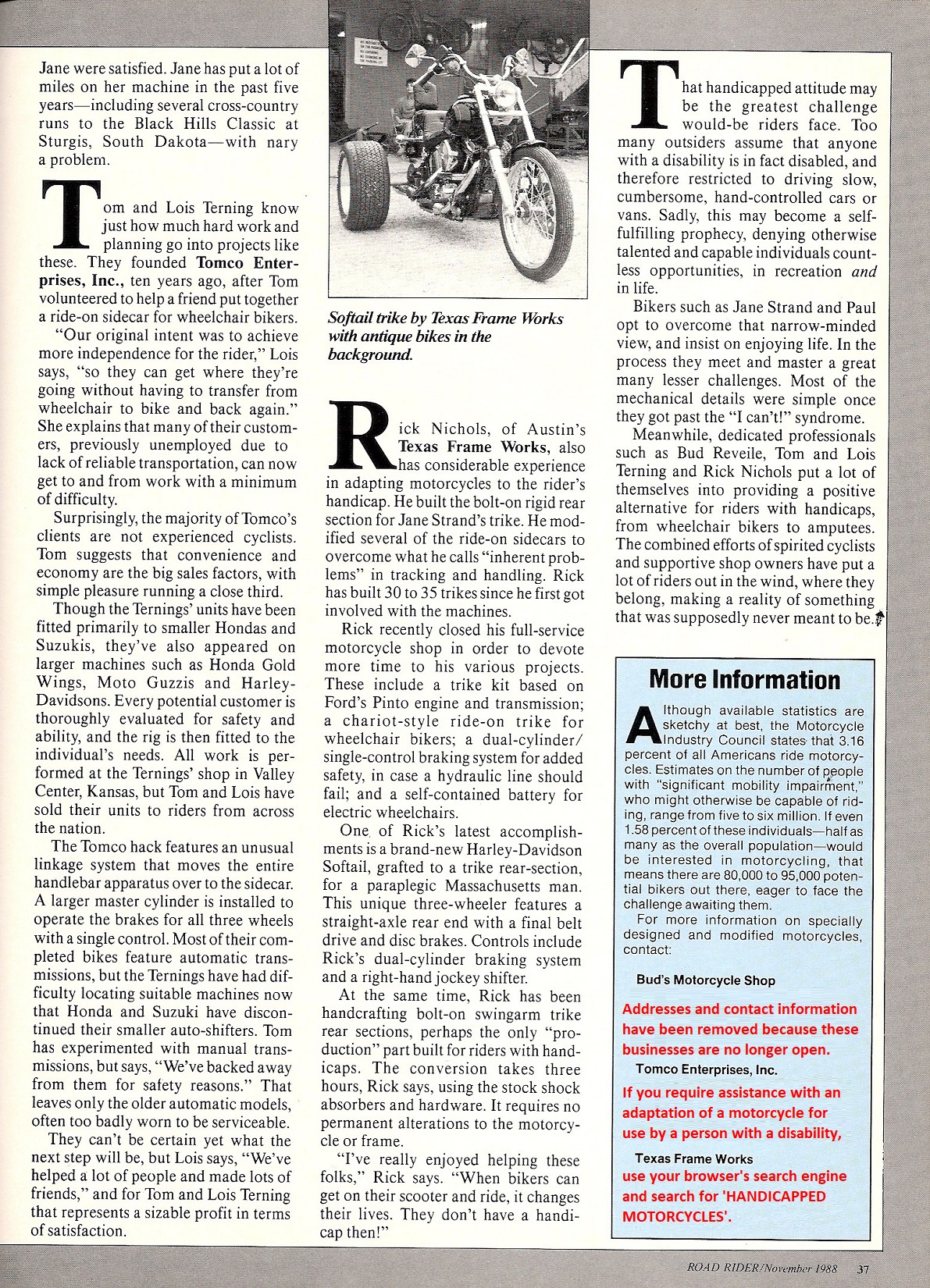
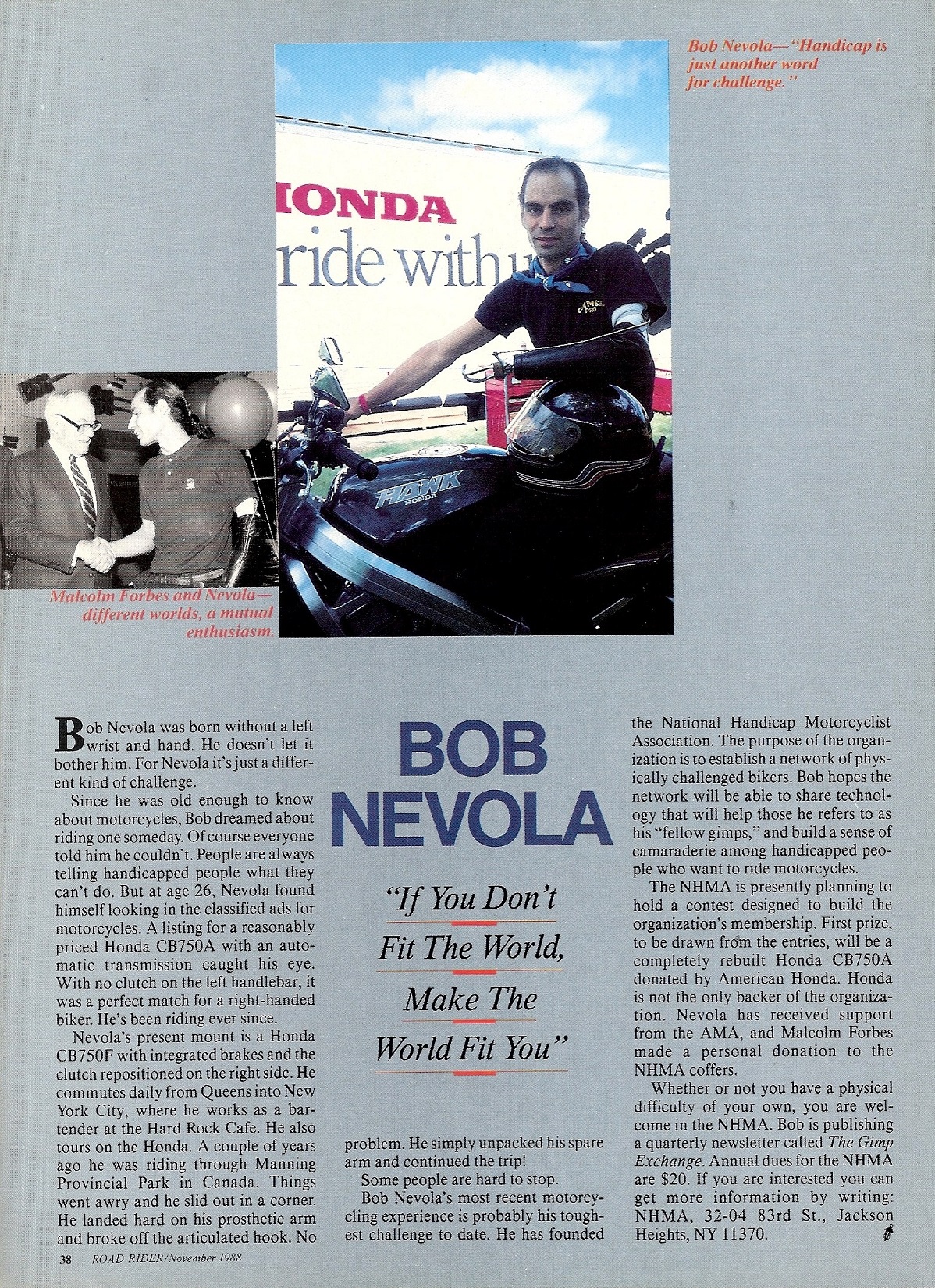
I’d written for newspapers and magazines for several years, so it was a natural progression to take what I’d learned and create a feature-length magazine article. I shopped the idea around, and Road Rider (later reconfigured as Motorcycle Consumer News) gave me the commission. I did the research, conducted my interviews, took the photographs, and my piece appeared in Road Rider‘s November 1988 issue. I didn’t even know it had come out until someone at a motorcycle rights organization meeting asked for my autograph! 🙄
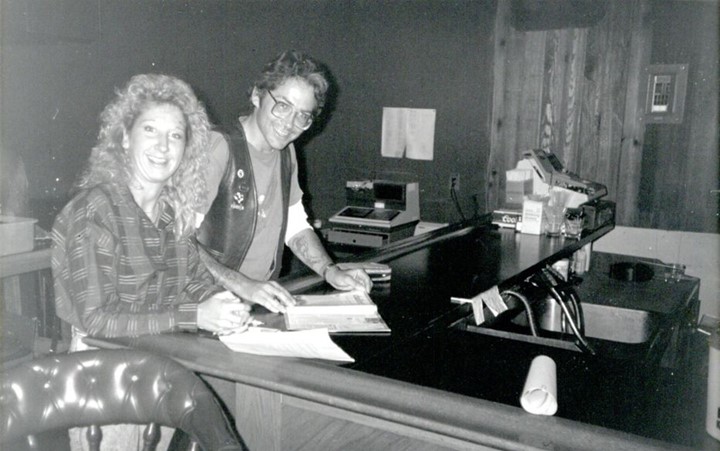
October, 1988: My friend Tina and I, as I sign my first (and last, so far) autograph on my just-released article about adapting motorcycles for use by handicapped riders. We were at Frank’s Lakeview Inn on Lake Belton, Texas, to attend a Texas Motorcycle Roadriders Association meeting.
Times have changed drastically since that article appeared. By the late ‘90s aftermarket manufacturers had begun releasing bolt-on trike kits, and now offer assemblies for almost every motorcycle marque on the road. In 2009, Harley-Davidson began marketing its own line of Big Twin trikes with a wide range of options. Aftermarket trike frames are also available, as are helpful add-ons like electronic shifter mechanisms, and reverse drive units for those who can’t back their bikes out of parking spaces. Meanwhile, the Can-Am Spyder and Polaris Slingshot offer something other than the traditional trike configuration, if you’re into that sort of thing.
Just in time, too, as the perennially playful Baby Boom ages into the need for three-wheelers! 😆
Okay, so, on to the articles:
This is my piece, written for Road Rider Magazine:
As an aside: the late Roger Hull, who co-founded and edited Road Rider, and has been inducted the Hall of Fame at the American Motorcyclist Association, was a personal hero of mine for his principled, unwavering stance on riders’ rights and freedom of the road. Even though he’d retired from the magazine by the time I sold them my piece, it gave me great pleasure to publish an article in those hallowed pages!
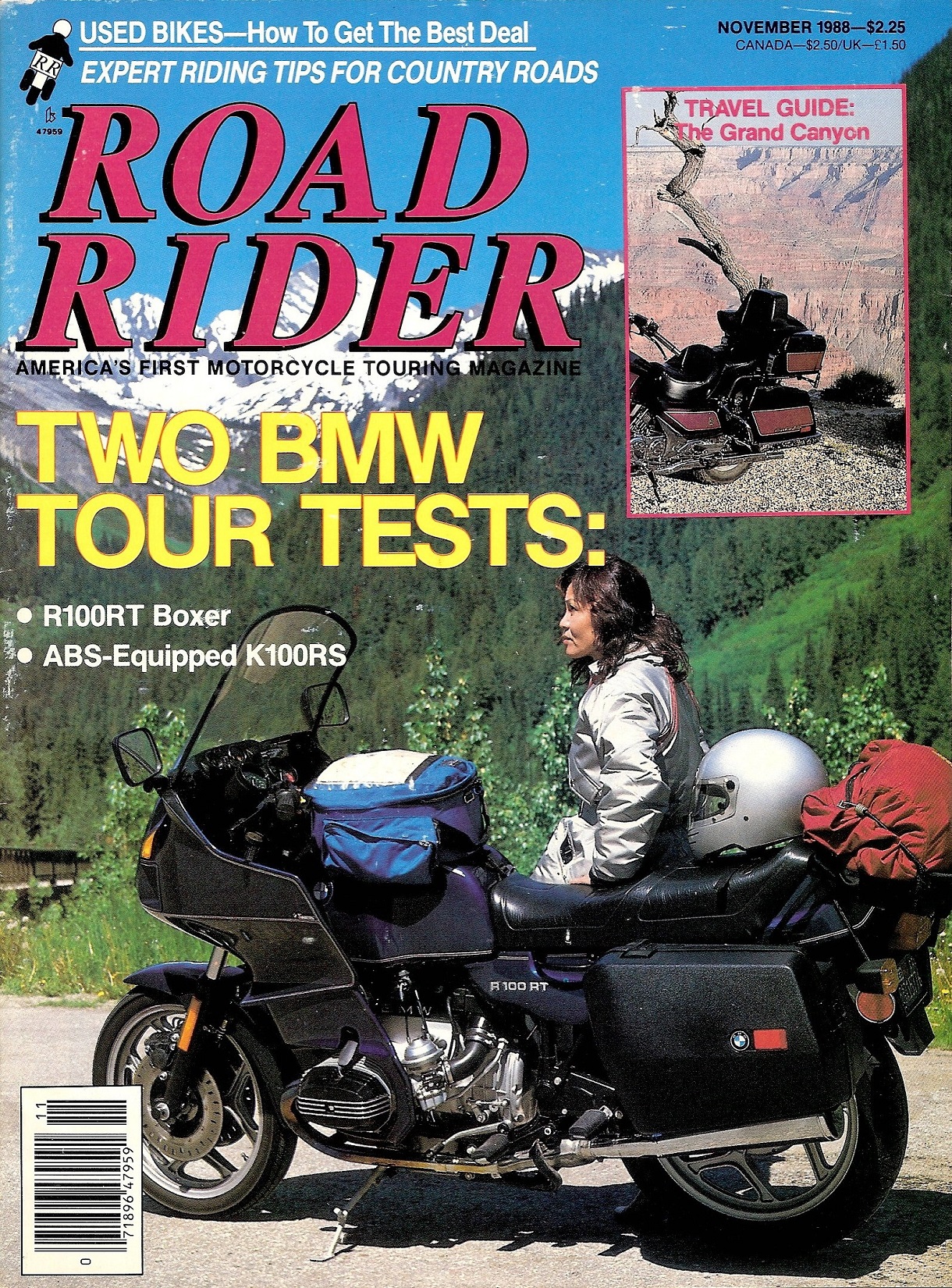

Here is the Easyriders article (January, 1985) about Paul and his trike:



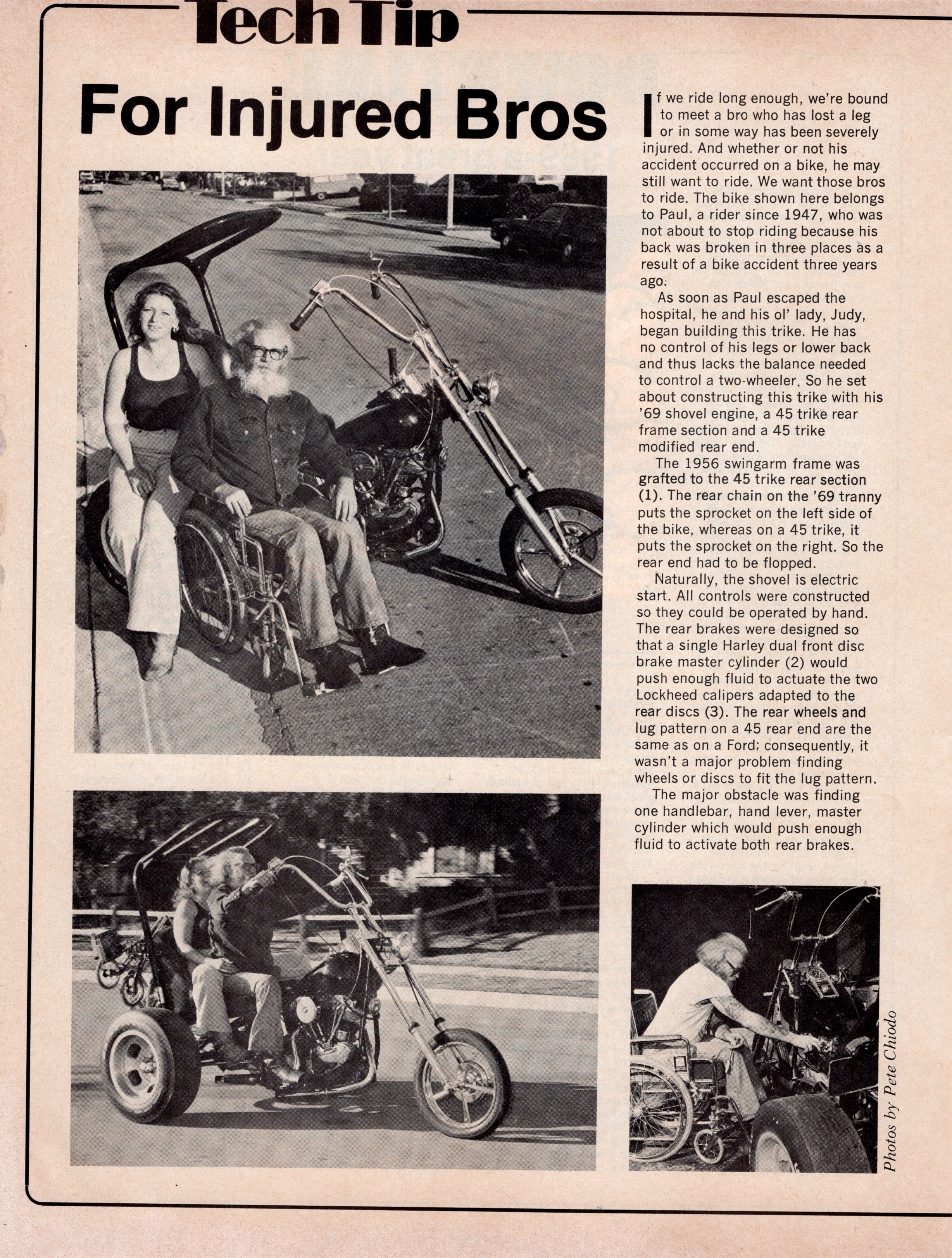
And another piece, from Easyriders’ March 1979 issue:
So, what’s this got to do with me? More at the link below. ‘Til then, sláinte! 😎


 The Shovel Shop