EASYRIDERS

Once upon a time, in the dark ages of the pre-internet world, there was a magazine called Easyriders.

The cover of the magazine’s very first issue. From the onset, Easyriders was determined to do things differently. What other bike rag of the day would boast of featuring the ‘World’s Ugliest Trike’?
 Image courtesy the author.

Easyriders was the brainchild of several California-based riders – Lou Kimzey, Joe Teresi and Mil Blair – who dreamt of a rag for bikers, by bikers, with none of the usual mealy-mouthed product reviews, and clean-cut models posed aboard factory-fresh machines from Europe and Japan.
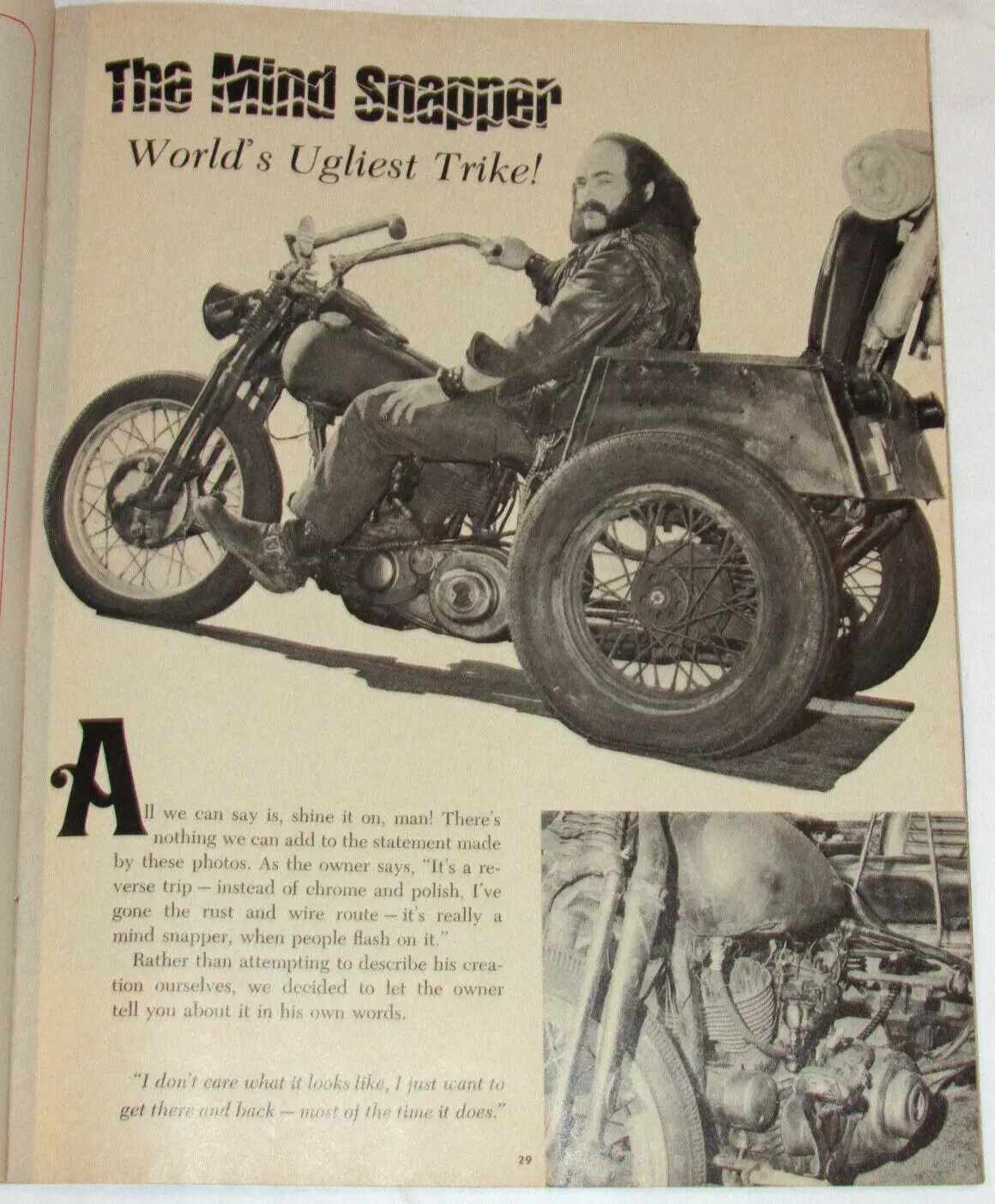
In their very first issue, Easyriders‘ editors proved they were following a different path than their predecessors and competitors.
 Image courtesy of eBay seller Cruzin’ for a Deal.

No, this new mag would be for hardcore bikers, patchholders and independents who lived, breathed, slept and dreamt motorcycles: preferably big American motorcycles like Harley-Davidson and Indian. The first issue trumpeted the new title as ‘For the Swinging Biker.‘ They later identified as ‘Entertainment for the Adult Biker.

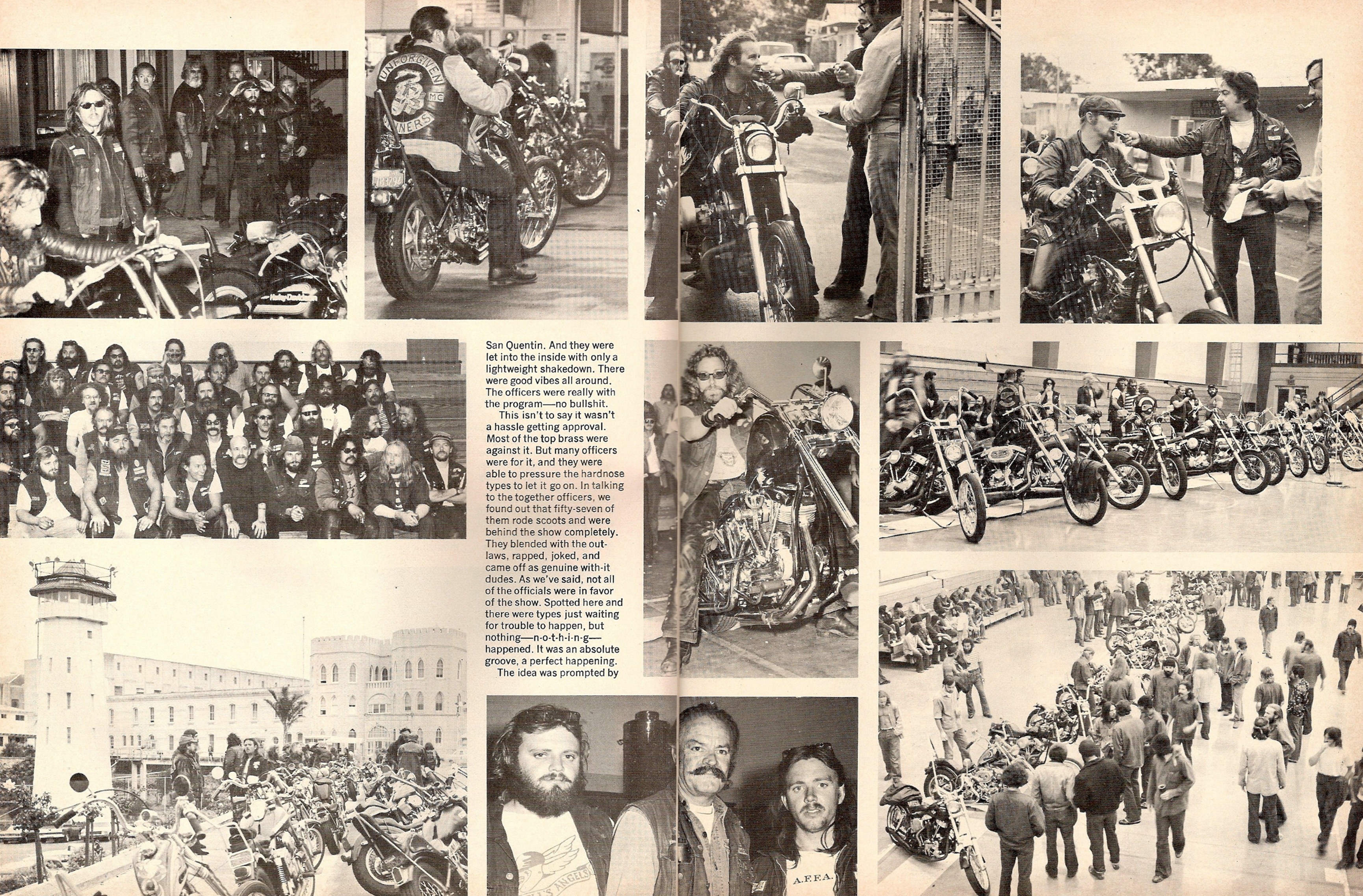
The other biker rags – even the ones that claimed to be hip to choppers – weren’t covering events like this!
In fact, those other guys were more likely to be sneering than cheering. Choppers were ‘cool’ but chopper builders? Those long-haired, greasy-bearded outlaw types? Eww! 🙄
San Quentin pages courtesy of the author.

Within its pages, Easyriders featured handbuilt choppers – genuine rigid-framed, long-forked machines with psychedelic paint jobs, sky-high sissybars, glistening spokes and heavily chromed engines like the ones featured in the magazine’s namesake movie. They were laid-back, long-legged beauties – dream machines – and in the ’60s and early ’70s many a young man (your humble narrator included) lusted after them. We looked for them at custom car and motorcycle shows, built plastic models of them, pressed our noses to the windows of Dad’s station wagon whenever one rumbled past and, naturally, pored over magazines about them.
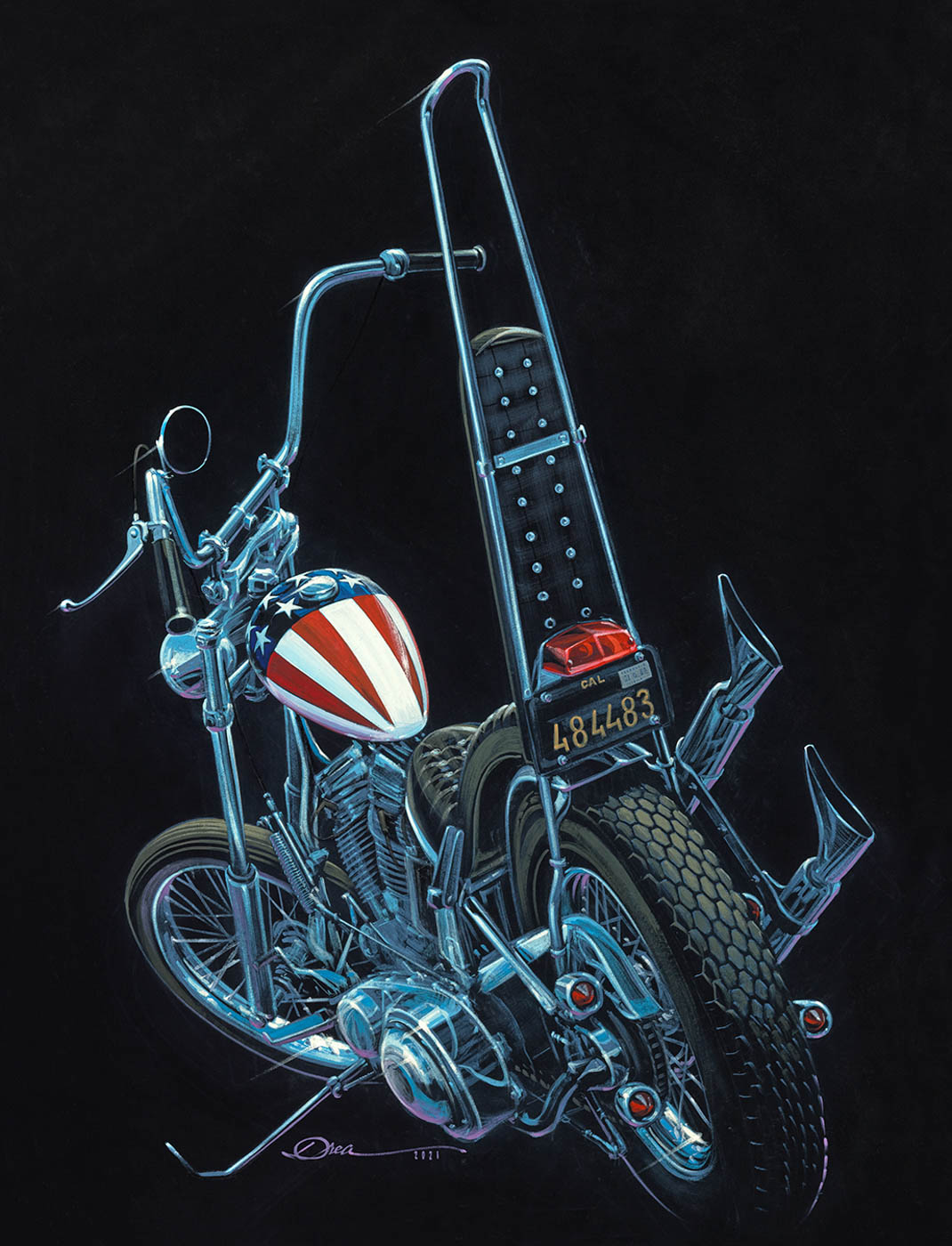
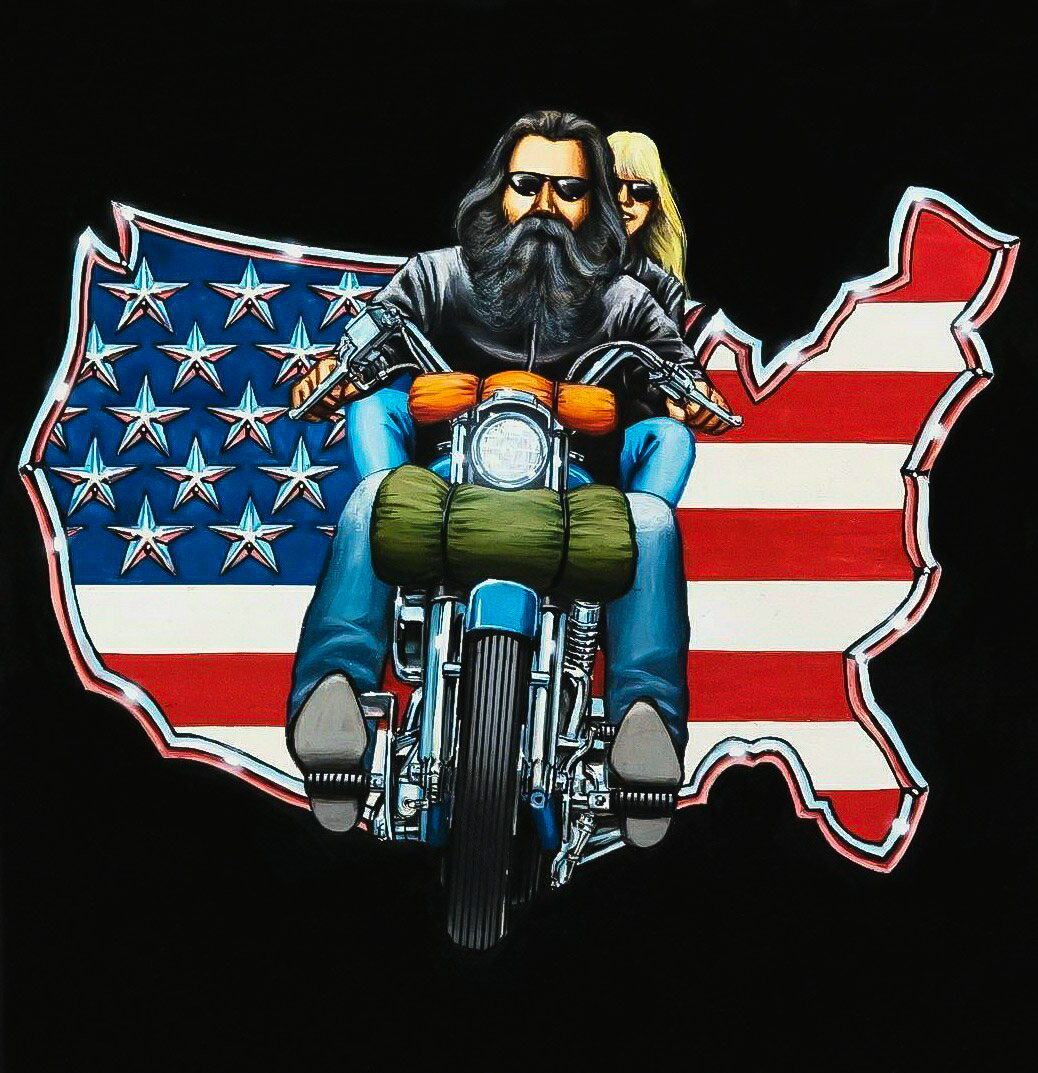
Captain America by artist Ray Drea.
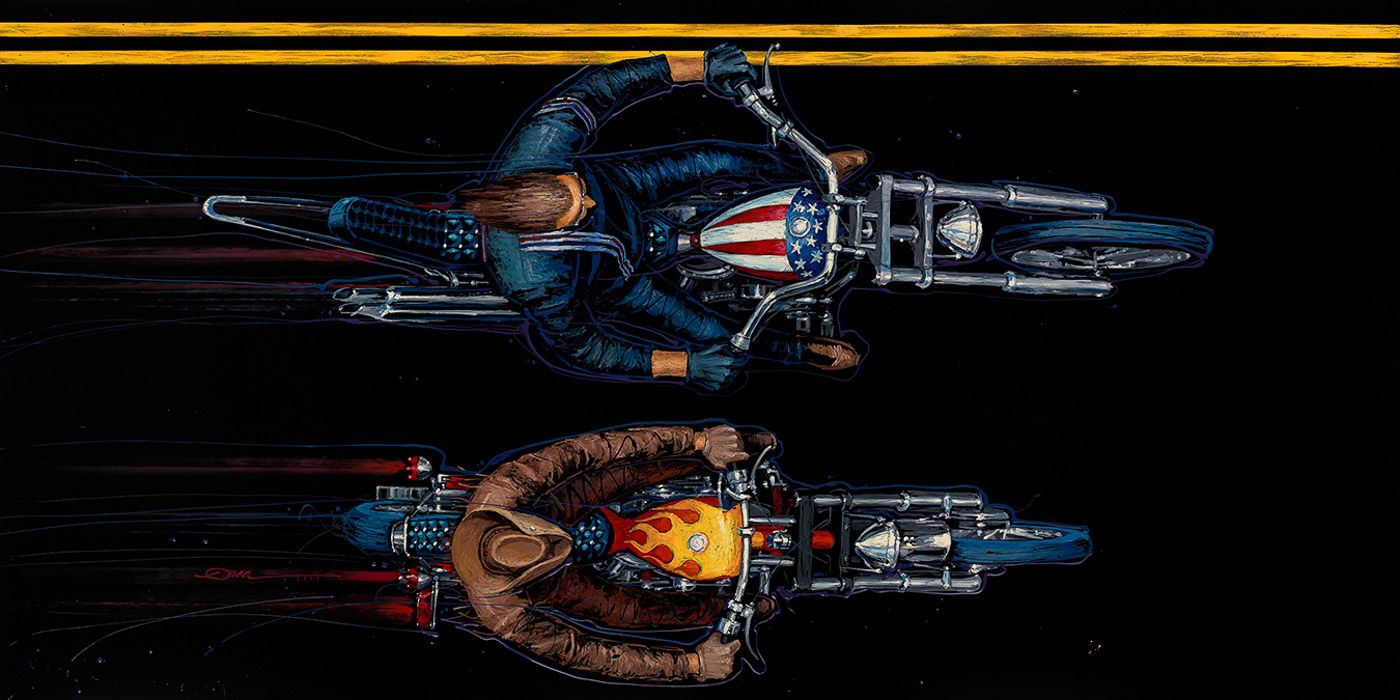
A unique take on the anti-heroes of Easy Rider (1969) by artist Ray Drea.
A life-size Billy Bike, seen at the 20th Annual David Mann Memorial Chopperfest in February, 2024.
 Image courtesy of the author.
Now that’s a chopper! Also spotted at the David Mann Chopperfest.
 Image courtesy of the author.

Choppers may have been works of art, but for most builders they were much, much more. Those workhorse v-twin engines – the ones that carried police officers through city traffic, and gave Mom and Pop a breath of fresh air and outdoor life at the end of a workaday week – were broken down and rebuilt, and in the process they were blown, stroked, bored and balanced to achieve ultimate performance in flat-out style. We’re talking balls-to-the-wall, explosive power.
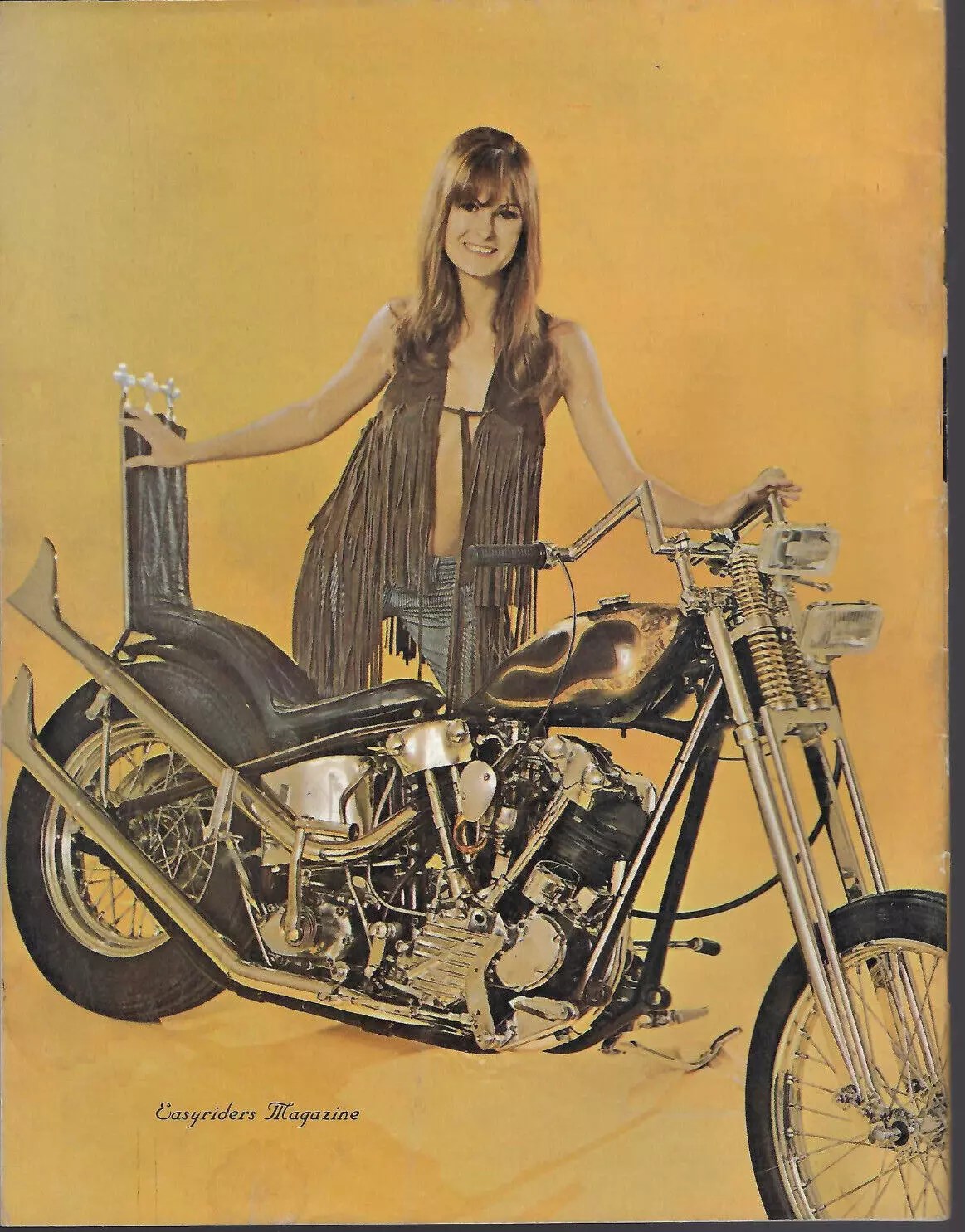
Editor Lou Kimzey’s knucklehead chopper appeared on the back cover of the magazine’s first issue.
 Image courtesy of eBay seller Cruzin’ for a Deal.

The bikes may have been built for cruising the highway with a chick on the p-pad and a fart sack strapped to the forks, but the engines were built for red-light racing and the quarter-mile, popping wheelies and other displays of brute acceleration. These weren’t upstart Jap scrap that whined like angry hornets, or prim European motorbikes with finely tuned suspensions and muted, throaty exhaust notes. You weren’t going to see choppers competing in Timed Trials challenges, or road-racing on the Isle of Man. They were, with few exceptions, big, loud, powerful, gas-guzzling, straight-line-balling, quintessentially American machines.

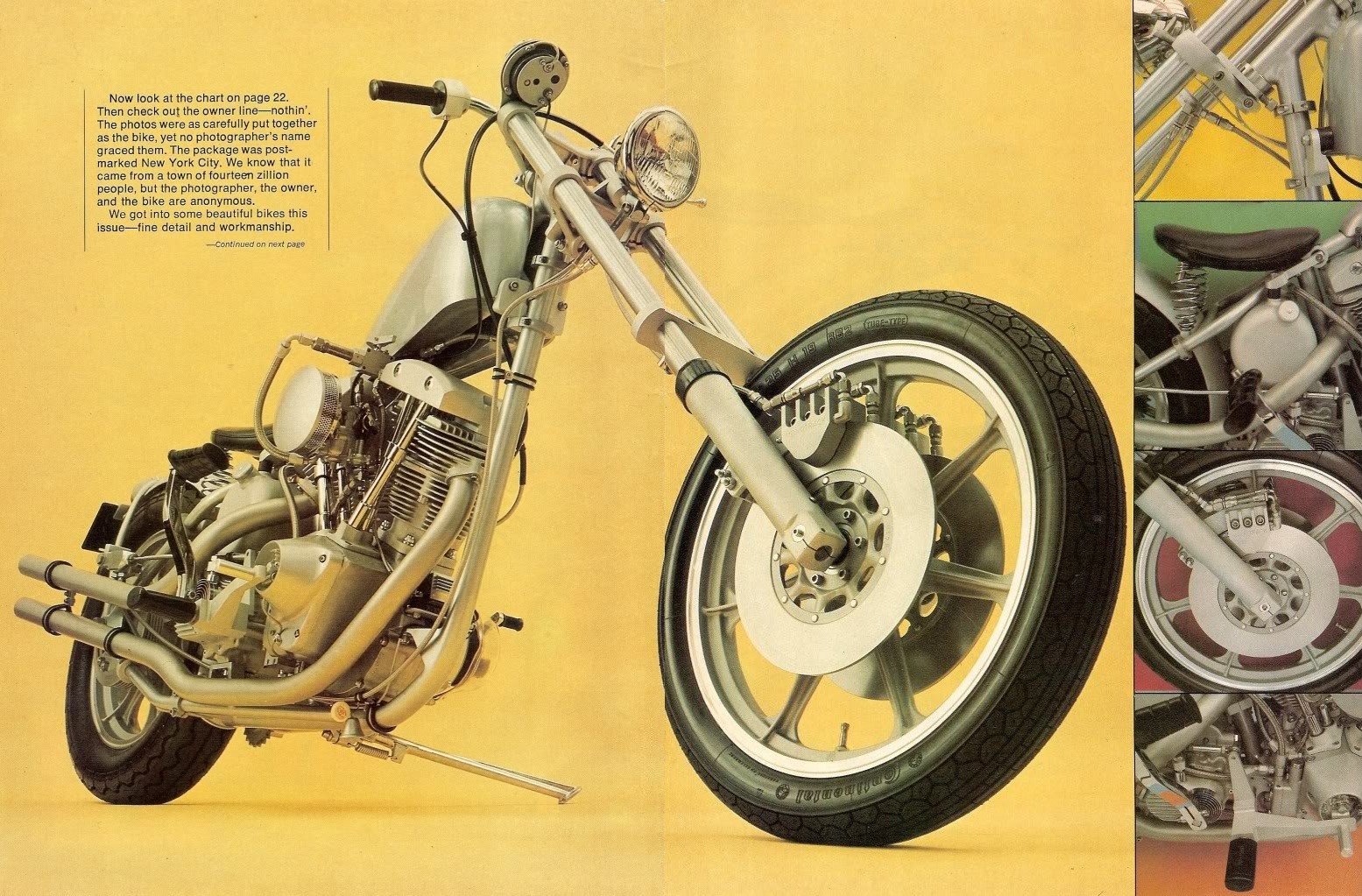
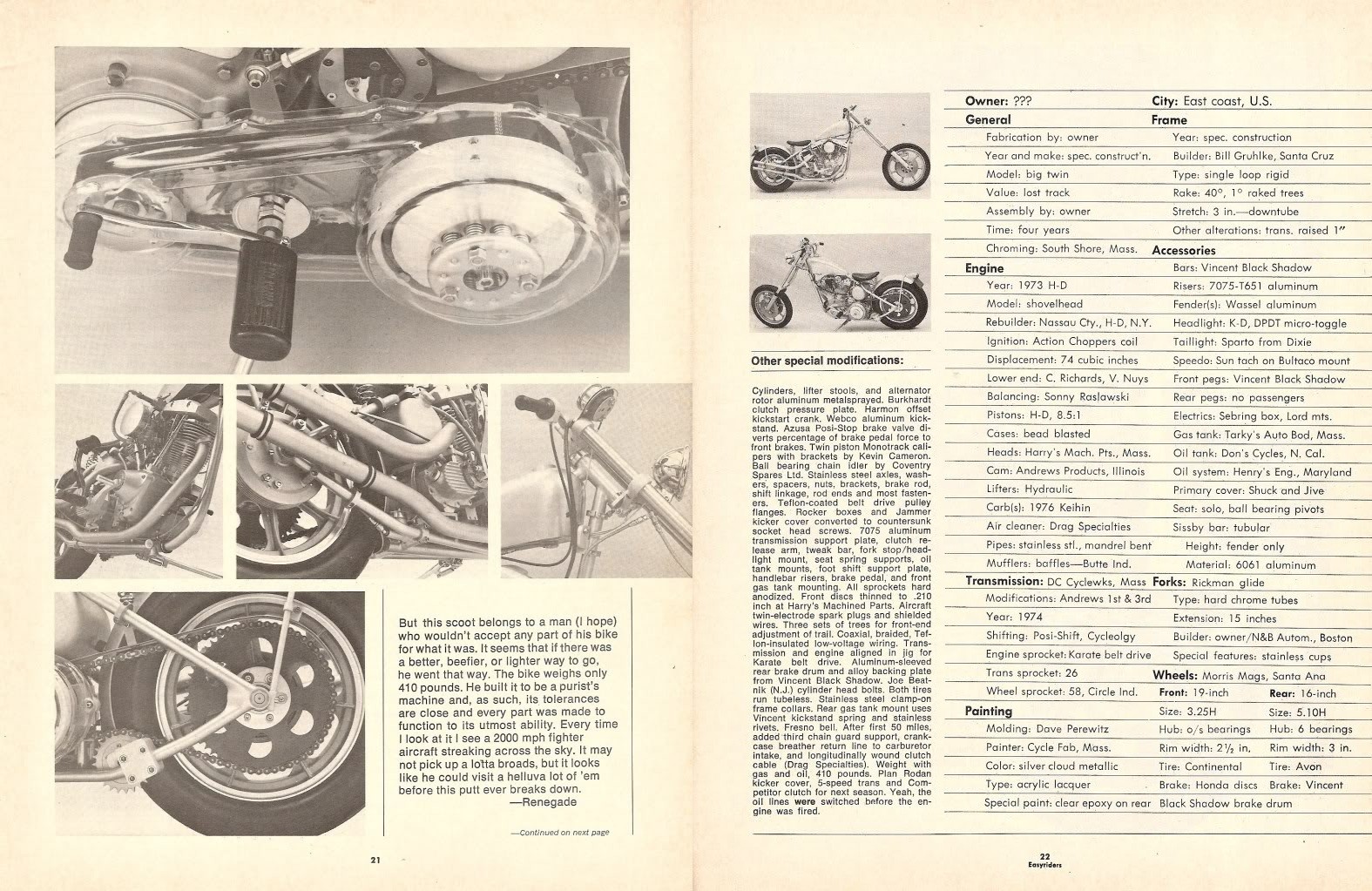
One of my favorite builds ever to appear in the magazine’s pages. The bike also appeared on an Easyriders calendar and in an anniversary issue. With its monochromatic color scheme and futuristic design, it stood out from the psychedelic dream machines most builders were crafting. So far as I know, the builder has never been identified.
The bike itself is far cleaner than anything I’d feel comfortable owning, but the detail is mind-boggling. This bike also gave me a low-level craving, as yet unfulfilled, to build a chopper on a single-loop frame.
The Mystery Sled also gave me a new appreciation for Morris Mags – beautiful wheels! – and the process of cleaning engine parts known as ‘bead blasting’. When I first went to work at Bud’s Motorcycle Shop in Austin, in 1979, I spent many an hour with my hands up to my shoulders in the glass-beading machine. I still love the soft grey finish the process leaves behind on aluminum and alloy parts.
 Mystery Sled images courtesy of the author.

Easyriders was the first biker lifestyle magazine to make it beyond a handful of issues, and reach a national (and later international) readership. Others, like Colors, produced by East Coast biker Phil Castle, and the California-based Choppers, created by signman-turned-customizer Ed ‘Big Daddy’ Roth, were short-lived and regional. You weren’t going to find issues of those magazines on the rack at your local 7-11 store, and by 1971 both had gone out of print.
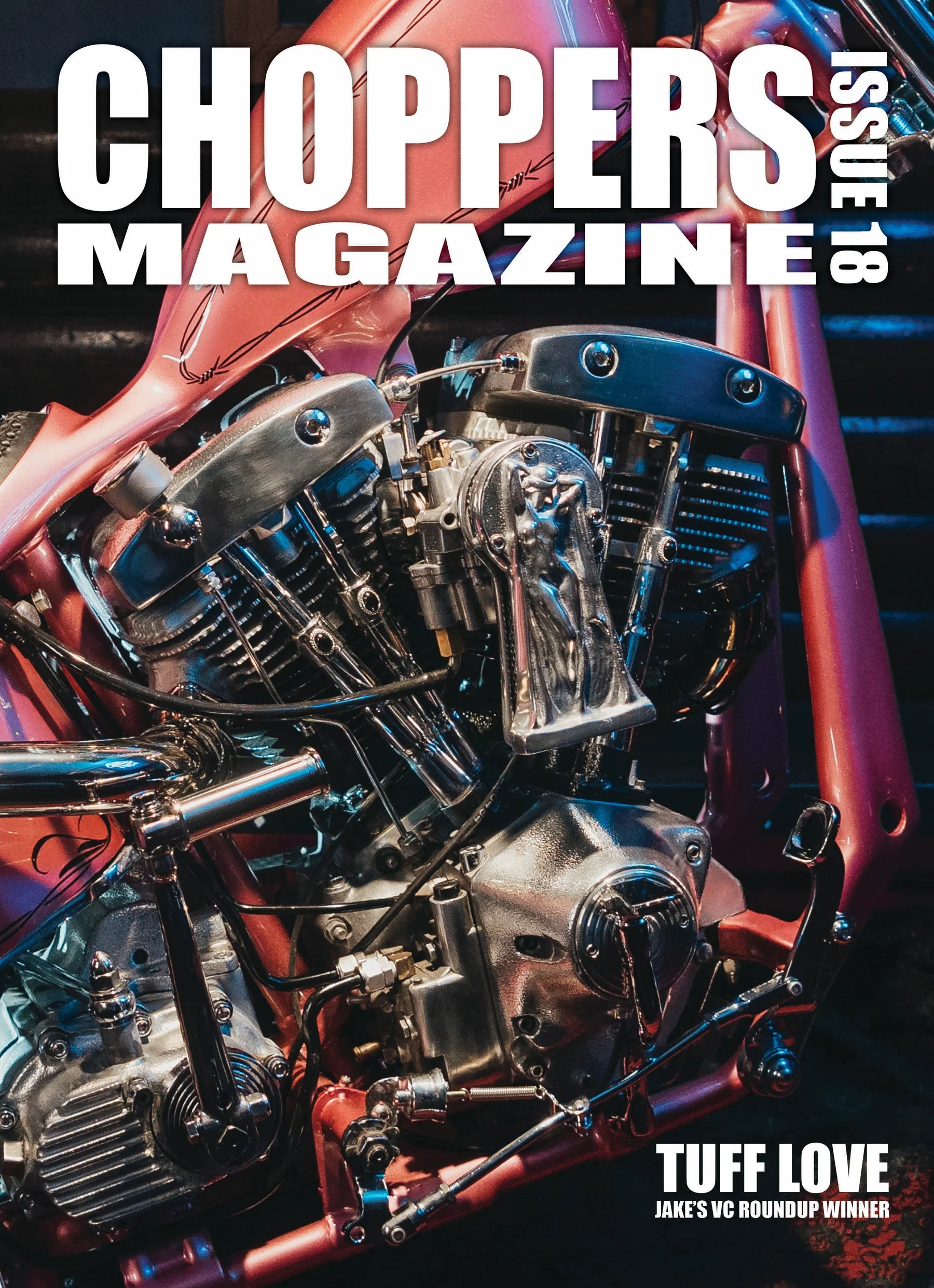
Choppers experienced a comeback of sorts in 2018, when fan Cary Brobeck secured rights to the title from Ed Roth’s heirs. The new Choppers hit newsstands in April of 2019, and is still in production as of this writing, January 2025.
 Image sourced from the internet.

Easyriders, on the other hand, endured, in part because it was so much more than just shiny paint and polished chrome plating. The magazine swiftly became the big dog on the block, its readership dwarfing titles like Big Bike, Custom Bike, Street Chopper and Supercycle, because Easyriders went farther than any of those titles dared. The rag truly wasentertainment for the adult biker’.

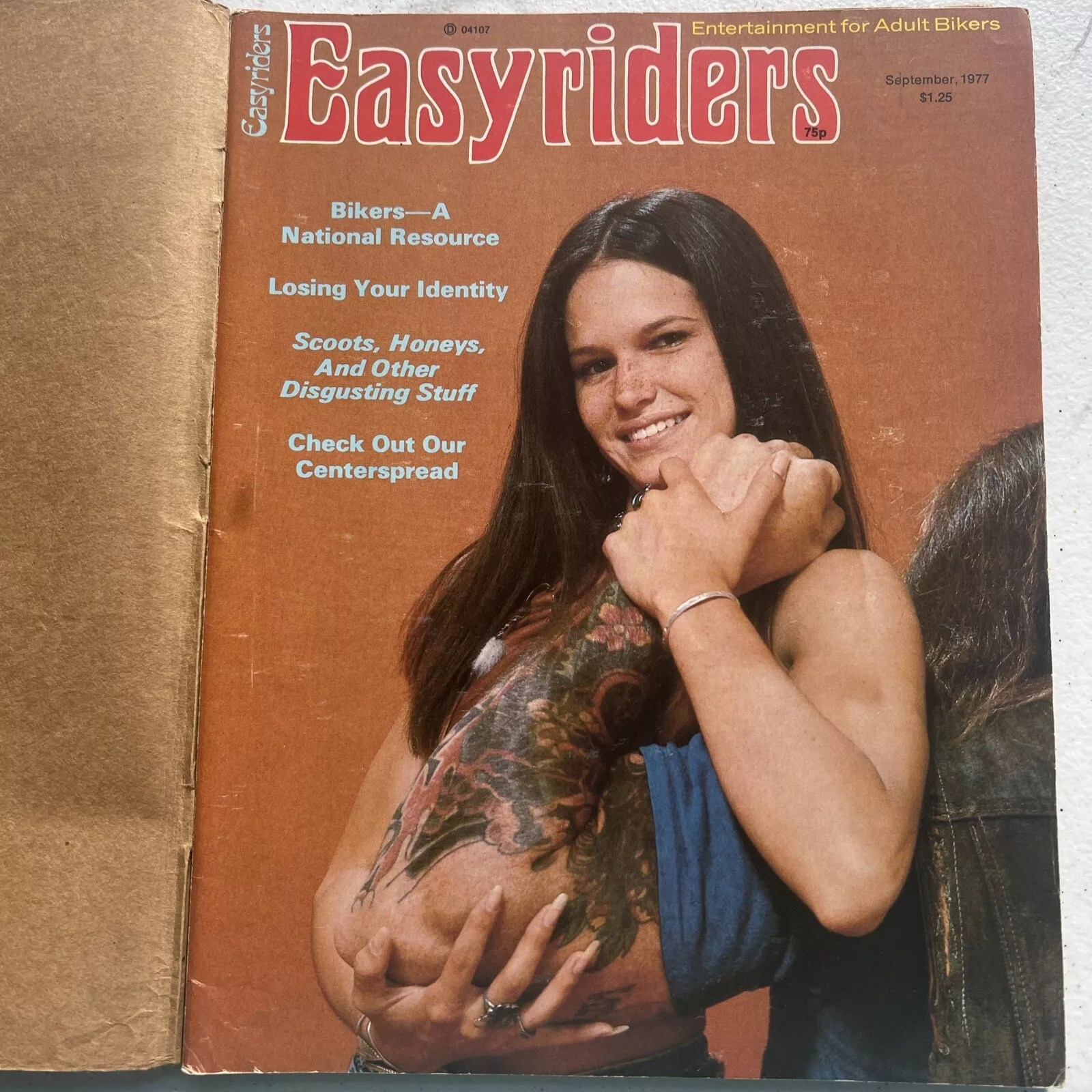
A typical Easyriders cover in the early days: a gal you could believe knew her way around a pillion pad, maybe a tattooed biker and his motorcycle, and a few tantalizing teasers for what’s inside.
 
Image courtesy of eBay seller pqu698.

For starters, Easyriders had bare-breasted models draped over choppers or curled up against the bikes’ owners: real biker women – often the bike owner’s ol’ lady – with tattoos, pimples and other ‘flaws’, showing more skin than other bike rags would dare.
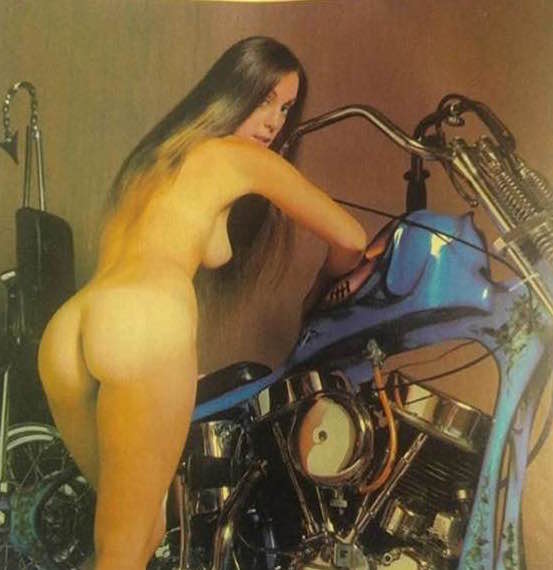
A typical photograph from the magazine’s early days.
 
Image sourced from internet.

They also began a feature (copied from Big Bike, a title editor Lou Kimzey created and edited prior to joining forces with Joe Teresi and Mil Blair) called the Ol’ Lady Contest, in which women (or their proud significant others) could submit photographs for the chance to win cash and prizes, and be named ‘Ol’ Lady of the Year’.

A ‘Ol’ Lady Contest’ in the magazine’s February 1983 issue.
 
Image courtesy of author.

Later, in a barely-perceptible nod to gender equity, they began including small (usually one- or two-page) spreads on bikes owned and built by women, titled Foxy Riders.
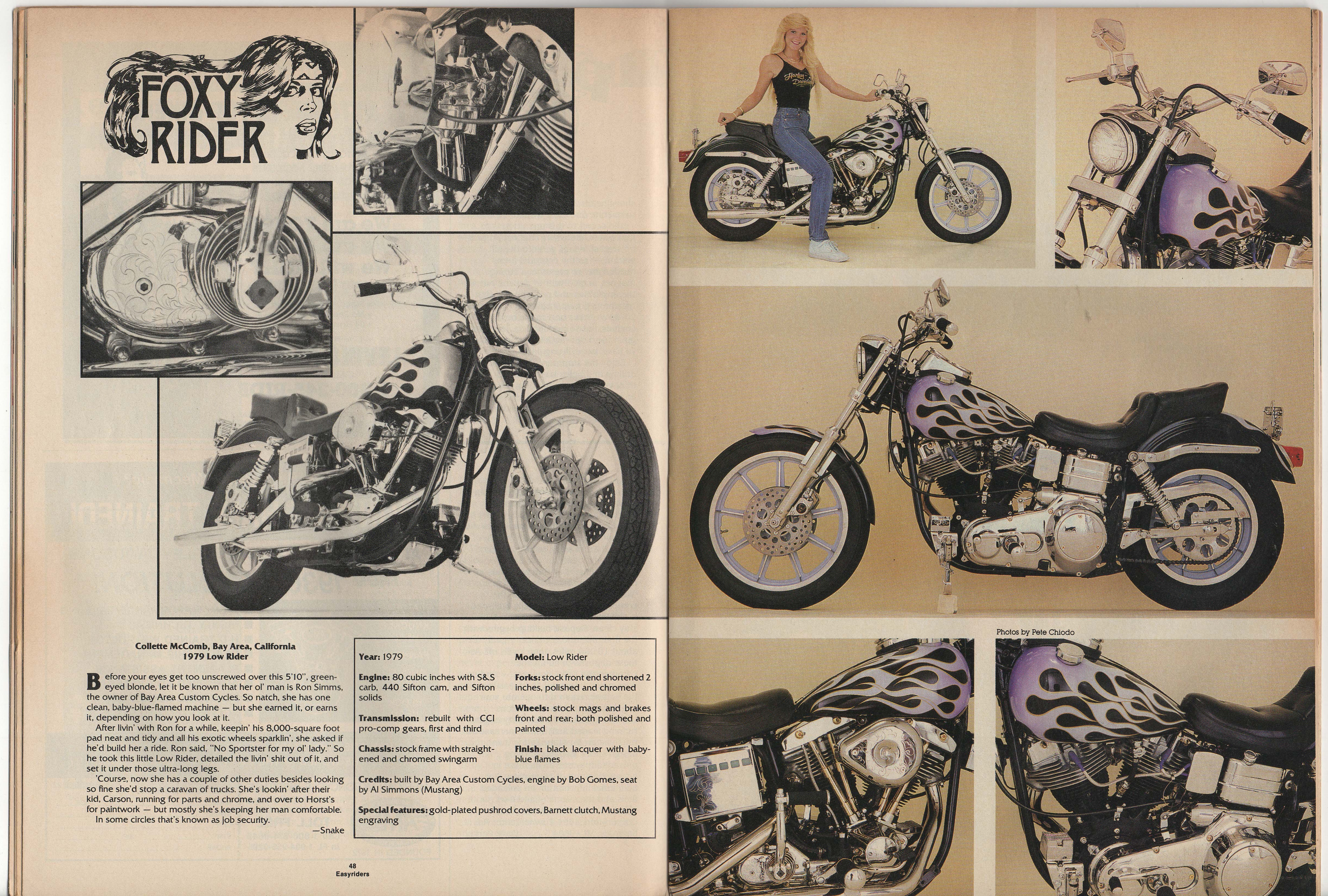
A ‘Foxy Rider’ gets her motorcycle featured in the magazine in June 1988.
 
Image courtesy of author.
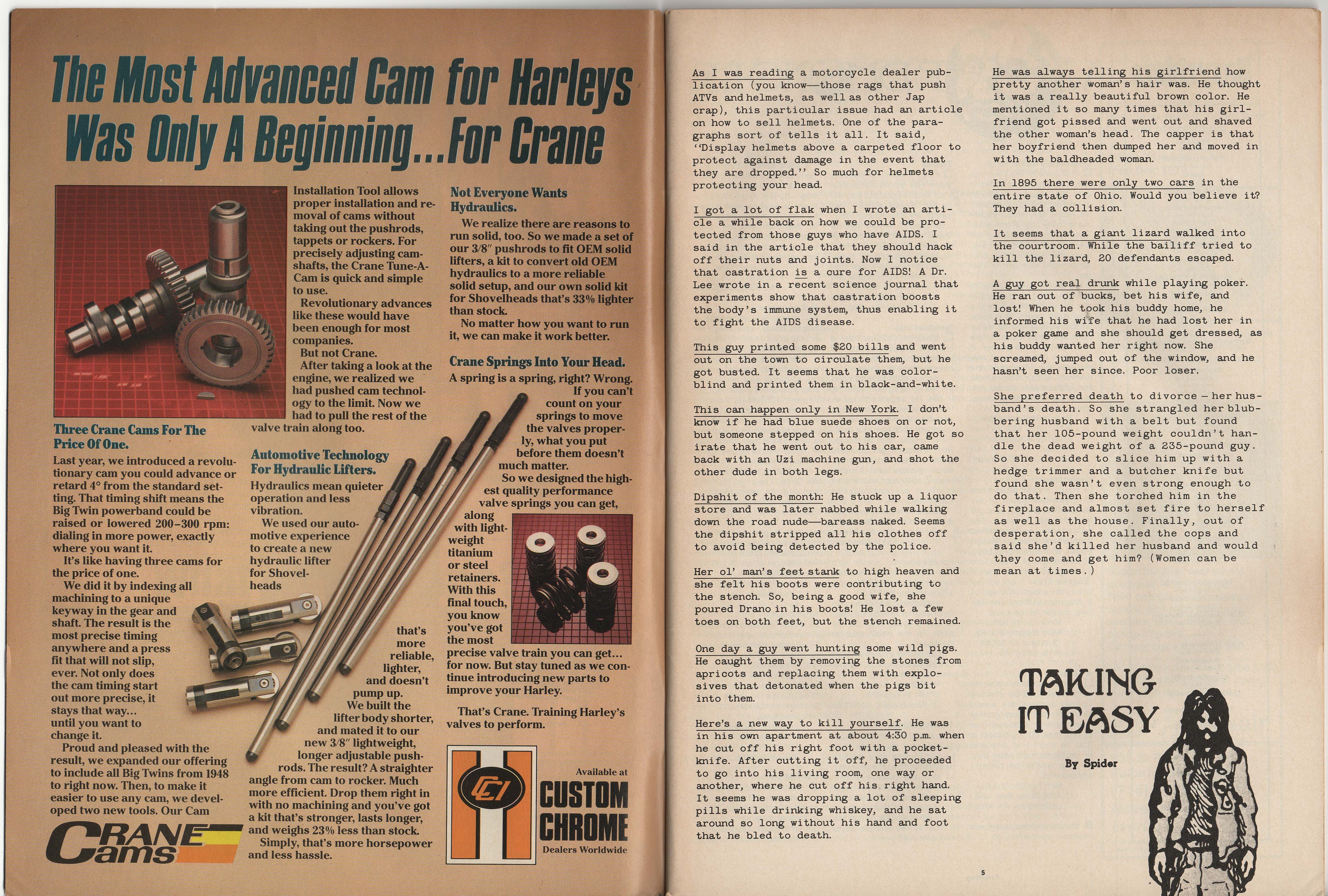
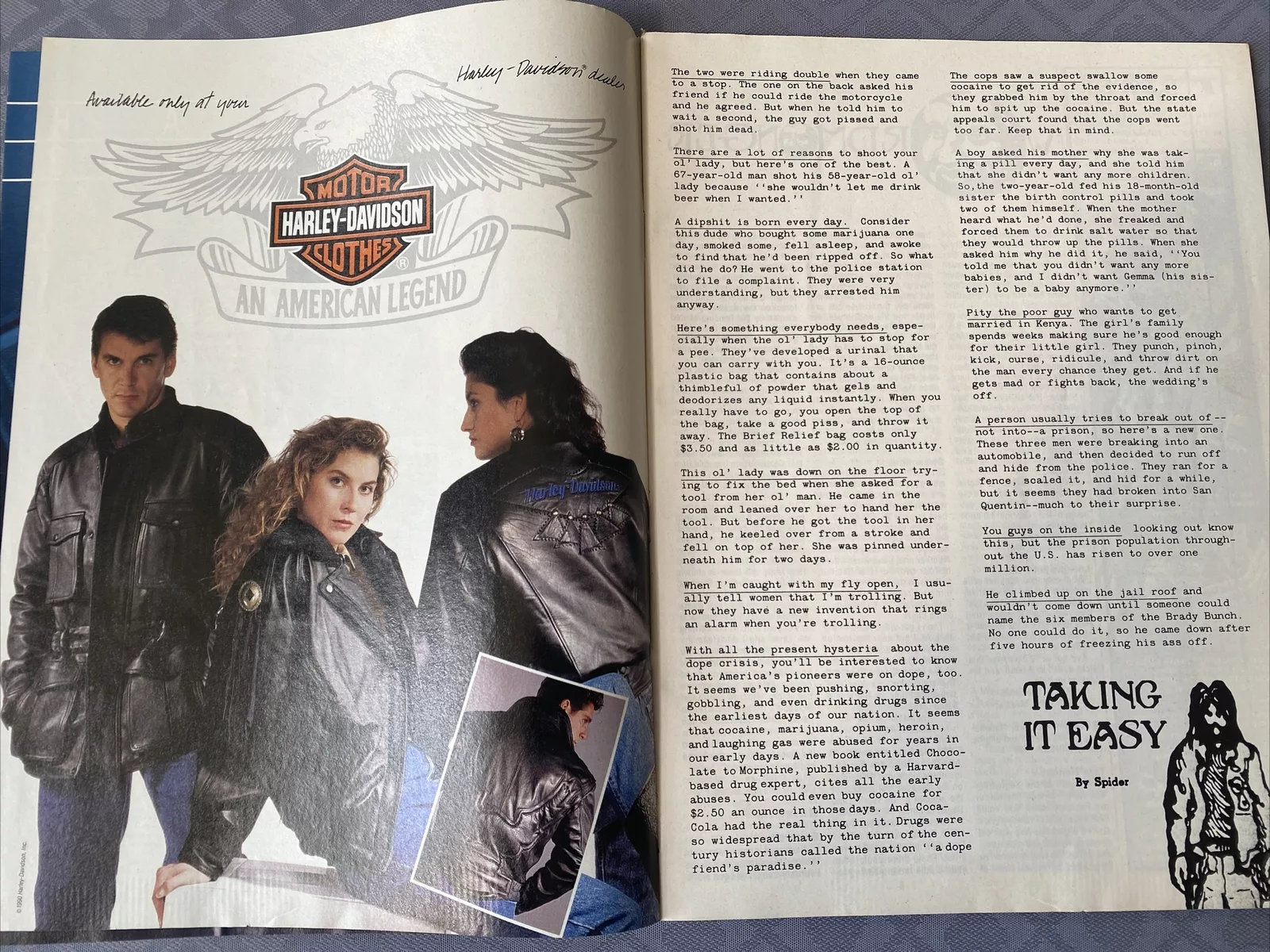
Spider’s column fronted the magazine for decades, sharing humorous stories and factoids like those shown above. Note that political correctness was not a concern. At times, misogyny and subtle racism permeated the magazine’s editorial content. Homophobia and transphobia were constants.
 Image courtesy of author.

There was also Spider’s Leg-Wetting Facts column (later renamed Taking It Easy, as shown above) that featured humorous factoids and anecdotes culled from the mainstream press and other bike rags. Farther back in the magazine were pages of jokes, too, usually submitted by readers.

Miraculous Mutha as envisioned by Easyriders cartoonist Hal Robinson, and identified on the magazine’s masthead as ‘Resident Nympho’. Some of the other job titles are just as outrageous!
 Images sourced from internet.

Miraculous Mutha, depicted above, purported to be an overweight, disease-riddled ‘mama’, doling out advice to the lovelorn and wayward in Miraculous Mutha Tells All, below. Her responses to readers’ letters were frequently lewd, lascivious, and more than a little perverse. Readers loved her!
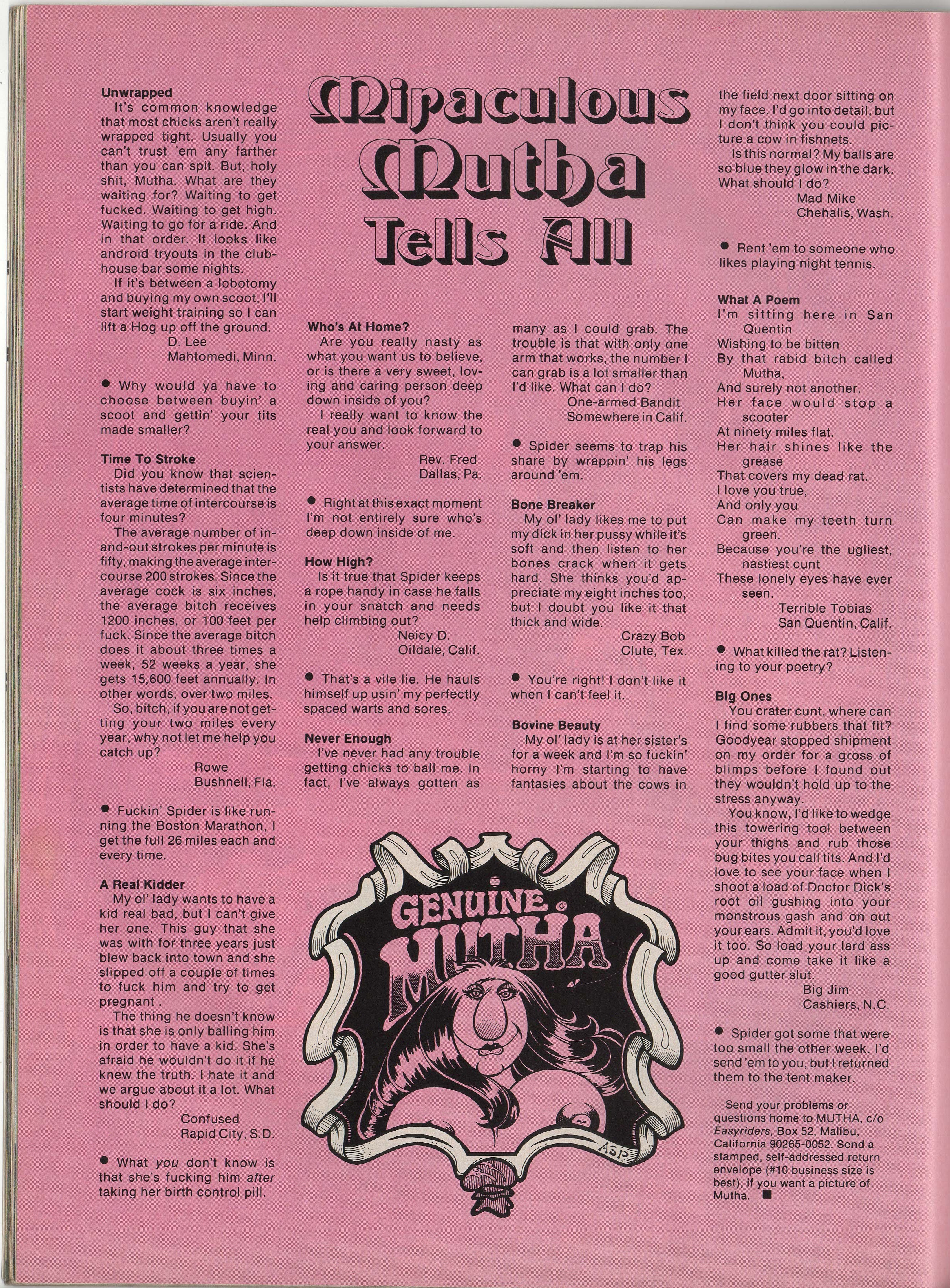
If you’re not offended or repelled, you’re not paying attention!
Image courtesy of author.

On a more serious note….
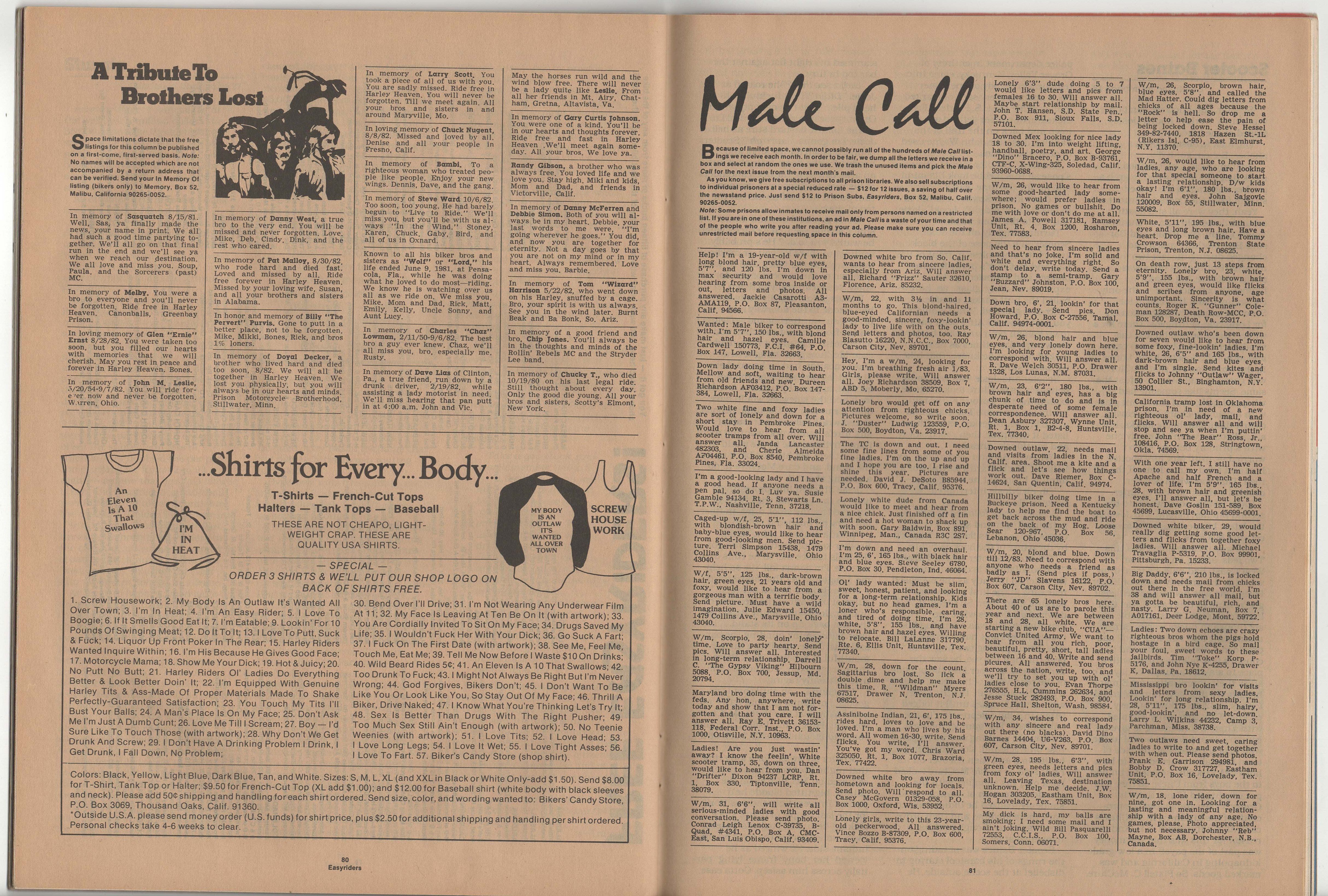
A Tribute to Brothers Lost and Male Call were just two of the ways the magazine attempted to foster community in the biker world.
Image courtesy of author.

In the magazine’s back pages, one feature allowed bikers to offer up A Tribute to Brothers Lost, while a separate feature titled Male Call helped incarcerated bikers hook up with pen-pals and potential post-release lovers. Another page of classifieds called Choppershopper let bikers reconnect with brothers, announce events, clear potential club names for conflicts, and trade and sell motorcycle parts.
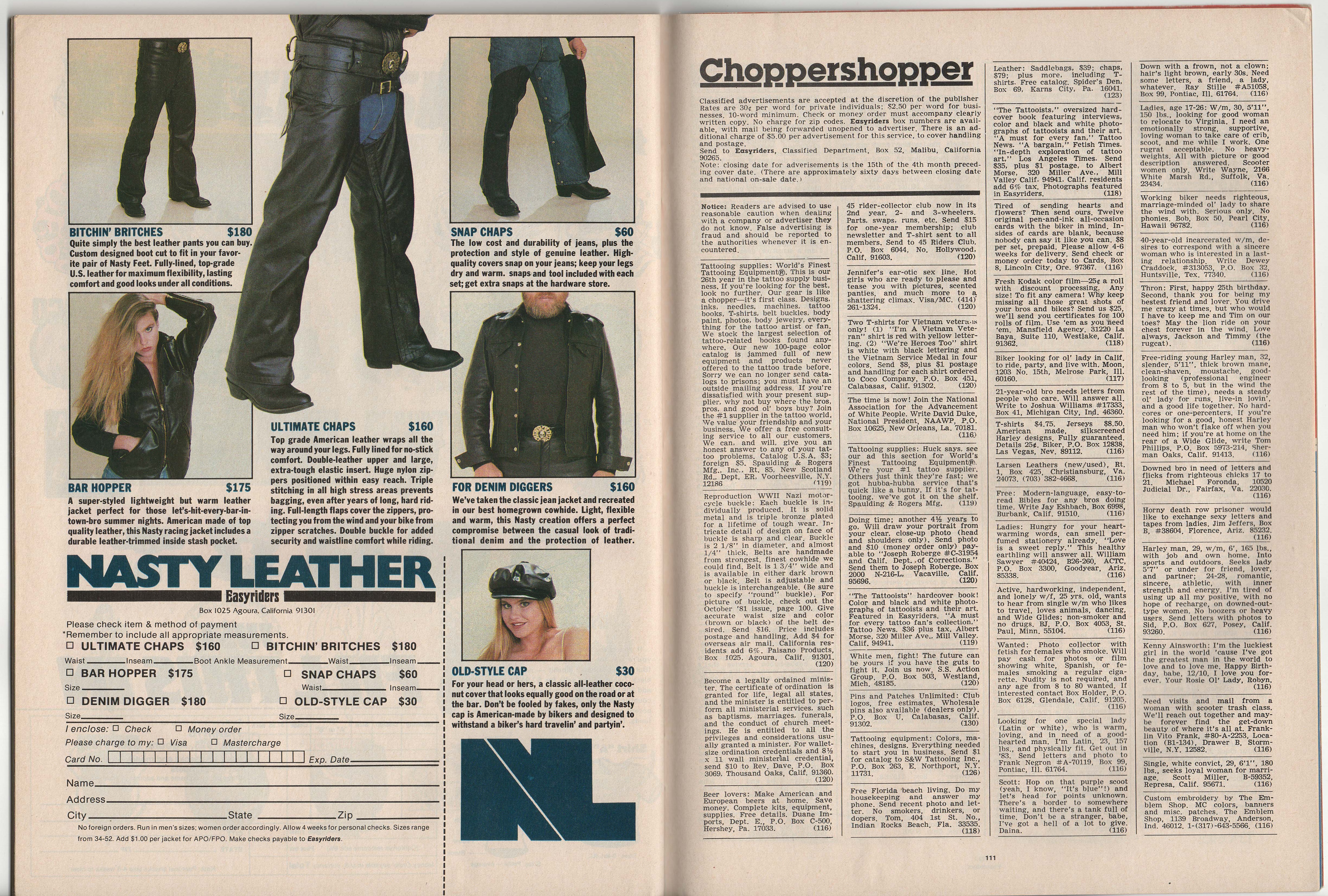
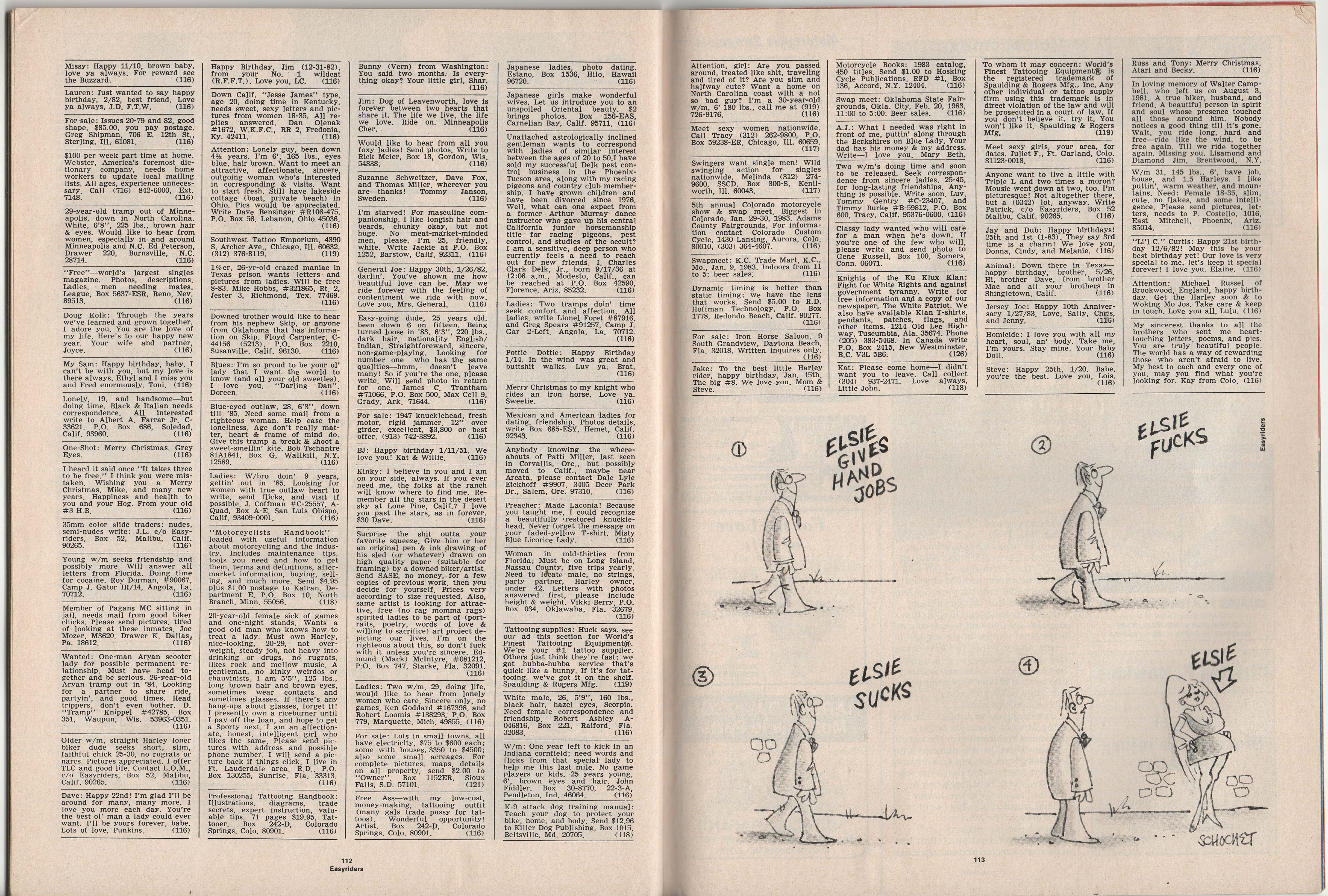
Choppershopper from Easyriders # 118, February 1983.
Image courtesy of author.
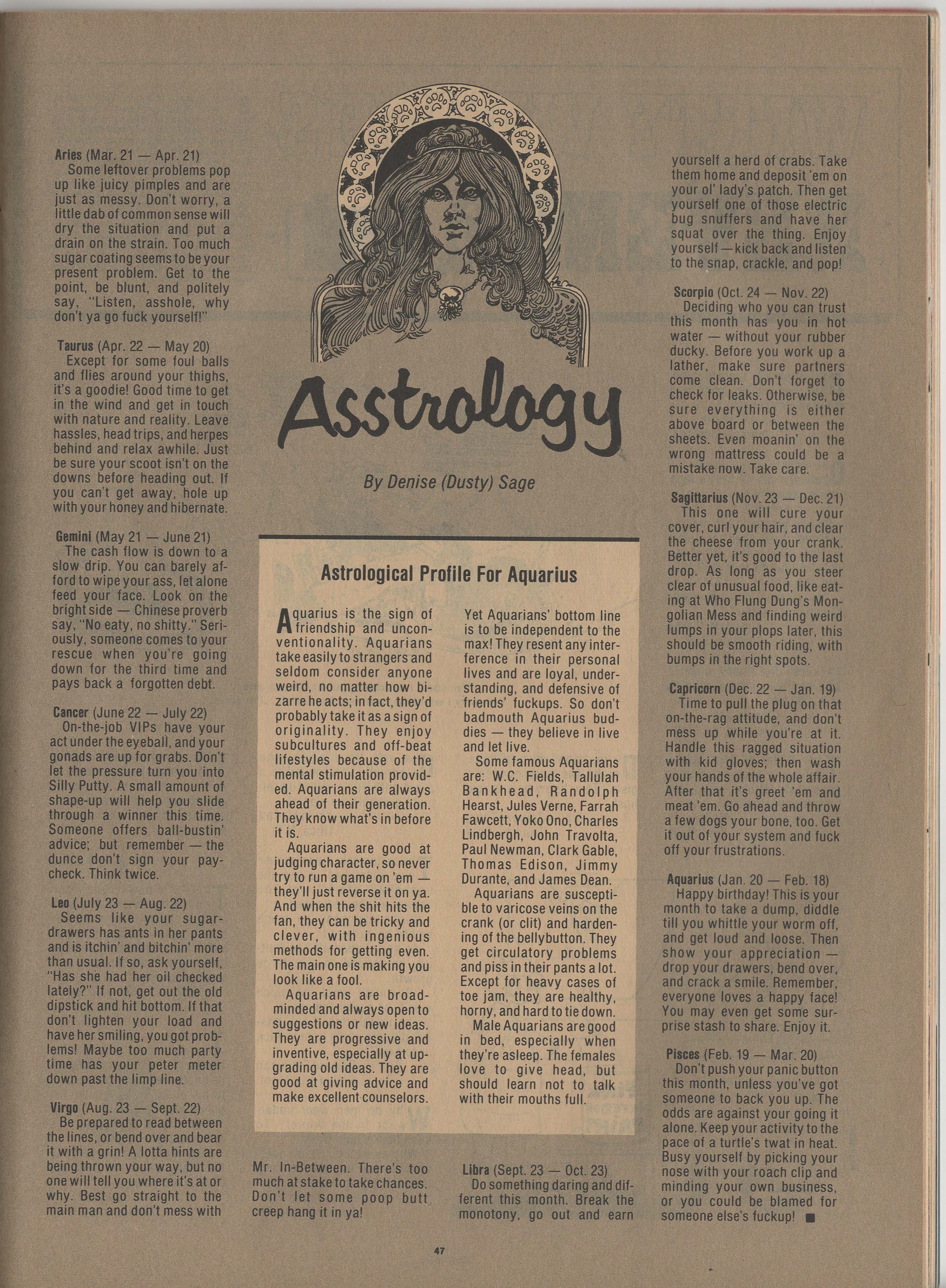
Asstrology, word games and other amusements made random appearances.
 
Image courtesy of author.

An Asstrology column made random appearances, along with word games, crossword puzzles and the like. Easyriders also ran an occasional Downtime column with reviews of new music, books and movies of interest to bikers. Finally, there were letters to the editors: some poignant, some profane, some laugh-out-loud funny. The editors’ often-acerbic replies were often even funnier.
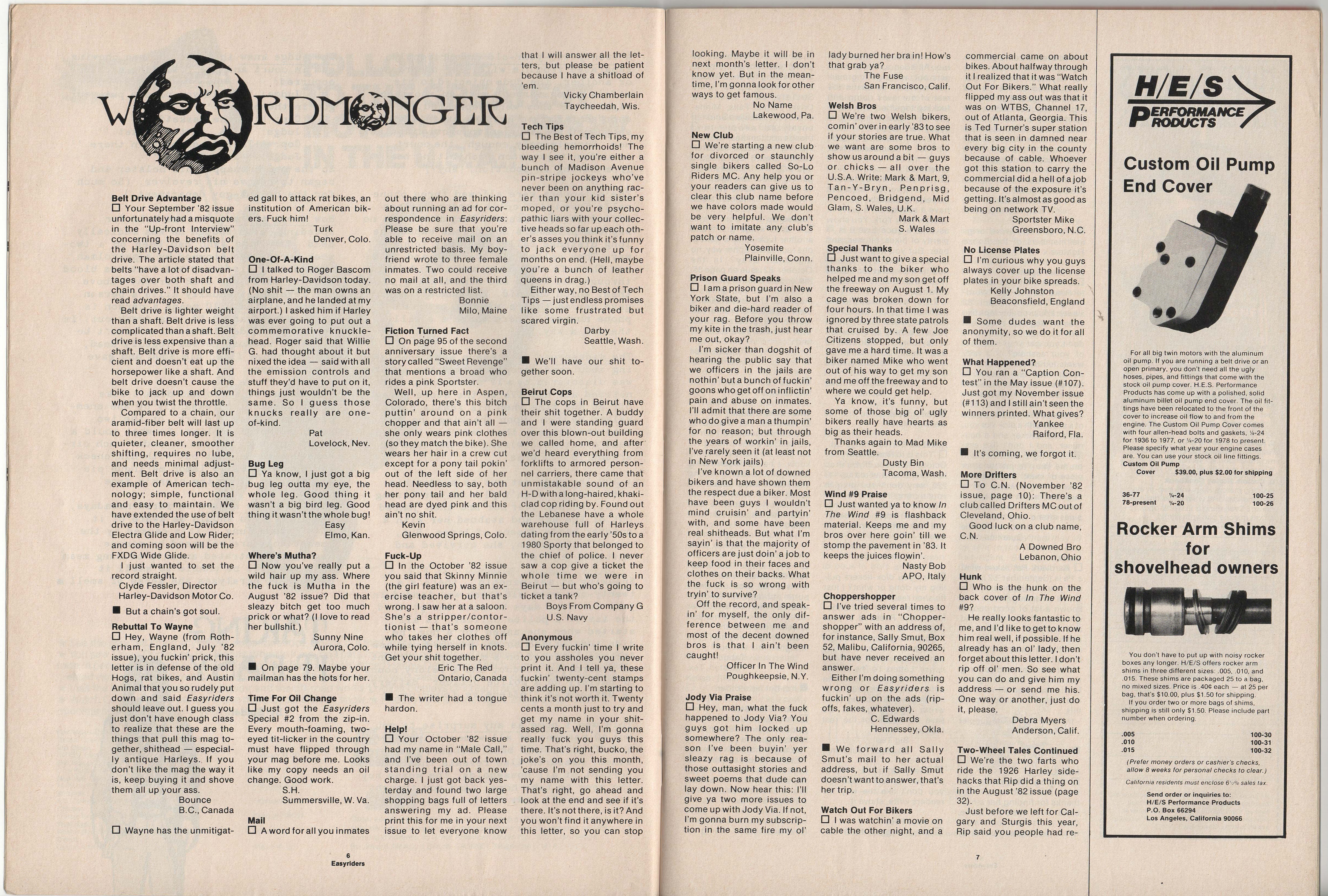
Letters to the editors were handled by Wordmonger, who must have had some fun sorting through the piles of mail the magazine received.
Image courtesy of the author.
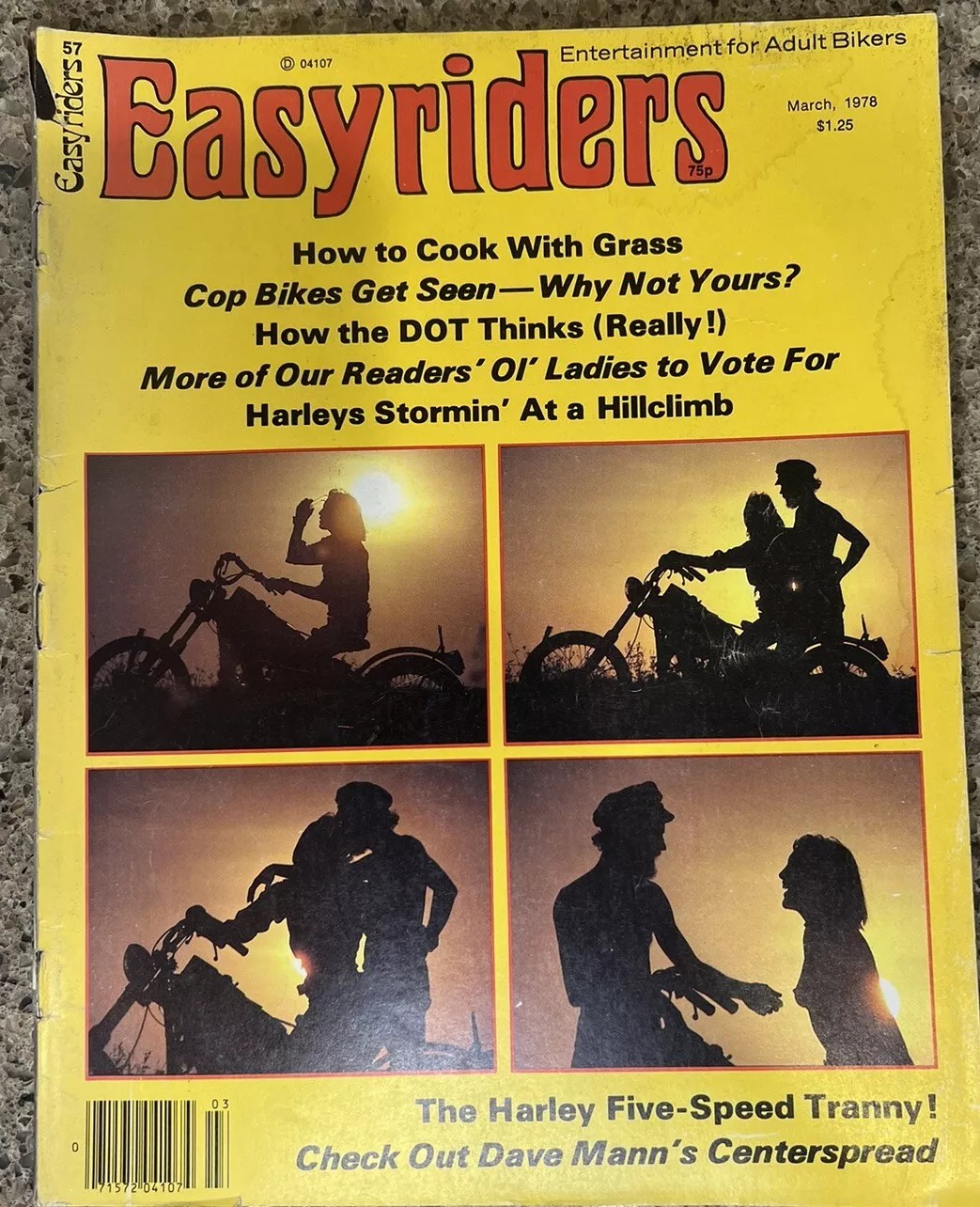
Tech tips might include a write-up on Harley-Davidson’s recently released five-speed transmission, and increased visibility for traffic safety. Others might include recipes for marijuana meals. Easyriders also featured updates on political issues of interest to bikers, like what the eggheads at the U.S. Department of Transportation might be up to.
 Image courtesy of eBay seller pqu698.

Easyriders also featured tech tips. Some were useful articles about motorcycles: how to decide what rake you needed for your chopper, or tune a Mikuni carburetor, or how to decipher Harley-Davidson’s Byzantine numbering system, so aspirant chopper builders could determine what year and model engine they were looking at when shopping for the Big Twin or Sportster engine of their dreams. Experienced bikers knew that a dodgy set of numbers could result in confiscation of the rider’s motorcycle by police. Rest assured, if the cops took your bike, you lost everything connected to it, even if you had receipts for every nut and bolt!

David Duke, the man who was going to mainstream racism with his ‘new and improved’ KKK, went on to win a seat in the Louisiana House of Representatives and make several runs for higher office, including Governor of Louisiana and President of the United States. After several unsuccessful campaigns, he dropped all pretense of civility and came out as a neo-Nazi. He also pleaded guilty to fraud charges in 2002, which netted him a fifteen-month sentence in a federal prison. He is reportedly still spewing his bile. Unfortunately, Easyriders recognized and exploited the fact that a large percentage of hardcore bikers adhere to racist and fascist ideologies.  
 
Image courtesy of eBay seller pqu698.

There were also handy ‘tech tips’ on how to conceal weapons, drugs and other contraband, grow marijuana and make prison tattoo machines, alongside interviews with controversial characters like Ku Klux Klan leader David Duke. These articles – and adverts for White Power t-shirts, swastika belt buckles and devices for smoking leafy products 😏 whilst riding your machine – were gradually phased out when prison and military censors began banning the magazine. Because so many bikers were in prison or serving in the military, the publishers of Easyriders went to great lengths to be sure the magazine was available to all, even offering free subscriptions to prison libraries.
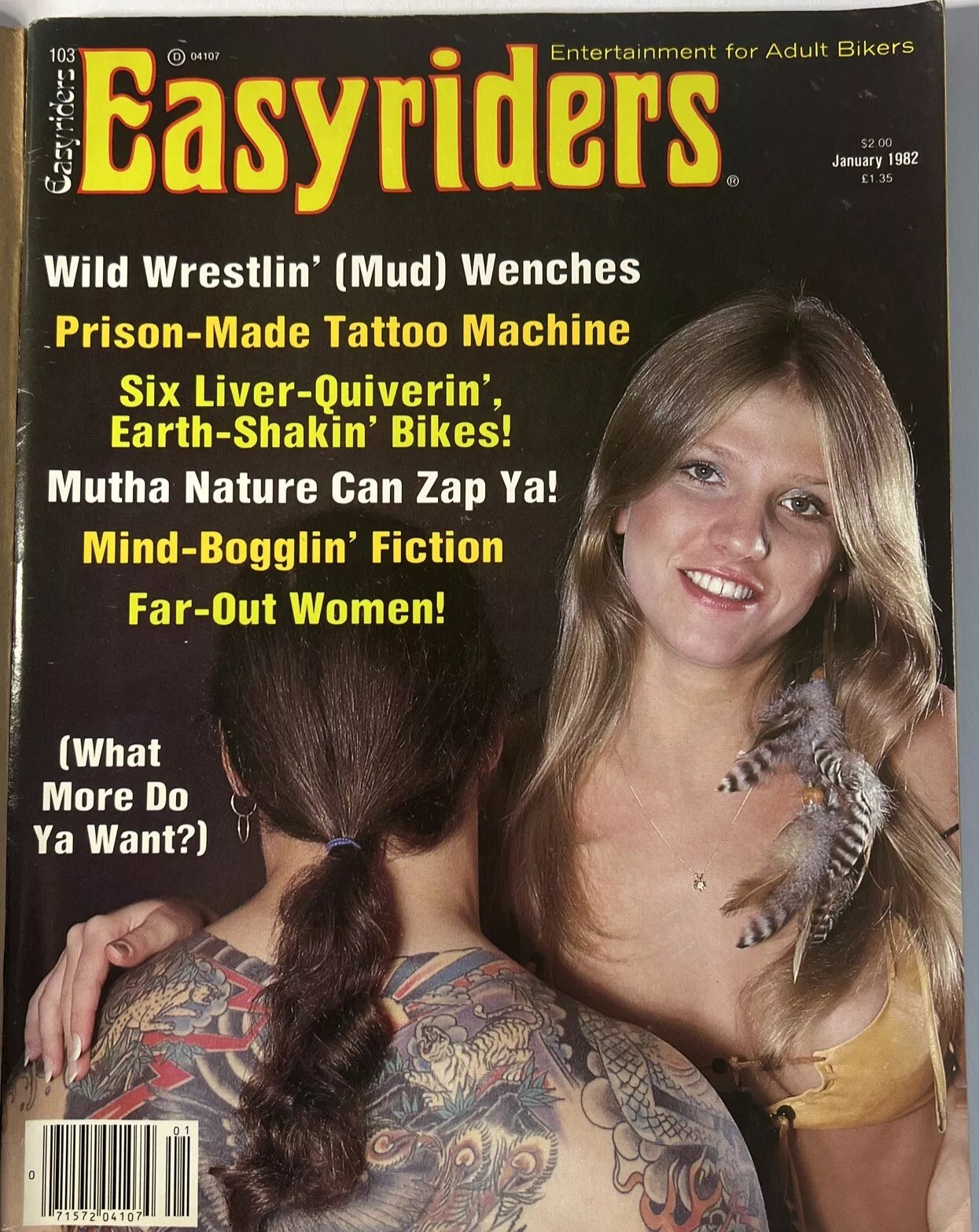
A typical cover from January, 1982. Note the featured articles include a ‘how to’ on making contraband prison tattoo machines.
 Image courtesy of eBay seller pqu698.

In a regular feature titled Easynews, the magazine also included political news relevant to bikers: the progress of helmet laws and other anti-biker legislation, R.I.C.O. 1 prosecutions of Hells Angels members and other outrages. When ‘safetycrats’ in Washington used federal highway funds to blackmail states into enacting mandatory helmet laws, Easyriders and A.B.A.T.E. 2, the homegrown Motorcycle Rights Organization (MRO) the editors created, led the fight against the mandates.

Easynews was a regular feature.
Image courtesy of author.

Through the 1970s, ’80s and ’90s there was a push-and-pull contest between pro- and anti-helmet law factions, which resulted in a patchwork quilt of requirements across the nation. One state might mandate helmets for all riders, while another only required them for riders under the age of twenty-one, or eighteen, or on machines over a certain engine size. To obfuscate the issue even more, in later years a wave of bills across the nation permitted riders to doff their helmets if they carried a certain amount of health insurance, which would cover them in the event of a motorcycle crash. Enforcement was unsustainable, and those states effectively became free choice states again.
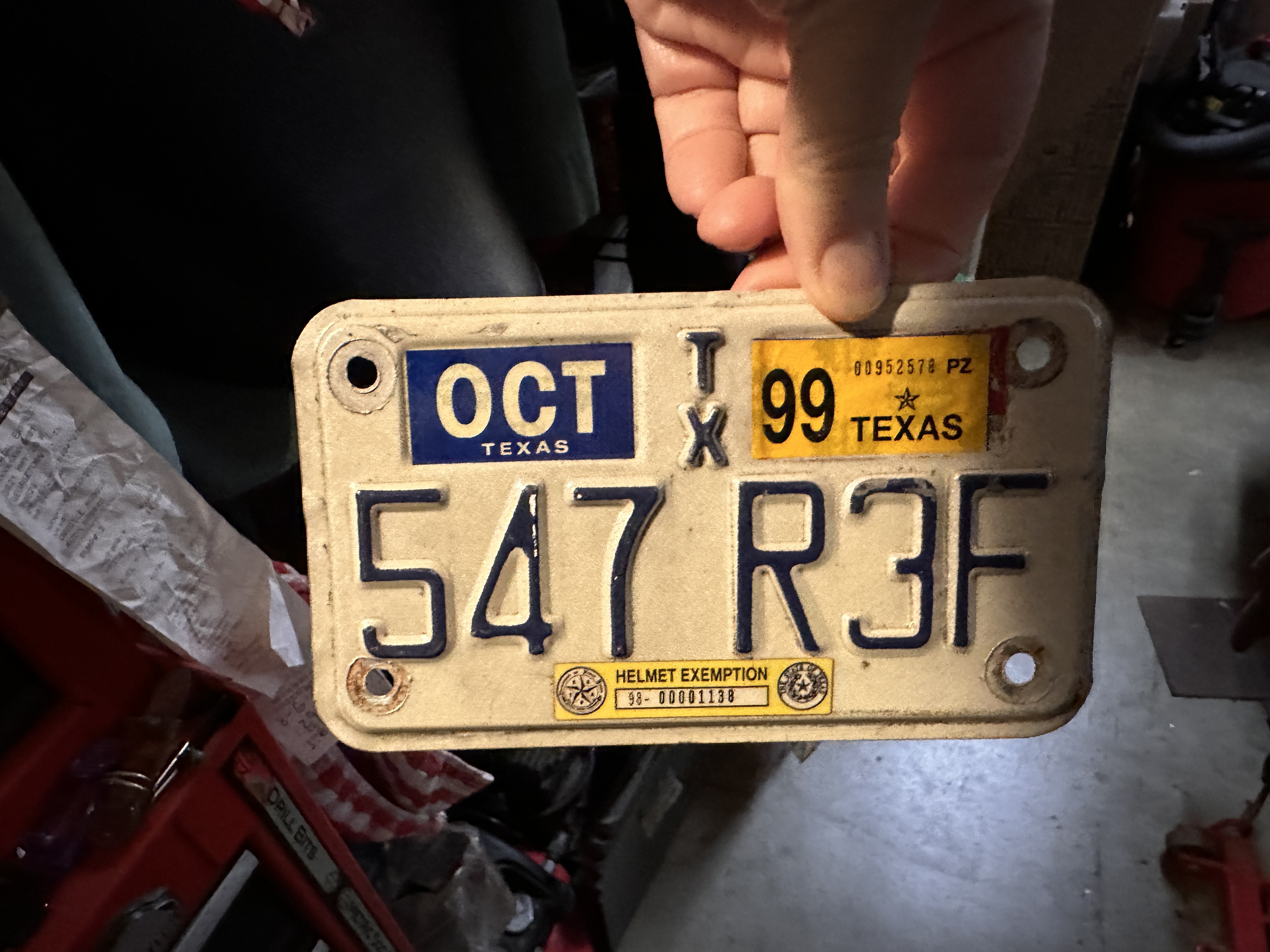
In the late ’90s, with passage of an insurance exemption bill as described above, Texas offered a Helmet Exemption sticker for those riders who carried proof of the requisite health insurance. It was optional, cost about $5 if I recall, and did not guarantee LEOs wouldn’t stop you for riding sans helmet anyway. The sticker program was eliminated in 2009.

But helmet laws weren’t the only issues facing riders. Some states attacked the ‘chopper lifestyle’ by mandating seat and handlebar heights, chain guards and front fenders, full-length rear fenders, turn signals, restrictive mufflers and more.

A motorcycle like my shovelhead could earn me a ‘seat too low’ ticket in certain jurisdictions, because I ran a frame-mounted butt bucket saddle on that low-slung OEM rigid wishbone frame. I never ran the sky-high apehangers some riders opted for, but my ‘baby apes’ were probably tall enough to get me ticketed in some states, and I have twice been ticketed for ‘exhaust too loud’. On both occasions I had brand new mufflers recently installed on my bike.
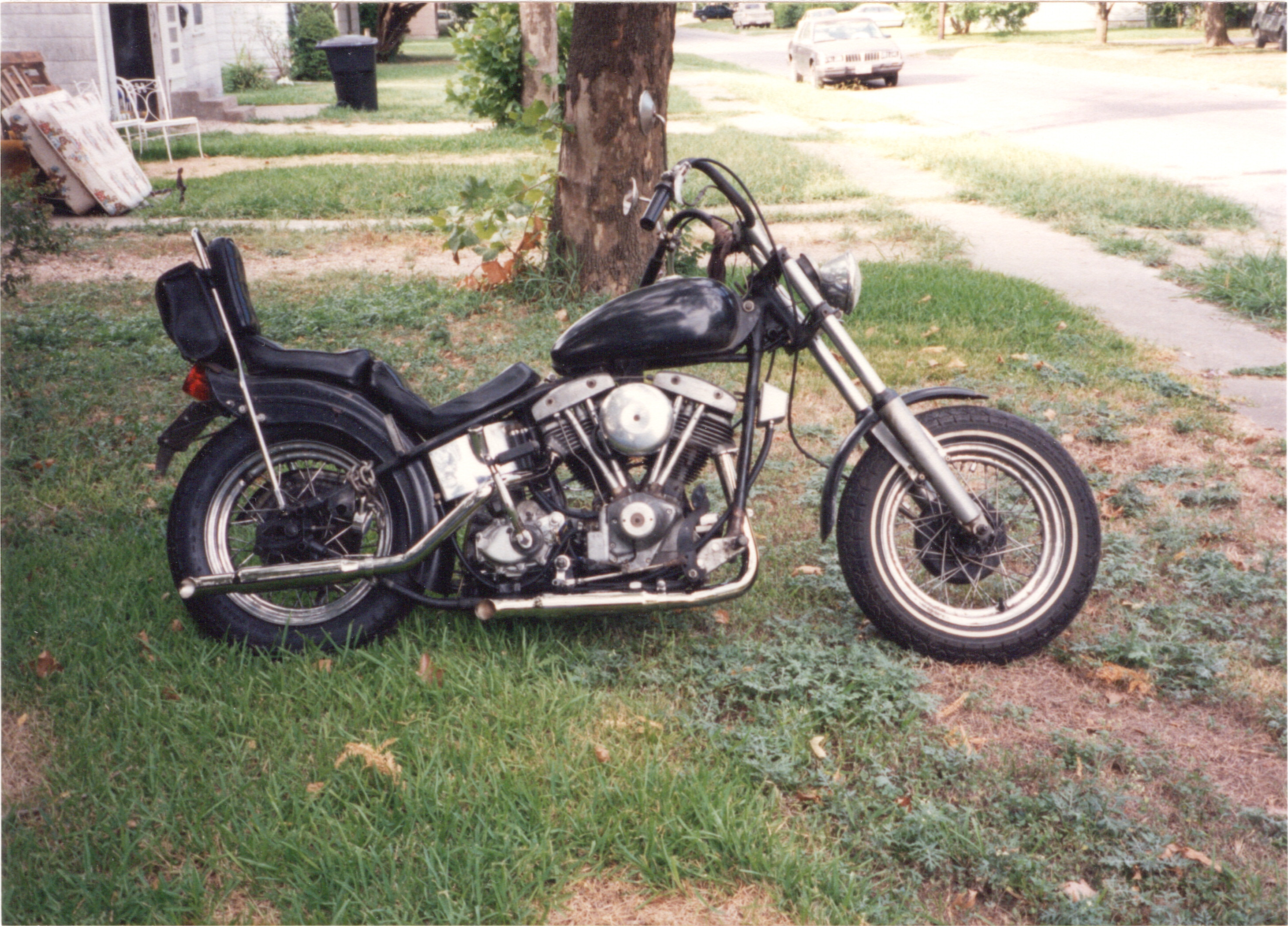
The low-slung frame-mounted butt-bucket saddle that would have earned me a ticket in places like Florida, and the brand-new exhaust system that garnered me an ‘exhaust too loud’ ticket in Bell County, Texas. The state trooper who wrote me up (after slowing down and forcing me to pass him) rubbed salt in the wound by claiming his dirt bike was quieter than my muffled Harley. I’d bet dollars to donuts that was a bald-faced lie!
 Photograph courtesy of the author.

Elsewhere, motorcyclists were being profiled by law enforcement officers – stopped and treated like armed-and-dangerous felons solely for being bikers – and businesses were discriminating against riders, with ‘no motorcycle attire’, ‘no club colors’ and ‘no motorcycle parking in lot’ signs popping up at bars, restaurants and other premises.

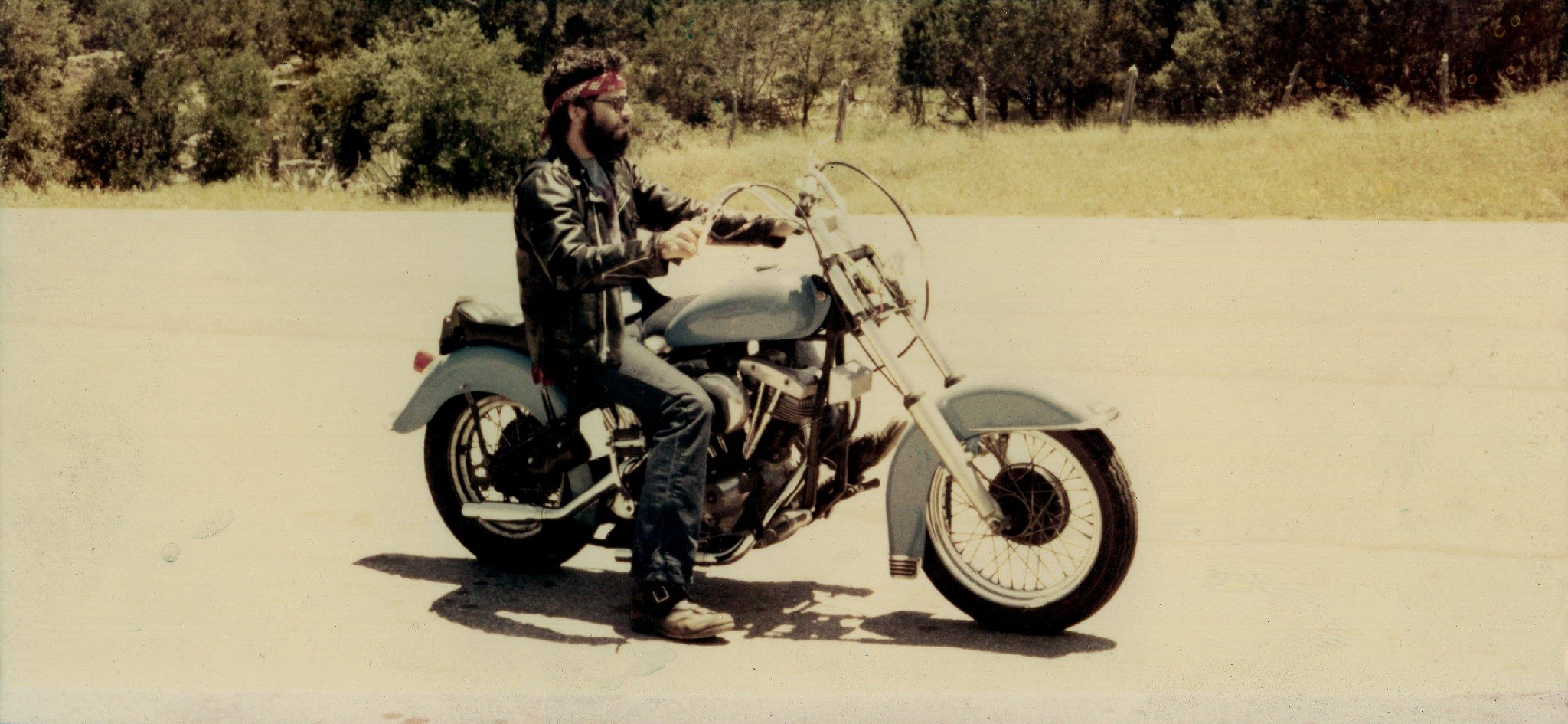
I recall a run from Austin to Lake Buchanan, in a pack of thirty or so bikes. We stopped at a roadhouse in rural Burnet County for lunch. As we were leaving, we found ourselves surrounded by law enforcement of all stripes – local police, county sheriff’s deputies and state troopers – with weapons drawn as they confronted us. We were put through the mill. License, registration and vehicle identification numbers were slowly and laboriously checked via radio, one at a time, to drag the process out. Bikes were searched and riders questioned as we sweltered in the blistering sun for over an hour – and the sum total of their efforts was one (1) arrest for an outstanding traffic warrant!
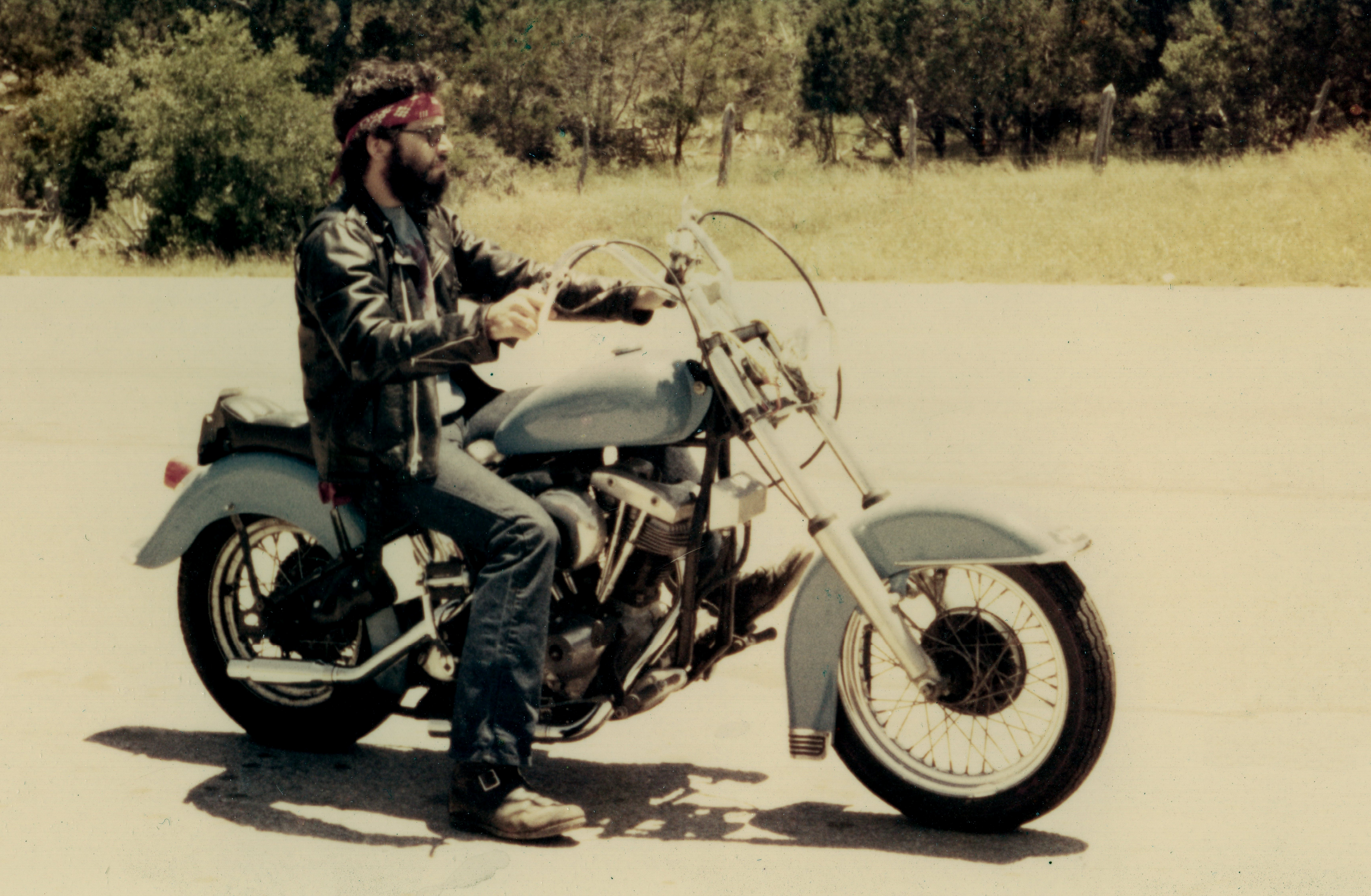
My shovel and I outside the Burnet County roadhouse where we were held at gunpoint by LEOs from every available agency. There were local yokels, county mounties, smokies… all armed with shotguns, hunting rifles and AR-15s. I wouldn’t have been at all surprised to learn the local dog catcher and building inspector were out there, getting in on the action!
 Photograph courtesy of the author.
NO COLORS ALLOWED…. but those young men seem to disagree with the sentiment. Hmm…. 😏 This photo appeared in Easyriders # 79, January 1980. Note the poem by Jody Via at right, and then see my footnote on him at the end of this post.
Image courtesy of eBay seller Vintage Variety 60.

In another instance, I was attending a bachelor’s party for a friend. Despite the fact that we were all sober riders, he wanted his party to include a tour of the topless bars around Waco, Texas.

The evening began with an excursion to a dive outside the city limits, with fully nude dancers. The first thing I saw, as we entered the bar, was a drunk crashing to the floor after leaning his chair back too far, and the naked teenager on stage raising her hands in fright, screaming ‘I never touched him!’

Later in the evening, we arrived at a ‘swanky gentlemen’s club’ in the city proper, and sure as hell, there was a sign saying ‘No Motorcycles in Parking Lot.’ The groom-to-be and most of our party were content to park in the lot next door, go in and carry on the festivities. Me, I do my best to avoid spending my money or time in places where I’m not wanted, so I stayed outside and rapped with the bouncers, most of whom were riders themselves!

And, for the record, there are damned few ‘gentlemen’ in those so-called ‘gentlemen’s clubs.’
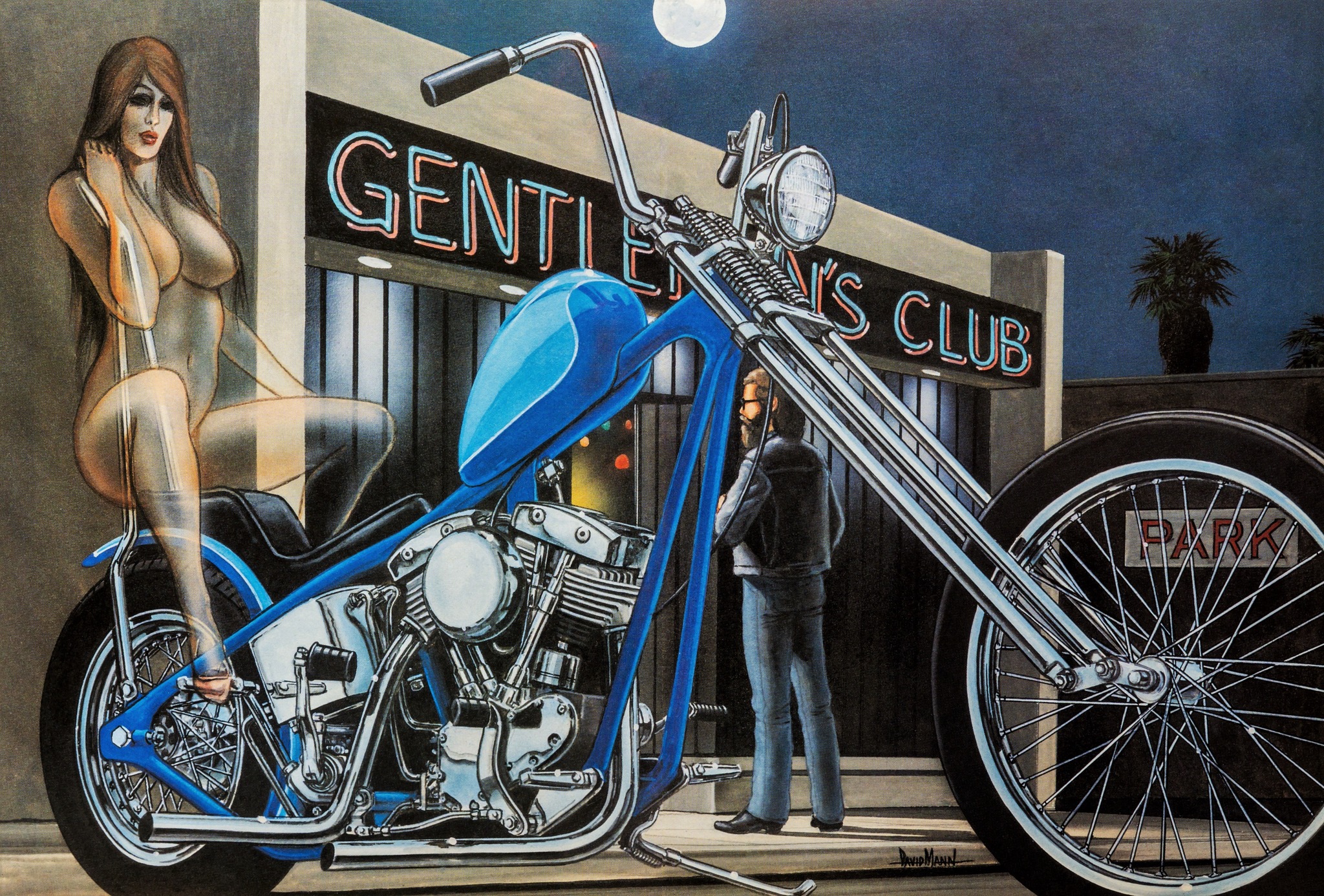
David Mann’s painting titled ‘Gentlemen’s Club’ appeared in the magazine’s June 1995 issue.
Image courtesy of the author.
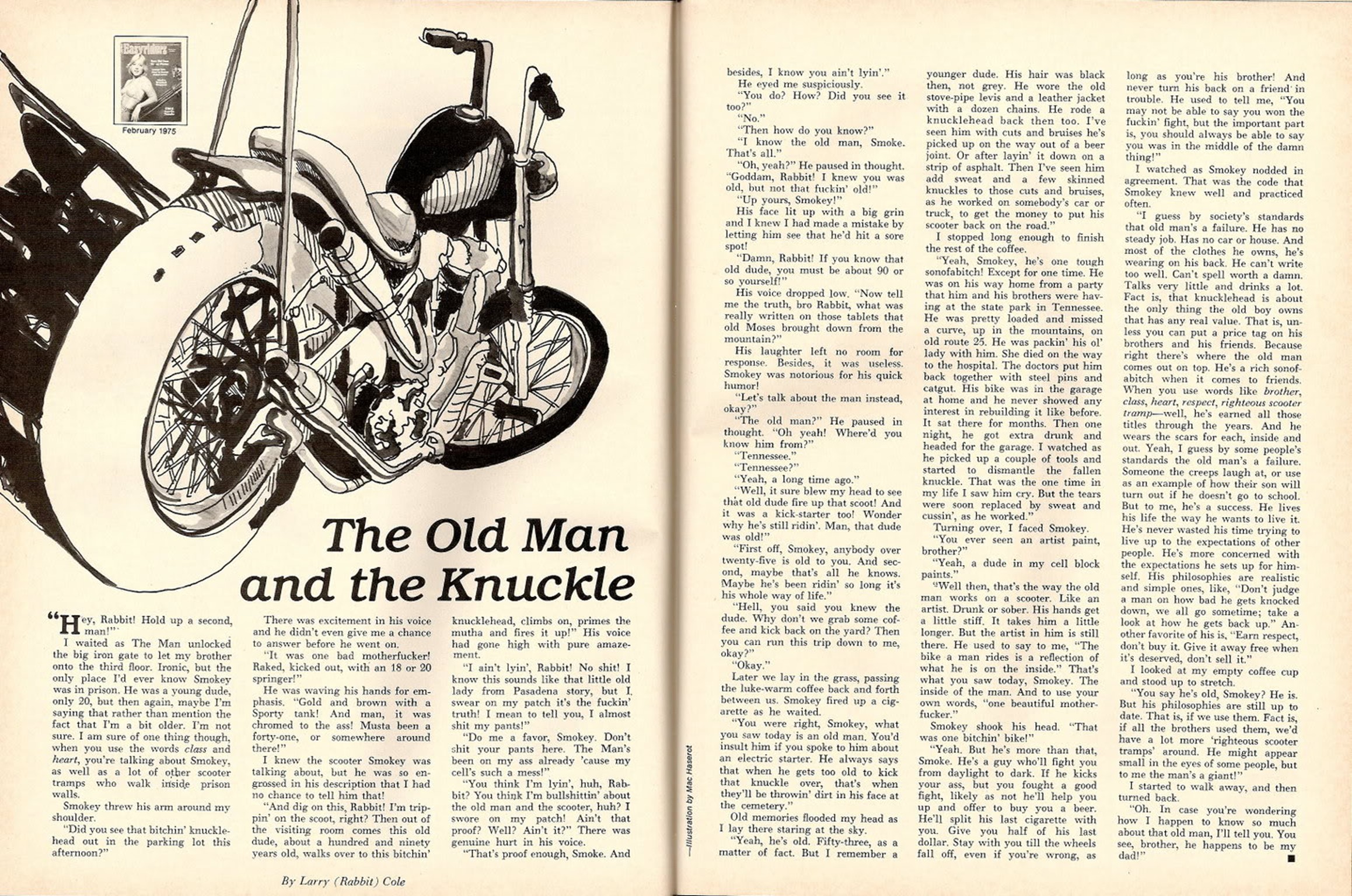
Larry (Rabbit) Cole was one of my favorite writers in the magazine’s best years. I have no idea what his personal history may have been, or what became of him once he stopped writing for Easyriders.

For me, one of the biggest differences between Easyriders and other magazines was that ER published short fiction about the biker lifestyle, by writers like Larry ‘Rabbit’ Cole (above) and Jody Via 3, and humor by psychotics like former Mouseketeer J.J. Solari.
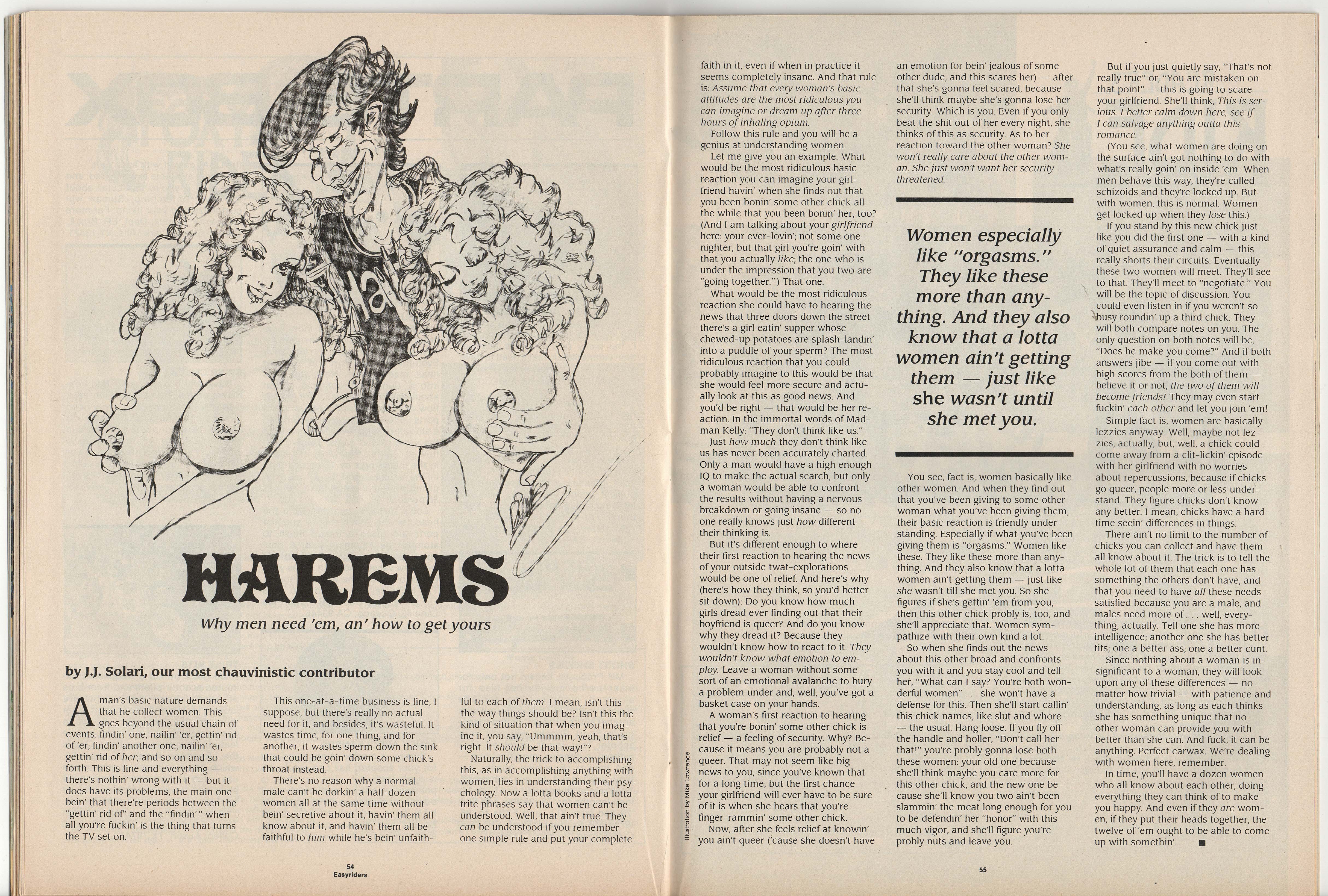
One of the erstwhile Mouseketeer’s twisted ‘masterpieces’. I will post one of his longer pieces in a separate post.
Image courtesy of the author.

Some of the writing was mediocre, but most was outstanding. There was real talent on display in those pages: well-crafted stories with vivid characters and dramatic arcs worth following. Easyriders was a huge influence on me as a teenage wannabe in the early ’70s, and was still the biker rag of record when I began riding later in the decade. I take great pride in the fact that my first manuscript sales — fiction and non-fiction — were to Easyriders, and I consider Lou Kimzey my first editor and mentor in the world of writing.

This artwork (by an as-yet-unnamed artist) accompanied my short story ‘Bloodlines’, which appeared in the June 1988 issue of the magazine. More about that and other short stories in a later post.
Image courtesy of the author.

Easyriders also ran the occasional poem, usually an ode to brotherhood or a motorcycle or, less frequently, the good woman who made it all worthwhile.

A love poem by Dan Pierce from a volume of the spin-off In the Wind magazine.
 Image sourced from internet. Photo-illustration by author.
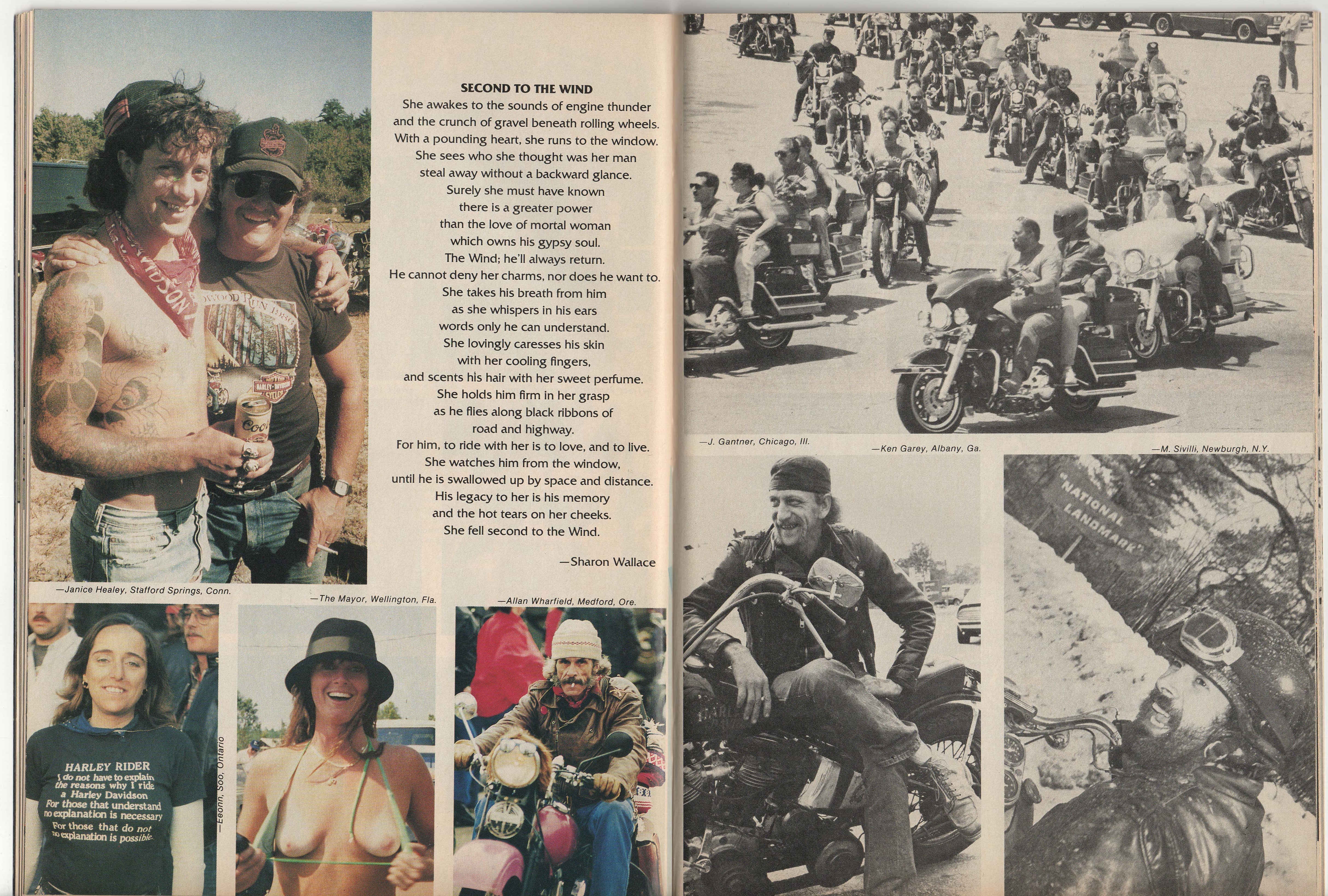
An un-love poem by Sharon Wallace in Easyriders # 185’s In the Wind section, November 1988.
Image courtesy of the author.

Notably, the magazine’s editors broke with traditional publishing practice by accepting handwritten manuscripts – unheard of in that era – because most prison inmates did not have ready access to typewriters.
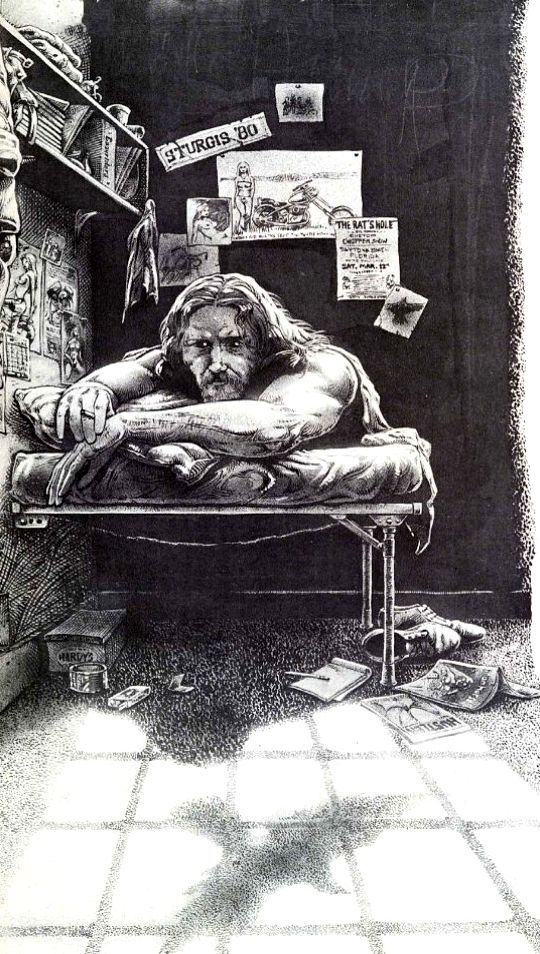
Duffy Duggan’s work appeared often in the magazine’s pages, illustrating short stories and articles. Here, a hapless biker serves time in prison, a common theme for hardcore bikers.
 Image sourced from internet.

In another groundbreaking move, Easyriders made a practice of publishing motorcycle-themed illustrations and paintings by talented artists like Duffy Duggan, above, and cartoonist Hal Robinson, below.
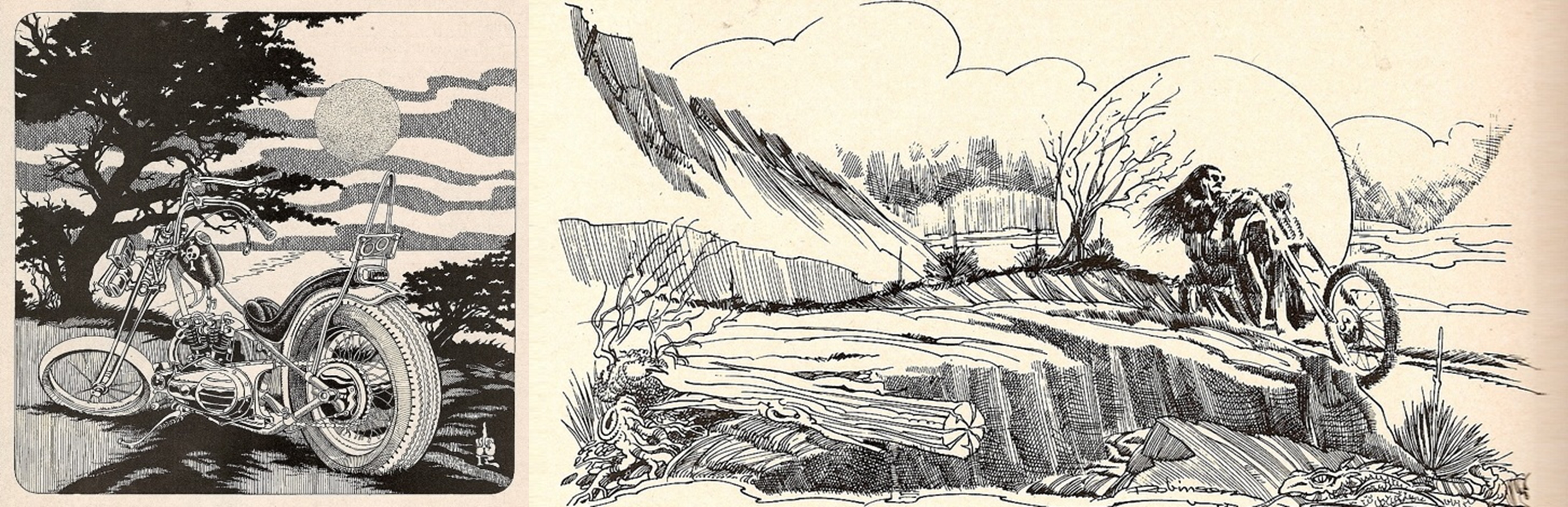
Artist Hal Robinson could do ‘funny’ easily, but occasionally took a turn at more contemplative works like the one above, at right.
 Images sourced from internet.

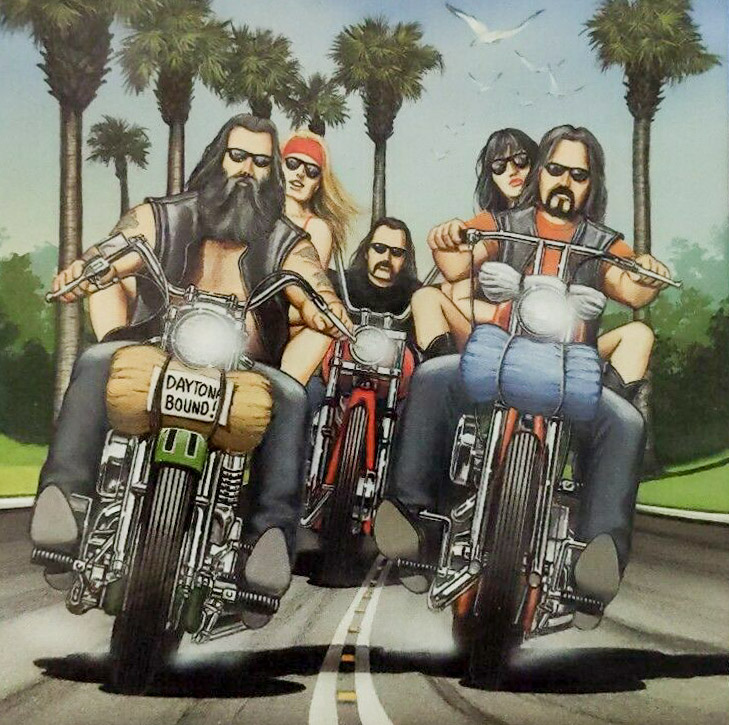
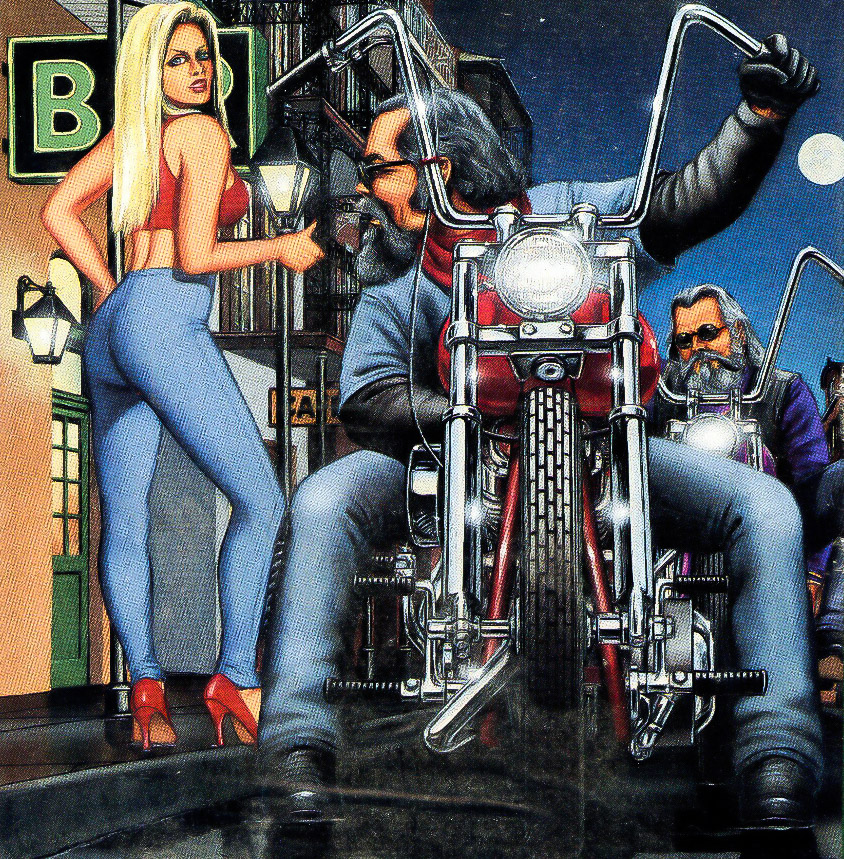
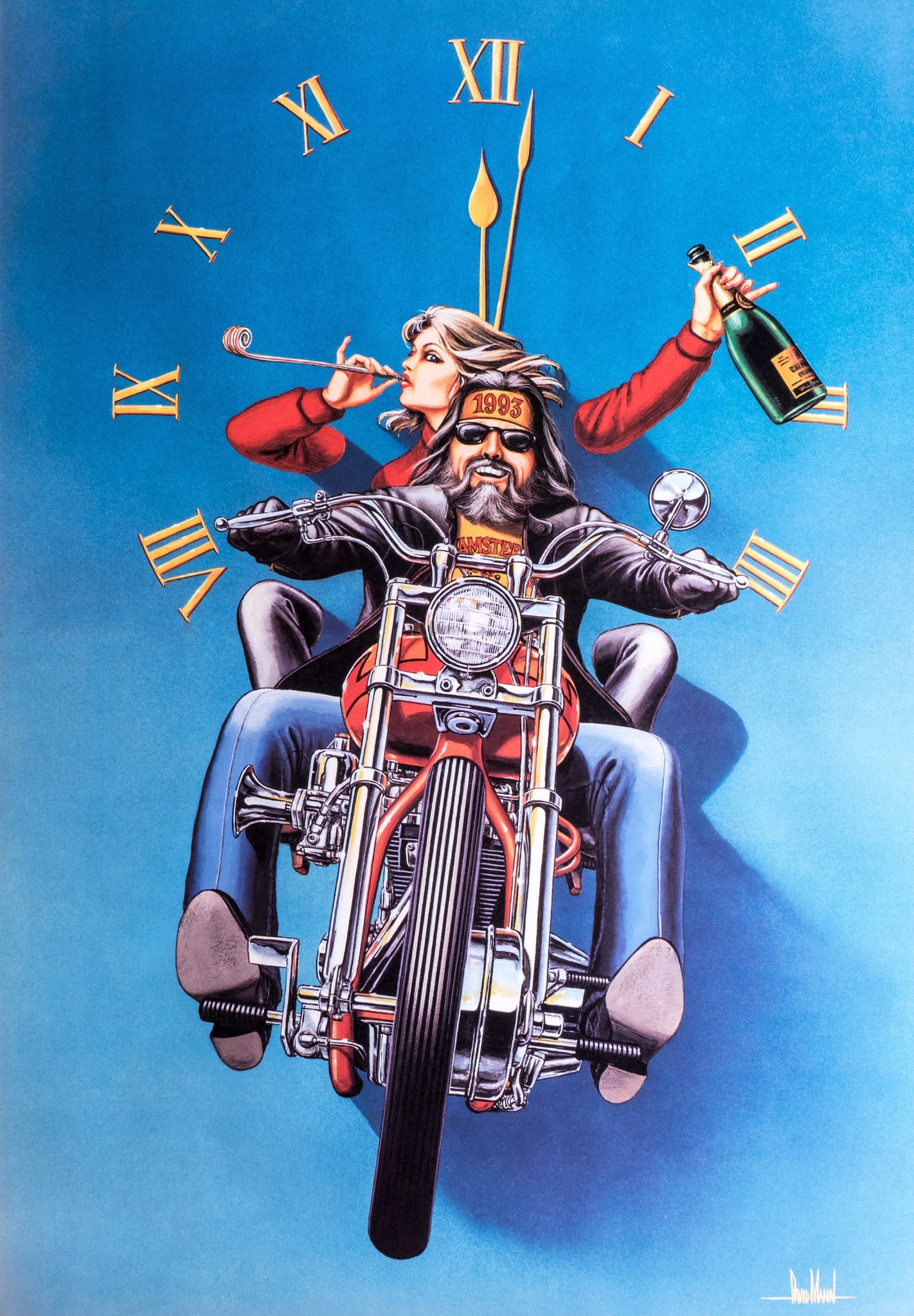
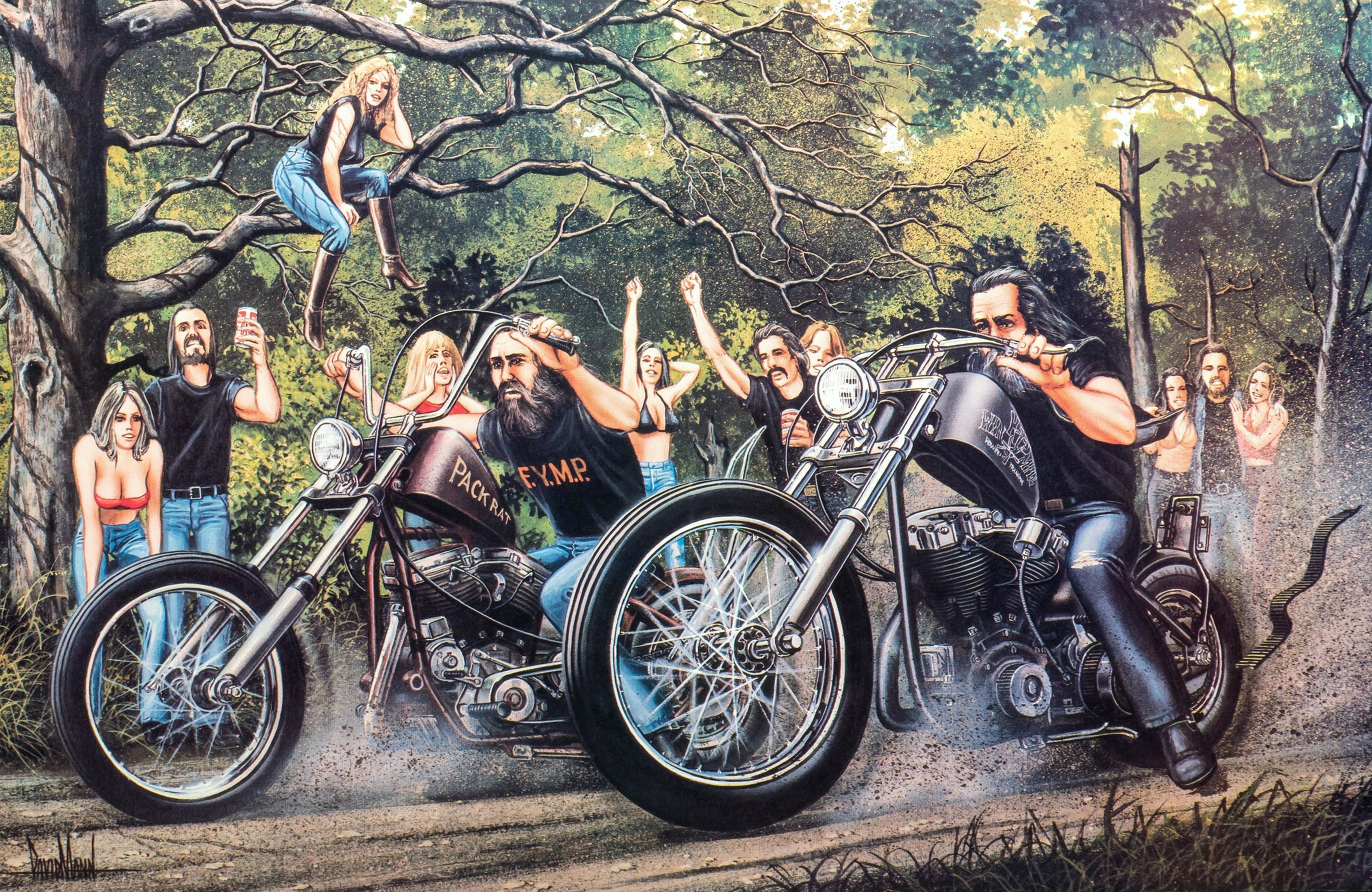
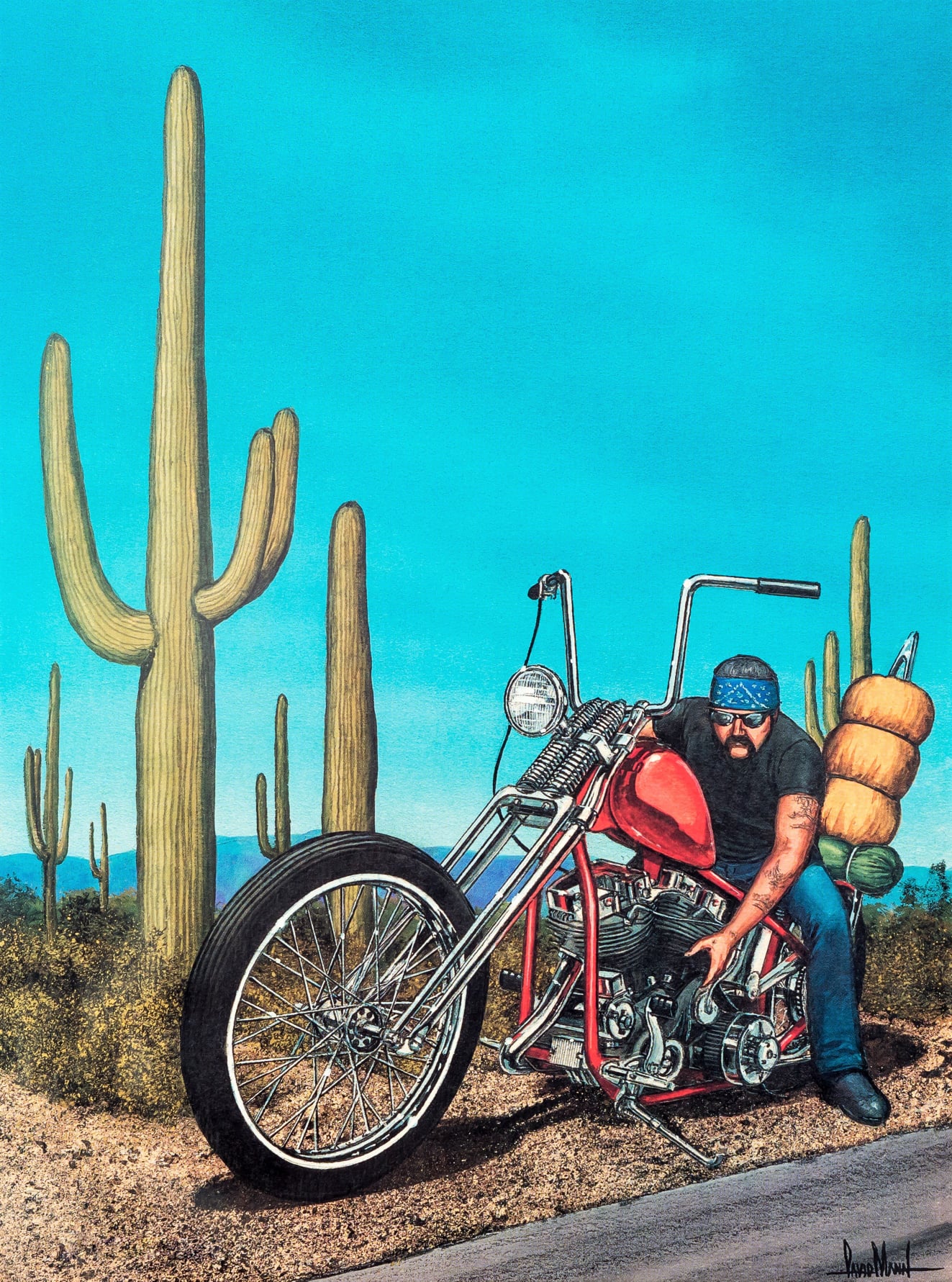
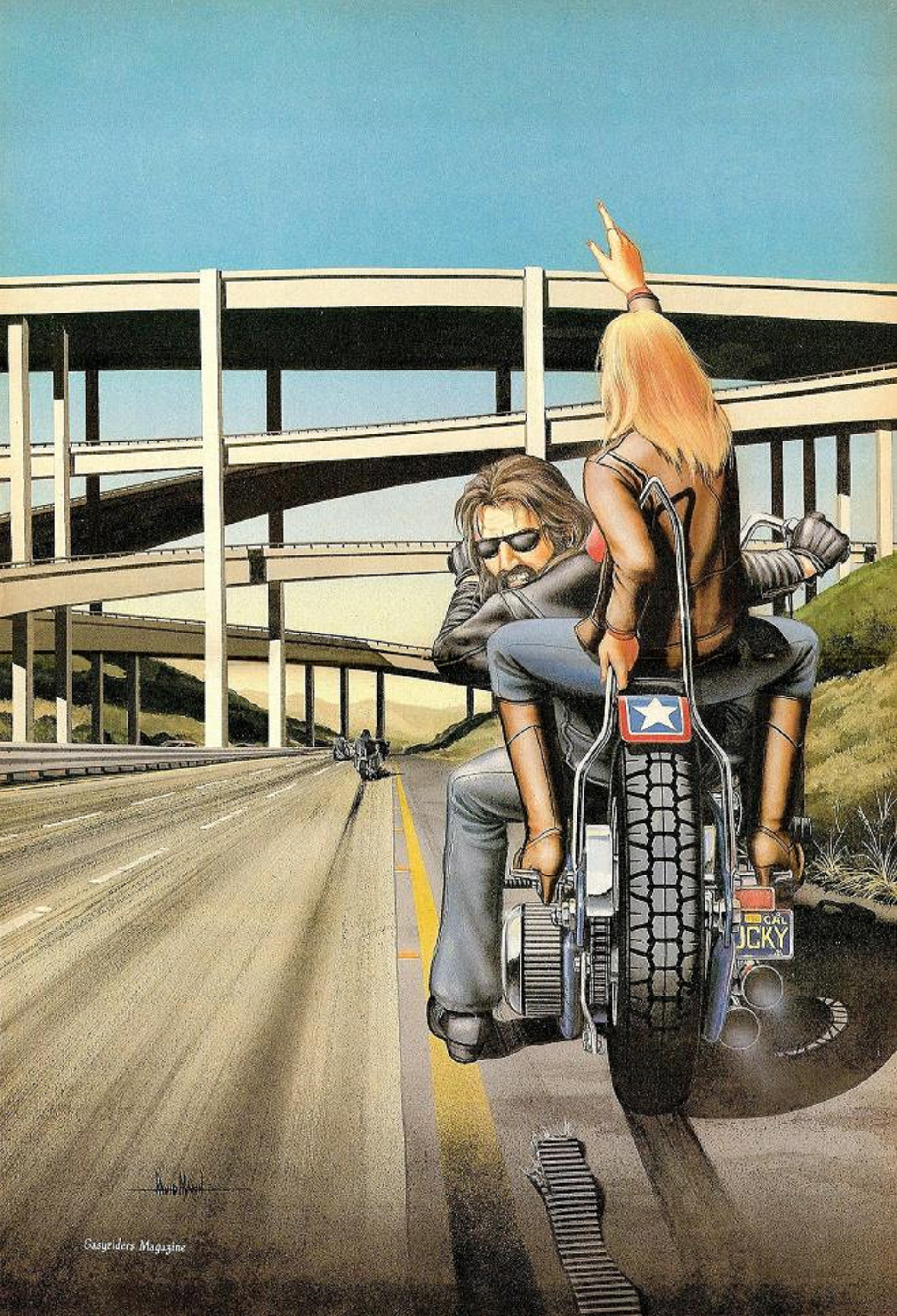
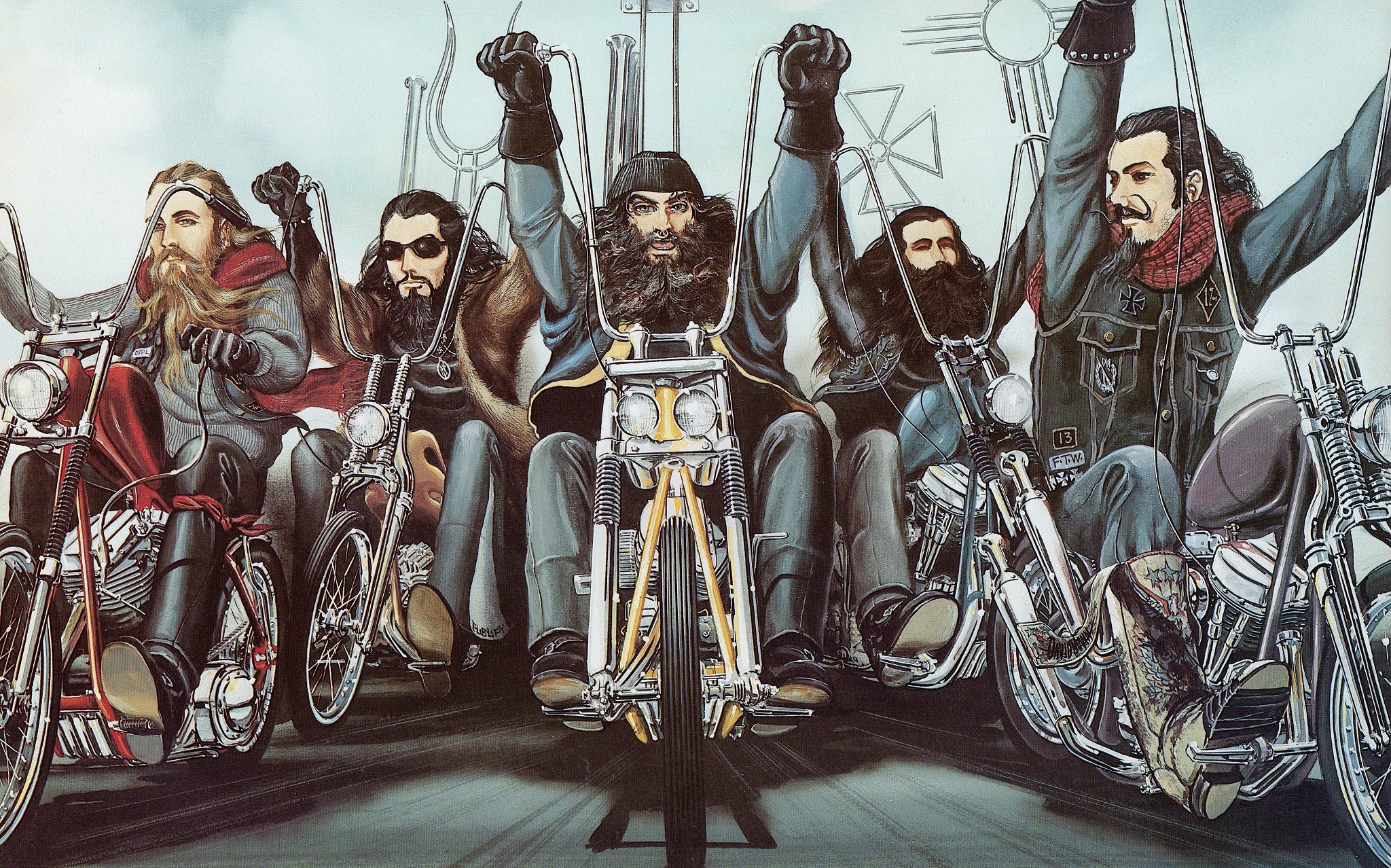
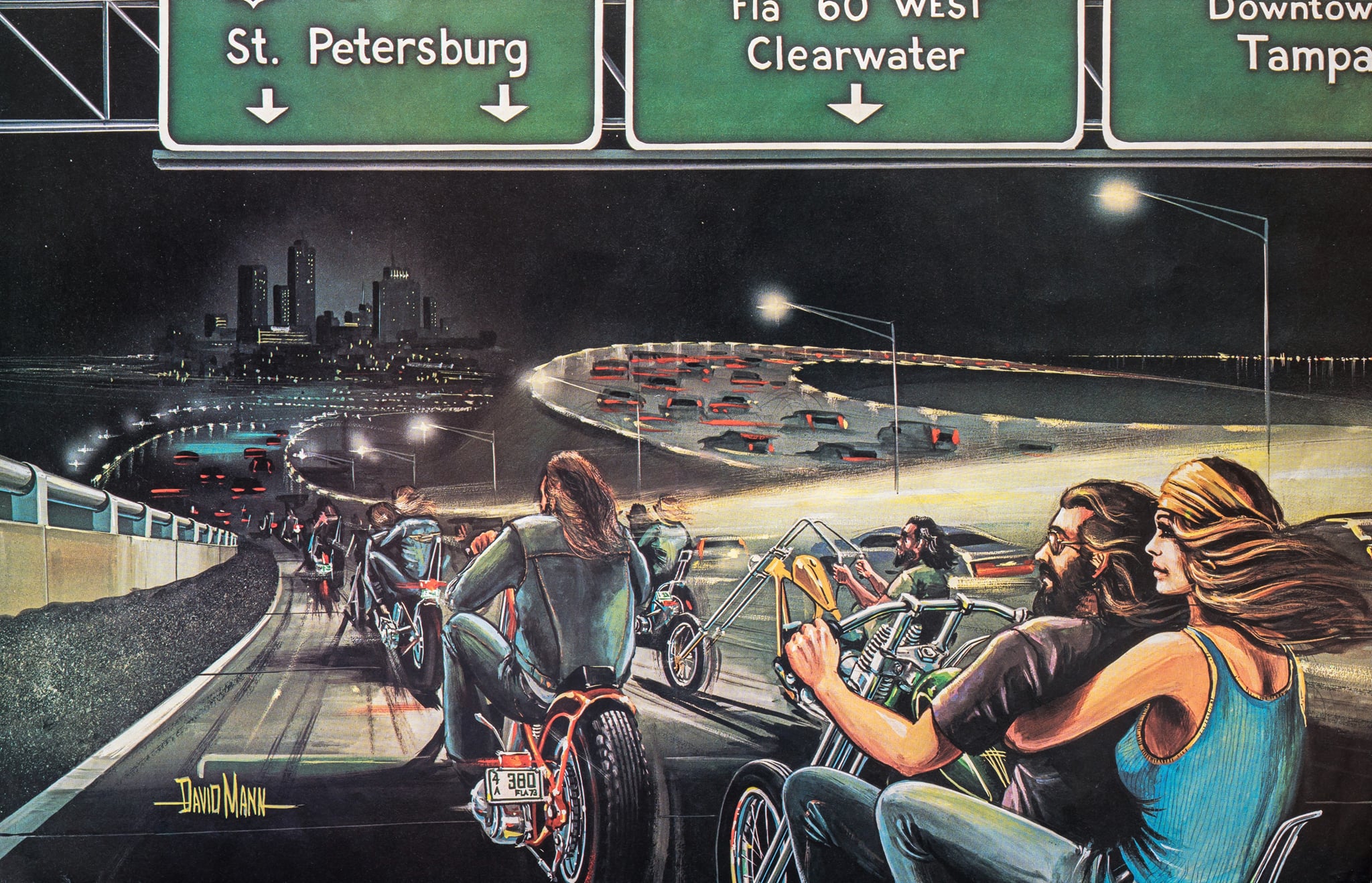
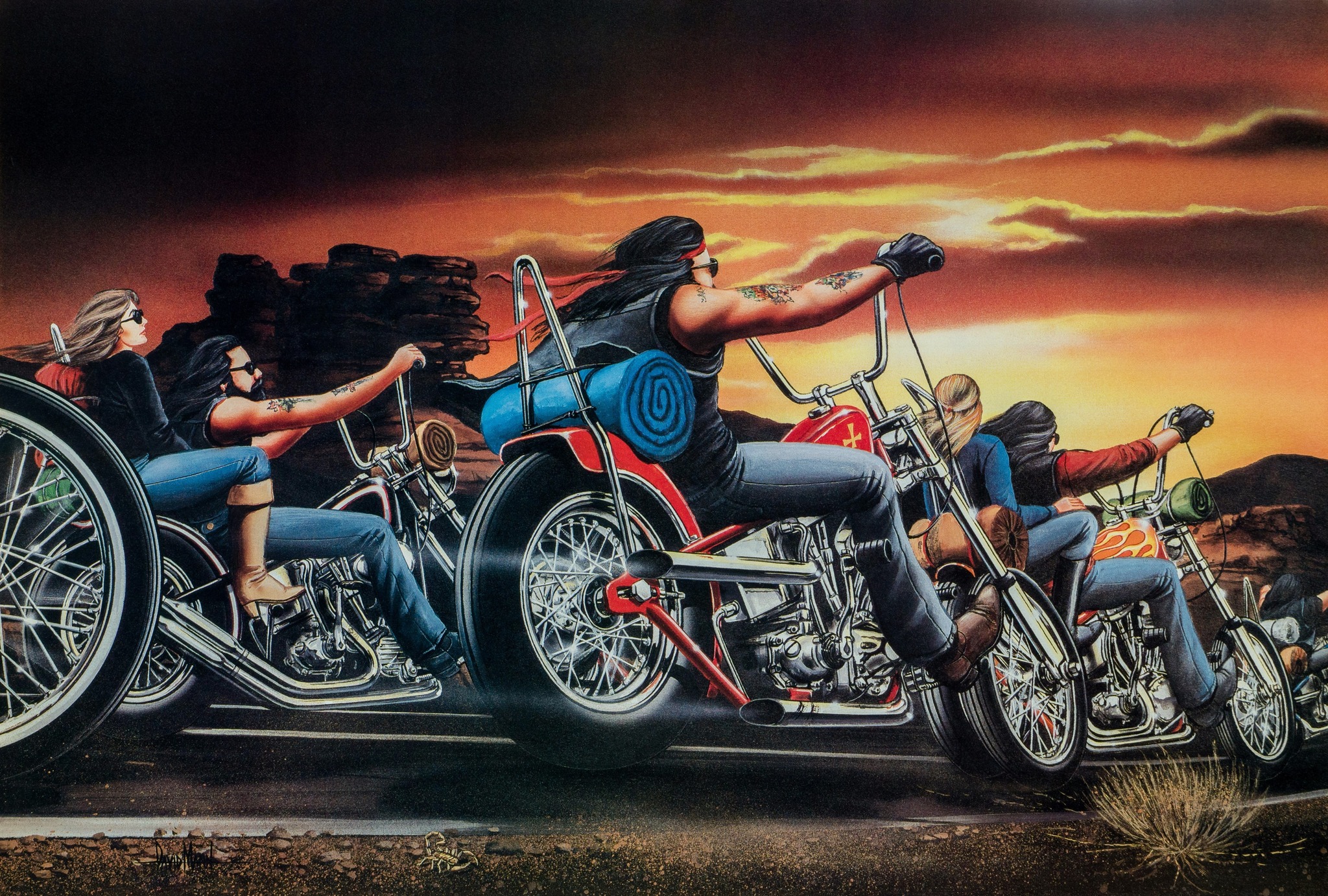
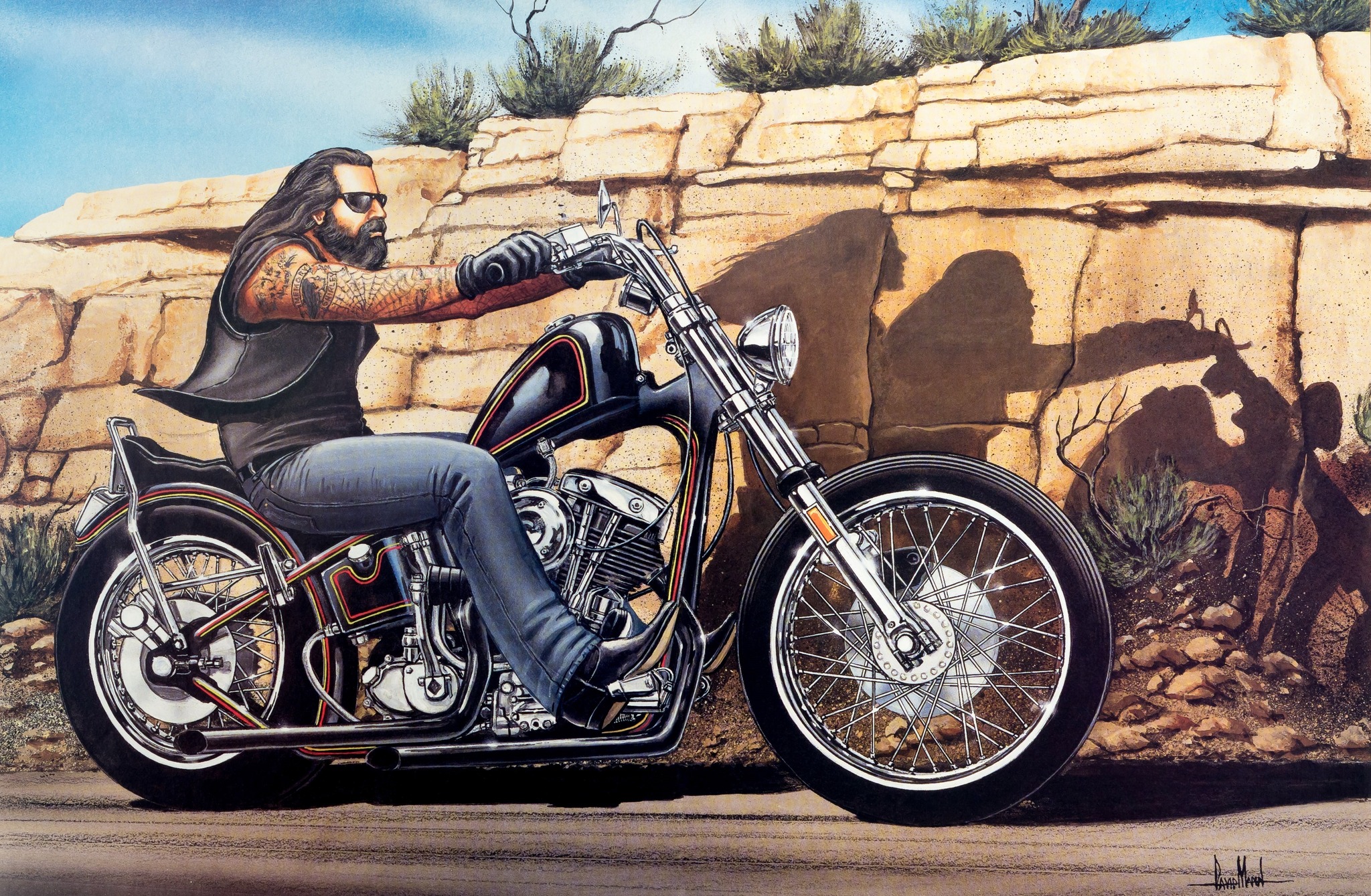
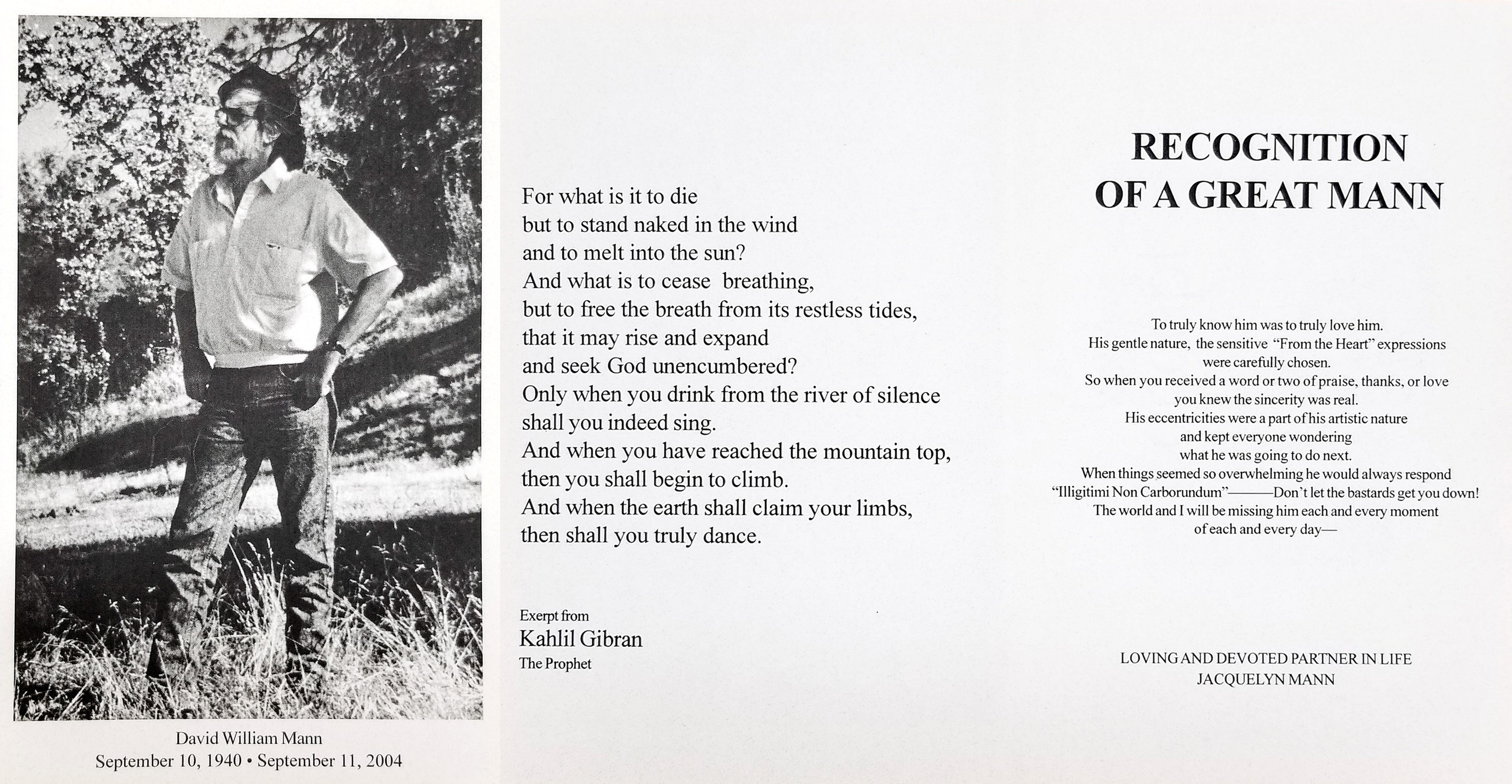
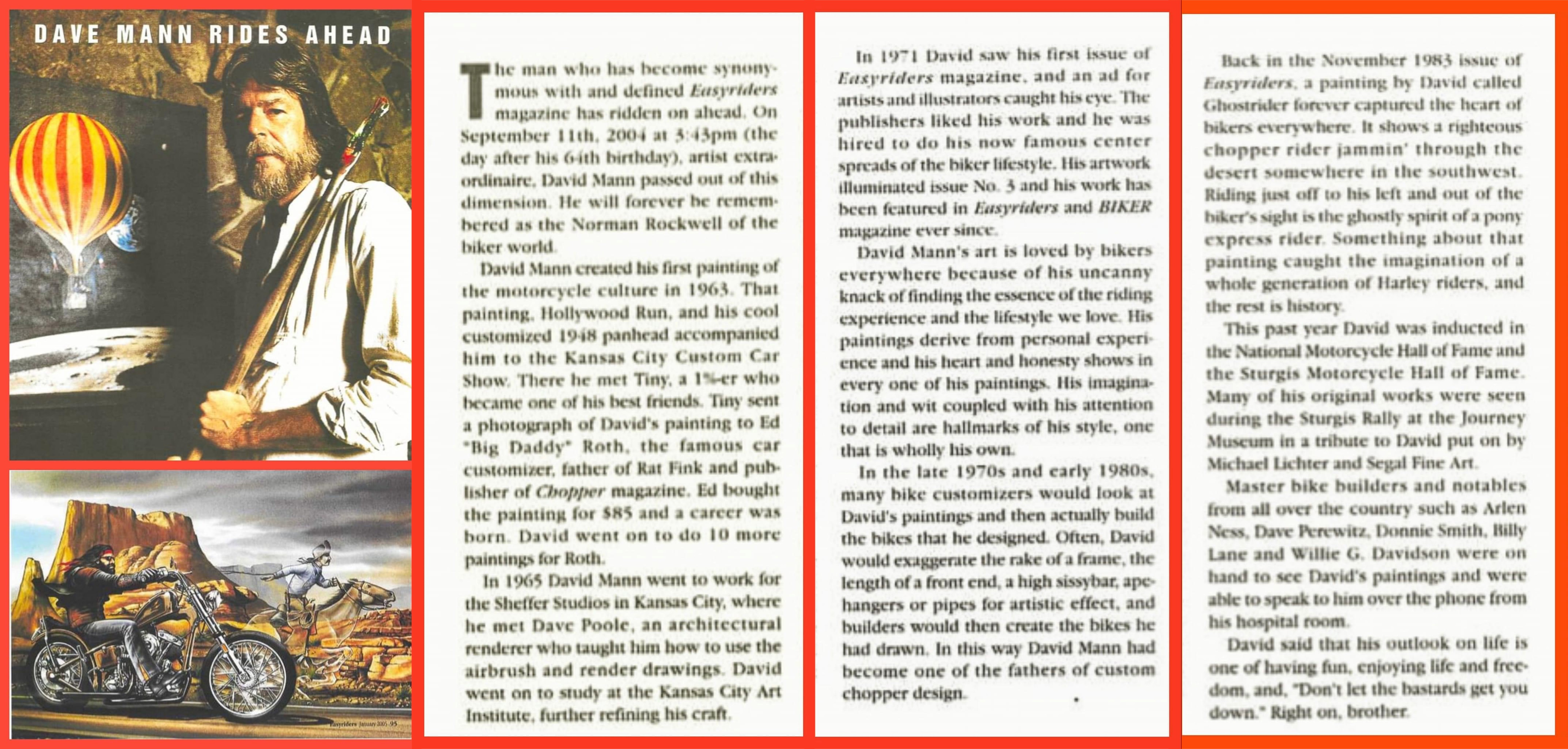
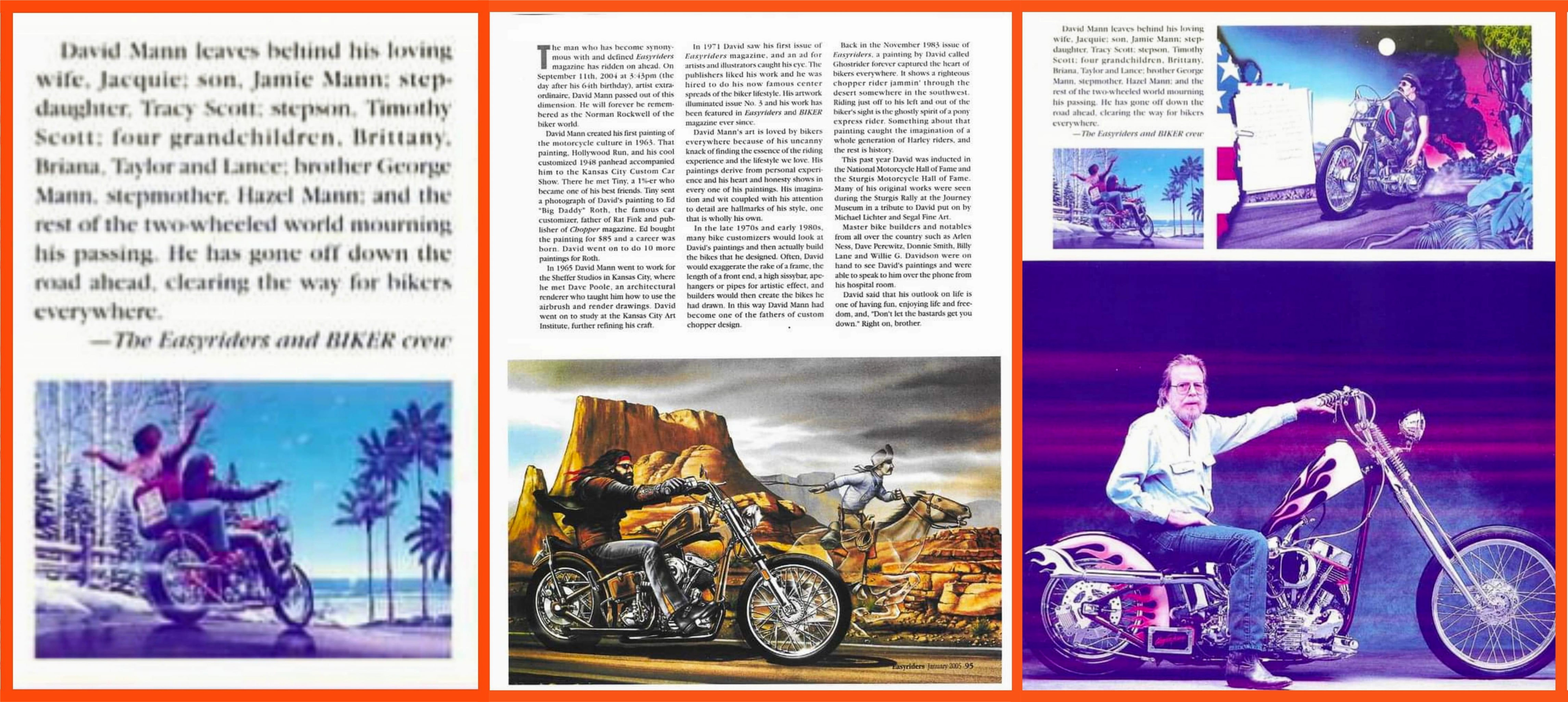
Most noteworthy of these was the godfather of chopper art, David Mann, who first broke out with a series of posters painted for Ed ‘Big Daddy’ Roth of Choppers Magazine fame. Mann created his first masterpiece centerfold painting for Easyriders‘ third issue in October, 1971. The artist – the Frederic Remington of the biker world – painted large centerfold paintings for the monthly magazine, and story illustrations, even as he cranked out book covers, centerfolds and illustrations for other publications. Despite that workload, the artist produced at least one piece for every issue of Easyriders from October, 1971 until his retirement in June, 2004. David Mann passed away in September of that year, but his paintings continued to appear in Easyriders and her sister publications for years afterward.

You can learn about David Mann and see much more of his artwork here.
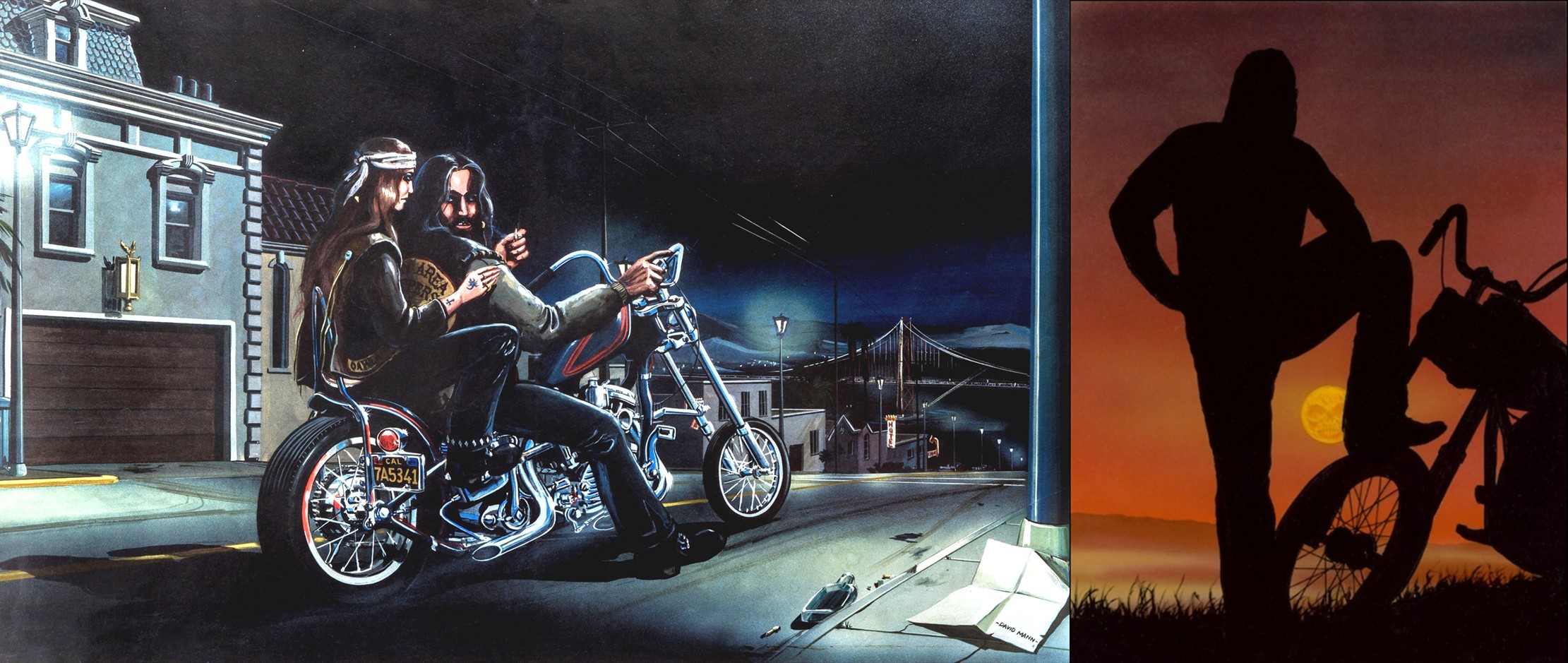
David Mann’s first and last paintings for Easyriders Magazine, in the October 1971 and June 2004 issues.
 Images courtesy of David Mann‘s Facebook page.

IN THE WIND
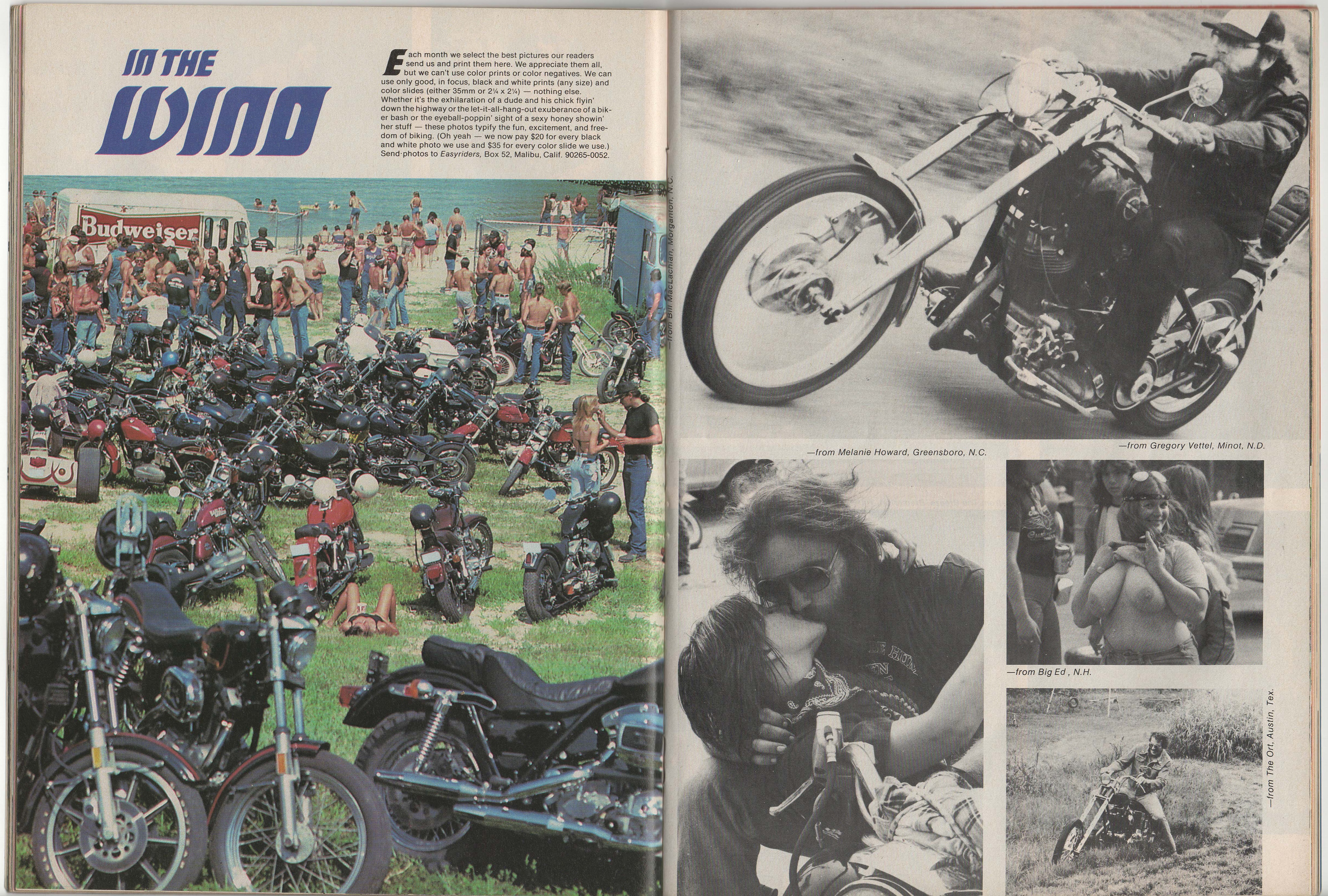
From Easyriders # 118, February 1983, the come-on to readers, to submit their photos for consideration. I can scarcely imagine the volume they received!
Image courtesy of the author.

One of Easyriders‘ more ingenious innovations was their In the Wind pages, where they offered readers cash (above) for ‘good, in-focus’ photographs of bikers at play, riding, partying, brawling or posing with their machines, and women, usually flashing their breasts for the camera.
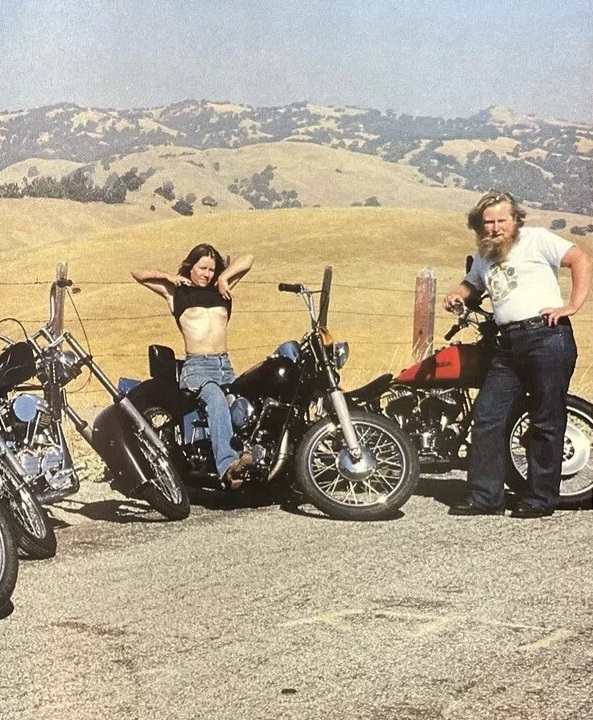
This appeared in In the Wind #11 in 1983.
 Image courtesy of eBay seller Touched by Time Treasures.

There were often older photographs, resurrected from Grandpa’s old picture album: proud farmers and sales clerks, and their bemused sisters or girlfriends, posing with Popes, Thors and Excelsiors. There were Allied soldiers aboard strap-back Harley J-Models and WLAs, Triumphs and BSAs, and their German counterparts on BMWs and NSUs. Other pages might teem with photos submitted by readers in Europe, Asia, South America and Africa, each with their own biker subculture.
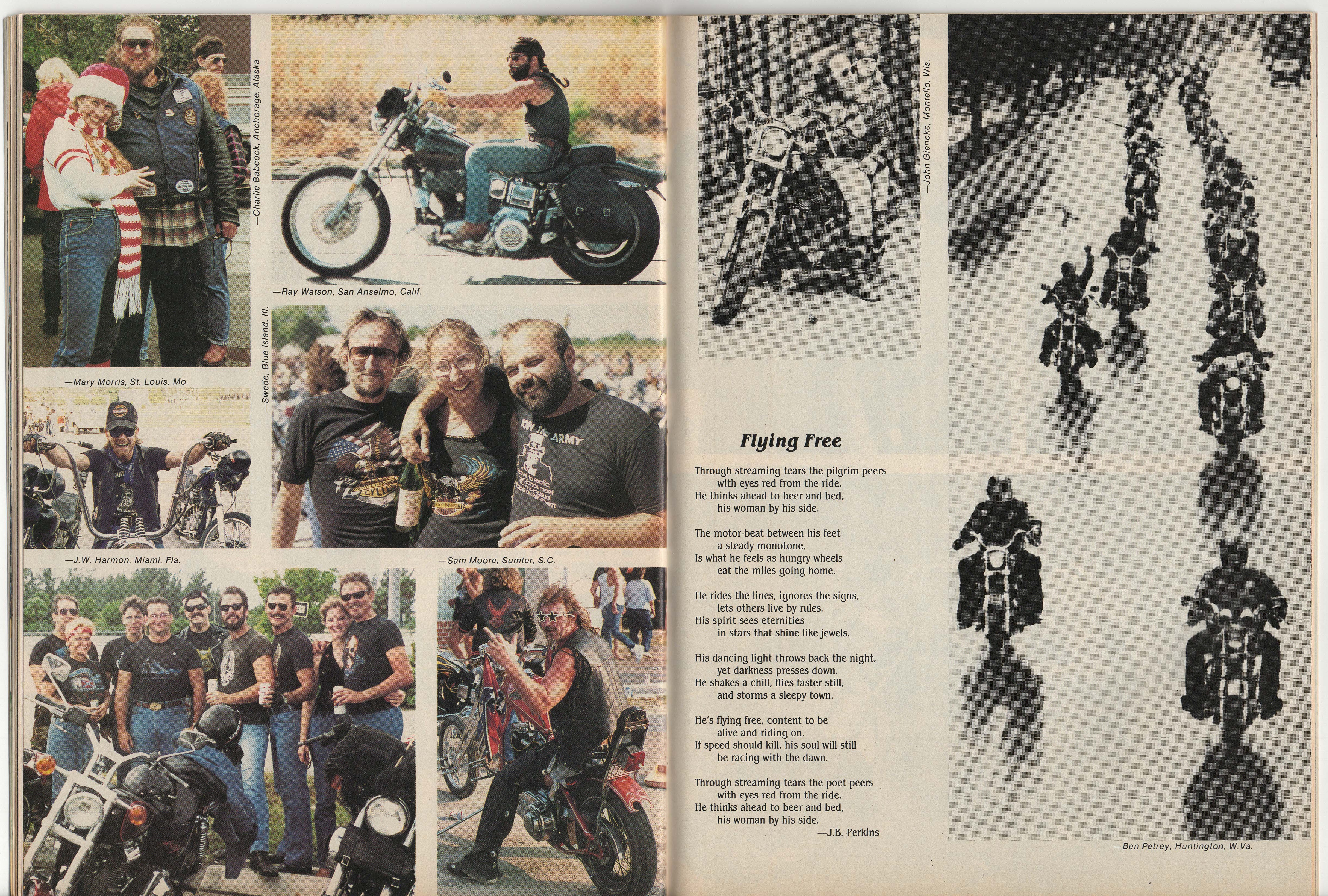
Pages of typical ‘In the Wind’ photographs from the August 1988 issue.
Image courtesy of the author.

And, of course, there were hundreds and hundreds of pics of bikers, male and female, outlaw and straight, on original or restored classics or wild-as-fuck radical customs. They were jamming down the road, hair floating in the breeze and tight grins on their faces, or scowling at the camera and flipping the universal biker salute – one raised finger – to friend and foe alike. They were drinking beer, wrestling in the mud of a campsite, or tearing a motorcycle apart beneath a tree as friends gathered to offer assistance….
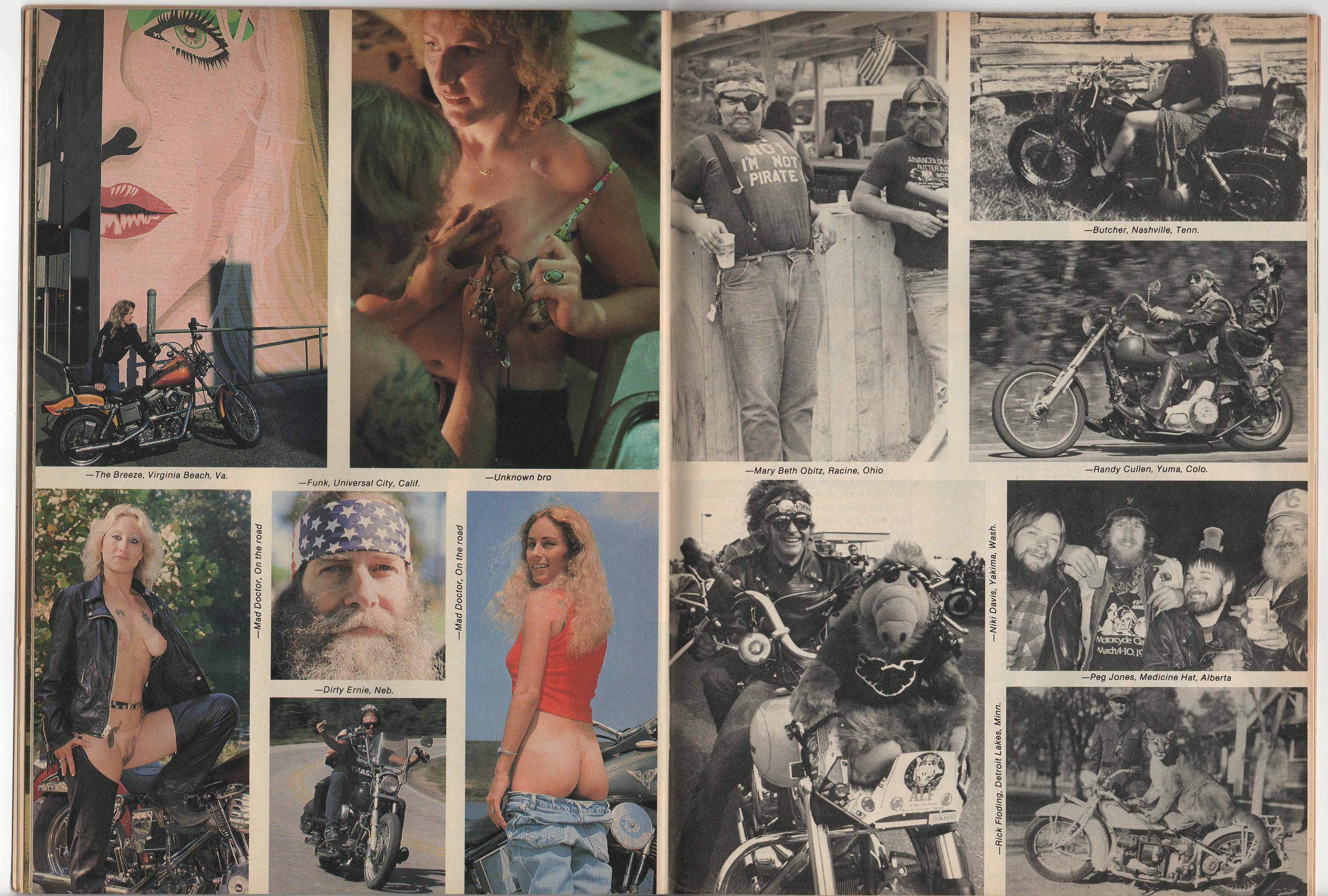
Pages of typical ‘In the Wind’ photographs from the June 1988 issue.
Image courtesy of the author.

….and women, in denim and leather or not much of anything, baring their all at a rally, packing behind their ol’ man or geared up and gripping the bars of their own machines. All ages, all shapes and sizes, but most pretty and slender and lithe enough to curl up behind a man as they blast down the highway together, her feet on the high pegs of that rigid frame and her arms around her man.
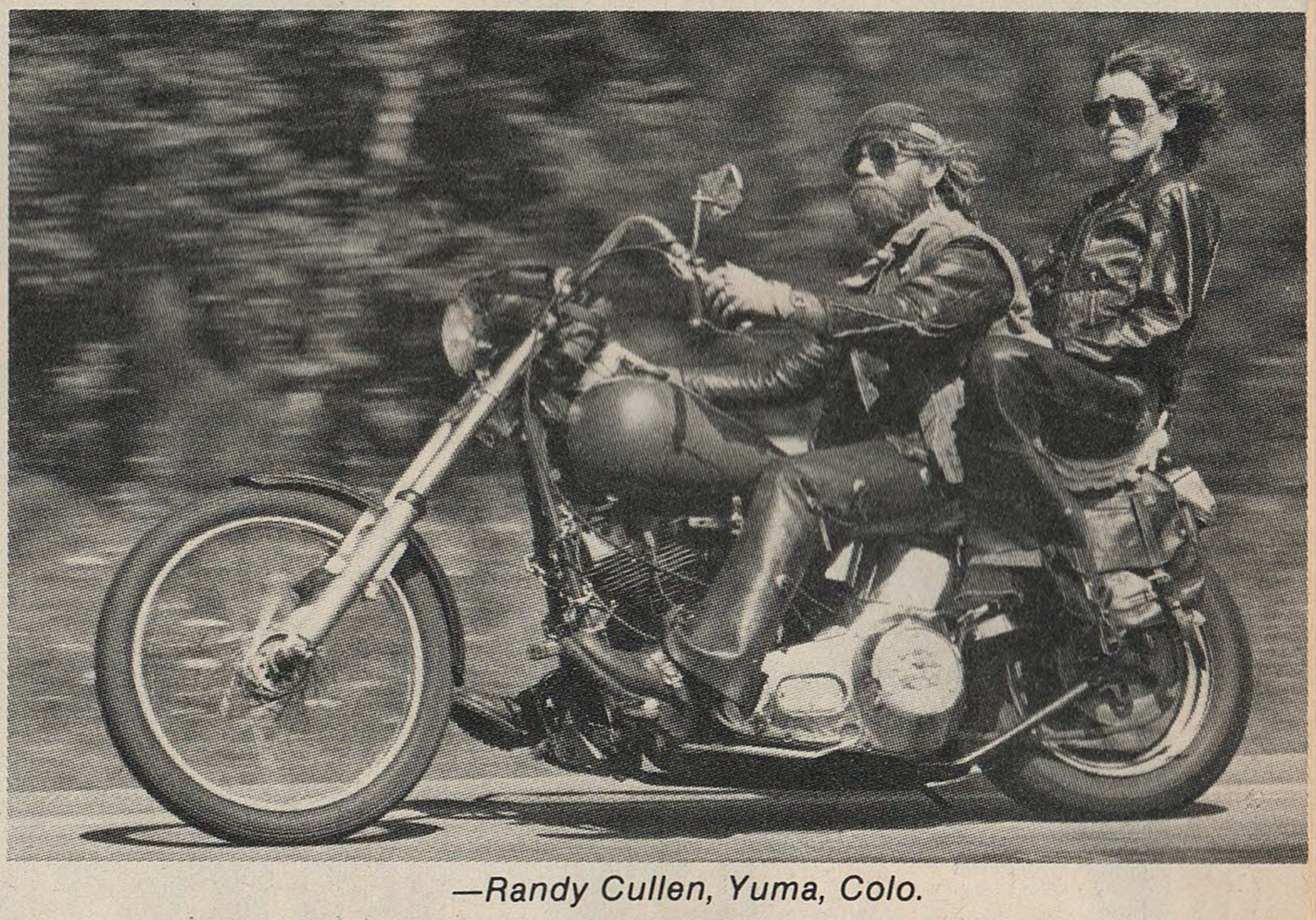
What it’s all about, really, in Easyriders, June 1988.
Image courtesy of the author.

I called In the Wind ‘ingenious’ because, while the editors paid for photos they published in the magazine itself, they reserved the right to use any and all submitted photographs free of charge in a spin-off magazine called In the Wind. It featured page after page of readers’ photographs, very little editorial content, and ran through well over a hundred and fifty issues. Aside from layout and pasteup, it couldn’t have cost much to produce, and every issue sold by the tens of thousands.
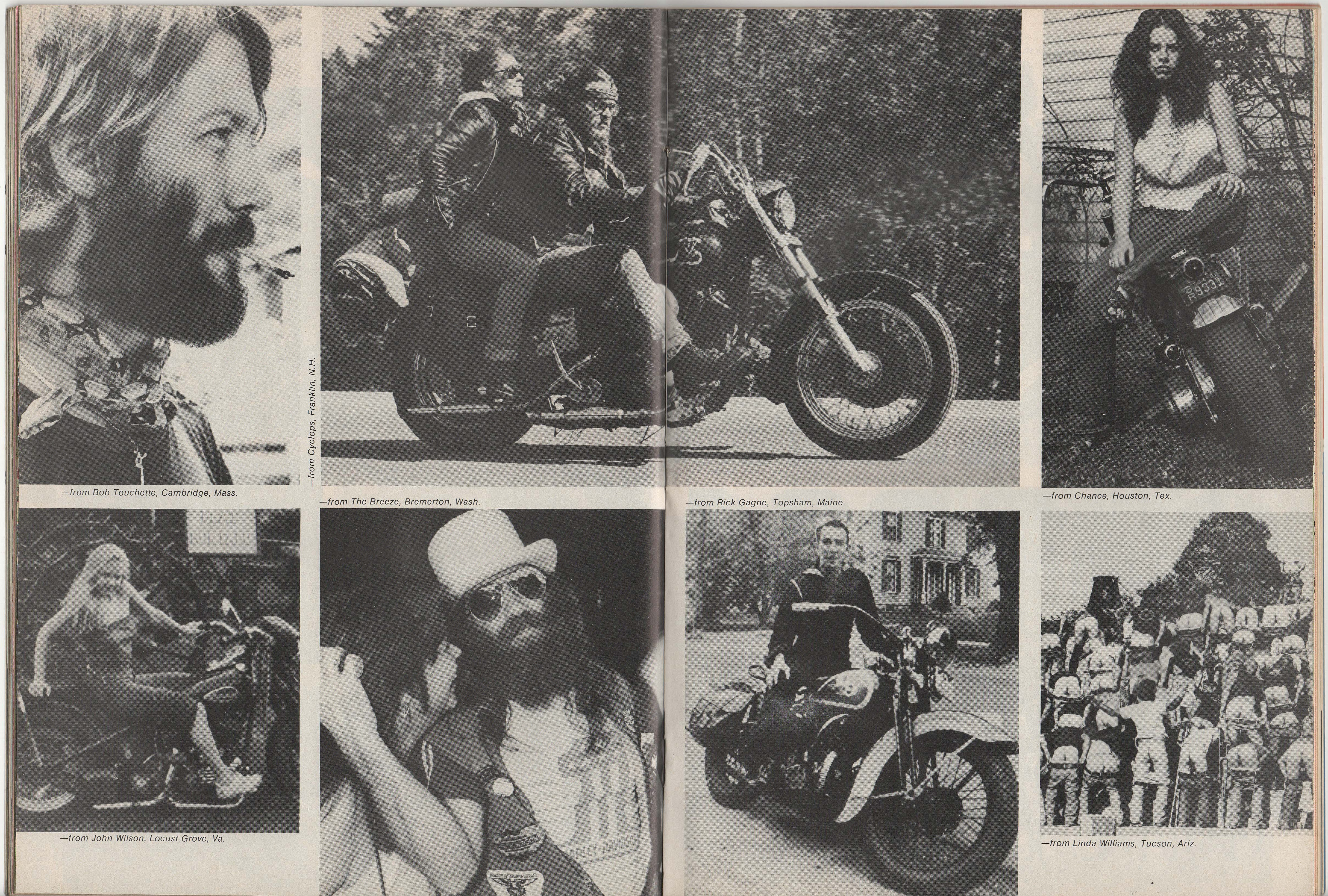
These appeared in Easyriders # 118 in February 1983 ‘In the Wind’ pages.
Image courtesy of the author.

I submitted a number of photos to the magazine’s for-pay column, but only ever saw them in later issues of In the Wind.
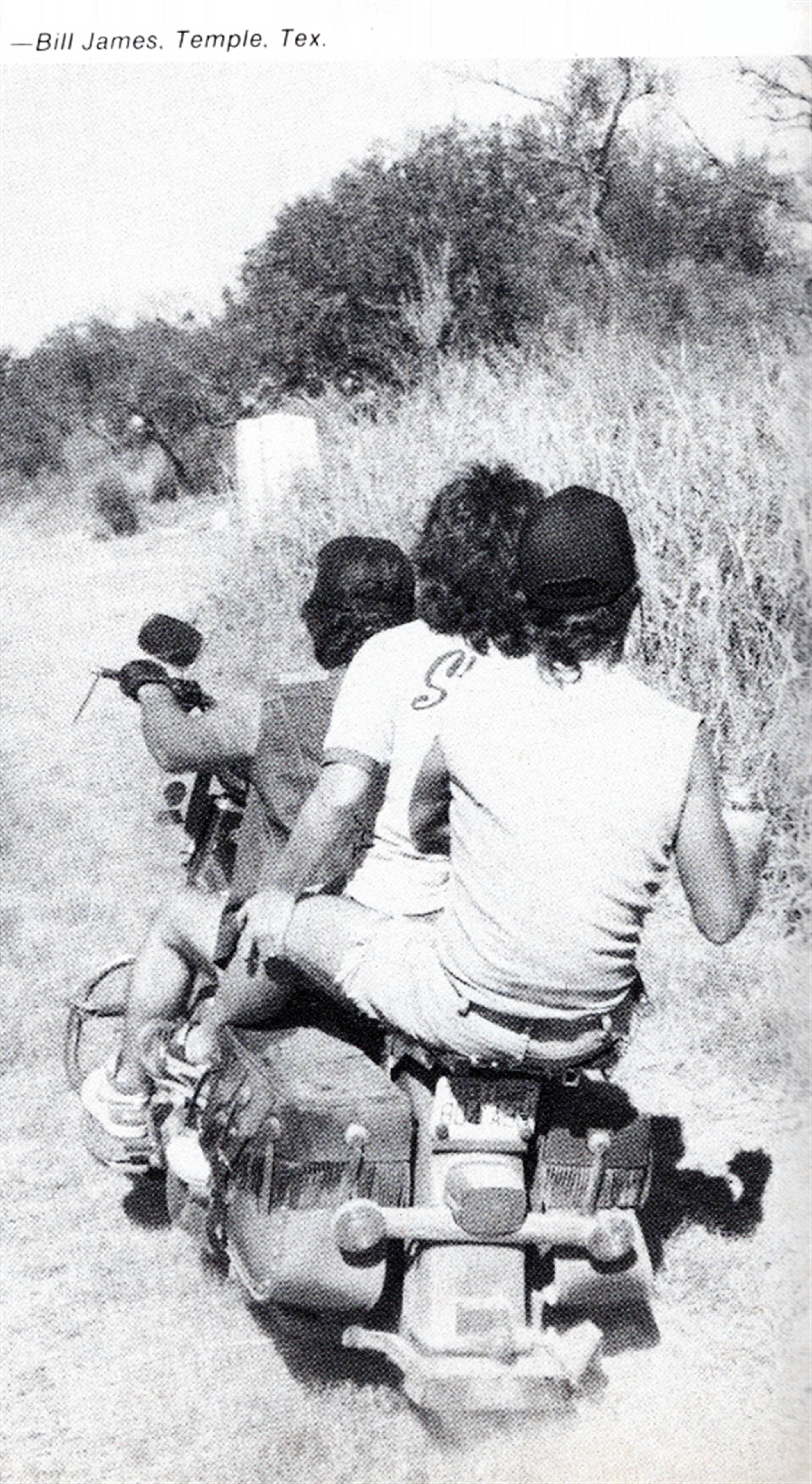
One of my many submissions to the magazine’s ‘In the Wind’ pages: a shot from one of the ABATE Texas annual members’ rallies. Several showed up in the spin-off publication, but none made the paid-for pages in the magazine itself. 😡
 Image courtesy of the author.

EXPANSION
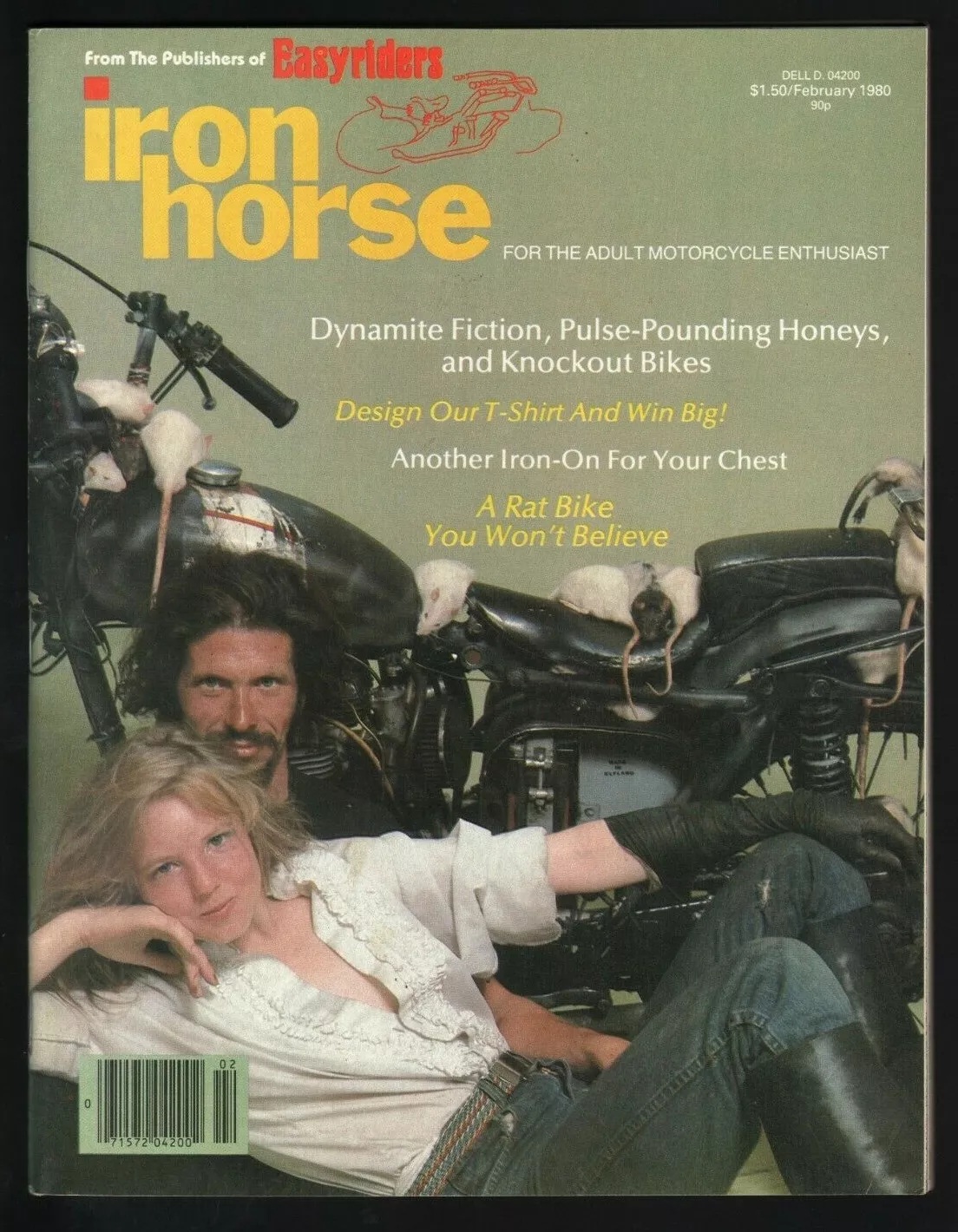
Iron Horse featured bikers and babes just as down-to-earth as Easyriders, but with a more inclusive flair.
 Image courtesy of eBay sellers Gallimore’s Goods.

Realizing that they had a good thing going, Easyriders‘ parent corporation, Paisano Publications, soon sought to expand the brand into a world-wide empire. First came the In the Wind magazines. These were followed by Iron Horse, a magazine more dedicated to metric riders. Still the same hard-partying, hard-riding biker ethos, but with more Triumphs and Hondas than Harleys and Indians.
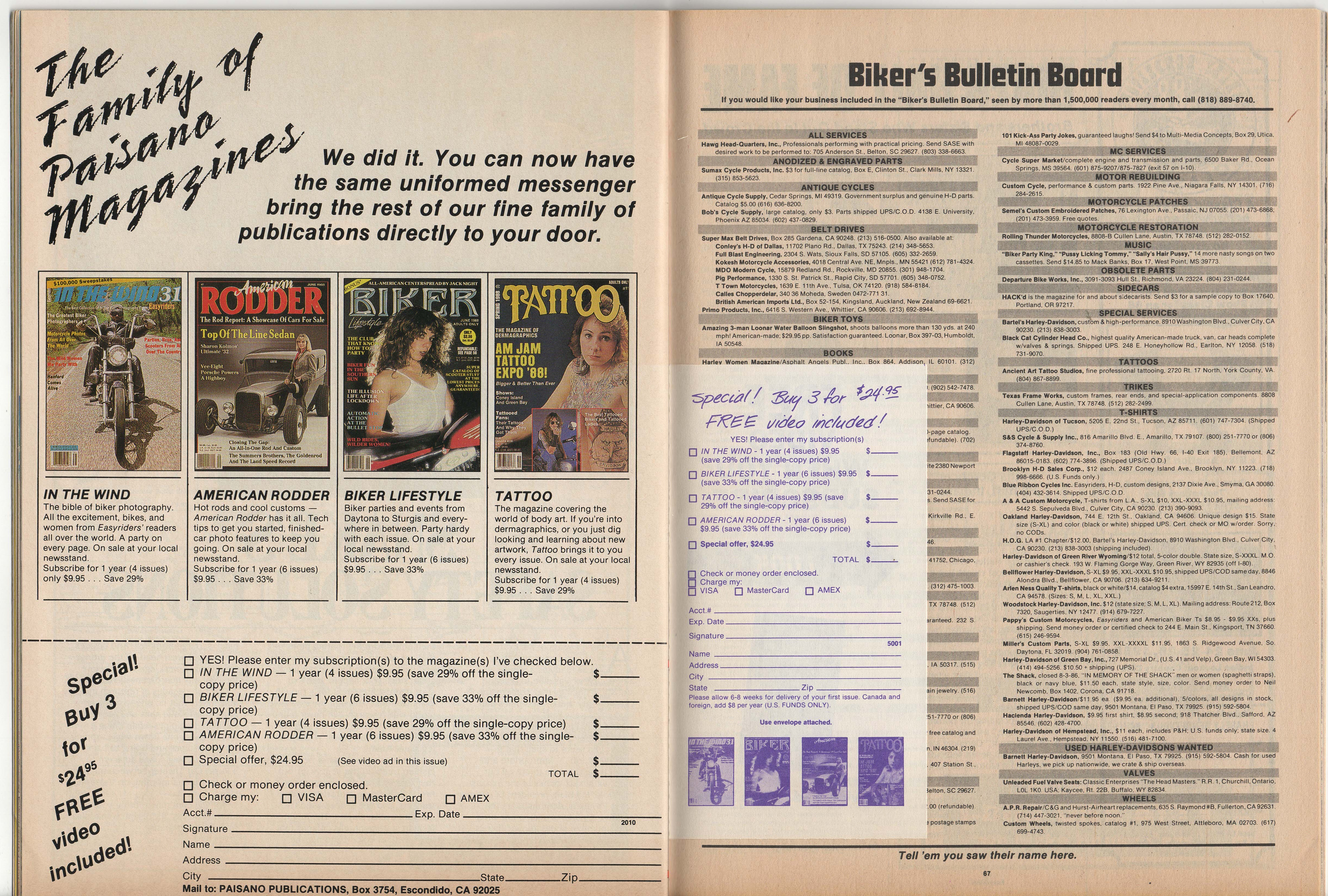
Paisano Publications‘ burgeoning publishing empire featured created titles like In the Wind, American Rodder and Iron Horse, and acquired titles like Tattoo and Biker.
Image courtesy of the author.

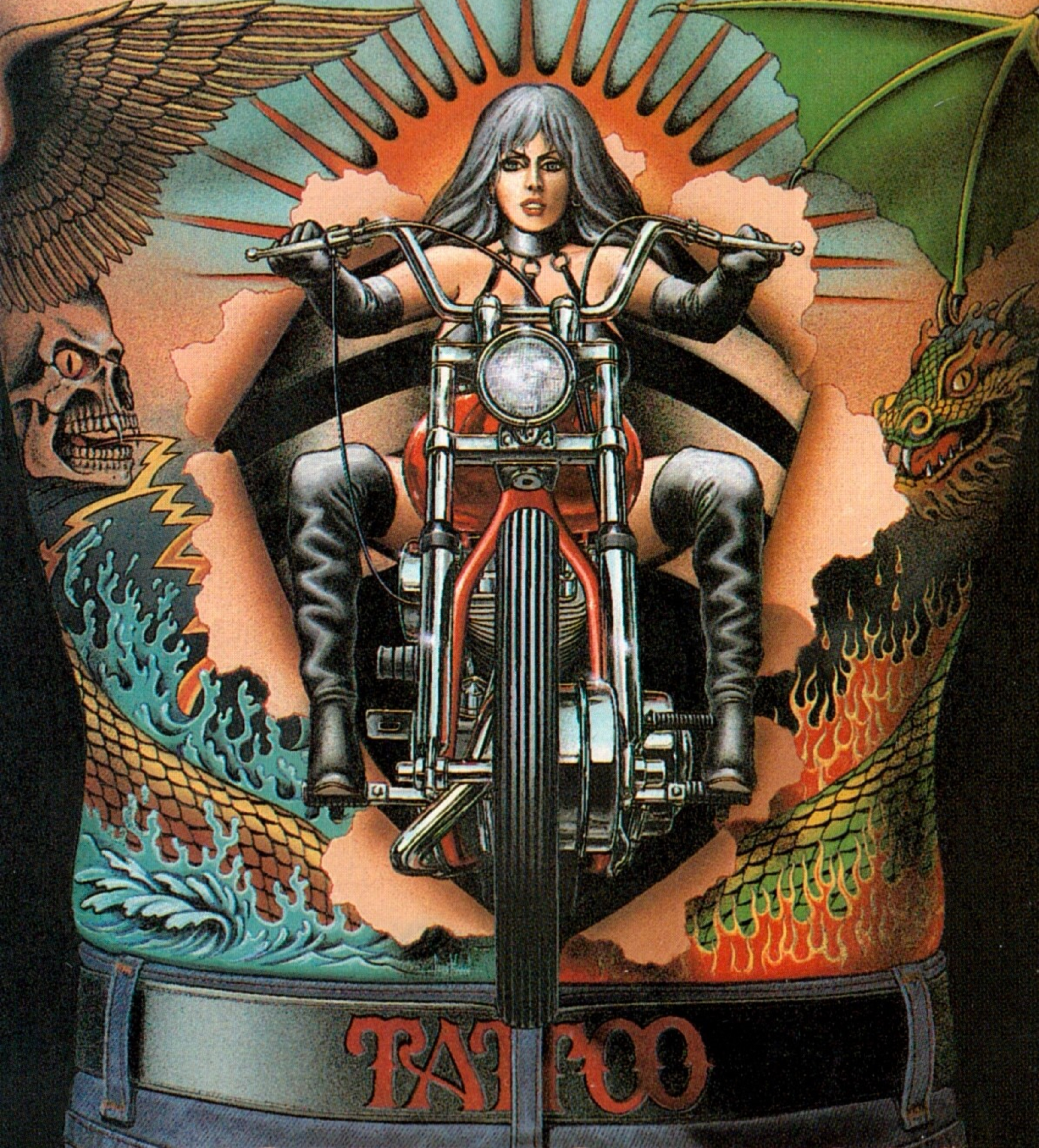
Later, we saw titles like Tattoo, which cashed in on (and helped fuel) the passion for skin art sweeping the nation in the ’90s and ’00s. Another spin-off magazine was V-Twin, intended as a ‘family friendly’ version of Easyriders. No topless women, fewer four-letter words…. 🙄 Worse still was VQ, a magazine ‘for the connoisseur.’ 🤢
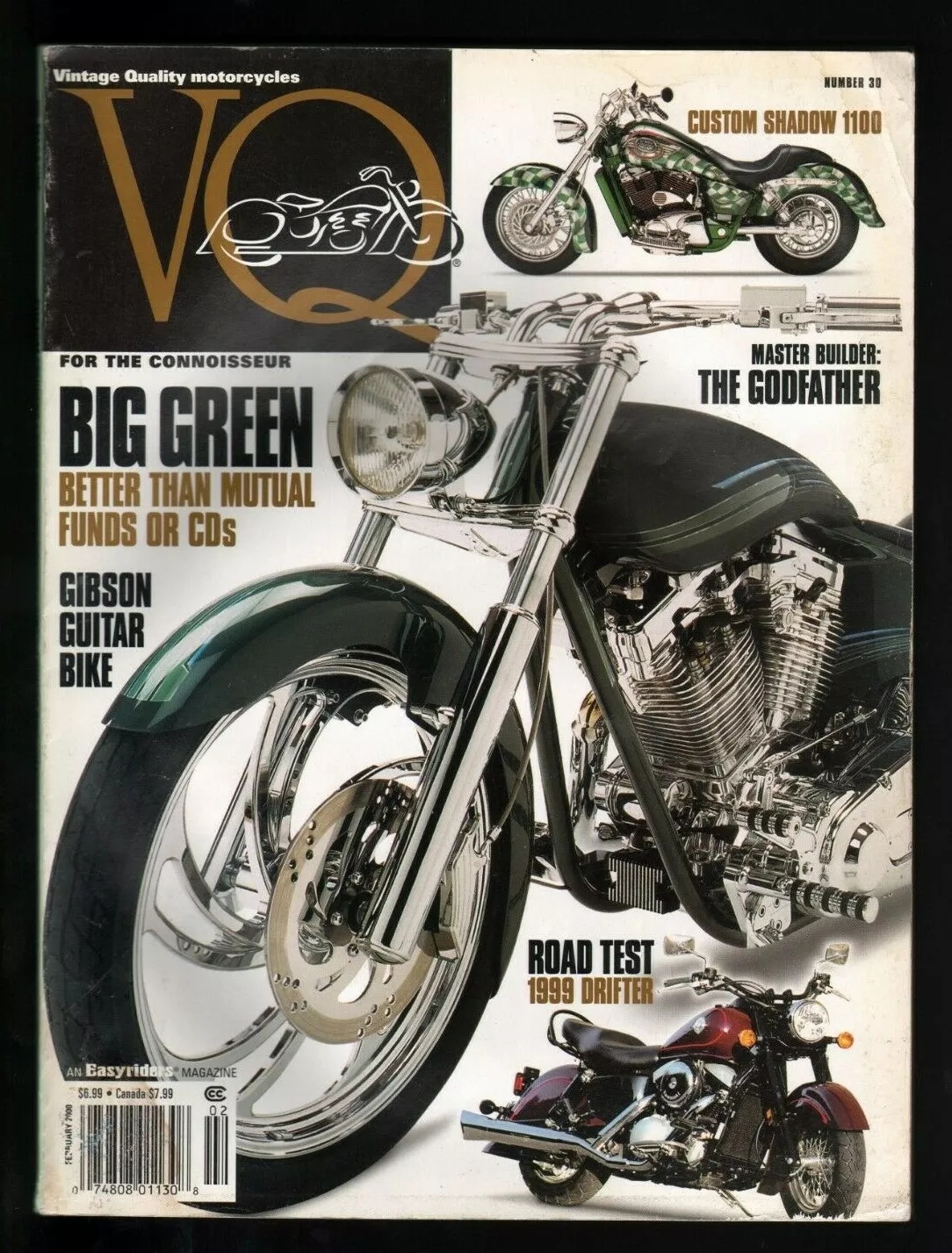
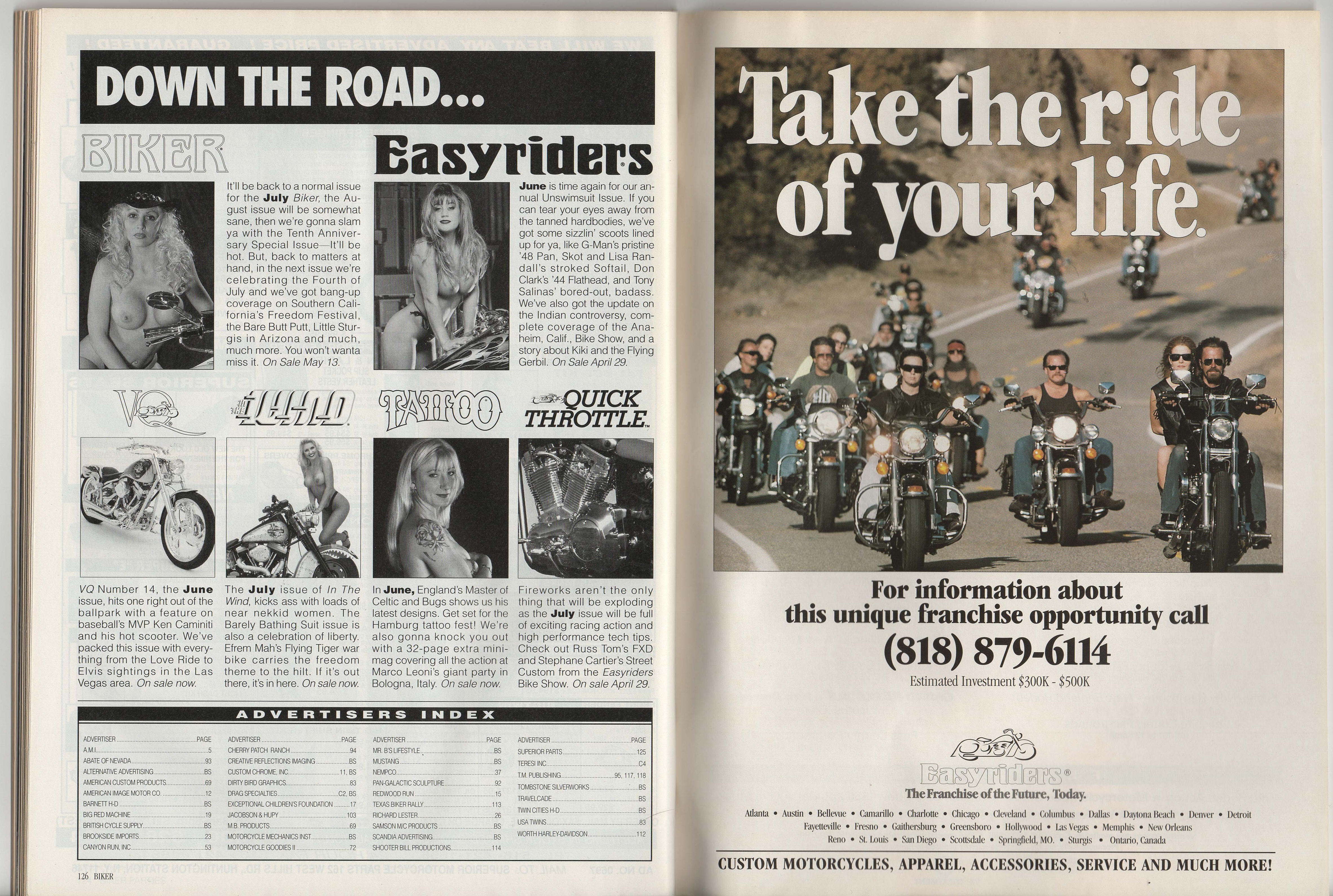
Image courtesy of eBay sellers Gallimore’s Goods.
Adverts for a number of Paisano Publications titles, including Easyriders, Biker, In the Wind, the aforementioned VQ, Tattoo and Quick Throttle. On the opposite page, a pitch for Easyriders store franchises. For reference, the $500K investment listed would be the equivalent of about $1 million today.
Image courtesy of the author.

Other cash cows turned up. There were Easyriders products like t-shirts, hats and scarves, which grew into a full-sized catalog insert in the magazine every Christmas season. Then came brick-and-mortar Easyriders stores – franchised outlets as advertised above – that sold clothing and custom parts. Some even tried to be full-service motorcycle shops, with bikes for sale and mechanics on duty.

An Easyriders Store as envisioned by artist David Mann.
 Image courtesy of the author.

Then there were the Easyriders Rodeos and other events: a series of prepackaged biker parties – mini-rallies, really – at venues around the country. These events were heavily sponsored by corporations like Custom Chrome, Chrome Specialties, Barnett and others, all purveyors of parts and equipment for Harley riders. At the rodeos, there were diversions like burnout contests, barstool races, poker runs, girly shows and live music, wedged in between the ceaseless marketing of products by Easyriders and its sponsors.
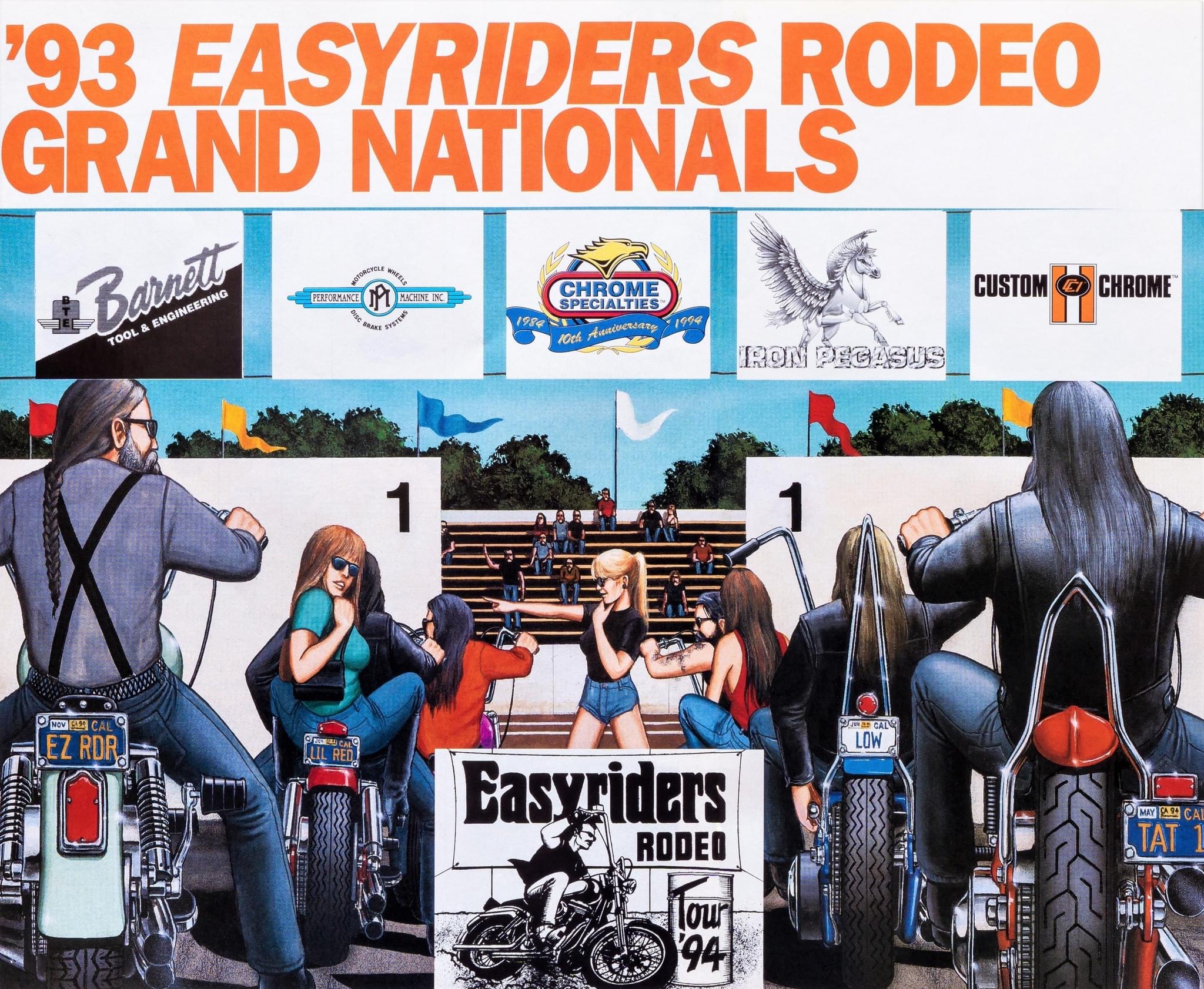
Artist David Mann did numerous adverts for the rodeo series.
  Image courtesy of the author.
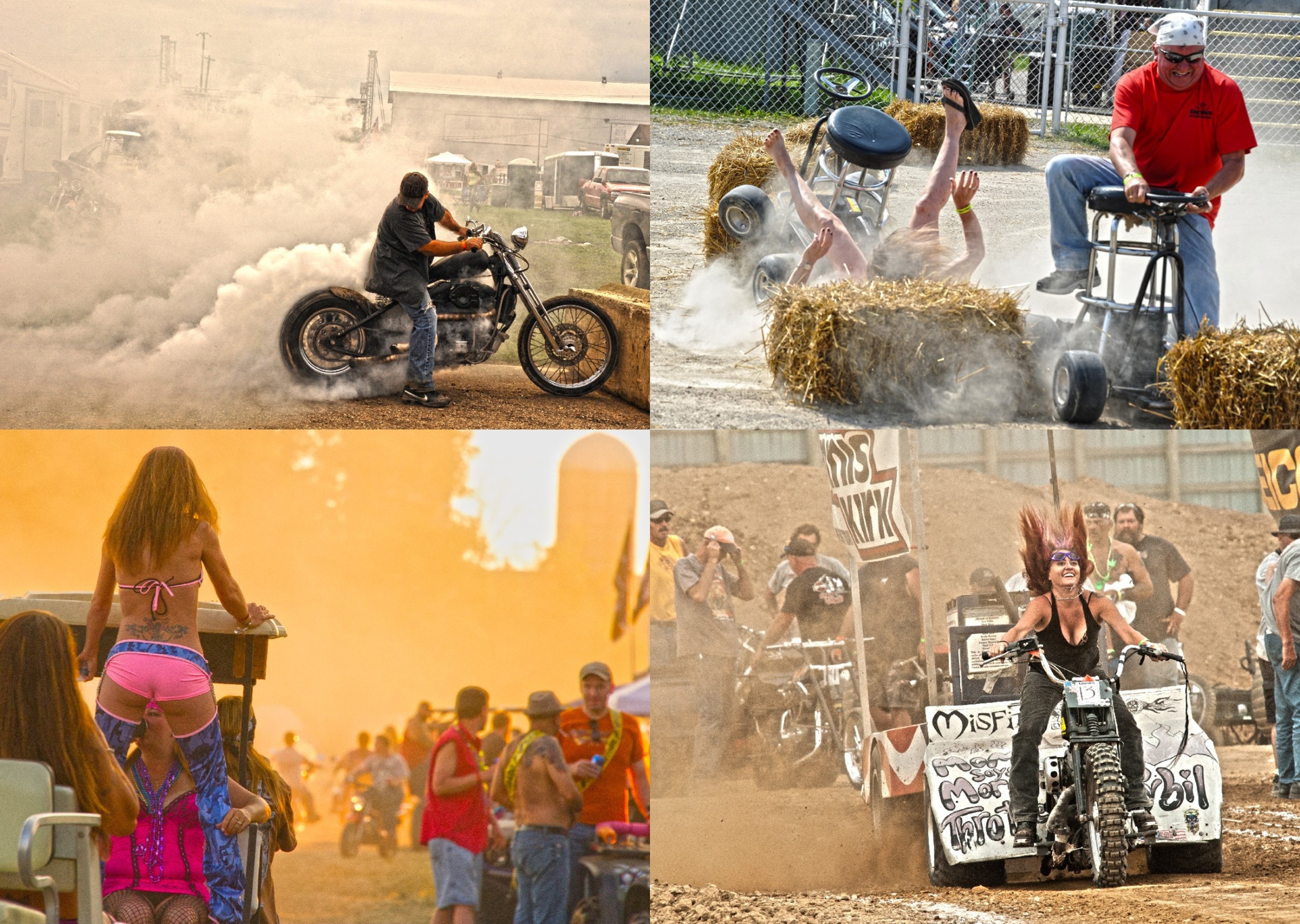
Just a few of the diversions to be seen at the rodeos.
 Photos courtesy of Easyriders Events.
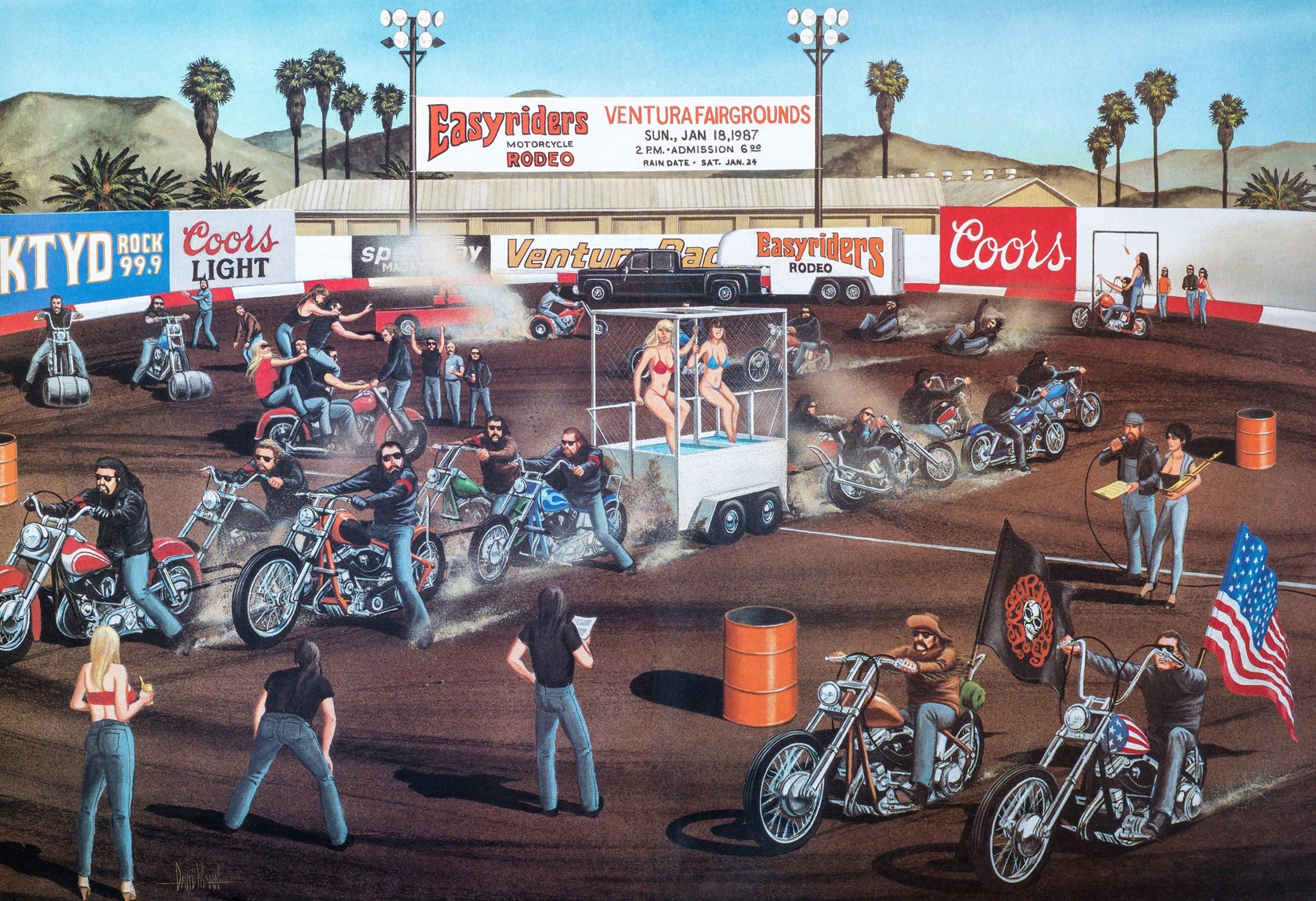
Those of us who were fans and collectors of David Mann‘s art were pissed that some of his monthly centerfold paintings were nothing more than advertisements for Easyriders events like the rodeo….
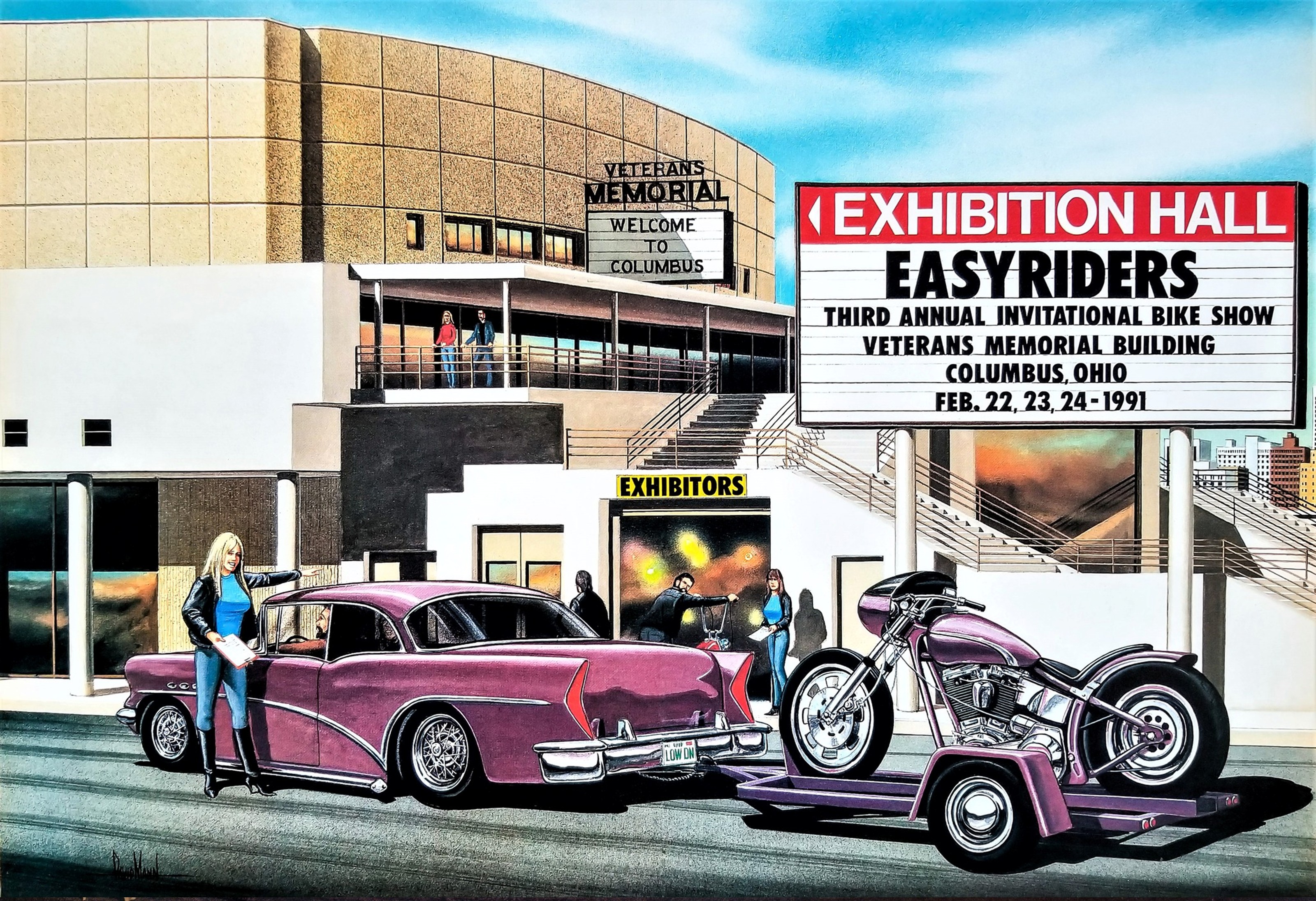
….or an Easyriders Invitational Bike Show. We didn’t appreciate seeing our favorite artist pimped out this way.
  Centerfold images courtesy of the author.
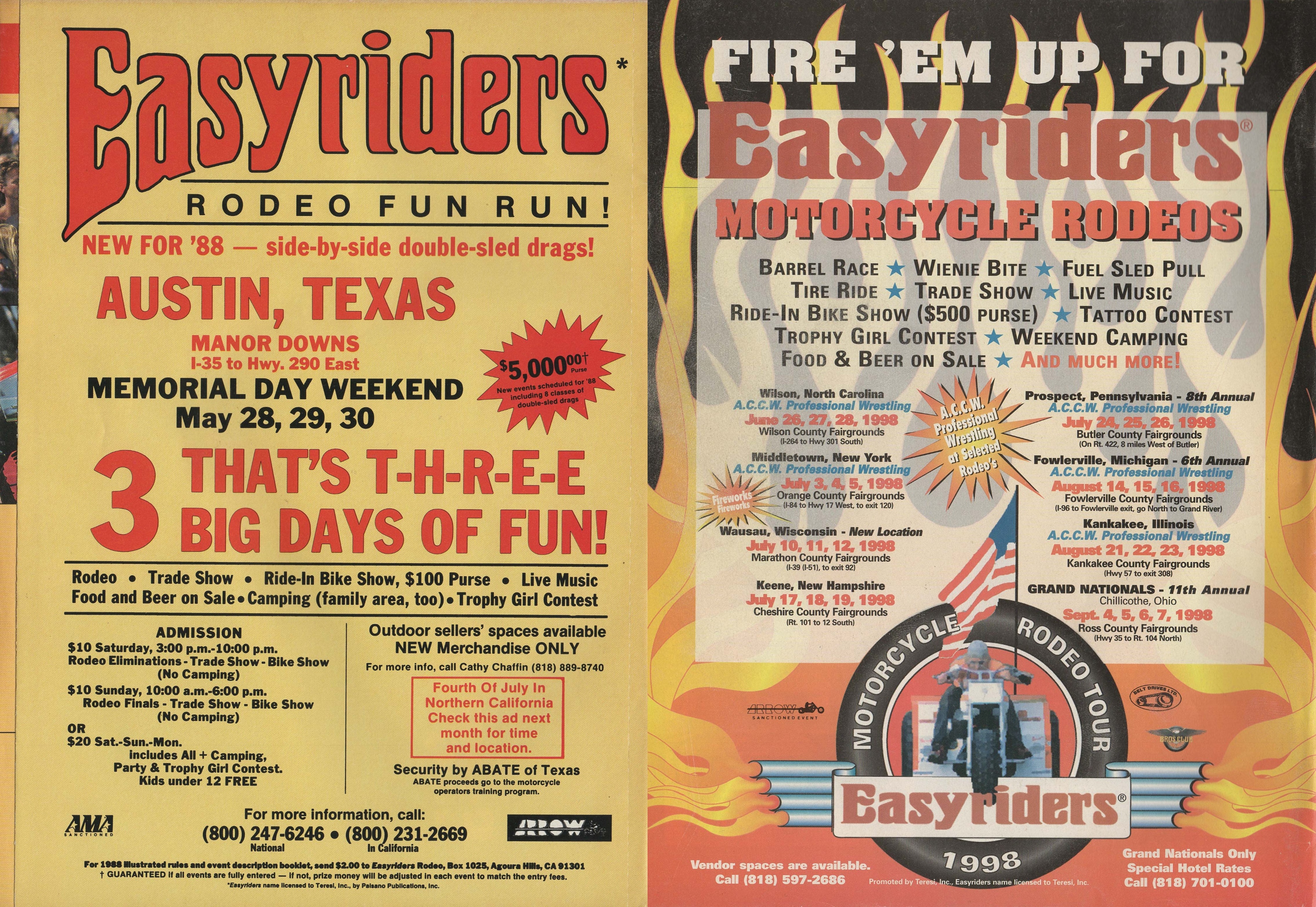
Adverts for upcoming Easyriders Rodeo events in Easyriders (June 1988) and Biker Parties (Summer 1998). I’ve done some event production and coordinating, and that slate at right looks like a damned grueling schedule.
Image courtesy of the author.

DEATH OF THE DREAM

Some say it was overreaching that killed Easyriders, but I have a different theory.

For decades, Easyriders remained the ‘biker rag of record’, in part because it was as ‘biker’ as any of its readers: tough, take-no-bullshit and ready to rock. However, that brutal bastard, time, and the harsh realities of print publishing eventually took their toll.
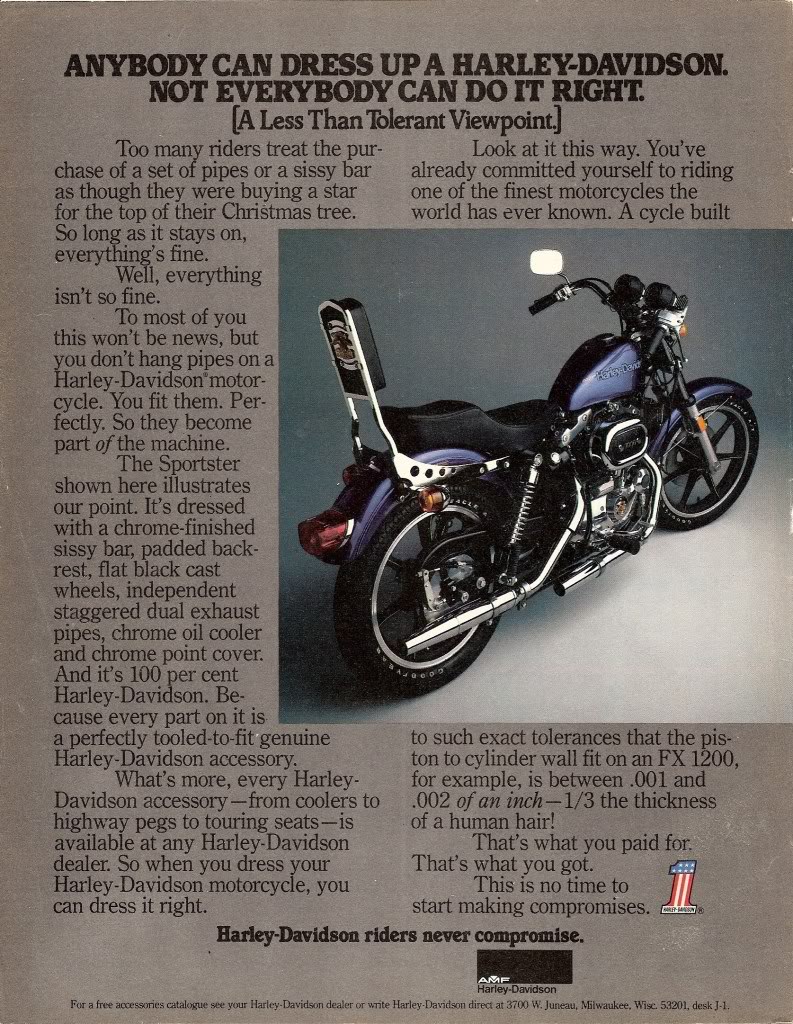
The first advert for Harley-Davidson appeared in the magazine’s April 1978 issue
Image courtesy of the author.

For instance: at its onset, the magazine’s editors swore they would never be beholden to any corporate master, and hence would never accept advertising from the Harley-Davidson Motor Company or its dealers. They held out for seven years, but ultimately the money was too good.
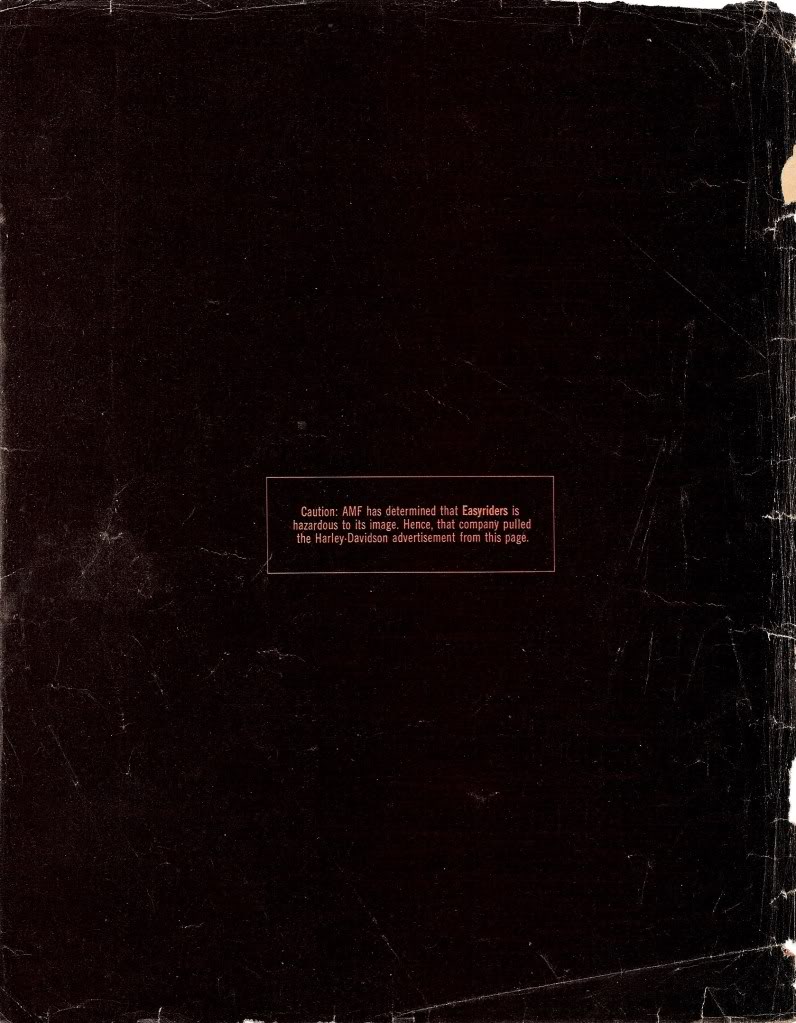
However, three issues later, the MoCo had a change of heart. They yanked their full-page advert at the last moment. Easyriders‘ editors responded with the black box page above.
Image courtesy of the author.

They also vowed they would never do new bike reviews or test rides. They eventually did….
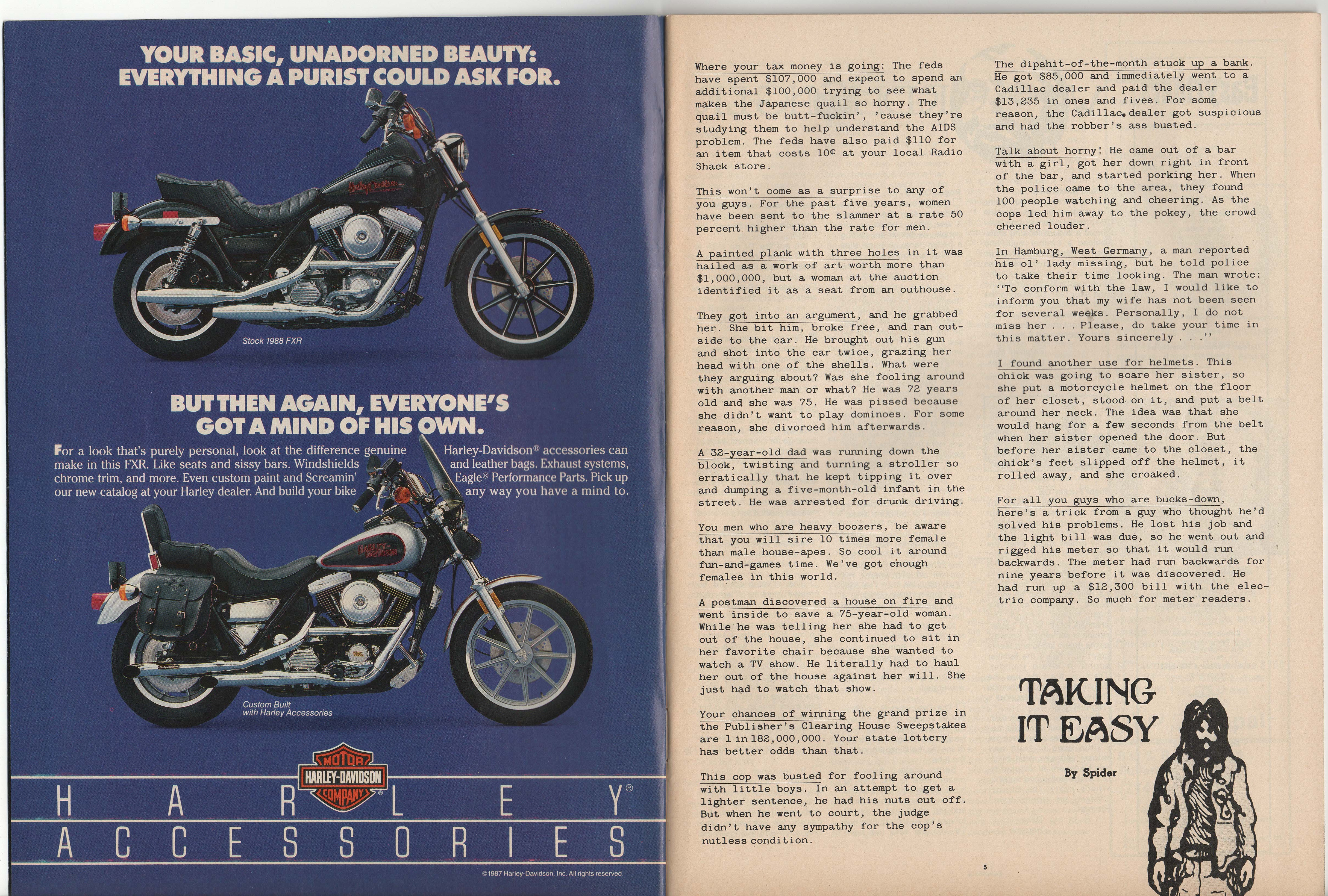
 However, a few years later, both sides had become more ‘accommodating’, and HD adverts were a regular feature. In fact, as seen here in the November 1988 issue, they were actually cozying up to Spider’s politically incorrect Taking It Easy column!
 Image courtesy of the author.

Very few magazines can survive on subscriptions alone. The money had to come from somewhere. I’m sure the magazine’s publisher shrugged and said ‘Well, why not the MoCo?’ 🤷🏻‍♀️

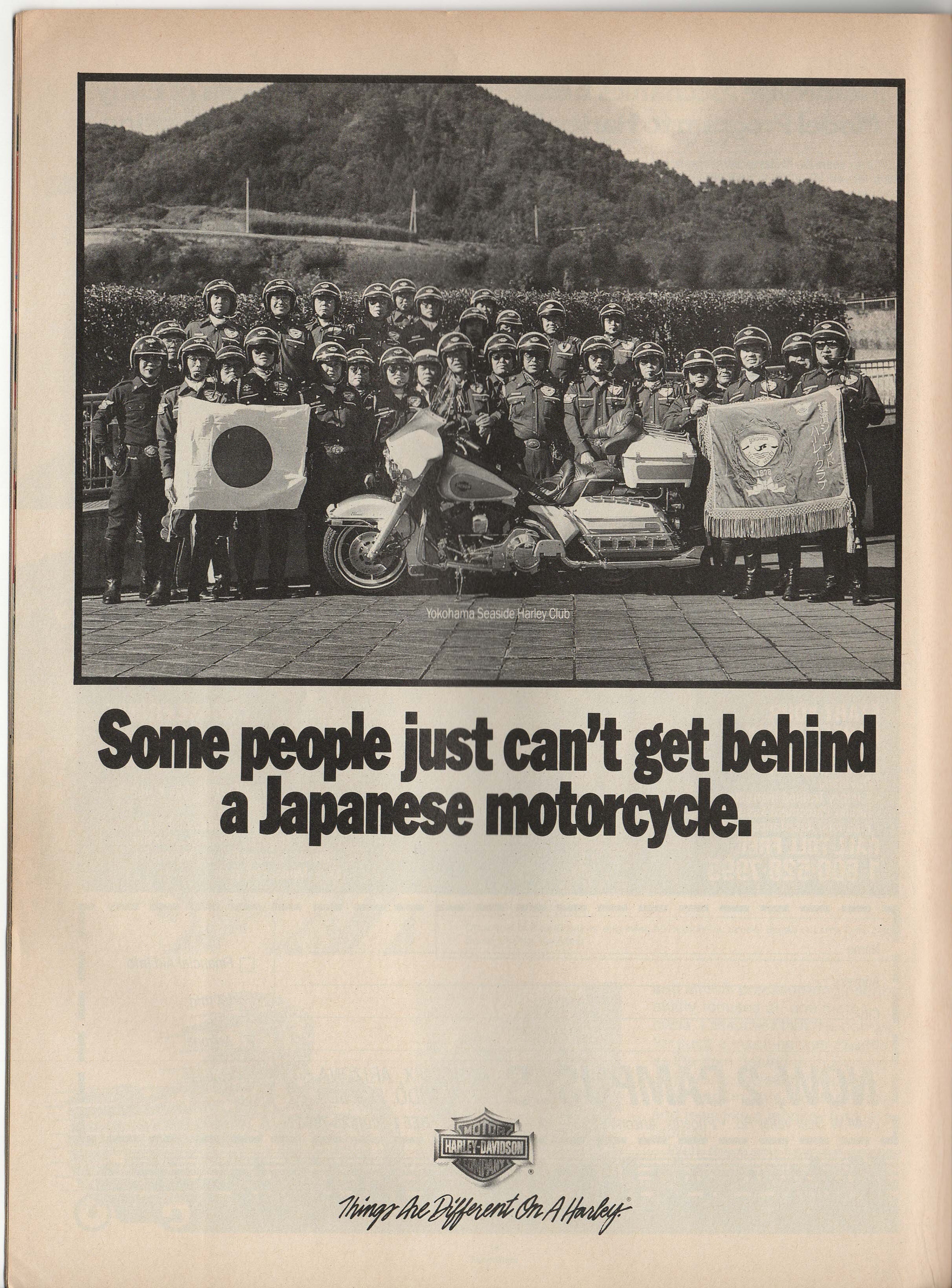
This appeared in the Easyriders issue of June 1988. Not only was it an advert for the Harley-Davidson Motor Company, but the ad features a fully dressed ‘bagger’ and rows of neatly uniformed club members, looking like motorcycle patrol officers! 😮 That’s a loooooong way from the chopper esthetic and hardcore biker ‘tude the magazine touted in early years.
Image courtesy of the author.

The Motor Company has offered riding gear from its earliest days, but when AMF (American Machine & Foundry, best known as the primary outfitter for bowling alleys) merged with Harley-Davidson in 1969, more effort was made to market ‘stylish’ clothing. Imagine leisure suits of sky-blue suede (seriously!) and his-and-hers t-shirts and jackets. When the two companies split again in 1981, marketing began in earnest, and Motorclothes was born. Old-school riders grouse that Harley dealerships look more like fashion boutiques nowadays. A common plaint is They used to hate us. Now they want to BE us!

They’re not wrong.

During the AMF years, Harley-Davidson struggled to counter the outlaw persona many street bikers affected: the long hair, beards and tattoos, black t-shirts, ragged jeans and greasy leather. Dealers refused to serve ‘chopper riders’ or work on modified motorcycles, and corporate headquarters demanded that dealers spruce up their premises and run off the undesirable Easyriders element. Austin’s own Austin Motorcycle Company, a family-owned franchise since the 1920s, surrendered its franchise in the late ’70s rather than comply with the Motor Company’s demands.

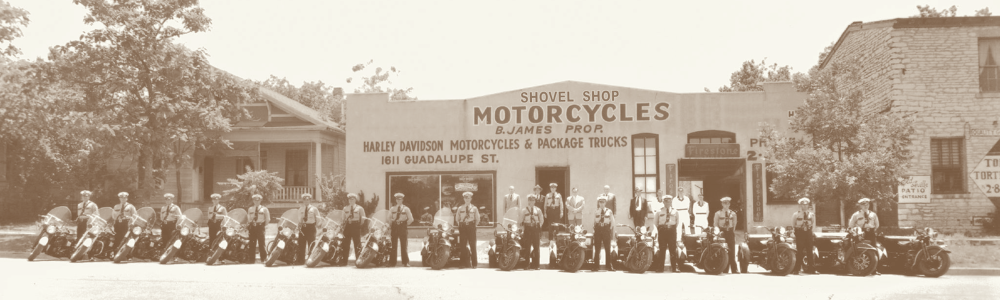
Austin Motorcycle Company, Austin’s premiere Harley-Davidson dealership, fell victim to corporate paternalism when owner Dan James (no relation, sadly) refused to upgrade his dusty old shop in the heart of downtown, or run off the ‘disreputable element’ that formed his customer base. Killeen auto dealer Ace Connell picked up the franchise Dan dropped, and a new, more-palatable dealership was opened on the city’s north side. Austin Motorcycle Company puttered along as an independent shop until Dan passed away in 1980. Two of his employees attempted to keep the shop going after Dan died, but soon moved on to other pursuits, and the shop faded into history.
 Image sourced from internet.
An advert for Harley-Davidson’s own clothing line, appropriately titled Motorclothes.
Image courtesy of eBay seller Vintage Variety 60.

However, the MoCo’s new owners – most former executives of the AMF-owned division – recognized a cash cow when they saw one, and Motorclothes stores and catalogs were soon teeming with fashions aping the look of those hardcore bikers HD once shunned. Witness their willingness to have their advert placed right beside Spider’s crude, frequently misogynistic column.
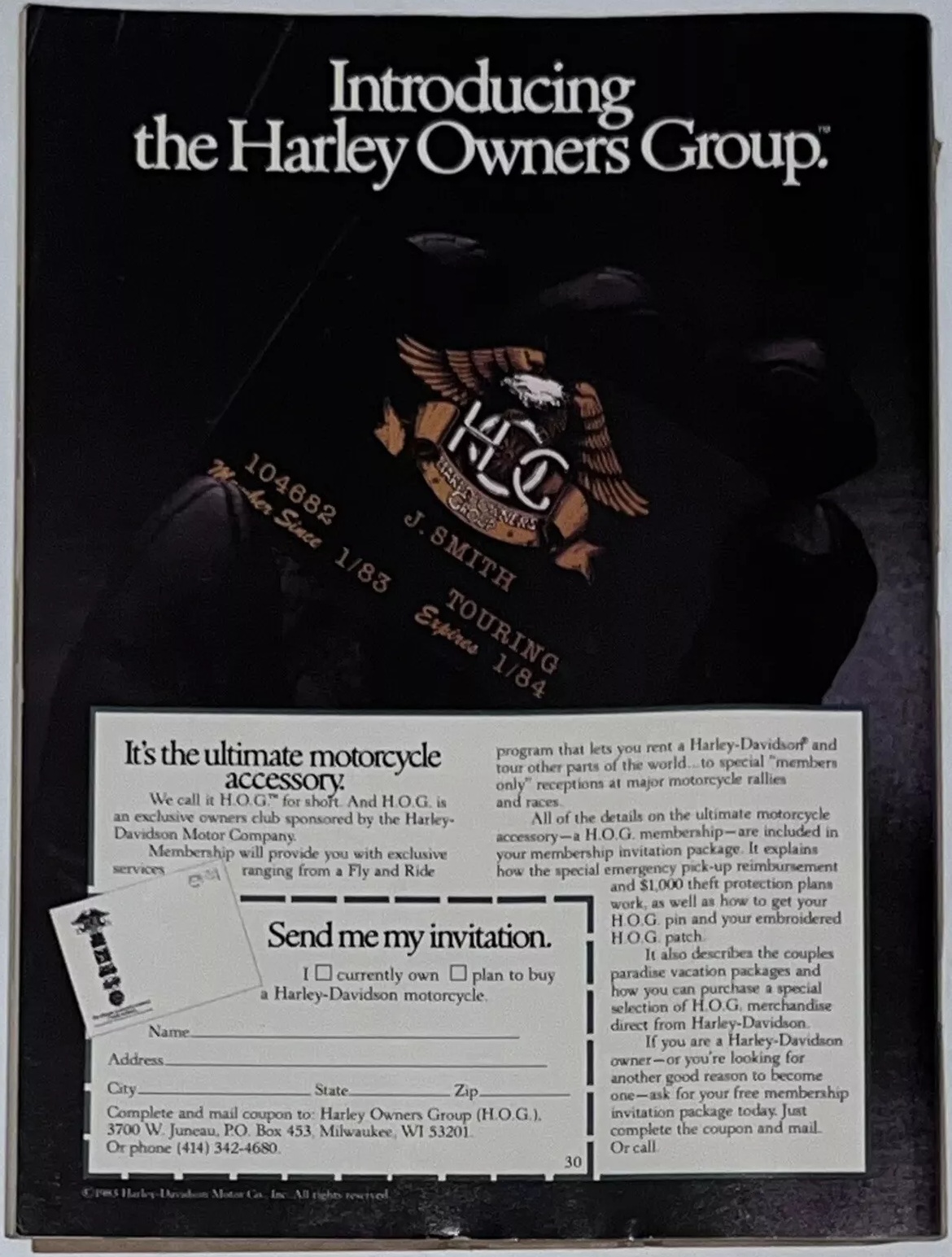
A Harley-Davidson advertisement for their ‘Harley Owner’s Group’ – a ‘motorcycle club’ with no membership requirements other than a wallet fat enough to afford a Harley-Davidson motorcycle – in the July 1983 issue. If you recall, the magazine started out catering to members of actual motorcycle clubs. They may as well have been peddling Sons of Anarchy fanwear!
 Image courtesy of eBay seller M&M Media and More.

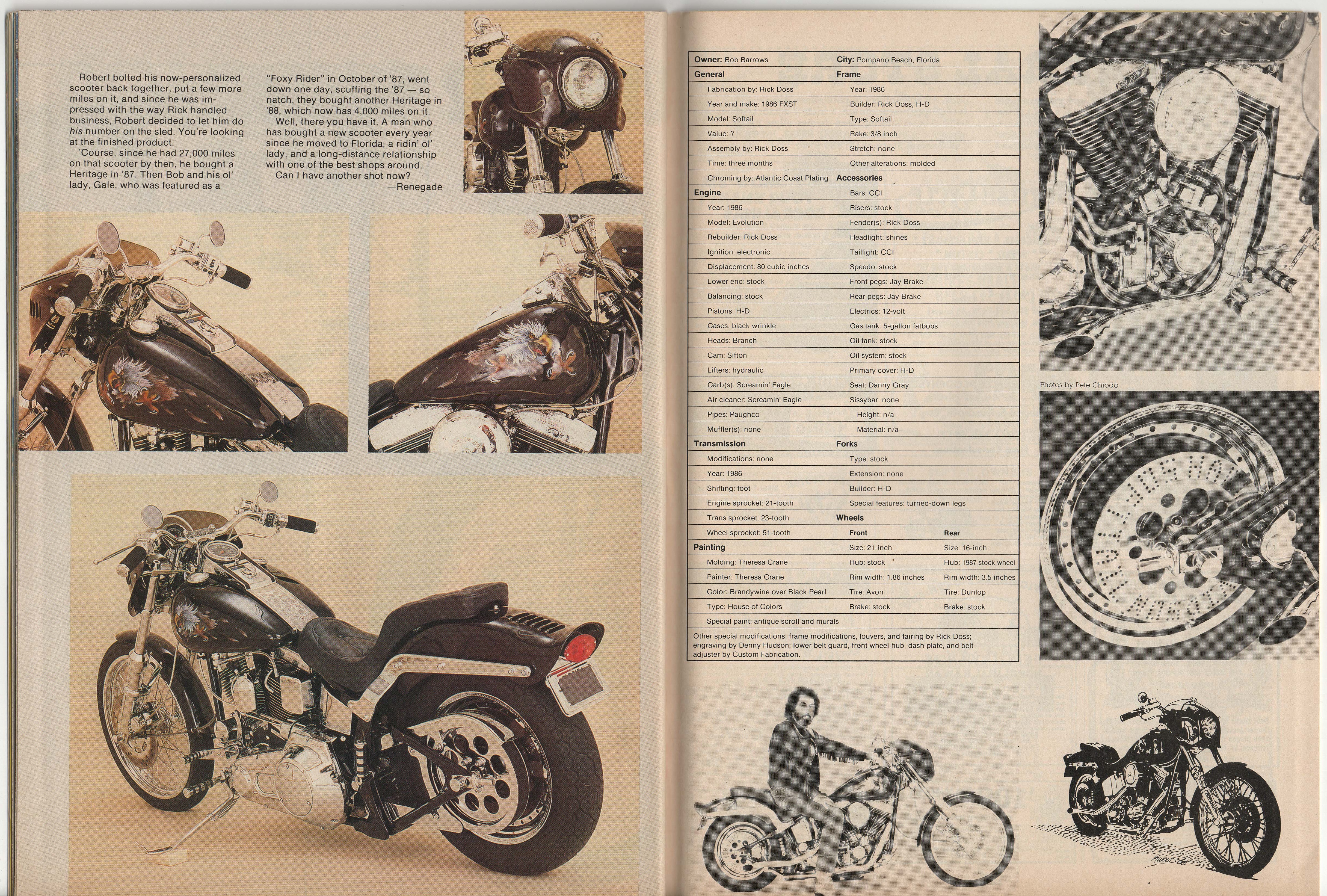
….but it was the publishers’ abandonment of the outlaw ethos upon which the magazine was founded (see Harley Owner’s Group advert, above, for example) that hurt the magazine the most. Gone were the grungy patchholders and those generous four-page features on the radical chopper some hardworking Harley lover crafted in a drafty garage with nothing but sheet metal, a crackerbox welder, swapmeet parts and bleeding knuckles.
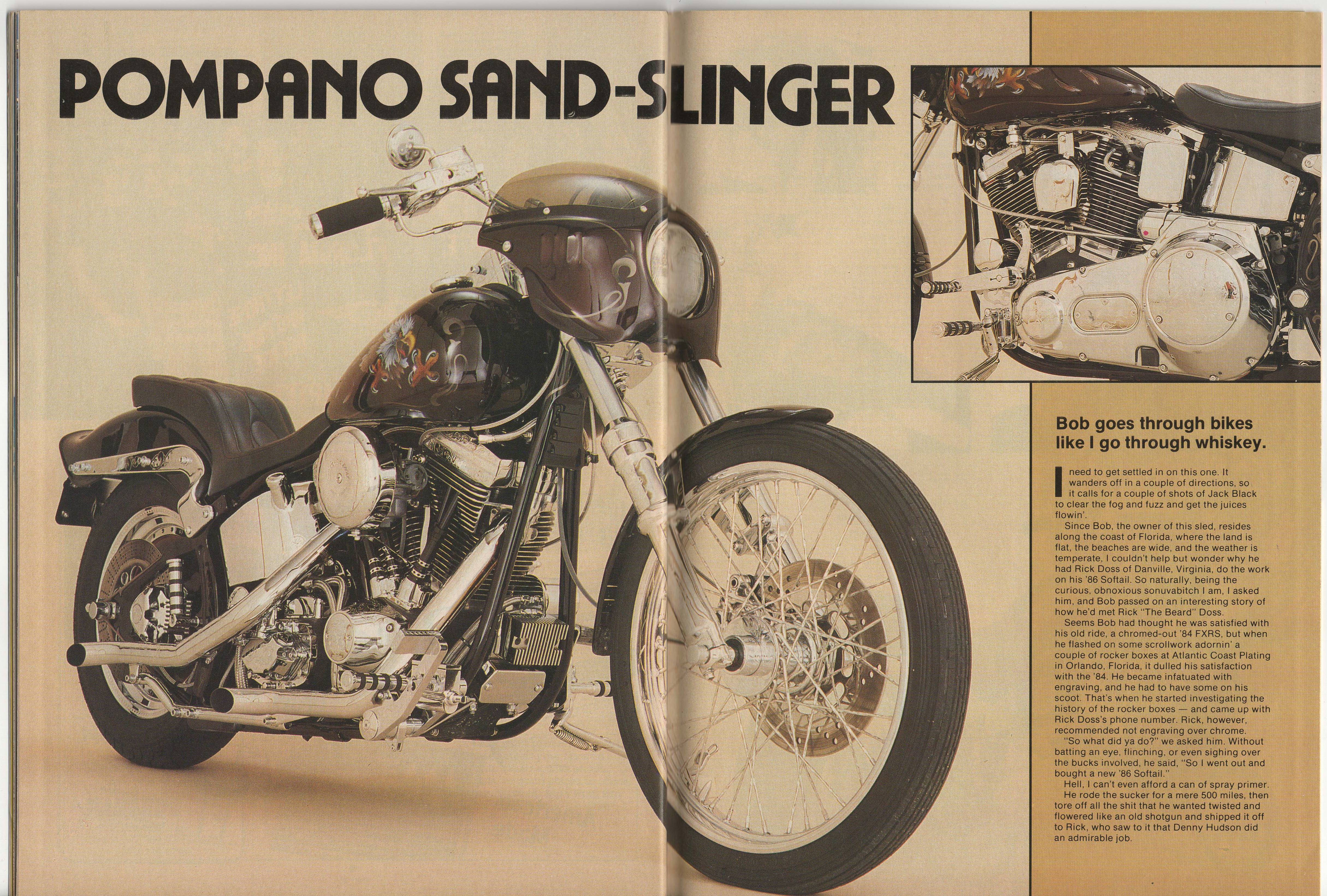
That ain’t no chopper, baby! Worse still, look at the spec sheet below. The owner hired out every aspect of the work on the thing. 🙄 This appeared in Easyriders # 181, in July 1988.
Images courtesy of the author.

In their place were Harley owners posing with made-to-order machines (see above) that they’d purchased in a shop and paid someone else to customize: ‘RUBs’ and ‘Rolex Riders’ who wouldn’t be caught dead mingling with the street bikers who made the magazine what it was. Builders like Arlen Ness and Rick Doss and pseudo-clubs like the Hamsters were given loads of press, with photos and glowing articles. Meanwhile, old school builders’ efforts were relegated to a tiny spread titled ‘Readers’ Rides’. No one seemed to remember or care that, back in the day, featured bikes were all ‘Readers Rides’! 🙄

A ‘Reader’s Ride’ from Easyriders, July 1988
Image courtesy of the author.

Gone, too, were the women we loved: those hardcore biker gals and dewy-eyed fender bunnies who brightened the pages of every issue. They were replaced by polished, airbrushed professional models who had obviously never been near a motorcycle until the photographer hired them for a shoot. These were women wearing too much makeup, ridiculous high heels that had no place in the rough-and-tumble biker’s world, and…. and…. they just weren’t our people. 🤷🏻‍♀️

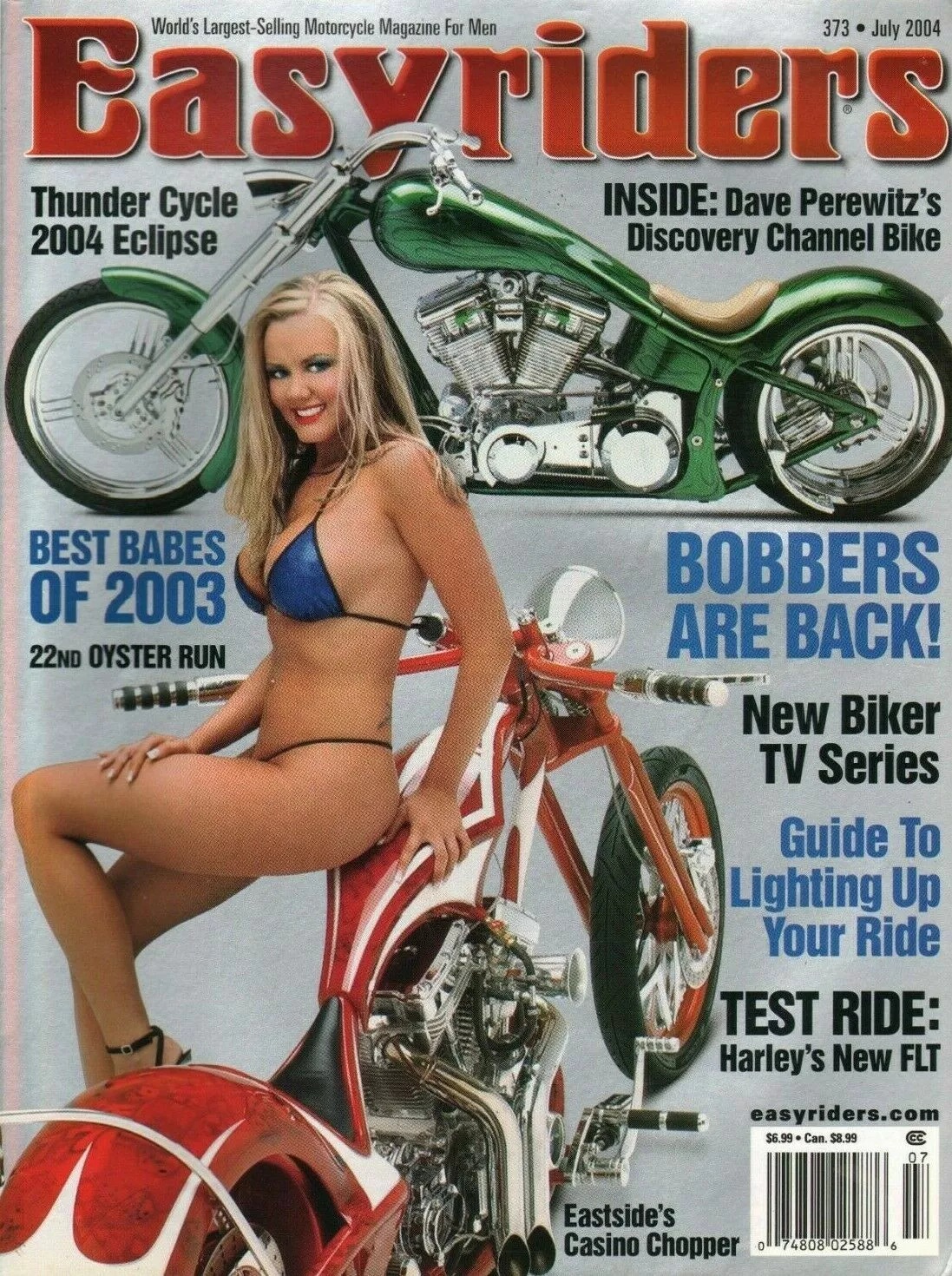
Compare this cover, from 2004, to the covers of earlier issues, circa 1970s and ’80s. A little ‘different’, yes?
 Image courtesy of eBay sellers Gallimore’s Goods.

Easyriders went under in 2019, after almost a half-century in print. As noted above, its quality and integrity had waned considerably in its final decades, even as print publications in general were hemorrhaging readership, so few longtime adherents mourn its passing. However, an upscale clothier has acquired and is attempting to revive the title as a ‘less trashy’ and ‘more inclusive’ publication. Some wag described it as ‘GQ for Bikers,’ but I think Easyriders beat them to the punch with VQ. 🙄

I’ve only seen two issues of the ‘new’ Easyriders and am thus far not impressed. 🤷🏻‍♀️

Original since 1970? 😮 I don’t think so! That’s like Indian claiming they are ‘the oldest American motorcycle manufacturer’. The revivalists — Indian and Easyriders alike — bought a name and nothing more. No lineage connects either venture to the originals, and it annoys me to no end when they cavalierly claim lineage and longevity they have not earned.
 Image sourced from internet.

FOOTNOTES

1) R.I.C.O. (Racketeer Influenced and Corrupt Organizations Act of 1970) was written for use against organized crime outfits like the Mafia, but prosecutors quickly realized it had implications far beyond that narrow aim.

For instance, federal prosecutors used R.I.C.O. to go after board members deemed responsible for the Savings and Loans crisis of the late 1980s and early 1990s. One unique feature of R.I.C.O. was that it permitted civil as well as criminal prosecutions. Civil trials require a less stringent burden of proof than criminal trials and, with R.I.C.O., prosecutors could seek triple the estimated damages of any violation. Hapless board members of S&Ls found themselves in court, targeted not because they were guilty but because they had the deepest pockets.

R.I.C.O. was also used to prosecute Hells Angel spokesman Sonny Barger and other members of the Oakland HAMC chapter. However, the fed’s case collapsed when they were unable to prove a ‘pattern of behavior’, or link the alleged illegalities to club policy. Barger, et alia, walked free, leaving prosecutors red-faced, frustrated and bitter.

Sonny Barger around the time of the R.I.C.O. prosecution. He dodged the R.I.C.O. case, but did time for other offenses. He emerged from prison even more a celebrity than when he went in, and turned to cashing in on his notoriety with books, a movie, and public appearances around the world.
 Photo courtesy of the author, from Supercycle Magazine‘s interview with Barger.

2) A.B.A.T.E. was alternately styled ‘American Bikers Against Totalitarian Enactments’ or ‘American Bikers Aiming Toward Education’. Both monikers applied. The group did fight against mandatory helmet laws, and laws restricting the customization of motorcycles, as numerous states enacted laws regulating seat and handlebar heights, requiring chain guards and front fenders, even mandating the length of rear fenders and the height of sissybars.

However, the group also fought for motorcycle rider education, to train new riders in street survival skills, and driver awareness campaigns to make motorists more aware of (and, it was to be hoped, more respectful of) motorcyclists in traffic.

I acted as State Awareness and Safety Coordinator for A.B.A.T.E. of Texas. In that capacity, I developed and spearheaded a statewide billboard campaign, and helped promote a tripart Safety and Awareness Rally which gathered motorcyclists together in three cities across Texas, to raise awareness of our cause. As a state officer for A.B.A.T.E., I was also involved in efforts to bring mandatory rider education to the state, and create a statewide training program for novice cyclists and the instructors who would train them. In my spare time 😆 I also edited the group’s newspaper, and designed a number of popular fundraising t-shirts.

Our billboard campaign, using no-cost or low-cost Public Service Announcement space provided by billboard companies like Duplex Advertising Company of Temple. Left to right, from top left: a) State Director of ABATE Texas, H.E. ‘Sundance’ Mitchell, at the press conference we held at the site of our very first billboard. b) Your humble narrator speaking at an ABATE State Members’ Rally in Llano, Texas. c) The stage at Llano, backstopped by one of our new full-color billboard posters. d) Our second billboard, on US Highway 190 west of Belton, Texas. e) Our first billboard location, on IH35 in Temple, Texas. f) It didn’t take long for the Texas Department of Public Safety‘s Motorcycle Safety Bureau to horn in on the act, stealing our headline and the billboard space we’d previously occupied.
 
Photographs courtesy of the author.
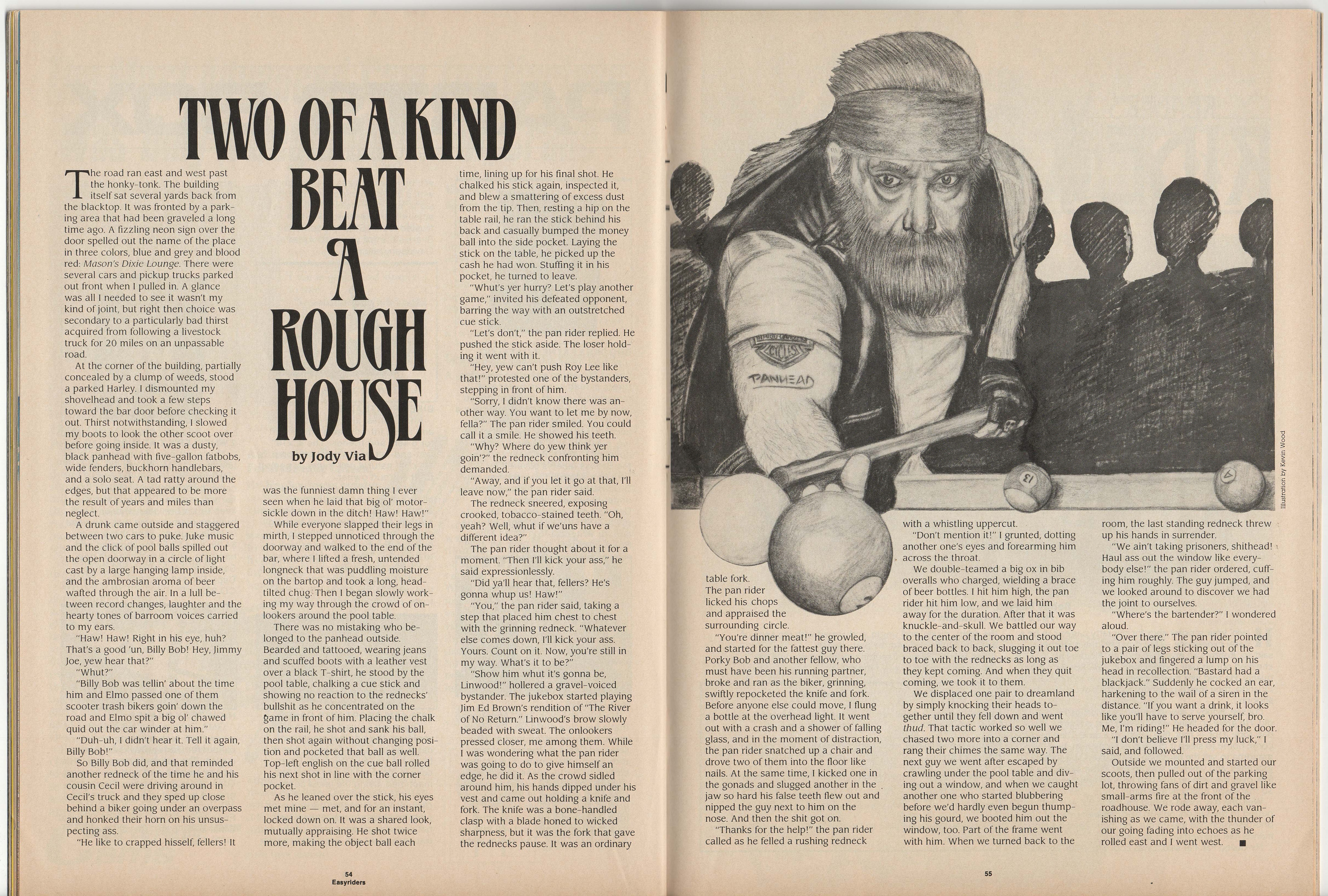
A Jody Via short story from Easyriders # 181, July 1988. Not his usual crime story as referenced below; just a quick yarn about a good ol’ fashioned beer-joint punch-up between two bikers and a room full of rednecks. Tropes and stereotypes ooze off the page. The bikers are brave, take-no-shit nomads: strangers until the fist started flying but brothers in arms in the heat of battle. They are, of course, outnumbered three-to-one, standing back to back against all odds, and the simple-minded, bigoted rednecks who were all bark and no bite. Here Via was simply tapping into the romanticized vision most Easyriders readers held of themselves. They were knights errant, living out the celluloid dreams of Easy Rider and Then Came Bronson in between shifts at the factory or feedlot where they earned their living.
Image courtesy of the author.

3) In researching this article, in a deep dive search for some of my favorite Easyriders writers, I unearthed the tragic tale of Jody Via. Jody was one of my faves from back in the day, capable of fashioning darkly compelling crime yarns from bolts of whole cloth….

….except that, per police, Via’s ‘yarns’ weren’t fiction at all. They say he was effectively recounting crimes he himself had committed during a murderous spree across Pennsylvania and Ohio in September, 1972, and selling them for publication!

First, we have Good Samaritan Harry Hoffman. Mr. Hoffman was a kindly gas station owner who stopped to help what appeared to be a young couple stranded at roadside. Hoffman took them back to his service station, and even made a fresh pot of coffee so they could warm up from the chill night air. For his troubles, Mr. Hoffman was bound, shot in the head and left for dead in the back room of his service station. He survived, and later identified his attacker in court.

Next, we have nineteen-year-old college student Jane Maguire, who fell for Via’s ‘stranded’ ruse and offered him a ride. Her body was discovered in a highway rest area. She had been raped, bound, shot in the head and left for dead. Sadly, Ms. Maguire did not survive.
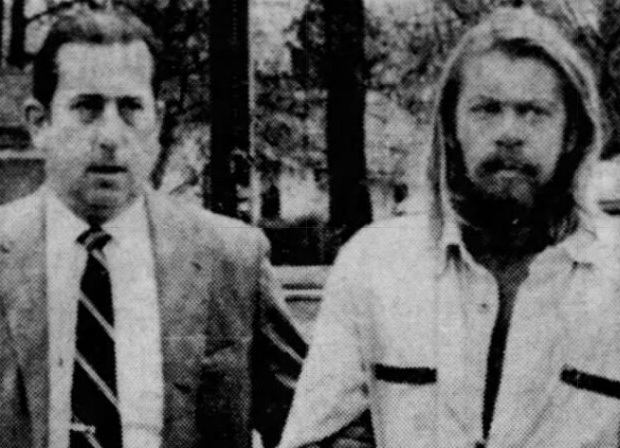
Larry ‘Jody’ Via after arrest in 1972, from Allentown (PA) Morning Call.

Via, who had holed up in his wife’s home, was arrested, charged with and convicted of the crimes, and received a life sentence. While serving that sentence, Via began submitting poetry and short stories to Easyrider, which published several of his works. He later sold some pieces to Outlaw Biker magazine, as well.
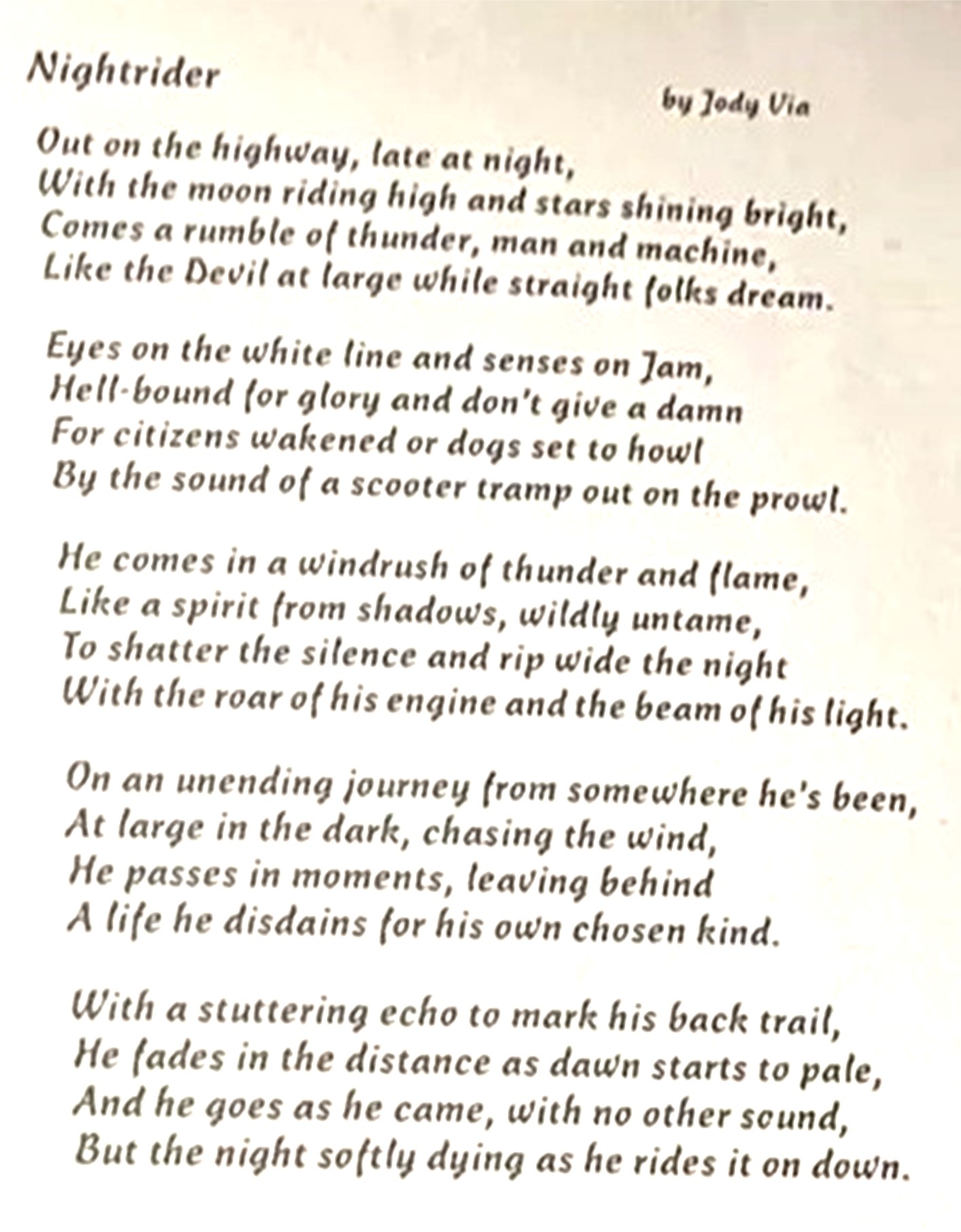
One of Jody Via’s poems appeared in Easyriders # 79, in January, 1980.
Image courtesy of eBay seller Vintage Variety 60.

However, in 2019, investigators working the September 1972 cold-case murder of twenty-nine-year-old salesman Morgan Peters, in Pennsylvania, were directed by two of Via’s ex-wives to look at Via’s published writings. There, in the stories Via sold the biker magazines, police found detailed descriptions of each of his crimes, including the as-yet-unsolved slaying of Peters. Via, still in prison for the rape and murder of Jane Maguire, was charged with Peters’ slaying in 2019. He was seventy-five years old.

I have yet to learn what became of those charges or the defendant.

Man, that took a dark turn, didn’t it? 😮
Larry ‘Jody’ Via’s alleged final victim, Morgan Peters, from the Franklin County District Attorney. May he and Jane Maguire both Rest in Peace.

ART IS ETERNAL

‘Art is eternal, for it reveals the inner landscape, which is the soul of man’
– – Martha Graham, Dancer and Choreographer – –

The very first article I ever published appeared in Easyriders, the groundbreaking magazine which was at once the LIFE, Saturday Evening Post and Reader’s Digest of the outlaw biker set. I wrote about tattoo removal – a topic I thought some readers might find interesting – after an encounter with a dermatologist at a Veteran’s Administration hospital in Hastings, Nebraska, who told me about a then-new technique for obliterating unwanted tattoos via laser. I won’t bore you with the details – the information is all woefully outdated anyway – but I ended my piece with the words

These days, even art is not eternal.’

However, barring catastrophic circumstances like the 9/11 attacks on the World Trade Center, where – in addition to thousands of lives, including my cousin Eddie – an estimated $110 million worth of art was destroyed, or the Taliban’s deliberate destruction of The Buddhas of Bamiyan, art really is eternal….

….and even those pieces lost or destroyed live on in memory.

….and all this to say ‘Hey! I got some cool stuff to show ya!’

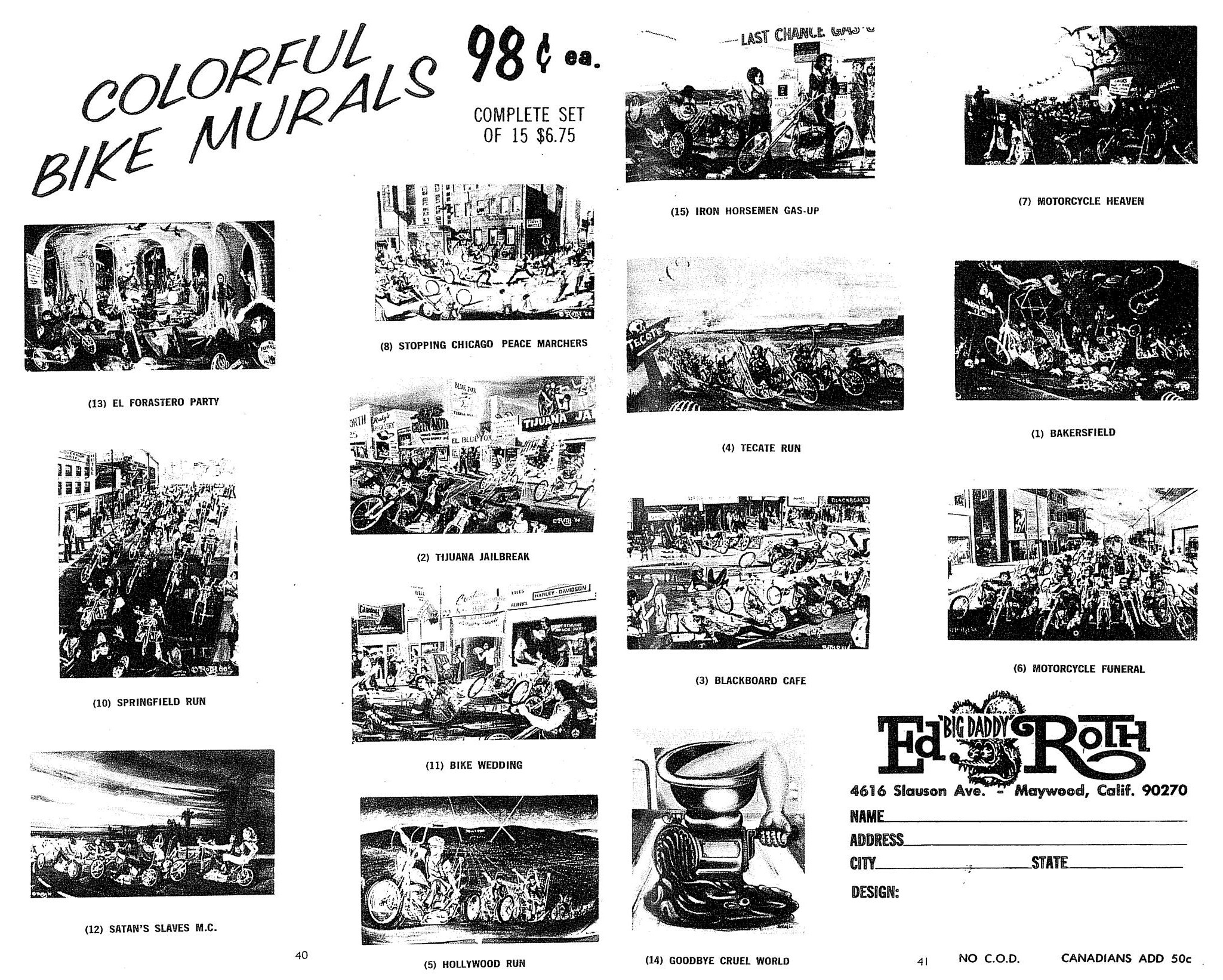
An advert for prints of Dave Mann’s earliest posters. Choppers publisher Ed ‘Big Daddy’ Roth was a wily self-promoter with a sharp eye for moneymaking opportunities. He had no problem exploiting the talents of young artists like Mann, and continued to make bank off Mann’s work long after Mann left his stable.

IN THE BEGINNING….

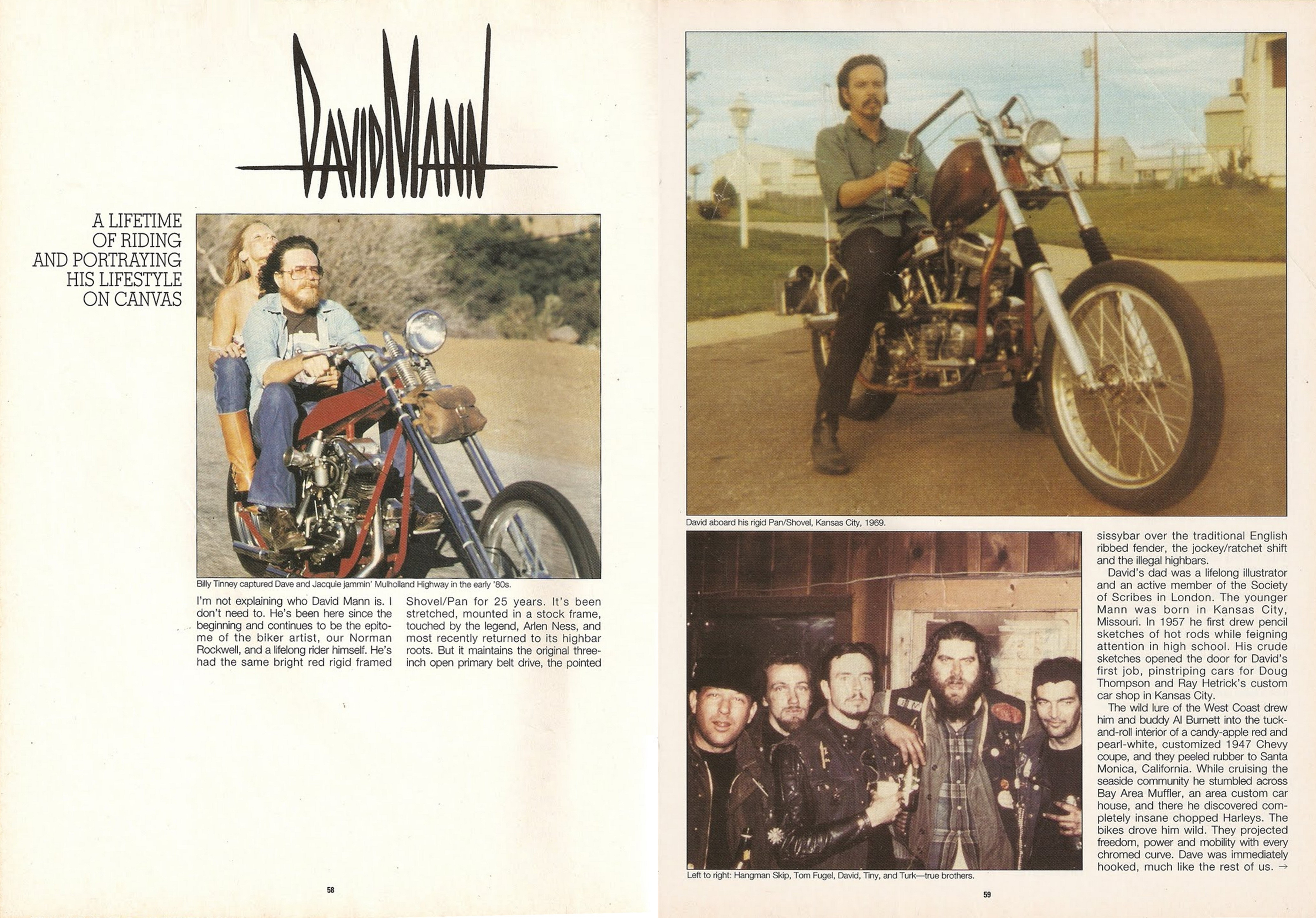
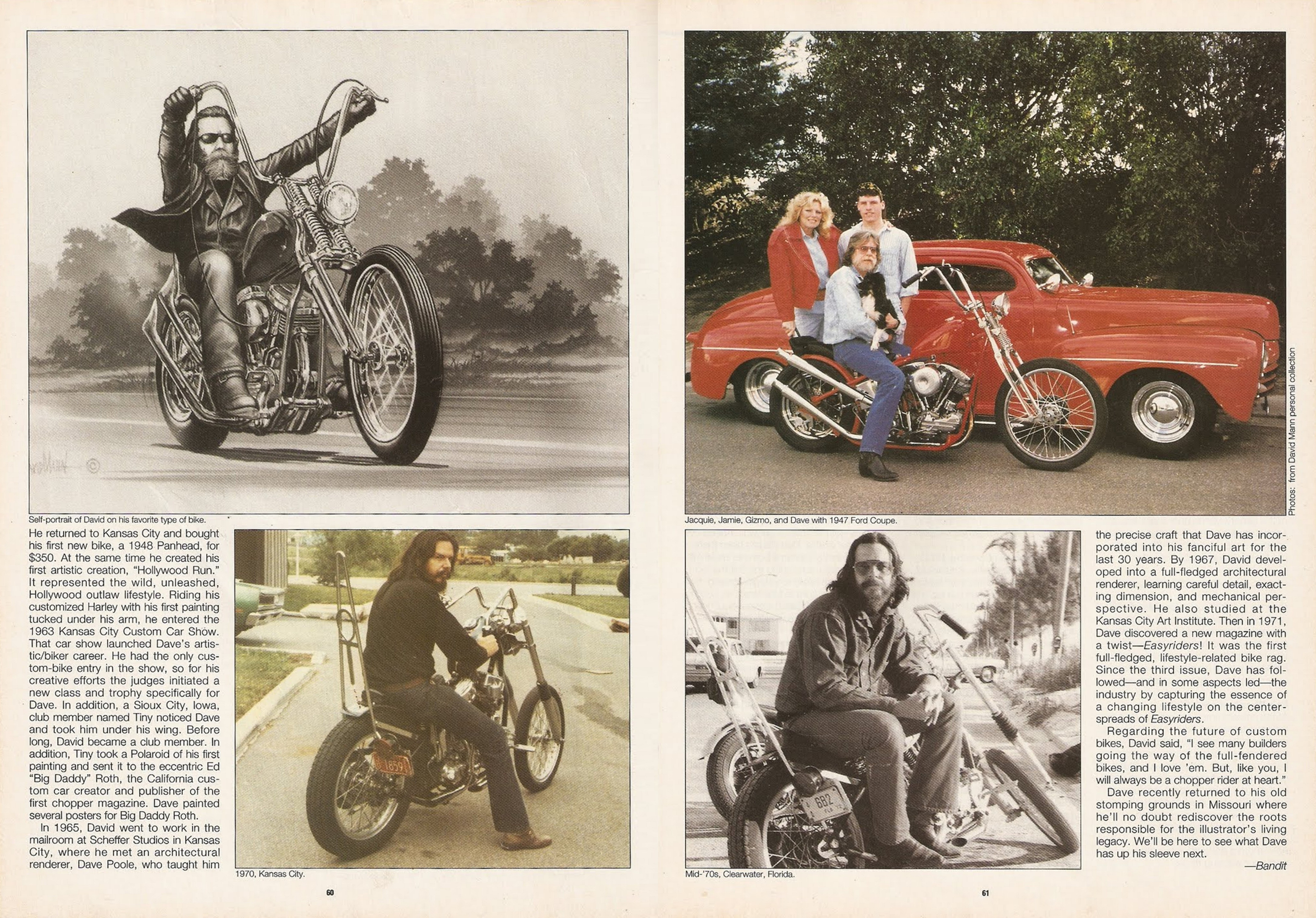
I don’t know who first attempted to paint or draw images of the biker life, but Dave Mann was certainly a pioneer. After selling some early paintings of biker life to Choppers magazine founder Ed ‘Big Daddy’ Roth (creator of the iconic ‘Rat Fink’ and a number of radically customized cars and motorcycles), Mann joined the El Forastero Motorcycle Club (forastero is ‘stranger’ or ‘foreigner’ in Spanish) as a charter member of the club’s Kansas City MO chapter.

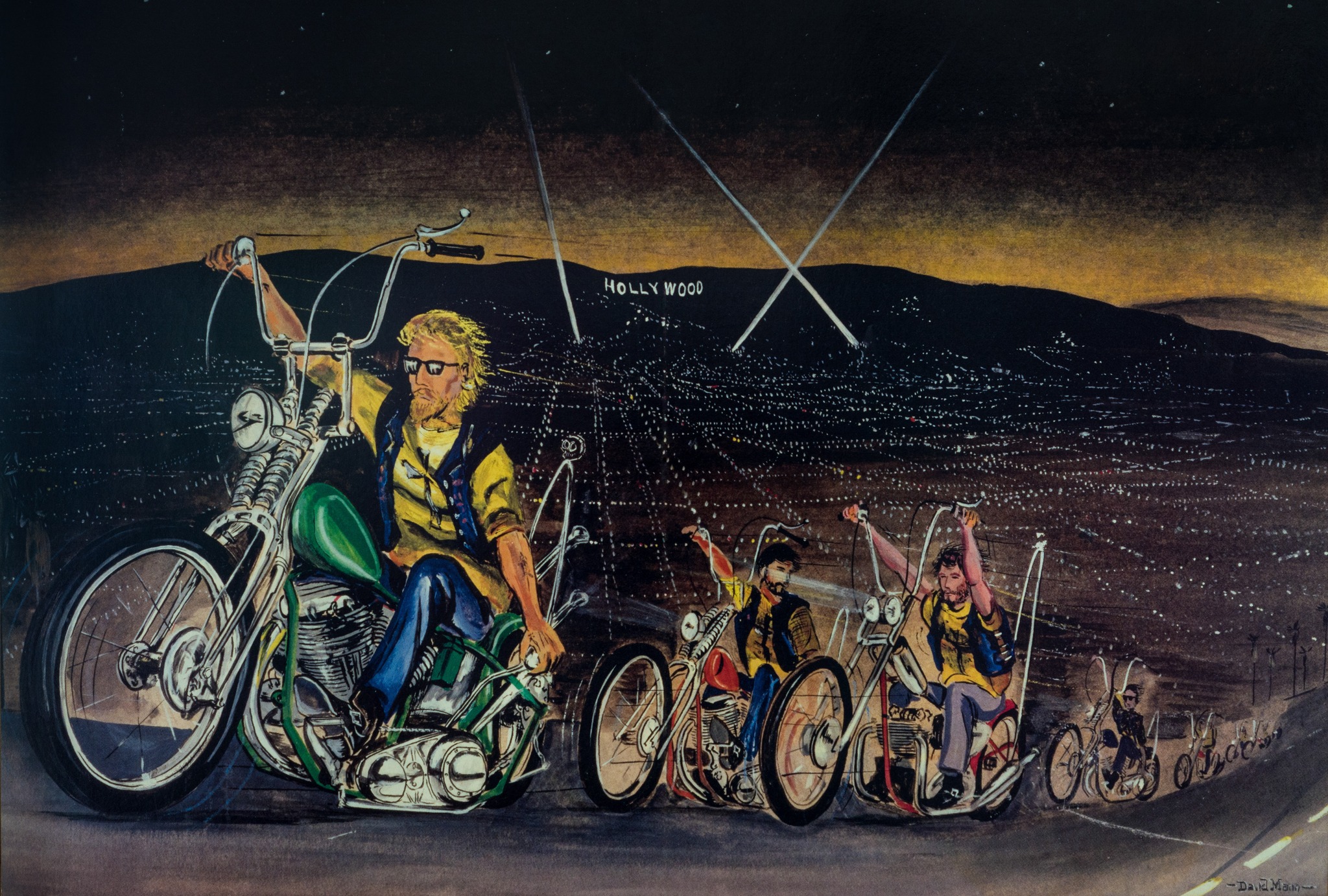
Hollywood Run was the painting Dave Mann’s friend and club brother Tiny showed to Choppers publisher Ed ‘Big Daddy’ Roth. Roth recognized Mann’s potential, quickly bought up as many of the artist’s paintings as he could, and turned them into a profitable line of posters.
Another of Dave Mann’s early paintings for Ed ‘Big Daddy’ Roth features a wild desert party populated by outlaw bikers from numerous extant motorcycle clubs of the day.
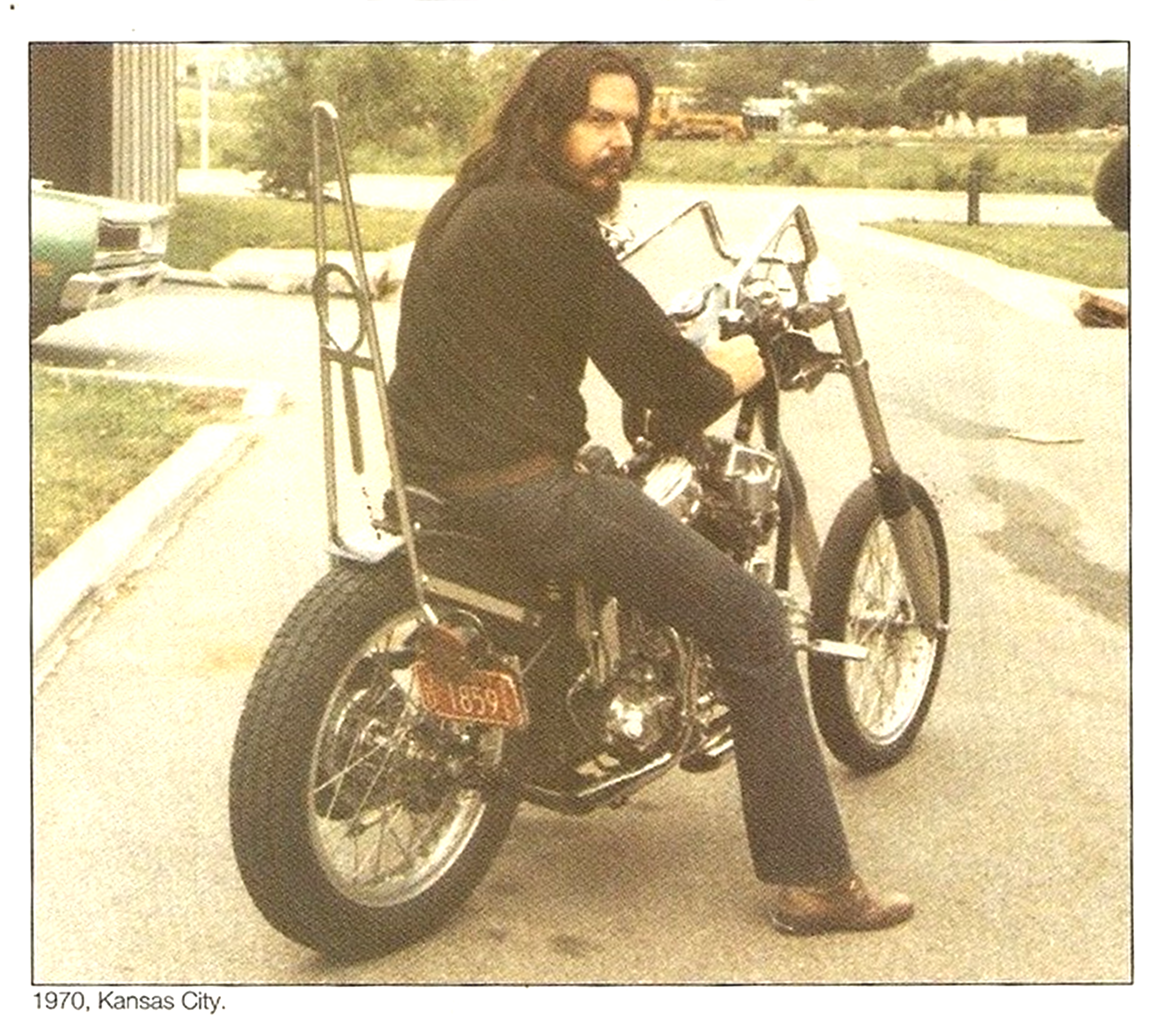
Dave Mann in 1970, aboard the panhead chopper he purchased from Hells Angels member Buzzard. BTW, Buzzard appears in Bill Ray’s book of photographs – Hells Angels of Berdoo ’65: Inside the Mother Charter (NYC, 2010, Bill Ray/Blurb) – and is mentioned in Hunter S. Thompson’s seminal work of ‘gonzo journalism’: Hell’s Angels: The Strange and Terrible Saga of the Outlaw Motorcycle Gangs (NYC, 1967, Random House)

In 1971 Mann answered an advert for a ‘motorcycle artist’, discovered in the back pages of a new biker magazine called Easyriders, and spent the remainder of his working life as in-house artist for the publication. His first centerfold painting for Easyriders appeared in October, 1971, and Mann reportedly produced artwork – centerfold paintings, story illustrations and adverts – for every issue from that first to his retirement in 2003, shortly before he passed away. His final piece, Sunset, appeared in the May 2004 issue.

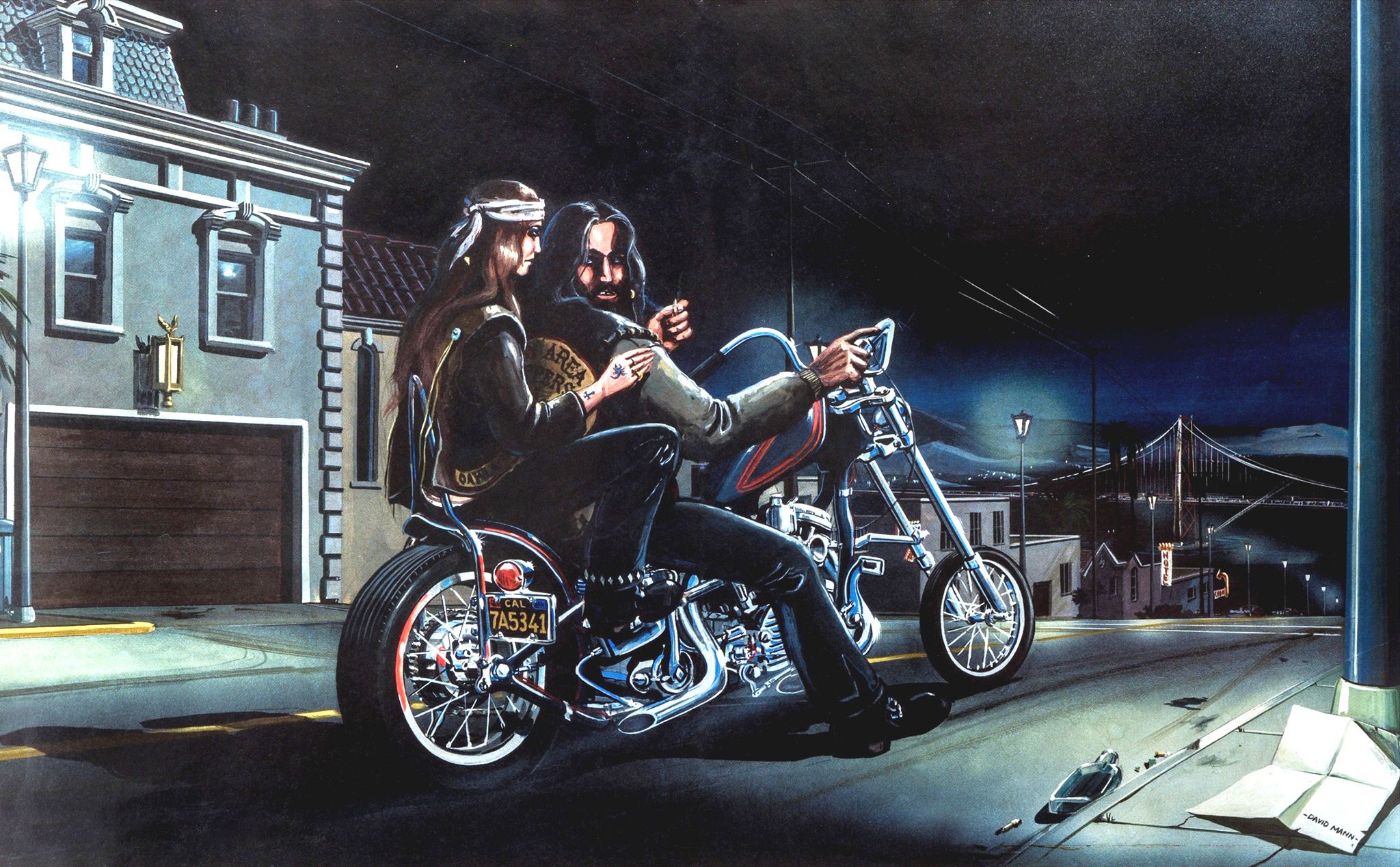
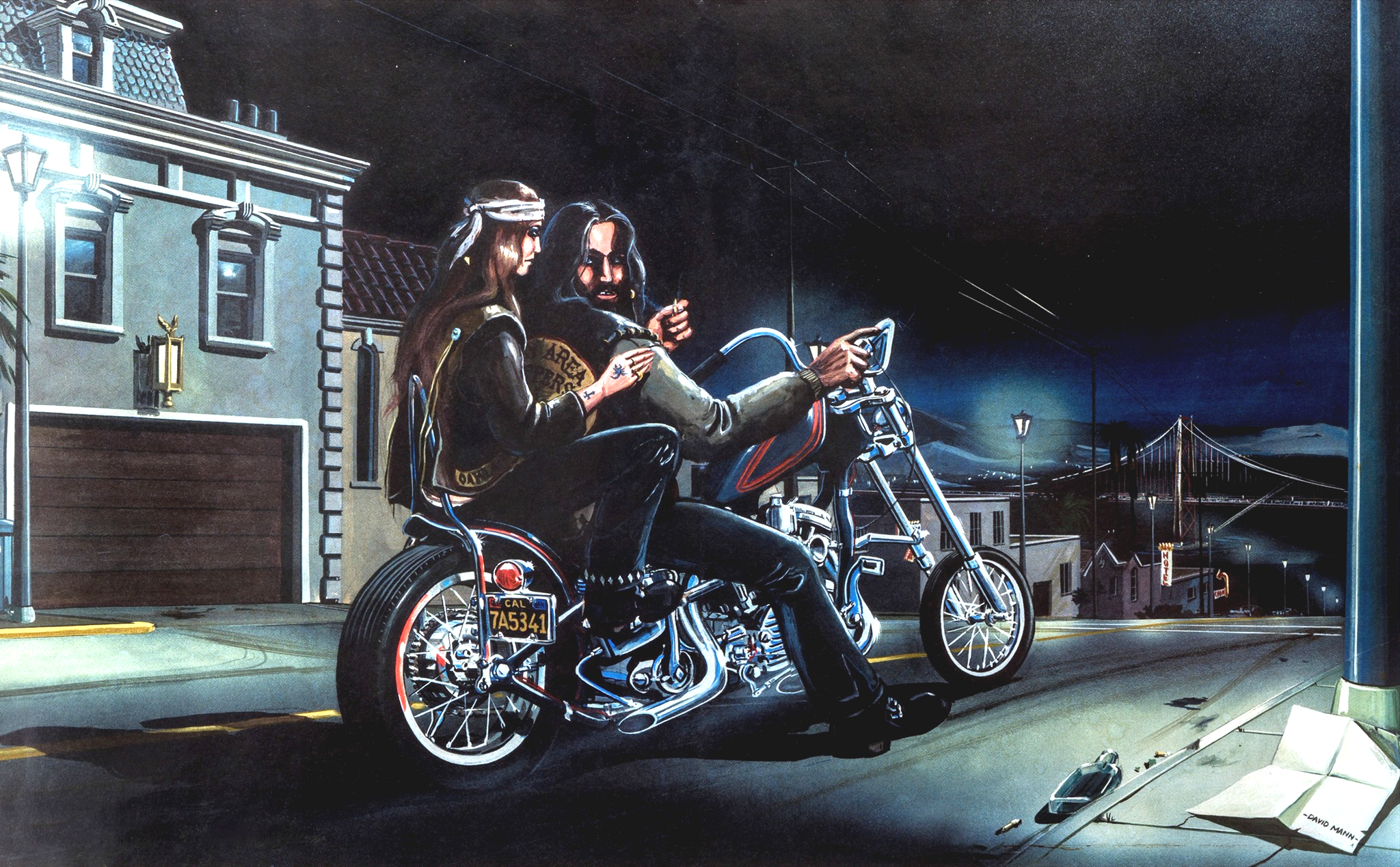
One last toke for the road. Titled ‘Frisco Nights‘ or ‘One More for the Road‘, this was Dave Mann’s first-ever centerfold for Easyriders. It appeared in the magazine’s third issue, in October, 1971. Mann reportedly created art for every issue between this and his final piece (below) published in May, 2004, along with additional illustrations for other magazines, book publishers, friends and collectors. That’s a hard-working artist!.
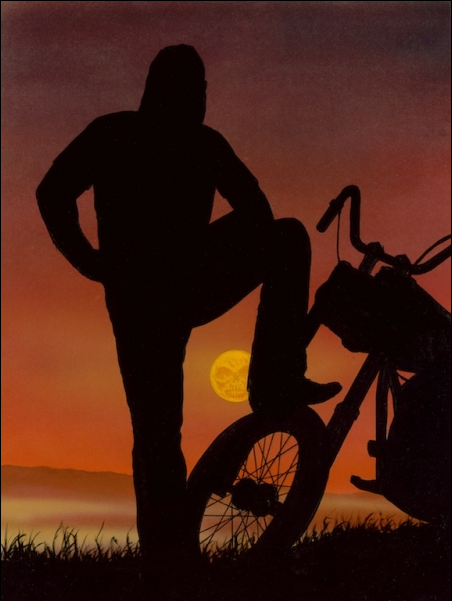
Aptly, Sunset, May 2004 was Mann’s last original piece for Easyriders.

REPRESENT!

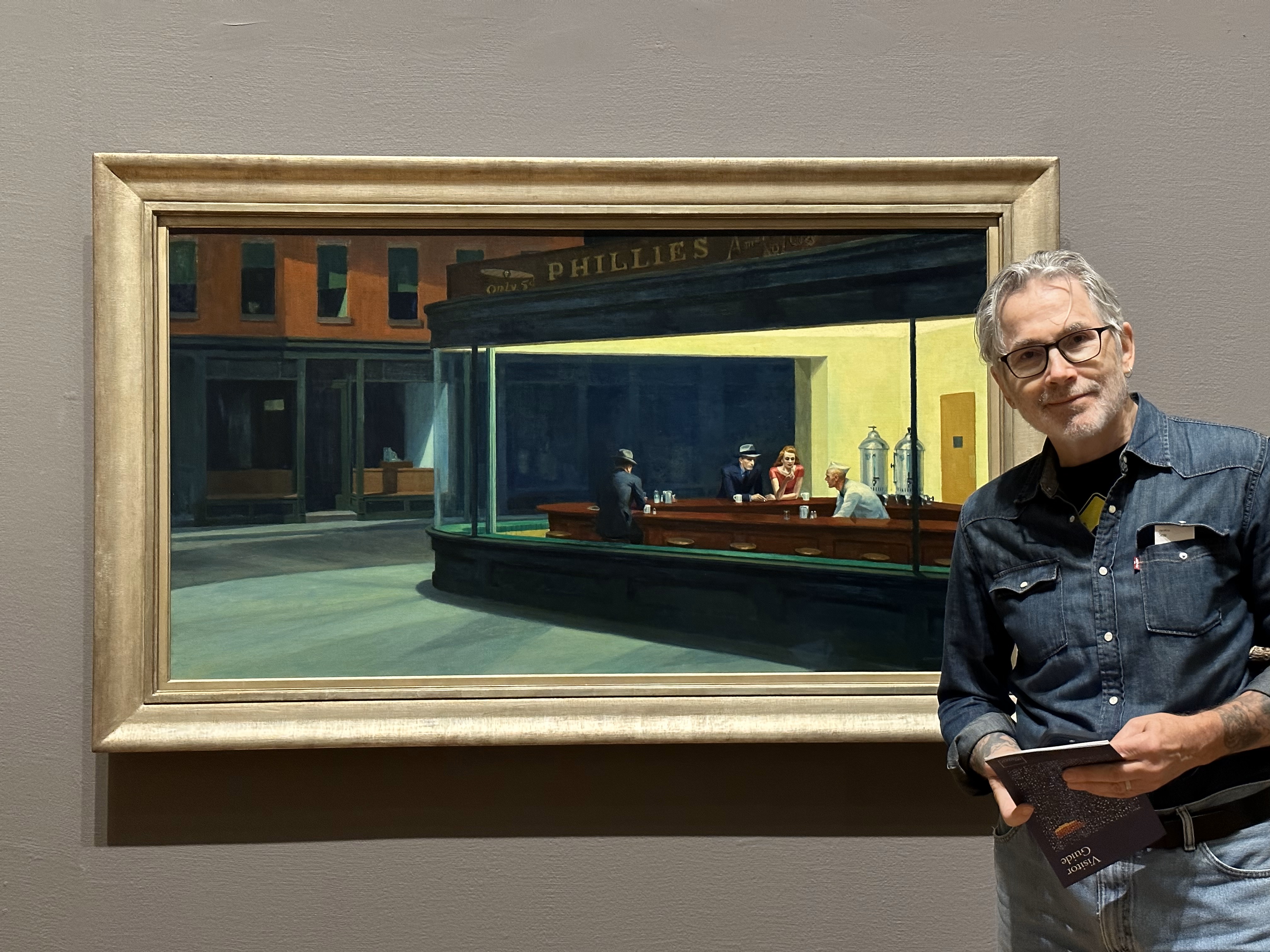
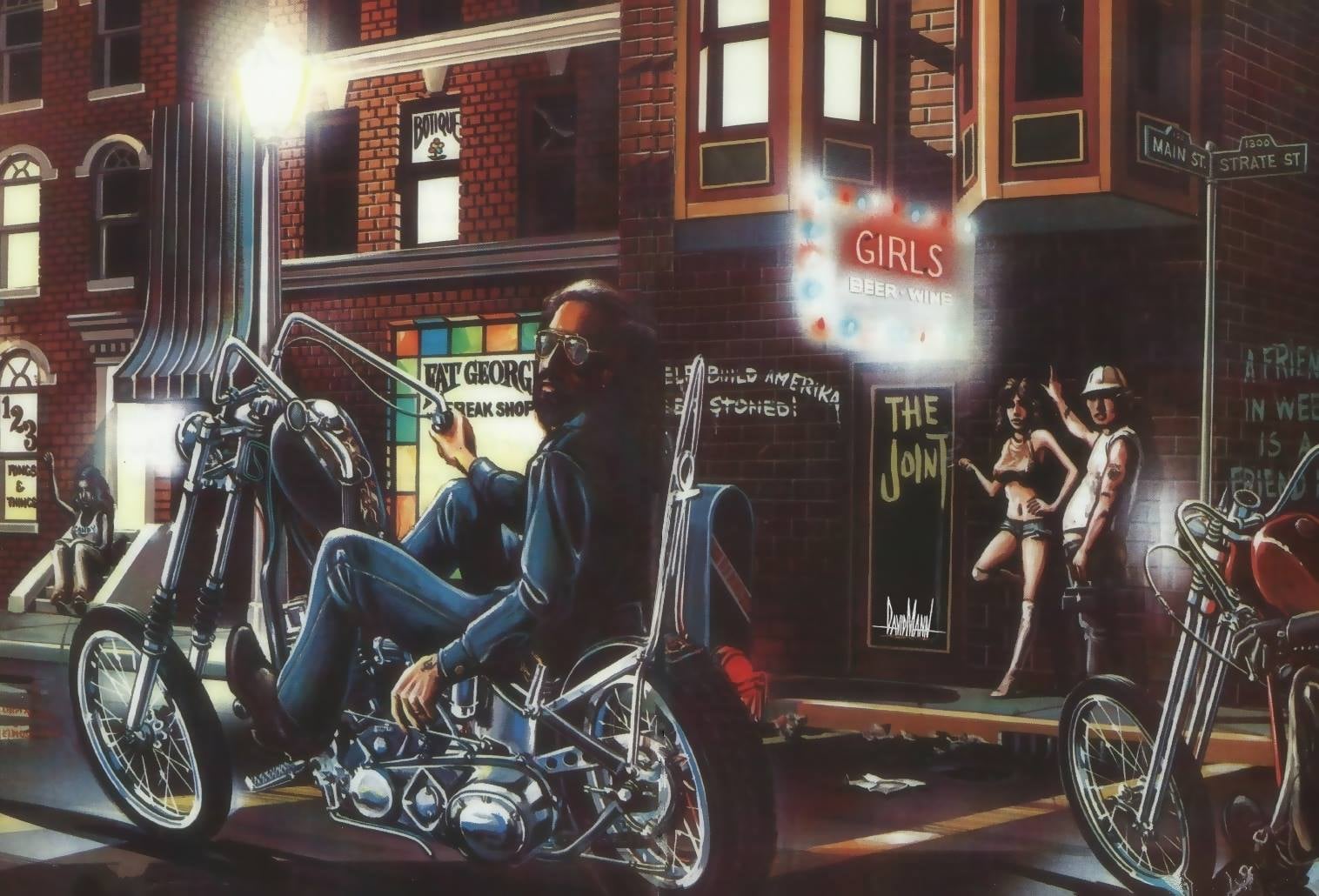
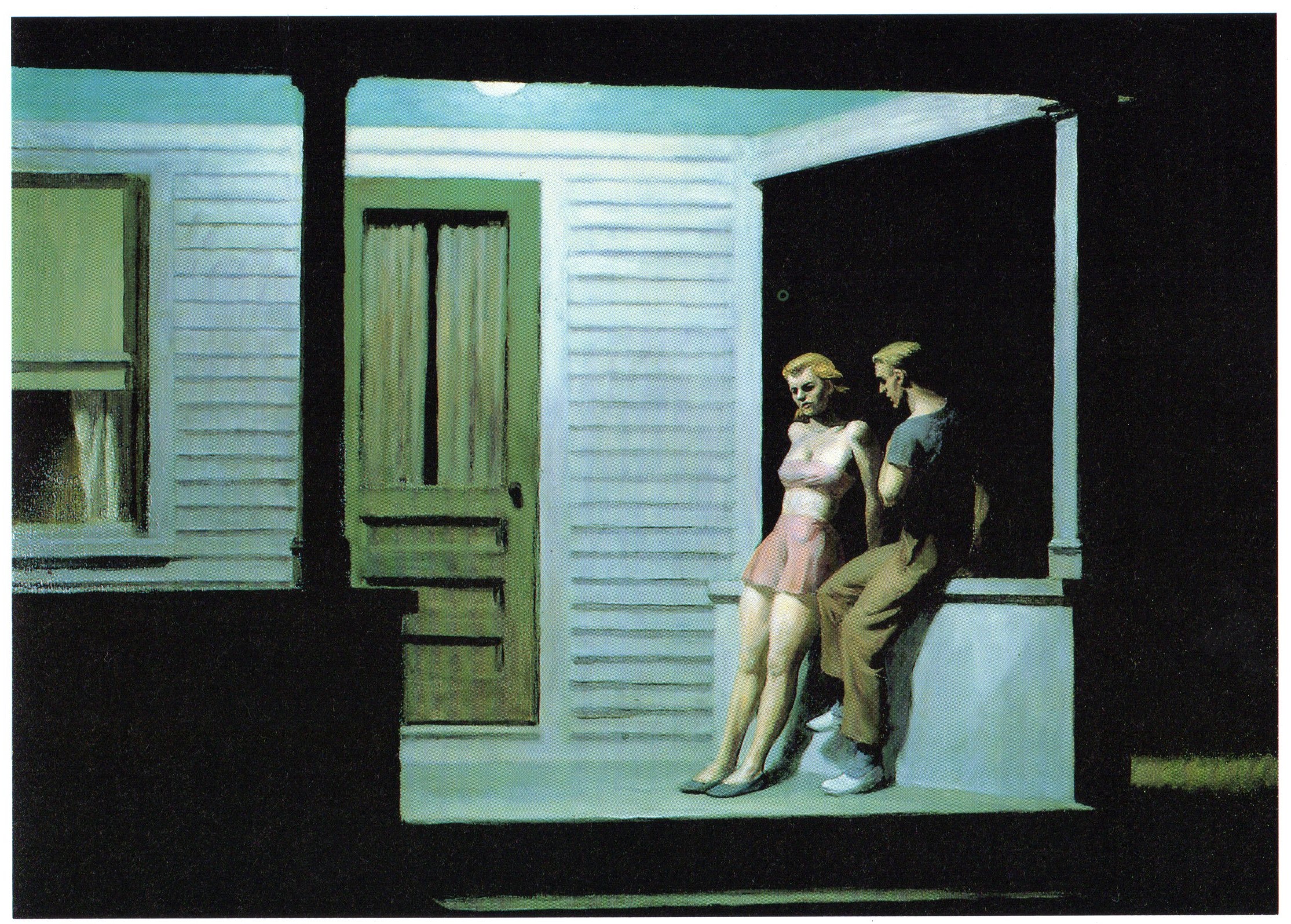
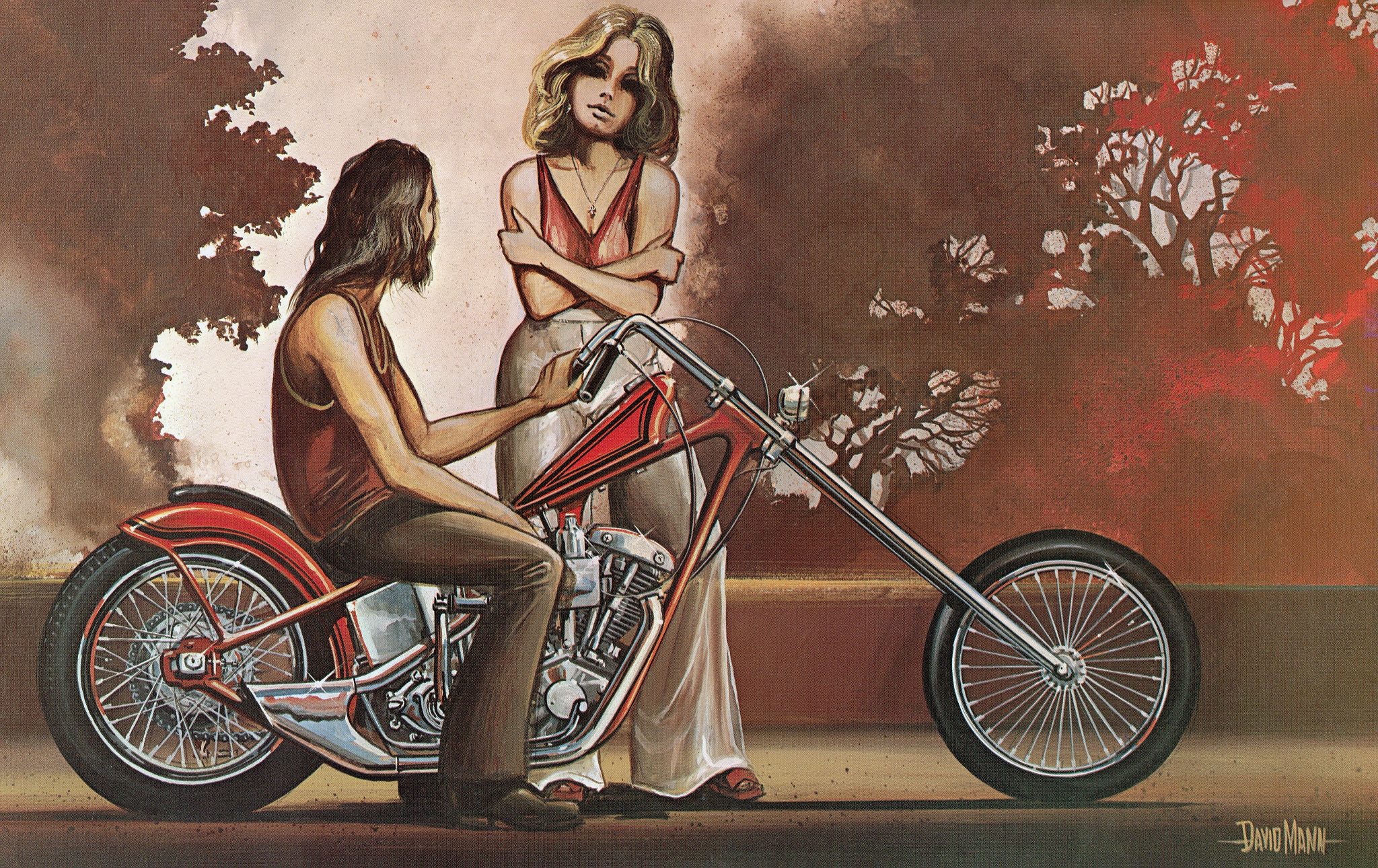
His earliest works were primitive – a cross between illustration and caricature – but as he gained experience Mann’s work took on a style reminiscent of the American painter Edward Hopper, who is best known for his iconic Nighthawks (1942). Look at the figures in Hopper’s work, and compare them to Mann’s. I certainly see the influence.

Edward Hopper The Nighthawks (1942)
On a road trip that took me to the National Motorcycle Museum at Anamosa, Iowa, on the day they closed forever, and the Harley-Davidson Museum in Milwaukee, I also got to visit the Art Institute of Chicago, where the original Nighthawks lives. My wife managed to catch me and the painting alone in the one split-second when it wasn’t surrounded by admirers!
David Mann Midnight Run (June, 1972)
Edward Hopper Summer Evening (1947)
David Mann Pick-Up (Want Some Candy?) January 1974
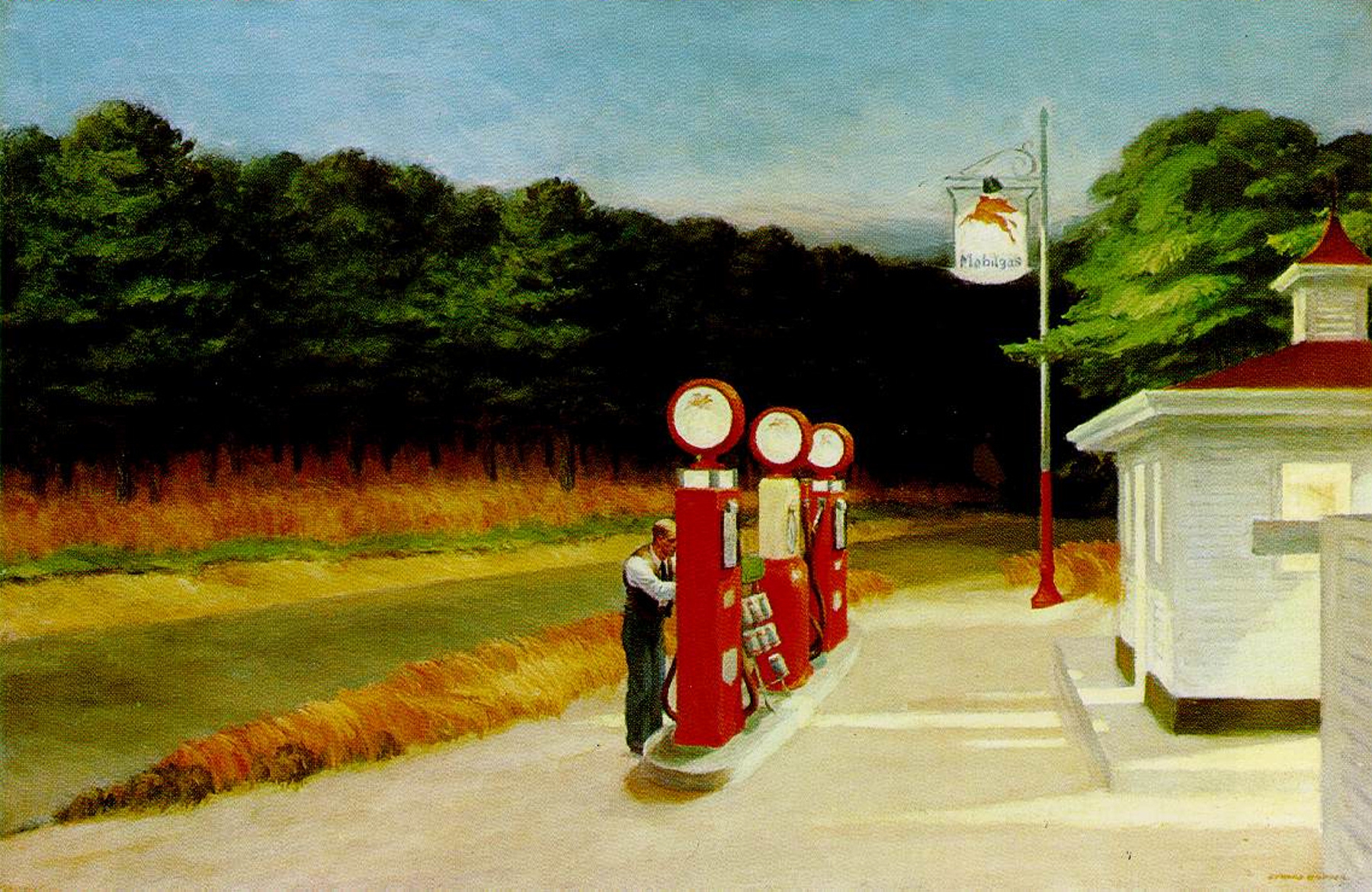
Edward Hopper Gas (1940)
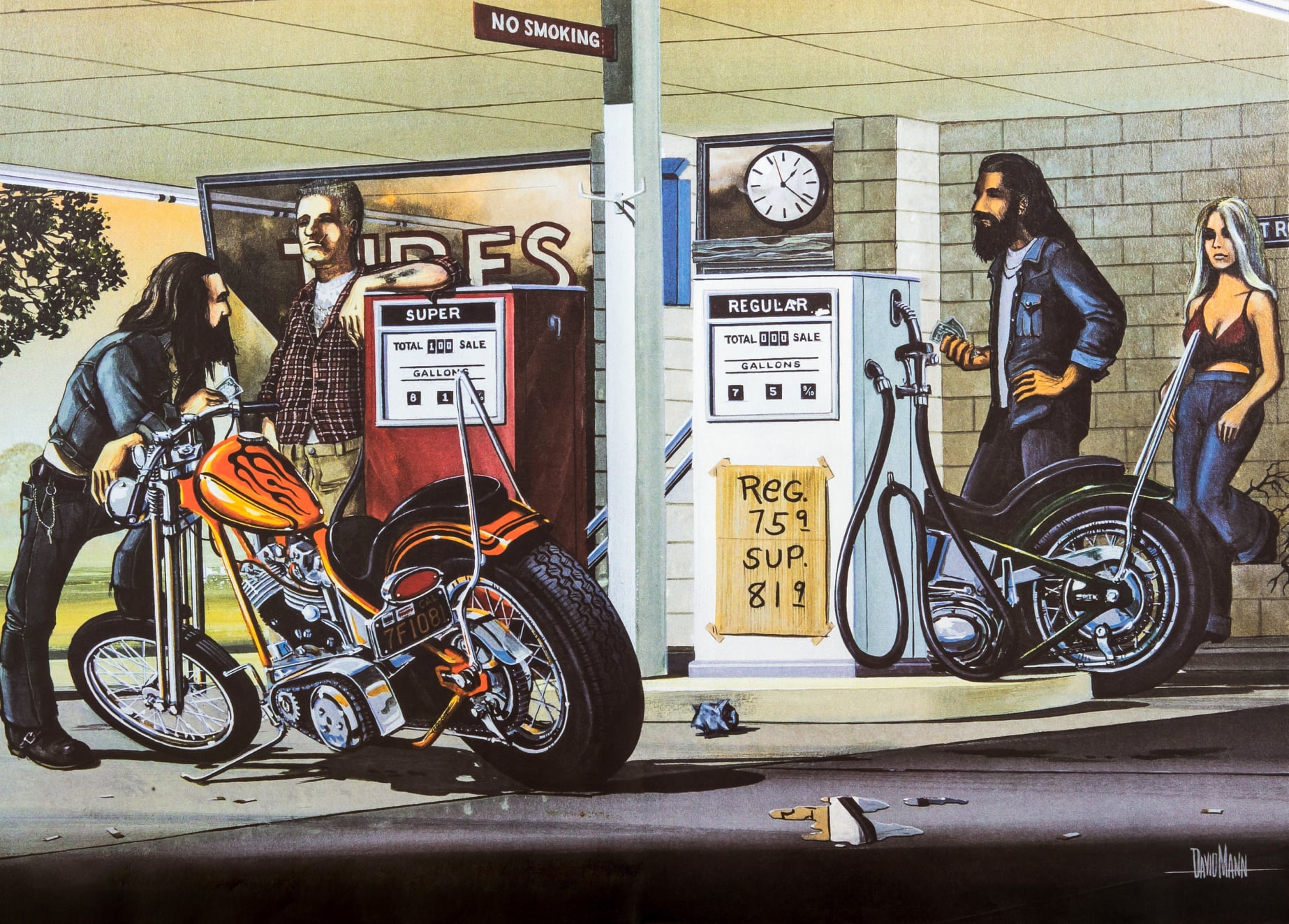
David Mann Gas Stop (1967)

More than technique or style, however, Hopper and Mann shared the desire to illustrate and elevate the prosaic, the quotidian, the mundane everyday doings of regular people historically overlooked by representational artists. For Hopper it might be patrons seated in a late-night diner – an apparent oasis of light and warmth in an otherwise dreary cityscape – sharing space and yet isolated from one another, silent, bored. For Mann it could be the streetwalker ignoring her john to watch the more attractive, more enticing biker cruise by on his radical panhead chopper. Hopper might present a sweet moment between a young couple on a dark summer evening – you can almost hear the crickets singing – while Mann’s swain straddles a raked and stretched shovelhead as he chats up the object of his affections on a crisp autumn afternoon….

You get the point.

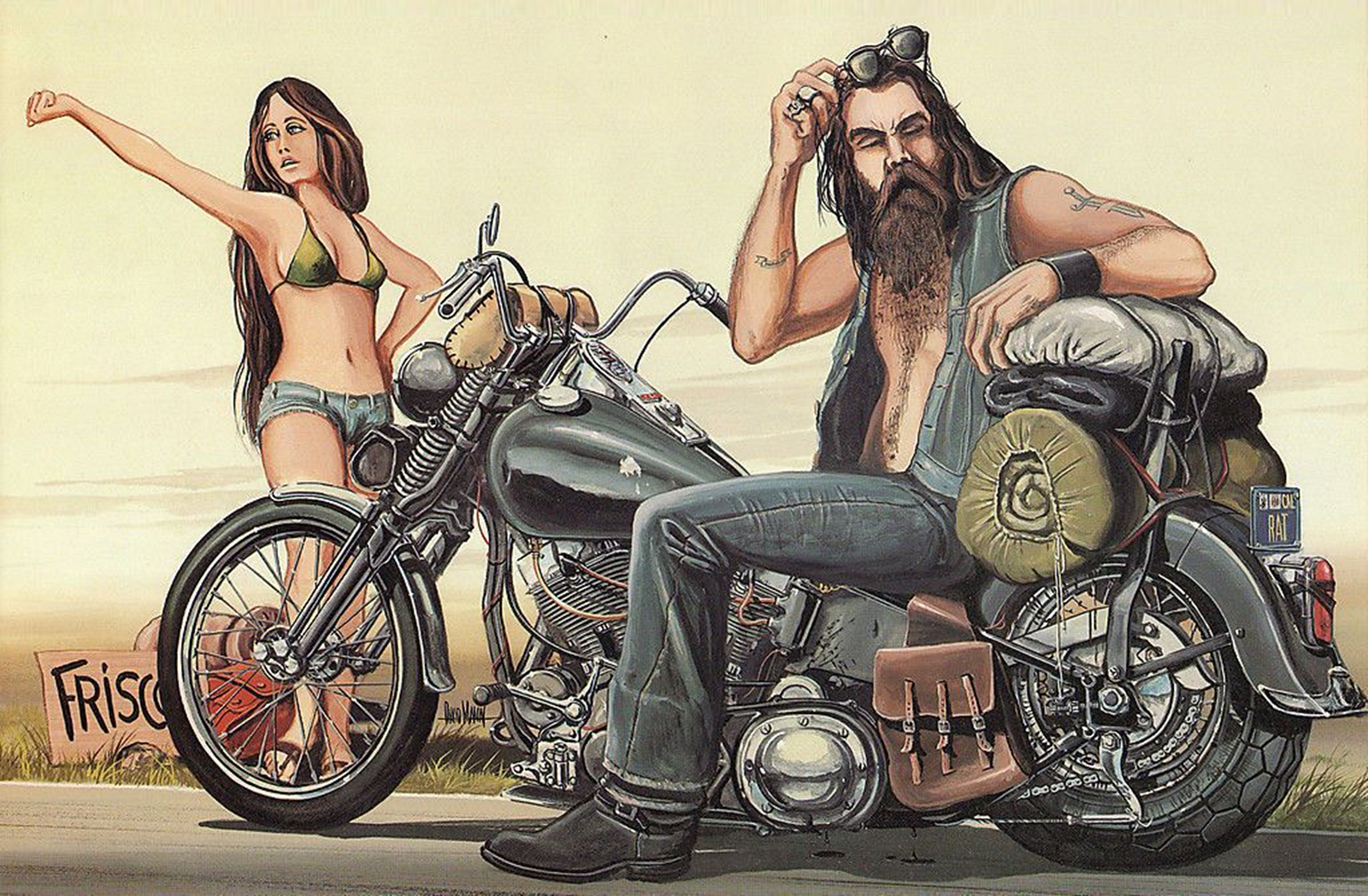
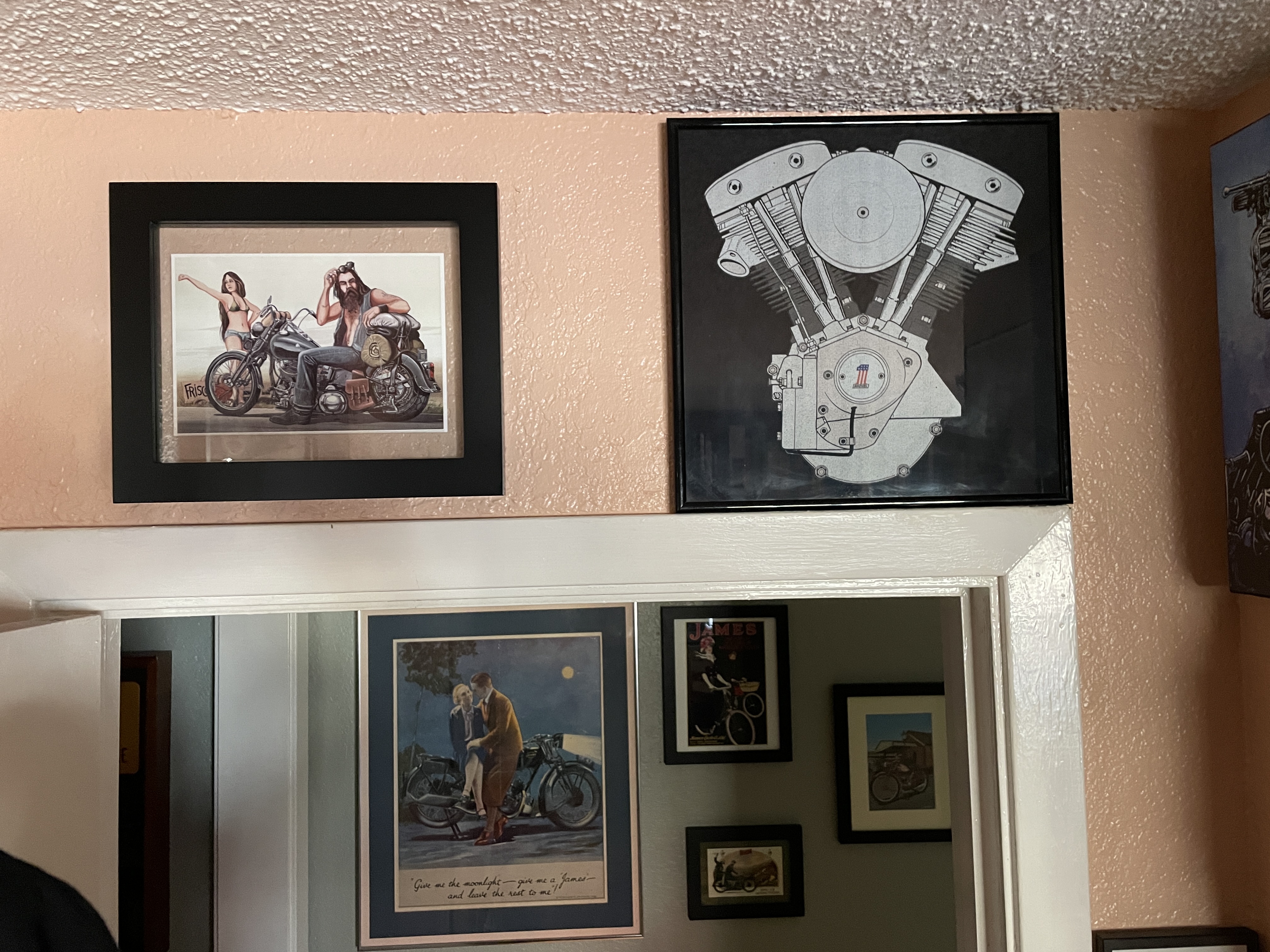
The Dilemma (September 1976) is one of my favorite Mann paintings of all time; I even have a small print of it framed above my office door. Dave’s attention to the minute details of this road-weary ‘rat’ panhead and rider is mind-boggling. Note the cracked and taped-together taillight lens, chipped paint on the fuel tank, mismatched tool bags strapped to the front forks and oil drips on the pavement below. Look at the rider’s military tattoos, too; his ragged cut-off vest, heavy engineer boots and greasy Levi’s, doubled up for added protection.
Then there’s the quiet humor of the scene – a hot hippie hitchhiker headed to that Haven of Hedonism, San Francisco, and the biker with no place to put her!
Sadly, this actually happened to my partner and I on our way to Sturgis. Our bikes were laden with camping gear, and we had no room to pick up two hitchhiking honeys we encountered just south of Oklahoma City! 😒
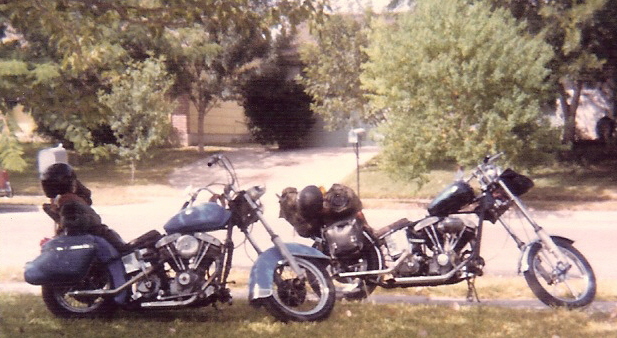
My rigid 1974 shovelhead and T.R.’s rigid jockey-shift ‘73 shovelhead chopper on the first Friday of August, 1982, packed and ready for the run to Sturgis.
The Dilemma and the design for my Shovel Shop t-shirts. In the hall, vintage adverts for the Famous James motorcycles. See my post below about the marque, its history and my history with it.

And by ‘centerfold’ I merely refer to the fact that Mann’s work appeared in the center pages of each issue, where it could be removed (as so many of us did) and turned into a poster. Although many of his paintings included idealized images of women, his purpose was to document our lives as bikers, not provide masturbation motivation for horny teenagers!

STRAIGHT ON FOR YOU!

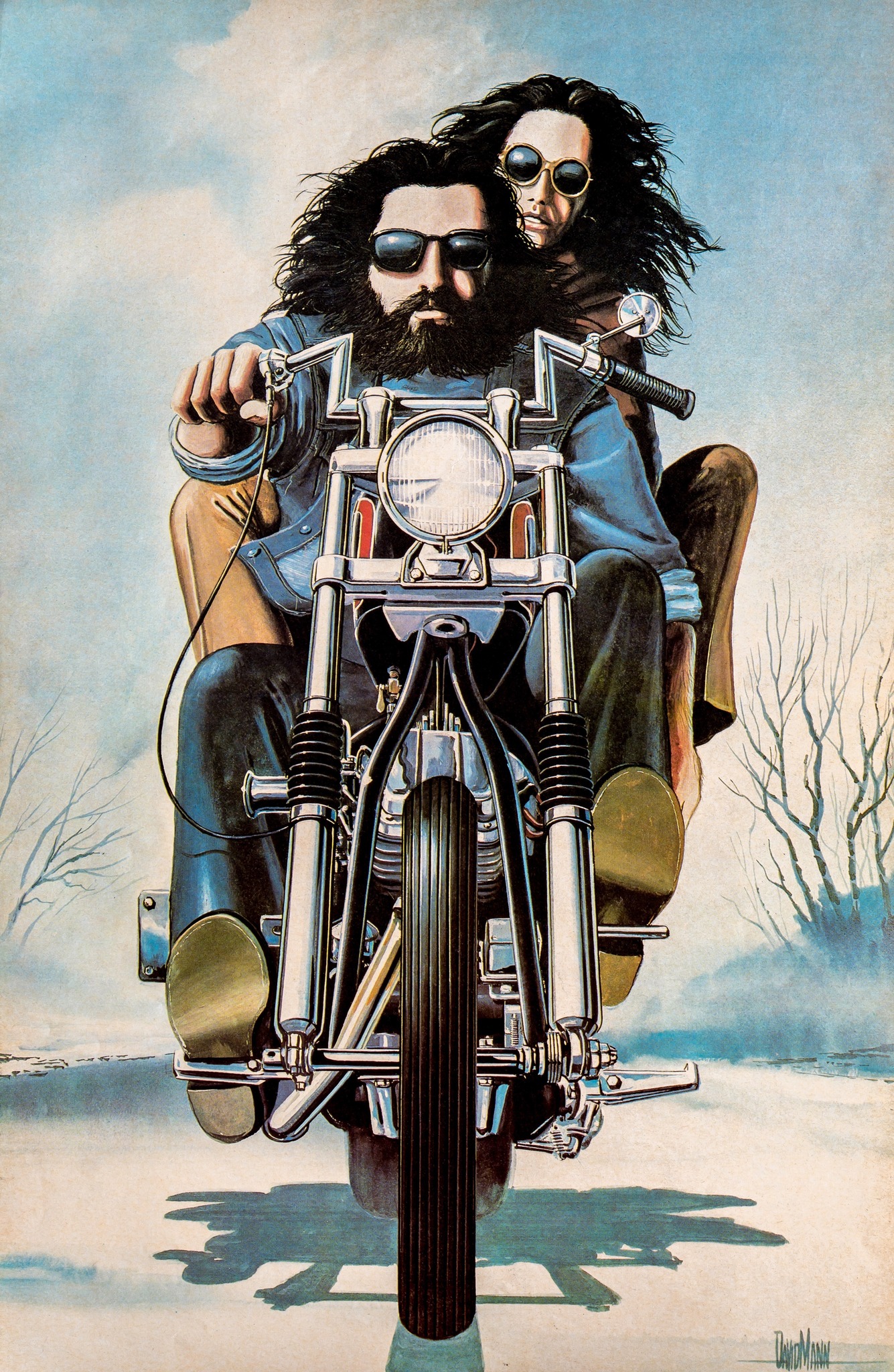
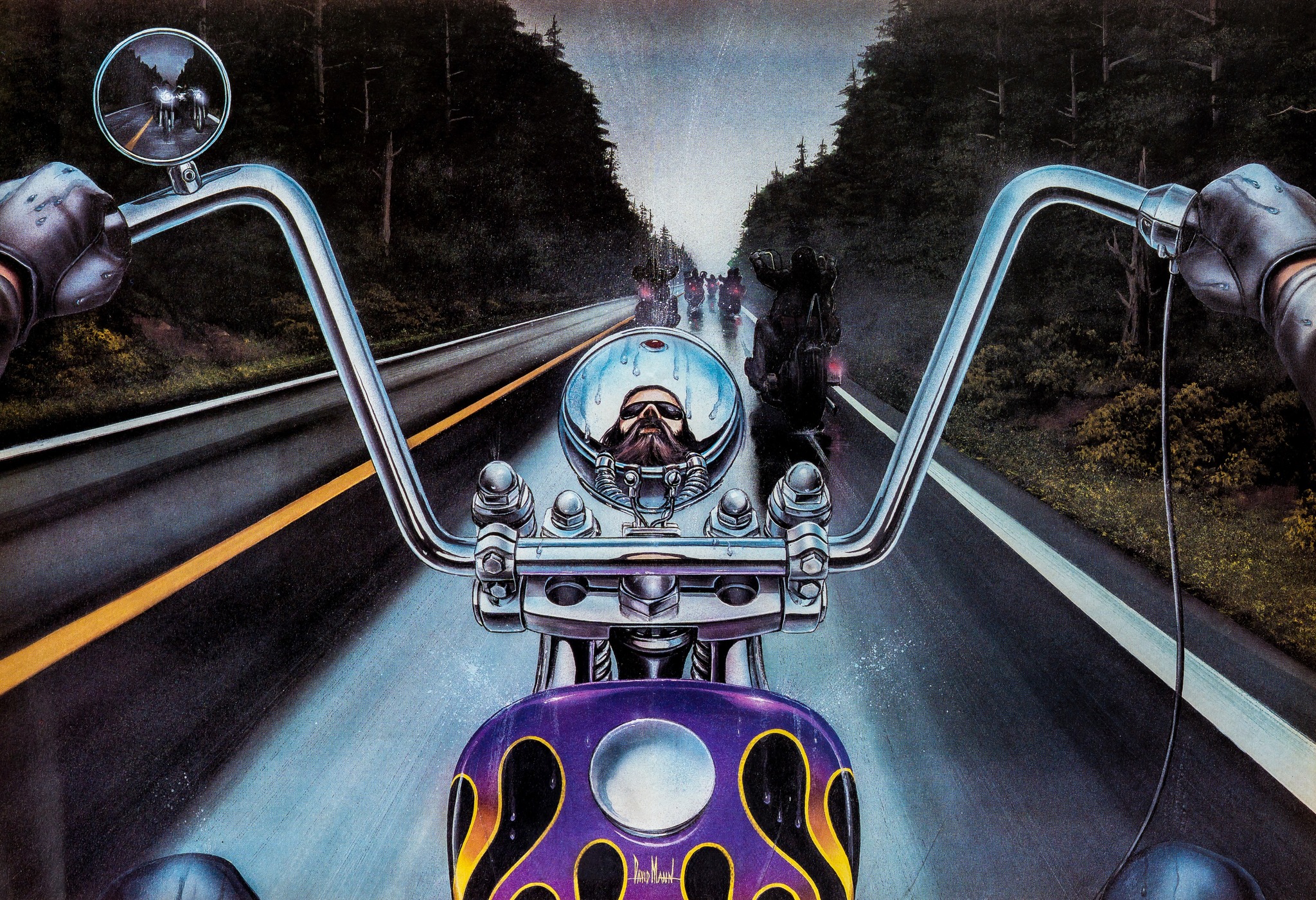
One perspective Mann relied on was full frontal….

….from his earliest efforts. This is Pacific Coast Highway Run, 1964
Easyriders Video #43 cover art
Easyriders Video #40 cover art
Easyriders Video #29 cover art
Easyriders Bikes & Babes Video cover art
Winter Ride, date unknown
A Cold Winter Ride, story illustration from Easyriders January 1990
Excelsior-Henderson, October 1998
First Ride of the Year, January 1993
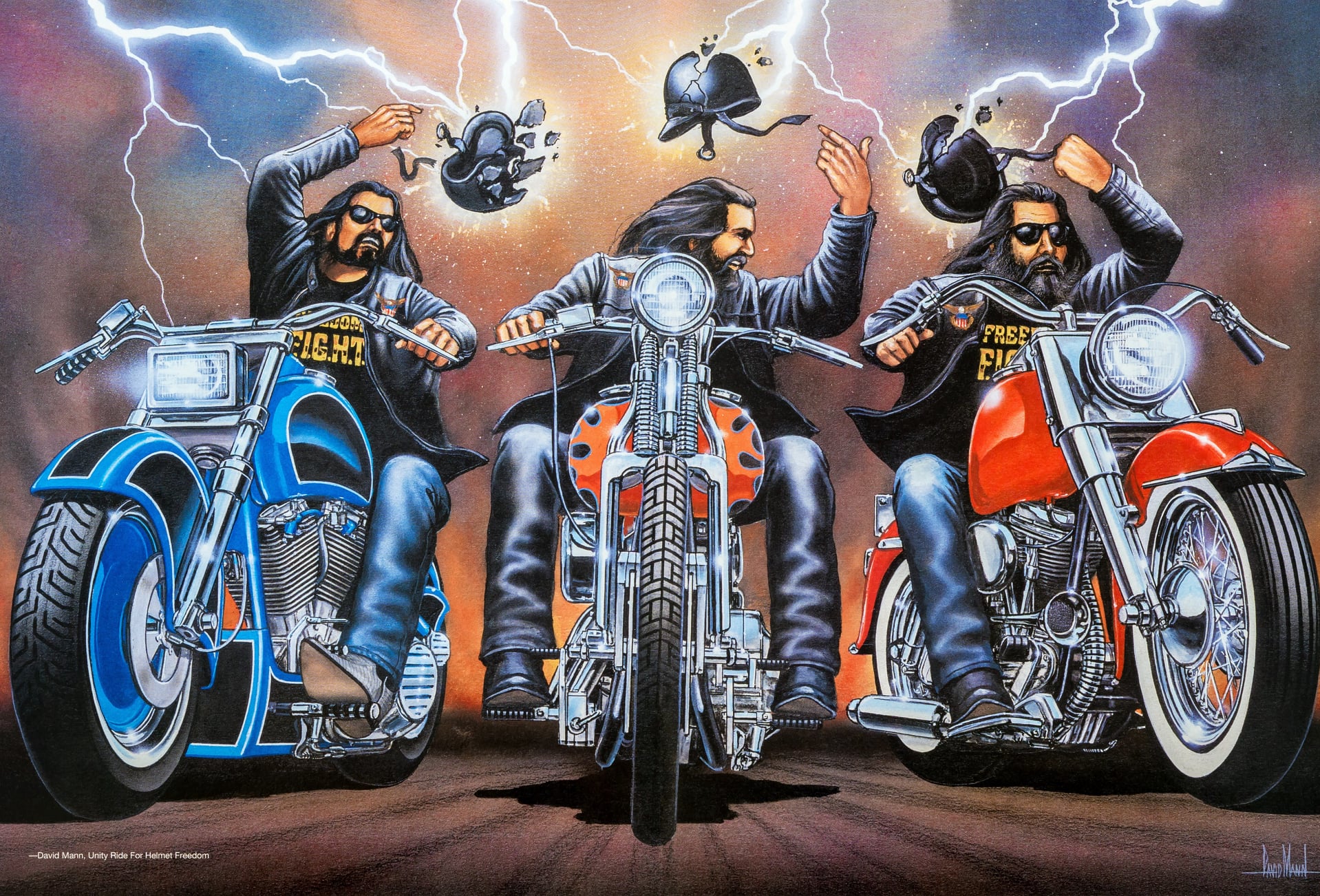
Helmet Protest, January 1996, highlighted a political position dear to most bikers’ hearts: the freedom to choose whether or not to wear a helmet when we ride. Even many of us who wear helmets by choice still believe the decision should be ours alone, and not left some government bureaucrat who has never ridden a motorcycle in his life. Mann revisited this theme over and over again through the years. This piece also shows his ability to capture complex objects like motorcycles at different angles in the same painting.
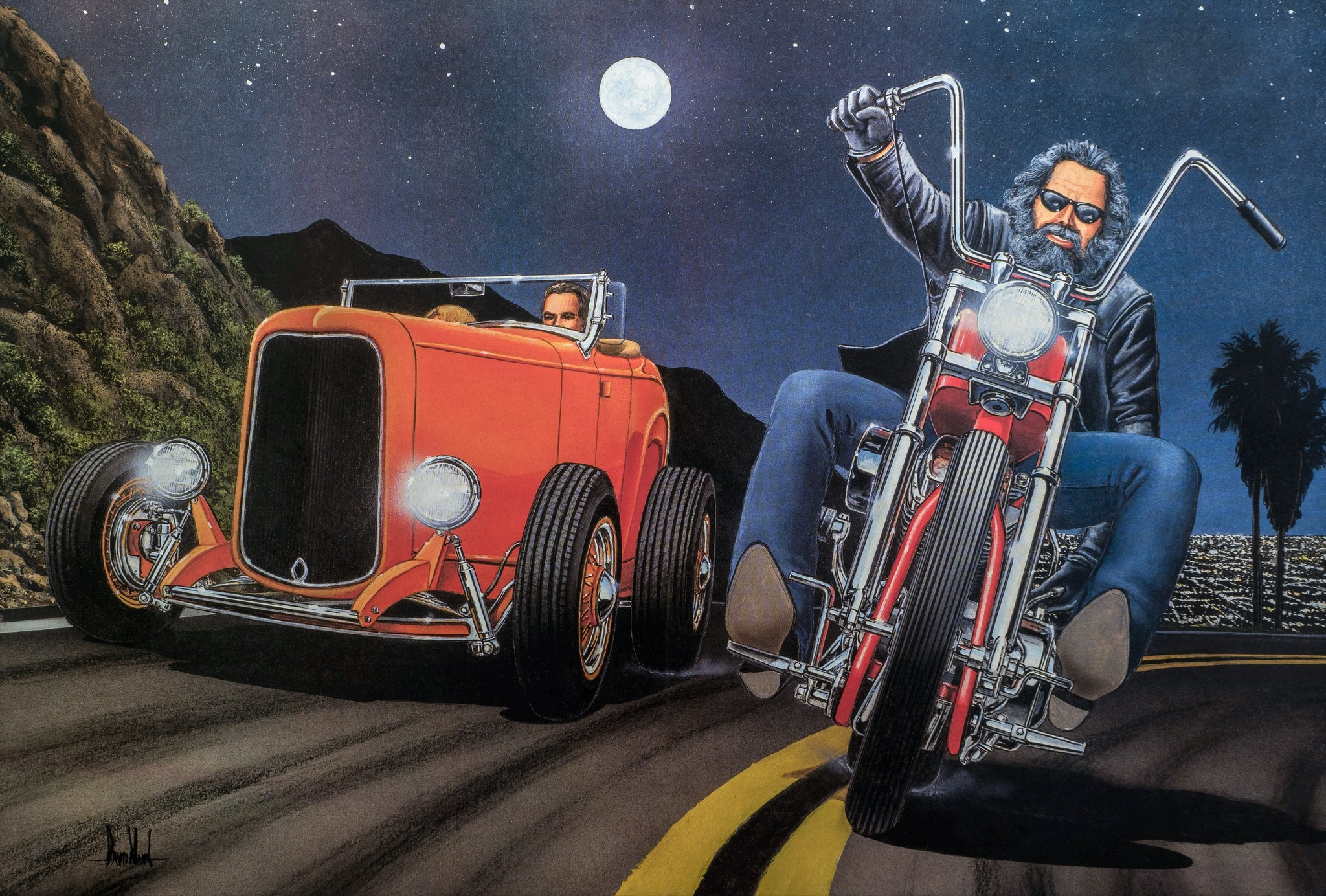
Inside Pass appeared in BIKER, July 2000. Dave was as skilled in painting automobiles as he was motorcycles, and capturing the action of two moving vehicles pitted in a wheel-to-wheel race.
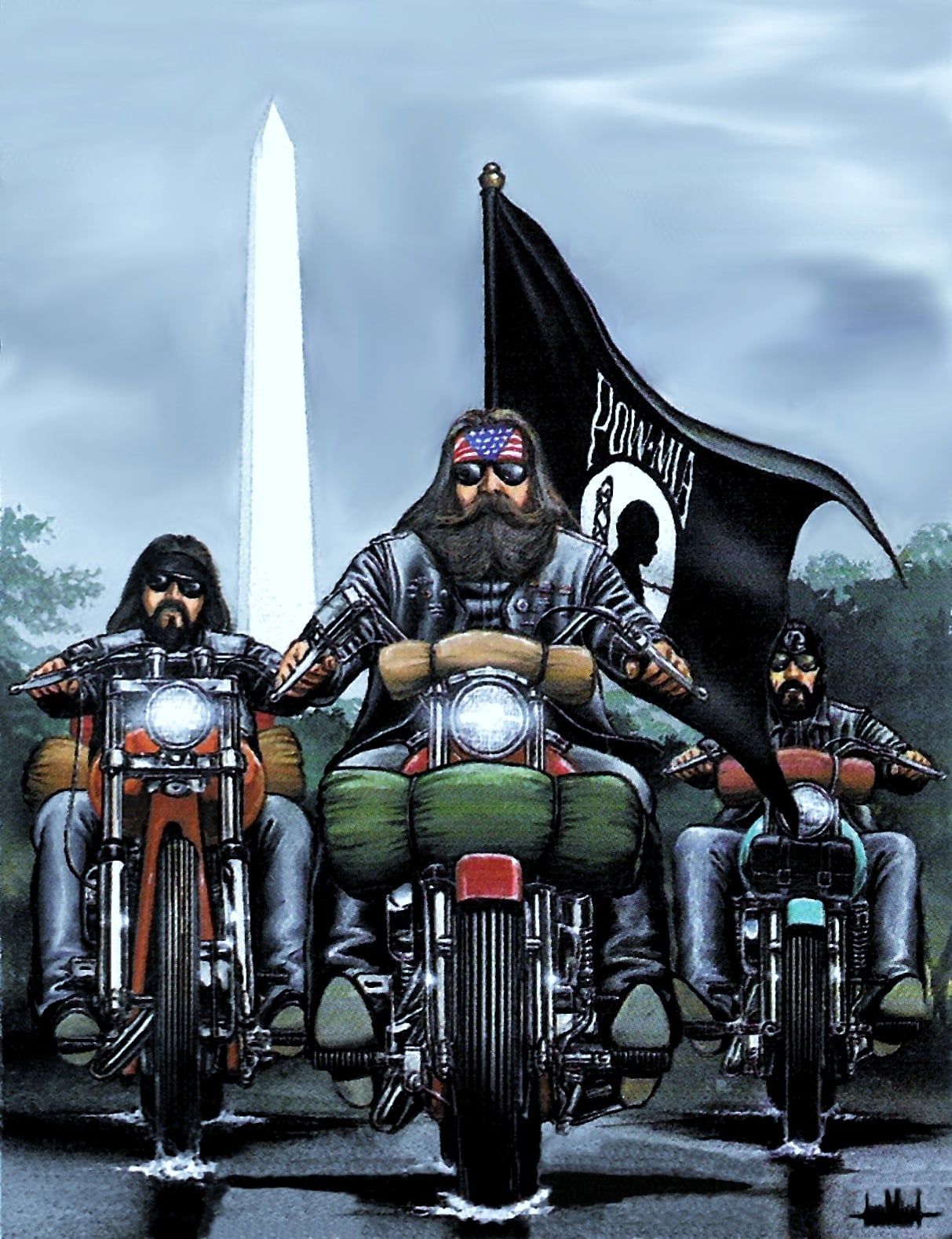
Run to the Wall , date unknown. Many bikers are military veterans, and believe no service member should be left behind, so the cause of POWs and MIAs affects us deeply.
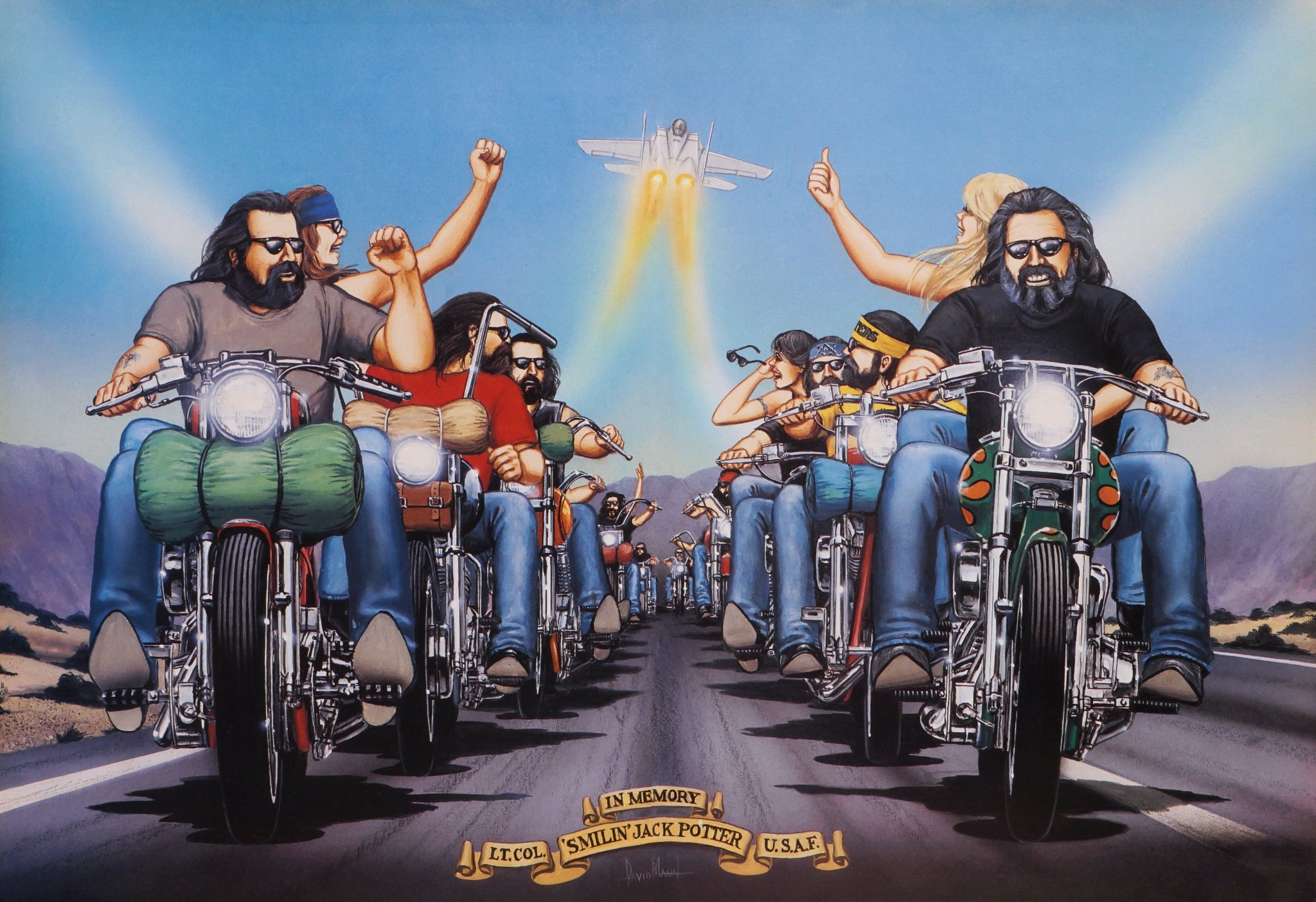
In Memory of Lt. Col. ‘Smilin’ Jack Potter, U.S.A.F. is a loving tribute to Jacquie’s father.
Even in self-portraiture: Dave Mann with Jacquie

Here is another of my favorites, a classic piece by Dave Mann:

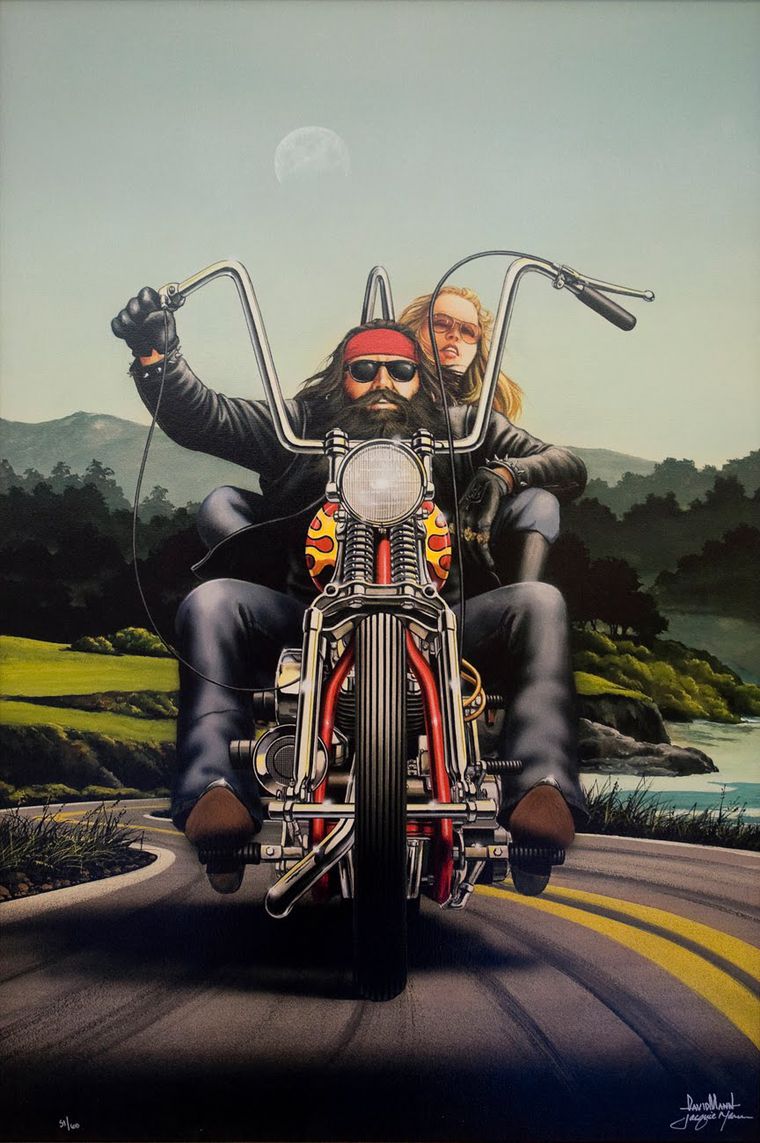
Another favorite Mann painting. I’m unsure of the title – it may be First Ride of Spring – but I love the way it captures one of the happier moments in a biker’s life: hauling ass up a scenic road with his woman tucked in behind. I used this as inspiration for my own piece, seen below: a t-shirt design I created for the Motorcycle Rights Organization ABATE of Texas back in 1989.
My design as it appeared on t-shirts. This artwork predates the introduction of computers into my artistic toolkit, so please be kind. The central image was all done by hand, and the lettering created letter by letter, line by line with Letraset ® rub-on letters. Much to my surprise Letraset fonts are still available! 😱
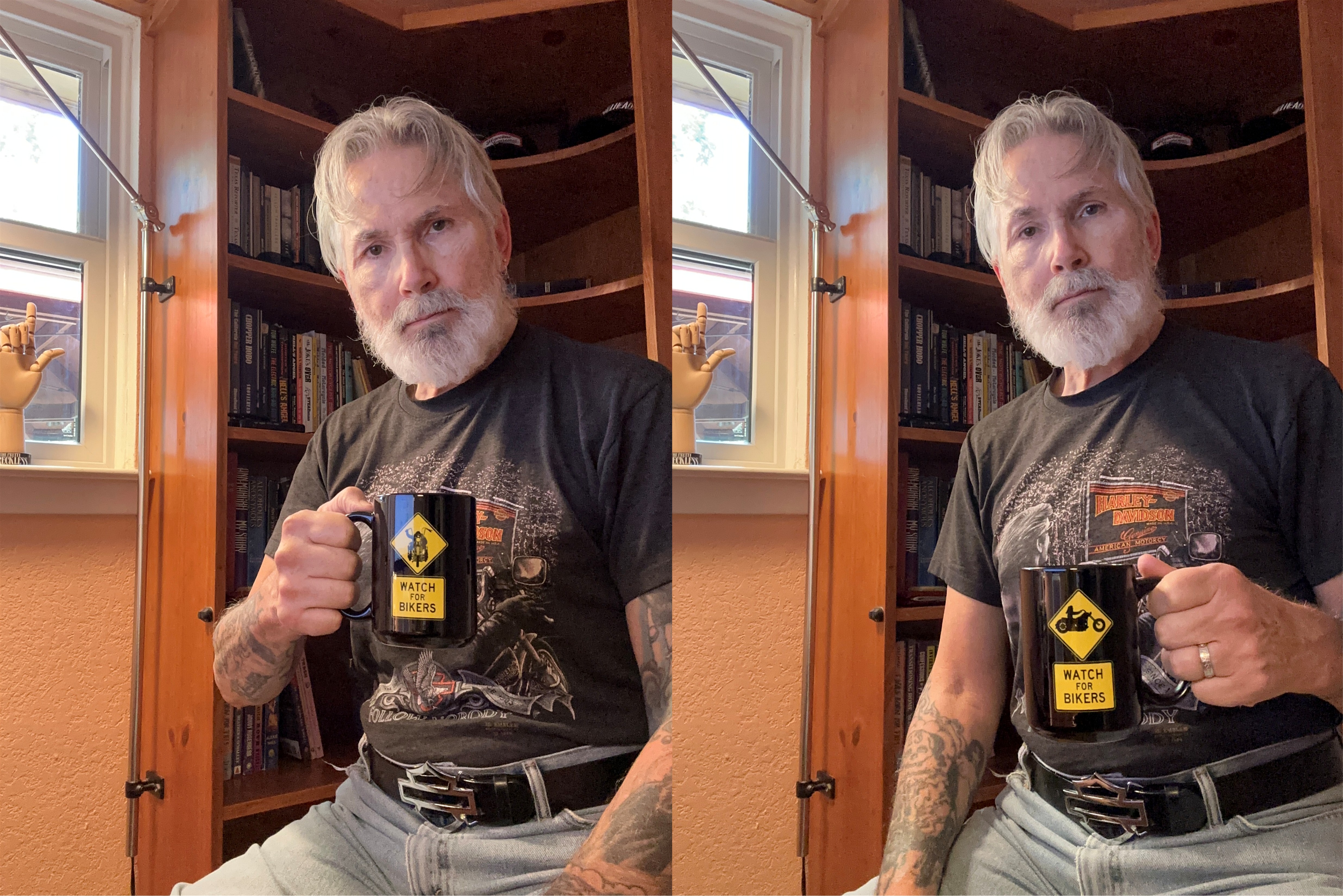
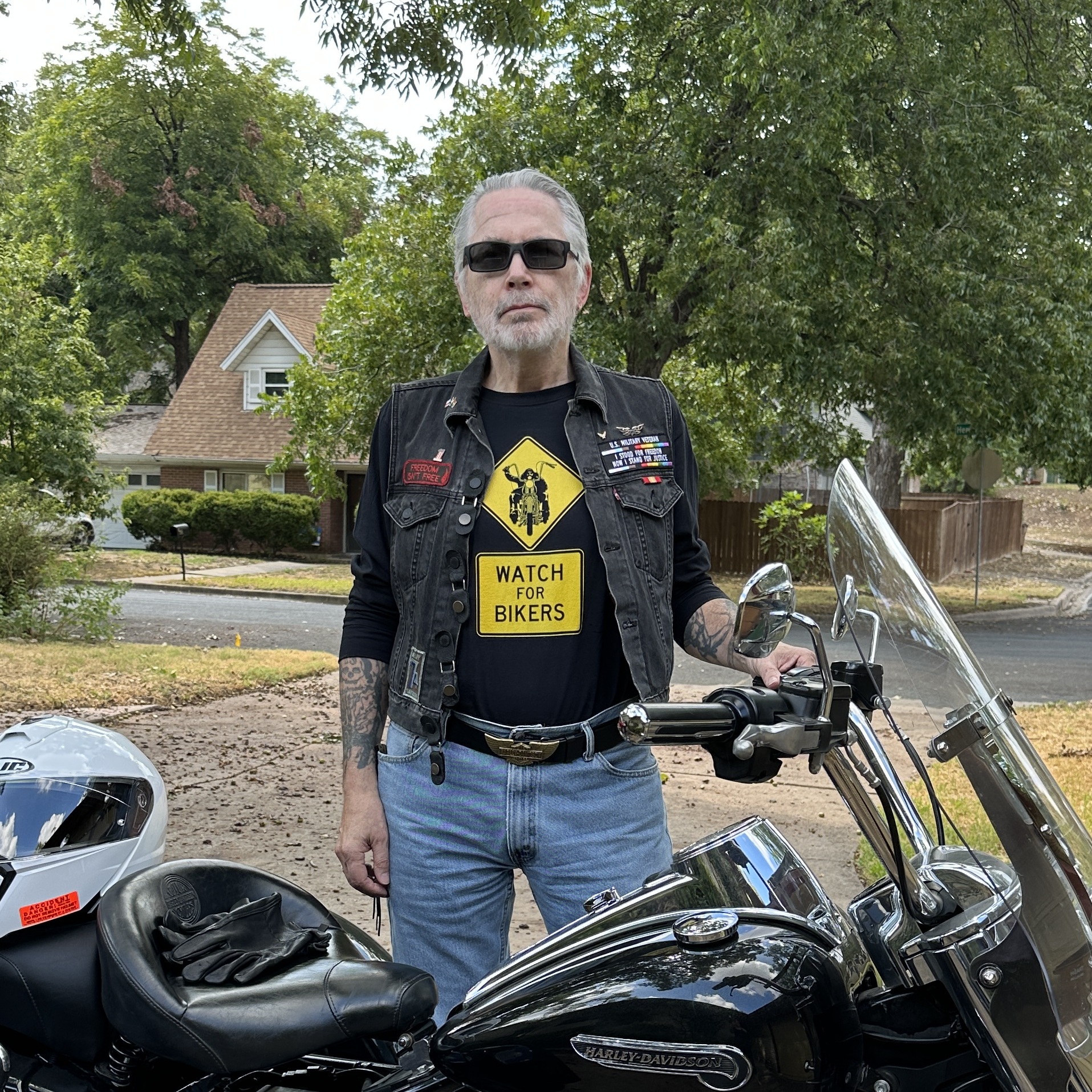
I was able to reuse that image on some recent creations: my Watch for Bikers coffee mugs and….
….and the matching Watch for Bikers t-shirts, both reasonably priced at my Shovel Shop store at Etsy..

Mann returned to that theme many times in his career.

Coming at You, April 1975
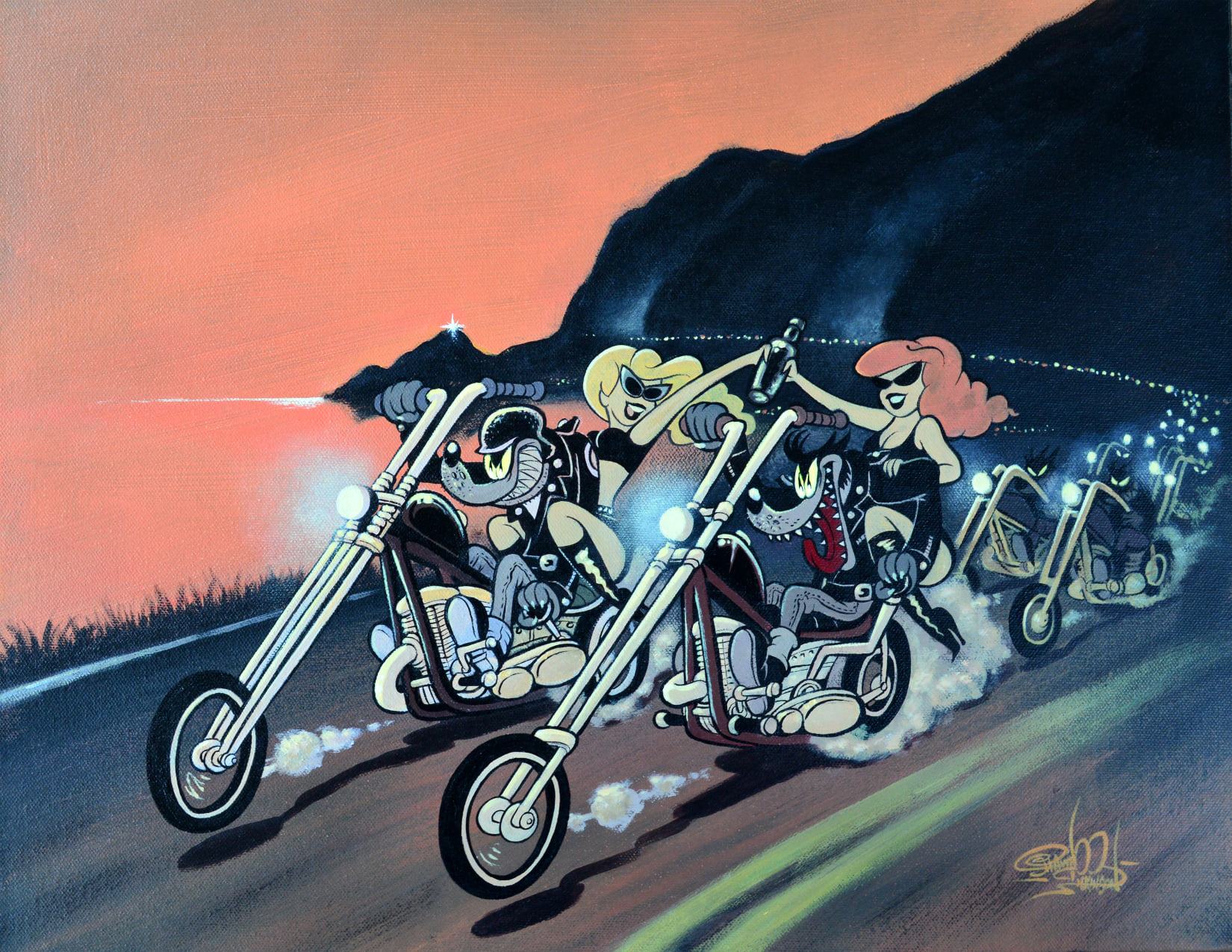
It even inspired this homage by artist Shawn Dickinson, titled Wild and Wolfy….
….and another titled Werewolves on Wheels, Shawn’s tribute to Dave Mann’s In the Wind on a Friday Night….
….and the original: In the Wind on a Friday Night, August 1972

Another favorite was the reverse: the motorcycle moving in a straight line away from the viewer. He used both angles to great effect.

Mann’s follow-up to Coming at You appeared in a Jammers Handbook. Mann’s attention to detail extended even to the smallest things, like the oil spatter up this passenger’s left shoulder, excess lubricant slung off the rear drive chain at speed. You could always spot a biker chick by those chain tracks, and you could tell if she was packin’ on a Big Twin or Sporty by which shoulder was marked. I pissed off more than one woman passenger when their nicest tops ended up ruined that way! 🤷‍♀️

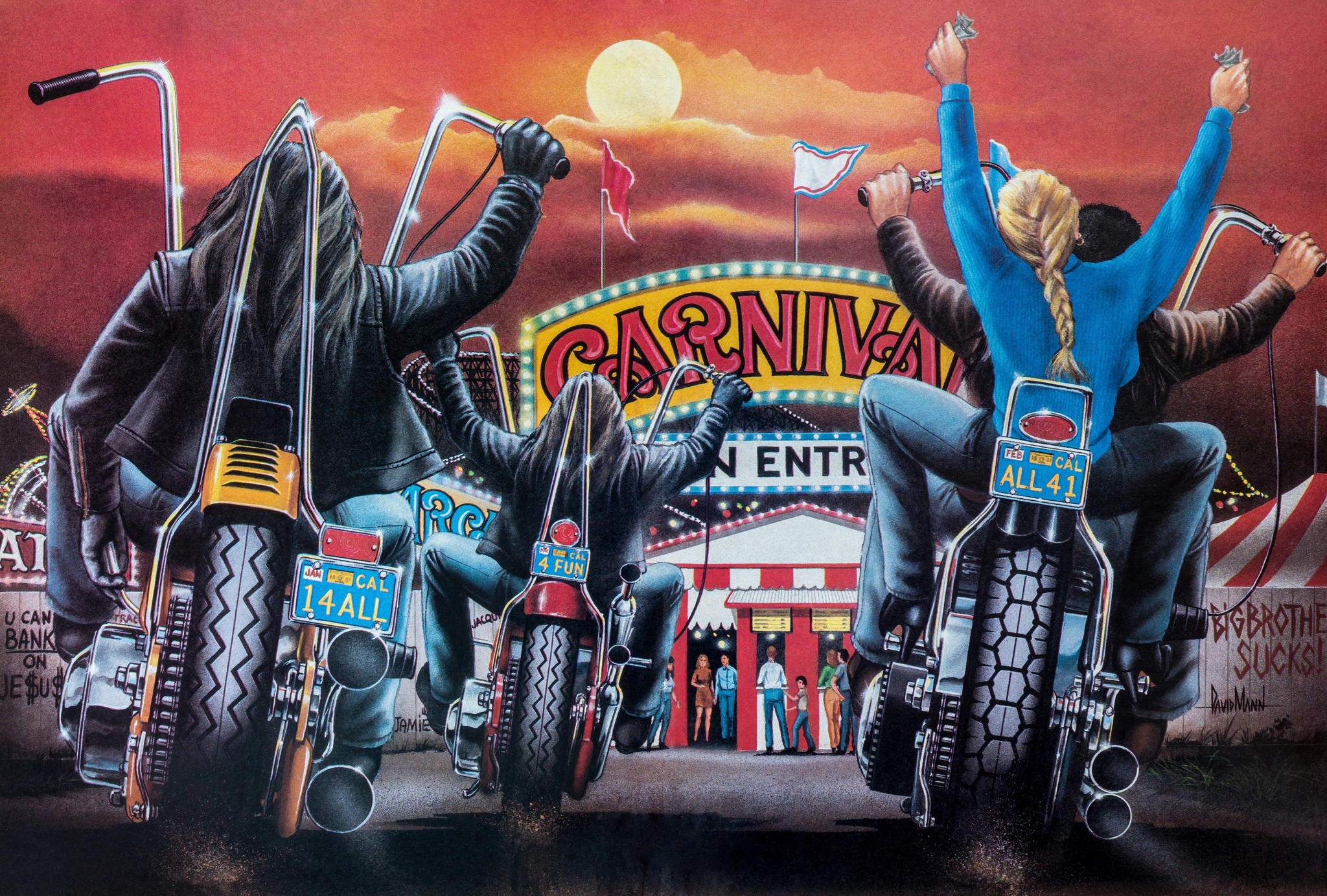
Carnival, September 1987. Note the graffiti at right.
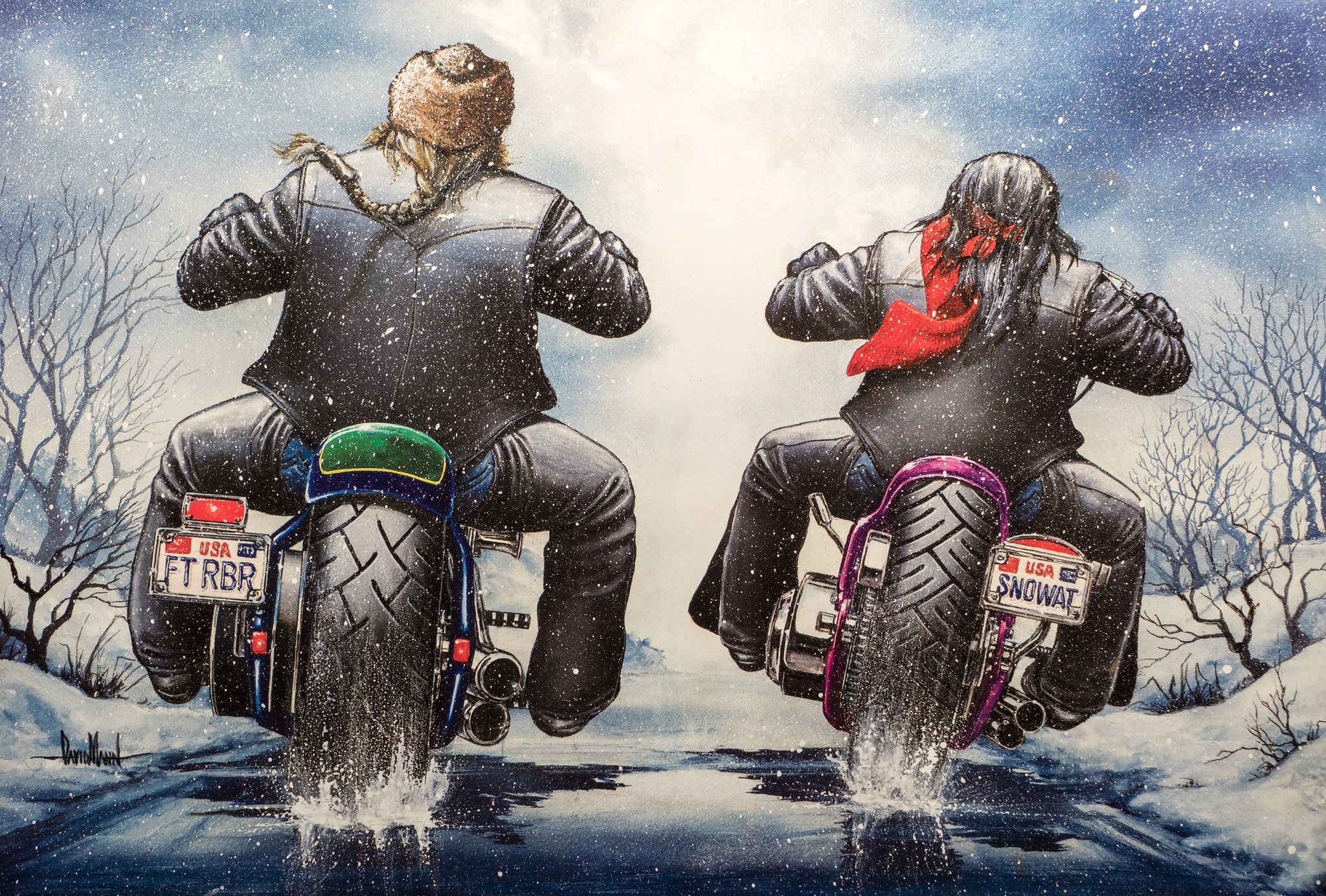
Snow What appeared in BIKER, February 2003
This image has an empty alt attribute; its file name is dm-art-freedom-fundraiser-poster.jpg
FREEDOM was a fundraising poster for some friends in Cleveland.
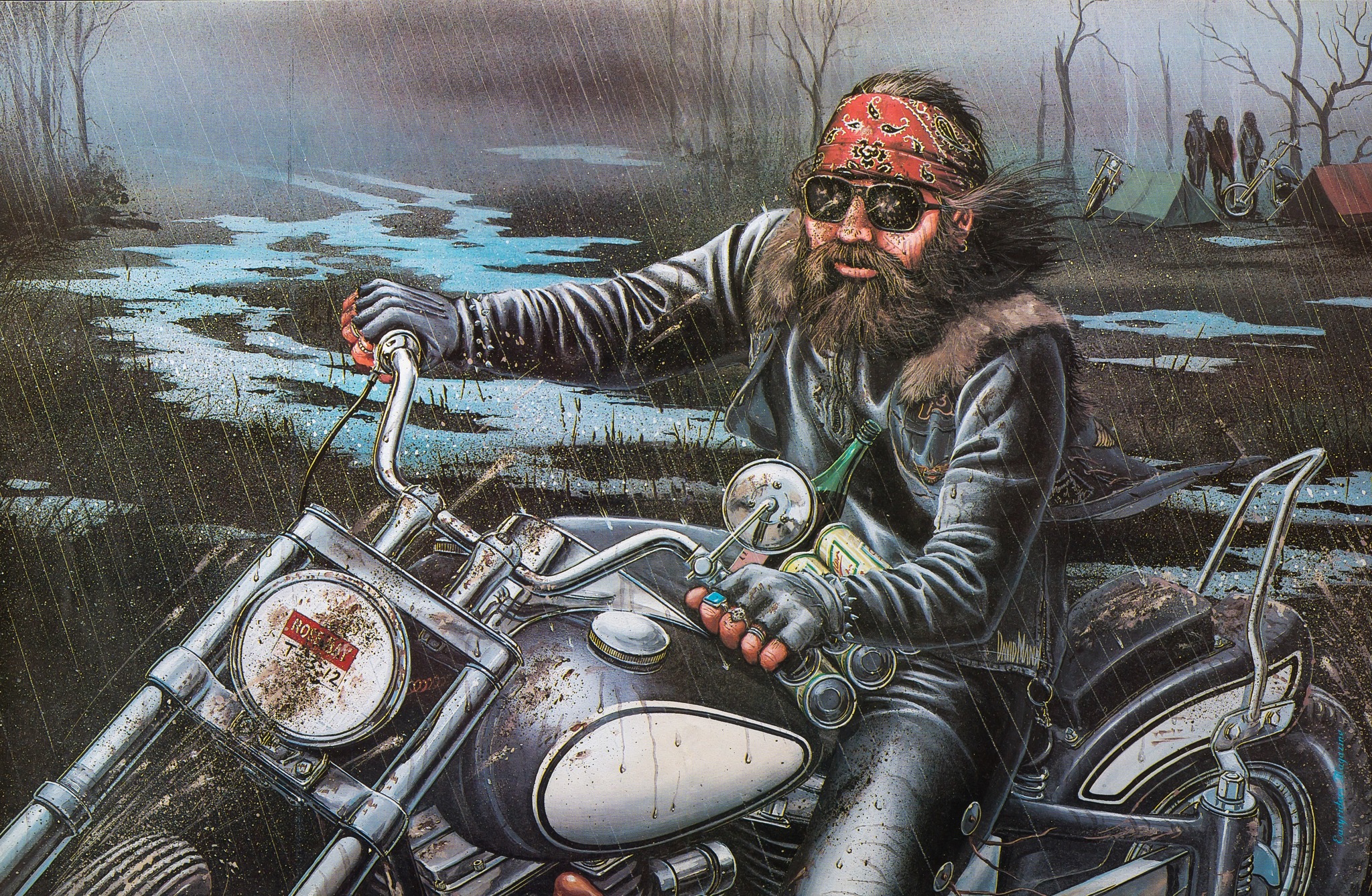
Storm Jammin’ appeared in Easyriders March 1989 and again in BIKER in October 2005. This one gets me because I took a soggy ride like this, from Austin to East Texas, to lay to rest a friend who died too soon…. as if there were any other kind. 😒

THE DAYS OF OUR LIVES

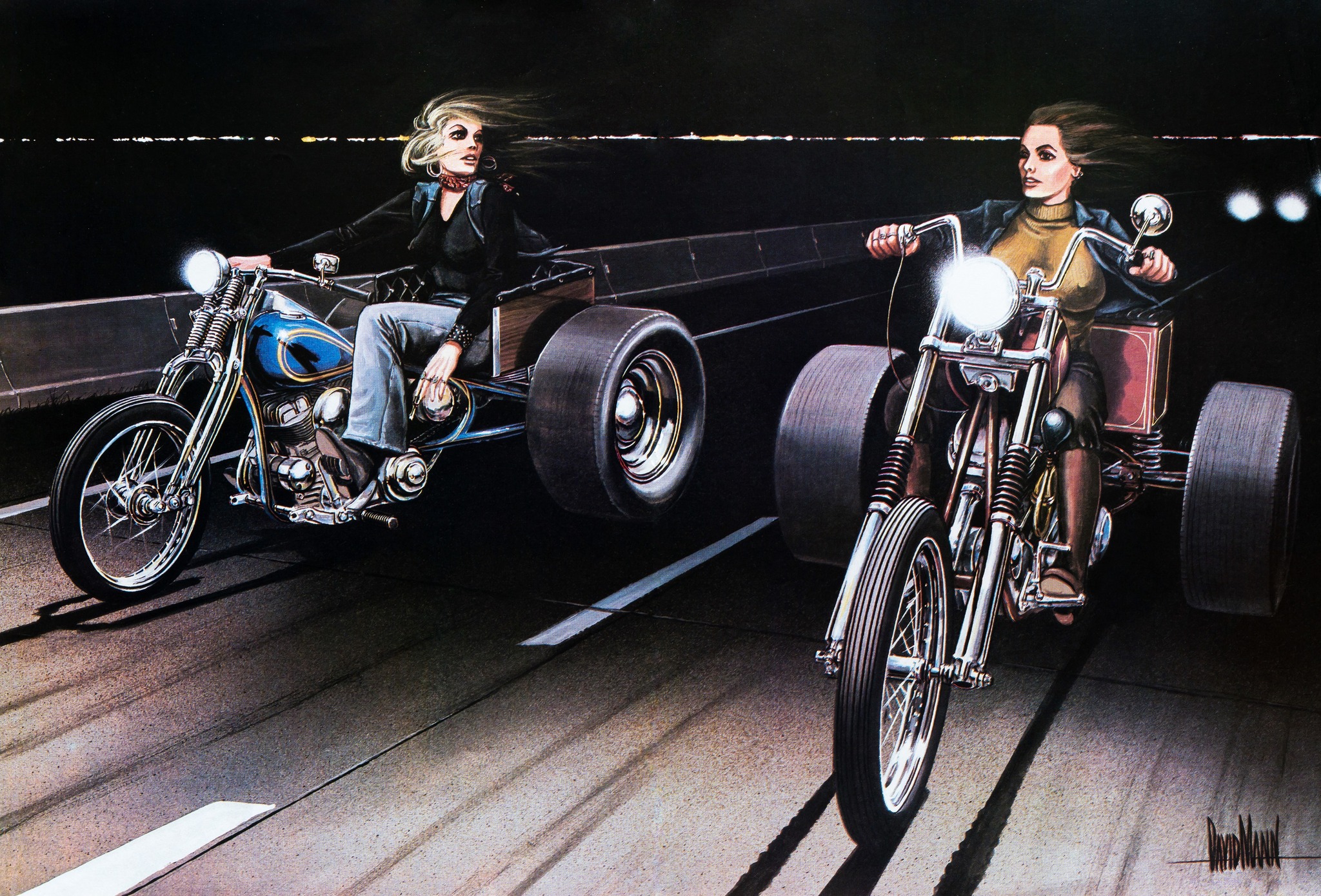
Mann’s technical abilities as an artist are undeniable but, as clearly demonstrated here, for those of us who ride it was Mann’s ability to illustrate the everyday aspects of our lives as bikers which so endeared him to us. He captured the emotional element – the ‘inner landscape’ Ms. Graham referenced in her quote – in painting after painting.. It might be two bikers blasting down an L.A. freeway, beards and club colors flapping in the wind, as one passes a joint to the other.

Hollyweed, November 1976. Note the altered ‘Hollywood’ sign high above the highway.

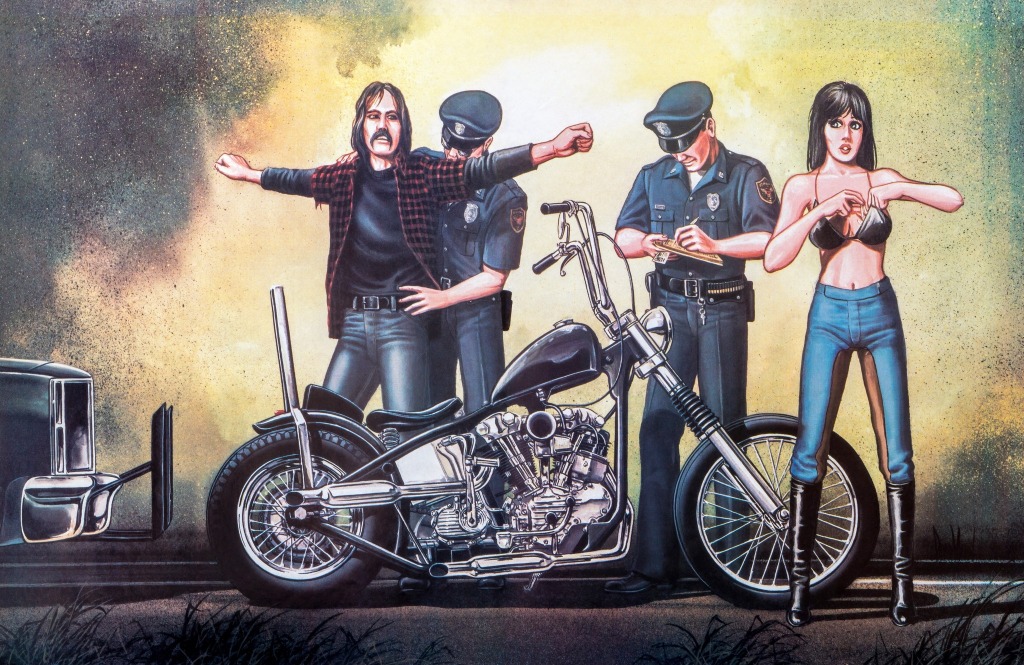
It might be a biker on his low, lean, radically stretched chopper, glaring balefully at the cop writing out a traffic ticket.

Busted, December 1974. Damn cops ruin everything, don’t they?

It might be a woman frustrated and angry because her old man, the insensitive prick, just passed a beer joint when she desperately needed a potty break….

Hey, What About….! December 1982.

….or another one of my favorites. showing a woman curled up against her man’s back, safe and secure and sleepy after a weekend of riding and camping out under the stars, while he steers his radical chopper back to the brightly-lit city in the distance.

Homeward Bound, January 1975

One of Dave Mann’s most iconic images has been stolen and reproduced on everything from t-shirts and coffee mugs to wall tapestries, area rugs and more. In ‘Ghost Rider’ Mann equates the hard-riding biker at the foreground to the hard-riding ghostly cowboy keeping pace with him. Some of the later reproductions went the politically correct route of erasing the SS lightning bolts Mann’s biker has on his fuel tank….

….and that’s a topic for a whole ‘nother post! 😎

Ghost Rider, November 1983. Unofficial (read: stolen, ripped off, plagiarized) iterations of the image, on tapestries, t-shirts, et cetera, excised the SS lightning bolts from the fuel tank in a lame attempt at political correctness. If you see the Ghost Rider without lightning bolts you’re most likely looking at a fake.

Mann covered breakdowns and break-ups, club life and solo riders, sleek choppers and road-warrior rat bikes, and brought to each painting the same skill and dedication to detail. He was our Frederic Remington, and we loved him for it.

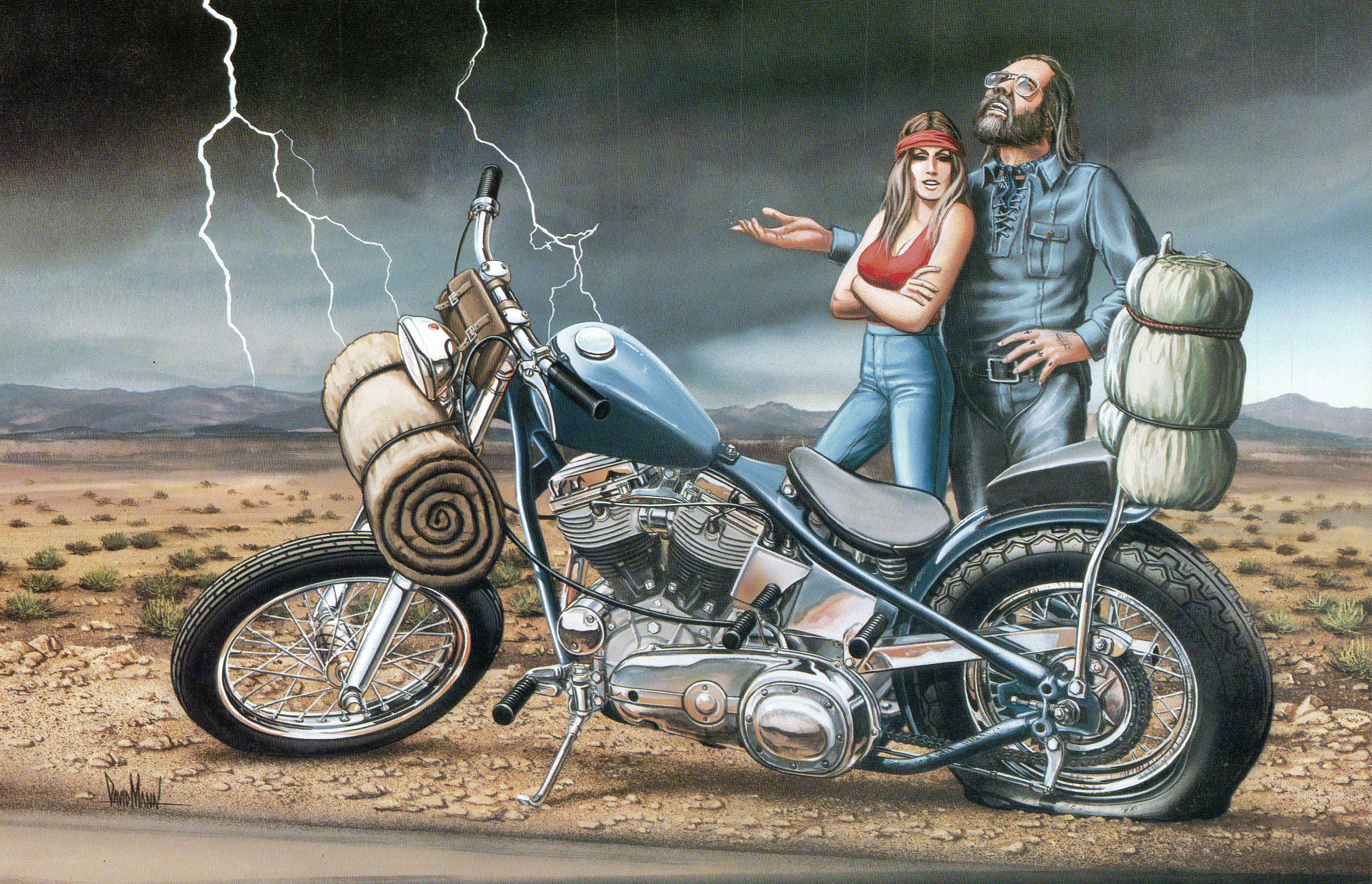
Another favorite. Anyone who rides very long at all has been in a similar situation….

Middle of Nowhere, June 1981

….but try to make the best of it! 😆

Beer Run, July, 1978. It’s a dirty job, but someone has to do it! 😁

BREAKING DOWN AND CRACKING UP!

Paul Simon once sang ‘Everything put together sooner or later falls apart,’ and that’s as true of motorcycles as anything else. In numerous paintings, Dave Mann captured the frustration and helplessness of that instant when your machine fails, and you realize there’s nothing you can do about it except sit and wait, or go for help.

Broken Primary Belt, October 1981.
I’ve been here! 😡 Primary Belt, January 2002.

In the early ’80s, on a ride through the Central Texas Hill Country southwest of Austin, I stripped the teeth off my primary drive belt while pulling up a steep hill. Thankfully, I wasn’t alone. It grieved me to interrupt my friends’ ride that way, but I was stuck.

BTW, that was one of the very few times my shovelhead rode home in the back of a truck.

One of the reasons I have always been psychotic about building my bikes to be bulletproof, and making sure I can fix all but the worst breakdowns with tools and spare parts in my road kit is because I cannot stand to be that helpless, hapless rider stranded beside the road. I’d rather have people depend on me than have to impose on friends or, worse still, depend on the kindness of strangers.

In this instance, when I got the bike home and went to replace the wasted primary belt, I learned that I couldn’t have replaced the belt by the side of the road even if I’d had a spare belt with me; that the inner primary cover (which can’t be removed without an impact wrench and clutch-hub puller) wouldn’t let me take the belt off the engine pulley! Since I had the inner primary cover off anyway, I took the opportunity to grind down the bosses on the inner primary so that I could take the belt off without removing the inner primary, the next time the need arose. That’s just how I roll! 😁

As an aside: I will never understand why some riders get angry when I mention tool kits and roadside repairs in that context. Seems to me everyone is better off if I can fix the problem by the side of the road and get on with the ride, rather than be forced to wait for a wrecker or a buddy with a trailer to come fetch me. Still, I’ve had riders – every one of them the sort I call ‘Born Again Bikers’ – get absolutely incensed at the notion that I am capable in that regard, as if my competence was – dare I say it? – a challenge to their manhood…. 🙄

And that’s a whole ‘nother post, too! 😏

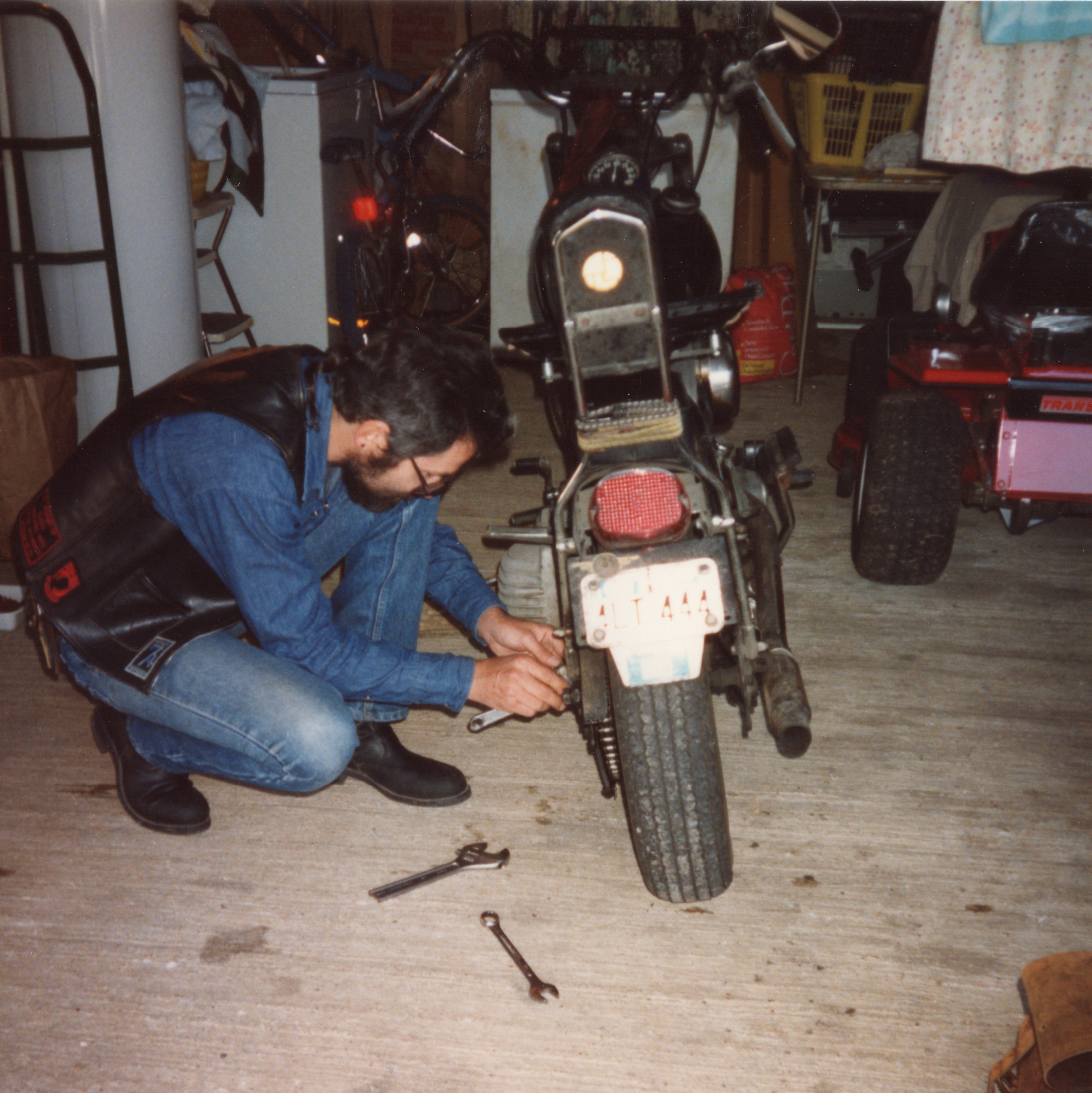
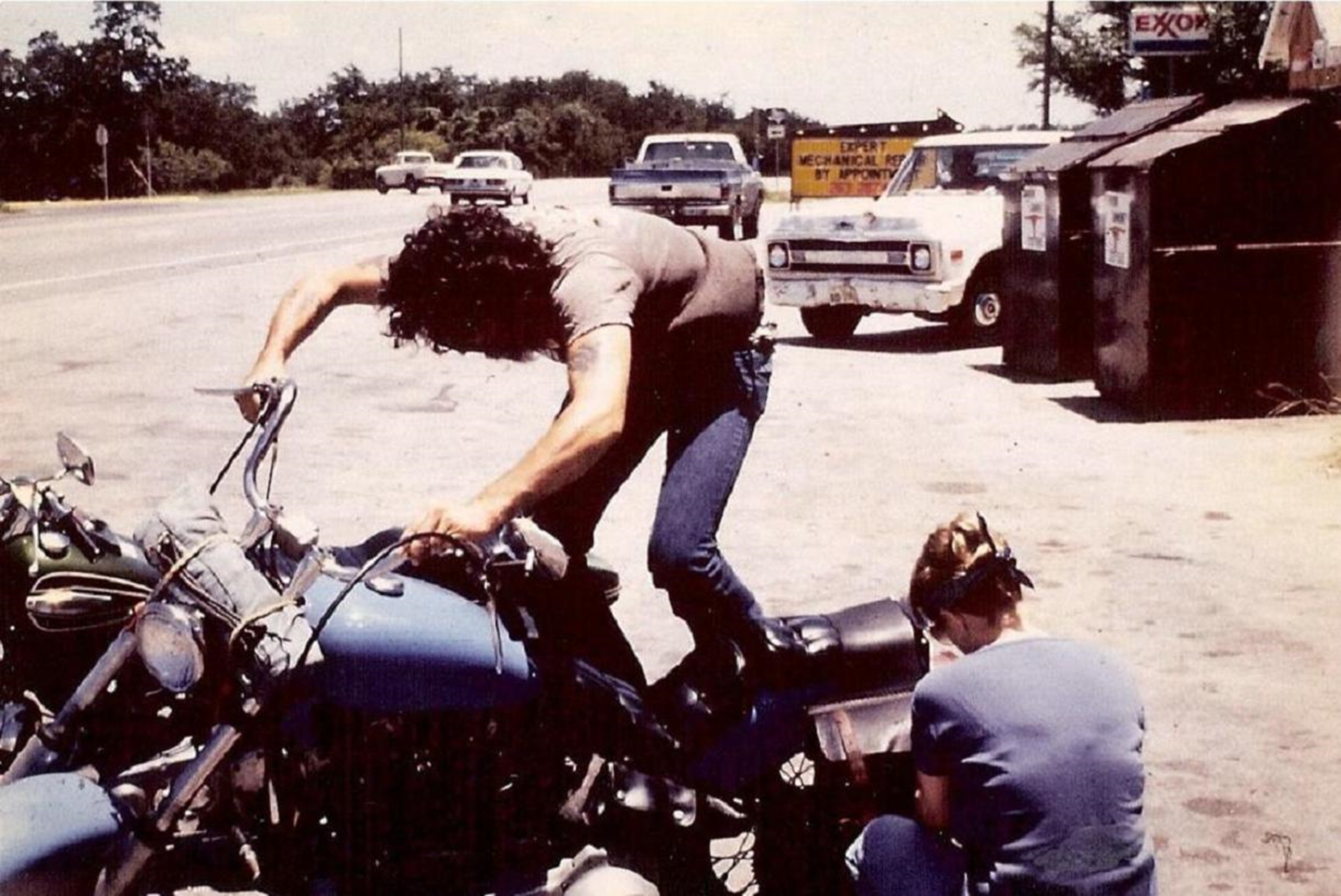
Oh, look! There I am making a minor repair to my shovelhead while on a run to the annual ‘Blow-In’ at Jim’s Motorcycle Shop in Axtell. Because I had the know-how and tools to accomplish that task, our group ride was not interrupted. Fifteen minutes of wrench twiddling, a quick test-ride, and then me and my date and my gaggle of buddies were back out on the road again! 😎
Lucky… or not. Broken Belt Bummer, March 1988. That kind of breakage happens often enough that it showed up in at least three of Dave Mann paintings, and in addition to my own adventure, I’ve seen it happen right in front of my eyes. Dog Breath, a good ol’ boy from Tennessee who worked with me at Bud’s, broke a belt on the street in front of the shop, trying to hotrod his shovelhead. Don’t see good ol’ steel chain doing something like that, do ya? 😆 Or do ya? Check out the next painting.

Of course, it could be worse. You could be well and truly fucked, like this poor couple….

Fuckin’ Rain! Thunderstruck! September, 1982. I have seen smaller images of this painting for years, and noticed the rain and the woman retrieving the broken drive chain. It wasn’t until I discovered a larger image on the Dave Mann Facebook page (link at bottom of column) that I spotted the broken spokes on the rear wheel. If that doesn’t make you want to flip off the sky gods nothing will!
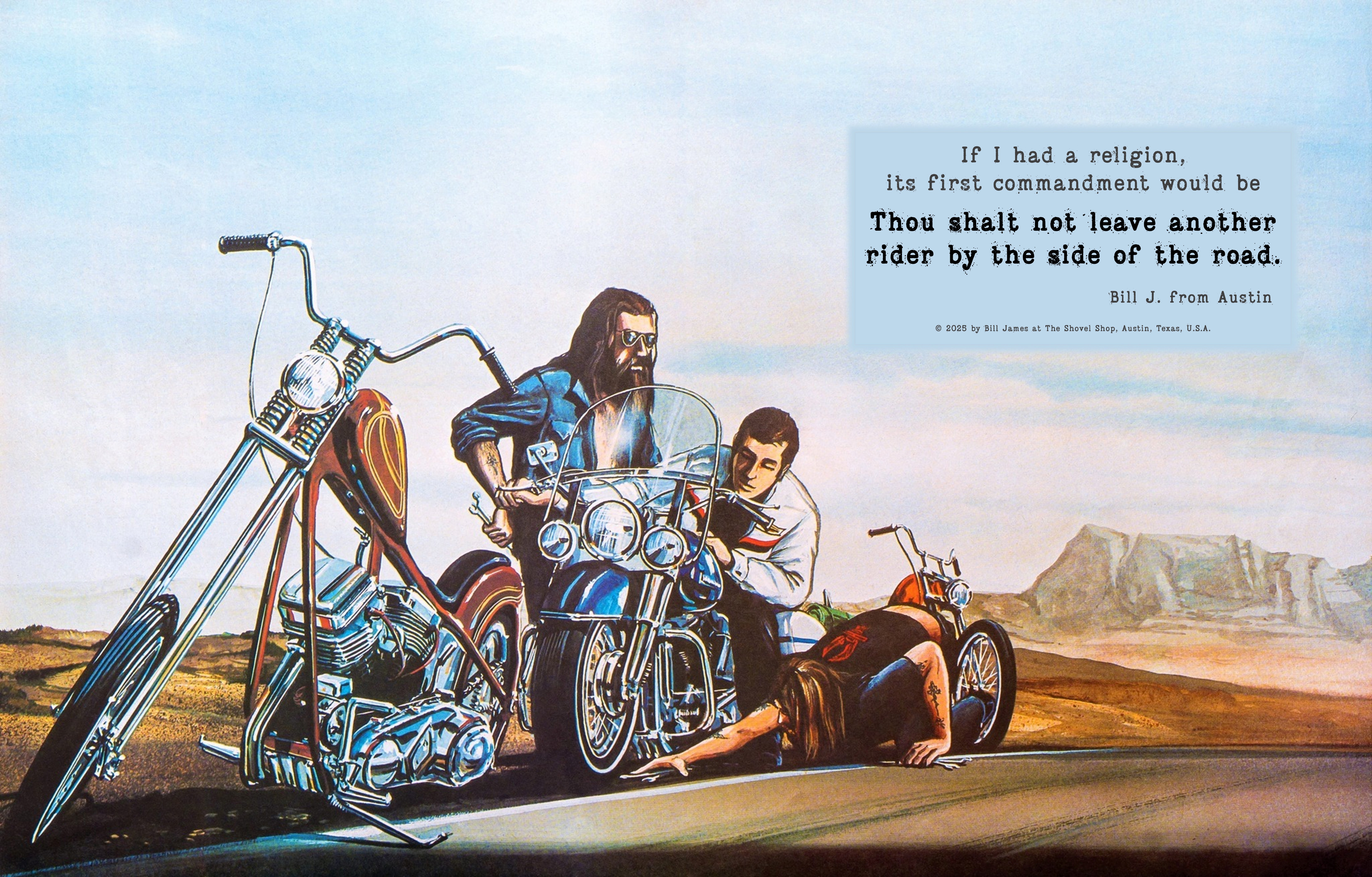
However, if you should break down anywhere near me, I promise you I’ll lend a hand.
When We Do Wrong, February 1975, originally had a quote attributed to the Hells Angels of the 1960s:

When We Do Right, No One Remembers
When We Do Wrong, No One Forgets

but I decided to repurpose the art for a quote of my own; something I say whenever the topic of helping brokedown riders is discussed. I’ve had enough strangers go out of their way to help me when I needed it. The only way I can repay their kindness is by passing it on to others.

BIKER’S CODE

However, if you’re lucky enough to break down while riding with others, the Biker’s Code says ‘No biker left behind.’ By hook or crook or boot or rope, you’re both getting home.

This is titled Dark Roadside Repairs (April 1982) but it’s obvious to anyone who wrenches on bikes (or has ridden long enough to run out of gas) that the guy on the green bike (with a small Sportster tank) has run out of gas, and the guy on the black bike (with the larger-capacity fat bob tanks) has dropped his fuel line and is draining petrol into a beer can salvaged out of the ditch, to get the guy on the green bike to the next service station.
I have done that, and had it done for me, so I made the task a lot simpler by running a single tank held in place with a big rubber band. I could just remove the rubber band, take the fuel line loose, lift the tank off my bike and give the other guy all the fuel he’d need. No muss, no fuss, no scrounging for ‘clean enough’ beer cans or bottles in roadside ditches! Unfortunately, that trick doesn’t work with fat bobs!
Sunrise Sunday Morning, Texas Panhandle, June 30, 1991

And if all else fails….

Push Home, November, 1978

Another scene most riders will recognize (or cringe from): the bike that just…. Will. Not. Start! I’ve never owned a Sportster, but I started my share during my years of working at Bud’s. I’ve also been that pissed at my shovel, when it’s been particularly coldblooded and cantankerous. Fortunately for me, those instances have been few and far between….

….and the next sound you hear will be me knockin’ on wood! 😱

Damn Sporty! February, 1979
Won’t Start, May 1979
Kickin’ the Bitch, Bee Caves, Texas, circa 1982. Photo by Bob Wilson, a rider from Pennsylvania who owned the forest green boattail FX seen at left. The young woman rummaging in my saddlebag was my live-in girlfriend, Lea.

Sadly, our machines aren’t the only things that betray us.

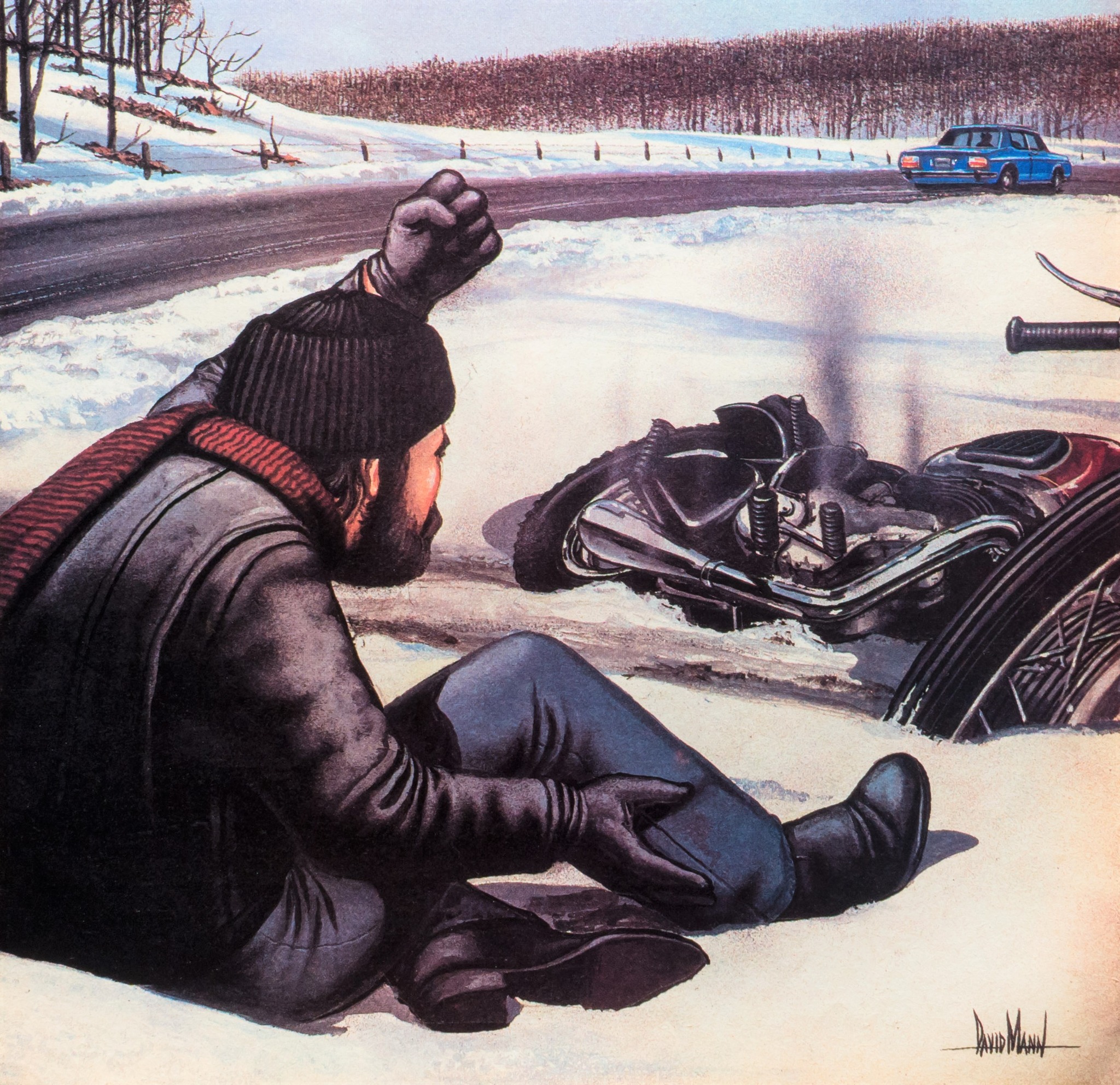
You can feel the rider’s frustration at the cager who recklessly or maliciously ran him off the road, then drove off and left him. This appeared in January 1986, as a story illustration.

Bikers are all too familiar with the cager who seems to have it in for us. Popular wisdom advises riders Don’t ride as if they can’t see you; ride as if they’re aiming for you! Unfortunately, I know from bitter experience that sometimes they actually are aiming for us!

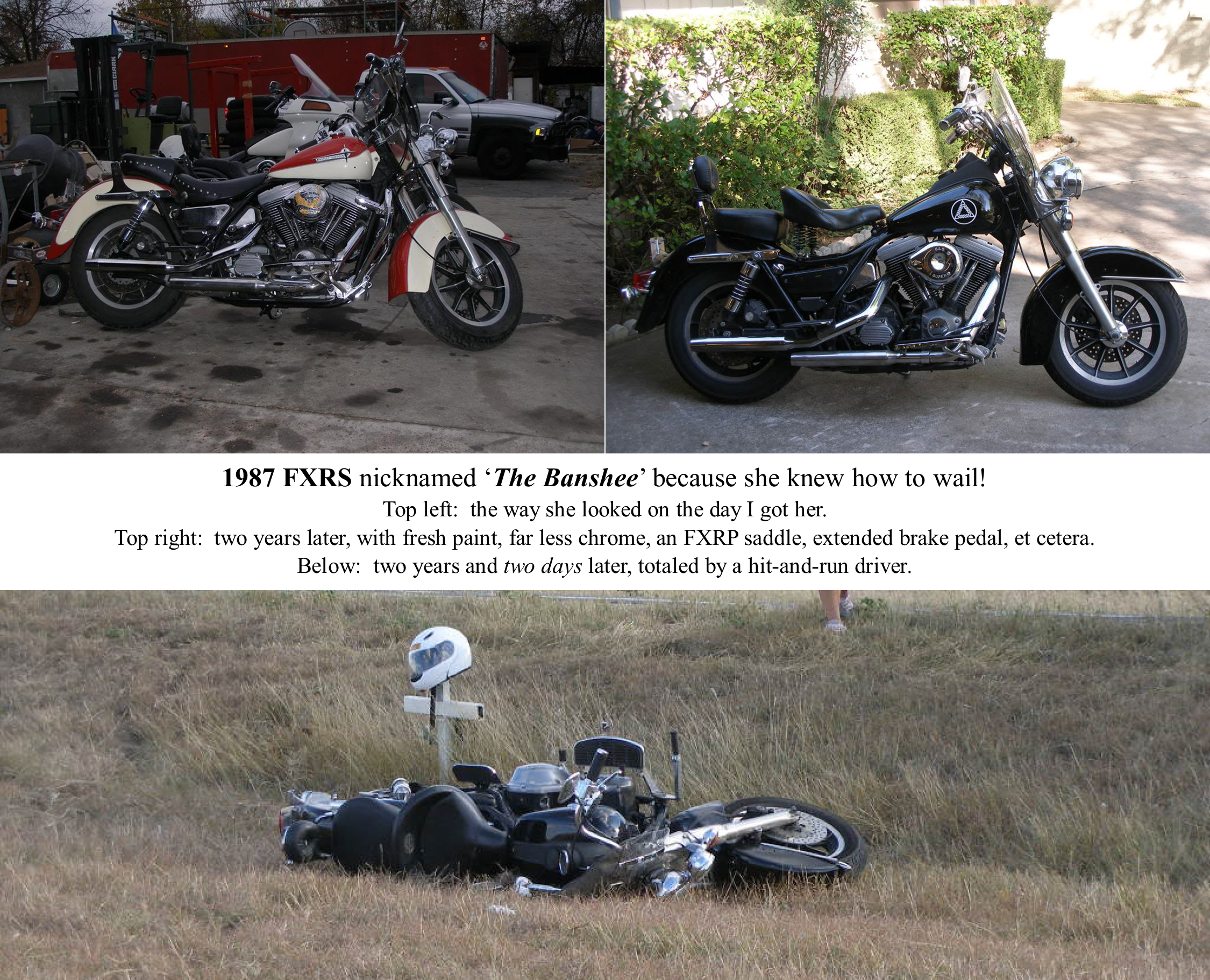
This is the 1987 FXRS I spent two years rebuilding and adapting to my disabilities. I added the finishing touches to her on a Friday afternoon. Two days later, on a beautiful sunlit Sunday in late October, Jackie and I were riding on a narrow two-lane road east of Taylor, Texas, when a kid in a pickup going the opposite direction decided to pass a slower-moving automobile. He crossed the double-yellow line, looked me right in the eye and kept on coming. Then he drove away, leaving us for dead. 🤬

Fortunately, neither of us were badly injured, but the bike was totaled. FMTT! I got to enjoy my new-to-me FXRS for less than forty-eight hours before it was snatched away from me! Forty-eight fucking hours! Damn, I was pissed! Still am, in fact!

But if one of the bastards does nail you, what can you do but heal as best you can, and dream of getting back in the wind where you belong?

Medicating a Broken Leg, October 1976

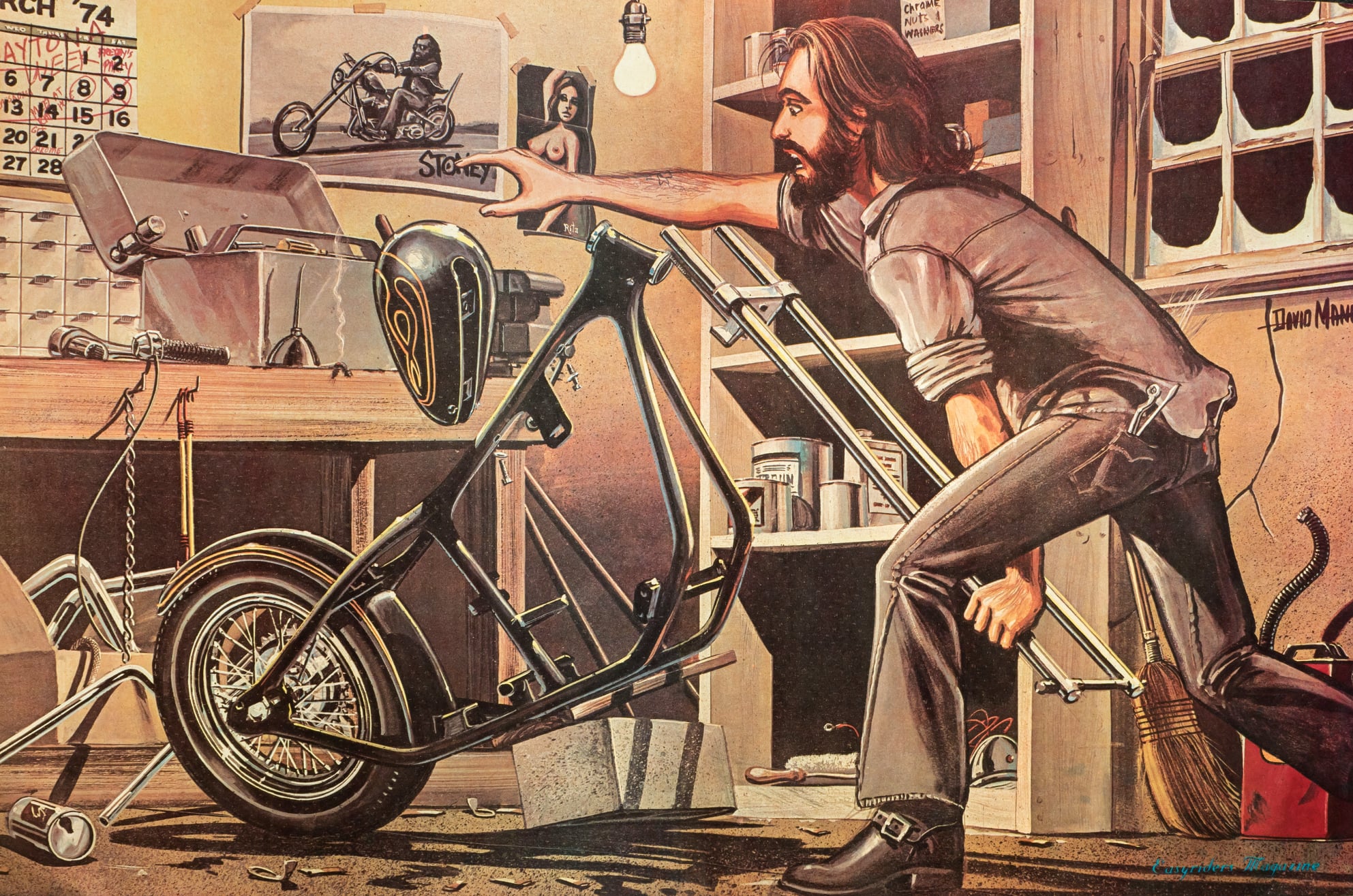
If you’ve ever built a motorcycle, you’ll recognize the anguished look on this fellow’s face, as he watches his freshly painted fuel tank head for a collision with the garage floor.

Oh, Shit! 1974

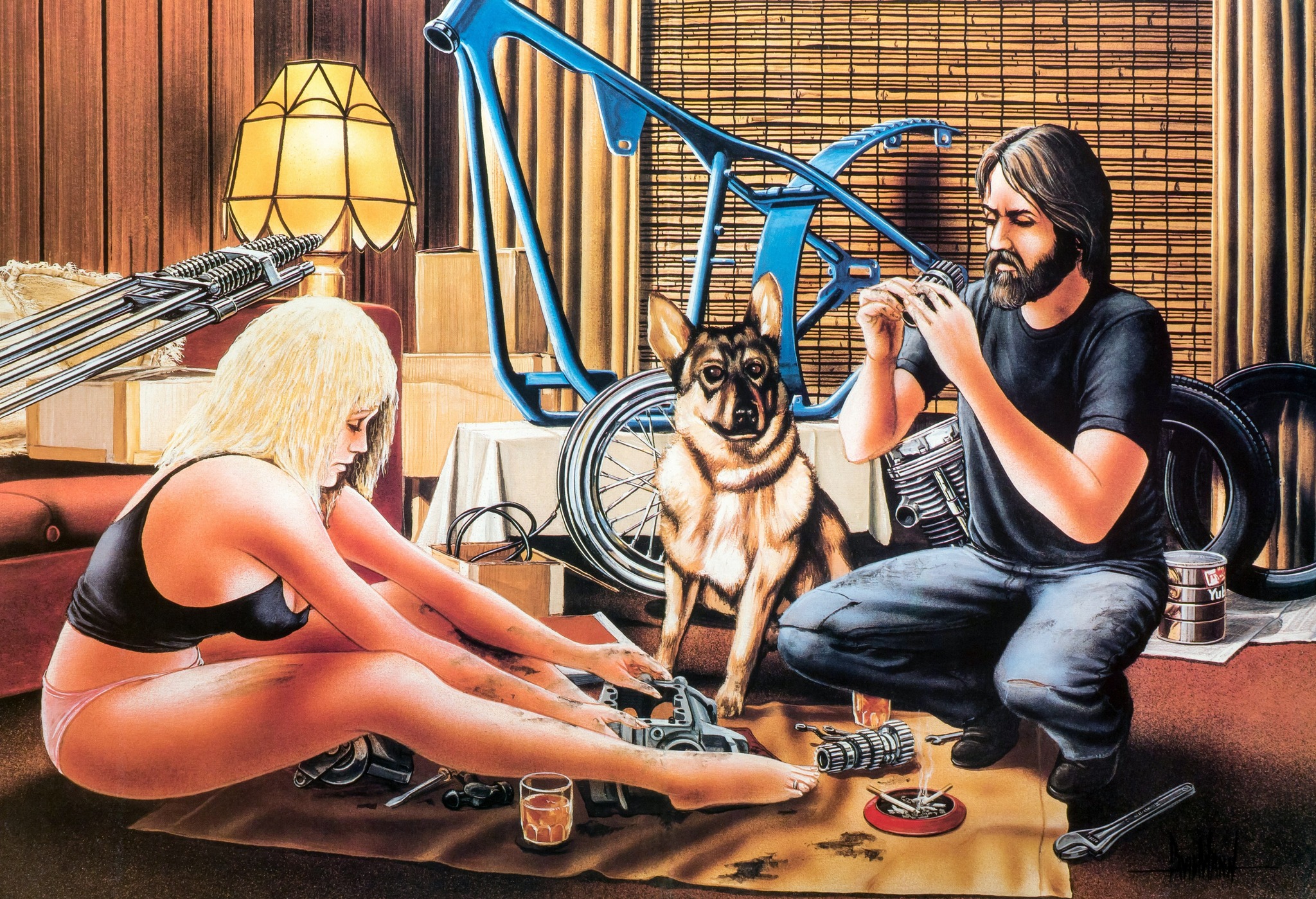
Mayhaps he needs a helper. Maybe a curvaceous blonde? Someone half-naked, perhaps? Yeah, that’ll do the trick! 😆

Parts Cleaner, January 1983

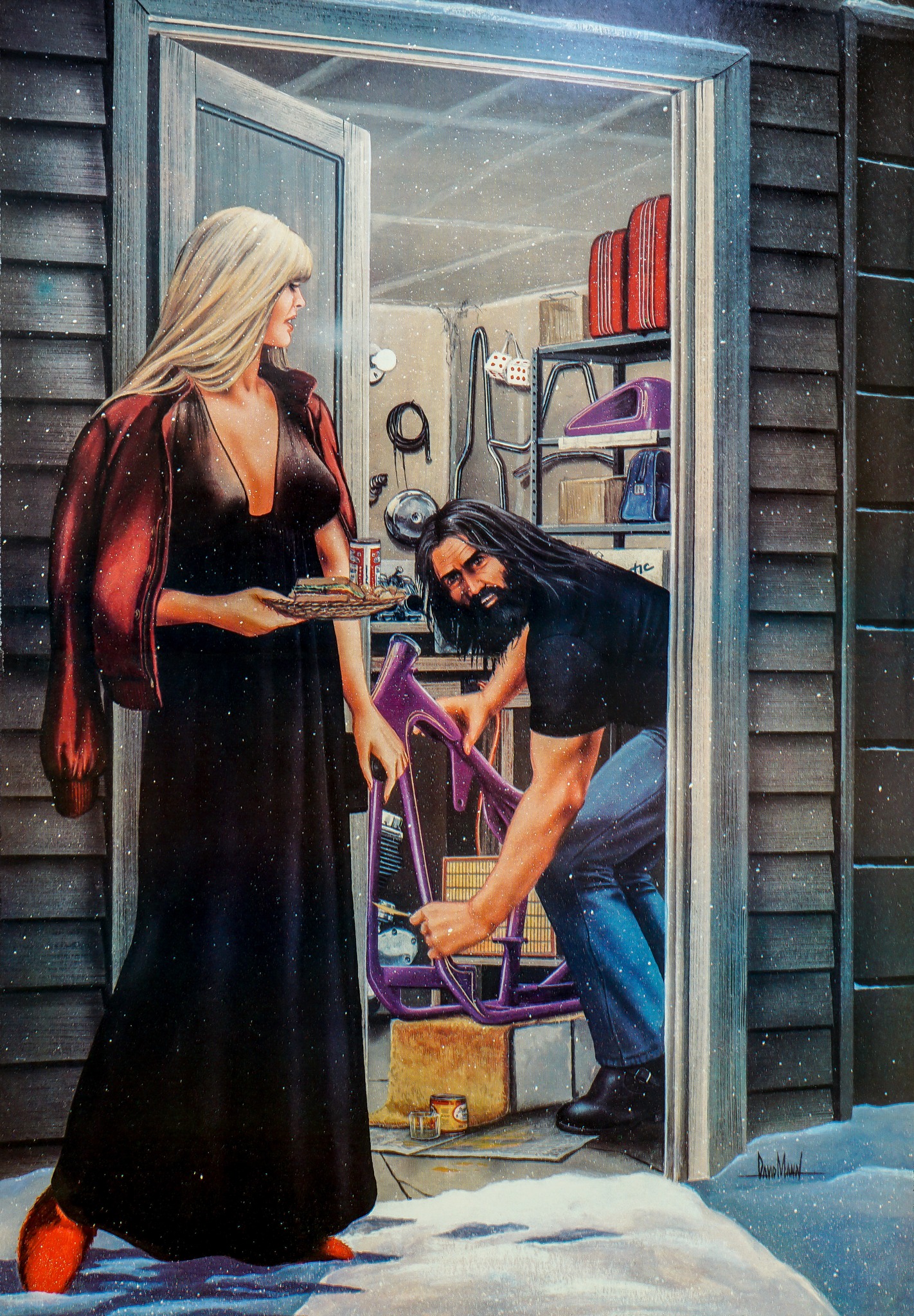
Or maybe he just needs a sandwich! 😁

Dinner’s Served, February 1984, IRON HORSE

GIRLS AND THEIR TOYS

In Mann’s art, women are primarily placed in secondary roles as backrests, bike washers, beer fetchers and sexual conquests. In Mann’s world, women rarely ride their own. In fact, of the hundreds of paintings Mann produced, I’ve only found a baker’s dozen thus far depicting women riders. However, to his credit, man or woman, when he painted them he brought the same skills, artistic integrity and vision to bear.

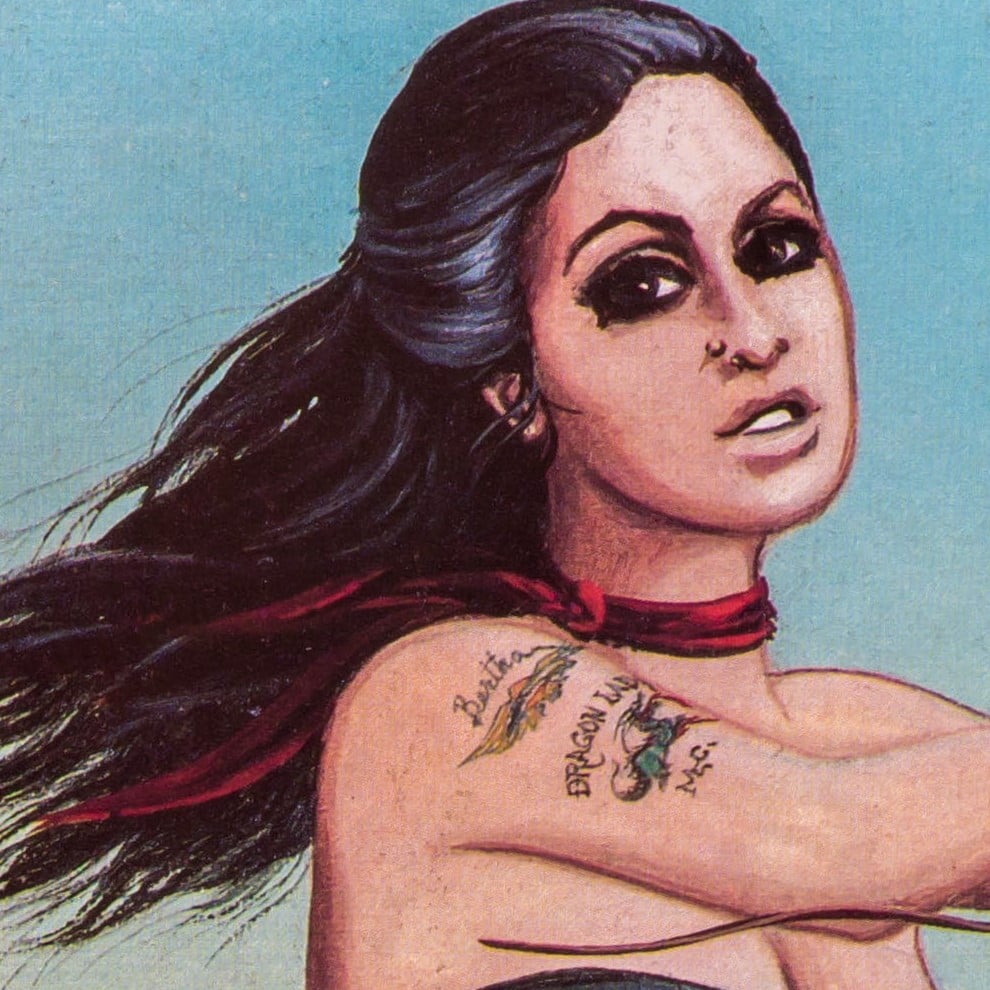
Big Bertha, December 1976, A woman on her own bike was still something of a novelty to a lot of bikers in the ’70s, even though women have been active in motorcycling from the very beginning. Look up the Van Buren sisters, or Effie and Avis Hotchkiss, for starters.
Bertha, Dragon Ladies MC
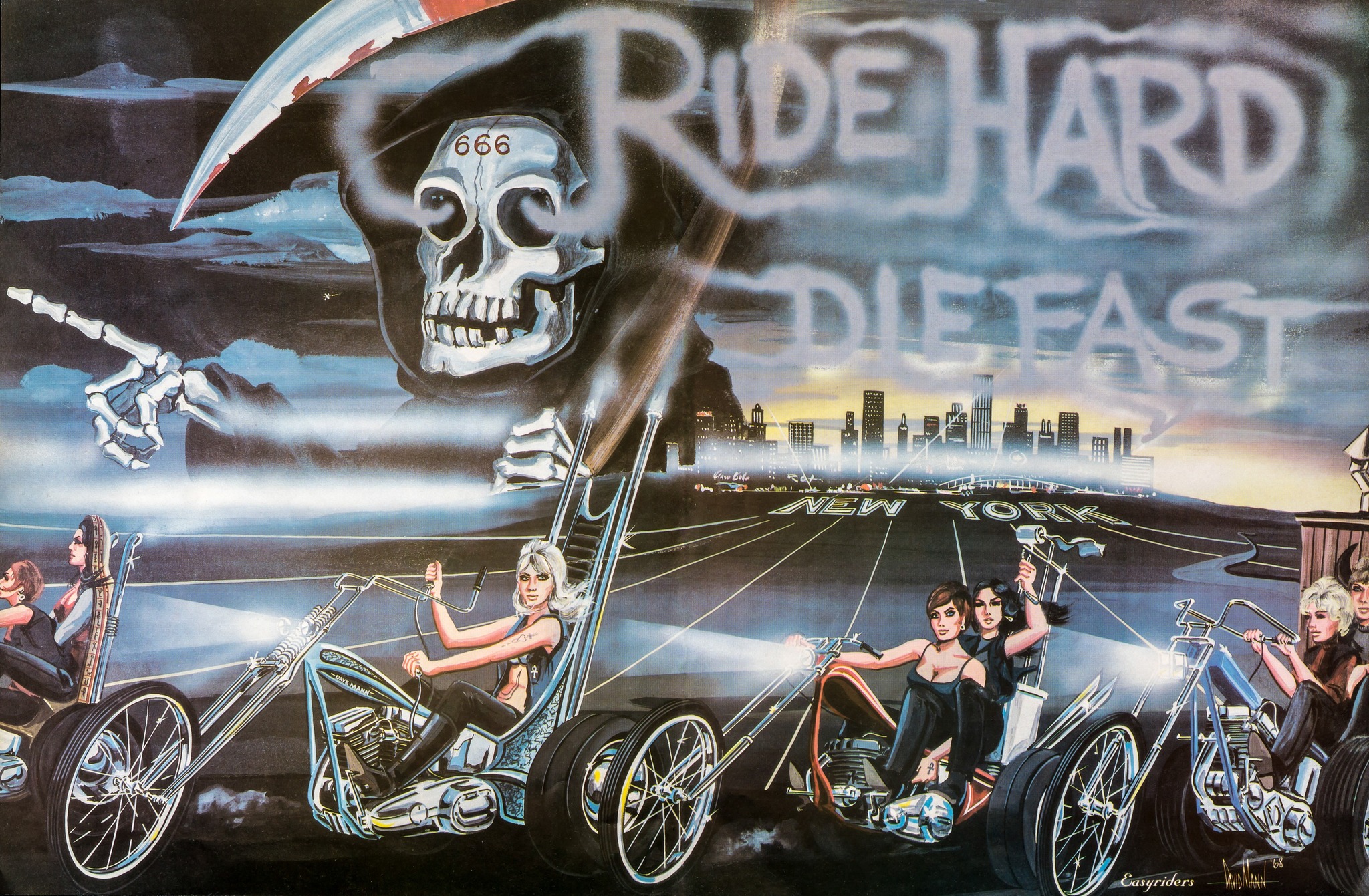
Ride Hard, Die Fast, 1968
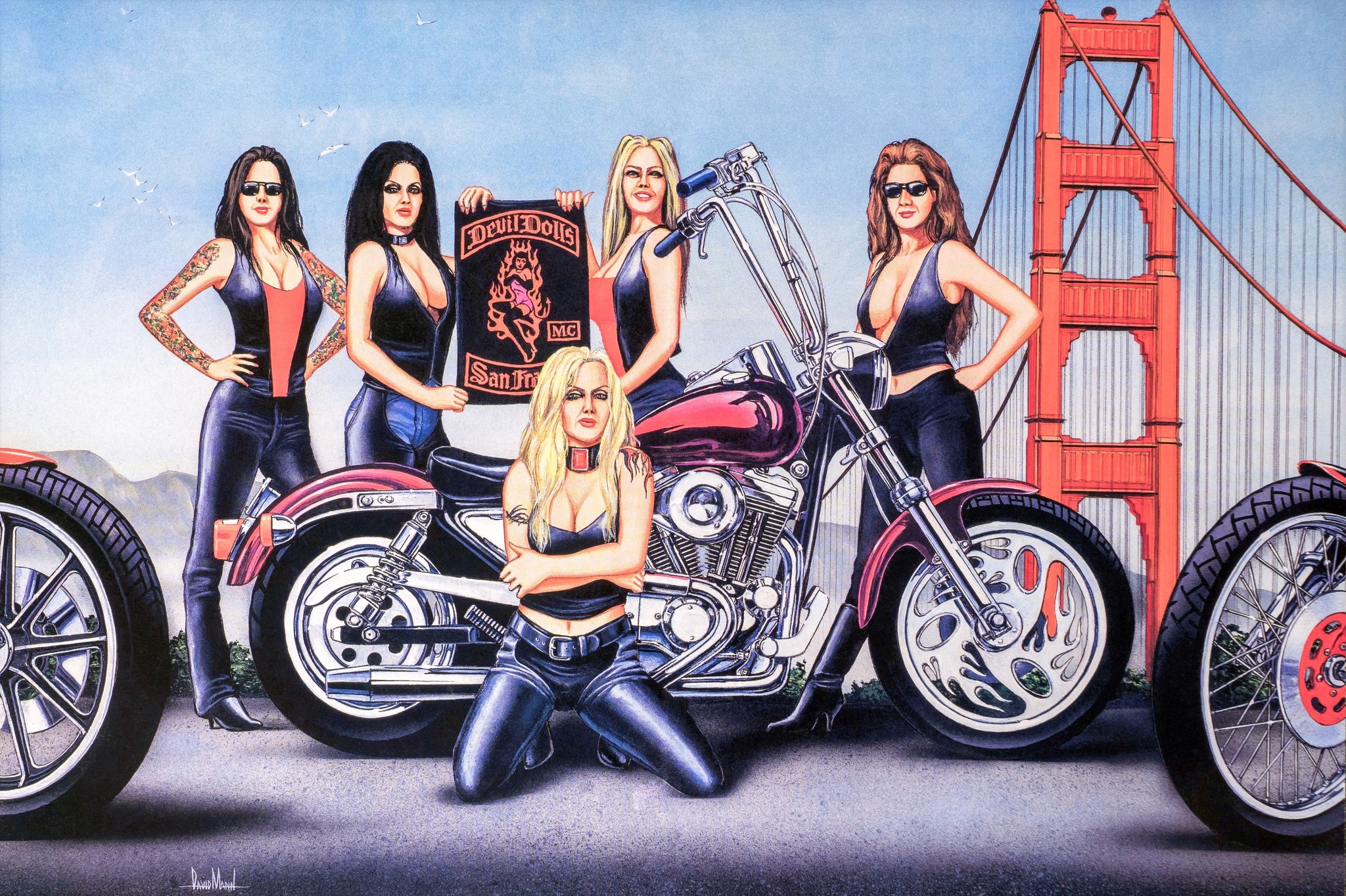
Devil Dolls MC in BIKER (March, 2001) is a real-life ‘outlaw’ club for women.
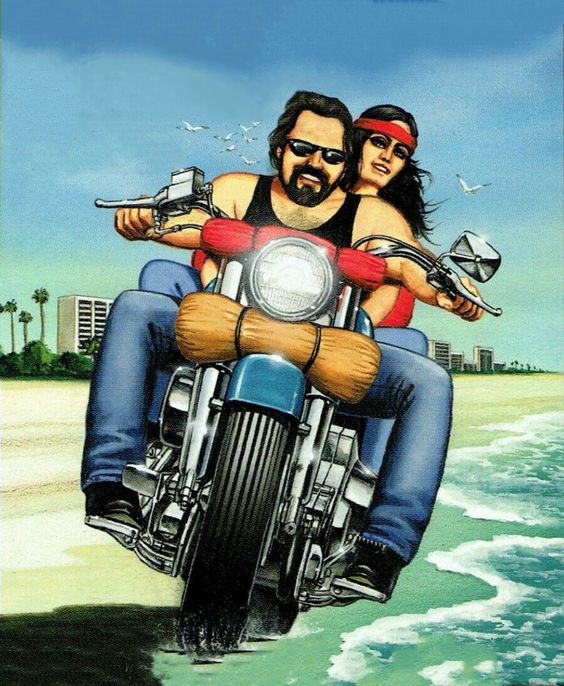
I Just Don’t Give Up, July 1999, was a story illustration. She’s riding a Servicar with a homemade taco box on the back. 45″ Servicars and solo rides were a popular choice for women riders back in the ’60s and ’70s – I dated a woman who rode a 45″ solo in the early ’80s – but nowadays women ride anything the boys can ride, from high-tech high-speed sportbikes by the Japanese and European marques to full-dress Harleys and Indians.
Jesus Chrysler, April 1998
His and Hers, July 1987. Sportsters for the girls and Big Twins for the boys, with matching paint jobs. The boys are quite amused that they’ve got the women packing all the gear So much for chivalry!
Solo Flight, a story illustration from Easyriders, November 1999. Coincidentally, November 1999 is when my solo flight ended! 😁Jackie and I got hitched at the end of that month, and (with apologies to Prince) partied like it was 1999. 😆
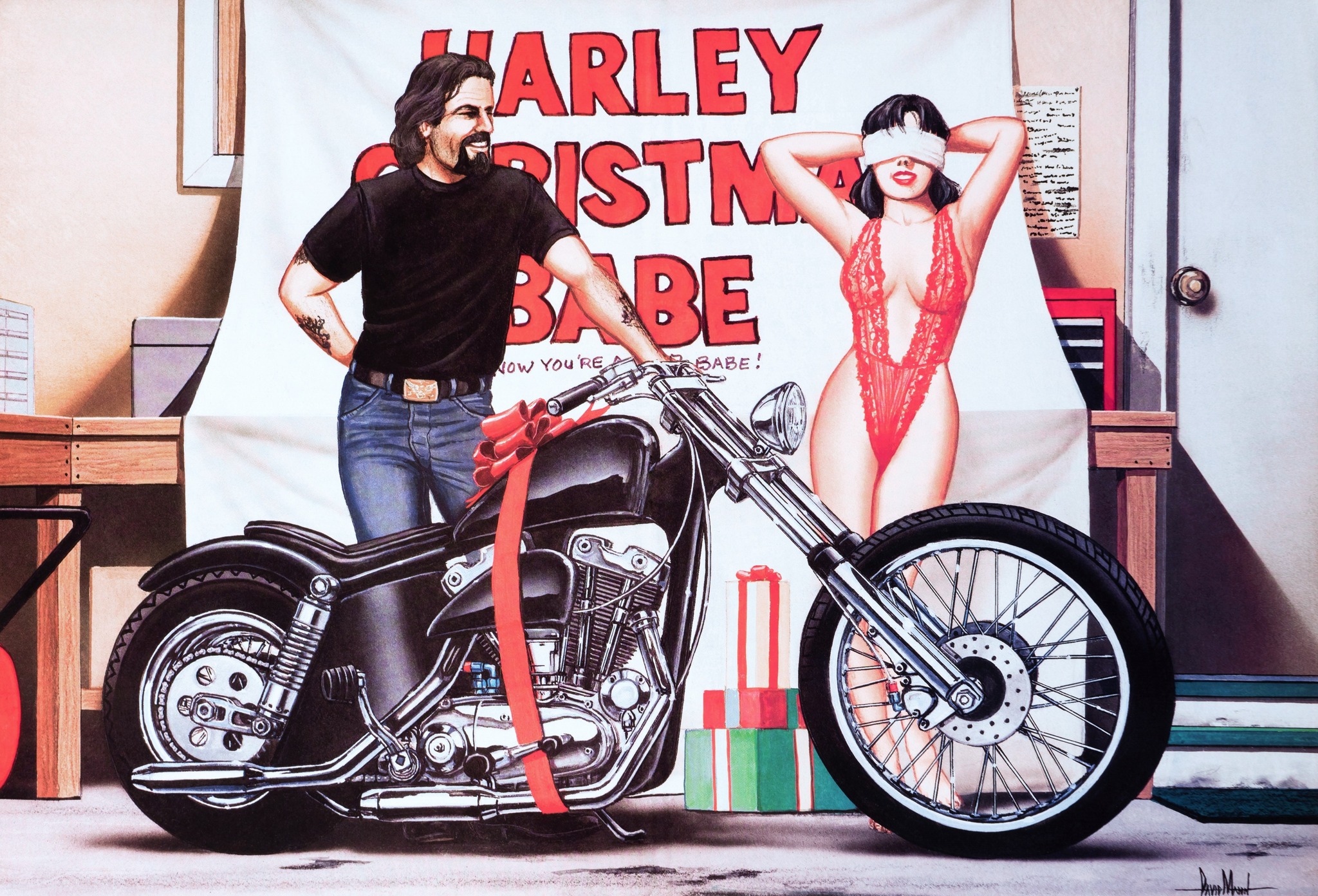
Merry Christmas, Babe! This appeared in BIKER, December, 1999. Technically, the woman is not riding the bike, but she is receiving one as a Christmas gift. I think we can safely assume she’ll be riding as soon as the snow melts, and she gets some leather on over that lacy lingerie! 😏
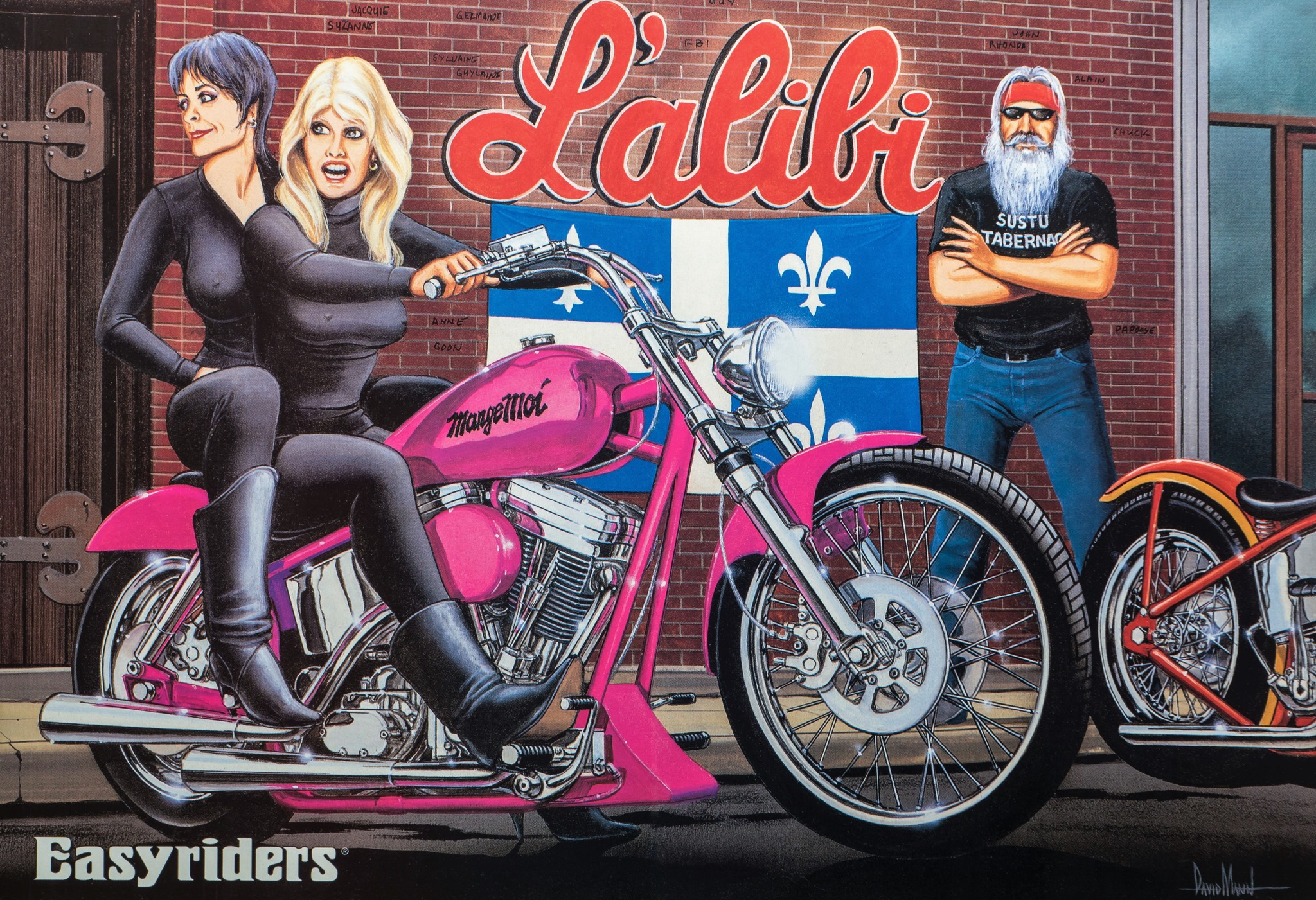
L’alibi, March 1997. Mann’s wife, Jacquie, made frequent appearances in her husband’s work for Easyriders. She’s shown here at the controls of a hot pink Evo constructed in Pro-Street Style.
Easyriders Video #13 cover art
Wild Women Don’t Worry, Wild Women Don’t Sing the Blues! I have no idea what the actual title is, but every time I see this painting that old tune by the late folk-blues singer Judy Roderick comes to mind.
….and Wild Women will look good on the cover of an Easyriders tattoo video!

Finally, what could be finer than doing something you love, like riding, and looking over to see the person you most love in this world enjoying the same thing?

Sunday Morning, July 1979.

I FOUGHT THE LAW AND THE LAW WON!

One of the downsides of biker life is the occasional brush with the law.

This image has an empty alt attribute; its file name is dm-art-noise-infraction-9-77.jpg
Noise Infraction, September 1977.

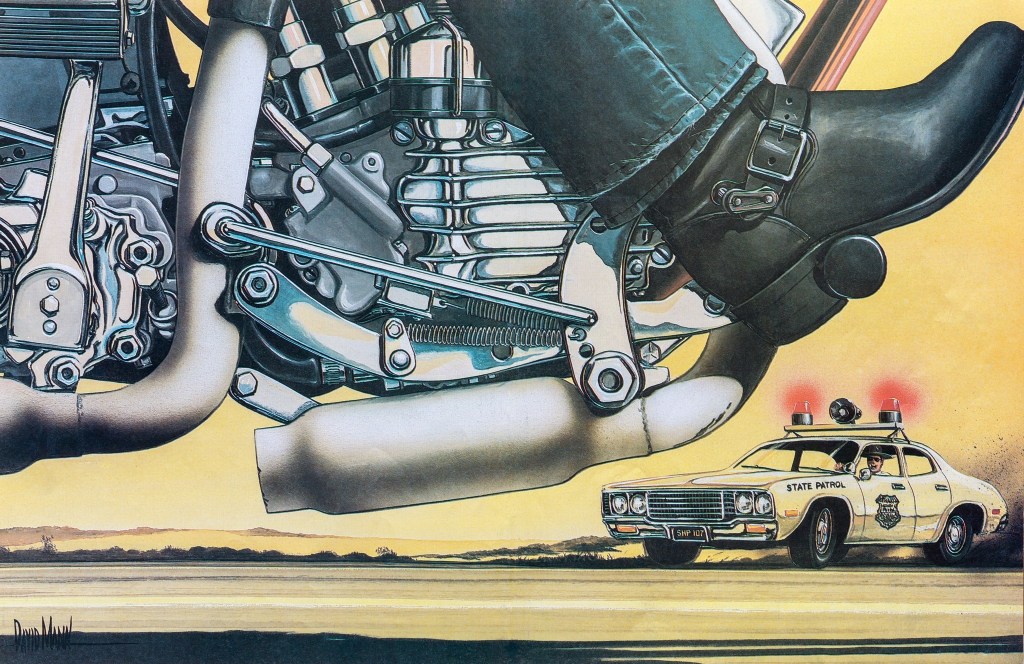
I’ve gotten a couple of these over the years. One was right after I’d installed brand new mufflers on my bike! Turns out I was riding my motorcycle in that trooper’s personal ‘No Biker Zone’. I’ve learned there are a lot of those in this state. 🙄 I’ve come to see ‘too loud’ tickets as a sort of ‘road-use tax’; nothing to do but pay the piper, no pun intended. 😏

My best road dog learned that the hard way. We were jamming through West Texas enroute to the Four Corners region when we were tagged by a state trooper near Sweetwater, Texas. On a busy Interstate Highway packed full of noisy highballing tractor-trailers and speeding cagers, he spotted us coming the opposite direction, doubled back and pulled us over. The fuckwad actually claimed he could hear our exhausts over the noise of the semis and pickup trucks, despite the fact that my exhaust system was in excellent condition and my partner’s was almost new. The trooper ignored the modified pickup that blasted past us as we stood there (leaving us all with tinnitus) and wrote us both tickets for ‘exhaust too loud.’

The first time I received a ‘too loud’ ticket, over a decade earlier, I was incensed because, as it happened, my mufflers were brand-new at the time. How could this asshole write me a ticket? I went so far as to call the State Attorney General’s office, to see if this was even legal, and was told the law leaves ‘too loud’ to the discretion of the officer making the traffic stop.

At the time I was incensed. The state is going to leave something like that up to officer discretion? Geez! The potential for abuse is staggering. How can you defend against an officer’s opinion, when it’s given the weight of evidence in a court of law? Well, you can’t, so I paid up….

….and that’s how I gained the ‘road-use tax’ perspective. If you can’t fight it, just find a way to accept it.

However, I later realized that ‘officer discretion’ is actually a good thing for us. It beats the hell out of decibel meters!

Think about it: the occasional cop may decide your pipes are too loud and ding you for ’em, but with a decibel meter? With a goddam decibel meter, every cop will be writing tickets for pipes too loud. When it comes to cops, better the few than the majority.

In fact, I’m so opposed to decibel meters, and the threat they pose to those of us who ride large-displacement American motors, that I resigned my membership in the American Motorcyclist Association when they made the incomprehensible decision to donate decibel meters to police departments. Seriously!?! What the ever-lovin’ fuck were they thinking? I doubt they miss my $50 annual dues, but I sleep better at night knowing I’m not arming our enemies and making life worse for my fellow riders.

Anyhoo, in the Sweetwater incident, I paid my fine before we left the jurisdiction. I am scrupulous about such things, because I never want to give a cop an excuse, like an unpaid traffic ticket, to pull me off my bike. If they want me they’re gonna have to make something up!

However, my partner, who had never been through this, was overcome with righteous indignation, and swore he’d fight this outrage. Sure enough, when we got back from our week on the road, he had his motorcycle inspected, gathered all pertinent documentation, closed his clinic for two days and hied himself out to Sweetwater to wage war against injustice.

The upshot? He lost two days out of his practice, the cost of travel to Sweetwater and overnight accommodations, and had to pay a fine and ‘court costs’ amounting to more than three times what I’d paid the day I got the ticket. I refrained from saying ‘I told you so,‘ but I did tell him so! 😆 As I said: nothing to do but pay the piper and get on down the road.

A final note: I mentioned the Sweetwater stop to my attorney at the time, who specialized in motorcycle-related law, and he said ‘Oh, that was Trooper _______.’ Apparently, the fellow who stopped us was renowned statewide for his hatred of bikers. 🤷‍♀️ Whatcha gonna do?

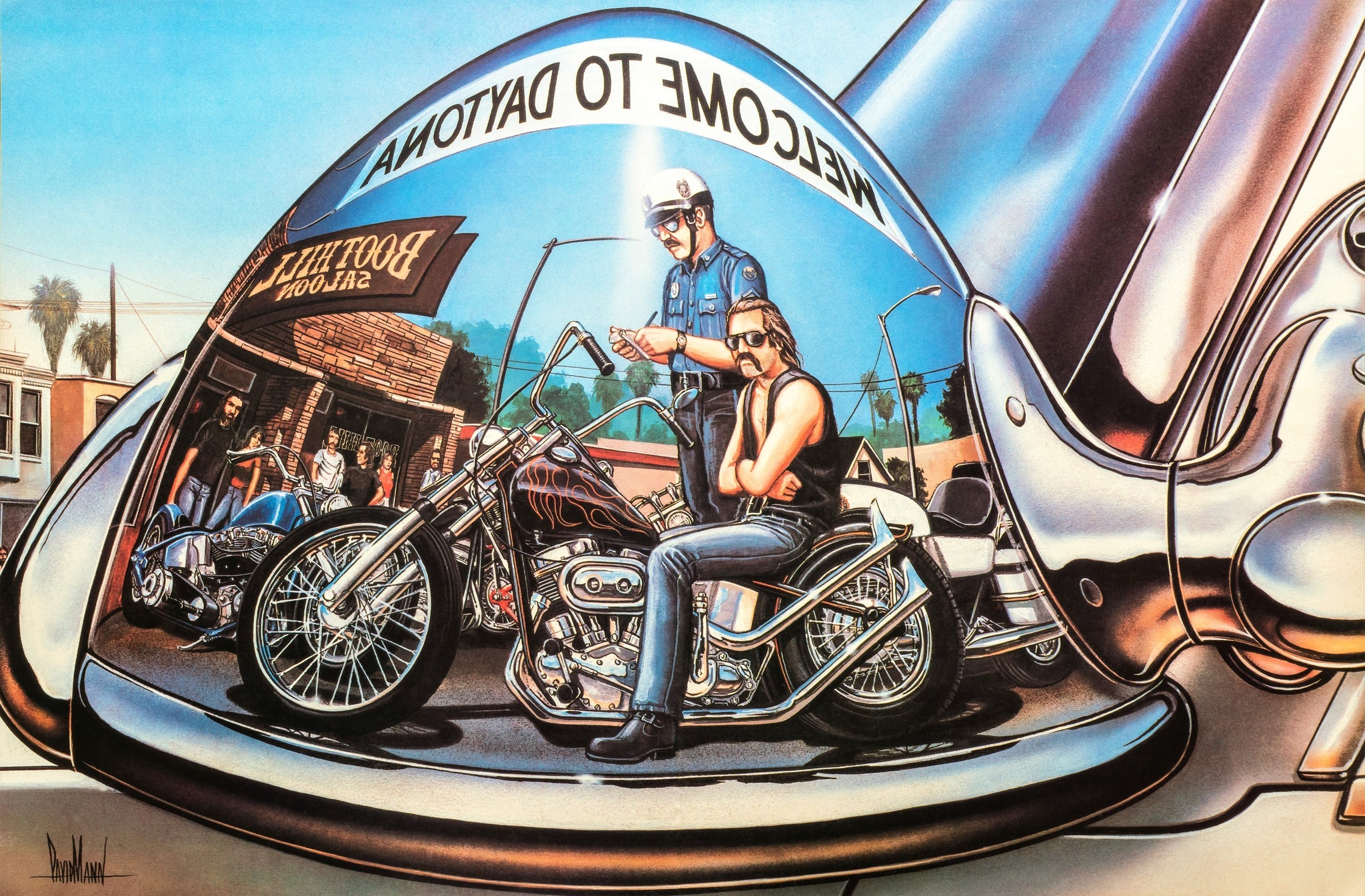
Welcome to Daytona Ticket in IRON HORSE, June, 1981

We’ve all had close calls like this one, too.

This image has an empty alt attribute; its file name is dm-art-nobody-talks-everybody-walks-september-1981.jpg
Nobody Talks, Everybody Walks, September 1981
This image has an empty alt attribute; its file name is dm-art-run-heat-july-1975.jpg
Run Heat, July 1975.
In the early ’80s I was part of a pack of about thirty or forty motorcycles enroute to a party at Lake Buchanan when we got jacked up by a battalion of LEOs of every stripe. Every cop in the county must have been there! We had local yokels, county mounties, smokies, probably a dogcatcher or two, all drawing down on us with shotguns and automatic rifles! It was a nice day for a ride with friends until the po-po came ’round. They ran us through the mill – license, tags, VINs, warrantless searches – and came up with exactly one warrant, for an unpaid traffic ticket. Out of forty of us, they got to arrest one! I guess we weren’t the roving band of criminal kingpins they thought we’d be! 😂

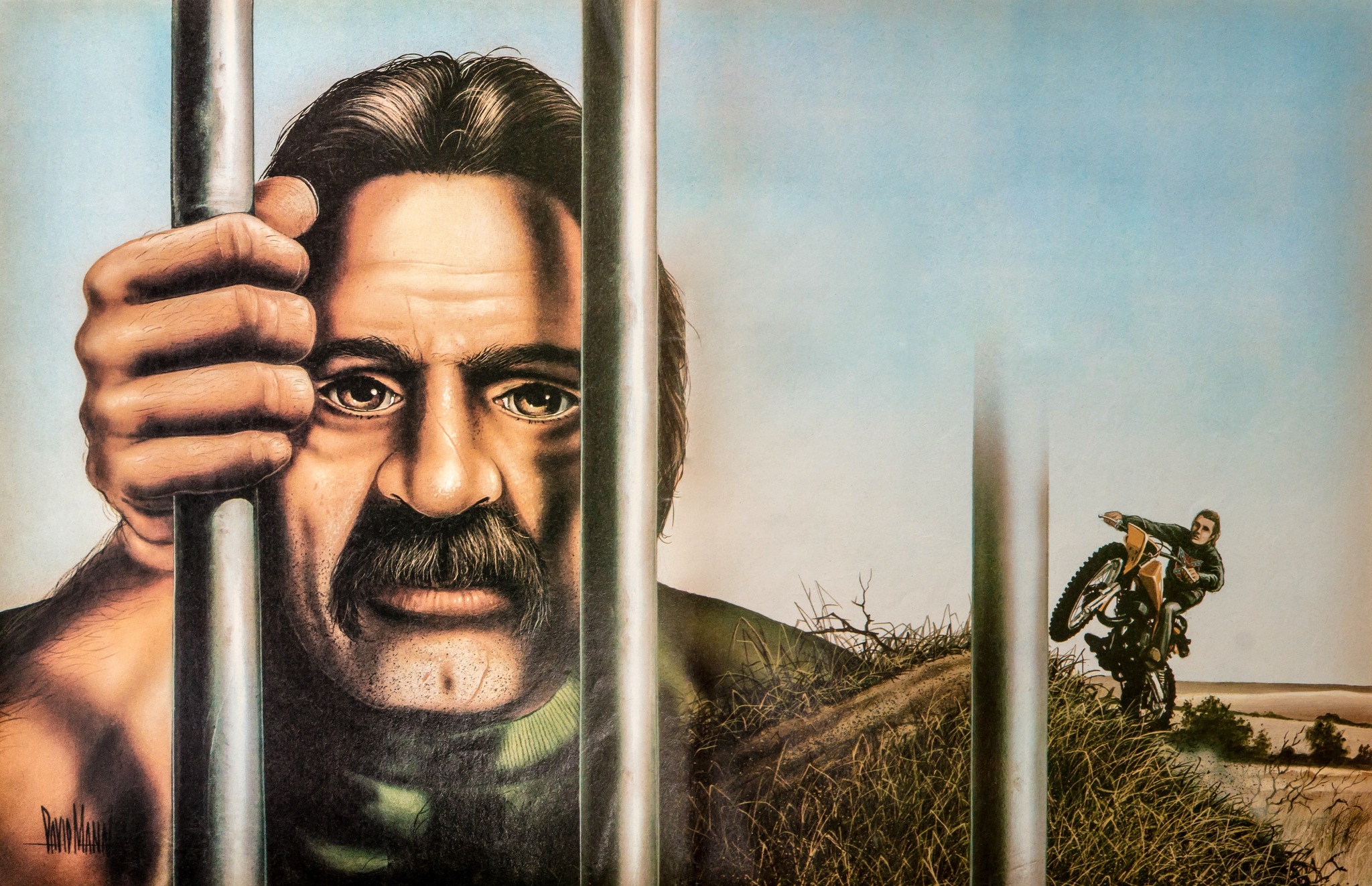
But sometimes the heat is more than just an inconvenient wants-and-warrants stop or speeding ticket. Prosecutors and LEOs seem to be convinced that bikers – particularly patchholders or independents on Harleys – are career criminals simply because they identify as bikers. As a result, too many bikers, many of them innocent, have wasted years inside prison walls. Mann showed their lives, as well.

Bum Beef illustrated a short story in Easyriders. FWIW, I never saw a prisoner’s toilet looking that nasty. In my experience, most cons keep their houses spotless, and especially their toilets.
Prison Memories illustrated another short story, about a convict who watches a young dirt-biker tearing up the fields outside the barred windows of his cell, and how the boy inspires him. One way that Easyriders stood out from all the other motorcycle magazines was with its publication of short fiction by a number of talented authors. Larry ‘Rabbit’ Cole was a particular favorite, as was Jody Via. (More on Jody Via in the footnotes to my history of Easyriders magazine.)

Although Easyriders went downhill in the late ’80s and ’90s, I take great pride in the fact that Easyriders published the first short story I ever sold!
😁 Sadly, Dave Mann did not create the illustration for it. What a feather in my cap that would have been!

If anyone cares, I will post a couple of short stories I have written in a future entry.

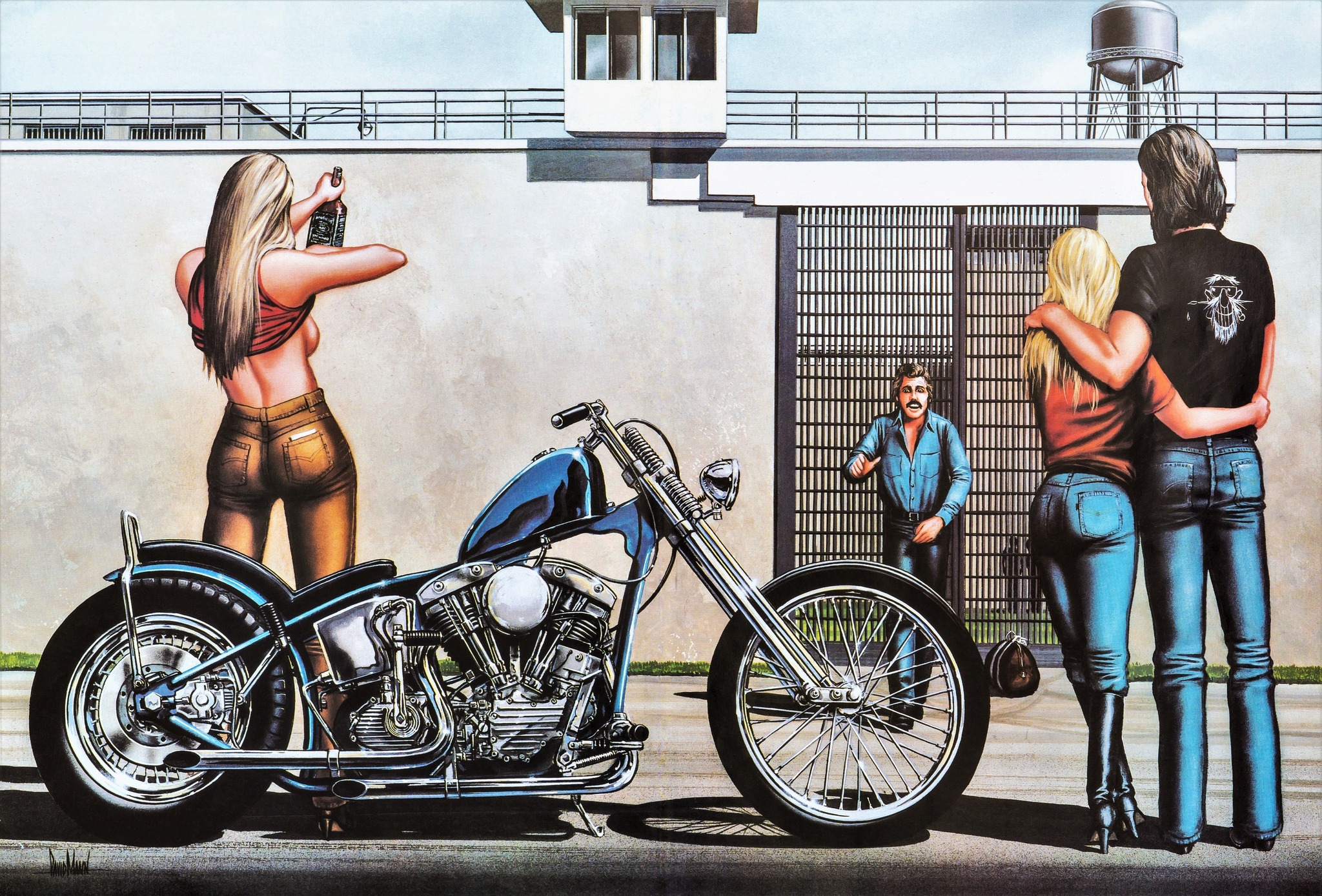
On a brighter note, here Mann captures the joy on a rider’s face as he clears those gates. The first things he sees are his girl, a bottle of Jack, and his prized shovelhead chop. As an added bonus: Dave Mann and Jacquie stand at far right, ready to welcome him back to the world.

Prison Release, August 1982

HISTORY LESSON

Mann knew the history of our tribe, too, from the streets of Hollister, California, where it all began….

Wild One, March 1993, celebrates the ‘Hollister Riot’ of 1947, a raucous motorcycle rally and party that allegedly got out of hand, and gave rise to the whole outlaw biker phenomenon. In response to negative press about the incident, a spokesman for the American Motorcycle Association (as it was then known) reportedly claimed the rowdies at Hollister were ‘outlawed’ by the AMA, which meant they would not be permitted to take part in AMA-sanctioned events. The AMA later went on to assure America that ‘99% of motorcyclists are upstanding, law-abiding citizens.’

Much to the AMA’s chagrin, it turned out the remaining 1% were just fine with the notion of being ‘outlaws’ – part of the elite rejected by the ‘straight’ association – and were soon sporting patches declaring themselves ‘one-percenters’. The honor is jealously guarded by those who claim it, and anyone wearing the ‘1%’ patch or tattoo had best be prepared to defend it!
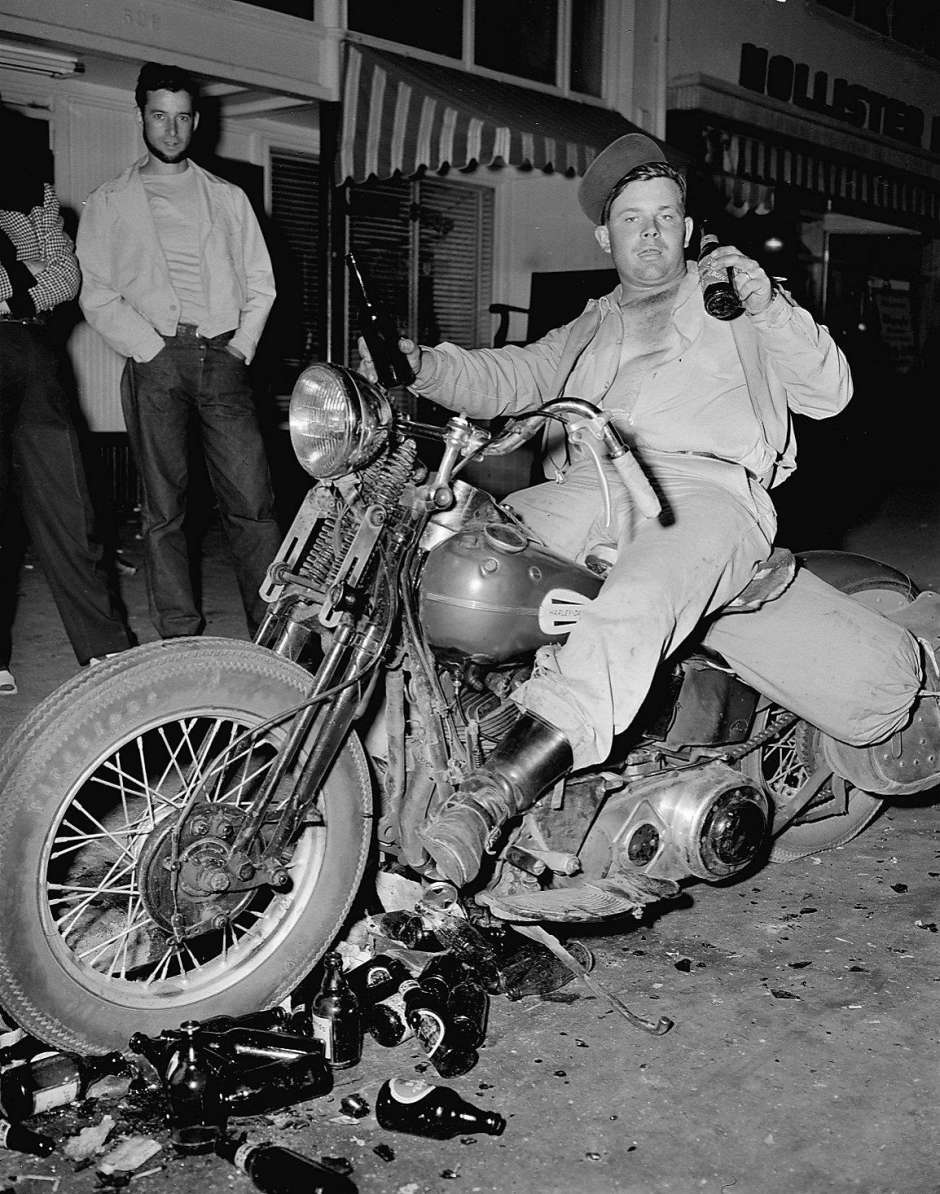
The infamous ‘Hollister riots’ photograph by Barney Peterson, which appeared in LIFE two weeks later, cemented in the minds of most Americans the image of motorcyclists as lawless, drunken ruffians. Unfortunately, the photo was staged. Peterson, assigned to cover the story, arrived too late to witness any of the ‘riot’ itself. Not wanting to miss out on his commission, he grabbed this fellow, later identified as Eddie Davenport of nearby Tulare. Peterson sat him on a motorcycle parked at the curb and artfully arranged bottles around the motorcycle, to make it seem the entire town was overrun by drunks on two wheels! His ploy worked: the photo hit the wire services and was picked up by LIFE

I’ve penned a lengthy article about the history and aftermath of the incident at Hollister here.

….through the early days of the custom bike scene.

This image has an empty alt attribute; its file name is dm-art-angelo-1952-kingdom-of-kicks-w.-text-2048x1312-1.png
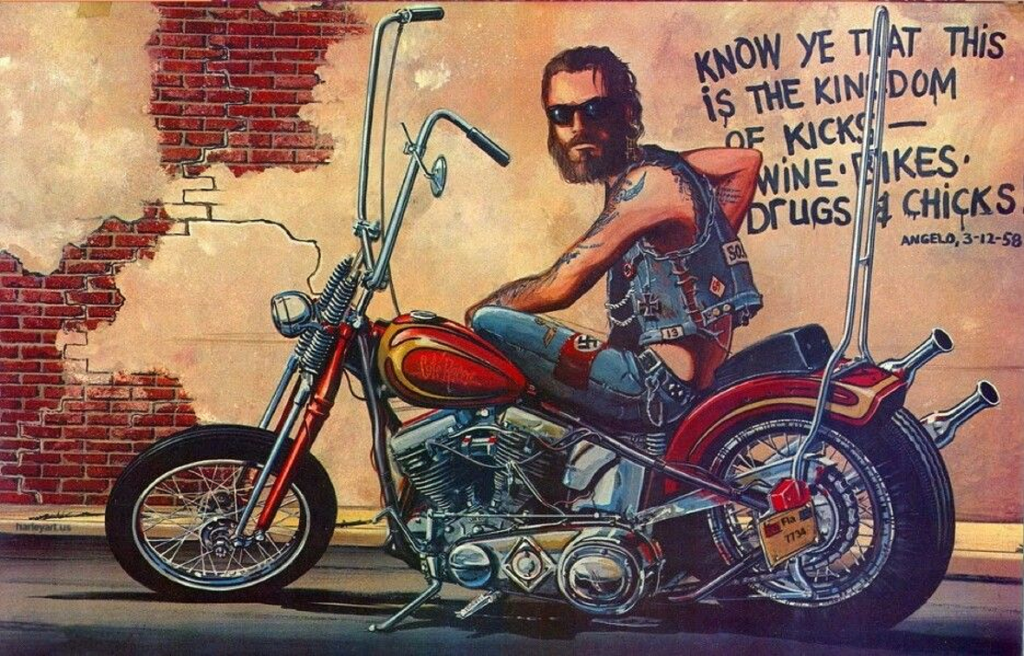
Ape Hanger Days (December, 1973) is one of Mann’s most widely recognized and reproduced images, topped only by Ghost Rider (November, 1983). From the bared brick behind the stucco wall to the ragged cut-off Levi’s jacket and the grease spattered on the rim and sidewall of the rear tire, the detail is astounding, and Angelo’s sweet little panhead is period correct and perfect in every way! The swastika is also period correct, although to Angelo the broken cross likely did not mean what it signifies today.
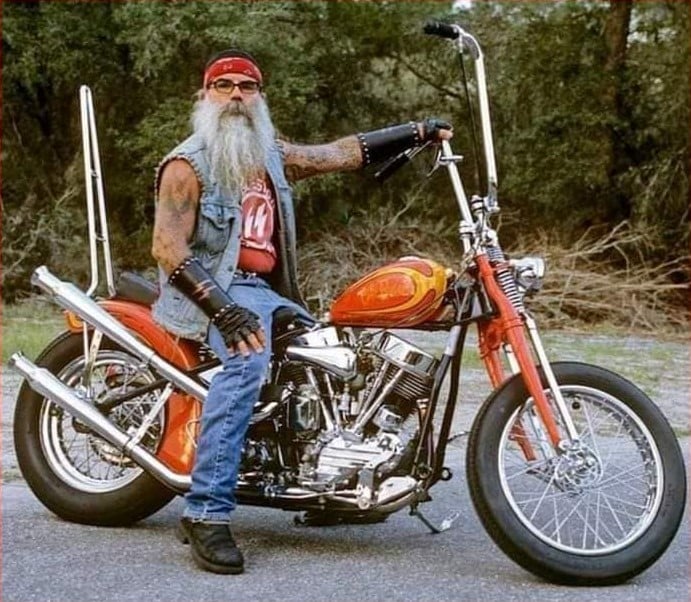
Only the gods know how many motorcycles (and paintings, and drawings, and tattoos…. see below) Dave Mann’s works have inspired. This is a note-for-note replica of Angelo’s panhead from ‘Ape Hanger Days‘ by a fellow from Florida named Hollywood Tig.

A RABBIT HOLE:

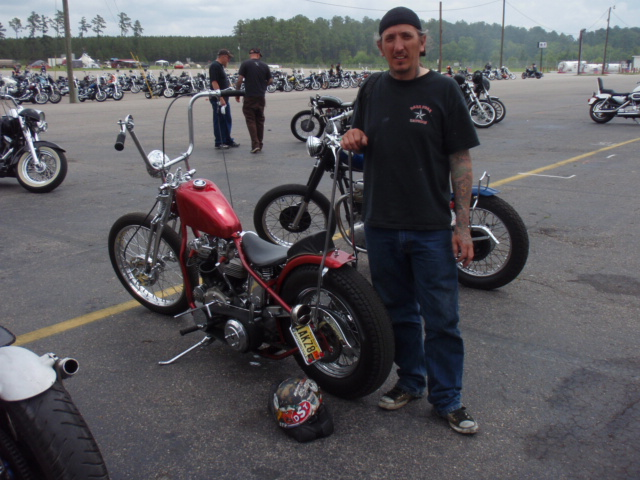
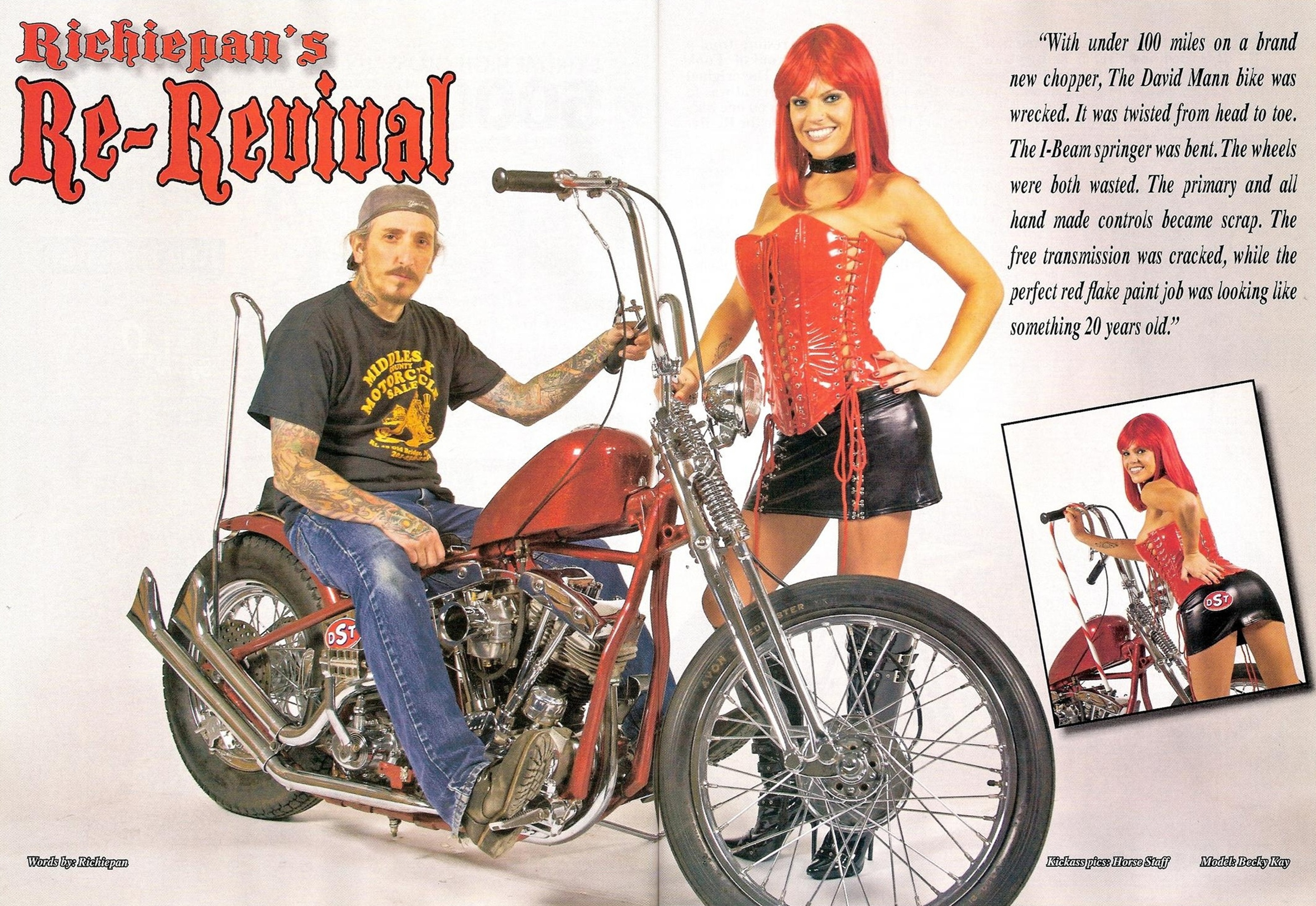
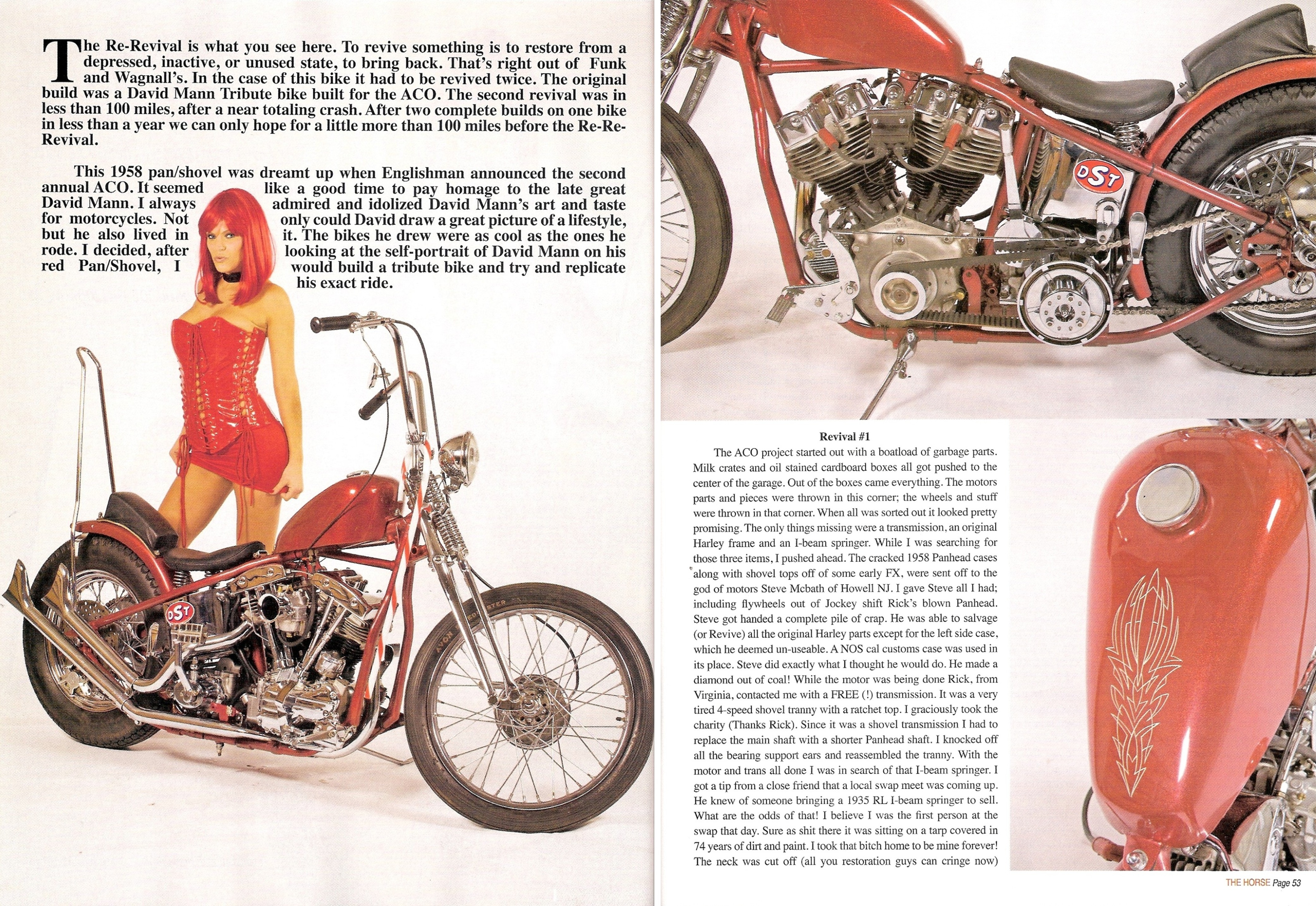
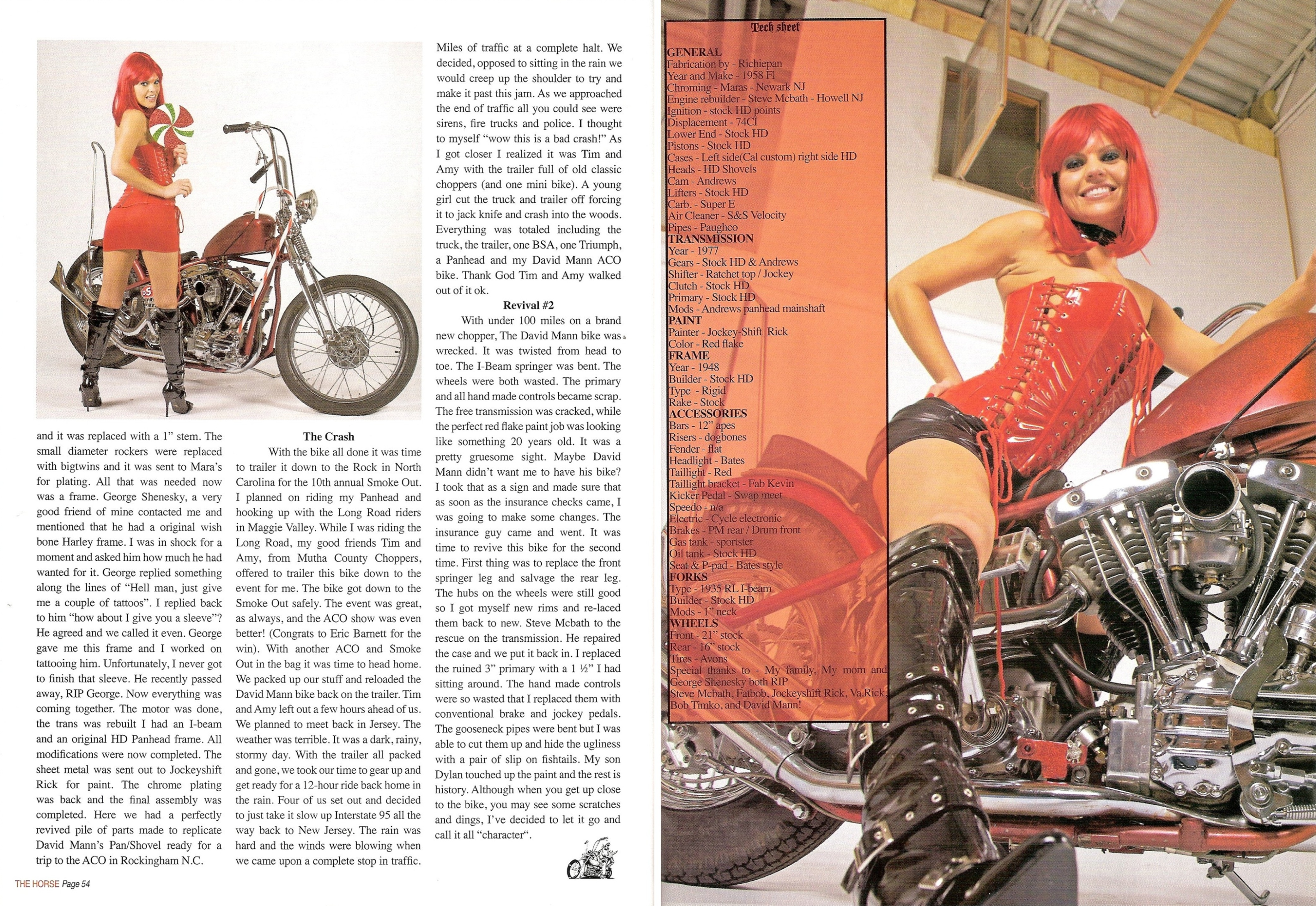
If you’ll excuse me, I’m going to go down another rabbit hole for just a moment, to show you another painstaking replica: the late tattoo artist Richiepan’s reproduction of Dave Mann’s own red rigid-framed shovelhead, as pictured below.

Crazy Dave’s Broad-Slide, AKA Slip-Slidin’ Away or Brodie! above. Dave often appeared in his own artwork. This image is particularly prized by fans because it features his shovelhead in action, showin’ class in front of a joint named ‘The Shores’, not far from where Dave and Jacquie lived. Below is Richiepan’s tribute bike.
Richiepan’s tribute bike in its prime.
Richiepan with his tribute to Dave Mann, prior to the disaster.
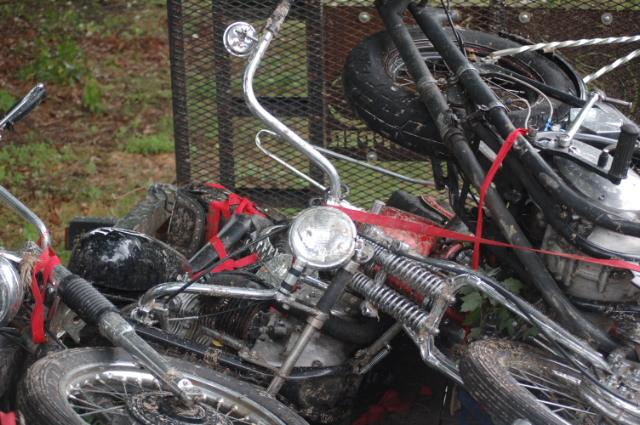
The Dave Mann tribute bike, and several others, after the trailer broke loose from the truck.
Oh, the humanity!

Here’s a write-up on Richiepan’s build from the December 2009 issue of The Horse/Backstreet Choppers:

Further down the rabbit hole: a documentary about Richiepan, shared from The Vintagent’s tribute to Richiepan.

OUT OF THE RABBIT HOLE AND BACK ON TOPIC:

Dave captured the club life of the Sixties….

My Old Gang (May 1979) depicts a number of Mann’s brothers in the El Forastero Motorcycle Club. Per David’s Facebook page (link at bottom of column) they are, from left: Tom Fugle, Greycat, Tiny, Skip Taylor and Dan Jungroth. They are often featured in Mann’s other paintings, as well.

….the custom bike movement of the Seventies….

Florida Freeway, October 1973

….the Eighties….

Family, August 1986

….the Nineties….

Cruisin’ Colorado, August 1998

….and into the new century.

Mondo, June 2001, is Mondo Parra of Denver’s Choppers, a respected custom builder from a long-lived, well known and historic chopper shop.

He gave us the prophetically named Last Call….

Last Call, painted shortly before he retired, appeared in BIKER June 2003

….and a glimpse into the future, come what may.

Future Riders appeared in BIKER October, 1999

Unlike Vincent van Gogh, David Mann didn’t have to die to become well-known. He had the satisfaction of knowing his talents were appreciated. There were frequent letters to the editors, lauding his works. Poster prints of his most popular paintings sold like hotcakes. Then there was the large-format book of his work released in 1987, which quickly sold out and is now highly collectible. Even the cheapie reprints Paisano Publications released in 2016 and 2017 are going for stupid money on eBay.

There’s the 1987 original, a gift from my best road dog, and the 2016 reprint. Same artwork and pretty good printing, but thinner, cheaper paper. The publisher released four of these, gathering artwork from all the publications David Mann painted for – Easyriders, Iron Horse, Biker, American Rodder, et cetera – and packaged them to make a quick buck off the now deceased artist. My understanding is that David’s widow, Jacquie, never saw a dime of that money. Not cool! 😡

Then there are the tattoos: so, so many tattoos! I mean, bikers like tattoos anyway, but they really like tattoos of Dave Mann’s art! Just Google ‘David Mann tattoos‘ and see what comes up. 😮

David Mann tattoos ~ at left by Chad Ramsey of Illinois Tattoo Company in Bloomington, Illinois, and at right by Cale Turpen at Geek Ink Tattoo in Tulsa, Oklahoma. If I were still getting inked, I’d want one of these guys to do the work!

Finally, there was this tribute to David Mann from the pages of Easyriders; just a biographical sketch and a heartfelt appreciation of the still-living artist. I can’t recall what issue it was in and the interwebs are keeping stum about it. I’ll add the date of publication ASAP, if I ever find it.

‘ART IS ETERNAL, FOR IT REVEALS THE INNER LANDSCAPE, WHICH IS THE SOUL OF MAN’

As noted at the top of this page, artists have the power to move us with their words, their images, their sculpture and dance and film – to limn the ‘inner landscape’ of absolute strangers – and David Mann had that ability, in spades!

HEARTBREAKING….

So many incredible paintings, but one of the images that most touches me is this one, depicting a rider on his rigid shovelhead; the biker and bike from Ghost Rider, sans SS lightning bolts and ethereal cowboy. This time, the biker is alone in the desert hills, but the shadows on the rock behind him tell us he’s missing his woman, wishing she were still packing behind him for the long ride, tucked in behind him where she belongs. The tattoo on his arm and the title – In Memory Of… – suggest that she is not just out of his life, but altogether gone from this world. So much emotion and history packed into one small frame!

Thankfully, I’ve never lost a lover to death, but I have lost brothers, friends and kinfolk, and I do know the ache of yearning for something you once had, and will never have again.

In Memory Of…, appeared in the August 1999 issue of BIKER. As noted below, it was painted with magazine staffer Clean Dean in mind. Dean had recently lost his wife to cancer, and Dave thoughtfully used Dean and Karen as models for the shadow figure on the rock wall.

Finally, another look at the artist himself, seated on his beloved shovelhead.

Here’s the Mann himself in happier days, with the shovelhead that inspired Richiepan’s replica. He is pictured with his brother ‘Wild Bill’ and friend Squirrel.

DAVID WILLIAM MANN, September 10th, 1940 to September 11th, 2004. R.I.P.

Recognition of a Great Mann
This tribute appeared in Easyriders January 2005, part I
This tribute appeared in Easyriders January 2005, part II

Paintings © David Mann, found at https://www.facebook.com/davidmannstore, and

Shawn Dickinson, found at https://www.facebook.com/profile.php?id=100063485559855

A great appreciation of Dave Mann by Mr. Timothy Schmitt appears at http://churchofchoppers.blogspot.com/2008/04/by-tim-schmitt-inside-artists-studio-on.html