
Sonny Barger joined the Hells Angels Motorcycle Club the same year I was born, and was still a member in good standing when he passed away on June 29th, 2022. That’s one long career!
Myself, I never met the man – to the best of my knowledge I never met any member of his club – but Barger was still a big influence in my life. He features prominently in Hunter S. Thompson’s Hell’s Angels: The Strange and Terrible Saga of the Outlaw Motorcycle Gangs (Random House, 1967) and parts of Tom Wolfe’s The Electric Kool-Aid Acid Test (Farrar Straus Giroux, 1968), and my nascent view of what it meant to be a motorcyclist – the life path I’d already chosen for myself – was informed by Barger’s and his brothers’ exploits. Not for me the ‘nicest people on a Honda’ as the infamous mid-’60s advert suggested. I would be a biker….
….and that’s what I did.
HELLS ANGELS ATTACH ANTIWAR PROTESTERS, AND SONNY LEARNS HOW TO USE THE PRESS
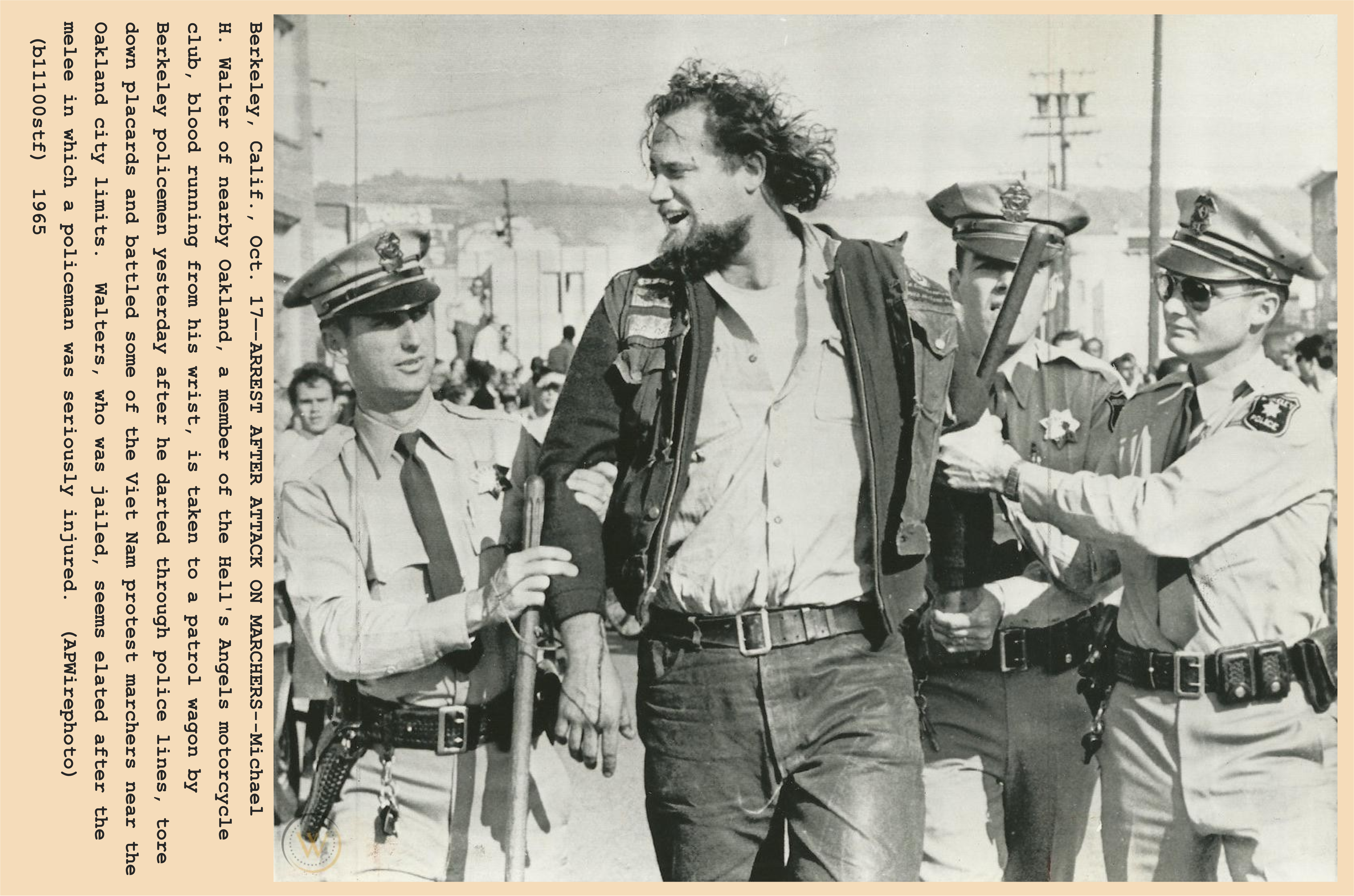
Aside from Evel Knievel, who was much more masochist than motorcyclist, Sonny Barger is assuredly the most famous biker in the world, and was in the news numerous times throughout his tenure. For example, after members of the Oakland chapter of the Hells Angels, which Sonny served as President, broke up an antiwar demonstration in October, 1965, Sonny held a press conference in which he foreswore violence against future protests because ‘Any physical encounter would only produce sympathy for this mob of traitors.’ He also read a telegram he’d sent then-President Lyndon Johnson, volunteering his club brothers for ‘behind the line duty in Vietnam’ as ‘a crack group of trained gorillas [sic]’ who would ‘demoralize the Vietcong and advance the cause of freedom.’

ALTAMONT FREE CONCERT, DECEMBER 6th, 1969
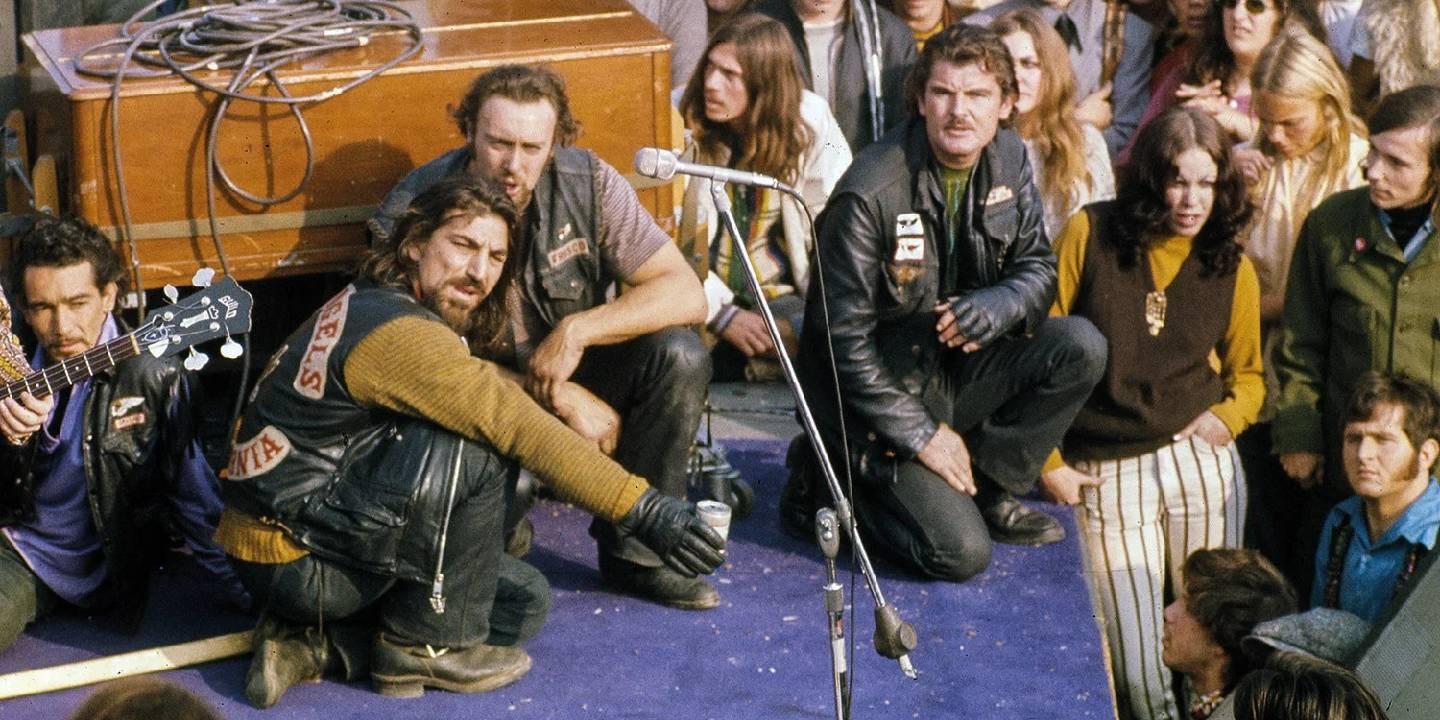
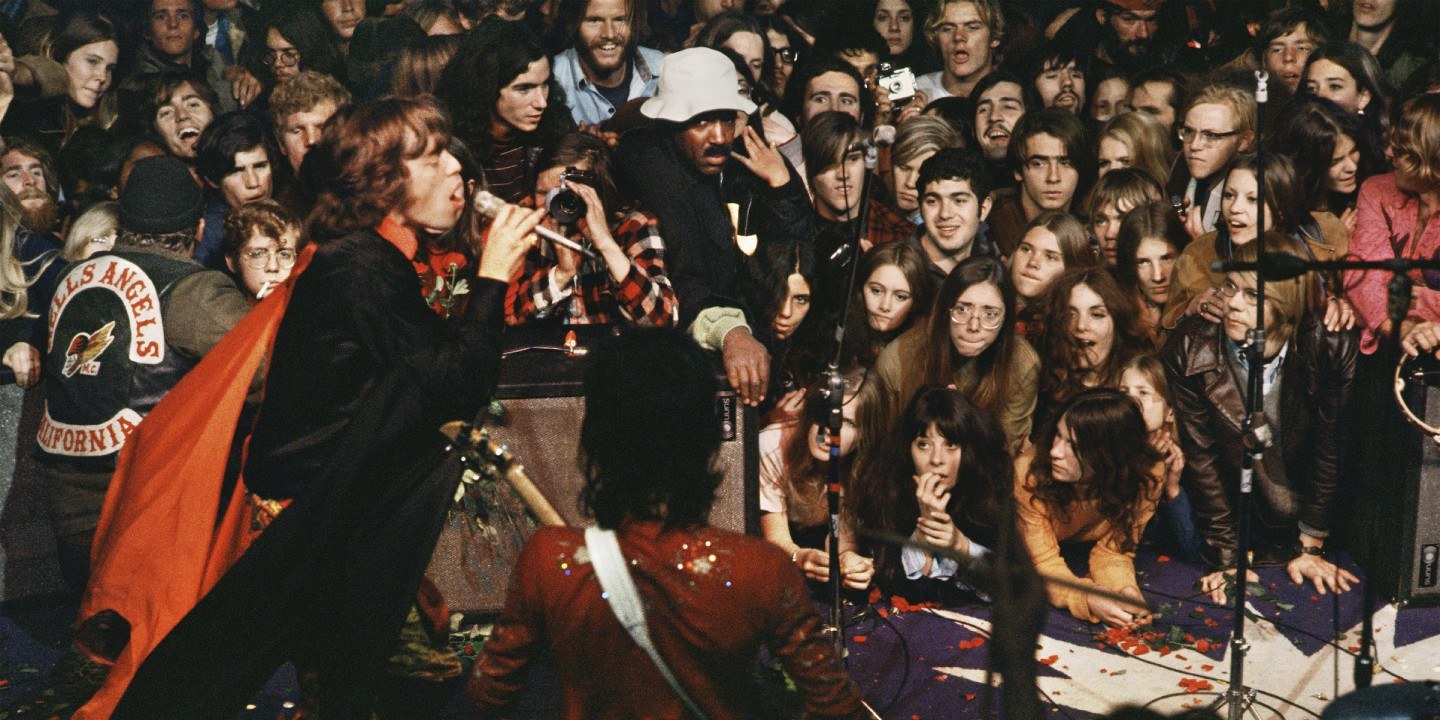
Sonny was also the voice of the Hells Angels after the disastrous Altamont Speedway concert in December, 1969, which resulted in the stabbing death of an eighteen-year-old African American named Meredith Hunter. Although accounts differ as to why they were present, the Angels had been sitting on the front edge of the low-slung stage, acting as a human barrier between the crowd and the performers. Hunter, who had been tossed off the stage by Hells Angels during a previous altercation, returned with a handgun and began waving it around, firing at least one shot into the crowd. Hells Angel member Alan Passaro stabbed and disarmed Hunter, who later died of his wounds.
The next morning, as the talking heads on local radio station KSAN attempted to unravel the chaotic stream of events, Sonny Barger called in and gave his club’s side of the story – the only official statement the club ever offered about the concert or the killing. Barger defended his patch holders, telling radio host Stefan Ponek ‘You can say anything you want and you can call them people flower children and this and that, and there was three hundred thousand people there approximately or whatever they say, and I guarantee you that the largest majority of them were there to have a good time, but there was a couple thousand of them that was there looking for trouble.’

Brushing aside the host’s attempt to cut in, Barger went on to say ‘Some of them people out there ain’t a bit better than what some of the people think of the worst of us, man, and it’s about time they realized it….’

The incident at Altamont and Barger’s telephone call to the radio station were captured on film by documentarians Albert and David Maysles and Charlotte Zwerin, and the resulting movie, Gimme Shelter, was released in 1970. One week after its premiere Hells Angel Alan Passaro went on trial, charged with murdering Meredith Hunter. However, when the film was played in court, it clearly showed Passaro acting in defense of self and third parties, and he was acquitted of all charges.

It annoys the fuck out of me when I hear people claim ‘those mean ol’ Hells Angels murdered poor li’l Meredith Hunter.’ 🤬 So far as I’m concerned, Alan Passaro deserved a medal for valor for going up against a wild-eyed gunman, armed with nothing but a knife and brass cojones. His bravery protected his brothers, the performers and stagehands, and every innocent concertgoer in that crowd who could have been wounded or killed by Hunter’s reckless gunplay.
Instead, because he was one of ‘those mean ol’ Hells Angels,’ Passaro was indicted on a charge of murder. However, when the jury say these scenes from the documentary, they voted (quite properly, IMO, to acquit Alan Passaro.
In 1985 Passaro died in a drowning police considered ‘suspicious’ (although no foul play was ever confirmed) but rumors that a second, unidentified assailant may have been involved in Hunter’s death kept the Altamont case open until 2005. In May of that year, the Alameda County Sheriff’s Office dismissed the theory that a second Hells Angel member took part in the fatal scuffle.
HOLLYWOOD CALLS….

Given the Hells Angels’ hard-won reputation as thuggish brutes prone to violence and lawlessness, Barger was preternaturally media savvy – an excellent spokesman for his club and a wily self-promoter. He finagled parts for himself and other Angels in a couple of biker films – Hells Angels on Wheels with Adam Roarke and future Easy Rider star Jack Nicholson, and Hells Angels ’69, starring ’60s heartthrob Jeremy Slate, who later played the biker gang leader in The Born Losers.

….BUT SO DO THE COPS
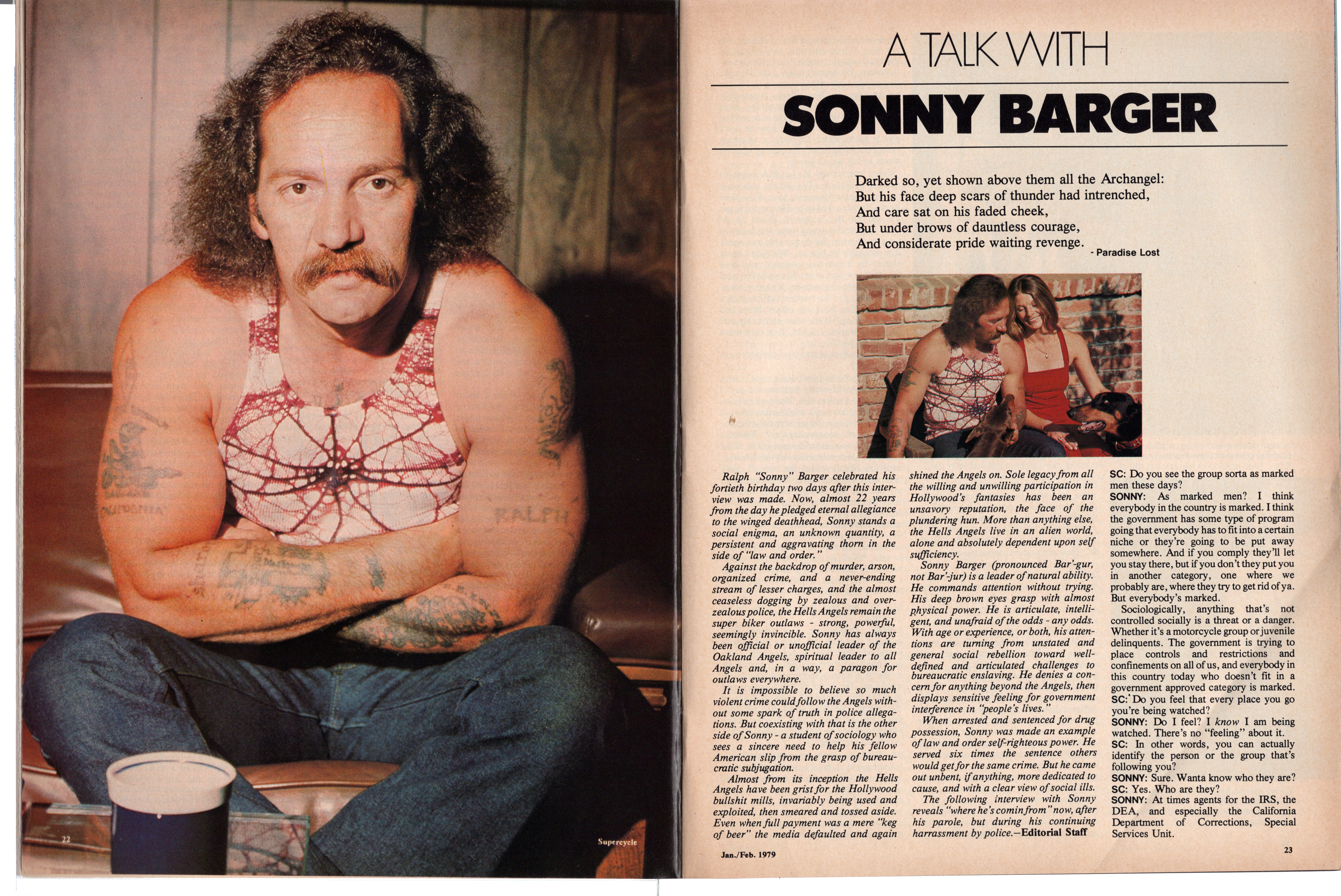
Barger was also in the headlines for numerous arrests on charges ranging from drugs and weapons charges to conspiracy and murder, and, while acquitted of the more serious charges, still spent several years in prison. During this time he gave several interviews to motorcycle magazines, including two for Supercycle, published in February and December, 1979.

SONNY BECOMES AN AUTHOR
During these years, and despite his numerous legal woes, Sonny discovered that he was a marketable commodity. The ‘Free Sonny’ t-shirts his wife sold during his incarceration were wildly popular, and other merchandise soon followed, but he really hit the jackpot when he teamed up with writers Keith and Kent Zimmerman and penned his memoir, Hell’s Angel: The Life and Times of Sonny Barger and the Hell’s Angels Motorcycle Club (William Morrow, 2000).
The book quickly became a best-seller, so he followed up with two biker-themed crime novels also co-authored by the Zimmerman Brothers – Dead in 5 Heartbeats and 6 Chambers, 1 Bullet (William Morrow, 2004 and 2006). He released a collection of road tales titled Ridin’ High, Livin’ Free: Hell-Raising Motorcycle Stories (William Morrow, 2003) and Freedom: Credos from the Road (William Morrow, 2005). Finally, with Darwin Holstrom, he co-authored Let’s Ride: Sonny Barger’s Guide to Motorcycling (William Morrow, 2010) in which he dissed American motorcycle manufacturer Harley-Davidson, for decades the only motorcycle Hells Angels were permitted to ride. In what can only be seen as heresy by those loyal to the brand, Barger wrote:
In terms of pure workmanship, personally, I don’t like Harleys. I ride them because I’m in the club, and that’s the image, but if I could I would seriously consider riding a Honda ST1100 or a BMW. We really missed the boat by not switching over to the Japanese models when they began building bigger bikes. I’ll usually say “Fuck Harley-Davidson.”
Sonny Barger
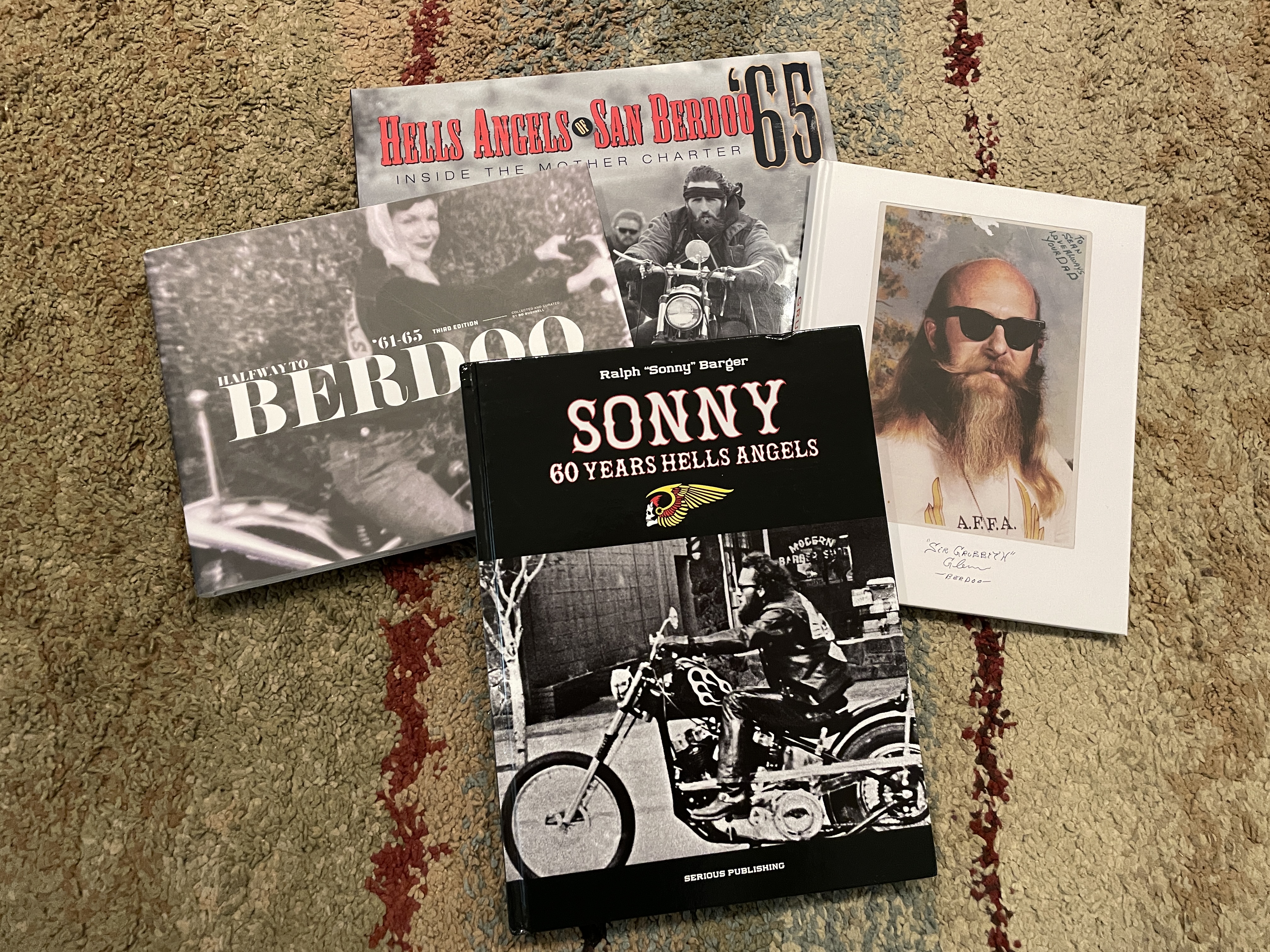
Sonny’s final contribution to the literature of motorcycling seems to be his massive scrapbook-styled tome, Sonny: 60 Years Hells Angels, published by the French imprint Serious Publishing in 2017. Copies are currently listed on Amazon at $357 USD! 😳 I swear, I did not pay even a fifth of that for my copy! 😎
Anyway, here is the first of the two 1979 interviews:
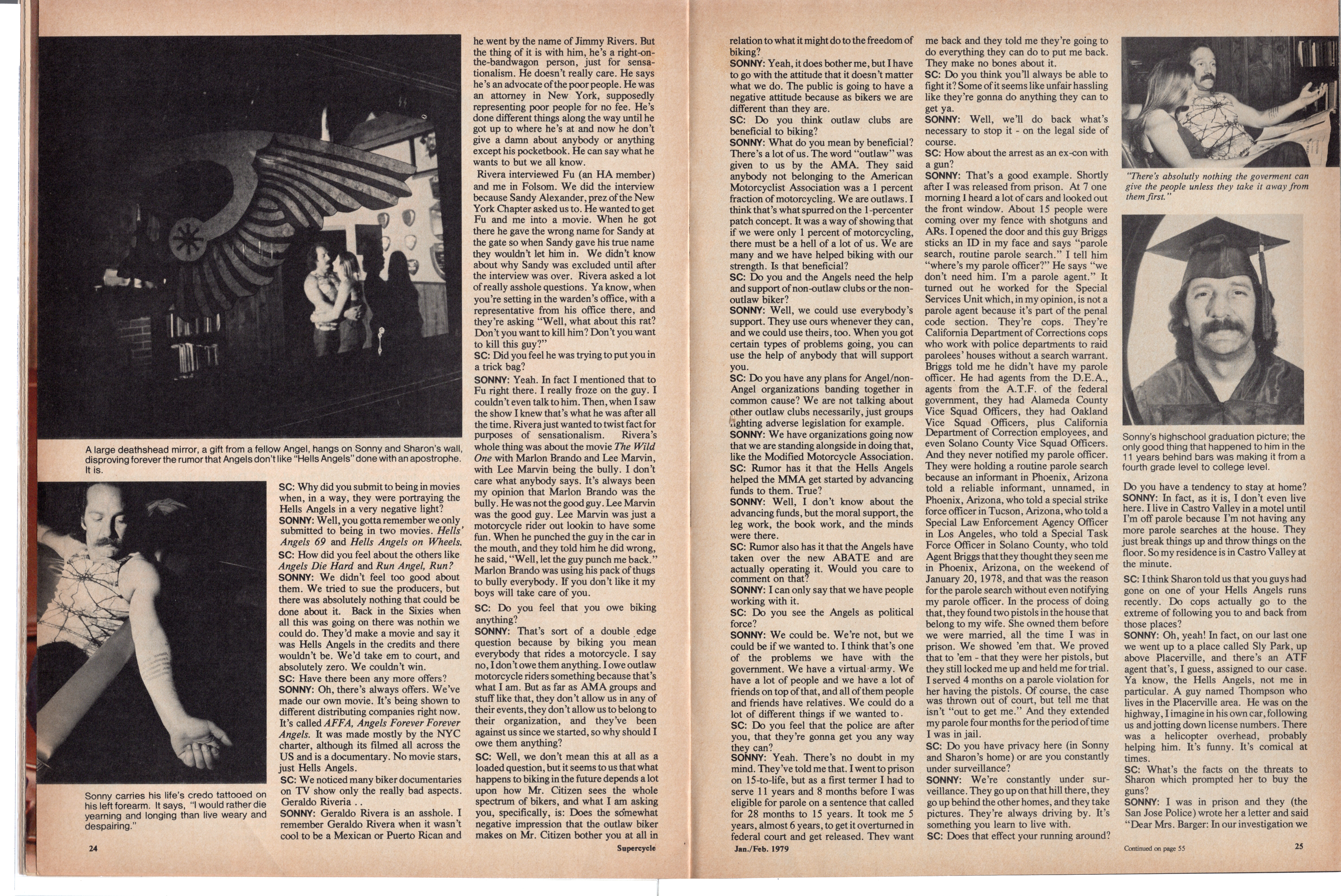
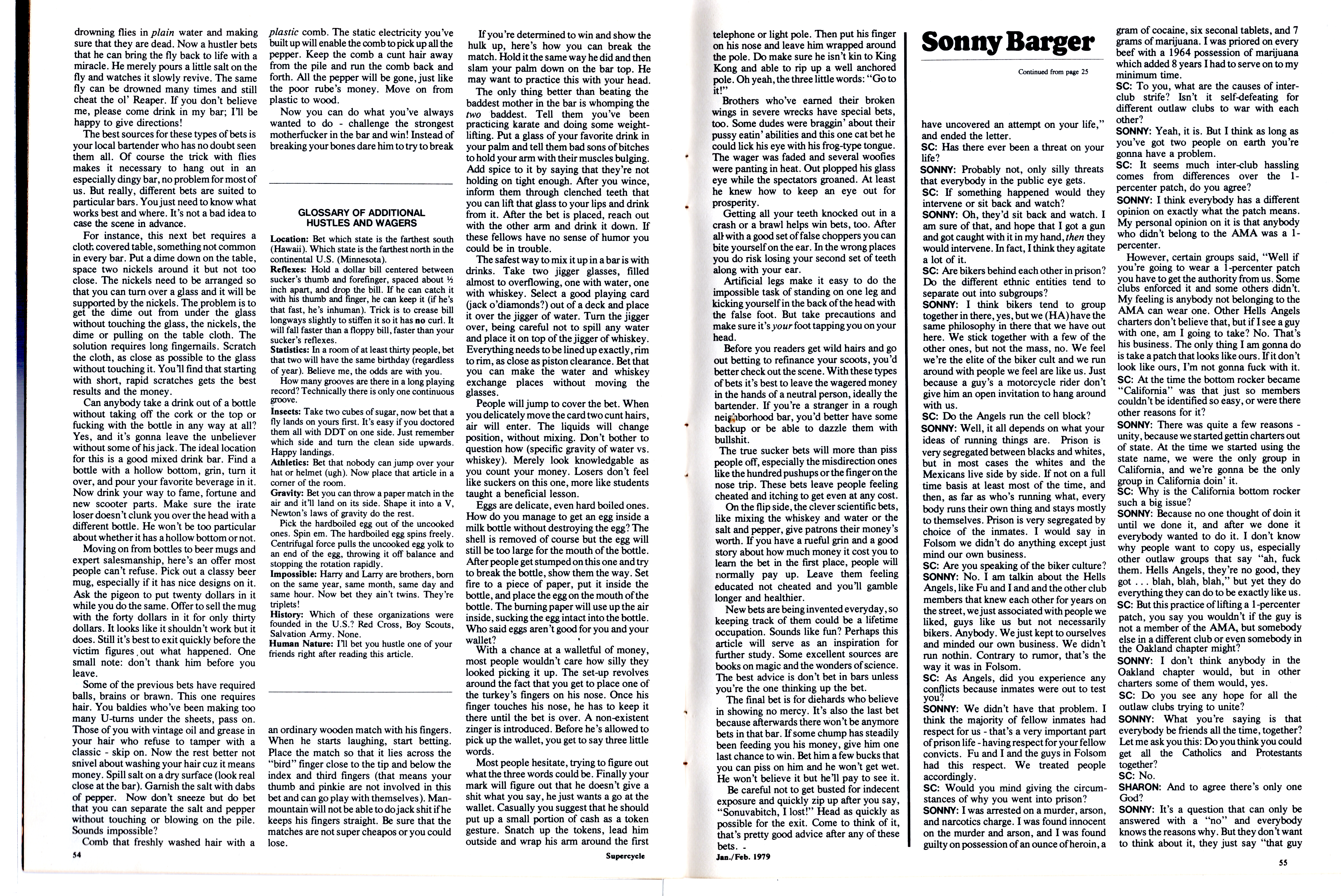
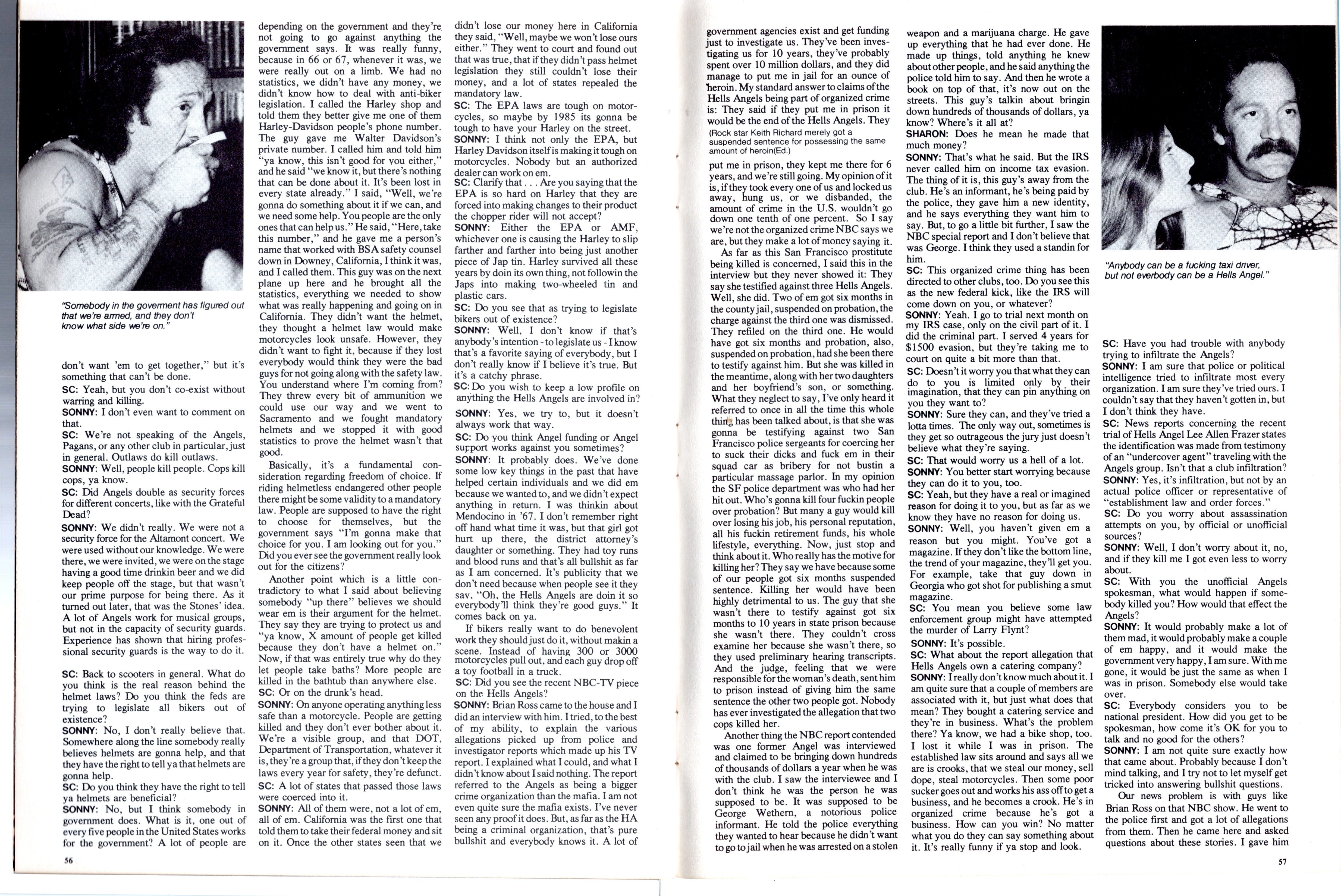
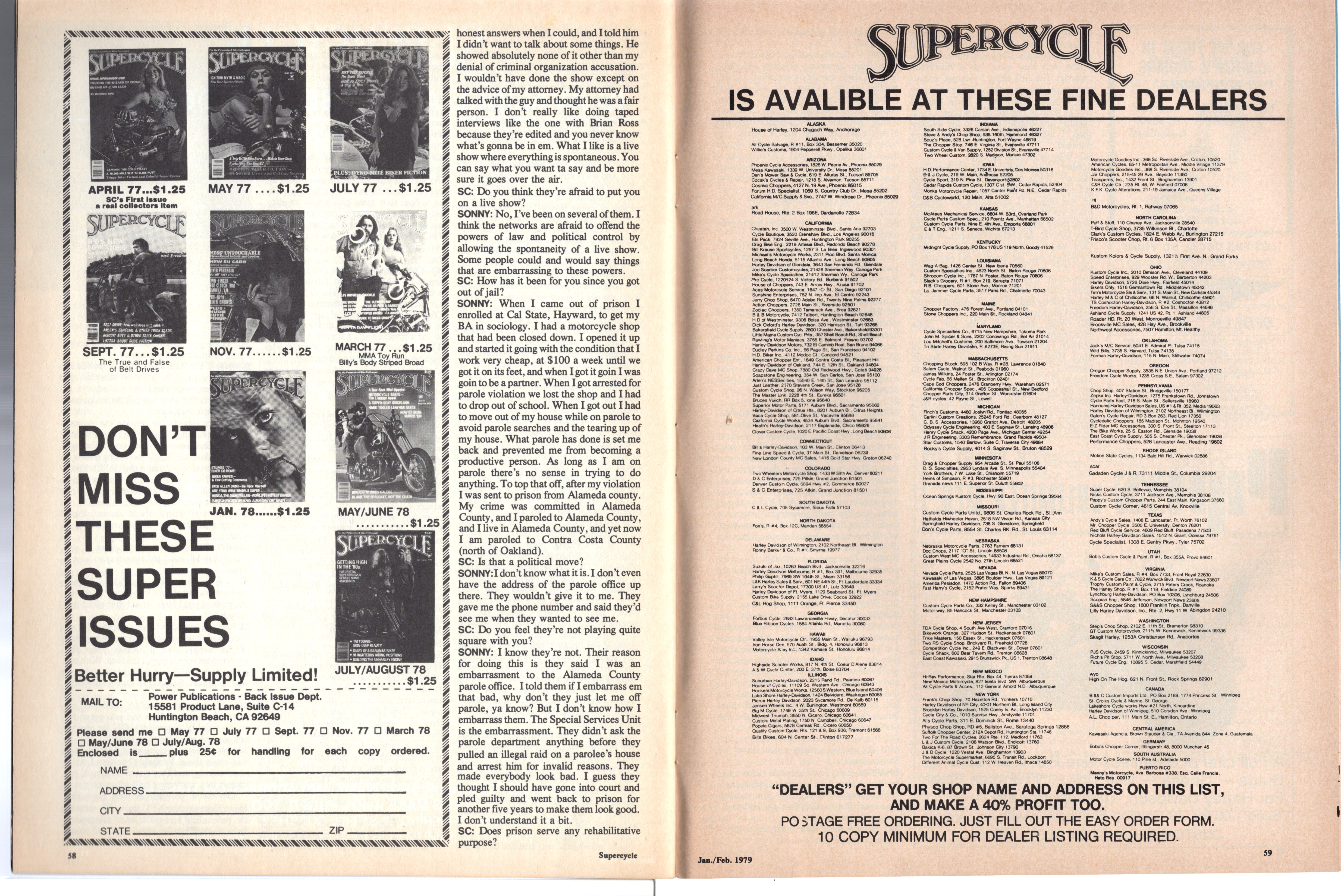
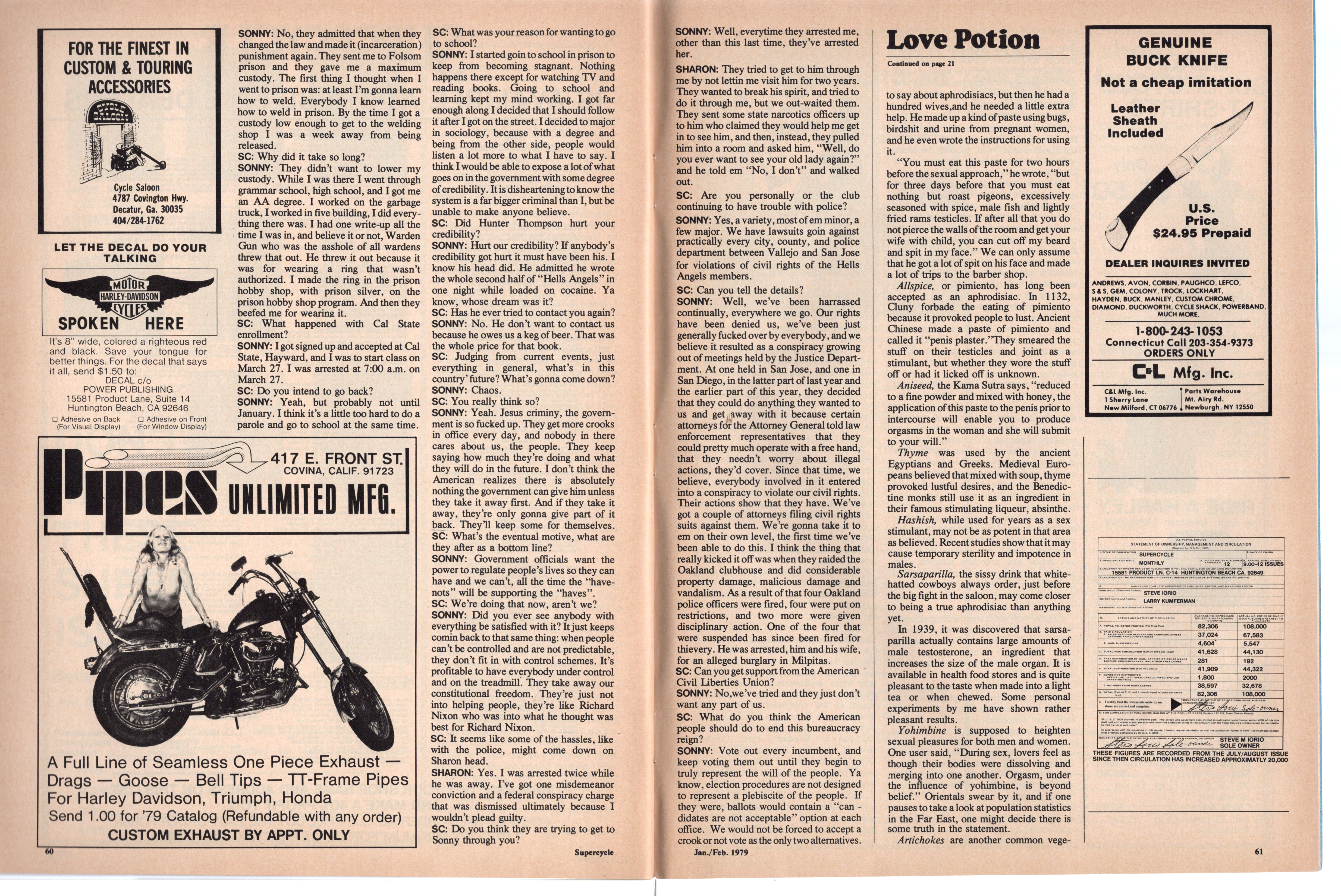
If enough folks are interested, I’ll post the second interview soon, along with some other articles about this and other clubs.
AS NOTED ABOVE: I am not associated with the Hells Angels Motorcycle Club (or any other club) and am only posting these images and this information in the interest of preserving and sharing the collective culture and history of the motorcycling world for historians and bikers like me, who are fascinated by it all. Sláinte!
 The Shovel Shop
Can you post some more pictures from the 1979 feb. of Supercycle? There is a picture of my dad in that magazine but I lost the copy I owned.
D, I apologize. I just this moment saw your message. It was pending my approval, but WordPress didn’t notify me about it. Purely chance that I saw it this evening.
Anyhoo, I’ll be glad to post those. Do you recall the page number or what the article was about? Let me know and I’ll get them out for you ASAP.